
Hot Springs City Zoning Code
ARTICLE XI
- OFF-STREET PARKING AND LOADING
16-2-11.1. - General requirements.
(a)
Existing parking facilities. Existing off-street parking and loading areas that do not conform to the requirements of this Code, but were in conformance with the requirements of this Code at the time the parking or loading facilities were established, are permitted to continue.
(b)
Completion of off-street parking facilities. All off-street vehicle and bicycle parking and loading facilities must be completed prior to the issuance of the certificate of occupancy for the use.
(c)
Use of parking facilities (lots and structures).
(1)
The sale, repair, or dismantling or servicing of any vehicles, equipment, materials, or supplies is prohibited.
(2)
The property owner is responsible for ensuring that parking and loading facilities are only used by residents, tenants, employees, visitors, and/or other authorized persons.
(d)
Seasonal parking. Any area, lot, or parcel designated as a seasonal parking lot must met the requirements for seasonal parking lots as established by the city code and required permit.
(e)
Code requirements. All parking spaces must meet all Code standards.
(Ord. No. 6513, § 1(Exh. A), 11-19-24)
16-2-11.2. - Vehicle and bicycle parking spaces.
(a)
Minimum vehicle parking required.
(1)
Only residential uses within the residential districts (as listed in article IV) are required to provide off-street parking in accordance with Table 11-1: Minimum Vehicle Spaces for Residential Uses in Residential Districts. Residential uses within the residential districts may be subject to parking maximums and required bicycle spaces in accordance with Table 11-3: Off-Street Parking Maximums and Minimum Bicycle Parking Requirements.
(2)
With the exception of such residential uses within the residential districts, the provision of off-street parking is not required.
(b)
Maximum vehicle parking spaces.
(1)
When off-street vehicle parking is provided, Table 11-3: Off-Street Parking Maximums and Minimum Bicycle Parking Requirements applies, which limits the maximum number of off-street parking spaces that can be provided for certain uses.
(2)
Certain uses in Table 11-3 are not subject to parking maximums.
(3)
Spaces reserved for the following are not included in calculating parking maximums:
a.
Accessible parking spaces in compliance with Americans with Disabilities Act (ADA) standards.
b.
Electric vehicle spaces do not count toward parking maximums.
c.
The following pick-up/drop-off spaces, which must be marked as reserved:
1.
Ride-hailing service vehicles.
2.
Delivery driver vehicles.
3.
Spaces for exchange of goods.
(4)
The following districts are exempt from the vehicle parking maximums:
a.
Industrial Districts.
b.
AFC District.
c.
INST District.
(c)
Required bicycle parking spaces.
(1)
When off-street vehicle parking is provided, Table 11-3: Off-Street Parking Maximums and Minimum Bicycle Parking Requirements applies, which requires those certain uses to provide bicycle parking spaces. Bicycle parking spaces are required only for new construction as of the March 1, 2025 effective date of this Code.
(2)
In all cases where bicycle parking is required, a minimum of two bicycle spaces is required.
(3)
Where bicycle parking space requirements indicate a threshold, such as "Over 10,000 sf GFA," this means that bicycle spaces are required only for structures over a certain gross floor area. Bicycle parking space requirements are then calculated on the basis of the entire gross floor area.
(4)
In no case are more than 20 bicycle parking spaces required to be provided. Additional spaces over 20 may be provided at the property owner's option.
(d)
Calculation of maximum vehicle parking and minimum bicycle parking.
(1)
The maximum number of required parking spaces and the minimum number of bicycle spaces is calculated by the principal use of the lot. When more than one use occupies the same lot, the number of required spaces is the sum of the separate requirements for each use, unless such use is a multi-tenant retail center, which has a separate requirement per [subsection] (2) below. The following standards for computation apply:
a.
When calculating the number of required off-street spaces results in a fractional requirement of 0.5 spaces or more, said fraction is rounded up.
b.
In places of assembly in which patrons or spectators occupy benches, pews, or similar seating facilities, each 24 inches of such seating facility is counted as one seat for the purpose of determining the requirement for off-street parking facilities. Floor area of a prayer hall is counted as one seat per marked prayer mat space or one seat for every six square feet in the prayer hall if prayer mat spaces are not marked.
(2)
Multi-tenant retail centers are subject to the following. A multi-tenant retail center is defined as a group of three or more commercial establishments that is planned, owned, and/or managed as a single property. The two main configurations of multi-tenant retail centers are large shopping centers and strip retail centers.
a.
Maximum parking for multi-tenant retail centers is calculated as one space required per 600 square feet of gross floor area, rather than by the individual uses
b.
Multi-tenant retail centers over 20,000 square feet in gross floor area require one bicycle space per 2,500 square feet of gross floor area.
(e)
Accessible spaces required. All parking facilities must comply with the "ADA Accessibility Guidelines for Buildings and Facilities" regulations issued by federal agencies under the Americans with Disabilities Act (ADA) and State of Arkansas and local requirements for the amount and design of accessible vehicle parking spaces required in parking lots and structures. Table 11-2: Minimum Accessible Spaces provides the required number of accessible spaces. In the case of conflict with federal or state requirements that prescribe the minimum number of accessible spaces, federal and state requirements will control over these requirements.
(Ord. No. 6513, § 1(Exh. A), 11-19-24)
16-2-11.3. - Off-street parking facility design.
When off-street parking lots or structures are provided, such facilities must comply with the following standards.
(1)
Dimensions. Off-street parking spaces and drive aisles within a parking facility must be designed in accordance with the minimum dimensions in Table 11-4: Off-Street Parking Space Minimum Dimensions. Other parking angles other than those described in Table 11-4 are permitted but must be approved by the Planning and Development Director and provide evidence of safe and efficient parking configuration and traffic circulation.
(2)
Access.
a.
All required off-street parking facilities must have vehicular access from a street, driveway, alley, or cross-access connection.
b.
All required off-street parking facilities must have an internal pedestrian circulation system that allows for safe passage between parking areas and any public sidewalk in the adjacent right-of-way and the use it serves. This includes, but is not limited to, interconnected sidewalks, striped walkways, and separated walkways.
c.
All parking facilities must be designed with vehicle egress and ingress points that least interfere with traffic movement. Parking facilities must be designed to allow the driver to proceed forward into traffic, rather than back out; this does not apply to single-family detached and attached and two-family dwellings.
d.
All curb cuts must comply with the regulations of the city code. Townhouse developments are prohibited from constructing individual curb cuts for each dwelling unit along a public street.
e.
All driveways must conform to all applicable City driveway specifications.
f.
Dead end parking lots without a turnaround space are prohibited.
(3)
Surfacing. All parking lots must be paved with all-weather materials such as asphalt, concrete, or brick. Permeable pavement is also permitted. Permeable paving includes any materials installed, operated, and maintained to permit the passage of water through the pavement, including, but not limited to, porous concrete, porous asphalt, permeable interlocking concrete pavers, and concrete grid pavers. Gravel is prohibited.
(4)
Striping. Off-street parking facilities for uses other than single-family detached and attached and two-family dwellings must delineate parking spaces with paint or other permanent materials, which must be maintained in clearly visible condition.
(5)
Curbing and wheel stops.
a.
Curbing and wheel stops are required when a parking space abuts required landscape areas, pedestrian walkways, structures, fences, or the edge of the parking lot along a lot line. Such curbing must be constructed of permanent materials, such as concrete or masonry, a minimum height of six inches above ground level, and permanently affixed to the paved parking area.
b.
Wheel stops within the interior of the parking lot are prohibited.
(6)
Lighting. Parking facility lighting must be in accordance with section 16-2-9.4.
(7)
Location of surface parking.
a.
Residential uses.
1.
Parking spaces must be located to the side or rear of the dwelling and behind the front building line. Parking spaces in the front of the front building line are prohibited.
2.
However, where a single-family detached and attached or two-family dwelling has a driveway that is a minimum of ten feet in width and 35 feet in length, such is deemed two parking spaces for a single-family detached or each unit in a single-family attached or two-family dwelling and may be in front of the front building line.
b.
Nonresidential uses.
1.
Parking spaces in the front of the front building line are prohibited in the following: C-TR, C-N, C-MU, CBD, and I-MU Districts.
2.
The following exceptions apply to [subsection] 1 above:
A.
For structures existing as of the March 1, 2025 effective date of this Code, existing parking located in front of the front building line is allowed and may be expanded.
B.
For lots abutting a state highway, parking is permitted in front of the front building but must be set back a minimum of 20 feet from the lot line or the dimension of the required setback of the district, whichever is greater.
(8)
Parking structure design.
a.
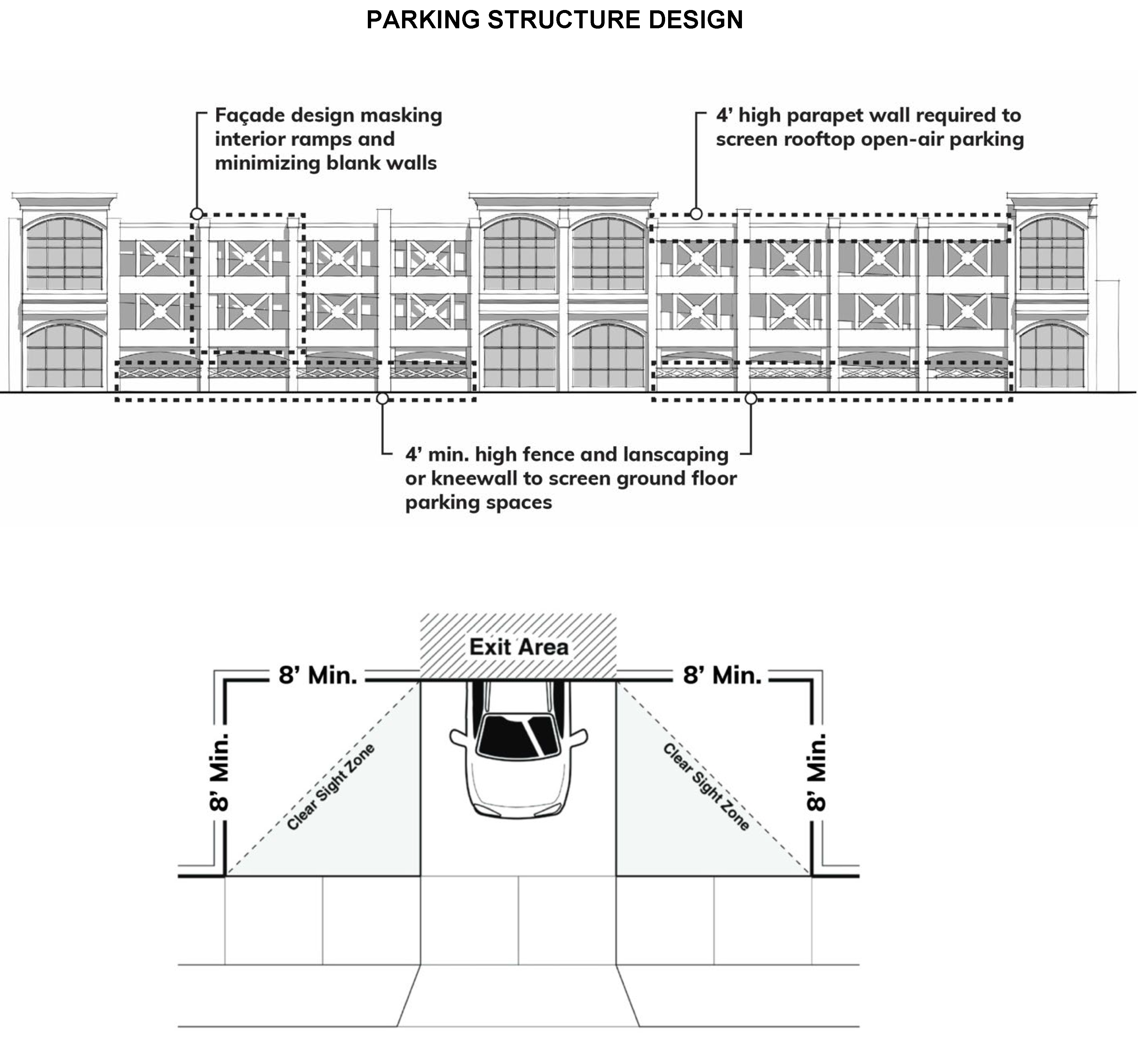
On façades that front on public streets, façade design and screening must mask the interior ramps.
b.
Parking structures must be designed to minimize blank façades through architectural detail and landscape.
c.
On portions of the ground floor façade where parking spaces are visible, a decorative fence and landscape or a kneewall is required to screen parking spaces. Such fence or kneewall must be a minimum of four feet in height.
d.
For parking structures with rooftop open-air parking, a four-foot parapet wall is required for screening.
e.
A vehicular clear sight zone must be included at vehicular exit areas as follows:
1.
The façade of vehicular exit areas must be set back from any pedestrian walkway along that façade a minimum of eight feet for the portion of the façade that includes the vehicle exit area and eight feet on each side of the exit opening.
2.
A sight triangle is defined by drawing a line from the edge of the vehicular exit area to a point on the property line abutting the pedestrian walkway eight feet to the side of the exit lane.
3.
In the sight triangle (bound by the parking structure wall, pedestrian walkway and vehicular exit lane), groundcover, landscape, or decorative wall must be used to act as a buffer between the exit aisle and the pedestrian walkway. Landscape or a decorative wall must not exceed three feet in height in order to maintain driver sightlines to the pedestrian walkway.
4.
The upper story façade(s) of the parking structure may overhang the vehicular clear sight zone.
f.
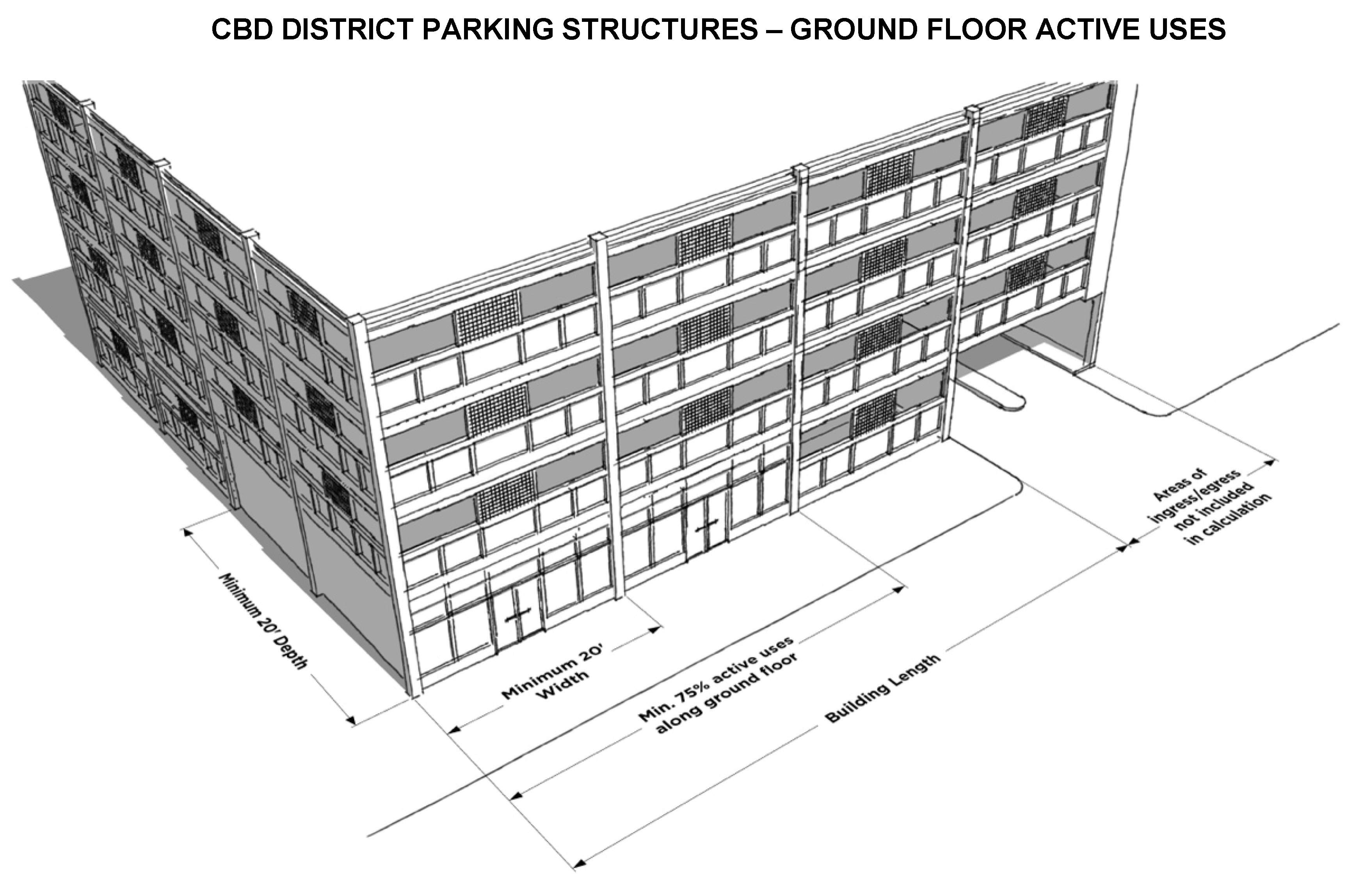
Parking structures in the CBD District must include residential or nonresidential active uses along ground floor designed as follows:
1.
Parking structures must include residential or nonresidential active uses along 75 percent of the ground floor building length along any façade abutting a street. This percentage is calculated as a percentage of the façade length after areas of required vehicular and pedestrian egress and mechanical or electrical equipment rooms are discounted from the façade length.
2.
Nonresidential active use spaces must be a minimum of 20 feet in width and 20 feet in depth.
3.
Nonresidential active use spaces must meet the design standards of the district.
(Ord. No. 6513, § 1(Exh. A), 11-19-24)
16-2-11.4. - Bicycle parking design.
(a)
Required bicycle spaces. When off-street parking facilities are provided, bicycle parking spaces must be provided as indicated in section 16-2-11.2 and Table 11-3.
(b)
Location.
(1)
Bicycle racks must be located on the same zoning lot as the use.
(2)
Bicycle racks must be located such that they are highly visible from the street and/or building entrance with adequate lighting. Bicycle parking must be located in designated areas that minimize pedestrian and vehicular conflicts. Bicycle parking located within an automobile parking area must be clearly designated and located as close to a building entrance as possible.
(3)
Required bicycle parking for residential uses may be provided in garages, storage rooms, and other resident-accessible, secure areas. Spaces within dwelling units or on balconies do not count toward satisfying bicycle parking requirements.
(c)
Design.
(1)
Bicyclists must be able to lock their bicycles to the rack with the rack supporting the bicycle in an upright position.
(2)
Bicycle parking must be provided on an improved hard surface and securely anchored to a supporting surface. Installation of bicycle racks must also conform to the requirements set forth by the bicycle rack manufacturer.
(3)
Bicycle rack must be installed with adequate space beside the parked bicycle so that a bicyclist will be able to reach and operate their locking mechanism.
(d)
Shared bicycle parking facilities Bicycle parking spaces for nonresidential uses may be shared between uses. Bicycle parking spaces must be accessible and clearly visible from all uses. A 20 percent reduction in the sum total number of required bicycle spaces is allowed for shared facilities.
(Ord. No. 6513, § 1(Exh. A), 11-19-24)
16-2-11.5. - Required off-street loading spaces.
(a)
Loading spaces are required as indicated in Table 11-5: Off-Street Loading Requirements. The location, design, and layout of all loading spaces must be indicated on required site plans.
(b)
A loading space shall be a minimum often feet by 45 feet and must have a minimum vertical clearance of 14 feet.
(c)
All off-street loading spaces must be improved with a hard surfaced, all-weather dustless material.
(d)
No part of a loading area utilized for the access, maneuvering and temporary parking of delivery vehicles shall also be used for vehicle parking. No part of a loading area may be utilized for the outdoor storage of materials, merchandise, and equipment.
(e)
Loading spaces must be located and designed that the vehicles intended to use them can maneuver safely and conveniently to and from a public right-of-way, and complete the loading or unloading operations without obstructing or interfering with any public right-of-way or any parking space or parking lot aisles.
(f)
Loading spaces must be located a minimum of 50 feet from any lot line that abuts a residential district.
(g)
Off-street loading spaces must be provided in accordance with Table 11-4. In the case of multi-tenant buildings or mixed-use developments, required loading spaces are calculated on the basis of each individual tenant (for example, if only one nonresidential use tenant of a multi-tenant building is over 10,000 square feet, only one loading space is required; if all tenants are under 10,000 square feet, no loading is required).
(Ord. No. 6513, § 1(Exh. A), 11-19-24)
16-2-11.6. - Commercial vehicle storage.
(a)
Residential lots.
(1)
No commercial vehicle may be parked outdoors on a residential lot with the exception of vehicles engaged in loading or unloading or current work being done to the adjacent premises.
a.
However, this does not include standard size passenger motor vehicles (including, but not limited to, vans, sports utility vehicles (SUVs), standard passenger size livery vehicles, and pick-up trucks), which may be stored or parked outdoors overnight on lots in residential districts.
b.
Permitted standard size passenger commercial vehicles, as described in item a above, also include those owned and used for commercial purposes by the occupant of a dwelling or guest, provided that the vehicle is stored or parked in a permitted parking area. Permitted personal commercial vehicles may include the logo of the commercial business painted on or applied to the vehicle.
(2)
All other commercial vehicles that exceed standard size passenger vehicles, including, but not limited to, semi-truck tractor units, with or without attached trailers, commercial trailers, flatbed trucks, box vans and box trucks, buses, tow trucks, construction vehicles, livery vehicles that exceed standard passenger vehicle size, such as limousines, or other large commercial vehicles, are not permitted to be parked outdoors overnight on a residential lot.
(b)
Nonresidential lots. On nonresidential lots, commercial vehicles with the logo of the commercial business painted on or applied to the vehicle that are being operated and stored in the normal course of business, such as signs located on delivery trucks, promotional vehicles, moving vans, and rental trucks, are permitted to be stored on the lot in areas related to their use as vehicles. All such vehicles must be in operable condition.
(Ord. No. 6513, § 1(Exh. A), 11-19-24)
16-2-11.7. - Recreational vehicle storage.
(a)
No recreational vehicle or trailer licensed to transport recreational vehicles or equipment may be stored outdoors within the front yard except on a driveway and for no more than seven days.
(b)
Recreational vehicles six feet or less in height, height as measured to the highest point of the vehicle, may be stored behind the front building line or in the rear yard.
(c)
Recreational vehicles more than six feet in height, as measured to the highest point of the vehicle, must be stored in the rear yard and located at least five feet from any lot line.
(d)
The area devoted to recreational vehicle storage must be on an all-weather dustless material.
(e)
There is no limit on the storage of recreational vehicles within fully enclosed permanent structures.
(f)
No recreational vehicle may be used for living, sleeping, or housekeeping purposes in any district and may not be hooked up to any public utilities.
(g)
All recreational vehicles must be maintained in mobile condition. No recreational vehicle may be parked or stored in such manner as to create a dangerous or unsafe condition on the lot where it is parked or stored. If the recreational vehicle is parked or stored, whether loaded or not, so that it may tip or roll, it is considered a dangerous and unsafe condition.
(Ord. No. 6513, § 1(Exh. A), 11-19-24)

