
Minturn City Zoning Code
ARTICLE 16
Off-Street Parking and Loading
Sec. 16-16-10.- Standards and administration.
(a)
Purpose and intent. This Article provides minimum standards for the development of parking areas in conjunction with the various uses permitted in this Chapter. The purpose of this Article is to ensure that all land uses are served by an adequate supply of well-planned and well-designed parking, and to ensure that the owner of the land and/or use provides sufficient parking spaces for the land use. The intent of these standards is to require attractive, convenient and efficiently developed parking areas which provide sufficient quantities of parking and loading space with ample area for fire lanes, maneuvering and public safety.
(b)
Applicability. The standards of this Article shall apply to all development, including development of new uses, expansion of existing uses and the change of use of land or structures. All uses shall provide the number of off-street parking spaces as listed in this Article.
(c)
Spaces shown with building permit application. No building permit shall be issued until plans are presented showing the area that will be made available for exclusive use to meet the applicable off-street parking and loading standards. A plan drawn to scale, indicating how the applicable off-street parking and loading standards will be fulfilled, shall accompany an application for a building permit.
(d)
Spaces remain available. Any subsequent use of property for which the building permit is issued shall be conditional upon the unqualified continuance and availability of parking and loading spaces that comply with the standards of this Article. No unauthorized reduction of off-street parking shall be permitted.
(e)
Change of use. Should the owner or occupant of any lot or building change the use to which the lot or building is put, thereby increasing off-street parking and loading requirements, it shall be unlawful and a violation of this Article until such time as the increased off-street parking and loading requirements are complied with.
(Prior code 16-16-1; Ord. 15-2008 §1)
Sec. 16-16-20. - Parking required for residential and lodging uses for all zone districts except for the 100 Block Commercial Zones.
The following Table 16-10 sets forth the parking required for residential and lodging uses:
TABLE 16-10
Residential and Lodging Uses
(Prior code 16-16-2; Ord. 15-2008 §1; Ord. 01-2015 §2; Ord. 13-2023 §2)
Editor's note— Ord. No. 13-2023, § 2, adopted Oct. 4, 2023, amended the title of § 16-16-20 to read as herein set out. The former § 16-16-20 title pertained to parking required for residential and lodging uses.
Sec. 16-16-30. - Parking required for commercial, office and institutional uses for all zone districts except for the 100 Block Commercial Zones.
The following Table 16-11 sets forth the parking required for commercial, office and institutional uses:
TABLE 16-11
Commercial, Office, Places of Worship, School and Medical Facility Uses
(Ord. 1 §1, 2013; Ord. 13-2023 §2)
Editor's note— Ord. No. 13-2023, § 2, adopted Oct. 4, 2023, amended the title of § 16-16-30 to read as herein set out. The former § 16-16-30 title pertained to parking required for commercial, office and institutional uses.
Sec. 16-16-40. - Parking required for light industrial, warehousing and storage facility uses for all zone districts except for the 100 Block Commercial Zones.
The following Table 16-12 sets forth the parking required for light industrial, warehousing and storage facility uses:
TABLE 16-12
Light Industrial, Warehousing and Storage Facility Uses
(Prior code 16-16-4; Ord. 15-2008 §1; Ord. 13-2023 §2)
Editor's note— Ord. No. 13-2023, § 2, adopted Oct. 4, 2023, amended the title of § 16-16-40 to read as herein set out. The former § 16-16-40 title pertained to parking required for light industrial, warehousing and storage facility uses.
_____
Sec. 16-16-50. - Determination of parking for uses not listed.
(a)
Requirements for types of buildings and uses not specifically listed in this Article shall be determined by the Planning Director after study and recommendation which should include all relevant factors, including but not limited to:
(1)
Appropriate parking studies, including vehicle occupancy studies, at the cost of the applicant;
(2)
Comparable requirements from other similar municipalities;
(3)
Requirements of comparable uses listed in this Article;
(4)
Suitable and adequate means exist for provision of public, community, group or common facilities; and
(5)
Provision of adequate loading facilities and for a system for distribution and pickup of goods.
(b)
The applicant may appeal the Planning Director's decision to the Town Council as per the provisions of this Chapter.
(Prior code 16-16-5; Ord. 15-2008 §1)
Sec. 16-16-60. - Main Street (Highway 24) parking.
For any business located in a commercial zone in the Old Town Character Area, off-site parking on Main Street (Highway 24) may be counted toward the required number of parking spaces, provided that the off-site parking shall not exceed six (6) spaces nor shall off-site parking exceed fifty percent (50%) of the total required parking, whichever is less. Off-site parking for multiple businesses on a single property on Main Street (Highway 24) shall be determined by the length of business frontage for each individual business that borders Main Street (Highway 24). Off-site parking for an individual business on a single property shall be determined by the length of the property frontage that borders Main Street (Highway 24).
(Prior code 16-16-6)
Sec. 16-16-70. - Supplemental parking and loading standards.
(a)
Parking requirements for two (2) or more uses: The off-street parking space required for two (2) or more uses is the combined total of parking spaces required by this Article for both or all uses unless it can be demonstrated to the Planning Director that joint parking arrangements are acceptable.
(b)
Handicapped parking. Any use requiring handicapped access, as defined in the International Building Code adopted by the Town, and having fifteen (15) or more parking spaces, shall provide one (1) of every fifteen (15) spaces for use only by physically handicapped persons.
(c)
Compact car spaces (spaces allowed). Compact parking shall be allowed to account for no greater than thirty percent (30%) of required parking spaces.
(d)
Off-street loading requirements. These standards apply only to residential, commercial and industrial developments where off-street loading berths are required. The following standards shall be used in establishing the minimum number of off-street loading berths required:
(Prior code 16-17-6; Ord. 15-2008 §1)
Sec. 16-16-80. - Measurement of floor area to determine parking spaces required.
(a)
Floor areas used in calculating the required number of parking spaces shall be gross floor areas of the building calculated from outside wall.
(b)
In mixed-use facilities:
(1)
Calculations shall be based on the gross square footage of each identifiable use within the building; and
(2)
Parking shall be calculated by the area of each individual use, not common areas.
(c)
The total square footage of each identifiable use shall be the same as the gross floor area calculated from outside wall to outside wall.
(Prior code 16-16-8)
Sec. 16-16-90. - Clear-vision area requirements.
A clear vision area shall be maintained on the corners of all property at the intersection of two (2) streets or a street and a railroad. A clear vision area shall contain no planting, fence, wall, structure or temporary or permanent obstruction exceeding two and one-half (2½) feet in height, measured from the top of the curb or, where no curb exists, from the established street centerline grade, except that trees exceeding this height may be located in this area, provided that all branches and foliage are removed to a height of eight (8) feet above the grade. A clear vision area may also be identified in these regulations as an "intersection clear zone" or as a "sight triangle" at intersections.
(1)
Clear vision area; measurement. A clear vision area shall consist of a triangular area, two (2) sides of which are lot lines measured from the corner intersection of the street lot lines for a distance specified in this regulation or, where the lot lines have rounded corners, the lot lines extended in a straight line to a point of intersection and so measured, and the third side of which is a line across the corner of the lot joining the non-intersection ends of the other two (2) sides. The following measurements shall establish clear-vision areas:
a.
In a residential zone, the minimum distance shall be fifteen (15) feet or, at intersections including an alley, ten (10) feet.
b.
In all other zones, where front and side yards adjacent to streets are required, the minimum distance shall be fifteen (15) feet or, at intersections including an alley, ten (10) feet; except when the angle of intersection between streets, other than an alley, is less than thirty (30) degrees, the distance shall be twenty-five (25) feet.
(2)
Clear vision area; driveways. Driveways shall have a minimum clear vision area formed by the intersection of the driveway centerline, the street right-of-way line and a straight line joining said lines through points twenty (20) feet from their intersection.
(3)
Fences may exceed the maximum clear vision height up to four (4) feet if they do not obscure sight by more than ten percent (10%) (i.e. a split rail fence).
(Prior code 16-16-9; Ord. 01-2015 §2)
Sec. 16-16-100. - General standards for parking and loading areas.
(a)
Pedestrian circulation. Safe and efficient pedestrian circulation paths shall be provided between required parking areas and the entry to the buildings on the site. As applicable, pedestrian circulation paths on the site shall also be connected to paths on adjacent sites.
(b)
Prohibited uses of required spaces. Required parking spaces shall be available only for the parking of operable passenger automobiles of residents, guests, customers, patrons and employees of the use for which they are required. Prohibited uses of required parking spaces shall be as follows:
(1)
Inoperable vehicles or materials. Inoperable vehicles or materials shall not be stored in required parking spaces.
(2)
Delivery vehicles. Delivery vehicles or trucks used in conducting the business or use shall not be parked in required parking spaces during business hours, but may be parked in such spaces overnight.
(3)
Vehicles for sale. Vehicles shall not be displayed for sale in any parking area required for nonresidential use, except for the temporary display of a vehicle by its owner when the owner is an employee or customer using the premises.
(4)
Repair work. Repair work shall not be conducted in any parking area required for a nonresidential use if the repairs render a vehicle inoperable for periods of more than twenty-four (24) hours.
(5)
Commercial vehicles on residential property. Commercial vehicles or heavy equipment used in a business operation shall not be parked in required parking spaces for residential use unless the commercial vehicle is used for a permitted home occupation or is a company vehicle used for commuting that is parked overnight.
(Prior code 16-16-10)
Sec. 16-16-110. - Location of required parking spaces.
Required off-street parking spaces shall be located as follows:
(1)
On the same lot. On the same lot as the structure the spaces are intended to serve.
(2)
Within a common assigned parking area. Within a common assigned parking area under the ownership or lease of the individual owners of the use the spaces are intended to serve.
(3)
Joint use of parking. Joint use of facilities is permitted when owners of two (2) or more uses, structures or parcels of land may agree to utilize the same parking and loading spaces when the hours of operation do not overlap, provided that satisfactory evidence is presented to the Planning Director in the form of agreements establishing such joint use.
(4)
Distance requirements. Off-street parking spaces for dwellings shall be located on the same lot with the dwelling. All other required nonresidential parking spaces located further than one hundred (100) feet from the building or use they are required to serve, measured in a straight line from the building, must first be approved by the Planning Director as a limited review use.
(Prior code 16-16-11; Ord. 15-2008 §1)
Sec. 16-16-120. - Design requirements for parking and loading areas.
(a)
Minimum parking area dimensions. The minimum dimensions of parking spaces, aisles and back-up areas shall be as specified in the following Table 16-13: In addition to compliance with Town Parking Standards, all applicable Americans With Disabilities Act requirements shall be observed.
TABLE 16-13
Minimum Parking and Loading Areas
(b)
Minimum dimensions of loading berths. The minimum dimension of any loading berth shall be ten (10) feet wide by thirty-five (35) feet long with a vertical clearance of fourteen (14) feet. Where the vehicles generally used for loading and unloading exceed these standards, the dimensions of these berths shall be increased.
(c)
Handicapped parking standards.
(1)
Minimum width. Parking spaces for the physically handicapped shall have a minimum stall width of twelve (12) feet, unless the space is parallel to a pedestrian walk, in which case the width may be a minimum of eight and one-half (8½) feet.
(2)
Sign. All spaces designated as being for the handicapped shall have a raised standard identification sign. The identification sign shall be twelve (12) inches by eighteen (18) inches, with a height not to exceed seven (7) feet. The standard colors of the sign shall be white on blue.
(3)
Location. Parking spaces reserved for use by physically handicapped persons shall be located as close to the entrance to the use as is reasonably possible.
(d)
Tandem parking. Tandem arrangements of parking (a vehicle parking directly behind another) shall only be allowed in valet parking lots in nonresidential areas or for single-family residences in residential areas, but shall not be considered as meeting the standards of this Chapter for any other use unless approved by the Planning Director as a limited review use.
(e)
Covered parking areas. Covered parking areas shall have an interior clear dimension of at least seven (7) feet high and shall comply with design specifications approved by the Building Official through the building permit process.
(f)
Access and turning radius. All parking areas shall be drawn to show the access and turning radius.
(g)
Driveways.
(1)
Driveways into required off-street parking areas shall be designed and constructed to facilitate the flow of traffic and provide maximum safety of traffic access and egress and the maximum safety of pedestrian and vehicular traffic on the site.
(2)
Maximum width. The maximum curb cut and driveway width is limited to eighteen (18) feet.
(h)
Parking surface and drainage. All parking areas shall be properly graded for drainage, provide on-site detention of run-off from precipitation and be surfaced with concrete, asphalt or an aggregate material. All parking areas shall be made of materials that:
(1)
Are suitable to the uses to which the parking area will be put; and
(2)
Are compatible with the character of the proposed development and the surrounding land uses and parking areas. They shall be maintained in good condition, free of weeds, dust, trash and debris.
(3)
Parking areas may contain pavers designed with grass or plants located in pavers; no matter the surface material, all parking areas are included as impervious surface under this Chapter.
(i)
Parking area lighting. All lights used to illuminate parking spaces, driveways or maneuvering areas shall be so designed, arranged and screened so that the source of direct lighting shall not be visible from any point on adjoining lots or streets. All lighting fixtures, including security lighting facilities, shall be directed away from adjacent residential uses and public streets and shall not be of an intensity which unreasonably disturbs adjacent residential users or users of public streets and shall not be installed above a maximum height of fifteen (15) feet.
(j)
Vehicular ingress and egress. Vehicular ingress and egress to public major or minor arterials from off-street parking shall be so combined, limited, located, designed and controlled with flared and/or channeled intersections as to direct traffic to and from such public right-of-way conveniently, safely and in a manner which minimizes traffic congestion and promotes free traffic flow on the streets without excessive interruption.
(k)
Parking spaces indicated. Parking spaces shall be marked and maintained on the pavement, and any other directional markings or signs shall be installed as permitted or required by the Town to ensure the approved utilization of space, direction of traffic flow and general safety.
(l)
Installation of protective devices. To ensure the proper maintenance and utilization of these facilities, a permanent curb, bumper, wheel stop or similar device shall be installed which shall be adequate to protect the public right-of-way, public sidewalk or planters from vehicular overhangs and to protect any structure from vehicular damage.
(Prior code 16-16-12; Ord. 15-2008 §1; Ord. 01-2015 §2)
Sec. 16-16-130. - Snow storage.
Adequate, usable, and accessible space within close or direct proximity to areas subject to snow removal shall be provided for the removal, management, and storage of snow removed from pedestrian and vehicular ways, driveways, parking, and loading spaces on any property that contains commercial or industrial uses, multi-family units, single-family units, duplexes, and a common outdoor parking area.
(1)
Minimum area. A designated area or areas, which shall be accessible and functional for snow removal and storage purposes, and which shall be sufficient in area to store snow for all pedestrian and vehicular ways, driveways, parking, and loading spaces on any property that contains commercial or industrial uses, multi-family units, single-family units, duplexes and a common outdoor parking area, shall be provided. A minimum of five (5) percent of the total land area of the subject property shall be designated to serve as a snow storage area or areas.
(2)
Storage in parking spaces prohibited. Snow shall not be stored within required parking spaces, except on an emergency basis for a period not to exceed forty-eight (48) hours.
(3)
Storage in yards and open spaces permitted. Snow may be stored in required yards and open space, including landscaped areas properly designed for snow storage. Snow stored in a required yard or open space shall not restrict access or circulation or to obstruct views of motorists.
(4)
Drainage. Adequate drainage shall be provided for the snow storage area to accommodate snowmelt and to ensure it does not drain onto adjacent property.
(Prior code 16-16-13; Ord. 01-2015 §2; Ord. 6-2023 §2)
Sec. 16-16-140. - Landscaping standards for parking areas.
See Article 17 below.
(Prior code 16-16-15)
Sec. 16-16-150. - 100 Block incentive-based parking program.
In order to incentivize sales-tax producing uses, the reuse of existing structures, activation of ground floor spaces, and a unique urban design concept of shared streets, parking requirements for any new uses on the 100 Block shall be exempt, except that residential parking shall be provided on-site at one (1) space per unit.
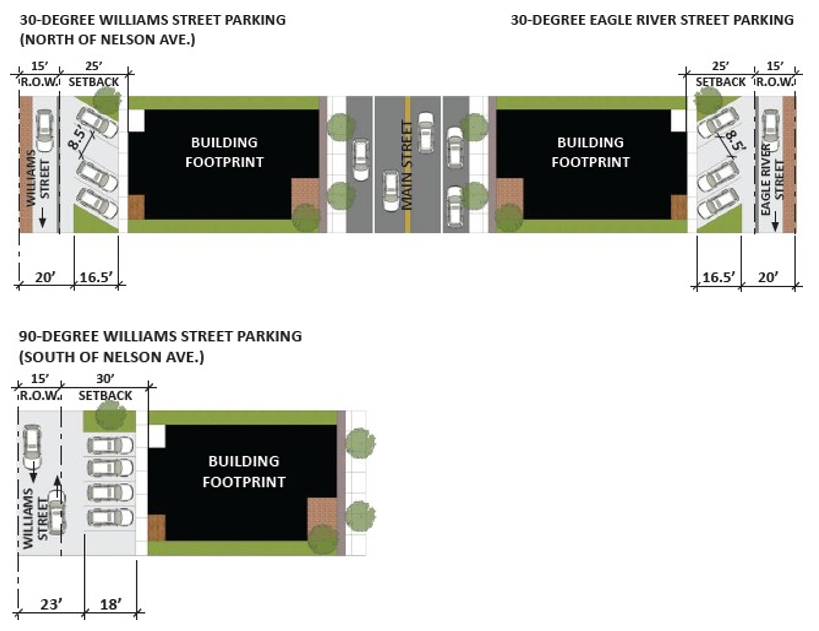
However, parking spaces shall be provided in the rear setback along Williams and Eagle River Streets for all new developments. When using Williams and Eagle River public rights-of-way for access to parking, the space must be lengthened to provide a total street width of twenty (20) feet for thirty-degree parking (Williams Street north of Toledo Street and Eagle River Street) and twenty-three (23) feet for ninety-degree parking (Williams Street south of Toledo Street)—see Illustration 16-16.
Enclosed garages are allowed but must meet setback requirements. Refer to SD.4 in Appendix B for more detail.
Illustration No. 16-16
(Ord. 11-2022 §2)
_____

