
Minturn City Zoning Code
ARTICLE 6
Old Town Character Area
Sec. 16-6-10.- Character Area characteristics.
The intent of the Community Plan is that the Old Town Character Area maintain its unique and friendly small town character while providing for a compatible mix of retail/commercial and residential uses. Old Town provides for low-impact retail/commercial and residential uses that support and enhance the friendly small town character. Small town main street characteristics such as walkability, window fronts, main entrances fronting sidewalks, and smaller scale buildings are to be promoted. The intent is to concentrate retail/commercial uses on Main Street and Williams Street and discourage retail/commercial uses on secondary streets when they would conflict with existing residential uses. The Old Town Character Area is to function as the primary retail/commercial core that encourages compatible retail/commercial activity and economic vitality. Subdivisions and planned unit development occurring within the Old Town Character Area need to comply with the zoning code and promote the objectives in the Design Guidelines.
The small town main street characteristics for the Old Town Character Area are set forth in the Minturn Design Standards and Guidelines. The Design Guidelines are the foundation underlying the Design Review process and are essential for the Town in its efforts to maintain the eclectic small town atmosphere, character and the over-all charm of our community. The Guidelines are a great starting point when considering building or remodeling in Town. Please visit the Planning Department Staff with any questions about your project after consulting the Design Guidelines.
(Prior code 16-6-1; Ord. 5-2016 §2)
Sec. 16-6-20. - Old Town Residential Zone.
(a)
The neighborhood is bisected by Highway 24 and is characterized by single-family residences with a mix of business and institutional uses. The residences are typically one (1) and two (2) stories, with outbuildings and minimal setback between structures.
(b)
The purpose of this zone is to provide for continued residential use and redevelopment that preserves the unique character and scale of the neighborhood. An objective is to retain the historically residential areas as quiet and safe neighborhoods while allowing for limited home-based occupations and home-based businesses to encourage permanent residency. This area can accommodate reasonable growth where land and services are available.
(Prior code 16-6-2)
Sec. 16-6-30. - Old Town Commercial Zone.
(a)
The Old Town Commercial Zone is located on either end of the 100 Block Commercial Zone. The Old Town Commercial Zone is also characterized by a compact commercial core area bisected by Main Street or Highway 24. The Old Town Commercial Zone, however, is adjacent to primary residential areas and does not extend off of the Highway 24/Main Street corridor. The area consists of businesses and residences with an identity of the historic commercial core that is distinct from other parts of the community.
(b)
The purpose of this area is to provide convenient commercial services to residents and visitors and to promote the development of the Town's retail commercial district along Highway 24 and Main Street. Accommodation of sales tax-generating commercial uses and residential units can enhance Old Town vitality while maintaining the visual character and scale. An objective is to facilitate small business development and economic vitality with land uses that are compatible and supportive, such as retail, office, institutional and residential uses, while maintaining the community scale.
(Prior code 16-6-3; Ord. 5-2016 §2)
Sec. 16-6-35. - 100 Block Commercial Zones.
(a)
The 100 Block Commercial Zones are characterized by a compact retail/commercial core area bisected by Highway 24. The area consists of businesses and residences with an identity of the historic commercial core that is distinct from other parts of the community.
(b)
The purpose of this area is to provide convenient commercial services to residents and visitors and to promote the development of the Town's primary retail commercial district. Accommodation of sales tax-generating commercial uses and non-street level residential units can enhance Old Town vitality while maintaining the visual character and scale. Street level space within the 100 Block Commercial Zones shall be dedicated to lodging in historic properties and retail uses. Non-street level space within the 100 Block Commercial Zones may be used for compatible retail, office, and residential uses.
(c)
The 100 Block Commercial Zones should function as a pedestrian shopping corridor. Buildings shall orient toward sidewalks and pedestrian areas with storefront windows and main entrance doors. The scale of buildings both in terms of height and width should encourage transparency, pedestrian engagement, and facilitate pedestrian movement not only along Highway 24 but also between Highway 24, Williams Street and Eagle Street and along all streets in the 100 Block.
(d)
The small town historic main street character will be maintained by keeping in scale with the original plat of twenty-five-foot by one hundred-foot lots and one- to two-story building frontages along Highway 24. Large monolithic buildings and "strip" retail areas are not allowed. New development in the 100 Block shall follow the standards and guidelines provided in Appendix B which seeks to ensure new structures maintain compatibility with historic structures while bringing new uses to increase vitality.
(Ord. 5-2016 §2; Ord. 12-2021 §2; Ord. 11-2022 §2; Ord. 20-2024 §2)
Sec. 16-6-40. - Old Town Mixed-Use Zone.
(a)
This area allows a compatible mix of residential uses, low-impact commercial uses and institutional uses that serve residents and visitors. The Old Town Mixed-Use Zone can accommodate various types of development if found not to significantly impact nearby properties.
(b)
The Old Town Mixed-Use Zone is intended to provide sites for combined residential and low-impact commercial and service uses which maintain a predominantly residential appearance. This area can accommodate reasonable growth where land and services are available and when services and amenities are needed for residents and visitors.
(Prior code 16-6-4)
Sec. 16-6-50. - Old Town Recreation and Open Space Zone.
(a)
This area allows a compatible mix of recreation and open space uses in close proximity to residential and commercial uses that serve residents and visitors. The Old Town Recreation and Open Space zone can accommodate recreation uses that are sensitive to the Eagle River if found to not significantly impact nearby properties.
(b)
The Old Town Recreation and Open Space Zone is intended to provide sites for low-impact recreation and open space uses that enhance the vitality of Old Town, while minimizing the impacts on nearby residential properties.
(Prior code 16-6-5)
Sec. 16-6-60. - Old Town Character Area map.
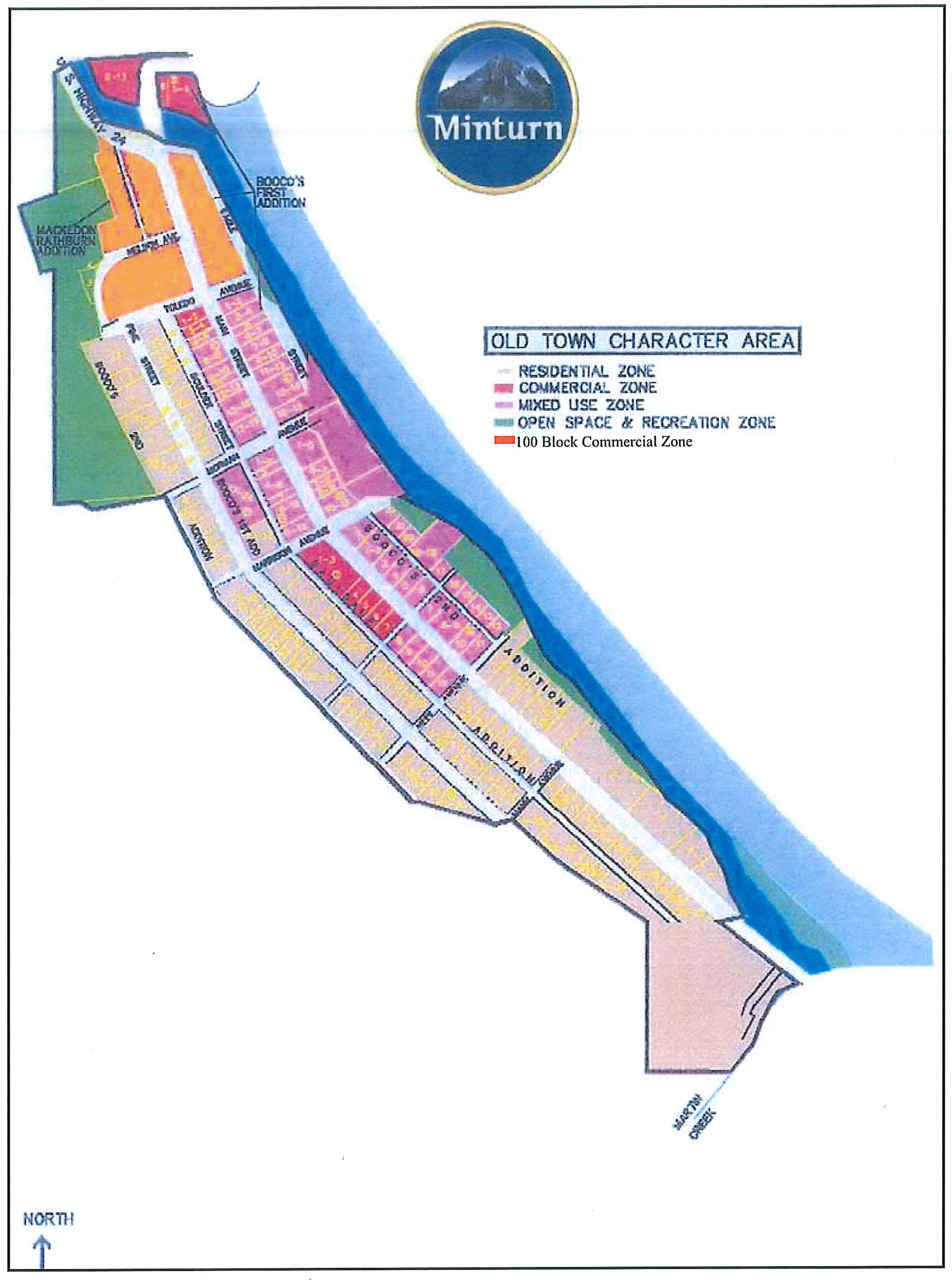
The Old Town Character Area map is set forth in Illustration 16-7 below:
Illustration 16-7
Old Town Character Area Map
(Prior code 16-6-6; Ord. 15-2008 §1; Ord. 5-2016 §2(Exh. A))
Sec. 16-6-70. - Old Town Character Area use table.
The following Table 16-2 sets forth the uses for the Old Town Character Area:
TABLE 16-2
Old Town Character Area Use Table
Refer to BD.2 in Appendix B for Active Use requirements on ground floor.
* Professional activities and offices may be allowed on the street level fronting Williams Street and Eagle River Street in the 100 Block, with conditional approval from Town Council depending on the use and parking demand.
** Historic property is exempt from the two-year ownership requirement. Historic properties within the 100 Block Zones are allowed to function as short-term rentals on all floors.
*** Residential is allowed on the back fifty percent (50%) of the proposed ground floor area of historic properties within the 100 Block Zones while meeting all residential parking requirements.
(Prior code 16-6-7; Ord. 15-2008 §1; Ord. 18, 2008 §1; Ord. 5-2016 §2; Ord. 12-2021 §2; Ord. 11-2022 §2; Ord. 20-2024 §2; Ord. 8-2025 §2(Exh. A))
Sec. 16-6-80. - Old Town Character Area limited use standards.
(a)
The Planning Director shall approve the limited use based upon the submittal and review of the following material. The use shall be approved upon finding that the limited use is:
(1)
Is not in conflict with applicable health, sanitation, safety or access regulations;
(2)
Is allowed by limited review in the subject Zone District; and
(3)
Can be operated so that it is compatible with adjacent uses and negative impact to adjacent properties has been minimized.
(b)
Accessory apartment.
(1)
Use: A maximum of one (1) accessory apartment shall be permitted in conjunction with and in addition to the principal use of the lot or parcel.
(2)
Size: The accessory apartment shall not exceed seven hundred fifty (750) square feet of floor area. The floor area associated with the accessory apartment shall be counted toward the maximum floor area permitted on the lot.
(3)
Location: The accessory apartment may be located within or attached to the structure containing the primary function, or it may be detached from the structure if it is located within or above an accessory building.
(4)
Parking: One (1) on-site parking space, additional to that number required for the primary use, shall be provided for the accessory apartment.
(5)
Ownership: The accessory apartment shall not be subdivided or sold from the primary unit on the parcel.
(6)
Water, sanitation, solid waste: Proof shall be provided that adequate water and sanitation are in place for the uses on the property. Proof shall be provided that adequate solid waste storage and removal are in place.
(7)
Dimensional limitations: Accessory apartments shall only be permitted on lots that conform to the minimum lot standards of the underlying zone district. The unit shall be developed so as to conform to all setback, height, building lot coverage, floor area and other dimensional limitations of the underlying zone district.
(c)
Accessory building.
(1)
Size: Accessory buildings shall not exceed one thousand two hundred (1,200) square feet.
(2)
Use: Accessory buildings are for the use of the residents of the property.
(3)
Dimensional limitations: Accessory buildings shall only be permitted on lots that conform to the minimum lot standards of the underlying zone district. The building shall be developed so as to conform to all setback, height, building lot coverage, floor area and other dimensional limitations of the underlying zone district.
(d)
Home occupation.
(1)
Use: The use of a dwelling for a home occupation shall be clearly incidental and subordinate to its use for residential purposes and shall not change the basic residential character of the parcel.
(2)
Nuisance: A home occupation shall not produce noise, electrical or magnetic interference, vibration, heat, glare, odors, fumes, smoke or dust and shall not operate at such hours or in such a manner as to create a public nuisance, disturb neighbors or alter the residential character of the premises.
(3)
Signs: Signs and other outdoor structures that advertise the home occupation shall be limited to two (2) square feet. Illumination of the structure housing the home occupation shall be limited to that which is customary for the residential use of the property.
(4)
Location: All activities associated with the home occupation shall be conducted indoors. Materials and equipment used in the home business shall be stored in a building.
(5)
Sales: Incidental sales of supplies or products associated with the home occupation shall be permitted on the premises. A home occupation whose primary activity is retail sales shall be prohibited, except if the function of the home occupation is catalogue sales.
(6)
A home occupation may not serve patrons on the premises, except in an incidental manner and on an appointment basis.
(7)
Employees: A home occupation shall be conducted only by persons residing on the premises.
(8)
Parking: No additional parking requirement shall apply to a home occupation.
(9)
Water, sanitation, solid waste: Proof shall be provided that adequate water and sanitation are in place for the uses on the property. Proof shall be provided that adequate solid waste storage and removal are in place.
(e)
Home business.
(1)
Use: The use of a dwelling for a home business shall be clearly incidental and subordinate to its use for residential purposes and shall not change the basic residential character of the parcel.
(2)
Nuisance: A home business shall not produce noise, electrical or magnetic interference, vibration, heat, glare, odors, fumes, smoke or dust and shall not operate at such hours or in such a manner as to create a public nuisance, disturb neighbors or alter the residential character of the premises.
(3)
Signs: Signs and other outdoor structures that advertise the home business shall be limited to two (2) square feet. Illumination of the structure housing the home business shall be limited to that which is customary for the residential use of the property.
(4)
Location: All activities associated with the home business shall be conducted indoors. Materials and equipment used in the home business shall be stored in a building.
(5)
Sales: Incidental sales of supplies or products associated with the home business shall be permitted on the premises. A home business whose primary activity is retail sales shall be prohibited, except if the function of the home business is catalogue sales.
(6)
A home business may serve patrons on the premises, provided that all other standards of this Section are met.
(7)
Employees: The home business shall be conducted by persons residing on the premises. A home business may have up to two (2) employees who reside off the premises.
(8)
Parking: A home business shall provide one (1) off-street parking space per employee and one (1) off-street parking space for patrons of the business.
(9)
Water, sanitation, solid waste: Proof shall be provided that adequate water and sanitation are in place for the uses on the property. Proof shall be provided that adequate solid waste storage and removal are in place.
(f)
Bed and breakfast.
(1)
Use: The use of a dwelling for a bed and breakfast shall be clearly incidental and subordinate to its use for residential purposes and shall not change the basic residential character of the parcel.
(2)
Number of units: A bed and breakfast shall be permitted a maximum of two (2) guest units in a Residential Zone District and a maximum of four (4) guest units in a Mixed-Use Zone District. Additional units may be approved through a conditional use permit.
(3)
Parking: A bed and breakfast shall provide one (1) off-street parking space per guest unit. This requirement shall be additional to the parking required for the residential use of the property.
(4)
Ownership: The owner of the bed and breakfast, or on-site manager employed by the owner, shall reside on the premises at all times when the use is in operation.
(5)
Water, sanitation, solid waste: Proof shall be provided that adequate water and sanitation are in place for the uses on the property. Proof shall be provided that adequate solid waste storage and removal are in place.
(g)
Day care center.
(1)
Licensing: Prior to operation, the day care center shall be required to provide proof that state and/or county licensing and requirements have been satisfied.
(2)
Size: Five (5) or more children shall be permitted; however, the applicant shall demonstrate that the size of the facility is suitable for the number of children permitted.
(3)
Operation: A day care center shall not produce noise, electrical or magnetic interference, vibration, heat, glare, odors, fumes, smoke or dust and shall not operate at such hours or in such a manner as to create a public nuisance or disturb neighbors.
(4)
Parking: Minimum requirements shall include one (1) off-street parking space per five hundred (500) square feet of floor area, plus one (1) off-street parking space per employee.
(5)
Water, sanitation, solid waste: Proof shall be provided that adequate water and sanitation are in place for the property. Proof shall be provided that adequate solid waste storage and removal are in place.
(Prior code 16-6-8; Ord. 15-2008 §1; Ord. 01-2015 §2; Ord. 12-2021 §2; Ord. 2-2022 §2)
Sec. 16-6-90. - Supplemental regulations and standards.
See Article 17, Supplemental Regulations and Standards.
(Prior code 16-6-9)

