
Morehead City City Zoning Code
ARTICLE 14
- EXCEPTIONS, MODIFICATIONS, AND SPECIAL REQUIREMENTS FOR CERTAIN USES
14-1 - Fences and Retaining Walls
It is the intent of this section to regulate materials, location, height and maintenance of fences and retaining walls to prevent nuisances and protect the safety and general welfare of the public.
14-1.1
Permit required.
(A)
No person may construct or cause to be constructed or erected any fence or retaining wall without first obtaining a fence permit.
(B)
No person may repair or replace or cause to be repaired or replaced, in whole or in part, a fence or retaining wall without first obtaining a fence permit.
(C)
Temporary, construction and agricultural fences associated with a bona fide farm are exempt from obtaining a permit.
14-1.2
Location.
(A)
Fences and retaining walls shall not be installed within easements.
(B)
Property owners are responsible for installation of fences and retaining walls on their property. If the exact location of property lines is unknown, a survey may be required.
(C)
Plantings may only be placed within drainage and utility easements with the approval of the City's Public Services Director.
(D)
It shall be the responsibility of the property owner to ensure that fences and retaining walls do not alter or impede the natural flow of water in any stream, creek, drainage swale, or ditch.
14-1.3
Height.
(A)
For purposes of this section, solid fence is defined as having less than fifty percent (50%) opening as viewed from outside the fence.
(B)
When a fence transitions from one height to another, the height of the fence will be measured from the ground to the tallest portion of the fence, excluding support posts.
(C)
Fence height will be measured from the average grade three (3) feet on each side of the fence.
(D)
Residential districts:
(1)
Solid fences located within a front yard may not exceed three (3) feet in height. No fence may exceed a height of four (4) feet in a front yard.
(2)
No fences in remaining yards of residential districts may exceed a height of six (6) feet.
(E)
Districts other than residential:
(1)
Solid fences located within a front yard may not exceed three (3) feet in height. Properties zoned CD or DB are exempt from this requirement.
(2)
Fences in yards of districts other than residential may not exceed a height of eight (8) feet.
(F)
Retaining walls proposed for the exclusive purpose of retaining fill material above naturally occurring grades shall not exceed two (2) feet in height as measured from the lowest ground elevation to the top of the retaining wall. Fill material shall not be added to the site for the sole purpose of allowing a retaining wall to be taller than two (2) feet. Any runoff created by permitted filling shall be directed toward the street or a designated and approved drainage area, not to adjacent properties. The applicant and/or property owner is responsible for containing and/or properly directing any runoff. Projects for which a valid state stormwater permit have been issued are exempt from the maximum retaining wall height requirements of Subsection 14-1.3(F) and shall be limited to the maximum height requirements for fences as contained in Subsection 14-1.3(A), (B), (C), (D), and (E).
(G)
Nothing in this section shall prohibit public utility companies from installing security fencing to protect utility sites and equipment from trespass or access by the public. Necessary fencing for utility sites/equipment shall be limited to eight (8) feet in height in any yard.
14-1.4
Maintenance.
(A)
Any fence or retaining wall which is, or has become dangerous to public safety, health or welfare, is considered a public nuisance.
(B)
Fences and retaining walls shall be maintained in a condition of reasonable repair and shall not be allowed to become and remain in a condition of disrepair or danger or to constitute a nuisance, public or private.
14-1.5
Additional.
(A)
In no event shall any fence, retaining wall, or other structure or planting be placed or maintained in a location or manner relative to a public or private street, alley, driveway or other means of ingress or egress such that the sight of on-coming vehicular or pedestrian traffic is impaired for users of such means of ingress and egress.
(B)
Fences and privacy screens shall only be installed with finish sides facing away from the property (i.e. construction side in). All fence posts must be located on the side of the fence facing the fence owner's property.
(C)
No fence erected within the city limits shall be electrically charged except fencing designed to be installed underground (invisible) to retain pets.
(D)
Fences and privacy screens shall be constructed of new or like new materials that are designed for the intended purpose.
14-2
Structures Excluded From Height Limitations. The height limits of these regulations shall not apply to a church spire, belfry, cupola, or dome; an ornamental tower not intended for human occupancy; a monument; a water tower; a transmission tower; a chimney or smokestack; a conveyor; a flag pole; a radio or television tower, mast, or aerial. The height limits of these regulations shall not apply to the community hospital, community college and institutions of higher learning with university affiliations because these uses are paramount to the public health, education and welfare of the City citizens and City visitors; the public cost to relocate these uses would be prohibitive; and, the amount of land available for such uses is limited within existing boundaries.
(Ord. No. 2025-O-04, 1-14-2025)
14-3 - Adjustments in Front Yard Setback Requirements
(A)
If twenty-five (25) percent or more of the lots within the same district on one side of the street between two (2) intersecting streets are improved with buildings all of which have observed an average setback line of greater than that required in Section 13-1 of this Ordinance, and no building varies more than six (6) feet from this average setback line, then no building shall be erected closer to the street line than the minimum average setback so established by the existing buildings, but this regulation shall not require a front setback of greater than fifty (50) feet.
(B)
Unenclosed porches and steps shall be permitted to be located within the front setbacks of the R5 and R5S Districts provided that the unenclosed porches contain no walls or screening. An uncovered deck may be permitted to encroach into a front setback provided the following are met:
(1)
The uncovered deck forms an integral part of a covered porch (i.e. railing around covered porch and uncovered deck area);
(2)
The area of the covered porch must be equivalent to or greater than one-third of the total combined area of the covered porch plus the uncovered deck area;
(3)
The uncovered deck shall not extend further into the front setback than the covered porch;
(4)
The uncovered deck shall not extend into a side setback; and
(5)
The width of the uncovered deck may not extend beyond the width of the house.
(C)
Residentially zoned lots with three (3) required front yard setbacks. If a lot has three (3) required front yard setbacks, the front yard setback may be reduced to ten (10) feet along the property line which is opposite/parallel to the property line requiring the side yard setback. This subsection shall not apply to multifamily developments.
(D)
In residential districts, uncovered steps may encroach beyond the minimum front setback line as determined by the minimum lot width up to the minimum setback as defined in Section 13-1.
(Ord. No. 2022-O-07, § 4, 6-14-2022; Ord. No. 2023-O-07, § 1, 6-13-2023)
14-4 - Substandard Lots of Record
Any lot of record existing at the time of the adoption of this Ordinance which has an area and/or a width which is less than required by this Ordinance shall be subject to the following exceptions and modifications:
14-4.1
Adjoining lots. Where two (2) or more adjoining lots with continuous frontage are in one ownership at any time after the adoption of this Ordinance, and such lots individually are less than the minimum square footage and/or have less than the minimum width required in the district in which they are located, then such group of lots shall be considered as a single lot or several lots of minimum permitted area and width for the district in which located.
14-4.2
Lot not meeting minimum lot size requirements. Except as set forth in Subsection 14-4.1 above, in any district in which single-family dwellings are permitted, any lot of record existing at the time of the adoption of these regulations which has an area or a width which is less than required by these regulations may be used as a building site for a single-family dwelling in an R district.
14-5 - Temporary Field Office
A temporary field office may be permitted by a special ninety-day renewable permit issued by the Land Use Administrator provided:
14-5.1
That no living quarters be maintained in such temporary field office; and
14-5.2
That the temporary field office be used only in conjunction with construction activity.
14-6 - Manufactured Homes and Recreational Vehicles as Temporary Residences or Business Locations
If any building which conforms to the permitted or special uses for the zoning district in which it is situated is destroyed (or rendered unfit for the purpose it was being used prior to such destruction or damage) by fire, flood, windstorm, or other act of God, it shall be lawful for the Land Use Administrator to issue a temporary renewable permit to the person owning such building or occupying it as a residence or for business or commercial purposes to locate a manufactured home or recreational vehicle on the lot occupied by such destroyed or damaged building and to use the same for a period not exceeding one hundred twenty (120) days for the same purpose as had the destroyed or damaged building immediately prior to the destruction or damage. No more than one family shall occupy a manufactured home or recreational vehicle for residential purposes and no more than one manufactured home or recreational vehicle shall be permitted on any residential lot. Temporary manufactured homes and recreational vehicles permitted under this section shall be subject to the following:
(A)
No manufactured home or recreational vehicle authorized under this section shall be permitted to be located upon any City property, parking lot operated or supervised by the City, or right-of-way of any City street or alley.
(B)
Temporary manufactured homes and recreational vehicles must be properly connected to an approved wastewater system or have a means to properly remove all wastewater and must have a permanent power source.
(C)
Temporary manufactured homes and recreational vehicles located within a special flood hazard area must meet the Flood Damage Prevention Ordinance requirements contained in Article 18 of this Ordinance.
A permit issued under this section may be extended by the Land Use Administrator for good cause such as substantial progress towards improvements. The maximum number of extensions that may be granted shall be limited to two extensions of one hundred and twenty (120) days each.
For purposes of Section 14-6, "recreational vehicle" shall include mobile campers, buses, trailers, and other vehicles, whether motorized or not, which are designed and appropriate for human occupation as living quarters and which have plumbing, sanitary waste storage/disposal facilities, a permanent power source, bedding, and sitting and storage areas. Outside storage is not allowed under this section. Tents, lean-tos, sheds, shacks, or other temporary structures or similar facilities which are not contained within or incorporated into a mobile vehicle shall not be permitted under this section.
(Ord. No. 2025-O-04, 1-14-2025)
14-7 - Family Care Homes
Family care homes shall not be located nearer to each other than one-half mile. Family care homes shall be deemed a residential use of property for zoning purposes and shall be a permissible use in all residential districts.
14-8 - Cemeteries
A cemetery shall meet the minimum requirements of the North Carolina Division of Health Services.
14-9 - Churches
14-9.1
A church or other place of worship may be allowed in an R district subject to the requirements of the district, any other applicable requirements of this Ordinance and provided that:
(A)
The structure shall have minimum side and rear yards of fifty (50) feet and a front yard at least twenty-five (25) feet greater than that required for single-family residences within the district.
(B)
See Subsection 20-3.2 for parking requirements.
14-9.2
Reserved.
14-10 - Home Occupations
14-10.1
Type A. A Type A home occupation is one where the residents use their home as a place of work; however, no employees or customers come to the site. No traffic shall be generated by Type A home occupations in greater volumes than would normally be expected in a residential neighborhood. Type A home occupations shall be permitted in all residential districts. Examples include: artists, crafts people, writers, consultants, appraisers and home offices that utilize technology rather than direct customer contact as the primary means of doing business.
14-10.2
Type B. A Type B home occupation is one where either one (1) employee or customers come to the site. A special use permit issued by the Board of Adjustment shall be required prior to establishing a Type B home occupation. Examples include: beauticians, home child day cares, home adult day cares.
14-10.3
General requirements.
(A)
No more than twenty (20) percent of the heated floor space of the principal dwelling shall be used for the home occupation.
(B)
The home shall continue to be used principally as a dwelling. The dwelling and site must remain residential in appearance and characteristics. Internal or external changes that will make the dwelling appear less residential in nature or function are prohibited. Examples of such prohibited alterations include construction of parking lots or adding commercial-like exterior lighting.
(C)
The occupation shall not be visible from the street.
(D)
No outside signs in excess of two (2) square feet in size shall be displayed on the premises.
(E)
The occupation shall not constitute a nuisance or any undue disturbance in the neighborhood. Noise, vibration and odor, etc., other than that which can be expected of a normal household shall be considered a nuisance or undue disturbance.
(F)
Home occupations shall be conducted entirely within the principal (main) dwelling. Detached and/or accessory buildings shall not be included as part of the principal building.
(G)
Deliveries. Truck deliveries or pick-ups of supplies or products associated with business activities are limited to those normally servicing residential neighborhoods.
(H)
Trucks and vehicles. No more than one light truck or vehicle per resident associated with the home occupation may be parked at the site.
(I)
Parking shall be in accordance with Article 20. Any need for parking generated by the conduct of such home occupation shall be met off street and not located in any required yard. No additional driveways to serve such home occupation shall be permitted.
(J)
A secondary outside access may be provided, however, all home occupations shall provide an access to the remaining portion of the residence.
14-10.4
Prohibited uses.
(A)
Any type of repair or assembly of vehicles or equipment with internal combustion engines (such as autos, motorcycles, scooters, marine engines, lawn mowers, chain saws and other small engines) or of large appliances (such as washing machines, dryers and refrigerators) or water crafts (such as jet skis) or any other similar type of work.
(B)
Accessory home occupations may not serve as headquarters of dispatch centers where employees come to the site and are dispatched to other locations.
14-10.5
Additional Type B home occupation regulations.
(A)
A Type B accessory home occupation is prohibited in duplexes, triplexes and multifamily developments.
(B)
A Type B home occupation shall be permitted only in single-family dwellings.
(C)
Hours. Customers may visit the site only during the hours of 7:00 a.m. and 9:00 p.m.
(D)
Retail sales. Retail sales of goods must be entirely accessory to any services provided on the site (i.e., such as hair care products sold as an accessory to hair cutting).
(E)
Number of Type B home occupations. No more than one Type B home occupation per dwelling unit is permitted.
14-11 - Hospitals
A hospital may be permitted in an MA district subject to the requirements of the district and provided that:
14-11.1
The lot size shall be not less than two (2) acres; and
14-11.2
Reserved.
14-12 - Junkyards
A junkyard may be permitted as a special use in the Industrial (I) district subject to the requirements of the district and provided that:
14-12.1
The junkyard shall be set back at least two (2) times the distance from the right-of-way line as required in the front setback requirements; and
14-12.2
The junkyard shall be fenced with a visual screen eight (8) feet in height in order that no junk can be seen from the street or surrounding properties.
Cross reference— Abandoned or junked motor vehicles, § 9-126 et seq.
14-13 - Home Child Day Care Centers, Preschools, and Nurseries
Home child day care centers, preschools, and nurseries may be allowed in an R district subject to the requirements of the district; provided, that:
14-13.1
Off-street parking and loading requirements in this Ordinance must be met;
14-13.2
Indoor and outdoor space requirements shall be in accordance with the applicable General Statutes;
14-13.3
The entire play area shall be enclosed by a fence having a minimum height of at least four (4) feet and constructed in such a manner that maximum safety to the children is ensured.
14-14 - Manufactured Home Parks
A manufactured home park may be permitted in an R-15M district subject to the requirements of the district and provided that:
14-14.1
The minimum manufactured home park size shall be 2.18 acres or a typical city block.
14-14.2
The park shall have minimum side and rear yards of twenty (20) feet and a front yard of at least thirty (30) feet greater than that required for uses permitted as a right in the district.
14-14.3
A manufactured home shall not be occupied by more than one family.
14-14.4
Each manufactured home shall be connected to a community water system and to a community sewage disposal system or an individual septic system approved by the Carteret County Health Department.
14-14.5
The minimum lot or stall size shall be not less than five thousand (5,000) square feet and the minimum stall width shall be no less than forty (40) feet for a single wide lot and shall be no less than fifty-four (54) feet in width for a double wide lot.
14-14.6
The minimum front and rear setback requirement for a stall shall be fifteen (15) feet.
14-14.7
The minimum side yard setback requirement for a stall shall be eight (8) feet.
14-14.8
An unobstructed right-of-way of at least thirty (30) feet wide shall be provided to serve all manufactured home stalls. Within such right-of-way there shall be at least a twenty-two foot paved road, paved in accordance with the standards set forth in the Morehead City Subdivision Regulations.
14-14.9
Where centrally located waste cans are used, they shall be no further than one hundred fifty (150) feet from any lot.
14-14.10
Each trailer [manufactured home] stall shall be clearly defined by means of concrete or steel or iron pipe markers placed at all corners.
14-14.11
At least two hundred (200) square feet for each manufactured home stall in the park shall be provided in one or more locations for community playground and recreation purposes. Such location shall be approved by the Planning Board.
14-14.12
A buffer shall be required around the perimeter of the manufactured home park in accordance with Section 15-1.
14-14.13
All manufactured homes must be skirted such that no area beneath the manufactured home is visible from any direction within sixty (60) days of placement in the park.
14-14.14
Approval of manufactured home parks.
(A)
For the establishment, maintenance, construction, or alteration of a manufactured home park that affects the number of sites within the park, a manufactured home park plan shall be prepared and submitted to the Planning Board and City Council for approval. No plan is required when minor facility improvements (not including public facilities) are proposed in an existing manufactured home park as long as the number of manufactured home lots is not affected.
(B)
Manufactured home park plan. The plan shall be drawn at a scale of not less than one hundred (100) feet to the inch and shall meet the plat requirements as described in this Ordinance.
14-14.15
No manufactured home park shall be occupied by a greater number of manufactured homes than that authorized on the approved plan. No manufactured home park shall be enlarged or extended except in compliance with this section.
14-14.16
All dimensional requirements shall be in accordance with and each manufactured home park shall operate in accordance with rules and regulations of the Carteret County Health Department relative to the location, sanitation, and operation of manufactured home parks.
14-14.17
Recreational vehicles, including park models, may be allowed in manufactured home parks subject to the following:
(A)
A recreational vehicle may be occupied in an established stall within a manufactured home park provided that the recreational vehicle is not located within a stall that is also occupied by a manufactured home.
(B)
Only one recreational vehicle shall be permitted within each individual stall.
(C)
The minimum stay for a recreational vehicle, including a park model recreational vehicle, in a manufactured home park is one month.
(D)
No recreational vehicle, including a park model recreational vehicle, may be permitted to be stored in a manufactured home park unless it is stored in an approved RV storage area designated for use only by park occupants.
(E)
The number of recreational vehicles, including park model recreational vehicles, permitted to be located in a manufactured home park shall be limited to a maximum of 49% of the total of manufactured homes approved to be located in the park.
(F)
Recreational vehicles located within a special flood hazard area shall comply with Subsection 18-5.2(F) of the Unified Development Ordinance.
(G)
The establishment, maintenance, construction, or alteration of a park that effects the number of homesites within a park shall be in accordance with Section 14-14.
(H)
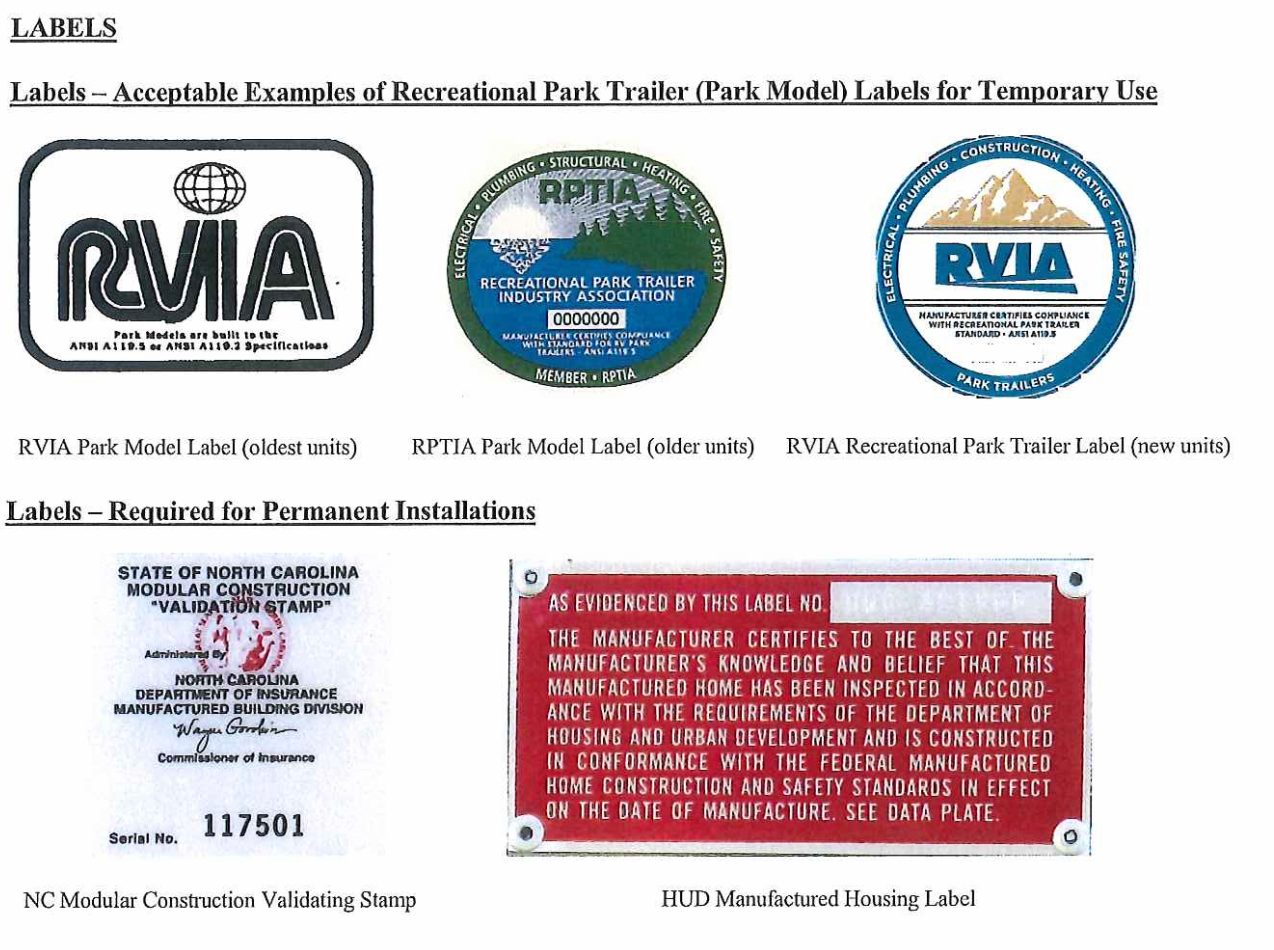
Park model recreational vehicles constructed through the Recreational Park Trailer construction program of the Recreational Vehicle Industry Association (RVIA) in addition to either the NC Modular Construction Program or the HUD Manufactured Housing program may be permanently installed as a single-family modular dwelling or manufactured home in accordance with the following:
(1)
Labeled Recreational Park Trailers that are also constructed and dual-labeled in accordance with the NC Modular Construction Program may be permanently installed as a single family modular dwelling in accordance with the NC Residential Code provided the installation meets the current NC Code's foundation/anchoring requirements and meets all other applicable zoning ordinances.
(2)
Labeled Recreational Park Trailers that are also constructed and dual labeled in accordance with the Federal Manufactured Housing Construction and Safety Standards as a single family (HUD) manufactured home may be permanently installed as a single family manufactured home dwelling in accordance with the State of North Carolina Regulations for Manufactured Homes provided the installation meets the foundation/anchoring requirements of these regulations and all other applicable zoning ordinances.
(I)
The following restrictions apply to the temporary installation of recreational vehicles, including park model recreational vehicles:
(1)
Recreational vehicles constructed in accordance with ANSI A119.5 Recreational Park Trailer Standard and only labeled as Recreational Park Trailer under the Recreational Park Trailer construction program of the Recreational Vehicle Industry Association (RVIA) and recreational park trailers constructed by manufacturers which are not members of the Recreational Vehicle Industry Association (RVIA) shall not be setup as permanent dwelling units.
(2)
No permanent electrical, plumbing, or mechanical connections are permitted to be made to a park model recreational vehicle installed under this section.
(3)
Units may be temporarily blocked up and anchored against overturning forces, but wheels and axles must remain on the unit at all times.
(4)
Accessory structures may not be supported with temporary installation park model recreational vehicles.
(5)
Recreational vehicles not meeting the permanent installation requirements of Subsection 14-14.17(G) may not be located within a manufactured home park unless the requirements of Subsection 14-14.17(H) are continuously met.
14-15 - Trailers, Trailer Parks
14-15.1
No trailer shall be permitted under any circumstances in either the residential or business zones; however, individual trailers may be used for temporary office or utility purposes in the business zones with written permission of the City Manager for a duration of not more than six (6) months for each permit. This subsection shall not include in its prohibition temporary field offices as defined in Section 14-5 of this Ordinance.
14-15.2
Only individual trailers for dwelling purposes shall be permitted within the Industrial (I) district, provided all ordinances of the City are complied with; however, individual trailers may be used for temporary office or utility purposes in the Industrial (I) district with the written permission of the City Manager for a duration of not more than six (6) months for each permit.
14-15.3
Special areas in the industrial zones specifically set apart for use as trailer parks, courts, or camps for dwelling purposes shall be permitted within the City or in the perimeter zoning area, provided all ordinances of the City, the Unified Development Ordinance and all area regulations are complied with.
14-15.4
It shall be unlawful to park or leave standing upon any City property, parking lot operated or supervised by the City, or right-of-way of any City street or alley, any manufactured home, camper, trailer, recreational vehicle or tent, for the purpose of occupying the same, temporarily or permanently, or for the purposes of preparing or consuming food in, on, or around such vehicle, manufactured home, tent, or camper.
(Ord. No. 2025-O-04, 1-14-2025)
14-16 - Private Clubs/Lodges
A private club or lodge may be permitted in an R district subject to the requirements of the district and provided that:
14-16.1
All new sites shall be no less than two (2) acres in size;
14-16.2
The structures shall have minimum side and rear setbacks of fifty (50) feet and a front yard of at least twenty-five (25) feet greater than that required for single-family residences within the district; and
14-16.3
Provisions for food, refreshment, and entertainment for club members and their guests may be allowed in conjunction with such use if the Board of Adjustment determines that said provisions will not constitute a nuisance.
14-17 - Public Utility Buildings and Uses
Public utility buildings and uses such as sewage lift stations, pump stations, electrical substations, etc., which do not create excessive noise, odor, smoke, dust, and which do not possess other objectionable characteristics which might be detrimental to surrounding neighbors or to other uses permitted in the district may be permitted in any district. Public buildings and uses in this case shall not be construed to include post offices, armories, schools, churches, etc.
14-18 - School
A public or private school may be allowed in an R district subject to the requirements of the district and provided that:
14-18.1
All structures shall have minimum side and rear yard(s) of fifty (50) feet and a front yard at least twenty-five (25) feet greater than that required for single-family residences within the district;
14-18.2
An off-street loading area that is based on the size of the school and current planning standards; and
14-18.3
The school site should meet the following minimum standards:
(A)
Public elementary school. Ten (10) acres plus one acre for each one hundred (100) enrollment.
(B)
Public junior high (middle) school. Fifteen (15) acres plus one acre for each one hundred (100) enrollment.
(C)
Public senior high school. Thirty (30) acres plus one acre for each one hundred (100) enrollment.
(D)
Private schools. No acreage requirement, but must meet all applicable sections of this Ordinance.
14-19 - Kennels
Kennels may be permitted in certain districts subject to the requirements of the district and the following:
14-19.1
The minimum lot size shall be one acre and the building shall not be located closer than fifty (50) feet to any property line.
14-19.2
Kennels shall be enclosed by a sound-proof barrier and be screened.
14-20 - Business Residence
A business residence may be established in the CD, O&P, CN, CH, and DB districts subject to the requirements of the district and the following limitations:
14-20.1
Not more than one (1) residence shall be permitted for each structure in the O&P, CN, and CH districts. Business residences located in the CD and DB district shall be permitted to have one (1) dwelling per six hundred twenty-five (625) square feet of land area. Density for buildings located over the water will be computed at one (1) unit per six hundred twenty-five (625) square feet of the building footprint;
14-20.2
The residence in the O&P, CN, and CH districts shall not exceed the gross floor area of the business operation;
14-20.3
Residences may be located above the business, but in no case shall be located in the front yard of the business; and
14-20.4
Any residence must be in the same structure as the business.
14-21 - Overnight Camping Trailer
Overnight camping trailers are permitted to be stored unoccupied on lots in any district. They are permitted to be occupied in overnight camping trailer parks.
14-22 - Emergency Shelter Mission
Emergency shelter missions may be permitted in the CD and DB districts provided that:
14-22.1
The emergency shelter mission is located no closer than one-half mile to a public or private school;
14-22.2
The emergency shelter mission is located no closer than one-half mile to another emergency shelter mission;
14-22.3
Sleeping quarters shall not be permitted unless the emergency shelter mission includes a soup kitchen;
14-22.4
In the event that sleeping quarters are included as part of the emergency shelter mission, the facility shall be staffed twenty-four (24) hours per day when the beds are in use and the length of stay per individual shall be limited to not more than ninety (90) calendar days.
(Ord. No. 2023-O-18, 2023, § 1, 11-14-2023)
14-23 - Cluster Development
Cluster housing may be permitted in any R district with the exception of R-5S; provided, that:
14-23.1
The density of the cluster housing does not exceed the maximum density requirements of the district in which it is to be located.
14-23.2
The minimum lot size for a cluster housing development is 2.15 acres.
14-23.3
Cluster development lots shall be required to meet the setback requirements for the district in which it is established.
14-23.4
Lot sizes may not be reduced by more than fifty (50) percent of the minimum lot size requirement for the district in which it is located.
14-23.5
The minimum setback requirements for the perimeter of the property are as follows:
Front: 40 feet.
Side: 40 feet.
Rear: 40 feet.
14-23.6
Zero lot line may be permitted within cluster housing developments; provided, that at least one side setback for the district is met. (Example: If the side setback requirement for the zoning district is fifteen (15) feet per side, the cluster homes may not be located closer than fifteen (15) feet to another residential structure.) At no point shall it be less than ten (10) feet between structures.
14-23.7
Approval of cluster housing developments shall be in accordance with the procedures outlined in the Subdivision Regulations.
14-23.8
Open space shall be deeded to the homeowners' association and shall not be developed except as passive recreational areas.
14-24 - Commercial Marina
Activities and possible uses on the marina property shall be limited to wet boat storage, drystack boat storage, boat service and repairs, boat accessory sales, ship's store, coffee shop, boat trailer parking areas, automobile parking areas, launching ramps, piers, and boat petroleum service areas subject to the following requirements:
14-24.1
If drystack boat storage buildings are located as part of the commercial marina, it shall be located no closer than thirty (30) feet from any property line unless such property line abuts the water. Also, a buffer shall be required between the building and any adjacent property lines in accordance with these regulations.
14-24.2
Pump out facilities are required.
14-25 - Automobile Repair Garages/Automobile Service Stations
Automobile repair garages and automobile service stations may be permitted in commercial and industrial districts subject to the district regulations and the following limitations:
14-25.1
Gasoline pumps and other appliances shall be located a minimum of fifteen (15) feet from any property line.
14-25.2
When an automobile repair garage or automobile service station adjoins a residential district, the underground storage tanks shall be located a minimum of thirty (30) feet from the property line.
14-25.3
All underground storage tank facilities shall comply with all federal, state, and local regulations.
14-25.4
Also, a buffer shall be required between the building and any adjacent property lines in accordance with these regulations.
14-26 - Bars and Cocktail Lounges
14-26.1
No bar or cocktail lounge shall be permitted to be located within one-quarter (¼) mile of an existing or proposed church, school or day care facility. If the bar or cocktail lounge is located on Arendell Street or Evans Street between 4th and 10th Street, the minimum distance between an existing or proposed church, school or day care facility shall be three hundred (300) feet.
14-26.2
Live entertainment shall be permitted in bars and cocktail lounges, provided that it shall occur inside the enclosed building.
14-26.3
Any bar or cocktail lounge applying for approval as a special use in the CD or DB district shall be subject to any approved design criteria. Cocktail lounges shall not be permitted on any lot in the CD or DB district that directly abuts or is directly across the street from a residentially zoned parcel.
14-26.4
No bar or cocktail lounge located in the CD or DB district shall play, operate or cause to be played or operated, any amplified or nonamplified musical instrument or sound reproductive device in a manner that causes a noise disturbance on any neighboring premises or public area. For the purposes of this section, a noise disturbance shall be presumed to exist where the sound or noise caused by any activity described herein is plainly audible within any occupied structure not the source of sound or within any public area more than sixty (60) feet from the property line of the applicant's establishment from 10:00 p.m. to 10:00 a.m.
14-26.5
It shall be the responsibility of the applicant to prevent its patrons from loitering on public or private property in the vicinity of the applicant's establishment.
14-27 - Yard Sales
14-27.1
Yard sales may be permitted in residential districts, provided that not more than two (2) yard sales occur at the same location within a one-year period.
14-27.2
Items sold during the yard sale shall not have been acquired for the sole purpose of reselling.
14-28 - Adult Establishments and Cabarets
An adult establishment, or an adult cabaret, may be permitted in a Commercial Highway (CH) district subject to the requirements of the district and provided that:
14-28.1
All sites shall be no less than two (2) acres in size.
14-28.2
The structure shall have minimum front, side, and rear setbacks of at least fifty (50) feet.
14-28.3
No adult establishment shall be permitted within thirteen hundred twenty (1,320) feet of an established adult establishment (see note).
14-28.4
No adult establishment shall be permitted within thirteen hundred twenty (1,320) feet of a church, school, public park, or existing child day care facility nor within five hundred (500) feet of any residential zoning district (see note);
14-28.5
No aspect of an adult establishment, as defined under G.S. 144-202.10, or an adult cabaret shall be permitted within any district other than a Commercial Highway (CH) district.
NOTE: Measurements shall be taken from the exterior property line and will be measured by a straight line to the nearest point on the property line of another adult establishment, church, school, public park, existing day care facility, or residential zoning district boundary.
14-29 - Relocation of Existing Buildings
The Building Inspector shall inspect each structure proposed to be relocated prior to issuing a permit to move a building to determine if the building to be moved is structurally sound.
14-30 - Logging Operations
Any logging operation on a parcel of land five (5) acres or greater shall be required to leave a minimum fifteen-foot buffer between the logging operation and abutting residential property lines. Buffers shall be vegetated, either left in a natural state or be replanted with not less than two (2) rows spaced not more than ten (10) feet apart of loblolly or long leaf pines spaced on not more than seven-foot centers. Pine seedlings shall be planted.
Any logging operation done in conjunction with an approved development plan shall be exempt from this requirement.
14-31 - Accessory Uses or Buildings
An accessory use or building as defined in this Ordinance shall be governed by the following requirements:
14-31.1
All accessory uses and buildings shall be required to meet the setback requirements established in Section 13-1, except that such buildings and uses may be located in the rear yard of any R district, provided it is located at a distance of not less than five (5) feet from the rear and side lot lines.
14-31.2
Accessory uses and buildings may consist of the following structures:
(A)
Garage;
(B
Greenhouse;
(C)
Playhouse;
(D)
Pump house;
(E)
Recreational area;
(F)
Storage shed;
(G)
Swimming pool—Swimming pools shall be installed in accordance with applicable North Carolina State Building Codes;
(H)
Tool shed;
(I)
Workshop;
(J)
Dog pen;
(K)
Antenna;
(L)
Docks and piers subject to the following conditions and requirements:
(1)
Only one dock or pier may be located on a residential lot.
(2)
Docks and piers shall be single (one deck only), private and noncommercial.
(3)
Without a primary structure, no more than two (2) water craft may be docked at any one time per residential lot.
(4)
All docks shall be built in accordance with the Coastal Area Management Act (CAMA) regulations.
(5)
Docks shall be built in accordance with the North Carolina State Building Code.
(6)
No living quarters, boathouses, or recreational buildings or structures shall be placed on a dock or pier nor shall any houseboat, boat, or floating structure be moored at the dock or pier to be used as a residence except they may be so used for periods not to exceed seven (7) consecutive days nor more than twenty (20) days in any calendar month.
(7)
Docks and piers must be maintained in a good and safe condition.
(8)
Within twenty-four (24) hours of any work on a pier or dock, all building materials used to build, repair, or for maintenance of the pier or dock shall be cleared away from the shore, bottom and water to proper disposal area. Nails left on the shore or bottom constitute a particular danger. Storage of materials must be such so as to prevent them from being floated on high or storm tides.
(9)
All federal and state laws and regulations concerning piers and docks shall be observed and obeyed.
(10)
Exception: Common Docks. Notwithstanding paragraphs 1 and 3 above, the owner(s) of a 100% interest in a waterfront lot, or multiple adjoining waterfront lots, where such lot or lots are located within a single block platted and shown on the official map of Morehead City (Map Book 1, Page 131, Carteret County Registry), may submit to the City an application for an accessory use dock which will be a "common dock" for use by the contiguous waterfront lot owners and non-waterfront lot owners within the same platted block. Each waterfront lot shall be limited to two (2) boat slips and each non-waterfront lot shall be limited to one (1) boat slip provided the total number of boat slips does not exceed nine (9). The application must be accompanied by the following:
(a)
An application processing fee in accordance with the City's Fee Schedule.
(b)
A drawing indicating the configuration, dimensions and location of the common dock to be constructed and the location of the lots of all participating owners.
(c)
All necessary CAMA and other governmental permits required for construction of the common dock.
(d)
A written instrument, suitable for recording in the records of the Carteret County Register of Deeds, signed by all participating, contiguous waterfront owners and all of the participating owner(s) of other lots in the same platted block who will share use of the common dock (collectively "participating owners"). The instrument shall include:
(i)
Provision for the management, maintenance and upkeep of the dock structure, utilities, and all access ways.
(ii)
Prohibition of trash, debris, and storage in the easements or on the common dock.
(iii)
Provision for easements and cross easements where necessary to be used by participating owners for access to and maintenance of the common dock.
(iv)
Restrictions limiting use of the common dock to no more than one slip per participating non-waterfront lot, and two slips per participating waterfront lot, such slips to be used only by that participating lot owner, only, and prohibition of slip rental, lease, or occupation by a vessel not owned by a guest to temporarily use a slip to which that lot owner has a right of occupancy for not more than ten days per calendar year.
(v)
Provision for signage, legible from both land and water, indicating that the common dock is private property and not for public use.
(vi)
A means to distribute the costs of maintenance and upkeep of the common dock among the users and to enforce collection of such funding.
(vii)
A method for providing insurance policies for protection against injuries and property damage from hazards and negligence.
(viii)
A list of all participating lot numbers which must include all waterfront lots that will have their riparian areas affected, and a provision that all heirs, successors, and assigns of such lot owners shall be bound by the instrument's provisions.
(ix)
Provision of a method for assignment of boat slips on a one to one, or one to two basis for each relevant lot.
(x)
Provision that all future deeds associated with the relevant lots shall reference and be bound by the terms of the instrument.
(xi)
Provision for creation and enforcement of Rules and Regulations applicable to the use of the common docks and easement areas.
(xii)
Prohibition of nuisances, whether from active or passive activities, including, but not limited to, activity which is noisy, producing noxious fumes or odors or otherwise interfering with the peace and quiet of the owners within that block.
(xiii)
That each waterfront owner associated with the common dock has or shall release their appurtenant littoral rights.
(xiv)
That in the event that all lot owners unanimously agree to release all of their rights to and use of the common dock, the instrument shall be cancelled of record, the littoral rights of the waterfront shall be restored, and the common dock shall be removed or reconfigured and brought back into compliance with the City's ordinances for individual lot accessory dock structures.
(xv)
Provision granting the City the right to enter upon the properties of the participating owners and the common dock for purposes of inspection and enforcement of the provisions of the instrument, such inspection and enforcement not being an obligation, but rather within the sole discretion of the City.
(xvi)
Provision that all participating owners will provide to each other and, upon request, to the City, a list of all vessels owned by the participating owners and the slips assigned to each and shall maintain that list so that it remains current.
(xvii)
Provision that the City, at the collective expense of the participating owners, may remove and store, or fully dispose of, any obstruction to any easement area and any vessel occupying a slip which is not shown on the list of vessels provided to the City or confirmed in writing upon request as being a vessel owned by a guest of a participating owner.
(e)
Common docks must adhere to and comply with items 2, and 4 through 9, of 14-31.2, Subsection L, as provided above.
(M)
Communication tower on a parcel where a public utility electrical substation exists subject to the requirements of Section 14-45.
14-31.3
For properties zoned R5 or R5S, accessory buildings/uses may be located on a separate (adjacent) lot if the property is under common ownership, even if separated by an alley or right-of-way, subject to the following conditions:
(A)
In no case are signs allowed on a separate lot as an accessory use.
(B)
If power, water, sewer or other utility lines will cross an alley or right-of-way, any necessary easement must be obtained from the entity having control of the area to be crossed.
(C)
In no case may the accessory building be occupied as a dwelling.
(D)
If the principal use requires a special use, then a special use permit is required for the accessory building/use.
(E)
District development standards (i.e., setbacks, lot coverage, height, etc.) must be met and the exemption for accessory buildings/uses in the rear yard of R districts does not apply.
(F)
If the two (2) lots are separated by an alley, the alley may not be blocked from the public use.
(G)
If the accessory use would require screening or landscaping on the same lot as the principal use, then the screening or landscaping requirements would apply on the separate lot.
(H)
There shall be no separate electrical meter allowed.
(Ord. No. 2025-O-04, 1-14-2025)
14-32 - Manufactured Homes
14-32.1
General requirements.
(A)
General. Prior to release of electricity, the Building Inspector or his/her agent shall inspect the premises for compliance with these regulations. A wind zone designation map and third party inspection agency tag are required for any homes moved into or within the City's jurisdiction.
14-32.2
Exterior structure.
(A)
General. The exterior of a structure shall be in good repair, structurally sound and sanitary so as not to pose a threat to the public health, safety or welfare. When located on privately owned lots, the towing apparatus and transporting lights shall be removed. The home shall be permanently placed on a foundation and that foundation shall be enclosed, screened, or underpinned with weather and rot-resistant materials and maintained in good condition.
(B)
Protective treatment. All exterior surfaces, including, but not limited to, doors, door and window frames, cornices, and trim, shall be in good condition. Exterior wood surfaces, other than decay-resistant woods, shall be protected from the elements and decay by painting or other protective covering or treatment. Peeling, flaking and chipped paint shall be eliminated and surfaces repainted. All siding and masonry joints, as well as those between the building envelope and the perimeter of windows, doors and skylights, shall be weather-resistant and tight. All metal surfaces subject to rust or corrosion shall be coated to inhibit such rust and corrosion and all surfaces with rust or corrosion shall be repaired if necessary and stabilized and coated to inhibit future rust and corrosion.
(C)
Structural members. All structural members shall be free from deterioration and shall be capable of safely supporting the imposed dead and live loads.
(D)
Exterior walls. All exterior walls shall be free from holes, breaks and loose or rotting materials and maintained weatherproof and properly surface coated, where required, to prevent deterioration. The exterior of the home shall be of brick, stone, vinyl siding, aluminum lap siding, wood lap siding, or other acceptable exterior siding materials.
(E)
Roofs and drainage. The roof and flashing shall be sound, tight and free of defects that could or does admit rain. Roof drainage shall be adequate to prevent dampness or deterioration in the walls or interior portion of the structure. Roofs shall have a minimum of 2:12 pitch and be finished with a type of covering that is commonly used in standard residential construction.
(F)
Window, skylight and door frames. Every window, skylight, door and frame shall be kept in sound condition, good repair and weather-tight. All glazing materials shall be free from cracks and holes. Every window, other than a fixed window, shall be easily openable and capable of being held in position by window hardware.
(G)
Doors. All doors, door assemblies and hardware shall be in good condition.
(H)
Light, ventilation, plumbing facilities, mechanical, electrical, fire safety, and sanitation. The provisions of this section shall be in accordance with those provisions and requirements of Article 23 of the Unified Development Ordinance.
(Ord. No. 2025-O-04, 1-14-2025)
14-33 - Marine Research Facility
Marine research facilities located within the CD district must provide a minimum of fifteen (15) percent of the building square footage for educational or retail purposes, accessible to the general public.
14-34 - Stables, Private
Private stables housing horses, mules or ponies may be located within an R district by permitted use subject to the following limitations:
14-34.1
The minimum lot size is two (2) acres. The number of horses allowed shall be limited to one horse for the first two (2) acres then one horse per acre.
14-34.2
In no case shall private stables be the principal use of a lot/tract.
14-34.3
All animals shall be confined within a fenced enclosure constructed for such use and maintained in good repair.
14-34.4
The minimum setback for all private stables shall be as follows:
14-35 - Stables, Public
Public stables housing horses, mules or ponies may be located within an R district by special use or within CN as a permitted use subject to the following limitations:
14-35.1
The minimum lot size is five (5) acres. The number of horses allowed shall be limited to one horse for the first two (2) acres then one horse per acre.
14-35.2
Public stables may, where appropriate, be the principal use of a lot/tract.
14-35.3
All animals shall be confined within a fenced enclosure constructed for such use and maintained in good repair.
14-35.4
The minimum setback for all public stables shall be as follows:
14-36 - Towing/Recovery Storage Yard
The use may not be allowed on properties where the use itself will front on any major or minor thoroughfare.
14-37 - Accessory Outdoor Storage
Accessory outdoor storage is permitted in the highway commercial district subject to the following conditions:
(a)
The outdoor storage area is screened from adjoining and adjacent properties with plantings. Plantings shall be evergreens, planted on five-foot centers, to form a hedge and be installed at a minimum height of six (6) feet.
(b)
The outdoor storage area is located no closer to the street than the wall of the principal use building that is closest to the street.
(c)
The outdoor storage area is not the principal use of the lot.
14-38 - Storage Containers
14-38.1
Storage containers (less than 120 days). Storage containers proposed to be located on site for one hundred twenty (120) days per calendar year or less shall be required to meet the following requirements:
(a)
The storage container is not located within any required setback unless it is screened from view;
(b)
The storage container is not placed on any required parking spaces; and
(c)
The storage container does not block any travel or fire lanes.
14-38.2
Storage containers (more than 120 days). Storage containers shall be permitted on a site for longer than one hundred twenty (120) calendar days per year provided the following conditions are met:
(a)
Storage containers are restricted to the following zoning districts: all commercial and industrial districts.
(b)
Storage containers shall not be permitted within residential districts.
(c)
A maximum of one (1) permanent storage container per site shall be permitted on lots of one (1) acre or less. One (1) additional storage container per acre may be permitted for lots greater than one (1) acre.
(d)
Storage containers shall not be stacked vertically.
(e)
Storage containers shall be maintained in good condition, free from structural damage, rust and deterioration. Containers shall be painted tan, brown, dark forest green or light gray.
(f)
Storage containers shall be used for storage purposes only.
(g)
Reserved.
(h)
All storage containers shall be screened from view from any public right-of-way or private street and any residential use or residential zoning district. Screening shall be accomplished by a wooden privacy fence or a brick or stucco screen wall at a height no greater than or less than six (6) feet. The exterior of the face or wall shall be lined with foundation plantings that reach a minimum of three (3) feet in height at maturity and spaced appropriately for the species.
(i)
Storage containers shall meet all building setback requirements and shall be located on the rear half of the lot.
(j)
Storage containers shall not be permitted in any required parking areas, loading areas or buffers.
(k)
Storage containers shall not be permitted to be rented or leased to use not located on the same lot.
(l)
The maximum allowable dimensions of a storage container are forty (40) feet in length, eight (8) feet in width and ten (10) feet in height.
(m)
Businesses desiring to locate a storage container shall be required to submit a site plan showing the proposed location and its relationship to the overall site. The plan shall indicate how the container meets all permanent requirements including stormwater, traffic circulation, screening/buffering requirements and any other applicable City, state or federal regulation.
14-38.3
Exemptions. Any storage containers located on a construction site shall be exempt from these regulations unless such storage containers remain after the permitted work is completed.
(a)
This section shall become effective immediately upon its adoption.
(b)
If any subsection, sentence, clause, or phrase of this section is for any reason held to be invalid or unconstitutional by the decision of any court of competent jurisdiction, such decision shall not affect the validity of the remaining portions of this section.
14-39 - Height Restrictions When Abutting a Single-Family Residential District, Including R5
14-39.1
No structure located within one hundred (100) feet of an abutting single-family residential zoning classification shall exceed a height of fifty (50) feet. The one hundred (100) feet is measured from the property line of the residentially-zoned property, except that if a commercial property is located across the street from the single-family residential and the street (right-of-way) width is less than one hundred (100) feet, then the one hundred (100) feet is measured from the commercial property line.
14-40 - Outdoor Vending Self-Service Machines
14-40.1
General requirements. All outdoor vending self-service machines as defined in this Ordinance shall be governed by the following requirements:
(A)
Shall not be placed in a location so as to impede access, block parking areas or create an unsafe condition;
(B)
Shall include a four-foot walkway installed and maintained to provide adequate walking area;
(C)
Shall not be placed in the public right-of-way;
(D)
Shall be connected to public utilities if water and/or sewer is required;
(E)
Shall not result in the use of exposed conduits, piping, or overhead utility connections;
(F)
Shall not be situated adjacent to any wall that is a lower height than that of the machine;
(G)
Shall not exceed a height of seventy-nine (79) inches unless located in an outdoor vending self-service kiosk; and
(H)
Shall not exceed a width of ninety-six (96) inches unless located in an outdoor vending self-service kiosk.
14-40.2
Accessory outdoor vending self-service machine. Accessory outdoor vending self-service machines shall not be located any distance greater than twelve (12) inches from the outside wall of the principal structure unless the architecture or building form provides a covered, contained area for the location of accessory outdoor vending self-service machines, not including covered sidewalks.
14-40.3
Outdoor vending self-service kiosks. Outdoor vending self-service machines that are not accessory shall be installed/grouped in an outdoor vending self-service kiosk which shall be permitted subject to the requirements of this Ordinance and the following conditions:
(A)
Shall establish a planted buffer area with a minimum width of twenty-four (24) inches around three (3) sides of the kiosk with evergreen shrubs planted on not less than eighteen-inch centers; and
(B)
Kiosk safety barriers shall be covered with wood or brick facade.
14-40.4
Freestanding manufactured ice vending machines. Freestanding manufactured ice vending machines shall be permitted subject to the requirements of this Ordinance and the following conditions:
(A)
Shall meet minimum setback requirements;
(B)
Shall not be permitted in any required parking areas, loading areas, or buffers;
(C)
A roof structure constructed of either metal or wood (not fabric) shall be required to screen the mechanical equipment and other rooftop appurtenances;
(D)
A planted buffer area with a minimum width of twenty-four (24) inches shall be established around three (3) sides of the base of the unit with evergreen shrubs planted on not less than eighteen-inch centers;
(E)
Shall meet signage requirements of Article 19, and
(F)
Safety barriers shall be covered with wood or brick facade.
14-41 - Townhouse Duplex
(A)
A townhouse duplex must meet all standards set forth in this Ordinance for a two-family dwelling (duplex). Construction of a townhouse duplex shall be in accordance with the building code requirements for townhouses.
(B)
Existing duplex lots may be developed as townhouse duplex by submitting to the Planning Department a recordable plat showing the duplex dwelling as constructed on the lot, with the land lying directly under each of the two (2) units being described by metes and bounds thereon, together with a jurat confirmation from the City's Building Inspector that the units have been constructed in accordance with the building code requirements for townhouses. Such submission shall not be considered a subdivision of property.
14-42 - Solar Panels
To the maximum extent feasible, solar panels shall be sized and located so as not to project over the peak of the roof to which the panels are attached and shall only project five (5) feet above a flat roof. All solar panels shall require a building permit and must conform to all state and local building codes and zoning ordinances.
14-42.1
Freestanding solar panels. Freestanding panels that are not attached to the structure will be considered accessory use to the main structure. Freestanding solar panels shall conform to all state and local building codes and zoning ordinances. Freestanding solar panels are limited in height to that of the highest part of the roof of the primary structure and the total square foot area of the panels will be calculated as part of the allowable lot coverage. Panels shall be situated as to minimize glare pollution to adjoining property owners.
14-43 - Reserved
Editor's note— Ord. No. 2023-O-16, § 3, adopted October 10, 2023, repealed § 14-43, which pertained to itinerant merchant and derived from the Prior Code.
14-44 - Dog Training Facilities
14-44.1
A minimum of seven hundred (700) square feet of building or land area is required to train up to five (5) dogs at a time. An additional one hundred forty (140) square foot area is required per each additional dog.
14-44.2
Boarding, breeding, selling, and/or grooming shall not be permitted as part of a dog training facility. Such activities are permitted in kennels as defined under Article [Section] 2-2.140.
14-44.3
Dogs entering and/or exiting the dog training facility shall be leashed and under the control of the dog owner or handler.
14-44.4
Outdoor dog training facilities may be permitted subject to the following exceptions and modifications:
(A)
Training shall occur within a secure fenced area;
(B)
Outdoor dog training areas shall be screened; and
(C)
Outdoor dog training facilities shall not be permitted in the CD (Downtown Commercial) district.
14-45 - Communication Towers
14-45.1
Communication towers are permitted in accordance with Article 11 except that communication towers are a permitted accessory use on a parcel that contains a public utility electrical substation.
14-45.2
Provided that the overall height of the communication tower is not increased, additional antennas and related buildings and support structures may be added to the communication tower for third parties so long as the tower and related ground equipment is within the existing fenced area with an approved landscape buffer and the most current ANSI inspection report and a structural analysis by a licensed North Carolina professional engineer is submitted certifying that the communication tower has sufficient structural capacity to support additional antennas and related equipment.
14-45.3
Maintenance: Communication towers shall be maintained in a condition of reasonable repair and shall not be allowed to become and remain in a condition of disrepair or danger. Upon request of the building inspector, the communication tower owner shall provide the most current ANSI inspection report and a structural analysis that the communication tower is being operated and maintained in accordance with the building code provisions in effect when the communication tower was constructed.
14-45.4
Height: No new communication tower or co-location shall exceed five hundred (500) feet above grade or preconstruction ground level. New communication towers taller than two hundred seventy-five (275) feet are prohibited in all residential zoning districts, residential subdivisions, group housing developments, manufactured home parks and recreational vehicle parks, but new colocations are permitted.
14-45.5
Setbacks:
14-45.5.1
All proposed communication towers shall provide an engineer's certification that the fall zone is fully contained within the parcel upon which the communication tower is installed.
14-45.5.2
No dwelling units, whether existing or proposed, may be located within the fall zone of any new communication tower.
14-45.5.3
Any accessory structure shall be located so as to comply with the applicable minimum setback requirements for the property on which it is situated.
14-46 - Accessory Body Art Studio
14-46.1
Accessory Body Art Studio is permitted in the DB district subject to the following conditions:
(A)
The primary (non-body art) business use shall be located in the storefront of the building.
(B)
The accessory body art studio shall not be visible from outside the building.
(C)
No accessory body art studio shall be located within two hundred fifty (250) feet of a church, daycare or school.
(D)
The minimum separation between businesses with accessory body art studios is three hundred (300) feet.
(E)
Accessory body art studios shall not be located in a business serving beer or alcohol.
(F)
No more than thirty (30) percent of the gross floor area of the building shall be occupied by an accessory body art studio, with seventy (70) percent of the gross area being occupied by the primary (non-body art business).
(G)
The body art studio use shall be shielded from view by persons within the primary business.
14-47 - Arcade Club
Arcade Club is permitted in accordance with Article 11 subject to the following conditions.
14-47.1
Alcohol service areas shall not be visible from the outside of the business.
14-47.2
No arcade club shall play, operate, or caused to be played or operated, any amplified or non-amplified musical instrument or sound reproductive device in a manner that causes a nuisance on any neighboring premises or public area.
14-48 - Small Wireless Facilities (SWF)
14-48.1
Purpose:
(A)
Promote the health, safety, and welfare of the public and minimize impacts of SWF on surrounding land uses;
(B)
Establish standards for location, structural integrity, and compatibility;
(C)
Encourage the location and co-location of equipment on existing structures in order to reduce the need for new towers or other structures, thereby minimizing visual clutter, public safety impacts, and effects upon the natural environment and wildlife;
(D)
Accommodate the growing need and demand for wireless communications services while protecting the aesthetics and character of the City and its neighborhoods;
(E)
Encourage coordination between suppliers and providers of telecommunications services to maximize use of existing SWF and structures;
(F)
Establish predictable and balanced regulations within the authority reserved for local land use determination;
(G)
Respond to the mandates of the Telecommunications Act of 1996, the Middle Class Tax Relief and Job Creation Act of 2012, North Carolina Statutes Section 160A-400.50 et seq., and other applicable federal and state laws limiting local discretion to regulate the location of SWF;
(H)
Encourage concealed technologies and the use of public lands, buildings, and structures as locations for SWF;
(I)
Recognize that the permitting, construction, modification, maintenance and operation of SWF facilities are declared to be matters of statewide concern and interest to the extent specifically addressed in North Carolina Statutes, Chapter 160A-400.50 through 160A-400.57.
(J)
Minimize the impacts of SWF in the right-of-way (ROW) and on surrounding land uses by establishing standards for location structural integrity specific to the climate conditions of the City.
14-48.2
Definitions. For the purposes of this Section 14-48 ONLY, unless otherwise specifically provided or unless otherwise clearly required by the context, the words and phrases defined in this subsection shall have the meanings herein set forth when used in this section. If a word or phrase used in this section is not defined by this subsection, to the extent such word or phrase is defined in Part 3 of Article 9 of Chapter 160D, that definition shall control.
(A)
Antenna. Communications equipment that transmits, receives, or transmits and receives electromagnetic radio signals used in the provision of all types of wireless communications services.
(B)
Applicable codes. The North Carolina State Building Code and any other uniform building, fire, electrical, plumbing, or mechanical codes adopted by a recognized national code organization together with State or local amendments to those codes enacted solely to address imminent threats of destruction of property or injury to persons.
(C)
Application. A request submitted by an applicant to the City for a permit to collocate wireless facilities or to approve the installation, modification, or replacement of a utility pole, city utility pole, or a wireless support structure.
(D)
Base station. A station at a specific site authorized to communicate with mobile stations, generally consisting of radio receivers, antennas, coaxial cables, power supplies, and other associated electronics.
(E)
Colocation. The placement, installation, maintenance, modification, operation, or replacement of wireless facilities on, under, within, or on the surface of the earth adjacent to existing structures, including utility poles, city utility poles, water towers, buildings, and other structures capable of structurally supporting the attachment of wireless facilities in compliance with applicable codes. The term does not include the installation of new utility poles, city utility poles, or wireless support structures.
(F)
Equipment compound. An area surrounding or near the base of a wireless support structure within which a wireless facility is located.
(G)
Fall zone. The area in which a wireless support structure may be expected to fall in the event of a structural failure, as measured by engineering standards.
(H)
Micro wireless facility. A small wireless facility that is no larger in dimension than 24 inches in length, 15 inches in width, and 12 inches in height and that has an exterior antenna, if any, no longer than 11 inches. A small wireless facility that is no larger in dimension than 24 inches in length, 15 inches in width, and 12 inches in height and that has an exterior antenna, if any, no longer than 11 inches.
(I)
Right-of-way. A right-of-way owned, leased, or operated by the City, including any public street or alley that is not a part of the State highway system.
(J)
Small wireless facility. Small wireless facility. A wireless facility that meets the following qualifications:
(1)
Each antenna is located inside an enclosure of no more than 6 cubic feet in volume or, in the case of an antenna that has exposed elements, the antenna and all of its exposed elements, if enclosed, could fit within an enclosure of no more than 6 cubic feet.
(2)
All other wireless equipment associated with the facility has a cumulative volume of no more than 28 cubic feet. For the purposes of this subsection, the following types of ancillary equipment are not included in the calculation of equipment volume: electric meters, concealment elements, telecommunications demarcation boxes, ground-based enclosures, grounding equipment, power transfer switches, cut-off switches, vertical cable runs for the connection of power and other services, or other support structures.
(K)
City utility pole. A pole owned by the City in the City's right-of-way that provides lighting, traffic control, or a similar function.
(L)
Utility pole. A structure that is designed for and used to carry lines, cables, wires, lighting facilities, or small wireless facilities for telephone, cable television, electricity, lighting, or wireless services.
(M)
Wireless facility. Equipment at a fixed location that enables wireless communications between user equipment and a communications network, including (i) equipment associated with wireless communications and (ii) radio transceivers, antennas, wires, coaxial or fiber-optic cable, regular and backup power supplies, and comparable equipment, regardless of technological configuration. The term includes small wireless facilities. The term does not include any of the following:
(1)
The structure or improvements on, under, within, or adjacent to which the equipment is collocated.
(2)
Wireline backhaul facilities.
(3)
Coaxial or fiber-optic cable that is between wireless structures or utility poles or city utility poles or that is otherwise not immediately adjacent to or directly associated with a particular antenna.
(N)
Wireless infrastructure provider. Any person with a certificate to provide telecommunications service in the State who builds or installs wireless communication transmission equipment, wireless facilities, or wireless support structures for small wireless facilities but that does not provide wireless services.
(O)
Wireless provider. A wireless infrastructure provider or a wireless services provider.
(P)
Wireless services. Any services, using licensed or unlicensed wireless spectrum, including the use of Wi-Fi, whether at a fixed location or mobile, provided to the public using wireless facilities.
(Q)
Wireless services provider. A person who provides wireless services.
(R)
Wireless support structure. A new or existing structure, such as a monopole, lattice tower, or guyed tower that is designed to support or capable of supporting wireless facilities. A utility pole or a city utility pole is not a wireless support structure.
14-48.3
Collection of Small Wireless Facilities.
(A)
Small wireless facilities that meet the height requirements of G.S. 160D-936(b)(2) shall only be subject to administrative review and approval under Subsection (B) of this section if they are collocated (i) in a city right-of-way within any zoning district or (ii) outside of city rights-of-way on property other than single-family residential property.
(B)
A permit shall be required to collocate a small wireless facility. The City shall receive applications for, process, and issue such permits subject to the following requirements:
(1)
The City may not, directly or indirectly, require an applicant to perform services unrelated to the collocation for which approval is sought. For purposes of this subsection, "services unrelated to the collocation," includes in-kind contributions to the City such as the reservation of fiber, conduit, or pole space for the City.
(2)
The wireless provider shall complete an application as specified in form and content by the Land Use Administrator. A wireless provider shall not be required to provide more information to obtain a permit than communications service providers that are not wireless providers.
(3)
A permit application shall be deemed complete unless the City provides notice otherwise in writing to the applicant within 30 days of submission or within some other mutually agreed-upon time frame. The notice shall identify the deficiencies in the application which, if cured, would make the application complete. The application shall be deemed complete on resubmission if the additional materials cure the deficiencies identified.
(4)
The permit application shall be processed on a nondiscriminatory basis and shall be deemed approved if the City fails to approve or deny the application within 45 days from the time the application is deemed complete or a mutually agreed upon time frame between the City and the applicant.
(5)
The City may deny an application only on the basis that it does not meet any of the following: (i) the City's applicable codes; (ii) provisions of this Ordinance that concern public safety, objective design standards for decorative utility poles, city utility poles, or reasonable and nondiscriminatory stealth and concealment requirements, including screening or landscaping for ground-mounted equipment, including but not limited to the provisions of Section 14-48.4 herein; (iii) public safety and reasonable spacing requirements concerning the location of ground-mounted equipment in a right-of-way; or (iv) the historic preservation requirements in G.S. 160D-936(i). The City must (i) document the basis for a denial, including the specific code provisions on which the denial was based and (ii) send the documentation to the applicant on or before the day the City denies an application. The applicant may cure the deficiencies identified by the City and resubmit the application within 30 days of the denial without paying an additional application fee. The City shall approve or deny the revised application within 30 days of the date on which the application was resubmitted. Any subsequent review shall be limited to the deficiencies cited in the prior denial.
(6)
An application shall include an attestation that the small wireless facilities must be collocated on the utility pole, city utility pole, or wireless support structure and that the small wireless facilities must be activated for use by a wireless services provider to provide service no later than one year from the permit issuance date, unless the City and the wireless provider agree to extend this period or a delay is caused by a lack of commercial power at the site.
(7)
An applicant seeking to collocate small wireless facilities at multiple locations within the jurisdiction of the City shall be allowed, at the applicant's discretion, to file a consolidated application for no more than 25 separate facilities and receive a permit for the collocation of all the small wireless facilities meeting the requirements of this section. The City may remove small wireless facility collocations from a consolidated application and treat separately small wireless facility collocations (i) for which incomplete information has been provided or (ii) that are denied. The City may issue a separate permit for each collocation that is approved.
(8)
The permit shall specify that collocation of the small wireless facility shall commence within six months of approval and shall be activated for use no later than one year from the permit issuance date, unless the City and the wireless provider agree to extend this period or a delay is caused by a lack of commercial power at the site.
(C)
Subject to the limitations provided in G.S. 160A-296(a)(6), the City may set and charge an application fee that shall not exceed the lesser of (i) the actual, direct, and reasonable costs to process and review applications for collocated small wireless facilities, (ii) the amount charged by the City for permitting of any similar activity, or (iii) one hundred dollars ($100.00) per facility for the first five small wireless facilities addressed in an application, plus fifty dollars ($50.00) for each additional small wireless facility addressed in the application. In any dispute concerning the appropriateness of a fee, the City has the burden of proving that the fee meets the requirements of this subsection.
(D)
Subject to the limitations provided in G.S. 160A-296(a)(6), the City may impose a technical consulting fee for each application, not to exceed five hundred dollars ($500.00), to offset the cost of reviewing and processing applications required by this section. The fee must be based on the actual, direct, and reasonable administrative costs incurred for the review, processing, and approval of an application. The City may engage an outside consultant for technical consultation and the review of an application. The fee imposed by the City for the review of the application shall not be used for either of the following:
(1)
Travel expenses incurred in the review of a collocation application by an outside consultant or other third party.
(2)
Direct payment or reimbursement for an outside consultant or other third party based on a contingent fee basis or results-based arrangement.
In any dispute concerning the appropriateness of a fee, the City has the burden of proving that the fee meets the requirements of this subsection.
(E)
A wireless services provider shall remove an abandoned wireless facility within 180 days of abandonment. Should the wireless services provider fail to timely remove the abandoned wireless facility, the City may cause such wireless facility to be removed and may recover the actual cost of such removal, including legal fees, if any, from the wireless services provider. For purposes of this subsection, a wireless facility shall be deemed abandoned at the earlier of the date that the wireless services provider indicates that it is abandoning such facility or the date that is 180 days after the date that such wireless facility ceases to transmit a signal, unless the wireless services provider gives the City reasonable evidence that it is diligently working to place such wireless facility back in service.
(F)
The City shall not require an application or permit or charge fees for (i) routine maintenance, (ii) the replacement of small wireless facilities with small wireless facilities that are the same size or smaller, or (iii) installation, placement, maintenance, or replacement of micro wireless facilities that are suspended on cables strung between existing utility poles or city utility poles in compliance with applicable codes by or for a communications service provider authorized to occupy the city rights-of-way and who is remitting taxes under G.S. 105-164.4(a)(4c) or G.S. 105-164.4(a)(6).
(G)
Nothing in this section shall prevent the City from requiring a work permit for work that involves excavation, affects traffic patterns, or obstructs vehicular traffic in the city right-of-way.
14-48.4
Public Safety, Design, Concealment, Spacing and Other Requirements.
(A)
Signage. A name plate sign no larger than four (4) inches by six (6) inches shall be installed in a visible location and include:
(1)
Party responsible for operation and maintenance of facility;
(2)
Emergency contact information including phone number; and
(3)
Signage identifying voltage dangers shall be in accordance with the National Electric Code. No other signage shall be permitted on any small wireless facility or micro wireless facility regulated under this section.
(B)
Lighting. No lighting shall be provided on any small wireless or micro wireless facility regulated under this section except for lighting that is an element of the concealment features of the small wireless facility (i.e. a street light or park light which also contains a small wireless facility).
(C)
Interference with Public Safety and Wireless Meter Reading Communications.
(1)
No small wireless facility or micro wireless facility shall interfere with public safety radio or wireless meter reading frequencies.
(2)
In the event a wireless service provider is notified by the City that its facility is creating such interference, the provider shall investigate and mitigate the interference in accordance with the procedures set forth in the joint wireless industry-public safety "Enhanced Best Practices Guide", released by the FCC in Appendix D of the FCC 04-168 released August 6, 2004, as amended.
(3)
In the event that the interference is not resolved within 24 hours of City notification, the provider shall take the facility offline and resolve the interference issue before restoring the facility operations.
(4)
Failure to initiate an appropriate response within 24 hours of the City's notification and failure to mitigate the interference shall result in the provider and property owner being jointly and severally responsible for reimbursing the City for all costs associated with ascertaining and resolving the interference.
(D)
Sounds.
(1)
No unusual sound emissions such as alarms, bells, buzzers or the like are permitted. Emergency generators are allowed. Sound levels shall not exceed 65 decibels as measured at the property boundaries for the facility.
(E)
Equipment Compounds/Cabinets/Boxes for Small Wireless Facilities on Private Property not in Single-Family Residential Districts.
(1)
The equipment compound shall be screened in accordance with Article 15-5.1(C)(1) Screen "A".
(2)
Equipment cabinets:
(a)
Shall not be visible from pedestrian and vehicular right-of-way views; and
(b)
May be provided within the principal building on the lot, behind a screen, on a rooftop, or on the ground.
(3)
Equipment compounds shall be constructed in a manner that enhances effects on the landscape and adjacent properties, with specific design considerations as to the height, scale, color, texture and architectural design of nearby buildings.
(4)
Equipment boxes for small cell wireless facilities shall be located no farther than five (5) feet from the base of the structure and shall not interfere with pedestrian or vehicular traffic.
(5)
When no other solution is feasible or practical, equipment boxes, including meters, for small cell wireless facilities may be attached on the pole at a height that does not interfere with pedestrian or vehicular traffic, public views, and traffic signs or signals.
(6)
Electronic Equipment shall be contained within twenty-eight (28) cubic feet of space in either:
(a)
Equipment cabinets;
(b)
Equipment boxes; or
(c)
Equipment shelters.
(F)
Separation Distances.
(1)
To enhance physical safety and enhance the visual impacts associated with the proliferation and clustering of antennas and associated above-ground equipment of a small wireless facility, no new small wireless facility in the city right-of-way shall be located within one hundred and sixty (160) feet of any existing utility pole or City utility pole which a wireless provider has the right to use on reasonable terms and conditions and which does not impose technical limitations or material additional costs on the wireless provider. If a wireless provider is unwilling to meet this requirement, it shall provide written certification as to the unavailability of the existing alternative, the unreasonable terms and conditions, the technical limitations or material additional costs precluding use of the existing alternate structure.
(G)
Inspections for Structural Integrity.
(1)
All small wireless facility owners shall submit a report certifying structural and electrical integrity annually to the City sealed by a registered professional engineer certifying that the structure has been inspected pursuant to the applicable building and safety codes and is structurally sound.
(2)
Because of the environment in which Morehead City is located, more frequent inspections may be required if there is evidence that the small wireless facility has a safety problem or is exposed to extraordinary conditions.
(3)
Inspections shall be conducted by an engineer licensed to practice in the State of North Carolina. Based upon the results of the inspection, repairs to and/or removal of the facility may be required.
(4)
In the event that required records and reports are not submitted, the City shall issue a notice of violation and provide a time frame to either repair or remove the facility.
(H)
Miscellaneous Requirements.
(1)
Each new small wireless facility shall cause all equipment and meters to be located either inside the pole structure if feasible, or if not, located adjacent to the pole structure in a cabinet vaulted underground where feasible or if not feasible due to the water table, in a cabinet concealed through the use of paint or landscaping consistent with the immediately adjacent area or through public art work or vinyl "wraps" containing designs consistent with the City's public art initiative in applicable locations. All transmission or feed lines shall be located either underground or within the pole structure. Except as provided herein, no meters, equipment or lines shall be affixed to the pole structure except for the antenna, which shall be concealed in a shroud structure.
(2)
When no other solution is feasible, equipment boxes, including meters, for small wireless facilities may be attached on the pole at a height that does not interfere with pedestrian or vehicular traffic, public views, and traffic signs or signals.
(3)
As-built construction drawings shall be provided to the City for all structures, equipment, cable, pipes and conduit located within the public right-of-way or within a public or City-owned easement. For fiber optic cable, the number of strands of fiber in the conduit must be included.
(4)
If any City utilities or other infrastructure is relocated within the right-of-way as part of the construction, the City shall have final approval of the design and engineering of such relocated items.
(5)
No new wireless communication facility regulated pursuant to Section 14-45 shall be located in the public right-of-way.
(6)
Whenever a wireless provider locates a small wireless facility in the right-of-way near an occupied structure or single-family residential structure, no pole, equipment, antenna or other structure shall be:
(a)
Placed directly in front of the residence; and
(b)
Located such that views to the street from the residence or occupied structure are significantly blocked.
(7)
If the right-of-way has residential or occupied structures on only one (1) side, the small wireless facility shall be located on the opposite side of the street whenever possible.
(8)
The City reserves the right to place and maintain, and permit to be placed or maintained other utilities and infrastructure, either underground or overhead that may be deemed necessary or proper by the City in the portion of the right-of-way occupied by the small cell wireless facility.
(9)
Wireless facilities shall be constructed and maintained so as not to interfere with, displace, damage, inhibit or destroy any other utilities or facilities.
(10)
As-built construction drawings shall be provided to the City for all structures, equipment, cable, pipes and conduit located within the public right-of-way or within a public or City-owned utility or multi-purpose easement, which must include for fiber optic cable the number of strands of fiber in the cable.
(11)
Spacing requirements for small wireless facilities. All small wireless facilities located in districts of any kind with adjacent residential structures shall be placed in the right-of-way at locations where there is at least 100 feet from the base of the facility to any residential structure. Whenever small wireless facilities must be placed in a right-of-way with residential uses on one (1) or both sides, neither poles, equipment, antennas or other structures shall be placed in front of a residential structure. If a right-of-way has residential structures on only one (1) side, the small wireless facilities shall be located on the opposite side of the right-of-way whenever possible. All small wireless facilities shall be located in such a way that they do not interfere with views from residential structures.
(12)
Tree topping (removal of tree crown) or the improper pruning of trees is prohibited. Any proposed pruning or removal of trees, shrubs, or other landscaping already existing in the right-of-way must be noted in the application and must be approved by the City.
(I)
Design/Concealment.
(1)
All small wireless facilities, whether within or outside a right-of-way, shall be constructed in a manner that enhances effects on the landscape and adjacent properties, with specific design considerations as to the height, scale, color, texture and architectural design of nearby buildings.
(2)
The appropriate means of concealment will be determined on a case-by-case basis dependent upon the location, aesthetics, design and developed features in the vicinity of the new facility.
(3)
Concealment types listed below are preferred and are in no particular order:
(a)
Decorative or standard street light or banner pole;
(b)
Flag pole with a flag that is proportional in size to the height and girth of the tower;
(c)
Tree of a type naturally occurring or normally found in geographic area; or
(d)
Other architectural or art feature.
(4)
Antenna attachments, including painted antenna and feed lines, shall match the color and blend with the concealed tower and the local environment.
(5)
Where feasible, antennas should be shrouded and placed directly above, or incorporated with, the vertical design elements of the utility pole or wireless support structure to maximize concealment.
(6)
All cables shall be installed internally. Where internal mounting is not possible, surface mounted wires shall be enclosed within conduit or a similar cable cover and shall be painted to match the structure or building upon which the facility is mounted.
(J)
Co-locations.
(1)
Co-locations on existing utility poles, City utility poles or wireless support structures, where feasible, are preferred over installation of new wireless support structures or utility poles.
(2)
New antenna mounts shall be flush-mounted onto existing structures where flush mounting was a condition of the original approval, unless it is demonstrated through radio frequency (RF) propagation analysis that flush-mounted antennas will not meet the network objectives of the desired coverage area, or unless the applicant demonstrates that flush-mounting would interfere with existing antenna mounting or coax arrangements that were previously approved.
(3)
Equipment cabinets shall be subject to the setback requirements of the underlying zoning district for primary structures.
(4)
When a co-located or combined antenna is to be located on a nonconforming building or structure, then the existing setback shall prevail.
(5)
A co-located antenna or antenna array:
(a)
shall not exceed the maximum allowable height; or
(b)
Increase the height of a small wireless facility by more than 10 feet above the utility pole, City utility pole or wireless support structure upon which it is located.
(6)
Setbacks:
(a)
At a minimum, new small wireless facilities and associated accessory uses shall be subject to the principle structure setbacks of the underlying zoning district; and
(b)
All new small wireless facilities shall provide an engineer's certification that the fall zone is fully contained within the parcel or leased area upon which the facility is installed.
(7)
Height.
(a)
Each new utility pole and each modified or replacement utility pole or City utility pole installed shall not exceed 50 feet above ground level, except in areas zoned for single-family residential development with underground utilities the maximum height shall not exceed 40 feet above ground level; and
(b)
Each co-located small wireless facility shall not extend more than 10 feet above the utility pole, City utility pole, or wireless support structure on which it is co-located.
(8)
Structural Standards.
(a)
All new small wireless facilities shall be constructed and maintained to meet the structural standards of ANSI/EIA/TIA-G (as amended) Series III, Exposure C or Exposure D, as applicable.
14-48.5
Use of City right-of-way.
(A)
Subject to the requirements of G.S. 160D-935, a wireless provider may collocate small wireless facilities along, across, upon, or under any City right-of-way. Subject to the requirements of this section, a wireless provider may place, maintain, modify, operate, or replace associated utility poles, city utility poles, conduit, cable, or related appurtenances and facilities along, across, upon, and under any City right-of-way. The placement, maintenance, modification, operation, or replacement of utility poles and city utility poles associated with the collocation of small wireless facilities, along, across, upon, or under any city right-of-way shall be subject only to review or approval under Section 14-48.3 if the wireless provider meets all of the following requirements:
(1)
Each new utility pole and each modified or replacement utility pole or city utility pole installed in the right-of-way shall not exceed 50 feet above ground level.
(2)
Each new small wireless facility in the right-of-way shall not extend more than 10 feet above the utility pole, city utility pole, or wireless support structure on which it is collocated.
(B)
Nothing in this section shall be construed to prohibit the City from allowing utility poles, city utility poles, or wireless facilities that exceed the limits set forth in Subsection 14-48.5(A)(1).
(C)
Applicants for use of a City right-of-way shall comply with the City's undergrounding requirements prohibiting the installation of above-ground structures in the City rights-of-way without prior zoning approval, if those requirements (i) are nondiscriminatory with respect to type of utility, (ii) do not prohibit the replacement of structures existing at the time of adoption of the requirements, and (iii) have a waiver process.
(D)
Notwithstanding Subsection (d) of this section, in no instance in an area zoned single-family residential where the existing utilities are installed underground may a utility pole, city utility pole, or wireless support structure exceed 40 feet above ground level, unless the city grants a waiver or variance approving a taller utility pole, city utility pole, or wireless support structure.
(E)
Except as provided in this Part, the City may assess a right-of-way charge under this section for use or occupation of the right-of-way by a wireless provider, subject to the restrictions set forth under G.S. 160A-296(a)(6). In addition, charges authorized by this section shall meet all of the following requirements:
(1)
The right-of-way charge shall not exceed the direct and actual cost of managing the City rights-of-way and shall not be based on the wireless provider's revenue or customer counts.
(2)
The right-of-way charge shall not exceed that imposed on other users of the right-of-way, including publicly, cooperatively, or municipally owned utilities.
(3)
The right-of-way charge shall be reasonable and nondiscriminatory.
Nothing in this subsection is intended to establish or otherwise affect rates charged for attachments to utility poles, city utility poles, or wireless support structures. At its discretion, the City may provide free access to city rights-of-way on a nondiscriminatory basis in order to facilitate the public benefits of the deployment of wireless services.
(F)
Nothing in this section is intended to authorize a person to place, maintain, modify, operate, or replace a privately owned utility pole or wireless support structure or to collocate small wireless facilities on a privately owned utility pole, a privately owned wireless support structure, or other private property without the consent of the property owner.
(G)
A wireless provider shall repair all damage to a City right-of-way directly caused by the activities of the wireless provider, while occupying, installing, repairing, or maintaining wireless facilities, wireless support structures, city utility poles, or utility poles and to return the right-of-way to its functional equivalence before the damage. If the wireless provider fails to make the repairs required by the City within a reasonable time after written notice, the City may undertake those repairs and charge the applicable party the reasonable and documented cost of the repairs. The City may maintain an action to recover the costs of the repairs.
(H)
This section shall not be construed to limit the City's authority to enforce historic preservation zoning regulations consistent with Part 4 of Article 9 of Chapter 160D, the preservation of local zoning authority under 47 U.S.C. § 332(c)(7), the requirements for facility modifications under 47 U.S.C. § 1455(a), or the National Historic Preservation Act of 1966, 54 U.S.C. § 300101, et seq., as amended, and the regulations, local acts, and City Charter provisions adopted to implement those laws.
(I)
A wireless provider may apply to the City to place utility poles in the City rights-of-way, or to replace or modify utility poles or city utility poles in the public rights-of-way, to support the collocation of small wireless facilities. A city shall accept and process the application in accordance with the provisions of Section 14-48.3, applicable codes, and other local codes governing the placement of utility poles or city utility poles in the City rights-of-way, including provisions or regulations that concern public safety, objective design standards for decorative utility poles or city utility poles, or reasonable and nondiscriminatory stealth and concealment requirements, including those relating to screening or landscaping, or public safety and reasonable spacing requirements. The application may be submitted in conjunction with the associated small wireless facility application.
14-48.6
Access to City Utility Poles to Install small Wireless Facilities.
(A)
The City shall allow any wireless provider to collocate small wireless facilities on its city utility poles at just, reasonable, and nondiscriminatory rates, terms, and conditions, but in no instance may the rate exceed fifty dollars ($50.00) per city utility pole per year.
(B)
A request to collocate under this section may be denied only if there is insufficient capacity or for reasons of safety, reliability, and generally applicable engineering principles, and those limitations cannot be remedied by rearranging, expanding, or otherwise reengineering the facilities at the reasonable and actual cost of the city to be reimbursed by the wireless provider. In granting a request under this section, the City shall require the requesting entity to comply with applicable safety requirements, including the National Electrical Safety Code and the applicable rules and regulations issued by the Occupational Safety and Health Administration.
(C)
Following receipt of the first request from a wireless provider to collocate on a city utility pole, the City shall, within 60 days, establish the rates, terms, and conditions for the use of or attachment to the city utility poles that it owns or controls. Upon request, a party shall state in writing its objections to any proposed rate, terms, and conditions of the other party.
(D)
In any controversy concerning the appropriateness of a rate for a collocation attachment to a city utility pole, the City has the burden of proving that the rates are reasonably related to the actual, direct, and reasonable costs incurred for use of space on the pole for such period.
(E)
The City shall provide a good-faith estimate for any make-ready work necessary to enable the city utility pole to support the requested collocation, including pole replacement, if necessary, within 60 days after receipt of a complete application. Make-ready work, including any pole replacement, shall be completed within 60 days of written acceptance of the good-faith estimate by the applicant. For purposes of this section, the term "make-ready work" means any modification or replacement of a city utility pole necessary for the city utility pole to support a small wireless facility in compliance with applicable safety requirements, including the National Electrical Safety Code, that is performed in preparation for a collocation installation.
(F)
The City shall not require more make-ready work than that required to meet applicable codes or industry standards. Fees for make-ready work shall not include costs related to preexisting or prior damage or noncompliance. Fees for make-ready work, including any pole replacement, shall not exceed actual costs or the amount charged to other communications service providers for similar work and shall not include any consultant fees or expenses.
(G)
Nothing in this section shall be construed to apply to an entity whose poles, ducts, and conduits are subject to regulation under section 224 of the Communications Act of 1934, 47 U.S.C. § 151, et seq., as amended, or under G.S. 62-350.
(H)
This section shall not apply to an excluded entity. Nothing in this section shall be construed to affect the authority of an excluded entity to deny, limit, restrict, or determine the rates, fees, terms, and conditions for the use of or attachment to its utility poles, city utility poles, or wireless support structures by a wireless provider. This section shall not be construed to alter or affect the provisions of G.S. 62-350, and the rates, terms, or conditions for the use of poles, ducts, or conduits by communications service providers, as defined in G.S. 62-350, are governed solely by G.S. 62-350. For purposes of this section, "excluded entity" means (i) a city that owns or operates a public enterprise pursuant to Article 16 of Chapter 160A of the General Statutes consisting of an electric power generation, transmission, or distribution system or (ii) an electric membership corporation organized under Chapter 117 of the General Statutes that owns or controls poles, ducts, or conduits, but which is exempt from regulation under section 224 of the Communications Act of 1934, 47 U.S.C. § 151, et seq., as amended.
14-48.7
Applicability.
(A)
Nothing contained in this section shall amend, modify, or otherwise affect any easement between private parties. Any and all rights for the use of a right-of-way are subject to the rights granted pursuant to an easement between private parties.
(B)
Except as provided in this section or otherwise specifically authorized by the General Statutes, the City may not adopt or enforce any regulation on the placement or operation of communications facilities in the rights-of-way of State-maintained highways or City rights-of-way by a provider authorized by State law to operate in the rights-of-way of State-maintained highways or City rights-of-way and may not regulate any communications services.
(C)
Except as provided in this section or specifically authorized by the General Statutes, the City may not impose or collect any tax, fee, or charge to provide a communications service over a communications facility in the right-of-way.
(D)
The approval of the installation, placement, maintenance, or operation of a small wireless facility pursuant to this section does not authorize the provision of any communications services or the installation, placement, maintenance, or operation of any communications facility, including a wireline backhaul facility, other than a small wireless facility, in the right-of-way.
14-48.8
Variance/Appeals.
(A)
The purpose of this section is to ensure that land use decisions with respect to siting of wireless service facilities comply with 47 USC 332(c)(7)(B). Any party aggrieved by an administrative siting decision made pursuant to Section 14-48 may exercise their appeal rights in accordance with Article 5-2. All appeals are heard by the Board of Adjustment.
(B)
Due to unique characteristics specific to a single application, such as terrain, existing infrastructure, or other factors unique to a particular location, strict application of a specific development standard for siting of a small wireless facility could have the effect of unreasonably discriminating among providers of functionally equivalent services within the meaning of 47 USC 332(c)(7)(B)(i)(I) or of prohibiting personal wireless services within the meaning of 47 USC 332(c)(7)(B)(i)(II). In such a case, the applicant (so long as the applicant is a provider of personal wireless services who will be using the facility) may seek a variance from such standard under this section.
(C)
Considerations for a variance are limited to the following development standards:
(1)
Flush mounting requirements;
(2)
Maximum height of antenna above utility pole/base station/supporting structure;
(3)
Separation distances; and
(4)
Landscaping/Screening/Concealment.
(D)
Consideration of increased financial costs are not unique characteristics and shall not constitute a valid basis for a variance.
(E)
To obtain a variance under this section, the provider must demonstrate by clear and convincing evidence that:
(1)
Due to the characteristics specific and unique to the particular facility and location, strict application of the development standard would not permit the applicant to address a demonstrable coverage gap/capacity shortfall or would result in unreasonable discrimination among providers of functionally equivalent services; or
(2)
There is no reasonable alternative available, to address the demonstrable coverage gap/capacity shortfall or to avoid unreasonable discrimination among providers of functionally equivalent services, including but not limited to use of another site, co-location on another facility, or modification of the proposed facility so as to meet the applicable standard; or
(3)
The extent of the variance proposed is the minimum necessary to address the demonstrable coverage gap or to avoid unreasonable discrimination among providers of functionally equivalent services, as confirmed by qualified independent third party review of the proposal; or
(4)
To obtain a variance to the screening requirements, the applicant must demonstrate that due to characteristics specific and unique to the particular facility and its location, strict application of screening requirement would be less aesthetically pleasing or effective for concealment than the alternative sought by the variance.
(Ord. No. 2025-O-04, 1-14-2025)
14-49 - Event Centers
14-49.1
Rooftop area. A rooftop area may be permitted.
14-49.2
Alcohol sales. An event center may include as an accessory use the service and/or sale of alcoholic beverages for on-site consumption to the guests of a private event subject to issuance of a Limited Special Occasion Permit or Special One Time Permit by the ABC Commission of North Carolina.
14-49.3
Noise. No event center in the CD or DB district shall play, operate, or cause to be played or operated any amplified or non-amplified musical instrument or sound reproductive device in a manner that causes a noise disturbance on any neighboring premises or public area. For the purposes of this section, a noise disturbance shall be presumed to exist where the sound or noise caused by any activity described herein is plainly audible within any occupied structure not the source of the sound or within any public area more than sixty (60) feet from the property line of the applicant's establishment from 10:00 p.m. to 10:00 a.m.
14-49.4
Outdoor activities. Outdoor activities shall not occur between the hours of 11:00 p.m. and 7:00 a.m. Event center operators shall demarcate the boundaries of an event center site for guests and shall include fences, walls, or other techniques such as landscaping to ensure guests do not inadvertently trespass on adjacent lots.
14-49.5
Lighting. Any lighting, whether temporary or permanent, shall be situated in such a manner that adjacent properties are not adversely affected. No direct light shall be cast upon adjacent properties or public areas including streets, alleys, sidewalks, or parks.
14-49.6
Trash and debris. The event venue shall provide sufficient on-site trash receptacles and shall ensure that windblown trash or other debris does not accumulate anywhere on the site.
14-49.7
Maximum number of guests. The maximum number of guests shall be in accordance with the maximum occupancy of the principal structure as determined by the Fire Chief or Fire Marshal.
14-49.8
Setbacks. Outdoor activity areas shall be setback from lot lines shared with a residential district by an amount at least twice the minimum setback of the adjoining residential district with a minimum distance of 14 feet.
14-50 - Event Venue, Residential
14-50.1
A residential event venue must be contained on a parcel or contiguous parcels under unified control totaling no less than 2.18 acres (or one city block) in area.
14-50.2
Parking for an event shall be contained on site and shall not cause overflow onto streets.
14-50.3
Events may be permitted a maximum of four (4) times per year on the property.
14-50.4
Temporary lighting, if any, shall be established in a manner such that adjacent properties are not adversely impacted.
14-50.5
No event venue shall play, operate, or cause to be played or operated any amplified or non-amplified musical instrument or sound reproductive device in a manner that causes a noise disturbance on any neighboring premises or public area from 11:00 p.m. to 7:00 a.m.
14-50.6
Restroom facilities shall be provided on site.
14-50.7
The event venue shall provide sufficient on-site trash receptacles and shall ensure that windblown trash or other debris does not accumulate anywhere on or off the site.
14-50.8
There shall be no on-site advertisement of the event venue.
14-50.9
A zoning permit must be obtained through the Planning and Inspections Department each time there is an event on site.
14-51 - In-law quarters
14-51.1
Such quarters are only permitted on zoning lots in the R20 Zoning District that are ten (10) acres or larger in size.
14-51.2
In-law quarters are only allowed with a permitted structure on the zoning lot such as the principal dwelling house and, whether attached to the dwelling house, or detached therefrom, permitted accessory such as garage, a barn, a garden house, or a pool house.
14-51.3
Only one In-law quarters is permitted on a zoning lot.
14-51.4
Habitation in such quarters is limited to not more than two persons related by consanguinity or affinity to an occupant of the principal dwelling house on the zoning lot.
14-51.5
The conditional space, i.e. heated and/or air-conditioned, of such quarters shall not exceed thirty percent (30%) of the contained space of the principal dwelling on the zoning lot.
14-51.6
In-law quarters may not be rented or advertised for rent separate from the principal dwelling house on the zoning lot; however, this shall not prevent occupants of such quarters from contributing to household expenses of the occupant of the principal dwelling on the lot.
14-51.7
The zoning lot on which an In-law quarters is located may not be subdivided or recombined with another lot such that the zoning lot on which said quarters and the principal dwelling house are located is reduced in size below ten (10) acres.
(Ord. No. 2021-0-15, § 3, 6-8-2021)

