
Morehead City City Zoning Code
ARTICLE 2
- BASIC DEFINITIONS AND INTERPRETATIONS
2-1 - Word Interpretation
Unless otherwise specifically provided, or unless otherwise clearly required by the context, the words and phrases defined in this Article shall have the meanings herein set forth when used in this Ordinance. If a word or phrase used in this Ordinance is not defined by this Article or elsewhere in this Ordinance, to the extent such word or phrase is defined in Chapter 160D, that definition shall control.
2-1.1
As used in this Ordinance, words importing the masculine gender include the feminine and neuter.
2-1.2
Words used in the singular in this Ordinance include the plural and words used in the plural include the singular.
2-1.3
Words used in the present tense include future tense.
2-1.4
Reserved.
2-1.5
The word "may" is permissive.
2-1.6
The word "shall" is always mandatory and not merely directive. 2-1.7 The words "used for" shall include the meaning "designed for."
2-1.8
The words "used" or "occupied" shall mean "intended, designed, and arranged to be used or occupied."
2-1.9
The word "lot" shall include the words "plot," "parcel," "tract," "site," and "premises."
2-1.10
The word "structure" shall include the word "building."
2-1.11
The word "Council" shall include "City Council" of Morehead City, North Carolina.
2-1.12
The words "Planning Board" shall mean the "Morehead City Planning Board."
2-1.13
The word "City" shall mean "Morehead City," a municipal corporation of the State of North Carolina.
2-1.14
The words "City Manager" shall mean the "Morehead City [City] Manager."
2-1.15
The words "map," "Zoning Map," and "Morehead City Zoning Map" shall mean the "Official Zoning Map for Morehead City, North Carolina."
2-1.16
The words "Board of Adjustment" shall mean the "Morehead City Board of Adjustment."
2-1.17
The words "Ordinance" and "regulation" shall mean the "Morehead City Unified Development Ordinance."
2-1.18
The words "dwelling," "dwelling units," "rooming house," "rooming units," and "premises" shall be construed as though they were followed by the words "or any part thereof."
2-1.19
The words "written" or "in writing" are deemed to include electronic documentation.
2-1.20
The words "Chapter 160D" shall mean Chapter 160D of the North Carolina General Statutes.
(Ord. No. 2025-O-04, 1-14-2025)
2-2 - Definitions of Basic Terms
2-2.1
Abandoned vehicle. As authorized and defined in G.S. 160A-303, an abandoned motor vehicle is one that:
(A)
Is left upon a public street or highway in violation of a law or ordinance prohibiting parking; or
(B)
Is left on a public street or highway for longer than seven (7) days; or
(C)
Is left on property owned or operated by the City for longer than twenty-four (24) hours; or
(D)
Is left on private property without the consent of the owner, occupant, or lessee thereof, for longer than two (2) hours.
2-2.1.1
Abandoned (other than vehicles). In addition to those definitions provided by state codes, local ordinances and case law, the term "abandoned" also means and refers to any item which has ceased to be used for its designed and intended purpose. The following factors, among others, will be considered in determining whether or not an item has been abandoned:
(A)
Present operability and functional utility;
(B)
The date of last effective use;
(C)
The condition of disrepair or damage;
(D)
The last time an effort was made to repair or rehabilitate the item;
(E)
The status of registration or licensing of the item;
(F)
The age and degree of obsolescence;
(G)
The cost of rehabilitation or repair of the item versus its market value; and
(H)
The nature of the area and the location of the item.
2-2.2
Abandonment. To visibly cease or discontinue a use or activity, but excluding temporary or short-term interruptions to a use or activity during periods of remodeling, maintaining, or otherwise improving or rearranging a facility, or during normal period of vacation or seasonal closure.
2-2.2.1
Abate. In addition to its common meaning, to repair, replace, remove, destroy or otherwise remedy the condition in question by such means and in such manner and to such an extent as the enforcement officer in his/her judgment shall determine is necessary in the interest of the public health, safety and welfare of the community and to carry out the purposes and provisions of this Article.
2-2.3
Abutting. Having a common border with or being separated from such a common border by a right-of-way, alley, or easement.
2-2.4
Accessory building or use. A structure or use that: is clearly incidental to and customarily found in connection with a principal building or use; is subordinate to and serves a principal building or principal use; is subordinate in area, extent, or purpose to the principal use served; contributes to the comfort, convenience, or necessity of occupants, business, or industry in the principal buildings or principal use served; and is located on the same lot as the principal building or use served except as allowed by Section 14-31.3 (see Section 14-31). Pole barns, hay sheds and the like qualify as accessory structures on farms, and may or may not be located on the same parcel as the farm dwelling or shop building.
2-2.5
Accessory outdoor displays. The outdoor display or storage of merchandise on private property which is subordinate to the indoor retail establishment.
2-2.6
Accessory personal services. This classification shall include a barber/beauty shop, tanning salon, and other similar uses. The customer base shall be limited to the residents of the multifamily project in which the accessory personal service is located and the services shall be provided in a public area of the multifamily project.
2-2.7
Accessory structure (appurtenant structure). Refer to accessory building or use.
2-2.8
Addition (to an existing building). An extension or increase in the floor area or height of a building or structure.
2-2.9
Address. The official house, building, or structure number assigned by the City for a specific lot, building, or portion thereof.
2-2.10
Adult cabaret. Any place which features topless dancers, go-go dancers, strippers, male or female impersonators or similar entertainment (see Section 14-28).
2-2.11
Adult day care center. An agency, organization, or individual providing daytime care to adults not related by blood or marriage, or not the legal wards of the attendant adult at any place other than an occupied dwelling.
2-2.12
Adult day care center, family. A private residence where care, protection, and supervision are provided, for a fee, at least twice a week to no more than six (6) adults at one (1) time who are not related by blood or marriage.
2-2.13
Adult establishment. Any place defined in G.S. 14-202.10 or an adult cabaret (see Section 14-28).
2-2.14
AEC. Area of Environmental Concern.
2-2.15
Air rights. The ownership or control of all land, property, and that area of space at and above a horizontal plane shall be at a height that is reasonably necessary or legally required for the full and free use of the ground surface.
2-2.16
Alley. A public vehicular accessway depicted on a plat or deed recorded prior to June 12, 2001, which affords a means of access to abutting property, other alleys, or streets.
2-2.17
Alteration. Any change, addition, or modification in construction or occupancy of an existing structure.
2-2.18
Alteration, structural. Any change in the supporting members of a building or structure, such as load-bearing walls, floor joists, columns, beams, or girders; provided, however, that the application of any exterior siding to an existing building shall not be considered a structural alteration.
2-2.19
Amusement arcade. A building or part of a building in which five (5) or more pinball machines, video games, or other similar player-operated amusement devices are maintained. This use is categorized as "recreation use, indoor."
2-2.20
Animal hospital/veterinary clinic. A place or facility which provides dental, medical, and surgical care for dogs, cats, and other domesticated animals within an enclosed building. Kennels are not included within this definition.
2-2.21
Antenna. Any system of wires, poles, rods, reflecting discs, or similar devices used for the transmission or reception of electromagnetic waves external to or attached to the exterior of any building.
2-2.22
Apartment. A room or suite of two (2) or more rooms which is designed or intended for occupancy by, or which is occupied by, one (1) family or person.
2-2.23
Appeal. A request for a review of the Administrator's interpretation of any provision of this Ordinance. For floodplain management and flood insurance purposes, a request for review of the Floodplain Administrator's interpretation of any provisions of the Flood Damage Prevention Ordinance (Article 18).
2-2.24.1
Arcade club. An establishment that features a combination of video games, arcade games, and/or table games such as air hockey or foosball and/or pinball machines and may include a bar area where alcohol may be sold.
2-2.25
Area of special flood hazard. See Special flood hazard area (SFHA).
2-2.25.1
Attractive nuisance. Any condition which is unsafe, unhealthy, unprotected and might prove detrimental to children whether on the premises of a building, or on an unoccupied lot. This includes any abandoned wells, shafts, basements or excavations; abandoned refrigerators and motor vehicles; or any lumber, trash, fences, debris or vegetation which might prove hazardous or dangerous to inquisitive minors.
2-2.26
Auction house. A place of business offering for sale or resale art, antiques, jewelry, porcelain, and similar goods which are owned by the owner/operator or have been placed there by consignment for normal business sales, and which periodically holds auctions on the premises for the purpose of selling said goods to the highest bidder at public auction.
2-2.27
Authorizing official. The supervisory employee of the police department or the City's building inspector, respectively, designated to authorize the removal of vehicles under the provisions of Section 22-2.
2-2.28
Automobile repair garage. An establishment where the following services are available: major mechanical repairs, including engine overhaul and transmission work; body rework; painting; and customizing. Repair garages can also offer services similar to service stations (see Section 14-25).
2-2.29
Automobile service station. A building or lot dedicated to the rendering of automotive services such as the sale of gasoline, oil, grease, and accessories and the minor repair of automobiles such as tuneups, brake adjustments, and tire changes, excluding body working, overhauling, and painting (see Section 14-25).
2-2.30
Automobile wrecking. Refer to junkyard.
2-2.31
Bar/cocktail lounge. Any premises licensed to sell alcoholic beverages which are sold at retail for consumption on the premises and minors are excluded therefrom by law. It shall not mean a premises wherein such beverages are sold in conjunction with the sale of food for consumption on the premises and the sale of said beverages according to state statutes (see Section 14-26).
2-2.32
Base flood. The flood having a one (1) percent chance of being equaled or exceeded in any given year.
2-2.33
Basement. Any area of the building having its floor subgrade (below ground level) on all sides.
2-2.34
Base flood elevation (BFE). A determination as published in the Flood Insurance Study of the water surface elevations of the base flood.
2-2.35
Bed and breakfast inn. A house, or portion thereof, where short term lodging rooms and breakfast are provided. The operator of the inn shall live on the premises or in adjacent premises.
2-2.35.1
Berm. A grassed, earthen mound designed to provide visual interest and screening and/or decrease noise.
2-2.36
Best management practices (BMP). A structural or nonstructural management based practice used singularly or in combination to reduce nonpoint source inputs to receiving waters in order to achieve water quality protection goals.
2-2.37
Billboard. Refer to Sign, outdoor advertising.
2-2.38
Block. A parcel of land which is bounded on all sides by public streets, highways, railroad rights-of-way, parks or green strips, rural land or drainage channels, bodies of water, or a combination thereof.
2-2.39
Boardinghouse. A building dedicated to the lodging or feeding or both of nontransient persons for compensation.
2-2.40
Boat sales/storage. An establishment in business to sell and store boats. This definition excludes commercial marinas. This use is classified under retail, marine-related.
2-2.41
Borrow pit. Any place or premises where dirt, soil, sand, gravel, or other material is excavated below the grade for any purpose other than that necessary and incidental to site grading or building construction. Borrow pits must meet any applicable state requirements.
2-2.42
Breakaway wall. A wall that is not part of the structural support of the building and is intended through its design and construction to collapse under specific lateral loading forces without causing damage to the elevated portion of the building or the supporting foundation system.
2-2.43
Reserved.
2-2.44
Reserved.
2-2.45
Building. Any structure which has a roof and which is designated for the shelter, support, or enclosure of persons, animals, or property of any kind. The term "building" shall be construed as if followed by the words "or part thereof." For floodplain management and flood insurance purposes, see Structure.
2-2.46
Building height. The vertical distance from the average finished grade of the building lot to the highest point of the building, including rooftop structures as defined in the North Carolina Building Code (i.e. stairwells, elevator shafts, etc.).
2-2.47
Building line. The line, parallel to the street line, that passes through the point of the principal building nearest the front lot line.
2-2.48
Building setback line. Refer to Setback line.
2-2.48.1
Bulkhead/sea wall. Any manmade structure erected for the purpose of preventing earth, soil or sand from along the banks of a canal, waterway or boat basin from washing or otherwise eroding into the waters of the canal, waterway or boat basin, or which structure prevents the water of the canal, waterway or boat basin from eroding or washing away the bank or shoreline of the property.
2-2.49
Business residence. A building which contains both a business and a residence and which is subject to the conditions of Section 14-20.
2-2.49.1
Canopy tree. A tree that is normally more than thirty (30) feet in height at maturity that provides shade from its foliage mass; also individual or tree groups forming an overhead cover. Recommended canopy trees are included in Appendix VI.
2-2.50
Car wash. A freestanding building or structure providing facilities for washing motor vehicles.
2-2.51
Cemetery. Land used or intended to be used for the burial of the dead and dedicated for cemetery purposes, including columbariums, crematories, mausoleums and mortuaries when operated within the boundaries of such cemeteries. This definition does not include pet cemeteries (see Section 14-8).
2-2.51.1
Changeable copy. A sign on which letters, numbers, or other copy can be changed to display different messages or images. This definition includes mechanical, manual, and electronic changeable copy of signs as well as tri-view signs.
2-2.51.2
Changeable copy, electronic. A sign conveying a message in an electronic format. This definition includes digital marquee signs.
2-2.52
Child day care (after-school). A facility receiving a payment, fee, or grant for the care of six (6) or more children thirteen (13) years of age or less for four (4) hours or less per school day and more than four (4) hours during school holidays and breaks.
2-2.53
Child day care (home). A private residence where care, protection, and supervision are provided for a fee at least twice a week to no more than five (5) children at one (1) time, including children of the adult supervisor (see Sections 14-10 and 14-13).
2-2.54
Child day care (preschool, nursery). Any child care arrangement or facility under which six (6) or more children of less than thirteen (13) years of age, not including the operator's after-school children, receive care away from their own home at least once per week for more than four (4) hours but less than twenty-four (24) hours per day, regardless of the time of day (and regardless of whether the same children attend regularly), by persons other than his parents, grandparents, aunts, uncles, brothers and sisters who are not minors and guardians or full-time custodians. The following are not included: public schools, nonpublic schools, whether or not accredited by the State Department of Public Instruction, which regularly and exclusively provide a course of grade school instruction to children who are of public school age; summer camps having children in full-time residence; summer day camps which are run by nonprofit organizations exempt from taxation pursuant to Article 4 of Ordinance 105 of the General Statutes (G.S. 105-103 et seq.); and facilities licensed under Article 2 of Ordinance 122C of the General Statutes (G.S. 122C-21 et seq.).
2-2.54.1
Chronic violator. A person who owns property whereupon, in the previous calendar year, the City gave notice of violation at least three (3) times under any provisions of the public nuisance ordinance.
2-2.55
City block. For the purposes of this Ordinance, a city block shall mean a block located in Old Morehead City which totals 2.18 acres. Old Morehead City consists of the area between Calico Creek and Bogue Sound from 34th Street east on the south side of Arendell Street and from 25th Street east on the north side of Arendell Street.
2-2.56
Church. An institution that people regularly attend to participate in or hold religious services, meetings, and other activities. The term "church" shall not carry a secular connotation and shall include buildings in which the religious services of any denomination are held (see Section 14-9).
2-2.57
Clear cutting. The systematic removal of trees, shrubs, or undergrowth with the intention of preparing real property for nonagricultural development purposes. This definition shall not include the selective removal of trees and shrubs when the soil is left relatively undisturbed, removal of dead trees, or normal mowing operations.
2-2.58
Clinic. A building designed and used for the care and treatment of human patients that does not include overnight care facilities.
2-2.59
Club or lodge, private. An incorporated or unincorporated association for civic, social, cultural, religious, fraternal, literary, political, recreational, or like activities operated on a nonprofit basis for the benefit of its members and holding a certificate of nonprofit organization from the Secretary of State of the State of North Carolina (see Section 14-16).
2-2.60
Cluster housing. Dwellings which are grouped together on lots which do not necessarily meet the minimum lot size requirements but do meet the density requirements of the district in which it is located.
2-2.61
Cluster housing development. A development design technique that concentrates buildings in specific areas on a site to allow the remaining land to be used for recreation, common open space, and preservation of environmentally sensitive areas. The development must meet the density requirement of the zoning district in which it is to be located (see Section 14-23).
2-2.62
CAMA/North Carolina's Coastal Area Management Act. CAMA, along with the Dredge and Fill Law and the Federal Coastal Zone Management Act, is managed through North Carolina Department of Environment and Natural Resources' (NCDENR's) Division of Coastal Management (DCM).
2-2.63
Chemical storage facility. A building, portion of a building, or exterior area adjacent to a building used for the storage of any chemical or chemically reactive products.
2-2.64
Coastal high hazard area. A special flood hazard area extending from offshore to the inland limit of a primary frontal dune along an open coast and any other area subject to high velocity wave action from storms or seismic sources. The area is designated on a FIRM or other adopted flood map as determined in Section 18-3.2 of this Code, as Zone VE or V1—30.
2-2.65
Commission. The North Carolina Coastal Resources Commission.
2-2.66
Communication services. This classification includes businesses which are associated with the communication field including answering services, radio services, cellular telephone services, etc.
2-2.66.01
Communication tower. A structure that is designed and constructed for the purpose of supporting one or more antennas including without limitation self-supporting lattice towers, guyed towers or monopole towers.
2-2.66.1.
Conditional zoning. A legislative Zoning Map amendment with site-specific conditions incorporated into the Zoning Map amendment.
2-2.66.5
Condominium hotel/condotel. Multifamily dwelling of ten (10) or more residential units in condominium form of ownership utilized for mixed transient and permanent occupancy, in which some or all units may be rented out by the owner[s] thereof on a daily or more extended basis, and which shall have on-site front desk staffed twenty-four (24) hours, seven (7) days a week every week, three hundred sixty-five (365) days a year and management services. Other typical hotel services may be provided for occupants of the premises such as cleaning, laundry, switchboard service, meeting rooms, limited breakfast service and fitness center. The maximum size of the facility will be limited by available parking spaces based upon two (2) spaces per unit.
2-2.67
Congregate housing. Any dwelling containing more than two (2) dwelling units.
2-2.67.51
Crisis response ministry center. A non-profit, charitable, or religious organization, recognized as a voting member of state Voluntary Organization Assisting in Disaster (VOAD), providing crisis cleanup and recovery services in response to a governmental declared disaster, and including ancillary services on its premises including offices, storage of crisis response related equipment and materials, and lodging and feeding of short-term volunteers. A crisis response ministry center may be permitted as either a principle use or as an accessory use to a church within the CD, DB, or IC districts, only.
2-2.68
Cul-de-sac. A short street having but one (1) end open to traffic and the other end being permanently or temporarily terminated in which a vehicular turnaround is provided.
2-2.69
Curb cut. A lowered or cut-away curb for purposes of ingress and egress for vehicles to property abutting a public street.
2-2.70
Dedication. A transfer, by the owner, of a right to use land for stated purposes. Because a transfer of property rights is entitled, dedication must be made by written instrument, and is completed by an acceptance.
2-2.71
Density. The number of dwelling units permitted per net acre of land.
2-2.72
Deteriorated. A dwelling that is unfit for human habitation and can be repaired, altered, or improved to comply with all of the minimum standards established by this Ordinance at a cost not in excess of fifty (50) percent of its value, as determined by finding of the inspector.
2-2.72.1
Determination. A written, final and binding order, requirement, or determination regarding an administrative decision.
2-2.73
Development. As defined in N.C.G.S. § 160D (12), "development" means any of the following:
(A)
The construction, erection, alteration, enlargement, renovation, substantial repair, movement to another site, or demolition of any structure.
(B)
The excavation, grading, filling, clearing, or alteration of land.
(C)
The subdivision of land as defined in N.C.G.S. § 160D-802.
(D)
The initiation or substantial change in the use of land or the intensity of use of land.
2-2.73.1
Development regulation or regulation. In accordance with N.C.G.S. § 160D-102(14), a unified development ordinance, zoning regulation, subdivision regulation, erosion and sedimentation control regulation, floodplain or flood damage prevention regulation, mountain ridge protection regulation, stormwater control regulation, wireless telecommunication facility regulation, historic preservation or landmark regulation, housing code, State Building Code enforcement, or any other regulation adopted pursuant to Chapter 160D, or a local act or charter that regulates land use or development.
2-2.73.2
Diameter at breast height (DBH). Diameter of a tree measured at four and one-half (4½) feet (fifty-four (54) inches) above the ground.
2-2.74
Dilapidated. A dwelling that is unfit for human habitation and cannot be repaired, altered, or improved to comply with all of the minimum standards established by this Ordinance at a cost not in excess of fifty (50) percent of its value, as determined by finding of the inspector.
2-2.75
Discontinue. To visibly break the continuity; cease to operate, administer, use, produce, or take.
2-2.75.1
Dismantled. That from which essential equipment, parts or contents have been removed or stripped if the outward appearance verifies the removal.
2-2.76
Disposal. Defined as in G.S. 130A-290(a)(6).
2-2.76.1
Distillery. A distillery as permitted by N.C.G.S. is an enterprise which engages in one or more of the following:
(A)
Manufacture, purchase, import, possess, and transport ingredients and equipment used in the distillation of spirituous liquor;
(B)
Sell, deliver and ship spirituous liquor in closed containers at wholesale to exporters and local boards within the state, and, subject to the laws of other jurisdictions, at wholesale or retail to private or public agencies or establishments of other states or nations;
(C)
Transport into or out of the distillery the maximum amount of liquor allowed under federal law, if the transportation is related to the distilling process.
2-2.77
District, zoning. A section of Morehead City within which the zoning regulations are uniform.
2-2.77.1
Dog training facility. A business where basic training skills for the mutual benefit of both humans and dogs is conducted in a structured class setting. This definition shall not be construed to include trainers of attack and security dogs. Dog training facilities are subject to additional requirements contained under Section 14-44.
2-2.78
Dormitory. A building used as living quarters for persons comprising a student body or a religious order or receiving resident care; i.e., an accessory use for a college, boarding school, orphanage, convent, monastery, or other principal institutional use.
2-2.79
Dry cleaning/laundry establishment. A laundromat which is primarily self-service and/or has a laundering/dry cleaning service available for walk-in customers.
2-2.80
Duplex. Refer to dwelling, two-family (duplex).
2-2.81
Dwelling. Any building, structure, manufactured home, or mobile home, or part thereof, used and occupied for human habitation or intended to be so used, and includes any outhouses and appurtenances belonging thereto or usually enjoyed therewith.
2-2.82
Dwelling, multifamily. A residence designed for or occupied by three (3) or more families, with separate housekeeping and cooking facilities for each, including apartments, hotel apartments, and group housing projects, (including some forms of unit ownership (condominium) development and townhouse development). For townhouse development, refer to Section 4-30.
2-2.82.1
Dwelling, multifamily (age-restricted). A multifamily dwelling intended for occupancy by persons' age 55 and up shall be permitted in districts which allow for dwelling, multifamily as provided by exemption to the federal Fair Housing Act.
2-2.83
Dwelling, single-family, detached. A detached residence, other than a manufactured home, designed for or occupied by one (1) family, entirely surrounded by open space.
2-2.84
Dwelling, two-family (duplex). A residence designed for or occupied by two (2) families, with separate housekeeping and cooking facilities for each.
2-2.85
Dwelling unit. A building or portion thereof providing complete living facilities for one (1) family.
2-2.86
Easement. A grant by the property owner of land for a specified use by another.
2-2.86.1
Election. A formal and organized process of electing or being elected, of members of a political body, sanctioned by the Carteret County Board of Elections.
2-2.87
Elevated building. A basement building which has its reference level raised above ground level by foundation walls, shear walls, posts, piers, pilings, or columns.
2-2.88
Emergency shelter mission. A nonprofit, charitable, or religious organization providing boarding and/or lodging and ancillary services on its premises to primarily indigent, needy, homeless, or transient persons. Soup kitchens shall be included within this definition (see Section 14-22).
2-2.89
Encroachment. The advance or infringement of uses, fill, excavation, buildings, permanent structures or development into a floodplain, which may impede or alter the flow capacity of a floodplain.
2-2.89.1
Enforcement officer. Same as "inspector" (see Subsection 2-2.210).
2-2.89.2
Event center (event venue, banquet hall, catering facility). A commercial establishment and associated grounds engaged in the hosting of pre-planned events such as weddings, receptions, banquets, bridal showers, baby showers, anniversaries, birthday parties, corporate events, and similar functions. A kitchen for renter or caterer use may be included as an accessory use. This use shall not include restaurant facilities which only occasionally lease out to private events.
2-2.89.3
Event venue, residential. A residential parcel or contiguous parcels under unified control where events such as weddings, receptions, bridal showers, baby showers, anniversaries, birthday parties, family events, and similar functions may occur subject to the requirements of Section 14-50.
2-2.89.4
Evidentiary hearing. A hearing to gather competent, material, and substantial evidence in order to make findings for a quasi-judicial decision required under this Ordinance.
2-2.90
Existing manufactured home park or manufactured home subdivision. A manufactured home park or subdivision for which the construction of facilities for servicing the lots on which the manufactured homes are to be affixed (including, at a minimum, the installation of utilities, the construction of streets, and either final site grading or the pouring of concrete pads) is pre-FIRM.
2-2.91
Extermination. The control and extermination of insects, rodents, or other pests by eliminating their harborage places; by removing or making in accessible materials that may serve as their food; by poisoning, spraying, fumigating, or trapping; or by any other recognized and legal pest elimination methods.
2-2.92
Fabricating shop. A shop which assembles prepared parts into finished products. This definition does not include the manufacturing of the prepared parts.
2-2.93
Facade. The exterior wall of a building exposed to public view or that wall viewed by persons not within the building.
2-2.94
Family. One (1) or more persons occupying a premises and living as a single housekeeping unit, as distinguished from a group occupying a boardinghouse, fraternity, or sorority house or a hotel.
2-2.95
Family care home. A home with support and supervisory personnel that provides room and board, personal care, and habilitation services in a family environment for not more than six resident persons with disabilities.
"Person with disabilities" for purposes of the definition of family care home shall mean a person with a temporary or permanent physical, emotional, or mental disability, including, but not limited to, mental retardation, cerebral palsy, epilepsy, autism, hearing and sight impairments, emotional disturbances, and orthopedic impairments but not including mentally ill persons who are dangerous to others as defined in G.S. 122C-3(11)b.
2-2.96
Family shelter home. A home providing temporary shelter for not more than nine (9) persons who are victims of domestic violence as defined by G.S. 50B-1, together with not more than two (2) persons providing supervision and other services to such persons, all of who live together as a single housekeeping unit.
2-2.97
Farmer's market. An open air market in which fresh produce is sold.
2-2.98
Fence. A structure, other than a building, which is a barrier and used as a boundary or means of protection or confinement. This definition includes chain-link, split rail, stockade, picket, shadow box, and other types of fences.
2-2.98.1
Fill. The act of depositing soil, sand, stone, or other inert debris customarily used for supplementing or augmenting land. The term "fill" also applies to the added soil, sand, stone, or other deposited material.
2-2.99
Financial institution. An establishment which conducts business involving the circulation of money, the granting of credit, the making of investments, and the provision of banking facilities.
2-2.100
Flea market. An occasional or periodic sales activity held within a building, structure, or open area where groups of individual sellers offer goods, new and used, for sale to the public, not to include private yard sales.
2-2.101
Flood or flooding. A general and temporary condition of partial or complete inundation of normally dry land areas from the:
(A)
Overflow of inland or tidal waters; and
(B)
Unusual and rapid accumulation of runoff of surface waters from any source.
2-2.102
Flood boundary and floodway map (FBFM). An official map of a community, issued by the Federal Emergency Management Agency, on which the special flood hazard areas and the floodways are delineated. This official map is a supplement to and shall be used in conjunction with the flood insurance rate map (FIRM).
2-2.103
Flood hazard boundary map (FHBM). An official map of a community, issued by the Federal Emergency Management Agency, where the boundaries of the special flood hazard areas have been defined as Zone A.
2-2.104
Flood insurance. The insurance coverage provided under the National Flood Insurance Program.
2-2.105
Flood insurance rate map (FIRM). An official map of a community, on which both the special flood hazard areas and the risk premium zones applicable to the community are delineated.
2-2.106
Flood insurance study (FIS). An examination, evaluation, and determination of flood hazard areas, corresponding water surface elevations (if appropriate), flood insurance risk zones, and other flood data in a community issued by FEMA. The flood insurance study report includes flood insurance rate maps (FIRMs) and flood boundary and floodway maps (FBFMs), if published.
2-2.107
Floodplain or floodprone area. Any land area susceptible to being inundated by water from any source.
2-2.108
Floodplain management. The operation of an overall program of corrective and preventive measures for reducing flood damage and preserving and enhancing, where possible, natural resources in the floodplain, including, but not limited to, emergency preparedness plans, flood control works, floodplain management regulations, and open space plans.
2-2.109
Floodplain Administrator. The individual appointed to administer and enforce the floodplain management regulations.
2-2.110
Floodplain regulations. This Ordinance and other zoning ordinances, subdivision regulations, building codes, health regulations, special purpose ordinances, and other applications of police power which control development in floodprone areas. This term describes federal, state or local regulations in any combination thereof, which provide standards for preventing and reducing flood loss and damage.
2-2.111
Floodproofing. Any combination of structural and nonstructural additions, changes, or adjustments to structures, which reduce or eliminate risk of flood damage to real estate or improved real property, water and sanitation facilities, or structures with their contents.
2-2.112
Floodprone area. See Floodplain.
2-2.113
Floodway. The channel of a river or other watercourse and the adjacent land areas that must be reserved in order to discharge the base flood without cumulatively increasing the water surface elevation more than one (1) foot.
2-2.114
Flood zone. A geographical area shown on a flood hazard boundary map or flood insurance rate map that reflects the severity or type of flooding in the area.
2-2.115
Floor. The top surface of an enclosed area in a building (including basement), i.e., top of slab in concrete slab construction or top of wood flooring in wood frame construction. The term does not include the floor of a garage used solely for parking vehicles. For floodplain management and flood insurance purposes, see Lowest floor.
2-2.116
Floor area, gross. The sum of the areas of the several floors of a building, including areas used for human occupancy, including basements, attics, and penthouses, as measured from the exterior faces of the walls. It does not include cellars, unenclosed porches, uncovered steps, or attics not used for human occupancy or any floor space in accessory buildings, in the main building intended and designed for the parking of motor vehicles in order to meet the parking requirements of this Ordinance, or any such floor space intended and designed for accessory heating and ventilating equipment. It shall include the horizontal area at each floor level devoted to stairwells and elevator shafts.
2-2.117
Floor area ratio (FAR). The maximum square foot amount of gross total floor area including all stories permitted for each square foot of ground area of the lot/parcel that the building is located on. The Floor Area Ratio is derived by dividing the gross floor area by the total area of the parcel.
2-2.117.1
Food pantry. A public or private nonprofit organization the distributes non-prepared food to low-income and unemployed households, including food from sources other than the Department of Agriculture, to relieve situations of emergency and distress.
2-2.118
Freeboard. The additional amount of height added to the base flood elevation (BFE) to account for uncertainties in the determination of flood elevations. See also Regulatory flood protection elevation.
2-2.119
Frontage. The distance between the two (2) side lot lines as measured along the street right-of-way line. For the purposes of determining yard requirements on corner lots, all sides of a lot adjacent to streets shall be considered frontage. For purposes of waterfront street end lots, the waterfront lot line shall also be considered frontage.
2-2.120
Frontage road. A local street or road that is parallel to a full or partial access controlled facility and functions to provide access to adjacent land.
2-2.121
Functionally dependent facility. A facility which cannot be used for its intended purpose unless it is located in close proximity to water, such as a docking or port facility necessary for the loading and unloading of cargo or passengers, shipbuilding or ship repair. The term does not include long-term storage, manufacture, sales, or service facilities.
2-2.122
Garage, public. Any building or premises used for the storage of motor vehicles for profit.
2-2.123
Garbage. The animal and vegetable waste resulting from the handling, preparation, cooking, and consumption of food.
2-2.123.5
Garden center. An establishment engaged in indoor and/or outdoor retailing of nursery and garden products, such as trees, shrubs, plants, seeds, bulbs, sod, mulch, and pine straw. Garden centers may be associated with a landscaping business providing offsite landscaping services.
2-2.124
Habitable room. A room or enclosed floor space used or intended to be used for living, sleeping, cooking, or eating purposes, excluding bathrooms, water closet compartments, laundries, pantries, foyers or communicating corridors, closets, and storage spaces.
2-2.125
Health/recreational facility. Indoor facilities operated to provide exercise and health improvement opportunities and which may include, but are not limited to, gymnasiums, diet centers, weight training, exercise, racquetball, tennis, swimming pool, and related activities. This use is categorized as "recreation use, indoor."
2-2.126
Hazardous waste management facility. A facility for the collection, storage, processing, treatment, recycling, recovery, or disposal of hazardous waste as defined in G.S. Article 9 of Chapter 130A.
2-2.127
Highest adjacent grade (HAG). The highest natural elevation of the ground surface, prior to construction, next to the proposed walls of the structure.
2-2.128
Historic structure. Any structure that is:
(A)
Listed individually in the National Register of Historic Places (a listing maintained by the U.S. Department of Interior) or preliminarily determined by the Secretary of Interior as meeting the requirements for individual listing on the National Register;
(B)
Certified or preliminarily determined by the Secretary of Interior as contributing to the historical significance of a registered historic district or a district preliminarily determined by the Secretary to qualify as a registered historic district;
(C)
Individually listed on a State inventory of historic places;
(D)
Individually listed on a local inventory of historic places in communities with historic preservation programs that have been certified:
(1)
By an approved state program as determined by the Secretary of Interior; or
(2)
Directly by the Secretary of Interior in states without approved programs.
2-2.129
Home occupation. An occupation, profession, activity, or use that is clearly a customary, incidental, and secondary use of a residential dwelling unit and which does not alter the exterior of the property or affect the residential character of the neighborhood (see Section 14-10).
2-2.130
Homeowners' or property owners' association. An organization of homeowners or property owners owning real property, residing or operating a business within a particular subdivision or planned development whose major purpose is to maintain and provide community facilities, services, or land for the common use of the residents or property owners of that subdivision or planned development.
2-2.131
Impervious surface. The portion of a project that is covered by impenetrable or partially impenetrable cover, including buildings, pavement, recreation facilities, etc., but not including wood decking.
2-2.132
Industry, heavy. A use engaged in the basic processing and manufacturing of materials or products predominantly from extracted raw materials, or a use engaged in storage of, or manufacturing processes using flammable or explosive materials, or storage or manufacturing processes that potentially involve hazardous or commonly recognized offensive conditions such as noise, waste, odor, vibration, etc.
2-2.133
Industry, unoffensive. A use engaged in the manufacture, predominantly from previously prepared materials, of finished products or parts, including fabrication, assembly, treatment, packaging, incidental storage, sales and distribution of such products, but excluding basic industrial processing.
2-2.134
Infestation. The presence within or around a dwelling of any insects, rodents, or other pests.
2-2.134.1
Inoperative. Incapable of functioning or producing activity for mechanical or other reasons.
2-2.135
Inspector. The City building inspector appointed as such to administer Article 23 and including any agent of the inspector who is authorized by the inspector.
2-2.136
Institution of higher learning. A college, university or trade school.
2-2.136.1
Intersection point. The point at which two (2) property lines meet at a street intersection.
2-2.136.2
In-law quarters. A self-contained dwelling unit within a permitted structure for habitation by not more than two persons related by consanguinity or affinity to an occupant of the principal dwelling house on the zoning lot. In-law quarters is a self-contained dwelling unit in addition to the principal dwelling house on the zoning lot.
2-2.137
Junk. Old, dilapidated, scrap or abandoned metal, paper, building material and equipment, bottles, glass, appliances, furniture, beds and bedding, rags, rubber, motor vehicles and parts thereof, boats and boat motors, household fixtures and salvage materials.
2-2.138
Junked motor vehicle. A motor vehicle that:
(A)
Cannot be self-propelled or moved in the manner in which it originally was intended to move; or
(B)
Does not display a license plate and evidence of a current registration (e.g., current year sticker).
2-2.139
Junkyard. Use of property for indoor and/or outdoor storage, sale, or resale of junk including scrap metal, rags, paper or other scrap materials, used lumber, salvaged house wrecking and structural steel, materials and equipment, or for the dismantling, demolition, or abandonment of automobiles and boats or other vehicles or machinery or parts thereof (see Section 14-12).
2-2.140
Kennel. An establishment licensed to operate a facility housing dogs, cats, or other household pets and where grooming, breeding, boarding, training, or selling of animals is conducted as a business (see Section 14-19).
2-2.140.1
Landscape screen. A buffer or strip of land together with plantings, groundcover, and/or walls or fences required thereon. Refer to Article 15 for landscape screen requirements.
2-2.140.2
Landscaping. Alterations to the features of a plot of ground intended to restore the natural environment and make it more attractive through the addition of trees, shrubs, and groundcover. Refer to Article 15 for landscaping requirements.
2-2.140.3
Landscaping plan. A plan containing the information provided for in Subsection 15-6.3.
2-2.141
Land Use Administrator. The City Manager or his/her designee, the agent for administration and enforcement of these regulations.
2-2.141.1
Legislative hearing. A hearing to solicit public comment on a proposed legislative decision.
2-2.141.2
Lienholder. Any person, as defined in this Article, who has a recorded interest in real property, including mortgagee, beneficiary under a deed of trust, or holder or other recorded liens or who claims an interest in real property.
2-2.142
Lot. A parcel of land of at least sufficient size to meet the minimum zoning requirements for use, coverage, and area and to provide such yards and other open spaces as are herein required. Such lot may consist of: a) a single lot of record; b) a portion of a lot of record; c) a combination of complete lots of record, a complete lot of record and portions of lots of record, or portions of lots of record; or d) a parcel of land described by metes and bounds; but in no case of division or combination shall any residual parcel be created which does not meet the requirements of this Ordinance (see Section 2-1.9).
2-2.143
Lot, corner. A lot which has at least two (2) adjacent sides abutting for their full lengths on a street, providing that the interior angle at the intersection of such two (2) sides is less than one hundred thirty-five (135) degrees. For the purposes of defining setbacks, a corner lot shall have two (2) front lot lines and two (2) side lot lines.
2-2.144
Lot coverage. That portion of an individual lot that is covered by a building or roof area, but not including decking as defined in 15 NCAC 2H.1000 (Stormwater Runoff Disposal).
2-2.145
Lot depth. The mean horizontal distance between front and rear lot lines.
2-2.146
Lot, interior. A lot other than a corner lot with only one (1) frontage on a street.
2-2.147
Lot line. A line dividing one (1) lot from another lot or from a street or alley.
2-2.148
Lot line, front. The line dividing a street right-of-way from a lot as defined in this Ordinance. All lot lines which are parallel to the street right-of-way shall be considered front lot lines.
2-2.149
Lot line, rear. The lot line not intersecting a front lot line that is most distance from and most closely parallel to the front lot line.
2-2.150
Lot line, side. Any lot line not a front or rear lot line.
2-2.151
Lot of record. A lot which is a part of a subdivision or plat which has been recorded in the office of the register of deeds of Carteret County, or a lot described by metes and bounds, the description of which has been so recorded in the office of the register of deeds.
2-2.152
Lot, reversed frontage. A lot which has frontage on two (2) or more streets with access restricted to a subordinate street.
2-2.153
Lot, single-tiered. A lot which backs up to a limited access highway, a railroad, a physical barrier, or another type of land use and to which access from the rear is usually prohibited.
2-2.154
Lot, substandard. A lot or parcel of land that has less than the required minimum area or width as established by the zone in which it is located and provided that such lot or parcel was of record as a legally created lot on the effective date of the Ordinance codified in this title.
2-2.155
Lot, through or double frontage. A lot other than a corner lot with frontage on more than one (1) street. Through lots abutting two (2) streets may be referred to as double frontage lots.
2-2.156
Lot width. The horizontal distance between the side lot lines measured at the required front setback line.
2-2.157
Lowest adjacent grade (LAG). The elevation of the ground, sidewalk, patio slab, or deck support immediately next to the building after completion of the building. For Zone A and AO, use the natural grade elevation prior to construction.
2-2.158
Lowest floor. For floodplain management and flood insurance purposes, the subfloor, top of slab or grade of the lowest enclosed area (including basement). An unfinished or flood resistant enclosure, usable solely for parking of vehicles, building access, or storage in an area other than a basement area is not considered a building's lowest floor, provided that such an enclosure is not built so as to render the structure in violation of the applicable elevation design requirements of this Ordinance.
2-2.159
Maintenance guarantee. A guarantee of facilities or work to ensure the correction of any failures of any improvements required pursuant to this Ordinance and regulations or to maintain the same.
2-2.160
Major and/or multi-unit development. Development consisting of:
(A)
Structures on a tract of three (3) acres or more; and/or
(B)
Nonresidential structures having a total floor area of two thousand five hundred (2,500) square feet or more.
2-2.161
Manufactured home. As defined in G.S. 143-145(7), a structure, transportable in one or more sections, which in the traveling mode is eight body feet or more in width, or 40 body feet or more in length, or, when erected on site, is 320 or more square feet; and which is built on a permanent chassis and designed to be used as a dwelling, with or without permanent foundation when connected to the required utilities, including the plumbing, heating, air conditioning and electrical systems contained therein. "Manufactured home" includes any structure that meets all of the requirements of this subsection except the size requirements and with respect to which the manufacturer voluntarily files a certification required by the Secretary of HUD and complies with the standards established under the National Manufactured Housing Construction and Safety Standards Act.
For manufactured homes built before June 15, 1976, "manufactured home" means a portable manufactured housing unit designed for transportation on its own chassis and placement on a temporary or semipermanent foundation having a measurement of over 32 feet in length and over eight feet in width. "Manufactured home" also means a double-wide manufactured home, which is two or more portable manufactured housing units designed for transportation on their own chassis that connect on site for placement on a temporary or semipermanent foundation having a measurement of over 32 feet in length and over eight feet in width. The term "manufactured home" does not include a "recreational vehicle."
2-2.162.
Manufactured home park. A parcel of land under unified control that has been planned and improved primarily for the placement of manufactured housing for dwelling purposes (see Section 14-14). Recreational vehicles may also be permitted to be located within manufactured home parks in accordance with Subsection 14-14.17.
2-2.162.1
Manufactured ice vending machines, freestanding. An automated, freestanding building or modular unit which produces, stores, dispenses and/or bags ice to a consumer for a fee.
2-2.163
Marina, commercial. Any dock or basin and associated structures providing permanent or temporary commercial harboring of ten (10) or more commercial and/or pleasure boats and providing services related to the facility, including, but not limited to, fuel sales, retail and food sales, drystack boat storage, and other related services (see Section 14-24).
2-2.164
Marine storage/repair yard. An establishment where the following services are available: boat building, boat storage, marine engine overhaul and repair, and boat repairs, painting, and customizing. May also include marine contractor equipment and materials needed to perform coastal marine jobs for the preservation of shoreline, safety of channels and bridge fender systems, and to access coastal waters and to cross coastal waters.
2-2.164.1
Marketplace. A space, either open or within a building, where a public community market provides space to vendors to display and distribute their products and services, such as homemade arts and crafts; fresh produce; meats and fish; food and beverage distribution; entertainment; and other similar products. This definition does not include a flea market.
2-2.165
Market value. The building value, excluding the land (as agreed to between a willing buyer and seller), as established by what the local real estate market will bear. Market value can be established by independent certified appraisal; replacement cost depreciated by age of building (actual cash value) or adjusted assessed values.
2-2.166
Massage parlor. An establishment where, for any form of consideration, massage, alcohol rub, fomentation, electric or magnetic treatment, or similar treatment or manipulation of the human body is administered, unless such treatment or manipulation is administered by a medical practitioner, chiropractor, acupuncturist, physical therapist, or similar professional person licensed by the state. This definition does not include an athletic club, health club, school, gymnasium, reducing salon, spa, or similar establishment where massage or similar manipulation to the human body is offered as an incidental or accessory use. This use shall be considered as an adult establishment (see Section 14-28).
2-2.167
Mean sea level. For purposes of the National Flood Insurance Program (NFIP), the National Geodetic Vertical Datum (NGVD) as corrected in 1929, the North American Vertical Datum (NAVD) as corrected in 1988 or other vertical control datum used as a reference for establishing varying elevations within the floodplain to which base flood elevations (BFEs) shown on a Flood Insurance Rate Map (FIRM) are referenced, refer to each FIRM panel to determine datum used.
2-2.167.5
Microbrewery. A small facility for the brewing of beer that produces less than fifteen thousand (15,000) barrels per year. It may often include a tasting room and retail space to sell the beer to patrons on the site and may be affiliated with an attached restaurant.
2-2.168
Minimum building setback line. Refer to setback line.
2-2.169
Mobile home. Refer to manufactured home.
2-2.170
Mobile home park. Refer to manufactured home park.
2-2.171
Motel (hotel, motor inn). A facility offering transient lodging accommodations on a daily rate to the general public, which may provide additional services, such as restaurants, meeting rooms, and recreational facilities.
2-2.172
Motor vehicle or vehicle. All machines designed or intended to travel over land by self-propulsion or while attached to any self-propelled vehicle.
2-2.173
Motor vehicle sales. The sale of any vehicle which requires the obtaining of a title from the North Carolina Division of Motor Vehicles.
2-2.173.1
Multi-tenant development. A development consisting of one (1) or more lots and two (2) or more businesses, services, or other non-residential entities or establishments which share appurtenant facilities, such as driveways, pedestrian walkways, or off-street parking or loading facilities. The community hospital shall be considered a multi-tenant development since it provides several distinct services to the community.
2-2.173.2
Natural vegetation. A generally undisturbed, maintenance-free, self-perpetuating stand of vegetation comprised of indigenous shrubs, flowers, wild grasses, and trees.
2-2.174
New construction. For floodplain management purposes, structures for which the "start of construction" commenced on or after the effective date of the original version of this Ordinance and includes any subsequent improvements to such structures.
2-2.175
New manufactured home park or subdivision. A manufactured home park or subdivision for which the construction of facilities for servicing the lots on which the manufactured homes are to be affixed (including at a minimum, the installation of utilities, the construction of streets, and either final site grading or the pouring of concrete slabs) is completed on or after November 10, 1977.
2-2.176
Nonconforming building or use. Any legally existing building or use which fails to comply with the provisions of this Ordinance.
2-2.177
Nonconforming building or development. For floodplain management and flood insurance purposes, any legally existing building or development which fails to comply with the current provisions of this Ordinance.
2-2.178
Nonconforming lot. A lot which does not conform to the size requirements of this Ordinance for the district in which it is located, either at the effective date of this Ordinance or as a result of subsequent amendments which may be incorporated.
2-2.179
Nonconforming structure. Any building that does not meet the limitations on building size, height, and/or location on a lot for the district in which such building is located or the use to which such building is being put.
2-2.180
Nonconforming use. A lawful use of land that does not comply with the use regulations for its zoning district but which complied with applicable regulations at the time the use was established.
2-2.181
Nonencroachment area. The channel of a river or other watercourse and the adjacent land areas that must be reserved in order to discharge the base flood without cumulatively increasing the water surface elevation more than one (1) foot as designated in the flood insurance study report.
2-2.181.1
Nuisance. Any public nuisance proscribed by statute, regulation, or this Article or known at common law or in equity jurisprudence.
2-2.182
Nuisance vehicle. A vehicle on public or private property that is determined and declared to be a health or safety hazard, a public nuisance, or unlawful, including a vehicle found to be:
(A)
A breeding ground or harbor for mosquitoes, other insects, rats, or other pests; or
(B)
A point of heavy growth of weeds or other noxious vegetation over eight (8) inches in height; or
(C)
A point of collection of pools or ponds of water; or
(D)
A point of concentration of quantities of gasoline, oil, or other flammable or explosive materials as evidenced by odor; or
(E)
One which has areas which cannot be operated from the inside, such as trunks, hoods, etc.; or
(F)
So situated or located that there is a danger of it falling or turning over; or
(G)
One which is a point of collection of garbage, food waste, animal waste, or any other rotten or putrescible matter of any kind; or
(H)
One which has sharp parts thereof which are jagged or contain sharp edges of metal or glass; or
(I)
One used by vagrants or others as a shelter or rendezvous; or
(J)
Any other vehicle specifically declared a health and safety hazard and a public nuisance by the City Council.
2-2.183
Nursing home (convalescent home, rest home)/assisted living facility. A health facility where persons are housed and furnished with meals and continuing nursing care for compensation.
2-2.184
Obstruction. Includes, but is not limited to, any dam, wall, wharf, embankment, levee, dike, pile, abutment, protection, excavation, channelization, bridge, conduit, culvert, building, wire, fence, rock, gravel, refuse, fill, structure, vegetation or other material in, along, across or projecting into any watercourse which may alter, impede, retard or change the direction and/or velocity of the flow of water, or due to its location, its propensity to snare or collect debris carried by the flow of water, or its likelihood of being carried downstream.
2-2.185
Occupant. Any person over one (1) year of age living, sleeping, cooking, or eating in, or having actual possession of, a dwelling unit or rooming unit.
2-2.186
Office. A building or portion of a building wherein services are performed involving predominantly administrative, professional, or clerical operations.
2-2.187
Official maps or plans. Any map or plans officially adopted by the Morehead City Council.
2-2.188
Open space or recreation area. An area that is intended to provide light and air and is designed for either environmental, scenic, or recreational purposes. Open space may include, but is not limited to, lawns, decorative planting, walkways, active and passive recreation areas, playgrounds, fountains, swimming pools, and/or wooded areas, and watercourses. Open space shall not be deemed to include driveways, parking lots, or other surfaces designed or intended for vehicular travel and power line rights-of-way. Open space shall also not be deemed to include 404 wetlands, coastal wetlands, retention/detention ponds, or areas over public waters.
2-2.189
Open space, common. Open space within or related to a development, not in individually owned lots or dedicated for public use, but which is designed and intended for the common use or enjoyment of the residents of the development.
2-2.190
Openable area. That part of a window or door available for unobstructed ventilation and which opens directly to the outdoors.
2-2.191
Operator. Any person who has charge, care, or control of a building or part thereof in which dwelling units or rooming units are let.
2-2.192
Outdoor storage. The keeping of any goods, material, merchandise, or vehicles in the same place for more than twenty-four (24) hours in an unenclosed area which is subject to the weather.
2-2.192.1
Outdoor vending self-service kiosk. Small, stand-alone structure used to house, cover and screen outdoor vending self-service machines that dispense products or services provided to consumers for payment or at no charge (see Section 14-40).
2-2.192.2
Outdoor vending self-service machine. Any self-contained or connected appliance, machine, and/or container which dispenses or provides storage of a product or service (see Section 14-40). Newspaper racks, telephone booths, automated teller machines, coin-operated rides, drink/food machines, FedEx/UPS drop-off boxes, and recycling machines are examples of vending machines as defined by this section. This definition shall not be construed as including publicly owned parking meters or change makers.
2-2.193
Owner. Any persons who alone or jointly or severally who:
(A)
Holds title in fee simple. Absent evidence to the contrary, the City may rely on the county tax records to determine who is a landowner. The landowner may authorize a person holding a valid option, lease, or contract to purchase to act as his or her agent or representative for the purpose of making applications for development approvals under this Ordinance;
(B)
Has charge, care, or control of any dwelling or dwelling unit, as owner or agent of the owner, or as executor, executrix, administrator, administratrix, trustee, or guardian of the estate of the owner. Any such person thus representing the actual owner shall be bound to comply with the provisions of this Ordinance, and of rules and regulations adopted pursuant to this Ordinance, to the same extent as if he were the owner;
(C)
Is the registered owner of a vehicle; or
(D)
Is the person(s) to whom property tax is assessed on personal property as shown on the last equalized assessment roll of the county; or
(E)
For purposes of nuisance abatement "owner" shall include renter(s) lessee(s) and other occupant(s) residing permanently or temporarily on real property.
2-2.194
Reserved.
2-2.195
Parking facility. An area where motor vehicles may be stored for the purposes of temporary, daily, or overnight off-street parking. This definition includes open parking lots as well as a public garage and parking deck.
2-2.196
Parking, shared. The development and use of parking areas on two (2) or more separate properties for joint use by the businesses on those properties.
2-2.197
Parking space. A unobstructed space or area other than a street or alley that is permanently reserved and maintained for the parking of one (1) motor vehicle.
2-2.198
Parties in interest. All individuals, associations, and corporations that have interests of record in a dwelling and any that are in possession thereof.
2-2.199
Performance guarantee. A financial guarantee to ensure that all improvements, facilities, or work required by this Ordinance will be completed in compliance with the Ordinance, regulations, and the approved plans and specifications of a development.
2-2.199.1
Person. An individual, partnership, firm, association, joint venture, public or private corporation, trust, estate, commission, board, public or private institution, utility, cooperative, interstate body, the State of North Carolina and its agencies and political subdivisions, or other legal entity.
2-2.200
Personal services. This classification shall include barber/beauty shops, tanning salons, and similar uses.
2-2.201
Planned development. A planned development is: (A) Land under unified control, to be planned and developed as a whole; (B) In a single development operation or a definitely programmed series of development operations, including all lands and buildings; (C) For principal and accessory structures and uses substantially related to the character and purposes of the district; (D) Developed according to detailed plans that include, but are not limited to, streets, utilities, lots, or building sites and the like and for all buildings as intended to be located, constructed, used, and related to each other; (E) Designed with a program for provision, operation, and maintenance of such areas, facilities, and improvements as will be for common use by some or all of the occupants of, or visitors to, the district, but such program will not be provided, operated, or maintained at general public expense.
2-2.202
Plat. A map or plan of a parcel of land which is to be, or has been subdivided.
2-2.203
Plumbing. All of the following supplied facilities and equipment: gas pipes, gas-burning equipment, water pipes, mechanical garbage disposal units (mechanical sink grinders), waste pipes, water closets, sinks, installed dishwashers, lavatories, bathtubs, shower baths, installed clothes-washing machines, catch basin, drains, vents, and any other similar supplied fixtures, together with all connections to the water, sewer, or gas line.
2-2.204
Post-FIRM. Construction or other development which started on or after January 1, 1975, or on or after the effective date of the initial flood insurance rate map for the area, whichever is later.
2-2.205
Pre-FIRM. Construction or other development which started before January 1, 1975, or before the effective date of the initial flood insurance rate map for the area, whichever is later.
2-2.205.1
Premises. Any building, lot, parcel, real estate, or land or portion thereof whether improved or unimproved, occupied or unoccupied.
2-2.206
Primary frontal dune. A continuous or nearly continuous mound or ridge of sand with relatively steep seaward and landward slopes immediately landward and adjacent to the beach and subject to erosion and over-topping from high tides and waves during major coastal storms. The inland limit of the primary frontal dune occurs at the point where there is a distinct change from a relatively steep slope to a relatively mild slope.
2-2.207
Principal building. A building wherein the primary use of the lot is conducted.
2-2.208
Principal use. The main use of land or structures, as distinguished from a secondary or accessory use.
2-2.208.1
Property. All real property subject to land-use regulation generally by a City. The term includes any improvements or structures customarily regarded as a part of real property.
2-2.208.2
Protected tree. A hardwood tree that has a minimum diameter at breast height (DBH) of eighteen (18) inches. This definition excludes pine trees.
2-2.209
Public authority. Any officer who is in charge of any department or branch of the government of the City or of the state relating to health, fire, building requirements, or other activities concerning dwellings in the City.
2-2.209.1
Public dedication. Land offered or dedicated to the public (open space, park land, etc.) for the public's use.
2-2.210
Inspector. The officer or officers who are authorized by ordinances adopted hereunder or appointed by the City Manager to exercise the powers prescribed by this Ordinance.
2-2.211
Public safety and/or nuisance. For floodplain management and flood insurance purposes, anything which is injurious to the safety or health of an entire community or neighborhood, or any considerable number of persons, or unlawfully obstructs the free passage or use, in the customary manner, of any navigable lake, or river, bay, stream, canal, or basin.
2-2.212
Public sewage disposal system. A system serving two (2) or more dwellings or commercial units and approved by the City, Carteret County Health Department, Department of Environment and Natural Resources, and/or other appropriate governmental agencies.
2-2.213
Public utility building/use. Any building or use connected with a public utility which is defined as a business organization, such as an electric, phone, or water company, which performs a public service and is subject to special governmental regulation.
2-2.213.1
Quasi-judicial decision. A decision involving the finding of facts regarding a specific application of a development regulation and that requires the exercise of discretion when applying the standards of the regulation. The term includes, but is not limited to, decisions involving variances, special use permits, certificates of appropriateness, and appeals of administrative determinations. Decisions on the approval of subdivision plats and site plans are quasi-judicial in nature if the regulation authorizes a decision-making board to approve or deny the application based not only upon whether the application complies with the specific requirements set forth in the regulation, but also on whether the application complies with one or more generally stated standards requiring a discretionary decision on the findings to be made by the decision-making board.
2-2.214
Recommended tree. A recommended tree listed in Appendix VI.
2-2.215
Recreation, passive. A leisure activity which occurs outdoors and is conducted with minimal impact to the natural environment. Examples include: walking trails, picnic areas, etc.
2-2.215.1
Recreation use, indoor. Uses or structures for active recreation including gymnasiums, health/fitness centers, indoor tracks, indoor ball courts, etc. This definition includes both non-profit and for-profit organizations.
2-2.215.2
Recreation use, outdoor. Parks and other open space used for active or passive recreation such as ballfields, playgrounds, trails, pools, boat ramps, tennis courts, golf courses, outdoor classroom and associated customary accessory uses. This definition includes both non-profit and for-profit operations.
2-2.216
Reserved.
2-2.216.1
Recreation use, governmental. Land or facilities owned, operated and managed by governmental agencies for public indoor or outdoor recreation use.
2-2.217
Reserved.
2-2.218
Recreational vehicle. A vehicle which is:
(A)
Built on a single chassis;
(B)
Four hundred (400) square feet or less when measured at the largest horizontal projection;
(C)
Designed to be self-propelled or permanently towable by a light duty truck;
(D)
Designed primarily not for use as a permanent dwelling, but as temporary living quarters for recreational, camping, travel, or seasonal use; and
(E)
Is fully licensed and ready for highway use.
2-2.218.1
Recreational vehicle, park model: A single living unit that is primarily designed and completed on a single chassis, mounted on wheels, to provide temporary living quarters for recreational, camping or seasonal use, and is certified by the manufacturer as complying with all applicable requirements of ANSI A119.5 and: 1) has a gross trailer area not exceeding 400 square feet (37.15 square meters) in the setup mode or 2) if having a gross trailer area not exceeding 320 square feet (29.72 square meters) in the setup mode, has a width greater than 8.5 feet (2.59 meters) in the transport mode.
2-2.219
Recycling center. A building in which used material is separated and processed prior to shipment to others who will use those materials to manufacture new products.
2-2.220
Recycling collection point. A designated use that serves as a neighborhood drop-off point for temporary storage of recoverable resources. No processing of such items would be allowed. This facility would generally be located in a shopping center parking lot or in other public/quasi-public areas, such as at churches and schools.
2-2.221
Recycling plant. A facility that is not a junkyard and in which recoverable resources, such as newspaper, magazines, books and other paper products, glass, metal cans, and other products are recycled, reprocessed, and treated to return such products to a condition in which they may again be used for production.
2-2.222
Reference feature. The receding edge of a bluff or eroding frontal dune or, if such a feature is not present, the normal highwater line or the seaward line of permanent vegetation if highwater line cannot be identified.
2-2.223
Reference level. The portion of a structure or other development that must be compared to the regulatory flood protection elevation to determine regulatory compliance of such building. Within Special Flood Hazard Areas designated as zones A1—A30, AE, A, A99, AO, or AH, the reference level is the top of the lowest floor. Within Special Flood Hazard Areas designated as zones VE or V1—V30, the reference level is the bottom of the lowest horizontal structural member.
2-2.224
Regulatory flood protection elevation. The elevation to which all structures and other development located within the special flood hazard areas must be elevated or floodproofed, if residential. Within areas where base flood elevations (BFEs) have been determined, this elevation shall be the BFE plus one (1) foot of freeboard. In areas where no BFE has been established, all structures and other development must be elevated or floodproofed, if residential, to two (2) feet above the highest adjacent grade.
2-2.225
Remedy a violation. To bring the structure or other development into compliance with state or community floodplain management regulations, or, if this is not possible, to reduce the impacts of its noncompliance. Ways that impacts may be reduced include protecting the structure or other affected development from flood damages, implementing the enforcement provisions of the ordinance or otherwise deterring future similar violations, or reducing federal financial exposure with regard to the structure or other development.
2-2.226
Repair. The replacement of existing work with the same kind of material used in the existing work, not including additional work that would change the structural safety of the building or that would affect or change required existing facilities, a vital element of an elevator, plumbing, gas piping, wiring, or heating installations, or that would be in violation of a provision of law or ordinance. The term "repair" or "repairs" shall not apply to any change in construction.
2-2.227
Required. Required by some provision of this Ordinance.
2-2.228
Reservation. An obligation to keep property free from development for a stated period of time or indefinitely.
2-2.229
Residential occupancy. Buildings in which families or households live or in which sleeping accommodations are provided and all dormitories shall be classified as "residential occupancy." Such buildings include, among others, the following: dwellings, multifamily dwellings, and lodging houses.
2-2.230
Restaurant. An establishment designed, in whole or in part, to cater to or accommodate the consumption of food and/or beverage on premises.
2-2.231
Restaurant, drive-in. An establishment designed, in whole or in part, to cater to or accommodate the consumption of food and/or beverages in automobiles on or off the premises.
2-2.232
Retail and wholesaling, indoor. An establishment which sells items at retail or wholesale wholly within an enclosed building.
2-2.232.1
Retaining wall. A manmade structure designed to prevent the lateral displacement of soil, rock, fill, or other similar material. This definition shall not include bulkheads.
2-2.233
Retrofitting. Measures, such as floodproofing, elevation, construction of small levees, and other modifications, taken on an existing building or its yard to protect it from flood damage.
2-2.234
Riverine. Relating to, formed by, or resembling a river (including tributaries), stream, brook, etc.
2-2.234.1
Rooftop structures. An enclosed structure on or above the roof of any part of a building, including rooftop structures as defined in the North Carolina Building Code (i.e. stairwells, elevator shafts, etc.).
2-2.235
Roominghouse. Any dwelling, or that part of any dwelling containing one (1) or more rooming units, in which space is let by the owner or operator to three (3) or more persons who are not husband and wife, son or daughter, mother or father, or sister or brother of the owner or operator.
2-2.236
Rooming unit. Any room or group of rooms forming a single habitable unit used or intended to be used for living and sleeping, but not for cooking or eating purposes.
2-2.237
Rubbish. Combustible and noncombustible waste materials except garbage. The term shall include the residue from the burning of wood, coal, coke, and other combustible material, paper, rags, cartons, boxes, wood, excelsior, rubber, leather, tree branches, yard trimmings, tin cans, metal mineral matter, glass, crockery, and dust.
2-2.238
Salvage yard. Property used for the storage, collection, and/or recycling of any type of equipment whatsoever, whether industrial or noncommercial, and including, but not limited to, vehicles, appliances and related machinery.
2-2.239
Satellite dish antenna. A device incorporating a reflective surface and is in the shape of a shallow dish or cone. Such device is used to transmit and/or receive radio or electromagnetic waves from satellites. Generally considered an accessory use.
2-2.240
School, private. An organization which provides education which is not under the control of the Carteret County Board of Education, serving grades kindergarten through 12.
2-2.241
School, public. An organization which provides education which is under the control of the Carteret County Board of Education, serving grades kindergarten through 12.
2-2.241.1
Screen. For purposes of interpreting landscaping requirements, refer to Landscape screen.
2-2.242
Seating capacity. The actual seating capacity of an area based upon the number of seats or one (1) seat per eighteen (18) inches of bench or pew length.
2-2.243
Self-service storage facility. A building consisting of individual, small, self-contained units that are leased or owned for the storage of business and household goods or contractors supplies.
2-2.244
Setback line. A line which runs parallel to a property line on the front, rear, or side of a lot set according to the zoning district regulations, which delineates the area upon which a structure may be built and maintained.
2-2.244.1
Shared driveway. A vehicular accessway that is privately owned and maintained which affords a means of access to two (2) or more abutting properties used for single-family residential dwellings.
2-2.245
Shopping center. A grouping of retail business and service uses on a site with common ingress/egress points from a public right-of-way and common off-street parking and loading facilities provided on the property.
2-2.245.1
Shrub. A woody plant or bush of relatively low height (two (2) to six (6) feet) distinguished from a tree by having numerous stems rather than having one (1) or more well-defined trunks at maturity.
2-2.246
SIC. Standard industrial classification (see Appendix I).
2-2.246.1
Sight triangle. The horizontal and vertical areas at the intersections of streets and/or driveways which must remain unobstructed in order to ensure that drivers can see traffic and pedestrians around the corner of intersections, street entrances, or driveways.
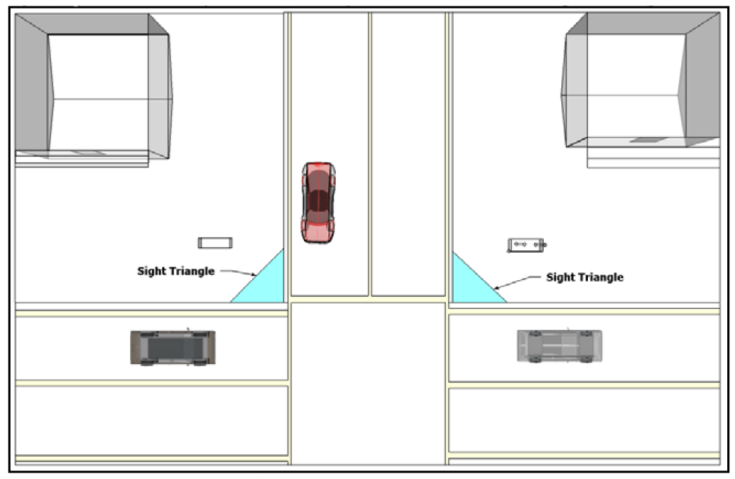
Sight Triangle
2-2.247
Sign. Any words, lettering, parts of letters, figures, numerals, phrases, sentences, emblems, devices, structures, designs, trade names, or trademarks by which anything is made known such as are used to designate an individual, firm, an association, a corporation, a profession, a business, or a commodity or product, which are used to attract attention.
2-2.248
Sign area. The entire area within a single continuous rectangle enclosing the extreme limits of such sign where writing, representation, emblem, or other display together with any material or color forming an integral part of the background may be placed; and in no case passing through or between any adjacent elements of same. However, such perimeter shall not include any structural or framing elements lying outside the limits of such sign and not forming an integral part of the display. Sign area shall be the same as sign face.
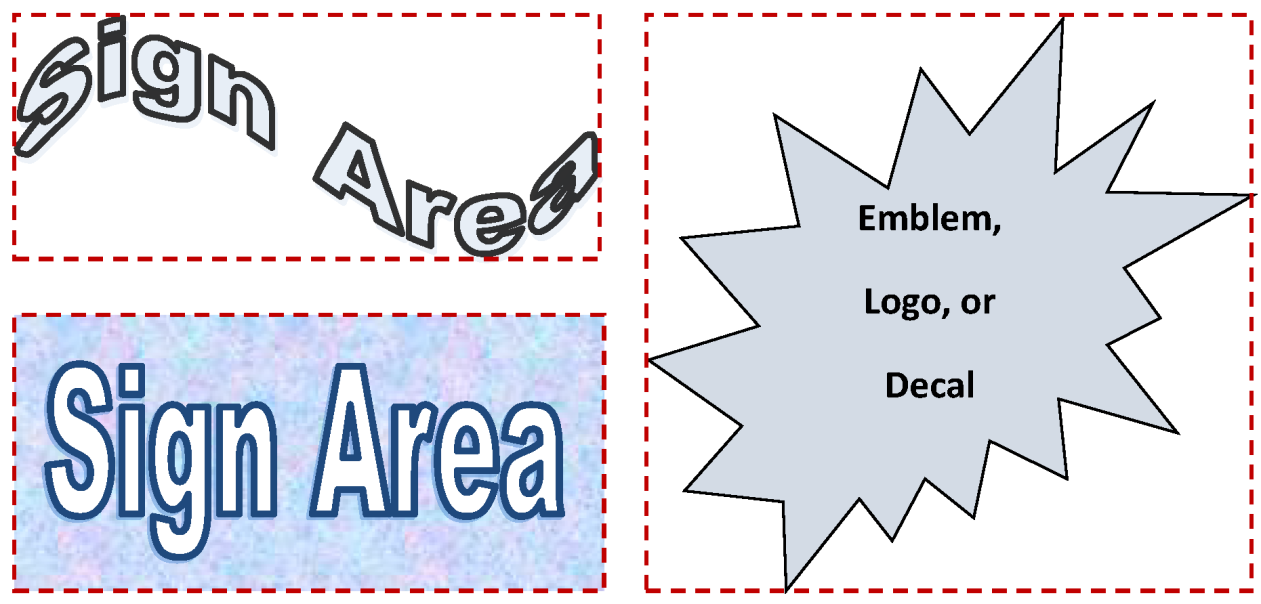
Sign Area Measurement Examples. Extent of Calculated Sign Area Shown in Red Dashed
Lines
2-2.250
Sign, banner. A non-permanent strip of cloth or other material on which a sign is drawn, written, painted, or otherwise applied.
2-2.251
Reserved.
2-2.252
Sign, canopy. A sign painted or otherwise applied to a permanent decorative porch or walkway cover other than an awning, which is attached to a building or supported by columns, extending to the ground. This definition shall include signs on gas station and convenience store canopies.
2-2.253
Reserved.
2-2.254
Reserved.
2-2.255
Reserved.
2-2.256
See "Sign area."
2-2.256.1
Sign, feather flag. A vertical sign that contains a pole driven into the ground for support or which is supported by means of an individual stand and which includes a vertically-elongated attached pennant. This definition includes banner flag, swooper flag, flutter flag, blade flag, sail flag, bow flag, teardrop flag, tall flag, and quill flag signs. This definition does not include pole banner signs.
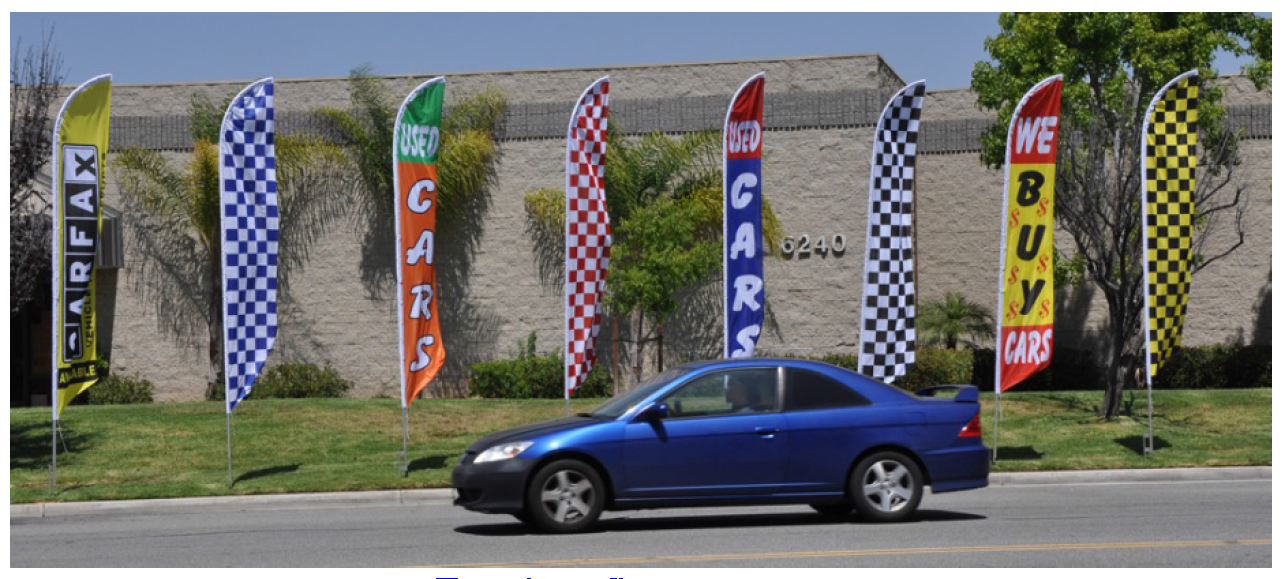
Feather Flags
2-2.256.2
Sign, fence screening. A sign printed or otherwise applied to a fence or gate wrap made of mesh fabric which is installed on a permitted fence and which is used to provide privacy, enhance safety, or provide wind protection at a construction site.
2-2.257
Sign, flag. A flag sign which is not classified as a governmental flag sign.
2-2.258
Sign, freestanding. A sign that is not attached to a building and is permanently attached to the ground by one (1) or more supports.
2-2.259
Sign, governmental flag. For the purposes of this Ordinance, a governmental flag is defined as the flag of the United States of America, the flag of nations recognized by the United States of America, the flag of the State of North Carolina, the flag of any state or territory of the United States, the flag of a political subdivision of any state or territory of the United States, or a governmentally affiliated military flag (e.g. Marine, Air Force, Navy, Army, Coast Guard, POW/MIA, etc.).
2-2.260
Sign height. The height of a sign shall be the vertical distance as measured from the normal grade to the highest point of the sign. Any berming or filling or excavating solely for the purpose of locating the sign shall be computed as a part of the sign height.
2-2.261
Sign, illegal. Any sign which was not lawfully installed or modified.
2-2.262
Sign, inflatable display. A display, that is gas or air-filled, and which is used to attract attention.
2-2.263
Sign, legal. Any sign that is not an illegal sign.
2-2.264
Sign, menu board. Signage attached or otherwise applied to the following types of menu boards:
(1)
Drive-through menu board used solely for drive-through service at a business where customers remain seated in a vehicle occupying a drive-through service lane to the point of a drive-through service window or other service area of a business;
(2)
Preview menu board which abuts a drive-through service lane and precedes the drive-through menu board for the purpose of expediting ordering of products and/or services from the drive-through menu; and
(3)
Parking stall menu board located immediately adjacent to a vehicle parking stall on the premises of a business utilizing drive-in parking stalls where customers remain seated in a vehicle.
2-2.265
Sign, noncommercial. A sign which carries no message, statement, or expression related to commercial interests.
2-2.266
Sign, nonconforming. Any sign which was lawfully erected and maintained in compliance with applicable code provisions, but which no longer complies with all of the provisions of this Ordinance due to the enactment of a subsequent amendment to this Ordinance.
2-2.267
Reserved.
2-2.268
Sign, obsolete. A sign related to or identifying a business which is no longer open or an activity or event which has already transpired.
2-2.269
Reserved.
2-2.270
Reserved.
2-2.271
Reserved.
2-2.272
Sign, outdoor advertising. Any outdoor sign, display, light, device, figure, painting, drawing, message, plaque, poster, billboard, or any other thing which is designed, intended, or used to advertise or inform, any part of the advertising or information contents of which is visible from any place on the main-traveled interstate or primary system, whether the same be permanent or a portable installation, and for which an outdoor advertising permit has been issued by the North Carolina Department of Transportation.
2-2.273
Sign, pedestrian wayfinding. A sign which facilitates pedestrian wayfinding and is part of an approved City wayfinding program.
2-2.273.1
Sign, pole banner. A sign which is vertically affixed at two ends to a light pole by way of pole banner brackets. This definition is not intended to include feather flag signs.
2-2.274
Sign, projecting. A sign forming an angle with a building, which extends beyond the exterior wall of the building and is attached to and supported by the building.
2-2.275
Reserved.
2-2.276
Sign, roof. Any sign attached to the roof of a building.
2-2.277
Sign, suspended. A sign that is attached to the underside of a horizontal plane or arm and is supported by the horizontal plane.
2-2.278
Reserved.
2-2.279
Sign, temporary. A sign which is intended for temporary use and which is not permanently mounted or permanently affixed to any structure nor permanently installed in the ground.
2-2.279.1
Sign, tri-view. A sign on which each face intermittently rotates with a maximum of three (3) faces per side.
2-2.280
Sign, wall. Any sign, other than a projecting sign, awning sign, or canopy sign, which is attached to or painted on the wall of a building.
2-2.281
Sign, window. Any sign that is attached to, painted on, or etched into a window.
2-2.882
Site Plan. A scaled drawing and supporting text showing the relationship between lot lines and the existing or proposed uses, buildings, or structures on the lot. The site plan may include site-specific details such as building areas, building height and floor area, setbacks from lot lines and street rights-of-way, intensities, densities, utility lines and locations, parking, access points, roads, and stormwater control facilities that are depicted to show compliance with all legally required development regulations that are applicable to the project and the site plan review. A site plan approval based solely upon application of objective standards is an administrative decision and a site plan approval based in whole or in part upon the application of standards involving judgment and discretion is a quasi-judicial decision. A site plan may also be approved as part of a conditional zoning decision.
2-2.283
Sixty-year setback. A distance equal to sixty (60) times the average annual long-term recession rate at a site, measured from the reference feature.
2-2.284
Special flood hazard area (SFHA). The land in the floodplain subject to a one (1) percent or greater chance of being flooded in any given year as determined in Subsection 18-3.2 of this Ordinance.
2-2.285
Special privilege to use. Allowing an applicant to use the property in a manner inconsistent with those uses permitted by the provisions of Section 11-1 of this Ordinance which would be applicable to the zoning district in which the property is located.
2-2.286.
Special use permit. A permit issued to authorize development or land uses in a particular zoning district upon presentation of competent, material, and substantial evidence establishing compliance with one or more general standards requiring that judgement and discretion be exercised as well as compliance with specific standards. This definition includes permits previously referred to as "conditional use permits" or "special exceptions".
2-2.286.1
Stable, private. A private stable houses horses, mules and ponies that are for the enjoyment of the property owner and horses are owned by the property owner.
2-2.286.2
Stable, public. A public stable houses horses, mules and ponies that are for the enjoyment of the property owner and the animals are available for hire, lease and/or riding lessons and stalls may be rented.
2-2.287
Stairway. One (1) or more flights of stairs and the necessary landings and platforms connecting them, to form a continuous and uninterrupted passage from one (1) story to another in a building or structure.
2-2.288
Start of construction. For other than new construction or substantial improvements under the Coastal Barrier Resources Act, P.L. 97-348, includes substantial improvement, and means the date the building permit was issued, provided the actual start of construction, repair, reconstruction, rehabilitation, addition, or improvement was within one hundred eighty (180) days of the permit date. The actual start means the first placement of permanent construction of a structure (including a manufactured home) on a site, such as the pouring of slabs or footings, installation of piles, construction of columns, or any work beyond the stage of excavation or the placement of a manufactured home on a foundation. Permanent construction does not include land preparation, such as clearing, grading, and filling; nor does it include the installation of streets and/or walkways; nor does it include excavation for a basement, footings, piers or foundations, or the erection of temporary forms; nor does it include the installation on the property of accessory buildings, such as garages or sheds not occupied as dwelling units or not part of the main structure. For a substantial improvement, the actual start of construction means the first alteration of any wall, ceiling, floor, or other structural part of the building, whether or not that alteration affects the external dimensions of the building.
2-2.288.1
Storage containers. A standardized reusable shipping container, with or without wheels, used in the transportation of freight and capable of being mounted and moved on a railcar, or mounted on a chassis for movement by truck trailer or loaded on a ship.
2-2.289
Story. That portion of a building included between the surface of any floor and the surface of the next floor above it, or if there is no floor above it, then the space between such floor and the ceiling next above it.
2-2.290
Reserved.
2-2.290.1
Street, limited. A publicly-dedicated street built to standards that differ from the standards applied to other local public streets. A limited street shall only be located within the City's corporate limits and be within a Planned Development (PD) zoning district.
2-2.291
Street, local. A local street is any link not part of a higher order urban system which serves primarily to provide direct access to abutting land and access to higher systems.
2-2.292
Street, local residential. Cul-de-sacs, loop streets, and streets less than two thousand five hundred (2,500) feet in length, or streets less than one (1) mile in length that do not connect thoroughfares, or serve major traffic generators, and do not collect traffic from more than one hundred (100) dwellings.
2-2.293
Street, major thoroughfare. Major streets that provide for the expeditious movement of volumes of traffic within and through urban areas.
2-2.294
Street, minor residential. A street serving primarily the lots or units in a subdivision, planned development, or apartment complex. No thoroughfares, highways, or state roads nor any street carrying or anticipated to carry volume of traffic which is found by the Land Use Administrator to be of such magnitude that to allow vehicles to back on to it would endanger life or property shall be considered a minor street.
2-2.295
Street, minor thoroughfare. A street which performs the function of collecting traffic from local access streets and carrying it to the major thoroughfare system. It may supplement the major thoroughfare system by facilitating minor through traffic movement and may also serve abutting property.
2-2.295.1
Street, private. A right-of-way for vehicular traffic that is privately owned and maintained which affords a means of access to abutting properties.
2-2.295.2
Street, public. A dedicated right-of-way for vehicular traffic which affords a means of access to abutting properties.
2-2.296
Street, residential collector. A local access street which serves as a connector street between local residential streets and the thoroughfare system. Residential collector streets typically collect traffic from one hundred (100) to four hundred (400) dwelling units.
2-2.297
Structure. Anything constructed, built, or erected with a fixed location on or in the ground or attached to something having more or less a fixed location on or in the ground. Among other things, structures include buildings, manufactured homes, garages, carports, porches, decks, signs, etc. For floodplain management and flood insurance purposes, a walled and roofed building, a manufactured home, a gas or liquid storage tank that is principally above ground.
2-2.298
Subdivider. Any person, firm, or corporation who subdivides or develops any land deemed to be a subdivision as defined in this Ordinance.
2-2.299
Subdivision. All divisions of a tract or parcel of land into two or more lots, building sites, or other divisions when any one or more of those divisions is created for the purpose of sale or building development, whether immediate or future, and shall include all divisions of land involving the dedication of a new street or a change in existing streets; but the following shall not be included within this definition nor be subject to the subdivision regulations contained in this Ordinance:
(1)
The combination or recombination of portions of previously subdivided and recorded lots where the total number of lots is not increased and the resultant lots are equal to or exceed the standards of the City as shown in its subdivision regulations.
(2)
The division of land into parcels greater than 10 acres where no street right-of-way dedication is involved.
(3)
The public acquisition by purchase of strips of land for the widening or opening of streets or for public transportation system corridors.
(4)
The division of a tract in single ownership whose entire area is no greater than 2 acres into not more than three lots, where no street right-of-way dedication is involved and where the resultant lots are equal to or exceed the standards of the City, as shown in its subdivision regulations.
(5)
The division of a tract into parcels in accordance with the terms of a probated will or in accordance with intestate succession under Chapter 29 of the General Statutes.
2-2.300
Subdivision, major. All subdivisions shall be considered major subdivisions except those defined as minor subdivisions in Article 4.
2-2.301
Subdivision, minor. The division of five (5) acres or less into five (5) or fewer lots and which creates no new public or private streets or roads, no right-of-way dedication, and no new easements except for electrical, drainage, cable or telephone easements, and no utility extensions.
2-2.302
Substandard dwelling or structure. A dwelling, dwelling unit, multifamily dwelling, apartment house, or any other space used or intended to be used as a habitable living space in any building or structure which does not meet the basic minimum requirements of this Ordinance for such use.
2-2.303
Substantial damage. Damage of any origin sustained by a structure during any one-year period whereby the cost of restoring the structure to its before damaged condition would equal or exceed fifty (50) percent of the market value of the structure before the damage occurred. See definition of substantial improvement.
2-2.304
Substantial improvement. Any combination of repairs, reconstruction, rehabilitation, addition, or other improvement of a structure, taking place during any one-year period whereby the cost of which equals or exceeds fifty (50) percent of the market value of the structure before the "start of construction" of the improvement. This term includes structures which have incurred "substantial damage," regardless of the actual repair work performed. The term does not, however, include either:
(A)
Any correction of existing violations of State or Community health, sanitary, or safety code specifications which have been identified by the community code enforcement official and which are the minimum necessary to assure safe living conditions; or
(B)
Any alteration of a historic structure, provided that the alteration will not preclude the structure's continued designation as a historic structure.
2-2.305
Substantially improved existing manufactured home park or subdivision. Where the repair, reconstruction, rehabilitation, or improvement of the streets, utilities, and pads equals or exceeds fifty (50) percent of the value of the streets, utilities, and pads before the repair, reconstruction, or improvement commenced.
2-2.306
Supplied. Paid for, furnished or provided by, or under the control of, the owner or operator.
2-2.307
Temporary housing. Any tent, manufactured home, or other structure used for human shelter that is designed to be transportable and that is not attached to the ground, to another structure or to any utilities system on the same premises for more than thirty (30) consecutive days.
2-2.308.1
Towing/recovery storage yard. An establishment/location offering the service of short-term storage (ninety (90) days or less) of towed/recovered/wrecked vehicles and which does not include dismantling, repair or service of the vehicles on the same site (see Section 14-36). Towing/recovery storage yard shall not include storage of junked vehicles or in any way operate as a "junkyard" except to the extent of processing of a vehicle as an "unclaimed vehicle" under G.S. 20-77.
2-2.309
Townhouse development. A townhouse development shall consist of one or more residential structures comprised of three (3) or more attached single-family residences, where land directly underneath each unit is sold with that unit.
2-2.309.1
Townhouse duplex. A residential structure constructed on a duplex lot, comprised of two (2) attached single-family residences where land directly underneath each unit is sold with that unit and the remainder of the land is owned as common area (see Section 14-41).
2-2.310
Townhouse lot. The area, when combined with one (1) attached single-family residence, which is sold fee simple within a townhouse development.
2-2.311
Townhouse plat. The entire development area as shown on an approved preliminary plat.
2-2.312
Trailer. Any vehicle, prefabricated vehicle, or prefabricated enclosure being or resembling a trailer, whether designed for a special installation or not, house car, camp car, house trailer, home trailer, home car, or any portable or movable vehicle on or off wheels, skids, rollers, blocks, brick, wood, steel, plastic, or aluminum, either self-propelled or propelled by any other means whatsoever, which is used or designed to be used for residential, living, sleeping, permanent office, commercial, or utility purposes, but not including those vehicles primarily designed for the transportation of goods.
2-2.313
Trailer, overnight camping. A vehicular-type unit primarily designed as temporary living quarters for recreational, camping, or travel use, which is mounted on or drawn by another vehicle. The basic entities are: travel trailer, camping trailer and truck camper.
2-2.314
Trailer park, camp or court. Land use or intended to be used, owned, leased, or rented for occupancy by six (6) or more trailers which are mounted on wheels, anchored in place by a foundation or other stationary supports, to be used for living or commercial quarters of any kind, together with automobile parking space and incidental utility structures and facilities required and provided in connection therewith. This definition shall not include trailer sales lots on which unoccupied trailers are parked for purposes of inspection and sales.
2-2.315
Trailer park, overnight camping (campground). An approved site, tract of land, or lot upon which not less than two (2) overnight campsites and/or overnight trailers occupied for temporary shelter, dwelling, recreational, or vacation uses may be located, regardless of whether or not a charge is made for such services. This use shall be classified under recreation use, outdoor.
2-2.315.1
Transitional family home. A not-for-profit home with support and supervisory personnel that provides room and board, personal care and habilitation services in a family environment for families with children transitioning into sustainable housing, all of whom live together as a single housekeeping unit and have entered into an occupancy contract. Support includes continued educational opportunities, budget and financial management counseling and assisting with employment opportunities.
2-2.315.2
Tree. A self-supporting woody plant having one (1) or more well-defined stems or trunks, a more or less definitely formed crown, usually attaining a mature height of at least ten (10) feet, and a trunk diameter of at least three (3) inches measured four and one-half (4 ½) feet (fifty-four (54) inches) above the ground.
2-2.315.3
Tree removal. The removal of a tree by an act that causes it to die, including: cutting, pruning, root damage or other damage resulting from construction, grading, paving, or other activities.
2-2.315.4
Understory tree. A tree that is normally less than thirty (30) feet in height at maturity, but that still provides shade and a degree of protection to the earth and vegetation beneath it. Examples of recommended understory trees are included in Appendix VI.
2-2.316
Unfit for human habitation. That conditions exist in a dwelling that violate or do not comply with one or more of the minimum standards of fitness or one (1) or more of the requirements established by this Ordinance.
2-2.317
Unit-ownership (condominium) development. A project of two (2) or more units in one (1) or more buildings designed and constructed for unit-ownership submitted under Section 3 of the North Carolina Unit-Ownership Act and other applicable regulations.
2-2.317.5
Value added operations. The enhancement added to a product or service before product is shipped.
2-2.318
Variance. A variance may be granted only by the Board of Adjustment pursuant to Section 3-7.3.
2-2.319
Ventilation. The process of supplying and removing air by natural or mechanical means to or from any space.
2-2.320
Violation. The failure of a structure or other development to be fully compliant with the community's floodplain management regulations. A structure or other development without the elevation certificate, other certifications, or other evidence of compliance required in Sections 18-4 and 18-5 is presumed to be in violation until such time as that documentation is provided.
2-2.320.1
Wall. For purposes of Article 19, "wall" includes any permanent architectural extension of a wall, including parapets, even if such extension projects beyond or above the enclosed portions of the building. For purposes of calculating sign area, the window area shall not be considered part of the wall.
2-2.321
Warehouse. A building used primarily for the storage of goods and materials.
2-2.322
Warehousing and distribution. A use engaged in storage, wholesale, and distribution of manufactured products, supplies, and equipment, but excluding bulk storage of materials that are flammable or explosive or that create hazardous or commonly recognized offensive conditions.
2-2.323
Watercourse. A lake, river, creek, stream, wash, channel or other topographic feature on or over which waters flow at least periodically. Watercourse includes specifically designated areas in which substantial flood damage may occur.
2-2.324
Water surface elevation (WSE). The height, in relation to mean sea level, of floods of various magnitudes and frequencies in the floodplains of coastal or riverine areas.
2-2.324.1
Wrecked. That which has outward manifestation or appearance of damage to parts and contents which are essential to operation.
2-2.325
Yard. A required open space unoccupied and unobstructed by any structure or portion of a structure from ground to sky.
2-2.326
Yard, front. A yard extending across the front of a lot from side lot line to side lot line and lying between the abutting street right-of-way line and the front building setback line.
2-2.327
Yard, rear. A yard extending across the rear of the lot from side lot line to side lot line and lying between the rear property line and the rear building setback line.
2-2.328
Yard, side. A yard extending along either side of a lot from front setback line to the rear building setback line.
2-2.329
Yard sale. All general sales, open to the public, conducted from or on a residential premises in any district for the purpose of disposing of personal household property. The term "yard sale" shall include all such herein described sales, whether or not they are garage, lawn, yard, attic, porch, room, backyard, patio, or rummage sales (see Section 14-27).
2-2.330
Zero lot line. The location of a building on a lot in such a manner that one (1) or more of the building's sides rests directly on a lot line.
2-2.331
Zone of imminent collapse. An area subject to erosion adjacent to the shoreline of an ocean, bay, or lake and within a distance equal to ten (10) feet plus five (5) times the average annual long-term erosion rate for the site, measured from the reference feature.
2-2.332
Zoning vested right. A right pursuant to G.S. 160D-108.1 to undertake and complete the development and use of property under the terms and conditions of an approved site specific development plan.
(Ord. No. 2021-O-15, § 1, 6-8-2021; Ord. No. 2021-O-17, § 1, 7-13-2021; Ord. No. 2022-O-07, § 1, 6-14-2022; Ord. No. 2022-O-08, § 1, 6-14-2022; Ord. No. 2022-O-14, § 1, 10-11-2022; Ord. No. 2022-O-15, § 1, 10-11-2022; Ord. No. 2023-O-14, § 1, 9-12-2023; Ord. No. 2025-O-04, 1-14-2025)
2-3 - Interpretation of Zoning District Boundaries
2-3.1
Streets, rights-of-way, and easements. Unless otherwise specifically indicated, where district boundaries are indicated on the Zoning Map as approximately following the centerline of a street, highway, railroad right-of-way, utility easement, stream or riverbed, or of such lines extended, then such lines shall be construed to be such district boundaries.
2-3.2
Lot lines. Boundaries indicated as approximately following platted lot lines shall be construed as following such lot lines.
2-3.3
Corporate limits. Boundaries indicated as approximately following the corporate limits shall be construed as following the corporate limits.
2-3.4
Property divisions. If a district boundary divides a lot, the requirements for the district in which the greater portion of the lot lies shall be extended to the balance of the lot; provided, that such extension shall not include any part of such lot which lies more than one hundred (100) feet beyond the district boundary; and further provided, that the remaining parcel shall not be less than the minimum required for the district in which it is located.
2-3.5
Vacation and abandonment. Where any public street or alley is hereafter officially vacated or abandoned, the regulations applicable to parcels abutting property shall apply to that portion of such street or alley added thereto by virtue of such vacation or abandonment.
2-3.6
Reserved.

