


Nampa City Zoning Code
CHAPTER 1
- GENERAL PROVISIONS
Sections:
10-1-1.- Title, citation and purpose.
This title, with maps, is known as the Nampa Comprehensive Zoning Ordinance. The purpose is:
• To promote the interest of health, safety and general welfare.
• To secure safety from fire and to provide adequate open spaces for light and air.
• To prevent the overcrowding of land.
• To avoid undue concentration of population.
• To conserve and stabilize property values.
• To promote the achievement of the comprehensive plan.
• To stabilize expectations regarding future development of Nampa thereby providing a basis for decisions with respect to such development.
(Ord. No. 4617, § 1(Exh. A), 10-4-2021)
10-1-2. - Terms and definitions.
A.
General.
Coloration: The appearance or pattern of color on an object.
Conjunction: The joining together or combining of two or more things.
Distinctive: Uniquely characteristic of a particular person, group or thing.
Drug paraphernalia: Anything defined or named under Idaho Code section 37-2701 as "drug paraphernalia."
Floodplain: Riverine floodplains are comprised of the floodway and the flood fringe. The floodway is comprised of the channel and adjacent overbank areas necessary to effectively convey floodwaters. The flood fringe are lands outside the floodway that are at or below the BFE that store, but do not effectively convey, floodwaters. Lands that compose the flood fringe will be inundated during a one percent chance flood event but, due to physical characteristics of the floodplain do not effectively convey floodwaters. The floodway and the Base Flood Elevation (BFE) of the one percent chance flood are determined using hydraulic modeling techniques.
Floodway: A "regulatory floodway" means the channel of a river or other watercourse and the adjacent land areas that must be reserved in order to discharge the base flood without cumulatively increasing the water surface elevation more than a designated height.
Flood hazard area: Flood hazard areas identified on the FEMA Flood Insurance Rate Map are identified as a special flood hazard area (SFHA). SFHA are defined as the area that will be inundated by a flood event having a 1-percent chance of being equaled or exceeded in any given year. The 1-percent annual chance flood is also referred to as the base flood or 100-year flood. Moderate flood hazard areas are the areas between the limits of the base flood and the 0.2-percent-annual-chance (or 500-year) flood.
Grade (gradient): The degree of inclination between two points, such as the grade of a road or sidewalk.
Grade elevation (ground level): The average of the finished ground level at the center of all walls of a building. In case walls are parallel to and within five feet of a sidewalk, alley or other public way, the grade elevation shall utilize the grade elevation of the adjacent sidewalk, alley or public way as the baseline elevation.
Grantor: A person or organization that makes a grant, gift or bequeathal.
Mass: The physical volume or bulk of a solid body.
Photometric test report: A report that analyzes the intensity, location, and distance that a light source emits.
Semiprivate facility: Any facility to which a class or a group of the public is permitted to attend or use subject to the regulations of an organization owning or regulating such facility.
B.
Planning and zoning.
Abutting: Land having a common property line or district line except when separated by a street, alley, railroad right-of-way, canal or easement.
Adjoining district: Lands within one block (usually 300 to 460 feet) radius of a point of reference. The lands may be in the same or a different zoning district than where the point of reference is based.
Area of city impact: The development area around but outside the city limits where the action or inaction of one jurisdiction affects another jurisdiction.
Buildable (lot or parcel): Jargon referring to whether or not a building permit may be issued for construction or modification of a principal structure upon a property.
Bulk requirements: Refers to zoning code established minimum, quantifiable, dimensional standards or measurements applicable to properties. For example, setback, density, height regulations are all bulk type zoning controls.
Certificate of occupancy: A certificate, issued by the city, to occupy a premises after inspection has verified compliance with the requirements and provisions of this title and applicable building and fire codes.
Commission: Planning and Zoning Commission as established in title 2 of this Code.
Comprehensive plan: A plan adopted by the council, which includes such things as the general location and extent of present and proposed physical facilities including housing, industrial and commercial uses, major transportation, parks, schools and other community facilities.
Conditional use: A use that may be permitted (if approved through a public hearing process by the planning and zoning commission and/or city council) in one or more zones as defined by this title but which, because of characteristics peculiar to such use, or because of size, technological processes or equipment, or because of the exact location with reference to surroundings, streets, and existing improvements or demands upon public facilities, requires a special degree of control to make such uses consistent with and compatible to other existing or permissible uses in the same zone(s). Also, sometimes referred to as a special use.
Conditional use permit: The documental evidence of authority granted by the planning and zoning commission to locate a conditional use at a particular location.
Dedication: The assignment of private property to a specific public use and its acceptance for use by a government entity.
District or zone: A portion of the territory of the city within which certain uniform regulations and requirements, or various combinations thereof, apply under the provisions of this title.
Easement: A defined portion of a property that holds specific access or building rights. When an easement and a setback overlap, no structure shall be constructed on the easement, unless an encroachment agreement is secured.
Enclave: An unannexed parcel or island of parcels contiguous with the city limits on all sides or surrounded by other properties so annexed into the city.
Final plat: The final map, drawing or chart on which the subdivision is presented to the city for approval.
Nonconforming building/use/situation: A building, land use or site situation/condition which is not permitted or is noncompliant (e.g., a setback, parking stall count, paving or landscaping provision) according to the regulations of the zone/district in which it is located, but which was permitted by, or conformed to, requirements of a previous zoning ordinance.
Permitted use: Any use authorized or permitted alone or in connection with another use in a specified district and subject to the limitations of the regulations of such use district.
Permittee: Recipient of a permit (also may refer to an applicant for a permit).
Planning director: A city official charged with the administration and enforcement of provisions of this title.
Planning director agent or representative: A city official who is appointed by the planning director to administer and render decision on his/her behalf.
Variance: An adjustment made in the application of the specific regulations of this title to a particular piece of property, which property because of special circumstances applicable to it is deprived of privileges commonly enjoyed by other properties in the same zone or vicinity and which adjustment remedies disparity in privileges. A variance is a form of special exception.
Zoning permit: A document issued by the city certifying that proposed buildings, structures or uses are consistent with the terms of this title so long as they comply with other requirements hereof.
C.
Animals and bees.
Animals:
Animal: Any organism other than human beings needing food to maintain and sustain its life which generally has mobility and a developed central nervous system.
Animal, feral: An animal that belongs to a domestic or agricultural species but behaves like a wild, free ranging species. They may or may not belong to humans.
Animals, agricultural: Animals normally kept for commercial production and sale, utility, and/or family food production, excluding swine, but including, and not limited to, animals to be considered, at maturity, "large" such as cattle, horses, mules, llamas, alpacas, emus, ostriches, and rheas; animals to be considered "medium" such as goats, potbellied pigs (only when kept as "pets" by special permit), sheep, turkeys, and miniature horses; and animals to be considered "small" such as chickens, chinchillas, rabbits, ducks, geese and bees. For purposes of this title and regulation, bees are to be considered as "agricultural animals" and are specifically addressed in section 10-21-4 of this title under "apiary" guidelines.
Animals, domestic pet: An animal that lives in or near the habitations of humans, often tamed, which is kept for companionship or utility but not for commercial purposes, including, but not limited to, amphibians (nonvenomous), cats, dogs, birds (excluding licensed birds of prey), reptiles (lizards, nonvenomous snakes), rodents (hamsters, gerbils, mice, rats, ferrets), aquarium fish and rabbits (although these are often "farmed"), and insects. Also, any agricultural animal so designated by permit from the planning director.
Animals, exotic: Animals not usually considered to be pets or agricultural animals. The term connotates unique, nonnative, or special in nature. See definition of animals, exotic, wild.
Animals, exotic, wild: Species (including hybrids) not native to the State of Idaho, whether or not in captivity, including, but not limited to, chukar, red fox, squirrels, lions, tigers, elephants, llama (allowed as agricultural animal), monkeys, dangerous reptiles like alligators, crocodiles, and gila monsters, Valley quail (California quail), Bobwhite quail, Gamble's quail, pheasants, turkeys (allowed as agricultural animal), also includes feral animals.
Animals, native wild: Free ranging species (including hybrids) presently native to the State of Idaho including bats, black bears, beavers, birds of prey (eagles, falcons, hawks, vultures, owls), magpies, mountain quail, mink, muskrats, bobcats, cougars, deer, elk, moose, kit fox, coyotes, gray wolf, skunks, weasel, badgers, raccoons, chipmunks, marmots, pocket gophers, ground squirrels, rabbits, mice, wood rats, river otters, porcupines, lizards, turtles, snakes, toads, frogs, songbirds, waterfowl (e.g., ducks), ravens, crows, various fish, insects.
Animal, service: An animal that accompanies a human to provide assistance, comfort, emotional support or therapeutic relief (such as would be provided by a trained service or guide dog, etc.) (see sections 6-2-16 and 6-2-18).
Animals, wild: Any animal of any size or species considered potentially dangerous or to have a greater than average chance to create nuisances and thereby disturb the public or whose presence in the community is an abnormality. These are animals not normally kept in captivity and may include, but are not limited to, the animals listed under "animals, exotic, wild" and "animals, native wild" as defined herein. Other animals normally associated with a zoo environment or considered protected or endangered species, are included here as well. (Note: Persons, groups, or centers commonly associated with maintaining wild animals include rehabilitators, falconers, and game ranches who are all to be licensed by various state and federal agencies.)
Grooming establishment, animal: Any place where animals (notably cats and dogs) are cared for by administering haircuts, or clipping, are bathed or otherwise conditioned as pets and/or for show in exchange for a fee. Such establishment shall be considered a small animal clinic for purposes of regulation.
Kennel, commercial: Any lot, building or enclosure, or portion thereof, in which more than two dogs and/or cats of at least six months of age are kept commercially for board, propagation, treatment and/or training. This includes centers where police, guard, or seeing eye dogs are trained and/or kept for sale. A kennel license is required per section 6-2-20 of this Code for this use.
Kennel, noncommercial: Any lot, building or enclosure, or portion thereof, in which more than a total of two dogs/pot belly pigs, of at least six months of age are kept, maintained and/or boarded, excluding one documented service animal for the use and enjoyment of the owner for personal, noncommercial purposes. The keeping of more than two dogs/pigs, more than six months of age, requires a conditional use permit and a noncommercial kennel license per section 6-2-20 of this Code.
Owner(s), animal: Any person(s), partnership(s), or corporation(s) owning, keeping, or harboring, possessing, or caring for or having any custodial duties over one or more animals.
Pasture: An enclosure for animals in which no feed is provided except that which the animals obtain by grazing.
Pen(s), animal: Any construction used to enclose, restrain, harbor, house, trap, or otherwise hold an animal within its confines that does not meet the criteria for a kennel, or shelter. The term is synonymous with run.
Performing animal exhibition: Any spectacle, display, act, or event, other than circuses, in which performing animals are used.
Pig, potbellied: Vietnamese or Chinese "minipig" kept at times as pets (allowed in Nampa up to a maximum size of 160 pounds and 24 inches in height).
Retail pet store: A place or person that obtains domesticated animals and/or animal supplies and offers them for sale, exchange, barter, or hire to the general public as a principal or agent, or on consignment, or who holds himself to be so engaged in said retail practice or use. Includes "pet shops" but does not include:
A.
Establishments or persons who deal in dogs used as guides by the visually impaired, or for hunting, security, or breeding purposes;
B.
Establishments or persons exhibiting, selling, or offering to exhibit or sell any wild or exotic or other "nonpet" species of warm-blooded animals (except birds), such as skunks, raccoons, primates, squirrels, ocelots, foxes, coyotes, etc.;
C.
Any establishment or person selling warm blooded animals (except birds, and laboratory rats and mice) for research or exhibition purposes;
D.
Any establishment wholesaling any animals (except birds, rats, and mice);
E.
Any establishment exhibiting pet animals in a room that is anywhere off the retail pet store premises;
F.
Any approved home occupation business dealing in or with pets.
Riding school (academy) or stable: Any place that has available for hire, boarding, and/or riding instruction, any horse, pony, donkey, mule, or burro, or similar animal; or any place that regularly buys, sells, or trains the above animals, including a small racetrack, trotting track, or rodeo.
Shelter, animal: A facility used to house or contain stray, homeless, abandoned or unwanted animals and that is owned, operated, or maintained by an organization dedicated to animal protection, an established humane society, animal welfare society, Society For The Prevention of Cruelty to Animals, or other nonprofit organizations devoted to the welfare, protection, and humane treatment of animals. Animals are contained within the facility for care, confinement, return to owner, adoption, or euthanasia. This use shall be considered as equivalent to a large animal clinic for purposes of regulation.
Zoo: A facility used to house and exhibit principally exotic animals under the supervision of trained, professional keepers as regulated by the Idaho Zoological Society.
Bees:
Apiary: Bees and hives wherever they are kept, located, or found (except native wild colonies).
Bees: Honey producing insects (of all life stages) of the genus Apis.
Colony, bee: A group of bees having a queen.
Colony, feral bee: A colony of bees (usually perceived by the public as wild in nature) in a natural cavity or a manufactured structure not intended for beekeeping on movable frames and comb.
Hive, abandoned bee: Any hive with or without bees, that evidences a lack of being properly managed in that it has not been supered in the spring, except nucs, or unsupered in the fall, or is otherwise not managed and/or left without authorization and is unattended on the property of another person or on public land.
Hive, bee: Any receptacle or container, or part of any receptacle or container, which is inhabited by a live colony of bees.
Swarm: A natural group of bees having a queen(s), which is the progeny of a parent colony, without a hive, and not a feral colony.
D.
Architecture and buildings.
Appropriate historic hues: Muted and a limited number of colors, usually not more than two accent colors used in any one building. See guidelines for specific color pallet. Colors shall be selected from the historical color pallet on file at the City of Nampa's Planning and Zoning or Economic Development Departments.
As built roof: The roof pitch and style constructed when the structure was originally constructed.
Basement: Any story having it's finished floor, not entirely above grade plane. A basement, when designated for or occupied by business or manufacturing shall be considered a story.
Building: Any structure utilized or intended for supporting or sheltering any occupancy.
Building addition: Extension or increase in floor area, number of stories, or height of a building or structure.
Building alteration: Any construction or renovation to an existing structure other than repair or addition.
Building expansion: See section 10-1-6 of this chapter.
Building front: Wall(s)/elevation(s) of a building that most directly adjoin(s) and face(s) the street from which the property the building sets upon derives access. This connotes that, generally, a building's "front" wall will run laterally parallel to the frontage street serving the property. In cases where more than one street abuts a property, then each such frontage may be considered a front or street side by the planning and zoning department, planning and zoning commission or building and site design standards committee as a case warrants.
Building/structure height: See Figure 9 of this chapter.
Building, principal: A building in which is conducted the principal use of the property on which the building is situated.
Building site: A total horizontal area within the property lines excluding external street, public or private.
Carport: A stationary structure to house or protect motor vehicles owned or operated by the occupants of the principal building which is open to the weather on at least two sides.
Cellar: That portion of a building between floor and ceiling which is wholly or partly below grade and so located that the vertical distance from grade to the floor below is equal to or greater than the vertical distance from grade to ceiling.
Corbel: A bracket of brick or stone that juts out of a wall to support a structure above it.
Court, building: An open uncovered space, unobstructed to the sky, bounded on three or more sides by exterior building walls or other enclosing devices.
Courtyard: An open uncovered space unobstructed to the sky surrounded by structures or walls, or landscaping to define the space.
Dentil: One of a series of small, square projecting blocks in the molding of a cornice.
Detached building: A building surrounded on all sides by open space.
Development site: Any location, be it on one or more parcels, lots or tracts of ground where land development, building and/or a project is planned to happen, is in process of being developed/built or is in place. For the purpose of this definition, ownership of a development site is deemed to include a lease of not less than 50 years' duration, with an option to renew such lease so as to provide a total lease of not less than 75 years' duration.
EIFS: Exterior insulation finish system, an exterior finish system with insulation.
Facade: Any face of a building, especially the principal or front face showing prominent architectural features.
Facade improvements: Any alteration of an existing building facade including repainting, etc.
Fascia: The flat horizontal surface immediately below the edge of a roof.
Gross floor area: The sum of the gross horizontal areas of the floors of a building or buildings, measured from the exterior faces of exterior walls and the centerline of division walls. Floor area shall include basement space, elevator shafts and stairwells at each floor, mechanical equipment rooms or attic spaces with headroom of seven feet six inches or more, penthouse floors, interior balconies and mezzanines, and enclosed porches. Floor area shall not include accessory water tanks and cooling towers, mechanical equipment or attic spaces with headroom of less than seven feet six inches, exterior steps or stairs, terraces, breezeways and open spaces.
Historic storefront pattern: A storefront which exhibits proportion and regular patterns in the relationship of windows, walls and doors, and is characterized by recessed entries, vertical and horizontal elements, and transparency.
Historic structure: Any structure that is: a) listed individually in the National Register of Historic Places or preliminarily determined by the Secretary of the Interior as meeting the requirements for individual listing on the National Register; b) certified or preliminarily determined by the Secretary of the Interior as contributing to the historical significance of a registered historic district or a district preliminarily determined by the secretary to qualify as a registered historic district; c) individually listed on a state inventory of historic places that have been approved by the Secretary of Interior; or d) individually listed on the city's inventory of historic places.
Net floor area: Gross square feet of a building, minus the following square footage: floor area devoted to accessory water tanks and cooling towers or HVAC equipment, attic space with headroom of less than seven feet six inches, exterior steps or stairs, terraces, breezeways and open spaces (such as lobbies, unless adjoining customer service counter space), closets (including utility/janitorial), bathrooms, break rooms, hallways, fire riser rooms or other spaces determined to be exempt by the planning and zoning director or his/her representative.
Original architectural character: The architectural style or elements of an architectural style that existed when the building was originally constructed.
Original building: The building that was located on a site prior to any major remodel, rehabilitation or expansion.
Parapet: A low protective wall built, for example, along the edge of a balcony, roof or bridge.
Quoin: To build an outer corner of a wall using blocks that are different, for example, in size or texture, from the other blocks or bricks used to build the wall.
Redevelopment: The rehabilitation of buildings or sites that have been neglected, run down, blighted or are in otherwise dilapidated condition such that rehabilitation is required to restore them to meet code standards.
Rehabilitation: The process of returning a structure to a state of utility through repair or alteration while preserving those portions or features which are significant to its architectural, historic, or cultural value.
Remodel: Any change to the exterior surfaces or external appearances of a building including, but not limited to, renovation, rehabilitation, reconstruction, restoration, replacement, or rearrangement of structural parts or elements; or any change that affects the plan configuration of walls, spaces, or bulk of a building.
Soffit: The underside of a structural component of a building, for example, the underside of a roof overhang or the inner curve of an arch.
Story, half: Any basement or cellar, except as provided in this title, which has less than six feet of its height above grade.
Structure: A combination of materials constructed and erected permanently on the ground or attached to something having a permanent location on the ground or on a movable support system like skids. Typically, structures are buildings. Not included are residential fences less than six feet in width, retaining walls, rockeries and similar improvements of a minor character less than three feet in height.
Structure, accessory: See accessory structure in residential dwellings.
Structure, contributing: A building, site or structure that adds to the historic architectural qualities, historic association, or cultural values of the district through location, design, setting, materials, workmanship, or association.
Structure, noncontributing: A building, site or structure that does not add to the historic architectural qualities, historic association, or cultural values of the area because: a) it was not present during the period of significance; b) it does not relate to the documented significance of the property due to alterations, disturbances, additions, or other changes; or c) it no longer possesses historic integrity nor is capable of yielding important information about the period.
Stucco: Plaster used for surfacing interior or exterior walls, often used in association with classical moldings.
Traditional building materials: Brick, masonry, stucco, wood, accents of metal, ceramic, etc.
Traditional building width: Buildings in the subdistrict were originally built on lots 25 feet to 50 feet in width.
Transparency: The amount of visibility allowed through a building plane as provided by windows and other openings.
E.
Land uses.
Agriculture: Use of the land for farming, dairying, pasturage, apiaries, horticulture, floriculture, viticulture, animal and poultry husbandry, and the necessary accessory uses for packing, processing, treating or storing the produce; provided the operation of any such accessory uses shall be secondary to that of normal agricultural activities; and that the above uses shall not include the commercial feeding of garbage or offal to swine or other animals. (See section 10-3-2 of this title.)
Alcohol sales establishment (primary use): Any premises where beer, wine or liquor is sold for consumption on premises and liquor receipts constitute 40 percent or more of gross receipts, including but not limited to: bars, lounges and nightclubs, brewery, wineries, distilleries, etc. This definition does not apply if a business' primary sales other than alcohol, exceed 60 percent. When alcohol sales are not distinguishable from the fee or sale of another service or product, the Planning Director or his/her designee shall review each business plan on a case by case basis to determine whether this definition applies.
Automobile or mobile home sales area: An open area, other than a street, used for the display, sale or rental of new or used motor vehicles or mobile homes in operable condition and where no repair work is done, but not including the rental of mobile homes as dwelling units in the sales area.
Automobile repair: Property whereupon vehicle repair is conducted (whether completely in a building or otherwise). Sales of vehicles on the same property may be allowed if automobiles or truck sales is allowable in the zone wherein the repair facility is located. Also, limited vehicle parts salvage and storage may be allowed provided that the area devoted to storage of parts for sale or being stored does not exceed the area devoted to repair of vehicles and that such activity does not, to the reasonable observer, become the predominant activity conducted by the business on the property. Any such storage must comply with storage restrictions (e.g., screening requirements) that may be in force on the property per zoning codes.
Automobile wrecking: The dismantling or disassembling of used motor vehicles or mobile homes, or the storage, sale or dumping of dismantled, obsolete or wrecked vehicles or their parts.
Call center: An office set up to handle a large volume of phone calls, especially for taking orders and providing customer service for a product or service. (Refer to office, general in section 10-3-2.)
Campus: The land upon which multiple buildings share common space.
Church/church uses: Church or place of worship is a building for regular assembly for religious worship that is used primarily for such purpose, which may or may not contain accessory activities that are customarily associated therewith and which may or may not contain the place of residence for ministers, priests, monks, nuns, rabbis or others who lead religious worship on the premises. Church or place of worship shall not include such nontraditional accessory uses as retail sales of nonreligious and nonchurch related goods, residential uses (other than as permitted hereinabove), or sports and/or entertainment facilities when not used for church purposes or when rented out for revenue purposes.
Circus: A commercial variety show featuring animal acts among others for public entertainment.
Clinic (medical/dental/health care): A property designed and used for the medical, dental or surgical diagnosis or treatment of patients under the care of doctors and/or nurses, or for the provision of other healthcare related services.
Clinic, large animal: Any building or portion thereof or business establishment designed or used for the care or administration of veterinary services for any agricultural or exotic animals. This use can also include veterinarian uses.
Clinic, small animal: Any building, or portion thereof, or business establishment designed or used for the care or administration of veterinary services for any of the following animals: dogs, cats, primates, birds, waterfowl, reptiles, rodents and similar animals, domestic pet animals on an outpatient basis. This use can also include small animal grooming businesses or veterinarian uses.
Club: An incorporated or unincorporated association of persons organized for social, fraternal, athletic, educational, literary or charitable purpose. Property occupied by a club is deemed to be semiprivate in character and is subject to the regulations governing public buildings and places, excluding groups organized primarily to render a service which is normally considered a business.
Commercial use: An activity with goods, merchandise or services for sale or rent.
Community center: A place where people for a particular/specific community can meet for social, educational, or recreational activities/events.
Community shopping center: A shopping center which provides, in addition to the convenience goods of the neighborhood center, a wider range of facilities for the sale of shopping goods such as apparel and furniture. A small department store, variety store or discount department store is the principal or anchor tenant.
Convenience store: A neighborhood store engaging primarily in the sale of basic food items. Nonfood items may also be sold provided they are considered everyday convenience goods.
Corporation yard, service yard: Buildings and premises, including offices, used by any person or by the city for storage, maintenance, repair and processing of equipment, materials and other items involved in construction or maintenance of physical facilities having permanent fixed locations, or in the operation of a fleet of rolling stock. (Also see Flex space in this title.)
Data center: A group of networked computer servers used by commercial organizations for the remote storage, processing, or distribution of large amounts of data.
Day nursery: Any institution, establishment or place in which are commonly received at one time more than 12 children not of common parentage, under the age of six years, for a period not exceeding 12 hours, for the purpose of being given board, care or training for compensation or reward.
Drive-in enterprise: A business activity or other use of land consisting of sales or service activity predominantly rendered to patrons who normally receive the products or utilize the services at least in part while in automobiles upon the premises. This definition includes, inter alia, automobile service stations, automotive car washes and drive-in or drive-through restaurants.
Drug paraphernalia store: Any store or shop that carries as product lines and/or sells any commodity/substance that has been banned and deemed illegal as a controlled substance by the State of Idaho, the Idaho Pharmaceutical Board, or the federal government.
Event center: A commercial establishment/venue which hosts social/business/educational/recreational gatherings for events such as: weddings, receptions, birthday parties, fundraising events for non-profits, class reunions, church and/or family activities.
Farmer's market: A seasonal event that is held on a periodic basis (generally weekly or twice a week during the summer months) that contains local produce and other street vendors. Farmer's markets are limited to areas that provide controlled space for vendors and patrons on paved surfaces in all off-street and on-street locations. If located on public streets, the appropriate right-of-way permit(s) is/are required. In all cases, the appropriate permitting from the City of Nampa and/or other regulatory agencies is required.
Firearms business: A business that participates in sales, storage, manufacturing, gunsmithing, and/or assembly of firearms/ammunition.
Flex space building: A commercial/industrial structure that can be modified internally for a variety of land uses.
Garage, repair: A building used for the storage, parking, care, servicing, or repair of motor vehicles, or where such vehicles are kept for remuneration, hire or sale.
Grooming establishment, animal: Any place where animals (notably cats and dogs) are cared for by administering haircuts, or clipping, are bathed or otherwise conditioned as pets and/or for show in exchange for a fee. Such establishment shall be considered a small animal clinic for purposes of regulation.
Hospital: An establishment which provides accommodations, facilities and services over a continuous period of 24 hours or more for observation, diagnosis and care, of two or more individuals, not related by blood or marriage to the operator, who are suffering from illness, injury, deformity or abnormality, or from any condition requiring obstetrical, medical or surgical services.
Hospital, animal: Premises for the medical or surgical treatment of animals or pets, including dog, cat and veterinary hospitals, including the boarding of hospitalized animals.
Hotel/motel: A commercial establishment offering paid lodging in multiple rooms or suites on a short-term basis (less than 31 days).
Hookah lounge (hookah bar): An establishment where patrons share tobacco from a communal hookah or shisha. This is considered a tobacco-related establishment for the purposes of this Code.
Kennel, commercial: See definition in section 10-1.
Kennel, noncommercial: See definition in section 10-1.
Marketplace: A place where goods and services are sold. The size can extend from several acres with large box retailers to a more intimate setting within a local commercial area with local retailers and smaller establishments. A marketplace setting includes a distinct identity with well-designed common areas, storefronts, parking areas, plazas, signage and other accoutrements.
Mobile home park: Any privately-owned place where two or more mobile homes used for human occupancy are parked within 500 feet of each other on a lot, tract or parcel of land under the same ownership (see section 10-28).
Neighborhood shopping center: A shopping center which provides for the sale of convenience goods and personal services for the day to day living needs of the immediate neighborhood. These are goods such as food, drugs, hardware and personal services. A supermarket is the principal tenant.
Primary use: The principal or predominant use to which the property is or may be devoted, and to which all other uses on the premises are accessory.
Professional offices: Offices maintained and used as a place of business for professionals including, but not limited to, engineers, attorneys, architects, certified or licensed public accountants, landscape architects and other design services, management services, occupational therapists, geologists, surveyors, real estate agents, realtors, financial planners or advisors, appraisers, social workers, and other persons providing services that commonly require specialized training or professional certification. Professional offices do not include offices maintained and used as a place of business for medical, dental or health care related professions, which are addressed under the definition for clinic (medical/dental/health care).
Public utility: A public service corporation performing some public service and subject to special governmental regulations, or a governmental agency performing similar services, the services by either of which are paid for directly by the recipients thereof. Such services shall include, but are not limited to, water supply, electric power, gas and transportation for persons and freight.
Restaurant: Any premises (other than a boarding house) where meals are provided for compensation. In order to serve beer, wine or liquor in a restaurant, liquor receipts shall constitute less than 40 percent of gross receipts for food and liquor combined. Restaurants whose liquor receipts constitute 40 percent or more of gross receipts for liquor and food combined shall be classified as taverns (see Alcohol sales establishment in this section).
Retail, bulky: Greater than 15,000 square feet (big box retailers 104,000 to 170,000 square feet) - Merchandising of cumbersome items sold from warehouse style buildings conducive to purchase. Mattresses, furniture, appliances, etc.
Retail, general: Less than or equal to 15,000 square feet - sales of relatively small quantities for use or consumption by the general public.
Retail pet store: A place or person that obtains domesticated animals and/or animal supplies and offers them for sale, exchange, barter, or hire to the general public as a principal or agent, or on consignment, or who holds himself to be so engaged in said retail practice or use. Includes "pet shops" but does not include:
A.
Establishments or persons who deal in dogs used as guides by the visually impaired, or for hunting, security, or breeding purposes;
B.
Establishments or persons exhibiting, selling, or offering to exhibit or sell any wild or exotic or other "nonpet" species of warm-blooded animals (except birds), such as skunks, raccoons, primates, squirrels, ocelots, foxes, coyotes, etc.;
C.
Any establishment or person selling warm blooded animals (except birds, and laboratory rats and mice) for research or exhibition purposes;
D.
Any establishment wholesaling any animals (except birds, rats, and mice);
E.
Any establishment exhibiting pet animals in a room that is anywhere off the retail pet store premises;
F.
Any approved home occupation business dealing in or with pets.
Riding school (academy) or stable: Any place that has available for hire, boarding, and/or riding instruction, any horse, pony, donkey, mule, or burro, or similar animal; or any place that regularly buys, sells, or trains the above animals, including a small racetrack, trotting track, or rodeo.
Salvage/recycling/junk/wrecking yard: Property whereupon the primary use is to salvage, strip, store and/or recycle junk, waste, junk vehicles, discarded or salvaged materials/parts in preparation for future dismantling, destruction, resale, repair or rebuilding. As pertaining to vehicles, this definition connotates that vehicles within such areas are inoperable either physically and/or legally (i.e., licensed and registered). While, expectedly, occasional sale or trading of items being stored may occur, this use classification/definition does not expect that such will become the primary activity conducted from the site. Specific examples (in common vernacular) of such uses include, but are not limited to, the following: automobile wrecking yards, house wrecking yards, junkyards, salvage yards, etc. (See automobile wrecking in this section.)
School, commercial: A building where instruction is given in arts, crafts or trades and operated as a commercial enterprise as distinguished from schools endowed and/or supported by taxation.
School, elementary, junior or senior high, including public, private and parochial: An institution of learning which offers instruction in the several branches of learning and study required to be taught in the public schools by the Idaho State Board of Education.
Secondary use (incidental or accessory): A minor or second use for which a lot, structure or building is designated or employed in conjunction with, but subordinate to, its primary use.
Service station or filling station: A retail place of business engaged in supplying goods and services essential to the normal operation of vehicles such as dispensing of fuel and motor oil, vehicle washing and lubricating services, and the sale and servicing of tires, batteries, replacement items and other automotive accessories.
Shelter, animal: A facility used to house or contain stray, homeless, abandoned or unwanted animals and that is owned, operated, or maintained by an organization dedicated to animal protection, an established humane society, animal welfare society, Society for the Prevention of Cruelty to Animals, or other nonprofit organizations devoted to the welfare, protection, and humane treatment of animals. Animals are contained within the facility for care, confinement, return to owner, adoption, or euthanasia. This use shall be considered as equivalent to a large animal clinic for purposes of regulation.
Storage/impound yard: Property whereupon the principal use in operation entails storage of building materials, contractors' materials, equipment, vehicles or other nonjunk, waste, refuse, or discarded materials. This connotates that vehicles within such areas are operable both physically and legally (i.e., licensed and registered). While, expectedly, occasional sale or trading of items being stored may occur, this use classification/definition does not expect that such will become the primary activity conducted from the site. Salvaging as a principal business practice is not an allowed activity within storage yards. Specific examples of storage/impound yard types include, but are not limited to, keeping/impounding of vehicles, buildings, heavy construction or farming or railroad or trucking equipment/machinery, contractor and/or construction/utility line materials of all sorts, etc.
Structure, temporary: Structure/building not having or requiring permanent attachment to the ground and erected for a period of less than 180 days in a calendar year.
Tattoo parlor: An establishment in which tattooing is carried out by a licensed professional.
Use: The purpose of land, buildings or structures for which it is occupied, maintained, arranged, designed or intended.
Use, seasonal: Any temporary use where merchandise is sold in connection with a holiday season or the growing season. These uses shall include, and are limited to, the following: produce stand, fireworks stands, pumpkin sales lots, Christmas tree lots, and farmers' markets.
Use, temporary: Any activity on a site operating for a limited time of operation. Such uses may include, but are not limited to, seasonal, event related or holiday sales of products or placement of temporary structures on a lot incidental to construction occurring on the lot, outdoor sales of merchandise, foodstuffs, temporary residences, offices or use of a permanent structure, visiting carnivals or amusement businesses, recycling containers placed on a site, and/or any other uses which the Director, or his/her authorized designee, may deem as able to function without permanent permits for a short time as allowed by this Code.
Vape store: A retail store that sells and promotes the use of vaporizing or e-cigarettes and the oils and products associated with the use of vaping equipment. Because these products generally involve inhaling vapors with tobacco oils in them, they are associated with tobacco-related establishments for the purposes of this Code.
Veterinary: The practice of prevention, cure or alleviation of disease and injury in animals without boarding services.
Village: A setting with a distinct identity that provides a variety of places for gathering, a marketplace, mixed residential and commercial uses that are well-organized at a human scale.
Wrecking yard: See Salvage/recycling/junk/wrecking yard in this section.
Yard, salvage: See Salvage/recycling/junk/wrecking yard in this section
Yard, storage: See Storage/impound yard in this section.
Zoo: A facility used to house and exhibit principally exotic animals under the supervision of trained, professional keepers as regulated by the Idaho Zoological Society.
F.
Landscaping and landscape features.
Enclosure, fencing: A fence or structure of at least six feet in height, forming or causing containment suitable to prevent the entry of young children, and suitable to confine an animal in conjunction with other measures which may be taken by the owner such as tethering of the animal. Any enclosure, per title 6 of this Code, shall be securely enclosed and locked and designed with secure sides, top and bottom and shall be designed to prevent the animal from escaping.
Fire pit (outdoor fireplace or pizza oven): A landscape feature wherein a controlled fire consisting of firewood, pellets or charcoal can be burnt. A fire pit/outdoor fireplace or pizza oven shall be located a minimum of 15 feet from any structure or property line. Natural gas or lite propane fire pits (fireplace/pizza ovens), are to be located per requirements imposed by the IBC and the Nampa Building Department.
Open space, common: Open space and landscaped areas which is not qualified open space and held in common and maintained by all property owners in a development.
Open space, general: Open space is land area that is not covered by buildings, parking structures, or accessory structures.
Open space, qualified: Land area within a subdivision, cluster development, planned unit development, or master planned community that meets specific requirements as listed in chapter 26 and 27 of this title.
Pedestrian amenities: Brick sidewalk pavers, benches, landscaping planters, landscaping walls, trash and recycling receptacles, bollards, pedestrian scale lighting, fountains, bike racks, public art, kiosks, way finding, plazas, gathering areas, fountains, statuary, interactive public art, café tables, movable seating, seat walls, etc.
Solid planting: A planting (e.g., hedge) of evergreen trees and shrubs that will thoroughly prevent penetration of sight or light.
Swimming pool: A receptacle for water or an artificial pool of water intended for the purpose of immersing human beings and which has a depth at any point of more than three feet including all pertinent equipment.
G.
Streets, drives, alleys, roadways, parking, and vehicles.
Access: The place, means or way by which pedestrians or vehicles shall have safe, adequate and usable ingress and egress to a property, use or parking space.
Accessway: An unobstructed way of specified width containing a drive or roadway that provides vehicular access within a mobile home park and connects to a public street.
Alley or lane: A passageway open to public travel, not more than 30 feet wide, which affords generally a secondary means of vehicular access to abutting lots and is not intended for general traffic circulation.
Common drive: See Engineering Division Development Policy Manual Section 101.
Drive, service or drive aisle: An area of land of varying dimensions intended to sustain vehicles' passage. Essentially, service drives function as driveways for non-single-family type developments (e.g., offices, apartments and apartment complexes, commercial and industrial business sites and complexes). Often service drives provide backup/maneuvering area for parking spaces besides providing paths of travel. They are also sometimes referred to as "access" drives or even driveways and are distinct from private or public streets or alleys (See section 10-22-3).
Driveway: A type of service drive typically considered to be a section of ground providing direct vehicle access to a structure on a site, usually a single-family residential unit (i.e., a house).
Loading space: An off-street space or berth on the same lot with a principal building or contiguous to a group of buildings, for the temporary parking of commercial vehicles while loading or unloading, and which abuts a street, alley or other appropriate means of ingress or egress.
Parking space: A permanently maintained space with proper access for one standard size automobile as indicated in chapter 22 of this title.
Parking, off-street: Parking spaces that are not within the public right-of-way, contained within a property.
Street, arterial or major: A fast or heavy traffic continuous street used primarily as a traffic artery for intercommunication among large areas.
Street, collector or secondary: A street which carries from minor streets and which serves for the circulation of traffic in residential areas or developments.
Street, cul-de-sac or dead end: A minor street with only one outlet.
Street, cul-de-sac or minor: A street used primarily for access to the abutting properties.
Street line: A lot line separating a street from other land.
Street, margin access: This is a street which is parallel and adjacent to arterial streets and which provides access to abutting properties and protection from through traffic.
Street, private: A thoroughfare that does not meet public street standards and has not been deeded, dedicated and accepted by the city. Such thoroughfares are distinct from service drives, access and driveways, alleys by way of design and identification. Private streets require city approval in order to be developed.
Street, public: A public thoroughfare or right-of-way dedicated, deeded or condemned which has been officially approved by the commission and accepted by the council for use as such, other than an alley, which affords the principal means of access to abutting property, including avenue, place, way, drive, lane, boulevard, highway, road and any other thoroughfare, except as excluded in this title.
Vehicle: Every device in, upon or by which any person or property is or may be transported or drawn upon a highway or street excepting devices moved exclusively by human power or used upon stationary rails or tracks. Examples include, but are not limited to, the following: cars, trucks, motorcycles, RVs, trailers, campers, boats, buses, tractors, pop tents/trailers, ATVs, scooters and vans.
Vehicle, emergency response/responder: A vehicular unit primarily used by law enforcement, emergency services or accident response. Specific vehicle types include, but are not limited to, the following: an ambulance, police car, "incident response" rig, tow truck (with one wrecked vehicle hooked thereto being allowable), paramedic or fire command official car, pickup or SUV, but shall not include a conventional "firetruck," armored box van/truck, military vehicle, or any three axle plus vehicle.
Vehicle, generic commercial: Any of the following:
A.
Any solid waste collection vehicle, tractor truck/semitrailer or tractor truck/trailer combination (or part thereof), dump truck, concrete mixer truck, box type truck, flatbed truck, commercial vehicle step vans, cube vans, buses, stake trucks, tank trucks, commercial or construction equipment, whether located on private property or on a truck, trailer, or semitrailer;
B.
Any trailer, semitrailer, or other vehicle in which food or beverages are stored or sold;
C.
Any trailer or semitrailer used for transporting landscaping or lawn care equipment whether or not such trailer or semitrailer is attached to another vehicle;
D.
Any taxicab or limousine(s);
E.
Any truck or vehicle registered as a commercial vehicle;
F.
Any other trailer or semitrailer used for commercial purposes; or
G.
Vehicles exceeding a maximum gross vehicle weight rating (GVWR) of 15,000 pounds (excluding pickup, dually style trucks, and SUV type vehicles used for residential purposes).
Vision clearance: A term referring to theoretical triangles imposed by code (to enhance safety) at every street intersection corner; every alley to street, or, alley to alley intersection; every service drive to street intersection; and every driveway to street intersection. The effect of the vision clearance triangles is to cause obstacles that obstruct clear vision that are in the triangles' areas to be either absent, or, both minimal in mass (e.g., no thicker/wider than a four inches by four inches post) and short (i.e., below 36 inches in height) or high enough (i.e., nine feet or more) to not impede vehicle drivers' view(s) around/through intersection corners.
The vision triangle is based on the type of intersection, road classification, vehicle stop location, and speed limits. These vision triangles are illustrated in section 10-1-15, figures 5a and 5b of this chapter.
H.
Residential dwellings.
Accessory dwelling (residential), detached: A detached accessory residential dwelling unit as a separate structure, is only allowed on the same lot/parcel as a single-family detached dwelling, provided they contain only one bedroom, no separate address, no separate utilities for their use. They may be combined with or be part of another detached structure such as a detached garage. The square footage of the accessory residential use within the detached structure, may not exceed 500 square feet of livable space.
Accessory structure: A building or other structure incidental and subordinate to the principal building(s) and/or use(s) located on the same property. In order to be considered "portable/mobile," the structure must be under 12 feet in height, and, be 200 square feet in area (total) or smaller, and, be placed on blocks or skids or resting on a hard surface (e.g., a concrete pad) but not be anchored thereto.
Accessory use: A use incidental and subordinate to the principal use of a property (or on an adjoining property as may be determined by the planning director or his/her designee) which does not alter the essential characteristic(s) of the principal use.
Affordable housing/workforce housing: Housing for which the occupant(s) is/are paying no more than 30 percent of their income for gross housing costs, including utilities. (U.S. Housing and Urban Development definition.)
Bed and breakfast: A dwelling operated as a form of regular business wherein the owner/operator lives on-site and the lodgers and/or boarders are housed for compensation for a temporary time frame (less than six months); similar to a small motel or form of boarding house.
Condominium: A building or complex in which units of property, are owned by individuals and common parts of the property, such as the grounds and building structure, are owned fractionally and jointly by the unit owners. The units are, in reality, three-dimensional legally described, titled, blocks of air space designated for a use such as an apartment, office or store inside of a structure (such as an apartment building).
Day shelter: Purpose-built, renovated or converted structure(s) with facilities that supplement homeless and low-income persons when the shelter they are staying in only offers shelter on an overnight basis. Case management, laundry facilities, shower facilities, meals and basic hygiene are often provided. An emergency or homeless shelter that allows clients to stay during the day is also classified under this category.
Duplex: See definition of dwelling, two-family (duplex).
Dwelling, apartment: A residential dwelling unit that is owned by a landlord and rented to a tenant. Apartments are in a building with five or more apartment dwelling units. Apartments may be in a single building or complex of several buildings.
Dwelling, combined with a business: A structure that contains both a dwelling (or dwellings) and a commercial use (or commercial uses).
Dwelling, container: See Modular home.
Dwelling, four-family (four-plex): A building designed or used exclusively for the occupancy of four families living independently of each other in four joined dwelling units and having separate housekeeping facilities (i.e., kitchen, bathrooms, entryways) for each family, contained in separate living units that are joined by common wall and roofline, without necessity that each unit be affixed to the ground. The minimum connection "length" between units, to qualify for four-plex status, shall be nine linear feet. The structural connection shall provide for a functional, usable and enclosed space.
Dwelling, group residence (group care home): A dwelling unit which physically and/or mentally handicapped or elderly persons legally reside as a single housekeeping unit who are supervised at the "group residence" in connection with their handicap or age-related infirmity. A group residence is a permitted use in all areas where a residential use has been entitled or permitted.
The limitations provided for in this definition do not apply to tenancy or planned tenancy in a "group residence" (hereinafter termed a "transition home").
As a limit to "group residences," persons convicted of manufacturing or distributing a controlled substance, juvenile offenders, and registered sex offenders are not construed to be handicapped by the city of Nampa and, therefore, in accordance with IC § 83-18-8331(1) may not reside together in residential dwelling units or residences in groups larger than two offenders.
Dwelling, multiple-family (five- or more-plex): A building designed or used exclusively for the occupancy of five or more families living independently of each other in five or more joined dwelling units and having separate housekeeping facilities (i.e., kitchen, bathrooms, entryways) for each family, contained in separate living units that are joined by common wall and roofline, without necessity that each unit be affixed to the ground. The minimum connection "length" between units, to qualify for multiple-plex status, shall be nine linear feet. The structural connection shall provide for a functional, usable and enclosed space.
Dwelling, single-family: A detached building designed or used exclusively to serve as living (i.e., cooking, sleeping, general living) quarters and having housekeeping facilities to serve all members of that household. A single-family dwelling (i.e., a home or house) incorporates habitable rooms which are occupied, or which are intended or designed with housekeeping facilities for living, sleeping, cooking and eating to serve all members of that household. Dwellings (dwelling units) shall not be deemed to include vehicles (e.g., camp trailers, cars, trucks, trailers, buses, RVs, towed pop tents, camper shells, and as elsewhere defined) nor other mobile and temporary shelters such as tents, boxes, etc., nor accessory buildings such as garages and storage sheds.
A "tiny house" is a residential structure that is 400 square feet or less in floor area excluding lofts with specific building code requirements. Tiny houses shall be constructed on site or placed on site as a modular structure and be placed on a permanent foundation - no axle or frame with axle foundations are permitted. Tiny house construction shall meet the city of Nampa adopted building codes for tiny houses and require necessary permits.
Dwelling, site built: A building constructed at the location where it is to be used. Not intended or designed to be moved.
Dwelling, three-family (tri-plex): A building designed or used exclusively for the occupancy of three families living independently of each other in three joined dwelling units and having separate housekeeping facilities (i.e., kitchen, bathrooms, entryways) for each family, contained in separate living units that are joined by common wall and roofline, without necessity that each unit be affixed to the ground. The minimum connection "length" between units, to qualify for tri-plex status, shall be nine linear feet. The structural connection shall provide for a functional, usable and enclosed space.
Dwelling, two-family (duplex): A building designed or used exclusively for the occupancy of two families living independently of each other in two joined dwelling units and having separate housekeeping facilities (i.e., kitchen, bathrooms, entryways) for each family, contained in separate living units that are joined by common wall and roofline, without necessity that each unit be affixed to the ground. The minimum connection "length" between units, to qualify for duplex status, shall be nine linear feet. The structural connection shall provide for a functional, usable and enclosed space. A duplex is not a townhouse.
Dwelling unit: A single unit providing complete independent living facilities for one or more persons, including permanent provisions for living, sleeping, eating, cooking and sanitation. Dwellings units shall not be deemed to include vehicles (e.g., camp trailers, cars, trucks, trailers, buses, RVs, towed pop tents, camper shells, and as elsewhere defined) nor other mobile and temporary shelters such as tents, boxes, etc., nor accessory buildings such as garages and storage sheds.
Halfway house: See transition home.
Home, rest, convalescent, for the aged: A home operated similarly to a boarding house but not restricted to any number of guests or guestrooms, and in which nursing, dietary and other personal services are furnished to convalescents, invalids and aged persons. In such homes no persons are kept who are suffering from an acute mental illness, or from a contagious or communicable disease, and no surgery is performed or other primary treatments such as are customarily provided in hospitals, and in which no persons are kept or served who normally would be admitted to a mental hospital.
Home, retirement: A place of residence for several families or individuals in apartment like quarters, rented, cooperative or condominium, which may feature services to retired persons such as limited nursing facilities, minimum maintenance living accommodations, and recreation programs and facilities.
Homeless shelter: A purpose-built, renovated, or converted building or space that provides sheltering for homeless and low-income persons. Meals and other supportive services are often offered.
Homeless shelter, emergency: A purpose-built, renovated, or converted building or space that provides short-term sheltering for homeless and low-income persons. Meals and other supportive services are often offered.
Manufactured home: A structure, constructed after June 15, 1976, in accordance with the HUD manufactured home construction and safety standards, and is transportable in one or more sections.
Mobile home: A factory-assembled structure or structures generally constructed prior to June 15, 1976, and equipped with the necessary service connections and made so as to be readily movable as a unit or units on their own running gear and designed to be used as a dwelling unit or units with or without a permanent foundation. (Idaho Code section 39-4105)
Mobile home park: Any privately-owned place where two or more mobile homes used for human occupancy are parked within 500 feet of each other on a lot, tract or parcel of land under the same ownership (see chapter 28).
Mobile home space: A plot of land within a mobile home park designated for the accommodation of a mobile home.
Model home office: A structure built as a house that will, at some point, be used as a single-family dwelling residence, but is temporarily being used as a sales office for homes and/or properties. The model home office shall be converted to a residence with appropriate garage facilities prior to all homes in the subdivision receiving certificate of occupancy or expiration of a temporary use permit (whichever is sooner).
Modular building: Any building or building component other than a manufactured home or mobile home that is of closed construction and either entirely or substantially prefabricated or assembled at a place other than the building site (Idaho Code section 39-4301).
Prefabricated home: Term referring to either a mobile, modular, or manufactured home whose components are largely constructed off site and then assembled on a property.
Recreational vehicle park: A plot of land upon which two or more recreational vehicle sites are located, established or maintained for occupancy by recreational vehicles of the general public as temporary living quarters for recreation or vacation purposes. This term shall not include or denote areas set aside as RV storage yards in subdivision and/or PUD developments wherein RVs may be kept/stored as a benefit (whether paid for on a rental basis by property owners in that subdivision or not) to property owners living or having property located in and a part of that particular subdivision and/or PUD (See chapter 32 of this title).
Recreational (hobby) vehicle/trailer: A vehicular unit primarily designated as temporary living quarters or used for recreational purposes including general recreation, fishing, camping, or travel which either has its own power or is mounted on or drawn by another vehicle. Examples of such vehicles include, but are not limited to, the following: travel trailers, camping trailers, truck campers, motor homes, fifth wheels, RVs, etc. Other recreational vehicle types for purposes of this definition shall include, but not be limited to: boats and boat trailers, transport trailers (e.g., used to haul motorcycles, jet skis, snowmobiles, four-wheelers), and other vehicles including, but not limited to: sandrails, mudder trucks, race cars, etc.
Reside: To dwell permanently or continuously; to occupy a place as one's legal domicile; this means that a resident shall, on a regular basis, eat, sleep, and otherwise live on a property (in an approved dwelling unit type). Evidence of residency for the purposes of this Code include, but are not limited to: voter registration, receiving mail, application for homeowner's exemption, and vehicle registrations with that address.
Rooming house or boarding house: A building in which renters occupy single rooms and share kitchens, bathrooms, and common areas for long term stay (greater than six months).
Temporary residence: As approved for use by this title shall denote an approved mobile, modular or manufactured home but not a vehicle of any kind.
Tiny house: See Dwelling, single-family.
Townhouse/townhome: A single-family dwelling unit constructed in a group of two or more attached units in which each unit extends from foundation to roof and with a yard or public way on not less than two sides where units are separated by property lines and with open space on at least two sides of each dwelling unit. A townhouse is not a duplex.
Transition home: Any residence wherein two or more persons currently under the supervision of the State Board of Corrections or other agency or who are required to register pursuant to IC chs. 83 or 84, tit. 18, or whose tenancy would otherwise constitute a direct threat to the health or safety of other individuals or whose tenancy would result in substantial physical damage to the property of others. Also often colloquially termed as a "halfway house."
Unauthorized permanent, principal dwelling units: Are and shall include vehicles (e.g., camp trailers, cars, trucks, office, horse and utility trailers, buses, RVs, towed pop tents, camper shells, fifth wheels, boats), other portable and temporary shelters including, but not limited to, tents and boxes, and accessory structures including, but not limited to, carports, garages and storage sheds.
I.
Subdivisions.
Common area: Land within a development, not individually owned or dedicated for public use, which is designed and intended for the common use of the residents of the development and owned by a home or property owners' association (which in turn is owned by, or whose membership consists of, property owners within the development). It may include complementary structures and improvements.
Development site: Any parcel(s), lots or tracts of ground where land development, building and/or a project is planned to happen, is in process of being developed/built, or is in place.
Flag lot: A parcel of land shaped like a flag with a narrow strip providing frontage and/or access to a public street, and the bulk of the property set away from the right-of-way (see 10-1-15, figure 6).
Infill: Development on property that is undeveloped or available for redevelopment and is serviceable by full city utilities and emergency services and is primarily surrounded by annexed city lands (though all sides do not necessarily need to be adjacent to city annexed lands).
Lot: A lot included in, and shown as, a part of a recorded, platted subdivision. From time to time is identified as a "lot of record" or a "property."
Lot types:
A.
Corner lot: A lot or development site either: 1) bounded entirely by streets; 2) a lot which adjoins the point of intersection of two (2) or more streets (one lot side to each street); or 3) a lot bounded on two contiguous sides by one street where that street's interior angle is 110 degrees or less. In the event any street line is a curve at its point of intersection with a lot line other than a street line, the tangent to the curve at that point shall be considered the direction of the street line (see section 10-1-15, figure 2 of this chapter).
B.
Interior lot: A lot or development site other than a corner lot with frontage only on one street (see section 10-1-15, figure 2 of this chapter).
C.
Through lot: A lot or development site other than a corner lot with frontage on more than one street. Also referred to as a "double fronted" or "double frontage" lot.
D.
Flag lot: A lot or parcel of land that has a narrow projection or "flagpole" to the public right-of-way. The flagpole, which shall not be considered as part of the lot area, serves as a private or privately shared access to the "buildable" area of the lot or parcel (see "Flag lot" in this section).
Lot, platted: A legal parcel created by a recorded plat or record of survey.
Lot/plot: A legal parcel or a proposed parcel to be recorded via a record of survey or subdivision plat, except, parking lots and cemetery plots defined elsewhere.
Mean depth (property): The depth of a property measured approximately perpendicular to the fronting street and midway between the side property lines of such property.
Open space: Any part of a property unobstructed from the ground upward, except for playground equipment. When a property is developing, open space can be provided in the form of parkland, landscaped areas, plazas, natural areas, community gardens, natural areas, agricultural grazing land, etc.
Parking area or lot: Privately or publicly owned property, other than streets and alleys, on which parking spaces are defined, designated or otherwise identified for use by the tenants, employees or owners of the property for which the parking area is required by this title and not open for use by the general public.
Property: A piece and/or portion of land of at least sufficient size to meet minimum zoning requirements for use, coverage and area, and provide such yards and other open spaces as are herein required; such land shall have frontage or legal access to a public street, and may consist of:
A.
A single lot of record.
B.
A portion of a lot of record.
C.
A combination of complete lots of record, or portions of lots of record considered as a group.
D.
A parcel of land described by metes and bounds or a record of survey.
E.
A portion of a parcel.
F.
A combination of parcels or portions of parcels considered as a group.
Property area: Term often used as part of an expression of a minimum standard; it refers to the land defined and confined by property lines. A property may be a lot or parcel. In order to meet minimum zoning area standards, property area may not include unusable areas on a property (e.g., land contained within usable portions of any drainage, or utility easement or waterway(s) access, or made a part of public right-of-way).
Property, corner: See property types.
Property coverage : That portion of a property that is covered by a structure.
Property depth: Shall be considered to be the distance between the midpoints of straight lines connecting the foremost points of the side property lines in front and the rearmost points of the side lines in the rear (see section 10-1-15, figure 3 of this chapter).
Property line, front: A property line contiguous with the street line. For corner properties, the front line may be considered either side of the property abutting the street, as best befitting any existing building orientation, addressing, setback pattern of nearby properties or proposed building project (see section 10-1-15, figure 3 of this chapter).
Property line, rear: A property line that is opposite and most distant from the front property line. For a triangular or gore shape lot, the "rear property line" shall mean a line ten feet in length within the lot or parcel that is parallel to the front property line, or parallel to the chord of a curved front property line (see section 10-1-15, figure 3 of this chapter).
Property line, side: A property line that is not a front or rear property line (see section 10-1-15, figure 3 of this chapter).
Subdivider: Any person commencing proceedings to effect a subdivision of land for himself or for another.
Subdivision: The division of a developed or undeveloped tract or parcel of land into three or more parts for the purpose, whether immediate or future, of sale or of building development; provided, that if any person within a calendar year divides any tract into three or more parts, or if a new street is involved in any division of a parcel of land, such land shall be deemed a subdivision within the meaning of this title. This definition shall not include the following:
A.
A readjustment of lot lines which does not reduce the area, frontage, width, depth or building setback lines below the minimums required.
B.
A subdivision of land into parcels where such parcels are no larger than one-fourth of one-fourth of a section of land or are lots in a section of land all as shown on the official U.S. government general land office township survey maps including resubdivisions thereof, or are parcels that are larger than 40 acres, all of which shall be designated exclusively for agricultural purposes, and which does not involve any new street dedication or the creation of private easement accesses to lots or parcels which could otherwise be provided access by a publicly dedicated street.
C.
An allocation of land in the settlement of an estate or a court decree for the distribution of property thereunder with the stipulation that the land may not be divided into more than four parcels with a size per parcel to be five acres.
D.
The unwilling sale of land as a result of legal condemnation as defined and allowed in the Idaho Code and when the dedication of a right-of-way for public purposes is initiated by a public body.
E.
The exchange of land for the purpose of straightening property boundaries or adding land to existing parcels by trade or sale which does not result in change of the present land use or in any way result in land parcels which do not meet existing zoning and other regulations. (See chapter 27 of this title.)
Viewshed: A view experienced at a given point through the whole or part of a property.
J.
Home occupations.
Daycare: Home occupations are restricted to a maximum of 12 children (family members of the owner/operator(s) under the age of six shall be included). Excepting, however, daycare home occupations in RS (Single-Family Residential) Zones providing care for seven or more children may only be allowed by conditional use permit.
Home occupation: The use of a portion of a residential property/structure for an accessory small scale business and as described in section 10-1-10.
Home occupations shall be conducted inside a structure, on the property where the owner/operator(s) lives.
K.
Temporary uses.
Food vendor: Any person or party who, as a function of operating a temporary use, utilizes a structure not on a permanent foundation, or vehicle, in order to prepare or otherwise make available food, snacks, beverages, etc., for sale from the structure or vehicle, or site upon which the structure or vehicle is stationed, at any given time.
Food vendor, mobile: Any person or party who, as a function of operating a temporary use, uses a mobile vehicle or structure, that does not stay in one location to serve customers, longer than 12 hours.
Fireworks stand: A temporary structure to sell fireworks.
Transient merchant: Any person or party who engages in a temporary business of selling, trading, offering for sale or trade, or displaying for the purpose of sale, trade, or giveaway of any goods, wares, merchandise, or services and does so within city limits, and, who in the furtherance of such purpose(s) hires, leases, uses or occupies any premises, including any parking lot or lot/parcel.
Transient merchant facility: Any tangible structure including, but not limited to, a stall, stand, booth, box, table, rack, ground cover cloth, pallet, trailer, cart, vehicle, structure, container, or other form of offering, displaying, selling, or storing of goods and/or services used in conjunction with a transient merchant. No food preparation is permitted in a transient merchant facility.
Vendor cart: Construed to be any cart, trailer, or similar nonmotorized vehicle that requires a person to move/propel it from place to place.
L.
Yards, setbacks, frontage.
Setback, yard requirements: The distance (typically expressed in measurements in feet) that buildings or uses must be removed from the property lines of the lot or parcel upon which they rest or will be placed.
Frontage, front yard/primary: The front yard of any property is and shall be established where said property abuts a public street/right-of-way from which it is addressed or as shown in figure 6 or 7 of this chapter. Where a property abuts two road rights-of-way (streets or alley), only one side of the property will be considered the property frontage. When abutting three or more road rights-of-way, no more than two frontages will be reviewed as "primary." When a property fronts more than one roadway, the primary entrance and/or access point shall be considered a primary frontage. An exception to this definition may be made by the director or his/her representative.
Frontage, street side yard: The street side yard of any property is and shall be established where said property abuts a public street/right-of-way and is not defined as front yard.
Setback measurements: Setbacks are to be measured from property lines. "Street side" setbacks for corner lots shall apply to that side of a property that abuts a public right-of-way which is determined by the city to not be the (main) frontage road serving the property.
Setbacks, double frontage properties: "Double frontage" or "through properties" abut streets, one at one end and another at the opposite end of the property, said streets running roughly parallel. Street side setback requirements in Nampa are often distinct from front setback yard requirements—especially in residential zones. Double fronted properties must treat each yard area that abuts a right-of-way as being a "front." Properties with three frontages may choose one side as a "street side" with the other two yards as "fronts" provided those are opposite each other, or roughly so. Properties surrounded by streets (e.g., abutted on all four sides) shall be required by the planning and zoning department to consider at least two sides as fronts with the other two as street side unless determined otherwise by the Planning Director who may be more restrictive in application of setback requirements to a property.
Yard: An open space unobstructed from the ground to sky, on the lot on which the building is situated. Another term used for a required yard is "setback" (See Setback yard requirements in this section).
Yard, front: A space extending the full width of the lot between front property line and the primary structure's front facade and measured perpendicular to the primary structure outer front corners to the front and side property lines.
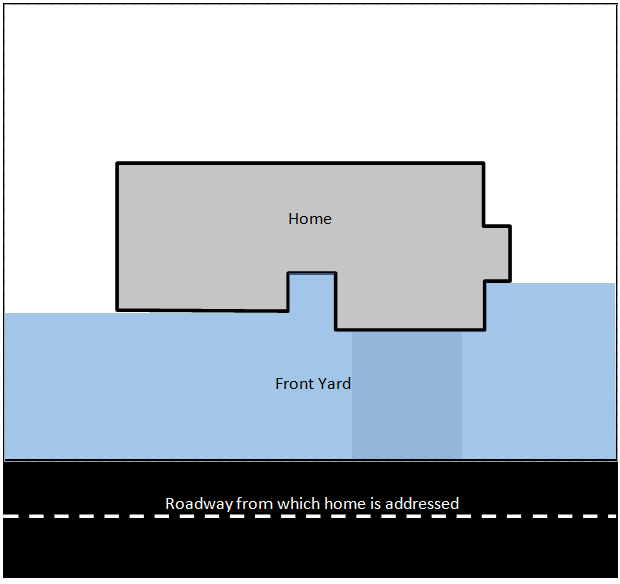
Yard, interior: The area of the property not defined as front yard.
Yard, street side: In the case of through or corner lots or parcels, is/shall be that yard (required setback area) abutting a street but not designated to be the front yard.
(Ord. No. 4617, § 1(Exh. A), 10-4-2021; Ord. No. 4671, § 1(Exh. A), 5-16-2022; Ord. No. 4702, § 1(Exh. A), 12-5-2022; Ord. No. 4777, § 1(Exh. A), 12-18-2023; Ord. No. 4809, § 1(Exh. A), 6-3-2024; Ord. No. 4843, § 1, 2-3-2025; Ord. No. 4873, § 4, 6-16-2025; Ord. No. 4907, § 2, 1-5-2026)
10-1-3. - Interpretation of title.
The provisions of this title shall be interpreted and applied as the minimum requirements for the promotion of the public health, safety, convenience, general welfare and other purpose. If any part, section, subsection, paragraph, subparagraph, sentence, phrase, clause, term, or word of this title and/or any other code provisions and/or laws are declared invalid or unconstitutional by the valid judgment or decree of any court of competent jurisdiction, the declaration of such unconstitutionality shall not affect the validity of other parts, sections, subsections, paragraphs, subparagraphs, sentences, phrases, clauses, terms, or words of this title and/or any other code provisions and/or laws contained in this title (including the prohibition on billboards contained herein).
(Ord. No. 4617, § 1(Exh. A), 10-4-2021)
10-1-4. - Certificate of occupancy.
It is unlawful to use, occupy or permit the use or occupancy of any premises, or part thereof created, erected, changed, concerted or altered or enlarged in its use or structure until a certificate of occupancy shall have been signed and issued by the building official stating that the proposed use of the building conforms to the requirements of this title and with all conditional provisions that may have been imposed. A certificate of occupancy authorizes only the use, arrangement and construction set forth in the approved plans and applications. Violations of this section or this title shall be, and are, punishable as provided in section 1-1-7 of this Code unless otherwise specifically stated in a section.
(Ord. No. 4617, § 1(Exh. A), 10-4-2021)
10-1-5. - Construction and use to be stated in applications.
Plans, permits, and certificates of occupancy. Building permits or certificates of occupancy issued on the basis of plans and applications approved by the building official authorizes only the use, arrangement, and construction set forth in such approved plans and applications, and no other use, arrangement or construction. Use, arrangement or construction at variance with that authorized via zoning entitlement or a certificate of occupancy shall be deemed a violation of this section and shall be, and is, punishable as provided in section 1-1-7 of this Code.
(Ord. No. 4617, § 1(Exh. A), 10-4-2021)
10-1-6. - Improvements required upon a change, expansion or enlargement of building(s) and/or principal property use, bonding, financial security or guarantee.
Improvements as defined in subsection C of this section are required to be emplaced on a lot or parcel or in a structure whenever:
A use on a lot or parcel, or one or more structures on a parcel or lot is expanded or enlarged in accordance with subsection A of this section (Exception: Design review standards shall not apply to existing facades unless they themselves are to be physically altered.);
When there is either a change of occupancy of a structure on a lot or parcel in accordance with subsection B of this section; or
Substantial refurbishment of a parking lot occurs, in accordance with subsection A.5 of this section.
All changes of use of a structure require the issuance of a building permit and the subsequent certificate of occupancy from the City of Nampa, Building Safety Division.
A.
Specific scope of requirement(s) relating to structural and/or use expansions or parking lot refurbishments. Site improvements shall be made to a property whenever one of the following situations occurs:
1.
Principal use has changed. The principal use of a structure and/or a property is changed to another as stipulated in subsection B of this section;
2.
Single structure use expanded/enlarged by 25 percent. The principal use of a single structure and/or portion of a property devoted to a use (i.e., building footprints, enclosed yard areas, parking areas) is expanded or enlarged by 25 percent or more of the existing use's area or building square footage (by devoting more land to a particular use, and/or, adding additional structures to a property devoted to a use). However, unenclosed, noncommercial awnings, patio covers and shade ports additions that will not have the effect of increasing a building's occupancy rating are, and shall be, exempt from this requirement unless they are (to be) larger than 50 percent of an existing building's footprint;
3.
Single structure square footage expanded/enlarged by 25 percent. When amongst multiple structures on the same property, a single structure is expanded or enlarged by 25 percent or more of that particular structure's square footage, regardless of the areas of the other structures;
4.
Multiple structures' collective square footage expanded by 25 percent. When a group of two or more structures on the same premises is expanded or enlarged either by 25 percent or more of the combined square footage of either of those structures, added collectively, or 25 percent or more of the area of all the structures on the property; or
5.
Parking lot expansion/renovation. When a parking lot is expanded or torn up and reconstructed (as opposed to being just resealed and/or striped) only the parking lot area itself (i.e., that part being renovated) shall be improved to meet current code(s). This shall require that landscaping and ADA parking be emplaced in and/or around the parking area such that the parking area complies with chapters 22 and 33 of this title including the 15-foot wide landscape buffer. Also, any engineering, water, wastewater or fire division/department improvement requirements shall apply to the "new" parking area. For example, such things as curb, gutter, sidewalk, curb cuts, drainage features, etc., shall all be improved or emplaced as part of the refurbishment of the parking area as required by the city.
A site improvement permit shall be required of an applicant and reviewed by the city (as specified in chapter 22 of this title) to ensure correct execution of this requirement unless the parking lot is being renovated because of concurrent interior structure remodeling occurring, or slated to occur, on the same property. In the case of parking lots simply being restriped (whether a slurry seal is used or not), the parking shall be arranged to comply with section 10-1-15, figure 1, of this chapter, but the parking lot need not be landscaped.
a.
Required parking spaces. When a building is enlarged in height or in ground coverage, off-street parking shall be provided for the enlargement in accordance with the requirements of this chapter and chapter 22 of this title.
6.
Landscape expansion/renovation. A landscape plan review and approval for subdivisions, multi-family developments, commercial developments, industrial developments, industrial park developments, healthcare developments, institutional developments, and institutional campus developments is required, when the following occurs:
a.
Changes/revisions/upgrades to grass, trees, shrubs and/or irrigation that differ from the originally approved landscape plan by more than 25 percent.
b.
If no approved landscape plan exists, the proposed landscape (grass, trees, shrubs and/or irrigation) changes differ more than 25 percent from the existing area,
B.
Change of use. Change of use shall be considered as occurring, or when there is proposed:
1.
Any change of occupancy group of a structure(s) according to the city's currently adopted edition of the IBC. Per chapter 3, use and occupancy classification, the principal occupancy groups are:
2.
Any changes of the primary use(s) of a property from being vacant/open to having new development/construction proposed upon it; and/or
3.
Any change of the majority of use to multi-tenant structures (e.g., shopping centers). (Such structures shall be treated as single use facilities when dealing with changes.) The aggregate area of a center devoted to retail uses versus, for instance, office use(s) shall be used when determining whether a change of use has occurred. Hence, for example, a large mall with various retail lessees shall not be required to upgrade with needed landscaping unless a majority of the retail users have left, and offices or other noncommercial sales businesses have filled their space(s).
C.
Emplaced improvements. Improvements required to be emplaced with or upon occurrence of an expansion or change of use as previously explained include:
1.
General property landscaping as required by chapter 33 of this title.
2.
Street, curb, gutter, stormwater collection and discharge, driveway approach, sidewalk and related improvements as required by the city engineer or his/her designee and/or any currently adopted downtown revitalization or streetscape plan.
3.
On site loading, parking lot/space improvements (including parking lot landscaping treatment). Such improvements shall include new paving or resurfacing and/or striping, as needed, to provide clear designated parking, loading and maneuvering space areas, and such shall be arranged in accordance with design regulations imposed by this title.
4.
A landscaped buffer area developed in accordance with standards set forth in chapter 33 and the applicable zoning chapter of this title shall be provided on properties along streets identified by the adopted Nampa street/path master plan map, Nampa Comprehensive Plan, and/or the city engineer as arterial or collector thoroughfares.
The strip shall be emplaced when a property is newly developed or redeveloped or expanded as described in subsections A.1 through A.5 of this section or the use is changed as described in subsection B of this section. Any land between the landscape strip and the developed roadway within the abutting right-of-way shall also be landscaped but only with grass, crushed rock or gravel, shrubs and/or flowers.
5.
Provision of pathway/trailway space by easement, or deed and dedication or by making the space a common lot in a subdivision as required by the planning and zoning department in accordance with the "Nampa Bicycle and Pedestrian Master Plan" and the city's comprehensive plan. This requirement shall apply against those properties that physically adjoin or abut a proposed trailway section as shown on the "Nampa proposed bikeway and off-street pathway network map in the Nampa Bicycle and Pedestrian Master Plan" or its currently adopted parks and recreation plan.
6.
Work on any "preexisting" residential structure(s) on a property to change the same into a non-single-family residential structure (e.g., expansion of a house into a duplex) shall be performed such that either said preexisting dwelling structure is first or concurrently made to comply with City of Nampa currently adopted building and zoning codes as part of site/project development, or, is removed from the site. Such work shall of necessity be satisfactorily accomplished before a certificate of occupancy may be issued by the city for the new or newly expanded/converted residential structure.
7.
Provision of improvements required by the currently adopted downtown implementation plan.
D.
Completion of improvements. Unless otherwise provided, all improvements may be made a condition(s) of any building/occupancy permit, and they shall be completed prior to final inspection and permanent occupancy of the building or property.
E.
Bonding, financial security or guarantee. Certificate of occupancy for a structure or tenant, by the City of Nampa, shall not occur in any multi-family, commercial or industrial structure until such time as all required site improvements have been completed/installed. If extenuating circumstances cause the improvements to be delayed, the applicant may request deferral of these improvements by providing the city with either an approved one-year irrevocable letter of credit issued by their financial institution or a check or cashier's check in the amount of 150 percent of the documented estimate for the completed work. For multi-tenant projects, an approved phasing plan, from the planning director, or his/her designee, is required prior to occupancy of any tenant space.
(Ord. No. 4617, § 1(Exh. A), 10-4-2021; Ord. No. 4702, § 1(Exh. A), 12-5-2022; Ord. No. 4777, § 1(Exh. A), 12-18-2023; Ord. No. 4809, § 1(Exh. A), 6-3-2024; Ord. No. 4873, § 4, 6-16-2025; Ord. No. 4907, § 2, 1-5-2026)
Editor's note— Ord. No. 4777, § 1(Exh. A), December 18, 2023, amended the title of § 10-1-6 to read as herein set out. The former § 10-1-6 title pertained to improvements required upon a change, expansion or enlargement of building(s) and/or principal property use.
10-1-7. - Miscellaneous, unilateral height, area, yard regulations including structure height exceptions, lot area exceptions, structure quantity and lot splitting controls, swimming pool securement requirements, setback intrusion allowances, etc.
A.
Structure height exceptions.[2]
1.
Through lots.
a.
On through lots having a depth of 150 feet or less, the structure height may be measured from the adjoining sidewalk level on either street.
b.
On through lots having a depth of more than 150 feet, the height regulations and basis of height measurements for the street permitting the greater height shall apply to a depth of not more than 150 feet from such street.
2.
Roof structures. Roof structures for the housing of elevators, stairways, tanks, ventilating fans and similar equipment required to operate and maintain the building, fore or parapet walls, skylights, towers, flagpoles, chimneys, smokestacks, wireless masts, TV and CB antennas, satellite dishes, steeples and similar structures may be erected above the height limits prescribed in each of the use districts, provided that no roof structure, feature or any other device above the prescribed height limit shall be allowed or used for the purpose of providing additional floor space.
3.
Additional height allowed for public buildings. Public utility buildings, public and parochial schools and churches may be erected to any height provided the structure is set back from required building setback lines at least one foot for each additional foot of building height above the maximum height, in feet, permitted in the zone within which the building is located.
4.
Minimum height of principal building(s). Structures that have their entire or the majority of their superstructure underground (i.e., basement style houses—not houses with basements) shall not be permitted anywhere within the city limits.
B.
General yard/frontage/access regulations.
1.
Legal access to or frontage on a public street.
a.
Generally. All building lots/parcels, or lots/parcels proposed as future building lots, in all land use zones whereon some structure will be emplaced are, and shall be, required to have legal access to a public street before any building permits for structures on those lots/parcels may be issued by the city (see section 10-1-2.9, "Property").
b.
Abutting a public street. All building lots/parcels abutting or proposed to abut a public street shall comply with any street frontage requirement required by the zoning district within which those lots/parcels are, or will be, located.
c.
Abutting a private street or common driveway. Lots/parcels abutting or proposed to abut an approved private street or an approved common driveway shall have, or be demonstrated to have, legal access to a public street (often accomplished via viable and recorded easements) before any building permits for structures on those lots/parcels may be issued by the city.
2.
Yard requirements for property abutting partial or future street rights-of-way. No structure shall be erected on a lot which abuts a public street having only a portion of its required width dedicated, unless the lot/parcel area provided and maintained in connection with such building has a width and/or depth needed to complete the street width and provide the width and/or depth of land necessary to comply with the required setbacks according to the regulations of the zone within which the structure will be placed.
3.
Open space and yards around buildings.
a.
No yard (setback area) or open space around any building shall be considered as providing a yard or open space for any other building.
b.
No yard (setback area) or open space on adjoining property shall be considered as providing a yard or open space for another lot or development site.
c.
No structure/building, whether principal or accessory, shall occupy or be placed over a required setback or an easement except as may be allowed for portable, temporary stands allowed by the planning director to so reside in conjunction with provisions in section 10-1-2 of this chapter. No structure/building, whether principal or accessory, shall be placed over a property line.
4.
Setback for garages and carports. Any newly proposed or existing garage or carport structure shall be required to comply with zoning district setback requirements pertinent to the land whereon the garage or carport lies, or, is proposed be emplaced. Furthermore, there shall be provided at least 20 feet of driveway from the street line (i.e., front or side street property line) to the foremost entry point of any attached/detached garage's or attached/detached carport's door or entry respectively.
Garages or carports on corner or through (double fronted) lots/parcels whose doors or entries face, or are intended to face, and access a side street must be set back 20 feet from that side street line; notwithstanding any ten foot setback allowance stated elsewhere in the rest of these zoning regulations (this title). However, garages or carports on corner lots/parcels with the middle of their auto bay doors/entries turned at least 55 degrees away from the side street may use the ten-foot setback instead of 20 feet. In such cases, the ten-foot setback will be measured from the point of the garage nearest the street, perpendicularly, to the edge of the adjoining right-of-way.
5.
Vision clearance. Trees in the vision clearance area shall be trimmed at least nine feet above the street to provide clear visibility up to that height. Shrubs and site obscuring fences or walls in vision clearance areas shall not exceed two and one-half feet (i.e., 30 inches) in height above the curb line.
On all corner properties located at the intersection of the alleys or streets with adjacent streets, unless otherwise permitted by the city engineer and commission, there shall be provided vision clearance in accordance with engineering requirements (see section 10-1-15, figures 5a and 5b, and section 10-1-2.7, Vision clearance).
6.
Common property line. When the common property line separating two or more contiguous properties, if and when under common ownership, is covered by a building such properties shall constitute a single development site and the interior yards (setbacks) as required by the district(s) pertinent thereto shall then not apply to the intervening, common property lines (except in the case of carport structures which shall not be allowed to connect over property lines). This code's stated allowance to have structures straddle property lines of lots/parcels under the same ownership shall not have or be construed to have the effect of abrogating codes, laws, regulations or requirements as administered by other agencies (e.g., building, stormwater and fire codes) pertaining to such common connections.
7.
Dwellings where permitted in commercial zones above nonresidential buildings. The front and interior yard requirements for residential uses shall not be applicable, provided that all yard requirements for the district in which such building is located are complied with.
C.
Lot area exceptions.
1.
The following exceptions shall be deemed to exist and to be eligible for legal, nonconforming status when demonstrated to be legitimate (a historical reality):
a.
Lots of record with less than the area required by each use district of an imposed subdistrict which existed prior to June 11, 2002.
b.
Lots or development sites which, as a process of their creation, were approved with substandard area by the commission.
2.
Government, emergency service, church, school and other community service lots allowed within residential zoning districts, per section 10-3-2, shall not be limited to the minimum or maximum lot sizes stated in the corresponding zoning chapter.
D.
Principal buildings and uses; and number of accessory buildings allowed.
1.
On any property in any residential zone, except the RML, RMH and RP districts, there shall be allowed only one principal use (as allowed by section 10-3-2 of this title) or structure (containing an allowed use). Still, in the RML, RMH or RP zone, if land division is proposed and/or executed in order to separate structures (apartment buildings) once planned and/or proposed, perhaps, as a singular development, then all new parcels/lots created shall meet zoning dimensional, setback and property area standards in order to be considered as acceptable and "conforming to code."
New parcels/lots shall also be encumbered with sufficient easements/maintenance agreements to allow shared vehicular maneuvering and parking access across and via service drives between the buildings unless total site redevelopment, that would legally separate parking for each building, is done. The planning director or his/her designee may review and/or inspect such proposals to determine their legitimacy before the law.
2.
For any property, regardless of zone, used as a single-family or multiple-family residential, the detached accessory structure footprint shall not exceed the area of the footprint of the principal structure on the same lot/parcel.
3.
For any property, regardless of zone, used as a single-family residence, there shall be no more than two accessory buildings, with the exception of a detached garage or carport where an attached garage or carport does not exist, on any lot or development site. The following are not considered accessory structures for the purposes of this title (10): Playground equipment, garden box, trellis, trampoline, shade sail, and patio umbrella/furniture, or other structures with the approval of the planning director or his/her designee.
4.
It shall be unlawful for any person owning, leasing, occupying, or having charge of any premises to facilitate and/or allow any person(s) to permanently reside in or stay more than 30 days and nights in an "unauthorized dwelling unit" (as defined by this Code) on their private property (or that which they manage) unless approved otherwise via a CUP.
E.
Property coverage and parking coverage requirements. Refer to provisions of specific districts.
F.
General setback (required yard(s)) exceptions and permitted intrusions into required yards (setbacks). The following intrusions may project into required yard (setback) space to the extent and under the conditions and limitations indicated:
1.
Depressed ramps yard intrusions allowed. In any district, openwork fences, hedges, guard railings or other landscaping or architectural devices for safety protection around depressed ramps or stairs may be located in required yards provided that such devices are not more than three and one-half feet in height.
2.
Accessory structures yard intrusions allowed.
a.
In front yards on through/double fronted lots. In any case where a through property has a depth of not more than 140 feet, accessory structures, except for garages or carports, may be located in one of the required front yards provided that every portion of such accessory structure is not less than ten feet from the nearest street line, that same front yard is thereafter identified and serves as the functional rear yard, and that the accessory structure is fenced from view from any adjoining street.
3.
Projecting building features yard intrusions allowed. The following features may project no more than two feet into any setback area:
a.
Eaves, cornices, bay windows lacking floor area, belt courses, sills, awnings, buttresses or other similar features (not to include porches, platforms, ramps, decks, balcony, landings, steps, or any portion of a living space area).
b.
Chimneys and fireplaces, provided they do not exceed eight feet in width.
4.
Structure setback measurement criteria. Setbacks in all zones for all structures and parking or landscaping features shall not be measured off of or from utility easement edges. Setbacks shall only measure from the edge of an access type easement (e.g., private driveways, private roads, service drives) if such access easement abuts/adjoins a property's boundary but does not cross over/traverse that property. If such an easement crosses or traverses a property or any portion thereof, then setbacks shall not be taken off the easement's edges but rather the property lines, as commonly done.
5.
Swimming pools. Swimming pools not completely enclosed within a building having solid walls shall be set back at least five feet from the property lines of the lot upon which the pool is located and shall either provide an approved safety cover or be completely surrounded by a fence (either around the pool or encompassing the yard/property wherein the pool is located) that shall be at least five feet tall, but may extend up to eight feet for a community or commonly owned pool (see section 10-1-8.E), with the following provisions:
a.
There shall be no openings in the fence larger than 36 square inches, except for a gate(s).
b.
Gates shall be equipped with self-closing and self-latching devices, or, an approved safety cover shall be provided to cover the pool. These safety measures shall comply with the 2018 International Swimming Pool and Spa Code (ISPSC), section 305: Barrier Requirements.
G.
Lot splitting/property boundary adjustment.
1.
Deeding lots. In the process of splitting property, unless otherwise allowed in accordance with applicable city ordinances, no space needed to meet the width, depth, yard, area, coverage, parking or other requirements of this title for a property or building may have ownership transferred apart from such property or building unless other space is simultaneously provided back to the grantor in order to keep the grantor property compliant with pertinent bulk zoning requirements.
2.
Buildable lot. Unless otherwise allowed in accordance with applicable city ordinances, no property that has less than the minimum width, depth and area requirements for the zoning district in which it is located, may be divided off from a larger property for the purpose, for building or development and still be considered a "buildable" lot or parcel.
3.
Lot splits. Either a record of survey (with associated deeds) or subdivision plat shall be required to be approved by the city and recorded in order to create a buildable lot. Lot splits done by description for lending purposes shall not create nonconforming setbacks or lot areas without variance approval. This restriction shall not preclude site clearance work nor emplacement of utilities where approved by city engineering and/or the State Division of Environmental Quality.
When a parcel is annexed into the city, one administrative lot split shall be permitted on that parcel. The new parcels created by that lot split shall be no smaller than is allowed by the zoning district assigned to that parcel. New parcels created shall have legal access to a public right-of-way. The layout of the newly created parcels shall be such that each shall meet, or be further subdivided to meet, and accommodate the minimum and maximum lot size requirements and density range of the assigned zoning district. Density requirements apply to new subdivisions or new lots created after October 4, 2021.
4.
Division of a building into condo units may and shall not have the effect of increasing the density of dwelling or non-dwelling (e.g., office, store, or storage) units of said building beyond that normally allowed in the zone in which the building is located. (For example, division of a single-family dwelling into two condo units shall not be allowed but division of a legal fourplex into four condo units could be allowed.)
5.
Permit required. A property boundary adjustment permit is required to adjust a property line or to create a new property boundary, upon any property within the city limits.
H.
Bus stop benches. Bus benches and signage may only be installed by an authorized entity of the regional transportation organization that has entered into a memorandum of understanding with the City of Nampa to provide bus service for the same.
Bus stop benches with signage affixed thereto may be located on public right-of-way only with prior authorization from the city engineer. Bus stop benches may be located on private residentially zoned, U or GB2 zoned properties; or private properties zoned commercially or industrially even if said properties in those zones already have preexisting, freestanding signs located on them along/in the same street frontage yard area as a/the newly proposed bus bench location(s).
Bus stop benches with signage affixed thereto shall not be placed on properties zoned CN (see section 10-23-18.D and section 10-23-20 for additional details). Bus stop benches without signage affixed thereto may be placed in the CN zones in accordance with the regulation in the first paragraph of this subsection.
(Ord. No. 4617, § 1(Exh. A), 10-4-2021; Ord. No. 4671, § 1(Exh. A), 5-16-2022; Ord. No. 4702, § 1(Exh. A), 12-5-2022; Ord. No. 4777, § 1(Exh. A), 12-18-2023; Ord. No. 4809, § 1(Exh. A), 6-3-2024; Ord. No. 4907, § 2, 1-5-2026)
Editor's note— See individual zoning chapters for specific height restrictions and requirements.
10-1-8. - Fences and walls.
A.
Permit required. It is unlawful for any person to construct or place a fence or masonry wall upon any property within the city limits without first having applied for and obtained a building permit to do so and without thereafter complying with all the provisions of said permit. Height of fences, walls or other screens whether stand alone or combined with other screening elements (e.g., a fence on top of a berm) shall be measured at grade level within six inches of the bottom of the fence or screen/wall/berm.
B.
Fences on rights-of-way or easements. Residential fences may be permitted to be constructed on/within public rights-of-way and easements subject to the sidewalk and vision clearance restrictions set forth herein. On commercial and industrial properties, fences shall not be placed within or blocking from view areas established as required yards (setbacks) but instead shall be on the side of those setbacks closest to the center of the property (i.e., behind the setbacks when viewed from off the property); provided, however, when fences are required for the protection of public wells and infrastructure, they may be erected within a designated setback. Where circumstances permit, fences may be built along a property line, providing that permission to construct fences on rights-of-way (where desired) shall be first obtained from the city engineer.
1.
Regarding fences in rights-of-way or easements. Upon receiving notification from the city, it is the property owner's responsibility to remove fences from public rights-of-way or easements, at owner's expense, should the city need to utilize any right-of-way or easement for maintenance or construction of any public facility or improvements or it is determined to be in the interest of the city or in the opinion of the city creates a safety hazard. Fences which constitute structures, as defined under this chapter, shall not be permitted upon or within public rights-of-way or easements. The design and height of any fences proposed for emplacement abutting Idaho state highway right-of-way shall be subject to the approval of the Idaho Transportation Department.
C.
General requirements. For the purposes of this subsection, walls (e.g., block, brick, straw), latticework, screens, hedges, berms and plantings shall be considered functionally equivalent to fences and shall be built, restricted in height and maintained in compliance with the fencing provisions contained in this chapter.
1.
Electric fences. Electric fences shall only be allowed in the city as provided in this section, subject to the following standards:
a.
IEC Standard 60335-2-76. Unless otherwise specified herein, electric fences shall be constructed or installed in conformance with the specifications set forth in International Electrotechnical Commission (IEC) standard 60335-2-76;
b.
Energizer. The energizer for electric fences must be driven by a commercial storage battery not to exceed 12 volts DC. The storage battery is charged primarily by a solar panel. However, the solar panel may be augmented by a commercial trickle charger;
c.
Charge limit. The electric charge produced by the fence upon contact shall not exceed energizer characteristics set forth in paragraph 22.108 and depicted in figure 102 of IEC standard 60335-2-76;
d.
Installation requirements. No electric fence shall be installed or used unless it is completely surrounded by a nonelectrical fence or wall that is not less than six feet in height save in the case where the fence serves to contain agricultural animals in which case the fence may be no higher than six feet;
e.
Outdoor storage areas. Electric fences shall be permitted on any nonresidential outdoor storage area property;
f.
Signage. Electric fences shall be clearly identified with warning signs that read, "Warning - Electric Fence" placed at intervals not less than 60 feet apart;
g.
Governing regulations. Electric fences shall otherwise be governed and regulated under burglar alarm regulations and permitted as such; and
h.
Violation. It shall be unlawful for any person to install, maintain or operate an electric fence in violation of this section save those fences designed and operated to contain agricultural animals. Those fences shall comply with traditional practice and industry standards applicable to livestock enclosure.
2.
Barbed wire. Barbed wire may be permitted in commercial or industrial zones when used as the top section for security fences, provided barbed wires are a minimum of five feet above grade and do not project over public right-of-way.
3.
Construction impairment. No fence shall be permitted in or across a sidewalk area or in a location that may impair construction.
4.
Fence owner responsibility. In the event any fence restricts access to or use of established rights-of-way and/or easements, it shall be the fence owner's responsibility, at his expense, to provide access upon demand of the city or other entitled party.
Any existing fence or fence to be constructed which restricts access to any utility meter shall provide a way of access through the fence by a "man" gate. In addition, no fence shall be constructed within 36 inches of a fire hydrant.
5.
Vision clearance. "Vision clearance" for fences at street and alley intersections shall be as defined in section 10-1-2.7 of this chapter.
6.
Screening sport venues. Fences utilized to screen playing fields, ball diamonds, tennis or basketball courts shall be exempt from the height regulations of this section (but not from setback or vision clearance requirements) provided they are considered to meet typical industry standards in terms of height and type and method of construction.
7.
Materials and appearance. Fences shall be constructed using common fencing materials commercially available. Fences shall be constructed such that one material (e.g., wood, vinyl, metal) is used throughout and its color(s), pattern, and composition are consistent. Slats inserted into chain-link fences shall be wide enough to completely fill the gaps they are inserted into/through. Slats inserted into chain-link fences shall be oriented vertically or diagonally. Chain-link fences shall have top rails.
D.
Residential districts (including RP zoned properties whereon a residential use, like a house, is located or proposed to be located).
1.
Interior lots. Perimeter fences up to a height of six feet may be built to enclose the area not defined as front yard. A three-foot closed-vision or a four-foot open-vision fence may be constructed in the front yard and may be built in the required front yard (setback area) from the setback line/mark to the inside of an existing sidewalk or to the inside of a proposed, future sidewalk.
2.
Corner lots. Perimeter fences may be built to a height of six feet along the side street of corner lots outside of the clear vision triangle and along the rear property line provided the following conditions are complied with (see figure 5a and 5b for clear vision triangle design guidelines):
a.
A seven and one-half foot vision triangle is maintained when the rear property line abuts an alley or drive approach.
3.
Private covenants, codes and restrictions. Recognizing that many subdivisions/properties have private covenants, codes and restrictions that in part govern the type, placement, height and appearance of fences, a fence permit as issued by/from the City of Nampa shall not be construed to be an abrogation of a property owner's responsibility to comply with pertinent, private covenants. The City of Nampa, accordingly, shall undertake no efforts to enforce any fence provisions stated in private covenants, but shall only enforce the fence code as contained within this title and chapter.
E.
Commercial, healthcare, or industrial districts (including RP zoned properties whereon a professional or commercial use, like an office or store, is located or proposed to be located, and, all kinds of multiple- [non-single-] family residential projects in all zones). Fences not to exceed eight feet in height (six feet for multiple-family residential projects) may be located or maintained on any commercially or industrially zoned property. In the case of security fences, when a barbed wire top section is utilized, the eight-foot maximum height limitation may be exceeded by up to 30 inches only by the barbed wire security top section.
Perimeter fences erected on commercially or industrially zoned property, or, for any form of multiple- (non-single) family residential project, shall, when/if placed, be set back behind required yards/setbacks as viewed from off the property or from an abutting street. In some cases, where zero-foot setbacks are required, then the fences may be located right on the property line, except within vision clearance areas unless appropriately reduced in height. Likewise, open vision perimeter fences to a height of six feet may be built out to the inside of an existing or future projected sidewalk, provided that: 1) the abutting property's required yard/setback along the sidewalk is zero feet; and 2) no barbed wire or other security top section is utilized and fences comply with vision clearance requirements for fences to be located at intersections.
F.
Fences required for sight/site obstruction.
1.
Certain uses are declared and others may be declared in the future by the city to possess characteristics that require sight/site obstruction in order to preclude damage, hazard, nuisance or other detriment to public health, safety or welfare, or to prevent a materially injurious situation to property or improvements in a given vicinity.
2.
Greenbelt or sight/site obscuring fences, where required by provisions of this subsection, shall be of dense coniferous planting, or climbing varieties of non-deciduous vines on permanently installed aluminum mesh fencing or solid non-vision type fencing of such design and materials that retains its attractiveness with nominal maintenance.
3.
The following uses are declared to require sight/site obscuring fences: Junkyard(s), wrecking yard(s), equipment storage yard(s), vehicle salvage and/or storage yard(s), sanitary landfill(s), and any other uses determined to be similar in nature to the preceding uses by the planning director or his/her designee.
G.
Abatement of unlawful fences. The following fences are declared unlawful nuisances and shall be subject to the enforcement provisions of section 3-4-2, "Abatement of nuisances," of this Code:
1.
Any fence that is in whole or in part weak, or constructed of broken, unsightly, inferior or old, worn materials of an inflammable nature that may impair the value of the adjoining land.
2.
Any fence constructed or maintained for the purpose of maliciously annoying the owners or occupants of an abutting property.
3.
Any fence not constructed or maintained in accordance with this section.
(Ord. No. 4617, § 1(Exh. A), 10-4-2021)
10-1-9. - Performance standards.
All operations conducted on the premises shall not be allowed to constitute a nuisance by reason of smoke, fumes, odor, steam, gases, vibrations, noise, hazards or other causes, beyond the property boundary lines, and shall comply with the performance standards of this section.
Any dissemination incident to a permitted use shall comply with the following standards:
A.
Noise. Noise emanating from a commercially or industrially zoned property, which lies abutting or adjacent to residentially zoned and used property, is subject to anti-noise regulations listed in section 6-7-3 of this Code. Exception: Noise caused by construction between 11:00 p.m. and 7:00 a.m. shall be exempt from such regulations if the owner or contractor holds a special waiver permit issued by the city's building department.
B.
Lighting and eye safety. Industrial and exterior lighting shall not be used in a manner that produces glare on public highways and neighboring property. Arc welding, acetylene torch cutting, or similar processes shall be performed so as not to be seen from any point beyond the outside of the property.
All exterior residential lighting shall be shielded, screened, or shuttered and shall be directed so as to prevent direct illumination of adjoining properties.
C.
Flammable and combustible liquids and gases.
1.
Storing and handling. Storing and handling of flammable and combustible liquids and gases and all explosives shall, in terms of fire and safety hazards, comply with rules and regulations falling under the jurisdiction of the Nampa Fire Department, as well as other applicable federal, state and local laws.
2.
Bulk storage. Bulk storage of flammable and combustible liquids and gases below ground shall be permitted; however, the tank type, design and location shall fall under the jurisdiction of the Nampa Fire Department, shall meet adopted fire code requirements and regulations, and, in any event, be located no closer to the property line than the greatest dimension (diameter, length or height) of the tank or as otherwise required by adopted fire code requirements and regulations, whichever is more restrictive.
3.
Aboveground tanks. No flammable or combustible liquids or gas shall be stored in aboveground tanks which exceed 500 gallons' capacity, except in the HC, IL, IP and IH zones. All storage, handling and dispensing shall fall under the jurisdiction of, and be approved by, the Nampa Fire Department and shall meet adopted fire code requirements and regulations.
4.
Location of fuel pumps used for the dispensing of flammable and combustible liquids. Fuel pumps (and their locations) used for the dispensing of flammable and combustible liquids shall fall under the jurisdiction of the Nampa Fire Department and shall meet adopted fire code regulations. Moreover, fuel pumps (and their locations) used for the dispensing of flammable and combustible liquids shall be set back not less than 20 feet from any street line to which the pump island is at right angles, and 15 feet from any street line to which the pump island is parallel, and not less than 12 feet from any residential district boundary line. If the pump island is set on an angle on the property with respect to the street, it shall be so located that vehicles stopping for service will not extend over the property line. In no case shall pumps (and their locations) used for the dispensing of flammable and combustible liquids be set closer than 15 feet from any street line. In the event that adopted fire codes or NFPA regulations require setbacks greater than the afore noted, then the fire codes or NFPA regulations shall prevail.
Canopies when supported by a column may be located within the setback, but not closer to a street than 14 feet.
D.
Power safety. Provisions must be made for necessary shielding or other preventive measures against interferences occasioned by mechanical, electrical, electronic and nuclear equipment, uses or processes with electrical apparatus in nearby buildings or land uses.
E.
Emissions.
1.
General prohibitions. The emission of obnoxious odors of any kind, as well as any toxic or corrosive fumes or gases is not permitted.
2.
Industrial dust. Dust created by an industrial operation shall not be exhausted or wasted into the air.
3.
Smoke and particulate matter. The emission or smoke or particulate matter of a density equal to or greater than number 3 on the "Ringelmann chart," as currently published and used by the U.S. Bureau of Mines, is prohibited at all times.
Dust and other types of air pollution borne by the wind from such sources as storage areas and roads shall be minimized by appropriate landscaping, paving, oiling or other acceptable means. Emission of particulate matter in excess of 0.2 grain per cubic foot of conveying gas or air measured at any property line is prohibited.
The rate of emission of particulate matter from all sources on any property shall not exceed a net weight of one pound per acre of property during any one hour.
F.
Waste products. Liquid and solid wastes, as well as the storage of animal or vegetable wastes, which attract insects, rodents or otherwise create a health hazard, shall be prohibited. No waste products shall be exposed to view from eye level from any property line.
G.
Open storage. All industrially related storage shall be located within an area not closer than 20 feet from the street right-of-way line and enclosed with a heavy wire fence or of a similar type, with the type of said fence not less than six feet above the adjoining street level, or by an attractive hedge or board fence at least six feet high.
In case of the open storage of lumber, coal, or other combustible material, a roadway designed and developed in accordance with accepted city standards shall be provided, graded, surfaced and maintained from the street to the rear of the property to permit free access of firetrucks at any time.
H.
Fabrication, repair. Not more than five persons shall be engaged in the fabrication, repair and other processing of goods in any establishment and not more than 12 aggregate horsepower shall be employed in the operation of all machines employed for the aforesaid purposes in a BC zone.
(Ord. No. 4617, § 1(Exh. A), 10-4-2021; Ord. No. 4702, § 1(Exh. A), 12-5-2022)
10-1-10. - Home occupations.
The home occupation ordinance presupposes that many small-scale business ventures (e.g., at home offices, crafts making, at home daycares, small scale vehicles repair, etc.) might not be sustained if it were necessary to lease commercial quarters for them. The intent of the home occupation ordinance is to only allow for home based businesses that are, or will expectedly be, compatible with the residential neighborhoods in which they are located in order to provide supplement retirement income, juvenile self-employment, etc.
In other words, it is the intent of the home occupation ordinance that full scale commercial or professional type operations that would change the appearance or condition of a residence and/or be detrimental to neighborhood character, and would ordinarily be conducted in a commercial or industrial district, continue to be conducted in such district and not at, or from, residential property/dwelling unit.
Thus, home occupations shall be conducted inside a structure on the property where the owner/operator(s) lives, or in the side or rear yards screened from view of neighbors. That means the owner/operator(s) shall, on a daily basis, eat, sleep, and otherwise live there. Further evidence that a location is lawfully functioning as a suitable location for a home occupation to be conducted shall be considered if an owner/operator (if a renter) has their rental agreement identifying that location as their residence, and/or (if a renter or homeowner) receives their mail at that property, has their trash picked up from that property, accumulates the majority of their domestic utility bills on/from that property, has their homeowner's exemption assigned to that property, even has their personal vehicles registration describing that property at their current residential address, etc.
A.
Home occupations subject to conditional use permits in any district. Certain types of home occupations require special consideration and approval because of the nature of the use and its potential incompatibility with residential living. The following businesses, if proposed to be conducted on residential property as home occupations, shall require conditional use approval prior to their being permitted in any residential zoning district: gun related sales and services; major appliance repair; paint shops; welding; woodworking and cabinet shops; daycare home occupations in certain zones with seven or more children (including the caregiver's if they are under six years of age); and any other use determined by the planning director to be similar to the aforementioned activities.
B.
Home occupation standards. "Home occupation" shall mean any occupation or profession carried on by a member of the family residing on the premises (in or from the dwelling unit or structures accessory thereto), provided the following conditions are satisfied:
1.
Signs. No sign is used other than a nameplate not over two square feet in area and nonilluminated.
2.
Space. The amount of floor area used solely for the home occupation (either in the dwelling unit or in an accessory building beside or behind the dwelling unit) shall not exceed 25 percent of the gross floor area of the dwelling unit involved.
3.
Storage and display. There is no outdoor display of goods or outside storage of equipment or materials used in the home occupation that would indicate from the exterior that the building is being used in whole or in part for any purpose other than residential use.
4.
Commercial vehicles. Not more than one commercial vehicle, not to exceed 15,000 GVWR, may/shall be kept by the operator of the home occupation on their residentially zoned property.
5.
Employment. There are no outside paid employees (except in short term instances when the resident operator must be temporarily away from home). Daycare home occupations are allowed to have one on-site employee. A licensed group home is allowed to have employees based on their licensing requirements.
6.
Traffic. It is intended that vehicular or pedestrian traffic to or from a residential property operating a home occupation not be generated in volumes significantly beyond that normal to the residential zoning district in which the home occupation is located. Clients/customers/guests of the home occupation may visit the residence by appointment only, appointments may not overlap appointments of other parties visiting the residence for the home occupation.
Exception 1: Private group instruction, such as music or swimming lessons, or other similar activities, may be permitted by obtaining a home occupation permit, for up to six visitors/guests at the same time. Up to two accessory off-street parking spaces may be required by the planning director to accommodate parking for such group instruction. Lessons/instructions shall be conducted for no greater than three hours per day.
Exception 2: Swimming lessons or other similar outdoor activity instruction may be conducted outside.
7.
Residential appearance. The building retains the appearance of residential use in terms of operating characteristics and does not destroy the residential character of the neighborhood.
8.
Nuisances. No equipment or process shall be used which creates noise, vibration, glare, fumes, odors or electrical interference detectable to the normal senses off the lot, if the occupation is conducted in a single-family residence or outside the dwelling unit if conducted in other than a single-family residence. In the case of electrical interference, no equipment or process shall be used which creates visual or audible interference in any radio or television receivers off the premises or causes fluctuations in line voltage off the premises. Home occupations involving storage of flammable or combustible materials shall conform with the city fire code for residential occupancy.
9.
Sales. Infrequent residential or out of home sales (i.e., garage sales, estate auctions/sales, moving sales, block sales, patio sales) may occur in residential areas, provided sales are conducted not more than three days at a time and no more frequently than once per calendar quarter. The seller shall not be in the business of regularly selling the same or similar property as that which is offered for sale at the yard sale. No temporary use permit is required for this kind of activity.
10.
Clients/customers/guests. When a business has clients/customers/guests coming to the property (as referenced in subsection 10-1-10.B.6) an accessory detached structure shall not be used for any functions of the business.
C.
Statement of compliance; registration. The person(s) desiring to operate the home occupation shall sign a statement that they are aware of all standards and conditions under which the occupation is allowed and that if any of the standards are violated they shall be guilty of a misdemeanor. The filing of the statement/registration shall be accompanied by a nonrefundable filing fee in an amount established by resolution of the city council.
D.
Complaint procedures. Complaints on conditions of subsections B.1 through B.4 of this section will be handled routinely by the planning department. Complaints on conditions of subsections B.5 through B.9 of this section will be dealt with as follows: The commission shall review home occupations upon receipt of two written complaints from two separate households located within 300 feet of the boundary of the affected property. Said complaints shall set forth the nature of objection(s).
Such complaints shall be investigated by the city and if found credible, the home occupation permit shall be revoked, unless the applicant wishes to secure approval through a conditional use permit. The public hearing procedure and notification process for the conditional use permit shall be the same as outlined in chapter 25 of this title.
1.
Standards for judging complaints shall include, but not be limited to:
a.
Generation of excessive traffic;
b.
Monopoly of on street parking spaces;
c.
Frequent deliveries and pickups by motor freight trucks;
d.
Noise in excess of that created by normal residential use (either interims of volume or hours of operation);
e.
Smoke, fumes or odors in excess of those created by normal residential use; and/or
f.
Other offensive activities not in harmony with a residential neighborhood.
(Ord. No. 4617, § 1(Exh. A), 10-4-2021; Ord. No. 4777, § 1(Exh. A), 12-18-2023)
10-1-11. - Use of historically significant buildings.
Buildings declared historically significant shall be eligible for conditional use permit consideration for light commercial or office usage regardless of zoning classification. The purpose of these regulations shall be to provide a method of protection and preservation for buildings historically significant to the community.
A.
Application for declaration. Building owners may make application to the planning and zoning commission for official declaration of historical significance by submitting a letter of request to the planning director.
B.
Review criteria. The following criteria shall guide the commission in their review and evaluation of individual requests:
1.
The building possesses integrity of location, design, setting, materials or workmanship;
2.
The building is associated with events or persons significant to the history of Nampa;
3.
The building embodies the distinctive characteristics of a type, period, or method of construction, or represents a significant and distinguishable design whose components may lack individual distinction.
C.
Declaration of historical significance. Following review and evaluation, in accordance with the above criteria, the commission may declare buildings to be historically significant to the city.
D.
Light commercial usage of historically significant buildings. Buildings declared historically significant shall be eligible for conditional use permit consideration for light commercial or office usage regardless of zoning classification. The commission may also approve an exception to the required number of off-street parking spaces for such usages provided it can be shown that existing on-street and off-street parking is inadequate for the proposed use without monopoly of adjacent on-street parking. The conditional use permit procedures of chapter 25 of this title shall govern such requests. The following uses shall be eligible for consideration: 1) Professional offices; 2) Light commercial establishments such as gift shops, antique shops, curio shops, hobby shops, clothing apparel shops, florists and small restaurants; 3) Any other uses determined to be similar to those listed above which would not have any different or more detrimental effect upon the adjoining neighborhood areas.
1.
Preservation of buildings. The commission shall require buildings and premises issued conditional use permits under this section to be renovated and restored in accordance with the Secretary of the Interior's Standards for Historic Preservation Projects.
The commission may also designate any other conditions it deems necessary to secure the purposes of this section for the protection and preservation of historical buildings.
(Ord. No. 4617, § 1(Exh. A), 10-4-2021)
10-1-12. - Provisions applying to miscellaneous and temporary and transient uses.
All miscellaneous and temporary uses as identified in this section shall be subject to the terms, regulations and conditions of this section as set forth hereafter. It shall be unlawful for any person or party to establish, maintain, operate or have a temporary use on property in the City of Nampa except in accordance and compliance with the following regulations:
A.
Regulations of certain temporary uses. Regulations governing establishment and operation of certain temporary uses in the City of Nampa according to their respective categorizations/definitions in section 10-1-2 of this chapter are and shall be as follows:
1.
Transient merchants as temporary uses.
a.
Locations allowed. Transient merchants are and shall be prohibited from locating on properties not commercially zoned and/or in any of the following locations:
i.
In any location whereat the city has reasonable grounds to believe that planned unit development community that has jurisdiction over the area wherein the temporary use permit is proposed to be exercised.
b.
Duration, frequency and hourly time limits. Time allotted to/for transient merchant operation(s) shall be as follows:
i.
Shall not be allowed to locate on any given lot or parcel for longer than nine calendar days in any given calendar year; and
ii.
Shall only operate between the hours of 6:00 a.m. and 12:00 midnight from an approved location; and
iii.
An eligible lot/parcel may only host one transient merchant one time per, and in, any given calendar year. (This does not and shall not prevent a lot/parcel from being host to an approved seasonal temporary use in accordance with the regulations/allowances established in this section for such types of temporary uses.)
c.
Land use regulations governing use and operation thereof.
i.
No more than one transient merchant use may or shall be established/allowed and operated from any given eligible lot/parcel at a time. It shall be illegal for more than one transient merchant to locate on an eligible lot/parcel at the same time;
ii.
Placement of a structure(s), merchandise, and/or vehicles related to/part of a transient merchant use or operation, within a required setback shall be prohibited unless specifically approved in writing by the Director or his/her designee on a case by case basis where no peril to health, safety or public welfare is foreseen or expected in connection with allowing setback intrusion; and
iii.
Notwithstanding the foregoing, no structure(s), merchandise, or vehicle(s) related to/part of a transient merchant use or operation shall be allowed to be placed or parked in a required vision triangle, in or blocking an area of a service drive required to permit legal ingress into or egress from a lot/parcel, over or blocking an ADA parking space, over or blocking a public sidewalk, blocking access to a trash dumpster, too close to a fire hydrant, adjacent a section of curb painted and designated as reserved for fire department use, in a position to obscure a city traffic regulation sign, in or overhanging a public right-of-way, or in or overhanging a public easement.
2.
Food vendors (e.g., "taco trucks, lunch wagons, BBQ grills/ranges on trailers, vendor carts, etc.") as temporary uses.
a.
Locations allowed. Food vendors are permitted only on properties with an established commercial or industrial use.
b.
Duration and hourly time limits. Food vendors' approved hours of operation shall be as follows:
i.
Neither vehicles, as defined by this title, nor vendor carts shall be used/set up as permanent (or effectually permanent) diners, eateries, restaurants, etc., nor feature outdoor facilities for dining purposes in any location in the city. Outdoor "eateries" or facilities are considered to be any business using seating, tables or some kind and/or some form of shelter (e.g., umbrellas, tents, canopy) to provide a place to sit and eat out of doors. It shall be illegal to do otherwise; correspondingly;
ii.
Food vendors shall not be or stay parked overnight (12:00 midnight to 6:00 a.m.) in any of those locations where they may legally sell food products (subsection A.2.a of this section); and
iii.
Food vendors shall obtain a temporary use permit every 180 days in order to lawfully sell food or other consumable commodities within the city.
c.
Land use regulations governing use and operation thereof.
i.
Food vendor vehicles or vendor carts are and shall not be allowed to be placed or parked in a required vision triangle, in or blocking an area of a service drive required to permit legal ingress into or egress from a lot/parcel, over or blocking an ADA parking space, over or blocking a public sidewalk, blocking access to a trash dumpster, too close to a fire hydrant, adjacent to a section of curb painted and designated as reserved for fire department use, or in a position that obscures a city traffic regulation sign. Furthermore, mobile food vendor vehicles shall not be allowed to be placed or parked in or overhanging a public right-of-way, or in or overhanging a public easement; and
ii.
Food vendors are required to have a temporary use permit in order to lawfully operate within the City of Nampa (refer to subsection A.2.b.iii of this section);
iii.
A current and valid copy of the Southwest District Health (SWDH) department permit shall be submitted in conjunction with any application for a temporary use permit and must be maintained and displayed on or in the vendor's vehicle in plain public view when open for business; and
iv.
Vendor carts shall also require a right-of-way permit to sanction their use if/when they are proposed to be or are operated/stationed in/on public right-of-way (e.g., on a sidewalk).
3.
Seasonal/holiday sales as temporary uses.
a.
Locations allowed. Seasonal/holiday vendors are and shall be prohibited from locating on properties not commercially or industrially zoned and/or in any of the following locations:
i.
Location. In any location whereat the city has reasonable grounds to believe that establishment and/or operation of the proposed temporary use would violate covenants, conditions and restrictions of any local subdivision, neighborhood or planned unit development community that has jurisdiction over the area wherein the temporary use permit is proposed to be exercised.
ii.
Additional restrictions for fireworks stands. Placement of fireworks stands shall also be required to be in accordance with regulations listed in title 5 of this Code. (Note that other restrictions respecting such stands are also provided in that chapter.)
b.
Duration and hourly time limits. Seasonal/holiday temporary merchandise sales/uses shall be allowed four times per calendar year, once in each quarter of the year (and in addition to any other transient merchant sales allowed on the same property during the year), on lots/parcels in the city according to the following schedule(s):
i.
Fireworks stands shall not commence sales before June 24 nor remain open after July 5 to sell for the 4 th of July holiday nor shall they commence sales before December 27 or remain open after January 1 for the New Year holiday and they shall not be allowed to sell merchandise until 12:00 midnight June 24 through 12:00 midnight July 5 for the 4 th of July holiday nor shall they be allowed to sell merchandise for the New Year holiday until 12:00 midnight December 26 through 12:00 midnight January 1 (see title 5 of this Code).
ii.
Christmas tree lots shall not be established before November 15 and sales shall shut down operation by no later than 12:00 midnight while such lots are in operation.
iii.
Pumpkin sales lots shall not be established before October 1 and sales shall shut down operation by no later than 12:00 midnight while such lots are in operation.
iv.
Valentine's Day and Mother's Day sales shall not be established more than seven days and not left in place and/or operation more than three days after those respective holidays. Sales shall shut down operation by no later than 12:00 midnight.
c.
Land use regulations governing use and operation thereof.
i.
Land use regulations governing use and operation of seasonal uses shall be the same as per other temporary uses as regulated in this section except that fireworks stands shall also be governed by those regulations contained in title 5 of this Code pertaining to their placement, operation and maintenance;
ii.
For fireworks stands, an additional permit from the Nampa Fire Department is required to be obtained first in order to apply for a temporary use permit in order to lawfully emplace/operate a stand; and
iii.
Lighting for outdoor seasonal sales shall be oriented so as to not illuminate nearby residential areas where at all possible.
4.
Off-site vehicle sales events as temporary uses.
a.
Locations allowed. Off-site vehicle sales events are and shall be prohibited from locating on properties not GB1 or BC zoned, or that are not municipal properties (e.g., the Idaho Center, Civic Center, public parks, etc.) and/or in any of the following locations:
i.
In any location whereat the city has reasonable grounds to believe that establishment and/or operation of the proposed temporary use would violate covenants, conditions and restrictions of any local subdivision, neighborhood or planned unit development community that has jurisdiction over the area wherein the temporary use permit is proposed to be exercised.
b.
Duration and hourly time limits. Off-site sales events shall be limited to a five day duration and shall not be conducted past 11:00 p.m. in the evening nor earlier than 7:00 a.m. in the morning. An eligible lot/parcel may only host six off-site sales events six times per, and in, any given calendar year. (This does not and shall not prevent a lot/parcel from being host to an approved seasonal temporary use in accordance with the regulations/allowances established in this section for such types of temporary uses. It shall be illegal for the owner of an eligible lot/parcel to allow any transient merchant to establish themselves on said lot more than once per calendar year.)
c.
Land use regulations governing use and operation thereof. Off-site sales events shall be allowed signage in accordance with section 10-23-18 and section 10-23-19 of this title notwithstanding the temporary use signage provisions stated elsewhere in this section.
5.
Job, hiring and contractor trailers/shacks as temporary uses.
a.
Locations allowed. On job sites including one per single-family subdivision, on multi-family, commercial, university, gateway, or industrially zoned construction sites.
b.
Duration and hourly time limits. Job, hiring and contractor trailers/shacks may be in use for a period of time as requested by the applicant and agreed to by the planning director or his/her designee but not to exceed a period of 365 calendar days unless an extension to that time frame is granted by the city. (Complaints regarding the operation of the use from neighbors shall serve as grounds to deny requests for extensions.)
c.
Land use regulations governing use and operation thereof.
i.
Shall only be those mobile units designated as "commercial coaches" which bear the label of the State of Idaho Division of Public Safety. This label shall designate the unit's approval number, occupancy group classification and construction type as specified in the International Building Code (IBC);
ii.
Shall only be placed on a property for which a building permit has been issued against the same and an erosion control permit approved and issued against/on the same property; and
iii.
Shall only be accessed by employees, potential employees, customers, contractors, subcontractors, inspectors, builders, or developers working directly with/on construction of site improvements being made on the property whereon the job, hiring and contractor trailer/shack is placed.
6.
Subdivision homes sales offices as temporary uses. Sales offices shall be either commercial ADA accessible coaches/trailers, or, homes converted wholly or in part for office use. Homes so utilized shall maintain their original appearance and shall be converted back into sellable residences when no longer in use as sales office space.
a.
Locations allowed. Shall be exclusive to the subdivision within which they are located, excepting however in those instances where the broker, contractor and developer are the same company. They may, in such instances, serve as a temporary office for the broker/contractor/developer (but shall be removed/converted back into a home when the subdivision is built out completely).
b.
Duration and hourly time limits. Shall be operated from/in a (future) house intended to be used for a period of one year. At the end of each one-year period, a new temporary use permit shall be obtained until the home is fully converted back to a residential unit.
c.
Land use regulations governing use and operation thereof.
i.
Shall serve for execution of real estate business only and not for other commercial or retail transactions or uses including builders' or contractors' offices save in instances referenced in subsection A.6.c.i of this section.
ii.
Shall provide/have two legal on-site parking spaces.
iii.
Shall, in addition to the signage allowances prescribed by this section, be entitled to have one freestanding sign no larger than 32 square feet in area.
iv.
Shall not have outdoor display or storage of building materials or fixtures unless the same is intended to allow for equipment and material that are ancillary to the development under construction (which may be one building lot/parcel up through a multiphased development with various lots encompassed therein). In such cases where storage is present, then it shall not be allowed in front of the sales office or trailer relative to the street and shall be otherwise screened from view of the street and shall not be composed of garbage, refuse, junk or salvaged materials.
7.
Fruit/vegetable vehicle sales or stands as temporary uses.
a.
Locations allowed. Fruit/vegetable stands/tents are and shall be prohibited from locating on properties not commercially zoned, zoned residential professional, and/or in any of the following locations:
i.
In any location whereat the city has reasonable grounds to believe that establishment and/or operation of the proposed temporary use would violate covenants, conditions and restrictions of any local subdivision, neighborhood or planned unit development community that has jurisdiction over the area wherein the temporary use permit is proposed to be exercised.
b.
Duration and hourly time limits. Shall be allowed for a maximum duration of 92 days on any given lot/parcel.
c.
Land use regulations governing use and operation thereof.
i.
An eligible lot/parcel may only host one fruit/vegetable stand one time per, and in, any given calendar year. (This does not and shall not prevent a lot/parcel from being host to an approved seasonal temporary use in accordance with the regulations/allowances established in this section for such types of temporary uses.)
8.
Temporary outdoor amusements. Such temporary uses include, but are not limited to, circuses, carnivals, petting zoos and similar amusements:
a.
Locations allowed. Outdoor amusements are and shall be prohibited from locating on properties that are commercially or industrially zoned and/or in any of the following locations:
i.
In any location whereat the city has reasonable grounds to believe that establishment and/or operation of the proposed temporary use would violate covenants, conditions and restrictions of any local subdivision, neighborhood or planned unit development community that has jurisdiction over the area wherein the temporary use permit is proposed to be exercised.
b.
Duration and hourly time limits. Temporary outdoor amusements shall be allowed for a period not exceeding 14 days unless Christmas or Thanksgiving or Independence Day season related and advertised, in which case they may occupy a lot/parcel for up to 90 days if approved by the director or his/her designee;
c.
Land use regulations governing use and operation thereof.
i.
Such facilities, if proposing to use a commercial power source or Idaho Power lines shall require electrical permits from the city as appropriate;
ii.
In the event that such uses are proposed to be operated from property that lacks cement or asphalt surfacing for the parking of vehicles by persons working at, using or attending the amusement, then the owner of the property or of the amusement shall be required to provide dust control to the satisfaction of the city prior to the use commencing operation;
iii.
No parking areas, booths, rides, corrals or other structures shall be placed in a clear vision triangle, required setback area, over an easement or in public right-of-way nor positioned so as to cover or block required ADA accessible parking spaces or their loading/unloading areas, or so as to interfere with fire lanes or access to fire hydrants;
iv.
Signage for such facilities shall be limited to two portable signs (one per street frontage), no larger than 32 square feet each frontage adjacent to the use's position on a property and to that signage attached or painted on rides, corrals, booths or other accessory structures which are already an integral part of the amusement facility(ies)/fixtures; and
v.
Lighting for outdoor seasonal sales shall be oriented so as to not illuminate nearby residential areas where at all possible.
9.
Storage/overflow containers (including, but not limited to, pods, intermodal containers, trailer boxes, cvans/milvans, and large containers of like type/form/construction/material(s)/function) as temporary uses.
a.
Locations allowed.
i.
Shall not be located in "front" (as defined by this title) of a/the principal structure(s) on the property on which the storage/overflow containers are emplaced unless it is demonstrated to the satisfaction of the director or his/her designee that there is no other suitable location on the property to temporarily position the container or the container is being used in conjunction with moving into or out of a dwelling unit (see subsection A.9.b.i of this section);
ii.
Shall not be allowed to be placed on any paved street unless: Parking is allowed along that street already by code, and the container projects from the closest curb line of the street no farther than nine feet into the street, and the container is properly identified with reflectors and/or other safety device; and a general right-of-way permit is first applied for and approved by the city engineering division;
iii.
Shall not be located over or blocking a city sidewalk; and
iv.
Shall not be positioned so as to be in or blocking an alley or on or blocking a service/common/shared drive.
b.
Duration and hourly time limits.
i.
Storage/overflow containers when used in conjunction with moving into or out of a permanent structure (e.g., a house), shall be limited to being used on or adjoining a site for seven days. No temporary use permit fee shall be required for containers used in this fashion;
ii.
Storage/overflow containers when used for/in a residentially used property shall be limited to providing emergency storage for 30 days one time in a calendar year;
iii.
Storage/overflow containers, when used as a temporary storage/overflow container for/in a commercially or industrially used property (e.g., when used by a store to keep extra merchandise during a national holiday), shall be kept at the site for no more than 30 days at a time, two times per calendar year;
iv.
Storage/overflow containers, when proposed for more than 30 consecutive days on any nonresidential lot/parcel, shall require approval via a building permit. (This requirement shall not pertain to those lawfully approved businesses that keep/maintain containers on their property(ies) for the purpose of renting, selling, transferring, or shipping the container(s) as the principal/primary function of their business.)
c.
Land use regulations governing use and operation thereof.
i.
Storage/overflow containers shall not cover "code required" parking spaces/stalls including and especially ADA accessible parking spaces or their associated loading/unloading areas;
ii.
Storage/overflow containers shall not be allowed in required setback/yard areas as established by the land use zone in which they are located or proposed to be located;
iii.
Storage/overflow containers shall not be placed in or over any established/recorded easements;
iv.
Storage/overflow containers shall not be stacked one on top of another;
v.
Storage/overflow containers shall not be used as welding, vehicle body repair, customization or paint shops/facilities/booths (or, in any event, for conducting of those activities);
vi.
Storage/overflow containers, when intended to be made into permanent facilities, shall be screened from public view via a sight/site obscuring fence placed around the entire perimeter of the container(s). Such screening shall receive design approval from the director or his/her designee prior to being installed;
vii.
Storage/overflow containers, when intended to be made into permanent facilities, shall comply with all city building department requirements pertaining to them;
viii.
Storage/overflow containers shall not have commercial advertising signs affixed/attached to them or painted on them notwithstanding signage allowances stated in this section or in chapter 23 of this title. Storage/overflow containers shall not be used as a sign or equivalent advertising device. This regulation shall not apply to plaques or painted signs that only advertise the storage/overflow container's owner; and
ix.
Storage/overflow containers shall not be allowed to be used as accessory structures on any residentially zoned lot/parcel.
10.
Concrete batch plant, asphalt plant, stone crushing and/or processing operations as temporary uses. Temporary batch plants and material processing operations located on site for approved construction projects may be allowed with a temporary use permit as follows:
a.
Locations allowed.
i.
Concrete batch plant, asphalt plant, stone crushing and/or processing are and shall be prohibited from locating on properties not zoned BC, IH, IL or AG.
ii.
Such uses may not be allowed within one-fourth mile of a residentially platted subdivision; whether city or county.
b.
Duration and hourly time limits. Such facilities shall be permitted only for the period of construction activity for the singular project for which they were intended to supply material except, in no case, shall they be allowed to remain on a property longer than 270 days. Only by issuance of an extension by the planning and zoning commission may they remain longer. The commission may approve up to an additional 180 day extension.
c.
Land use regulations governing use and operation thereof.
i.
Prior to the establishment of the use, photos of the site shall be submitted in conjunction with application for a temporary use permit;
ii.
Primary routing to/from as well as ingress/egress to/from the site shall be over/along/from a collector or arterial roadway unless deemed by the director or his/her designee to be unreasonable because of site location, access constraints including topography, or interference with safe traffic flow to/from the streets from off the nearest collector or arterial roadways;
iii.
Such facilities shall only be allowed in association with a construction project which itself is located, or to be located, in the City of Nampa. Upon completion of construction activity(ies) related to any particular facility, the concrete batch plant, asphalt plant, stone crushing and/or processing operation shall be terminated and the site whereon it operated shall be restored to a city acceptable degree of predevelopment condition; and
iv.
Prevention of any dust, fumes, vapors, mists or gas nuisances due to operations shall be maintained at all times in accordance with established city and EPA nuisance control and abatement standards.
11.
Temporary residences as temporary uses.
a.
Locations allowed.
i.
Temporary residences used as pre-"move on" homes shall be allowed on legal building lots/parcels located in zones wherein a single-family house is allowed by right according to section 10-3-2 of this title;
ii.
Temporary residences used for the care and keeping of an immediate family member for healthcare/caregiving purposes shall be allowed on legal building lots/parcels located in zones wherein a single-family house is allowed by right according to section 10-3-2 of this title; and
iii.
Use of a temporary residence for other than the above two stated purposes shall not be allowed.
b.
Duration and hourly time limits.
i.
Temporary residences used as pre-"move on" homes shall be allowed for a maximum period of 365 calendar days from the date of approval. One 180-day extension may be sought and approved for such uses.
ii.
Temporary residences used for/as caregiving domiciles shall be removed once the family member being cared for either moves out or passes away.
c.
Land use regulations governing use and operation thereof.
i.
Emplacement. In placing any temporary residence, required setbacks shall be complied with, height regulations of the zone wherein the structure is intended to be placed shall be complied with, minimum structure separation and adequate fire protection shall be maintained, any utility service provided shall require installation or hookup approval in accordance with city adopted codes.
ii.
Temporary residences.
(1)
Type of structure(s) allowed. Temporary residences shall either be a mobile or manufactured home structure. It shall be illegal to use any form of mobile vehicle (e.g., RVs or buses) as, or for, a temporary residence;
(2)
Permit required. Temporary residences used as pre-"move on" homes or used for/as caregiving domiciles shall also require a conditional use permit to commence operating;
(3)
Separate address prohibited. Temporary residences used for/as caregiving domiciles shall not have separate addresses;
(4)
Additional requirements. Any conditional use permit issued for temporary caregiving residences shall require recording by the city of a document denoting the requirement that the caregiving unit be removed from the property for which it was approved once the family member residing therein moves or passes away.
12.
Temporary animal pens, kennels, enclosures, runs, etc.
a.
Locations allowed. Temporary animal pens, kennels, enclosures, runs, etc., shall be allowed in residential (R) zones wherever detached accessory structures are allowed by right according to section 10-3-2 of this title or on property zoned AG.
b.
Duration and hourly time limits. Not applicable.
c.
Land use regulations governing use and operation thereof. Temporary animal pens, kennels, runs, etc., shall be allowed and be treated as accessory structures as far as required setbacks, maximum sizes and maximum heights allowable are concerned excepting that no such structure shall be maintained closer than 40 feet to any apartment house, condominium, hotel, restaurant, boarding house, retail food store, or building used for school, worship or hospital services, or other similar use determined by the director or his/her designee (subsections 10-1-8.C.1 through 10-1-8.C.5 of this chapter contain regulations regarding electric or barbed wire fencing solely used to contain animals).
13.
Temporary placement of RVs and similar vehicles.
a.
Locations allowed. Placement of RVs in mobile home parks as a substitute for a mobile or manufactured home is and shall be prohibited.
14.
Drop off recycling collection containers and/or sites. (The containers herein noted are those types which are equivalent in nature and size to regular trash dumpster and not the small recycling boxes left or collected curbside.)
a.
Locations allowed. Temporary recycling containers are and shall not be allowed to be placed or parked in a required vision triangle, in or blocking an area of a service drive required to permit legal ingress into or egress from a lot/parcel, over or blocking an ADA parking space, over or blocking a public sidewalk, blocking access to a trash dumpster, too close to a fire hydrant, adjacent a section of curb painted and designated as reserved for fire department use, in a position to obscure a city traffic regulation sign, in or overhanging a public right-of-way, or in or overhanging a public easement. Any violations of the foregoing prohibition(s) are and shall be deemed illegal.
b.
Duration and hourly time limits. Not applicable.
c.
Land use regulations governing use and operation thereof.
i.
Containers shall be kept in a good state of repair;
ii.
Containers shall be emptied on a regular basis to prevent overflow; and
iii.
Containers shall be clearly marked/labeled as to the materials therein able to be deposited.
15.
Temporary gravel parking lots.
a.
Locations allowed. Shall be allowed in AG, BC, IL, IH Zones only, with staff approval, but shall only be allowed in other zones with pre-approval by the city council.
b.
Duration and hourly time limits. Shall be allowed on a property for a period not to exceed 365 consecutive calendar days.
c.
Land use regulations governing use and operation thereof.
i.
In addition to the submittal requirements associated with application for a temporary use permit, the following additional issues shall be addressed in a written narrative to be provided at time of application:
(1)
Shall be provided with wheel stops/bumper blocks at the head end of any automobile parking spaces;
(2)
Shall provide for any required ADA parking space and loading/unloading area to be paved (either asphalt or concrete) as well as provide a paved access route to link the ADA space's loading/unloading area to a building's main entrance and/or the public right-of-way; and
(3)
Shall comply with regulations/standards in subsection 10-22-5.D of this title.
16.
Coffee/snow cone/smoothie shacks and similar facilities.
a.
Locations allowed. Coffee/snow cone/smoothie shacks and similar facilities are and shall be prohibited from locating on properties not commercially or industrially zoned and/or in any of the following locations:
i.
In any location whereat the city has reasonable grounds to believe that establishment and/or operation of the proposed temporary use would violate covenants, conditions and restrictions of any local subdivision, neighborhood or planned unit development community that has jurisdiction over the area wherein the temporary use permit is proposed to be located.
b.
Duration and hourly time limits. Coffee/snow cone/smoothie shacks and similar facilities approved hours of operation shall be as follows:
i.
Coffee/snow cone/smoothie shacks and similar facilities shall be allowed to remain a maximum of 180 days in any calendar year on any given lot/parcel;
ii.
Coffee/snow cone/smoothie shacks and similar facilities shall only operate between daytime business hours (6:01 a.m. to 11:59 p.m.);
iii.
Coffee/snow cone/smoothie shacks and similar facilities, as defined by this title, shall not be used as permanent (or effectually permanent) diners, eateries, restaurants, etc., in any location in the city unless site improvements are emplaced around and pertinent to the same equivalent to what other permanent uses in the city establish when newly built or "redeveloped" as regulated in section 10-1-6 of this chapter. It shall be illegal to do otherwise; and
iv.
Coffee/snow cone/smoothie shacks and similar facilities shall obtain a temporary use permit in order to lawfully sell food or other consumable commodities within the city.
c.
Land use regulations governing use and operation thereof.
i.
Coffee/snow cone/smoothie shacks and similar facilities are and shall not be allowed to be placed in a required vision triangle, in or blocking an area of a service drive required to permit legal ingress into or egress from a lot/parcel, over or blocking an ADA parking space, over or blocking a public sidewalk, blocking access to a trash dumpster, too close to a fire hydrant, adjacent a section of curb painted and designated as reserved for fire department use, in a position to obscure a city traffic regulation sign, in or overhanging a public right-of-way, or in or overhanging a public easement; and
ii.
Coffee/snow cone/smoothie shacks and similar facilities are required to have a temporary use permit in order to lawfully operate within the City of Nampa (see A.2.b.iii of this section).
17.
Service oriented businesses or service based extensions of permanent businesses (e.g., emissions testing vehicles, windshield repair tents, for-profit car washes, light vehicle repair or inspection uses, etc.) (To be considered a service based temporary use, the nature of the use must be evaluated. A good example of a service-based use would be one in which more than 50 percent of the transactions thereof must be noncash based by being insurance based):
a.
Locations allowed. Service businesses or service based extensions of permanent businesses are and shall be prohibited from locating on properties not commercially zoned and/or in any of the following locations:
i.
In any location whereat the city has reasonable grounds to believe that establishment and/or operation of the proposed temporary use would violate covenants, conditions and restrictions of any local subdivision, neighborhood or planned unit development community that has jurisdiction over the area wherein the temporary use permit is proposed to be exercised.
b.
Duration, frequency and hourly time limits. Time allotted to/for a temporary service business or service based extension of a permanent business' operation(s) shall be as follows:
i.
Shall not be allowed to locate on any given lot or parcel for longer than 90 calendar days in any given calendar year;
ii.
Shall only operate between the hours of 6:00 a.m. and 12:00 midnight from an approved location; and
iii.
An eligible lot/parcel may only host one service oriented temporary business one time per, and in, any given calendar year. (This does not and shall not prevent a lot/parcel from being host to an approved seasonal temporary use in accordance with the regulations/allowances established in this section for such types of temporary uses.)
c.
Land use regulations governing use and operation thereof.
i.
No more than one service business or service-based extension of a permanent business use may or shall be established/allowed and operated from any given eligible lot/parcel at a time. It shall be illegal for more than one service business or service-based extension of a permanent business to locate on an eligible lot/parcel at the same time;
ii.
Placement of a structure(s), merchandise, and/or vehicles related to/part of a service business or service based extension of a permanent business use or operation, within a required setback shall be prohibited unless specifically approved in writing by the director or his/her designee on a case by case basis where no peril to health, safety or public welfare is foreseen or expected in connection with allowing setback intrusion; and
iii.
Notwithstanding the foregoing, no structure(s), merchandise, or vehicle(s) related to/part of a service business or service based extension of a permanent business use or operation shall be allowed to be placed or parked in a required vision triangle, in or blocking an area of a service drive required to permit legal ingress into or egress from a lot/parcel, over or blocking an ADA parking space, over or blocking a public sidewalk, blocking access to a trash dumpster, too close to a fire hydrant, adjacent a section of curb painted and designated as reserved for fire department use, in a position to obscure a city traffic regulation sign, in or overhanging a public right-of-way, or in or overhanging a public easement.
B.
Additional general regulations pertaining to temporary uses and/or their establishment or operation. These regulations are in addition to (as applicable) and not in lieu of those specific standards in subsection A of this section.
1.
Food/beverage sales.
a.
From a temporary structure. When conducted from a temporary structure, food preparation shall not entail any cooking process and/or equipment that generate(s) grease laden vapors unless the Nampa Fire Department certifies that the proposed cooking "setup" meets applicable requirements of the most current edition of the National Fire Protection Association regulations they enforce. "Grease laden vapors" are vapors containing rendered animal fat, vegetable shortening, and other such oily matter used for the purposes of and resulting from cooking and/or preparing foods.
b.
Vehicles. As already previously stated, vehicles, as defined by this title, shall not be used as permanent (or effectually permanent) diners, eateries, restaurants, etc., in any location in the city.
c.
Outdoor Eateries. Temporary outdoor eateries, unless used as an extension of a permanent restaurant (i.e., outdoor patio seating) or a fair, carnival, advertised sales promotions by permanent businesses and/or recognized civic event, shall not be allowed. Outdoor eateries are considered to be any business using seating, tables or some kind and/or some form of shelter (e.g., umbrellas, tents, canopy) to provide a place to eat outside. Drive-throughs associated with such businesses shall also be prohibited whether arranged on site or created by serving food to vehicles traveling along or pulling off of a street.
2.
Hard surface for a base. Temporary uses shall be placed on a noncombustible surface (i.e., only gravel, concrete or asphalt) and must be at least 25 feet away from combustible materials (e.g., weeds patches, board fences and permanent structures).
3.
Property owner's permission. Written permission of the property owner(s) of a lot/parcel whereon a temporary use is proposed to be established and operated shall be required to be submitted to the city in conjunction with any application for a temporary use permit in order for the city to entertain approving such a permit request.
4.
Accessibility. Temporary uses shall provide adequate accessibility as required by ADA standards.
5.
Sanitary facilities. In those cases where sanitary facilities are not provided within a structure being used in conjunction with a temporary use, the applicant for a temporary use permit shall provide written evidence of an agreement between the proprietor/operator of the temporary use and the owner or property landlord of the lot/parcel whereon the temporary use is proposed to be located at the time of application for a temporary use permit that access to sanitary facilities will be made available to persons working in/at the temporary use via those facilities on site in a primary structure/use already located on the same site.
6.
Number allowed. No more than one temporary use shall be allowed/located on a property at a time unless one of the uses is a seasonal use and the other is a mobile food vendor use, in which case two (2) temporary uses may co-share a property for a limited time as defined in this section.
7.
Temporary uses as principal or permanent uses. No temporary use shall be allowed to occupy a vacant lot/parcel by itself (thus becoming, effectually, the primary/principal use of that property). No temporary use shall be allowed to remain established on or operate from a lot/parcel longer than the time periods allotted to said use by this section or by the terms and conditions of a temporary use permit issued to that use and its proprietor, whichever is more restrictive.
a.
Structures under 120 square feet used in conjunction with a temporary use (e.g., for sale of food/beverage products including, but not limited to, coffee shacks, smoothie shacks, snow cone shacks, etc.) shall be allowed to become permanent provided that they:
i.
Are an accessory structure to another principal structure on site; and
ii.
A zoning certificate and a site design permit (if a drive-through is proposed, or, if the site area whereon the structure and its requisite parking are intended to be placed is not already paved) are applied for and granted by the city. Thus, in order to sanction their permanent establishment/emplacement a requisite paved parking and service drive area (in accordance with requirements found in chapter 22 of this title) must be provided to/for them (i.e., their employees and clientele).
Such uses not intended to be increased to over 120 square feet and whose proprietors do not intend to make permanent, shall be removed after 180 days of being emplaced on a property. Another temporary use permit to allow more than 180 days in the same calendar year shall not be allowed/granted.
b.
Tent type structures (membrane structures) shall:
i.
Be able to resist wind up to 75 miles per hour;
ii.
Be a wire supported suspension;
iii.
Be water resistant;
iv.
Be made out of quality and sturdy materials (e.g., two-inch anodized aluminum, frame with galvanized connectors, twenty-two inches by two feet round concrete feet at 200 pounds each); and
v.
Shall respect clear vision triangles and setbacks (as any other temporary use must also).
C.
Regulation(s) exceptions allowances. The provisions of this section shall not apply to temporary uses including:
1.
Any sales conducted under special court order;
2.
Traveling salespersons, commercial travelers or the like who exclusively or primarily sell to or solicit orders for delivery, from local retailers, local businesses, local governments, local schools, or local wholesale firms;
3.
The sale of farm or garden products at a farmers' market event or the operation of a farmers' market itself;
4.
The sale of newspaper subscription in which the seller is a person engaged in both the delivery and sale of the newspaper;
5.
The occasional sale of admission by local school students to a function of their school or fundraising sales by local service groups or clubs such as Elks, Kiwanis, Lions, Rotary or Boy or Girl Scouts;
6.
Any political group seeking funds or membership, conducting a political rally or election activity;
7.
Garage, yard or similar sales lawfully conducted by individuals at their residence or place of business (such sales are regulated in part by this Code);
8.
Private community center events. Such shall include craft and art shows, meetings, exhibitions and similar events;
9.
Any activity conducted as a "special event" as sponsored and so identified by the City of Nampa;
10.
Curbside lemonade stand(s) operated by persons under the age of 18 years in front of their own residence using a few chairs, a table and supplies;
11.
Charitable/benefit car wash(es), bake and rummage sales, onetime annual events on a single lot/parcel for no longer than seven days' duration from said person as conducted only by churches, recognized 501(c)(3) nonprofit organizations, service clubs, schools or ancillaries thereto for the purpose of fundraising;
12.
Idaho Youth Games;
13.
Events conducted at the parks of the city or at the Idaho Center including equestrian events and concerts;
14.
God and Country Rally;
15.
Weddings and funeral ceremonies conducted at churches, cemeteries, private facilities and residences;
16.
On premises sales of garden produce;
17.
Any uses similar to the aforelisted as approved/exempted by the director or his/her designee not to include those uses listed in subsection A of this section.
D.
Director or designee discretion in imposing additional approval conditions or classifying a proposed temporary use not identified herein as similar to another temporary use identified herein and regulating the same. Where discretion is exercised by the Director or his/her designee to determine whether a given proposed temporary use operation should be treated/regulated as equivalent to one of the types specifically recognized and categorized by this title, no allowance shall be made for the establishment or operation of such uses from properties within the city which, in order to be operated permanently from the same site, would be required to first obtain a conditional use permit from the city's planning and zoning commission.
E.
Temporary use permit submittal requirements and review/issuance procedures. Temporary use permits shall be the form and permit used by the city to receive information, requisite fees, and permissions suitable to review and approve, approve with conditions or deny requests by transient merchants and/or mobile food vendors as well as all other temporary use permits as defined, categorized and regulated by this title. Application requests for information, application procedures and submittal requirements shall be as set forth on a form to be provided by the director or his/her designee and made available at the city and may include a requested copy of a temporary use vendor's sales tax exemption number or certificate to verify legitimacy.
F.
Fees and refunds.
1.
Fee. Temporary use permits shall have a fee which shall be established by resolution of the city council. The fee may be adjusted by the council from time to time as circumstances warrant.
2.
Refunds. No refund of a fee paid for in conjunction with submittal of an application for a temporary use permit shall be given once paid.
3.
Exceptions. Payment of the application fee shall be waived when the petitioner is the city, county, state (including state sponsored institutions of higher learning) or federal government. All other agencies, organizations and entities shall be required to pay all required fees unless such fees are waived by the city council.
G.
Sign and advertising regulations for temporary uses.
1.
All temporary uses wherein a structure is used in conjunction with, or as the base of, the use (except for seasonal fireworks stands and outdoor amusements) shall be limited to having no more than three, nonilluminated, wall signs on the structure (either painted or cabinet style) no larger than four feet by four feet each in area or dimension. Only one such wall sign per wall of the structure shall be allowed. As exceptions, off site vehicle sales and seasonal temporary uses may use signage in accordance with section 10-23-18 of this title plus up to two banners.
2.
Temporary window signs may be used in temporary structures in accordance with section 10-23-7 of this title.
3.
No freestanding, portable or temporary signs shall be used in conjunction with a temporary use except as allowed for "off site sales," for merchants not using a vehicle or structure in association with their temporary use (because they only use tables, rug racks, etc.) and model home sales offices as herein explained.
4.
Banners, streamers, flags and pennants shall not be allowed in conjunction with operation of a temporary use as prohibited by subsection 10-23-8.E of this title.
5.
Mobile food vendors shall only be allowed advertising on their vehicles (i.e., no movable [portable] signs shall be used/displayed in conjunction with their operation).
H.
Appeals of temporary use permit approvals, conditions or denials. The act of a requested temporary use permit having been approved, denied or assigned conditions by the planning and zoning department may be appealed. If a permit was reviewed by a staff member, then appeal to the director may be made and if the director handled the permit, appeal to the planning and zoning commission may be made regarding the approval, approval conditions or denial of the permit. Appeals shall be submitted on a form prescribed by the director with an accompanying fee as set by resolution of the council within ten calendar days of the date of a decision on the permit in question in order to be valid and acceptable. Appeals shall be handled as routine business matters.
I.
Revocation of temporary use permits. The following regulations shall govern the rescinding of temporary use permits issued by the city:
1.
Temporary use permits granted in accordance with the provisions of this section may be revoked if any of the conditions or terms of the permit are violated or if any law or ordinance is violated in connection with the establishment/setup or operation of the temporary use;
2.
Any temporary use permit issued by the director or his/her designee shall be considered null and void if the setup, operation and/or activity of the use does not conform to the approved site plan layout or plan of operation(s). Any major deviations requested from the originally approved site plan or plan of operations shall require application for a new temporary use permit. Minor changes may be approved in the planning and zoning department office or "in the field."
J.
Enforcement.
1.
Violations. Violations of the temporary use code found in this section shall be deemed a misdemeanor and punishable as such in accordance with section 1-1-7 of this Code;
2.
Exemption/abrogation. Imposition of and compliance to the regulations set forth in this section does not excuse, exempt or otherwise abrogate a person or party responsible for a temporary use from satisfying all applicable requirements (e.g., peddler's permit, building permit, fire department approval, etc.) of other city departments or other agencies who might be involved in the review of a temporary use permit;
3.
Failure to clean site. Temporary uses that do not clean up the premises (including the removal of any temporary use related structure) whereon they were permitted to operate after cessation of their respective temporary use may be fined, be subject to abatement, and/or have further issuance of temporary use permits suspended by either the planning and zoning or fire departments in addition to being subject to fines and legal enforcement actions as noted hereafter;
a.
Compliance notice and enforcement.
i.
Upon finding that a temporary use proprietor or operator is in violation of the regulations of this section or of the zoning ordinance, the director or his/her designee may declare the use illegal and in violation of zoning codes. The director may then instruct the owner or operator of the use to immediately remove it from the premises on which it is then established by giving a written demand/directive to vacate the premises.
ii.
Alternatively or in addition thereto, the director or his/her designee may request that the city's code enforcement division notify and remove the offending temporary use via their normal or emergency abatement process(es) (in accordance with section 3-4-2 of this Code, or the uniform abatement for dangerous buildings code) as the situation warrants;
iii.
In the event that enforcement proceedings are initially handled by staff members of the planning and zoning department and all reasonable attempts by said staff to remove a violator from a lot/parcel fail, then staff shall inform the appropriate code enforcement officer of the violation(s) committed by the violator for purposes of pursuing prosecution;
b.
Removal of unlawful use(s). Any temporary use found in violation of this section may be abated, impounded and sold or otherwise disposed of by the city or its lawful agents as follows:
i.
Impoundment and expense. Any unlawful temporary use which has not been removed following expiration of the notice to comply period, may be impounded at the request of the planning director or his/her designee, and the costs of removal and storage shall constitute a lien in favor of the city upon and against such temporary use structure, or the city may levy a special assessment of the premises whereon the temporary use was located to defray cost or to reimburse the city for the cost of abating the same. The city has the authority to employ such labor as necessary to carry out the provisions of this chapter and allow the bills therefor. Neither the city nor its agents shall be liable for any structure damage at the time of removal or storage. If removal or storage costs have not been paid and the structure reclaimed within 30 days of its removal by the city, the city may proceed to sell or otherwise dispose of the temporary use in accordance with subsection J.3.b.iii of this section.
ii.
Proof of ownership. Any person claiming ownership of any impounded temporary use structure shall furnish proof of ownership. The applicant listed on the temporary use permit application shall be presumed to be the owner of the temporary use structure thereon, unless otherwise brought to the attention of the planning director. The structure shall be released to the owner upon payment of all the costs assessed against the structure.
iii.
Sale or disposal of impounded temporary use structure. All temporary use structures which are not reclaimed shall be subjected to sale to the highest bidder for cash in the manner provided in subsection J.3.b.iv of this section. Any proceeds in excess of removal and storage costs shall be paid to the owner. In the event there are no purchasers for the sale of such structure, the city may discard such signs in any way deemed convenient.
iv.
Notice of sale or disposal. Whenever any temporary use structure shall be sold hereunder, written notice shall be given to the owner as well as notice in one issue of the official newspaper five days prior to the date of sale. The notice shall state that a sale of such structure will be had giving the time and place of such sale, that all bids shall be for cash to the highest bidder and that the city reserves the right to reject any or all bids. Upon payment of the bid prices, the city shall execute and deliver a bill of sale to the purchaser of such structure.
(Ord. No. 4617, § 1(Exh. A), 10-4-2021; Ord. No. 4671, § 1(Exh. A), 5-16-2022; Ord. No. 4702, § 1(Exh. A), 12-5-2022; Ord. No. 4777, § 1(Exh. A), 12-18-2023; Ord. No. 4843, §§ 2, 3, 2-3-2025; Ord. No. 4907, § 2, 1-5-2026)
10-1-13. - Caldwell Boulevard setback requirements.
No permanent buildings or structures, except for signs or advertising structures landscaping, sidewalks, drive aisles or parking areas, shall be placed within 64 feet either way and perpendicular from the centerline of Caldwell Boulevard, also being designated as U.S. 30, as said road lies in the city limit boundary of said public road. No permanent signs or advertising structures shall be placed within any easement, right-of-way, or projected future rights-of-way of said public roadway. Projected future rights-of-way shall be determined by the city engineer.
(Ord. No. 4617, § 1(Exh. A), 10-4-2021; Ord. No. 4671, § 1(Exh. A), 5-16-2022)
10-1-14. - Fees.
All fees corresponding to items in this title are established by recommendation of the commission and adopted by resolution of the council, and such fees are nonrefundable unless approved otherwise by the planning director.
(Ord. No. 4617, § 1(Exh. A), 10-4-2021)
10-1-15. - Figures.
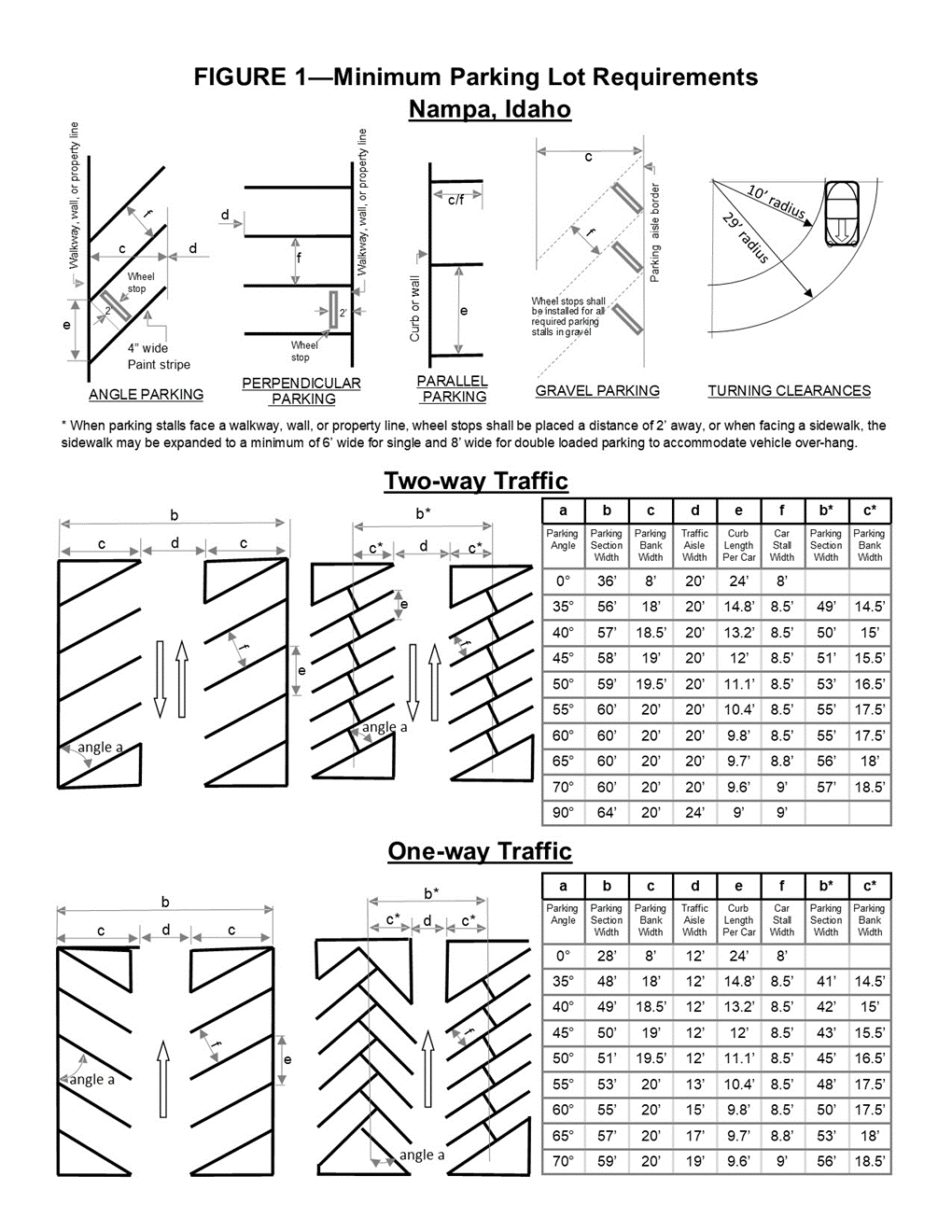
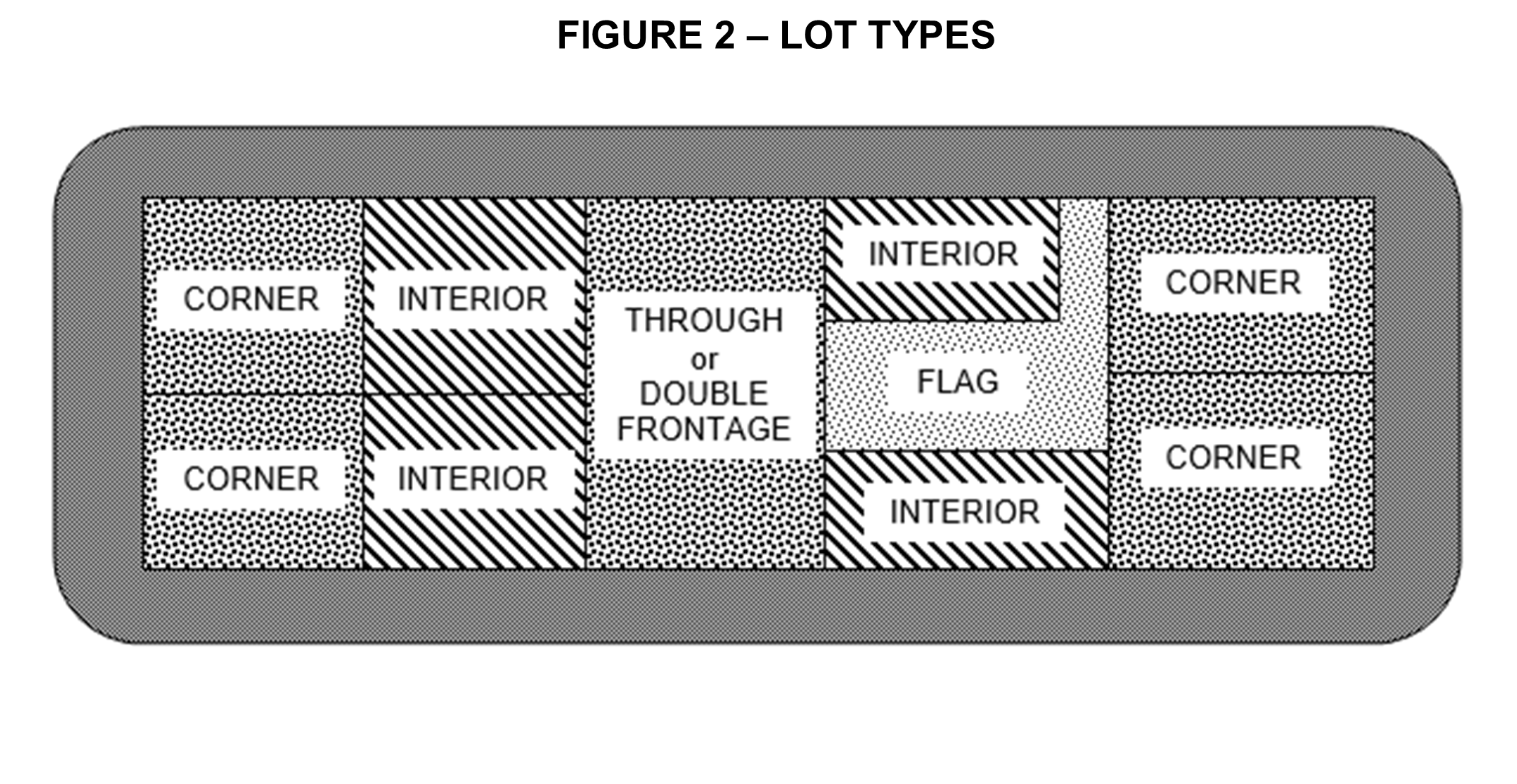
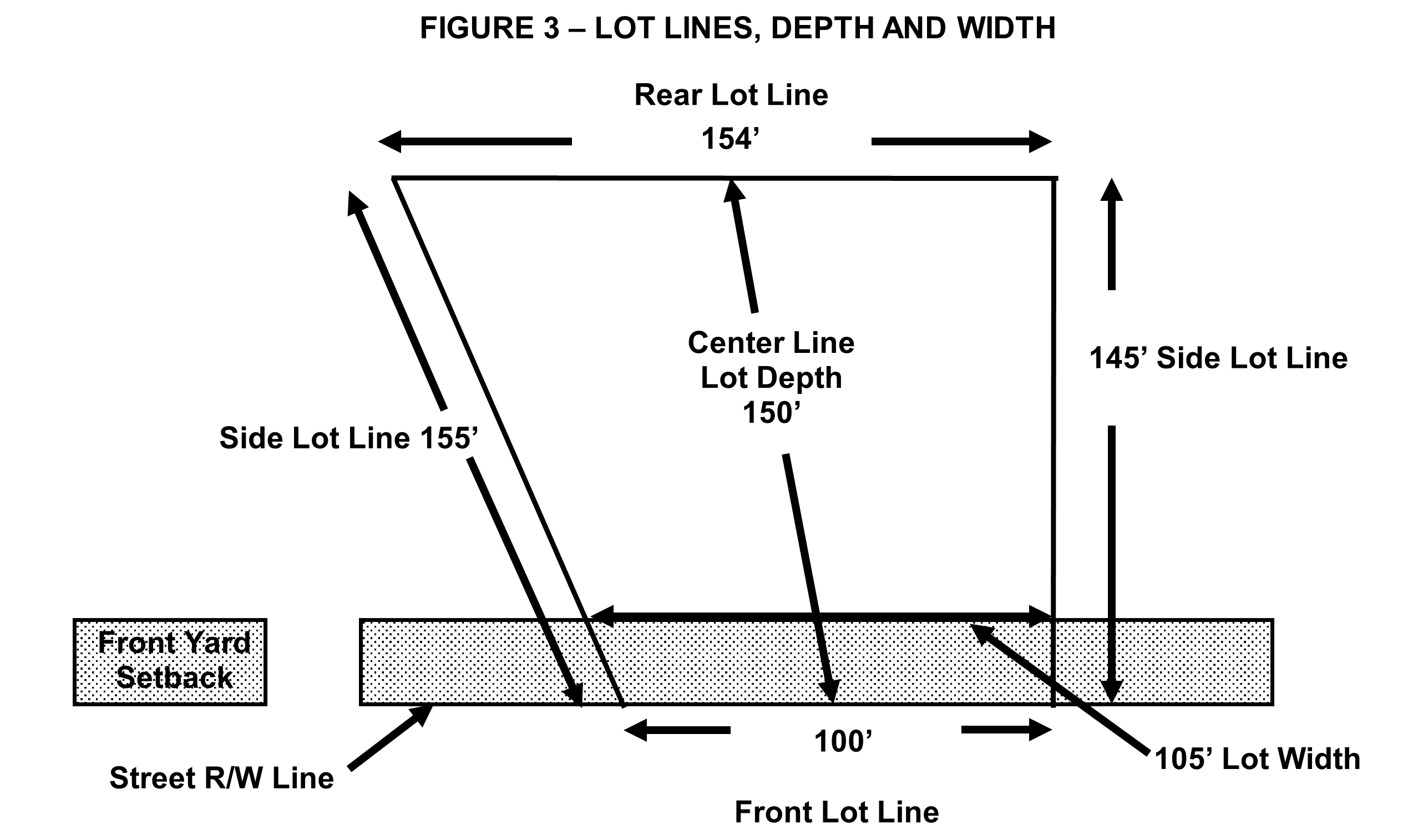
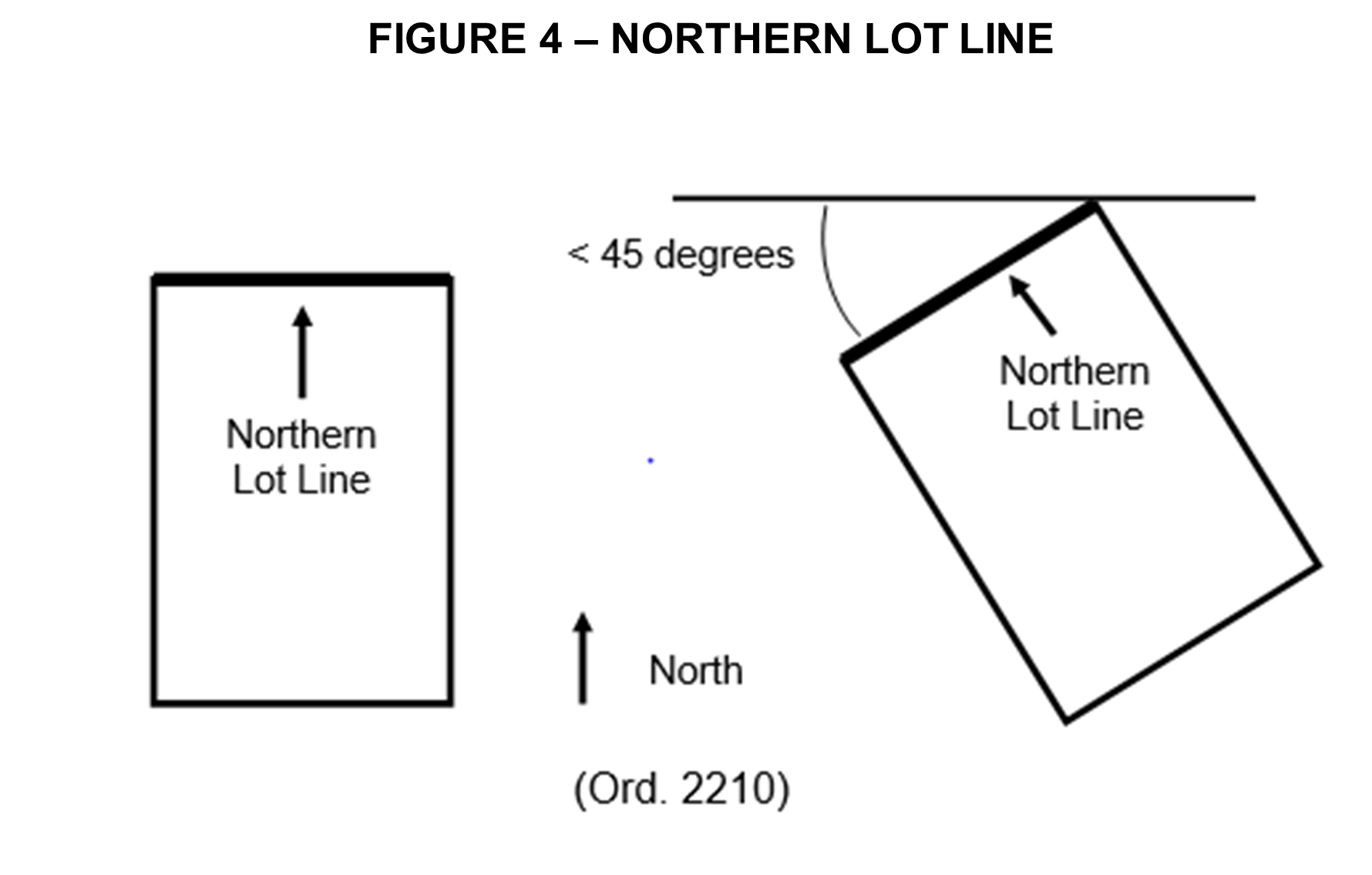
Figure 5A—Vision Triangle
(Partially Controlled Intersection)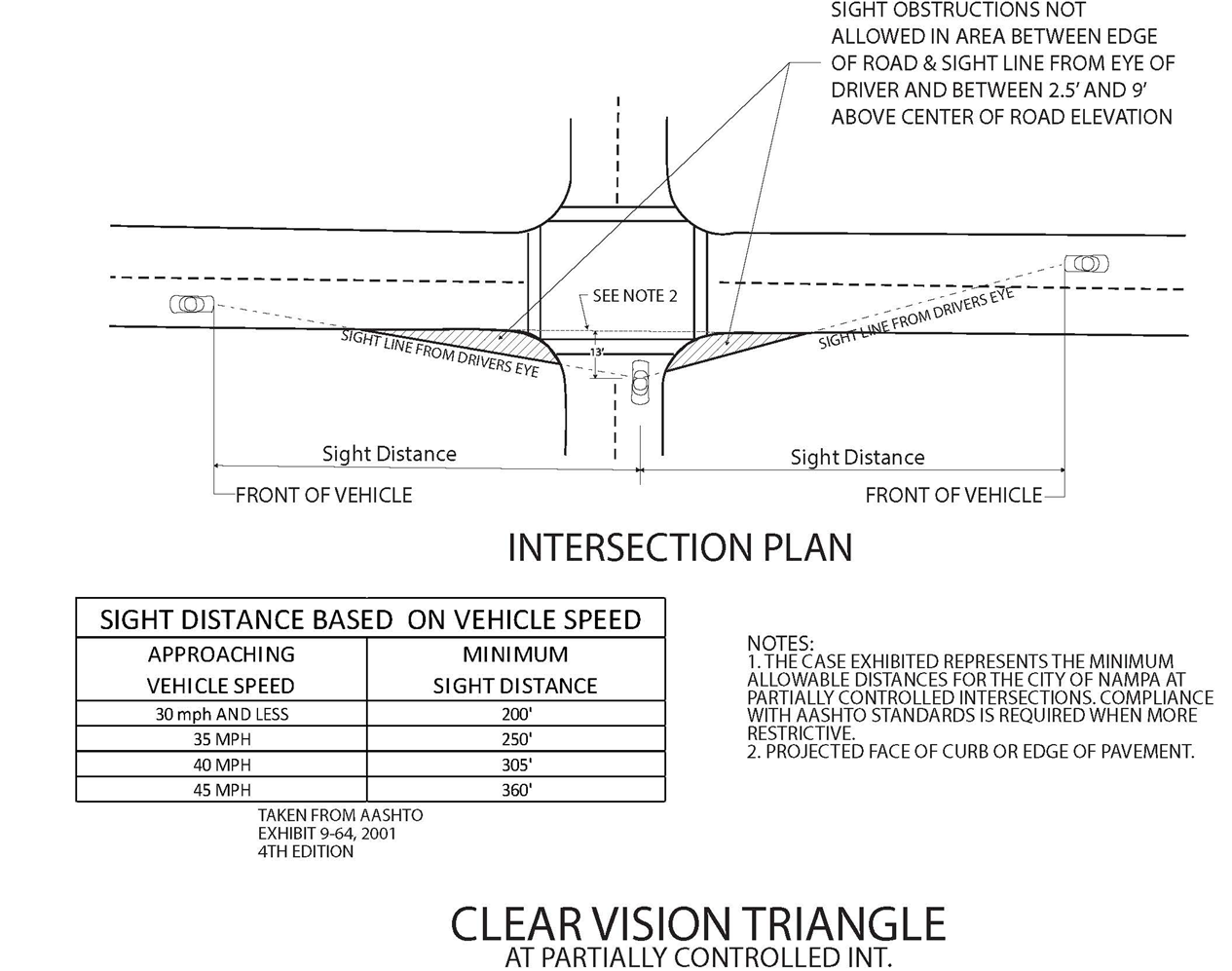
Figure 5b—Vision Triangle
(Uncontrolled Intersection)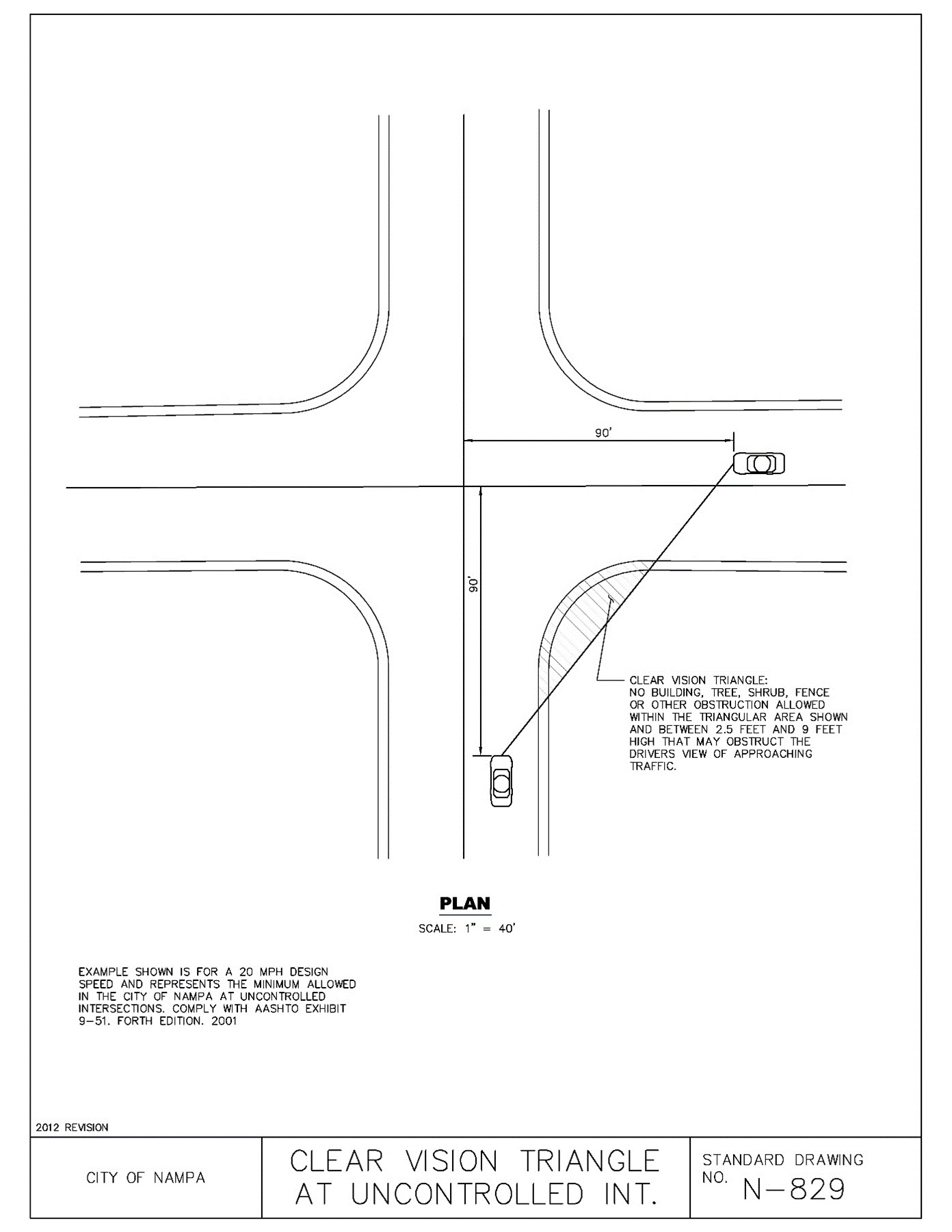
Figure 6—Flag Lot and Stacked Lots w/ Private Street and Access Easement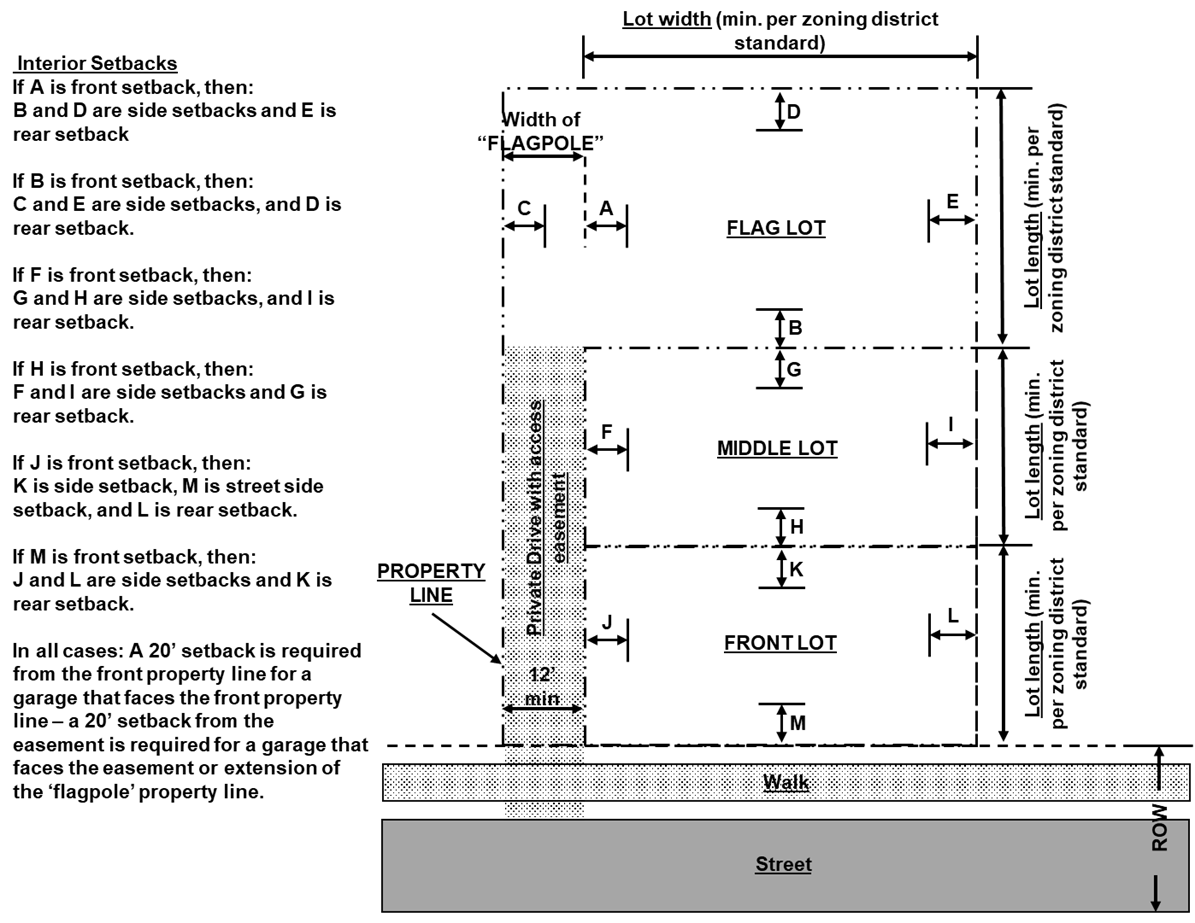
Figure 7—Stacked Lots w/ Private Street or Common Drive, and Access Easement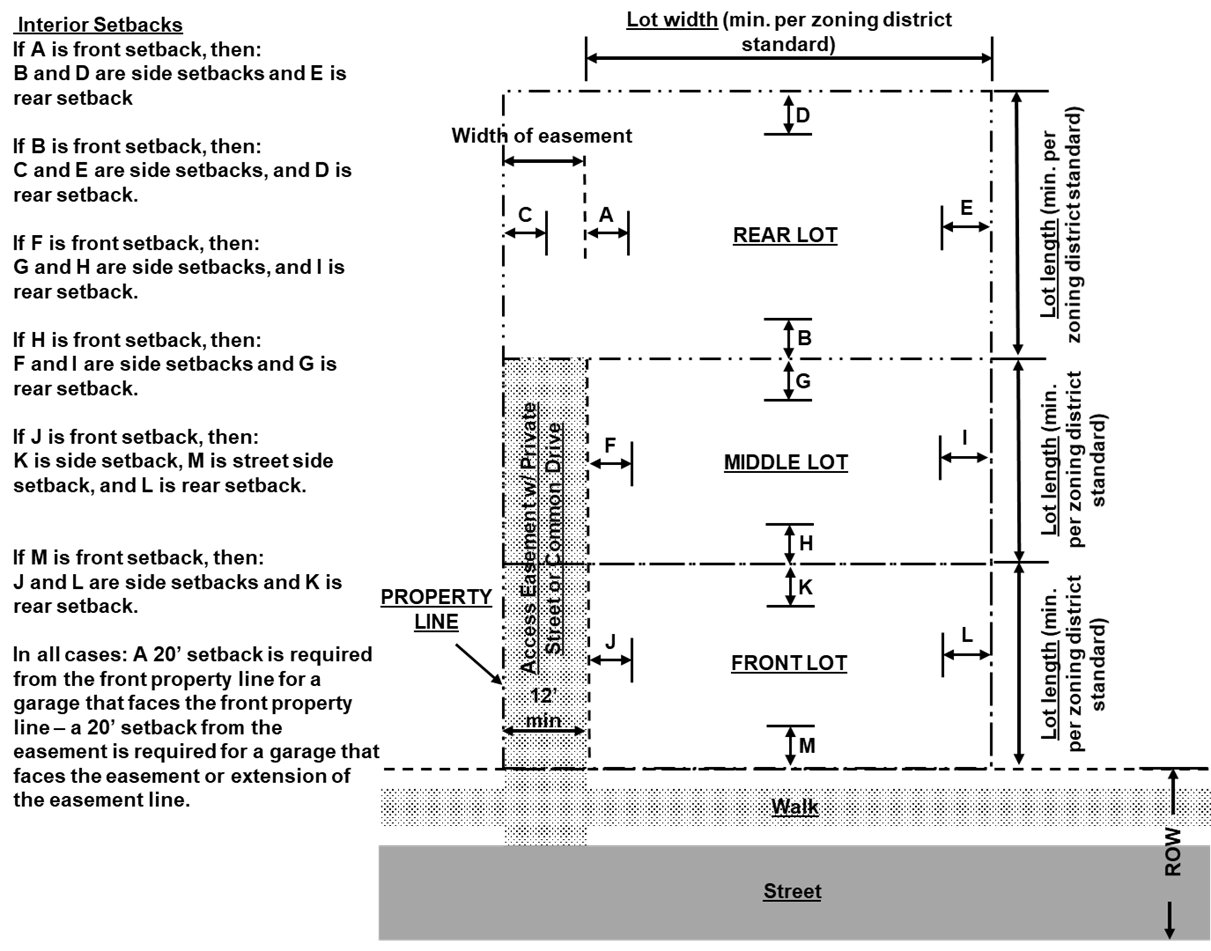
Figure 8—Standard Residential Setbacks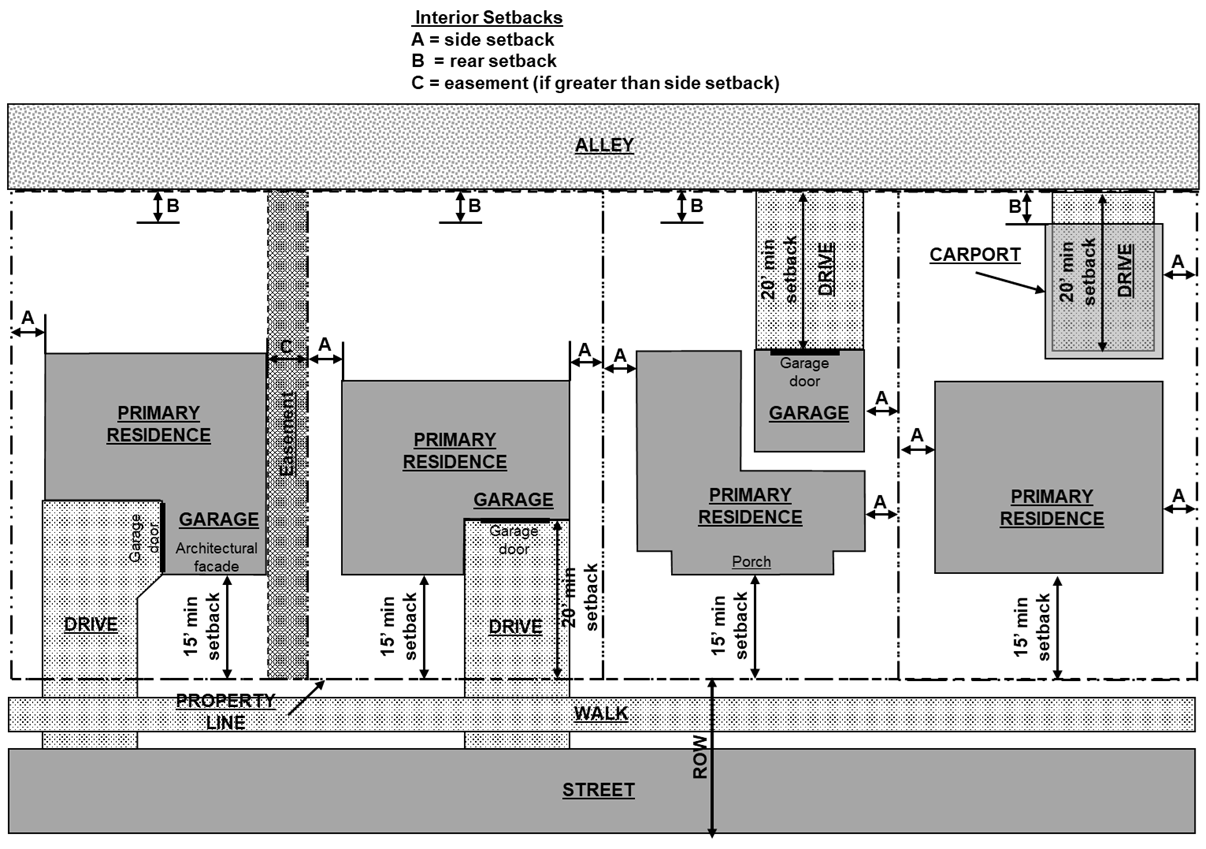
Figure 9—Building/Structure Height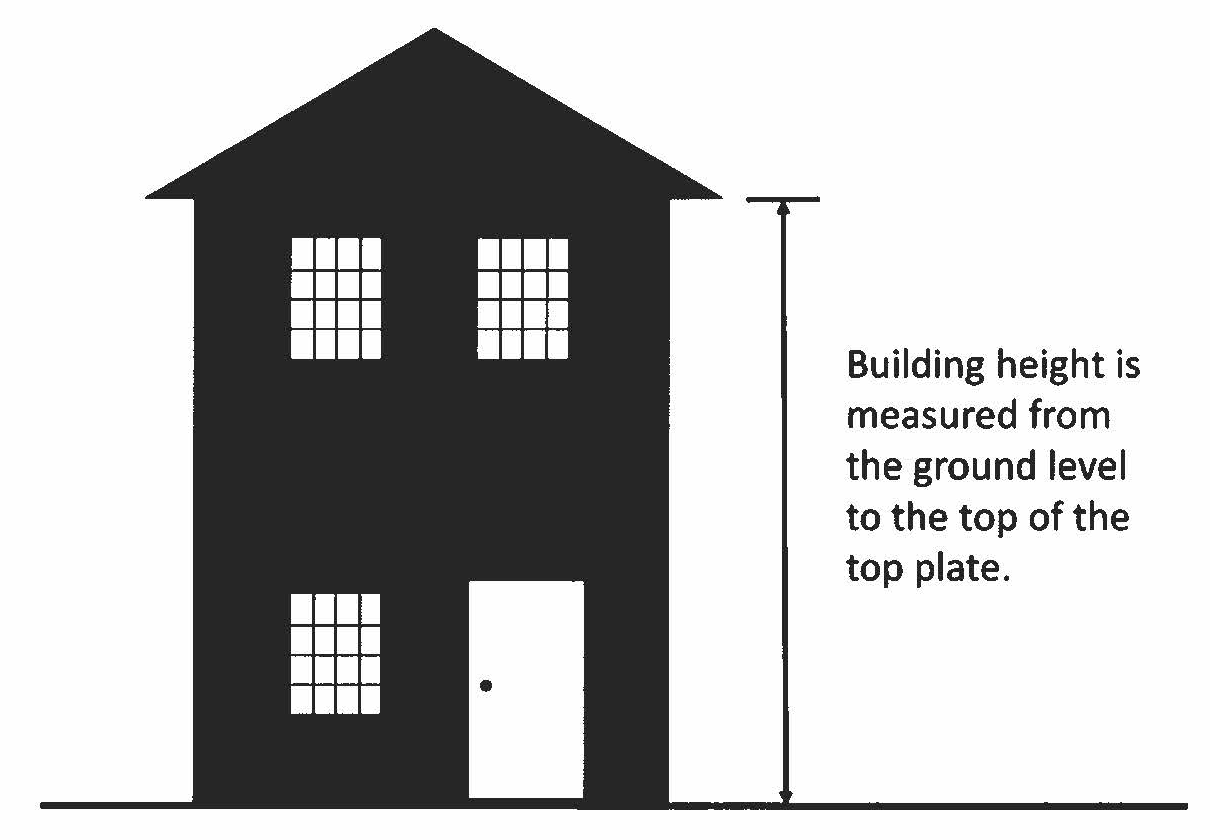
(Ord. No. 4617, § 1(Exh. A), 10-4-2021; Ord. No. 4809, § 1(Exh. A), 6-3-2024)
10-1-16. - Professional, public self-storage facility design regulations.
These site and building design standards shall apply to public self-storage facilities proposed to be: Newly constructed or otherwise developed, converted from open ground, converted from another use, converted from an existing storage facility to a public facility, and existing storage unit facilities that expand. A conditional use permit shall be required from the city council and shall follow all application procedures as outlined in chapter 10-34. Design standards shall comply with the following:
A.
General regulations of storage units.
1.
These site and building design standards shall apply to public self-storage facilities proposed to be newly constructed or otherwise developed, converted from open ground, converted from another use, converted from an existing storage facility to a public facility, and existing storage unit facilities that expand. A conditional use permit shall be required from the city council.
a.
Locations allowed. Public storage facilities shall be located on property that abuts a public street. The service drive(s) in a storage facility may remain private.
b.
Setback. A conditional use permit shall require that at least 25 percent of the property be used for something other than public storage facilities or public storage offices, said uses still being required to be consistent with the underlying zone. Said other use shall be located between the public storage facilities and the public road onto which the property fronts. The percentage of the property used for non-public storage uses may be reduced for properties with a depth in excess of 750 feet, however, in no such case shall the setback required by this subsection be more than 150 feet.
Exception for interstate/freeway: Public storage facility buildings shall be placed a minimum of 250 feet from the interstate freeway right of way.
c.
Public storage facility buildings shall be located a minimum distance of 100 feet from any RS (single family residential) or RD (residential duplex) zoning district, from any low or medium density designation on the comprehensive plan future land use map not annexed into the city, and 100 feet from any existing residential building.
2.
Setback from residential district. Public storage facility buildings shall be located a minimum distance of 100 feet from any RS (single family residential) or RD (residential duplex) zoning district, from any low or medium density designation on the comprehensive plan future land use map not annexed into the city, and 100 feet from any existing residential building.
3.
Buffer from other storage. No new public storage facility or conditioned multi-level storage building shall be allowed within 2,500 feet of the property line of any existing storage facility or multi-level storage building, regardless of the jurisdiction in which the existing storage facility or multi-level storage building is located. The foregoing limitation shall not apply to the location of storage facilities/units inside of a preexisting, temperature-controlled building. Expansion of storage facilities existing as of September 8, 2020, shall be limited to the property boundaries existing at date of securing planning and zoning entitlement; storage facilities having obtained a building permit for construction of a storage facility as of September 8, 2020, shall be permitted to expand within the boundaries of the property/properties as those property boundaries existed on September 8, 2020.
B.
Structure appearance requirements.
1.
Any portion of a building wall visible from a public street and longer than 100 feet shall include façade changes such as bases, fenestration, offsets, and wall plane jogs;
2.
External building materials on walls visible from a public street shall be limited to masonry (e.g., brick, stone, quality concrete, quality concrete block), glazing, and EIFS systems. Overhead doors may be metal;
3.
Exterior finish materials shall be non-reflective and shall include use of at least three colors and three material textures or three different materials;
4.
Any roof mounted vents (e.g., on the office building) shall be painted to match the color of the roof;
5.
Exterior paint colors shall be earth tone with no white, black or reflective/fluorescent coloring allowed;
6.
In addition to the foregoing, storage facility offices shall have at least 25 percent glazing on their primary facade(s); and
7.
Public storage facility structures that are contiguous to RS (residential single family) or RD (residential duplex) zoning districts, or that are located in a BN (neighborhood business) or RP (residential professional) zoning district shall limit the height of storage buildings to 15 feet at the edge of eaves.
C.
Project design and layout.
1.
Service drives accessing and running between the units shall comply with standards adopted either by the Nampa Fire Department (as they also serve as fire lanes) or by regulations found in chapter 22 of this title, whichever is more restrictive;
2.
All service drives and parking areas, except for areas used for large recreational vehicle storage shall be paved. Parking areas exclusively designed for the parking of recreational vehicles (including trailers, RVs, boats and motorcycle/four-wheeler/ATV vehicles on trailers, etc.) may be graveled and may be covered with an unenclosed carport structure not exceeding 19 feet in height. Such structures shall have a minimum eighteen fascia and six columns or posts;
3.
Buildings may be used as perimeter side and rear yard fencing, however, when adjoining a residentially zoned or used property, a sight/site obscuring fence between six feet and eight feet in height shall be placed on the property line between the storage facility and residential neighbor buildings closest to that property line shall comply with the interior yard setback requirements pertinent to the zone within which the storage facility will be developed;
4.
A storage facility project shall comply with front yard setback requirements pertinent to the zone within which the facility is proposed to be developed;
5.
The office of a storage facility project shall be located closer to the main street which the project fronts than the storage buildings of said project; and
6.
Landscape buffer. The 15-foot landscape buffer as described in section 10-33-4.A.1 shall be expanded to 25 feet and apply to any portion of the project property/properties that are contiguous to street, pathway, or sidewalk right-of-way, and along any property line shared by a residentially zoned property or a property designated as low or medium density residential in the comprehensive plan future land use map.
D.
Lighting and security.
1.
All exterior structure lighting shall be shielded, screened, and/or shuttered from with 90 degree cutoff luminaries and shall be otherwise directed so as to prevent illumination of adjoining properties, particularly when located adjoining or across the street from residentially used or zoned properties;
2.
Pole lights shall be limited to two light poles per 100 feet of service drive and shall not exceed 12 feet in height. Such lights shall also use 90 degree cutoff luminaries ("downlighting");
3.
Electrical feeds to outdoor light fixtures shall be placed underground not overhead;
4.
Floodlights shall not be allowed;
5.
Security cameras shall be allowed but only directed inwardly toward areas of the facility itself excepting for the main entrance area of the project which may be monitored from the office or other location; and
6.
Audible alarms shall be controlled in decibel level so as to not exceed industry standard(s).
E.
Signage. Public self-storage facilities shall be governed by the sign provisions for the zone in which they are located.
(Ord. No. 4617, § 1(Exh. A), 10-4-2021; Ord. No. 4671, § 1(Exh. A), 5-16-2022; Ord. No. 4777, § 1(Exh. A), 12-18-2023)
10-1-17. - Relocated residential buildings.
Move-on houses, manufactured houses more than five years of age (based on date of proposed move), garages, may be relocated into or within the City of Nampa under the following conditions:
A.
Relocated structures shall be brought into substantial compliance with current building, electrical, plumbing, mechanical and energy codes as adopted by the City of Nampa.
B.
Structures requesting consideration for relocation must be inspected by the building safety department prior to moving. The inspection shall be done in accordance with the provisions of section 4-6-4, "Inspection" of this Code. The inspection report outlining the required reparations to bring the move-on structure into substantial compliance with applicable codes shall be issued and become a condition of the building permit.
C.
The property owner shall provide a cashier's check (preferable) or a letter of credit (acceptable but less preferred) in and for the amount of the estimated demolition cost for the relocated structure and restoration of the property. The owner/permittee may obtain an independent third party bid from a legitimate demolition contractor for the required demolition and site restoration. In the absence of a qualified bid the building official shall estimate the amount of demolition and restoration, and the owner/permittee shall provide a bond in an amount of one and one-half times the estimate. The bond shall be made payable to the City of Nampa and shall be exercised upon failure of the owner/permittee to complete the work specified by the building permit conditions.
D.
Upon expiration of a building permit to emplace a move-on structure or, after one year from the date of the building permit's issuance, whichever is sooner, the city will demand that all required reparations be completed as originally conditioned by the building permit.
If the owner fails to complete the work as required the building official shall issue a notice and order as specified in city's adopted abatement code (the Uniform Code for the Abatement of Dangerous Buildings, 1997 edition). This notice and order shall specify a time not to exceed 60 days for the owner/permittee to complete the work. Failure to then finish the work shall, upon following proper due process, cause the city to raze the building using the bond to cover costs.
(Ord. No. 4617, § 1(Exh. A), 10-4-2021)