


Nampa City Zoning Code
CHAPTER 26
- PLANNED UNIT DEVELOPMENTS AND MASTER PLANNED COMMUNITIES
Sections:
10-26-1.- Purpose.
Planned unit development (PUD). The intent of PUD regulations is to permit greater but limited flexibility to: zoning, uses, lot sizes, bulk requirements, setbacks, building height, and placement of structures that are typically required in zoning districts, and consequently, more creative design for development than generally is possible under conventional zoning regulations or subdivision regulations as affected by zoning regulations. Density allowance is increased by 20 percent over standard subdivision development. It is further intended to promote more economical and efficient use of land while facilitating a harmonious variety of neighborhood development, a higher level of urban amenities, and preservation of natural scenic qualities of open spaces.
Master planned community (MPC). MPCs encompass a large geographic area (at least 40 acres) and contain multiple zones, uses, densities and housing types. They are required to meet standard building requirements (building code, fire code and other regulatory requirements). MPCs allow alterations to: lot sizes, bulk requirements, setbacks, building height, and placement of structures that are typically required in zoning districts. Density allowance is increased by 20 percent over standard subdivision development. The intent is to allow a developer to use creativity and successful design principles that bring together multiple elements in a cohesive design utilizing smart growth principles that may otherwise not be permitted in the Nampa City Code.
(Ord. No. 4617, § 1(Exh. A), 10-4-2021; Ord. No. 4702, § 1(Exh. A), 12-5-2022; Ord. No. 4727, § 1(Exh. A), 4-3-2023; Ord. No. 4842, § 7, 2-3-2025)
10-26-2. - Use requirements.
A.
PUD and MPC ratio of land uses.
1.
Ratio of land uses for MPC's, PUD's that are larger than five acres in a mixed use land use designation. In the residential mixed-use land use designation on the future land use map, over 50 percent of the proposed land use shall be residential with no less than five percent of the land use as commercial. In the community mixed-use land use designation on the future land use map, over 50 percent of the proposed land use shall be commercial with no less than five percent of the land use as high-density residential and/or light industrial.
2.
A development not located in a mixed-use future land use designation, may propose a mix of zoning designations and uses. Up to 30 percent of the land area may be assigned a zone that does not match the future land use designation.
B.
Local land uses controls. Proposed land uses shall be subject to architectural controls as administered by a homeowners' association using their CCR's and any related policies.
C.
Industrial parks. An owner/developer wishing to establish an "industrial park" shall obtain approval of a planned unit development or master planned community for any industrially zoned property. An approved concept plan will establish the location of accessways, structure orientation, primary facades for review, the location of overhead doors and any enhanced landscaping that may be proposed. If any exceptions from title 10, chapter 34 design review standards are being requested, they shall be outlined in the narrative and on the concept plan.
(Ord. No. 4617, § 1(Exh. A), 10-4-2021; Ord. No. 4727, § 1(Exh. A), 4-3-2023; Ord. No. 4777, § 1(Exh. A), 12-18-2023; Ord. No. 4842, § 8, 2-3-2025)
10-26-3. - Area requirements.
A.
Entire development. No PUD shall be for an area less than two acres in size, and no MPC shall be for an area less than 40 acres in size.
B.
Connectivity requirements. Any PUD or MPC with multiple zoning designations shall provide pedestrian and bicycle access through and between land uses.
(Ord. No. 4617, § 1(Exh. A), 10-4-2021; Ord. No. 4727, § 1(Exh. A), 4-3-2023; Ord. No. 4873, § 16, 6-16-2025)
10-26-4. - Exceptions to district regulations.
Individual uses and structures in PUDs and MPCs shall comply with the specific zoning-based regulations of the underlying districts with the following exceptions:
A.
Detached building spacing.
1.
Wall separation. Where two walls oppose each other, minimum separation shall be as required by city fire regulations.
2.
Privacy. Where windows are placed in only one of two facing walls or there are no windows, or where the builder provides adequate screening for windows, or where the windows are at such a height or location to provide adequate privacy, the building spacing may be reduced.
3.
Light and air. Building spacing may be reduced where there are no windows or very small window areas and where rooms have adequate provisions for light and air from another direction.
4.
Utility areas. When areas between buildings are to be used for utility purposes a reduction of building spacing shall be permitted. Where this use is similar for both houses, a reduction of building space permitting effective design of a utility space shall be permitted. Kitchens and garages are suitable uses for rooms abutting such utility yards.
5.
Building configuration. Where building configuration is irregular, so the needs expressed in subsections A.2, A.3 and A.4 of this section are met by the building configuration, reduced building spacing is permissible, as determined by the average spacing or by measuring spacing where rooms open toward adjacent buildings.
B.
Bulk requirements (i.e., setbacks, property depth, property width, building height, density, and street frontage). Bulk requirements that would otherwise be applicable to a project developed in a given zone wherein a PUD or MPC is proposed/allowed may be altered by the commission as part of a PUDs or MPCs review and approval process. The Commission may allow deviations from the setback, lot sizes, property depth, property width, building height, and street frontage requirements without one or more variance application permits being required provided that they conclude that any code required bulk requirement exceptions allowed comply with the following standards by assuring that:
1.
Building separation. Shall meet current adopted International Building Codes.
2.
Parking space clearance. Garages and carports shall be no closer to the street or alley than 20 feet. Off street parking pads and driveways shall be paved for two vehicles and at least 20 feet deep. All other parking shall comply with parking requirements as stated in title 10, chapter 22, Off-street parking.
3.
Access. Access to a public street is assured to each and every building lot/parcel by direct access, recorded easement or shared parking/cross-access agreement.
4.
Setback. Shall conform to the zoning district setback requirements wherein the structures are placed. RS and RD side and rear yard setbacks may be reduced to four feet or from the easement, whichever is greater, or to a distance required by building and fire codes. Structures that are four feet from the property line shall be allowed a one-foot maximum eve encroachment into the setback.
5.
Height of buildings. Building heights in a PUD and MPC development may extend up to two stories above the limitation of the zone in which it is located only when the zone does not abut a single-family residence, residential subdivision, residential zoning district or a low- or medium-density residential land use designation on the City of Nampa's Future Land Use Map on the side(s) of the PUD or MPC. Structures on the PUD property adjacent to residential land uses, zones and land use designations shall not exceed the height limitation of those residential zones, or 30 feet if undefined, extending 100 feet into the PUD or MPC.
C.
Density and lot size.
1.
Planned unit developments and master planned communities shall adhere to the applicable residential zoning district density and lot size limitations with the option of increasing the density by 20 percent and reducing the minimum lot size by 20 percent (see subsection 10-27-3.C.2 for lot sizes allowed per zoning district and product type).
2.
Buildable lot size and density requirements. New lots created on or after October 4, 2021 by an administrative lot split or through a subdivision of the land must conform to the minimum and maximum lot size and density requirements established for the zoning district assigned to that parcel, or as approved through a PUD or MPC, in order to be considered a 'buildable' lot.
D.
Zero lot line structure placement(s). Buildings may be placed close to, or on the lot line by common wall construction. Zero lot line units shall be allowed in PUDs and MPCs provided the following requirements are met:
1.
In the case of common wall construction all applicable city, state and federal building regulations shall be complied with.
2.
Sites shall be selected to avoid drainage problems since it becomes more difficult for each lot to drain on its own with one side yard eliminated.
3.
In the case of buildings which are to be placed close to or on the lot line the following shall apply:
a.
The adjoining lot shall provide a five-foot maintenance easement on the zero lot line side.
b.
The use of maintenance easements shall be restricted to daylight hours and the total number of days per year the easement may be used shall be agreed upon.
c.
The owner(s) of the adjacent lot shall not make any attachments to lot line walls, alter it in any way, or use it as a playing surface for any sport.
E.
Residential cluster subdivisions.
1.
Definitions.
Cluster home: A self-contained single-family dwelling unit. Cluster homes may be configured in the form of a single-family detached dwelling unit, a two-unit townhouse, or three-unit townhouse building. Each cluster home shall contain at least one bedroom, kitchen, living area, laundry, and bathroom. Each cluster home shall be on its own lot and individually owned. They shall be single-story, or two story with setback limitations (see subsection 10-26-4.E.1.c "setbacks and height limitations" below). Cluster homes shall be permanent structures built on a permanent foundation. A cluster home unit may be a "tiny house" (see "tiny house" definition below).
Cluster residential subdivision: A cluster residential subdivision is a stand-alone subdivision not associated with any other subdivision. It shall consist of a cluster of cluster homes each residing on its own lot. Cluster residential subdivisions shall share a common interior open space around which the dwelling units are clustered. All units shall be connected to the open space area and city walks by an integrated pathway system. Parking shall be provided to the dwelling units by a shared parking area.
Tiny house: A "tiny house" is a residential structure that is 400 square feet or less in floor area excluding lofts with specific building code requirements. Tiny houses shall be constructed on site on a permanent foundation using standard construction methods. No "mobile," "axle," "frame with axle," or other nonpermanent foundations are permitted. Tiny house construction shall meet the City of Nampa adopted building codes for tiny houses and require necessary permits.
a.
Units, zoning and lot sizes.
• Each cluster residential subdivision shall consist of single-family detached cluster homes, two-unit townhouses, or some combination thereof, in the AG, RA, and RS-4 zoning districts or single-family detached units, two-unit townhouses, and three-unit townhouses, or some combination thereof in the RD, RML, RMH, GB2 and RP zoning districts.
• Cluster residential subdivisions shall be configured with cluster homes surrounding a central courtyard. The central common courtyard shall be a cumulative size comprising of at least 500 square feet per dwelling unit.
• Lot sizes: Lots shall be sized utilizing the following matrix:
b.
Floor area and building articulation.
• Dwelling unit minimum floor area and ceiling height shall be determined by the building codes utilized by the city building department.
• Fronts of all dwelling units shall face the central common area, with exception of corner units, which may face the side of a dwelling unit that faces the central common area.
• At least 60 percent of the living space shall be located on the first floor of any two-story dwelling unit excluding sleeping lofts.
c.
Setbacks and height limitations.
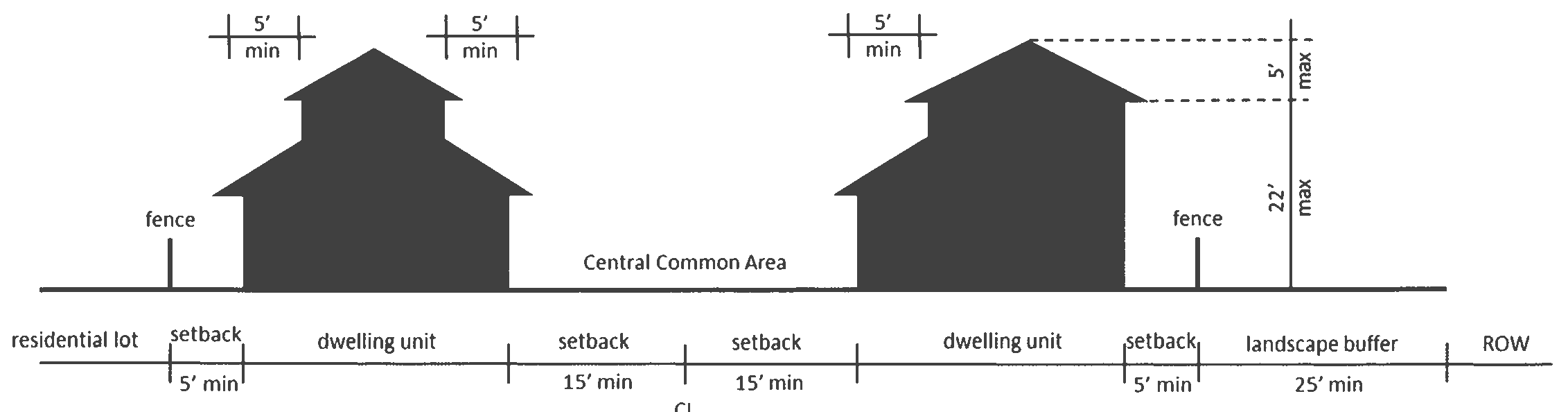
• Lot property lines of dwelling units facing the central common area shall join in the center of the central courtyard where feasible.
• A common easement shall be created for all common areas.
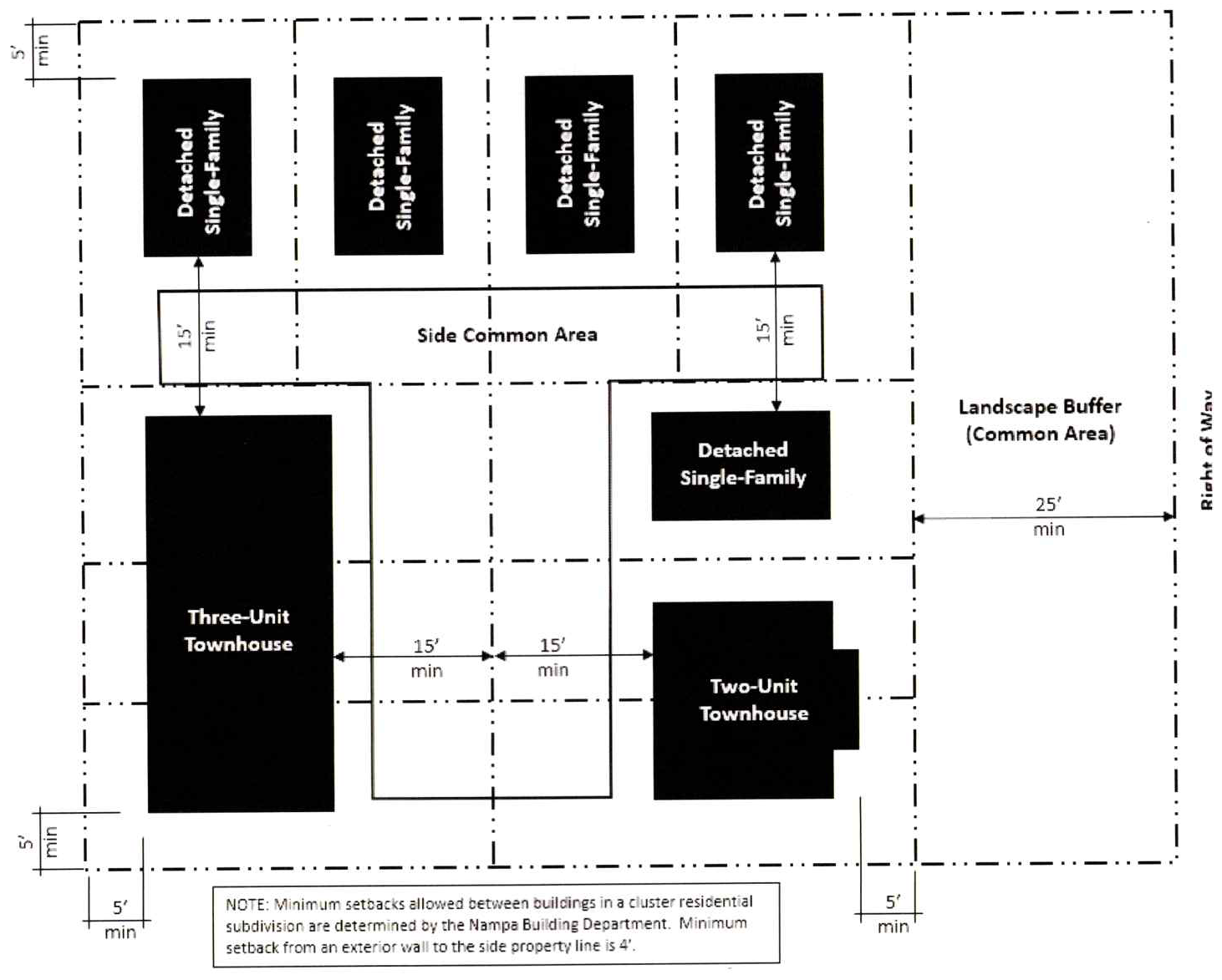
• The side and rear setback between the subdivision and unrelated adjoining properties shall be a minimum of five feet.
• Setbacks from landscape buffer shall be five feet.
• Minimum setbacks allowed between buildings in a cluster residential subdivision are determined by the Nampa Building Department. Minimum setback from an exterior wall to the side property line is four feet.
• The front setback of dwelling units that face the central common area and share a common property line shall be a minimum of 15 feet.
• The front setback from a dwelling unit's front property line that abuts another dwelling unit's side property line shall be a minimum of 15 feet.
• Setbacks from the center line of any alley shall be a minimum of 15 feet.
• If an easement is wider than a required setback, the easement width shall prevail as the minimum required setback.
• Second story walls that face common areas shall be setback at least five feet from the first story front wall or front porch plane.
• Second story walls that face an adjacent residential property that is not part of the cottage/cluster subdivision shall be setback five feet from the first story rear or side wall plane.
• Each building shall be no higher than 22 feet (measured from the finished floor elevation to the highest ceiling elevation).
• The height of the apex of the roof may exceed the building height limit by no more than five feet.
d.
Street frontage requirements. None required for dwelling units. Parking lot must have legal access to a public street or city-approved private drive or common driveway.
e.
Accessory structures. One accessory structure is permitted per dwelling unit.
Accessory structures:
• Shall not exceed 100 square feet in size;
• Shall not exceed seven feet in height (ceiling elevation);
• Shall not be any closer than three feet to the principal dwelling unit;
• Shall not be located within any setback area;
• Shall complement the architecture of the primary dwelling unit and subdivision; and
• Shall not be used as a dwelling unit.
f.
Landscaping.
• All cottage/cluster subdivisions shall be fully landscaped with trees, shrubs and groundcover.
• A 25-foot landscape buffer is required on all collector, arterial and local roads and shall be designed per specifications listed in NCC 10-33.
• One Class I or Class II tree shall be planted for every dwelling unit anywhere in the subdivision.
• All planted areas shall be irrigated with a subterranean automatic irrigation system per specifications listed in NCC 10-33.
• Subdivision HOA shall include a provision in the subdivision CCR's for the maintenance and preservation of trees in a healthy and safe condition. Those provisions shall include a requirement that any tree that dies within the subdivision shall be replaced within 90 days, or as soon as the weather permits (see NCC 10-33 for specific information about the maintenance of landscaped areas).
• Five-foot wide or wider concrete or masonry walkway connections are required to connect the entrance of each dwelling unit to the courtyard, parking lot and public sidewalk.
• All ground cover shall be turf, living groundcover plants or decorative rock. No more than 30 percent of the total area covered in living groundcover or shrubs shall be decorative rock.
• All trees specified for planting within the subdivision are subject to approval by the city forester or his/her designee.
g.
Parking.
• Off-street parking lot: two and a half spaces required per dwelling unit (two spaces per dwelling unit for residents, and the remainder as guest parking).
• Off-street residential parking lot(s) shall be located in the same cottage cluster subdivision development as the dwelling units that they serve.
• All residential parking spaces shall be covered by a carport. Guest parking is not required to be covered.
• A carport shall be setback five feet from the side and rear property line, and shall not encroach into a landscape buffer area.
• Carports must be out of the vision clearance triangle (see section 10- 1-15, Figures 5a and 5b of this title).
h.
Required design elements. All dwelling units shall be required to follow the standards listed below:
• Covered front porches are required for each dwelling unit with a minimum area of 80 square feet.
• All fences on the rear and side yard property lines behind the front plane of the dwelling unit(s) shall be a maximum height of six feet.
• Fences in the front of dwelling units shall be a maximum height of three feet.
• No chain link fence shall be permitted.
• Each subdivision shall share a common architectural theme (bungalow, craftsman, stone cottage, etc.).
• Each unit shall contain at least three different siding elements (planking, staggered shakes, stacked stone, etc.).
• Exterior chimneys shall be covered with masonry, stacked stone, stone, or other elements that match the architecture of the development.
• Three distinct complementary paint/finish colors are required for wall planes and trim.
• Roof type and colors shall be appropriate to the style of architecture and selected color palette.
• Colors and painting schemes shall not be garish, fluorescent, or harsh.
• At least 30 percent of the walls that face the courtyard shall be in glazing (doors with at least one third in glazing may be considered part of the calculation).
• Large blank wall planes, inadequate glazing, inadequate/inappropriate lighting, limited variation in texture and architectural elements, are not permitted.
• All mechanical units shall be screened from view with a solid fence or with evergreen vegetative screening. HVAC units shall be in rear or side yards and away from common areas.
• Trash enclosures shall be screened from view by fencing with evergreen vegetative screening.
• Exterior gas fireplaces/firepits shall be placed and permitted according to all building and fire code regulations.
• Overhang from exterior awnings, trellises, gazebos and other exterior structures shall be permitted to extend one foot into any building setback for each lot.
• The subdivision shall be designed to meet engineering standards for runoff and rainwater collection.
i.
Common space and amenities.
• Courtyard area requirement: (500 square feet) x (# of dwelling units in the subdivision) minimum.
• Private open space, unintegrated stormwater retention management facilities, landscape buffers, parking areas, and driveways do not qualify as courtyard or common open space area.
• Each dwelling unit shall have paved pedestrian access from their front door to:
• The central open space area
• The resident parking lot
• A public sidewalk
• Trash enclosure(s)
j.
Project review process.
i.
All cluster residential subdivisions without a tiny house shall be subject to the standard subdivision review and approval process (see sections 27-2 and 27-3 of this title).
ii.
All cluster residential subdivisions that include a tiny house on a development of 0—1.99 gross acres, shall, in addition to being subject to the standards subdivision review and approval process, require a conditional use permit.
iii.
All cluster residential subdivisions that include a tiny house on a development of two or more gross acres, shall be submitted for review and approval as a planned unit development (see section 10-26-8).
iv.
Cluster residential subdivisions preliminary development plans shall be reviewed by city staff in a pre-application meeting. The plan will be presented to the commission and council in the preliminary plat application process.
v.
The preliminary development plan shall be presented in the same form, and contain the same information, as outlined for preliminary subdivision plats under chapter 27 of this title, or as required for PUD's in chapter 26 of this title. In addition, the development plan shall contain the following information:
• Notation(s) regarding proposed ownership of streets, public or private.
• A landscape plan identifying materials and elements used for private front yards; common courtyard and open space areas; intervening spaces between rights-of-way and building lines; and between buildings, drives and parking areas.
• Schematics of the proposed development, building elevations and open space area elements.
• Deed restrictions, protective covenants and other legal statements or devices to be used to control the use, development and maintenance of the land, and the improvements thereon, including those areas which are to be commonly owned and maintained.
• General outline of intended organizational structure related to property owners' association, deed restrictions and provisions of services.
• A copy of the legal title to the property or proof of a legally binding sales agreement ensuring the entire project area is under single ownership or control.
• Existing features of the development site including major wooded areas and structures.
• The pattern of public and private roads, driveways, parking facilities, pedestrian ways and intended design standards.
• The size arrangement and location of lots or of proposed building groups.
• Preliminary building elevation renderings/pictures/etc.
(Ord. No. 4617, § 1(Exh. A), 10-4-2021; Ord. No. 4671, § 1(Exh. A), 5-16-2022; Ord. No. 4727, § 1(Exh. A), 4-3-2023; Ord. No. 4777, § 1(Exh. A), 12-18-2023; Ord. No. 4809, § 1(Exh. A), 6-3-2024; Ord. No. 4842, § 8, 2-3-2025; Ord. No. 4873, § 16, 6-16-2025)
10-26-5. - Open space requirements.
A.
Qualified open space.
1.
PUDs.
a.
For developments with a gross acreage of 2—4.99 acres: At least ten percent of the total gross acreage shall be retained as qualified open space. Buildable acreage with residential lots that are 32,000 square feet or greater is not required to contain qualified open space.
b.
For developments with a gross acreage of five acres or greater: At least 15 percent of the total gross acreage shall be retained as qualified open space. Buildable acreage with residential lots that are 32,000 square feet or greater is not required to contain qualified open space.
2.
MPCs. At least 15 percent of the total gross acreage shall be retained as qualified open space.
3.
Qualified open space shall include land area that:
a.
Is not covered by buildings, parking structures, or accessory structures (except commonly held recreational structures);
b.
Is not enclaved inside individual, privately held building lots;
c.
Is not part of any proposed or existing street, common driveway, private driveway or parking pad, alley, or exclusive easement;
d.
Is not proposed to be platted into lots arranged in such oddly dimensioned, unusable shapes, as to be considered realistically unusable, as determined by the director or his/her designee;
e.
Is not unsuitable land or in an inaccessible easement;
f.
Is not sloped such that it creates a dangerous or hazardous condition.
4.
All open space areas with active recreational elements shall be sloped per industry standards for those activities and shall provide accommodation for ADA access.
B.
Qualified open space calculation.
1.
Drainage Basins as Qualified Open Space.
a.
Drainage basins or portions thereof that meet the "multi-use" facility standards identified in Nampa Engineering Drainage and Stormwater Policy and have a surface suitable for recreational use shall count towards the total percentage of qualified open space. Suitable surfaces include turf, hardscape, and others as approved by the Nampa Engineering Division and Planning Department. Filter sand is generally not considered a suitable surface. Vegetation (plants, grasses, shrubs, trees) shall be selected appropriately to withstand the periodic or frequent inundation with water. Mulch if used shall be a non-floatable material.
b.
Multi-use facilities that provide other benefits beyond active recreation and that integrate into the character of the planned development and compliment the surrounding open space and corresponding amenities may also count towards the total percentage of qualified open space. Inclusion of these areas are subject to the review and approval of the Nampa Engineering Division and Planning Department. Examples include, but are not limited to:
• Permanent pools for active/passive recreation.
• Constructed wetland/wildlife habitat areas.
• Other landscape features designed to mimic natural spaces.
2.
Natural areas as qualified open space. Natural areas that have water features, forested areas, wetlands and other natural landform landscapes may be considered qualified open space. Access must be provided to these features via a paved or compacted natural trail. Areas that are not accessible must be able to be enjoyed visually by the residents of the development.
3.
Park credit towards qualified open space. Up to a five percent reduction in the qualified open space requirement may be granted for developments of two or more acres that border a public park on one side or more that is two acres or larger and has at least one recreational element (playground, picnic area, athletic fields, looped trail system of at least ¼ mile, courts for basketball or tennis, swimming pool, splash pad, community garden, or another active recreational element). If a reduction of qualified open space is granted by the commission, the developer shall contribute land, or funding in the amount of the value of a fully developed parcel of parkland (irrigation, turf, trees and six feet wide pathway circumventing the parcel), equaling the percentage of the reduction to the parks department to be used towards the construction of the adjacent public park.
4.
Landscape buffer credit towards qualified open space. Fifty percent of a landscape buffer that has a pathway meandering through it may be used as qualified open space.
5.
Community plazas credit towards qualified open space. The area of a community plaza that is open to the elements, including covered walkways, gazebos, trellis-covered areas, landscaping planters, fountains, and sitting areas may count towards qualified open space. Any areas of a community plaza covered by buildings, accessory buildings, parking and loading facilities for these areas is not considered qualified open space.
C.
Distribution of qualified open space. Qualified open space shall contain a larger recreational element that is centralized within the subdivision and the remainder shall be distributed throughout the subdivision.
D.
Qualified open space required elements. Each development over five acres (gross) or over shall contain at least two qualified open space elements from the following list:
1.
Large play/picnic area. Large play area with a tot lot (0—five year), youth (five—12 year) play equipment; and splash pad or shelter for a minimum of three picnic tables. The play areas shall include a grassy area of at least one acre in size with at least five Class II trees.
2.
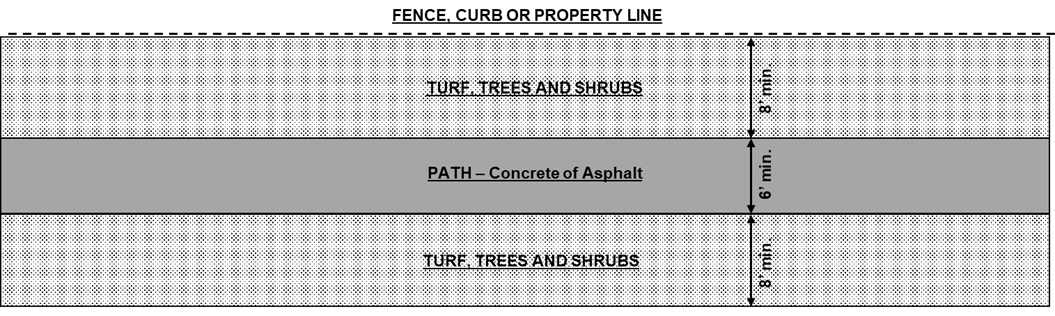
Walking path. For every 200 dwelling units: One mile of six feet wide paved looped walking trail with eight feet shoulders of turf, trees and shrubs, seating every 1,000 feet, and one-quarter mile markers is required. Trees shall be one and one-half inch caliper at one foot above the root ball, Class I or Class II deciduous variety, or six feet minimum height evergreen trees (no more than 25 percent of the total trees utilized may be evergreen trees). The total number of trees required shall be one tree for every 50 linear feet of trail. Trees and shrubs may be linear or grouped in clusters that are evenly distributed along the trail corridor, or some combination thereof (see below). Exceptions to the width of the eight feet shoulders and the tree planting requirements may be granted by the commission as part of the conceptual plan approval process.
3.
Community swimming pool. Community swimming pool with landscaping and pool house with restrooms/changing rooms and gathering area.
4.
Recreational field. Two acres of turf field area for recreational activities with one one and one-half inch caliper tree for every five dwelling units to be planted on the periphery of the athletic field area.
5.
Basketball and tennis courts. One full-size concrete-edged, paved and surfaced basketball court and two fenced tennis courts for every 200 dwelling units (one tennis court can be replaced with two pickle ball or "sport" courts).
6.
Community garden. A community garden with garden building containing a gathering room and restrooms. The community garden area shall be two acres for every 200 dwelling units.
7.
Outdoor amphitheater. An Amphitheater with stage, grass seating area—with space for two lawn chairs (or seat wall seats) for every dwelling unit.
8.
Community plaza. Large community plaza in decorative paving, fountain, seating, lighting and elements for public gatherings/farmer's market with neighborhood-scale commercial, live-work units, apartments, multi-family, condominiums or townhomes surrounding.
9.
Additional embellishment. As approved by the planning and zoning commission, may include significantly enhanced streetscaping with added trees and vegetation; community entrance with iconic wayfinding or artistic features throughout the development; additional street furnishings; additional open space elements, etc.
10.
Other open space elements. As proposed by the applicant and approved by the planning and zoning commission and city council.
E.
Common open space. Open space and landscaped areas which is not Qualified Open Space and held in common and maintained by all property owners in the PUD or MPC.
F.
Maintenance. The maintenance of such qualified and common open space areas shall be assured by establishment of appropriate management organization for the project (HOA).
G.
Ownership. Ownership and tax liability of private qualified and common open space area reservation shall be established in a manner acceptable to the city and notated on the final plat.
(Ord. No. 4617, § 1(Exh. A), 10-4-2021; Ord. No. 4671, § 1(Exh. A), 5-16-2022; Ord. No. 4727, § 1(Exh. A), 4-3-2023; Ord. No. 4777, § 1(Exh. A), 12-18-2023)
10-26-6. - Private streets.
Private streets shall be allowed in PUDs and MPCs in accordance with City of Nampa standards as noted in the city's adopted subdivision process policy manual and the standard construction specifications manual.
(Ord. No. 4617, § 1(Exh. A), 10-4-2021)
10-26-7. - Criteria for approval.
The commission in making its determination shall consider the following:
A.
Proposed development. The proposed development is consistent in all respects to the spirit and intent of this chapter, is in general conformance with the comprehensive plan, that the area surrounding the development can be planned and zoned in coordination and substantial compatibility with the PUD or MPC and that the benefits and improved design of the development will have a beneficial effect which would not be achieved under standard district regulations.
B.
Project design.
1.
MPC design to follow Smart Growth Principles. Master Planned Communities are to be designed utilizing Smart Growth principles that provide opportunities for residences to live, work and recreate within walking/biking distance of their homes. MPCs are to be designed to integrate with the greater Nampa community.
2.
No periphery requirements. PUDs and MPCs shall be exempt from the subdivision periphery lot compatibility requirements stated in subsection 10-27-6.F of this title.
3.
Project design elements for PUDs and MPCs.
a.
Landscaping. Streetscape, open spaces, plazas, use of existing landscape, pedestrian way and recreational areas.
b.
Siting. Visual focal points, use of existing physical features such as topography, view, solar access orientation according to the provisions of the specifications in chapter 27 of this title, sun and wind orientation, circulation patterns, physical environment, variation in building setbacks and building grouping.
c.
Design features. Street sections, architectural styles, harmonious use of materials, varied use of building types and parking areas broken by landscaping.
4.
Commercial area site development. The architectural design, landscaping, control of lighting and general site development will result in an attractive and harmonious service area creating an effect upon the property values of the surrounding neighborhood compatible with that anticipated under the comprehensive plan.
a.
Commercial area planned groups. Commercial uses, commercial buildings and establishments are planned as groups having common parking areas and common entrance and exit points.
b.
Commercial area landscaping. Planting screens or fences shall be provided on the perimeter of any commercial areas/properties abutting residential areas.
c.
All areas designed for future expansion or not intended for immediate development shall be landscaped or otherwise maintained in a neat and orderly manner.
d.
All intervening spaces between rights-of-way and building lines, and between buildings, drives, parking areas and improved areas shall be landscaped with trees and shrubs and properly maintained.
5.
Industrial uses. Light industrial uses shall be permitted in PUD and MPC development and shall be limited to those uses that are compatible with surrounding development. No industrial land uses that create a nuisance of any kind are permitted.
a.
Industrial area site development. The operational character, physical plant arrangement and architectural design of buildings shall be compatible with contemporary performance standards and industrial development design and will not produce an effect upon the property values of the surrounding neighborhood incompatible with that anticipated under the comprehensive plan.
b.
Industrial area planned groups. There will be harmony of buildings and a compact grouping in order to economize the provision of such utilities as are required.
c.
Industrial area landscaping. Industrial uses and parcels shall be developed in parklike surroundings utilizing landscaping and existing woodlands as buffers to screen lighting, parking areas, loading areas or docks and/or storage of raw materials and products.
d.
All intervening spaces between rights-of-way and building lines, and between buildings, drives, parking areas and improved areas shall be landscaped with fences and shrubs and properly maintained at all times.
(Ord. No. 4617, § 1(Exh. A), 10-4-2021)
10-26-8. - Procedure for PUD and MPC plan approvals.
A.
Planned unit development approval process.
1.
PUD permit. A PUD requires a PUD permit. A PUD permit is tied to the project and is valid for 18 months from the date that the PUD is approved by the planning and zoning commission. If a preliminary plat under that PUD is not submitted within the 18-month timeframe, the PUD expires. If a final plat under the preliminary plat is not submitted within 18 months, the preliminary plat and PUD expire.
2.
Preapplication meeting. The developer shall meet with the planning director or his/her designated staff prior to submission of an application. The purpose of this meeting is to discuss informally the purpose and effect of this chapter and the criteria and standards contained herein, and to familiarize the developer with the comprehensive plan, "zoning ordinance," "subdivision ordinance" and such other items as deemed appropriate.
3.
Application for a PUD permit.
a.
An application for a PUD permit shall be filed with the planning director or his/her designee by a property owner or person having existing interest in the property.
b.
The application shall be on a form as prescribed by the planning director and shall be accompanied by a nonrefundable fee as established by resolution of the council.
c.
The application for a PUD permit shall be accompanied by a written statement by the developer setting forth the reasons why, in his opinion, the PUD would be in the public interest.
4.
PUD development plan details. An applicant shall incorporate all PUD design elements into one preliminary development plan for presentation to the commission. The preliminary development plan shall be presented in the same form and contain the same information as outlined for preliminary subdivision plats under chapter 27 of this title. In addition, the development plan shall contain the following information:
a.
Location and type of land uses.
b.
Parks and community or open spaces.
c.
Notation(s) regarding proposed ownership of streets, public or private.
d.
A landscape plan, designed by a registered landscape architect or professional landscape designer, identifying materials and elements used for private and common open spaces, intervening spaces between rights-of-way and building lines, and between buildings, drives and parking areas.
e.
A description of the design principles for buildings and streetscapes; tabulation of the number of acres in the residential population by type of housing; estimated nonresidential population; standards for height, open space, building density, parking areas, population density and public improvements proposed for each unit of the development whenever the applicant proposed an exception from standard zoning districts or other ordinances governing development.
f.
Deed restrictions, protective covenants and other legal statements or devices to be used to control the use, development and maintenance of the land, and the improvements thereon, including those areas which are to be commonly owned and maintained.
g.
General outline of intended organizational structure related to property owners' association, deed restrictions and provisions of services.
h.
A copy of the legal title to the property or proof of a legally binding sales agreement ensuring the entire project area is under single ownership or control.
i.
Existing features of the development site including major wooded areas and structures.
j.
The pattern of public and private roads, driveways, parking facilities, pedestrian ways and intended design standards.
k.
The size arrangement and location of lots or of proposed building groups.
l.
The type, size and location of structures.
m.
The type, size and location of recreational and open space areas and areas reserved or dedicated for public uses such as schools, parks, etc.
n.
Site plan, showing building(s), various functional use areas, circulation and their relationship.
o.
Preliminary building elevation renderings/pictures/etc.
4.
Neighborhood meeting. A neighborhood meeting shall be conducted as outlined in section 10-2-2.B, Planning application neighborhood meeting, of this title.
5.
Public hearing procedures. When a public hearing is required by this chapter the same procedures for public hearing and legal notification, as required by chapter 25 of this title for conditional use permits, shall be followed.
6.
Design review required. Multi-family residential and commercial development shall be subject to design review.
7.
Commission action. Following application for PUD development plan approval, the commission shall review the development plan in accordance with the approval criteria set forth in this chapter and apply any necessary conditions of approval.
PUD approvals are valid for the life of the preliminary plat associated with it and will become permanent upon recordation of the first final plat for the development.
8.
Plat in lieu of a development plan and PUD permit. A preliminary plat may be submitted in lieu of a development plan with the PUD permit submittal materials. See section 10-27-2 of this title for preliminary plat form, content and process.
9.
Amendments. Any subsequent amendment to the approved development plan; changing location; positioning; and height of buildings and structures may be authorized by the commission as a business item without additional public hearings, if required, by engineering or other circumstances not foreseen at the time the development plan was approved. In no case shall the commission authorize changes which may, by reasonable judgment, expectedly cause any of the following:
a.
A substantial change in the use or character of the development.
b.
A decrease in common open space below that required in the project (e.g., via increase in overall coverage of structures).
c.
An increase in the intensity of any afore identified use(s) (e.g., via operating hours, trip traffic, building area increase, signage display, etc.) beyond that presented to the commission.
d.
An increase in the problems of traffic circulation and public utilities.
All other changes in use, rearrangement of lots, blocks, travel distances and building tracts, or in the provision of common open spaces and changes other than those listed above which constitute substantial alteration of the original plan, shall require a new public hearing before the commission.
B.
Master planned community approval process.
1.
Required approvals. An MPC requires an approved conceptual plan, approved annexation/rezone, and an approved development agreement.
2.
Preapplication meeting. The developer shall meet with the planning director or his/her designated staff prior to submission of the application. The purpose of this meeting is to discuss informally the purpose and effect of this chapter and the criteria and standards contained herein, and to familiarize the developer with the comprehensive plan, "zoning ordinance," "subdivision ordinance" and such other items as deemed appropriate.
3.
Application for an MPC.
a.
An application for an annexation/rezone and MPC shall be filed with the planning director or his/her designee by a property owner or person(s) having existing interest in the property.
b.
The application shall be on a form as prescribed by the planning director and shall be accompanied by a nonrefundable fee as established by resolution of the council.
c.
The application shall be accompanied by a statement by the owner/developer setting forth the reasons why, in his or her opinion, the MPC would be in the public interest.
4.
Conceptual plan. A conceptual plan approval is required prior to any preliminary plat approval. A preliminary plat may not be approved in lieu of a conceptual plan.
a.
Conceptual plan content. A master planned community conceptual plan for the entire MPC shall include the following information:
i.
"Bubble" diagram of the zoning, location, acreage and type of land uses.
ii.
Proposed densities and housing types for residential land uses for each area of the development.
iii.
The type, size and location of qualified and common open space areas with proposed recreational amenities and areas reserved or dedicated for public uses such as schools, parks, etc.
iv.
Notation(s) regarding proposed ownership of streets, public or private.
v.
The pattern of public and private roads, driveways, parking facilities, pedestrian ways and intended design standards.
vi.
General landscaping concepts with graphics showing landscape, street and central gathering area theme(s).
vii.
Existing features of the development site including major wooded areas, significant slopes, geological features and structures.
viii.
A statement or graphic drawing showing how special features of the site are to be highlighted or utilized.
ix.
Conceptual building elevation renderings/pictures/etc.
x.
A description of the smart growth principles that the MPC introduces into the plat design and how the plan integrates into the surrounding area and greater Nampa community.
xi.
A summary of the nature of the variations from zoning standards.
5.
MPC Development agreement. See section 10-2-5.B of this title.
6.
Neighborhood meeting. Applicant shall hold one neighborhood meeting with all property owners who reside within a 300 feet buffer area surrounding the project. The addresses of the invitees will be provided by the planning and zoning department (see section 10-2-3.B.1).
a.
Neighborhood meeting logistics.
i.
The applicant shall organize and conduct a neighborhood meeting regarding the project. The meeting shall be held after work hours, during the weekend or during a time when the greatest number of residents and interested parties can attend. The meeting shall be held at a location on site or within one mile of the project boundary.
ii.
The applicant shall advertise the meeting at least 10 calendar days in advance.
iii.
The meeting shall consist of a presentation about the conceptual plan, proposed land uses, residential density levels and features of the proposed development.
iv.
The applicant shall indicate to the residents the timing and logistics (phasing) of the project.
v.
The applicant shall address any concerns that the attendees may have.
7.
Public hearing procedures.
a.
An applicant shall submit a conceptual plan for review and recommendation by the commission, and approval by the council. If approved, the conceptual plan shall be included in a development agreement.
b.
The same procedures for public hearing for an annexation or rezone and development agreement in chapter 2 of this title shall be followed. An applicant may submit a preliminary plat or preliminary plats to the commission for approval as outlined in chapter 27 of this title concurrently with the annexation/rezone, and development agreement after the conceptual plan is approved.
8.
Commission/council action—Annexation/zoning and conceptual plan. Following application for an annexation/rezone and MPC, the commission shall review and make a recommendation to the council to approve or deny the annexation/zoning and MPC Conceptual Plan with any supplemental conditions in accordance with the approval criteria set forth in this chapter and the provisions outlined in chapter 2 of this title.
9.
Cause to enter into a development agreement. Approval of the city council of the annexation/rezone and MPC conceptual plan with any supplemental conditions attached thereto shall cause the city to enter into a development agreement for an MPC with the property owner/developer in accordance with the provisions outlined in chapter 2 of this title.
10.
Commission/council action—Preliminary plat approval.
a.
Following conceptual plan approval and completion of a development agreement, preliminary plats may be submitted for approval for specific development areas within the MPC (such as residential, commercial or industrial), or a preliminary plat may be submitted for the entire MPC development.
b.
Any preliminary plat submitted for a specific development area within an MPC, or for the entire MPC shall include a copy of the approved conceptual plan and a statement from the applicant indicating how the preliminary plan(s) meet(s) the conditions and features of the approved conceptual plan and associated development agreement. All preliminary plats are subject to the review and approval process outlined in sections 10-27-2 and 10-27-3 of this title.
c.
The commission shall review and approve or deny a/the preliminary plat(s) for the MPC in accordance with the approval criteria set forth and provisions outlined in chapter 27 of this title.
11.
Amendments. Any subsequent amendment to the final development agreement shall be subject to the provisions in section 10-2-5.D, Modification, enforcement, termination and extention, of this title.
C.
Industrial park approval process.
1.
Required approvals. An industrial park planned unit development or master planned community requires an approved conceptual plan from the Nampa Planning and Zoning Commission.
2.
Preapplication meeting. The developer shall meet with the planning director or his/her designated staff prior to submission of the application. The purpose of this meeting is to discuss informally the purpose and effect of establishing an industrial park and identify any challenges or need for exceptions.
3.
Application for an industrial park PUD or MPC.
a.
An application for an industrial park PUD or MPC shall be filed with the planning director or his/her designee by a property owner or person(s) having existing interest in the property.
b.
The application shall be on a form as prescribed by the planning director and shall be accompanied by a nonrefundable fee as established by resolution of the council.
4.
Conceptual plan content. The concept plan shall include the following information:
a.
The type, size and location of all building envelopes showing the orientation of the structures proposed. Identify the following:
i.
Primary facades to be reviewed per the definition in the design review guideline document and chapter 34.
ii.
Facades that may not need to be reviewed per the definition in the design review guideline document and chapter 34.
iii.
Locations of overhead doors.
b.
The pattern of public and private roads, driveways, parking facilities, pedestrian ways and potential amenities.
c.
General landscaping concepts with graphics showing landscape design, especially if the landscaping serves to screen utilities, overhead doors and/or facades or mitigate any design requirements. Include a statement or graphic drawing showing how special features of the site are to be highlighted or utilized for aesthetic or screening purposes.
d.
Existing features of the development site including major wooded areas, significant slopes, geological features and structures that may serve to screen certain portions of the proposed structures, making those facades unnecessary for design review.
e.
Conceptual building elevation renderings/pictures/etc.
f.
A summary of any exceptions requested from the standards in chapter 34.
4.
Neighborhood meeting. A neighborhood meeting is not required for any property already within the city limits and zoned IL (light industrial) or IH (heavy industrial) that is requesting approval as an industrial park for design review purposes. If the property requires annexation and zoning, a neighborhood meeting is required for the annexation application submittal.
5.
Public hearing procedures.
a.
An applicant shall submit a conceptual plan for review and approval by the commission. The approved concept plan will be used to assist in design review of any structure located within the boundary of the project.
b.
The same procedures for public hearing for conditional use permit in chapter 2 of this title shall be followed. An applicant may submit a preliminary plat to the commission for approval as outlined in chapter 27 of this title concurrently with the PUD/MPC application if they choose to subdivide.
6.
Amendments. Any subsequent amendment to the approved concept plan shall follow the same procedure again, as outlined in the previous section.
(Ord. No. 4617, § 1(Exh. A), 10-4-2021; Ord. No. 4702, § 1(Exh. A), 12-5-2022; Ord. No. 4777, § 1(Exh. A), 12-18-2023)
10-26-9. - Subdivision regulations.
In addition to those sections of chapter 27 of this title which have been specifically referred to within this chapter, the following sections of this title shall also be applicable and considered a part of this chapter or affect PUDs and MPCs just like they do residential subdivisions, unless specific exceptions have otherwise been granted by the commission based on positive recommendation(s) from the city's engineering and zoning departments as part of the PUD review and approval process:
A.
Section 10-27-6, General development and improvements; requirements.
B.
Section 10-27-7, Construction observation.
C.
Section 10-27-8, Subdivision improvement agreement.
D.
Section 10-27-10, Financial security and guarantee.
E.
Section 10-27-11, Dedications.
F.
Section 10-27-12, Correcting/vacating/amending plats.
(Ord. No. 4617, § 1(Exh. A), 10-4-2021)
10-26-10. - Expiration and extension of approval periods.
If the applicant: a) fails to apply for final development plan approval within two years of approval of the preliminary development plan; or b) fails to record an associated subdivision plat and begin project development within two years of approval of the final development plan, the preliminary and/or final development plans shall be rendered/considered null and void. Extensions of time beyond the two year validity period of approved preliminary and/or final plans may be granted by the commission, in/for up to one-year increments, if the commission determines such extensions are in the public interest.
(Ord. No. 4617, § 1(Exh. A), 10-4-2021)
10-26-11. - Conflict with other laws.
Whenever there is a conflict or difference between the provisions of this chapter and those of other chapters of this title, the provisions of this chapter shall prevail. Subjects not covered by this chapter shall be governed by the respective provisions found elsewhere in this title.
(Ord. No. 4617, § 1(Exh. A), 10-4-2021)
10-26-12. - Fees.
Persons making application for a PUD or MPC permit/approval shall submit requisite materials as determined by the planning director or his/her designee and shall pay to the city a nonrefundable office checking fee in an amount to be established by the council.
(Ord. No. 4617, § 1(Exh. A), 10-4-2021)