


Nampa City Zoning Code
CHAPTER 2
- ENFORCEMENT AND ADMINISTRATION
Sections:
10-2-1.- Powers and duties of enforcing officers.
It is the duty of the planning director, or his/her authorized designee, to enforce all provisions of this title 10 and, generally, as determined requisite refer all violations to the city attorney, entering actions in the courts when necessary, and his failure to do so shall not legalize any violation of such provisions, nor shall the failure of the city attorney to enter actions legalize any violation of such provisions (see section 10-2-6 of this chapter).
The planning director, and his/her duly authorized designee, shall have the right to enter upon any land during the daytime in the course of his duties, and, if approached by the property owner or lessor shall show proper identification and give that individual notice as to the purpose of the visit. The director or his/her designee may enter in any building upon being invited by an owner or tenant and may enter a structure closed to them by will of an owner or occupant or through absence of the same upon obtaining an administrative search warrant. They may seek accompaniment, as may be approved by a judge to have other enforcement agency representatives accompany them.
(Ord. No. 4617, § 1(Exh. A), 10-4-2021)
10-2-2. - Application and plans required.
A.
Permits. Any person desiring to construct a building in the city shall first apply for a permit to the building official. All applications for building permits shall be accompanied by a site plan showing the size and location of the existing buildings and buildings to be erected. Before a building permit is issued all requirements of this title shall be met.
B.
Planning application neighborhood meeting. An application for: Annexation, CUP (conditional use permit) for multiple-family (over four units), MPC (master planned community), PUD (planned unit development), preliminary plat, short plat, or zoning map amendment, shall include proof of holding a neighborhood meeting. Any sign-in form or notice letter, submitted as proof, shall include the date, time, location and names of attendees of the neighborhood meeting.
Exception: A neighborhood meeting is not required for annexation of a single commercial, industrial or single-family property that is one acre or less in size, annexation of a single-family dwelling to connect to city utilities, and zoning map amendment for an existing commercial, industrial, or single-family dwelling (with no proposed expansion). A neighborhood meeting is also not required on existing industrially zoned property that is applying for a planned unit development or master planned community approval to create an industrial park for design review purposes.
1.
Applicant/developer shall provide an invitation to each tenant, and property owner within a 300 foot buffer area surrounding the project.
2.
The meeting shall begin at a time between 5:00 p.m. and 8:00 p.m. on weekdays, or on Saturday between the hours of 10:00 a.m. and 8:00 p.m. The meeting shall be held at a location on-site or within one mile of the project.
3.
The applicant shall send invitations, at least ten calendar days prior to the neighborhood meeting.
4.
The applicant/developer shall provide a development plan, proposed land uses, densities, and features of the proposed development. The applicant or representative shall be available at the meeting to answer questions regarding the proposal.
5.
The applicant shall communicate the timing and logistics (phasing) of the project.
6.
Location and format of the neighborhood meeting. The director of the planning department may approve a change to the location and format of the neighborhood meeting as circumstances warrant.
C.
Public hearing notification, advertising and property posting.
1.
Applicability. For applications requiring a public hearing, notification shall be published in a local newspaper and hearing information posted on the subject property.
a.
Notification.
i.
Publication. The city shall publish notice in a local newspaper, not less than 15 days prior to the public hearing.
Exceptions:
For variance applications, the city shall follow publication procedures found in IC § 67-6516.
For vacation applications, the city shall follow publication procedures found in IC § 50-1317.
ii.
Mailing notices. The city shall provide notice by mail to property owners or purchasers of record, both within the land area being considered and 300 feet of the external boundaries of the subject property.
Exceptions:
If a conditional use permit is required due to building height that exceeds 100 feet, the city shall follow notification procedures in IC § 67-6512.B.
For variance applications, the city shall follow notification procedures found in IC § 67-6516.
For vacation applications, the city shall follow notification procedures found in IC § 50-1317.
iii.
Property posting. Applicants shall be responsible for posting signage with public hearing details, on the subject property, not less than 16 calendar days prior to the hearing. Refer to subsection 10-2-2.C.2 for property posting requirements.
Exceptions:
The city will post notice on the subject property for all nondevelopment projects on one single-family residential parcel not less than ten days prior to the hearing.
For variance and vacation applications, no property posting is required.
b.
Alternative notice.
i.
Mass notification. When and if notice is required to be given to 200 or more property owners or purchasers of record, an alternative form of notification of the public hearing for both the commission and council shall be exercised. In lieu of mailing individual notices to all property owners or purchasers of record in the area under consideration and/or posting notice on each property being considered for reclassification or within 300 feet of the same, additional public notice shall be provided by publishing notice of upcoming consideration of the matter in the official, locally provided newspaper at least 15 days prior to the public hearing.
(a)
Exception. In the case of conditional use permits the property shall also be posted as described in subsection 10-2-2.C.1.a.iii.
(b)
Exception. For corrections of plats under subsection 10-27-12.D notice shall be published once a week for two successive weeks in the official newspaper of the city, the last of which shall be not less than seven days prior to the date of said hearing.
2.
Property posting (signage) requirements.
a.
Figure A: Location(s) and size(s) of sign(s).
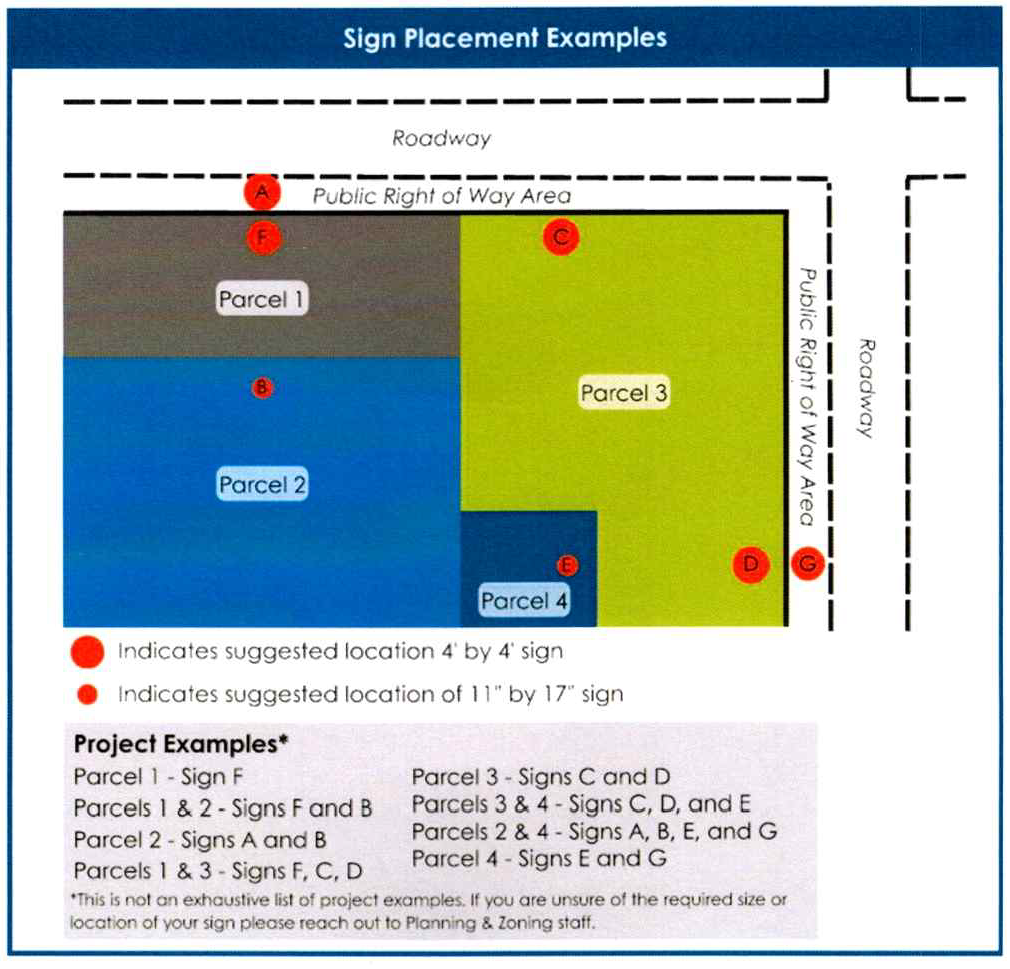
A four-foot by four-foot sign located on the subject property(ies), adjacent to the street but outside of the public right-of-way, shall be required unless additional signage and/or alternate size or placement is specified based on the circumstances below. Refer to Figure A for clarification and examples.
• If the sign cannot be placed on the property and still be clearly visible from the nearest public roadway, a four-foot by four-foot sign shall be placed within the public right-of-way upon approval of the city for placement. A posting shall also appear on the subject parcel itself, an 11-inch by 17-inch posting may be used. (For an example, refer to project example for Parcel 2 in Figure A.)
• Each parcel in the area of a project being considered must have a property posting. Each project requires at least one four-foot by four-foot sign placed adjacent to each street. When multiple parcels have street frontage, each street front parcel(s) will be posted with a four-foot by four-foot sign on each road frontage. If the requirement for at least one four-foot by four-foot sign at for the street frontage has been satisfied, then interior parcels (without street frontage) may be posted with 11-inch by 17-inch size sign(s). (For an example, refer to project example for Parcels 3 and 4 in Figure A.)
• Parcel(s) with frontage greater than 1,000 feet, shall provide two or more four-foot by four-foot signs spaced 500 feet apart.
• Where placing signs per the standards listed herein is not practical, the director may identify an alternative sign placement strategy.
b.
Sign specifications.
i.
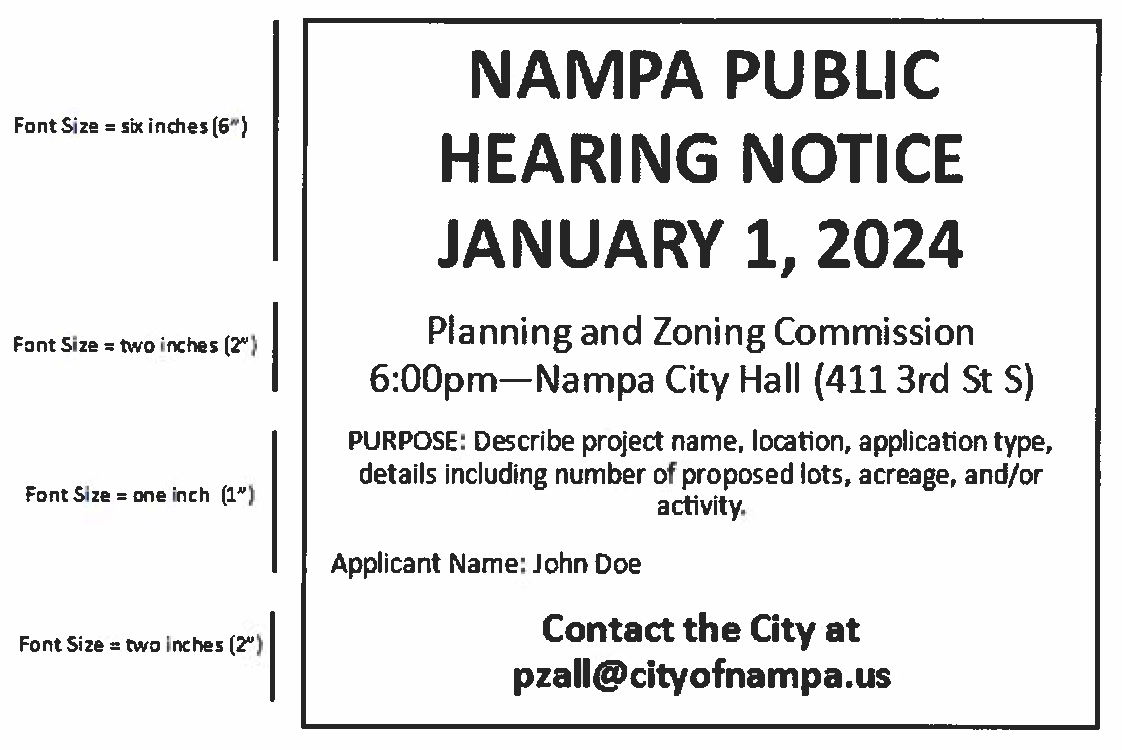
Figure B: Four by four sign example.
(a)
Construction and mounting. The sign construction and mounting shall conform to the following standards:
• Four-foot by four-foot plywood or other durable, hard surface.
• Mounted on two sturdy posts, or attached to another director approved support in such a manner.
• Mounted perpendicular to the roadway along which the sign is posted.
(b)
Sign content. Text copy shall inform the public of the date, time, location and the nature of each public hearing. Text size shall meet or exceed the minimum standards identified in Figure B.
ii.
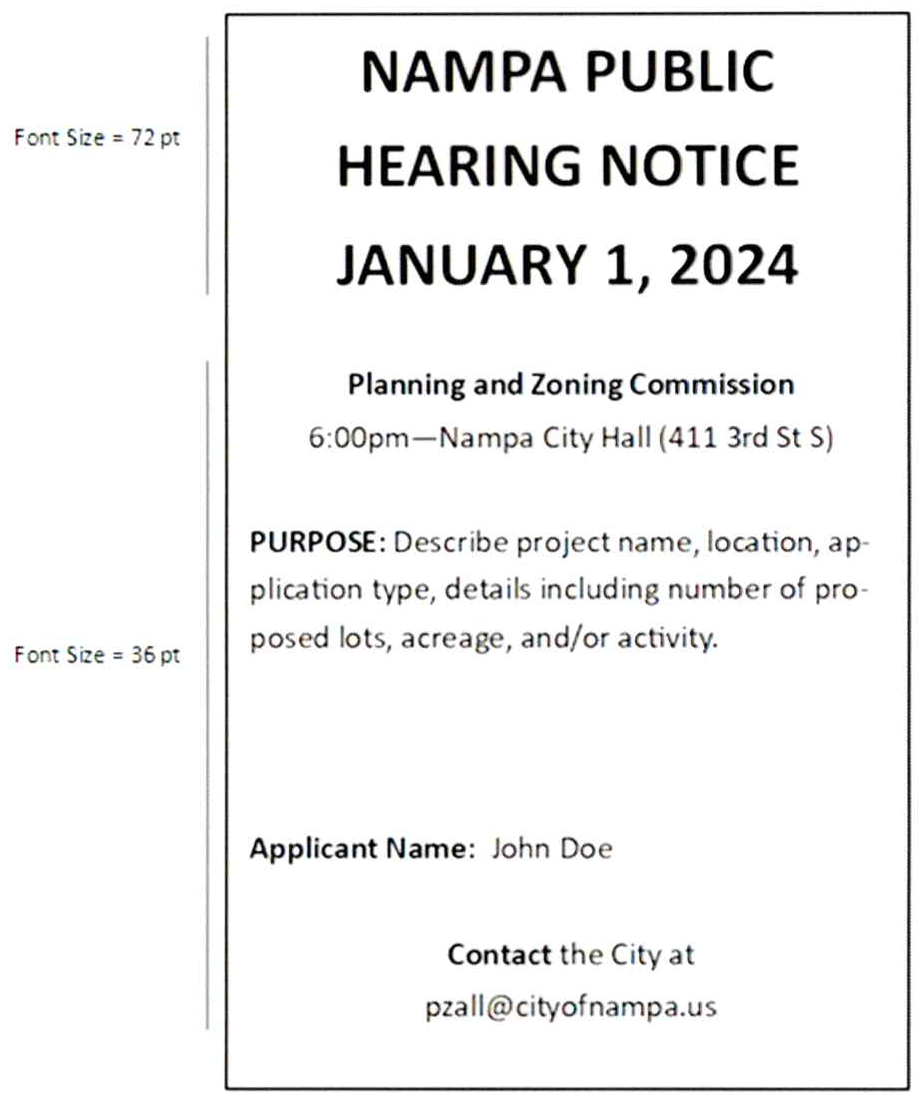
Figure C: 11 by 17 sign example.
(a)
Construction and mounting. The sign construction and mounting shall conform to the following standards:
• Black text on brightly-colored, 11 by 17 sized-laminated paper.
• The sign may be posted using a sturdy stake.
• The face of the sign shall be at least three feet above ground level.
(b)
Sign content. Text copy shall inform the public of the date, time, location and the nature of each public hearing. Test size shall meet or exceed the minimum standards identified in Figure C.
c.
Exception. When the city is responsible to post notification for an application, staff will comply with Idaho State Code for the application type.
3.
Proof of posting. A signed statement, map depicting the location(s) of the sign(s) and a photograph of the posting shall be provided to the city no later than seven days prior to the public hearing attesting to where and when the sign(s) were posted. Unless certificate is received by such date, the hearing will be continued.
4.
Sign removal. The signs shall be removed no later than three days after the final applicable public hearing.
(Ord. No. 4617, § 1(Exh. A), 10-4-2021; Ord. No. 4671, § 1(Exh. A), 5-16-2022; Ord. No. 4702, § 1(Exh. A), 12-5-2022; Ord. No. 4777, § 1(Exh. A), 12-18-2023; Ord. No. 4843, § 4, 2-3-2025; Ord. No. 4873, § 5, 6-16-2025)
10-2-3. - Amendments to zoning ordinance and zoning map (rezones).
A.
Amendments. This zoning ordinance, including the map, may be amended but all proposed amendments shall be submitted first to the planning and zoning commission for its recommendations, which recommendations shall be submitted to the council for its consideration.
B.
Application; filing fees. Any person seeking an amendment of the zoning ordinance's language and/or land use map shall submit to the planning director an application form as prescribed by the city together with a requisite, nonrefundable fee as established by resolution of the council, designating the change(s) desired, the reasons therefor, and how they perceive that the proposed amendment(s) would benefit the city.
1.
Neighborhood meeting. A neighborhood meeting shall be conducted as outlined in subsection 10-2-2.B, planning application neighborhood meeting, of this title.
2.
Commission level public hearing required. Following proper advertisement of the request(s), per subsection 10-2-2.C, the commission shall conduct at least one public hearing during which the public shall have an opportunity to present their opinions on the matter(s) and the commission shall consider the proposed amendment(s). The commission shall make one or more recommendations on the request(s) to the city council. The commission shall either: recommend approval of the request(s), approval with modifications to the request(s), or denial of the request(s). Alternatively, they may vote to table or postpone taking action on the request(s).
3.
Commission amendments to zoning map. The city planning and zoning commission may also recommend amendments to the official zoning map of the city to the council on and of its own initiative but only after first holding an advertised and noticed public hearing as required by regulation.
C.
Conclusions of laws pertinent to proposed zoning map amendments. The commission shall conclude the following conclusions of law before recommending to city council approval of an amendment to the city's official zoning map; city council shall conclude the following conclusions of law before approving an amendment to the city's official zoning map:
1.
The proposed map amendment(s) is, are or would be in harmony with the city's currently adopted comprehensive plan and comprehensive plan land use map;
2.
The proposed map amendment(s) is, are or would provide for a proposed use or set of uses that would be at least reasonably compatible with existing, adjoining property uses;
3.
The proposed amendment(s) is, are or would be in the interest of the public and reasonably necessary.
D.
Conclusions of law pertinent to proposed zoning ordinance text amendments. The commission shall find and conclude the following before recommending a text (content) amendment to the zoning ordinance; city council shall find and conclude the following before approving any text (content) amendment(s) to the zoning ordinance:
1.
That the proposed amendment(s) is, are or would be reasonably necessary, in the interest of the public, and in harmony with the goals and/or policies of the adopted comprehensive plan.
E.
Public hearing required by council, notice. Amendments to this zoning ordinance or zoning map may be adopted only after a public hearing before the council. Notification of the city council public hearing shall follow the procedures outlined in subsection 10-2-2.C.
F.
Reversal of council action. If the council adopts a zoning classification or map amendment pursuant to a request by a property owner, the council shall not subsequently reverse its action or otherwise change the zoning classification of said property without the consent in writing of the current property owner for a period of four years from the date the council adopted said individual property owner's request for a zoning classification change or map amendment.
(Ord. No. 4617, § 1(Exh. A), 10-4-2021; Ord. No. 4809, § 1(Exh. A), 6-3-2024; Ord. No. 4843, §§ 5, 6, 2-3-2025)
10-2-4. - Annexation(s), deannexation(s) and preannexation(s).
It is the expressed policy of the State of Idaho that cities of the state should be able to annex lands which are reasonably necessary to assure the orderly development of Idaho's cities in order to allow efficient and economically viable provision of tax supported and fee supported municipal services, to enable the orderly development of private lands which benefit from the cost effective availability of municipal services in urbanizing areas and to equitably allocate the costs of public services in management of development on the urban fringe.
A.
General annexation authority. Nampa has, and shall exercise, the authority to annex land into the city upon compliance with the procedures required in this section as allowed by state law.
B.
Right(s)-of-way annexation. In any annexation proceeding, all portions of highways lying wholly or partially within an area to be annexed shall be included within the area annexed unless expressly agreed upon otherwise between the City of Nampa and the governing board of the Nampa Highway District No. 1. Provided further, that the council shall not have the power to declare such land, lots or blocks a part of the city if they will be connected to Nampa only by a shoestring or strip of land that is comprised of a railroad or highway right-of-way.
C.
Reserved.
D.
Annexation procedures. Annexation of lands into Nampa shall follow the guidance found in IC tit. 50.
E.
Judicial review. The decision of the city council to annex and zone lands shall be subject to judicial review in accordance with the procedures provided in IC chapter 52, title 67, and pursuant to the standards set forth in IC § 67-5279. Any such appeal shall be filed by an affected person in the appropriate district court no later than 28 days after the date of publication of the annexation ordinance. All cases in which there may arise a question of the validity of any annexation under this section shall be advanced as a matter of immediate public interest and concern, and shall be heard by the district court at the earliest practicable time.
F.
Annexation of noncontiguous municipal airfield. The city may annex land that is not contiguous to the city and is occupied by a municipally owned or operated airport or landing field. However, the city may not annex any other land adjacent to such noncontiguous facilities which is not otherwise annexable pursuant to this section.
G.
Exclusion or deannexation/disannexation of land(s). Applications to exclude or deannex/disannex land from within the incorporated limits of the city shall be processed in the same manner as applications to annex. The council may choose to grant or deny such applications to deannex, in its sole discretion, as provided in Idaho Code section 50-225. Decisions to grant or deny any application for exclusion, deannexation or disannexation do not require that the council articulate or provide findings justifying its decision.
H.
Annexation application; filing fee. Prior to consideration of any petition or request for annexation into, or deannexation out of, the city, an application for annexation must be filed with the office of the planning director. The application shall be accompanied by a filing fee in an amount established by council resolution, and which is nonrefundable. The application shall be furnished by the city.
1.
Neighborhood meeting. A neighborhood meeting shall be conducted as outlined in subsection 10-2-2.B, planning application neighborhood meeting, of this title.
2.
Commission level public hearing required. Following proper advertisement of the request(s), per subsection 10-2-2.C, the commission shall conduct at least one public hearing during which the public shall have an opportunity to present their opinions on the matter(s) and the commission shall consider the proposed request(s). The commission shall make their recommendation on each of the applications before them to the city council. The commission shall either: recommend approval of the request(s), approval with modifications or conditions to the request(s), or denial of the request(s). Alternatively, they may vote to table or postpone taking action on the request(s).
3.
Public hearing required by council, notice. Annexation requests may be adopted via ordinance only after a public hearing before the council. Notification of the city council public hearing shall follow the procedures outlined in subsection 10-2-2.C.
I.
Pre-annexation process, application. Properties seeking connection to city utilities, that are not contiguous to city limits, shall obtain a pre-annexation approval from the city prior to connecting to city utilities.
Properties seeking to development within the area of city impact, that are not contiguous to city limits, shall obtain a pre-annexation approval from the city in order to receive a letter of support for the project.
1.
Process. A public hearing with the planning and zoning commission and city council as outlined in subsection 10-2-4.H, with a board of appraisers recommendation will determine the ability and willingness for city to serve the proposed area. Upon approval, the city engineering division will require a utility agreement and assess a future annexation fee (for the planning and zoning department), with an additional fee per parcel within the development (this assessed fee is separate from the application and filing fee referenced in subsection 10-2-4.I.2). The utility agreement shall require annexation upon the development boundary being contiguous.
2.
Application and filing fee. An application for pre-annexation must be filed with the planning and zoning department. The application shall be accompanied by a fee in an amount established by council resolution, and which is nonrefundable. The application shall be furnished by the city.
a.
Neighborhood meeting. A neighborhood meeting shall be conducted as outlined in subsection 10-2-2.B, planning application neighborhood meeting, of this title.
b.
Commission level public hearing required. Following proper advertisement of the request(s), per subsection 10-2-2.C, the commission shall conduct at least one public hearing during which the public shall have an opportunity to present their opinions on the matter(s) and the commission shall consider the proposed request(s). The commission shall make one or more recommendations on the request(s) to the city council. The commission shall either: recommend approval of the request(s), approval with modifications to the request(s), or denial of the request(s). Alternatively, they may vote to table or postpone taking action on the request(s).
c.
Public hearing required by council, notice. Pre-annexation requests may be approved through a development agreement with the applicant/owner, only after a public hearing has been held before the council. Notification of the city council public hearing shall follow the procedures outlined in subsection 10-2-2.C.
3.
Pre-annexation of a property must meet the following findings.
a.
The project is consistent with the Nampa Comprehensive Plan and future land use map.
b.
The project proposal meets city standards and code requirements.
c.
The proposed pre-annexation is in the interest of the public and reasonably necessary.
d.
If requested, the Nampa Board of Appraisers formally recommended utility connections to the development to the Nampa City Council.
As a condition of pre-annexation approval, a developer is required to ensure that purchasers of real property within the development are informed by the title company via the title transfer documentation, and in the CC&R's, that their property(ies) will be annexed into the City of Nampa when any portion of the entire subdivision is contiguous to Nampa city limits.
(Ord. No. 4617, § 1(Exh. A), 10-4-2021; Ord. No. 4671, § 1(Exh. A), 5-16-2022; Ord. No. 4702, § 1(Exh. A), 12-5-2022; Ord. No. 4777, § 1(Exh. A), 12-18-2023; Ord. No. 4843, §§ 7, 8, 2-3-2025; Ord. No. 4873, § 5, 6-16-2025)
10-2-5. - Development agreements.
In accordance with allowances made by state law, a property owner or developer may request, or the city may require, that an application for rezone or zoning map amendment be processed in conjunction with the execution of a development agreement. Through such agreements, a property owner or developer may agree to make written conditional commitments concerning the use or development of a subject parcel in exchange for the change of zoning requested. The purpose of such agreements shall be to allow development that provides benefits for both the property owner or developer and the city by providing a balance between the owner's or developer's desire for certainty in the development process and the city's desire for control of the impacts of the project.
Conditional commitments made under such agreements are in addition to the regulations provided for in the zoning district by ordinance, and are established to ensure compatibility of the resulting land use with the surrounding area. Unless multiple land use zones are used/applied within a project in accordance with that which is allowed by the table at section 10-3-2 of this title, the use of a PUD or MPC application process shall be the only means whereby the City of Nampa will/shall entertain allowing uses in a zone not normally allowed therein; development agreement conditions not excepting. The following rules shall govern development agreements:
A.
Creation and form. At a minimum, development agreements shall include the following: 1) a legal description of the subject property, 2) a description of the uses permitted on the land, 3) provisions for any reservation or dedication of land, 4) the duration of the agreement, 5) the commitments or other terms of the agreement. Furthermore, agreements shall include, if provided by an applicant and/or requested by the Planning and Zoning Commission and/or City Council: 1) a conceptual site plan showing proposed arrangement of any structure(s), business or industrial or multi-family park/complex freestanding signage, landscaping and parking area design(s); and/or 2) a set of building(s) elevations showing exterior building treatments and design(s).
B.
Commitments and safeguards. The written commitments or conditions exacted shall not be vague and shall have a reasonable relation to the zoning change approved. In addition, the following safeguards shall be applied:
1.
A development agreement shall only be allowed in connection with annexations or rezones applied for within bona fide transitional areas, i.e., where two or more competing and incompatible uses have valid claims.
2.
If a substantial amount of land surrounding a property zoned in connection with a development agreement is rezoned to the same zoning as originally requested for the subject property, said development agreement and the commitments contained therein may be lifted by the city upon request of the owner or developer after complying with the notice and hearing provisions of section 10-2-3 of this chapter.
3.
A development agreement shall not prevent the city in subsequent actions applicable to the property, from applying new rules, regulations or policies that do not conflict with commitments applicable to the property as set forth within any duly executed agreement.
4.
If a conditional commitment involves ongoing performance and the owner or developer fails to comply with the commitment after completion of construction, said failure may be dealt with by the city according to the violations and penalties provisions of section 10-2-6 of this chapter.
5.
When a commitment is required to be satisfied prior to completion of construction, and it is not so satisfied, construction shall be halted until compliance is established.
C.
Recording. Development agreements shall be attached as an exhibit to the ordinance establishing the zoning map amendment. Agreements shall take effect and shall be recorded in the Canyon County Recorder's office upon the adoption of the ordinance establishing the zoning map amendment by the city council. Should a development agreement be terminated by the city, and the zoning designation upon which the use is based be reversed, a document recording such termination and zoning reversal shall also be recorded by the city in the office of the county recorder unless otherwise modified or terminated by the city council. An agreement shall be binding on the owner of the parcel, each subsequent owner, and each other person acquiring an interest in the parcel.
D.
Modification, enforcement, termination and extension. Development agreements are generated at the time of annexation, pre-annexation or zoning map amendment requests. A modification of a development agreement can be requested at any time. Modification of and to an executed agreement shall be required by the planning director or his/her designee under the following circumstances:
1.
A substantial change to the conceptual layout, terms, provisions or conditions of the most recently recorded development agreement. These substantial changes could include but are not limited to:
• Exceeding the number of buildable lots;
• Decreasing the amount of approved open space;
• Revision of the approved open space concept;
• Revision of the approved set of building elevations;
• Items determined to be a substantial change according to the planning and zoning director or his/her designees.
In the event of default of this agreement, the city may provide written notice of said default. The owner/developer shall have 30 days after delivery of such notice to cure the default to the satisfaction of the city. In case the default cannot be cured within the 30 day period, the owner/developer may apply to the planning and zoning director, for a single six month extension. The decision to grant the extension is in the discretion of the planning and zoning director. No default by a subsequent owner of a portion of the property shall constitute a default by the original owner/developer. A subsequent owner may request extensions or modifications for their portion of the originally described property.
Upon default of a development agreement, a hearing for termination or modification may be convened by the city after complying with the notice and hearing provisions of subsection 10-2-2.C of this chapter and any relevant termination terms of the pertinent agreement. During the hearing, the council may vote to take no action, cause modification of the agreement if the applicant is willing, or terminate the agreement.
In accordance with state law, the establishment of a development agreement and the written commitments contained therein shall provide written consent for the city council to change the zoning of the subject property to its prior designation upon failure of an applicant to comply with the conditions imposed by their agreement.
E.
Application; filing fee. Prior to consideration of any petition or request for development agreement modification, an application for the request must be filed with the office of the planning director. The application shall be accompanied by a filing fee in an amount established by council resolution, and which is nonrefundable. The application shall be furnished by the city.
1.
Neighborhood meeting. A neighborhood meeting shall be conducted as outlined in subsection 10-2-2.B, planning application neighborhood meeting, of this title.
2.
Commission level public hearing required. Following proper advertisement of the request(s), per subsection 10-2-2.C, the commission shall conduct at least one public hearing during which the public shall have an opportunity to present their opinions on the matter(s) and the commission shall consider the proposed request(s). The commission shall make one or more recommendations on the request(s) to the city council. The commission shall either: recommend approval of the request(s), approval with modifications to the request(s), or denial of the request(s). Alternatively, they may vote to table or postpone taking action on the request(s).
3.
Public hearing required by council, notice. Development agreement modification requests may be adopted via ordinance only after a public hearing has been held. Notification of the city council public hearing shall follow the procedures outlined in subsection 10-2-2.C.
(Ord. No. 4617, § 1(Exh. A), 10-4-2021; Ord. No. 4843, §§ 9—11, 2-3-2025; Ord. No. 4873, § 5, 6-16-2025)
10-2-6. - Violations and penalties.
A.
Authority. In any case where any building or structure is erected, constructed, reconstructed, altered, converted or maintained or any building, structure or land is used in violation of this title, as determined by the planning director, his/her designee or a code enforcement officer or otherwise other proper legal authorities of the city, that authority may institute any appropriate action or proceedings to prevent such unlawful erection, construction, reconstruction, alteration, conversion, maintenance or use, to restrain, correct or abate such violation, to prevent the occupancy or use of said building, structure, or land, or to prevent any illegal act, conduct, business or use in or about such building, structure or land. In exercising enforcement authority, the city representative shall follow any specific remedial/enforcement sections listed in relevant chapters of this title (e.g., as listed for signs and temporary uses) or, in their absence, adhere to the provisions of this section specifically.
Upon the awareness of any violation of any of the provisions of this title the planning director, his/her designee, or, a code enforcement officer shall serve notice of such violation on the person committing or permitting the same, and if such violation has not ceased within such reasonable length of time as the planning director, or his/her designee, or, a code enforcement officer may determine, he/she will take action as may be necessary to terminate the violation as specified below.
B.
Compliance notice. Upon the awareness of any violation of any of the provisions of this title, before abating any unlawful activity the planning director, or his/her designee, or, a code enforcement officer shall first serve notice of such violation on the person committing or permitting the same.
C.
Corrective action. If such violation has not ceased within such reasonable length of time as the planning director, or, his/her designee, or a code enforcement officer may determine, then the planning director, or, his/her designee or a code enforcement officer shall take such action as may be necessary to terminate the violation. This may infer initial issuance of a citation, solicitation of assistance from other local authorities, abatement of a nuisance, posting of some type of cease and desist or stop work order, withholding a certificate of occupancy or building permit, etc., or pursuit of legal remedies.
(Ord. No. 4617, § 1(Exh. A), 10-4-2021)
10-2-7. - Adoption, amendment and repeal, of the Nampa Comprehensive Plan.
A.
Commission. The commission, prior to recommending any comprehensive plan amendment or repeal to the council, shall conduct at least one public hearing in which interested persons shall have an opportunity to be heard. At least 15 calendar days prior to the hearing, notice of the time and a summary of the plan to be discussed shall be published in the official newspaper or paper of general circulation within the jurisdiction. The commission shall also make available a notice to other papers, radio and television stations serving the jurisdiction for use as a public service announcement. Upon the commission's recommendation to either approve or deny, council will conduct a subsequent public hearing and will follow the notification procedures listed in this section. A record of the hearings, findings made, and actions taken shall be maintained by the city.
B.
Council. The council prior to the adoption, amendment or repeal of the comprehensive plan, may conduct at least one public hearing, in addition to the public hearing(s) conducted by the commission, using the same notice hearing procedures as the commission. The council shall not hold a public hearing, give notice of a proposed hearing, or take action upon the plan, amendments, or repeal until the commission's recommendation has been received. Following consideration by the council, if the council makes a material change in the recommendation or alternative options contained in the recommendation by the commission concerning adoption, amendment or repeal of a plan, further notice and hearing shall be provided before the council adopts, amends or repeals the plan.
C.
Resolution. No plan shall be effective unless adopted by resolution by the council. A resolution enacting or amending the plan or a part of the plan may be adopted, amended, or repealed by definitive reference to the specific plan document. A copy of the adopted or amended plan shall accompany each adopting resolution and shall be kept on file with the city clerk.
D.
Change to comprehensive plan. Requests to amend the comprehensive plan will be scheduled for a public hearing every six months, at the second planning and zoning commission public hearing in April and October, and the next available city council public hearing following. Any person may petition the city to amend the comprehensive plan at any time, but the application will be held for public hearing until the following April or October.
Exception: When a request to change the comprehensive plan future land use designation on a property is incorporated into a master planned community or planned unit development request, the application for the comprehensive plan amendment can be heard on the same schedule as the application for the master planned community or planned unit development.
E.
Application to change comprehensive plan. Any person seeking an amendment to the comprehensive plan text or map shall submit to the planning director an application form as prescribed by the planning director, designating the change desired, the reasons therefore, and how the proposed amendment would be in the public interests. Amendment fees are established by council resolution and are nonrefundable. The planning director shall transmit the requested amendment to the commission. If the requested amendment is for a map change, it may be concurrently reviewed with an application for amendment of the zoning map or an application for annexation, provided procedural requirements for each application are met.
(Ord. No. 4617, § 1(Exh. A), 10-4-2021; Ord. No. 4809, § 1(Exh. A), 6-3-2024; Ord. No. 4843, §§ 12, 13, 2-3-2025)
10-2-8. - Public hearings.
The public hearing process exists to provide an opportunity for citizens to present their views on an issue that may affect them, define the issue upon which a decision is to be made, and obtain essential evidence upon which a decision can be made.
A.
Evidence. City staff reports shall be entered as a part of the public record. Comments from agencies appropriately involved in the review of a project that will be reviewed in a hearing setting may be received and entered into the public record.
B.
Ex parte communications and conflicts of interest. All material contacts received by public officials outside of the public hearing shall be disclosed prior to the commencement of the public hearing. ("Material contacts" shall be defined as those contacts received outside the public hearing process that expectedly will have a significant effect on the opinion of a public official on a given issue.) If there is a question of conflict of interest, as defined by Idaho Code section 67-6506 for council member or commissioner (public official), it shall be disclosed prior to the commencement of the hearing. That official shall not participate in voting or deliberating as an official on any matter with which they have a conflict, but they may testify as a member of the public in the same manner and under the same restrictions as any other citizen.
A city council member, planning commissioner or mayor shall avoid all "ex parte" contact(s) with an applicant or the public once an application for a zoning or other land use request has been filed with the planning and zoning office. If already engaged in a conversation and discussion concerning a zoning or land use application ensues, then that council member, commissioner or the mayor shall thereafter disclose before the acting governing body, for the record, and prior to a vote on the pertinent matter being taken/made the name if the person/people they talked with (contact) a summary of the substance of their conversation, the relationship or affiliation of the contact with a business or organization with a stake in a/the matter.
C.
Hearing procedures. The following sequence of events shall be followed/used during public zoning hearing(s):
1.
Call to order. The mayor, presiding council person, planning chairperson, or presiding commissioner (all hereinafter a.k.a. "presiding officer") shall explain the meeting's hearing procedures thereby setting forth the rules under which the public meeting shall be conducted, and shall announce the amount of time to be allotted to speakers.
2.
Allotted speaker times.
a.
Standard hearing item speaking times. At the commencement of the hearing, the presiding officer may establish and announce a time limit to be observed by all speakers. If a specific time limit is not given to the attending audience, then initial presentation by the applicant or his representative shall be limited to seven minutes, persons from the audience shall be limited to three minutes each, and closing applicant's rebuttal or concluding comments shall be limited to five minutes. Persons representing groups may be given more time than individuals presenting their own views, if allowed by the meeting's chair. City staff shall be given sufficient time to present their report(s).
b.
Items on appeal speaking times. At the commencement of the hearing, the presiding officer may establish and announce a time limit to be observed by all speakers. If a specific time limit is not given to the attending audience, then initial presentation by the appellant shall be limited to seven minutes, city staff shall be given time as they require, the appellee/respondent, if any, shall then have seven minutes, persons from the audience shall be limited to three minutes each, closing appellant's concluding comments shall be limited to five minutes and concluding appellee's/respondent's concluding comments shall be limited to five minutes. Persons representing groups may be given more time than individuals presenting their own views if allowed by the meeting's chair providing that if more time is allotted to either the appellant or appellee/respondent, then the opposing side shall be afforded equal time to rebut.
3.
Hearing protocol.
a.
The applicant(s) or appellant(s) and/or their representative(s) may present their case. During such presentation or immediately following it, the council or commission may ask their questions of the applicant(s) or appellant(s) and/or their representative(s). Applicants or appellants are encouraged to be or have a representative present to convey their desires and justifications as related to their request and/or to answer questions.
b.
City planning and zoning staff shall present their findings regarding the matter at hand.
c.
Written correspondence shall be officially recognized and accepted as part of the hearing record for the matter at hand under review.
d.
The council or commission shall then receive testimony from those persons with an interest in the application. No person shall be permitted to speak at a public hearing until the presiding officer has recognized such person. Each person testifying shall be limited to three minutes per person (unless made more or less by the conducting officer following official announcement of the same at the start of the hearing).
e.
The applicant(s) or appellant(s) and/or their representative(s) shall then be allowed to rebut statements previously made by any person who testified.
f.
The presiding officer shall then close the public hearing to further testimony and allow initiation of deliberations on the matter at hand. They may also ask or receive any code interpretation or procedural questions of, or from, the city staff as deemed warranted.
If, however, the commission, or council, reopens the hearing by vote, then they may take further public testimony. In so doing, they shall provide for rebuttal time by the public and the applicant(s) or appellant(s) and/or their representative equal to that expended by any that speak on the record in support of, or opposition to, the application(s) under consideration.
g.
The attending/governing board shall then vote on the item once deliberations have ceased.
4.
Continuance/recess/remand. If all sides of the issue cannot be heard in the time allotted, the hearing may be recessed to a later time during the same meeting stated by the chairperson. Persons not having had an opportunity to be heard may sign a roster in order to secure their opportunity to speak at the time stated.
The council or planning and zoning commission may remand an application back to the recommending body for reconsideration of their decision based on new information presented or requested at the public hearing. The application shall be accompanied by a filing fee in an amount established by council resolution, and which is nonrefundable. The application shall be furnished by the city.
5.
Compliance required. Any person not conforming to these procedures may be prohibited from speaking during a public meeting. Should any person refuse to comply with such prohibition, they may be removed from the room by order of the presiding officer.
D.
Other hearing conduct rules.
1.
Public officials shall not bring up the pros and cons of the subject of the hearing prior to all testimony and evidence being submitted.
2.
A transcribable, record of hearing shall be made and kept in accordance with Idaho Code section 67-6536. In order to assure accuracy of the record, each person shall speak before the microphone in an orderly and constructive fashion, giving their full name and address and stating their views as briefly as possible.
3.
The audience, public officials or city staff, shall not interrupt speakers until their time limit has expired or until they have completed their comments.
4.
At the conclusion of a speaker's comments, public officials or Planning staff when recognized, shall be allowed to question the speaker and the speaker shall be limited to answer to the question asked. The question-and-answer period shall not be included in the speaker's time limit.
(Ord. No. 4617, § 1(Exh. A), 10-4-2021; Ord. No. 4671, § 1(Exh. A), 5-16-2022; Ord. No. 4809, § 1(Exh. A), 6-3-2024)
10-2-9. - Application approval or denial.
The approval or denial and adoption of the findings of fact and conclusions of law, of any zoning related application shall be communicated to the applicant in writing by the planning director or his/her designee. The written notice may be in a form prescribed by the planning director and shall contain a signed copy of the adopted findings of fact and conclusions of law. The written notice shall contain a statement of the actions the applicant could take to obtain approval, if any, and notice to the applicant regarding the applicant's right to request a regulatory taking analysis pursuant to IC § 67-8003. As elsewhere noted in this chapter, rationale for a decision shall be based on applicable provisions of the comprehensive plan, relevant ordinances, statutory provisions, pertinent constitutional principles and actual information contained within the record.
As required by IC § 67-6535(2)(b), any applicant or affected person who wishes to seek judicial review of compliance with the provisions of IC § 67-6535, must first seek reconsideration of the final decision within 14 days of the date the decision letter was issued. Such written request must be delivered to the city clerk within that time frame and must identify specific deficiencies in the decision for which reconsideration is sought. Upon reconsideration, the decision may be affirmed, reversed or modified after compliance with applicable procedural standards. A written decision shall be provided to the applicant or affected person within 60 days of receipt of the request for reconsideration or the request is deemed denied. A decision shall not be deemed final for purposes of judicial review unless the process required in this subsection has been followed. The 28-day time frame for seeking judicial review is tolled until the date of the written decision regarding reconsideration or the expiration of the 60-day reconsideration period, whichever occurs first.
(Ord. No. 4617, § 1(Exh. A), 10-4-2021; Ord. No. 4777, § 1(Exh. A), 12-18-2023)
10-2-10. - Requests for reconsideration.
A.
On any application brought before the city council affecting the use, occupancy or development of real property, including, but not limited to, those matters governed by the Idaho Local Land Use Planning Act, found at Idaho Code section 67-6501 et seq., or the Nampa Comprehensive Zoning Ordinance, found in this title, a party may request that the city council reconsider a decision pursuant to the terms of this section. Decisions and recommendations of the planning and zoning commission are not subject to reconsideration but may be appealed to the city council as provided in this title.
To make such a request for reconsideration, the following criteria must be met:
1.
The requesting party must have been a party interested in the underlying action in one of the following ways: the property owner of the subject property; The applicant for the project; or, any interested person who presented written or oral testimony at the public hearing on the application in question;
2.
The request must be made in writing and presented to the city clerk no more than 14 calendar days after the adoption of written findings of fact, conclusions of law, and/or an order of decision, or, if no such written decision is required or will be issued, within 14 days of the date on which the decision was made;
3.
The request must state the basis for the request, including a brief statement of the issues and decision that the requesting party is asking to be reconsidered; and
4.
The request shall identify specific deficiencies in council's decision (IC § 67-6535(2)(b)).
B.
The city council will consider the request at the next regularly scheduled meeting. No testimony or evidence will be submitted in connection with the request, and the city council shall grant or deny the request at its discretion solely on the basis of the written request for reconsideration.
C.
If the city council grants the request, the requesting party must pay the fee for a new public hearing within ten calendar days from the city council's decision to grant reconsideration. If the payment is not made to the planning and zoning department within the specified time frame the request for reconsideration shall be automatically rescinded.
D.
All noticing for the hearing at which the city council will reconsider a prior decision shall be completed in the same manner as was required for the original application. The new hearing shall be conducted in the same manner as all public hearings and shall be considered a de novo hearing.
E.
Upon payment of fees, the planning director will schedule a new public hearing for the application as allowed by this Code. The new public hearing and ultimate decision shall be the final action of the city council.
F.
Once the council has reconsidered any of its decisions relating to a given application, as set forth hereinabove, it may not entertain any additional or subsequent request for reconsideration, whether by the same or any other interested party.
(Ord. No. 4617, § 1(Exh. A), 10-4-2021; Ord. No. 4671, § 1(Exh. A), 5-16-2022; Ord. No. 4777, § 1(Exh. A), 12-18-2023)