


Nampa City Zoning Code
CHAPTER 22
- OFF-STREET PARKING AND LOADING
Sections:
10-22-1.- Location.
A.
Required off-street parking spaces. Required off-street parking spaces (in quantity per section 10-22-6 of this chapter) shall be provided for all zones except CN and GBE (in the CN zone only residential dwelling units require parking; in the GBE zone, no additional off-street parking is required because parking throughout the zone is shared). Off-street parking facilities shall be located on a respective development site(s) unless approved otherwise through a shared parking agreement as may be approved by the planning director or his/her designee in conjunction with plan review of a proposed project in accordance with section 10-22-4 of this chapter. Criteria in section 10-24-4 of this title shall be considered by the council when reviewing any variance request to allow required parking spaces to be located "off-site." All required parking and drive aisle areas located on site must be under the same ownership as the development site served.
Dimensions of off-street parking areas shall be not less than as shown in section 10-1-15, figure 1, of this title.
B.
Extra parking spaces. Extra (i.e., nonrequired) parking spaces for a development shall also be provided on site, unless otherwise provided by special covenant agreements and/or cross access easements, which bind any off site/property parking and drive aisle area(s) to the development site, as may be approved by the Planning Division in accordance with section 10-22-4 of this chapter.
C.
Secondary/auxiliary parking pads and driveways in residential zones. Recreational vehicles, pickups and automobiles, trailers, boat trailers, campers and all other vehicles not in daily use, may be parked off driveways within the front yard setback area of residentially zoned properties, on a surface of appropriate dustless materials (e.g., gravel, concrete, asphalt, etc.).
Recreational vehicles, trailers or large objects, any of which that are taller than three feet, shall be parked behind the 15-foot front yard setback that applies to the livable space of a structure. Passenger vehicles (car, truck, van, motorcycle) are not subject to the 15-foot setback.
D.
Storage of certain vehicles in residential districts. The storage of generic commercial vehicles and equipment shall not be permitted on any residentially zoned property(ies), except as follows: 1) one such vehicle under 15,000 GVWR may be allowed on a residential property as allowed by subsection 10-1-10.B.4 of this title; or 2) "generic commercial vehicles" stored on a property during the period of actual construction of improvements (e.g., a building) on that same property. (All such vehicles and equipment when involved with on-site construction shall not in any case, however, be kept or stored for more than 1 year on that property.)
(Ord. No. 4617, § 1(Exh. A), 10-4-2021; Ord. No. 4671, § 1(Exh. A), 5-16-2022; Ord. No. 4702, § 1(Exh. A), 12-5-2022; Ord. No. 4777, § 1(Exh. A), 12-18-2023; Ord. No. 4907, § 6, 1-5-2026)
10-22-2. - Enlargement.
When a building is enlarged in height or in ground coverage, off-street parking shall be provided for the enlargement in accordance with the requirements of this chapter and chapter 1 of this title. Nothing in this provision shall be construed to require off-street parking spaces for the portion of such building existing prior to May 5, 1971.
(Ord. No. 4617, § 1(Exh. A), 10-4-2021)
10-22-3. - Parking area design.
All parking areas, whether public, private or in a parking garage structure, shall be designed, and constructed in accordance with the provisions of this chapter, chapter 33 of this title and section 10-1-15, "Figure 1 — Minimum Parking Lot Requirements" of this title.
Newly designed parking areas shall not provide backing movement of a vehicle within or onto an arterial or collector street.
A.
Residential yard intrusion(s), common driveways, service drives, and required drive widths. In any residential district, public or private parking spaces and/or associated back up/drive aisle/maneuvering areas shall not be permitted in any required yard (setback area), except as follows or if a variance is obtained from city council for some amount of intrusion:
1.
Permitted location of parking and driveways. Required/auxiliary parking spaces and individual, private driveways associated with any detached single-family dwelling on a single property are permitted in the required front yard setback area (outside of the landscaped area) and potentially up to a side property line in the required side yard setback, or allowed to abut an alley edge.
2.
Minimum private drive width. Private, individual residential driveways for detached houses, two-unit townhouses or duplexes shall be at least 12 feet wide unless they are/will be longer than 150 feet, in which case they shall be 20 feet wide unless they are common driveways.
3.
Minimum common drive width. Common driveways serving either three or four duplexes or two-unit attached (townhouses) or three or more detached dwelling units shall be at least 20 feet wide. Common driveways shall otherwise comply with standards listed in chapter 27 of this title (including being set back from the nearest side property line that parallels the drive).
4.
Provision for fire truck turnaround. All driveways longer than 150 feet shall provide for a turnaround acceptable to the fire department at or near their terminus on the property, as appropriate.
5.
Service drives. Service drives shall comply with following design guidelines:
a.
Service drives in setback areas. Service drives in and around any single building containing three or more units, or any group/complex of buildings each containing three or more units (e.g., a sixplex), shall be allowed to cross required yard (setback) areas when they provide linkage between a parking area and a street or alley.
b.
Service drive width requirements. Service drives or sections thereof lacking parking spaces to either side shall be at least 12 feet wide when designed to move traffic in a one-way direction and at least 20 feet wide when designed to move traffic in two ways.
c.
Service Drives longer than 150 feet. Service drives or sections thereof lacking parking spaces to either side shall be at least 20 feet wide if and when longer than 150 feet.
B.
Commercial/office/university/industrial setback/required yard intrusion. In any commercial, office, university or industrial district (or for a commercial, office, university related or industrial development), public or private parking areas (i.e., back up/maneuvering/drive aisle areas, spaces) are not and shall not be permitted in any required front/side/rear setback. Except when:
1.
In a commercial or industrial development, when properties share a common drive area that is bisected by a property line, no setbacks/landscaping shall be required within the common drive area.
2.
Those parking areas or spaces abut an alley, provided that said parking areas, structures or spaces shall comply with the parking diagram respecting configuration (see section 10-1-15 of this title); or
3.
Development of an off-site, though perhaps abutting or adjoining, parking area is provided for a property. (As noted in subsection 10-22-1.A of this chapter, the planning director or his/her designee, as appropriate, may grant approval for a shared or mixed parking arrangement per section 10-22-4 of this chapter.) The permission of an adjoining property owner(s) to be on an adjoining property howbeit under different ownership, management or control from the develop-ment site and a cross access easement approved by that property's owner must also be obtained. In such cases, connecting drive aisles shall be allowed to cross any intervening property line.
Landscaping around the parking area/lot on the original development site itself shall still be required per standards in this chapter and chapter 33 of this title. The off-site parking area must also otherwise comply with zoning setbacks and landscaping requirements applicable to that particular property.
4.
Access, service or other driveways (required to provide access to parking areas from streets, alleys or other drives) shall be allowed to cross or travel through interior yard setback areas. As noted above, required front yard setbacks shall not be otherwise intruded in by service drives, parking spaces or parking space back up/maneuvering areas except by variance approval by the city council.
5.
The Nampa City Council issues a variance approving some amount of intrusion into a required setback area.
6.
In no case shall two-way and one-way service/access drives (those or those sections lacking parking to either side of them) be less than 20 feet and 12 feet wide respectively. Service drives, or portions thereof, that also function as back-up /maneuvering areas behind designated parking spaces may be required to be wider than 20 feet or 12 feet. Their minimum widths shall be in accordance with minimum linear foot width requirements listed in section 10-1-15, figure 1, column d, "Traffic aisle width" of this title.
C.
Excess areas. Public parking areas provided in excess of the requirements of this section or as a permitted use shall be designed and laid out in conformance to section 10-1-15, Figure 1, of this title.
(Ord. No. 4617, § 1(Exh. A), 10-4-2021; Ord. No. 4671, § 1(Exh. A), 5-16-2022; Ord. No. 4777, § 1(Exh. A), 12-18-2023)
10-22-4. - Common/shared parking facilities and off-site parking allowance.
In the case of determining the number of required parking spaces for mixed uses (e.g., a shopping center, office complex, etc.), or for shared spaces in a multi-structure development (like an apartment complex) the total requirements for off-street parking spaces shall be the sum of the requirements for the various uses.
Off-street parking facilities for a particular use shall not be considered as providing parking facilities for any other use except under the following conditions:
A.
That in either case that documentation provided to the city via the planning director or his/her designee demonstrates that there is/are no substantial conflict(s) in/between the principal operating hours of the structures or uses for which an arrangement of mixed use of off-street parking facilities is proposed.
B.
That in either case the applicant presents to the city via the planning director or his/her designee properly drawn legal instruments/agreements to be recorded with the county recorder, executed by the parties involved in the proposed mixed use of off-street parking facilities. Upon planning division approval of proposed shared or joint parking, such instrument(s)/agreement(s) shall be filed with the planning and zoning division.
C.
The planning director or his/her designee may allow shared parking between parcels within 300 feet of each other's property lines and if the hours of operation do not conflict via recorded shared parking agreement. All parking in the GBE zoning district is common and shared among district land uses.
(Ord. No. 4617, § 1(Exh. A), 10-4-2021; Ord. No. 4671, § 1(Exh. A), 5-16-2022)
10-22-5. - Parking area improvements and plans.
A.
Striping required. Parking spaces in the city shall be striped.
B.
Plans. Required parking plans as noted below shall be in/to scale (e.g., 1" = 10'/20'/30'/40'/50'/60').
C.
Site plan depicting parking plan. A plan of any proposed parking area or lot associated with a building project for which a building permit is required shall be submitted with the building permit. When new or additional parking area is to be constructed or reconstructed (as opposed to just restriped) outside the authority granted by the issuance of a building permit, then a site improvement permit shall first be obtained from the city planning department.
D.
Site improvement permit. For new construction/redesign/updating of landscape-only on a site, a landscape development plan shall be submitted with the site improvement permit application to the city planning department for review and approval, prior to actual site development. The plan shall indicate the proposed landscape design including, locations of structures, drainage basins, landscape features, plantings, hardscape, edging, curbing, irrigation layout, and planting/irrigation details per Nampa City Code, title 10, chapter 33. For details regarding reconstruction of a parking lot, refer to subsection 10-22-5.K.4.
1.
Site improvement permit processing. The city shall have 30 days to process the site improvement permit. Upon issuance of the permit, development plans may be executed. Any improvements in the right-of-way, including curb and gutter, sidewalk, driveway approaches or cuts in existing curbs, etc., shall require application for an issuance of a right-of-way permit from the city engineer's office prior to actual construction. The permit fee shall be set/established by council resolution. The permit shall be valid for a period of six months unless extended by consent of the planning and zoning, and engineering departments.
E.
Civil site permit. For all new construction/redesign/updating of a site (except for a landscape-only improvement), a civil site development plan shall be submitted with the civil site permit application, to the city building department for distribution and review by all departments with an interest in the development project, prior to actual site development. The plan shall indicate the proposed design including location, size, shape, design, curb cuts, lighting, landscaping, drainage, utilities, and construction details, accessible spaces and ramps along with any other features and appurtenances deemed necessary by city staff. Review and issuance of this permit will follow Nampa Building Department policy timeframes.
F.
Surfacing. In any zoning district, all areas where any kind of vehicles may/will traverse, be parked or stored shall be required to be paved (via asphalt or concrete).
1.
The following may be surfaced with a gravel, pavers, or equivalent, in lieu of concrete or asphalt:
a.
Secondary/auxiliary residential driveways for the full length of the path of travel.
b.
A parking area, screened from view of the public right-of-way, in a commercially or industrially zoned property that provides exterior storage or vehicle access.
2.
Certain parking lots temporarily exempted. Permanent parking lots may be initially established in the city without having to be paved, striped or even landscaped for a time, but only in accordance with the following conditions/situations:
a.
That the parking lot is approved to be temporary (as allowed and regulated by subsection 10-1-12.A.15 of this title); and that the parking lot is covered with gravel or oiled, recycled asphalt as approved by the city council; or
b.
That the parking lot is developed as a public facility by the City of Nampa upon special approval through vote of the city council; however, this exception to surfacing shall not apply to any parking lot on a property where a structure is subject to building and site design standards review.
3.
Certain permanent parking lots exempted. Certain types of permanent parking lots may be established in the city without having to be paved, and striped, but only in accordance with the following conditions/situations:
a.
That the parking lot is intended for use by/for vehicle salvage/wrecking yard areas, and/or used by/regularly parked on by semitrucks or other trucks of equivalent GVW (gross vehicle weight unloaded) heavy or construction/mining type vehicle/machinery or RV storage lots (within storage unit complexes or subdivisions or as stand-alone commercial ventures) and/or are used as contractor's storage yards in which case:
i.
The parking lot shall be completely enclosed/screened from view from any abutting public right-of-way (unless the parking lot serves as a loading/unloading area for trucks or a sales display area for semitrucks or other heavy equipment). Display areas shall provide a dust controlling ground cover. The fencing used to screen from view the parking areas shall be "behind" (when viewed from off the property/from abutting street, etc.) any required setback area(s) as required by subsection 10-1-8.E of this title.
4.
Unlawful to park on grass. It is and shall be unlawful for persons or parties to park vehicles on the grass on properties in residential zones off of a driveway/parking pad. Vehicles shall not be parked on grass (including required landscape setback areas) in all other zones save for limited protrusions as allowed by the director or his/her designee for automobile sales lot car display pads located in commercial or industrial zones.
G.
Traffic control devices. All traffic control devices such as parking stripes designating car stalls, directional arrows or signs, curbs and other development shall be installed and completed as shown on approved plans. Hard surfaced parking areas shall use paint or similar devices to delineate car stalls and directional arrows
H.
Landscaping. Emplacement of landscaping along collectors and arterials is/shall be required and shall comply with applicable regulations contained in chapter 33 of this title. Landscaping shall also be emplaced in and around parking lots according to the regulations listed hereafter in this chapter.
I.
Form of screening. Screening in the form of either a solid masonry wall, architectural fences or dense coniferous hedges shall be erected or planted and maintained to a height of not less than five feet nor more than six feet where a "commercial" parking lot shares a common boundary/abuts up with any residentially zoned property.
J.
Lighting for parking. Lighting of areas provided for off-street parking shall be so arranged to not constitute a nuisance or hazard to passing traffic and where said lots share a common boundary with any residentially zoned property. Illuminating devices provided for nonresidential off-street parking shall be shuttered and directed so that the light shines away from or otherwise impacts as minimally as reasonably possible adjoining residential property.
K.
Parking lot landscaping development and reconstruction standards. All parking areas shall include landscaping as stipulated in this chapter.
1.
Size of plantings. Right-of-way, setback and fencing or screen plantings that have a mature size consistent with vehicular and pedestrian traffic visibility needs shall be used (see "vision clearance" definition in section 10-1-2 of this title).
2.
Maintenance needs of plantings. Consideration shall be given to maintenance needs including: feeding, pruning, spraying, irrigation, necessary replacement frequency, and applying new rules, regulations, or policies that do not conflict with commitments applicable to the property as set forth within any duly executed agreement.
3.
Parking lot development in phases. If a parking lot is going to be developed in portions or phases, then landscaping shall extend to the extent of the proposed paving work per phase.
4.
Reconstruction of a parking lot. A civil site improvement permit is required when a parking lot is expanded, or torn up and then reconstructed (as opposed to being just resealed/slurried and/or striped). Only the parking lot area itself (i.e., that part being renovated) shall be improved to meet current code(s). This shall require that landscaping and ADA parking be emplaced in and/or around the parking area such that the parking area complies with this chapter and chapter 33 of this title including the 15-foot wide landscaping strip noted in subsection 10-1-6.C.4 of this title.
In addition, any engineering, water, wastewater or fire division/department improvement requirements shall apply to the "new" parking area. For example, such things including, but not limited to, curbing, gutter, sidewalk, downtown business district street amenities, curb cuts, drainage features, etc., shall all be improved or emplaced as part of the refurbishment of the parking area as required by the city. A civil site improvement permit shall be required of an applicant and reviewed by the city (as specified in this chapter) to ensure correct execution of this requirement unless the parking lot is being renovated because of concurrent interior structure remodeling occurring, or slated to occur, on the same property. In the case of parking simply being restriped (whether a slurry seal is used or not), the parking shall be arranged to comply with section 10-1-15, Figure 1 of this title, but need not be landscaped.
5.
Property line plantings. Any area not encumbered by a structure or paved parking, shall be landscaped, unless screened by approved fencing. Exterior/perimeter planting along property lines shall be as follows:
a.
Exterior planters around the perimeter of a parking lot shall be as wide as required by corridor regulations or zoning district yard setbacks whichever is more restrictive or provides for the best matching of landscape strip lines in the area as determined by the planning director.
b.
Perimeter landscape shall be landscaped. Landscape areas shall not be left in or with bare dirt, weeds, gravel or devoid of vegetation (i.e., grass, shrubs, trees, etc.).
c.
All landscaping shall be irrigated. New developments shall use underground irrigation. Existing sites being updated/renovated to meet code(s) may use domestic water with an approved landscape meter and approved backflow device. Consult Nampa Water Division regarding the latter option.
6.
Interior parking lot planters. Interior parking lot planters (with curbed surrounds) are required as visual landscaping interruptions in parking rows/banks.
a.
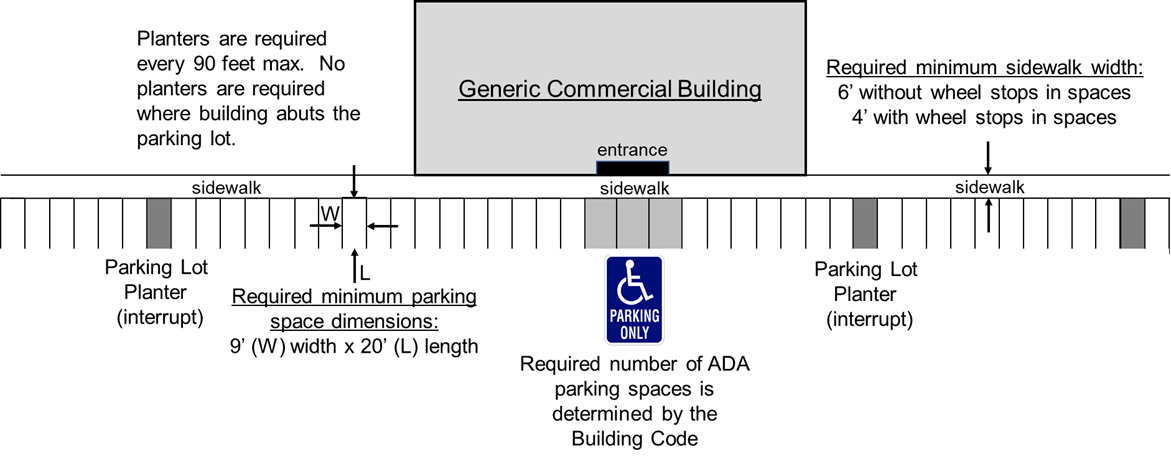
Landscape planter spacing. Interior parking lot planters shall be located at intervals not to exceed 90 feet within each parking bank except for any parking bank/row located immediately fronting/against any principal commercial or industrial (termed commercial collectively) building on a property and between the limits/span of its exterior side walls, for which such placement is optional.
If a parking bank that abuts the front entry area of such a building extends past the outside walls of the building, then planters shall be required where any continuous 90-foot parking space intervals are found past the building walls. Refer to the following illustration:
b.
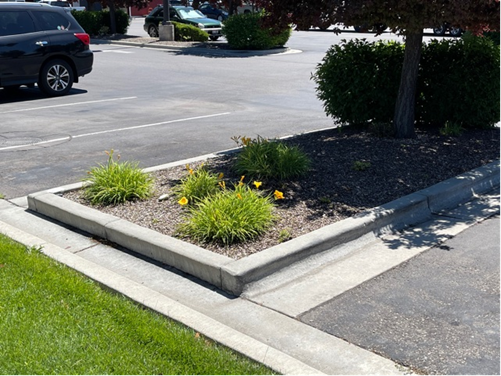
Parking bank interrupt style landscape planters' content(s). Each single interior interrupt style planter shall contain one 1.5-inch caliper deciduous shade tree as may be selected by the developer or property or project manager or owner, provided such tree(s) will grow on/from a single trunk and be at least 15 feet tall at maturity (see image examples in the chapter). Interior parking lot planters shall also contain some combination of shrubs, ornamental grasses, groundcover and decorative rock or bark mulch. Turf is prohibited in interior parking islands.
c.
Landscape planters' dimensions. Interior planters shall be of equivalent size, dimensions and angle of the parking stalls that surround them in the same parking bank. For example, if located in a single row of 90 degree oriented parking spaces that are nine feet wide by 20 feet deep/long, a landscape planter would also need to be nine feet wide and 20 feet deep.
Where two parking rows adjoin each other "head to head," back to back planters may be situated, or they may be separated. If placed back to back in, for example, a pair of 90 degree oriented parking rows, then the resulting planters would likely appear to be a single nine foot wide by 40-foot deep/long planter.
d.
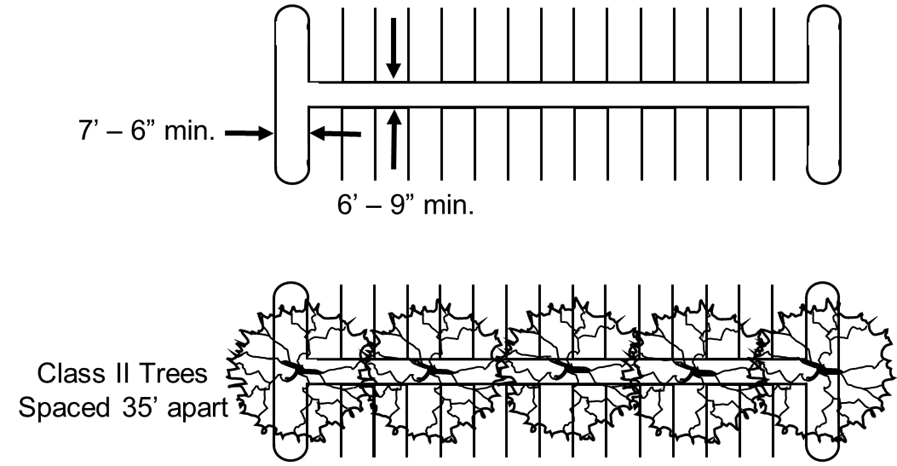
Exception. In lieu of parking bank interim interrupt style planters, landscape strips as detailed in subsection 10-22-5.J.6.e of this section may, instead, be emplaced between doubled parking banks. Within such landscape strips (when used), one and one-half inch caliper deciduous shade trees from the Class II species listed in subsection 10-33-2.F.1 of this title shall be planted every 35 feet on center running laterally through the strip.
e.
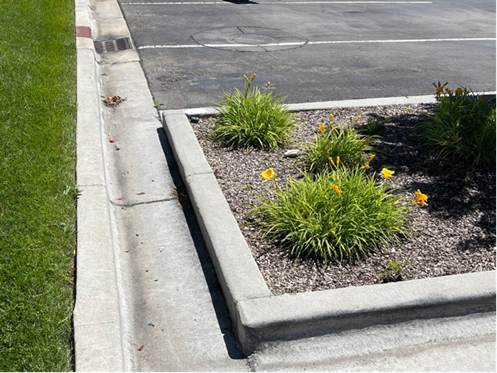
Drainage channel. A one foot cutout (preferred) or six- to eight-foot culvert pipe (less preferred) may be used at the end of or within a parking planter's abutment against a curb or other barrier in order to facilitate site drainage (e.g., stormwater flow across a parking lot into a drain). (See examples below.)
f.
Planters' contribution to parking lot landscaping. At least five percent of a parking lot area (i.e., area devoted to parking stalls and maneuvering/backup/service drive(s)) shall be landscaped in/around the same. The area(s) of interior parking lot planters as well as any immediate perimeter landscaping (e.g., that lies immediately around, abutting, or within required setback/yard areas) shall count toward providing the five percent.
g.
Landscaping irrigation, generally. All landscaping emplaced in conjunction with new development shall be irrigated with an subterranean irrigation system. Said system will be designed to minimize watershed onto adjoining public right(s)-of-way. Properties being renovated and/or upgraded to meet site development codes may utilize a subterranean or temporary aboveground irrigation system (e.g., watering with hose-end sprinkler).
L.
Directional arrows and/or crosswalks. The planning director or his/her designee may require emplacement of painted directional arrows and/or pedestrian/accessible crosswalks for new development sites as part of their parking lot/service drive/drive-through lane planning and development/"build-out."
M.
Bicycle parking. Where provided, bicycle parking shall conform to the following:
•Racks shall support a bicycle at two points and be permanently secured to a nonpermeable surface.
•Racks (or spaces containing a bike rack) shall be located within 50 feet of the main entrance of the building(s) which they serve, shall provide at least four feet of clear space around their perimeter, and otherwise, shall not obstruct pedestrian movement.
•It is recommended that there be one bicycle parking space for each ten required automobile parking spaces.
•For multi-family residential, one space per dwelling unit is recommended.
(Ord. No. 4617, § 1(Exh. A), 10-4-2021; Ord. No. 4671, § 1(Exh. A), 5-16-2022; Ord. No. 4702, § 1(Exh. A), 12-5-2022; Ord. No. 4727, § 1(Exh. A), 4-3-2023; Ord. No. 4873, § 13, 6-16-2025)
10-22-6. - Special parking and landscape corridor districts and spaces required.
A.
Special parking/landscape corridor overlay district(s). Provision for special parking and landscape corridor overlay districts is hereby established in order to accommodate the need for off-street parking ratio and parking and landscape strip design alternatives in specific city areas above and beyond what is normally allowed. Origination of such areas results from various causes including: legal nonconformities in landscape strip, parking area, service drive, landscape area and setback areas introduced by the city or state completing street improvements (including widening), implementation of special plan studies, enactment of local improvement districts, and so forth.
The following regulations, in addition to the general regulations of this chapter, shall apply to all land classified as being and sited in a 'P' district. If any of the parking or chapter 33 of this title landscape corridor regulations specified in this title differ from the corresponding provisions of this section, the regulations of this section shall govern.
P-1 Parking District:
1.
Nampa/Caldwell Boulevard Special Parking/Landscape Corridor District (P-1).
a.
Boundaries. The boundary of the P-1 District is described as follows:
Commencing at the intersection of N. Canyon Street and the Nampa/Caldwell Boulevard on the northwest corner of that intersection and thence northwesterly along the center line of the Nampa/Caldwell Boulevard to the intersection of the Nampa/Caldwell Boulevard and W. Karcher Road then back easterly along the northernmost and rear property lines of each and every lot or parcel having immediate frontage along the Nampa/Caldwell Boulevard to N. Canyon Street then southerly to the intersection of the Nampa/Caldwell Boulevard and N. Canyon Street, point of beginning.
b.
Requirements of the P-1 District. Landscape corridor provision, parking layout/design, parking setback and provision of spaces shall adhere to requirements set forth in section 10-1-15, figure 1, of this title, this section, and chapter 33 of this title. Expansion of site/structural improvements or property redevelopment/new construction that would normally require updating of site improvements in accordance with section 10-1-6 of this title shall still be therein required. Exceptions to such standards, where necessitated because of the property being legally nonconforming, may be allowed without requiring a variance. Structures destroyed by fire or other calamity may be rebuilt within the same footprint as previously occupied by the same but are exempt from having to update site improvements at that time to establish parking in accordance with this chapter. Those properties within the P-1 District whereupon an existing structure is located at or within 30 feet from the back of the sidewalk shall be allowed access off of, and onto, the Nampa/Caldwell Boulevard at any point along their property frontage abutting the same. Thus, drive accesses in such situations may be as wide as the property's frontage.
c.
Federal ADA restrictions. The provisions of this section shall not be construed as abrogation of Federal ADA regulations. Such shall still be applicable provided that emplacement of handicap parking spaces and signage will not be enforced by the city in the P-1 zone.
P-2 Parking District:
2.
Garrity Boulevard Special Parking/Landscape Corridor District (P-2).
a.
Boundaries. The boundary of the P-2 District is described as follows:
Commencing at the east side of the intersection of N. Grant Street and Garrity Boulevard and thence along the centerline of Garrity Boulevard to the center of the overpass at the interchange (exit 38) and including in the same each and every lot or parcel having immediate frontage along the Garrity Boulevard on either side of the same at the time of the passage date hereof.
b.
Requirements of the P-2 District.
i.
Landscape corridor provision, parking layout/design, parking setback and provision of spaces shall adhere to requirements set forth in section 10-1-15, figure 1, of this title, this section, and chapter 33 of this title; and,
ii.
Expansion of site/structural improvements or property re-development/new construction that would normally require updating of site improvements in accordance with section 10-1-6 of this title shall still be required for properties within the P-2 District. Exceptions to such standards, where necessitated because of the property being legally nonconforming, may be allowed without requiring a variance. Structures destroyed by fire or other calamity may be rebuilt within the same footprint as previously occupied by the same but are exempt from having to update site improvements at that time to establish parking in accordance with this chapter; and,
iii.
Private properties within the P-2 District that have frontage abutting Garrity shall install but four feet of landscaping along Garrity when such is required to be emplaced instead of 20 feet or other metric as determined by a zone.
c.
Federal ADA restrictions. The provisions of this section shall not be construed as abrogation of Federal ADA regulations. Such shall still be applicable provided that emplacement of handicap parking spaces and signage will not be enforced by the city in the P-2 zone.
B.
Number of spaces required. The number of off-street/on-property (site) parking spaces required and/or provided for land and structure uses shall be no less than as set forth in the following chart. Where fractional numbers result, round to the next highest whole amount. Thus, 2.6 spaces needed for a project means that three spaces are/will be actually required. ADA spaces required by ANSI standards shall be installed in addition to the following parking calculations:
C.
Unspecified or undetermined uses. Off-street parking requirements for buildings and uses not set forth herein and of undetermined use shall be determined by the planning director. The director's determination shall be based upon the requirements for the most comparable building or use specified herein. The director's decision may be appealed to the commission.
(Ord. No. 4617, § 1(Exh. A), 10-4-2021; Ord. No. 4671, § 1(Exh. A), 5-16-2022; Ord. No. 4702, § 1(Exh. A), 12-5-2022; Ord. No. 4775, § 1(Exh. A), 12-18-2023; Ord. No. 4777, § 1(Exh. A), 12-18-2023; Ord. No. 4809, § 1(Exh. A), 6-3-2024; Ord. No. 4907, § 6, 1-5-2026)
10-22-7. - Loading spaces.
Each off-street loading space (open air or dock) shall measure not less than 35 feet by 12 feet and shall have an unobstructed height of 15 feet and shall be made permanently available for parking and shall be surfaced, improved and maintained as required in section 10-22-5 of this chapter.
A.
Department stores, freight terminals, hospitals, sanitariums, industrial or manufacturing establishments, retail or wholesale stores or storage warehouses or any similar use which has, or intends to have, 10,000 square feet or more, shall provide the following truck loading or unloading spaces:
B.
Auditoriums, convention or exhibit halls, sports arenas, hotels, office buildings, restaurants or similar uses which have, or intend to have, an aggregate gross floor area of 40,000 square feet or more, shall provide the following truck loading or unloading spaces:
(Ord. No. 4617, § 1(Exh. A), 10-4-2021)
10-22-8. - Maintenance.
Maintenance of all areas provided for off-street parking and loading shall include removal and replacement of dead and dying trees, grass and shrubs, removal of trash, weeds and other debris. Maintenance shall also include repair of parking loading, and drive aisle surfaces, traffic control devices, signs, light standards, fences, walls, curbs and railing. All areas shall provide for proper drainage of surface water to prevent drainage onto adjacent properties and walkways. Any lights used to illuminate such areas shall be so arranged as to reflect the light away from the adjoining properties.
(Ord. No. 4617, § 1(Exh. A), 10-4-2021)
10-22-9. - Drive-through regulations.
No drive-up establishment shall be permitted unless the planning director or his/her designee finds that design and operation of the establishment is substantially in compliance with the following requirements and conditions:
A.
The waiting lane(s) be of sufficient length so as to prevent site traffic circulation from being disrupted by increased vehicular congestion, blockage, or rerouting caused by the drive-through;
B.
The design, signage or operational characteristics of the establishment prevent or discourage vehicles from waiting for service on public sidewalks or streets;
C.
Drive-through waiting lanes be designed so that curbs, gates or other devices do not prevent a vehicle from leaving them. A ten foot wide unobstructed emergency escape lane or area shall be provided adjacent and adjoining a drive-through lane starting 20 feet past the entry point. If an end of the drive-up lane splits into multiple lanes then the escape lane shall follow the outer side of the lane farthest from the drive-up facility. Thus, in such a situation, multiple escape lanes are not required at the diversion point;
D.
All lights and other illuminated materials/signage shall be screened to prevent lighting and glare from falling on adjoining residentially zoned or used property;
E.
The nearest edge of a drive-through lane is set back ten feet from the nearest and adjoining residentially zoned, or used, property unless required to be further displaced according to zoning district setback regulations pertaining to the property, whereupon the drive-through to be emplaced, are more restrictive. The planning director may vary the setback requirements to lessen the impact of sound, exhaust, or other disturbance to the residential area as appropriate. Areas of commercial sites with existing natural or manmade barriers or screens or lengthy distances separating them from residential areas or uses are preferable for development of drive-through areas;
F.
A drive-through lane is clearly marked with devices such as cones, signs or painted lines; and
G.
Any parking spaces lost in a parking lot covered by a drive-through associated with a detached business on a "pad" site do not reduce the total number of available parking spaces for the principal business(es) on the same or associated site/property below the minimum number required for them.
(Ord. No. 4617, § 1(Exh. A), 10-4-2021)