
Oak Hill City Zoning Code
Sec. 14-113
Definitions.
The following words, terms and phrases, when used in this ordinance, shall have the meanings ascribed to them in this section, all terms shall be used as commonly defined, except where they either are specifically defined or used in a context that clearly indicates a different meaning.
Access. A private driveway or other point of vehicle access that intersects or connects to a public street.
Accessory use. A use that is customarily incidental, appropriate, and subordinate to the principal use of land or buildings and is located upon the same lot.
Accessory structure. A structure that is subordinate in use and square footage to a principal structure or permitted use.
Basement. The portion of a residence or structure that is more than fifty (50%) percent underground and at least forty-eight (48) inches below finished grade on the front side of the structure and the sides of a structure (facing the side setbacks of the property). Usable conditioned floor space of basements meeting this criteria are not included in the gross floor area calculations.
Building. A structure with a roof, intended for the shelter or enclosure of persons or property. Where roofed structures are separated from each other by party walls having no openings for passage, each portion so separated shall be considered a separate building.
Building envelope. The area of a lot in which building(s) may be located taking into account applicable setbacks and minimum yard requirements.
Building line. A line parallel to the right-of-way line at the point of the front yard setback or building facade, whichever is greater.
Building permit. A written permit required by this ordinance prior to commencement of certain types of construction.
Bulk. Describes the size of buildings or other structures, their relationship to each other and to open areas and lot lines and, therefore, includes:
(1)
The size (including height and floor area) of other structures.
(2)
The area of the zoning lot upon which a residential building is located, and the number of dwellings within such buildings in relation to the area of the zoning lot.
(3)
The location of exterior walls of buildings or structures in relation to lot lines, to other walls of the same building, to legally required windows, or to other structures.
(4)
All open areas relating to buildings or other structures and their relationship thereto.
Certificate of occupancy. The final permit or authorization issued by the city allowing occupancy or use of a building, and certifying that the building has been constructed in accordance with all applicable requirements.
Church. A building or buildings where people regularly congregate to participate in or hold religious services, meetings or other similar activities.
Commercial use. Any nonresidential use of land engaged in commerce or commercial activity, such as wholesale or retail trade, or the provision of services.
Conditional use. A conditional use is a use that would not be appropriate generally, or without restriction, throughout the zoning division or districts but which, if controlled as to number, area, location, or relation to the neighborhood, would promote the public health, safety, welfare, morals, order, comfort, convenience, appearance, prosperity, or general welfare. For the purposes of this ordinance, conditional uses shall be construed as synonymous with special exceptions as authorized by Tennessee Code Annotated, § 13-7-206.
Construction. The placing of construction materials in their permanent position, fastened in a permanent manner; actual work in excavation, grading or any land disturbance, or the demolition or removal of an existing structure begun preparatory to rebuilding.
District. One (1) or more sections or areas of the City of Oak Hill, for which the regulation governing the height, area, use of buildings and premises, are the same.
Dwelling. A structure designed and used primarily for residential human habitation. For the purpose of this chapter, the word "dwelling" shall not include a travel trailer, hotel, motel, dormitory or extended stay hotel.
Dwelling, one-family. A residential structure dwelling other than a mobile home, located on a single lot, for occupancy by one family or single housekeeping unit and constructed with no connection by a common wall. The terms, "one-family dwelling," "single-family dwelling," "one-family residence," and "single-family residence," as used in this ordinance shall be synonymous. A mobile home shall qualify as a one-family dwelling only to the extent as this ordinance is pre-empted by state law.
Driveway. Area designated and constructed for vehicular ingress and egress on property and to public street.
Facade. The exterior wall on the front, side, or rear elevation of the building.
Family. One (1) or more persons occupying a premises and living as a single, nonprofit, housekeeping unit, as distinguished from a group occupying a hotel, club, fraternity, rooming house, or other structures designed for transient residence.
(1)
A dwelling will be considered a single-family residence only if its permanent occupants are limited to one (1) of the following categories:
(i)
One (1) individual.
(ii)
Any number of persons related by blood, marriage, adoption or foster care.
(iii)
A group of persons consisting of an individual or any number of persons related by blood, marriage, adoption or foster care, such occupant(s) being referred to as the primary occupant(s) for the purposes of this section; plus no more than one (1) person who is not related to the primary occupant(s); all of whom occupy the dwelling and function as a single housekeeping unit. Providing unrestricted access to the entire dwelling to all occupants; sharing food and other necessities; and sharing household expenses and responsibilities are indications that a group of persons is living as a single housekeeping unit. For purposes of this section, at least one (1) of the primary occupants of a residence must have evidence of a legal right to occupy the property, such as being named on a deed or lease to the property.
Not more than eight (8) unrelated persons with disabilities (as defined by state law and as determined by any duly authorized entity, including governmental agencies or licensed medical practitioners) pursuant to the requirements of Tennessee Code Annotated, § 13-24-102. Such a residence may also be occupied by three (3) additional persons acting as house parents or guardians, who need not be related to each other or to any of the other persons residing in the home. Notwithstanding the foregoing, a group home operated as a for-profit commercial enterprise shall not be a permitted use within a residential zoning district. As used in this section, "persons having mental illness" does not include: Persons who have a mental illness and, because of such mental illness, pose a likelihood of serious harm as defined in Tennessee Code Annotated, § 33-6-501, or who have been convicted of serious criminal conduct related to such mental illness.
(2)
A person shall be considered to be a permanent occupant of a dwelling for purposes of this section if such person:
(i)
Occupies a dwelling for more than twenty-one (21) days within any twelve (12) month period.
(ii)
Registers to vote using the address of a dwelling.
(iii)
Receives mail at a dwelling.
(iv)
Registers a vehicle or applies for a driver's license using the address of the dwelling or
(v)
Is registered to attend school, using the address of the dwelling.
(3)
In addition to the foregoing, the following are not considered to be single-family residences:
(i)
Boarding houses.
(ii)
Apartment houses.
(iii)
Dwellings in which one (1) or more rooms are rented to unrelated tenants.
(iv)
Dwellings in which separate portions are designated for or used as separate housekeeping units.
(v)
Structures or portions of structures which are designed or constructed for any of the above purposes; and such structures and uses of structures are explicitly prohibited in each residential zoning district unless otherwise specifically permitted. Notwithstanding the foregoing, single-family residence may include a dwelling which includes separate quarters for persons who are related by blood, marriage or adoption to the primary occupants, provided such quarters are connected by interior passageways to the other portions of the dwelling, and are not rented to any unrelated tenants or otherwise used in violation of this chapter. Only one (1) water meter (excluding a separate irrigation meter) one (1) gas meter, and one (1) electric meter area allowed per lot.
Floor. The horizontal surface on an enclosed area of a building or structure, not including basements, as measured to the ceiling.
Floor area ratio (FAR). The total gross floor area divided by the total square footage of the lot.
Flat roof. Roofs with a slope of less than 3:12.
Garage. A structure, building, outbuilding, accessory structure or portion of a residential structure for the purpose of parking or storage of vehicles, which may or may not be conditioned.
Gross floor area. The total of the horizontal area of all floors within a building or structure that is under roof or conditioned and used for habitation. Specifically excluded from the gross floor area are accessory buildings, pool houses, basements, patios (no roof), open air balconies, open air decks (no roof), half stories, and attic spaces.
Half story. A horizontal level of a building, used for habitation or activity, as defined by the building code, which has a ceiling or roof above that has a ceiling height of not less than eight (8) feet tall or fifty (50%) percent or less of the floor area. Habitable or usable floor area of a "half story" is based on areas of ceiling heights of five (5) feet or greater. Half stories are not included in the gross floor area.
Height (of building). The vertical distance from the average elevation of the finished grade along the front (facing the front setbacks) of the building to the highest point of the roof. Excluded shall be chimneys, cupolas, decorative spires (not to exceed three (3) feet in height), lightning rods, and antennas.
Height zones.
(1)
Height zone 1. A percentage of the lot width as measured at the front setback line from side property line to side property line. See bulk standards for maximum height of portions of a building within height zone 1. Portions of a building within height zone 1 may have a second floor as a half story.
Zone B: fifteen (15%) percent of the lot width each side.
Zone C: twenty (20%) percent of the lot width each side.
Zone D: twenty-two (22%) percent of the lot width each side.
(2)
Height zone 2. The remaining portion of the building envelope as illustrated below. See bulk standards for the maximum height of portions of a building within height zone 2.
(3)
Height zone 3. Thirty (30%) percent from the midpoint of the front property line to the midpoint of the rear property line. Height zone 3 is applied along the rear property line. See bulk standards for maximum height of portions of a building within height zone 3. Portions of a building within height zone 3 may have a second floor as a half story.
Home occupation. A business, profession, occupation, or trade that is conducted within a dwelling for the economic gain or support of a resident of the dwelling and is incidental and secondary to the residential use.
Impervious surface. Buildings, parking areas, driveways, streets, sidewalks, structures, areas of concrete, asphalt, gravel, or other compacted aggregate, and areas covered by the outdoor storage of goods or materials that do not absorb water.
Incidental. Being secondary, accessory, subordinate or ancillary. Incidental alterations:
(1)
Changes or replacements in the nonstructural parts of a building or other structure without limitations to the following examples:
(i)
Alteration of interior partitions in a nonconforming residential building, provided that no additional dwellings are created.
(ii)
Alterations of interior non-load bearing partitions in all other types of buildings or other structures.
(iii)
Replacement of, or minor changes in capacity of, utility pipes, ducts, or conduits.
(2)
Changes or replacements in the structural parts of a building or other structure, limited to the following examples or others of similar character or extent:
(i)
Making windows or doors in exterior walls.
(ii)
Replacement of buildings facades having non-load bearing capacity.
(iii)
Strengthening the floor load-bearing capacity, in not more than ten (10%) percent of the total floor area, to permit the accommodation of specialized machinery or equipment.
Kitchen. A room or area or adjoining room or area (in the case of a preparation kitchen or a kosher kitchen) in a building used for the preparation and cooking of food, containing cooking and storage appliances or facilities including ovens, stoves, or built in grills.
Land Disturbance. Any man-made change to the land surface, including but not limited to, the removal of vegetative cover, clearing, grubbing, excavating, filling, grading, or any other activity that alters the topography or exposes the underlying soil. Any such activity that may result in soil erosion from water or wind and the movement of sediment is considered land disturbance. Activities constituting land disturbance shall include, but are not limited to, the following:
• Clearing and grubbing of existing vegetation, trees, or stumps.
• Stripping topsoil from any portion of a site.
• Excavating, cutting, or digging into the natural terrain.
• Filling or stockpiling of soil, rock, or other earthen materials.
• Grading, shaping, or contouring of the land surface.
• Trenching for the installation of utilities, foundations, or drainage systems.
• The demolition of structures where such activity exposes or moves soil.
• The construction of new buildings, additions, roads, driveways, or parking lots.
• Disturbance associated with construction equipment, including paths of travel necessary for construction activity.
For the purposes of this chapter, the following activities shall not be considered land disturbance, provided they do not alter the general grading or drainage patterns of the site:
• Home gardening and routine landscape maintenance on an existing residential lot.
• Routine landscape maintenance, including lawn mowing, tree trimming, and removal of dead, diseased, or invasive vegetation, provided root wads are left in place to maintain soil stability.
• Minor repairs or maintenance of existing structures, utilities, roads, and driveways, provided that soil is not exposed and subject to erosion.
• Emergency work necessary to protect life or property.
Landscaping. The planting and maintenance of trees, shrubs, lawns, and other ground cover or materials. Terraces, fountains, retaining walls, street furniture, sculptures, or other art objects, and similar accessory features may be included as landscaping if integrally designed.
Lighting, private. Exterior lights and lighting fixtures intended to illuminate private on-site parking areas, access drives, and other on-site areas.
Lot. A piece or parcel of land occupied, or to be occupied, by one (1) principal building and its accessory buildings, and including the open spaces required in this ordinance.
(1)
Front lot line. The front lot line is the parcel boundary abutting the public right-of-way.
(2)
Rear lot line. The lot line opposite and the most distant from the front lot line.
(3)
Side lot line. Any lot line not a front line or rear lot line shall be termed a side lot line.
Lot coverage. The gross area of a lot covered by any impervious surface, including the square footage of the area of land occupied by the ground floor of any building, or other structure including driveways and swimming pools.
Lot frontage. The front of a lot shall be construed to be the portion nearest the public right-of-way extending from the front lot line. For the purposes of determining yard requirements on corner lots and through lots, all lines of a lot abutting a public right-of-way shall be considered frontage (or front lot lines).
Lot of record. A lot or tract of land, described by deed and/or subdivision plat, filed in the register's office, Davidson County, Tennessee.
Lot of record, nonconforming. See Nonconforming lot.
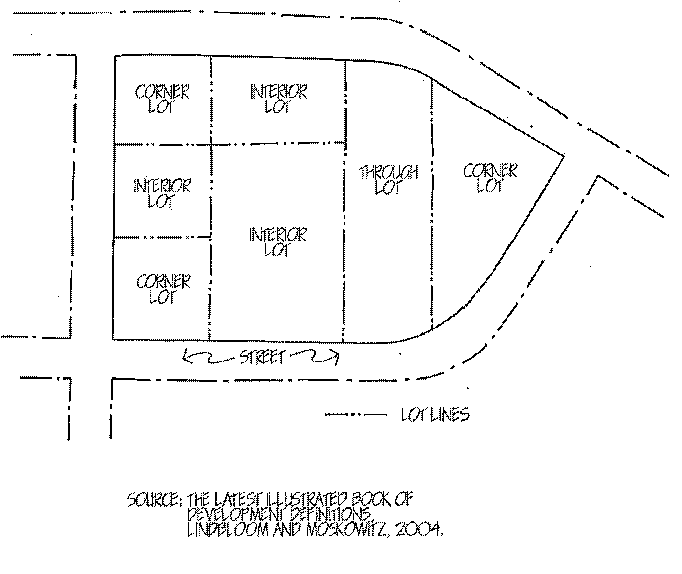
Lot types. The diagram (Figure 1) which follows illustrates terminology used in this ordinance with reference to corner lots, interior lots, and through lots:
(1)
Corner lot. A lot located at the intersection of two (2) or more streets (public or private) or on two (2) parts of the same street forming an interior angle of less one hundred thirty-five (135) degrees.
(2)
Interior lot, defined as a lot other than a corner lot with only one (1) frontage on a right-of-way.
(3)
Through lot, defined as a lot other than a corner lot with frontage on more than one (1) right-of-way. Through lots abutting two (2) rights-of-way may be referred to as double frontage lots.
Figure 1. Lot Examples
Manufactured home. A factory-built, single family structure that meets the Federal Manufactured Home Construction and Safety Standards. This type of structure is also referred to as a modular home and is fixed in place and not considered mobile.
Mobile home. A manufactured residential structure that is built on a chassis designed to be used as a dwelling with or without a permanent foundation.
Nonconformity. The portion of an existing use, structure, lot of record, or sign, legally initiated, developed, established, or erected before the effective date of this ordinance or any amendment thereto, that has continued in its use and/or existence without having been discontinued or abandoned for more than one (1) year, and remains unchanged, but that does not conform with one (1) or more provisions of this chapter.
Nonconforming lot. A lot of record legally established before the effective date of this ordinance or any amendment thereto, that has remained unchanged, but that does not conform with one (1) or more provisions of this ordinance.
Nonconforming structure. A structure (not including signs) legally developed before the effective date of this ordinance or any amendment thereto, that has continued in its use and/or existence without having been discontinued or abandoned for more than one (1) year, but that does not conform with one (1) or more provisions of this ordinance.
Nonconforming use. A use legally initiated before the effective date of this ordinance, or any amendment thereto, that has continued in its use and/or existence without having been discontinued or abandoned for more than one (1) year, but that does not conform with one (1) or more provisions of this ordinance.
Outdoor storage. The keeping in an unroofed area of any goods, junk, material, merchandise in the same place for more than twenty-four (24) hours.
Pool house (cabana or bath house). A free standing accessory structure subject to the requirements of section 14-132, built in connection to a swimming pool, which may not be used for occupancy as living quarters, but may contain bathrooms and dressing rooms. Square footage, height, and lot coverage of pool houses are subject to the bulk standards restrictions, however are not included in the gross floor area calculations.
Private swimming pool. Any pool, hot tub, spa or receptacle of water intended for swimming, wading, or recreational bathing.
Public building or facility. Any building, structure, property or other facility that is owned, leased or otherwise used by a governmental body or public entity.
Public utility or facility. Buildings, structures, and facilities, including generating and switching stations, poles, lines, pipes, pumping stations, repeaters, antennas, transmitters and receivers, valves, and all buildings and structures related to the furnishing of utility services, such as electric, gas, telephone, water, sewer, and public transit, to the public.
Recreation equipment. See definition of structure types below.
Recreation facilities, private. A facility designed for the conduct of sports and leisure-time activities for the use of the household and guests, and located on a lot as an accessory use to a residence.
Recreational vehicles. Any building, structure, or vehicle designed and used for living or sleeping and/or recreational purposes and equipped with wheels to facilitate movement from place to place, and automobiles when used for living or sleeping purposes and including pick-up coaches (campers), motorized homes, boats, travel trailers, and camping trailers not meeting the specifications required for a manufactured home or mobile home.
School. A public, parochial, private, charitable, or nonprofit facility providing primary and/or secondary educational instruction which may include recreational uses and other incidental facilities for students, teachers and employees.
Setback line. A line running parallel to the right-of-way or property lines which establish the minimum distance the principal building must be setback from the right-of-way or property line.
Story. A horizontal level of a building, used for habitation or activity, which has a ceiling or roof above. Height of a story varies but cannot be less than eight (8) feet in height.
Street. A public or approved private right-of-way, other than an alley, used for vehicular traffic and providing access to abutting properties.
Structure. Anything constructed or erected requiring more or less permanent location on the ground or attachment to something having permanent location on the ground, excluding wheels. Any new structure requires a building permit.
Subordinate. Being secondary, ancillary, accessory or derivative.
Temporary structure. A structure erected without any foundation or footings and removed when the designated time period, activity, or use for which the temporary structure was erected has ceased.
Temporary use. A use established for a limited duration with the intent to discontinue such use upon the expiration of the time period.
Use. The performance of a function or operation which constitutes the use of land or a structure.
Use and occupancy permit. See certificate of occupancy.
Yard. Open space on a lot which is unoccupied and unobstructed from the ground upward except as permitted in this ordinance.
Yard, front. The yard from the front lot line to the front facade of the principal structure, across the entire width of the lot. The front yard shall include the yard between the closest point on the front of the principal structure and the nearest side lot line and the front lot line. See Figure 2.
Yard, rear. The yard from the rear of the lot to the rear facade of the principal structure, across the entire width of the lot. The rear yard shall include the yard between the closest point on the rear of the principal structure and the nearest side lot line and the rear lot line. See Figure 2.
Yard, side. The yard on one (1) or more sides of a principal structure extending from the principal structure to the side property line. See Figure 2.
Figure 2. Yard Example
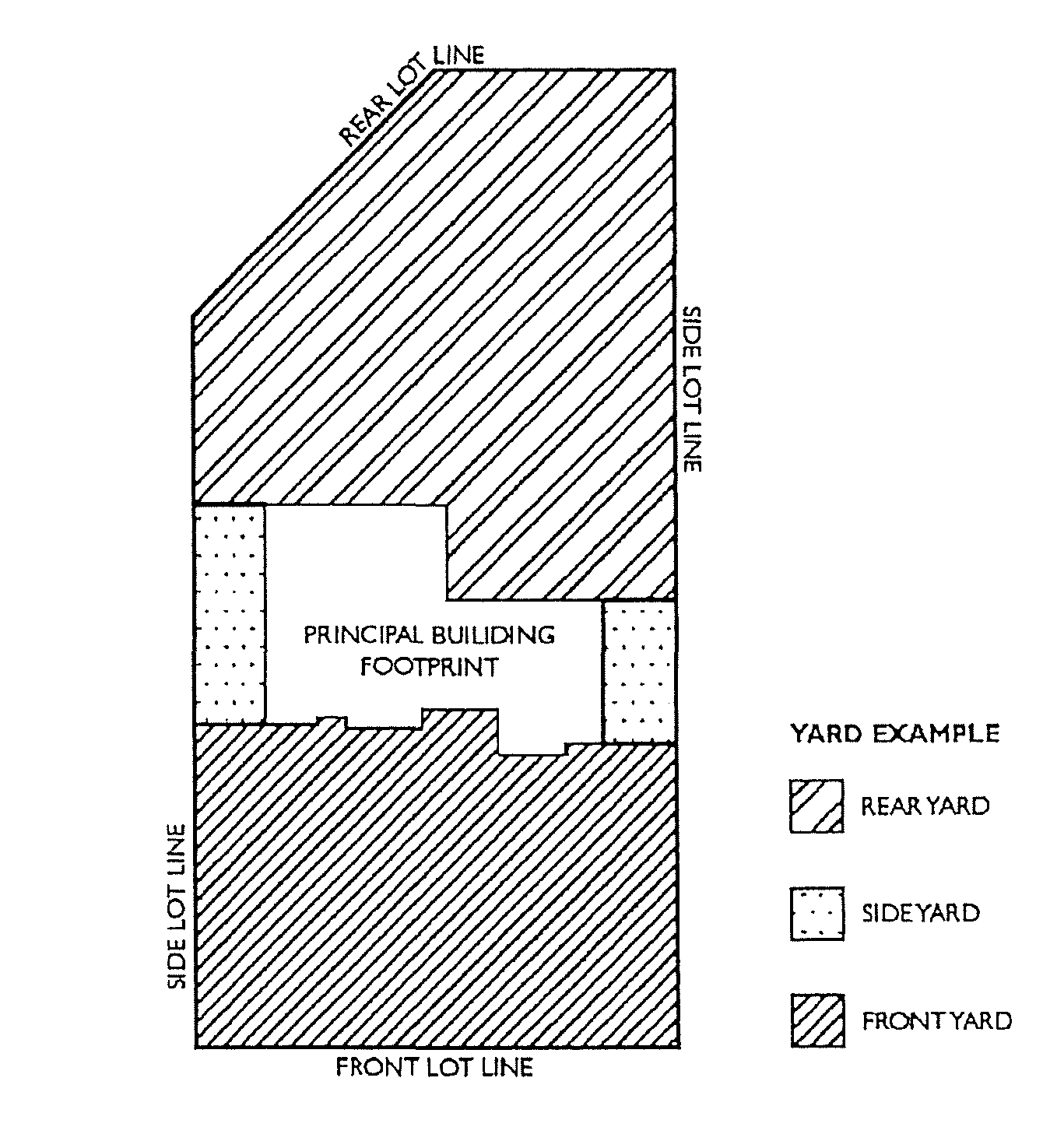
Figure 3. Corner Yard Examples
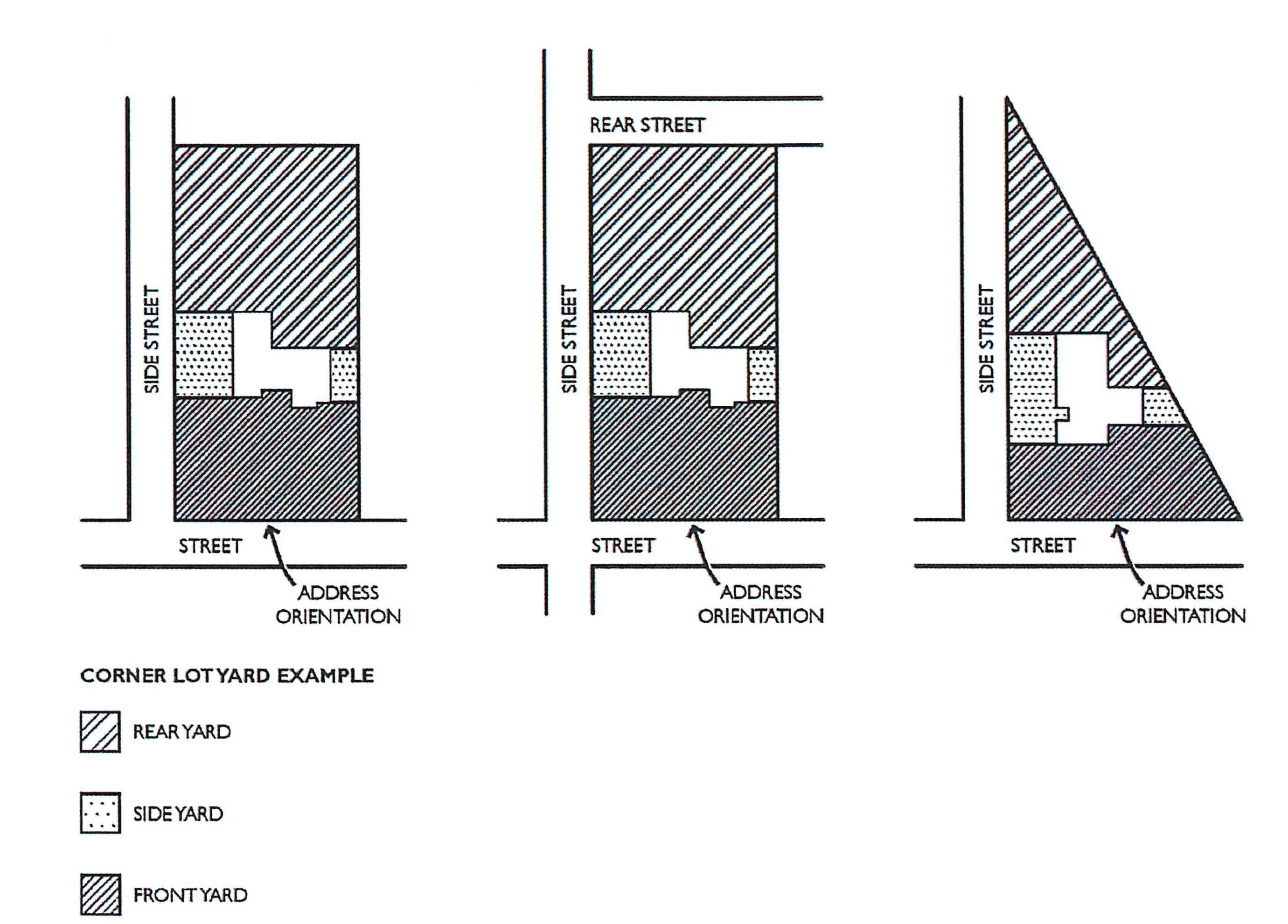
Figure 4. Corner Lot Building Envelope and Setbacks
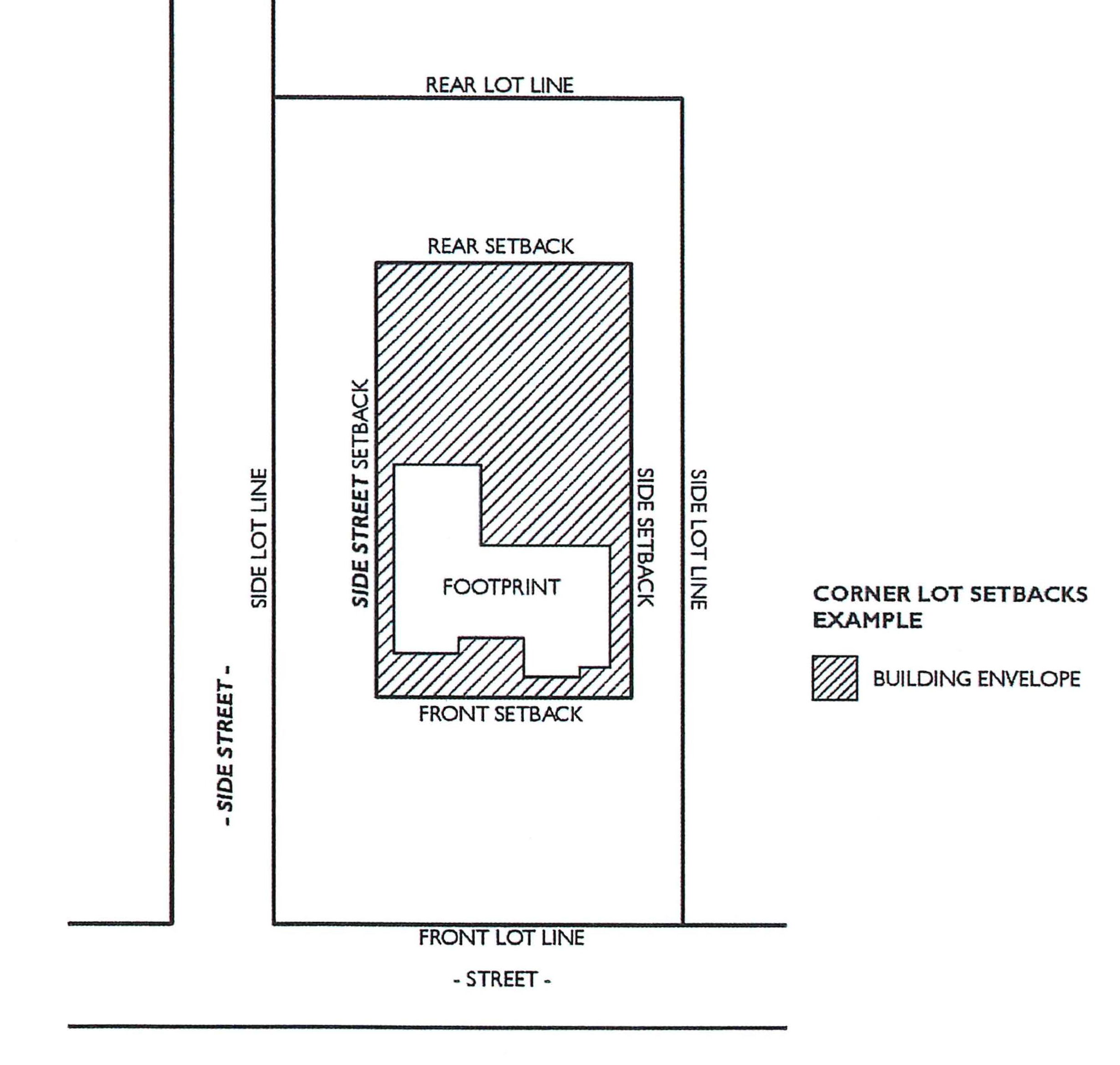
Figure 5. Building Envelope and Setback Examples
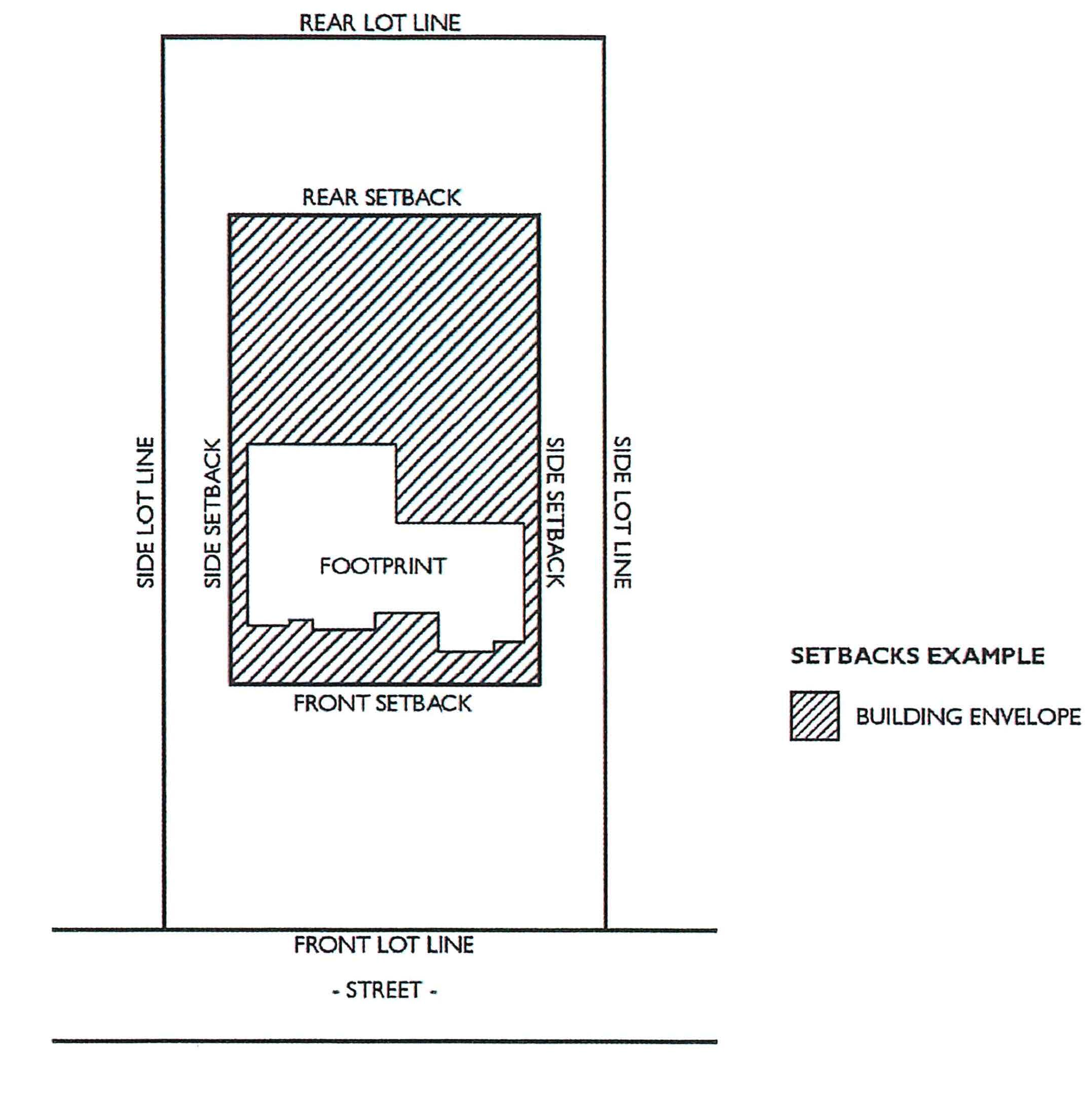
Figure 6. Height Zone Examples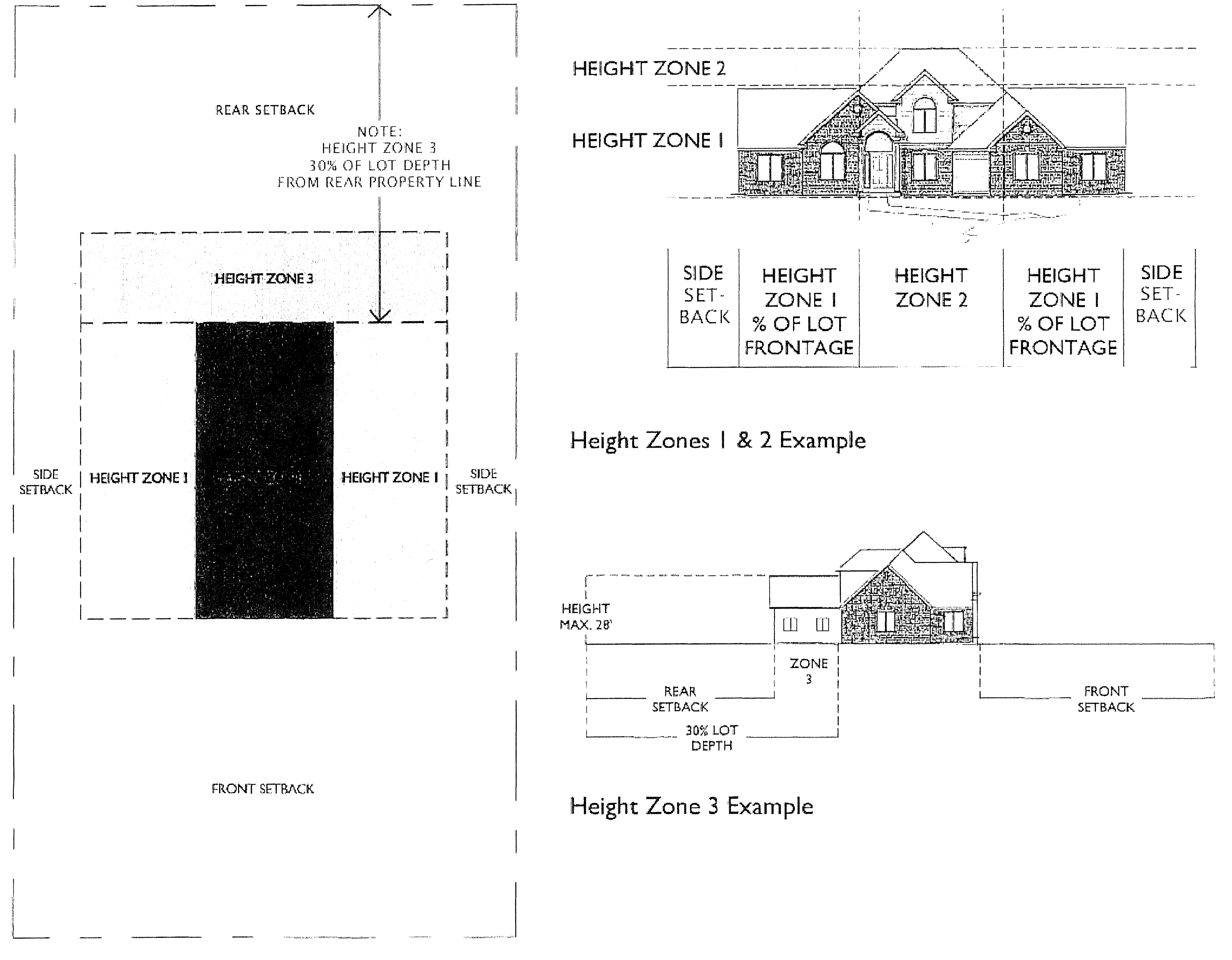
(Ord. No. 12-16, Jan. 2013, modified; Ord. No. O-21-01-10-30, § 1, 1-25-2022; Ord. No. 2023-04, Exh. A, 2-27-2024; Ord. No. 2025-07, § 1 (Exh. A), 11-25-2025)
ESTABLISHMENT OF DISTRICTS - PROVISIONS FOR OFFICIAL ZONING MAP - APPLICATION OF DISTRICT REGULATIONS
Establishment of Districts

