CN NEIGHBORHOOD CENTER COMMERCIAL ZONES REGULATIONS
Sections:
A.
Title and Intent. The provisions of this Chapter shall be known as the CN Neighborhood Center Commercial Zones Regulations. The intent of the Neighborhood Center Commercial (CN) Zones is to create, preserve, and enhance mixed use neighborhood commercial centers. The centers are typically characterized by smaller scale pedestrian oriented, continuous and active store fronts with opportunities for comparison shopping. These regulations shall apply to the CN Zones.
B.
Description of Zones. This Chapter establishes land use regulations for the following four (4) zones:
1.
CN-1 Neighborhood Commercial - 1 Zone. The intent of the CN-1 Zone is to maintain and enhance vibrant commercial districts with a wide range of retail establishments serving both short and long term needs in attractive settings oriented to pedestrian comparison shopping.
2.
CN-2 Neighborhood Commercial - 2 Zone. The intent of the CN-2 Zone is to enhance the character of established neighborhood commercial centers that have a compact, vibrant pedestrian environment.
3.
CN-3 Neighborhood Commercial - 3 Zone. The intent of the CN-3 Zone is to create, improve, and enhance areas neighborhood commercial centers that have a compact, vibrant pedestrian environment.
4.
CN-4 Neighborhood Commercial - 4 Zone. The intent of the CN-4 Zone is to accommodate a broad range of low impact, retail, and service uses in small commercial districts, often near lower density residential neighborhoods.
(Ord. No. 13357, § 3(Exh. A), 2-16-2016; Ord. No. 13064, § 2(Exh. A), 3-15-2011)
Except for projects that are exempt from design review as set forth in Section 17.136.025, no Building Facility, Designated Historic Property, Potentially Designated Historic Property, Telecommunications Facility, Sign, or other associated structure shall be constructed, established, or altered in exterior appearance, unless plans for the proposal have been approved pursuant to the design review procedure in Chapter 17.136, and when applicable, the Telecommunications regulations in Chapter 17.128, or the Sign regulations in Chapter 17.104.
(Ord. No. 13064, § 2(Exh. A), 3-15-2011)
Table 17.33.01 lists the permitted, conditionally permitted, and prohibited activities in the CN Zones. The descriptions of these activities are contained in Chapter 17.10. Section 17.10.040 contains permitted accessory activities.
"P" designates permitted activities in the corresponding zone.
"C" designates activities that are permitted only upon the granting of a Conditional Use Permit (CUP) in the corresponding zone (see Chapter 17.134 for the CUP procedure).
"L" designates activities subject to certain limitations or notes listed at the bottom of the table.
"—" designates activities that are prohibited except as accessory activities according to the regulations contained in Section 17.010.040.
Table 17.33.01: Permitted and Conditionally Permitted Activities
Limitations on Table 17.33.01:
L1. See Section 17.103.010 for other regulations regarding Residential Care Residential Activities, and Sections 17.103.010 and 17.103.015 for other regulations regarding Emergency Shelter Residential Activities.
L2. These activities are only permitted upon the granting of a Conditional Use Permit (see Chapter 17.134 for the CUP procedure) when located within thirty (30) feet of the principal street frontage on the ground floor of a building. Incidental pedestrian entrances that lead to one of these activities elsewhere in the building are exempted from this Conditional Use Permit requirement. In addition to the CUP criteria contained in Section 17.134.050, these conditionally permitted ground floor activities must also meet the criteria contained in L4, below.
L3. See Section 17.33.040 for limitations on the construction of new ground floor Residential Facilities.
L4. Any Conditional Use Permit (CUP) required in the above table or its associated limitations shall conform to the CUP criteria contained in Section 17.134.050 and to each of the following additional criteria:
a. That the proposal will not detract from the character desired for the area;
b. That the proposal will not impair a generally continuous wall of building facades;
c. That the proposal will not weaken the concentration and continuity of retail facilities at ground level, and will not impair the retention or creation of an important shopping frontage;
d. That the proposal will not interfere with the movement of people along an important pedestrian street; and
e. That the proposal will conform in all significant respects with any applicable district plan which has been adopted by the City Council.
L5. Emergency Shelters are permitted by-right on properties owned by churches, temples, synagogues, and other similar places of worship approved for Community Assembly Civic Activities; and within those portions of Martin Luther King Jr. Way, San Pablo Avenue, and Macarthur Boulevard corridors described in Section 17.103.015(A)(1)(2)(7) respectively and subject to the development standards in Section 17.103.015(B); permitted upon the granting of a Conditional Use Permit elsewhere in the zone subject to the standards in Section 17.103.010.
L6. The total floor area devoted to these activities on the ground floor by any single establishment shall only exceed seven thousand five hundred (7,500) square feet upon the granting of a Conditional Use Permit (see Chapter 17.134 for the CUP procedure). In addition to the CUP criteria contained in Section 17.134.050, these conditionally permitted ground floor activities must also meet the criteria contained in L4, above.
L7. No new or expanded Special Health Care Civic Activity shall be located closer than two thousand five hundred (2,500) feet from any other such activity, or five hundred (500) feet from any K-12 school or Licensed Emergency Shelters. See Section 17.103.020 for further regulations regarding Special Health Care Civic Activities.
L8. A Medical Service Commercial Activity that is located on the ground floor of a building and occupies either: 1) a street corner space, or 2) an interior lot space with more than thirty-five (35) linear feet of frontage facing the principal street, is only permitted upon the granting of a Conditional Use Permit (see Chapter 17.134 for the CUP procedure). All ground floor window space facing the principal street shall be clear, non-reflective, and allow views into the indoor space.
L9. The total floor area devoted to these activities on the ground floor by any single establishment may only exceed twenty thousand (20,000) square feet upon the granting of a Conditional Use Permit (see Chapter 17.134 for the CUP procedure), except for grocery stores located within a food desert as defined in Section 17.09.040. Grocery stores in food deserts are not subject to Conditional Use Permit requirements and do not have a size threshold. In addition to the CUP criteria contained in Section 17.134.050, these conditionally permitted ground floor activities must also meet the criteria contained in L4, above.
L10. See Section 17.102.170 for special regulations relating to massage services and Section 17.102.450 for special regulations relating to laundromats.
L11. With the exception of retail bank branches, these activities are only permitted upon the granting of a Conditional Use Permit (see Chapter 17.134 for the CUP procedure) when located both on the ground floor of a building and within thirty (30) feet of the principal street frontage. Incidental pedestrian entrances that lead to one of these activities elsewhere in the building are exempted from this Conditional Use Permit requirement. In addition to the CUP criteria contained in Section 17.134.050, these conditionally permitted ground floor activities must also meet the criteria contained in L4, above. The size threshold triggering the requirement for a Conditional Use Permit described in L6, above, shall apply to retail bank branches.
L12. No new or expanded Adult Entertainment Activity shall be located closer than one thousand (1,000) feet to the boundary of any Residential Zone or three hundred (300) feet from any other Adult Entertainment Activity. See Section 17.102.160 for further regulations regarding Adult Entertainment Activities.
L13. Not permitted on the ground floor.
L14. Limited Agriculture is only permitted upon the granting of a Conditional Use Permit (see Chapter 17.134 for the CUP procedure). In addition to the CUP criteria contained in Section 17.134.050, this activity must meet the following use permit criteria:
1. The proposal will not adversely affect the livability or appropriate development of abutting properties and the surrounding neighborhood in terms of noise, water and pesticide runoff, farming equipment operation, hours of operation, odor, security, and vehicular traffic;
2. Agricultural chemicals or pesticides will not impact abutting properties or the surrounding neighborhood; and
3. The soil used in growing does not contain any harmful contaminants and the activity will not create contaminated soil.
L15. Limited Agriculture is permitted if the activity occupies less than twenty thousand (20,000) square feet acre of land area and any sales area is less than one thousand (1,000) square feet; conditionally permitted if the activity is larger in either land or sales area (see Chapter 17.134 for the CUP procedure).
L16. Extensive Agriculture is only permitted upon the granting of a Conditional Use Permit (see Chapter 17.134 for the CUP procedure). In addition to the criteria contained in Section 17.134.050, this activity must meet the following use permit criteria:
a. The proposal will not adversely affect the livability or appropriate development of abutting properties and the surrounding neighborhood in terms of noise, water and pesticide runoff, farming equipment operation, hours of operation, odor, security, and vehicular traffic.
L17. Community Gardens are permitted if they do not include any livestock production or the cultivation of animals and/or animal products by agricultural methods, except for bee keeping involving no more than three (3) hives.
(Ord. No. 13763, § 5, 10-3-2023; Ord. No. 13393, § 2(Exh. A), 10-4-2016; Ord. No. 13357, § 3(Exh. A), 2-16-2016; Ord. No. 13270, § 3(Exh. A), 11-18-2014; Ord. No. 13248, § 3(Exh. A), 7-15-2014; Ord. No. 13172, § 3(Exh. A), 7-2-2013; Ord. No. 13064, § 2(Exh. A), 3-15-2011)
Table 17.33.02 lists the permitted, conditionally permitted, and prohibited facilities in the CN Zones. The descriptions of these facilities are contained in Chapter 17.10.
"P" designates permitted facilities in the corresponding zone.
"C" designates facilities that are permitted only upon the granting of a Conditional Use Permit (CUP) in the corresponding zone (see Chapter 17.134 for the CUP procedure).
"L" designates facilities subject to certain limitations listed at the bottom of the table.
"—" designates facilities that are prohibited.
Table 17.33.02: Permitted and Conditionally Permitted Facilities
Limitations on Table 17.33.02:
L1. See Section 17.103.080 and Chapter 17.88 for regulations regarding permitted Accessory Dwelling Units. Also applicable are the provisions of Chapter 17.114, Nonconforming Uses, for additions and alterations to legal nonconforming Residential Facilities, provided, however, that Accessory Dwelling Units are permitted when there is an existing One-Family Dwelling on a lot, subject to the provisions of Section 17.103.080 and Chapter 17.88.
L2. Construction of new ground floor Residential Facilities is not permitted within thirty (30) feet of the principal street frontage except for incidental pedestrian entrances that lead to one of these activities elsewhere in the building.
L3. Ground floor construction of new Residential Facilities within thirty (30) feet of the principal street frontage is only permitted upon the granting of a Conditional Use Permit (see Chapter 17.134 for the CUP process).
L4. In the CN-1 and CN-2 Zones, no conditional use permit is required for Open Nonresidential Facilities to accommodate Civic Activities, seasonal sales, or special events. In the CN-3 and CN-4 Zones, no conditional use permit is required for Open Nonresidential Facilities to accommodate Civic Activities, Limited Agriculture, seasonal sales, or special events.
L5. No new or expanded Fast-Food Restaurants with Drive-Through Nonresidential Facilities shall be located closer than five hundred (500) feet of an elementary school, park, or playground. See Sections 17.103.030 and 17.103.100 for further regulations regarding Drive-Through Nonresidential Facilities.
L6. See Section 17.128.025 for restrictions on Telecommunication Facilities near Residential Zones, HBX Zones, or D-CE-3 or D-CE-4 Zones.
(Ord. No. 13763, § 5, 10-3-2023; Ord. No. 13677, § 4(Exh. A), 1-18-2022; Ord. No. 13666, § 3(Exh. A), 11-16-2021; Ord. No. 13435, § 4(Exh. A), 5-2-2017; Ord. No. 13357, § 3(Exh. A), 2-16-2016; Ord. No. 13270, § 3(Exh. A), 11-18-2014; Ord. No. 13172, § 3(Exh. A), 7-2-2013; Ord. No. 13168, § 5(Exh. A-2), 6-18-2013; Ord. No. 13064, § 2(Exh. A), 3-15-2011)
A.
Zone Specific Standards. Table 17.33.03 below prescribes development standards specific to individual zones. The number designations in the "Additional Regulations" column refer to the regulations listed at the end of the Table. "N/A" designates a standard is not applicable to the specified zone.
Table 17.33.03: Property Development Standards
Additional Regulations for Table 17.33.03:
1. See Sections 17.106.010 and 17.106.020 for exceptions to lot area, lot width mean, and street frontage regulations.
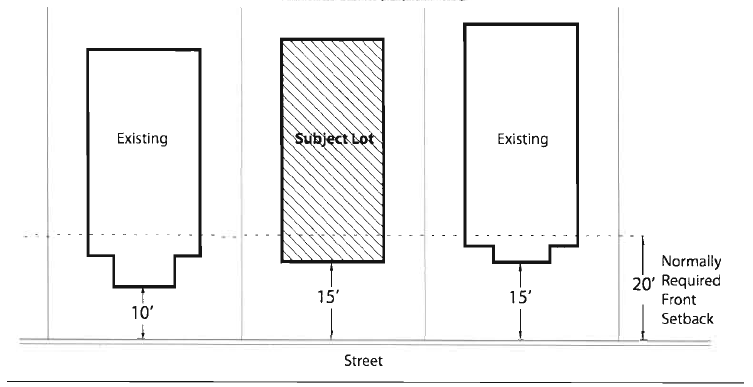
2. If fifty percent (50%) or more of the frontage on one (1) side of the street between two (2) intersecting streets is in any Residential Zone and all or part of the remaining frontage is in any Commercial or Industrial Zone, the required front setback of the commercially or industrially zoned lots is one-half (½) of the minimum front setback required in the Residential Zone. If fifty percent (50%) or more of the total frontage is in more than one Residential Zone, then the minimum front setback on the commercially or industrially zoned lots is one-half (½) of that required in the Residential Zone with the lesser front setback (see Illustration for Table 17.33.03 [Additional Regulation 2]). Also, see Section 17.108.130 for allowed projections into setbacks.
Illustration for Table 17.33.03 [Additional Regulation 2]
*for illustration purposes only
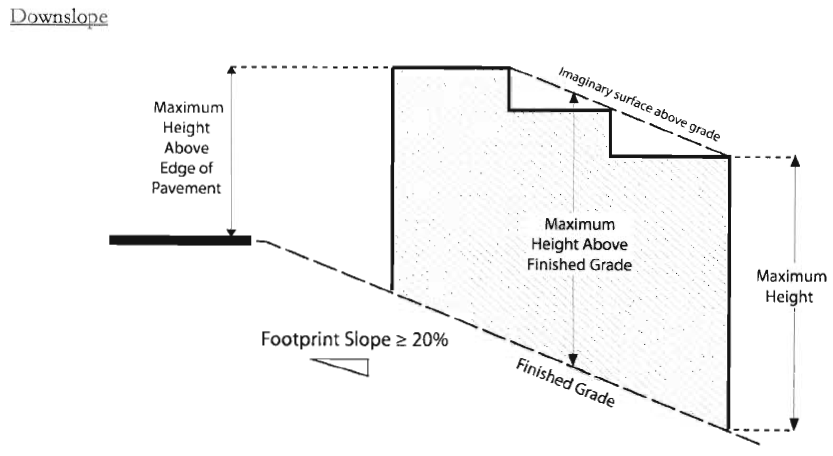
3. The following notes apply to the maximum front yard requirement:
a. The requirements only apply to the construction of new principal buildings.
b. The requirements do not apply to lots containing Recreational Assembly, Community Education, Utility and Vehicular, or Extensive Impact Civic Activities or Automobile and Other Light Vehicle Gas Station and Servicing Commercial Activities as principal activities.
c. Maximum yards apply to seventy-five percent (75%) of the street frontage on the principal street and fifty percent (50%) on other streets, if any. All percentages, however, may be reduced to fifty percent (50%) upon the granting of Regular Design Review approval (see Chapter 17.136 for the design review procedure). In addition to the criteria contained in Section 17.136.050, the proposal to reduce to fifty percent (50%) must also meet each of the following criteria:
i. The additional yard area abutting the principal street is designed to accommodate publicly accessible plazas, sidewalk cafes, or restaurants;
ii. The proposal will not impair a generally continuous wall of building facades;
iii. The proposal will not weaken the concentration and continuity of retail facilities at ground-level, and will not impair the retention or creation of an important shopping frontage; and
iv. The proposal will not interfere with the movement of people along an important pedestrian street.
4. Wherever an interior side lot line abuts an interior side lot line of any lot located in an RH or RD Zone, a side setback of six (6) feet is required. In the case where an interior side lot line abuts an interior side lot line in a RM Zone, the setback of the abutting portion of its side lot line is five (5) feet. In the case where an interior side lot line abuts an interior side lot line of any lot located in an RU-1 or RU-2 Zone, a side setback of four (4) feet is required (see Illustration for Table 17.33.03 [Additional Regulation 4], below). Also, see Section 17.108.130 for allowed projections into setbacks.
Illustration for Table 17.33.03 [Additional Regulation 4]
*for illustration purposes only
5. See Section 17.108.080 for the required interior side and rear yard setbacks on a lot containing two or more living units and opposite a legally required living room window.
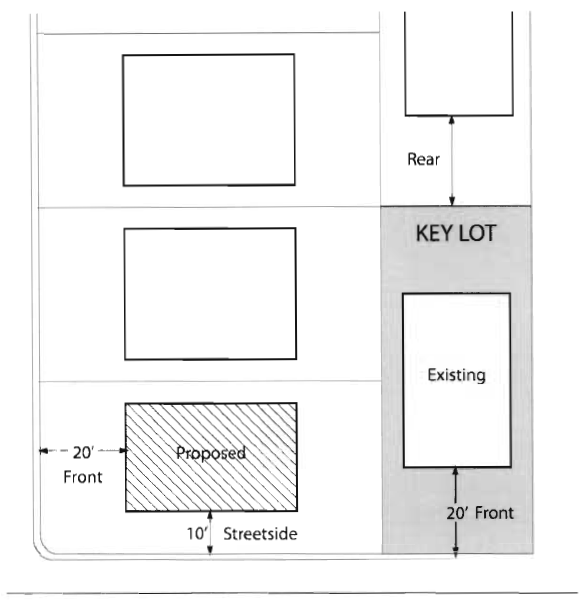
6. When the rear yard of a reversed corner lot abuts a key lot that is in an RH, RD, or RM Zone, the required street side yard setback in the rear ten (10) feet of the reversed corner lot is one-half (½) of the minimum front yard required on the key lot, but shall not be required to exceed four (4) feet in width if it would reduce to less than twenty-five (25) feet the buildable width of any corner lot (see Illustration for Table 17.33.03 [Additional Regulation 6], below). Also, see Section 17.108.130 for allowed projections into setbacks.
Illustration for Table 17.33.03 [Additional Regulation 6]
*for illustration purposes only
7. Wherever a rear lot line abuts an alley, one-half of the right-of-way width of the alley may be counted toward the required minimum rear setback; provided, however, that the portion of the minimum rear setback actually on the lot itself shall not be so reduced to less than ten (10) feet. Also, see Section 17.108.130 for allowed projections into setbacks.
8. When a rear lot line is adjacent to an RH, RD, or RM Zone, the required rear setback for both Residential and Nonresidential Facilities is ten (10) feet. When a rear lot line is not adjacent to an RH, RD, or RM Zone, the required rear setback is ten (10) feet for Residential Facilities and there is no required setback for Nonresidential Facilities.
9. This percentage of transparency is only required for principal buildings that include ground floor Nonresidential Facilities, and only applies to the facade facing the principal street. The regulations only apply to facades located within twenty (20) feet of a street frontage. The area of required transparency is between two (2) feet and nine (9) feet in height of the ground floor and must be comprised of clear, nonreflective windows that allow views out of indoor activity space, or lobbies (see Illustration for Table 17.33.03 [Additional Regulation 9], below). Areas required for garage doors shall not be included in the calculation of facade area (see Additional Regulation 12 for limitations on the location of parking access). Glass block does not qualify as a transparent window. Exceptions to this regulation may be allowed by the Planning Director for unique facilities such as convention centers, gymnasiums, parks, gas stations, theaters and other similar facilities.
Illustration for Table 17.33.03 [Additional Regulation 9]
*for illustration purposes only
10. This height is only required for new principal buildings that include ground floor Nonresidential Facilities, and is measured from the sidewalk grade to the second story floor.
11. This regulation only applies to new Residential Facilities and ground floor living space located within fifteen (15) feet of a street frontage.
12. For the new construction of principal buildings in the CN-1, CN-2, and CN-3 Zones, access to parking and loading facilities through driveways, garage doors, or other means shall not be from the principal street when alternative access is feasible from another location such as a secondary frontage or an alley. Where this is not feasible, every reasonable effort shall be made to share means of vehicular access with abutting properties. Open parking areas shall not be located between the sidewalk and a principal building.
13. For the new construction of principal buildings in the CN-1, CN-2, and CN-3 Zones, ground level parking spaces, locker areas, mechanical rooms, and other non-active spaces shall not be located within thirty (30) feet of the front of the principal building, except for incidental entrances to such activities elsewhere in the building. Exceptions to this regulation may be permitted by the Planning Director for utilities and trash enclosures that cannot be feasibly placed in other locations of the building. Driveways, garage entrances, or other access to parking and loading facilities may be located on the ground floor of this area as regulated by Additional Regulation 12, above.
14. See Section 17.103.080 for additional parking regulations that apply to Accessory Dwelling Units.
15. Vehicular Residential Facilities shall be located a minimum of thirty (30) feet from the street or be located behind a building. See Section 17.103.085 for additional setback and separation requirements for Vehicular Residential Facilities.
B.
Height, Floor Area Ratio (FAR), Density, and Open Space. Table 17.33.04 below prescribes height, FAR, density, and open space standards associated with the Height Areas described in the Zoning Maps. The number designations in the "Additional Regulations" column refer to regulations below the table. "N/A" designates a regulation is not applicable to the specified Height Area.
Table 17.33.04 Height, Floor Area Ratio (FAR), Density, and Open Space Regulations
Additional Regulations for Table 17.33.04:
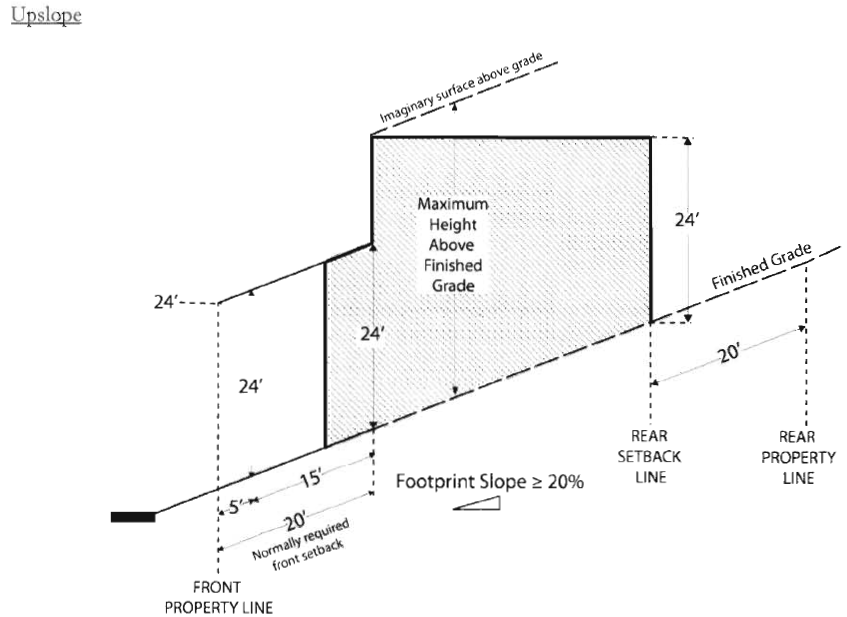
1. The maximum height within ten (10) feet of the front property line is either the height limit on the subject lot shown in the above table or the height maximum for the height area of the parcel directly across the principal street, whatever is less (see Illustration for Table 17.33.04 [Additional Regulation 1], below).
Illustration for Table 17.33.04 [Additional Regulation 1]
*for illustration purposes only
2. Buildings in the CN Zones shall have a thirty (30) foot maximum height at the setback line associated with any rear or interior side lot line that abut a lot in an RH, RD, or RM Zone; if the principal building on the abutting lot has a height of thirty (30) feet or less, this maximum height shall increase one (1) foot for every foot of distance away from this setback line. If the principal building on the abutting lot has a height of greater than thirty (30) feet, the maximum height shall increase two (2) feet for every foot away from the applicable setback line (see Illustration for Table 17.33.04 [Additional Regulation 2], below). Also, see Section 17.108.030 for allowed projections above height limits and Section 17.108.020 for increased height limits in certain situations.
Illustration for Table 17.33.04 [Additional Regulation 2]
*for illustration purposes only
3. This minimum height requirement only applies to the new construction of a principal building that is located on parcels adjacent to a street right-of-way that is one hundred (100) feet wide or more. Buildings constructed to accommodate Essential Service, Utility and Vehicular, or Extensive Impact Civic Activities or Automobile and Other Light Vehicle Gas Station and Servicing Commercial Activities may be exempted from the height minimum regulation by the Planning Director. The allowed projections into the height limits contained in Section 17.108.030 are not counted towards the height minimum.
4. See Chapter 17.107 for affordable and senior housing incentives. See Section 17.103.080 and Chapter 17.88 for regulations regarding permitted Accessory Dwelling Units. Also applicable are the provisions of Section 17.102.270 with respect to additional kitchens for a dwelling unit, and the provisions of Section 17.102.300 with respect to dwelling units with five (5) or more bedrooms.
5. As specified in Section 17.106.030, the total lot area shall be used as the basis for computing both the maximum nonresidential FAR and the maximum residential density for mixed use projects.
6. In the 35* height area, residential developments are subject to the same residential density and open space regulations as the adjacent RH, RD, or RM Zone, except that One-Family Dwellings, along with one (1) or more Accessory Dwelling Units as specified in Section 17.103.080, are permitted in the 35* height area regardless of the residential density regulations in the adjacent zone (see also Table 17.33.02). When there is more than one (1) of these abutting zones, then the regulations of the zone allowing the greatest density shall apply.
7. Usable open space is only required on lots with two (2) or more dwelling units, excluding any permitted Accessory Dwelling Units. Each one (1) square foot of private usable open space equals two (2) square feet towards the total usable open space requirement, except that actual group space shall be provided in the minimum amount specified in the table per dwelling unit, excluding any permitted Accessory Dwelling Units. All usable open space shall meet the standards contained in Chapter 17.126.
(Ord. No. 13763, § 5, 10-3-2023; Ord. No. 13677, § 4(Exh. A), 1-18-2022; Ord. No. 13666, § 3(Exh. A), 11-16-2021; Ord. No. 13357, § 3(Exh. A), 2-16-2016; Ord. No. 13270, § 3(Exh. A), 11-18-2014; Ord. No. 13172, § 3(Exh. A), 7-2-2013; Ord. No. 13064, § 2(Exh. A), 3-15-2011)
A.
Planned Unit Developments. Large integrated developments shall be subject to the Planned Unit Development (PUD) regulations in Chapter 17.142 if they exceed the sizes specified therein. In developments which are approved pursuant to said regulations, certain uses may be permitted in addition to those otherwise allowed in the CN Zones, and certain of the other regulations applying in said zone may be waived or modified. The normally required design review process may also be waived for developments at the time of initial granting of a Planned Unit Development (PUD) permit. Unless otherwise specified in the PUD permit, any future changes within the Planned Unit Development shall be subject to applicable design review regulations.
(Ord. No. 13763, § 5, 10-3-2023; Ord. No. 13677, § 4(Exh. A), 1-18-2022; Ord. No. 13357, § 3(Exh. A), 2-16-2016; Ord. No. 13172, § 3(Exh. A), 7-2-2013; Ord. No. 13064, § 2(Exh. A), 3-15-2011)
Editor's note— Ord. No. 13677, § 4(Exh. A), adopted Jan. 18, 2022, amended the title of § 17.33.060 to read as herein set out. The former § 17.33.060 title pertained to special regulations for Mini-Lot and Planned Unit Developments.
A.
Home Occupations. Home occupations shall be subject to the applicable provisions of the home occupation regulations in Chapter 17.112.
B.
Nonconforming Uses. Nonconforming uses and changes therein shall be subject to the nonconforming use regulations in Chapter 17.114.
C.
General Provisions. The general exceptions and other regulations set forth in Chapters 17.102, 17.104, 17.106, and 17.108 shall apply in the CN Zones.
D.
Recycling Space Allocation Requirements. The regulations set forth in Chapter 17.118 shall apply in CN Zones.
E.
Landscaping and Screening Standards. The landscaping and screening regulations set forth in Chapter 17.124 shall apply in the CN Zones.
F.
Buffering. All uses shall be subject to the applicable requirements of the buffering regulations in Chapter 17.110 with respect to screening or location of parking, loading, storage areas, control of artificial illumination, and other matters specified therein.
(Ord. No. 13357, § 3(Exh. A), 2-16-2016; Ord. No. 13172, § 3(Exh. A), 7-2-2013; Ord. No. 13064, § 2(Exh. A), 3-15-2011)
CN NEIGHBORHOOD CENTER COMMERCIAL ZONES REGULATIONS
Sections:
A.
Title and Intent. The provisions of this Chapter shall be known as the CN Neighborhood Center Commercial Zones Regulations. The intent of the Neighborhood Center Commercial (CN) Zones is to create, preserve, and enhance mixed use neighborhood commercial centers. The centers are typically characterized by smaller scale pedestrian oriented, continuous and active store fronts with opportunities for comparison shopping. These regulations shall apply to the CN Zones.
B.
Description of Zones. This Chapter establishes land use regulations for the following four (4) zones:
1.
CN-1 Neighborhood Commercial - 1 Zone. The intent of the CN-1 Zone is to maintain and enhance vibrant commercial districts with a wide range of retail establishments serving both short and long term needs in attractive settings oriented to pedestrian comparison shopping.
2.
CN-2 Neighborhood Commercial - 2 Zone. The intent of the CN-2 Zone is to enhance the character of established neighborhood commercial centers that have a compact, vibrant pedestrian environment.
3.
CN-3 Neighborhood Commercial - 3 Zone. The intent of the CN-3 Zone is to create, improve, and enhance areas neighborhood commercial centers that have a compact, vibrant pedestrian environment.
4.
CN-4 Neighborhood Commercial - 4 Zone. The intent of the CN-4 Zone is to accommodate a broad range of low impact, retail, and service uses in small commercial districts, often near lower density residential neighborhoods.
(Ord. No. 13357, § 3(Exh. A), 2-16-2016; Ord. No. 13064, § 2(Exh. A), 3-15-2011)
Except for projects that are exempt from design review as set forth in Section 17.136.025, no Building Facility, Designated Historic Property, Potentially Designated Historic Property, Telecommunications Facility, Sign, or other associated structure shall be constructed, established, or altered in exterior appearance, unless plans for the proposal have been approved pursuant to the design review procedure in Chapter 17.136, and when applicable, the Telecommunications regulations in Chapter 17.128, or the Sign regulations in Chapter 17.104.
(Ord. No. 13064, § 2(Exh. A), 3-15-2011)
Table 17.33.01 lists the permitted, conditionally permitted, and prohibited activities in the CN Zones. The descriptions of these activities are contained in Chapter 17.10. Section 17.10.040 contains permitted accessory activities.
"P" designates permitted activities in the corresponding zone.
"C" designates activities that are permitted only upon the granting of a Conditional Use Permit (CUP) in the corresponding zone (see Chapter 17.134 for the CUP procedure).
"L" designates activities subject to certain limitations or notes listed at the bottom of the table.
"—" designates activities that are prohibited except as accessory activities according to the regulations contained in Section 17.010.040.
Table 17.33.01: Permitted and Conditionally Permitted Activities
Limitations on Table 17.33.01:
L1. See Section 17.103.010 for other regulations regarding Residential Care Residential Activities, and Sections 17.103.010 and 17.103.015 for other regulations regarding Emergency Shelter Residential Activities.
L2. These activities are only permitted upon the granting of a Conditional Use Permit (see Chapter 17.134 for the CUP procedure) when located within thirty (30) feet of the principal street frontage on the ground floor of a building. Incidental pedestrian entrances that lead to one of these activities elsewhere in the building are exempted from this Conditional Use Permit requirement. In addition to the CUP criteria contained in Section 17.134.050, these conditionally permitted ground floor activities must also meet the criteria contained in L4, below.
L3. See Section 17.33.040 for limitations on the construction of new ground floor Residential Facilities.
L4. Any Conditional Use Permit (CUP) required in the above table or its associated limitations shall conform to the CUP criteria contained in Section 17.134.050 and to each of the following additional criteria:
a. That the proposal will not detract from the character desired for the area;
b. That the proposal will not impair a generally continuous wall of building facades;
c. That the proposal will not weaken the concentration and continuity of retail facilities at ground level, and will not impair the retention or creation of an important shopping frontage;
d. That the proposal will not interfere with the movement of people along an important pedestrian street; and
e. That the proposal will conform in all significant respects with any applicable district plan which has been adopted by the City Council.
L5. Emergency Shelters are permitted by-right on properties owned by churches, temples, synagogues, and other similar places of worship approved for Community Assembly Civic Activities; and within those portions of Martin Luther King Jr. Way, San Pablo Avenue, and Macarthur Boulevard corridors described in Section 17.103.015(A)(1)(2)(7) respectively and subject to the development standards in Section 17.103.015(B); permitted upon the granting of a Conditional Use Permit elsewhere in the zone subject to the standards in Section 17.103.010.
L6. The total floor area devoted to these activities on the ground floor by any single establishment shall only exceed seven thousand five hundred (7,500) square feet upon the granting of a Conditional Use Permit (see Chapter 17.134 for the CUP procedure). In addition to the CUP criteria contained in Section 17.134.050, these conditionally permitted ground floor activities must also meet the criteria contained in L4, above.
L7. No new or expanded Special Health Care Civic Activity shall be located closer than two thousand five hundred (2,500) feet from any other such activity, or five hundred (500) feet from any K-12 school or Licensed Emergency Shelters. See Section 17.103.020 for further regulations regarding Special Health Care Civic Activities.
L8. A Medical Service Commercial Activity that is located on the ground floor of a building and occupies either: 1) a street corner space, or 2) an interior lot space with more than thirty-five (35) linear feet of frontage facing the principal street, is only permitted upon the granting of a Conditional Use Permit (see Chapter 17.134 for the CUP procedure). All ground floor window space facing the principal street shall be clear, non-reflective, and allow views into the indoor space.
L9. The total floor area devoted to these activities on the ground floor by any single establishment may only exceed twenty thousand (20,000) square feet upon the granting of a Conditional Use Permit (see Chapter 17.134 for the CUP procedure), except for grocery stores located within a food desert as defined in Section 17.09.040. Grocery stores in food deserts are not subject to Conditional Use Permit requirements and do not have a size threshold. In addition to the CUP criteria contained in Section 17.134.050, these conditionally permitted ground floor activities must also meet the criteria contained in L4, above.
L10. See Section 17.102.170 for special regulations relating to massage services and Section 17.102.450 for special regulations relating to laundromats.
L11. With the exception of retail bank branches, these activities are only permitted upon the granting of a Conditional Use Permit (see Chapter 17.134 for the CUP procedure) when located both on the ground floor of a building and within thirty (30) feet of the principal street frontage. Incidental pedestrian entrances that lead to one of these activities elsewhere in the building are exempted from this Conditional Use Permit requirement. In addition to the CUP criteria contained in Section 17.134.050, these conditionally permitted ground floor activities must also meet the criteria contained in L4, above. The size threshold triggering the requirement for a Conditional Use Permit described in L6, above, shall apply to retail bank branches.
L12. No new or expanded Adult Entertainment Activity shall be located closer than one thousand (1,000) feet to the boundary of any Residential Zone or three hundred (300) feet from any other Adult Entertainment Activity. See Section 17.102.160 for further regulations regarding Adult Entertainment Activities.
L13. Not permitted on the ground floor.
L14. Limited Agriculture is only permitted upon the granting of a Conditional Use Permit (see Chapter 17.134 for the CUP procedure). In addition to the CUP criteria contained in Section 17.134.050, this activity must meet the following use permit criteria:
1. The proposal will not adversely affect the livability or appropriate development of abutting properties and the surrounding neighborhood in terms of noise, water and pesticide runoff, farming equipment operation, hours of operation, odor, security, and vehicular traffic;
2. Agricultural chemicals or pesticides will not impact abutting properties or the surrounding neighborhood; and
3. The soil used in growing does not contain any harmful contaminants and the activity will not create contaminated soil.
L15. Limited Agriculture is permitted if the activity occupies less than twenty thousand (20,000) square feet acre of land area and any sales area is less than one thousand (1,000) square feet; conditionally permitted if the activity is larger in either land or sales area (see Chapter 17.134 for the CUP procedure).
L16. Extensive Agriculture is only permitted upon the granting of a Conditional Use Permit (see Chapter 17.134 for the CUP procedure). In addition to the criteria contained in Section 17.134.050, this activity must meet the following use permit criteria:
a. The proposal will not adversely affect the livability or appropriate development of abutting properties and the surrounding neighborhood in terms of noise, water and pesticide runoff, farming equipment operation, hours of operation, odor, security, and vehicular traffic.
L17. Community Gardens are permitted if they do not include any livestock production or the cultivation of animals and/or animal products by agricultural methods, except for bee keeping involving no more than three (3) hives.
(Ord. No. 13763, § 5, 10-3-2023; Ord. No. 13393, § 2(Exh. A), 10-4-2016; Ord. No. 13357, § 3(Exh. A), 2-16-2016; Ord. No. 13270, § 3(Exh. A), 11-18-2014; Ord. No. 13248, § 3(Exh. A), 7-15-2014; Ord. No. 13172, § 3(Exh. A), 7-2-2013; Ord. No. 13064, § 2(Exh. A), 3-15-2011)
Table 17.33.02 lists the permitted, conditionally permitted, and prohibited facilities in the CN Zones. The descriptions of these facilities are contained in Chapter 17.10.
"P" designates permitted facilities in the corresponding zone.
"C" designates facilities that are permitted only upon the granting of a Conditional Use Permit (CUP) in the corresponding zone (see Chapter 17.134 for the CUP procedure).
"L" designates facilities subject to certain limitations listed at the bottom of the table.
"—" designates facilities that are prohibited.
Table 17.33.02: Permitted and Conditionally Permitted Facilities
Limitations on Table 17.33.02:
L1. See Section 17.103.080 and Chapter 17.88 for regulations regarding permitted Accessory Dwelling Units. Also applicable are the provisions of Chapter 17.114, Nonconforming Uses, for additions and alterations to legal nonconforming Residential Facilities, provided, however, that Accessory Dwelling Units are permitted when there is an existing One-Family Dwelling on a lot, subject to the provisions of Section 17.103.080 and Chapter 17.88.
L2. Construction of new ground floor Residential Facilities is not permitted within thirty (30) feet of the principal street frontage except for incidental pedestrian entrances that lead to one of these activities elsewhere in the building.
L3. Ground floor construction of new Residential Facilities within thirty (30) feet of the principal street frontage is only permitted upon the granting of a Conditional Use Permit (see Chapter 17.134 for the CUP process).
L4. In the CN-1 and CN-2 Zones, no conditional use permit is required for Open Nonresidential Facilities to accommodate Civic Activities, seasonal sales, or special events. In the CN-3 and CN-4 Zones, no conditional use permit is required for Open Nonresidential Facilities to accommodate Civic Activities, Limited Agriculture, seasonal sales, or special events.
L5. No new or expanded Fast-Food Restaurants with Drive-Through Nonresidential Facilities shall be located closer than five hundred (500) feet of an elementary school, park, or playground. See Sections 17.103.030 and 17.103.100 for further regulations regarding Drive-Through Nonresidential Facilities.
L6. See Section 17.128.025 for restrictions on Telecommunication Facilities near Residential Zones, HBX Zones, or D-CE-3 or D-CE-4 Zones.
(Ord. No. 13763, § 5, 10-3-2023; Ord. No. 13677, § 4(Exh. A), 1-18-2022; Ord. No. 13666, § 3(Exh. A), 11-16-2021; Ord. No. 13435, § 4(Exh. A), 5-2-2017; Ord. No. 13357, § 3(Exh. A), 2-16-2016; Ord. No. 13270, § 3(Exh. A), 11-18-2014; Ord. No. 13172, § 3(Exh. A), 7-2-2013; Ord. No. 13168, § 5(Exh. A-2), 6-18-2013; Ord. No. 13064, § 2(Exh. A), 3-15-2011)
A.
Zone Specific Standards. Table 17.33.03 below prescribes development standards specific to individual zones. The number designations in the "Additional Regulations" column refer to the regulations listed at the end of the Table. "N/A" designates a standard is not applicable to the specified zone.
Table 17.33.03: Property Development Standards
Additional Regulations for Table 17.33.03:
1. See Sections 17.106.010 and 17.106.020 for exceptions to lot area, lot width mean, and street frontage regulations.
2. If fifty percent (50%) or more of the frontage on one (1) side of the street between two (2) intersecting streets is in any Residential Zone and all or part of the remaining frontage is in any Commercial or Industrial Zone, the required front setback of the commercially or industrially zoned lots is one-half (½) of the minimum front setback required in the Residential Zone. If fifty percent (50%) or more of the total frontage is in more than one Residential Zone, then the minimum front setback on the commercially or industrially zoned lots is one-half (½) of that required in the Residential Zone with the lesser front setback (see Illustration for Table 17.33.03 [Additional Regulation 2]). Also, see Section 17.108.130 for allowed projections into setbacks.
Illustration for Table 17.33.03 [Additional Regulation 2]
*for illustration purposes only
3. The following notes apply to the maximum front yard requirement:
a. The requirements only apply to the construction of new principal buildings.
b. The requirements do not apply to lots containing Recreational Assembly, Community Education, Utility and Vehicular, or Extensive Impact Civic Activities or Automobile and Other Light Vehicle Gas Station and Servicing Commercial Activities as principal activities.
c. Maximum yards apply to seventy-five percent (75%) of the street frontage on the principal street and fifty percent (50%) on other streets, if any. All percentages, however, may be reduced to fifty percent (50%) upon the granting of Regular Design Review approval (see Chapter 17.136 for the design review procedure). In addition to the criteria contained in Section 17.136.050, the proposal to reduce to fifty percent (50%) must also meet each of the following criteria:
i. The additional yard area abutting the principal street is designed to accommodate publicly accessible plazas, sidewalk cafes, or restaurants;
ii. The proposal will not impair a generally continuous wall of building facades;
iii. The proposal will not weaken the concentration and continuity of retail facilities at ground-level, and will not impair the retention or creation of an important shopping frontage; and
iv. The proposal will not interfere with the movement of people along an important pedestrian street.
4. Wherever an interior side lot line abuts an interior side lot line of any lot located in an RH or RD Zone, a side setback of six (6) feet is required. In the case where an interior side lot line abuts an interior side lot line in a RM Zone, the setback of the abutting portion of its side lot line is five (5) feet. In the case where an interior side lot line abuts an interior side lot line of any lot located in an RU-1 or RU-2 Zone, a side setback of four (4) feet is required (see Illustration for Table 17.33.03 [Additional Regulation 4], below). Also, see Section 17.108.130 for allowed projections into setbacks.
Illustration for Table 17.33.03 [Additional Regulation 4]
*for illustration purposes only
5. See Section 17.108.080 for the required interior side and rear yard setbacks on a lot containing two or more living units and opposite a legally required living room window.
6. When the rear yard of a reversed corner lot abuts a key lot that is in an RH, RD, or RM Zone, the required street side yard setback in the rear ten (10) feet of the reversed corner lot is one-half (½) of the minimum front yard required on the key lot, but shall not be required to exceed four (4) feet in width if it would reduce to less than twenty-five (25) feet the buildable width of any corner lot (see Illustration for Table 17.33.03 [Additional Regulation 6], below). Also, see Section 17.108.130 for allowed projections into setbacks.
Illustration for Table 17.33.03 [Additional Regulation 6]
*for illustration purposes only
7. Wherever a rear lot line abuts an alley, one-half of the right-of-way width of the alley may be counted toward the required minimum rear setback; provided, however, that the portion of the minimum rear setback actually on the lot itself shall not be so reduced to less than ten (10) feet. Also, see Section 17.108.130 for allowed projections into setbacks.
8. When a rear lot line is adjacent to an RH, RD, or RM Zone, the required rear setback for both Residential and Nonresidential Facilities is ten (10) feet. When a rear lot line is not adjacent to an RH, RD, or RM Zone, the required rear setback is ten (10) feet for Residential Facilities and there is no required setback for Nonresidential Facilities.
9. This percentage of transparency is only required for principal buildings that include ground floor Nonresidential Facilities, and only applies to the facade facing the principal street. The regulations only apply to facades located within twenty (20) feet of a street frontage. The area of required transparency is between two (2) feet and nine (9) feet in height of the ground floor and must be comprised of clear, nonreflective windows that allow views out of indoor activity space, or lobbies (see Illustration for Table 17.33.03 [Additional Regulation 9], below). Areas required for garage doors shall not be included in the calculation of facade area (see Additional Regulation 12 for limitations on the location of parking access). Glass block does not qualify as a transparent window. Exceptions to this regulation may be allowed by the Planning Director for unique facilities such as convention centers, gymnasiums, parks, gas stations, theaters and other similar facilities.
Illustration for Table 17.33.03 [Additional Regulation 9]
*for illustration purposes only
10. This height is only required for new principal buildings that include ground floor Nonresidential Facilities, and is measured from the sidewalk grade to the second story floor.
11. This regulation only applies to new Residential Facilities and ground floor living space located within fifteen (15) feet of a street frontage.
12. For the new construction of principal buildings in the CN-1, CN-2, and CN-3 Zones, access to parking and loading facilities through driveways, garage doors, or other means shall not be from the principal street when alternative access is feasible from another location such as a secondary frontage or an alley. Where this is not feasible, every reasonable effort shall be made to share means of vehicular access with abutting properties. Open parking areas shall not be located between the sidewalk and a principal building.
13. For the new construction of principal buildings in the CN-1, CN-2, and CN-3 Zones, ground level parking spaces, locker areas, mechanical rooms, and other non-active spaces shall not be located within thirty (30) feet of the front of the principal building, except for incidental entrances to such activities elsewhere in the building. Exceptions to this regulation may be permitted by the Planning Director for utilities and trash enclosures that cannot be feasibly placed in other locations of the building. Driveways, garage entrances, or other access to parking and loading facilities may be located on the ground floor of this area as regulated by Additional Regulation 12, above.
14. See Section 17.103.080 for additional parking regulations that apply to Accessory Dwelling Units.
15. Vehicular Residential Facilities shall be located a minimum of thirty (30) feet from the street or be located behind a building. See Section 17.103.085 for additional setback and separation requirements for Vehicular Residential Facilities.
B.
Height, Floor Area Ratio (FAR), Density, and Open Space. Table 17.33.04 below prescribes height, FAR, density, and open space standards associated with the Height Areas described in the Zoning Maps. The number designations in the "Additional Regulations" column refer to regulations below the table. "N/A" designates a regulation is not applicable to the specified Height Area.
Table 17.33.04 Height, Floor Area Ratio (FAR), Density, and Open Space Regulations
Additional Regulations for Table 17.33.04:
1. The maximum height within ten (10) feet of the front property line is either the height limit on the subject lot shown in the above table or the height maximum for the height area of the parcel directly across the principal street, whatever is less (see Illustration for Table 17.33.04 [Additional Regulation 1], below).
Illustration for Table 17.33.04 [Additional Regulation 1]
*for illustration purposes only
2. Buildings in the CN Zones shall have a thirty (30) foot maximum height at the setback line associated with any rear or interior side lot line that abut a lot in an RH, RD, or RM Zone; if the principal building on the abutting lot has a height of thirty (30) feet or less, this maximum height shall increase one (1) foot for every foot of distance away from this setback line. If the principal building on the abutting lot has a height of greater than thirty (30) feet, the maximum height shall increase two (2) feet for every foot away from the applicable setback line (see Illustration for Table 17.33.04 [Additional Regulation 2], below). Also, see Section 17.108.030 for allowed projections above height limits and Section 17.108.020 for increased height limits in certain situations.
Illustration for Table 17.33.04 [Additional Regulation 2]
*for illustration purposes only
3. This minimum height requirement only applies to the new construction of a principal building that is located on parcels adjacent to a street right-of-way that is one hundred (100) feet wide or more. Buildings constructed to accommodate Essential Service, Utility and Vehicular, or Extensive Impact Civic Activities or Automobile and Other Light Vehicle Gas Station and Servicing Commercial Activities may be exempted from the height minimum regulation by the Planning Director. The allowed projections into the height limits contained in Section 17.108.030 are not counted towards the height minimum.
4. See Chapter 17.107 for affordable and senior housing incentives. See Section 17.103.080 and Chapter 17.88 for regulations regarding permitted Accessory Dwelling Units. Also applicable are the provisions of Section 17.102.270 with respect to additional kitchens for a dwelling unit, and the provisions of Section 17.102.300 with respect to dwelling units with five (5) or more bedrooms.
5. As specified in Section 17.106.030, the total lot area shall be used as the basis for computing both the maximum nonresidential FAR and the maximum residential density for mixed use projects.
6. In the 35* height area, residential developments are subject to the same residential density and open space regulations as the adjacent RH, RD, or RM Zone, except that One-Family Dwellings, along with one (1) or more Accessory Dwelling Units as specified in Section 17.103.080, are permitted in the 35* height area regardless of the residential density regulations in the adjacent zone (see also Table 17.33.02). When there is more than one (1) of these abutting zones, then the regulations of the zone allowing the greatest density shall apply.
7. Usable open space is only required on lots with two (2) or more dwelling units, excluding any permitted Accessory Dwelling Units. Each one (1) square foot of private usable open space equals two (2) square feet towards the total usable open space requirement, except that actual group space shall be provided in the minimum amount specified in the table per dwelling unit, excluding any permitted Accessory Dwelling Units. All usable open space shall meet the standards contained in Chapter 17.126.
(Ord. No. 13763, § 5, 10-3-2023; Ord. No. 13677, § 4(Exh. A), 1-18-2022; Ord. No. 13666, § 3(Exh. A), 11-16-2021; Ord. No. 13357, § 3(Exh. A), 2-16-2016; Ord. No. 13270, § 3(Exh. A), 11-18-2014; Ord. No. 13172, § 3(Exh. A), 7-2-2013; Ord. No. 13064, § 2(Exh. A), 3-15-2011)
A.
Planned Unit Developments. Large integrated developments shall be subject to the Planned Unit Development (PUD) regulations in Chapter 17.142 if they exceed the sizes specified therein. In developments which are approved pursuant to said regulations, certain uses may be permitted in addition to those otherwise allowed in the CN Zones, and certain of the other regulations applying in said zone may be waived or modified. The normally required design review process may also be waived for developments at the time of initial granting of a Planned Unit Development (PUD) permit. Unless otherwise specified in the PUD permit, any future changes within the Planned Unit Development shall be subject to applicable design review regulations.
(Ord. No. 13763, § 5, 10-3-2023; Ord. No. 13677, § 4(Exh. A), 1-18-2022; Ord. No. 13357, § 3(Exh. A), 2-16-2016; Ord. No. 13172, § 3(Exh. A), 7-2-2013; Ord. No. 13064, § 2(Exh. A), 3-15-2011)

Editor's note— Ord. No. 13677, § 4(Exh. A), adopted Jan. 18, 2022, amended the title of § 17.33.060 to read as herein set out. The former § 17.33.060 title pertained to special regulations for Mini-Lot and Planned Unit Developments.
A.
Home Occupations. Home occupations shall be subject to the applicable provisions of the home occupation regulations in Chapter 17.112.
B.
Nonconforming Uses. Nonconforming uses and changes therein shall be subject to the nonconforming use regulations in Chapter 17.114.
C.
General Provisions. The general exceptions and other regulations set forth in Chapters 17.102, 17.104, 17.106, and 17.108 shall apply in the CN Zones.
D.
Recycling Space Allocation Requirements. The regulations set forth in Chapter 17.118 shall apply in CN Zones.
E.
Landscaping and Screening Standards. The landscaping and screening regulations set forth in Chapter 17.124 shall apply in the CN Zones.
F.
Buffering. All uses shall be subject to the applicable requirements of the buffering regulations in Chapter 17.110 with respect to screening or location of parking, loading, storage areas, control of artificial illumination, and other matters specified therein.
(Ord. No. 13357, § 3(Exh. A), 2-16-2016; Ord. No. 13172, § 3(Exh. A), 7-2-2013; Ord. No. 13064, § 2(Exh. A), 3-15-2011)