
Oakland City Zoning Code
CHAPTER 17
101C - D-BV BROADWAY VALDEZ DISTRICT COMMERCIAL ZONES REGULATIONS48
Editor's note— Ord. No. 13241, § 5(Exh. A), adopted July 1, 2014, amended Chapter 17.101C in its entirety to read as herein set out. Formerly, Chapter 17.101C, §§ 17.101C.010—17.101C.100 pertained to the D-BR Broadway retail frontage district interim combining zone regulations, and derived from Ord. No. 13059, § 2(Exh. A), adopted March 1, 2011; Ord. No. 13151, § 2(Exh. A), adopted February 5, 2013, and Ord. No. 13172, § 3(Exh. A), adopted July 2, 2013.
17.101C.010 - Title, intent, and description.
A.
Title and Intent. The intent of the D-BV Broadway Valdez District Commercial Zones is to implement the Broadway Valdez District Specific Plan. The Broadway Valdez District Specific Plan area is divided into two subareas: the Valdez Triangle and the North End. These regulations shall apply to the Broadway Valdez District (D-BV) Zones.
1.
The intent for the Valdez Triangle subarea regulations is to:
a.
Create a recognized Oakland destination that provides a mix of uses that contributes to around-the-clock activity with people present both day and night, and on weekdays and weekends.
b.
Create a destination retail district that addresses the City's need for comparison goods shopping complemented with local-serving retail, dining, entertainment, office, and service uses.
c.
Encourage, support, and enhance a mix of small, medium, and large-scale retail, commercial, dining, entertainment, arts, cultural, office, residential, service, public plaza, and visitor uses.
d.
Encourage and enhance a pedestrian-oriented streetscape with street-fronting retail and complementary dining and entertainment uses.
e.
Establish a pedestrian, bicycle, and transit-oriented district that accommodates vehicular access.
2.
The intent for the North End subarea regulations is to:
a.
Create an attractive, mixed-use boulevard that links the Downtown and Valdez Triangle areas to the Pill Hill, Piedmont, and North Broadway areas, and is integrated with the adjoining residential and health care-oriented neighborhoods.
b.
Encourage horizontally or vertically mixed use development that complements the Valdez Triangle and addresses the needs of adjoining and nearby neighborhoods with the potential of serving some regional needs close to Interstate 580.
c.
Encourage uses that complement and support the adjoining medical centers, such as professional and medical office uses, medical supplies outlets, and visitor and workforce housing.
d.
Encourage existing and new automotive sales that incorporate an urban format with a showroom and repair shop providing car storage either in a structured garage or in an off-site location.
B.
Description of Zones. This Chapter establishes land use regulations for the following four (4) zones:
1.
D-BV-1 Broadway Valdez District Retail Priority Sites - 1 Commercial Zone. The intent of the D-BV-1 Zone is to establish Retail Priority Sites in the Broadway Valdez District Specific Plan Area in order to encourage a core of comparison goods retail with a combination of small-, medium-, and large-scale retail stores. Priority Sites 3 and 5 are further divided into subareas a, b, and c and Priority Site 4 into subareas a and b as shown in the Height Area Map. Each Retail Priority Site and subarea will have a specified minimum square footage of retail required prior to Residential or Transient Habitation Activities and Facilities being permitted.
2.
D-BV-2 Broadway Valdez District Retail - 2 Commercial Zone. The intent of the D-BV-2 Zone is to create, maintain, and enhance areas of the Broadway Valdez District Specific Plan Area for ground-level retail, restaurants, entertainment, and art activities with pedestrian-oriented, active storefront uses. Upper-story spaces are intended to be available for a wide range of Office and Residential Activities.
3.
D-BV-3 Broadway Valdez District Mixed Use Boulevard - 3 Commercial Zone. The D-BV-3 Zone is intended to create, maintain, and enhance areas with direct frontage and access along Broadway, 27 th Street, Piedmont Avenue, and Harrison Street. A wider range of ground-floor office and other commercial activities are allowed than permitted in the D-BV-2 Zone with upper-story spaces intended to be available for a broad range of Residential, Office, or other Commercial Activities. Mixed uses can either be vertical and/or horizontal.
4.
D-BV-4 Broadway Valdez District Mixed Use - 4 Commercial Zone. The D-BV-4 Zone is intended to create, maintain, and enhance areas that do not front Broadway, 27 th Street, Piedmont Avenue, or Harrison Street, and allows the widest range of uses on the ground floor including both residential and commercial businesses. Upper-story spaces are intended to be available for a broad range of Residential or Commercial Activities.
C.
Description of Combining Zone. This Chapter establishes land use regulations for the following combining zone:
1.
N North Large Development Site Combining Zone. The intent of the N Combining Zone is to encourage more active commercial uses on those sites that have deeper lots that front along Broadway. Incentives for large developments are included. When a primary zone is combined with the N Combining Zone, the N Combining Zone permitted uses supersede those of the primary zone.
(Ord. No. 13393, § 2(Exh. A), 10-4-2016; Ord. No. 13357, § 3(Exh. A), 2-16-2016; Ord. No. 13241, § 5(Exh. C), 7-1-2014)
17.101C.020 - Required design review process.
Except for projects that are exempt from design review as set forth in Section 17.136.025, no Building Facility, Designated Historic Property, Potentially Designated Historic Property, Telecommunications Facility, Sign, or other associated structure shall be constructed, established, or altered in exterior appearance, unless plans for the proposal have been approved pursuant to the design review procedure in Chapter 17.136, and when applicable, the Telecommunications regulations in Chapter 17.128, or the Sign regulations in Chapter 17.104.
(Ord. No. 13241, § 5(Exh. C), 7-1-2014)
17.101C.030 - Permitted and conditionally permitted activities.
Table 17.101C.01 lists the permitted, conditionally permitted, and prohibited activities in the D-BV Zones. The descriptions of these activities are contained in Chapter 17.10. Section 17.10.040 contains permitted accessory activities.
"P" designates permitted activities in the corresponding zone.
"C" designates activities that are permitted only upon the granting of a Conditional Use permit (CUP) in the corresponding zone (see Chapter 17.134 for the CUP procedure).
"L" designates activities subject to certain limitations or notes listed at the bottom of the table.
"—" designates activities that are prohibited except as accessory activities according to the regulations contained in Section 17.010.040.
Table 17.101C.01: Permitted and Conditionally Permitted Activities
Limitations on Table 17.101C.01:
L1. Except in the D-BV-1 Zone, Residential Care is permitted if located in a One-Family Dwelling Residential Facility. Residential Care is conditionally permitted if located anywhere in the D-BV-1 Zone; or if located anywhere other than a One-Family Dwelling Residential Facility in the D-BV-2, D-BV-3, or D-BV-4 Zones (see Chapter 17.134 for the CUP procedure). See Section 17.103.010 for other regulations regarding Residential Care and Emergency Shelter Residential Activities.
L2. These activities are only permitted upon the granting of a Conditional Use Permit (see Chapter 17.134 for the CUP procedure). In addition to the CUP criteria contained in Section 17.134.050 these activities must meet each of the following additional criteria:
a. A minimum square footage of retail area is part of the overall project, in accordance with Section 17.101C.050C and Section 17.101C.050D; and
b. The retail area encompasses a significant portion of the first floor but can also be part of the second floor and third floor. Incidental pedestrian entrances that lead to other activities in the building are permitted.
L3. See Section 17.101C.040 for limitations on the construction of certain types of new Residential Facilities.
L4. These activities are not permitted if located on the ground floor of a building and within thirty (30) feet of the principal street frontage; incidental pedestrian entrances that lead to one of these activities elsewhere in the building are exempted from this restriction.
L5. If located on the ground floor of a building and within thirty (30) feet from any street-abutting property line facing 23rd Street, 24th Street, 27th Street, Broadway, Piedmont Avenue, or Valdez Street, these activities are only permitted upon the granting of a Conditional Use Permit (see Chapter 17.134 for the CUP procedure). Incidental pedestrian entrances that lead to one of these activities elsewhere in the building are exempted from this Conditional Use Permit requirement. In addition to the CUP criteria contained in Section 17.134.050 these ground-floor activates must also meet each of the following additional criteria:
a. The proposal will not impair a generally continuous wall of building facades;
b. The proposal will not weaken the concentration and continuity of retail facilities at ground level, and will not impair the retention or creation of an important shopping frontage;
c. The proposal will not interfere with the movement of people along an important pedestrian street;
d. The proposal will conform to the Design Guidelines for the Broadway Valdez Specific Plan Area; and
e. The proposal will conform in all significant respects with the Broadway Valdez District Specific Plan.
L6. These activities are prohibited if located on the ground floor of a building and within thirty (30) feet from any street-abutting property line facing Broadway. Incidental pedestrian entrances that lead to one of these activities in stories above the ground floor are exempt from this restriction.
L7. Emergency Shelters are permitted by-right on properties owned by churches, temples, synagogues, and other similar places of worship approved for Community Assembly Civic Activities; and within the portion of the Webster Street area described in Section 17.103.015(A)(3) and subject to the development standards in Sections 17.103.010 and 17.103.015; prohibited if located elsewhere in the zone.
L8. These activities, including accessory activities, are only allowed to be performed indoors. This requirement includes, but is not limited to: vehicles stored before and after servicing, general storage, vehicle and other repair, and automotive cleaning. This requirement excludes parking for customers currently at the business and automotive fueling. Gas stations are prohibited.
L9. These activities are limited to areas north of Hawthorne Street and west of Broadway. No new or expanded Special Health Care Civic Activity shall be located closer than two thousand five hundred (2,500) feet from any other such activity, or five hundred (500) feet from any K-12 school or Licensed Emergency Shelters. See Section 17.103.020 for further regulations regarding Special Health Care Civic Activities.
L10. These activities are prohibited if located on the ground floor of a building and within thirty (30) feet from any street-abutting property line facing Broadway. Incidental pedestrian entrances that lead to one of these activities in stories above the ground floor are exempt from this restriction. If these activities are located above the ground floor or beyond thirty (30) feet of Broadway they are only permitted upon the granting of a Conditional Use Permit (CUP) (see Chapter 17.134 for the CUP procedure), and shall conform to the CUP criteria contained in Section 17.134.050.
L11. If greater than five thousand (5,000) square feet of floor area, these activities are not allowed in new construction unless combined within a retail project that meets the requirements of Section 17.101C.050C and Section 17.101C.050D.
L12. Only these activities can be counted towards the minimum retail floor area that is required to develop Residential Facilities pursuant to Sections 17.101C.050C and 17.101C.050D. For Automobile and Other Light Vehicle Sales and Rental Commercial Activities, only the interior showroom space can be counted toward the residential bonus threshold (space for auto repair, interior/outdoor inventory storage, and outdoor sales is not included).
L13. See Section 17.102.170 for special regulations relating to massage services and Section 17.102.450 for special regulations relating to laundromats.
L14. With the exception of parcels facing Broadway, the total floor area devoted to these activities on the ground floor by any single establishment may only exceed ten thousand (10,000) square feet upon the granting of a Conditional Use Permit (see Chapter 17.134 for the CUP procedure). However, the total floor area devoted to Consumer Cleaning and Repair on the ground floor may only exceed five thousand (5,000) square feet upon the granting of a Conditional Use Permit (see Chapter 17.134 for the CUP procedure). In addition to the CUP criteria contained in Section 17.134.050, these conditionally permitted ground floor activities must also meet the additional criteria contained in L5.
L15. No new or expanded Adult Entertainment Activity shall be located closer than one thousand (1,000) feet to the boundary of any Residential Zone or three hundred (300) feet from any other Adult Entertainment Activity. See Section 17.102.160 for further regulations regarding Adult Entertainment Activities.
L16. Showrooms associated with these activities must be enclosed. Auto service is only allowed as an accessory activity. These Automobile and Other Light Vehicle Sales and Rental activities must meet each of the following additional criteria:
1. That there will be no outside inventory lots;
2. That auto inventory will be stored either:
a. inside or on top of the dealership building; or
b. located at an offsite location that is outside of the D-BV-1, D-BV-2, or D-BV-3 Zones; or
c. within an existing structured parking facility that is within the D-BV-1, D-BV-2, or D-BV-3 Zones; or within a new structured parking facility that is within the D-BV-3 Zone;
3. That the proposal will not impair a generally continuous wall of building facades;
4. That the proposal will not weaken the concentration and continuity of retail facilities at ground level, and will not impair the retention or creation of an important shopping frontage;
5. That the proposal will not interfere with the movement of people along an important pedestrian street;
6. The proposal will conform to the Design Guidelines for the Broadway Valdez Specific Plan Area; and
7. That the proposal will conform in all significant respects with the Broadway Valdez District Specific Plan.
L17. Reestablishment of a discontinued, legal non-conforming Automobile and Other Light Vehicle Gas Station and Servicing and/or Automotive and Other Light Vehicle Repair and Cleaning Commercial Activity may only occur no later than six (6) months after discontinuation of such an activity, per Section 17.114.050(A).
L18. The auto showroom for an approved Automobile and Other Light Vehicle Sales and Rental Commercial Activity and its accessory Automotive and Other Light Vehicle Repair and Cleaning Activity are permitted to be on separate lots upon the granting of a Conditional Use Permit (see Chapter 17.134 for the CUP procedure). In addition to the CUP criteria contained in Section 17.134.050, the project must also meet each of the following criteria:
1. The auto repair facility is at, or between, 24th Street and I-580, and the auto showroom is on Broadway;
2. With the exception of the building addition described in criteria 3 below, the auto repair activity is within an existing Nonresidential Facility;
3. The amount of added floor area devoted to the auto repair activity does not exceed twenty percent (20%) of that already existing on the affected lot; and
4. All overnight storage (including inoperable vehicle storage) and auto repair takes place indoors.
L19. Automotive Fee Parking is permitted when located on a lot containing a principal facility or in a multi-story parking garage to serve nearby businesses.
L20. Botanical Gardens are only permitted upon the granting of a Conditional Use Permit (see Chapter 17.134 for the CUP procedure).
L21. Limited Agriculture is only permitted upon the granting of a Conditional Use Permit (see Chapter 17.134 for the CUP procedure). In addition to the CUP criteria contained in Section 17.134.050, this activity must meet the following use permit criteria:
1. The proposal will not adversely affect the livability or appropriate development of abutting properties and the surrounding neighborhood in terms of noise, water and pesticide runoff, farming equipment operation, hours of operation, odor, security, and vehicular traffic;
2. Agricultural chemicals or pesticides will not impact abutting properties or the surrounding neighborhood; and
3. The soil used in growing does not contain any harmful contaminants and the activity will not create contaminated soil.
L22. Extensive Agriculture is only permitted upon the granting of a Conditional Use Permit (see Chapter 17.134 for the CUP procedure). In addition to the criteria contained in Section 17.134.050, this activity must meet the following use permit criteria:
1. The proposal will not adversely affect the livability or appropriate development of abutting properties and the surrounding neighborhood in terms of noise, water and pesticide runoff, farming equipment operation, hours of operation, odor, security, and vehicular traffic.
L23. Reserved.
L24. Any on-sale and/or off-sale of alcoholic beverages in conjunction with an approved arts, entertainment, or cultural use in these zones does not require a Conditional Use Permit (CUP), but instead shall obtain a Central District Entertainment Venue Permit as described in Oakland Municipal Code Chapter 5.12. Arts, entertainment, and cultural uses include, but are not limited to: bars, cabarets, night clubs, pool halls, bowling alleys, mini-golf, mechanical or electronic games, museums, art galleries, barber shops or salons, nail salons, performing arts centers, auditoriums, theaters, and other similar venues. Any alcoholic beverages sales in conjunction with an approved arts, entertainment, or cultural use must conform to all applicable regulations, including, but not limited to, Oakland Municipal Code Chapter 5.12.
L25. The total floor area devoted to these activities on the ground floor by any single establishment may only exceed five thousand (5,000) square feet upon the granting of a Conditional Use Permit (see Chapter 17.134 for the CUP procedure). In addition to the CUP criteria contained in Section 17.134.050, these conditionally permitted ground floor activities must also meet the additional criteria contained in L5. See Table 17.101C.03, additional regulation 15, for regulations regarding special ground floor transparency requirements for Medical Service and Animal Care Commercial Activities.
L26. During operating hours, ground floor Artisan Production Commercial Activities shall be open to the public to purchase and view items produced on site. On other floors, these activities shall either be open to the public during operating hours or available by appointment to view and purchase items produced on site.
(Ord. No. 13868, § 2(Exh. A), 12-16-2026; Ord. No. 13840, § 2(Exh. A), 5-6-2025; Ord. No. 13763, § 5, 10-3-2023; Ord. No. 13598, § 2(Exh. A), 6-9-2020; Ord. No. 13596, § 2(Exh. A), 6-2-2020; Ord. No. 13357, § 3(Exh. A), 2-16-2016; Ord. No. 13270, § 3(Exh. A), 11-18-2014; Ord. No. 13241, § 5(Exh. C), 7-1-2014)
17.101C.040 - Permitted and conditionally permitted facilities.
Table 17.101C.02 lists the permitted, conditionally permitted, and prohibited facilities in the D-BV Zones. The descriptions of these facilities are contained in Chapter 17.10.
"P" designates permitted facilities in the corresponding zone.
"C" designates facilities that are permitted only upon the granting of a Conditional Use Permit (CUP) in the corresponding zone (see Chapter 17.134 for the CUP procedure).
"L" designates facilities subject to certain limitations listed at the bottom of the Table.
"—" designates facilities that are prohibited.
Table 17.101C.02: Permitted and Conditionally Permitted Facilities
Limitations on Table 17.101C.02:
L1. See Chapter 17.114, Nonconforming Uses, for additions and alterations to legal nonconforming Residential Facilities, provided, however, that Accessory Dwelling Units are permitted when there is an existing primary Residential Facility on a lot, subject to the provisions of Section 17.103.080 and Chapter 17.88.
L2. When located in a Retail Priority Site, construction of new Residential Facilities is only permitted upon the granting of a Conditional Use Permit (see Chapter 17.134 for the CUP procedure) and when part of a larger project with a minimum square footage of retail area, in accordance with Section 17.101C.050C and Section 17.101C.050D.
L3. Construction of new ground-floor Residential Facilities is only permitted upon the granting of a Conditional Use Permit (see Chapter 17.134 for the CUP procedure). Incidental pedestrian entrances that lead to one (1) of these activities elsewhere in the building are exempted from this Conditional Use Permit requirement.
L4. Construction of new ground-floor Residential Facilities within thirty (30) feet from any street-abutting property line facing Broadway, 27th Street, or Piedmont Avenue, is only permitted upon the granting of a Conditional Use Permit (see Chapter 17.134 for the CUP procedure). Incidental pedestrian entrances that lead to one of these activities elsewhere in the building are exempted from this Conditional Use Permit requirement.
L5. Construction of new ground-floor Residential Facilities within thirty (30) feet from any street-abutting property line facing Broadway is prohibited. Incidental pedestrian entrances that lead to one of these activities elsewhere in the building are exempt from this restriction.
L6. In the D-BV-3 Zone, Micro Living Quarters may only be located southeast of Harrison Street and Bay Place.
L7. Micro Living Quarters may only be permitted upon the granting of a Conditional Use Permit (CUP) pursuant to the Conditional Use Permit procedure in Chapter 17.134. See Section 17.101C.055 for the definition and requirements of Micro Living Quarters.
L8. No Conditional Use Permit is required for Open Nonresidential Facilities to accommodate Civic Activities, seasonal sales, or special events.
L9. A Drive Through Nonresidential Facility is only permitted upon the granting of a Conditional Use Permit (see Chapter 17.134 for the CUP procedure) and is not permitted to enter or exit onto Broadway, 27 th Street, Harrison Street, or Piedmont Avenue. No new or expanded Fast-Food Restaurants with Drive-Through Nonresidential Facilities shall be located closer than five hundred (500) feet of an elementary school, park, or playground. See Sections 17.103.030 and 17.103.100 for further regulations regarding Drive-Through Nonresidential Facilities.
L10. See Section 17.128.025 for restrictions on Telecommunication Facilities near Residential or HBX Zones.
L11. See Section 17.103.080 and Chapter 17.88 for regulations regarding permitted Accessory Dwelling Units.
(Ord. No. 13868, § 2(Exh. A), 12-16-2026; Ord. No. 13840, § 2(Exh. A), 5-6-2025; Ord. No. 13763, § 5, 10-3-2023; Ord. No. 13677, § 4(Exh. A), 1-18-2022; Ord. No. 13666, § 3(Exh. A), 11-16-2021; Ord. No. 13435, § 4(Exh. A), 5-2-2017; Ord. No. 13357, § 3(Exh. A), 2-16-2016; Ord. No. 13270, § 3(Exh. A), 11-18-2014; Ord. No. 13241, § 5(Exh. C), 7-1-2014)
17.101C.050 - Property development standards.
A.
Zone Specific Standards. Table 17.101C.03 below prescribes development standards specific to individual zones. The number designations in the "Additional Regulations" column refer to the regulations listed at the end of the Table. "—" indicates that a standard is not required in the specified zone.
Table 17.101C.03: Property Development Standards
Additional Regulations for Table 17.101C.03:
1. See Sections 17.106.010 and 17.106.020 for exceptions to lot area, lot width mean, and street frontage regulations.
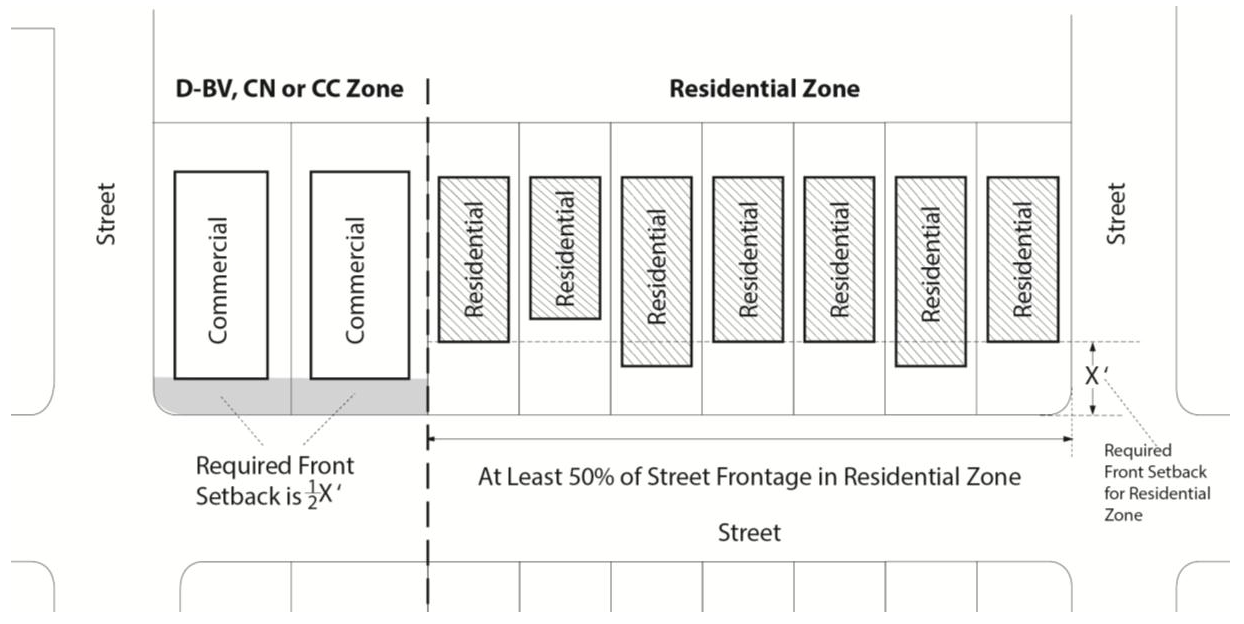
2. If fifty percent (50%) or more of the frontage on one side of the street between two intersecting streets is in any Residential Zone and all or part of the remaining frontage is in any Commercial or Industrial Zone, the required front setback of the commercially or industrially zoned lots is one-half of the minimum front setback required in the Residential Zone. If fifty percent (50%) or more of the total frontage is in more than one Residential Zone, then the minimum front setback on the commercially or industrially zoned lots is one-half (½) of that required in the Residential Zone with the lesser front setback (see Illustration for Table 17.101C.03 [Additional Regulation 2], below).
Illustration for Table 17.101C.03 [Additional Regulation 2]
*
for illustration purposes only
3. The minimum front yard required in the N Combining Zone is four (4) feet from Broadway if the rest of the block fronting Broadway is either vacant or has at least a four (4) foot front setback. Otherwise the front setback shall equal the setback of the existing building on the adjacent lot.
4. The following notes apply to the maximum front yard requirement:
a. The requirements only apply to the construction of new principal buildings.
b. The requirements do not apply to lots containing Recreational Assembly, Community Education, Utility and Vehicular, or Extensive Impact Civic Activities or Automobile and Other Light Vehicle Gas Station and Servicing Commercial Activities as principal activities.
c. Maximum yards apply to seventy-five percent (75%) of the street frontage on the principal street and fifty percent (50%) on other streets, if any. All percentages, however, may be reduced to fifty percent (50%) upon the granting of Regular Design Review approval (see Chapter 17.136 for the design review procedure). In addition to the Regular Design Review criteria contained in Section 17.136.035, the proposal to reduce to fifty percent (50%) must also meet each of the following additional criteria:
i. The additional yard area abutting the principal street is designed to accommodate publicly accessible plazas, cafes, or restaurants;
ii. The proposal will not impair a generally continuous wall of building facades;
iii. The proposal will not weaken the concentration and continuity of retail facilities at ground-level, and will not impair the retention or creation of an important shopping frontage; and
iv. The proposal will not interfere with the movement of people along an important pedestrian street.
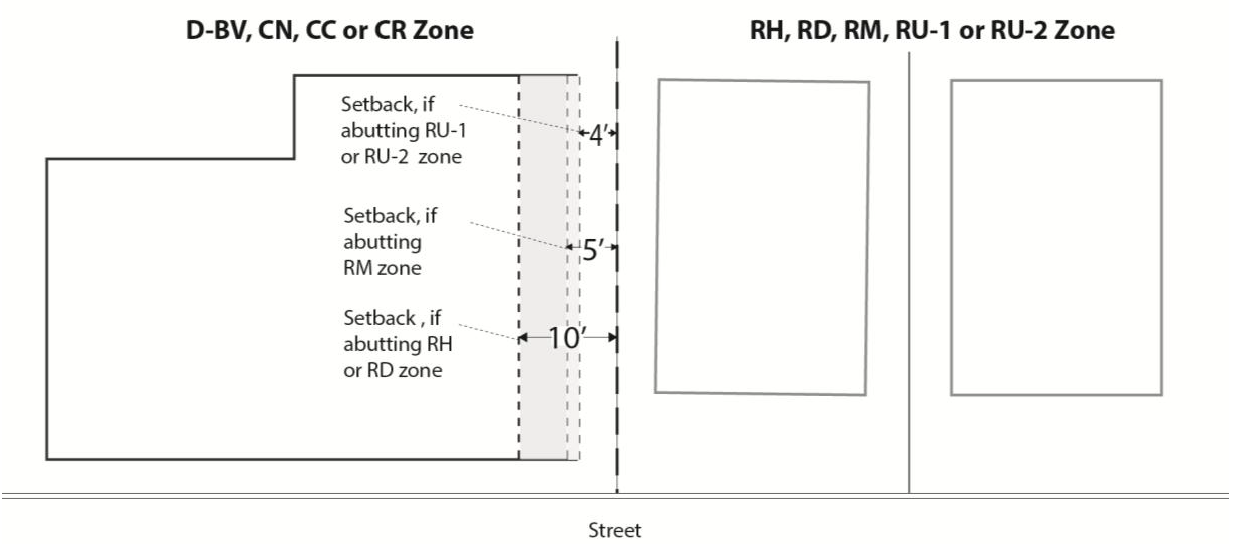
5. Wherever an interior side lot line abuts an interior side lot line of any lot located in an RH or RD Zone, a side setback of six (6) feet is required. In the case where an interior side lot line abuts an interior side lot line in an RM Zone, the setback of the abutting portion of its side lot line is five (5) feet. In the case where an interior side lot line abuts an interior side lot line of any lot located in an RU-1 or RU-2 Zone, a side setback of four (4) feet is required (see Illustration for Table 17.101C.03 [Additional Regulation 5], below). Also, see Section 17.108.130 for allowed projections into setbacks.
Illustration for Table 17.101C.03 [Additional Regulation 5]
*
for illustration purposes only
6. See Section 17.108.080 for the required interior side and rear yard, setbacks on a lot containing two (2) or more living units and opposite a legally required living room window.
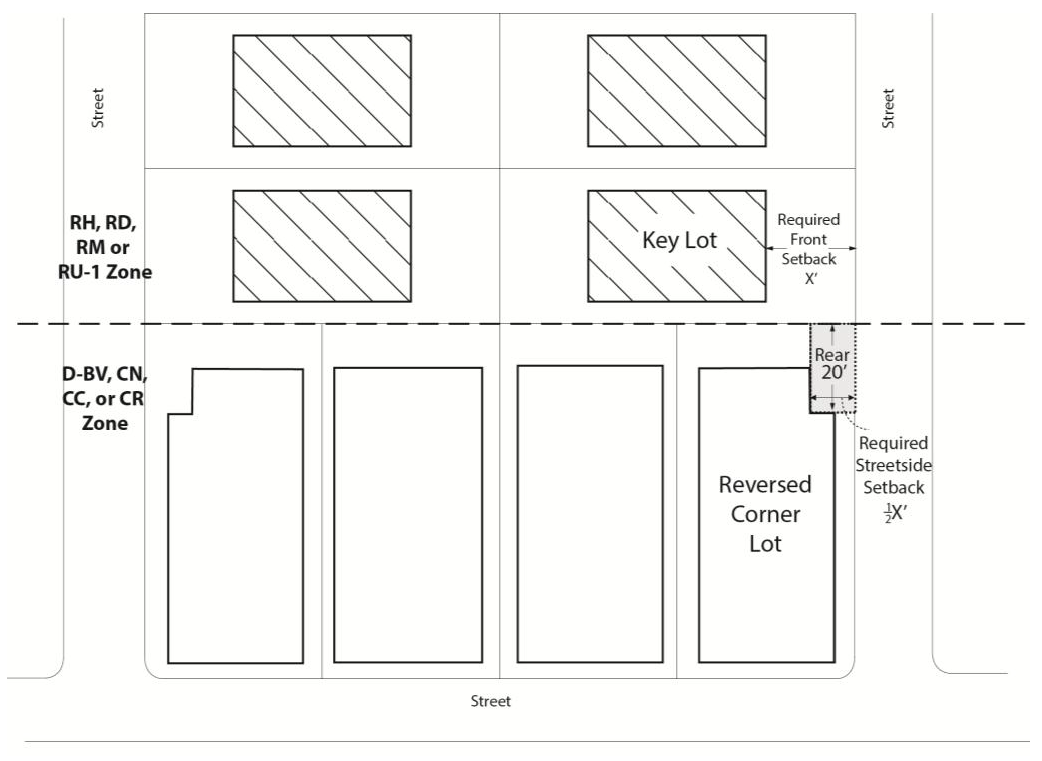
7. When the rear yard of a reversed corner lot abuts a key lot that is in an RH, RD, or RM Zone, the required street side yard setback in the rear ten (10) feet of the reversed corner lot is one-half (½) of the minimum front yard required on the key lot but shall not be required to exceed four (4) feet in width if it would reduce to less than twenty-five (25) feet the buildable width of any corner lot (see Illustration for Table 17.101C.03 [Additional Regulation 7], below). Also, see Section 17.108.130 for allowed projections into the setbacks.
Illustration for Table 17.101C.03 [Additional Regulation 7]
*
for illustration purposes only
8. Wherever a rear lot line abuts an alley, one-half (½) of the right-of-way width of the alley may be counted toward the required minimum rear setback; provided, however, that the portion of the minimum rear setback actually on the lot itself shall not be so reduced to less than ten (10) feet. Also, see Section 17.108.130 for allowed projections into setbacks.
9. When a rear lot line is adjacent to an RH, RD, or RM Zone, the required rear setback for both Residential and Nonresidential Facilities is ten (10) feet. When a rear lot line is not adjacent to an RH, RD, or RM Zone, the required rear setback is ten (10) feet for Residential Facilities and there is no required setback for Nonresidential Facilities.
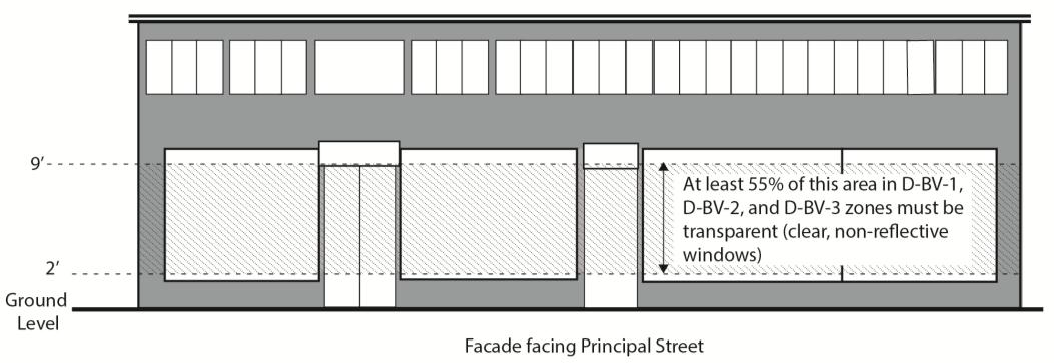
10. This percentage of transparency is only required for principal buildings that include ground-floor Nonresidential Facilities, and only applies to the facade facing the principal street. The regulations only apply to facades located within twenty (20) feet of a street frontage. The area of required transparency is between two (2) feet and nine (9) feet in height of the ground floor and must be comprised of clear, non-reflective windows that allow views out of indoor activity space or lobbies (see Illustration for Table 17.101C.03 [Additional Regulation 10], below). Areas required for garage doors shall not be included in the calculation of facade area (see Note 12 for limitations on the location of parking access). Glass block does not qualify as a transparent window. Exceptions to this regulation may be allowed by the Planning Director for unique facilities such as convention centers, gymnasiums, parks, gas stations, theaters, and other similar facilities.
Illustration for Table 17.101C.03 [Additional Regulation 10]
*
for illustration purposes only
11. This height is required for new principal buildings that include ground floor Nonresidential Facilities, and is measured from the sidewalk grade to the second story floor.
12. For the new construction of principal buildings in the D-BV-1, D-BV-2, D-BV-3 Zone, and N Combining Zone, access to parking and loading facilities through driveways, garage doors, or other means shall not be from the principal street when alternative access is available from another location such as a secondary frontage or an alley. Where this is not feasible, every reasonable effort shall be made to share means of vehicular access with abutting properties. Open parking areas shall not be located between the sidewalk and a principal building.
13. For the new construction of principal buildings in the D-BV-1, D-BV-2, D-BV-3 Zone, and N Combining Zone, ground level parking spaces, locker areas, mechanical rooms, and other non-active spaces shall not be located within thirty (30) feet of the front of the principal building, except for incidental entrances to such activities elsewhere in the building. Exceptions to this regulation may be permitted by the Planning Director for utilities and trash enclosures that cannot be feasibly placed in other locations of the building. Driveways, garage entrances, or other access to parking and loading facilities may be located on the ground floor of this area as regulated by Additional Regulation 12, above.
14. Vehicular Residential Facilities shall be located a minimum of thirty (30) feet from the street or be located behind a building. See Section 17.103.085 for additional setback and separation requirements for Vehicular Residential Facilities.
B.
Height, Floor Area Ratio (FAR), Density, and Open Space. Table 17.101C.04 below prescribes height, Floor Area Ratio (FAR), density, and open space standards associated with the Height Areas described in the Zoning Maps. The number designations in the "Additional Regulations" column refer to regulations below the table. "N/A" designates the regulation is not applicable to the specified Height Area.
15. For ground floor Medical Service and Animal Care Commercial Activities, this level of transparency shall apply to the street-fronting adjacent spaces, such as reception, lobby, and waiting areas. Medical treatment rooms shall not face the street.
Table 17.101C.04 Height, Floor Area Ratio (FAR), Density, and Open Space Regulations
* See Tables 17.101C.05 and 17.101C.06 for minimum retail square footage required and for potentially greater heights, stories, FAR, and residential bonus for mixed use, residential developments, or taller Non-residential Facilities in the Height Area 45* when part of a large project that involves major retail development.
Additional Regulations for Table 17.101C.04:
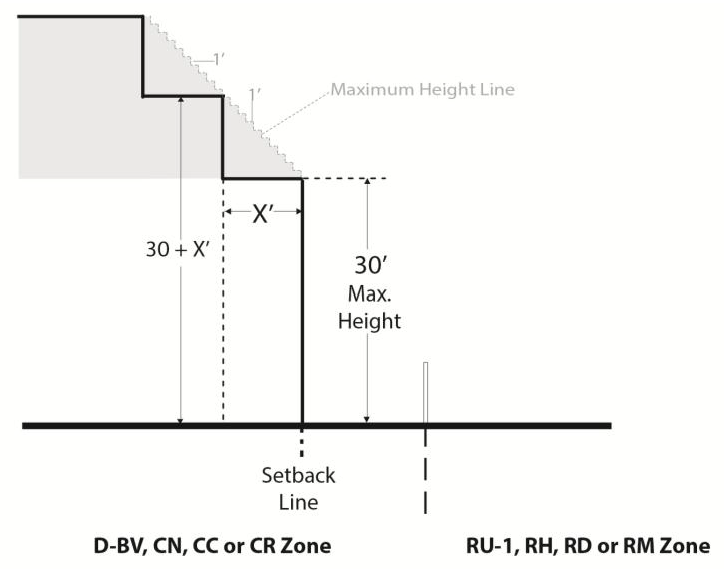
1. Buildings shall have a thirty (30) foot maximum height at the setback line associated with any rear or interior side lot line that abut a lot in an RH, RD, or RM Zone; if the principal building on the abutting lot has a height of thirty (30) feet or less, this maximum height shall increase one (1) foot for every foot of distance away from this setback line. If the principal building on the abutting lot has a height of greater than thirty (30) feet, the maximum height shall increase two (2) feet for every foot away from the applicable setback line (see Illustration for Table 17.101C.04 [Additional Regulation 1], below). Also, see Section 17.108.030 for allowed projections above height limits and Section 17.108.020 for increased height limits in certain situations.
Illustration for Table 17.101C.04 [Additional Regulation 1]
*
for illustration purposes only
2. See Tables 17.101C.05 and 17.101C.06 for minimum retail square footage required and for potentially greater heights, stories, FAR, and residential bonus for mixed use, residential developments, or taller Nonresidential Facilities in the Height Area 45* when part of a large project that involves major retail development. There are five (5) Retail Priority Sites that comprise Height Area 45*. Priority Sites 3 and 5 are further divided into subareas a, b, and c, and Priority Site 4 is divided into subareas a and b. Each Priority Site and subarea has a specified minimum square footage of retail required prior to Residential Activities and Facilities being permitted, as well as taller Nonresidential Facilities.
3. The numbers to the right of the slash (/) are only permitted upon the granting of a Conditional Use Permit (see Chapter 17.134 for the CUP procedure).
4. The allowed projections into the height limits contained in Section 17.108.030 are not counted towards the height minimum.
5. See Chapter 17.107 for affordable and senior housing incentives. See Section 17.103.080 and Chapter 17.88 for regulations regarding permitted Accessory Dwelling Units. Also applicable are the provisions of Section 17.102.270 with respect to additional kitchens for a primary dwelling unit, and the provisions of Section 17.102.300 with respect to dwelling units with five (5) or more bedrooms.
6. For mixed use projects the allowable intensity of development shall be measured according to both the maximum nonresidential Floor Area Ratio (FAR) allowed by the zone and the maximum residential density allowed by the zone. The total lot area shall be used as a basis for computing both the maximum nonresidential FAR and the maximum residential density.
7. The following apply to open space standards. These requirements shall supersede those in Chapter 17.126:
a. Areas occupied by vents or other structures which do not enhance usability of the space shall not be counted toward the listed dimension.
b. Openness. There shall be no obstructions above the space except for devices to enhance its usability, such as pergola or awning structures. There shall be no obstructions over ground-level private usable open space except that not more than fifty percent (50%) of the space may be covered by a private balcony projecting from a higher story. Above-ground-level private usable open space shall have at least one exterior side open and unobstructed, except for incidental railings or balustrades, for eight (8) feet above its floor level.
c. Usability. A surface shall be provided which prevents dust and allows convenient use for outdoor activities. Such surface shall be any practicable combination of lawn, garden, flagstone, wood planking, concrete, asphalt or other serviceable, dust free surfacing. Slope shall not exceed ten percent (10%). Off-street parking and loading areas, driveways, and service areas shall not be counted as usable open space. Adequate safety railings or other protective devices shall be erected whenever necessary for space on a roof, but shall not be more than the minimum height required by the Oakland Building Code.
d. Accessibility. Usable open space, other than private usable open space, shall be accessible to all the living units on the lot. It shall be served by any stairway or other accessway qualifying under the Oakland Building Code as an egress facility from a habitable room. Private usable open space may be located anywhere on the lot. Above-ground-level space may be counted even though it projects beyond a street line. All private usable open space shall be adjacent to, and not more than four (4) feet above or below the floor level of, the living unit served. Private usable open space shall be accessible to only one living unit by a doorway to a habitable room or hallway.
e. Landscaping requirements. At least ten percent (10%) of rooftop or courtyard usable open space area shall include landscaping enhancements. At least twenty percent (20%) of public ground-level plaza area shall include landscaping enhancements. Landscaping enhancements shall consist of permanent features, such as trees, shrubbery, decorative planting containers, fountains, boulders or artwork (sculptures, etc.) The remainder of the space shall include user amenities such as seating, decorative paving, or playground structures.
8. In-Lieu Fee: The open space requirements of this Section may be reduced or waived upon the granting of a Conditional Use Permit (see Chapter 17.134 for the CUP procedure) and payment of an in-lieu fee to the City of Oakland to be used to pay for new public open space/plaza(s) or existing public open space/plaza(s) improvements. The open space in-lieu fee shall be as set forth in the Master Fee Schedule. Open space in-lieu fees shall be deposited with the City of Oakland prior to issuance of a building permit. An open space in-lieu fee may be refunded, without interest, to the person who made such payment, or his assignee or designee, if additional open space is provided for such building so as to satisfy the open space requirement for which the in-lieu payment was made. To obtain a refund, the required open space must be in place prior to issuance of a certificate of occupancy and before funds are spent or committed by the City.
9. Notwithstanding anything to the contrary contained in the Planning Code, variances may not be granted relating to: (a) a reduction and/or elimination of any open space; or (b) a reduction and/or elimination of any open space serving any activity, or if already less than currently required open space, shall not be reduced further below the requirements prescribed for such activity in this Chapter, as the granting of a CUP (see Chapter 17.134 for the CUP procedure) and payment of the in-lieu fee shall be the sole means of reducing or eliminating open space, except as provisions in state and local law requiring regulatory concessions for certain types of affordable and senior housing projects may apply.
C.
Retail Priority Sites Minimum Square Footage of Retail Area for Residential Facilities Bonus. Table 17.101C.05 below prescribes the minimum square footage of retail area required for each Retail Priority Site before a Residential or Transient Habitation Activity or Facility, or taller Nonresidential or Mixed Use Facility is allowed. The number designations in the "Additional Regulations" column refer to regulations below the table.
Table 17.101C.05 Retail Priority Sites Minimum Square Footage of Retail Area for Residential Facilities Bonus
Additional Regulations for Table 17.101C.05:
1. See additional regulations in Table 17.101C.06: Retail Priority Sites: Height, Floor Area Ratio (FAR), Residential Bonus, and Open Space.
2. The following are regulations for retail square footage minimums:
a. The following contribute to the retail square footage minimums:
i. Retail floor area (see Limitation L12 in Table 17.101C.01 for all of the complementary activities that count as retail floor area);
ii. Internal pedestrian stairs, corridors, and circulation;
iii. Ground-floor public plaza/open space located on-site or adjacent off-site.
b. Utilization of existing buildings towards new retail floor area can count toward the retail square footage. In the case of a CEQA Historic Resource:
i. New retail square footage in a CEQA Historic Resource can count double towards the retail square footage required to obtain a residential bonus; or
ii. If a CEQA Historic Resource is maintained and not used for retail, the area of its footprint can be deducted from the overall square footage of the Retail Priority Site in determining the square footage of retail required.
c. Square footage of the following do not count towards the retail square footage minimum:
i. Loading dock;
ii. Parking;
iii. Driveways, ramps, and circulation for cars and trucks.
3. If a project is phased, the minimum retail portion must be built first or concurrently with any residential portion. Any additional residential bonus units that are dependent on additional retail square footage may also only be built after the retail project or concurrently. If determined by the Director of City Planning, an applicant may be required to submit a financial guarantee, in a form and manner acceptable to the City, that the retail space will be built as part of the conditions of approval of the project.
4. An applicant that provides a retail project that equals at least sixty percent (60%) of the square footage of the Retail Priority Site may transfer the development rights of residential bonus units and height from one retail priority site to a different lot within the same retail priority site or to a lot within a different retail priority site upon the granting of a Conditional Use Permit (CUP). A CUP to transfer development rights of residential bonus units may be granted only upon determination that the proposal conforms to the general use permit criteria contained in Section 17.134.050 and to each of the following additional criteria:
a. The applicant has acquired development rights from the owner(s) of lots within a Retail Priority Site Zone, restricting the number of residential units which may be developed thereon so long as the facilities proposed by the applicant are in existence;
b. The owners of all such lots shall prepare and execute an agreement, approved as to form and legality by the City Attorney and filed with the Alameda County Recorder, incorporating such restriction;
c. The proposed location and site planning of any transferred residential bonus units will not make infeasible future construction of the minimum retail square footage required at that Retail Priority Site;
d. Residential bonus units can only be transferred to a lot that cannot meet the minimum retail square footage required in that Retail Priority Site to build residential;
e. The site receiving the transferred residential units must include retail area on the ground floor pursuant to the requirements of the D-BV-1 Broadway Retail Priority Sites Zone; and
f. Retail floor area that existed prior to the effective date of this Chapter (July 31, 2014) cannot count towards the retail square footage needed for transfer of development rights for residential bonus units to other Retail Priority Sites.
5. For a bonus of residential units, the State Density Bonus can be applied by providing affordable housing units (see California Government Code, Section 65915-65918, as implemented by Chapter 17.101 of the Oakland Planning Code) or an applicant can utilize the following residential bonus within a Retail Priority Zone. However, these bonuses cannot be combined. The affordable units can be built on site or on another site within any D-BV Zone. The residential bonus shall not be included when determining the number of target units that must be affordable to the relevant income group. If fifteen percent (15%) of the total Dwelling Units of a Residential Housing Development are affordable, an additional residential bonus of thirty-five percent (35%) will be granted when an applicant for a Residential Housing Development seeks, and agrees to construct, at least any one of the following categories (which are defined in Section 17.107.020 (K), the following definitions in Section 17.107.020 (A)(B)(J)(M) also apply, and all of the provisions of Sections 17.107.110 - 17.107.114 must be met):
a. Lower Income Households; or
b. Very Low Income Households; or
c. A common interest development as defined in Section 1351 of the California Civil Code, for persons and families of Moderate Income, provided that all units in the development are offered to the public for purchase.
6. In the Retail Priority Areas, an exception to the minimum retail square footage required to receive the bonus right to residential units may be granted only upon determination that the proposal conforms to the general use permit criteria contained in Section 17.134.050, to any applicable use permit criteria set forth in Table 17.101C.01 Note L2, and to each of the following additional criteria:
a. The applicant submits an architectural study, prepared by a qualified architectural firm, that demonstrates at least one or more alternatives would be physically infeasible due to operational and/or site constraints if it were to meet the minimum retail square footage specified;
b. Strict compliance with the minimum retail square footage would preclude an effective design solution improving livability, operational efficiency, or appearance; and
c. The project will remain consistent with the Broadway Valdez District Specific Plan goals and policies related to retail development as well as its Design Guidelines.
D.
Retail Priority Sites: Height, Floor Area Ratio (FAR), Residential Bonus, and Open Space. Table 17.101C.06 below prescribes height, FAR, residential bonus, and open space, standards associated with the minimum retail area required in the Retail Priority Sites described in Table 17.101C.05 above. The number designations in the "Additional Regulations" column refer to regulations below the table. "N/A" designates the regulation is not applicable to the specified retail percentage category.
Table 17.101C.06: Retail Priority Sites: Height, Floor Area Ratio (FAR), Residential Bonus, and Open Space
Additional Regulations for Table 17.101C.06:
1. An applicant that provides a retail project that equals at least sixty percent (60%) of the square footage of the Retail Priority Site shall also be granted: (a) a maximum height of two hundred (200) feet and an FAR of 8.0; or (b) a maximum height of two hundred fifty (250) feet and a FAR of 10.0 for no more than: (i) one building within 100 feet of 23 rd Street and/or within the vacant portion of the block bounded by 23 rd Street, Valdez Street, 24 th Street, and Waverly Street; and (ii) one building within the block bounded by 23 rd Street, Waverly Street, 24 th Street, and Harrison Street.
2. See additional regulations in Table 17.101C.05 numbers 2-6.
3. See Chapter 17.107 for affordable and senior housing incentives. See Section 17.103.080 and Chapter 17.88 for regulations regarding permitted Accessory Dwelling Units. Also applicable are the provisions of Section 17.102.270 with respect to additional kitchens for a primary dwelling unit, and the provisions of Section 17.102.300 with respect to dwelling units with five (5) or more bedrooms.
4. The overall number of residential units cannot exceed the General Plan density allowance of eighty-seven (87) square feet of lot area per principal unit.
5. The following apply to open space standards:
a. Areas occupied by vents or other structures which do not enhance usability of the space shall not be counted toward the listed dimension.
b. Openness. There shall be no obstructions above the space except for devices to enhance its usability, such as pergola or awning structures. There shall be no obstructions over ground-level private usable open space except that not more than fifty percent (50%) of the space may be covered by a private balcony projecting from a higher story. Above-ground-level private usable open space shall have at least one exterior side open and unobstructed, except for incidental railings or balustrades, for eight (8) feet above its floor level.
c. Usability. A surface shall be provided which prevents dust and allows convenient use for outdoor activities. Such surface shall be any practicable combination of lawn, garden, flagstone, wood planking, concrete, asphalt or other serviceable, dust free surfacing. Slope shall not exceed ten percent (10%). Off-street parking and loading areas, driveways, and service areas shall not be counted as usable open space. Adequate safety railings or other protective devices shall be erected whenever necessary for space on a roof, but shall not be more than four (4) feet high.
d. Accessibility. Usable open space, other than private usable open space, shall be accessible to all the living units on the lot. It shall be served by any stairway or other accessway qualifying under the Oakland Building Code as an egress facility from a habitable room. Private usable open space may be located anywhere on the lot except that ground-level space shall not be located in a required minimum front yard and except that above-ground-level space shall not be located within five (5) feet of an interior side lot line. Above-ground-level space may be counted even though it projects beyond a street line. All private usable open space shall be adjacent to, and not more than four (4) feet above or below the floor level of, the living unit served. Private usable open space shall be accessible to only one living unit by a doorway to a habitable room or hallway.
e. Landscaping requirements. At least ten percent (10%) of rooftop or courtyard usable open space area shall include landscaping enhancements. At least twenty percent (20%) of public ground-level plaza area shall include landscaping enhancements. Landscaping enhancements shall consist of permanent features, such as trees, shrubbery, decorative planting containers, fountains, boulders or artwork (sculptures, etc.). The remainder of the space shall include user amenities such as seating, decorative paving, or playground structures.
6. In-Lieu Fee: The open space requirements of this Section may be reduced or waived upon the granting of a Conditional Use Permit (see Chapter 17.134 for the CUP procedure) and payment of an in-lieu fee to the City of Oakland. The open space in-lieu fee shall be as set forth in the Master Fee Schedule. Open space in-lieu fees shall be deposited with the City of Oakland prior to issuance of a building permit. An open space in-lieu fee may be refunded, without interest, to the person who made such payment, or his assignee or designee, if additional open space is provided for such building so as to satisfy the open space requirement for which the in-lieu payment was made. To obtain a refund, the required open space must be in place prior to issuance of a certificate of occupancy and before funds are spent or committed by the City.
7. Notwithstanding anything to the contrary contained in the Planning Code, variances may not be granted relating to (a) a reduction and/or elimination of any open space; or (b) a reduction and/or elimination of any open space serving any activity, or if already less than currently required open space, shall not be reduced further below the requirements prescribed for such activity in this Chapter, as the granting of a CUP (see Chapter 17.134 for the CUP procedure) and payment of the in-lieu fee shall be the sole means of reducing or eliminating open space, except as provisions in state and local law requiring regulatory concessions for certain types of affordable and senior housing projects may apply.
(Ord. No. 13840, § 2(Exh. A), 5-6-2025; Ord. No. 13779, § 2(Exh. A), 1-16-2024; Ord. No. 13763, § 5, 10-3-2023; Ord. No. 13677, § 4(Exh. A), 1-18-2022; Ord. No. 13666, § 3(Exh. A), 11-16-2021; Ord. No. 13393, § 2(Exh. A), 10-4-2016; Ord. No. 13357, § 3(Exh. A), 2-16-2016; Ord. No. 13241, § 5(Exh. C), 7-1-2014)
17.101C.055 - Micro Living Quarters.
A.
Definition. For the purposes of the D-BV Zone Chapter only, the following definition is added as a facility type. Definitions for other facility types are contained in the Oakland Planning Code Chapter 17.10.
1.
"Micro Living Quarters" mean one or more rooms located in a multiple-tenant building having an average net floor area of one hundred seventy-five (175) square feet, but a minimum size of one hundred fifty (150) square feet of net floor area, and occupied by a permanent residential activity. Bathroom facilities, which include toilet and sink, as well as shower and/or bathtub, are required to be located within each individual Micro Living Quarter. Cooking facilities are not allowed to be located within each individual Micro Living Quarter, and shared kitchen facilities are required within close proximity on the same building floor. The maximum number of Micro Living Quarters within a building shall not be regulated by residential density limits in the corresponding zone, but instead shall be established through the application of the Micro Living Quarters required average size (one hundred seventy-five (175) square feet); the Floor Area Ratio (FAR) limits specified in the corresponding zone; all other applicable development regulations establishing the buildable envelope in the corresponding zone including, but not limited to, maximum height and minimum setbacks; and the requirements of the Building and Fire Codes.
B.
Requirements. The following are requirements for Micro Living Quarters.
1.
The number of off-street parking spaces, bicycle parking, and amount of open space required for Micro Living Quarters shall be based on the requirements for a Rooming House Residential Facility type in the corresponding zone.
2.
Micro Living Quarters shall only be allowed as part of an application for new construction of a multi-tenant building, or alteration of an existing Potentially Designated Historic Property (PDHP) or property listed in the City of Oakland's Local Register of Historical Resources as defined in Policy 3.8 of Oakland's General Plan Historic Preservation Element that is a Nonresidential Facility or Multifamily Dwelling Residential Facility.
3.
Shared recreational area, with seating or other similar amenities, shall be required in the interior of the Micro Living Quarter building equaling a minimum of five (5) square feet per individual Micro Living Quarter or two hundred fifty (250) square feet whichever is greater. A shared kitchen may be open to a shared recreation area if it is adjacent to and directly accessible from such shared kitchen facilities. Kitchen counters, cabinets, sinks, and appliances, and the floor area that encompasses an assemblage of these items, shall not be included in the calculation of minimum required shared recreational area. Shared laundry facilities or other similar utilitarian spaces shall also not be included in the calculation of minimum required shared recreational area. The minimum width in this shared recreational area shall be twelve (12) feet. The interior shared recreational area shall be accessible to all tenants of the Micro Living Quarter building.
4.
All common areas, including but not limited to shared kitchens, interior recreational area, and outdoor open space, shall be maintained by the building management.
5.
Demolition of a property listed in the City of Oakland's Local Register of Historical Resources as defined in Policy 3.8 of Oakland's General Plan Historic Preservation Element is not allowed in order to build Micro Living Quarters.
6.
Use Permit Criteria. A Conditional Use Permit for Micro Living Quarters may only be granted upon determination that the proposal conforms to the general use permit criteria set forth in the Conditional Use Permit procedure in Chapter 17.134, and to each of the following additional use permit criteria:
a.
The proposal will not detract from the character desired for the area;
b.
The proposal will not impair a generally continuous wall of building facades;
c.
The proposal will not weaken the concentration and continuity of retail facilities at ground level, and will not impair the retention or creation of an important shopping frontage;
d.
The proposal will not interfere with the movement of people along an important pedestrian street; and
e.
The proposal will conform in all significant respects with the Broadway Valdez District Specific Plan.
(Ord. No. 13357, § 3(Exh. A), 2-16-2016; Ord. No. 13241, § 5(Exh. C), 7-1-2014)
17.101C.060 - Special regulations for Planned Unit Developments.
A.
Planned Unit Developments. Large integrated developments shall be subject to the Planned Unit Development (PUD) regulations in Chapter 17.142 if they exceed the sizes specified therein. In developments which are approved pursuant to said regulations, certain uses may be permitted in addition to those otherwise allowed in the D-BV Zones, and certain of the other regulations applying in said zone may be waived or modified. The normally required design review process may also be waived for developments at the time of initial granting of a Planned Unit Development (PUD) permit. Unless otherwise specified in the PUD permit, any future changes within the Planned Unit Development shall be subject to applicable design review regulations.
(Ord. No. 13763, § 5, 10-3-2023; Ord. No. 13677, § 4(Exh. A), 1-18-2022; Ord. No. 13357, § 3(Exh. A), 2-16-2016; Ord. No. 13241, § 5(Exh. C), 7-1-2014)
Editor's note— Ord. No. 13677, § 4(Exh. A), adopted Jan. 18, 2022, amended the title of § 17.101C.060 to read as herein set out. The former § 17.101C.060 title pertained to special regulations for Mini-Lot and Planned Unit Developments.
17.101C.070 - Other zoning provisions.
A.
Home Occupations. Home occupations shall be subject to the applicable provisions of the home occupation regulations in Chapter 17.112
B.
Nonconforming Uses. Nonconforming uses and changes therein shall be subject to the nonconforming use regulations in Chapter 17.114
C.
General Provisions. The general exceptions and other regulations set forth in Chapters 17.102, 17.104, 17.106, and 17.108 shall apply in the D-BV Zones.
D.
Recycling Space Allocation Requirements. The regulations set forth in Chapter 17.118 shall apply in the D-BV Zones.
E.
Landscaping and Screening Standards. The regulations set forth in Chapter 17.124 shall apply in the D-BV Zones.
F.
Buffering. All uses shall be subject to the applicable requirements of the buffering regulations in Chapter 17.110 with respect to screening or location of parking, loading, storage areas, control of artificial illumination, and other matters specified therein.
(Ord. No. 13357, § 3(Exh. A), 2-16-2016; Ord. No. 13241, § 5(Exh. C), 7-1-2014)

