
Oakland City Zoning Code
CHAPTER 17
101H - D-CO COLISEUM AREA DISTRICT ZONES REGULATIONS
17.101H.010 - Title, intent, and description.
A.
Title and Intent. The provisions of this Chapter shall be known as the D-CO Coliseum Area District Zones Regulations. The intent of the Coliseum Area District (D-CO) Zones is to:
1.
Implement the Coliseum Area Specific Plan (CASP) in the Coliseum Plan Area,
2.
Support retention of Oakland's professional sports teams, and the economic benefit of the sports teams and their facilities for the City of Oakland and Alameda County;
3
Allow for the consider of residential, commercial, and mixed-use developments at high densities in designated locations in the Coliseum Plan Area;
4.
Encourage the creation of a regionally significant jobs and employment center in the Coliseum Plan Area that builds on the area's prime transit-oriented and airport-adjacent location;
5.
Establish development standards that allow a broad mix of uses to compatibly co-exist;
6.
Provide convenient access to public open space and the waterfront;
7.
Improve access to the Coliseum Plan area's creeks, channels, and bay frontage, and provide recreational opportunities along these waterways;
8.
Encourage quality and variety in building and landscape design, as well as compatibility in use and form; and
9.
Encourage development that is respectful of the environmental qualities that the Coliseum Plan area has to offer.
B.
Description of Zones. This Chapter establishes land use regulations for the following six (6) zones:
1.
D-CO-1 Coliseum Area Transit-Oriented Development District - 1 Commercial Zone (Coliseum BART/San Leandro Street). The D-CO-1 Zone is intended to create, preserve and enhance areas devoted primarily to serve multiple nodes of transportation and to feature high-density residential, commercial, and mixed-use developments, to encourage a balance of pedestrian-oriented activities, transit opportunities, and concentrated development; and encourage a safe and pleasant pedestrian environment near transit stations by allowing a mixture of Residential, Civic, Commercial, and Light Industrial Activities.
2.
D-CO-2 Coliseum Area District - 2 Commercial Zone (Coliseum District). The D-CO-2 Zone is intended to create, maintain and enhance areas that allow a broad mixture of residential, retail, commercial, office, and light industrial uses, and serve as region-drawing centers of sports, entertainment, and business activities.
3.
D-CO-3 Coliseum Area District - 3 Commercial Zone (Oakport South/Hegenberger Road). The D-CO-3 Zone is intended to create, maintain and enhance areas suitable for a wide variety of retail, commercial, and industrial operations along the Oakport Street and Hegenberger Road corridors, and in region-drawing centers of Commercial, and Light Industrial Activities.
4.
D-CO-4 Coliseum Area District - 4 Commercial Zone (Edgewater North/Waterfront). The D-CO-4 Zone is intended to create, maintain and enhance a mix of activities on or near the Northwest Edgewater Drive waterfront. This zone allows for the consideration of housing, if shown to be compatible in an area with a strong presence of Commercial and Industrial Activities.
5.
D-CO-5 Coliseum Area Commercial Mix District - 5 Industrial Zone (Edgewater South/Pardee Drive). The D-CO-5 Zone is intended to create, preserve, and enhance areas near Pardee Drive and within the southern portion of the Airport Business Park that are appropriate for a wide variety of Office, Commercial, Industrial, and Logistics Activities.
6.
D-CO-6 Coliseum Area Commercial Mix District - 6 Industrial Zone (Oakport North). The D-CO-6 Zone is intended to apply to commercial, industrial and institutional areas with strong locational advantages that make possible the attraction of higher intensity commercial and light industrial land uses and development types.
(Ord. No. 13393, § 2(Exh. A), 10-4-2016; Ord. No. 13357, § 3(Exh. A), 2-16-2016; Ord. No. 13302, § 5(Exh. B), 4-21-2015)
17.101H.020 - Required design review.
A.
Except for projects that are exempt from design review as set forth in Section 17.136.025, no Building Facility, Designated Historic Property, Potentially Designated Historic Property, Telecommunications Facility, Sign, or other associated structure shall be constructed, established, or altered in exterior appearance, unless plans for the proposal have been approved pursuant to the design review procedure in Chapter 17.136, and when applicable, the Telecommunications regulations in Chapter 17.128, or the Sign regulations in Chapter 17.104. Properties located within the Land Use Jurisdiction of the Port of Oakland, as amended, are subject to the Port's Land Use and Development Code, which supersedes the Oakland Planning Code in areas of the Port's jurisdiction.
B.
In addition to the design review criteria listed in Chapter 17.136, conformance with the design review guidelines in the Coliseum Area Specific Plan is required for any proposal in the D-CO Zones subject to the design review procedure in Chapter 17.136.
C.
Where there is a conflict between the design review criteria contained in Chapter 17.136 and the design review guidelines contained in the Coliseum Area Specific Plan, the design objectives in the Coliseum Area Specific Plan shall prevail.
(Ord. No. 13357, § 3(Exh. A), 2-16-2016; Ord. No. 13302, § 5(Exh. B), 4-21-2015)
17.101H.030 - Permitted and conditionally permitted activities.
Table 17.101H.01 lists the permitted, conditionally permitted, and prohibited activities in the D-CO zones. The descriptions of these activities are contained in Chapter 17.10. Section 17.10.040 contains permitted accessory activities.
"P" designates permitted activities in the corresponding zone.
"C" designates activities that are permitted only upon the granting of a Conditional Use permit (CUP) in the corresponding zone (see Chapter 17.134 for the CUP procedure).
"L" designates activities subject to certain limitations or notes listed at the bottom of the table.
"—" designates activities that are prohibited except as accessory activities according to the regulations contained in Section 17.10.040.
Table 17.101H.01: Permitted and Conditionally Permitted Activities
Limitations on Table 17.101H.01:
L1. See Section 17.103.010 for other regulations regarding Residential Care Residential Activities, and Sections 17.103.010 and 17.103.015 for other regulations regarding Emergency Shelter Residential Activities. Notwithstanding anything to the contrary contained in the Planning Code, Emergency Shelter Residential Activities are permitted by-right on properties owned by churches, temples, synagogues, and other similar places of worship approved for Community Assembly Civic Activities); permitted upon the granting of a Conditional Use Permit elsewhere in the zone subject to the standards in Section 17.103.010.
L2. The total floor area devoted to these activities by any single establishment shall only exceed fifteen thousand (15,000) square feet upon the granting of a Conditional Use Permit (see Chapter 17.134 for the CUP procedure), and Section 17.103.065 for special findings and additional requirements for Truck-Intensive Industrial Activities in the M-40, CIX, IG, IO, D-DT-JLI, D-CE-5, D-CE-6, D-CO-5, and D-CO-6 Zones).
L3. The total floor area devoted to these activities by any single establishment shall only exceed twenty-five thousand (25,000) square feet upon the granting of a Conditional Use Permit (see Chapter 17.134 for the CUP procedure), and Section 17.103.065 for special findings and additional requirements for Truck-Intensive Industrial Activities in the M-40, CIX, IG, IO, D-DT-JLI, D-CE-5, D-CE-6, D-CO-5, and D-CO-6 Zones).
L4. This activity is only permitted upon determination that the proposal conforms to the general use permit criteria set forth in the Conditional Use Permit procedure in Chapter 17.134, and to all of the following additional use permit criteria:
1. That the project is designed in a way that minimizes the potential health impacts of locating a residential use near the surrounding activities;
2. That new development will meet residential environmental safety standards;
3. That the design of the development and site accounts for the projected rise in sea levels and the potential for inundation by the Bay and other flood waters in a manner that protects both human infrastructure as well as the natural aquatic resources of San Leandro Bay;
4. That avigation easements for the Oakland International Airport will be negotiated with future owners or tenants, and deed disclosures about proximity to Airport operations will be made; and
5. That measures that minimize adverse impacts to the surrounding activities have been incorporated into the project.
L5. The Extensive Impact Civic Activity category includes, but is not limited to, stadiums and sports arenas (see Section 17.10.240.Q). In the D-CO-3 Zone, stadiums and sports arenas are only allowed in the area between Damon Slough and Elmhurst Creek.
L6. Conditionally permitted if located in the D-CO-3 or D-CO-4 Zones between Damon Slough and Elmhurst Creek; prohibited if located elsewhere in the D-CO-3 or D-CO-4 Zones (see Chapter 17.134 for the CUP procedure).
L7. In the D-CO-5 Zone, these activities are only allowed in the area between San Leandro Creek and Doolittle Drive. See also Section 17.103.065 for special findings and additional requirements for Truck-Intensive Industrial Activities in the M-40, CIX, IG, IO, D-DT-JLI, D-CE-5, D-CE-6, D-CO-5, and D-CO-6 Zones.
L8. See Section 17.102.170 for special regulations relating to massage services and Section 17.102.450 for special regulations related to Laundromats.
L9. Not including accessory activities, this activity shall take place entirely within an enclosed building. Other outdoor activities shall only be permitted upon the granting of a conditional use permit (see Chapter 17.134 for the CUP procedure).
L10. Permitted if located within one thousand (1,000) feet of Highway 880 or Hegenberger Road; conditionally permitted if located elsewhere throughout the zone (see Chapter 17.134 for the CUP procedure).
L11. Except for such uses that are accessory to an approved Automobile and Other Light Vehicle Sales and Rental Commercial Activity, these activities are not permitted within three hundred (300) feet of a lot line adjacent to the Hegenberger Road right-of-way. See also Section 17.103.065 for special findings and additional requirements for Truck-Intensive Industrial Activities in the M-40, CIX, IG, IO, D-DT-JLI, D-CE-5, D-CE-6, D-CO-5, and D-CO-6 Zones.
L12. This activity is only permitted upon the granting of a Conditional Use Permit (see Chapter 17.134 for the CUP procedure) and that all repair and servicing is performed in an enclosed building.
L13. Any Outdoor Storage activities to be located within six hundred (600) feet of: a) the Oakport Street right-of-way; b) the Estuary or Bay shoreline; c) the Damon Slough, Elmhurst Creek, East Creek Slough, or San Leandro Creek top of bank; or d) any Open Space Zone shall only be permitted upon determination that the proposal conforms to the general use permit criteria set forth in the Conditional Use Permit procedure in Chapter 17.134, and to all of the following additional use permit criteria:
a. The activity is screened in a manner as determined by the Planning Director, including but not limited to, buffer planting installed along the site exterior; and
b. The proposal will not adversely affect the livability or appropriate development of abutting properties and the surrounding district in terms of noise, water and pollutant runoff, heavy equipment operation, hours of operation, odor, security, and vehicular traffic.
L14. No new or expanded Adult Entertainment Activity shall be located closer than one thousand (1,000) feet to the boundary of any Residential Zone or three hundred (300) feet from any other Adult Entertainment Activity. See Section 17.102.160 for further regulations regarding Adult Entertainment Activities.
L15. Existing automotive fee parking lots within three hundred (300) feet of a lot line adjacent to the Hegenberger Road right-of-way may be reconfigured to increase the number of parking spaces and make more efficient use of the existing parking area. Expansion of existing facilities to include structured parking or expanding the size of the parcel with the parking constitutes an expansion of a nonconforming use and is not permitted.
L16. Limited Agriculture is permitted outright if the activity occupies less than ten thousand (10,000) square feet of land area and any sales area is less than one thousand (1,000) square feet; conditionally permitted if the activity is larger in either land or sales area (see Chapter 17.134 for the CUP procedure).
L17. Extensive Agriculture is only permitted upon the granting of a Conditional Use Permit (see Chapter 17.134 for the CUP procedure). In addition to the criteria contained in Section 17.134.050, this activity must meet the following use permit criteria:
a. The proposal will not adversely affect the livability or appropriate development of abutting properties and the surrounding neighborhood in terms of noise, water and pesticide runoff, farming equipment operation, hours of operation, odor, security, and vehicular traffic.
L18. Conditionally permitted if located between Damon Slough and San Leandro Street; prohibited if located elsewhere in the D-CO-1 Zone (see Chapter 17.134 for the CUP procedure). Not including accessory activities, this activity shall take place entirely within an enclosed building. Where conditionally permitted, this activity shall only be allowed upon determination that the proposal conforms to the general use permit criteria set forth in the Conditional Use Permit procedure in Chapter 17.134, and to all of the following additional use permit criteria:
1. The activity is screened in a manner as determined by the Planning Director, including, but not limited to, buffer planting along the side exterior; and
2. The proposal will not adversely affect the livability or appropriate development of abutting properties and the surrounding district in terms of noise, pollutant runoff, heavy equipment operation, hours of operation, odor, security, and the operation of trucks, and other heavy vehicles that have a gross vehicle weight rating greater than or equal to fourteen thousand (14,000) pounds.
L19. This activity is only permitted upon granting of a Conditional Use Permit (see Chapter 17.134 for the CUP procedure) when: a) proposing this activity in a primary or accessory Open Nonresidential Facility; or b) the total floor area devoted to this activity exceeds fifteen thousand (15,000) square feet.
L20. Any proposed Group Assembly activity that does not require a CUP but proposes to use amplified sound shall submit an Operational Noise Plan prepared by a qualified acoustical consultant for City review and approval that contains a set of site-specific noise attenuation measures to reduce operational noise to be consistent with Chapter 17.120 of the Planning Code.
L21. Automotive Fee Parking is permitted in the D-CO-2, D-CO-3, and D-CO-4 Commercial Zones in areas outside of those excluded in Limitations 11 and 15, provided the Facility meets the requirements in Section 17.103.055.
L22. If located within six hundred (600) feet of a Residential Zone boundary, any storage or use of hazardous materials or waste, as defined in the O.M.C. Section 8.42.060, shall be reviewed and approved by the Fire Department prior to commencement of operation or any alteration of activity. A risk management plan may also be required, per the Certified Program Uniform Assistance (CUPA) Ordinance (O.M.C. Chapter 8.42).
L23. A Conditional Use Permit is required if located within six hundred (600) feet of Residential Zone boundary or one-half (½) mile of a BART Station (see Chapter 17.134 for the CUP procedure, and Section 17.103.065 for special findings and additional requirements for Truck Intensive Industrial Activities in the M-40, CIX, IG, IO, D-CE-5, D-CE-6, D-CO-5, and D-CO-6 Zones). Permitted if located beyond six hundred (600) feet of a Residential Zone or one-half (½) mile of a BART Station.
L24. Notwithstanding anything to the contrary contained in the Planning Code, Satellite Recycling Collection Centers less than five hundred (500) square feet in area located in or associated with approved supermarkets and shopping centers that are established pursuant to requirements of the California Beverage Container Recycling and Litter Reduction Act of 1986, to collect beverage containers made from materials such as aluminum, glass, plastic, and bimetal for recycling are permitted by right as an accessory activity (see Accessory Activities, Section 17.10.040.P).
(Ord. No. 13868, § 2(Exh. A), 12-16-2026; Ord. No. 13812, § 4(Exh. A), 7-30-2024; Ord. No. 13763, § 5, 10-3-2023; Ord. No. 13393, § 2(Exh. A), 10-4-2016; Ord. No. 13357, § 3(Exh. A), 2-16-2016; Ord. No. 13302, § 5(Exh. B), 4-21-2015)
17.101H.040 - Permitted and conditionally permitted facilities.
Table 17.101H.02 lists the permitted, conditionally permitted, and prohibited facilities in the D-CO Zones. The descriptions of these facilities are contained in Chapter 17.10.
"P" designates permitted facilities in the corresponding zone.
"C" designates facilities that are permitted only upon the granting of a Conditional Use Permit (CUP) in the corresponding-zone (see Chapter 17.134 for the CUP procedure).
"L" designates facilities subject to certain limitations listed at the bottom of the Table.
"—" designates facilities that are prohibited.
Table 17.101H.02: Permitted and Conditionally Permitted Facilities
Limitations on Table 17.101H.02:
L1. No Conditional Use Permit (CUP) is required for Open Nonresidential Facilities to accommodate Civic Activities, Limited Agriculture, seasonal sales, or special events.
L2. No new or expanded Fast-Food Restaurants with Drive-Through Nonresidential Facilities shall be located closer than three hundred (300) feet of a lot line adjacent to the Hegenberger Road or Oakport Street right-of-way; or five hundred (500) feet of an elementary school, park, or playground. See Sections 17.103.030 and 17.103.100 for further regulations regarding Drive-Through Nonresidential Facilities.
L3. See Section 17.128.025 for restrictions on Telecommunication Facilities near Residential Zones.
L4. See Chapter 17.114, Nonconforming Uses, for additions and alterations to legal nonconforming Residential Facilities, provided, however, that Accessory Dwelling Units are permitted when there is an existing applicable Residential Facility on a lot, subject to the provisions of Section 17.103.080 and Chapter 17.88.
L5. See Section 17.103.080 and Chapter 17.88 for regulations regarding permitted Accessory Dwelling Units Dwellings.
L6. General Advertising signs are not permitted except 1) as otherwise provided for in Section 17.104.060, and 2) for those facilities approved pursuant to the design review procedure in Chapter 17.136 associated with naming rights and/or sponsorships related to stadiums and performance venues.
(Ord. No. 13800, § 3(Exh. C), 6-18-2024; Ord. No. 13763, § 5, 10-3-2023; Ord. No. 13677, § 4(Exh. A), 1-18-2022; Ord. No. 13666, § 3(Exh. A), 11-16-2021; Ord. No. 13357, § 3(Exh. A), 2-16-2016; Ord. No. 13302, § 5(Exh. B), 4-21-2015)
17.101H.050 - Property development standards.
Zone Specific Standards Table 17.101H.03 below prescribes development standards specific to individual zones. The number designations in the "Additional Regulations" column refer to the regulations listed at the end of the Table. "N/A" designates the regulation is not applicable to the specified zone.
Table 17.101H.03 Property Development Standards
Additional Regulations for Table 17.101H.03:
1. See Sections 17.106.010 and 17.106.020 for exceptions to lot area, lot width mean, and street frontage regulations.
2. In the D-CO-3, D-CO-5 and D-CO-6 Zones, a minimum front yard setback area of ten (10) feet shall apply to frontages adjacent to the Hegenberger Road and Oakport Street right-of-way. This minimum front yard shall be developed as open landscaped areas, including but not limited to lawn, ground cover, shrubs, trees, and decorative paving materials, subject to the standards for required landscaping and screening in Chapter 17.124. In the D-CO-1, D-CO-2, and D-CO-4 Zones, see Section 17.108.080 for the required interior side and rear yard setbacks on a lot containing two (2) or more living units and opposite a legally required living room window.
3. In the D-CO-1, D-CO-2, and D-CO-4 Zones, wherever a rear lot line abuts an alley, one-half (½) of the right-of-way width of the alley may be counted toward the required minimum rear setback; provided, however, that the portion of the minimum rear setback actually on the lot itself shall not be so reduced to less than ten (10) feet. Also, see Section 17.108.130 for allowed projections into setbacks.
4. The height of all structures shall be subject to Federal Aviation Administration (FAA) regulations. Notwithstanding anything to the contrary contained in the Planning Code, buildings and structures in the D-CO zoned areas between Doolittle Drive, Swan Way, Pardee Drive, and Hegenberger Road shall not exceed a maximum height of one hundred (100) feet above mean sea level and the maximum applicable Federal Aviation Regulations (FAR) Part 77 surfaces height of the Oakland International Airport Land Use Compatibility Plan.
5. Exceptions to Height Standards. In the D-CO Zones, buildings and structures may only be allowed to exceed the height of the maximum applicable Federal Aviation Regulations (FAR) Part 77 surfaces of the Oakland International Airport Land Use Compatibility Plan in the following situation:
a) The proposed structure has been reviewed by the FAA in accordance with FAR Part 77 and the City receives:
i) An FAA finding that the structure is "No Hazard To Air Navigation" and would not result in the FAA altering, curtailing, limiting, or restricting flight operations in any manner; and an Alameda County Airport Land Use Commission (ALUC) determination that the proposed structure is consistent with the Oakland International Airport Land Use Compatibility Plan (ALUCP); and
ii) Agreement from the applicant to mark and light that structure in a manner consistent with FAA standards; and
b) The additional height has received approval pursuant to the City's Conditional Use Permit procedure (see Chapter 17.134).
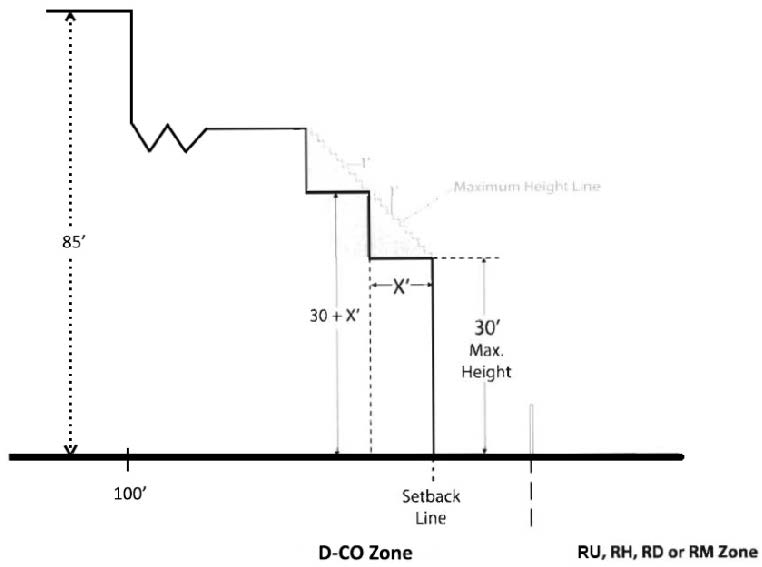
6. Buildings shall have a ninety-five (95) foot maximum height when located within one hundred (100 feet) of any lot line that abuts a lot in a RH, RD, RM, RU, or S-15 Zone. In addition, buildings shall have a thirty (30) foot maximum height at the setback line associated with any rear or interior side lot line that abuts a lot in a RH, RD, RM, or RU Zone; if the principal building on the abutting lot has a height of thirty (30) feet or less, this maximum height shall increase one (1) foot for every foot of distance away from this setback line. If the principal building on the abutting lot has a height of greater than thirty (30) feet, the maximum height shall increase two (2) feet for every foot away from the applicable setback line (see Illustration for Table 17.101H.03 [Additional Regulation 6], below). Also, see Section 17.108.030 for allowed projections above height limits and Section 17.108.020 for increased height limits in certain situations.
Illustration for Table 17.101H.03 [Additional Regulation 6]
*
for illustration purposes only
7. All projects which involve the construction of a new Nonresidential Facility, or the addition to an existing Nonresidential Facility of over one thousand (1,000) square feet, shall comply with the landscape requirements in this Chapter and in Chapter 17.124. Landscaping shall consist of pervious surface with lawn, ground cover, shrubs, permeable paving materials, and/or trees and which is irrigated and maintained. See Chapter 17.124 and Section 17.124.025 for other Landscaping and Screening Standards
8. Parking Lot Landscaping applies only to lots associated with new construction of more than ten thousand (10,000) square feet of floor area. Shade trees shall be provided at a ratio of one (1) tree for every ten (10) spaces through the parking lot. A minimum of ten percent (10%) of a surface parking lot shall be landscaped accompanied by an irrigation system that is permanent, below grade and activated by automatic timing controls which may be provided entirely in permeable surfacing in lieu of irrigated landscaping if approved through the Design Review process (see Chapter 17.136). Parking lots located adjacent to a public right-of-way shall include screening consisting of a minimum of five-foot deep planted area or a three-foot tall opaque, concrete, or masonry wall with a minimum three-foot deep planted area. Chain link, cyclone, and barbed wire fencing is prohibited in all cases.
9. For all projects involving the construction of a new Nonresidential Facility, or the addition to an existing Nonresidential Facility of over one thousand (1,000) square feet, street trees are required (see Chapter 17.124 and Section 17.124.025 for other Landscaping and Screening Standards). In addition to the general landscaping requirements set forth above, a minimum of one (1) 15-gallon tree, or substantially equivalent landscaping consistent with City policy and as approved by the Director of City Planning, shall be provided for every twenty (20) feet of street frontage or portion thereof and, if a curbside planting strip exists, for every twenty-five (25) feet of street frontage. On streets with sidewalks where the distance from the face of the curb to the outer edge of the sidewalk is at least six and one-half (6½) feet, the trees to be provided shall include street trees to the satisfaction of the Tree Division.
10. See Section 17.103.085 for setback and separation requirements for Vehicular Residential Facilities.
(Ord. No. 13779, § 2(Exh. A), 1-16-2024; Ord. No. 13763, § 5, 10-3-2023; Ord. No. 13666, § 3(Exh. A), 11-16-2021; Ord. No. 13357, § 3(Exh. A), 2-16-2016; Ord. No. 13302, § 5(Exh. B), 4-21-2015)
17.101H.060 - Special regulations applying to mixed-use developments on Bay Area Rapid Transit (BART) stations on sites with one (1) acre or more land area.
No mixed-use developments that include Bay Area Rapid Transit (BART) stations located on sites with one (1) acre or more land area shall be permitted except upon the granting of a conditional use permit pursuant to Section 17.101H.070 and the conditional use permit procedure in Chapter 17.134 or upon the granting of a Planned Unit Development (PUD) permit pursuant to Chapters 17.140 and 17.142, and shall be subject to the following special regulations:
A.
Intermodal Activities and Pedestrian Plaza. Developments should incorporate multiple forms of public transportation and a pedestrian plaza.
B.
Professional Design. The application shall utilize the following professionals in the design process for the development:
1.
An architect licensed by the state of California; and
2.
A landscape architect licensed by the state of California, or an urban planner holding or capable of holding membership in the American Institute of Certified Planners.
C.
Undergrounding of Utilities. All electric and telephone facilities; fire alarm conduits; street light wiring; and other wiring, conduits, and similar facilities shall be placed underground by the developer as required by the City. Electric and telephone facilities shall be installed in accordance with standard specifications of the serving utilities. Street lighting and fire alarm facilities shall be installed in accordance with standard specifications of the Electrical Department.
D.
Performance Bonds. The City Planning Commission or, on appeal, the City Council may, as a condition of approval of any said development, require a cash bond or surety bond for the completion of all or specified parts of the development deemed to be essential to the achievement of the purposes set forth in Section 17.101H.060. The bond shall be in a form approved by the City Attorney, in a sum of one hundred fifty percent (150%) of the estimated cost of the work, and conditioned upon the faithful performance of the work specified within the time specified. This requirement shall not apply if evidence is provided to the city which indicates that alternative bonding or other assurances have been secured by the Bay Area Rapid Transit District.
(Ord. No. 13357, § 3(Exh. A), 2-16-2016; Ord. No. 13302, § 5(Exh. B), 4-21-2015)
17.101H.070 - Use permit criteria in the D-CO-1 Zone.
In the D-CO-1 Zone, a conditional use permit for any activity or facility listed in Sections 17.101H.030, 17.101H.040, and 17.101H.060, may be granted only upon determination that the proposal conforms to the general use permit criteria set forth in the conditional use permit procedure in Chapter 17.134 and to the following additional use permit criteria:
A.
That the proposal will be of a quality and character which harmonizes with and serves to protect the value of private and public investment in the area;
B.
That the proposal will encourage an appropriate mixture of Residential and/or Commercial Activities in a manner which promotes and enhances use of multiple modes of transportation;
C.
That the proposal is designed to provide a safe and pleasant pedestrian environment;
D.
That no front yard parking, loading area, or driveway shall connect or abut directly with the principal commercial street unless the determination can be made:
1.
That vehicular access cannot reasonably be provided from a different street or other way;
2.
That every reasonable effort has been made to share means of vehicular access with abutting properties;
3.
That the proposal is enclosed or screened from view of the abutting principal street by the measures required in Section 17.110.040B.
E.
That the amount of off-street parking, if any, provided in excess of this code will not contribute significantly to an increased orientation of the area to automobile or truck movement.
F.
In addition to the foregoing criteria and any other applicable requirements, Automotive Fee Parking within this zone shall be subject to the following additional use permit criteria:
1.
The Automotive Fee Parking is part of a larger development that contains a significant amount of Commercial and/or Residential Facilities;
2.
The Automotive Fee Parking is contained in a structured parking facility of at least three stories that replaces an existing at-grade parking facility;
3.
The new parking structure represents no more than a seventy-five percent (75%) increase of existing parking at the site;
4.
Automotive Fee Parking at the site is designed to promote a transit oriented district as defined by the General Plan;
5.
Where feasible, the Automotive Fee Parking is located behind and substantially visually obstructed from the principal street(s) by the Residential and/or Commercial Facility or Facilities; and
6.
The project shall be consistent in all significant respects with the goals, objectives, and policies of the General Plan that promote transit oriented development and districts.
For purposes of Subsection 17.101H.100(F), "principal street" means the street or streets on which the development is most primarily oriented and that is appropriately designated in the general plan to accommodate the amount of trips proposed. On an interior lot, the principal street shall be the street in front of the development. On a corner lot, the principal streets shall be both the streets adjacent to the development. On a lot that has frontage on three (3) or more streets, at least two (2) streets shall be designated as principal streets.
(Ord. No. 13393, § 2(Exh. A), 10-4-2016; Ord. No. 13357, § 3(Exh. A), 2-16-2016; Ord. No. 13302, § 5(Exh. B), 4-21-2015)
17.101H.080 - Special regulations for Large-Scale Developments.
No development which involves more than one hundred thousand (100,000) square feet of new floor area shall be permitted except upon the granting of a Conditional Use Permit pursuant to the Conditional Use Permit procedure in Chapter 17.134, or upon the granting of a Planned Unit Development approval pursuant to Chapters 17.140 and 17.142. This requirement shall not apply to developments that include one hundred percent (100%) affordable housing units, other than manager's units, or where a valid Planned Unit Development permit is in effect.
(Ord. No. 13779, § 2(Exh. A), 1-16-2024; Ord. No. 13763, § 5, 10-3-2023; Ord. No. 13763, § 5, 10-3-2023; Ord. No. 13357, § 3(Exh. A), 2-16-2016; Ord. No. 13302, § 5(Exh. B), 4-21-2015)
17.101H.090 - Special regulations for Planned Unit Developments.
A.
Planned Unit Developments. Large integrated developments shall be subject to the Planned Unit Development (PUD) regulations in Chapter 17.142 if they exceed the sizes specified therein. In developments which are approved pursuant to said regulations, certain uses may be permitted in addition to those otherwise allowed in the D-CO Zones, and certain of the other regulations applying in said zones may be waived or modified. The normally required design review process may also be waived for developments at the time of initial granting of a Planned Unit Development (PUD) permit. Unless otherwise specified in the PUD permit, any future changes within the Planned Unit Development shall be subject to applicable design review regulations.
(Ord. No. 13763, § 5, 10-3-2023; Ord. No. 13357, § 3(Exh. A), 2-16-2016; Ord. No. 13302, § 5(Exh. B), 4-21-2015; Ord. No. 13677, § 4(Exh. A), 1-18-2022)
Editor's note— Ord. No. 13677, § 4(Exh. A), adopted Jan. 18, 2022, amended the title of § 17.101H.090 to read as herein set out. The former § 17.101H.090 title pertained to special regulations for Mini-Lot and Planned Unit Developments.
17.101H.095 - Compliance with Oakland Airport Land Use Compatibility Plan.
The Oakland International Airport Land Use Compatibility Plan (ALUCP) details the types of development inside the Airport Influence Area (the land west of San Leandro Street) which are to be reviewed by the Alameda County Airport Land Use Commission (ALUC). New development in any D-CO Zone which meets the definitions of Section 2.6.2 "Land Use Actions Recommended for ALUC review" is to follow the review process in the Airport Land Use Compatibility Plan.
(Ord. No. 13357, § 3(Exh. A), 2-16-2016; Ord. No. 13302, § 5(Exh. B), 4-21-2015)
17.101H.100 - Other zoning provisions.
The following contains referrals to other regulations that may apply:
A.
General Provisions. The general exceptions and other regulations set forth in Chapters 17.102, 17.103, 17.104, 17.106, and 17.108 shall apply in the D-CO Zones.
B.
Parking and Loading. Off-street parking and loading shall be provided as prescribed in the off-street parking and loading requirements in Chapter 17.116.
C.
Nonconforming Uses. Nonconforming uses and changes therein shall be subject to the nonconforming use regulations in Chapter 17.114.
D.
Recycling Space Allocation Requirements. The regulations set forth in Chapter 17.118 shall apply in the D-CO Zones.
E.
Landscaping and Screening Standards. The regulations set forth in Chapter 17.124 and Chapter 17.102.400, screening of utility meters, etc., shall apply in the D-CO Zones.
F.
Buffering. All uses shall be subject to the applicable requirements of the buffering regulations in Chapter 17.110 with respect to screening or location of parking, loading, storage areas, control of artificial illumination, and other matters specified therein.
G.
Performance standards regarding the control of noise, odor, smoke, and other objectionable impacts in Chapter 17.120 shall apply in the D-CO Zones.
(Ord. No. 13302, § 5(Exh. B), 4-21-2015)

