S-15 TRANSIT-ORIENTED DEVELOPMENT COMMERCIAL ZONES REGULATIONS[44]
Editor's note— Ord. No. 13393, § 2(Exh. A), adopted October 4, 2016, changed the title of Chapter 17.97 from "S-15 Transit-oriented development zones regulations" to "S-15 Transit-oriented development commercial zones regulations."
The provisions of this Chapter shall be known as the S-15 Transit-Oriented Development Commercial Zones Regulations. The Transit-Oriented Development (S-15) Zones are intended to create, preserve and enhance areas devoted primarily to serve multiple nodes of transportation and to feature high-density residential, commercial, and mixed-use developments to encourage a balance of pedestrian-oriented activities, transit opportunities, and concentrated development; and encourage a safe and pleasant pedestrian environment near transit stations by allowing a mixture of Residential, Civic, Commercial, and Light Industrial Activities, allowing for amenities such as benches, kiosks, lighting, and outdoor cafes; and by limiting conflicts between vehicles and pedestrians, and is typically appropriate around transit centers such as Bay Area Rapid Transit (BART) stations, AC Transit centers, and other transportation nodes. These regulations shall apply in the S-15 Zones.
(Ord. No. 13393, § 2(Exh. A), 10-4-2016; Ord. No. 13357, § 3(Exh. A), 2-16-2016; Ord. No. 13251, § 5(Exh. A), 7-29-2014; Ord. 12776 § 3, Exh. A (part), 2006: Ord. 11892 § 4 (part), 1996: prior planning code § 6850)
Except for projects that are exempt from design review as set forth in Section 17.136.025, no Building Facility, Designated Historic Property, Potentially Designated Historic Property, Telecommunications Facility, Sign, or other associated structure shall be constructed, established, or altered in exterior appearance, unless plans for the proposal have been approved pursuant to the design review procedure in Chapter 17.136, and when applicable, the Telecommunications regulations in Chapter 17.128, or the Sign regulations in Chapter 17.104.
(Ord. No. 13251, § 5(Exh. A), 7-29-2014; Ord. No. 13028, § 2(Exh. A), 7-20-2010; Ord. No. 12999, § 4(Exh. A), 3-16-2010; Ord. 12776 § 3, Exh. A (part), 2006: Ord. 12606 Att. A (part), 2004: Ord. 11904 § 5.62 (part), 1996: Ord. 11892 § 4 (part), 1996: prior planning code § 6851)
In the S-15 Zones, a Conditional Use Permit for any Activity or Facility listed in Sections 17.97.030, 17.97.040, 17.97.050, and 17.97.080, may be granted only upon determination that the proposal conforms to the general use permit criteria set forth in the Conditional Use Permit procedure in Chapter 17.134 and to the following additional use permit criteria:
A.
That the proposal will be of a quality and character which harmonizes with and serves to protect the value of private and public investment in the area;
B.
That the proposal will encourage an appropriate mixture of Residential and/or Commercial Activities in a manner which promotes and enhances use of multiple modes of transportation;
C.
That the proposal is designed to provide a safe and pleasant pedestrian environment;
D.
That no front yard parking, loading area, or driveway shall connect or abut directly with the principal commercial street unless the determination can be made:
1.
That vehicular access cannot reasonably be provided from a different street or other way;
2.
That every reasonable effort has been made to share means of vehicular access with abutting properties;
3.
That the proposal is enclosed or screened from view of the abutting principal street by the measures required in Section 17.110.040B.
E.
That the amount of off-street parking, if any, provided in excess of this code will not contribute significantly to an increased orientation of the area to automobile or truck movement.
F.
In addition to the foregoing criteria and any other applicable requirements, Automotive Fee Parking within this zone shall be subject to the following use permit criteria:
1.
Automotive Fee Parking Commercial Activities shall be part of a larger development that contains a significant amount of Commercial and/or Residential Facilities;
2.
Automotive Fee Parking Commercial Activities may only be contained in a structured parking facility of at least three (3) stories that replaces an existing at grade parking facility;
3.
The new parking structure shall represent no more than a seventy-five percent (75%) increase of existing parking at the site;
4.
Automotive Fee Parking Commercial Activities at the site shall be specifically designated by a city sponsored plan or study designed to promote a transit oriented district as defined by the General Plan;
5.
The facility or facilities containing the Residential and/or Commercial Activities shall be adjacent to the principal street(s) and the Automotive Fee Parking Commercial Activities shall be behind and substantially visually obstructed from the principal Street(s) by the Residential and/or Commercial Facility or Facilities; and
6.
The project shall be consistent in all significant respects with the General Plan's goals, objectives, and policies that promote transit oriented development and districts.
(Ord. No. 13763, § 5, 10-3-2023; Ord. No. 13393, § 2(Exh. A), 10-4-2016)
No development which involves more than one hundred thousand (100,000) square feet of new floor area shall be permitted except upon the granting of a Conditional Use Permit pursuant to the conditional use permit procedure in Chapter 17.134. This requirement shall not apply to developments that include one hundred percent (100%) affordable housing units, other than manager's units, or where a valid Planned Unit Development permit is in effect.
(Ord. No. 13779, § 2(Exh. A), 1-16-2024; Ord. No. 13763, § 5, 10-3-2023; Ord. No. 13393, § 2(Exh. A), 10-4-2016)
No mixed-use developments that include Bay Area Rapid Transit (BART) stations located on sites with one (1) acre or more land area shall be permitted except upon the granting of a conditional use permit pursuant to Section 17.97.025 and the conditional use permit procedure in Chapter 17.134 or upon the granting of a Planned Unit Development permit pursuant to Chapters 17.140 and 17.142, and shall be subject to the following special regulations:
A.
Intermodal Activities and Pedestrian Plaza. Developments should incorporate multiple forms of public transportation and a pedestrian plaza.
B.
Professional Design. The application shall utilize the following professionals in the design process for the development:
1.
An architect licensed by the state of California; and
2.
A landscape architect licensed by the state of California, or an urban planner holding or capable of holding membership in the American Institute of Certified Planners.
C.
Undergrounding of Utilities. All electric and telephone facilities; fire alarm conduits; street light wiring; and other wiring, conduits, and similar facilities shall be placed underground by the developer as required by the city. Electric and telephone facilities shall be installed in accordance with standard specifications of the serving utilities. Street lighting and fire alarm facilities shall be installed in accordance with standard specifications of the Electrical Department.
D.
Performance Bonds. The City Planning Commission or, on appeal, the City Council may, as a condition of approval of any said development, require a cash bond or surety bond for the completion of all or specified parts of the development deemed to be essential to the achievement of the purposes set forth in Section 17.97.010. The bond shall be in a form approved by the City Attorney, in a sum of one hundred fifty percent (150%) of the estimated cost of the work, and conditioned upon the faithful performance of the work specified within the time specified. This requirement shall not apply if evidence is provided to the city which indicates that alternative bonding or other assurances have been secured by the Bay Area Rapid Transit District.
(Ord. No. 13393, § 2(Exh. A), 10-4-2016; Ord. No. 13357, § 3(Exh. A), 2-16-2016; Ord. No. 13172, § 3(Exh. A), 7-2-2013; Ord. 12872 § 4 (part), 2008; Ord. 12776 § 3, Exh. A (part), 2006: Ord. 11892 § 4 (part), 1996: prior planning code § 6852)
Editor's note— Ord. No. 13393, § 2(Exh. A), adopted October 4, 2016, renumbered the former Section 17.97.030 as Section 17.97.035. The historical notation has been preserved for reference purposes.
Table 17.97.01 lists the permitted, conditionally permitted, and prohibited activities in the S-15 Zones. The descriptions of these activities are contained in Chapter 17.10. Section 17.10.040 contains permitted accessory activities.
"P" designates permitted activities in the corresponding zone.
"C" designates activities that are permitted only upon the granting of a Conditional Use Permit (CUP) in the corresponding zone (see Chapter 17.134 for the CUP procedure).
"L" designates activities subject to certain limitations or notes listed at the bottom of the table.
"—" designates activities that are prohibited except as accessory activities according to the regulations contained in Section 17.010.040.
Table 17.97.01: Permitted and Conditionally Permitted Activities
Limitations on Table 17.97.01:
L1. See Section 17.103.010 for other regulations regarding Residential Care Residential Activities, and Sections 17.103.010 and 17.103.015 for other regulations regarding Emergency Shelter Residential Activities. Notwithstanding anything to the contrary contained in the Planning Code, Emergency Shelter Residential Activities are permitted by-right on properties owned by churches, temples, synagogues, and other similar places of worship approved for Community Assembly Civic Activities; prohibited elsewhere in the zone.
L2. Community Gardens are permitted if they do not include the cultivation of animals, animal products, and/or livestock production, except for bee keeping involving no more than three (3) hives.
L3. Industrial Activities. All Industrial Activities shall be conducted entirely within an enclosed facility.
L4. Limited Agriculture is permitted if the activity occupies less than five thousand (5,000) square feet of land area and any sales area is less than one thousand (1,000) square feet; conditionally permitted if the activity is larger in either land or sales area (see Chapter 17.134 for the CUP procedure).
L5. Extensive Agriculture is only permitted upon the granting of a Conditional Use Permit (see Chapter 17.134 for the CUP procedure). In addition to the CUP criteria contained in Section 17.134.050, these activities must meet the use permit criteria in Section 17.97.025.
(Ord. No. 13800, § 3(Exh. C), 6-18-2024; Ord. No. 13779, § 2(Exh. A), 1-16-2024; Ord. No. 13393, § 2(Exh. A), 10-4-2016; Ord. No. 13357, § 3(Exh. A), 2-16-2016; Ord. No. 13270, § 3(Exh. A), 11-18-2014; Ord. No. 13251, § 5(Exh. A), 7-29-2014)
Editor's note— Ord. No. 13251, § 5(Exh. A), adopted July 29, 2014, amended Section 17.97.040 in its entirety to read as herein set out. Formerly, Section 17.97.040 pertained to permitted activities, and derived from the prior planning code, § 6853; Ord. No. 11892, § 4(part), adopted in 1996; Ord. No. 11904, § 5.78, adopted in 1996; Ord. No. 12776, § 3(Exh. A)(part), adopted in 2006; Ord. No. 12939, § 4(Exh. A), adopted June 16, 2009; Ord. No. 12999, § 4(Exh. A), adopted March 16, 2010, and Ord. No. 13172, § 3(Exh. A), adopted July 2, 2013.
Table 17.97.02 lists the permitted, conditionally permitted, and prohibited facilities in the S-15 Zones. The descriptions of these facilities are contained in Chapter 17.10.
"P" designates permitted facilities in the corresponding zone.
"C" designates facilities that are permitted only upon the granting of a Conditional Use Permit (CUP) in the corresponding zone (see Chapter 17.134 for the CUP procedure).
"L" designates facilities subject to certain limitations listed at the bottom of the table.
"—" designates facilities that are prohibited.
Table 17.97.02: Permitted and Conditionally Permitted Facilities
Limitations on Table 17.97.02:
L1. No Conditional Use Permit (CUP) is required for Open Nonresidential Facilities to accommodate Civic Activities, Limited Agriculture, seasonal sales, or special events. Chapter 17.134
L2. See Chapter 17.114, Nonconforming Uses, for additions and alterations to legal nonconforming Residential Facilities, provided, however, that Accessory Dwelling Units are permitted when there is an existing primary Residential Facility on a lot, subject to the provisions of Section 17.103.080 and Chapter 17.88.
L3. See Section 17.103.080 and Chapter 17.88 for regulations regarding permitted Accessory Dwelling Units.
(Ord. No. 13779, § 2(Exh. A), 1-16-2024; Ord. No. 13763, § 5, 10-3-2023; Ord. No. 13677, § 4(Exh. A), 1-18-2022; Ord. No. 13666, § 3(Exh. A), 11-16-2021; Ord. No. 13435, § 4(Exh. A), 5-2-2017; Ord. No. 13357, § 3(Exh. A), 2-16-2016; Ord. No. 13270, § 3(Exh. A), 11-18-2014; Ord. No. 13251, § 5(Exh. A), 7-29-2014)
Editor's note— Ord. No. 13251, § 5(Exh. A), adopted July 29, 2014, amended Section 17.97.050 in its entirety to read as herein set out. Formerly, Section 17.97.050 pertained to conditionally permitted activities, and derived from the prior planning code, § 6854; Ord. No. 11892, § 4(part), adopted in 1996; Ord. No. 12138, § 5(part), adopted in 1999; Ord. No. 12561, § 3(part), adopted in 2004; Ord. No. 12776, § 3(Exh. A)(part), adopted in 2006; Ord. No. 12899, § 4(Exh. A)(part), adopted in 2008; Ord. No. 12939, § 4(Exh. A), adopted June 16, 2009, and Ord. No. 13172, § 3(Exh. A), adopted July 2, 2013.
A.
Zone Specific Standards. Table 17.97.03 below prescribes development standards specific to individual zones. The number designations in the "Additional Regulations" column refer to the regulations listed at the end of the Table.
Table 17.97.03: Property Development Standards
Additional Regulations for Table 17.97.03:
1. See Section 17.106.010 and 17.106.020 for exceptions to lot area, lot width mean, and street frontage regulations.
2. If fifty percent (50%) or more of the frontage on one side of the street between two (2) intersecting streets is in any Residential Zone and all or part of the remaining frontage is in any Commercial or Industrial Zone, the required front setback of the commercially or industrially zoned lots is one-half (½) of the minimum front setback required in the Residential Zone. If fifty percent (50%) or more of the total frontage is in more than one Residential Zone, then the minimum front setback on the commercially or industrially zoned lots is one-half (½) of that required in the Residential Zone with the lesser front setback.
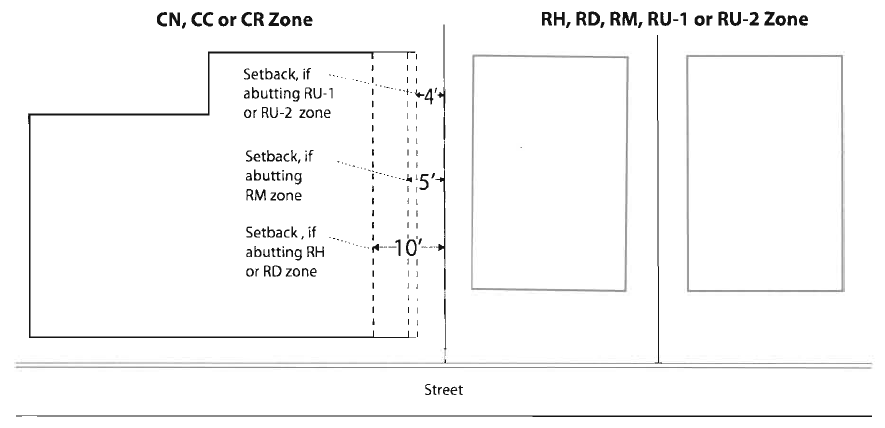
3. Wherever an interior side lot line abuts an interior side lot line of any lot located in an RH or RD Zone, a side setback of six (6) feet is required. In the case where an interior side lot line abuts an interior side lot line in an RM Zone, the setback of the abutting portion of its side lot line is five (5) feet. In the case where an interior side lot line abuts an interior side lot line of any lot located in an RU-1 or RU-2 Zone, a side setback of four (4) feet is required (see Illustration for Table 17.97.03 [Additional Regulation 3], below). Also, see Section 17.108.130 for allowed projections into setbacks.
Illustration for Table 17.97.03 [Additional Regulation 3]
*for illustration purposes only
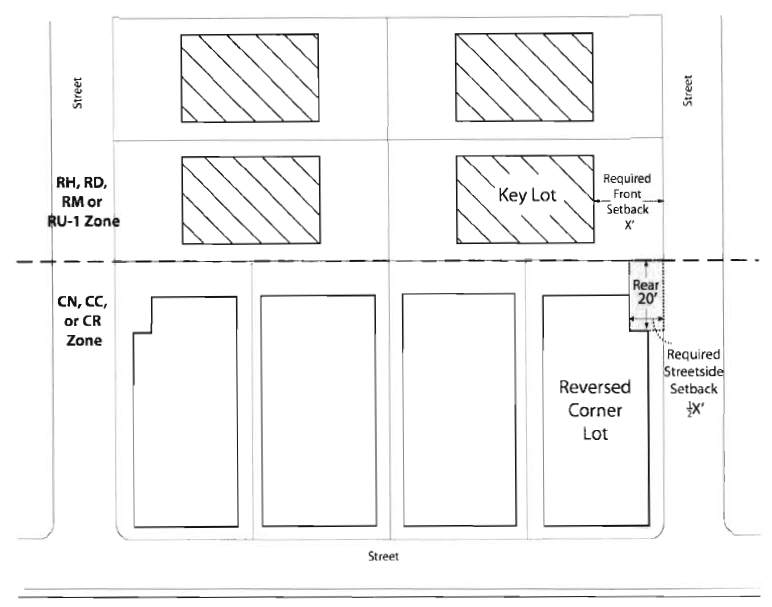
4. When the rear yard of a reversed corner lot abuts a key lot that is in an RH, RD, or RM Zone, the required street side yard setback in the rear ten (10) feet of the reversed corner lot is one-half (½) of the minimum front yard required on the key lot but shall not be required to exceed four (4) feet in width if it would reduce to less than twenty-five (25) feet the buildable width of any corner lot (see Illustration for Table 17.97.03 [Additional Regulation 4], below). Also, see Section 17.108.130 for allowed projections into setbacks.
Illustration for Table 17.97.03 [Additional Regulation 4]
*for illustration purposes only
5. Wherever a rear lot line abuts an alley, one-half of the right-of-way width of the alley may be counted toward the required minimum rear setback; provided, however, that the portion of the minimum rear setback actually on the lot itself shall not be so reduced to less than ten (10) feet. Also, see Section 17.108.130 for allowed projections into setbacks.
6. When a rear lot line is adjacent to an RH, RD, or RM Zone, the required rear setback for both Residential and Nonresidential Facilities is ten (10) feet. When a rear lot line is not adjacent to an RH, RD, or RM Zone, the required rear setback is ten (10) feet for Residential Facilities and there is no required setback for Nonresidential Facilities.
7. Ground Floor Parking and Loading. Off-street parking, loading, and driveway located within twenty (20) feet from all pedestrian walkways and plazas may only be permitted upon the granting of a conditional use permit pursuant to the conditional use permit procedures in Chapter 17.134 and the use permit criteria in Section 17.97.025.
8. Vehicular Residential Facilities shall be located a minimum of thirty (30) feet from the street or be located behind a building. See Section 17.103.085 for additional setback and separation requirements for Vehicular Residential Facilities.
(Ord. No. 13779, § 2(Exh. A), 1-16-2024; Ord. No. 13393, § 2(Exh. A), 10-4-2016; Ord. No. 13666, § 3(Exh. A), 11-16-2021)
Editor's note—
Prior to the reenactment of Section 17.97.060 by Ord. No. 13393, § 2(Exh. A), adopted
October 4, 2016, Ord. No. 13251, § 5(Exh. A), adopted July 29, 2014, repealed the
former Section 17.97.060 in its entirety, which pertained to permitted facilities,
and derived from the prior planning code, § 6855; Ord. No. 11892, § 4(part), adopted
in 1996; Ord. No. 11904, § 5.82, adopted in 1996; Ord. No. 12776, § 3(Exh. A)(part),
adopted in 2006; Ord. No. 12999, § 4(Exh. A), adopted March 16, 2010, and Ord. No.
13060, § 2(Exh. A), adopted March 1, 2011.
For current provisions pertaining to similar subject matter, the user's attention
is directed to Section 17.97.050.
Table 17.97.04 below prescribes height, FAR, density, and open space standards associated with the S-15 and S-15W Height Areas described in the Zoning Maps. The number designations in the "Additional Regulations" column refer to regulations below the table. "N/A" designates the regulation is not applicable to the specified Height Area.
Table 17.97.04 Height, Floor Area Ratio (FAR), Density, and Open Space Regulations
Additional Regulations for Table 17.97.04:
1. The maximum height within ten (10) feet of the front property line is either the height limit on the subject lot shown in the above table or the height maximum for the height area of the parcel directly across the principal street, whatever is less (see Illustration for Table 17.97.04 [Additional Regulation 1], below).
Illustration for Table 17.97.04 [Additional Regulation 1]
*for illustration purposes only
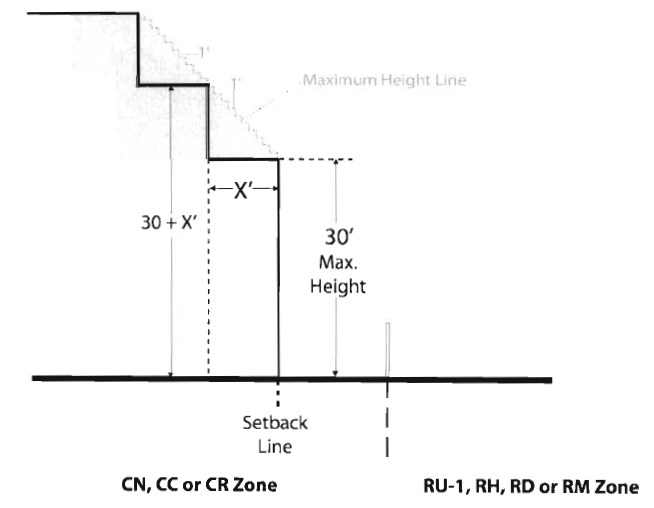
2. Buildings shall have a thirty (30) foot maximum height at the setback line associated with any rear or interior side lot line that abut a lot in an RH, RD, or RM Zone; if the principal building on the abutting lot has a height of thirty (30) feet or less, this maximum height shall increase one (1) foot for every foot of distance away from this setback line. If the principal building on the abutting lot has a height of greater than thirty (30) feet, the maximum height shall increase two (2) feet for every foot away from the applicable setback line (see Illustration for Table 17.97.04 [Additional Regulation 2], below). Also, see Section 17.108.030 for allowed projections above height limits and Section 17.108.020 for increased height limits in certain situations.
Illustration Table 17.97.04 [Additional Regulation 2]
*for illustration purposes only
3. This minimum height requirement only applies to the new construction of a principal building that is located on parcels adjacent to a street right-of-way that is one hundred (100) feet wide or more. Buildings constructed to accommodate Essential Service, Utility and Vehicular or Extensive Impact Civic Activities, or Automobile and Other Light Vehicle Sales and Rental, Automobile and Other Light Vehicle Gas Station and Servicing, or Automobile and Other Light Vehicle Repair and Cleaning Commercial Activities may be exempted from the height minimum regulation by the Planning Director. The allowed projections into the height limits contained in Section 17.108.030 are not counted towards the height minimum.
4. See Chapter 17.107 for affordable and senior housing incentives, and Section 17.103.080 for regulations regarding permitted Accessory Dwelling Units. Also applicable are the provisions of Section 17.102.270 with respect to additional kitchens for a primary dwelling unit, and the provisions of Section 17.102.300 with respect to dwelling units with five (5) or more bedrooms.
5. As specified in Section 17.106.030, the total lot area shall be used as the basis for computing both the maximum nonresidential FAR and the maximum residential density for mixed use projects.
6. Usable open space is only required on lots with two (2) or more dwelling units, excluding any permitted Accessory Dwelling Units. Each one (1) square foot of private usable open space equals two (2) square feet towards the total usable open space requirement, except that actual group space shall be provided in the minimum amount specified in the table per dwelling unit, excluding any permitted Accessory Dwelling Units. All usable open space shall meet the standards contained in Chapter 17.126.
(Ord. No. 13800, § 3(Exh. C), 6-18-2024; Ord. No. 13779, § 2(Exh. A), 1-16-2024; Ord. No. 13763, § 5, 10-3-2023; Ord. No. 13064, § 2(Exh. A), 3-15-2011 Ord. No. 13677, § 4(Exh. A), 1-18-2022; Ord. No. 13666, § 3(Exh. A), 11-16-2021; Ord. No. 13393, § 2(Exh. A), 10-4-2016; Ord. No. 13357, § 3(Exh. A), 2-16-2016; Ord. No. 13251, § 5(Exh. A), 7-29-2014; Ord. No. 13172, § 3(Exh. A), 7-2-2013)
Editor's note—
Prior to the reenactment of Section 17.97.070 by Ord. No. 13393, § 2(Exh. A), adopted
October 4, 2016, Ord. No. 13251, § 5(Exh. A), adopted July 29, 2014, repealed the
former Section 17.97.070 in its entirety, which pertained to conditionally permitted
facilities, and derived from the prior planning code, § 6856; Ord. No. 11892, § 4(part),
adopted in 1996; Ord. No. 11904, § 5.86, adopted in 1996; Ord. No. 12776, § 3(Exh.
A)(part), adopted in 2006, and Ord. No. 12999, § 4(Exh. A), adopted March 16, 2010.
For current provisions pertaining to similar subject matter, the user's attention
is directed to Section 17.97.050.
See editor's note at Section 17.97.130.
Editor's note— Ord. No. 13393, § 2(Exh. A), adopted October 4, 2016, repealed the former Section 17.97.080 in its entirety, which pertained to special regulations applying to certain commercial and industrial activities, and derived from the prior planning code § 6858; Ord. No. 11892, § 4, adopted 1996; Ord. No. 12776, § 3(Exh. A), adopted 2006; Ord. No. 12899, § 4(Exh. A), adopted in 2008; Ord. No. 13064, § 2(Exh. A), adopted March 15, 2011; Ord. No. 13172, § 3(Exh. A), adopted July 2, 2013, and Ord. No. 13357, § 3(Exh. A), adopted February 16, 2016.
Editor's note— Ord. No. 13060, § 2(Exh. A), adopted March 1, 2011, repealed the former Section 17.97.085 in its entirety, which pertained to restrictions on telecommunications facilities and derived from Ord. No. 12999, § 4(Exh. A), adopted March 16, 2010.
A.
Planned Unit Developments. Large integrated developments shall be subject to the Planned Unit Development (PUD) regulations in Chapter 17.142 if they exceed the sizes specified therein. In developments which are approved pursuant to said regulations, certain uses may be permitted in addition to those otherwise allowed in the S-15 Zones, and certain of the other regulations applying in said zone may be waived or modified. The normally required design review process may also be waived for developments at the time of initial granting of a Planned Unit Development (PUD) permit. Unless otherwise specified in the PUD permit, any future changes within the Planned Unit Development shall be subject to applicable design review regulations.
(Ord. No. 13779, § 2(Exh. A), 1-16-2024; Ord. No. 13763, § 5, 10-3-2023; Ord. No. 13677, § 4(Exh. A), 1-18-2022; Ord. No. 13393, § 2(Exh. A), 10-4-2016)
Editor's note— Ord. No. 13677, § 4(Exh. A), adopted Jan. 18, 2022, amended the title of § 17.97.090 to read as herein set out. The former § 17.97.090 title pertained to special regulations for Mini-Lot and Planned Unit Developments.
A.
Parking and Loading. Off-street parking and loading shall be provided as prescribed in the off-street parking and loading requirements in Chapter 17.116.
B.
Bicycle Parking. Bicycle parking shall be provided as prescribed in the bicycle parking regulations in Chapter 17.117.
C.
Home Occupations. Home occupations shall be subject to the applicable provisions of the home occupation regulations in Chapter 17.112.
D.
Nonconforming Uses. Nonconforming uses and changes therein shall be subject to the nonconforming use regulations in Chapter 17.114.
E.
General Provisions. The general exceptions and other regulations set forth in Chapter 17.102 shall apply in the S-15 Zones.
(Ord. No. 13779, § 2(Exh. A), 1-16-2024; Ord. No. 13393, § 2(Exh. A), 10-4-2016; Ord. No. 13357, § 3(Exh. A), 2-16-2016; Ord. No. 13251, § 5(Exh. A), 7-29-2014; Ord. No. 13172, § 3(Exh. A), 7-2-2013; Ord. 12884 § 2 (part), 2008; Ord. 12776 § 3, Exh. A (part), 2006: amended during 1997 codification; prior code § 6876)
Editor's note—
Ord. No. 13393, § 2(Exh. A), adopted October 4, 2016, repealed the former Section
17.97.100 in its entirety, which pertained to use permit criteria, and derived from
the prior planning code § 6860; Ord. No. 11892, § 4, adopted 1996; Ord. No. 12561,
§ 3, adopted 2004; Ord. No. 12776, § 3(Exh. A), adopted 2006; Ord. No. 13172, § 3(Exh.
A), adopted July 2, 2013; Ord. No. 13251, § 5(Exh. A), adopted July 29, 2014, and
Ord. No. 13357, § 3(Exh. A), adopted February 16, 2016.
Subsequently, Ord. No. 13393 redesignated the former Section 17.97.210 as Section
17.97.100. The historical notation of Section 17.97.210 has been preserved for reference
purposes.
Editor's note— Ord. No. 13393, § 2(Exh. A), adopted October 4, 2016, repealed the former Sections 17.97.110 and 17.97.120 in their entirety, which pertained to limitations on signs, marquees, awnings, and minimum lot area, width, and frontage, respectively, and derived from the prior planning code §§ 6863, 6864; Ord. No. 11892, § 4 (part), 1996; Ord. No. 12606, Ann. A, adopted 2004; Ord. No. 12776, § 3(Exh. A), adopted 2006; Ord. No. 13064, § 2(Exh. A), adopted March 15, 2011; Ord. No. 13251, § 5(Exh. A), adopted July 29, 2014; Ord. No. 13357, § 3(Exh. A), adopted February 16, 2016;
Note— See editor's note at Section 17.97.070.
Editor's note— Ord. No. 13064, § 2(Exh. A), adopted March 15, 2011, repealed the former Sections 17.97.140 and 17.97.150 in their entirety, which pertained to maximum nonresidential floor area ratio and maximum height, respectively, and derived from the prior planning code, §§ 6867, 6869; Ord. No. 11892, § 4, adopted 1996; Ord. No. 11904, § 5.90, adopted 1996, and Ord. No. 12776, § 3(Exh. A), adopted 2006.
Editor's note— Ord. No. 13393, § 2(Exh. A), adopted October 4, 2016, repealed the former Section 17.97.160 in its entirety, which pertained to minimum yards and courts, and derived from the prior planning code § 6870; Ord. No. 11892, § 4, adopted 1996; Ord. No. 12776, § 3(Exh. A), adopted 2006; Ord. No. 13064, § 2(Exh. A), adopted March 15, 2011; Ord. No. 13357, § 3(Exh. A), adopted February 16, 2016.
Editor's note— Ord. No. 13064, § 2(Exh. A), adopted March 15, 2011, repealed the former Section 17.97.170 in its entirety, which pertained to minimum usable open space and derived from the prior planning code, § 6871; Ord. No. 11892, § 4, adopted 1996, and Ord. No. 12776, § 3(Exh. A), adopted 2006.
Editor's note— Ord. No. 13393, § 2(Exh. A), adopted October 4, 2016, repealed the former Sections 17.97.180—17.97.200 in their entirety, which pertained to buffering and landscaping, special regulations for mini-lot developments, and special regulations for large-scale developments, respectively, and derived from the prior planning code, §§ 6872, 6873, 6875; Ord. No. 11892, § 4, adopted 1996; Ord. No. 12776, § 3(Exh. A), adopted 2006; Ord. No. 12872, § 4, adopted 2008; Ord. No. 13172, § 3(Exh. A), adopted July 2, 2013; Ord. No. 13251, § 5(Exh. A), adopted July 29, 2014, and Ord. No. 13357, § 3(Exh. A), adopted February 16, 2016.
Note— See editor's note at Section 17.97.100.
S-15 TRANSIT-ORIENTED DEVELOPMENT COMMERCIAL ZONES REGULATIONS[44]
Editor's note— Ord. No. 13393, § 2(Exh. A), adopted October 4, 2016, changed the title of Chapter 17.97 from "S-15 Transit-oriented development zones regulations" to "S-15 Transit-oriented development commercial zones regulations."
The provisions of this Chapter shall be known as the S-15 Transit-Oriented Development Commercial Zones Regulations. The Transit-Oriented Development (S-15) Zones are intended to create, preserve and enhance areas devoted primarily to serve multiple nodes of transportation and to feature high-density residential, commercial, and mixed-use developments to encourage a balance of pedestrian-oriented activities, transit opportunities, and concentrated development; and encourage a safe and pleasant pedestrian environment near transit stations by allowing a mixture of Residential, Civic, Commercial, and Light Industrial Activities, allowing for amenities such as benches, kiosks, lighting, and outdoor cafes; and by limiting conflicts between vehicles and pedestrians, and is typically appropriate around transit centers such as Bay Area Rapid Transit (BART) stations, AC Transit centers, and other transportation nodes. These regulations shall apply in the S-15 Zones.
(Ord. No. 13393, § 2(Exh. A), 10-4-2016; Ord. No. 13357, § 3(Exh. A), 2-16-2016; Ord. No. 13251, § 5(Exh. A), 7-29-2014; Ord. 12776 § 3, Exh. A (part), 2006: Ord. 11892 § 4 (part), 1996: prior planning code § 6850)
Except for projects that are exempt from design review as set forth in Section 17.136.025, no Building Facility, Designated Historic Property, Potentially Designated Historic Property, Telecommunications Facility, Sign, or other associated structure shall be constructed, established, or altered in exterior appearance, unless plans for the proposal have been approved pursuant to the design review procedure in Chapter 17.136, and when applicable, the Telecommunications regulations in Chapter 17.128, or the Sign regulations in Chapter 17.104.
(Ord. No. 13251, § 5(Exh. A), 7-29-2014; Ord. No. 13028, § 2(Exh. A), 7-20-2010; Ord. No. 12999, § 4(Exh. A), 3-16-2010; Ord. 12776 § 3, Exh. A (part), 2006: Ord. 12606 Att. A (part), 2004: Ord. 11904 § 5.62 (part), 1996: Ord. 11892 § 4 (part), 1996: prior planning code § 6851)
In the S-15 Zones, a Conditional Use Permit for any Activity or Facility listed in Sections 17.97.030, 17.97.040, 17.97.050, and 17.97.080, may be granted only upon determination that the proposal conforms to the general use permit criteria set forth in the Conditional Use Permit procedure in Chapter 17.134 and to the following additional use permit criteria:
A.
That the proposal will be of a quality and character which harmonizes with and serves to protect the value of private and public investment in the area;
B.
That the proposal will encourage an appropriate mixture of Residential and/or Commercial Activities in a manner which promotes and enhances use of multiple modes of transportation;
C.
That the proposal is designed to provide a safe and pleasant pedestrian environment;
D.
That no front yard parking, loading area, or driveway shall connect or abut directly with the principal commercial street unless the determination can be made:
1.
That vehicular access cannot reasonably be provided from a different street or other way;
2.
That every reasonable effort has been made to share means of vehicular access with abutting properties;
3.
That the proposal is enclosed or screened from view of the abutting principal street by the measures required in Section 17.110.040B.
E.
That the amount of off-street parking, if any, provided in excess of this code will not contribute significantly to an increased orientation of the area to automobile or truck movement.
F.
In addition to the foregoing criteria and any other applicable requirements, Automotive Fee Parking within this zone shall be subject to the following use permit criteria:
1.
Automotive Fee Parking Commercial Activities shall be part of a larger development that contains a significant amount of Commercial and/or Residential Facilities;
2.
Automotive Fee Parking Commercial Activities may only be contained in a structured parking facility of at least three (3) stories that replaces an existing at grade parking facility;
3.
The new parking structure shall represent no more than a seventy-five percent (75%) increase of existing parking at the site;
4.
Automotive Fee Parking Commercial Activities at the site shall be specifically designated by a city sponsored plan or study designed to promote a transit oriented district as defined by the General Plan;
5.
The facility or facilities containing the Residential and/or Commercial Activities shall be adjacent to the principal street(s) and the Automotive Fee Parking Commercial Activities shall be behind and substantially visually obstructed from the principal Street(s) by the Residential and/or Commercial Facility or Facilities; and
6.
The project shall be consistent in all significant respects with the General Plan's goals, objectives, and policies that promote transit oriented development and districts.
(Ord. No. 13763, § 5, 10-3-2023; Ord. No. 13393, § 2(Exh. A), 10-4-2016)
No development which involves more than one hundred thousand (100,000) square feet of new floor area shall be permitted except upon the granting of a Conditional Use Permit pursuant to the conditional use permit procedure in Chapter 17.134. This requirement shall not apply to developments that include one hundred percent (100%) affordable housing units, other than manager's units, or where a valid Planned Unit Development permit is in effect.
(Ord. No. 13779, § 2(Exh. A), 1-16-2024; Ord. No. 13763, § 5, 10-3-2023; Ord. No. 13393, § 2(Exh. A), 10-4-2016)
No mixed-use developments that include Bay Area Rapid Transit (BART) stations located on sites with one (1) acre or more land area shall be permitted except upon the granting of a conditional use permit pursuant to Section 17.97.025 and the conditional use permit procedure in Chapter 17.134 or upon the granting of a Planned Unit Development permit pursuant to Chapters 17.140 and 17.142, and shall be subject to the following special regulations:
A.
Intermodal Activities and Pedestrian Plaza. Developments should incorporate multiple forms of public transportation and a pedestrian plaza.
B.
Professional Design. The application shall utilize the following professionals in the design process for the development:
1.
An architect licensed by the state of California; and
2.
A landscape architect licensed by the state of California, or an urban planner holding or capable of holding membership in the American Institute of Certified Planners.
C.
Undergrounding of Utilities. All electric and telephone facilities; fire alarm conduits; street light wiring; and other wiring, conduits, and similar facilities shall be placed underground by the developer as required by the city. Electric and telephone facilities shall be installed in accordance with standard specifications of the serving utilities. Street lighting and fire alarm facilities shall be installed in accordance with standard specifications of the Electrical Department.
D.
Performance Bonds. The City Planning Commission or, on appeal, the City Council may, as a condition of approval of any said development, require a cash bond or surety bond for the completion of all or specified parts of the development deemed to be essential to the achievement of the purposes set forth in Section 17.97.010. The bond shall be in a form approved by the City Attorney, in a sum of one hundred fifty percent (150%) of the estimated cost of the work, and conditioned upon the faithful performance of the work specified within the time specified. This requirement shall not apply if evidence is provided to the city which indicates that alternative bonding or other assurances have been secured by the Bay Area Rapid Transit District.
(Ord. No. 13393, § 2(Exh. A), 10-4-2016; Ord. No. 13357, § 3(Exh. A), 2-16-2016; Ord. No. 13172, § 3(Exh. A), 7-2-2013; Ord. 12872 § 4 (part), 2008; Ord. 12776 § 3, Exh. A (part), 2006: Ord. 11892 § 4 (part), 1996: prior planning code § 6852)
Editor's note— Ord. No. 13393, § 2(Exh. A), adopted October 4, 2016, renumbered the former Section 17.97.030 as Section 17.97.035. The historical notation has been preserved for reference purposes.
Table 17.97.01 lists the permitted, conditionally permitted, and prohibited activities in the S-15 Zones. The descriptions of these activities are contained in Chapter 17.10. Section 17.10.040 contains permitted accessory activities.
"P" designates permitted activities in the corresponding zone.
"C" designates activities that are permitted only upon the granting of a Conditional Use Permit (CUP) in the corresponding zone (see Chapter 17.134 for the CUP procedure).
"L" designates activities subject to certain limitations or notes listed at the bottom of the table.
"—" designates activities that are prohibited except as accessory activities according to the regulations contained in Section 17.010.040.
Table 17.97.01: Permitted and Conditionally Permitted Activities
Limitations on Table 17.97.01:
L1. See Section 17.103.010 for other regulations regarding Residential Care Residential Activities, and Sections 17.103.010 and 17.103.015 for other regulations regarding Emergency Shelter Residential Activities. Notwithstanding anything to the contrary contained in the Planning Code, Emergency Shelter Residential Activities are permitted by-right on properties owned by churches, temples, synagogues, and other similar places of worship approved for Community Assembly Civic Activities; prohibited elsewhere in the zone.
L2. Community Gardens are permitted if they do not include the cultivation of animals, animal products, and/or livestock production, except for bee keeping involving no more than three (3) hives.
L3. Industrial Activities. All Industrial Activities shall be conducted entirely within an enclosed facility.
L4. Limited Agriculture is permitted if the activity occupies less than five thousand (5,000) square feet of land area and any sales area is less than one thousand (1,000) square feet; conditionally permitted if the activity is larger in either land or sales area (see Chapter 17.134 for the CUP procedure).
L5. Extensive Agriculture is only permitted upon the granting of a Conditional Use Permit (see Chapter 17.134 for the CUP procedure). In addition to the CUP criteria contained in Section 17.134.050, these activities must meet the use permit criteria in Section 17.97.025.
(Ord. No. 13800, § 3(Exh. C), 6-18-2024; Ord. No. 13779, § 2(Exh. A), 1-16-2024; Ord. No. 13393, § 2(Exh. A), 10-4-2016; Ord. No. 13357, § 3(Exh. A), 2-16-2016; Ord. No. 13270, § 3(Exh. A), 11-18-2014; Ord. No. 13251, § 5(Exh. A), 7-29-2014)
Editor's note— Ord. No. 13251, § 5(Exh. A), adopted July 29, 2014, amended Section 17.97.040 in its entirety to read as herein set out. Formerly, Section 17.97.040 pertained to permitted activities, and derived from the prior planning code, § 6853; Ord. No. 11892, § 4(part), adopted in 1996; Ord. No. 11904, § 5.78, adopted in 1996; Ord. No. 12776, § 3(Exh. A)(part), adopted in 2006; Ord. No. 12939, § 4(Exh. A), adopted June 16, 2009; Ord. No. 12999, § 4(Exh. A), adopted March 16, 2010, and Ord. No. 13172, § 3(Exh. A), adopted July 2, 2013.
Table 17.97.02 lists the permitted, conditionally permitted, and prohibited facilities in the S-15 Zones. The descriptions of these facilities are contained in Chapter 17.10.
"P" designates permitted facilities in the corresponding zone.
"C" designates facilities that are permitted only upon the granting of a Conditional Use Permit (CUP) in the corresponding zone (see Chapter 17.134 for the CUP procedure).
"L" designates facilities subject to certain limitations listed at the bottom of the table.
"—" designates facilities that are prohibited.
Table 17.97.02: Permitted and Conditionally Permitted Facilities
Limitations on Table 17.97.02:
L1. No Conditional Use Permit (CUP) is required for Open Nonresidential Facilities to accommodate Civic Activities, Limited Agriculture, seasonal sales, or special events. Chapter 17.134
L2. See Chapter 17.114, Nonconforming Uses, for additions and alterations to legal nonconforming Residential Facilities, provided, however, that Accessory Dwelling Units are permitted when there is an existing primary Residential Facility on a lot, subject to the provisions of Section 17.103.080 and Chapter 17.88.
L3. See Section 17.103.080 and Chapter 17.88 for regulations regarding permitted Accessory Dwelling Units.
(Ord. No. 13779, § 2(Exh. A), 1-16-2024; Ord. No. 13763, § 5, 10-3-2023; Ord. No. 13677, § 4(Exh. A), 1-18-2022; Ord. No. 13666, § 3(Exh. A), 11-16-2021; Ord. No. 13435, § 4(Exh. A), 5-2-2017; Ord. No. 13357, § 3(Exh. A), 2-16-2016; Ord. No. 13270, § 3(Exh. A), 11-18-2014; Ord. No. 13251, § 5(Exh. A), 7-29-2014)
Editor's note— Ord. No. 13251, § 5(Exh. A), adopted July 29, 2014, amended Section 17.97.050 in its entirety to read as herein set out. Formerly, Section 17.97.050 pertained to conditionally permitted activities, and derived from the prior planning code, § 6854; Ord. No. 11892, § 4(part), adopted in 1996; Ord. No. 12138, § 5(part), adopted in 1999; Ord. No. 12561, § 3(part), adopted in 2004; Ord. No. 12776, § 3(Exh. A)(part), adopted in 2006; Ord. No. 12899, § 4(Exh. A)(part), adopted in 2008; Ord. No. 12939, § 4(Exh. A), adopted June 16, 2009, and Ord. No. 13172, § 3(Exh. A), adopted July 2, 2013.
A.
Zone Specific Standards. Table 17.97.03 below prescribes development standards specific to individual zones. The number designations in the "Additional Regulations" column refer to the regulations listed at the end of the Table.
Table 17.97.03: Property Development Standards
Additional Regulations for Table 17.97.03:
1. See Section 17.106.010 and 17.106.020 for exceptions to lot area, lot width mean, and street frontage regulations.
2. If fifty percent (50%) or more of the frontage on one side of the street between two (2) intersecting streets is in any Residential Zone and all or part of the remaining frontage is in any Commercial or Industrial Zone, the required front setback of the commercially or industrially zoned lots is one-half (½) of the minimum front setback required in the Residential Zone. If fifty percent (50%) or more of the total frontage is in more than one Residential Zone, then the minimum front setback on the commercially or industrially zoned lots is one-half (½) of that required in the Residential Zone with the lesser front setback.
3. Wherever an interior side lot line abuts an interior side lot line of any lot located in an RH or RD Zone, a side setback of six (6) feet is required. In the case where an interior side lot line abuts an interior side lot line in an RM Zone, the setback of the abutting portion of its side lot line is five (5) feet. In the case where an interior side lot line abuts an interior side lot line of any lot located in an RU-1 or RU-2 Zone, a side setback of four (4) feet is required (see Illustration for Table 17.97.03 [Additional Regulation 3], below). Also, see Section 17.108.130 for allowed projections into setbacks.
Illustration for Table 17.97.03 [Additional Regulation 3]
*for illustration purposes only
4. When the rear yard of a reversed corner lot abuts a key lot that is in an RH, RD, or RM Zone, the required street side yard setback in the rear ten (10) feet of the reversed corner lot is one-half (½) of the minimum front yard required on the key lot but shall not be required to exceed four (4) feet in width if it would reduce to less than twenty-five (25) feet the buildable width of any corner lot (see Illustration for Table 17.97.03 [Additional Regulation 4], below). Also, see Section 17.108.130 for allowed projections into setbacks.
Illustration for Table 17.97.03 [Additional Regulation 4]
*for illustration purposes only
5. Wherever a rear lot line abuts an alley, one-half of the right-of-way width of the alley may be counted toward the required minimum rear setback; provided, however, that the portion of the minimum rear setback actually on the lot itself shall not be so reduced to less than ten (10) feet. Also, see Section 17.108.130 for allowed projections into setbacks.
6. When a rear lot line is adjacent to an RH, RD, or RM Zone, the required rear setback for both Residential and Nonresidential Facilities is ten (10) feet. When a rear lot line is not adjacent to an RH, RD, or RM Zone, the required rear setback is ten (10) feet for Residential Facilities and there is no required setback for Nonresidential Facilities.
7. Ground Floor Parking and Loading. Off-street parking, loading, and driveway located within twenty (20) feet from all pedestrian walkways and plazas may only be permitted upon the granting of a conditional use permit pursuant to the conditional use permit procedures in Chapter 17.134 and the use permit criteria in Section 17.97.025.
8. Vehicular Residential Facilities shall be located a minimum of thirty (30) feet from the street or be located behind a building. See Section 17.103.085 for additional setback and separation requirements for Vehicular Residential Facilities.
(Ord. No. 13779, § 2(Exh. A), 1-16-2024; Ord. No. 13393, § 2(Exh. A), 10-4-2016; Ord. No. 13666, § 3(Exh. A), 11-16-2021)
Editor's note—
Prior to the reenactment of Section 17.97.060 by Ord. No. 13393, § 2(Exh. A), adopted
October 4, 2016, Ord. No. 13251, § 5(Exh. A), adopted July 29, 2014, repealed the
former Section 17.97.060 in its entirety, which pertained to permitted facilities,
and derived from the prior planning code, § 6855; Ord. No. 11892, § 4(part), adopted
in 1996; Ord. No. 11904, § 5.82, adopted in 1996; Ord. No. 12776, § 3(Exh. A)(part),
adopted in 2006; Ord. No. 12999, § 4(Exh. A), adopted March 16, 2010, and Ord. No.
13060, § 2(Exh. A), adopted March 1, 2011.
For current provisions pertaining to similar subject matter, the user's attention
is directed to Section 17.97.050.
Table 17.97.04 below prescribes height, FAR, density, and open space standards associated with the S-15 and S-15W Height Areas described in the Zoning Maps. The number designations in the "Additional Regulations" column refer to regulations below the table. "N/A" designates the regulation is not applicable to the specified Height Area.
Table 17.97.04 Height, Floor Area Ratio (FAR), Density, and Open Space Regulations
Additional Regulations for Table 17.97.04:
1. The maximum height within ten (10) feet of the front property line is either the height limit on the subject lot shown in the above table or the height maximum for the height area of the parcel directly across the principal street, whatever is less (see Illustration for Table 17.97.04 [Additional Regulation 1], below).
Illustration for Table 17.97.04 [Additional Regulation 1]
*for illustration purposes only
2. Buildings shall have a thirty (30) foot maximum height at the setback line associated with any rear or interior side lot line that abut a lot in an RH, RD, or RM Zone; if the principal building on the abutting lot has a height of thirty (30) feet or less, this maximum height shall increase one (1) foot for every foot of distance away from this setback line. If the principal building on the abutting lot has a height of greater than thirty (30) feet, the maximum height shall increase two (2) feet for every foot away from the applicable setback line (see Illustration for Table 17.97.04 [Additional Regulation 2], below). Also, see Section 17.108.030 for allowed projections above height limits and Section 17.108.020 for increased height limits in certain situations.
Illustration Table 17.97.04 [Additional Regulation 2]
*for illustration purposes only
3. This minimum height requirement only applies to the new construction of a principal building that is located on parcels adjacent to a street right-of-way that is one hundred (100) feet wide or more. Buildings constructed to accommodate Essential Service, Utility and Vehicular or Extensive Impact Civic Activities, or Automobile and Other Light Vehicle Sales and Rental, Automobile and Other Light Vehicle Gas Station and Servicing, or Automobile and Other Light Vehicle Repair and Cleaning Commercial Activities may be exempted from the height minimum regulation by the Planning Director. The allowed projections into the height limits contained in Section 17.108.030 are not counted towards the height minimum.
4. See Chapter 17.107 for affordable and senior housing incentives, and Section 17.103.080 for regulations regarding permitted Accessory Dwelling Units. Also applicable are the provisions of Section 17.102.270 with respect to additional kitchens for a primary dwelling unit, and the provisions of Section 17.102.300 with respect to dwelling units with five (5) or more bedrooms.
5. As specified in Section 17.106.030, the total lot area shall be used as the basis for computing both the maximum nonresidential FAR and the maximum residential density for mixed use projects.
6. Usable open space is only required on lots with two (2) or more dwelling units, excluding any permitted Accessory Dwelling Units. Each one (1) square foot of private usable open space equals two (2) square feet towards the total usable open space requirement, except that actual group space shall be provided in the minimum amount specified in the table per dwelling unit, excluding any permitted Accessory Dwelling Units. All usable open space shall meet the standards contained in Chapter 17.126.
(Ord. No. 13800, § 3(Exh. C), 6-18-2024; Ord. No. 13779, § 2(Exh. A), 1-16-2024; Ord. No. 13763, § 5, 10-3-2023; Ord. No. 13064, § 2(Exh. A), 3-15-2011 Ord. No. 13677, § 4(Exh. A), 1-18-2022; Ord. No. 13666, § 3(Exh. A), 11-16-2021; Ord. No. 13393, § 2(Exh. A), 10-4-2016; Ord. No. 13357, § 3(Exh. A), 2-16-2016; Ord. No. 13251, § 5(Exh. A), 7-29-2014; Ord. No. 13172, § 3(Exh. A), 7-2-2013)
Editor's note—
Prior to the reenactment of Section 17.97.070 by Ord. No. 13393, § 2(Exh. A), adopted
October 4, 2016, Ord. No. 13251, § 5(Exh. A), adopted July 29, 2014, repealed the
former Section 17.97.070 in its entirety, which pertained to conditionally permitted
facilities, and derived from the prior planning code, § 6856; Ord. No. 11892, § 4(part),
adopted in 1996; Ord. No. 11904, § 5.86, adopted in 1996; Ord. No. 12776, § 3(Exh.
A)(part), adopted in 2006, and Ord. No. 12999, § 4(Exh. A), adopted March 16, 2010.
For current provisions pertaining to similar subject matter, the user's attention
is directed to Section 17.97.050.
See editor's note at Section 17.97.130.
Editor's note— Ord. No. 13393, § 2(Exh. A), adopted October 4, 2016, repealed the former Section 17.97.080 in its entirety, which pertained to special regulations applying to certain commercial and industrial activities, and derived from the prior planning code § 6858; Ord. No. 11892, § 4, adopted 1996; Ord. No. 12776, § 3(Exh. A), adopted 2006; Ord. No. 12899, § 4(Exh. A), adopted in 2008; Ord. No. 13064, § 2(Exh. A), adopted March 15, 2011; Ord. No. 13172, § 3(Exh. A), adopted July 2, 2013, and Ord. No. 13357, § 3(Exh. A), adopted February 16, 2016.
Editor's note— Ord. No. 13060, § 2(Exh. A), adopted March 1, 2011, repealed the former Section 17.97.085 in its entirety, which pertained to restrictions on telecommunications facilities and derived from Ord. No. 12999, § 4(Exh. A), adopted March 16, 2010.
A.
Planned Unit Developments. Large integrated developments shall be subject to the Planned Unit Development (PUD) regulations in Chapter 17.142 if they exceed the sizes specified therein. In developments which are approved pursuant to said regulations, certain uses may be permitted in addition to those otherwise allowed in the S-15 Zones, and certain of the other regulations applying in said zone may be waived or modified. The normally required design review process may also be waived for developments at the time of initial granting of a Planned Unit Development (PUD) permit. Unless otherwise specified in the PUD permit, any future changes within the Planned Unit Development shall be subject to applicable design review regulations.
(Ord. No. 13779, § 2(Exh. A), 1-16-2024; Ord. No. 13763, § 5, 10-3-2023; Ord. No. 13677, § 4(Exh. A), 1-18-2022; Ord. No. 13393, § 2(Exh. A), 10-4-2016)
Editor's note— Ord. No. 13677, § 4(Exh. A), adopted Jan. 18, 2022, amended the title of § 17.97.090 to read as herein set out. The former § 17.97.090 title pertained to special regulations for Mini-Lot and Planned Unit Developments.
A.
Parking and Loading. Off-street parking and loading shall be provided as prescribed in the off-street parking and loading requirements in Chapter 17.116.
B.
Bicycle Parking. Bicycle parking shall be provided as prescribed in the bicycle parking regulations in Chapter 17.117.
C.
Home Occupations. Home occupations shall be subject to the applicable provisions of the home occupation regulations in Chapter 17.112.
D.
Nonconforming Uses. Nonconforming uses and changes therein shall be subject to the nonconforming use regulations in Chapter 17.114.
E.
General Provisions. The general exceptions and other regulations set forth in Chapter 17.102 shall apply in the S-15 Zones.
(Ord. No. 13779, § 2(Exh. A), 1-16-2024; Ord. No. 13393, § 2(Exh. A), 10-4-2016; Ord. No. 13357, § 3(Exh. A), 2-16-2016; Ord. No. 13251, § 5(Exh. A), 7-29-2014; Ord. No. 13172, § 3(Exh. A), 7-2-2013; Ord. 12884 § 2 (part), 2008; Ord. 12776 § 3, Exh. A (part), 2006: amended during 1997 codification; prior code § 6876)
Editor's note—
Ord. No. 13393, § 2(Exh. A), adopted October 4, 2016, repealed the former Section
17.97.100 in its entirety, which pertained to use permit criteria, and derived from
the prior planning code § 6860; Ord. No. 11892, § 4, adopted 1996; Ord. No. 12561,
§ 3, adopted 2004; Ord. No. 12776, § 3(Exh. A), adopted 2006; Ord. No. 13172, § 3(Exh.
A), adopted July 2, 2013; Ord. No. 13251, § 5(Exh. A), adopted July 29, 2014, and
Ord. No. 13357, § 3(Exh. A), adopted February 16, 2016.
Subsequently, Ord. No. 13393 redesignated the former Section 17.97.210 as Section
17.97.100. The historical notation of Section 17.97.210 has been preserved for reference
purposes.
Editor's note— Ord. No. 13393, § 2(Exh. A), adopted October 4, 2016, repealed the former Sections 17.97.110 and 17.97.120 in their entirety, which pertained to limitations on signs, marquees, awnings, and minimum lot area, width, and frontage, respectively, and derived from the prior planning code §§ 6863, 6864; Ord. No. 11892, § 4 (part), 1996; Ord. No. 12606, Ann. A, adopted 2004; Ord. No. 12776, § 3(Exh. A), adopted 2006; Ord. No. 13064, § 2(Exh. A), adopted March 15, 2011; Ord. No. 13251, § 5(Exh. A), adopted July 29, 2014; Ord. No. 13357, § 3(Exh. A), adopted February 16, 2016;
Note— See editor's note at Section 17.97.070.
Editor's note— Ord. No. 13064, § 2(Exh. A), adopted March 15, 2011, repealed the former Sections 17.97.140 and 17.97.150 in their entirety, which pertained to maximum nonresidential floor area ratio and maximum height, respectively, and derived from the prior planning code, §§ 6867, 6869; Ord. No. 11892, § 4, adopted 1996; Ord. No. 11904, § 5.90, adopted 1996, and Ord. No. 12776, § 3(Exh. A), adopted 2006.
Editor's note— Ord. No. 13393, § 2(Exh. A), adopted October 4, 2016, repealed the former Section 17.97.160 in its entirety, which pertained to minimum yards and courts, and derived from the prior planning code § 6870; Ord. No. 11892, § 4, adopted 1996; Ord. No. 12776, § 3(Exh. A), adopted 2006; Ord. No. 13064, § 2(Exh. A), adopted March 15, 2011; Ord. No. 13357, § 3(Exh. A), adopted February 16, 2016.
Editor's note— Ord. No. 13064, § 2(Exh. A), adopted March 15, 2011, repealed the former Section 17.97.170 in its entirety, which pertained to minimum usable open space and derived from the prior planning code, § 6871; Ord. No. 11892, § 4, adopted 1996, and Ord. No. 12776, § 3(Exh. A), adopted 2006.
Editor's note— Ord. No. 13393, § 2(Exh. A), adopted October 4, 2016, repealed the former Sections 17.97.180—17.97.200 in their entirety, which pertained to buffering and landscaping, special regulations for mini-lot developments, and special regulations for large-scale developments, respectively, and derived from the prior planning code, §§ 6872, 6873, 6875; Ord. No. 11892, § 4, adopted 1996; Ord. No. 12776, § 3(Exh. A), adopted 2006; Ord. No. 12872, § 4, adopted 2008; Ord. No. 13172, § 3(Exh. A), adopted July 2, 2013; Ord. No. 13251, § 5(Exh. A), adopted July 29, 2014, and Ord. No. 13357, § 3(Exh. A), adopted February 16, 2016.
Note— See editor's note at Section 17.97.100.

