
Oakland City Zoning Code
CHAPTER 17
73 - CIX, IG AND IO INDUSTRIAL ZONES REGULATIONS35
Editor's note— Ord. No. 13251, § 5(Exh. A), adopted July 29, 2014, amended Chapter 17.73 in its entirety to read as herein set out. Formerly, Chapter 17.73 pertained to CIX-1, CIX-2, IG and IO industrial zone regulations, and derived from Ord. No. 12875, § 2(part), adopted in 2008; Ord. No. 12923, § 2(Exh. A), adopted March 17, 2009; Ord. No. 12939, § 4(Exh. A), adopted June 16, 2009; Ord. No. 12999, § 4(Exh. A), adopted March 16, 2010; Ord. No. 13064, § 2(Exh. A), adopted March 15, 2011; Ord. No. 13172, § 3(Exh. A), adopted July 2, 2013, and Ord. No. 13248, § 3(Exh. A), adopted July 15, 2014.
17.73.010 - Title, purpose, and applicability.
The provisions of this Chapter shall be known as the CIX, IG, and IO Industrial Zones Regulations. This Chapter establishes regulations for the (CIX-1A) West Oakland Plan Area Commercial Industrial Mix-1A, (CIX-1B) West Oakland Plan Area Commercial Industrial Mix-1B, (CIX-1C) West Oakland Plan Area Commercial Industrial Mix-1C, (CIX-1D) West Oakland Plan Area Commercial Industrial Mix-1D, (CIX-1) Commercial Industrial Mix-1, (CIX-2) Commercial Industrial Mix-2, (IG) General Industrial, and (IO) Industrial Office Zones.
The intent of the CIX-1A, CIX-1B, CIX-1C, and CIX-1D Industrial Zones is to implement the West Oakland Specific Plan. These and the other CIX, IG, and IO Industrial Zones are intended to create, preserve, and enhance areas for industrial uses, including manufacturing, scientific and product-related research and development, construction, transportation, warehousing/storage/distribution, recycling/waste-related activities, clean technology, and similar uses. The primary purposes of these areas are to support Oakland's economic base and to provide employment opportunities. The specific purposes of the CIX, IG, and IO Industrial Zones are to:
1.
Provide a diversified economic base and a wide range of employment opportunities;
2.
Maximize Oakland's regional role as a transportation, distribution, and communications hub;
3.
Support Port operations and expansion by providing land for Port services such as trucking, warehousing, and distribution;
4.
Preserve areas with good freeway, rail, seaport, and/or airport access for business and industrial uses;
5.
Prohibit residential uses and limit commercial uses in General Industrial (IG) areas so that a maximum amount of the City's land base is preserved for industrial uses, and so that industrial uses may operate without impacting those activities;
6.
Locate high impact industrial uses away from residential areas; and
7.
Allow heavy-impact or large-scale commercial retail uses on sites with direct access to the regional transportation system.
A.
Description of Zones. This Chapter establishes land use regulations for the following zones:
1.
CIX-1 Commercial Industrial Mix - 1 Industrial Zone. The CIX-1 Zone is intended to create, preserve, and enhance industrial areas that are appropriate for a wide variety of businesses and related commercial and industrial establishments. This zone is intended to accommodate existing older industries and provide flexibility in order to anticipate new technologies. Large-scale commercial and retail uses will be limited to sites with direct access to the regional transportation system.
2.
CIX-1A West Oakland Plan Area Commercial Industrial Mix - 1A Industrial Zone (Business Enhancement). The CIX-1A Zone intended to create, preserve, and enhance industrial areas in the West Oakland Specific Plan Area that are appropriate for incubator space for specific industry groups, adaptable space for artisans and craftspeople, and flexible small spaces for start-up businesses.
3.
CIX-1B West Oakland Plan Area Commercial Industrial Mix - 1B Industrial Zone (Low Intensity Business). The CIX-1B Zone is intended to support industrial areas in the West Oakland Specific Plan Area that are appropriate for a broad range of new custom and light manufacturing, light industrial, warehouse, research and development, and service commercial uses.
4.
CIX-1C West Oakland Plan Area Commercial Industrial Mix - 1C Industrial Zone (High Intensity Business). The CIX-1C Zone is intended to support industrial areas in the West Oakland Specific Plan Area that are appropriate for a broad range of higher intensity commercial, retail, office, and advanced manufacturing-type users. This zone is applied to areas with strong locational advantages that make possible the attraction of high intensity commercial and light industrial land uses and development types.
5.
CIX-1D West Oakland Plan Area Commercial Industrial Mix - 1D Industrial Zone (Retail Commercial Mix). The CIX-1D Zone is intended to create, preserve, and enhance industrial areas in the West Oakland Specific Plan Area that are appropriate for a broad range of large-scale retail and commercial uses. This district is applied to areas with a prominent street location.
6.
CIX-2 Commercial Industrial Mix - 2 Industrial Zone. The CIX-2 Zone is intended to create, preserve, and enhance industrial areas that are appropriate for a wide variety of commercial and industrial establishments. Uses with greater off-site impacts may be permitted provided they meet specific performance standards and are buffered from residential areas.
7.
IG General Industrial Zone. The IG Zone is intended to create, preserve and enhance areas of the City that are appropriate for a wide variety of businesses and related commercial and industrial establishments that may have the potential to generate off-site impacts such as noise, light/glare, odor, and traffic. This zone allows heavy industrial and manufacturing uses, transportation facilities, warehousing and distribution, and similar and related supporting uses. Uses that may inhibit such uses, or the expansion thereof, are prohibited. This district is applied to areas with good freeway, rail, seaport, and/or airport access.
8.
IO Industrial Office Industrial Zone. The IO Zone is intended to create and support areas of the City that are appropriate for a wide variety of businesses and related commercial and industrial establishments in a campus-style setting. Development and performance standards in this district are more restrictive and accommodate large-parcel development in an attractive, well-landscaped setting. Future development shall reflect large-scale office, research and development, light industrial, wholesaling and distribution, and similar and related supporting uses.
B.
Description of Combining Zone. This Chapter establishes land use regulations for the following combining zone:
1.
T Transport and Warehousing Combining Zone. The intent of the T Combining Zone is to create and support areas of the city with the CIX-1A, CIX-1B, CIX-1C, or CIX-1D Industrial Zone designation that are appropriate for a wide variety of transportation facilities, warehousing and distribution, and similar and related supporting uses. The T Combining Zone is applied to areas with good freeway, rail, and/or seaport access. When a primary zone is combined with the T Combining Zone, the T Combining Zone permitted uses supersede those of the primary zone.
(Ord. No. 13393, § 2(Exh. A), 10-4-2016; Ord. No. 13357, § 3(Exh. A), 2-16-2016; Ord. No. 13270, § 3(Exh. A), 11-18-2014; Ord. No. 13251, § 5(Exh. A), 7-29-2014)
17.73.015 - Required design review process.
A.
In the CIX-1A, CIX-1B, CIX-1C, and CIX-1D Zones: Except for projects that are exempt from design review as set forth in Section 17.136.025, no Building Facility, Designated Historic Property, Potentially Designated Historic Property, Telecommunications Facility, Sign, or other associated structure shall be constructed, established, or altered in exterior appearance, unless plans for the proposal have been approved pursuant to the design review procedure in Chapter 17.136, and when applicable, the Telecommunications regulations in Chapter 17.128, or the Sign regulations in Chapter 17.104.
B.
In the CIX-1, CIX-2, IG, and IO Zones: Except for projects that are exempt from design review as set forth in Section 17.136.025, no Residential Facility, Designated Historic Property, Potentially Designated Historic Property, Telecommunications Facility, Sign, or other associated structure shall be constructed, established, or altered in exterior appearance, unless plans for the proposal have been approved pursuant to the design review procedure in Chapter 17.136, and when applicable, the Telecommunications regulations in Chapter 17.128, or the Sign regulations in Chapter 17.104.
C.
No facility located within six hundred (600) feet of any Residential Zone boundary and accommodating the following activities shall be constructed, established, or expanded in size unless plans for the proposal have been approved pursuant to the Regular Design Review procedure in Chapter 17.136.
1.
Automobile and Other Light Vehicle Gas Station and Servicing Activity.
2.
Automobile and Other Light Vehicle Repair and Cleaning Activity.
3.
Freight/Truck Terminal.
4.
Truck Yard.
5.
Truck Weigh Stations.
6.
Truck and Other Heavy Vehicle Sales, Rental, and Leasing.
7.
Truck and Other Heavy Vehicle Service, Repair, and Refueling.
D.
Establishment of a Work/Live unit shall only be permitted upon determination that the proposal conforms to the Regular design review criteria set forth in the Regular Design Review procedure in Chapter 17.136 and to all of the additional criteria set forth in Subsection 17.73.040.D.
(Ord. No. 13779, § 2(Exh. A), 1-16-2024; Ord. No. 13357, § 3(Exh. A), 2-16-2016; Ord. No. 13302, § 5(Exh. C), 4-21-2015; Ord. No. 13251, § 5(Exh. A), 7-29-2014)
17.73.020 - Permitted and conditionally permitted activities and facilities.
The following table lists the permitted, conditionally permitted, and prohibited activities and facilities in the CIX, IG, and IO Zones. The descriptions of these uses are contained in Chapter 17.10.
"P" designates permitted activities and facilities in the corresponding zone.
"C" designates activities and facilities that are permitted only upon the granting of a conditional use permit (see Chapter 17.134) in the corresponding zone.
"L" designates activities and facilities subject to certain limitations listed at the bottom of the Table.
"—" designates activities and facilities that are prohibited in the corresponding zone.
Table 17.73.020: Permitted and Conditionally Permitted Activities and Facilities
* If a CIX-1A, CIX-1B, CIX-1C or CIX-1D Base Zone also has the T Combining Zone, the T regulations shall supersede the Base Zone. Wherever the T Combining Zone regulations are silent, the Base Zone regulations shall supersede.
* If a CIX-1A, CIX-1B, CIX-1C or CIX-1D Base Zone also has the T Combining Zone, the T regulations shall supersede the Base Zone. Wherever the T Combining Zone regulations are silent, the Base Zone regulations shall supersede.
Limitations on Table 17.73.020:
L1. All new Residential Activities are prohibited in the CIX, IG, and IO Zones, except that Emergency Shelters are permitted by-right on properties owned by churches, temples, synagogues, and other similar places of worship approved for Community Assembly Civic Activities; and within those portions of the 3rd Street corridor, East 12th Street corridor and Coliseum Way area described in Section 17.103.015(A)(5)(6)(8) respectively and subject to the development standards in Section 17.103.015(B); and conversion of an existing Transient Habitation Commercial Activity in the CIX-2 Zone into a Permanent Residential, Residential Care, Supportive Housing, or Transitional Housing Residential Activity may be permitted through a Conditional Use Permit in any portion of the CIX-2 Zone not located within one thousand five hundred (1,500) feet of Hegenberger Road. A Conditional Use Permit for such residential conversion of an existing Transient Habitation Commercial Activity in the CIX-2 Zone may only be granted upon determination that the proposal conforms to the general use permit criteria set forth in the Conditional Use Permit procedure in Chapter 17.134 and to the following additional criteria:
a. That the proposal involves housing that is only for one or more underserved populations, including but not limited to, low-income households, seniors, or veterans.
L2. Limited to location on a ground floor in the CIX-2, IG and IO Zones. Over five thousand (5,000) sf. floor area requires a Conditional Use Permit in the CIX-2, IG, and IO Zones.
L3. Reserved.
L4. A Conditional Use Permit is required if located within six hundred (600) feet of a Residential Zone boundary or one-half (1/2) mile of a BART Station (see Chapter 17.134 for the CUP procedure, and Section 17.103.065 for special findings and additional requirements for Truck-Intensive Industrial Activities in the M-40, CIX, IG, IO, D-CE-5, D-CE-6, D-CO-5, and D-CO-6 Zones). Permitted if located beyond six hundred (600) feet of a Residential Zone or one-half (½) mile of a BART Station.
L5. A Conditional Use Permit is required if the use involves any of the following: a) outdoor yard activities; or b) ancillary overnight boarding.
L6. Prohibited if located within six hundred (600) feet of a Residential Zone or one-half (½) mile of a BART Station. A Conditional Use Permit is required elsewhere throughout the zone. (see Chapter 17.134 for the CUP procedure, and Section 17.103.065 for special findings and additional requirements for Truck-Intensive Industrial Activities in the M-40, CIX, IG, IO, D-CE-5, D-CE-6, D-CO-5, and D-CO-6 Zones).
L7. A Conditional Use Permit is required if: a) within six hundred (600) feet of a Residential Zone, b) located anywhere in the district when outdoor repair and service activity exceeds fifty percent (50%) of site area, or c) gas stations are proposed as a principal activity anywhere in the district.
L8. All outdoor activities shall be screened in a manner as determined by the Planning Director, including, but not limited to, solid fencing and buffer planting installed and maintained along the applicable areas of the site exterior.
L9. A Conditional Use Permit is required for entertainment, educational and athletic uses (see Chapter 17.134 for the CUP procedure). Also, no new or expanded Adult Entertainment Activity shall be located closer than one thousand (1,000) feet to the boundary of any Residential Zone or three hundred (300) feet from any other Adult Entertainment Activity. See Section 17.102.160 for further regulations regarding Adult Entertainment Activities.
L10. In the IG Zone, Administrative activities are only permitted if accessory to an approved Industrial Activity are limited to twenty percent (20%) of floor area.
L11. Prohibited if located within six hundred (600) feet of a Residential Zone; a Conditional Use Permit containing requirements no less stringent than the performance standards set out in Section 17.73.035 is required if located beyond six hundred (600) feet of a Residential Zone boundary.
L12. Prohibited if located within six hundred (600) feet of a Residential Zone, permitted beyond six hundred (600) feet with a standard set of performance standards that would apply to existing, new or expanded uses, as detailed in Section 17.73.035.
L13. A Conditional Use Permit is required for Electroplating Activities.
L14. Limited Agriculture is permitted if the activity occupies less than ten thousand (10,000) square feet of land area and any sales area is less than one thousand (1,000) square feet; conditionally permitted if the activity is larger in either land or sales area (see Chapter 17.134 for the CUP procedure).
L15. Limited Agriculture is only permitted upon the granting of a Conditional Use Permit (see Chapter 17.134 for the CUP procedure). In addition to the CUP criteria contained in Section 17.134.050, this activity must meet the following use permit criteria:
a. The proposal will not adversely affect the livability or appropriate development of abutting properties and the surrounding neighborhood in terms of noise, water and pesticide runoff, farming equipment operation, hours of operation, odor, security, and vehicular traffic;
b. Agricultural chemicals or pesticides will not impact abutting properties or the surrounding neighborhood; and
c. The soil used in growing does not contain any harmful contaminants and the activity will not create contaminated soil.
L16. Extensive Agriculture is only permitted upon the granting of a Conditional Use Permit (see Chapter 17.134 for the CUP procedure). In addition to the criteria contained in Section 17.134.050, this activity must meet the following use permit criteria:
a. The proposal will not adversely affect the livability or appropriate development of abutting properties and the surrounding neighborhood in terms of noise, water and pesticide runoff, farming equipment operation, hours of operation, odor, security, and vehicular traffic.
L17. Permitted if located within one thousand (1,000) feet of Highway 880, International Boulevard, Hegenberger Road, or 66th Avenue; conditionally permitted if located elsewhere throughout the zone (see Chapter 17.134 for the CUP procedure).
L18. The total floor area devoted to these activities shall only exceed twenty-five thousand (25,000) square feet upon the granting of a Conditional Use Permit (see Chapter 17.134).
L19. If located within six hundred (600) feet of a Residential Zone boundary, any storage or use of hazardous materials or waste, as defined in O.M.C. Section 8.42.060, shall be reviewed and approved by the Fire Department prior to commencement of operation or any alteration of activity. A risk management plan may also be required, per the Certified Program Uniform Assistance (CUPA) Ordinance (O.M.C. Chapter 8.42).
L20. See Section 17.102.170 for special regulations relating to massage services and Section 17.102.450 for special regulations related to Laundromats.
L21. Botanical Gardens are only permitted upon the granting of a Conditional Use Permit (see Chapter 17.134 for the CUP procedure).
L22. No new or expanded Special Health Care Civic Activity shall be located closer than two thousand five hundred (2,500) feet from any other such activity, or five hundred (500) feet from any K-12 school or Licensed Emergency Shelters. See Section 17.103.020 for further regulations regarding Special Health Care Civic Activities.
L23. A Conditional Use Permit is required if located within six hundred (600) feet of a Residential Zone (see Chapter 17.134 for the CUP procedure); prohibited if located beyond six hundred (600) feet.
L24. Notwithstanding anything to the contrary contained in the Planning Code, Satellite Recycling Collection Centers less than five hundred (500) square feet in area located in or associated with approved supermarkets and shopping centers that are established pursuant to requirements of the California Beverage Container Recycling and Litter Reduction Act of 1986, to collect beverage containers made from materials such as aluminum, glass, plastic, and bimetal for recycling are permitted ty right as an accessory activity (see Accessory Activities, Section 17.10.040.P).
(Ord. No. 13868, § 2(Exh. A), 12-16-2026; Ord. No. 13812, § 4(Exh. A), 7-30-2024; Ord. No. 13763, § 5, 10-3-2023; Ord. No. 13518, § 4(Exh. A), 2-5-2019; Ord. No. 13501, § 4(Exh. A), 7-24-2018; Ord. No. 13357, § 3(Exh. A), 2-16-2016; Ord. No. 13302, § 5(Exh. C), 4-21-2015; Ord. No. 13270, § 3(Exh. A), 11-18-2014; Ord. No. 13251, § 5(Exh. A), 7-29-2014; Ord. No. 13248, § 3(Exh. A), 7-15-2014)
17.73.030 - Property Development Standards.
Table 17.73.030 contains the property development standards for all zones within this Chapter.
Table 17.73.030: Property Development Standards
Additional Regulations Noted in Table 17.73.030
1. See Sections 17.106.010 and 17.106.020 for exceptions to street frontage, lot width and lot area regulations.
2. A conditional use permit to exceed the maximum Floor Area Ratio (FAR) as shown in Table 17.73.030 may be granted for the CIX-1C, CIX-1D, CIX-1, CIX-2, IG, and IO Zones upon determination that the proposal conforms to the conditional use permit criteria set forth in the conditional use permit procedure in Chapter 17.134, and to all of the following additional criteria:
a. If in the CIX-1, CIX-2, IG, or IO Zones, the additional intensity will not exceed the maximum Floor Area Ratio (FAR) for sites greater than three hundred (300) feet from a Residential Zone boundary; or if in the CIX-1C or CIX-1D Zones, will not exceed a Floor Area Ratio (FAR) of 3.0. Any additional intensity in the CIX, IG or IO Zones will not subject residentially zoned areas within three hundred (300) feet to significant adverse impacts related to: truck traffic; nighttime operations; noise; vehicular traffic; hazardous materials exposure and risk; air emissions; blockage of sunlight to private open space areas; or other such environmental impacts;
b. If in the CIX-1, CIX-2, IG, or IO Zones, the site is located on a major arterial, freeway, rail line or other location that has adequate capacity to handle the intensity and type of traffic volume. If in the CIX-1C or CIX-1D Zones, the site is located within five hundred (500) feet of Mandela Parkway, or in or within five hundred (500) feet of the T overlay Zone;
c. If adjacent to a Residential or Open Space Zone boundary, the proposed development has a stepback of one (1) foot to every one (1) foot of height, beginning with a maximum height of thirty (30) feet at all required yard setbacks; and
d. All new development activities meet the Performance Standards in Chapter 17.120.
3. For additional regulations regarding height, see Section 17.108.030 (Allowed Projections above Height Limits), Chapter 17.128 (Telecommunications Regulations), Section 17.108.010 for lots lying along a boundary of certain Residential Zones, and Section 17.104.020 for maximum height of Signs, and Section 17.108.020 for increased height limits in certain situations.
4. The height of materials stored in any outdoor yards shall be no higher than eight (8) feet within the required rear or side yard setback along the property line. However, materials may be stacked up to the height of the wall, and may be stacked within the required yard area if a solid wall at least eight (8) feet in height and buffer planting is installed. The aisle width and material composition of all stored material, and the ultimate height of all outdoor materials stored beyond the ten-foot yard requirement, shall be according to the Fire Code regulations. The wall design shall be approved by the Planning Director, or his or her designee. In addition, the following regulation shall apply in the West Oakland Specific Plan Area only:
a. Outdoor storage located within twenty-five (25) feet from any Residential or Open Space Zone shall be no higher than eight (8) feet, and shall be screened by a solid wall at least as tall as the height of the stored materials, with buffer planting installed along the exterior wall perimeter.
5. See Section 17.108.130 for minimum front, side, and rear yards in Commercial and Industrial Zones which may be across from, abut or be adjacent to a Residential Zone or alley. Accessory structures or other facilities allowed within the yards and setbacks are in Sections 17.108.130.
6. All projects which involve the construction of a new Nonresidential Facility, or the addition to an existing Nonresidential Facility of over one thousand (1,000) square feet, shall comply with the landscape requirements in this Chapter and in Chapter 17.124. Landscaping shall consist of pervious surface with lawn, ground cover, shrubs, permeable paving materials, and/or trees and which is irrigated and maintained. See Chapter 17.124 and Section 17.124.025 for other Landscaping and Screening Standards.
7. In the IO district, the minimum front yard setback area required shall, except for driveways, walkways, and allowable Signs, be developed as open landscaped areas with lawn or other ground cover, shrubs, trees and decorative and permeable paving materials, subject to the standards for required landscaping and screening in Chapter 17.124.
8. Parking Lot Landscaping applies only to lots associated with new construction of more than ten thousand (10,000) square feet of floor area. Shade trees shall be provided at a ratio of one (1) tree for every ten (10) spaces through the parking lot. A minimum of ten percent (10%) of a surface parking lot shall be landscaped accompanied by an irrigation system that is permanent, below grade and activated by automatic timing controls which may be provided entirely in permeable surfacing in lieu of irrigated landscaping if approved through the Design Review process (see Chapter 17.136). Parking lots located adjacent to a public right-of-way shall include screening consisting of a minimum of five (5) foot deep planted area or a three (3) foot tall opaque, concrete, or masonry wall with a minimum three (3) foot deep planted area. Chain link, cyclone, and barbed wire fencing is prohibited in all cases.
9. For all projects requiring a building permit, street trees are required. In addition to the general landscaping requirements set forth above, a minimum of one (1) 15-gallon tree, or substantially equivalent landscaping consistent with City policy and as approved by the Director of City Planning, shall be provided for every twenty (20) feet of street frontage or portion thereof and, if a curbside planting strip exists, for every twenty-five (25) feet of street frontage. On streets with sidewalks where the distance from the face of the curb to the outer edge of the sidewalk is at least six and one-half (6½) feet, the trees to be provided shall include street trees to the satisfaction of the Tree Division.
10. The street tree requirement noted above shall apply to all projects which involve the construction of a new Nonresidential Facility, or the addition to an existing Nonresidential Facility of over one thousand (1,000) square feet (see Chapter 17.124 and Section 17.124.025 for other Landscaping and Screening Standards).
11. Applies to new development; or expansion of industrial or commercial buildings by more than twenty percent (20%) floor area; or b) addition or expansion of an existing building so that the building to land ratio exceeds thirty-five percent (35%), whichever is greater; and all new driveway projects. This requirement may be waived administratively if such distance requirement will impede direct access to a rail line.
12. Driveway shall not exceed thirty-five (35) feet in width without obtaining approval from the Engineering Department of Building Services through the Driveway Appeal Process.
13. A clearly defined and lighted walkway, at least four (4) feet wide, shall be provided between the main building entry and a public sidewalk for all new development. On-site walkways shall be separated from on-site automobile circulation and parking areas by landscaping, a change in paving material, or a change in elevation.
14. See Section 17.108.140 for standards applicable to fences, barriers and similar freestanding walls.
15. The wall and landscape design shall be approved by the Planning Director, or his or her designee.
(Ord. No. 13779, § 2(Exh. A), 1-16-2024; Ord. No. 13763, § 5, 10-3-2023; Ord. No. 13666, § 3(Exh. A), 11-16-2021; Ord. No. 13357, § 3(Exh. A), 2-16-2016; Ord. No. 13270, § 3(Exh. A), 11-18-2014; Ord. No. 13251, § 5(Exh. A), 7-29-2014; )
17.73.035 - Special regulations for Recycling and Waste-Related Industrial Activities—Primary Recycling Collection Centers in the CIX, IG, and IO Industrial Zones.
A.
Applicability. This Section applies to Recycling and Waste-Related Industrial Activities - Primary Collection Centers, that are located in the Commercial Industrial Mix (CIX), General Industrial (IG), or Industrial Office (IO) Zones. Conditional use permits issued for operations in CIX Zones must contain conditions no less stringent than the performance standards set out in this Section. Where there is any apparent conflict between these regulations and regulations contained elsewhere in Title 17 of the Oakland Municipal Code, and/or with conditions of approval, the more stringent shall govern.
B.
Performance Standards. In addition to the performance standards set forth in Chapter 17.120, the following minimum performance standards shall be uniformly applied, as applicable, to all Primary Recycling Collection Centers.
1.
Site Design and Layout. For new and expanded uses, submittal and approval of the following plans, and implementation of approved plans shall be required:
a.
Site and floor plans, which shall include designated areas for separation and disposal of materials, as well as required fencing/walls, to the Planning and Zoning and Building Services Divisions;
b.
Building plans to the Fire Services Division;
c.
Fire safety/emergency plan to the Fire Services Division.
2.
Signage. For existing, new or expanded uses: identification, directional and informational signs shall be provided on site in conformance with Chapter 17.104 General Limitation on Signs and with the design review procedure in Chapter 17.136. At a minimum, the following information shall be posted near the entrance(s) and/or perimeter of the facility:
a.
Business Identification, 24-hour contact information of facility operator;
b.
Hours of operation;
c.
Signage prohibiting the delivery or drop off of material to be recycled after-hours;
d.
Signage prohibiting illegal dumping, littering loitering or sleeping in proximity of the site's perimeter;
e.
A map of authorized truck routes to the facility posted at the office or scale house (and available to customers);
f.
A list of accepted and/or non-accepted materials for recycling.
3.
Appearance and Design.
a.
Landscaping.
i)
For existing, new or expanded uses, all required planting shall be permanently maintained in good growing condition and, whenever necessary, replaced with new plant materials to ensure continued compliance with applicable landscaping requirements. All required irrigation systems shall be permanently maintained in good condition, and, whenever necessary, repaired or replaced.
ii)
For new or expanded uses, submittal and approval of a landscape and irrigation maintenance plan and/or street tree plan, and implementation of approved plan for new and expanded uses, as required by the Planning Director or his/her designee;
b.
Screening. For existing, new and expanded uses, screening by a solid fences and/or walls shall be required around the entire site;
c.
Lighting.
i)
For new or expanded uses, submittal and approval of lighting plans, and implementation of approved plans, to the Planning and Zoning Division and the Electrical Services Division of the Public Works Agency shall be required. The proposed lighting fixtures shall be adequately shielded to a point below the light bulb and reflector so as to prevent unnecessary glare onto adjacent properties or public streets.
ii)
For existing uses, lighting shall comply with the performance standards of Section 17.120.100 of the Oakland Planning Code relating to glare. Lighting shall be so operated as to not adversely affect nearby properties or public streets.
4.
Noise, Vibration and Other Applicable Health and Safety Regulations. For existing, new or expanded uses:
a.
Noise levels from the activity, property, or any mechanical equipment on site shall comply with the performance standards of Chapter 17.120 of the Oakland Planning Code and Chapter 8.18 of the Oakland Municipal Code. If noise levels exceed these standards, the activity causing the noise shall be abated until appropriate noise reduction measures have been installed and compliance verified by the Planning and Zoning and Building Services Divisions;
b.
Vibration levels from the activity, property, or any mechanical equipment on site shall comply with the performance standards of Chapter 17.120 of the Oakland Planning Code. If vibration levels exceed these standards, the activity causing the vibration shall be abated until appropriate vibration reduction measures have been installed and compliance verified by the Planning and Zoning Division and Building Services;
c.
The project operator/applicant shall comply with State and other regional bodies and/or applicable regulations including, but not limited to, the federal Clean Water Act and Occupational Safety and Health Administration (OSHA), the California Penal Code Section 496.(a), the Environmental Protection Agency (EPA), the Bay Area Air Quality Management District (BAAQMD) and Best Management Practices (BMP) for stormwater.
5.
Litter, Debris, Graffiti and Cleanliness. For existing, new or expanded uses:
a.
The site shall be maintained in a clean and orderly condition, free of vectors, and free of standing water and any odiferous waste;
b.
The public right-of-way shall not be used for storage or processing of materials;
c.
Graffiti shall be removed within seventy-two (72) hours of application;
d.
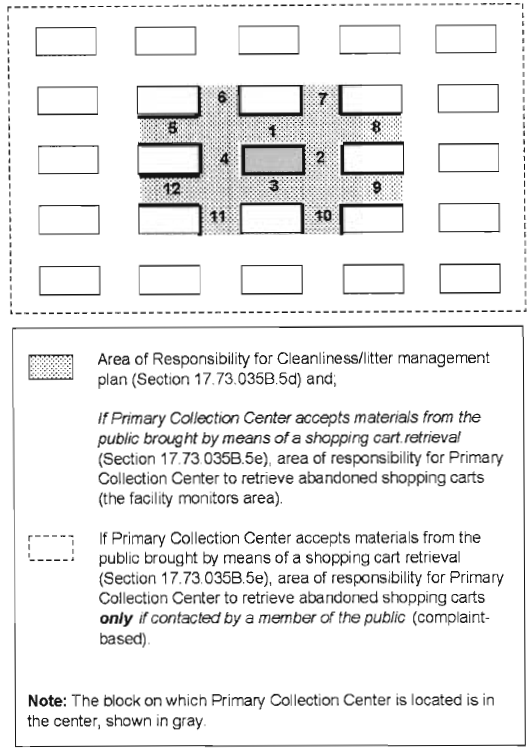
A cleanliness/litter management and control plan shall be developed, implemented and maintained, such that it is ready for inspection. The plan shall include provisions for the disposal of recycling-related litter and debris in the public right-of-way within the area comprised of all streets adjacent to the premises, and the one-block extension of those streets to the north and south, and east and west, respectively (See Figure 17.73.01). This would not include material illegally dumped that is not related to the recycling operation, including but not limited to, hazardous material, containers of paint or unidentified liquids, tree trimmings, residential, commercial and/or industrial waste or dumping of materials not accepted by the Primary Recycling Collection Center. In addition, the Primary Recycling Collection Center shall produce a notice to distribute to customers that states that all illegal dumping shall be reported to City authorities.
e.
A site/immediate neighborhood shopping cart management plan shall be developed, implemented and maintained, such that it is ready for inspection. If the Primary Recycling Collection Center accepts materials from the public brought by means of a shopping cart, it shall be responsible for the retrieval of all shopping carts within the area comprised of all streets adjacent to the premises, and the one-block extension of those streets to the north and south, and east and west, respectively (See Figure 17.73.01). Additionally, a Primary Recycling Collection Center shall post signage that includes contact information to report abandoned shopping carts in the vicinity of the facility; if called or notified by a member of the public about abandoned shopping carts located within a two-block radius of the premises, a Primary Recycling Collection Center shall retrieve said carts. A two-block radius of the premises shall comprise all street sides of the twenty-five (25) square block area that includes the block on which the premises is located (as the center block of the twenty-five (25) square block area) See Figure 17.73.01).
f.
A loitering deterrence plan shall be developed, implemented and maintained, such that is ready for inspection;
6.
Circulation. For new or expanded uses submittal and approval of the following plans, and implementation of approved plans are required:
a.
A circulation plan that shows ingress and egress, parking both on-site and off-street, as well as includes provisions for any needed staff to monitor on-site traffic operations, submitted to the Transportation Services Division;
b.
A plan showing rail loading and unloading within site shall be required (as applicable) submitted to the Transportation Services Division.
7.
Equipment and Facilities. For existing, new or expanded uses:
a.
There shall be no exterior pay telephones located at the site;
b.
All equipment shall be maintained and kept in good working order;
c.
After business hours, all facility-owned vehicles shall be stored within the facility or at an appropriate alternative off-street location.
8.
Operations. All existing, new or expanded uses:
a.
Shall have a representative attend Neighborhood Crime Prevention Council meetings—a minimum of two (2) meetings per year or more frequently if items pertaining to their facility are on the agenda—for their community policing beat with the sole purpose of addressing and responding to community complaints. For the purposes of this provision said representative will mean a site or company manager with sufficient authority to address the concerns of neighbors;
b.
Shall maintain a 24-hour "hotline" where neighbors can log complaints regarding nuisance activity associated with or emanating from the recycling facility. Complaints logs shall be maintained and made available to the City for inspection/copying upon reasonable notice;
Figure 17.73.01: Illustration of Extent of Area Primary Recycling Collection Centers are responsible for Litter/Garbage/Debris Removal and Shopping Cart Retrieval
c.
Shall provide staff and training for traffic operations needed on-site, as required by the Transportation Services Division as part of any circulation plan;
d.
Shall develop, implement and maintain a plan for the disposal and containment of non-recoverable materials that is ready for inspection; submittal and approval of such a plan prior to operation shall be required for new or expanded uses;
e.
Shall keep all entrance gates closed and locked when the Primary Recycling Collection facility is not open to the public;
f.
Shall not burn insulation from copper wire as a means to increase the material's value or for any other purpose.
C.
Relief from Performance Standards. Any person who owns or operates, or who has applied to construct, expand, modify or establish an activity or facility that involves Primary Recycling Collection Centers which would be affected by the performance standards required, and who contends that the performance standards as applied to him or her would be unlawful under Federal, State, or local law or regulation, may submit a written application to the Planning Director requesting relief from the performance standards within ten (10) days of being initially notified of the performance standards. For purposes of this Section, notice to a predecessor in interest shall constitute such initial notice to subsequent owners/operators. The written request for relief from these performance standards must: (a) identify the name and address of the applicant and business; (b) the affected application number; (c) specifically state how the performance standards as applied to him or her would be unlawful under Federal, State, or local law or regulation; and (d) include all appropriate legal and factual support for the request for relief. Within thirty (30) days of receipt of the completed request for relief, the Planning Director, or his/her designee, shall mail to the applicant a written determination. The applicant may appeal such determination pursuant to the provisions in Oakland Planning Code Chapter 17.132.
(Ord. No. 13763, § 5, 10-3-2023; Ord. No. 13357, § 3(Exh. A), 2-16-2016; Ord. No. 13251, § 5(Exh. A), 7-29-2014)
17.73.040 - Special regulations for Work/Live units in the CIX, IG, and IO Industrial Zones.
A.
Applicability. A Work/Live unit in the CIX, IG, and IO Industrial Zones must meet all applicable regulations contained in this Section. The CIX, IG, and IO Zones regulations contained in this Section supersede regulations contained in Section 17.102.190 relating to the conversion of buildings originally designed for Commercial or Industrial Activities into joint living and working quarters (JLWQs).
B.
Definition. The following definition applies to this Chapter only: A "Work/Live unit" means a room or suite of rooms that are internally connected maintaining a common household that includes: (1) cooking space and sanitary facilities that satisfy the provisions of other applicable codes, and (2) adequate working space reserved for, and regularly used by, one or more persons residing therein. A Work/Live unit accommodates a primary Nonresidential Activity with an accessory residential component.
C.
Conditional Use Permit required.
1.
Establishment of a Work/Live unit is only permitted upon determination that the proposal conforms to the Conditional Use Permit criteria set forth in the Conditional Use Permit procedure in Chapter 17.134 and to one or both of the following additional use permit criteria:
a.
The project is in the CIX Zones, and involves new construction or conversion of an existing building originally designed for Commercial or Industrial Activities located within three hundred (300) feet of a Residential Zone;
b.
The project is in the CIX, IG, or IO Zones, and involves conversion of an existing building originally designed for Commercial or Industrial Activities and there are existing artist and/or artisan residents who meet the requirements of Zoning Code Bulletin regarding "Live/Work" (issued August 29, 2001 and amended August 23, 2004).
D.
Design review required. Establishment of a Work/Live unit in the CIX, IG, and IO Industrial Zones shall conform to the design review criteria set forth in the design review procedure in Chapter 17.136 and if Regular Design Review is applicable, to all of the following additional criteria:
1.
That the exterior of a new building containing primarily Work/Live units in the CIX, IG or IO Industrial Zones has a commercial or industrial appearance. This includes, but is not necessarily limited to, the use of nonresidential building styles or other techniques;
2.
That units on the ground floor or level of a building have a business presence on the street. This includes, but is not necessarily limited to, providing roll up doors at the street or storefront style windows that allow interior space to be visible from the street, a business door that is oriented towards the street, a sign or other means that identifies the business on the door and elsewhere, a prominent ground floor height, or other techniques;
3.
That the layout of nonresidential floor areas within a unit provides a functional and bona fide open area for working activities;
4.
That the floor and site plan for the project include an adequate provision for the delivery of items required for a variety of businesses. This may include, but is not necessarily limited to, the following:
a.
Service elevators designed to carry and move oversized items;
b.
Stairwells wide and/or straight enough to deliver large items;
c.
Loading areas located near stairs and/or elevators; and
d.
Wide corridors for the movement of oversized items; and
5.
That the floor and site plan for the project provide units that are easily identified as businesses and conveniently accessible by clients, employees and other business visitors.
E.
Activity, parking, loading, open space, and unit size standards for Work/Live units in the CIX, IG, and IO Industrial Zones. The following table contains the activities allowed in a Work/Live unit; the minimum size of an industrial Work/Live unit; and the parking, loading and open space required for each Work/Live unit:
Table 17.73.040.C Activity, parking, loading, open space, and unit size standards for Work/Live units in the CIX, IG, and IO Industrial Zones.
Notes:
1. See Chapter 17.116 for off-street parking standards.
2. All required usable open space shall meet the usable open standards contained in Chapter 17.126, except that all usable open space for Work/Live units may be provided above ground. Further, each one (1) square foot of private usable open space equals two (2) square feet towards the total usable open space requirement.
3. Parking, loading, and open space standards shall apply to new construction and additions only. No additional parking, loading or open space is required for newly established Work/Live units within an existing building. For conversion of existing buildings, maintaining the amount of existing parking, loading, and open space is required to at least these minimum standards. If there is more parking, loading, and open space on the lot than required, then each can be reduced to the minimum required.
F.
A Work/Live unit shall consist of a maximum of one-third (⅓) residential floor area with the remaining floor area to be used for the primary Nonresidential Activity. All required plans for the creation of industrial Work/Live units shall: (1) delineate areas designated to contain Residential Activities and areas designated to contain Nonresidential Activities, and (2) contain a table showing the square footage of each unit devoted to Residential and Nonresidential Activities.
G.
Work/Live units shall be considered Commercially/Industrially Oriented Joint Living and Working Quarters under the Building Code. Any building permit plans for the construction or establishment of Work/Live units shall: (1) clearly state that the proposal includes Commercial/Industrially Joint Living and Working Quarters and (2) label the units intended to be these units as Commercially/Industrially Joint Living and Working Quarters. This requirement is to assure the City applies building codes that allow Industrial Activities in Work/Live units in the CIX, IG, and IO Industrial Zones.
H.
Each unit shall contain at least one (1) tenant that operates a business within that unit. That tenant shall possess a valid and active City of Oakland Business Tax Certificate to operate a business out of the unit.
I.
For any Work/Live unit in the CIX, IG, and IO Industrial Zones, a statement of disclosure shall be: (1) provided to prospective owners or tenants before a unit or property is rented, leased, or sold, and (2) recorded with the County of Alameda as a Notice of Limitation and in any other covenant, conditions and restrictions associated with a facility. This statement of disclosure shall contain the following acknowledgments:
1.
The unit is in a Nonresidential Facility that allows Commercial and/or Industrial Activities that may generate odors, truck traffic, vibrations, noise and other impacts at levels and during hours that residents may find disturbing.
2.
Each unit shall contain at least one (1) tenant that operates a business within that unit. This tenant must possess an active City of Oakland Business Tax Certificate for the operation out of the unit.
J.
Each building in the CIX, IG, and IO Industrial Zones with a Work/Live unit shall contain a sign that: (1) is permanently posted; (2) is at a common location where it can be frequently seen by all tenants such as a mailbox, lobby, or entrance area; (3) is made of durable material; (4) has a minimum dimension of nine (9) by eleven (11) inches and lettering at least one-half (½) an inch tall. This sign shall contain the following language: "This development contains work/live units. As such, please anticipate the possibility of odors, truck traffic, noise or other impacts at levels and hours that residents may find disturbing."
K.
The development of Work/Live units in the CIX, IG, and IO Industrial Zones shall not be considered adding housing units to the City's rental supply, nor does it create "conversion rights" under the City's condominium conversion ordinance, O.M.C. Chapter 16.36, nor are the development standards for Work/Live units intended to be a circumvention of the requirements of the City's condominium conversion ordinance, O.M.C. Chapter 16.36.
(Ord. No. 13779, § 2(Exh. A), 1-16-2024; Ord. No. 13763, § 5, 10-3-2023; Ord. No. 13518, § 4(Exh. A), 2-5-2019; Ord. No. 13357, § 3(Exh. A), 2-16-2016; Ord. No. 13251, § 5(Exh. A), 7-29-2014)
17.73.050 - Parking and loading dock restrictions.
A.
Off-street parking and loading shall be provided as prescribed in the off-street parking and loading requirements in Chapter 17.116.
B.
Parking for new development shall be located at the rear of the site or at the side of the building in the CIX and IO Zones except for drop-off areas, which may be at the entry, except where access to existing loading docks and/or rail lines is required. New truck loading docks shall not be located closer than fifty (50) feet from property line as measured from the subject dock to any property boundary if located within three hundred (300) feet of a Residential Zone, unless such a distance requirement will impede direct access to a rail line. Truck docks shall be located such that trucks do not encroach into the public right-of-way. All existing loading docks are not subject to this requirement.
(Ord. No. 13357, § 3(Exh. A), 2-16-2016; Ord. No. 13251, § 5(Exh. A), 7-29-2014)
17.73.060 - Referral to other applicable regulations.
The following table contains referrals to other regulations that may apply:
Table 17.73.050: Referral to Other Regulations
(Ord. No. 13868, § 2(Exh. A), 12-16-2026; Ord. No. 13779, § 2(Exh. A), 1-16-2024; Ord. No. 13357, § 3(Exh. A), 2-16-2016; Ord. No. 13251, § 5(Exh. A), 7-29-2014)
17.73.070 - Other zoning provisions.
A.
Parking and Loading. Off-street parking and loading shall be provided as prescribed in the off-street parking and loading requirements in Chapter 17.116.
B.
Bicycle Parking. Bicycle parking shall be provided as prescribed in the bicycle parking regulations in Chapter 17.117.
C.
Home Occupations. Home occupations shall be subject to the applicable provisions of the home occupation regulations in Chapter 17.112.
D.
Nonconforming Uses. Nonconforming uses and changes therein shall be subject to the nonconforming use regulations in Chapter 17.114.
E.
General Provisions. The general exceptions and other regulations set forth in Chapter 17.102 shall apply in the CIX, IG, and IO Zones.
F.
Recycling Space Allocation Requirements. The regulations set forth in Chapter 17.118 shall apply in the CIX, IG, and IO Zones.
(Ord. No. 13251, § 5(Exh. A), 7-29-2014)

