
Oakland City Zoning Code
CHAPTER 17
17 - RM MIXED HOUSING TYPE RESIDENTIAL ZONES REGULATIONS
Sections:
17.17.010 - Title, intent, and description.
A.
Title and Intent. The provisions of this Chapter shall be known as the RM Mixed Housing Type Residential Zones Regulations. The intent of the Mixed Housing Type Residential (RM) Zones is to create, maintain, and enhance residential areas typically located near the City's major arterials and characterized by a mix of single-family homes, townhouses, small multi-unit buildings, and neighborhood businesses where appropriate.
B.
Description of Primary Zones. This Chapter establishes land use regulations for the following four (4) primary zones:
1.
RM-1 Mixed Housing Type Residential - 1 Zone. The intent of the RM-1 Zone is to create, maintain, and enhance residential areas characterized by a mix of single family homes and duplexes, and neighborhood businesses where appropriate.
2.
RM-2 Mixed Housing Type Residential - 2 Zone. The intent of the RM-2 Zone is to create, maintain, and enhance residential areas characterized by a mix of single family homes, duplexes, townhouses, small multi-unit buildings, and neighborhood businesses where appropriate.
3.
RM-3 Mixed Housing Type Residential - 3 Zone. The intent of the RM-3 Zone is to create, maintain, and enhance residential areas characterized by a mix of single family homes, duplexes, townhouses, small multi-unit buildings at somewhat higher densities than in RM-2, and neighborhood businesses where appropriate.
4.
RM-4 Mixed Housing Type Residential - 4 Zone. The intent of the RM-4 Zone is to create, maintain, and enhance residential areas typically located on or near the City's major arterials and characterized by a mix of single family homes, townhouses, small multi-unit buildings at somewhat higher densities than RM-3, and neighborhood businesses where appropriate.
C.
Description of Combining Zone. This Chapter establishes land use regulations for the following combining zone:
1.
C Residential Commercial Combining Zone. The intent of the C Combining Zone is to allow for expanded commercial uses, as well as new commercial uses within certain areas of the Mixed Housing Type Residential (RM) Zones. When an above primary zone is combined with the C Combining Zone, the C Residential Commercial Combining Zone permitted uses supersede those of the primary zone.
(Ord. No. 13763, § 5, 10-3-2023; Ord. No. 13357, § 3(Exh. A), 2-16-2016; Ord. No. 13064, § 2(Exh. A), 3-15-2011)
17.17.020 - Required design review process.
Except for projects that are exempt from design review as set forth in Section 17.136.025, no Building Facility, Designated Historic Property, Potentially Designated Historic Property, Telecommunications Facility, Sign, or other associated structure shall be constructed, established, or altered in exterior appearance, unless plans for the proposal have been approved pursuant to the design review procedure in Chapter 17.136, and when applicable, the Telecommunications regulations in Chapter 17.128, or the Sign regulations in Chapter 17.104.
(Ord. No. 13064, § 2(Exh. A), 3-15-2011)
17.17.030 - Permitted and conditionally permitted activities.
Table 17.17.01 lists the permitted, conditionally permitted, and prohibited activities in the RM Zones. The descriptions of these activities are contained in Chapter 17.10. Section 17.10.040 contains permitted accessory activities.
"P" designates permitted activities in the corresponding zone.
"C" designates activities that are permitted only upon the granting of a Conditional Use Permit (CUP) in the corresponding zone (see Chapter 17.134 for the CUP procedure).
"L" designates activities subject to certain limitations or notes listed at the bottom of the table.
"—" designates activities that are prohibited except as accessory activities according to the regulations contained in Section 17.010.040.
Table 17.17.01: Permitted and Conditionally Permitted Activities
Limitations on Table 17.17.01:
* If an RM Base Zone (RM-1, RM-2, RM-3, or RM-4) also has the C Combining Zone, the C regulations supersede the Base Zone.
L1. See Section 17.103.010 for other regulations regarding Residential Care Residential Activities, and Sections 17.103.010 and 17.103.015 for other regulations regarding Emergency Shelter Residential Activities.
L2. Emergency Shelters are permitted by-right on properties owned by churches, temples, synagogues, and other similar places of worship approved for Community Assembly Civic Activities; and within that portion of the Martin Luther King Jr. Way corridor described in Section 17.103.015(A)(1) and subject to the development standards in Section 17.103.015(B); prohibited elsewhere in the zone.
L3. Reserved.
L4. The overall outside dimensions of an existing Nonresidential Facility built prior to April 14, 2011 devoted to this activity shall not be increased; and no open parking, loading, or production serving such activity shall be increased in size. For the purposes of this limitation, a facility is considered existing if it received its certificate of occupancy or passed its final building inspection on its building permit. This regulation supersedes the applicable provisions in Chapter 17.114.
L5. These activities may only be located in an existing Nonresidential Facility that was built prior to April 14, 2011 or on the ground floor of a new Nonresidential Facility, and may only operate within the hours of 7:00 a.m. and 10:00 p.m.; a Conditional Use Permit (CUP) is required if the total floor area devoted to these activities on any single lot exceeds three thousand (3,000) square feet (see Chapter 17.134 for the CUP procedure). For the purposes of this limitation, a facility is considered existing if it received its certificate of occupancy or passed its final building inspection on its building permit.
L6. In the case of an existing, nonconforming Alcoholic Beverage Sales Activity, the total floor area, open areas, or outside building dimensions occupied by the establishment shall not be increased. This regulation supersedes the Nonconforming Activity [in] Subsection 17.114.080.A.1.
L7. These activities may only be located in an existing Nonresidential Facility that was built prior to April 14, 2011 or on the ground floor of a new Nonresidential Facility, and the activity may only operate within the hours of 7:00 a.m. and 10:00 p.m. For the purposes of this limitation, a facility is considered existing if it received its certificate of occupancy or passed its final building inspection on its building permit.
L8. Adult Entertainment Activities are prohibited.
L9. These activities may only be located in an existing Nonresidential Facility that was built prior to April 15, 2011. For the purposes of this limitation, a facility is considered existing if it received its certificate of occupancy or passed its final building inspection on its building permit. Also, these activities may only operate within the hours of 7:00 a.m. and 10:00 p.m.; a Conditional Use Permit (CUP) is required if the total floor area devoted to these activities on any single lot exceeds one thousand five hundred (1,500) square feet (see Chapter 17.134 for the CUP procedure).
L10. Limited Agriculture is permitted if the activity occupies less than twenty thousand (20,000) square feet of land area and any on-site sales occur no more than two (2) times per week between the hours of 8:00 am and 9:00 pm in a temporary movable structure not exceeding two hundred (200) square feet in size; conditionally permitted if the activity is larger in either land area, or in sales area, frequency, or hours of operation (see Chapter 17.134 for the CUP procedure).
L11. Extensive Agriculture is only permitted upon the granting of a Conditional Use Permit (see Chapter 17.134 for the CUP procedure). In addition to the criteria contained in Section 17.134.050, this activity must meet the following use permit criteria:
a. The proposal will not adversely affect the livability or appropriate development of abutting properties and the surrounding neighborhood in terms of noise, water and pesticide runoff, farming equipment operation, hours of operation, odor, security, and vehicular traffic.
L12. Notwithstanding anything to the contrary contained in the Planning Code, a Major Conditional Use Permit is required if these activities are to be located in the residentially zoned areas between 53rd Street, 55th Street, Martin Luther King Jr. Way, and Highway 24 (see Chapter 17.134 for the CUP procedure).
(Ord. No. 13868, § 2(Exh. A), 12-16-2026; Ord. No. 13763, § 5, 10-3-2024; Ord. No. 13357, § 3(Exh. A), 2-16-2016; Ord. No. 13270, § 3(Exh. A), 11-18-2014; Ord. No. 13248, § 3(Exh. A), 7-15-2014; Ord. No. 13172, § 3(Exh. A), 7-2-2013; Ord. No. 13090, § 4(Exh. A), 10-4-2011; Ord. No. 13064, § 2(Exh. A), 3-15-2011)
17.17.040 - Permitted and conditionally permitted facilities.
Table 17.17.02 lists the permitted, conditionally permitted, and prohibited facilities in the RM Zones. The descriptions of these facilities are contained in Chapter 17.10. Section 17.10.040 contains permitted accessory activities.
"P" designates permitted facilities in the corresponding zone.
"C" designates facilities that are permitted only upon the granting of a Conditional Use Permit (CUP) in the corresponding zone (see Chapter 17.134 for the CUP procedure).
"L" designates facilities subject to certain limitations listed at the bottom of the table.
"—" designates facilities that are prohibited.
Table 17.17.02: Permitted and Conditionally Permitted Facilities
Limitations on Table 17.17.02:
* If an RM Base Zone (RM-1, RM-2, RM-3, or RM-4) also has the C Combining Zone, the C regulations supersede the Base Zone.
L1. See Section 17.103.080 and Chapter 17.88 for regulations regarding permitted Accessory Dwelling Units. Also, see Table 17.17.03, Property Development Standards, for additional regulations on density.
L2. Sidewalk cafes are allowed only as an accessory facility to an approved Full Service Restaurant or Limited Service Restaurant and Cafe. The sidewalk cafe may only operate within the hours of 7:00 a.m. to 10:00 p.m. See Section 17.103.090 for other regulations regarding Sidewalk Cafes; however, the regulations in this Section supersede any contradicting regulations in Section 17.103.090.
L3. For RM Zones without the C Combining Zone, Business Signs are only allowed on existing Nonresidential Facilities built prior to April 14, 2011; otherwise Chapter 17.104 applies. For the purposes of this limitation, a facility is considered existing if it received its certificate of occupancy or passed its final building inspection on its building permit. Also, the maximum aggregate area of display surface of all Business, Civic, and Residential Signs on any one lot shall be 0.5 square foot for each one foot of lot frontage in the case of an interior lot, or 0.25 square feet for each one foot of lot frontage in the case of a corner lot. The aggregate shall include only one face of a double-faced sign. The total amount of aggregate sign area shall not exceed one hundred (100) square feet on any one property. See Chapter 17.104 for other regulations regarding Business Signs; however, the regulations in this Section supersede any contradicting regulations in Chapter 17.104.
L4. Business Signs are allowed in the C Combining Zone on existing or new Nonresidential Facilities. The maximum aggregate area of display surface of all Business, Civic, and Residential Signs on any one lot shall be one square foot for each one foot of lot frontage in the case of an interior lot, or 0.5 square feet for each one foot of lot frontage in the case of a corner lot. The aggregate shall include only one face of a double-faced sign. The total amount of aggregate sign area shall not exceed one hundred (100) square feet on any one property. See Chapter 17.104 for other regulations regarding Business Signs; however, the regulations in this Section supersede any contradicting regulations in Chapter 17.104.
L5. For RM Zones with the C Combining Zone, no Conditional Use Permit (CUP) is required for Open Nonresidential Facilities to accommodate Civic Activities, Limited Agriculture, seasonal sales, or special events.
(Ord. No. 13763, § 5, 10-3-2023; Ord. No. 13677, § 4(Exh. A), 1-18-2022; Ord. No. 13666, § 3(Exh. A), 11-16-2021; Ord. No. 13357, § 3(Exh. A), 2-16-2016; Ord. No. 13270, § 3(Exh. A), 11-18-2014; Ord. No. 13251, § 5(Exh. A), 7-29-2014; Ord. No. 13172, § 3(Exh. A), 7-2-2013; Ord. No. 13090, § 4(Exh. A), 10-4-2011; Ord. No. 13064, § 2(Exh. A), 3-15-2011; )
17.17.050 - Property development standards.
A.
Zone Specific Standards. Table 17.17.03 below prescribes development standards specific to individual zones. The number designations in the "Additional Regulations" column refer to the regulations listed at the end of the Table. "N/A" designates the standard is not applicable to the specified zone.
Table 17.17.03: Property Development Standards
Additional Regulations for Table 17.17.03:
1. See Sections 17.106.010 and 17.106.020 for exceptions to lot development standard regulations.
2. See Chapter 17.107 for affordable and senior housing incentives; and Section 17.103.080 and Chapter 17.88 for regulations regarding permitted Accessory Dwelling Units. Also applicable are the provisions of Section 17.102.270 with respect to additional kitchens for a primary dwelling unit, and the provisions of Section 17.102.300 with respect to dwelling units with five (5) or more bedrooms.
3. See Chapter 17.136 for the applicable design review procedure.
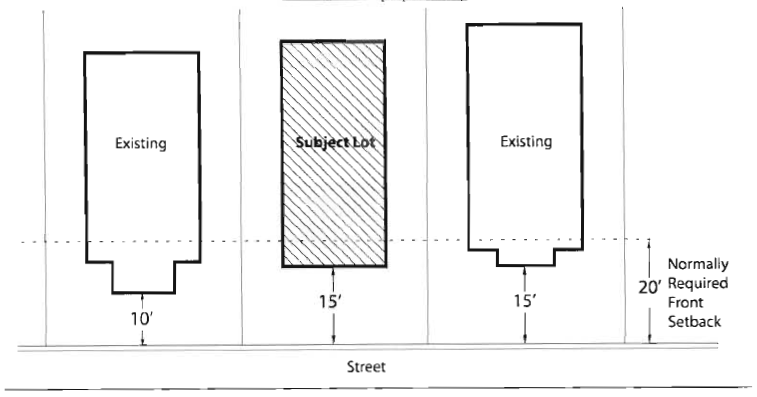
4. If adjacent lots abutting the side lot lines of the subject lot both contain principal Residential Facilities that have front setbacks with a depth of less than the minimum required in this Chapter, the minimum front setback shall be reduced for buildings and other structures on the subject lot up to a line parallel to the front lot line and extended from the most forward projection of the principal Residential Facility on the adjacent lots having the deeper front setback depth. In the case of a corner lot, or lot that has one or more vacant parcels next to it, this same principal shall apply if the nearest non-vacant lot to each side of a corner lots, or to each side of a lot that has one or more vacant parcels next to it, have less than the minimum front setback required in this Chapter (see Illustration for Table 17.17.03 [Additional Regulation 4], below). Also, see Section 17.108.130 for allowed projections into setbacks.
Illustration for Table 17.17.03 [Additional Regulation 4]
*For illustration purposes only
5. On lots with only Residential Facilities, paved surfaces within required street-fronting yards, and any unimproved rights-of-way of adjacent streets, shall be limited to fifty percent (50%) on interior lots and thirty percent (30%) on corner lots. Exceptions: The maximum percentages of paved surfaces specified in this additional regulation may be exceeded within unimproved rights-of-way in the following cases upon issuance of a private construction of public improvements (P-job) permit or if undertaken directly by the City or by a private contractor under contract to the City:
a. Roadway construction or widening;
b. Sidewalk construction or widening; and
c. Any work pursuant to an approved final map, parcel map or final development plan pursuant to a Planned Unit Development (PUD) permit.
For purposes of this additional regulation, an unimproved right-of-way is the portion of a street or alley right-of-way that is not paved.
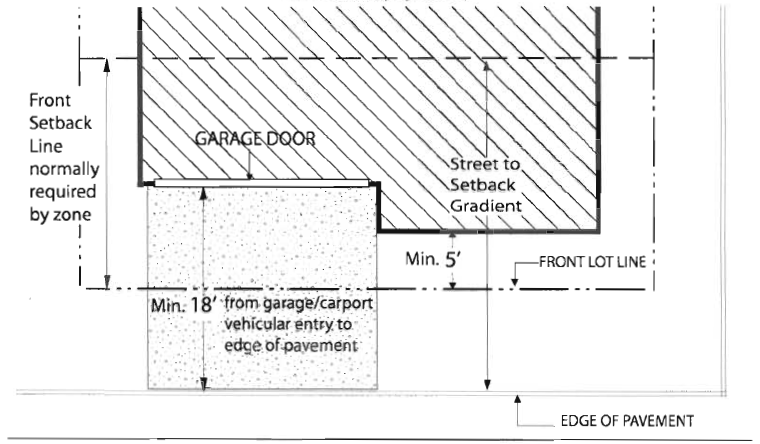
6. In all RM Zones, the minimum front setback depth otherwise required by the applicable individual zone regulations shall be reduced to five (5) feet on any lot with a street-to-setback gradient that exceeds twenty percent (20%), provided, however, that the distance from a garage or carport elevation containing one or more vehicular entries to the edge of the street or sidewalk pavement, whichever is closer, shall be at least eighteen (18) feet (see Illustration for Table 17.17.03 [Additional Regulation 6], below). See Section 17.108.130 for allowed projections into setbacks.
Illustration for Table 17.17.03 [Additional Regulation 6]
*for illustration purposes only
7. Except as stated below in this limitation, no front or side setbacks are required for the following facilities in the C Combining Zone:
a. Existing Commercial Facilities;
b. New principal buildings that include ground floor Commercial Facilities; and
c. New Commercial Facilities located to the front of a Potential Designated Historic Property (PDHP) or Designated Historic Property (DHP), but only if the height of the new Commercial Facility in the area between the front property line and the front building elevation of the existing historic structure does not exceed fifteen (15) feet.
A side yard of the normally required minimum width in Table 17.17.03 shall be required for new construction or addition along any side lot line abutting an interior side lot line of any lot that is not located in a C Combining Zone or Commercial Zone. (Where it abuts a rear lot line, no side yard is required). Section 17.108.080 still applies. Also, see Section 17.108.130 for allowed projections into setbacks.
8. Table 17.17.04 for general reduced setbacks for smaller lots, and Section 17.108.130 for allowed projections into setbacks.
9. See Section 17.108.080 for the required interior side and rear setbacks on a lot containing two (2) or more living units and opposite a legally-required living room window.
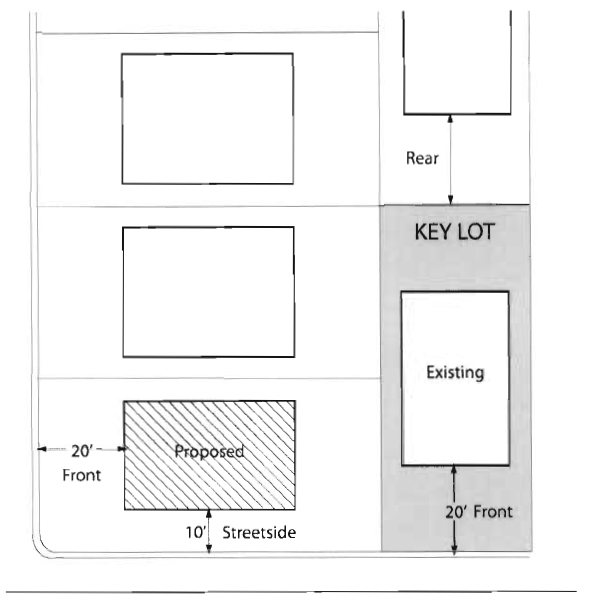
10. In all RM Zones, on every corner lot which abuts to the rear a key lot which is in a Residential Zone, there shall be provided on the street side of such corner lot a side setback with a minimum width equal to one-half (½) of the minimum front setback depth required on the key lot and no less than the minimum side setback width required along an interior side lot line of the corner lot. However, such side setback shall only apply to the rear ten (10) feet of the corner lot, and not be required to exceed four (4) feet in width if it would reduce to less than twenty-five (25) feet the buildable width of any corner lot. Such setback shall be provided unobstructed except for the accessory structures or the other facilities allowed therein by Section 17.108.130. This regulation does not apply to lots within the C Combining Zone (see Illustration for Table 17.17.03 [Additional Regulation 10], below). See also Subsection 17.110.040.C for special controls on location of detached accessory buildings on such corner lots.
Illustration Table 17.17.03 [Additional Regulation 10]
*for illustration purposes only
11. Wherever a rear lot line abuts an alley, one-half (½) of the right-of-way width of the alley may be counted toward the required minimum rear setback; provided, however, that the portion of the minimum rear setback depth actually on the lot itself shall not be reduced to less than ten (10) feet. Also, see Section 17.108.130 for allowed projections into setbacks.
12. See Section 17.108.030 for allowed projections above height limits and Section 17.108.020 for increased height limits in certain situations.
13. In the RM-2 Zone, the maximum pitched roof height shall only be permitted in conjunction with a project with a pitched roof having a vertical to horizontal ratio of a minimum of four in twelve (4:12) slope.
14. Off-street parking and loading shall be provided as prescribed in the off-street parking and loading requirements in Chapter 17.116. Bicycle parking shall be provided as prescribed in the bicycle parking regulations in Chapter 17.117. Also, additional parking standards apply within the S-11 and S-12 Zones, as prescribed in Chapters 17.92 and 17.94.
15. See Section 17.103.080 for additional parking regulations that apply to Accessory Dwelling Units.
16. Usable open space is only required on lots with two (2) or more dwelling units, excluding any permitted Accessory Dwelling Units. Each one (1) square foot of private usable open space equals two (2) square feet towards the total usable open space requirement, except that actual group space shall be provided in the minimum amount specified in the table per dwelling unit, excluding any permitted Accessory Dwelling Units. All usable open space shall meet the standards contained in Chapter 17.126.
17. This regulation does not apply in the C Combining Zone.
18. See Section 17.103.085 for setback and separation requirements for Vehicular Residential Facilities.
19. Maximum Lot Coverage and maximum Floor Area Ratio (FAR) only apply to lots with one to two dwelling units, excluding any permitted Accessory Dwelling Units. See Table 17.17.05 for applicable regulations.
20. This height is only required for new principal buildings that include ground floor Nonresidential Facilities, and is measured from the sidewalk grade to the second story floor. If the Nonresidential Facility is to be located to the front of a Potentially Designated Historic Property (PDHP) or Designated Historic Property (DHP), this height shall also be the maximum allowed for a Nonresidential Facility in the area between the front property line and the front building elevation of the existing historic structure.
21. For developments involving the creation of new units on two or more adjoining parcels under the same ownership, there is no minimum interior side setback required between those new units.
B.
Reduced Setbacks for Smaller Lots. Table 17.17.04 below prescribes reduced setback standards for lots less than three thousand (3,000) square feet. The number designations in the "Additional Regulations" column refer to the regulations listed at the end of the Table.
Table 17.17.04 Reduced Setbacks for Lots Less than Three Thousand (3,000) Square Feet
Additional Regulations for Table 17.17.04:
1. Except as stated below in this limitation, no front or side setbacks are required for the following facilities in the C Combining Zone:
a. New principal buildings that include ground floor Nonresidential Facilities; and
b. New Nonresidential Commercial Facilities associated with a Potential Designated Historic Property (PDHP) or Designated Historic Property (DHP), but only if there is an existing context within the adjoining block face of no front and/or side yard setback. For the purposes of this limitation, an "existing context" of no front or side yard setback means that at least sixty percent (60%) of the existing buildings from street corner to street corner on the same side of the street have no front or side yard setback. If the Commercial Facility is to be located to the front of a PDHP or DHP, the maximum height allowed for the portion of the Commercial Facility between the sidewalk and the existing structure shall be fifteen (15) feet.
A side yard of the normally required minimum width in Table 17.17.04 shall be required for new construction or addition along any side lot line abutting an interior side lot line of any lot that is not located in a C Combining Zone or Commercial Zone. (Where it abuts a rear lot line, no yard is required). Section 17.108.080 still applies. Also, see Section 17.106.010 for exceptions to lot development standard regulations and Section 17.108.130 for allowed projections into setbacks.
2. See Section 17.103.085 for setback and separation requirements for Vehicular Residential Facilities.
3. See Section 17.106.010 for exceptions to lot development standard regulations.
4. For developments involving the creation of new units on two or more adjoining parcels under the same ownership, there is no minimum interior side setback required between those new units.
C.
Maximum Floor Area Ratio (FAR) and Lot Coverage for One and Two Dwelling Units Only. Table 17.17.05 below prescribes FAR and lot coverage standards for one and two dwelling units associated with the lot sizes listed, excluding any permitted Accessory Dwelling Units. The numbers in the "Additional Regulations" column refer to the regulations listed at the end of the Table.
Table 17.17.05 Maximum Floor Area Ratio (FAR) and Lot Coverage Regulations for One and Two Dwelling Units Only
Additional Regulations for Table 17.17.05:
1. Maximum Floor Area Ratio (FAR) only applies to lots that have a footprint slope of greater than twenty percent (20%). Lots less than four thousand (4,000) square feet may have a minimum of two thousand (2,000) square feet of floor area, regardless of FAR listed.
2. Regulation does not apply in the C Combining Zone.
3. Lots less than four thousand (4,000) square feet may have a lot coverage of up to two thousand (2,000) square feet regardless of lot coverage percentage (%) listed.
4. See Section 17.106.010 for exceptions to lot development standard regulations.
D.
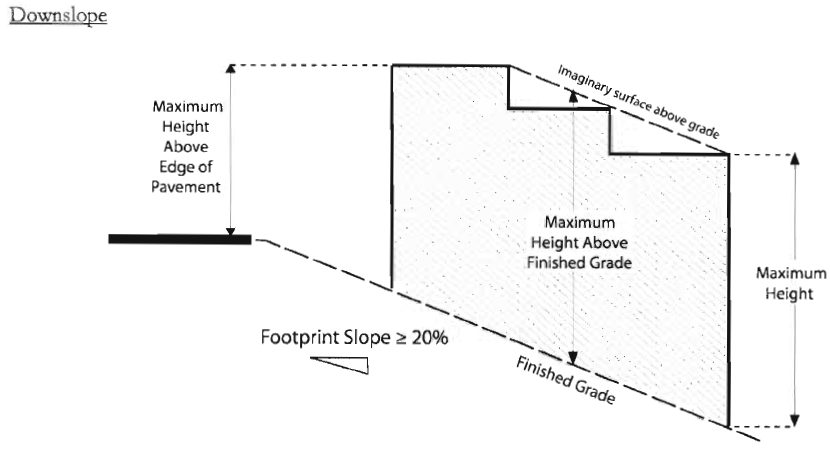
Height. Table 17.17.06 below prescribes height standards associated with different sloped lots. The numbers in the "Additional Regulations" column refer to the regulations listed at the end of the Table. "N/A" designates the regulation is not applicable to the specified footprint slope category.
Table 17.17.06 Height Regulations for all Lots With a Footprint Slope of >20%
Additional Regulations for Table 17.17.06:
1. See Section 17.108.030 for allowed projections above height limits and Section 17.108.020 for increased height limits in certain situations.
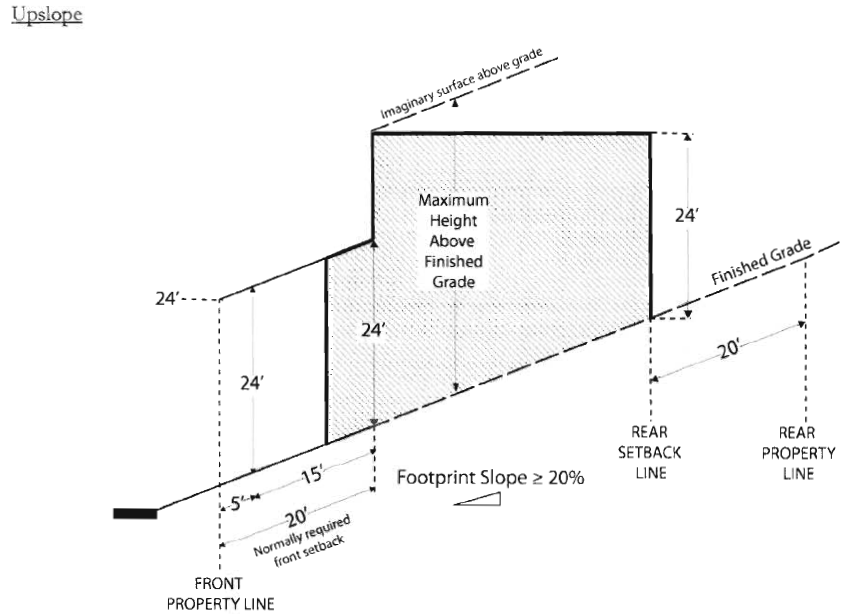
2. On a downslope lot greater than forty percent (40%) footprint slope, the rear wall of an attached garage or carport may exceed the wall height and roof height by five (5) feet, but may not exceed eighteen (18) feet above ground elevation at edge of pavement, if the garage or carport conforms with all of the following criteria:
a. Maximum width is twenty-two (22) feet and maximum depth is twenty (20) feet; and
b. Garage or carport floor is at the same level as the edge of the street pavement resulting from the project at the center point of the driveway entrance or is at a lower level; and
c. Maximum height above the garage or carport floor is ten (10) feet for walls to the top of the plate or flat roof, and twelve (12) feet for pitched roofs (see Illustration for Table 17.17.06 [Additional Regulation 2], below).
3. The building height is measured from finished or existing grade, whichever is lower.
Illustrations for Table 17.17.06 [Additional Regulation 2]
*for illustration purposes only
(Ord. No. 13868, § 2(Exh. A), 12-16-2026; Ord. No. 13805, § 2(Exh. A), 7-16-2024; Ord. No. 13763, § 5, 10-3-2023; Ord. No. 13677, § 4(Exh. A), 1-18-2022; Ord. No. 13666, § 3(Exh. A), 11-16-2021; Ord. No. 13596, § 2(Exh. A), 6-2-2020; Ord. No. 13518, § 4(Exh. A), 2-5-2019; Ord. No. 13357, § 3(Exh. A), 2-16-2016; Ord. No. 13251, § 5(Exh. A), 7-29-2014; Ord. No. 13172, § 3(Exh. A), 7-2-2013; Ord. No. 13090, § 4(Exh. A), 10-4-2011; Ord. No. 13064, § 2(Exh. A), 3-15-2011)
17.17.060 - Special regulations for Planned Unit Developments.
A.
Planned Unit Developments. Large integrated developments shall be subject to the Planned Unit Development (PUD) regulations in Chapter 17.142 if they exceed the sizes specified therein. In developments which are approved pursuant to said regulations, certain uses may be permitted in addition to those otherwise allowed in the RM Zones, and certain of the other regulations applying in said zone may be waived or modified. The normally required design review process may also be waived for developments at the time of initial granting of a Planned Unit Development (PUD) permit. Unless otherwise specified in the PUD permit, any future changes within the Planned Unit Development shall be subject to applicable design review regulations.
(Ord. No. 13779, § 2(Exh. A), 1-16-2024; Ord. No. 13763, § 5, 10-3-2023; Ord. No. 13357, § 3(Exh. A), 2-16-2016; Ord. No. 13251, § 5(Exh. A), 7-29-2014; Ord. No. 13172, § 3(Exh. A), 7-2-2013; Ord. No. 13064, § 2(Exh. A), 3-15-2011; Ord. No. 13677, § 4(Exh. A), 1-18-2022)
Editor's note— Ord. No. 13677, § 4(Exh. A), adopted Jan. 18, 2022, amended the title of § 17.17.060 to read as herein set out. The former § 17.17.060 title pertained to special regulations for Mini-Lot and Planned Unit Developments.
17.17.070 - Other zoning provisions.
A.
Home Occupations. Home occupations shall be subject to the applicable provisions of the home occupation regulations in Chapter 17.112. See Section 17.112.060 for home occupation regulations specific to the West Oakland Specific Plan Area.
B.
Nonconforming Uses. Nonconforming uses and changes therein shall be subject to the nonconforming use regulations in Chapter 17.114.
C.
General Provisions. The general exceptions and other regulations set forth in Chapters 17.102, 17.104, 17.106, and 17.108 shall apply in the RM Zones.
D.
Recycling Space Allocation Requirements. The regulations set forth in Chapter 17.118 shall apply in RM Zones.
E.
Landscaping and Screening Standards. The landscaping and screening regulations set forth in Chapter 17.124 shall apply in the RM Zones.
F.
Buffering. All uses shall be subject to the applicable requirements of the buffering regulations in Chapter 17.110 with respect to screening or location of parking, loading, storage areas, control of artificial illumination, and other matters specified therein.
(Ord. No. 13357, § 3(Exh. A), 2-16-2016; Ord. No. 13251, § 5(Exh. A), 7-29-2014; Ord. No. 13172, § 3(Exh. A), 7-2-2013; Ord. No. 13064, § 2(Exh. A), 3-15-2011)

