
Pawleys Island City Zoning Code
ARTICLE 1
- IN GENERAL
1-1.- Short title.
This Unified Development Code shall be known and may be cited as the "Town of Pawleys Island Unified Development Ordinance," except as referred to herein, where it shall be known as "this ordinance."
(Ord. No. 2003-29, § 1-1, 12-8-2003)
1-2. - Repeals and enactment.
1-2.1
Repeal of conflicting ordinances.
All ordinances, or portions thereof, of the Town of Pawleys Island, South Carolina, which relate to zoning, subdivision, dune protection, flood damage prevention and land use which are inconsistent with the provisions of this Unified Development Code are hereby repealed to the extent necessary to give this Unified Development Code full force and effect.
The existing Pawleys Island Flood Damage Prevention Ordinance and Pawleys Island Zoning Ordinance enacted on April 10, 1986, as amended, are hereby repealed. The adoption of the ordinance from which this Unified Development Code is derived, however, shall not affect nor prevent any pending or future prosecution of or action to abate any existing violation of said ordinances, as amended, if the violation is also a violation of the provisions of this Unified Development Code. All zoning maps previously adopted, pursuant to the zoning ordinance enacted on April 10, 1986, as amended, and any modifications or changes thereto are to remain in effect.
1-2.2
Enactment. This ordinance is hereby enacted and shall be the Unified Development Ordinance for Pawleys Island, South Carolina.
1-2.3
Effective date. This ordinance shall become effective on December 8, 2003.
(Ord. No. 2003-29, § 1-2, 12-8-2003)
1-3. - Purpose.
1-3.1
General purpose. It is the purpose of this Unified Development Code to promote the health, safety, and general welfare of the residents of Pawleys Island through the regulations of this Unified Development Code.
1-3.2
Zoning regulation purpose. The zoning regulations, adopted and prescribed in this Unified Development Code, are found by the town council to be necessary and appropriate to:
(A)
Lessen congestion in the roads;
(B)
Secure safety from fire, panic and other dangers;
(C)
Provide adequate light and air;
(D)
Prevent the overcrowding of land;
(E)
Avoid undue concentration of population;
(F)
Facilitate the adequate and economic provision of transportation, water, sewage, parks, and other public services;
(G)
Preserve and enhance visual attractiveness and economic vitality; and
(H)
Require appropriate setbacks for buildings and other structures to facilitate the safe movement of vehicular and pedestrian traffic, provide adequate fire lanes and ensure adequate distance from dust, noise and fumes created by vehicular traffic.
1-3.3
Development regulation purpose. Even though there is limited potential for new development in Pawleys Island, South Carolina, the development regulations, adopted and prescribed in this Unified Development Code, are found by the town council to be necessary and appropriate to:
(A)
Promote orderly growth and development;
(B)
Provide for suitable residential developments with adequate utilities and appropriate building sites;
(C)
Provide for the distribution of population and traffic in a manner which shall avoid congestion and overcrowding;
(D)
Provide for the dedication or reservation of adequate spaces for public lands and buildings;
(E)
Encourage design that is protective of environmental quality; and
(F)
Provide proper land records for the convenience of the public and for better identification and permanent location of real property boundaries.
1-3.4
Sign regulation purpose. The sign regulations, adopted and prescribed in this Unified Development Code, are found by the town council to be necessary and appropriate to:
(A)
Recognize that signs serve a legitimate public service and that they complement and support tourism and investment within the Town of Pawleys Island when used on a limited basis;
(B)
Encourage the effective use of signs as a means of visual communication;
(C)
Promote a positive community appearance for the enjoyment of all citizens;
(D)
Maintain and enhance the aesthetic environment;
(E)
Protect the public from damage or injury attributable to distractions and/or obstructions caused by improperly designed or located signs; and
(F)
Protect existing property values in residential areas.
1-3.5
Flood damage prevention regulation purpose. The flood damage prevention regulations, adopted and prescribed in this Unified Development Code, are found by the town council to be necessary and appropriate in order to:
(A)
Permit only that development within the floodplain which is appropriate in light of the probability of flood damage and which represents a reasonable social and economic use of land in relation to the hazards involved;
(B)
Comply with regulations promulgated by the Federal Emergency Management Agency designed to lesson the impacts associated with flood damage; and,
(C)
Minimize public and private losses due to flood conditions in specific areas by enactment of provisions designed to:
1)
Restrict or prohibit uses which are dangerous to health, safety and property due to water or erosion hazards, or which result in damaging increases in erosion or in flood heights or velocities;
2)
Require that uses vulnerable to floods, including facilities which serve such uses, be protected against flood damage at the time of initial construction;
3)
Control the alteration of natural floodplains, stream channels, and natural protective barriers which are involved in the accommodation of floodwaters;
4)
Control filling, grading, dredging and other development which may increase erosion or flood damage;
5)
Prevent or regulate the construction of flood barriers which will unnaturally divert floodwaters or which may increase flood hazards to other lands;
6)
Protect human life and health;
7)
Minimize expenditure of public money for costly flood control projects;
8)
Minimize the need for rescue and relief efforts associated with flooding and generally undertaken at the expense of the general public;
9)
Minimize damage to public facilities and utilities such as water, sewer, gas, electric, and telephones lines and roads and bridges located in floodplains;
10)
Provide for the sound use and development of floodprone areas in such a manner as to minimize flood blight areas;
11)
Permit and encourage the retention of open land uses which will be so located and designed as to constitute a harmonious and appropriate part of the physical development of the community and which will not impede the flow of floodwaters; and
12)
Ensure that potential buyers are notified whenever property is in a flood hazard area.
1-3.6
Sand dune protection regulation purpose. The sand dune protection regulations, adopted and prescribed in this Unified Development Code, are found by the town council to be necessary and appropriate in order to:
(A)
Protect public and private coastal property from damage caused by flooding and erosion;
(B)
Allow reasonable use of coastal property while promoting the general health, safety and welfare of the public by protecting the natural beach and dune system from alterations that impair their ability to serve as buffers from wind, water and wave action.
1-3.7
Miscellaneous regulation purpose. The miscellaneous regulations deal with storage and use of campers, motor homes and travel trailers, stormwater discharges, beach lighting, solid waste and property numbering. These regulations are found by the town council to be necessary and appropriate to:
(A)
Promote the general health, safety and welfare of the public;
(B)
Restrict or prohibit activities which are potentially hazardous or damaging to the environment;
(C)
Protect human life and health; and
(D)
Promote a positive community appearance for the enjoyment of all citizens.
(Ord. No. 2003-29, § 1-3, 12-8-2003)
1-4. - Jurisdiction.
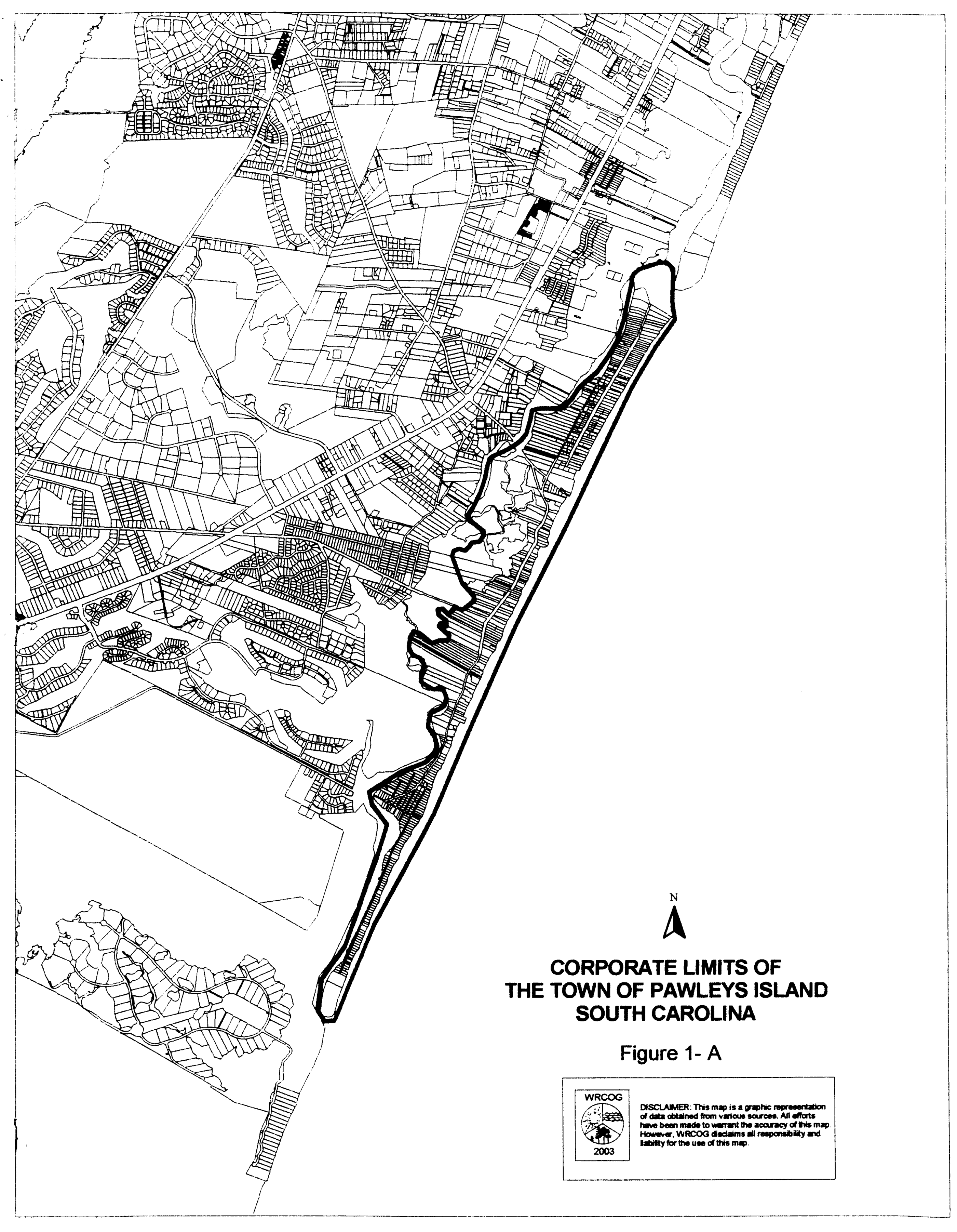
The standards contained herein shall hereafter apply to all territory within the corporate limits of the Town of Pawleys Island, South Carolina. Figure 1-A displays the corporate limits of the Town of Pawleys Island, South Carolina.
(Ord. No. 2003-29, § 1-4, 12-8-2003)
1-5. - Authority.
Pursuant to authority conferred by the General Statutes of South Carolina, Title 5, Chapters 7, 23 and 25 and Title 6, Chapter 7 and amendments thereto, the town council of Pawleys Island does ordain and enact into law this Unified Development Code. This Unified Development Code may be amended from time to time by subsequent action by the town council.
(Ord. No. 2003-29, § 1-5, 12-8-2003)
1-6. - Abrogation and greater restrictions.
This Unified Development Code is not intended to repeal, abrogate, annul, impair or interfere with any existing easements, covenants, deed restrictions, agreements, rules, regulations, or permits previously adopted or issued pursuant to law. However, where these regulations and others conflict or overlap, whichever imposes the more stringent restrictions shall prevail.
(Ord. No. 2003-29, § 1-6, 12-8-2003)
1-7. - Compliance.
No building, premises, or structure shall be constructed, erected, modified, converted, occupied, placed, maintained or moved, and no land use shall be commenced, maintained, or modified, except as authorized by this Unified Development Code.
(Ord. No. 2003-29, § 1-7, 12-8-2003)
1-8. - Interpretation.
In the interpretation and application of this ordinance, all provisions shall be considered as minimum requirements, liberally construed in favor of the governing body, and deemed neither to limit nor repeal any other powers granted under state law. This ordinance is not intended to repeal, abrogate, or impair any existing easements, covenants, or deed restrictions. However, where this ordinance and another conflict or overlap, whichever imposes the more stringent restrictions, shall prevail.
(Ord. No. 2003-29, § 1-8, 12-8-2003; Ord. No. 2023-05, 5-2-2023)
1-9. - Relationship to the comprehensive plan.
It is the intention of the town council that this Unified Development Code implement the planning policies adopted by the Town Council for Pawleys Island, as reflected in the Pawleys Island Comprehensive Plan. While the town council reaffirms its commitment that this Unified Development Code and any amendment to it be in conformity with the comprehensive plan, the town council hereby expresses its intent that neither this Unified Development Code nor any amendment to it may be challenged on the basis of any alleged nonconformity with any planning document.
(Ord. No. 2003-29, § 1-9, 12-8-2003)
1-10. - Fees.
Reasonable fees sufficient to cover the costs of administration, inspection, publication of notice and similar matters may be charged to applicants for zoning permits, sign permits, conditional use permits, special use permits, subdivision plat approval, zoning amendments, variances and other administrative relief. The fee schedule may be found in figure 1-B.
FIGURE 1-B
FEE SCHEDULE
TOWN OF PAWLEYS ISLAND, SOUTH CAROLINA
BUILDING PERMIT FEES
No permit shall be issued until the prescribed fee shall have been paid. No amendment to a permit shall be approved until the additional fee, if any, shall have been paid, and that if any person commences any work on a building or structure, or starts any development before obtaining the necessary permit from the building official he shall be subject to a penalty of a double permit fee, which is in addition to any other penalties which may be assessed pursuant to applicable law, and that the building official shall keep a permanent and accurate accounting of all permits and fees and all other monies collected. Prior to issuance of the certificate of occupancy, the owner, or agent, shall certify actual cost. This building permit shall expire exactly one year from the date of issue. The maximum of a six-month extension may be authorized by the building and zoning office, upon the application thereof and a fee of $20.00 being paid by the applicant. If the work described in any building permit has not begun within six months from the date of issuance thereof, said permit shall expire; it shall be canceled by the building inspector and written notice thereof shall be given to the person affected. A copy of all building permit applications and certificates of occupancy shall be kept on file in the building office for a period of three years. A fee shall be paid at the time of issuance of a permit for all buildings, structures, and developments in accordance with the following schedule:
For the moving of any building or structure, the fee shall be $100.00.
For the demolition of any building or structure, the fee shall be $100.00.
For reinspection when the permittee fails to have the facility open for inspection or does not have construction at the proper stage for the inspection requested, the fee shall be $50.00 or each such reinspection, to be paid before the reinspection is made.
When the value of the proposed construction exceeds $10,000.00 or a plan is required to be submitted, a plan checking fee shall be paid to the building official at the time of the issuance of the building permit. Said plan checking fee shall be equal to one-half of the building permit fee but in no case less than $50.00.
If in the opinion of the building official the valuation of building or alteration of structure appears to be underestimated on the application, the permit shall be denied, unless the applicant can show detailed estimated cost to meet the approval of the Building Official. Permit valuations shall include the total cost such as plumbing, electrical and mechanical equipment and other systems to be a part of the structure.
(Ord. No. 2003-29, § 1-10, 12-8-2003)
1-11. - Severability.
1-11.1
Invalidation. Should any section, sentence, clause, phrase, or word of this Unified Development Code be held invalid or unconstitutional by a court of competent jurisdiction of either the State of South Carolina or the United States, such decision shall not affect, impair, or invalidate the validity of the remaining parts of this Unified Development Code which can be given effect without the invalid provision.
1-11.2
Prejudicial application. If any section, sentence, clause, phrase, or word of this Unified Development Code is held invalid or unconstitutional in its application to a particular case, such decision shall not affect or prejudice its application to other cases.
1-11.3
Lawful presumption. There shall be a conclusive presumption when the building official, planning commission, board of zoning appeals or the town council authorizes regulatory action, that such administrator or board would not have authorized such action except in the belief that such action was lawful.
(Ord. No. 2003-29, § 1-11, 12-8-2003)
1-12. - Penalties for violation.
Violation of the provisions of this ordinance or failure to comply with any of its requirements, including violation of conditions and safeguards established in connection with grants of variance or special exceptions, shall constitute a misdemeanor. Any person who violates this ordinance or fails to comply with any of its requirements shall, upon conviction thereof, be fined not more than $500.00 or imprisoned for not more than 30 days, or both. Each day the violation continues shall be considered a separate offense. Nothing herein contained shall prevent the town from taking such other lawful action as is necessary to prevent or remedy any violation.
(Ord. No. 2003-29, § 1-12, 12-8-2003; Ord. No. 2023-05, 5-2-2023)
1-13. - Decision matrix.
Throughout this Unified Development Code, there are requirements for various types of approvals of plans, amendments, variances, etc. All such approvals have been summarized in a decision matrix and may be found in appendix A which is attached to Ordinance No. 2003-29.
(Ord. No. 2003-29, § 1-13, 12-8-2003)
1-14. - General.
Pursuant to South Carolina Title 6, Chapter 9, as may be amended by the General Assembly, the Town of Pawleys Island hereby automatically adopts the latest edition of the mandatory building codes, as amended from time to time by the South Carolina Building Code Council and shall be applicable to all provisions of this Unified Development Ordinance herein. It is the intent of this ordinance to adopt the mandatory building codes prescribed by the South Carolina Building Code Council as amended as it relates to all building code matters for the present and any amendments made in the future.
(Ord. No. 2008-09, § 1-14, 8-11-2008; Ord. No. 2013-09, 8-12-2013; Ord. No. 2018-02, 4-9-18)

