
Pawleys Island City Zoning Code
ARTICLE 5
- FLOOD HAZARD REDUCTION
5-1.- General provisions.
5-1.1.
Lands to which this ordinance applies. This ordinance shall apply to all areas of special flood hazard within the jurisdiction of the town as identified by the Federal Emergency Management Agency (FEMA) in its Flood Insurance Study, dated May 9, 2023 with accompanying maps and other supporting data that are hereby adopted by reference and declared to be a part of this ordinance.
Upon annexation, any special flood hazard areas identified by the Federal Emergency Management Agency (FEMA) in its Flood Insurance Study for the unincorporated areas of the county, with accompanying map and other data are adopted by reference and declared part of this ordinance.
5-1.2
Basis for establishing the areas of special flood hazard. The area of special flood hazard identified by the Federal Emergency Management Agency through a scientific and engineering report entitled "The Flood Insurance Study for the Unincorporated Areas of Georgetown County," dated March 1, 1984, which with accompanying flood insurance rate maps (450255 0001D and 0002D), dated March 16, 1989, are hereby adopted by reference and declared to be a part of these regulations.
5-1.3
Establishment of development permit. A development permit shall be required in conformance with the provisions of these regulations prior to the commencement of any development activities.
5-1.4
Compliance. No structure or land shall hereafter be located, extended, converted or structurally altered without full compliance with the terms of these regulations and other applicable regulations. The town will also enforce other state and federal stormwater management laws.
5-1.5
Warning and disclaimer of liability. The degree of flood protection required by these regulations is considered reasonable for regulatory purposes and is based on scientific and engineering considerations. Larger floods can and will occur on rare occasions. Flood heights may be increased by manmade or natural causes. These regulations do not imply that land outside the areas of special flood hazard or uses permitted within such areas will be free from flooding or flood damages. These regulations shall not create liability on the part of the Town of Pawleys Island or by any officer or employee thereof for any flood damages that result from reliance on these regulations or any administrative decision lawfully made thereunder.
5-1.6.
Findings of fact. The special flood hazard areas of the town are subject to periodic inundation which results in loss of life, property, health and safety hazards, disruption of commerce and governmental services, extraordinary public expenditures of flood protection and relief, and impairment of the tax base, all of which adversely affect the public health, safety, and general welfare.
Furthermore, these flood losses are caused by the cumulative effect of obstructions in floodplains causing increases in flood heights and velocities, and by the occupancy in flood hazard areas by uses vulnerable to floods or hazardous to other lands which are inadequately elevated, floodproofed, or otherwise unprotected from flood damages.
5-1.7.
Statement of purpose and objectives. It is the purpose of this ordinance to protect human life and health, minimize property damage, and encourage appropriate construction practices to minimize public and private losses due to flood conditions by requiring that uses vulnerable to floods, including facilities which serve such uses, be protected against flood damage at the time of initial construction. Uses of the floodplain which are dangerous to health, safety, and property due to water or erosion hazards, or which increase flood heights, velocities, or erosion are restricted or prohibited. These provisions attempt to control the alteration of natural floodplains, stream channels, and natural protective barriers which are involved in the accommodation of flood waters, and control filling, grading, dredging and other development which may increase flood damage or erosion. Additionally, the ordinance prevents or regulates the construction of flood barriers which will unnaturally divert floodwaters or which may increase flood hazards to other lands.
The objectives of this ordinance are to protect human life and health, to help maintain a stable tax base by providing for the sound use and development of flood-prone areas in such a manner as to minimize flood blight areas, and to insure that potential home buyers are notified that property is in a flood area. The provisions of the ordinance are intended to minimize damage to public facilities and utilities such as water and gas mains, electric, telephone, and sewer lines, streets and bridges located in the floodplain, and prolonged business interruptions. Also, an important floodplain management objective of this ordinance is to minimize expenditure of public money for costly flood control projects and rescue and relief efforts associated with flooding.
Floodplains are an important asset to the community. They perform vital natural functions such as temporary storage of floodwaters, moderation of peak flood flows, maintenance of water quality, groundwater recharge, prevention of erosion, habitat for diverse natural wildlife populations, recreational opportunities, and aesthetic quality. These functions are best served if floodplains are kept in their natural state. Wherever possible, the natural characteristics of floodplains and their associated wetlands and water bodies should be preserved and enhanced. Decisions to alter floodplains, especially floodways and stream channels, should be the result of careful planning processes that evaluate resource conditions and human needs.
5-1.8.
Adoption of letter of map revisions (LOMR): All LOMRs that are issued in the areas identified in section 5-1.1 are hereby adopted.
(Ord. No. 2003-29, § 5-1, 12-8-2003; Ord. No. 2008-02, § 5-1.4, 2-11-2008; Ord. No. 2008-12, § 5-1.2, 9-8-2008; Ord. No. 2023-05, 5-2-2023)
5-2. - Administration.
5-2.1
Designation of local floodplain administrator. The building official or his/her designee is hereby appointed to administer and implement the provisions of this ordinance.
(A)
Development permit and certification requirements.
(1)
Development permit. Application for a development permit shall be made to the local floodplain administrator on forms furnished by him or her prior to any development activities. The development permit may include, but not be limited to, plans in duplicate drawn to scale showing: the nature, location, dimensions, and elevations of the area in question; existing or proposed structures; and the location of fill materials, storage areas, and drainage facilities. Specifically, the following information is required:
a.
A plot plan that shows the 100-year floodplain contour or a statement that the entire lot is within the floodplain must be provided by the development permit applicant when the lot is within or appears to be within the floodplain as mapped by the Federal Emergency Management Agency or the floodplain identified pursuant to either the article 5-2.3(J), the use of best available data or the standards for streams without estimated Base flood elevations and floodways of article 5-4.4. The plot plan must be prepared by or under the direct supervision of a registered land surveyor or professional engineer and certified by it. The plot plan must show the floodway, if any, as identified by the Federal Emergency Management Agency or the floodway identified pursuant to either article 5-2.3(J), the use of best available data or the standards for streams without estimated base flood elevations and floodways of article 5-4.4.
b.
Where base flood elevation data is provided as set forth in article 5-1.1 or article 5-2.3(J) the application for a development permit within the flood hazard area shall show:
1.
The elevation (in relation to mean sea level) of the lowest floor of all new and substantially improved structures, and
2.
If the structure will be floodproofed in accordance with the nonresidential construction requirements of article 5-4.2(B) the elevation (in relation to mean sea level) to which the structure will be floodproofed.
c.
Where base flood elevation data is not provided as set forth in article 5-1.1 or article 5-2.3(J), then the provisions in the standards for streams without estimated base flood elevations and floodways of article 5-4.4 must be met.
d.
Alteration of watercourse: Where any watercourse will be altered or relocated as a result of proposed development, the application for a development permit shall include a description of the extent of watercourse alteration or relocation, an engineering study to demonstrate that the flood-carrying capacity of the altered or relocated watercourse is maintained and a map showing the location of the proposed watercourse alteration or relocation.
(2)
Certifications.
a.
Floodproofing Certification. When a structure is floodproofed, the applicant shall provide certification from a registered, professional engineer or architect that the nonresidential, floodproofed structure meets the floodproofing criteria in the nonresidential construction requirements of article 5-4.2(B) and article 5-4.6(B)
b.
Certification during construction. A lowest floor elevation certification is required after the lowest floor is completed. As soon as possible after completion of the lowest floor and before any further vertical construction commences, or floodproofing by whatever construction means, whichever is applicable, it shall be the duty of the permit holder to submit to the local floodplain administrator a certification of the elevation of the lowest floor, or floodproofed elevation, whichever is applicable, as built, in relation to mean sea level. Said certification shall be prepared by or under the direct supervision of a registered land surveyor or professional engineer and certified by it. Any work done prior to submission of the certification shall be at the permit holder's risk. The local floodplain administrator shall review the floor elevation survey data submitted. The permit holder immediately and prior to further progressive work being permitted to proceed shall correct deficiencies detected by such review. Failure to submit the survey or failure to make said corrections required hereby shall be cause to issue a stop-work order for the project.
c.
V-Zone certification. When a structure is located in zones V, VE, or Vl-30, certification shall be provided from a registered professional engineer or architect, separate from submitted plans, that new construction and substantial improvement meets the criteria for the coastal high hazard areas outlined in article 5-4.7(E).
d.
As-built certification. Upon completion of the development a registered professional engineer or land surveyor, in accordance with state law, shall certify according to the requirements of article 5-2.1(B)(1), (B)(2), and (B)(3) that the development is built in accordance with the submitted plans and previous pre-development certifications.
(B)
Duties and responsibilities of the local floodplain manager shall include but not be limited to:
(1)
Permit review. Review all development permits to assure that the requirements of this ordinance have been satisfied.
(2)
Requirement of federal and/or state permits. Review proposed development to assure that all necessary permits have been received from those governmental agencies from which approval is required by federal or state law, including section 404 of the Federal Water Pollution Control Act Amendments of 1972, 33 U.S.C. 1334.
(3)
Watercourse alterations.
a.
Notify adjacent communities and the South Carolina Department of Natural Resources, Land, Water, and Conservation Division, state coordinator for the National Flood Insurance Program, prior to any alteration or relocation of a watercourse, and submit evidence of such notification to the Federal Emergency Management Agency.
b.
In addition to the notifications required for watercourse alterations per article 5-2.3(C), written reports of maintenance records must be maintained to show that maintenance has been provided within the altered or relocated portion of said watercourse so that the flood-carrying capacity is maintained. This maintenance must consist of a comprehensive program of periodic inspections, and routine channel clearing and dredging, or other related functions. The assurance shall consist of a description of maintenance activities, frequency of performance, and the local official responsible for maintenance performance. Records shall be kept on file for FEMA inspection.
c.
If the proposed project will modify the configuration of the watercourse and/or floodway or change the base flood elevations for which a detailed flood insurance study has been developed, article 5-4.2(D) shall apply.
d.
Within 60 days of completion of an alteration of a watercourse, referenced in the certification requirements of article 5-2.1(B)(7), the applicant shall submit as-built certification, by a registered professional engineer, to the Federal Emergency Management Agency.
(4)
Floodway encroachments. Prevent encroachments within floodways unless the certification and flood hazard reduction provisions of article IV.B.5 are met.
(5)
Adjoining floodplains. Cooperate with neighboring communities with respect to the management of adjoining floodplains and/or flood-related erosion areas in order to prevent aggravation of existing hazards.
(6)
Notifying adjacent communities. Notify adjacent communities prior to permitting substantial commercial developments and large subdivisions to be undertaken in areas of special flood hazard and/or flood-related erosion hazards.
(7)
Certification requirements.
a.
Obtain and review actual elevation (in relation to mean sea level) of the lowest floor of all new or substantially improved structures, in accordance with administrative procedures outlined in article 5-2.2 or the coastal high hazard area requirements outlined in article 5-4.7(E).
b.
Obtain the actual elevation (in relation to mean sea level) to which the new or substantially improved structures have been floodproofed, in accordance with the floodproofing certification outlined in article 5-2.1(A)(2).
c.
When floodproofing is utilized for a particular structure, obtain certifications from a registered professional engineer or architect in accordance with the nonresidential construction requirements outlined in article 5-4.2(B).
d.
A registered professional engineer or architect shall certify that the design, specifications, and plans for construction are in compliance with the provisions contained in the coastal high hazard area requirements outlined in article 5-4.7(E).
(8)
Map interpretation. Where interpretation is needed as to the exact location of boundaries of the areas of special flood hazard (for example, where there appears to be a conflict between a mapped boundary and actual field conditions), make the necessary interpretation. The person contesting the location of the boundary shall be given a reasonable opportunity to appeal the interpretation.
(9)
Prevailing authority. Where a map boundary showing an area of special flood hazard and field elevations disagree, the base flood elevations for flood protection elevations (as found on an elevation profile, floodway data table, etc.) shall prevail. The correct information should be submitted to FEMA as per the map maintenance activity requirements outlined in article 5-4.2(D)(2).
(10)
Use of best available data. When base flood elevation data and floodway data has not been provided in accordance with article 5-1.1, obtain, review, and reasonably utilize best available base flood elevation data and floodway data available from a federal, state, or other source, including data developed pursuant to article 5-4.4(A) in order to administer the provisions of this ordinance. Data from preliminary, draft, and final flood insurance studies constitutes best available data from a federal, state, or other source, which must be developed using hydraulic models meeting the minimum requirement of NFIP approved model. If an appeal is pending on the study in accordance with 44 CFR Ch. 1, Part 67.5 and 67.6, the data does not have to be used.
(11)
Special flood hazard area/topographic boundaries conflict. When the exact location of boundaries of the areas special flood hazards conflict with the current, natural topography information at the site; the site information takes precedence when the lowest adjacent grade is at or above the BFE, the property owner may apply and be approved for a letter of map amendment (LOMA) by FEMA. The local floodplain administrator in the permit file will maintain a copy of the letter of map amendment issued from FEMA.
(12)
On-site inspections. Make on-site inspections of projects in accordance with the administrative procedures outlined in article 5-2.2(A).
(13)
Administrative notices. Serve notices of violations, issue stop-work orders, revoke permits and take corrective actions in accordance with the administrative procedures in article 5-2.2.
(14)
Records maintenance. Maintain all records pertaining to the administration of this ordinance and make these records available for public inspection.
(15)
Annexations and detachments. Notify the South Carolina Department of Natural Resources Land, Water and Conservation Division, state coordinator for the National Flood Insurance Program within six months of any annexations or detachments that include special flood hazard areas.
(16)
Federally funded development. All federally funded development must comply with all applicable executive orders. Evidence of compliance with the executive order must be submitted as part of the permit review process.
(17)
Substantial damage determination. Perform an assessment of damage from any origin to the structure to determine the percent damage, which is based on the market value of the structure before the damage occurred.
(18)
Substantial improvement determinations. Perform an assessment of permit applications for improvements or repairs (to include percent damage) to be made to a building or structure that equals or exceeds 50 percent of the market value of the structure before the start of construction. Cost of work counted for determining if and when substantial improvement to a structure occurs shall be cumulative for a period of five years. If the improvement project is conducted in phases, the total of all costs associated with each phase, beginning with the issuance of the first permit, shall be utilized to determine whether "substantial improvement" will occur.
The market values shall be determined by one of the following methods:
a.
The current assessed building value as determined by the county's assessor's office or the value of an appraisal performed by a licensed appraiser at the expense of the owner within the past six months.
b.
One or more certified appraisals from a registered professional licensed appraiser in accordance with the laws of South Carolina. The appraisal shall indicate actual replacement value of the building or structure in its pre-improvement condition, less the cost of site improvements and depreciation for functionality and obsolescence.
c.
Real estate purchase contract within six months prior to the date of the application for a permit.
d.
Computed actual cash value. This value is based on the average cost of construction per square foot less the depreciation value.
FIGURE 5-A
FLOOD ZONE MAP PAWLEYS ISLAND, SOUTH CAROLINA
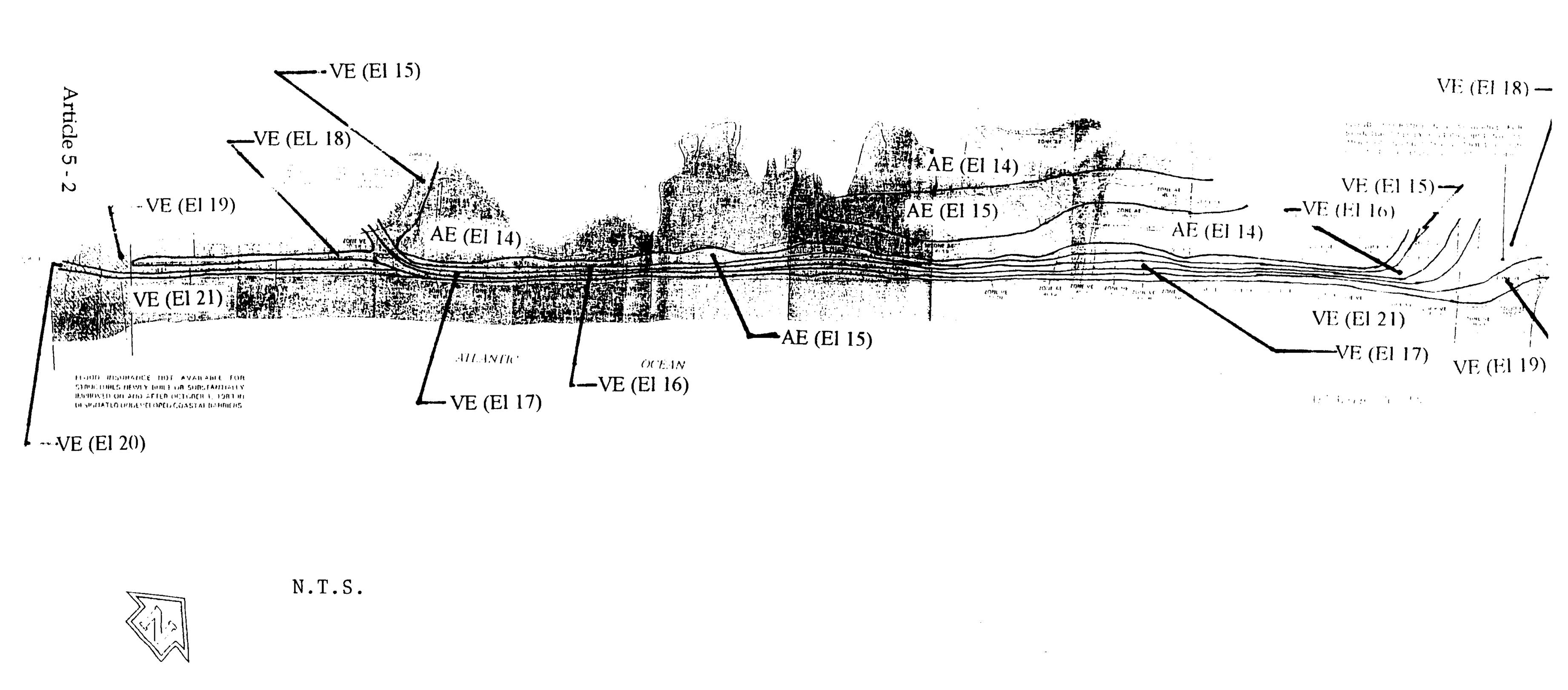
Note— The map shown hereon is a graphic representation of data obtained from other sources. All efforts have been made to warrant the accuracy of this map; however, WRCOG disclaims all responsibility and liability for the use of this map.
5-2.2.
Administrative procedures.
(A)
Inspections of work in progress. As the work pursuant to a permit progress, the local floodplain administrator shall make as many inspections of the work as may be necessary to ensure that the work is being done according to the provisions of the local ordinance and the terms of the permit. In exercising this power, the floodplain administrator has a right, upon presentation of proper credentials, to enter on any premises within the territorial jurisdiction at any reasonable hour for the purposes of inspection or other enforcement action.
(B)
Stop-work orders. Whenever a building or part thereof is being constructed, reconstructed, altered, or repaired in violation of this ordinance, the floodplain administrator may order the work to be immediately stopped. The stop-work order shall be in writing and directed to the person doing the work. The stop-work order shall state the specific work to be stopped, the specific reasons for the stoppage, and the conditions under which the work may be resumed. Violation of a stop-work order constitutes a misdemeanor.
(C)
Revocation of permits. The local floodplain administrator may revoke and require the return of the development permit by notifying the permit holder in writing, stating the reason for the revocation. Permits shall be revoked for any substantial departure from the approved application, plans, or specifications; for refusal or failure to comply with the requirements of state or local laws; or for false statements or misrepresentations made in securing the permit. Any permit mistakenly issued in violation of an applicable state or local law may also be revoked.
(D)
Periodic inspections. The local floodplain administrator and each member of his/her inspections department shall have a right, upon presentation of proper credentials, to enter on any premises within the territorial jurisdiction of the department at any reasonable hour for the purposes of inspection or other enforcement action. Inspections may be made during construction and post construction to ensure continued compliance with the NFIP.
(E)
Violations to be corrected. When the local floodplain administrator finds violations of applicable state and local laws, it shall be his/her duty to notify the owner or occupant of the building of the violation. The owner or occupant shall immediately remedy each of the violations of law on the property he owns.
(F)
Actions in event of failure to take corrective action. If the owner of a building or property shall fail to take prompt corrective action, the floodplain administrator shall give him written notice, by certified or registered mail to his last known address or by personal service, that:
(1)
The building or property is in violation of the flood damage prevention ordinance,
(2)
A hearing will be held before the local floodplain administrator at a designated place and time, not later than ten days after the date of the notice, at which time the owner shall be entitled to be heard in person or by counsel and to present arguments and evidence pertaining to the matter: and,
(3)
Following the hearing, the local floodplain administrator may issue such order to alter, vacate, or demolish the building; or to remove fill as appears appropriate.
(G)
Order to take corrective action. If, upon a hearing held pursuant to the notice prescribed above, the floodplain administrator shall find that the building or development is in violation of the flood damage prevention ordinance, he/she shall make an order in writing to the owner, requiring the owner to remedy the violation within such period, not more than 180 days the floodplain administrator may prescribe; provided that where the floodplain administrator finds that there is imminent danger to life or other property, he may order that corrective action be taken in such lesser period as may be feasible.
(H)
Appeal. Any owner who has received an order to take corrective action may appeal from the order to the local elected governing body by giving notice of appeal in writing to the floodplain administrator and the clerk within ten days following issuance of the final order. In the absence of an appeal, the order of the floodplain administrator shall be final. The local governing body shall hear an appeal within a reasonable time and may affirm, modify and affirm, or revoke the order.
(I)
Failure to comply with order. If the owner of a building or property fails to comply with an order to take corrective action from which no appeal has been taken or fails to comply with an order of the governing body following an appeal, he shall be guilty of a misdemeanor and shall be punished in the discretion of the court.
(J)
Denial of flood insurance under the NFIP. If a structure is declared in violation of this ordinance and after all other penalties are exhausted to achieve compliance with this ordinance then the local floodplain administrator shall notify the Federal Emergency Management Agency (FEMA) to initiate a Section 1316 of the National Flood insurance Act of 1968 action against the structure upon the finding that the violator refuses to bring the violation into compliance with the ordinance. Once a violation has been remedied the local floodplain administrator shall notify FEMA of the remedy and ask that the Section 1316 be rescinded.
(K)
The following documents are incorporated by reference and may be used by the local floodplain administrator to provide further guidance and interpretation of this ordinance as found on FEMA's website at www.fema.gov:
(1)
FEMA 55 Coastal Construction Manual
(2)
All FEMA Technical Bulletins
(3)
All FEMA Floodplain Management Bulletins
(4)
FEMA 348 Protecting Building Utilities from Flood Damage
(5)
FEMA 499 Home Builder's Guide to Coastal Construction Technical Fact Sheets
(Ord. No. 2003-29, § 5-2, 12-8-2003; Ord. No. 2015-04, 4-13-2015; Ord. No. 2016-05, 8-8-2016; Ord. No. 2023-05, 5-2-2023)
5-3. - Variance procedures.
5-3.1
Who may file an appeal. A person having substantial interest may make an appeal for a decision of the building inspector to circuit court. The person must file a written petition with the clerk of court stating why the decision is contrary to law. The person filing the petition shall also immediately file the petition with the building inspector. The clerk of court is required to give immediate notice of the appeal to the town. The filing of an appeal does not act as a supersedeas, but the circuit judge may grant a supersedeas upon reasonable terms.
5-3.2
Hearings and decisions. The circuit court shall hear and decide appeals when it is alleged there is an error in any requirement, decision or determination made by the building inspector in the enforcement or administration of this article.
5-3.3
Historic structures. Variances may be granted by the circuit court for the reconstruction, rehabilitation or restoration of structures listed on the National Register of Historic Places or the state inventory of historic places, without regard to the procedures set forth in this section, except for 5-3.4(A) and (D) and provided the proposed reconstruction, rehabilitation or restoration will not result in the structure losing its historical designation.
5-3.4
Criteria for granting variances. In passing upon such applications, the circuit court shall consider all technical evaluations, all relevant factors, all standards specified in other sections of this article, and:
(A)
The danger that materials may be swept onto other lands to the injury of others;
(B)
The danger to life and property due to flooding or erosion damage;
(C)
The effect of such damage on the individual owner;
(D)
The importance of the services provided by the proposed facility to the community;
(E)
The necessity to the facility of a waterfront location, in the case of functionally dependent facility;
(F)
The availability of alternative locations, not subject to flooding or erosion damage, for the proposed use;
(G)
The compatibility of the proposed use with existing and anticipated development;
(H)
The relationship of the proposed use to the comprehensive plan and floodplain management program for the town;
(I)
The safety of access to the property in times of flood for ordinary and emergency vehicles;
(J)
The expected heights, velocity, duration, rate of rise and sediment transport of the floodwaters and the effects of wave action, if applicable, expected at the site; and,
(K)
The costs of providing governmental services during and after flood conditions including maintenance and repair of public utilities and facilities such as sewer, gas, electrical and water systems, streets and bridges.
5-3.5
Modifications to requests. Upon consideration of the factors listed above and the purposes of this article, the circuit court may attach such conditions to the granting of variances as it deems necessary to further the purposes of this article.
5-3.6
Floodways. Variances shall not be issued within any designated floodway if any increase in flood levels during the base flood discharge would result.
5-3.7
Conditions for variances.
(A)
Variances shall only be issued upon a determination that the variance is the minimum necessary, considering the flood hazard, to afford relief; and in the instance of a historical building, a determination that the variance is the minimum necessary so as to not destroy the historic character and design of the building.
(B)
Variances shall only be issued upon:
1)
A showing of good and sufficient cause;
2)
A determination that failure to grant the variance would result in exceptional hardship; and,
3)
A determination that the granting of a variance will not result in increased flood heights, additional threats to public safety, extraordinary public expense, create nuisance, cause fraud on or victimization of the public, or conflict with existing local laws or ordinances.
(C)
Any applicant to whom a variance is granted shall be given written notice specifying the difference between the base flood elevation and the elevation to which the structure is to be built and stating that the cost of flood insurance will be commensurate with the increased risk resulting from the reduced lowest floor elevation.
(D)
The building inspector shall maintain the records of all appeal actions and report any variances to the Federal Emergency Management Agency upon request.
5-3.8
Appeal to supreme court. A person may appeal a circuit court decision to the supreme court in the same manner as other circuit court judgments. The person must serve a notice of appeal to the supreme court within 30 days after receiving written notice of entry of the order of the circuit court.
(Ord. No. 2003-29, § 5-3, 12-8-2003)
5-4. - Provisions for flood hazard reduction.
5-4.1
General standards. Development may not occur in the special flood hazard area (SFHA) where alternative locations exist due to the inherent hazards and risks involved. Before a permit is issued, the applicant shall demonstrate that new structures cannot be located out of the SFHA and that encroachments onto the SFHA are minimized. In all areas of special flood hazard the following provisions are required:
(A)
Reasonably safe from flooding. Review all permit applications to determine whether proposed building sites will be reasonably safe from flooding.
(B)
Anchoring. All new construction and substantial improvements shall be anchored to prevent flotation, collapse, and lateral movement of the structure.
(C)
Flood-resistant materials and equipment. All new construction and substantial improvements shall be constructed with flood resistant materials and utility equipment resistant to flood damage in accordance with Technical Bulletin 2, Flood Damage-Resistant Materials Requirements, available from the Federal Emergency Management Agency.
(D)
Minimize flood damage. All new construction and substantial improvements shall be constructed by methods and practices that minimize flood damages.
(E)
Critical development. All new construction and substantial improvements that meet the definition of critical development shall be elevated to the 500-year flood elevation or be elevated to the highest known historical flood elevation (where records are available), whichever is greater. If no data exists establishing the 500-year flood elevation or the highest known historical flood elevation, the applicant shall provide a hydrologic and hydraulic engineering analysis that generates 500-year flood elevation data.
(F)
Utilities. Electrical, ventilation, plumbing, heating and air conditioning equipment (including ductwork), and other service facilities shall be designed and/or located so as to prevent water from entering or accumulating within the components during conditions of the base flood plus three feet (freeboard).
(G)
Water supply systems. All new and replacement water supply systems shall be designed to minimize or eliminate infiltration of floodwaters into the system.
(H)
Sanitary sewage systems. New and replacement sanitary sewage systems shall be designed to minimize or eliminate infiltration of floodwaters into the systems and discharges from the systems into floodwaters. On-site waste disposal systems shall be located and constructed to avoid impairment to them or contamination from them during flooding.
(I)
Gas or liquid storage tanks. All gas or liquid storage tanks, either located above ground or buried, shall be anchored to prevent floatation and lateral movement resulting from hydrodynamic and hydrostatic loads.
(J)
Alteration, repair, reconstruction, or improvements. Any alteration, repair, reconstruction, or improvement to a structure that is in compliance with the provisions of this ordinance, shall meet the requirements of "new construction" as contained in this ordinance. This includes post-FIRM development and structures.
(K)
Nonconforming buildings or uses. Nonconforming buildings or uses, including historic structures, may not be enlarged, replaced, or rebuilt unless such enlargement or reconstruction is accomplished in conformance with the provisions of this ordinance.
(L)
American with Disabilities Act (ADA). A building must meet the specific standards for floodplain construction outlined in article 5-4, as well as any applicable ADA requirements. The ADA is not justification for issuing a variance or otherwise waiving these requirements. Also, the cost of improvements required to meet the ADA provisions shall be included in the costs of the improvements for calculating substantial improvement.
5-4.2
Specific standards. In all areas of special flood hazard zones A, AE, AH, AO, Al-30 unless otherwise specified where base flood elevation data has been provided, as set forth in article 5-1.1 or article 5-2.4(J), the following provisions are required:
(A)
Residential construction. New construction and substantial improvement of any residential structure (including manufactured homes) shall have the lowest floor elevated no lower than three feet above the base flood elevation. No basements are permitted. Should solid foundation perimeter walls be used to elevate a structure, flood openings sufficient to automatically equalize hydrostatic flood forces, shall be provided in accordance with the elevated buildings requirements in article 5-4.2(C).
(B)
Nonresidential construction.
(1)
New construction and substantial improvement of any commercial, industrial, or nonresidential structure {including manufactured homes) shall have the lowest floor elevated no lower than three feet above the level of the base flood elevation. Should solid foundation perimeter walls be used to elevate a structure, flood openings sufficient to automatically equalize hydrostatic flood forces, shall be provided in accordance with the elevated buildings requirements in article 5-4.2(C). No basements are permitted. Structures located in A-zones may be floodproofed in lieu of elevation provided that all areas of the structure below the required elevation are watertight with walls substantially impermeable to the passage of water, using structural components having the capability of resisting hydrostatic and hydrodynamic loads and the effect of buoyancy.
(2)
A registered, professional engineer or architect shall certify that the standards of this subsection are satisfied. Such certifications shall be provided to the official as set forth in the floodproofing certification requirements in article 5-2.1(A)(2)a. Structures that are floodproofed are required to have an approved maintenance plan with an annual exercise. The local floodplain administrator must approve the maintenance plan and receive notification of the annual exercise.
(C)
Elevated buildings. New construction and substantial improvements of elevated buildings that include fully enclosed areas below the lowest floor that are usable solely for the parking of vehicles, building access, or limited storage in an area other than a basement, and which are subject to flooding shall be designed to preclude finished space and be designed to automatically equalize hydrostatic flood forces on exterior walls by allowing for the entry and exit of floodwaters.
(1)
Designs for complying with this requirement must either be certified by a professional engineer or architect or meet or exceed all of the following minimum criteria:
a.
Provide a minimum of two openings on different walls having a total net area of not less than one square inch for every square foot of enclosed area.
b.
The bottom of each opening must be no more than one foot above the higher of the interior or exterior grade immediately under the opening.
c.
Only the portions of openings that are below the base flood elevation {BFE) plus freeboard can be counted towards the required net open area. If the lowest adjacent grade (LAG) is between the BFE and the freeboard, openings are still required until a LOMA has been approved.
d.
Openings may be equipped with screens, louvers, valves, or other coverings or devices provided they permit the automatic flow of floodwaters in both directions.
e.
Fill placed around foundation walls must be graded so that the grade inside the enclosed area is equal to or higher than the adjacent grade outside the building on at least one side of the building.
(2)
Hazardous velocities. Hydrodynamic pressure must be considered in the design of any foundation system where velocity waters or the potential for debris flow exists. If flood velocities are excessive (greater than five feet per second), foundation systems other than solid foundations walls should be considered so that obstructions to damaging flood flows are minimized.
(3)
Enclosures below lowest floor.
a.
Access to the enclosed area shall be the minimum necessary to allow for parking of vehicles {garage door) or limited storage of maintenance equipment used in connection with the premises (standard exterior door) or entry to the living area (stairway or elevator).
b.
The interior portion of such enclosed area shall be unfinished or finished with flood resistant material and not partitioned into separate rooms, must be void of utilities except for essential lighting as required for safety, and cannot be temperature controlled. A ground fault interrupt breaker may be installed below the required lowest floor elevation specified in the specific standards outlined in article 5-4.2(A), (B), and (C)
c.
All construction materials below the required lowest floor elevation specified in the specific standards outlined in article 5-4.2(A), (B), (C), and (D) should be of flood-resistant materials.
(D)
Floodways. Located within areas of special flood hazard established in article 5-1.1, are areas designated as floodways. The floodway is an extremely hazardous area due to the velocity of floodwaters that carry debris and potential projectiles and has erosion potential. The following provisions shall apply within such areas:
(1)
No encroachments, including fill, new construction, substantial improvements, additions, and other developments shall be permitted unless:
a.
It has been demonstrated through hydrologic and hydraulic analyses performed in accordance with standard engineering practice that the proposed encroachment would not result in any impact of the flood levels during the occurrence of the base flood. Such certification and technical data shall be presented to the local floodplain administrator, OR:
b.
A conditional letter of map revision (CLOMR) has been approved by FEMA. A letter of map revision must be obtained upon completion of the proposed development.
(2)
If article 5-4.2(D)(1) is satisfied, all new construction and substantial improvements shall comply with all applicable flood hazard reduction provisions of article 5-4.2.
a.
A replacement manufactured home may be allowed provided the anchoring and the elevation standards of article 5-4.2(C) and the encroachment standards of article 5-4.2(D) may apply except when the replacement manufactured home is the same size as the existing.
Permissible uses within floodways may include general farming, pasture, outdoor plant nurseries, horticulture, forestry, wildlife sanctuary, game farm, and other similar agricultural, wildlife, and related uses. Also, lawns, gardens, play areas, picnic grounds, and hiking and horseback riding trails are acceptable uses, provided that they do not employ structures or fill. Substantial development of a permissible use may require a no-impact certification. The uses listed in this subsection are permissible only if and to the extent that they do not cause any increase in base flood elevations or changes to the floodway configuration.
(E)
Map maintenance activities. The National Flood Insurance Program (NFIP) requires flood data to be reviewed and approved by FEMA. This ensures that flood maps, studies and other data identified in article 5-1.1 accurately represent flooding conditions so appropriate floodplain management criteria are based on current data. The following map maintenance activities are identified and shall apply to all areas of special flood hazard:
(1)
Requirement to submit new technical data.
a.
For all development proposals that impact floodway/floodplain delineations or base flood elevations, the community shall ensure that a letter of map revision reflecting the impacts be submitted to FEMA as soon as practicable, but no later than six months from the end of construction of the impact. These development proposals include but not limited to:
1.
Floodway encroachments that increase or decrease base flood elevations or alter floodway boundaries;
2.
Fill sites to be used for the placement of proposed structures where the applicant desires to remove the site from the special flood hazard area;
3.
Alteration of watercourses that result in a relocation or elimination of the special flood hazard area, including stream restoration and the placement of culverts; and
4.
Subdivision or large scale development proposals requiring the establishment of base flood elevations in accordance with article 5-4.4(A).
5.
Any development that will alter the boundaries of the area of special flood hazard.
b.
It is the responsibility of the applicant to have technical data, required in accordance with article 5-4.2(E), prepared in a format required for a conditional letter of map revision or letter of map revision, and submitted to FEMA. Submittal and processing fees for these map revisions shall also be the responsibility of the applicant.
c.
The local floodplain administrator shall require a conditional letter of map revision prior to the issuance of a floodplain development permit for:
1.
Proposed floodway encroachments that increase the base flood elevation; or
2.
Proposed development which increases the base flood elevation by more than one foot in areas where FEMA has provided base flood elevations but no floodway.
d.
The local floodplain administrator may require a conditional letter of map revision for any development that they want the impacts to be evaluated prior to issuance of a permit.
e.
Floodplain development permits issued by the local floodplain administrator shall be conditioned upon the applicant obtaining a letter of map revision from FEMA for any development proposal subject to article 5-4.2(d).
(2)
Right to submit new technical data. The floodplain administrator may request changes to any of the information shown on an effective map that does not impact floodplain or floodway delineations or base flood elevations, such as labeling or planimetric details. Such a submission shall include appropriate supporting documentation made in writing by the local jurisdiction and may be submitted at any time.
(F)
Accessory structures. Detached accessory structures used only for parking of vehicles and storage are permitted at grade if:
(1)
In special flood hazard areas other than coastal high hazard areas (zones A, AE, AH, AO and Al-30), they are not larger than one-story and 600 square feet in area. Walls must have openings in compliance with article 5-4.2(C).
(2)
In coastal high hazard areas (zones V, VE, Vl-30 and VO) they are not larger than 100 square feet and in compliance with article 5-4.7.
(3)
Anchored to resist flotation, collapse, and lateral movement.
(4)
Flood damage resistant materials used below the base elevation in accordance with Technical Bulletin 2, Flood Damage Resistant Materials Requirement.
(5)
Mechanical, electrical, and utility equipment comply with the requirements of article 5-4.1(F).
(6)
Accessory structures shall be designed to have low flood damage potential.
(7)
Accessory structures shall be constructed and placed on the building site so as to offer the minimum resistance to the flow of floodwaters.
(G)
Swimming pool utility equipment rooms. If the building cannot be built at or above the BFE, because of functionality of the equipment then a structure to house the utilities for the pool may be built below the BFE with the following provisions:
(1)
Meet the requirements for accessory structures in article 5-4.7(I).
(2)
The utilities must be anchored to prevent flotation and shall be designed to prevent water from entering or accumulating within the components during conditions of the base flood.
(H)
Elevators.
(1)
Install a float switch system or another system that provides the same level of safety necessary for all elevators where there is a potential for the elevator cab to descend below the BFE during a flood per FEMA's Technical Bulletin 4 Elevator Installation for Buildings located in Special Flood Hazard Areas.
(2)
All equipment that may have to be installed below the BFE such as counter weight roller guides, compensation cable and pulleys, and oil buffers for traction elevators and the jack assembly for a hydraulic elevator must be constructed using flood-resistant materials where possible per FEMA's Technical Bulletin 4 Elevator Installation for Buildings located in Special Flood Hazard Areas.
(I)
Fill. An applicant shall demonstrate that fill is the only alternative to raising the building to meet the residential and nonresidential construction requirements of article 5-4.2(A) and article 5-4.2(B), and that the amount of fill used will not affect the flood storage capacity or adversely affect adjacent properties. The following provisions shall apply to all fill placed in the special flood hazard area:
(1)
Fill may not be placed in tidal or nontidal wetlands without the required state and federal permits.
(2)
Fill must consist of soil and rock materials only. A registered professional geotechnical engineer may use dredged material as fill only upon certification of suitability. Landfills, rubble fills, dumps, and sanitary fills are not permitted in the floodplain.
(3)
Fill used to support structures must comply with ASTM Standard D-698, and its suitability to support structures certified by a registered, professional engineer.
(4)
Fill slopes shall be no greater than two horizontal to one vertical. Flatter slopes may be required where velocities may result in erosion.
(5)
The use of fill shall not increase flooding or cause drainage problems on neighboring properties.
(6)
Fill may not be used for structural support in the coastal high hazard areas.
(7)
Shall meet the requirements of FEMA Technical Bulletin 10, Ensuring That Structures Built On Fill In or Near Special Flood Hazard Areas Are Reasonably Safe From Flooding.
5-4.3
Standards for subdivision proposals and other development.
(A)
All subdivision proposals and other proposed new development shall be consistent with the need to minimize flood damage and are subject to all applicable standards in these regulations.
(B)
All subdivision proposals and other proposed new development shall have public utilities and facilities such as sewer, gas, electrical, and water systems located and constructed to minimize flood damage.
(C)
All subdivision proposals and other proposed new development shall have adequate drainage provided to reduce exposure to flood damage.
(D)
The applicant shall meet the requirement to submit technical data to FEMA in article 5-4.2(D) when a hydrologic and hydraulic analysis is completed that generates base flood elevations.
5-4.4
Standards for streams without established base flood elevations and floodways. Located within the areas of special flood hazard (zones A and V) established in article 5-1.1, are small streams where no base flood data has been provided and where no floodways have been identified. The following provisions apply within such areas:
(A)
In all areas of special flood hazard where base flood elevation data are not available, the applicant shall provide a hydrologic and hydraulic engineering analysis that generates base flood elevations for all subdivision proposals and other proposed developments containing at least 50 lots or five acres, whichever is less.
(B)
No encroachments, including fill, new construction, substantial improvements and new development shall be permitted within 100 feet of the stream bank unless certification with supporting technical data by a registered professional engineer is provided demonstrating that such encroachments shall not result in any increase in flood levels during the occurrence of the base flood discharge.
(C)
If article 5-4.4(A) is satisfied and base flood elevation data is available from other sources, all new construction and substantial improvements within such areas shall comply with all applicable flood hazard ordinance provisions of article IV and shall be elevated or floodproofed in accordance with elevations established in accordance with article 5-2.1(B)(10).
(D)
Data from preliminary, and draft flood insurance studies constitutes best available data. Refer to FEMA Floodplain Management Technical Bulletin 1-98, Use of Flood Insurance Study (FIS) Data as Available Data. If an appeal is pending on the study in accordance with 44 CFR Ch. 1, Part 67.5 and 67.6, the data does not have to be used.
(E)
When base flood elevation (BFE) data is not available from a federal, state, or other source one of the following methods must be used to determine a BFE in Approximate Zone A Areas:
(1)
Contour interpolation.
a.
Superimpose approximate Zone A boundaries onto a topographic map and estimate a BFE.
b.
Add one-half of the contour interval of the topographic map that is used to the BFE.
(2)
Data extrapolation. A BFE can be determined if a site within 500 feet upstream of the project site has a full detailed study for which a 100-year profile has been computed, and the floodplain and channel bottom slope characteristics are relatively similar to the downstream reaches. No hydraulic structures shall be present.
a.
Hydrologic and hydraulic calculations. Perform hydrologic and hydraulic calculations to determine BFEs using FEMA approved methods and software.
b.
A zone model. A BFE can be pulled from the model and applied if determined that the BFE is useable.
5-4.5
Standards for streams with established base flood elevations but without floodways. Along rivers and streams where BFE data is provided but no floodway is identified for a special flood hazard area on the FIRM or in the FIS.
(A)
No encroachments including fill, new construction, substantial improvements, or other development shall be permitted unless certification with supporting technical data by a registered professional engineer is provided demonstrating that the cumulative effect of the proposed development, when combined with all other existing and anticipated development, will not increase the water surface elevation of the base flood more than one foot at any point within the community.
5-4.6
Standards for areas of shallow flooding (AO Zones). Located within the areas of special flood hazard established in article 5-1.1, are areas designated as shallow flooding. The following provisions shall apply within such areas:
(A)
All new construction and substantial improvements of residential structures shall have the lowest floor elevated to at least as high as the depth number specified on the FIRM, in feet, above the highest adjacent grade. If no depth number is specified, the lowest floor shall be elevated at least three feet above the highest adjacent grade.
(B)
All new construction and substantial improvements of nonresidential structures shall:
(1)
Have the lowest floor elevated to at least as high as the depth number specified on the FIRM, in feet, above the highest adjacent grade. If no depth number is specified, the lowest floor shall be elevated at least three feet above the highest adjacent grade; or,
(2)
Be completely floodproofed together with attendant utility and sanitary facilities to or above that level so that any space below that level is watertight with walls substantially impermeable to the passage of water and with structural components having the capability of resisting hydrostatic and hydrodynamic loads and effects of buoyancy. Certification is required as stated in article III.C.
(C)
All structures on slopes must have drainage paths around them to guide water away from the structures.
5-4.7
Coastal high hazard areas (V Zones). Located within the areas of special flood hazard established in article 5-1.1 are areas designated as coastal high hazard areas. These areas have special flood hazards associated with wave wash. The following provisions shall apply within such areas:
(A)
All new construction and substantial improvements shall be located landward of the reach of mean high tide, first line of stable natural vegetation and comply with all applicable Department of Health and Environmental Control (DHEC) Ocean and Coastal Resource Management (OCRM) setback requirements.
(B)
All new construction and substantial improvements shall be elevated so that the bottom of the lowest supporting horizontal structural member (excluding pilings or columns) of the lowest floor is located no lower than three feet above the base flood elevation.
(C)
All buildings or structures shall be securely anchored on pilings or columns, extending vertically below a grade of sufficient depth and the zone of potential scour, and securely anchored to the subsoil strata.
(D)
All pilings, columns and the attached structures shall be anchored to resist flotation, collapse, lateral movement and scour due to the effect of wind and water loads acting simultaneously on all building components.
(E)
A registered professional engineer or architect shall certify that the design, specifications and plans for construction are in compliance with the provisions contained in article 5-4.7(B), (C), (D), (G), and (I) of this ordinance.
(F)
There shall be no fill used as structural support. Noncompacted fill may be used around the perimeter of a building for landscaping/aesthetic purposes provided the fill will wash out from storm surge, thereby rendering the building free of obstruction prior to generating excessive loading forces, ramping effects, or wave deflection. Only beach compatible sand may be used. The local floodplain administrator shall approve design plans for landscaping/ aesthetic fill only after the applicant has provided an analysis by an engineer, architect, and/or soil scientist that demonstrates that the following factors have been fully considered:
(1)
Particle composition of fill material does not have a tendency for excessive natural compaction,
(2)
Volume and distribution of fill will not cause wave deflection to adjacent properties; and
(3)
Slope of fill will not cause wave run-up or ramping.
(G)
There shall be no alteration of sand dunes that would increase potential flood damage.
(H)
All new construction and substantial improvements have the space below the lowest floor either free of obstruction or constructed with nonsupporting breakaway walls, open wood lattice-work, or insect screening intended to collapse under wind and water loads without causing collapse, displacement, or other structural damage to the elevated portion of the building or supporting foundation system. Breakaway wall enclosures shall not exceed 299 square feet. Only flood-resistant materials shall be used below the required flood elevation specified in article 5-4.2. A ground fault interrupt breaker may be installed below the required lowest floor elevation specified in article 5-4.2.
Use of breakaway walls may be permitted only if a registered professional engineer or architect certifies that the designs proposed meet the following conditions:
(1)
Breakaway wall collapse shall result from water load less than that which would occur during the base flood.
(2)
The elevated portion of the building and supporting foundation system shall not be subject to collapse, displacement, or other structural damage due to the effects of wind and water loads acting simultaneously on all building components (structural and nonstructural). The water loading shall be those values associated with the base flood. The wind loading values shall be those required by applicable International Building Code (IBC).
(3)
Such enclosed space shall be useable solely for parking of vehicles, building access, or storage. Such space shall not be used for human habitation, finished or partitioned into multiple rooms, or temperature-controlled.
(I)
Accessory structures below the required lowest floor elevation specified in article 5-4.7(B), are prohibited except for the following:
(1)
Structures 100 square feet or less and in accordance with article 5-4.7(I).
(2)
Swimming pools.
a.
They are installed at-grade or elevated so long as the pool will not act as an obstruction.
b.
They must be structurally independent of the building and its foundation.
c.
They may be placed beneath a coastal building only if the top of the pool and any accompanying decking or walkway are flush with the existing grade and only if the lower area remains unenclosed.
d.
As part of the certification process for V-zone buildings the design professional must consider the effects that any of these elements will have on the building in question and any nearby buildings.
(3)
Access stairs attached to or beneath an elevated building:
a.
Must be constructed of flood-resistant materials.
b.
Must be constructed as open staircases so they do not block flow under the structure in accordance with article 5-4.7(B) or if enclosed then constructed in accordance with article 5-4.7(I).
(4)
Decks.
a.
If the deck is structurally attached to a building, then the bottom of the lowest horizontal member must be at or above the elevation of the buildings lowest horizontal member.
b.
If the deck is to be built below the BFE then it must be structurally independent of the main building and must not cause an obstruction.
c.
If an at-grade, structurally independent deck is proposed then a design professional must evaluate the design to determine if it will adversely affect the building and nearby buildings.
(J)
Parking areas should be located on a stable grade under or landward of a structure.
(K)
Electrical, ventilation, plumbing, heating and air conditioning equipment (including ductwork), and other service facilities shall be designed and/or located so as to prevent water from entering or accumulating within the components during conditions of base flood event plus three feet. This requirement does not exclude the installation of outdoor faucets for shower heads, sinks, hoses, etc., as long as cut off devices and back flow prevention devices are installed to prevent contamination to the service components and thereby minimize any flood damages to the building. No utilities or components shall be attached to breakaway walls.
(Ord. No. 2003-29, § 5-4.1, 12-8-2003; Ord. No. 2003-29, § 5-4.2, 12-8-2003; Ord. No. 2004-11, 11-08-2004; Ord. No. 2016-06, 8-8-2016; Ord. No. 2016-07, 8-8-2016; Ord. No. 2016-08, 8-8-2016; Ord. No. 2016-09, 8-8-2016; Ord. No. 2023-05, 5-2-2023)
5-5. - Legal status provisions.
5-5.1
Effect on rights and liabilities under the existing flood damage prevention ordinance. This ordinance in part comes forward by re-enactment of some of the provisions of the flood hazard reduction ordinance enacted on December 8, 2003 and sections of this article most recently amended on September 8, 2008 and it is not the intention to repeal but rather to re-enact and continue to enforce without interruption of such existing provisions, so that all rights and liabilities that have accrued there under are reserved and may be enforced. The enactment of this ordinance shall not affect any action, suit or proceeding instituted or pending. All provisions of the flood hazard reduction ordinance of the town enacted on December 8,2003, as amended, which are not reenacted herein, are repealed.
5-5.2
Effect upon outstanding permits. Nothing herein contained shall require any change in the plans, construction, size or designated use of building, structure or part thereof for which a building permit has been granted by the chief building inspector or his authorized agents before the time of passage of this ordinance; provided however that when start of construction has not begun under such outstanding permit before the passage of this ordinance, construction or use shall be in conformity with the provisions of this ordinance.
(Ord. No. 2023-05, 5-2-2023)

