
Pawleys Island City Zoning Code
ARTICLE 3
- DISTRICT BOUNDARIES
3-1.- Establishment of districts and rules for the interpretation of boundaries.
3-1.1
Establishment of districts. For the purpose of this Unified Development Code the Town of Pawleys Island, as specified on the Official Zoning Map for the Town of Pawleys Island, is hereby divided into the following zoning districts:
Conservation and Preservation—CP District (Conservation/Preservation)
Residential—R-1 District (Low Density Residential)
Residential—R-2 District (Medium Density Residential)
Planned Development (PD)
3-1.2
District boundaries. The boundaries of the above zoning districts are hereby established as shown on the official zoning map of the Town of Pawleys Island which, together with all explanatory matter thereon, is hereby adopted by reference and declared to be a part of this Unified Development Code. A copy of the official zoning map may be found in figure 3-A.
(A)
The official zoning map shall be identified by the signature of the mayor attested by the town clerk and bearing the seal of the town under the words: "Official Zoning Map; Town of Pawleys Island, South Carolina," together with the date of the adoption of this Unified Development Code.
(B)
If, in accordance with the provisions of this Unified Development Code and S.C. Code 1976, § 6-29-760, changes are made in district boundaries or other matter portrayed on the official zoning map, such changes shall be entered on the official zoning map promptly after the amendment has been approved by the town council. No amendment to this Unified Development Code which involves matters portrayed on the official zoning map shall become effective until after such change has been made on said map.
(C)
No changes of any nature shall be made on the official zoning map or matter shown thereon except in conformity with the procedures set forth in this Unified Development Code. Any unauthorized change of whatever kind by any person or persons shall be considered a violation of this Unified Development Code and punishable as provided by law.
OFFICIAL ZONING MAP THE TOWN OF PAWLEYS ISLAND SOUTH CAROLINA
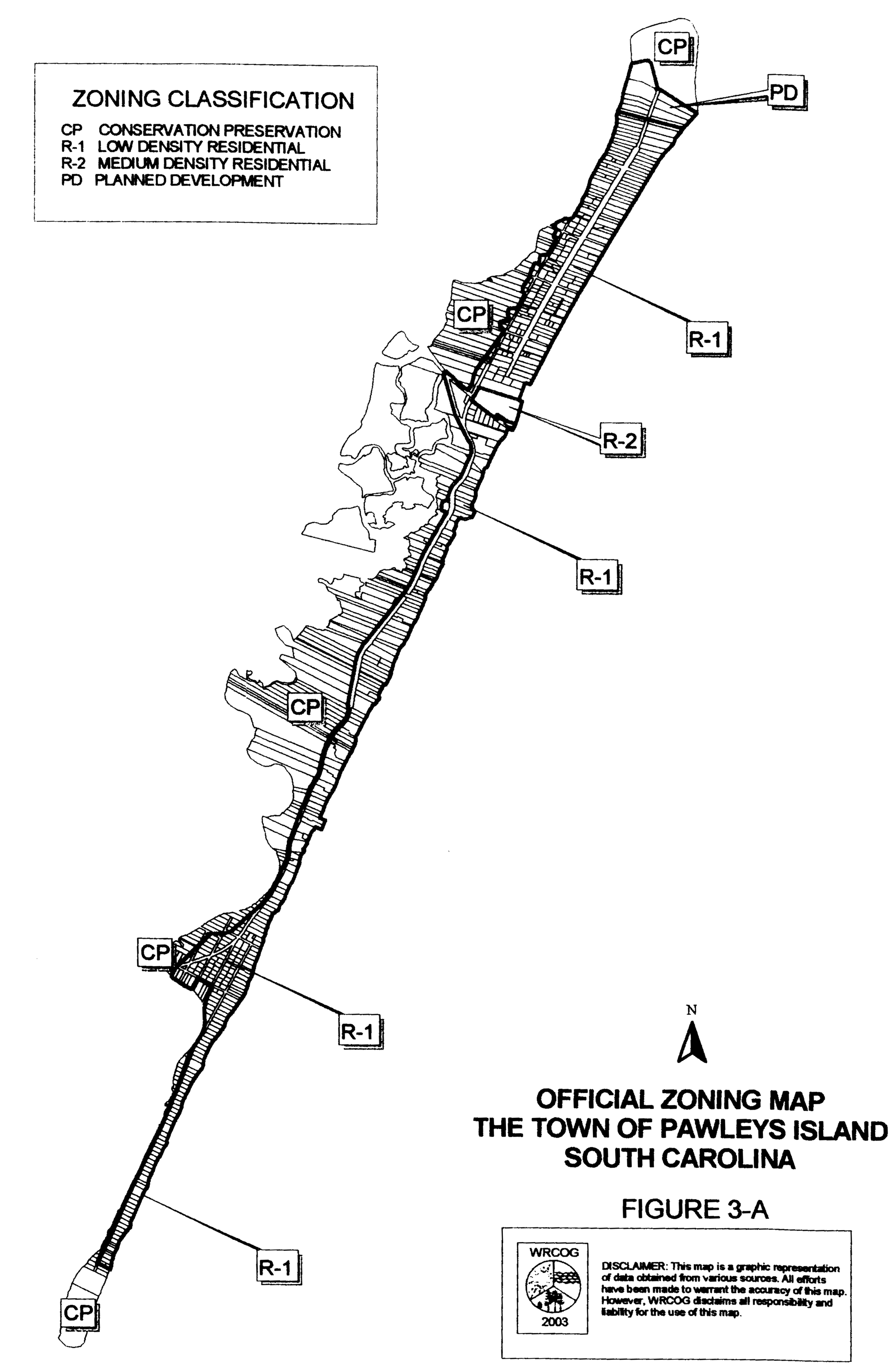
(Ord. No. 2003-29, § 3-1, 12-8-2003)
3-2. - Provisions governing use districts.
3-2.1
Conservation Preservation District (CP). Pawleys Island is unique in that several hundred acres within the town limits are estuarine land and water formations. These areas possess great natural beauty and serve as breeding grounds and refuges for marine life and land animals, whose survival is economically important to sport and commercial fishing, hunting activity and nature study of our citizens and visitors. In addition, these areas provide needed open space for general outdoor recreational use so necessary for the health and general welfare of people. The regulations which apply within this district are designed to reserve such areas for the purposes outlined herein and to discourage any encroachment by other uses capable of adversely affecting the relatively undeveloped character of the district.
(A)
Permitted uses. The following uses shall be permitted in any Conservation Preservation District:
1)
Harbors, channels essential to connect harbors, boat ramps and marine facilities;
2)
Navigational aids;
3)
Private docks, boat houses and cabanas; and,
4)
Such other uses, including alterations of land, provided that the building inspector is presented with valid state and federal permits required for such use.
(B)
Conditional uses. None
(C)
Minimum lot size. None
(D)
Minimum lot width at the building line. None
(E)
Minimum required yards.
1)
Front—none
2)
Side—none
3)
Rear—none
(F)
Maximum building height. 12 feet above the base flood elevation.
(G)
Types of signs allowed. Only signs listed in article 11, section 11-1.1 are allowed in this district.
(H)
Waste disposal systems. No waste disposal system shall be located in, or extend into, the conservation/preservation district.
(I)
Other special requirements. None
3-2.2
Low Density Residential District (R-1). It is the intent of this district to provide areas which are suitable for low density residential development where an adequate public water and sewer supply is available. The principal use of land within this district is low density single-family residences. Modular homes are allowed.
(A)
Permitted uses. The following uses shall be permitted in any R-1 district:
1)
Single-family dwelling (not including mobile homes or vacation time sharing plans);
2)
Noncommercial horticulture or agriculture, but not including the keeping of poultry or livestock; and,
3)
Customary accessory uses.
(B)
Conditional uses. The following uses shall be allowed in any R-1 district provided the conditions set forth below are met:
1)
Public buildings, uses, utility substations or sub-installations provided that:
a)
Such uses shall be enclosed by a buffer strip at least six feet in height above finished grade (see section 2-13);
b)
There is no outdoor storage of equipment on the premises;
c)
The location of these uses, lot sizes, widths and setbacks shall be reviewed and approved by the building inspector; and
d)
Radio, television and satellite dishes provided that they are less than two feet in diameter.
Note—For group dwellings, please see section 3-5.6.
2)
Group dwelling (excluding vacation time sharing plans), provided that:
a)
There is at least 1,000 square feet of lot area for each rental room;
b)
Food service facilities will accommodate only boarders of said establishment and their guests; and,
c)
At least 50 square feet of dining area shall be provided for each rental room.
(C)
Minimum buildable lot size.
1)
Single-family dwellings: 7,500 square feet;
2)
Duplexes: 12,500 square feet;
3)
Conditional uses: established by the building inspector.
(D)
Minimum lot width at the building line.
1)
Single-family dwellings: 50 feet;
2)
Duplexes: 60 feet;
3)
Conditional uses: established by the building inspector.
(E)
Minimum required yards (measured from outside wall of structure).
Note— For lots exceeding 60 feet in width at the building line, an additional sideline setback of two-tenths of a foot for each foot of width over 60 shall be required. The maximum side setback under this provision is 20 feet.
(Also see section 3-5.1.)
(F)
Maximum building height. 35 feet above the design flood elevation and shall have no more than two habitable floors.
(G)
Types of signs allowed. Only signs listed in article 11, section 11-1.1 are allowed in this district.
(H)
Other special requirements.
1)
All uses allowed in this district are required to conform to the off-street parking requirements contained in section 3-3.3.
(I)
Roof pitch.
1)
All homes shall have a minimum roof pitch of 7:12 or steeper
2)
Ancillary roofs such as porches and dormers may have a minimum roof pitch of 3:12 or steeper.
(J)
Porches and decks. No exterior structure, such as porches and decks (including railings), are permitted at or above the top plate of the main roof structure, except for the roof of a porch. This does not include "widow walks," which are provided for in Article 3-5.5.
3-2.3
Medium Density Residential District (R-2). It is the intent of this district to provide areas for medium density residential development and to establish requirements necessary to allow for adequate open space. These areas should be served with adequate water and sewer facilities and be designed in such a manner as to be compatible with adjacent residential development.
(A)
Permitted uses. The following uses shall be permitted in any R-2 district:
1)
Single-family dwellings (not including mobile homes or vacation time sharing plans);
2)
Multi-family dwellings (excluding multiple ownership/time sharing);
3)
Noncommercial horticulture or agriculture, but not including the keeping of poultry or livestock; and,
4)
Customary accessory uses.
(B)
Conditional uses. The following uses shall be allowed in any R-2 district provided the conditions set forth below are met:
1)
Public buildings, uses, utility substations or subinstallations provided that:
a)
Such uses shall be enclosed by a buffer strip at least six feet in height above finished grade (see section 2-13);
b)
There is no outdoor storage of equipment on the premises; and
c)
The location of these uses, lot sizes, widths and setbacks shall be reviewed and approved by the building inspector.
(C)
Minimum buildable lot size.
1)
Single-family dwellings: 7,500 square feet;
2)
Multi-family dwellings: 6,000 square feet per unit; and,
3)
Conditional uses: established either by the regulations or by the building inspector.
(D)
Minimum lot width at the building line.
1)
Single-family dwellings: 50 feet.
2)
Multi-family dwellings: 100 feet.
3)
Conditional uses: established by the building inspector.
(E)
Minimum required yards (measured from outside wall of structure).
(F)
Maximum building height. 35 feet above the design flood elevation and shall have no more than two habitable floors.
(G)
Types of signs allowed. Only signs listed in article 11, section 11-1.1 are allowed in this district.
(H)
Other special requirements.
1)
All uses allowed in this district are required to conform to the off-street parking requirements contained in section 3-3.3.
3-2.4
Planned Development District (PD). The intent of the Planned Development District (sometimes hereinafter referred to as PD) is to provide the opportunities to create more desirable environments through the application of flexible and diversified land development standards under a comprehensive plan and program professionally prepared. The planned development is intended to be used to encourage the application of new techniques and technology to community development which will result in superior living or development arrangements with lasting values. It is further intended to achieve economies in land development, maintenance of street systems and utilities networks, while providing building groupings for privacy, usable attractive open spaces, safe circulation and the general well-being of the inhabitants. New or additional planned developments are prohibited.
(A)
Location. A PD may be located within any zoning district provided that the density requirements of the district in which such PD is to be located are adhered to. The PD plan shall be reviewed by the planning commission and approved by the town council.
(B)
Minimum acreage requirement. The site utilized for a planned development must contain at least three acres.
(C)
Development standards and site improvements.
1)
All dedicated public streets shall be constructed as to conform with SCDOT standards.
2)
There may be constructed sidewalks, or an equivalent paved internal pedestrian circulation system. The minimum width of such sidewalks shall be four feet.
3)
Storm sewers shall be constructed in accordance with plans and specifications approved by the planning commission and town council.
4)
For the prevention of noise, improvement of visual character and a generally more pleasing environment, adequate landscaping and screening may be required by the planning commission and shown on the planned development plan.
(D)
Building construction. No multi-family structure in a PD shall have more than four contiguous units that are not separated by fire-resistant construction or as required by the building code.
(E)
Open space requirements. On-site usable recreation and open space shall be provided. Such areas shall be set aside for open space or recreational purposes only. It is intended to serve the residents of the PD and should therefore be easily accessible to them. If the PD is to be of individually owned units then this space shall be maintained in common ownership, established in the appropriate legal manner.
(F)
Staging. The applicant may elect to develop the site in successive stages in a manner indicated in the planned development plan; however, each stage shall be substantially completed before the commencement or development of the next phase.
(G)
Changes and modifications.
1)
Major changes. Major changes in the planned development after it has been adopted shall be considered the same as a new petition and shall be made in accordance with the procedures specified in section 3-8.
2)
Minor changes. Minor changes in the planned development may be approved by the building inspector provided that such changes:
a)
Do not increases the densities;
b)
Do not change the outside (exterior) boundaries;
c)
Do not change any use;
d)
Do not materially change the location or amount of land devoted to a specific land use; or
e)
Do not significantly change the exterior appearance from those shown on any plans which may be submitted or presented by developers;
f)
Minor changes may include, but are not limited to: minor shifting of the location of buildings, proposed streets, public or private ways, utility easements parks or other public open spaces or other features of the plan.
(H)
Application procedure for planned development. To obtain approval of a PD, the developer shall submit a conceptual plan of the development to the planning commission for its review and recommendation. This conceptual plan shall be drawn at a minimum scale of one inch equals 100 feet and shall:
1)
Define the location, size, accessibility and existing zoning of the proposed site;
2)
Indicate the surrounding type of development and land use;
3)
Set forth the type of development proposed, the density of the proposed development and the location of all structures, parking areas and open spaces;
4)
Show a plan for streets, public utilities and other public or community uses;
5)
In addition to the above, the planning commission may require such other additional information as may be determined necessary to adequately review the proposed development;
6)
No building permits shall be issued until after approval of both the final PD plan and a final plat for any portion of the property contained within the area encompassed by the final PD plan which is to be subdivided. The building inspector shall revoke any permit issued in reliance upon said plan as finally approved at such time as it becomes obvious that such plan is not being complied with. A copy of the approved plans shall be submitted to the building inspector before a building permit shall be issued;
7)
The final PD plan shall conform to the conceptual PD plan and shall include items and in such format as may be required according to procedures adopted and published by the planning commission;
8)
Any permit shall expire 12 months from and after its issuance if the development as planned has not been adhered to or is not adhered to; provided, however, that for good cause shown said approval may be extended by the town council for two additional periods not to exceed one year each.
(I)
Assey planned development. The Assey planned development approval contains the following provisions:
1)
The Assey PD shall be included in, and controlled by, the R-1, low density residential district as defined in section 3-2.4 of the town's Unified Development Ordinance with the exception of anything shown in the approved development plat dated July 20, 2005 and approved September 12, 2005.
2)
The development plat dated July 20, 2005 and approved September 12, 2005 shall define the boundaries of the PD and the approved lots, and contains approved deviations from R-1 zoning of the development, which deviations shall supersede the R-1 zoning regulations of the town.
3)
All other rules, regulations and ordinances of the town, effective now or in the future, will apply to the PD.
4)
All utilities will be place underground in the PD.
5)
All lots shall be deeded with a disclaimer of interest, ownership or liability in the ownership of the terminal groin and include a hold harmless agreement in case of groin failure approved by the town attorney.
6)
Pedestrian right of way shall be allowed on all easements shown on the approved plat including the street easement.
7)
Utilities shall be placed underground in the PD.
8)
This ordinance is retroactive to the date of second reading, September 13, 2004.
(Ord. No. 2003-29, § 3-2, 12-8-2003; Ord. of 9-13-04; Ord. No. 2007-11, § 3-2.2(I), 11-12-2007; Ord. No. 2007-12, § 3-2.2(J), 11-12-2007; Ord. of 11-2009; Ord. No. 2009-14, § 3-2.4, 12-17-2009; Ord. No. 2012-7, 8-13-2012; Ord. No. 2012-11, 9-10-2012; Ord. No. 2013-04, 3-11-2013; Ord. No. 2019-01, 4-18-2019; Ord. No. 2019-02, 4-18-2019; Ord. No. 2019-03, 4-18-2019; Ord. No. 2022-02, 5-9-2022)
3-3. - General provisions.
3-3.1
Nonconformities.
(A)
Purpose and intent. It is the general policy of the Town of Pawleys Island to allow uses, structures, lots and site features that came into existence legally, in conformance with the then-applicable requirements, to continue to exist and be put to productive use. Further, it is the policy of the town that as many aspects of a nonconformity be brought into compliance with the existing regulations as is reasonably possible. This section establishes regulations governing nonconformities that were lawfully established but that do not comply with one or more existing requirements of this Unified Development Code. The regulations of this subsection are intended to:
(1)
Recognize the interest of property owners in continuing the use of their property;
(2)
Place reasonable limits on the alteration and continuation of nonconformities that have the potential to adversely affect surrounding properties or the town as a whole;
(3)
Provide a mechanism that allows for the maintenance and refurbishment of nonconformities while limiting their expansion; and
(4)
Mitigate potential hardships by permitting the restoration of certain nonconformities in the event of loss by natural disaster.
(B)
Definitions applicable to subsection. For the purposes of this subsection, the following words and terms shall have the meanings as provided below:
(1)
Calamity. A disastrous event. For the purpose of this subsection, a calamity shall include fire, flood, wind, earthquake, or other act of God or the public enemy.
(2)
Demolition (demolish). The razing, destruction, or removal of a structure or site feature whether entirely or partially. Demolition shall include any activity, event, or combination thereof, taking place during the last 12 months, which singularly or cumulatively results in a) the complete destruction or removal of a structure or feature, b) removal of 50 percent or more of the perimeter walls, or c) removal of a structural component(s) and 50 percent or more of the gross floor or surface area of a structure. In addition, in the case of a nonconforming structure where portions of the structure would meet requirements while others would not, demolition shall include any activity, event, or combination thereof, taking place during the last 12 months, which singularly or cumulatively results in a) the complete destruction or removal of the nonconforming portion, b) removal of 50 percent or more of the perimeter walls surrounding the nonconforming portion, or c) removal of a structural component(s) and 50 percent or more of the gross floor area or surface area of the nonconforming portion.
Exception to definition: The removal of stairs and roofs (including supporting structural components), whether in whole or part, shall not constitute a demolition as defined herein. Stairs and roofs may be restored pursuant to the requirements of sections 3-3.1(D)(4)(c) and 3-3.1(E)(5)(c).
(3)
Deterioration (deteriorate). A condition of decay, rot, or marked decline caused by the passage of time resulting from prolonged use or exposure to rain, wind, sunlight, mold, mildew, termites, or other conditions of nature.
(4)
Incidental repair, maintenance, and renovations. Repairs and nonstructural alterations necessary in the ordinary course and operation of a building or structure. Incidental repair, maintenance, and renovations include painting, the replacement of roofing materials, and the installation, repair, or relocation of interior walls, interior partitions, fixtures, wiring or plumbing, water and/or waste water systems, and similar features. Activities under this definition do not include the replacement of structural components or structural alterations.
(5)
Refurbishment (refurbish). To replace or improve existing building finishes, nonstructural surfaces or fenestration for the purposes of maintenance or aesthetic improvement. Refurbished does not include the replacement of structural components or structural alterations but may include the modification or replacement of existing windows and exterior doors.
(6)
Restoration (restore). To repair, replace, improve, reconstruct, or reestablish a use, structure, feature, or any portion thereof to its original condition as it existed prior to damage, destruction, demolition, or deterioration. The restoration of a nonconformity, when authorized by this subsection, shall not include or otherwise authorize any improvement that would a) increase the height, b) increase the square footage or surface area, c) increase the number of dwelling units, d) extend to a location outside of the original footprint, or e) increase the nonconformity of any affected use, structure, or feature to any degree greater than existed prior to damage, destruction, demolition, or deterioration.
(7)
Structural alteration. Any change that would alter the dimensions or configurations of the roof or exterior walls of a structure or that would increase the gross floor area, surface area (including decks, raised walkways, and stairs), or height of a structure.
(8)
Structural component. Supporting members of a structure such as exterior bearing walls, beams or girders including rafters and floor joists, and pilings or foundations.
(9)
Voluntary demolition. The demolition of a nonconformity in the absence of (1) proportional, documented damage by a calamity or (2) an official order of the building inspector pursuant to section 3-3.1(C)(2).
(C)
Nonconformities in general. The following standards shall apply to all nonconformities:
(1)
Continuance and loss of legal nonconforming status. Any use, structure, lot, or feature that legally existed prior to the adoption of this Unified Development Code, or that became nonconforming upon the adoption of any amendment to this code, may be continued in accordance with the provisions contained herein.
The
legal nonconforming status of a nonconformity shall be lost when:
(a)
A nonconforming use: 1) is abandoned, 2) is replaced by a conforming use, 3) is voluntarily demolished, or 4) when permitted, is not restored within the time limitations provided herein.
(b)
A nonconforming structure: 1) is voluntarily demolished, 2) is moved, or 3) when permitted, in not restored within the time limitations provided herein.
(c)
A nonconforming lot is combined with another lot and the resulting consolidated lot would meet the area, lot width, and frontage requirements of the code.
(d)
A nonconforming feature: 1) is voluntarily demolished, 2) the use or structure the feature is appurtenant to is abandoned or has lost its legal nonconforming status, or 3) when permitted, is not restored within the time limitations provided herein.
Thereafter, a nonconformity shall not be established or reestablished, used, constructed or restored, repaired, or otherwise altered except in compliance with the requirements of this Unified Development Code.
Exception: Group dwellings may retain their nonconforming status in cases of voluntary demolition in accordance with sections 3-3.1(D)(4)(b) and 3-3.1(E)(5)(b).
(2)
Repairs and maintenance. Incidental repairs, maintenance, and renovations, to include exterior refurbishments, of nonconformities shall be permitted unless such repairs are otherwise expressly prohibited by this Unified Development Code. Nothing herein shall be construed to prevent structures from being structurally strengthened or restored to a safe condition, in accordance with an official order of the building inspector.
(3)
Change of tenancy or ownership. The status of a nonconformity is not affected by changes of tenancy, ownership, or management.
(4)
Flood hazard reduction and shoreline protection provisions unaffected. The provisions of this subsection do not eliminate or supplant any requirement imposed by the flood hazard reduction (Article 5) and shoreline protection provisions (Article 6) of this Unified Development Code.
(5)
Nonconforming uses and structures in combination. In cases where a combination of nonconformities exist (e.g. a nonconforming structure containing a nonconforming use) and there is an alleged conflict between the standards applicable to each individually or in combination, the more restrictive standard shall apply.
(6)
Determination of nonconformity status. The burden of establishing that a nonconformity is a legal nonconformity shall, in all cases, be solely upon the owner of such nonconformity.
(7)
Permits required. Prior to any repair, maintenance, renovation, refurbishment, structural alteration, demolition, restoration, or the replacement of structural components as provided herein, the owner of such nonconformity shall obtain a permit. The building inspector shall require the property owner to document the status and extent of the nonconformity and provide sufficient information to determine the nature and extent of the proposed work, as deemed necessary to ensure compliance with this subsection.
(D)
Nonconforming uses. In addition to the general requirements applicable to all nonconformities in section 3-3.1(C), the following standards shall apply to nonconforming uses:
(1)
Change of use. A nonconforming use shall not be changed to any use other than a use allowed in the zoning district in which it is located.
(2)
Abandonment. If a nonconforming use is replaced by another use or is discontinued for any reason for a period of more than 365 days, the use shall be considered abandoned. Once abandoned, the use's legal nonconforming status shall be lost and the re-establishment of the nonconforming use shall be prohibited. Any subsequent use of the property shall comply with the regulations of the zoning district in which it is located.
Abandonment shall not be deemed to have occurred when a use is being restored, subject to the time limitations and requirements provided by section 3-3.1(D)(4).
(3)
Expansion and structural alteration prohibited. A nonconforming use shall not be enlarged, expanded, or structurally altered unless one of the following conditions exists:
(a)
Such expansion or alteration eliminates or reduces the nonconforming aspects of the situation; or
(b)
The expansion is into part of the existing building or structure that was lawfully and manifestly designed or arranged for such use, provided that no such expansion shall be allowed if it displaces a conforming use.
(4)
Damage or demolition and replacement of structural components. A nonconforming use shall not be restored after damage, destruction, demolition, or deterioration nor shall any structural component be replaced except in conformity with this Unified Development Code and as provided below:
(a)
Damage or destruction. A nonconforming use that is damaged or destroyed by a calamity may be restored provided that such restoration begins within 12 months and is completed within 24 months of the date of such damage. Failure to restore a nonconforming use within the timeframe provided above will result in the loss of the use's legal nonconforming status. A nonconforming use or component thereof (including stairs, porches, or decks) which is not restored within 24 months of the date of such damage shall not thereafter be reestablished.
In administering the provision, the building inspector shall limit the extent of restoration to only those elements which have been damaged or destroyed. This provision shall not extend to or permit the restoration of a nonconforming use following the use's voluntary demolition. The voluntary demolition of such nonconformity shall thereafter require full compliance with this Unified Development Code.
(b)
Group dwellings. Group dwelling uses, as identified by section 3-5.6 of this code, that are voluntarily demolished may be restored provided that such restoration begins within 12 months and is completed within 24 months of the date of such demolition. Failure to restore a group dwelling use within the timeframe provided above will result in the loss of the use's legal nonconforming status. A group dwelling use or component thereof (including stairs, porches, or decks) which is not restored within 24 months of the date of such demolition shall not thereafter be reestablished.
(c)
Replacement of deteriorated or defective components. The building inspector shall authorize the restoration of individual structural components and nonstructural exterior components (such as steps, stairs, deck planks, railings) upon finding that: 1) such elements are deteriorated and are in need of replacement, or 2) such elements are defective and have the potential of creating an unsafe condition or would jeopardize the structural stability of the nonconformity, and 3) the proposed restoration would not constitute a voluntary demolition as defined herein.
In administering this provision, the building inspector shall limit the extent of restoration to only those elements which are deteriorated or defective. Construction authorized by this provision shall be completed within 12 months from the date a permit or authorization is granted. Thereafter, any deteriorated or defective component that was removed shall not be restored.
(5)
Accessory uses and structures. No use or structure that is accessory to a principal nonconforming use shall continue after such principal use shall have ceased or terminated, unless it complies with all regulations of this Unified Development Code. Accessory uses and related structures may be restored in accordance with provisions (a), (b), and (c) of section 3-3.1(D)(4). No new accessory use or structure shall hereafter be established on any lot containing a nonconforming use.
(E)
Nonconforming structures. In addition to the general requirements applicable to all nonconformities in section 3-3.1(C), the following standards shall apply to nonconforming structures:
(1)
Use. A nonconforming structure may be occupied by any use allowed in the underlying zoning district or by any legally established nonconforming use.
(2)
Moving of structure. A nonconforming structure may be moved in whole or in part to another location on the same lot if the movement or relocation does not increase the extent of nonconformity.
(3)
Subdivision. If a lot is occupied by a nonconforming structure, it may be subdivided provided that subdividing does not create a new nonconformity or increase the degree of a structure's nonconformity.
(4)
Structural alterations. A nonconforming structure shall not be structurally altered in a way which increases its nonconformity. A nonconforming structure may be structurally altered provided that such enlargement or expansion would meet required setbacks, height restrictions, size and area limitations, and all other requirements as established by this Unified Development Code.
(5)
Damage or demolition and replacement of structural components. A nonconforming structure shall not be restored after damage, destruction, demolition, or deterioration nor shall any structural component of a nonconforming structure be replaced, except in conformity with this Unified Development Code and as provided below:
(a)
Damage or destruction. A nonconforming structure that is damaged or destroyed by calamity may be restored provided that restoration begins within 12 months and is completed within 24 months of the date of such damage. Failure to restore a nonconforming structure, or component thereof (including stairs, porches, or decks); within the timeframe provided above will result in the loss of the legal nonconforming status. Any structure or portion thereof (including stairs, porches, or decks) which is not restored within 24 months of the date of such damage shall not thereafter be reestablished except in conformity with this Unified Development Code.
In administering this provision, the building inspector shall limit the extent of restoration to only those elements which have been damaged or destroyed. This provision shall not extend to or permit the restoration of a nonconforming structure following the structure's voluntary demolition. The voluntary demolition of such nonconformity shall thereafter require full compliance with this Unified Development Code.
(b)
Group dwellings. Nonconforming structures containing a group dwelling use, as identified by section 3-5.6 of this code, that are voluntarily demolished may be restored provided that such restoration begins within 12 months and is completed within 24 months of the date of such demolition. Failure to restore a nonconforming structure(s), containing a group dwelling use, within the timeframe provided above will result in the loss of the legal nonconforming status. Any structure or component thereof (including stairs, porches, or decks) which is not restored within 24 months of the date of such demolition shall not thereafter be reestablished except in conformity with this code.
(c)
Replacement of deteriorated, defective, or noncontributing structural components. The building inspector shall authorize the restoration of individual structural components and nonstructural exterior components (such as steps, stairs, deck planks, railings, etc) upon finding that: 1) such elements are deteriorated and are in need of replacement, or 2) such elements are defective and have the potential of creating an unsafe condition or would jeopardize the structural stability of the nonconformity, or 3) the structural component is on an otherwise conforming portion of the structure or does not contribute to the nonconformity, and 4) the proposed restoration would not constitute a voluntary demolition as defined herein.
In administering this provision, the building inspector shall limit the extent of restoration to only those elements which are deteriorated, defective, or noncontributing. Construction authorized by this provision shall be completed within 12 months from the date a permit or authorization is granted. Thereafter, any deteriorated or defective component that was removed shall not be restored except in conformity with this Unified Development Code.
(F)
Nonconforming lots. A nonconforming lot(s) may be built upon and/or occupied by a use permitted within the zoning district or by a legally established nonconforming use, subject to the procedures and requirements established by sections 3-5.1 and 3-5.2 of this Unified Development Code.
(G)
Nonconforming features. Except as may be provided elsewhere in this code, nonconforming features to include a deficiency in illumination, parking, impervious area, landscaping, signs, or similar site appurtenances may continue subject to the following:
(1)
The abandonment or loss of nonconforming status by the use or structure that the nonconforming feature is appurtenant to shall thereafter require that the feature conform to the requirements of this Unified Development Code.
(2)
A nonconforming feature shall not hereafter be expanded except where such expansion would be in conformance with the requirements of this Unified Development Code.
(3)
A nonconforming feature that is damaged by calamity may be restored provided that such restoration begins within 12 months and is completed within 24 months of the date of such damage. Failure to restore a nonconforming feature within the timeframe provided above will result in the loss of the legal nonconforming status. Any nonconforming feature which is not restored within 24 months of the date of such damage shall not thereafter be reestablished except in conformity with this Unified Development Code.
This provision shall not extend to or permit the restoration of a nonconforming feature following the feature's voluntary demolition. The voluntary demolition of such nonconformity shall thereafter require compliance with this Unified Development Code.
3-3.2 Discontinuance of certain nonconformities. Notwithstanding other provisions of this Unified Development Code, certain nonconformities shall be discontinued either generally or in specific districts after set periods of time.
(A)
The date and corresponding time period on which the nonconformity listed must be discontinued shall be calculated from the first day this Unified Development Code, or any subsequent amendment affecting the nonconformity, was adopted:
3-3.3
Off-street parking. Off-street automobile storage or parking space shall be provided on each lot on which any of the following uses are hereafter established. The number of parking spaces provided shall be at least as great as the number specified herein for various uses. When application of said provisions results in a fractional space requirement, the next larger requirement shall prevail.
(A)
Dwellings.
1)
Single-family dwellings, duplexes and multi-family dwellings. One space for each 1,000 square feet of heated space, or fraction thereof.
2)
Group dwellings. One off-street parking space per rental room, one space per each three employees on the largest work shift, and if owner or manager occupied, two additional off-street parking spaces required.
3-3.4
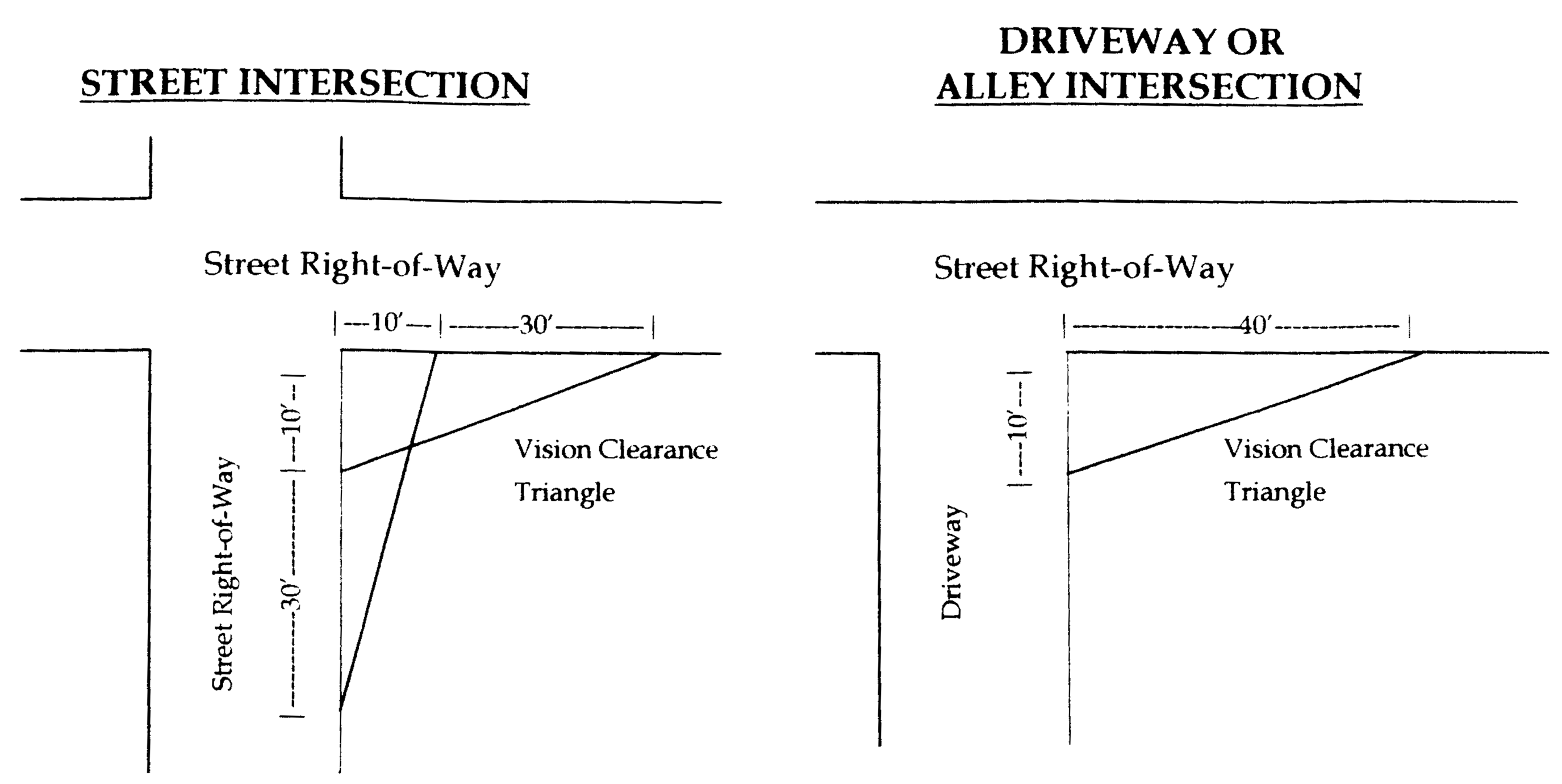
Vision clearance. In all zoning districts established by this Unified Development Code, no fence, wall, shrubbery, sign structure, building or other obstruction to vision between the height of three feet and ten feet above finished street grade shall be located within the triangular area created by connecting points located on the property line a distance of ten feet and 40 feet, respectively, from the corner of all intersections, including driveway intersections as illustrated in the following.
3-3.5
Ingress and egress. A plan for adequate and safe ingress and egress for all land uses shall be required.
3-3.6
Flood protection. Any structure proposed to be located within a flood hazard area as indicated on the flood insurance rate map shall meet the requirements of the Town of Pawleys Island flood damage prevention regulations.
(Ord. No. 2003-29, § 3-3, 12-8-2003; Ord. No. 2012-6, 5-14-2012; Ord. No. 2012-7, 8-13-2012; Ord. No 2012-11, 9-10-2012)
3-4. - Application of regulations.
3-4.1
Use. Except as herein provided, no building or land shall hereafter be used and no building or part thereof shall be erected, moved, or altered unless for a use expressly permitted by and in conformity with the regulations herein specified for district in which it is located. (Note—See section 2-5.4)
3-4.2
Street frontage. No building shall hereafter be erected, constructed, moved or relocated on a lot which does not have at least 50 feet of continuous frontage, and is contiguous with one of the official public streets of the Town of Pawleys Island, as shown on the Official Town Map and listed below. If the lot is bisected by the street, frontage shall be measured on that lot section containing the building site. This shall apply to all lots, except: This paragraph shall not supersede the provisions of this Unified Development Code relating to, "lots of record." (Note—See section 2-54.7)
OFFICIAL STREETS OF PAWLEYS ISLAND, SC
All streets and lot numbers are as shown on the official map of the Town of Pawleys Island, SC.
Atlantic Avenue, North to South from Assey PDD to one block South of 1 st Street at Lot 310B;
Myrtle Avenue, North to South from one block North of 3 rd Street at Lot 180 to Lot 615 & 618;
Shell Road, West to East from Pawleys Creek to Atlantic Avenue;
3 rd Street, West to East from Pawleys Creek to Atlantic Avenue;
2 nd Street, West to East from Myrtle Avenue to Atlantic Avenue;
1 st Street, West to East from Myrtle Avenue to Atlantic Avenue;
Pearce Street, West to East from Atlantic Avenue to Fraser Street;
Fraser Street, North to South from Lot 240 to Pearce Street;
North Causeway, West to East from Pawleys Creek to Myrtle Avenue;
Pavilion, Northwest to Southeast from North Causeway to Myrtle Avenue;
South Causeway, West to East from Pawleys Creek to Myrtle Avenue;
Hazard Street, West to East from Myrtle Avenue to Springs Avenue;
Doyle Avenue, North to South from Myrtle Avenue to Pritchard Street;
Scarborough Avenue, North to South from Myrtle Avenue to Pritchard Street;
Pritchard Street, West to East from Pawleys Creek to Springs Avenue;
Springs Avenue, North to South from Hazard Street to Georgetown County Parking Lot.
3-4.3
Corner lots. The minimum width of a side yard along an intersecting street shall be 50 percent greater than the minimum side yard requirements of the district in which the lot is located.
3-4.4
One principal building on a lot. Only one principal building and its customary accessory buildings may hereafter be erected on any lot, except that multifamily dwellings may be excluded from this provision with the approval of the planning commission.
3-4.5
Reduction of lot size. No lot shall be reduced in area so that yards, lot area per family, lot width, building area or other provisions of this Unified Development Code shall not be maintained.
3-4.6
Yard and open space. No part of any yard or other open space required for any building to comply with the provisions of this Unified Development Code shall be included as part of a yard or other open space required under this Unified Development Code for another building.
3-4.7
Conformity to development regulations. No building permit shall be issued for or no building shall be erected on any lot within the town unless the streets giving access to the lot on which said building is proposed to be placed shall have been accepted or opened as a public street prior to that time or unless such street corresponds in its location in line with a street shown on a subdivision plat approved by the Town of Pawleys Island Planning Commission and such approval entered in writing on the plat by the chairman of the commission.
3-4.8
Height and density. No building or structure shall hereafter be erected or altered so as to exceed the building height limit, to accommodate or house a greater number of families or to have narrower or smaller front yards or side yards than are required or specified in the regulations herein for the district in which it is located.
3-4.9
Parking and storage of certain vehicles. Automotive vehicles without current license plates and trailers of any kind or type (excluding boat or utility trailers) shall not be parked or stored on any property without the approval of the building inspector.
3-4.10
Accessory use, building or structure. No accessory use, building or structure in any zoning district shall be erected within six feet of any other building or structure and shall not be located in any required yard.
3-4.11
Abandoned, burned and/or obsolete structures. The owner of any structure or part thereof which becomes vacant, obsolete, burned and/or reparable for a period of six months or more shall be served written notice by the building inspector that such structure shall be removed. The owner of such structure shall begin removal within three months after receipt of notice from the building inspector and removal shall be completed within six months. Should the owner of such structure fail to comply with this regulation, the town council shall authorize the removal of said structure and the owner shall reimburse the Town of Pawleys Island for the cost of removal.
(A)
Unsafe structures and lots. The owner of any structure or part thereof which becomes unsafe to the general public for a period of six months shall be served written notice by the building inspector that immediate action be taken to rectify the conditions.
3-4.12
Fences. Fences may be erected in any zoning district subject to the restrictions listed below:
(A)
A building permit is required. All fences are subject to town review, requiring a sketch of proposed design for approval.
(B)
Fences may only be constructed of wood material, wood fiber composite material, brick or combinations thereof.
(C)
Fences shall not exceed six feet in height at any point, measured from the lowest adjacent grade on either side of the structure.
(D)
For fences on property in a FEMA AE zone, solid wood construction is allowed. Fences at the option of the property owner may be constructed of wood, wood fiber composite material, brick or combinations thereof. A vent is required to be installed every 48 linear inches. The vent size shall be a minimum of 100 square inches and allow for the full flow of water in any direction. The vent shall not be more than 12 inches above adjacent grade.
(E)
For fences on property in a FEMA VE zone, exposed foundation designs, solid walls and brick material are prohibited. All fencing must allow for full flow of water in any direction.
(F)
The most restrictive flood zone crossed by the fence will prevail.
(G)
Fences constructed on lots directly adjacent to public beach access parking lots can be up to eight feet in height. Fences at the option of the owner may be constructed of solid wood material or solid wood fiber composite material if designed and certified to "break away" from supports under velocity flood conditions.
(H)
Sand fence shall be designed and installed in accordance with the regulations of the office of coastal resource management; these regulations are available at the town hall. No sand fence shall be designed in a manner that will interfere with access to the dune by nesting loggerhead turtles and the seaward movement of loggerhead sea turtle hatchlings.
(I)
Barrier pool fences are for safety and to prevent unauthorized access.
1.
Barrier pool fences shall enclose the perimeter of the surrounding pool/patio/deck and be a minimum of four feet above the top of pool structure and patio/deck.
2.
Acceptable materials include wood, metal or composite materials containing wood fibers.
3.
Standard chain link fences with pipe framing are not permitted.
4.
Access gates shall be self-closing and locking.
5.
Openings in the fence shall not exceed four inches between pickets.
6.
Barrier fence and grade level patio/deck may extend to the property line.
7.
Any deck above grade level is restricted to property setback requirements.
3-4.13
Swimming pools, spas and hot tubs. The following regulations govern the, construction, alteration, maintenance, operation and use of residential swimming pools, spas and hot tubs:
(A)
Construction.
1.
In-ground permanent construction pools are permitted. Prefabricated fiberglass type pools/hot tubs are not permitted in-ground.
2.
Above-ground on-ground pools/hot tubs are not permitted.
3.
Elevated pools/hot tubs attached to the home may include prefabricated fiberglass type material.
(B)
Salt Water or Chlorine Chemicals.
1.
Salt water pools are required. Draining of pool water shall not be disposed of directly into storm drains, sewer system or marsh/creek areas.
(C)
Location.
1.
In-ground pools may be located within five feet of rear and side property lines and outside the front yard setback. A minimum of 15 feet setback shall apply from the edge of any salt water marsh wetland line as determined by OCRM.
2.
Elevated pools/spas/hot tubs attached to the home shall meet flood elevation and building setback requirements.
3.
An oceanfront lot pool shall comply with Pawleys Island Shore Protection Line and OCRM requirements.
4.
Any pool pump or equipment structure for in-ground construction shall meet the above five feet setback requirement.
5.
Power line/utility easements, if applicable, may affect location.
(D)
Barrier requirements for exterior construction.
1.
Barriers are for safety and to prevent unauthorized access. Barrier pool fences shall enclose the perimeter of the surrounding pool/patio/deck and be a minimum of four feet above the top of pool structure and patio/deck.
2.
Barriers of a visually open type are required.
i.
Acceptable materials include wood, metal or composite materials.
ii.
Unacceptable materials include standard chain link with pipe framing
3.
Access gates shall be self-closing and locking.
4.
Openings in the fence shall not exceed four inches between pickets.
5.
Barrier fence and grade level patio/deck may extend to the property line. Any deck above grade level is restricted to property setback requirements.
(E)
Permits.
1.
Building permits are required for pool construction.
(F)
Lot area coverage.
1.
Swimming pools are considered impervious material (P.I. UDC 2-47) and shall meet P.I. UDC Lot Area Coverage 3-5.8(A) requirements.
3-4.14
Driveways. Driveways are specifically prohibited from being constructed out of impervious material. A building permit is required for the construction, replacement or reconfiguration of a driveway constructed using materials other than gravel, shell or crushed stone. Impervious material requirements provided by sections 2-47 and 2-47(A).
(Ord. No. 2003-29, § 3-4, 12-8-2003; Ord. No. 2005-09, § 3-4.2, 12-12-2005; Ord. No. 2006-08, § 3-4.2, 5-8-2006; Ord. No. 2006-10, § 3-4.2, 11-13-2006; Ord. No. 2013-04, 3-11-2013; Ord. No. 2014-08, 11-10-2014; Ord. No. 2014-09, 11-10-2014; Ord. No. 2015-03, 4-13-2015; Ord. No. 2015-05, 4-13-2015)
3-5. - Exceptions and modifications.
3-5.1
Lot of record (as of the date of adoption of the ordinance from which this Unified Development Code is derived). Where the owner of a lot does not own sufficient land to enable him to confirm to the yard or other requirements of this Unified Development Code, an application may be submitted to the zoning board of adjustment for a variance from the terms of this Unified Development Code, in accordance with variance provisions established by this Unified Development Code. Such a lot may be used as a building site, provided however that the yard and other requirements of the district are compiled with as closely as possible in the opinion of the board of zoning appeals.
(A)
The building inspector shall be authorized to approve a building permit for a lot of record between 40 and 60 feet in width, provided that all requirements other than side yards are complied with. Minimum side yards permissible for lots between 40 and 60 feet in width shall be as follows:
*Minimum required yards. (Measured from outside wall of structure.)
(B)
Any alteration, reconstruction or new construction of buildings located closer than ten feet from side lot lines shall comply with the following:
(*Measured from building wall having an overhang projection).
Key to type fire protection.
A
Inside wall treatment shall consist of five-eighths inch type × gypsum wall board plus outside wall assembly approved for one-hour fire rating.
B
Inside wall treatment shall consist of five-eighths inch type × gypsum wall board plus outside wall assembly approved for one-hour fire rating.
C
Inside wall treatment shall consist of five-eighths inch type × gypsum wall board.
Note— Openings and roof overhangs shall be permitted in walls perpendicular to the line used to determine the fire separation distance.
3-5.2
Adjoining and vacant lots of record. A plot of land consisting of two or more adjacent lots with continuous frontage in single ownership, which individually are less than the lots widths required by this Unified Development Code, such groups of lots shall be considered as a single lot or several lots of minimum permitted size and the lot or lots in one ownership shall be subjected to the requirements of this Unified Development Code.
3-5.3
Front yard. The front yard requirements of this Unified Development Code for residential districts shall not apply to any lot where the average depth of existing front yards on developed lots, located within 100 feet on each side of such lot and within the same block and zoning district and fronting on the same street as such lot, is less than the minimum required front yard depth. In such case, the minimum front yard shall be the average of the existing front yard depths on the developed lots.
Note— See sections 3-2.2 and 3-2.3.
3-5.4
Exception on height limits. The height limitations of this Unified Development Code shall not apply to chimneys, flag poles and aerials as approved by the building inspector, subject to appeal to the board of zoning appeals. Communication towers of any type must be approved by the town council.
Note— See sections 3-2.2 and 3-2.3.
3-5.5
Restrictions on roof structures. Widow walks, observation platforms or sun decks shall be an integral part of the main part of a residential roof structure and not exceed 100 square feet in area, (the longest dimension shall not exceed ten feet nor extend more than four feet above the peak of the roof).
3-5.6
Group dwellings. New group dwellings are prohibited in the Town of Pawleys Island. Existing group dwellings that were lawfully established are nonconforming uses. These uses shall be limited to the following existing group dwelling lots of record:
The above listed group dwellings may continue and be repaired or restored in accordance with section 3-3.1 of this Code.
In addition to all other requirements applicable to group dwellings and nonconformities, existing group dwellings shall maintain: 1) 1,000 square feet of lot area for each rental room; 2) At least 50 square feet of dining area for each rental room; and 3) food service facilities that will accommodate only boarders of said establishments and their guests.
3-5.7
Setback exceptions for certain structures. Elevators, roof over hangs, on-grade patios, fences, sidewalks, pavement, air conditioning units and signs shall be exempt from the minimum setback requirements as required in section 3-2, provided that the requirements contained in section 3-3.4 are maintained.
(A)
The use of rain gutters and downspouts are encouraged to assist in managing stormwater runoff. Downspouts should be directed into vegetated areas. Gutters may extend into the minimum set back requirements.
(B)
Maximum allowed roof overhang projection varies with size of required setback distance. Roof overhangs or eaves may project 25 percent into the side setback distance. Rain gutters are not included when calculating the 25 percent and will be allowed in addition to the overhang.
(C)
Elevators may extend into any setback area a maximum distance of five feet provided the required setback area is not less than seven feet from the property line.
3-5.8
Lot area coverage and FAR limits. The following regulations shall apply to all zoning districts:
(A)
Not more than 40 percent of the area of a lot shall be covered by impervious material, provided that this requirement shall not limit lot coverage to less than 1,000 square feet nor allow lot coverage to exceed 4,000 square feet.
(B)
The floor area ratio (FAR) of a lot shall not exceed 40 percent of the area of a lot, provided that this requirement shall not limit the enclosed heated living space of a principal structure to less than 2,000 square feet nor allow such living space to exceed 4,000 square feet.
3-5.9
Second floor to first floor area ratio. Second floor total enclosed heated living space shall be limited to 80 percent or less of the first floor's total enclosed heated living space provided that this requirement shall not limit the enclosed heated living space of a principal structure to less than 2,000 square feet. The intent of the code is to restrict the second story total square footage, resulting in an overall reduced second story.
(Ord. No. 2003-29, § 3-5, 12-8-2003; Ord. No. 2007-05, § 3.5-7(A), 3-12-2007; Ord. No. 2007-09, § 3-5.5, 9-10-2007; Ord. of 11-2009; Ord. No. 2009-15, § 3-5.6, 12-7-2009; Ord. No. 2012-7, 8-13-2012; Ord. No. 2012-11, 9-10-2012; Ord. No. 2014-06, 9-8-14; Ord. No. 2014-10, 11-10-2014; Ord. No. 2015-06, 7-20-2015; Ord. No. 2015-11, 9-14-2015; Ord. No. 2017-06, 7-10-2017; Ord. No. 2021-05, 6-14-2021)
3-6. - Administration, enforcement, appeals, complaints and remedies.
3-6.1
Administration and enforcement. It shall be the duty of the duly appointed building inspector and he is hereby given the authority to administer and enforce the provisions of the zoning regulations. If the building inspector shall find that any of the provisions of these regulations are being violated, he shall notify in writing the person responsible for such violation, indicating the nature of the violation and ordering the action necessary to correct it. He shall order discontinuance of illegal uses of land, buildings or structures or of illegal additions, alterations or structural changes; discontinuance of any illegal work being done; or shall take any other action authorized by the zoning regulations to ensure compliance with or to prevent violation of its provisions.
3-6.2
Building permit required. No building or other structure shall be erected, moved, added to or structurally altered without a permit therefor issued by the building inspector. No building permit shall be issued by the building inspector except in conformity with the provisions of these regulations unless he receives a written order from the board of zoning appeals in the form of an administrative review or variance as provided by the zoning regulations. The building inspector shall issue building permits in accordance with the provisions of the building code in effect in the Town of Pawleys Island.
(A)
Prior to making application for a building permit, the applicant shall complete a UDO checklist and secure a signed review by a designated member of the Pawleys Island Planning Commission. This information is available from the town clerk. The approved checklist will become a part of the building permit application process, in addition to those requirements provided for in article 6.3.
3-6.3
Work exempt from permit. Permits shall not be required for the following. Exemption from permit requirements of this code shall not be deemed to grant authorization for any work to be done in any manner in violation of the provisions of this code or any other laws or ordinances of this jurisdiction.
(A)
Building:
1.
Painting, papering, tiling, carpeting, cabinets, counter tops and similar finish work.
2.
Swings and other playground equipment.
3.
Window awnings supported by an exterior wall which do not project more than 54 inches (1,372 mm) from the exterior wall and do not require additional support or do not infringe on any setback requirements.
(B)
Electrical repairs and maintenance: A permit shall not be required for minor repair work, including the replacement of lamps or the connection of approved portable electrical equipment to approved permanently installed receptacles.
(C)
Gas:
1.
Portable heating, cooking or clothes drying appliances.
2.
Replacement of any minor part that does not alter approval of equipment or make such equipment unsafe.
3.
Portable fuel-cell appliances that are not connected to a fixed piping system and are not interconnected to a power grid.
(D)
Mechanical:
1.
Portable heating appliances.
2.
Portable ventilation appliances.
3.
Portable cooling units.
4.
Steam, hot or chilled water piping within any heating or cooling equipment regulated by this code.
5.
Replacement of any minor part that does not alter approval of equipment or make such equipment unsafe.
6.
Portable evaporative coolers.
7.
Self-contained refrigeration systems containing ten pounds (4.54 kg) or less of refrigerant or that are actuated by motors of one horsepower (746 W) or less.
8.
Portable fuel-cell appliances that are not connected to a fixed piping system and are not interconnected to a power grid.
(E)
The stopping of leaks in drains, water, soil, waste or vent pipe; provided, however, that if any concealed trap, drainpipe, water, soil, waste or vent pipe becomes defective and it becomes necessary to remove and replace the same with new material, such work shall be considered as new work and a permit shall be obtained and inspection made as provided in this code.
(F)
The clearing of stoppages or the repairing of leaks in pipes, valves or fixtures and the removal and reinstallation of water closets, provided such repairs do not involve or require the replacement or rearrangement of valves, pipes or fixtures.
3-6.4
Emergency repairs. Where equipment replacements and repairs must be performed in an emergency situation, the permit application shall be submitted within the next working business day to the building official.
3-6.5
Repairs. Application or notice to the building official is not required for ordinary repairs to structures, replacement of lamps or the connection of approved portable electrical equipment to approved permanently installed receptacles. Such repairs shall not include the cutting away of any wall, partition or portion thereof, the removal or cutting of any structural beam or load-bearing support, or the removal or change or any required means of egress, or rearrangement of parts of a structure affecting the egress requirements that include creek walkways, docks, beach boardwalks and steps; nor shall ordinary repairs include addition to, alteration of, replacement or relocation of any water supply, sewer, drainage, drain leader, gas, soil, waste, vent or similar piping, electrical wiring or mechanical or other work affecting public health or general safety.
3-6.6
Public service agencies. A permit shall not be required for the installation, alteration or repair of generation, transmission, distribution, metering or other related equipment that is under the ownership and control of public service agencies by established right.
3-6.7
Application for building permit. All applications for building permits shall be accompanied by plans in duplicate drawn to scale, showing the actual dimensions and shape of the lot to be built upon; the exact sizes and locations on the lot of buildings already in existence, if any; and the locations and dimensions of the proposed building or alteration. The application shall include such other information as lawfully may be required by the building inspector, including existing or proposed buildings or alterations; existing or proposed used of the building and land; the number of families, housekeeping units or rental units the building is designed to accommodate; conditions existing on the lot; and such other matters as may be necessary to determine conformance with and provide for the enforcement of the zoning regulations. One copy of the plans shall be returned to the applicant by the building inspector after he shall have marked such copy. The original copy of the plans, similarly marked, shall be retained by the building inspector. The building permit shall expire exactly one year from the date of issue. The maximum of a six-month extension may be authorized by the building and zoning office, upon the application thereof and a fee of $20.00 being paid by the applicant.
3-6.8
Certificates of occupancy for new, altered or nonconforming structures of uses. It shall be unlawful to use, occupy or permit the use or occupancy of any building or premises or both or parts thereof thereafter created, erected, changed, converted, wholly or partly altered or enlarged in its use or structure until a certificate of occupancy shall have been issued therefore by the building inspector stating that the proposed use of the building or land conforms to the requirements of the zoning regulations.
3-6.9
Temporary structures and uses.
(A)
The building inspector is authorized to issue a temporary certificate of occupancy for the following temporary uses:
(1)
Contractor's office and equipment shed for a period not to exceed six months, provided that the structure is placed on the property to which it is appurtenant;
(2)
Any other use which is considered to be temporary in nature for a period not to exceed six months; and
(3)
All temporary certificates of occupancy may be renewed by the town council, provided such use will not cause traffic congestion nor create a nuisance to surrounding uses.
(B)
The building inspector shall maintain a record of all certificates of occupancy and a copy shall be furnished upon request to any person.
(C)
Failure to obtain a certificate of occupancy shall constitute a violation of these regulations and is punishable under section 3-6.7 of these regulations.
3-6.10
Complaints regarding violation. Whenever a violation of the zoning regulations occurs or is alleged to have occurred, any person may file a written complaint. Such complaint stating fully the causes and basis thereof shall be filed with the building inspector. The building inspector shall record properly such complaint, immediately investigate and take action thereon as provided by these regulations.
3-6.11
Penalties for violation. Any person violating any provision of these regulations shall be guilty of a misdemeanor and upon conviction, shall be fined and/or imprisoned by a judge of a court of competent jurisdiction, in the amount of up to a $500.00 fine and/or up to 30 days in prison, or any combination thereof, for each and every offense. Each day such violation continues, this shall constitute a separate offense. Nothing herein contained shall prevent the town from taking such other lawful action as is necessary to prevent or remedy any violation. It is the intention of the zoning regulations that all questions arising in connection with the enforcement of these regulations shall be presented first to the building inspector and that such questions shall be presented to the board of zoning appeals only on appeal from the decision of the building inspector.
(Ord. No. 2003-29, § 3-6, 12-8-2003; Ord. No. 2008-01, § 3-6.2, 2-11-2008; Ord. No. 2013-02, 1-14-2013; Ord. No. 2015-03, 4-13-2015)
3-7. - Board of zoning appeals.
3-7.1
Establishment of board of zoning appeals. A board of zoning appeals is hereby established. Said board shall consist of five members who shall be citizens of the Town of Pawleys Island or own property within the Town of Pawleys Island and shall be appointed by the town council for overlapping terms. Initial appointment shall be as follows: two members for a term of three years, two members for a term of two years and one member for a term of one year. Any vacancy in the membership shall be filled for the unexpired term in the same manner as the initial appointment. Members shall serve without pay.
3-7.2
Proceedings of the board of zoning appeals. The board shall elect one of its members chairman, who shall serve for one year or until he is re-elected or his successor is elected and qualified. The board shall appoint a secretary who may be an officer of the governing authority or of the zoning board. The board shall adopt rules of procedure in accordance with the provisions of an ordinance adopted pursuant to S.C. Code 1976, § 6-29-790. Meetings of the board must be held at the call of the chairman and at such other times as the board (at least 15 days) may determine. Notice of all meetings of the board shall be provided by publication in a newspaper of general circulation in the town. In cases involving variances, conspicuous notice shall be posted on or adjacent to the property affected, with at least one such notice being visible from each public thoroughfare that abuts the property. The chairman or, in his or her absence, the acting chairman, may administer oaths and compel the attendance of witnesses by subpoena. The board shall keep minutes of its proceedings, showing the vote of each member upon each question, or if absent or failing to vote indicating that fact, and shall keep records of its examinations and other official actions, all of which must be immediately filed in the office of the board and must be a public record.
3-7.3
Decisions of the board of zoning appeals. The concurring vote of a majority of the members present at a meeting shall be necessary to reverse any order, requirement, decision or determination of the building inspector or to decide in favor of the applicant on any matter upon which it is required to pass under these zoning regulations or to affect any variation of these zoning regulations. The board shall keep minutes of its proceedings, showing the vote of each member upon each question or if absent or failing to vote, indicating such fact and shall keep records of its examinations and other official actions, all of which shall be immediately filed in the office of the board and shall be public record. On all appeals, applications and other matters brought before the board of zoning appeals, the board shall inform in writing all the parties involved of its decision and the reasons therefor.
3-7.4
Appeals, hearings and notice. Appeals to the board may be taken by any person aggrieved or by an officer, department, board or bureau of the town. Such appeals shall be taken within a reasonable time, as provided by the rules of the board, by filing with the officer from whom the appeal is taken and with the board of zoning appeals a notice of appeal specifying the grounds thereof. The building inspector shall forthwith transmit to the board all the papers constituting the record upon which the action appealed from was taken. An appeal stays all legal proceedings in furtherance of the action appealed from unless the officer from whom the appeal is taken certifies to the board, after the notice of appeal shall have been filed with him, that by reason of facts stated in the certificate a stay would, in his opinion, cause imminent peril to life and property. In such case, proceedings shall not be granted by the board or by a court of record on application, on notice to the officer from whom the appeal is taken and on due cause shown.
The board shall fix a reasonable time for the hearing of the appeal or other matters referred to it and give public notice thereof, as well as due notice to the parties in interest and decide the same within a reasonable time. At the hearing any party may appear in person or by agent or by attorney.
3-7.5
Powers and duties. The board of zoning appeals shall have the following powers and duties:
(A)
To hear and decide appeals where it is alleged there is error in any order, requirement, decision or determination made by the building inspector in the enforcement of article III of this Unified Development Code.
(B)
To authorize upon appeal in specific cases a variance from the terms of the zoning regulations as will not be contrary to the public interest where, owning to special conditions, a literal enforcement of the provisions of the zoning regulations will in an individual case result in unnecessary hardship, so that the spirit of the zoning regulations shall be observed, public safety and welfare secured and substantial justice done. Such variance may be granted in such individual case of unnecessary hardship upon a finding by the board of zoning appeals that:
1)
There are extraordinary and exceptional conditions pertaining to the particular piece of property in question because of its size, shape or topography; and,
2)
The application of the zoning regulations on this particular piece of property would create an unnecessary hardship; and,
3)
Such conditions are peculiar to the particular piece of property involved; and,
4)
Relief, if granted, would not cause substantial detriment to the public good or impair the purpose and intent of the zoning regulations or the comprehensive plan provided, however, that no variance may be granted for a use of land of building or structure that is prohibited in a given district.
(C)
In exercising the above powers, the board of zoning appeals may, in conformity with the provisions of the zoning regulations, reverse or affirm wholly or in part or may modify the order, requirements, decision or determination of the building inspector and to that end shall have all the powers of the officer from whom the appeal is taken and may issue or direct the issuance of a permit. The board, in the execution of the duties for which appointed, may subpoena witnesses and in case of contempt, may certify such fact to the circuit court having jurisdiction. All findings of fact and conclusions of law must be separately stated in final decisions which must be delivered to parties of interest by certified mail.
3-7.6
Appeals from decision of the board of zoning appeals. Any person who may have a substantial interest in any decision of the board of zoning appeals may appeal from any decision of the board to the circuit court in and for the County of Georgetown by filing with the clerk of such court a petition in writing setting forth plainly, fully and distinctly wherein such decision is contrary to law. Such appeal shall be filed within 30 days after the decision of the board is rendered.
(Ord. No. 2003-29, § 3-7, 12-8-2003)
3-8. - Amendments.
3-8.1
Authority. These zoning regulations, including the official zoning map, may be amended from time to time by the town council as herein specified, but no amendment shall become effective unless it shall have been proposed by or shall first have been submitted to the planning commission for review and recommendation. The planning commission shall have 30 days within which to submit its report. If the planning commission fails to submit a report within the 30 day period, it shall be deemed to have approved the proposed amendment.
3-8.2
Requirements for change. When the public necessity, convenience, general welfare or good zoning practice justify such action and after the required review and report of the planning commission, the town council may undertake the necessary steps to amend the zoning regulations.
3-8.3
Procedure for amendments. Requests to amend the zoning regulations shall be processed in accordance with the following requirements:
(A)
Initiation of amendment. A proposed amendment to the zoning regulations may be initiated by the planning commission or by the owners of the property proposed to be changed; provided however, that action shall not be initiated for a zoning amendment affecting the same parcel of parcels of property or any part thereof and requesting the same change in district classification by a property owner or owners more often than once every 12 months.
(B)
Application procedure. Applications for amendment requests shall be obtained from the planning commission or the building inspector. Completed forms together with an application fee to cover administrative costs, plus additional information that the applicant feels to be pertinent shall be submitted to the planning commission. Any communication purporting to be an application for an amendment shall be regarded mere notice to seek relief until it is made in the form required.
1)
Applications for amendments must be submitted in proper form at least three weeks prior to a planning commission meeting in order to be heard at the meeting.
2)
Application fees shall be forwarded by the planning commission to the clerk who shall supervise the application of same to the cost of advertising and other administrative expenses.
3)
The planning commission, at regular meetings, shall review and prepare a report, including its recommendation for transmittal to the town council.
4)
All meetings of the planning commission shall be open to the public. At a meeting, any party may appear in person or by agent or by attorney. The applicant and property owners within 200 feet of the property to be rezoned shall be given at least ten days' notice of the public hearing.
5)
No member of the planning commission shall participate in a matter in which he has any pecuniary or special interest.
6)
Following action by the planning commission, all papers and data pertinent to the application shall be transmitted to the town council for final action.
(C)
[Public hearing.] Town council or planning commission shall hold a public hearing thereon, notice of time and place of which shall be published in a newspaper of general circulation in the town at least 15 days in advance of the scheduled public hearing date. In addition, a rezoning notice shall be posted on the subject property at least ten days prior to the public hearing.
(D)
Changes in the zoning map. Following final action by the town council any necessary changes shall be made on the official zoning map. A written record of the type and date of such changes shall be maintained by the town clerk. Until such change is made, no action by the town council on amendments to the zoning map shall be considered official.
3-8.4
Reversion. To prevent land speculation at the expense of the general public and to insure the timing of projects in accord with stated developmental objectives, construction shall start on all rezoned property within six months after rezoning. If construction is not begun within the specified time and is not completed within two years, the planning commission shall review the zoning of said property and the progress which has taken place and if deemed necessary, initiate proceedings to reclassify the property in a manner consistent with the comprehensive plan.
(Ord. No. 2003-29, § 3-8, 12-8-2003)

