
Pinal County Unincorporated
City Zoning Code
City Zoning Code
CHAPTER 2
145.- SIGNS, BILLBOARDS, NAME PLATES AND OTHER OUTDOOR ADVERTISING
2.145.010.- Purpose.
The uses, locations, types, heights, sizes and illumination of signs are herein regulated in order to protect the attractiveness of the county, to enhance tourism, to promote commerce, to preserve property values, to insulate residential areas from the undue impact of signs, to foster the effectiveness of business signage, to promote traffic and pedestrian safety, and to protect the general welfare.
(Ord. No. 61862, § 2201)
2.145.020. - Definitions.
The following words, terms and phrases, when used in this chapter, shall have the meanings ascribed to them in this section, except where the context clearly indicates a different meaning:
A-frame means any portable upright, rigid, self-supporting frame sign in the form of a triangle or the letter "A." (See Figure 1.)
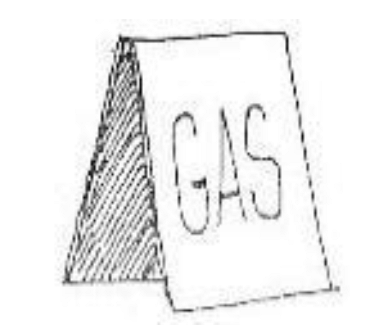
Figure 1
Advertising means to call public attention to things, usually to promote sale.
Aggregate sign area means the total area in square feet of all signage permitted for a given business.
Awning means a shelter or cover projecting from and supported by an exterior wall of a building.
Banner means a sign painted or printed on a strip of durable fabric, cloth or plastic.
Banner, feather, means a vertical portable sign that contains a harpoon-style pole or staff driven into the ground for support or supported by means of an individual stand. (See Figure 2.)

Figure 2
Canopy. Same as Awning.
Complex, commercial, industrial or office means a group of two or more businesses associated by a common agreement or common ownership with common parking facilities.
Construction (beginning) means the placement or attachment of sign-related materials (e.g., posts, poles, brackets, standards, bolts, screws, lumber, concrete, block, footings, paint) on the ground or on an existing building or other structure.
Frontage means the length of property line of any one premises along a public right-of-way on which it borders.
Grade means average elevation of the ground within a radius of 20 feet from the center point of the sign.
Interstate freeway interchange means where ingress or egress is obtained to a federal interstate highway; specifically delineated as lying within 300 feet of the right-of-way and between the two points of widening of the interstate highway right-of-way approaching the interchange.
Lighting, internal-reverse print, means an internally lighted sign in which the visible lighted area constitutes less than 50 percent of the total sign area, with lighted or visible letters against a dark background.
Mansard means a roof with two angles of slope, the lower portion of which is steeper and is architecturally comparable to a building wall. (See Figure 3.) Also a facade with a slope approaching the vertical which imitates a roof.
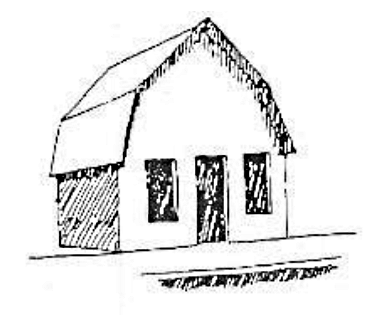
Figure 3
Marquee means a permanent roof-like structure or canopy of rigid materials supported by and extending from the facade of a building, to be considered a canopy for sign allowances.
Parapet means the extension of a false front or wall above a roof line.
Pennant means a geometric shaped flag made of flexible materials, suspended from one or two corners fastened to a string, which is secured or tethered so as to allow movement and used as an attention-getting form of media.
Reconstruction, substantial, means improvement or repair valued in excess of 50 percent of the current value of a sign. The term ""reconstruction does not include merely repainting or changing the copy on the sign if the use and size remain the same.
Roof line means the highest point of a structure including parapets, but not to include spires, chimneys or heating or cooling mechanical devices. (See Figures 4 and 5.)
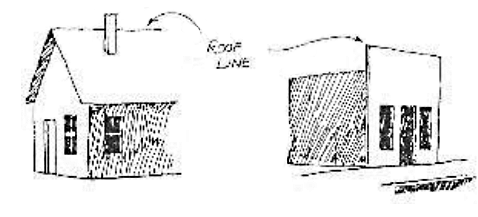
Figure 4 and Figure 5
Sign means any identification, description, illustration, symbol, or device which is affixed directly or indirectly upon a building, vehicle, structure, or land and which conveys information identifying or directing attention to or advertising a product, place, activity, person, institution, or business.
Sign, abandoned, means a sign which no longer identifies or advertises a bona fide business, lessor, service, owner, product, or activity, and/or for which no legal owner can be found.
Sign, canopy, means any sign erected directly upon or suspended from a canopy (awning). (See Figure 6.)
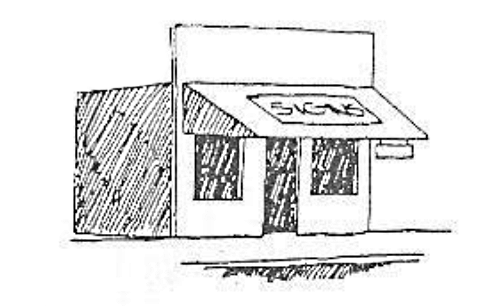
Figure 6
Sign, directional, means any sign which is designed solely for the purpose of traffic or pedestrian direction and placed on the property to which or on which the public is directed, and which contains no advertising copy. (See Figure 7.)
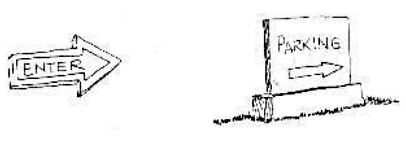
Figure 7
Sign, directory, means any sign listing the names, use, or location of the businesses or activities conducted within a building or group of buildings. (See Figure 8.)

Figure 8
Sign, freestanding, means a sign which is erected on its own self-supporting permanent structure, detached from any significant (i.e., weight-bearing) supporting elements of a building (lateral stabilizing support is not considered attachment to the building). (See Figure 9.)
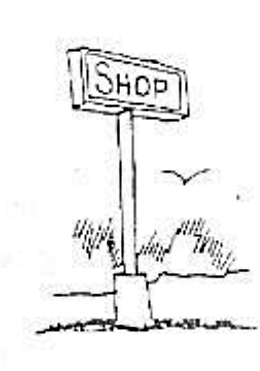
Figure 9
Sign height means the distance measured from grade at the base of a sign to the topmost portion of a sign, including decorative embellishments.
Sign, identification, means any sign identifying by name, message or symbol, a business, residence, occupant activity, institution, establishment, operation, merchandise, product, or service available at the property on which the sign is displayed.
Sign, illuminated, means a sign with an artificial light source incorporated internally or externally for the purpose of illuminating the sign.
Sign, inflated, means a sign held up by helium or blowing air.
Sign, monument, means a freestanding sign for a commercial, industrial or office site that displays the names of tenants on the site as well as the complex name. These signs are typically integrated into the landscaping for the complex.
Sign, nonconforming, means any sign which is not allowed under this Code, but which, when first constructed, was lawful.
Sign, off-premises, (billboard, outdoor advertising) means a sign advertising a business, place, activity, goods, services, or products on a different property from where said sign is located.
Sign, on-premises, means a sign advertising a business, place, activity, goods or services or products on the same property on which the sign is located.
Sign, political, means a temporary sign used in connection with a local, state, or national election or referendum.
Sign, portable, means any sign not permanently affixed to the ground or a structure on the site it occupies.
Sign, projection, means any sign attached to a building or other structure and extending in whole or in part more than 12 inches beyond the building shall be considered a freestanding sign with reference to square footage allowances. (See Figure 10.)
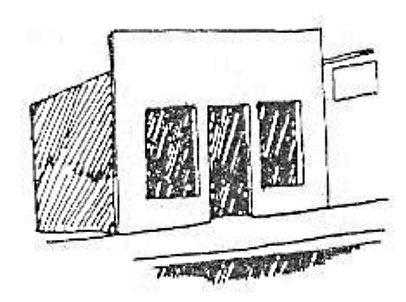
Figure 10
Sign, roof,means any sign erected upon the roof of any building which is partially or totally supported by the roof or reroof structure of the building. (See Figure 11.)

Figure 11
Sign, temporary kiosk, means a freestanding, non-illuminated structure consisting of a maximum seven directional panels per side, for a total of 14 directional panels per kiosk.
Sign, temporary promotional, means banners, streamers, flags, pennants, inflatable structures and other attention-getting media or devices designed to promote a sale or event or for some other short-term promotional purpose.
Sign, under-canopy, means a sign suspended beneath a canopy, ceiling, roof, or marquee shall be considered a freestanding sign with reference to square footage allowances.
Sign, wall-mounted, means a sign mounted or painted flat against, projecting less than 12 inches or painted on the wall of a building with the exposed face of the sign in a plane parallel to the face of said wall.
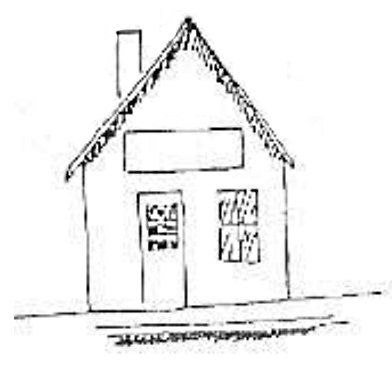
Figure 12
(Ord. No. PZ-C-002-12, §§ 1—5; Ord. No. 2010-PZ-C-006-09, § 1; Ord. No. 61862, § 2202)
2.145.030. - General provisions.
Except as may be further restricted in designated zoning districts, all permitted signs shall be subject to the following:
A.
A sign may be illuminated during the hours of operation of the facility being identified or advertised or until 11:00 p.m., whichever is later, but the source of illumination shall not be visible beyond the property lines. No flashing or intermittent illumination shall be used. Internally lighted signs may be "reverse print" or otherwise. No portion of any sign shall consist of mirrors or highly polished reflective surfaces.
B.
No sign (nor any portion of a sign) shall rotate, move, or simulate movement by means of fluttering, spinning, or reflection devices. (Not including temporary promotional signs.) Nor shall it contain an electronic message device except for "time and temperature" signs, nor shall it flash, blink, be audible, or be animated by any means.
C.
Lighted beacons, searchlights, or other lights or lighted devices which attract attention to a property are prohibited.
D.
No sign may encroach upon or overhang adjacent property or public right-of-way. No sign shall be attached to any utility pole, light standard, bridge, or any other public facility located within the public right-of-way. Signs may be located in or project into required yards but no sign nor any support for a sign shall be located in, or project into any private street, alley, easement, driveway, parking area or pedestrian way in such a manner at to obstruct the intended use or to constitute a safety hazard.
E.
Canopy (awning) signs shall not project above the canopy. Signs may be attached flat against canopies made of rigid materials; canopies of nonrigid materials, e.g., canvas, shall only have signs painted on them. Signs attached to a building shall not project above the eave line or parapet. Signs mounted on the lower portion of a mansard roof with a slope exceeding 74 degrees from the horizontal are permitted, provided they do not project above the top of the lower roof.
F.
In no case shall any sign exceed 30 feet in height.
G.
The square footage of a sign made up of letters, words, or symbols within a frame or border shall be determined from the outside edge of the frame or border itself. The square footage of a sign composed of only letters, words, or symbols shall be determined from imaginary straight lines drawn around the entire copy or grouping of such letters, words, or symbols. Only those portions of the construction elements that are an integral part of the sign itself shall be considered in the allocation of square footage allowed.
H.
No sign shall be painted on or affixed to any natural object in its natural location such as a boulder, tree or cliff face.
I.
Signs may be painted directly onto structural surfaces (walls or buildings) but not onto any roof.
J.
No sign shall be located in such a manner as to obstruct or otherwise interfere with an official traffic sign, signal or device or obstruct or interfere with a driver's view of approaching, merging or intersection traffic.
K.
No sign shall simulate the appearance of an official traffic sign, signal or device, nor the warning or signal device of any emergency vehicle.
L.
Signs painted on or attached to vehicles which are parked on the public right-of-way or on private premises for a continuous period in excess of 72 hours or repeatedly for three consecutive days for the purpose of intentionally circumventing the intention of this title shall be considered portable signs within the meaning of this title.
M.
In no case shall any sign project above the roof line of the building upon which it is mounted. Roof-mounted signs are permitted (if otherwise in compliance) and shall be considered to be a variety of wall-mounted sign.
N.
Repealed by Ord. No. 012010-AEO.
O.
New signs exceeding six square feet in area or exceeding eight feet in height shall follow the permitting requirements specified in PCDSC 2.145.140. Relocation or substantial reconstruction (i.e., costing more than 50 percent of the present value) of a sign shall be considered a new sign for building permit purposes.
P.
Signs which identify or advertise uses on other than the property on which they are located shall be permitted only in CB-2, C-2 and C-3 zoning districts and all industrial zoning districts. (See PCDSC 2.145.060, Off-premises signs.)
Q.
Signs which are not permitted in a residential zoning district, but are permitted in the zoning district of the adjacent property, shall be set back a minimum of 20 feet from the residential zone.
R.
Signs located within the triangular area on a corner lot formed by measuring 30 feet along both street lines from their intersection of a public street and a private street or driveway, shall maintain a maximum three-foot top height or minimum eight-foot bottom height and contain a maximum of two supports with a maximum 12-inch diameter each. (See Figure 13.)
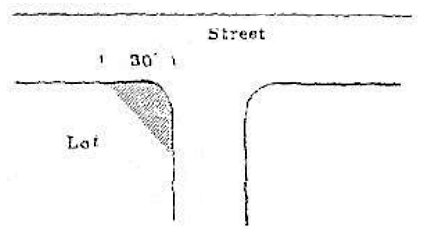
Figure 13
S.
Portable signs are permitted where indicated for zoning districts provided they are planted securely into the ground, weighted, or otherwise anchored to resist rolling, blowing, tipping over or otherwise moving from a safe location and further provided they are not attached to or sitting upon wheels or trailers.
T.
A-frame signs shall not exceed four feet in height and six square feet per face. A-frame signs must be located within 15 feet of the building entrance of the business being advertised. One A-frame sign is allowed per business and shall not be included in the aggregate sign area allowances. Churches located in schools and churches located in multitenant shopping, office or industrial centers, when they are not located next to a street, are allowed to place a maximum of two A-frame signs on private property next to the nearest street. Church A-frame signs can be placed in the allowed locations 24 hours before the start of worship and must be removed three hours after worship has concluded.
(Ord. No. PZ-C-002-13, § 1; Ord. No. PZ-C-002-12, § 6; Ord. No. 012010-AEO, § 1; Ord. No. 61862, § 2203)
2.145.040. - Exempt signs.
The following signs shall be exempt from obtaining permits and other provisions of this title provided they satisfy all requirements or specifications contained within this section:
A.
Official notices authorized by a court, public body, or public safety official.
B.
Directional, warning or information signs authorized by or consistent with federal, state, county, or municipal authority.
C.
Memorial plaques and building cornerstones when cut or carved into masonry surface or when made of incombustible material and made an integral part of the building or structure.
D.
Commemorative symbols, plaques and historical tablets.
E.
Political signs that meet the requirements in PCDSC 2.145.050(E).
F.
Flags, emblems, insignias and posters of any nation, state, international organization, political subdivision or other governmental agency; unlighted nonverbal religious symbols attached to a place of religious worship; and temporary displays (maximum of 30 days) of a patriotic, religious, charitable, or civic character shall be exempt from the provisions of this section; however, if the height exceeds the building height of the zoning district in which it is located, such signs shall be required to go through the comprehensive sign package process prior to their erection. The preceding shall not be construed as to permit the use of such flags, insignias, etc., for the purpose of advertising or identifying a product or business.
G.
Signs located within structures, including inside window signs intended to be seen from outside of the building.
(Ord. No. PZ-C-002-12, § 7; Ord. No. 61862, § 2204)
2.145.050. - Special purpose signs.
A.
Directional or information signs.
1.
Permanent on-premises directional signs are permitted in all zoning districts (and are in addition to the aggregate area limits specified in each zoning district) subject to the following:
a.
This sign shall contain no advertising copy.
b.
This sign shall not exceed four square feet in area per face.
c.
This sign may be double-faced.
d.
This sign may be placed flat against a wall of a building or such sign may be freestanding, but shall be no higher than eight feet above grade.
e.
This sign may be used to designate entrance or exits to or from a parking area, but the number shall be limited to one for each such entrance or exit.
f.
Off-premises permanent directional or information signs for public service or safety facilities (such as hospitals and clinics) may be permitted through the special use permit process as provided in PCDSC 2.151.010. Such signs may be specifically approved up to 24 square feet per sign.
g.
The total number of directional signs is not limited provided such signs are not located within required setback yards.
h.
Directional subdivision signs are permitted in any zoning district, and are subject to that zoning district's square footage limitations. Unlighted signs advertising subdivisions containing only the name of the subdivision, the name of the developer and/or agent, an identification emblem and directional message shall be permitted, provided:
i.
There shall be no more than one such sign for each subdivision vehicular entrance, not to exceed a total of three; and
ii.
Directional subdivision signs may only be displayed during the two years following the date of recordation of the final plat map.
2.
Permanent off-premises directional signs are permitted for certain tourist and recreation-related businesses which by their nature must be located away from arterial highways, such as destination campgrounds and resorts. Such signs shall be:
a.
Located at the arterial highway and/or intersections of access roads heading directly to the business.
b.
Limited to six square feet of panel area, not to exceed eight feet in height above grade, unlighted, and no closer than 20 feet to any property line.
c.
Limited in content to a generic description (one or two words) of the facility (such as "camping"), an arrow or words giving directions (such as "next right"), and a symbol or logo identifying the chain or name of the business.
d.
Mounted on the same standard where more than one such sign is erected at any one intersection and elsewhere whenever possible.
e.
Required to obtain an off-premises sign permit (even though under the minimum size otherwise requiring a permit).
f.
Limited to three such signs providing direction to any one parcel.
g.
Required to obtain a special use permit (PCDSC 2.151.010) for each sign.
B.
Temporary real estate, construction and subdivision signs.
1.
Temporary (including portable) "for sale" or rental signs are permitted in any zoning district. One on-site unlighted sign not exceeding six square feet on each street frontage adjoining a site, plus one "open house" sign not exceeding six square feet are allowed. Open house signs shall not be located in landscaped parkways, street medians, or bike trails. When affixed to a parcel of two acres or larger which lies contiguous to a major arterial highway with a right-of-way width of at least 150 feet at the location of the sign, a sign shall be permitted not to exceed 12 square feet in area. Freestanding signs shall not exceed six feet in height. All sale and rental signs shall be removed within 30 days from date of sale or rental, or after removal of the property from the active market.
2.
Construction signs are permitted, subject to the square footage limitation of the respective zoning district and in no case to exceed a total of 40 square feet in area for the project. On the site of a project actively under construction, unlighted signs to identify each contractor, architect or engineer, etc., engaged in a project are permitted. Freestanding signs shall not exceed eight feet in height. Such signs shall be removed within 30 days after the completion of the project or any cessation of construction activity for a continuous period of six months.
3.
On-site signs for subdivisions (including condominium projects), advertising only the subdivision and the sale of lots or units from a recorded plat, shall be permitted provided there shall be no more than 100 square feet of total sign area for each subdivision and a total of five signs. They shall not extend into any required yard nor shall any sign exceed 12 feet in height. Such on-site signs shall be permitted until sales office is abandoned in the subdivision or for a maximum of two years, whichever occurs first; and provided, that such signs are maintained in good condition. Extensions beyond the two-year limitation may be granted in the form of a special use permit (PCDSC 2.151.010) for one-year increments.
4.
For the purpose of administering this section, apartment or group housing complexes of 30 units or more shall be considered within the definition and regulations of a "subdivision" in subsection (B)(3) of this section. Apartment complexes may display directional signs for a period of one year following construction completion, subject to the additional regulations of subsection (A)(1) of this section.
5.
Office buildings or complexes, shopping centers and industrial parks may display leasing and rental signs for a period of one year following construction completion. These signs shall be limited to one freestanding sign and two building-mounted signs not to exceed a combined total of 100 square feet in area. Freestanding signs shall not exceed eight feet in height. After this one-year period, the regulations of subsection (B)(1) of this section shall apply.
C.
Temporary promotional signs.
1.
Promotional event types.
a.
Grand opening signs are allowed for a permitted business at the business location during one of the following:
i.
An "arm's length" change of ownership.
ii.
Opening a new location.
iii.
An expansion of floor area of at least 25 percent.
b.
Sale or event signs are signs designed to promote a sale or event or for some other short-term promotional purpose.
2.
Allowed signs.
a.
Banners, feather banners, pennants, inflatable structures.
b.
A-frame signs subject to PCDSC 2.145.030(T).
3.
Approvals required. A temporary sign permit will be required.
4.
Time limitations.
a.
Permits shall be for a maximum of 45 days.
i.
Grand opening signs shall be permitted no more than once in any 12-month period.
ii.
Sale or event signs shall be permitted no more than twice in any 12-month period.
5.
Requirements for all temporary promotional signs.
a.
Located on the property for which the temporary sign permit has been issued.
b.
Cannot be affixed to any utility pole, tree or similar object.
c.
Not permitted in parking aisles.
d.
All sign owners must maintain their signs in a professional manner as to appearance and structure.
6.
Additional banner requirements.
a.
Maximum size: 20 feet by five feet.
b.
One-sided.
c.
Securely attached to the building for which the temporary sign permit has been issued.
7.
Additional feather banner requirements.
a.
Maximum size: Ten feet in height measured from the base and a maximum of 30 square feet in area.
b.
Separated from any other sign, driveway or intersection by at least 50 feet; excluding wall-mounted and gasoline pricing signs.
c.
Two feather banners are permitted per tenant up to 20,000 square feet of building area.
d.
Four feather banners are permitted per tenant over 20,000 square feet of building area.
D.
Temporary kiosk sign.
1.
Temporary kiosk signs are approved for the following entities only: Communities, planned area developments, named subdivisions, builders, and governmental entities. There will be no additional advertising outside of the company name, logo, and directional arrow.
2.
All temporary kiosk sign structures will be required to get a temporary sign permit and will comply with the size, construction type, and color scheme as set forth by the planning department.
3.
All applications shall require a minimum of one contract from an existing community and/or builder within the service area.
4.
All applications shall require a written contract from the property owner for which the proposed sign is to be located. If on state land, a permit must be obtained first from the state. The planning department will not hold locations pending approval from any entity, whether private or public. Under no circumstances will signs be permitted in a right-of-way.
5.
A temporary kiosk sign located in the vicinity of state highways must obtain a state permit prior to submitting to the planning department.
6.
All locations must be approved by the planning department prior to the installation of the sign. These locations will be approved only if the site is beneficial to the surrounding area.
7.
Only one temporary kiosk sign shall be allowed per applicant per corner/location until that customer's original kiosk is sold out and displayed. For the purpose of simplicity, a four-way intersection is considered to have four corners; a three-way intersection is considered to have three corners.
8.
Off-premises temporary kiosk signs located outside of an intersection must maintain a minimum of 500 feet from closest intersection.
9.
Builders shall be allowed to advertise on off-premises temporary kiosks within a three- to five-mile radius of the community.
10.
Temporary kiosk signs approved for on-premises road side have the option of replacing the "Pinal County" name and logo with that of the community name and logo only. Under no circumstances will any other names be allowed, such as builders, etc.
11.
All sign owners must maintain their signs in a professional manner as to appearance and structure.
12.
Two panels on each side may identify community/public facilities (city hall, library, parks, districts, historic sites, etc.) at the discretion of the planning department.
E.
Political signs.
1.
Political signs can be located on private property or in public rights-of-way that are owned or controlled by the county, if the following conditions are met:
a.
The sign is erected no more than 90 days prior to a primary election and removed 15 days after the general election, except that for a sign for a candidate in a primary election who does not advance to the general election, the period ends 15 days after the primary election.
b.
The sign has a maximum area of 16 square feet if the sign is located in an area zoned for residential use, or a maximum area of 32 square feet if the sign is located in any other area.
c.
The sign supports or opposes a candidate for public office or it supports or opposes a ballot measure.
d.
The sign is not placed in a location that is hazardous to public safety, obstructs clear vision in the area or interferes with the requirements of the Americans with Disabilities Act.
2.
If the county deems the placement of a political sign constitutes an emergency, the county may immediately relocate the sign and notify the candidate or campaign committee that placed the sign within 24 hours after the relocation.
3.
If a sign is placed in violation of subsection (E)(1) of this section, and the placement is not deemed to constitute an emergency, the county may notify the candidate or campaign committee that placed the sign of the violation and provide 24 hours for its removal. If it is not removed 24 hours after the notification, the county may remove the sign and retain it for ten business days to allow the candidate or campaign committee to retrieve the sign without penalty.
(Ord. No. PZ-C-002-12, §§ 8—11; Ord. No. 2010-PZ-C-006-09, § 2; Ord. No. 61862, § 2205)
2.145.060. - Off-premises signs.
Off-premises signs (i.e., signs advertising a business, person, place, activity, goods, or products, on a different property from where the sign is located) may be permitted subject to the following conditions and restrictions:
A.
Off-premises signs other than directional signs described in PCDSC 2.145.040(B) shall be permitted only in the CB-2, C-2, C-3 and all industrial zoning districts.
B.
No new, relocated, or reconstructed off-premises sign shall be permitted within 200 feet of a residential zoning district.
C.
No new, relocated, or reconstructed off-premises sign shall be permitted within 1,500 feet of an existing off-premises sign.
D.
Off-premises signs shall be constructed on no more than three supports.
E.
In addition to the general provisions of PCDSC 2.145.030, all off-premises signs shall conform to the following development standards:
1.
Maximum height: 20 feet.
2.
Maximum area: 160 square feet.
3.
Shall not be located closer to a street than any existing building within 100 feet thereof, but in no case closer to the street right-of-way than 20 feet.
4.
Lighting shall be either internal or by indirect source (shielded and directed downward with reference to the horizontal plane of the ground surface in accordance with the Pinal County light ordinance).
F.
A city, town, or unincorporated community with a year-round population of 100 or more, the center of which is within ten miles of an interstate highway, upon petition by at least 51 adult residents, and approval by the Arizona Department of Transportation, and upon compliance with the special use permit application process requirements (PCDSC 2.151.010), may apply for a special use permit for a "community off-premises sign."
1.
Such community off-premises sign shall be located in commercial and industrial zoning districts.
2.
Such community off-premises sign shall have a maximum area of 200 square feet.
3.
Such community off-premises sign shall contain only approved copy limited to the following:
a.
Name of the community.
b.
A phrase expressing a motto or slogan referring to the community as a whole.
c.
The direction, route, and distance to the community.
d.
A list of types of services and amenities available in or reasonably near the community.
e.
The dates of the next community event or festival.
4.
Each community shall be limited to one such off-premises sign for each off-ramp at the interstate interchange closest to the center of the community by the most usable route between the interchange and the community.
5.
All community off-premises signs shall otherwise comply with all requirements and restrictions for off-premises signs.
G.
Off-premises signs consisting of banners, pennants or other temporary means of advertising annual special community events, festivals, and similar public gatherings of a not-for-profit nature shall be permitted in office, commercial, activity center and industrial zoning districts. Such signs shall obtain temporary sign permits (on a no-fee basis) prior to their erection. Permits for such signs shall be for a specific period, after which such signs shall be removed. Such signs shall otherwise comply with the general provisions, and the provisions of the zoning district in which they are to be placed, except that with proper authorization, such signs may be placed within or across the right-of-way of a public street or road. The number of such signs shall be limited to one per entrance to the community by a county or state arterial highway.
H.
If any off-premises sign contains copy advertising a use, business or product no longer in existence or available; or is left blank or damaged so as to be largely illegible; or is maintained without copy or without "space available" advertising for a period exceeding 180 days (six months), such sign shall be deemed abandoned and such sign shall be removed within 30 days upon written notification.
(Ord. No. PZ-C-002-12, § 12; Ord. No. 61862, § 2206)
2.145.070. - Sign regulations specific to the rural or residential zoning districts.
No sign shall be placed or maintained in any rural, residential or transitional zoning district (when used as residential) except as follows:
A.
Permanent signs.
1.
Name plate signs. A name plate sign identifying the name of the occupant of a residence, the occupant's profession, home occupation or title, and the address of the dwelling is permitted subject to the following:
a.
This sign shall not exceed four square feet in area, nor eight feet above grade at the sign.
b.
This sign shall be located on the property to which it pertains and the number of signs shall be limited to one for each dwelling.
c.
This sign may be indirectly illuminated by one light bulb or fluorescent tube not exceeding 15 watts.
2.
Identification signs.
a.
Signs identifying any allowed use within the zoning district are permitted, subject to the following:
i.
This sign shall not exceed 24 square feet in area, and may not be double-faced.
ii.
This sign may be placed flat against a wall of a building or such sign may be freestanding, but placement against a wall of a building shall extend no higher than ten feet above the grade at the base of the wall. The height of a freestanding sign shall not exceed ten feet above the grade.
iii.
This sign shall contain no advertising copy.
iv.
This sign shall be located on the property to which it pertains and the number shall be limited to one for each such use listed in subsection (A)(2)(a) of this section. Two such signs shall be permitted if the parcel exceeds five acres in area and has frontage on more than one publicly dedicated street or road.
b.
Signs identifying multifamily dwellings, apartment developments, boarding or rooming houses shall be allowed one sign per street frontage entrance, not exceeding 16 square feet in area each:
i.
This sign may be placed flat against a wall of a building or such sign may be freestanding, but placement against a wall of a building shall be no higher than ten feet above grade nor above the roof line. The height of a freestanding sign shall not exceed ten feet above grade.
ii.
This sign shall be for residential identification purposes only and shall contain no business identification or advertising copy.
iii.
This sign shall be located on the property to which it pertains.
3.
Subdivision signs. Permanent subdivision entrance signs are permitted. At the major street entrance to a subdivision or development, not more than two signs, indicating only the name, symbol, logo, or other graphic identification of the subdivision or development, each sign not exceeding six feet in height nor 50 square feet in area, attached to and not extending above a wall or fence, are permitted.
B.
Temporary signs. Temporary signs as provided in PCDSC 2.145.050(B) are permitted subject to all regulations contained therein.
(Ord. No. PZ-C-002-12, § 13; Ord. No. 61862, § 2207)
2.145.080. - Sign regulations specific to local business, neighborhood commercial and minor office (CB-1, C-1 and O-1) zoning districts.
No sign shall be placed or maintained in any TR (when used as commercial) or CB-1, C-1 or O-1 zoning district except as follows:
A.
Identification or advertising. Signs identifying uses permitted in any TR or CB-1, C-1 or O-1 zoning district and not located in a commercial or industrial complex are permitted subject to the following:
1.
Signs may be wall-mounted, freestanding or portable.
2.
The aggregate sign area on any one property shall not exceed an area of one square foot for each linear foot of street frontage adjoining the property to which it pertains, except that the total area need not be less than 24 square feet, and in no case shall the area exceed 96 square feet.
3.
One freestanding sign is permitted, the area of which may not exceed one-third of the allowable total aggregate area for the property, except that the area of the sign need not be less than 16 square feet. This sign may be double-faced.
4.
Freestanding signs shall not exceed a height of 12 feet, except that freestanding signs at interstate freeway interchanges (see PCDSC 2.145.020, definitions) in the CB-1, C-1 or O-1 zoning districts shall not exceed a height of 30 feet.
5.
Signs shall be located on the property to which they pertain.
6.
A-frame signs, subject to the requirements set forth in PCDSC 2.145.030.
B.
Temporary signs. Temporary signs as provided in PCDSC 2.145.030(B), 2.145.050(B) and 2.145.060(H) are permitted, subject to all regulations contained therein.
(Ord. No. PZ-C-002-12, § 14; Ord. No. 61862, § 2208)
2.145.090. - Sign regulations specific to the general business and general office (CB-2, C-2, C-3 and O-2) zoning districts.
No sign shall be placed or maintained in any CB-2, C-2, C-3 or O-2 zoning district except as follows:
A.
Identification or advertising (on premises). Signs identifying uses permitted in any commercial and office zoning district and not located in an office, commercial or industrial complex are permitted subject to the following:
1.
Signs may be wall-mounted, freestanding, or portable.
2.
The aggregate sign area on any one property shall not exceed an area of one square foot for each linear foot of street frontage adjoining the property to which it pertains, except that the total area need not be less than 24 square feet, and in no case shall the area exceed 128 square feet.
3.
One freestanding sign is permitted, the area of which may not exceed one-half of the allowable total aggregate area for the property, except that the area of the sign need not be less than 24 square feet. This sign may be double-faced.
4.
Freestanding signs shall not exceed a height of 15 feet, except that freestanding signs at interstate freeway interchanges (see PCDSC 2.145.020, definitions) shall not exceed a height of 30 feet.
5.
A-frame signs, subject to the requirements set forth in PCDSC 2.145.030.
B.
Off-premises signs. Off-premises signs are permitted, subject to PCDSC 2.145.060(H).
C.
Temporary signs. Temporary signs as provided in PCDSC 2.145.030(B) and 2.145.050(B) are permitted, subject to all regulations contained therein.
(Ord. No. PZ-C-002-12, § 15; Ord. No. 61862, § 2209)
2.145.100. - Sign regulations specific to the industrial zoning districts.
No sign shall be placed or maintained in any industrial zoning district except as follows:
A.
Identification or advertising signs (on-premises). Signs identifying or advertising uses permitted in any industrial zoning district not located in a commercial or industrial center are permitted subject to the following:
1.
Signs may be attached to a wall of a building or such sign may be freestanding or portable.
2.
The aggregate sign area for any one property shall not exceed an area of one square foot for each linear foot of street frontage adjoining the property to which it pertains, except that the total area need not be less than 60 square feet, and in no case shall the area exceed 160 square feet.
3.
One freestanding sign is permitted, the area of which may not exceed one-half of the allowable total aggregate area for the property; except that the area of the sign need not be less than 24 square feet. This sign may be double-faced.
4.
Freestanding signs shall not exceed a height of 15 feet, except that freestanding signs at interstate freeway interchanges (see PCDSC 2.145.020, definitions) shall not exceed a height of 30 feet.
5.
A-frame signs, subject to the requirements set forth in PCDSC 2.145.030.
B.
Off-premises signs. Off-premises signs are permitted, subject to all regulations contained in PCDSC 2.145.060.
C.
Temporary signs. Temporary signs as provided in PCDSC 2.145.030(B), 2.145.050(B) and 2.145.060(H) are permitted, subject to all regulations contained therein.
(Ord. No. PZ-C-002-12, § 16; Ord. No. 61862, § 2210)
2.145.110. - Sign regulations, specific to the PAD zoning districts and special use permits.
Permanent and temporary signs are permitted as stipulated in the PAD, or special use permit approval, or (if not stipulated) consistent with the regulations of the underlying zoning district.
(Ord. No. PZ-C-002-12, § 17; Ord. No. 61862, § 2211)
2.145.120. - Sign regulations, specific to manufactured/mobile home, travel trailer-recreational vehicle parks.
A.
Signs placed or maintained within any manufactured/mobile home, travel trailer-recreational vehicle parks are subject to all the regulations set forth under PCDSC 2.145.070(A)(1), name plate signs.
B.
Permanent entrance signs shall comply with the regulations set forth under PCDSC 2.145.070(A)(3), Subdivision Signs.
(Ord. No. 61862, § 2212)
2.145.130. - Sign regulations specific to commercial, industrial and office complexes.
Signs pertaining to a group of two or more businesses associated by a common agreement or common ownership with common parking facilities are permitted subject to the following regulations:
A.
Individual business signs shall be in accordance with the following:
1.
The total aggregate area of all signs on the site pertaining to any one business shall not exceed 32 square feet. However, if the portion of the building adjacent to its lot's street property line measures more than 40 feet, then the total aggregate area of one face of all such signs on the site may be increased in area at the rate of one square foot of sign area for each foot of building frontage in excess of 40 lineal feet; but the total aggregate area of all such signs on the site shall not exceed 48 square feet for each separate business. For corner buildings, only the main entrance frontage shall be so measured.
2.
When two or more businesses occupy one building with common entrances (i.e., without separate entrances), they shall be considered one business for sign computation purposes.
3.
Such signs shall be wall-mounted or under canopy signs.
4.
Under canopy signs shall be business identification signs and shall be limited to one per business and maximum six square feet in area.
5.
A-frame signs, subject to the requirements set forth in PCDSC 2.145.030.
B.
Monument signs are permitted subject to the following:
1.
One freestanding monument sign is permitted for any lot or parcel with a minimum of 300 feet of arterial or major collector street frontage; provided, that:
a.
Such signs shall not be counted in the total aggregate sign area for individual business identification.
b.
The maximum sign area shall not exceed 60 square feet and the maximum height shall not exceed 15 feet.
c.
Individual tenant signs located on the monument sign shall be no less than four square feet in area.
d.
The sign face shall be located at least four feet from the back of sidewalk and a minimum 30 feet from a driveway or intersection.
2.
One additional freestanding monument sign shall be permitted for each additional 200 feet of arterial or major collector street frontage. Where such additional sign is permitted, it shall be at least 100 feet from any other monument sign. No more than one monument sign per driveway entrance is permitted. Gasoline pricing signs are exempt from the minimum separation between signs.
C.
Directory signs may be provided for direction (with location numbers and/or arrows) to individual businesses in an office complex or commercial/industrial center in accordance with the following:
1.
No more than one such sign per tenant business per directory.
2.
Each sign shall not exceed one square foot in area. Such sign's area shall be permitted in addition to the aggregate permitted in subsection (A) of this section.
3.
Such signs shall be placed together in one or more groups at points nearest the pedestrian entrances to the businesses so indicated.
4.
Such signs or groupings of signs shall be wall-mounted or mounted on freestanding monument sign standards.
5.
Such signs or groupings of signs shall not exceed six feet in height.
(Ord. No. PZ-C-002-12, § 18; Ord. No. 61862, § 2213)
2.145.140. - Sign permits.
A.
Permit required. A sign permit shall be secured from the Pinal County planning and development services department prior to the erection, relocation, construction, installation or substantial reconstruction (including enlarging a painted sign on the surface of a permitted structure) of any nonexempt sign exceeding six square feet in area, or higher than eight feet above grade at the sign, regardless of value, according to the following:
B.
Fees. A uniform fee as provided for in chapter 2.160 PCDSC shall be paid for each sign permit application.
C.
Sign permit applications. Each application for a sign permit shall be made at a county planning and development services department office on the appropriate form and shall contain the information as required in chapter 2.160 PCDSC.
D.
Sign sticker or tag. Each permitted sign shall display an official county tag or sticker indicating its assigned permit number affixed to the face or support of the sign on the side facing the street in a visible location.
E.
Preexisting signs.
1.
Legal conforming signs and legal nonconforming signs existing prior to the effective date of the ordinance codified in this title shall be permitted to continue subject to PCDSC 2.05.080. Continuation shall include the right to repaint or change the message or copy on the sign provided the size and height is not increased and provided the sign is not converted from the on-premises to off-premises use. A change of ownership and/or business name shall not in and of itself alter the right of continued use of a sign.
2.
Preexisting signs shall be inventoried and identified by the county as preexisting. Such signs shall have an identification tag or sticker affixed to its surface by the county denoting its inventoried preexisting status.
F.
Signs not requiring permits. Signs not requiring permits by virtue of their height and size must nevertheless comply with all other requirements and restrictions of this title.
G.
Temporary sign permits. Signs with a limited duration of use (such as those provided in PCDSC 2.145.030(B), 2.145.040(B), and 2.145.050(B)) shall obtain a temporary sign permit. The requirements and criteria for such signs are as follows:
1.
Temporary sign permits shall be issued for no more than twice a year in 45-day increments. An extension of a temporary sign permit shall be made the subject of application for a special use permit (PCDSC 2.151.010).
2.
Temporary signs shall conform to all other requirements of this title.
3.
The fee for a temporary sign permit shall be the same as a permanent sign permit except as otherwise noted.
(Ord. No. PZ-C-002-12, § 19; Ord. No. 61862, § 2214)
2.145.150. - Flexibility provisions.
This section sets forth a procedure which provides flexibility in the sign code for signs or sign packages not allowed in PCDSC 2.145.010 through 2.145.140, or as the result of a stipulation to a zoning approval. The procedures include the use of design review to receive additional height and area for signs.
A.
[Sign review committee (SRC).] A sign review committee (SRC) consisting of staff from planning and development, public works, county manager's office, and a Pinal County resident not employed by Pinal County shall be appointed to review comprehensive sign packages. Planning and development staff will coordinate the preparation and submission of the comprehensive sign package. The SRC will make a recommendation to the director of planning and development services, who will make the final decision. Any person aggrieved by the determination may appeal that decision to the board of supervisors.
B.
[Comprehensive sign package; approval.] Approval of a comprehensive sign package is intended to encourage a flexible procedure to allow signage which is not in strict compliance with the provisions of the zoning district regulations under this chapter, but which is appropriate to the character of the development, provides adequate identification and information, provides a good visual environment, promotes traffic safety and is regulated to the extent necessary to be consistent with the purpose and intent of this chapter as specified in PCDSC 2.145.010.
C.
[Comprehensive sign package; application.] Approval of the application may contain such conditions, requirements or standards that may be stipulated by the sign review committee, as approved by the director of planning and development services, to assure that signs covered by the use permit will not be detrimental to persons or property in the vicinity, or to the public welfare in general.
D.
[Comprehensive sign package; evaluation.] Comprehensive sign packages approved under this section shall be evaluated based upon the following criteria:
1.
Placement. All signs shall be placed where they are sufficiently visible and readable for their function. Factors to be considered shall include the purpose of the sign, its location relative to traffic movement and access points, site features, structures, and sign orientation relative to viewing distances and viewing angles. In commercial centers in which some tenants are in locations having little or no street visibility, in order to provide identification, wall signs may be placed on walls of the building in which such tenants are located, even though not a wall of the space occupied by those tenants.
2.
Quantity. The number of signs that may be approved within any development shall not be greater than that required to provide project identification and entry signs, internal circulation and directional information to destinations and development subareas, and business identification. Factors to be considered shall include the size of the development, the number of development subareas, and the division or integration of sign functions.
3.
Size. All signs shall be no larger than necessary for visibility and readability. Factors to be considered in determining appropriate size shall include topography, volume of traffic, speed of traffic, visibility range, proximity to adjacent uses, amount of sign copy, placement of display (location and height), lettering style and the presence of distractive influences.
4.
Materials. Sign materials shall be compatible with architectural and/or natural features of the project. This may be accomplished through similarity of materials for sign structures and faces, the use of complementary colors, similarity of architectural style, or the use of a consistent lettering style or copy.
5.
Context. The design of all signs should respect the context of the surrounding area and the character established by existing signage. Items to be considered include, but are not limited to, lettering style, sign placement, and architectural style.
6.
Considerations. In making its determination to approve additional signs, the SRC shall consider the following standards:
a.
The views of or from adjacent properties are not impaired;
b.
The signs do not interfere with public utilities, government uses, transportation, landscaping or other factors felt relevant by the SRC;
c.
The width of the street, the traffic volume, and the traffic speed warrant the proposed signage;
d.
The signs do not pose a hazard to public safety.
E.
Amendments. Applications for amendments to the comprehensive sign package shall be processed in the same way as an original application.
F.
Minor alterations. Minor alterations in sign locations resulting from unexpected conditions on site may be approved by the director of planning and development services.
G.
Submittal package. A completed application shall be filed with the planning and development department together with an application fee; the application shall include the following:
1.
A justification letter describing the request and how the sign structure, materials, and colors are compatible with the project's building architecture. Include a list in outline form of each sign requested, both freestanding and wall, to include verbiage, area in square feet, and height.
2.
An inventory and photographs of any or all existing freestanding signs.
3.
Preliminary site/landscape plan.
a.
A vicinity map showing the location of the property in relationship to adjoining properties.
b.
Provide a north arrow, date of plan preparation, with subsequent revision dates; project title and address; architect and/or consultant's name, address, and telephone number; property owner name, address, and telephone number.
c.
Provide a data table on the site plan that includes existing zoning and the net site area.
d.
Show property boundaries and dimensions.
e.
Show adjacent street right-of-way, existing and proposed; and existing/proposed street and sidewalk improvements noted to center line.
f.
Show location of conceptual or existing landscape concepts including trees, shrubs, ground covers, berms, and screen walls.
g.
Show location of proposed freestanding signs including dimensions, height, materials and colors, and method of illumination.
h.
Include elevations of buildings showing wall sign locations with dimensions.
i.
When more than one sign is located on a property, or where more than one building or business is located in a single development project, such as a shopping center, a comprehensive sign package shall be submitted demonstrating consistency and uniformity among signs within the project. The requirements of a comprehensive sign package shall apply to all businesses within a related project, even if the properties have been subdivided. Revisions or amendments to the comprehensive sign package shall require documentation from all tenants on the property prior to approval.
See the appendix at the end of this title for sign review committee evaluation sheet.
H.
Review process.
1.
SRC review. Upon the filing of the completed application, the SRC shall review the application and forward the application together with a recommendation to the director.
a.
If the application is for a freestanding or wall sign that exceeds any ordinance maximum height standard by 50 percent or less, or exceeds any maximum area standard by 25 percent or less, or is for a directional sign that exceeds the area or height restrictions permitted on the site, the director shall make a decision of approval or denial.
b.
If the application is for a freestanding or wall sign that will exceed any ordinance maximum height standard by more than 50 percent, or any ordinance maximum area standard by more than 25 percent, or that contains an electronic message device, except for "time and temperature," the director shall transmit the application, along with the SRC's recommendation and the director's recommendation, to the board of supervisors.
2.
Director's decision. On applications reviewed by the director, notification of his/her decision shall be given in writing to the applicant. Said notice shall also inform applicant of applicant's right to request a review of the director's decision by the board of supervisors and the process for such a request.
3.
Request to review director's decision. Within 30 calendar days from the mailing date of the director's decision, applicant may file in writing with the clerk of the board of supervisors a request for review of the director's decision by the supervisors. A public hearing shall be set for the supervisors to hear the request for review.
4.
Board of supervisors' process.
a.
Public hearing. Applications transmitted to the supervisors for their consideration shall be set for a public hearing.
b.
Notices. Notice of the date and time of the public hearing shall be given by:
i.
Publication. At least one publication in a newspaper of general circulation in the county seat at least 15 calendar days prior to the date of the public hearing.
ii.
Posting. Posting the area of the site of the proposed location for the sign at least 15 calendar days prior to the date of the public hearing. The posting shall be along perimeter public rights-of-way so that the notice is visible from the nearest public right-of-way. It shall not be the responsibility of the county to maintain such posting once erected.
iii.
Mailings. By first class mail to each property owner, as shown on the assessment of the property, within 600 feet of the property where the sign will be located.
c.
Notice content. At a minimum, the notice shall include the date, time and place of the public hearing and a general explanation of the matter to be considered and how statements of support or opposition may be filed on the proposed action.
d.
Procedure. This is not a quasi-judicial procedure. Notice of the public hearing on the review request shall be by publication, posting and mailing as set forth in subsection (H)(4)(b) of this section. The supervisors may uphold the director's decision, modify the decision or reject the decision and make a new decision.
(Ord. No. PZ-C-002-13, § 1; Ord. No. PZ-C-002-12, § 20; Ord. No. 61862, § 2215)

