
Pinal County Unincorporated
City Zoning Code
City Zoning Code
CHAPTER 2
150.- GENERAL PROVISIONS, STANDARDS AND EXCEPTIONS
2.150.010.- Utilities.
A.
Transmission lines for the distribution of water, gas, wastewater, electricity, telephone, cable, including meter boxes, pipes, poles, wires, hydrants or similar installations necessary to distribute such utilities; power substations, and pumping and lift stations shall be permitted in any zoning district and shall not be subject to the minimum lot area requirement.
B.
Substations, pumping and lift stations enclosed in a building shall be subject to minimum front yard and side yards of the zoning district where located; and if not enclosed within a building, they shall be surrounded by an eight-foot wall and subject to front yard and side yard requirements of the zoning district where located.
C.
Structures such as power plants, wastewater treatment plants and ancillary offices and buildings which are not performing a governmental function are not exempt and must be located within the appropriate zoning district or obtain an SUP.
(Ord. No. 011812-ZO-PZ-C-007-10, § 11)
2.150.020. - Clay, sand or gravel pits, rock or stone quarries, gas or petroleum drilling permitted.
Clay, sand or gravel pits, rock or stone quarries, and drilling for petroleum or natural gas may be permitted in any zone; provided, that an SUP is obtained prior to the operation of any such use.
(Ord. No. 011812-ZO-PZ-C-007-10, § 11; Ord. No. 61862, § 2304. Formerly § 2.150.070)
2.150.030. - Parking lots in residence zones.
Land in a residence zone contiguous to a business or industrial zone and not exceeding 30,000 square feet in area may be used for automobile parking space, provided the conditions of PCDSC 2.140.030 are complied with, that a front yard of 20 feet be provided, planted and maintained in keeping with the residential neighborhood, that side and rear yards of ten feet each be provided and that no entrance be provided from an alley at the rear of said parking lot.
(Ord. No. 011812-ZO-PZ-C-007-10, § 11; Ord. No. 61862, § 2305. Formerly § 2.150.080)
2.150.040. - Reserved.
Reserved for future use.
(Ord. No. 011812-ZO-PZ-C-007-10, § 11)
2.150.050. - Height limit exemptions.
The height limits of this title shall not apply to:
A.
Water tanks, chimneys, conveyors, flag poles, spires, radio or television towers, masts and aerials, silos, smokestacks, electric power transmission towers, windmills and power poles.
B.
Fire or hose towers, cooling towers, gas holders, grain elevators, sugar refineries or other structures where the manufacturing process requires a greater height, provided the minimum side and rear yards are increased by an additional foot in width or depth for each foot by which the height of such structures exceed the maximum height permitted in the zone in which such structure is to be located.
(Ord. No. 011812-ZO-PZ-C-007-10, § 11)
2.150.060. - Height limit exceptions.
A.
Hospitals may be erected to a height not exceeding 60 feet and private schools to a height not exceeding 40 feet, provided the minimum side and rear yards are increased by an additional foot in width or depth for each foot by which the height of such buildings exceed the maximum height permitted in the zone in which such building is to be located.
B.
Elevators, cupolas, domes and steeples shall be allowed to exceed the height of the main building by 20 feet if the following criteria are met:
1.
They are attached to the main building;
2.
The roof area does not exceed ten percent of the roof area of the main building.
(Ord. No. 011812-ZO-PZ-C-007-10, § 11)
2.150.070. - Rear dwelling requirements.
In addition to the requirements of this title, the following shall apply to any dwelling in the rear of a principal building:
A.
There shall be provided an unoccupied and unobstructed accessway to a street, which accessway shall have a width of at least 15 feet for one dwelling unit and at least 20 feet for two or more dwelling units.
B.
For the purpose of determining the front yard for a rear dwelling in any residential zone, the rear line of the rear yard required for the building in the front shall be considered the front lot line for the building in the rear.
(Ord. No. 011812-ZO-PZ-C-007-10, § 11; Ord. No. 61862, § 2310. Formerly § 2.150.140)
2.150.080. - Structures in the front yard on corner lots.
A.
On any corner lot, no fence, structure, sign or planting shall be erected or maintained within 20 feet of the property corner so as to interfere with traffic visibility across the corner. (See following example.)
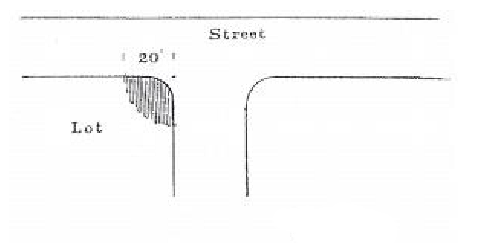
Traffic Visibility Across
Corner
B.
On any corner lot, trees are not permitted within the sight-visibility triangle and no temporary or permanent object, structure or landscaping shall exceed 24 inches in height within the sight-visibility triangle.
(Ord. No. 011812-ZO-PZ-C-007-10, § 11; Ord. No. 61862, § 2311. Formerly § 2.150.150)
2.150.090. - Front yard exceptions.
A.
In any rural or residential zone where a lot adjoins lots having existing front yards less than the minimum required by this title, the minimum front yard on said lot shall be the average of the existing front yards on the two adjoining lots, or if only one of the lots is built upon, such front yard of the adjoining lot and the minimum front yard of the zone; provided no such front yard shall be less than ten feet.
B.
In any zone, any property fronting or abutting on a turnaround at the end of a cul-de-sac, or similarly increased radii of the street property line at the angle in a street, the minimum front yard required shall be one-half of the front yard required in the particular zoning district.
(Ord. No. 011812-ZO-PZ-C-007-10, § 11; Ord. No. 61862, § 2312. Formerly § 2.150.160)
2.150.100. - Fences.
A.
Setbacks.
1.
On corner lots, fences exceeding 24 inches in height are not permitted within the sight visibility triangle.
2.
Other setback requirements of this title shall not apply to fences or walls being used as fences located in front yards (meaning along the front and sides of the front setback area) that are either:
a.
Open fencing of five feet or less in height; or
b.
Fencing of five feet or less in height where the portion of fence over three feet is open fencing;
c.
Fencing of six feet in height consisting of pipe rail or wrought iron. Gate may be no higher than eight feet.
3.
The setback requirements of this title shall not apply to fences or wall type fences of six feet or less in height that are being used as fences in side and rear setbacks.
4.
On office, commercial and industrial properties, the planning director may exempt fences or wall type fences higher than six feet from the setback requirements of the zone.
B.
Standards.
1.
Fences may consist of wood posts, wood planks, wood or metal rails, wire, chain link, or other customary fencing material approved by the planning director.
2.
Fences may not carry an electrical current or charge of electricity intended to render shock, except in rural zones for the enclosure of livestock.
3.
Fences may not contain barbed wire, except in rural and industrial zones.
4.
Fences may not consist of broken glass, tires, junk, other scrap, hazardous materials or devices.
5.
Wall type fences:
a.
May be constructed of concrete, stone, brick, tile, glass in the form of a mosaic or similar types of materials.
b.
May not consist of broken glass placed on top of or within the wall to act as a deterrent; tires, junk, other scrap unless surrounded or covered by masonry; hazardous material or devices, or carry an electrical current or charge of electricity intended to render shock except as described above.
(Ord. No. 011812-ZO-PZ-C-007-10, § 11)
2.150.110. - Projections into yards.
A.
An open deck not over three feet high above the natural grade and set back at least five feet from every lot line may project into any minimum front, side or rear yard.
B.
In any business or industrial zone, a marquee, canopy or awning, suspended or cantilevered from a building, either for the purpose of, or giving the appearance of shelter or shade may project not more than ten feet into any minimum front yard.
(Ord. No. 011812-ZO-PZ-C-007-10, § 11; Ord. No. 61862, § 2314. Formerly § 2.150.180)
2.150.120. - Rear yard adjoining alley.
A minimum rear yard may be measured to the center line of an alley adjoining such rear yard; provided, that the required rear yard shall not be reduced more than ten feet.
(Ord. No. 011812-ZO-PZ-C-007-10, § 11; Ord. No. 61862, § 2315. Formerly § 2.150.190)
2.150.130. - Rear yard exception on corner lot.
On any corner lot in a CR-3, CR-4, CR-5, TR, CB-1, R-9, R-7, MD or C-1 zoning district, the minimum rear yard may be reduced to not less than ten feet from the rear property line, provided the minimum side yard on the side street is increased by ten feet, and all off-street parking provisions of this title are complied with.
(Ord. No. 011812-ZO-PZ-C-007-10, § 11; Ord. No. 61862, § 2316. Formerly § 2.150.200)
2.150.140. - Accessory building attached to main building.
An accessory building attached to the main building shall have at least 50 percent of the length of one of its walls integrated with the main building and such accessory building shall comply in all respects with the requirements for the building.
(Ord. No. 011812-ZO-PZ-C-007-10, § 11; Ord. No. 61862, § 2317. Formerly § 2.150.210)
2.150.150. - Detached accessory building on corner lot.
On any corner lot, an accessory building shall meet the required minimum side yard requirements of the main building on that lot; provided further, that where the rear of a corner lot adjoins a key lot, no part of an accessory building within ten feet of the rear lot line shall be nearer the street side lot line than the depth of the front yard required on the key lot.
(Ord. No. 011812-ZO-PZ-C-007-10, § 11; Ord. No. 61862, § 2318. Formerly § 2.150.220)
2.150.160. - Storage and accessory uses.
A.
Mobile homes, manufactured homes and recreational vehicles (RV)/travel trailers are prohibited as storage facilities in any zone.
B.
Mobile homes and manufactured homes are prohibited as a guest house or casita, except where a mobile home or manufactured home is a permitted use in the zone.
C.
Manufactured homes and travel trailers are prohibited as an accessory use, except where permitted by a special density permit.
D.
Containers that are designed to be used for storage and appear to be cargo containers, yet do not meet the specifications for commercial shipping, packing, or transportation of freight, shall comply with the requirements of this section; except under special circumstances, as determined by the zoning inspector, or natural disasters, such containers may be used for storage on a short-term basis in any zone.
E.
Containers formerly used for transporting sea-going cargo, railroad cars, cabooses, semi-trailers, shipping containers, camper shells, or other units which slide off a chassis or frame including a body, box or unit which is removed from a chassis are not allowed for human occupancy in any zone.
F.
Containers formerly used for transporting sea-going cargo, railroad cars, cabooses, semi-trailers, shipping containers, camper shells, or other units which slide off a chassis or frame including a body, box or unit which is removed from a chassis are prohibited as storage facilities or accessory buildings in the following zones: CR-1A, CR-1, CR-2, CR-3, CR-4, CR-5, MH, RV, MHP, PM/RVP, TR, R-43, R-35, R-20, R-12, R-9, R-7, MD, MR, AC-1, AC-2, AC-3, O-1, O-2, C-1, MH-8, MHP-435 and PM/RVP-435.
G.
Containers formerly used for transporting sea-going cargo, railroad cars, cabooses, semi-trailers, shipping containers, or other units which slide off a chassis or frame including a body, box or unit which is removed from a chassis are allowed as storage facilities in CAR, SR, SR-1, SH, GR, RU-10, RU-5, RU-3.3, RU-2 and RU-1.25, subject to the following requirements:
1.
Containers may not be stacked;
2.
Containers shall be:
a.
Limited to one per acre, but not to exceed three per parcel;
b.
Shall not be larger than 400 square feet in size;
c.
Shall be painted in a mono-color; and
d.
Shall not be used for advertisements.
H.
Containers formerly used for transporting sea-going cargo, railroad cars, cabooses, semi-trailers, shipping containers, or other units which slide off a chassis or frame including a body, box or unit which is removed from a chassis are allowed as storage facilities in CB-1, CB-2, CI-B, C-2, and C-3, subject to the following requirements:
1.
Limited to one per parcel;
2.
Shall not be larger than 400 square feet in size;
3.
Shall be painted in a mono-color; and
4.
Shall not be used for advertisements.
I.
Containers formerly used for transporting sea-going cargo, railroad cars, cabooses, semi-trailers, shipping containers, or other units which slide off a chassis or frame including a body, box or unit which is removed from a chassis are allowed as storage facilities in CI-1, CI-2, I-1, I-2, and I-3, subject to the following requirements:
1.
Containers used for storage:
a.
Shall be painted in a mono-color; and
b.
Shall not be used for advertisements.
2.
Cargo or shipping containers used for cargo purposes in industrial zones are not considered storage facilities and may be stacked.
J.
Cargo containers used by licensed contractors for temporary storage of equipment and/or materials at a construction site during construction that is authorized by a county building permit are allowed in any zone.
(Ord. No. 011812-ZO-PZ-C-007-10, § 11)
2.150.170. - Exception for slope.
Parking spaces or detached garages may be occupied or built to within five feet of the street line on any lot where the slope of the front half of the lot is greater than one-foot rise or fall in a seven-foot run from the established street elevation at the property line or where the elevation of the front half of the lot is more than four feet above or below the established street elevation at the property line.
(Ord. No. 011812-ZO-PZ-C-007-10, § 11; Ord. No. 61862, § 2320. Formerly § 2.150.240)
2.150.180. - Maintenance of stock-tight fences.
All livestock and poultry kept in any residential, business or industrial zone shall be kept confined by fences or other restraints of sufficient strength and durability to prevent such livestock and poultry from roaming at large.
(Ord. No. 011812-ZO-PZ-C-007-10, § 11; Ord. No. 61862, § 2321. Formerly § 2.150.250)
2.150.190. - General information, location, and use for factory-built buildings (modular) and manufactured homes.
This title, for the unincorporated area of the county, provides for the residential use of a factory-built building (modular) and manufactured home as follows:
A.
Factory-built building (modular).
1.
A structure fabricated in a factory and delivered to the building site in one or more sections;
2.
The structure shall be designed only for installation on a site-built permanent foundation and not designed to be moved once installed on the foundation. The unit shall include all the plumbing, heating, cooling and electrical systems of the building and shall bear the Arizona insignia of approval pursuant to A.R.S. § 41-2195;
3.
A factory-built building shall be considered the same as a building and/or a dwelling unit; and
4.
Building permits for these structures may be issued only in those residential zones which allow conventional construction of homes as a permitted use.
B.
Manufactured home. A dwelling unit, transportable in one or more sections, manufactured after June 15, 1976, built to HUD standards with a HUD seal affixed, and does not include a recreational vehicle as defined in PCDSC 2.10.010, or a mobile home or factory-built building (modular) as defined in this section, which:
1.
In the traveling mode is greater than eight feet in width or 40 feet in length, or when erected on a site, is more than 320 square feet; and
2.
Is built on a permanent chassis; and
3.
Is designed to be used as a dwelling, with or without a permanent foundation, when connected to the required utilities, which include the plumbing, heating, cooling and electrical systems therein and subject to all the standards itemized below:
a.
If a perimeter foundation wall is not installed, all sides of the home shall extend to meet the ground, or a facade with the appearance of a foundation wall shall be used on all sides of the home, or skirting of approved material.
4.
Installation permits for these structures may be issued only in accordance with those residential zones in which manufactured homes are a permitted use, pursuant to floodplain regulations.
5.
Only manufactured homes completed after June 15, 1976, to standards established by the U.S. Department of Housing and Urban Development shall be allowed within the unincorporated areas of the county. The age limit shall apply to manufactured home installation permits issued on or after January 5, 2004. The only exception will be those mobile homes having been approved for rehab prior to January 5, 2004, which will be issued one installation permit only for the lifetime of the mobile home.
C.
Mobile home. A factory-assembled portable structure exceeding eight feet wide and/or 40 feet long, containing kitchen and bathroom facilities and service connections, built prior to June 15, 1976, on a permanent chassis, capable of being transported in one or more sections and designed to be used without a permanent foundation as a dwelling unit when connected to on-site utilities, except that it does not include a recreational vehicle as defined in PCDSC 2.10.010 or a manufactured home or factory-built home as defined in this section. A mobile home does not comply with the National Manufactured Home Construction and Safety Standards Act of 1974. No installation permits for mobile homes shall be issued on or after January 5, 2004. The only exception will be mobile homes approved for rehabilitation by Pinal County prior to January 5, 2004, and where the rehabilitation is completed by the applicant and approved by Pinal County prior to July 1, 2004. These rehabilitated mobile homes will be issued one installation permit only for the lifetime of the mobile home.
D.
As of the effective date of the ordinance codified in this title, mobile home and manufactured home unit construction and safety standards adopted by the U.S. Department of Housing and Urban Development (HUD), pursuant to section 7(D), Department of Housing and Urban Development Act, 42 USC 3535(D), title VI, Housing and Community Development Act of 1974 (42 USC 5401) and amendments thereto, are hereby adopted as the mobile home and manufactured home unit construction and safety standards for the county. One copy each of 42 USC 5401 is maintained in the office of the clerk of the board of supervisors, in each district office of the supervisors and is hereby adopted by this reference.
E.
As of the effective date of the ordinance codified in this title, the county zoning inspector shall not issue an installation permit for any mobile home or manufactured home within the county unless said mobile home or manufactured home can be proven to comply with those standards set forth in subsection (D) of this section. These regulations shall also apply to any mobile home or manufactured home installation permit sought to be issued for the relocation (i.e., from one location to another location on the same property or different property) of any mobile home or manufactured home within the county, except as provided in subsection (G) of this section.
F.
It shall be the responsibility of the permit applicants to demonstrate to the zoning inspector that the mobile home or manufactured home, for which an installation permit is requested, is in compliance with the standards set forth in subsection (D) of this section. Proof of compliance shall include, but is not necessarily limited to:
1.
A decal certifying that the manufactured home has been inspected and constructed in accordance with the requirements of the U.S. Department of Housing and Urban Development (HUD) in effect at the date of manufacture wherein such date shall not have been prior to June 15, 1976; or
2.
A State of Arizona insignia of approval as defined by A.R.S. § 41-2142, and its successor.
G.
Exceptions.
1.
The provisions of subsection (E) of this section shall not apply to a recreational vehicle as defined in A.R.S. § 41-2142.
2.
The provisions of subsection (E) of this section shall not apply to a mobile home as defined in subsection (C) of this section, provided the applicant for the installation permit is the owner of the mobile home and that the applicant furnishes proof of compliance with the following conditions and requirements:
a.
The mobile home has been continuously occupied by the owner/applicant for a period of not less than one year immediately preceding the application date;
b.
The mobile home continuously, for a period of not less than one year immediately preceding the installation permit application date, has been located on land not owned by the owner of the mobile home and the owner of the mobile home has paid rent for the mobile home space during that period of time;
c.
The owner/applicant intends to continue to occupy the mobile home following issuance of the installation permit;
d.
The owner/applicant shall state in a written affidavit that the above-stated conditions and requirements have been or will be complied with and that the owner/applicant shall continue to occupy the mobile home following issuance of the installation permit; and
e.
The mobile home is to be moved to and installed upon a mobile home space not owned by the owner of the mobile home and the owner of the mobile home is to pay rent for the mobile home space pursuant to a rental agreement as defined in A.R.S. § 33-1409.
i.
The planning director or the county manager shall have authority to waive the foregoing requirement and allow installation of an owner occupied mobile home upon property belonging to the owner.
ii.
The supervisors shall have the authority to review and amend any decision of the planning director or the county manager.
(Ord. No. 011812-ZO-PZ-C-007-10, § 11; Ord. No. 61862, § 2330. Formerly § 2.150.330)
2.150.200. - Group homes.
To permit the establishment of group homes in residential neighborhoods, while preserving the residential character of the community.
A.
Definition. The term "group home" means a licensed home suitable for accommodating more than six, but fewer than 11 adults or minor children who require special care for physical, mental, or developmental disabilities.
B.
Homes of six or fewer persons receiving care on a 24-hour-per-day basis shall be considered a single-family residence for the purposes of this title. The limitation of six or fewer persons does not include the operator or members of the operator's family or staff.
C.
Group homes shall be permitted in the SR, SR-1, SH, GR, GR-5, GR-10, CR-1A, CR-1, CR-2, CR-3, CR-4, CR-5, TR, MH, RU-10, RU-5, RU-3.3, RU-2, RU-1.25, R-43, R-35, R-20, R-12, R-9, R-7, MD, AC-1, AC-2, and AC-3 zoning districts, subject to issuance of a use permit by the zoning inspector showing compliance with the requirements of this subsection.
D.
Requirements.
1.
If licensing is required by the State of Arizona, for the use, proof of such licensure shall be provided to the planning and development department;
2.
The establishment must obtain a certificate of occupancy if required by county building codes;
3.
No such home shall be located on a lot with a property line within 1,200 feet, measured in a straight line in any direction, of the lot line of another such group home;
4.
The establishment must meet the minimum off-street parking requirements as set forth in PCDSC 2.140.020; and
5.
There shall be no exterior signage or other exterior indication that the property is being used as a group home. This shall not prevent improvements that are necessary for compliance with the Americans with Disabilities Act.
(Ord. No. 011812-ZO-PZ-C-007-10, § 11; Ord. No. 61862, § 2331. Formerly § 2.150.340)
2.150.210. - Bed and breakfast.
In addition to the requirements of a specific zone, a bed and breakfast is subject to the following additional requirements:
A.
Structures shall be altered or built in a way that maintains a residential appearance.
B.
For parking requirements, see PCDSC 2.140.020.
C.
No long-term rental of rooms shall be permitted; the maximum length of stay shall be 30 consecutive days.
D.
Other than registered guests, no meals shall be served to the general public.
E.
A specific site plan shall be submitted for review and approval, subject to chapter 2.200 PCDSC.
(Ord. No. 011812-ZO-PZ-C-007-10, § 11)
2.150.220. - Church.
Churches are subject to the following requirements:
A.
The primary access to the site is from an existing or planned arterial or collector street.
B.
Structures must be set back from any residential lot line, one foot for each one foot in height of the tallest part of the structure, other than the steeple.
C.
Maximum height of 40 feet, excluding unoccupied towers or steeples (See PCDSC 2.150.060(B) for height of steeples).
D.
For parking requirements, see PCDSC 2.140.020.
E.
A specific site plan shall be submitted for review and approval, subject to chapter 2.200 PCDSC.
F.
For height limit exceptions, see PCDSC 2.150.060.
(Ord. No. 011812-ZO-PZ-C-007-10, § 11)
2.150.221. - Cluster option for RU-10 and RU-5 zoning districts.
The requirements for the cluster option for the GR zoning district can be found in PCDSD 2.40.040. The requirements for the cluster option for RU-10 and RU-5 zoning districts are as follows:
A.
Intent. The cluster option provides for:
1.
Voluntary, permanent conservation of open space as a product of the subdivision of land.
2.
Protection of natural features including riparian areas, rock outcrops and natural topography.
3.
Flexibility in designing residential developments while not exceeding standard residential densities in these zones.
B.
Purpose. The purpose of the cluster option is to:
1.
Preserve significant conservation open space areas without increasing overall residential densities;
2.
Encourage and provide incentives for innovative site planning that is harmonious with the natural features and constraints of the property;
3.
Support open spaces that are interconnected, continuous, and integrated, particularly when located contiguous to public preserves;
4.
Allow for design innovation, flexibility, and more cost effective development due to more efficient servicing of the development with utilities, roads and other services; and
5.
Provide additional usable open space.
C.
Applicability.
1.
These cluster standards may be used to allow development on land containing natural features while permanently conserving substantial amounts of valuable open space.
2.
The cluster option is only to be applied to land that contains natural features such as desert washes, riparian areas, prominent peaks and ridges or natural slopes over 15 percent, and shall not be applied to agricultural lands where natural features have been removed, such as farm fields.
3.
The cluster option can only be used in conjunction with the application for a subdivision plat submitted and processed in accordance with this title and other regulations.
4.
This cluster option shall not be used in conjunction with a planned area development overlay zoning district application. Except as noted in this chapter, all other requirements of this title shall apply.
D.
Permitted uses. Unless listed below, a use is not permitted with the cluster option. The uses listed below may be different from the permitted uses in the base zone. The following uses may not be mixed with the permitted uses in the base zone unless approved with a special use permit:
1.
One-family dwelling unit, conventional construction.
2.
Child care (no more than ten children) for which compensation is received.
3.
Church, subject to the requirements of PCDSC 2.150.220.
4.
Community service agency, library or museum.
5.
Governmental structures, fire district stations, sheriff's facilities and their accessory uses.
6.
Group home, subject to PCDSC 2.150.200.
7.
Guest house/casitas, subject to the requirements of PCDSC 2.150.240.
8.
Home occupation, subject to the requirements of PCDSC 2.150.260.
9.
Parks.
10.
Private stable for the exclusive use by residents, provided the site contains not less than ten acres and the buildings or structures housing animals are set back from all lot lines a distance of not less than 100 feet.
11.
Public schools.
12.
Detached accessory buildings.
a.
Maximum height: 20 feet.
b.
Minimum distance to main buildings: Seven feet.
c.
Minimum distance to front lot line: 60 feet.
d.
Minimum distance to side and rear lot lines: Four feet.
e.
Accessory buildings shall be detached from the main building except they may be attached by means of an unenclosed structure that has only one wall not over six feet high which shall be placed on only one side of the structure.
E.
Development standards. Development standards shall be in accordance with the zone where the development is located, except as modified herein:
1.
Minimum subdivision area: 160 acres.
2.
Maximum density: Determined by dividing the subdivision area by the minimum lot area for the applicable zone without using this cluster option.
3.
Minimum lot size: 5,000 square feet.
4.
Minimum setbacks: front: 20 feet; side: eight feet; rear: 25 feet.
5.
Minimum lot width: 50 feet.
6.
Subdivision perimeter. The subdivision perimeter shall consist of a conservation open space buffer a minimum of 200 feet in width. Roadways may not act as a buffer; however, roadways may cross buffer areas and shall do so over the shortest distance feasible, preferably at 90-degree angles and in a manner that minimizes impacts to the conservation open space buffer and existing neighboring residential uses.
7.
Crossings. If approved by the planning director, roads, driveways, utility easements or similar improvements may cross conservation open space areas in alignments that are the least disruptive to the natural features, including topography, of the site.
8.
Fencing. Wildlife friendly fencing shall be used, with the following exceptions:
a.
Fencing and walls in private living areas on individual lots; and
b.
Fencing and walls for domestic pet enclosures on portions of lots not restricted by a conservation easement.
9.
Driveways. Widths shall be limited to a maximum of 24 feet with a maximum three-foot graded area on each side of the driveway. In sloped conditions, disturbed areas beyond the maximum three-foot graded area shall be restored. Maneuvering and turnaround areas adjacent to the private living areas of the lot may be wider than 24 feet.
F.
Open space. The subdivision's open space shall protect the subdivision's primary conservation features and provide links, as appropriate, between open space areas and important habitat areas. Open space requirements are as follows:
1.
A minimum of 30 percent of the subdivision shall be open space.
2.
No more than 50 percent of the required open space shall be recreation area open space as defined in chapter 2.10 PCDSC. The remaining required open space shall be conservation open space as defined in chapter 2.10 PCDSC.
3.
Open space adjacent to public parks or preserves may be deeded to the county, if approved by the supervisors, or to a nonprofit land trust.
4.
Except where protection of sensitive natural resources is paramount, frequent nonvehicular access points shall be provided to the open space areas of the subdivision making the open space amenities equally accessible to all residents of the subdivision.
5.
To maximize conservation open space benefits, open space areas shall provide connections to public preserves, undisturbed riparian areas and natural areas on adjoining properties where appropriate.
6.
Where possible, conservation open space areas shall be designed as part of a larger contiguous and integrated open space system of undeveloped areas.
7.
Buffers shall be provided adjacent to existing development to mitigate impacts of sound, visibility and traffic. Buffers may include landscaping, walls, fences, pathways, drainage ways, natural features and existing vegetation. Roads shall not be used as buffers.
8.
Ownership and control of conservation open space areas shall be:
a.
As part of an individual, private lot with recorded covenants running with the land; or
b.
By a homeowners' association, as specified in this section; or
c.
By the county, as legally dedicated either in fee simple or as a conservation easement, by form of instrument approved by the county. The county may but is not required to accept conservation open space areas; or
d.
By a nonprofit organization with perpetual existence that is acceptable to the county and whose principal purpose is to conserve natural areas and/or natural resources.
9.
If the conservation open space areas are to be owned and maintained by the homeowners' association of the subdivision, the subdivider shall record covenants, conditions and restrictions approved by the county including maintenance and preservation standards running with the land. The covenants shall contain the following provisions:
a.
A clause stating that designated conservation open space on the subdivision plat shall be restricted to conservation open space in perpetuity, and maintained by the homeowners' association; and
b.
A clause stating that the county is not responsible for maintenance or liability of the conservation open space areas, but that the county may enforce the maintenance and preservation standards and that the clause cannot be amended or repealed without the written consent of the county.
G.
Grading. Grading shall be in accordance with county grading and drainage regulations, standards and policies. Additional grading requirements for subdivisions using the cluster option are:
1.
Grading of a subdivision is permitted only for infrastructure including roadways, drainage facilities, utilities, recreation facilities and within the approved development areas.
2.
The maximum grading area on lots smaller than one acre (43,560 square feet) is 16,000 square feet.
3.
The maximum grading area on lots one acre or larger is 20,000 square feet.
4.
Lots with grading area limitations as described in subsections (G)(1) and (2) of this section shall have building envelopes delineated on the subdivision plat indicating the maximum area of the lot to be graded.
5.
The development shall be designed to have the least impact on the primary conservation features.
6.
Cut and fill.
a.
Cut material may not be pushed, dumped or disposed over any existing 15 percent or greater slope.
b.
Fill depth may not exceed eight feet and the face of exposed constructed slopes may not exceed eight vertical feet when measured from existing grade to the finished elevation.
c.
The height of any exposed cut slope shall not exceed 12 vertical feet. Larger cuts are permitted provided they are completely shielded from view from all surrounding areas.
7.
Within washes that have riparian habitat, only that grading for roadways and utilities that is necessary to provide access to approved development areas is permitted. Wash disturbance shall be minimized and all utilities shall be installed within utility easements, except where a utility easement is not a practical location for the utility as confirmed by the planning director, then the utility crossing shall utilize the least intrusive construction methodology. The disturbed wash area is subject to mitigation and revegetation as approved by the planning director.
8.
Graded and disturbed areas outside private living areas and fenced or walled pet runs shall be revegetated with plant material that replicates the understory, mid-story and canopy of adjoining open space areas. Drought tolerant, low water use plants including trees, shrubs, cacti, ground cover, grasses and seed mixes approved by the planning director may also be used.
9.
Except as provided in subsection (G)(8) of this section, revegetation of graded or disturbed areas shall be with indigenous trees, shrubs, and ground cover to simulate understory, mid-story and canopy of adjoining open space areas.
10.
Grading design, including the requirements of this section, will be included on the grading/landscape and restoration plan submitted with the tentative plat.
H.
Infrastructure standards.
1.
Cluster development shall comply with county roadway standards.
2.
Streets shall be laid out in a manner that avoids or minimizes adverse impacts to conservation open space areas to the greatest extent practical.
3.
There is no restriction on cul-de-sac length in a cluster subdivision project, subject to satisfaction of public health and safety concerns including reasonable accommodation for emergency vehicles. No cul-de-sac may serve more than 50 dwellings or any use that would generate 500 or more average daily vehicle trips. The county may require enhanced cul-de-sac street design, including traffic calming devices or additional pavement width, to reasonably offset local traffic impacts and public safety concerns created by additional cul-de-sac length.
I.
Submittal requirements. For review purposes, a cluster project submittal will include:
1.
Tentative subdivision plat to county standards and application requirements.
2.
Grading, landscaping and restoration/revegetation plans are required for all portions of the site disturbed during development.
3.
Covenants, conditions and restrictions that will apply to the cluster subdivision project.
4.
Application for review of a tentative subdivision plat utilizing the cluster option shall be submitted in writing together with required fees to the planning and development department.
J.
Procedures. County subdivision platting procedures shall apply to the processing of cluster subdivision projects. The following additional requirements also apply:
1.
A pre-application concept review meeting with the planning and development department is required for all proposals prior to submittal of a tentative plat utilizing the cluster option. The applicant shall prepare for the meeting a preliminary plan that shows:
a.
Proposed recreation area and conservation open space areas;
b.
Lot pattern;
c.
Street layout; and
d.
All development areas.
2.
The applicant shall consult with other applicable governmental agencies, affected utility companies and property owners within 600 feet of the site and submit a summary report that includes the names, addresses and dates of consultations to the planning director at least 30 calendar days prior to review of the subdivision plat by the commission.
3.
The tentative plat shall be prepared according to the county subdivision regulations. Additionally, the tentative plat shall include the following:
a.
Determination of density yield shall be determined by the minimum lot area in each applicable zone.
b.
Identification of open space areas, including primary conservation areas.
c.
Identification of development areas.
d.
Approximate location of building sites.
e.
Grading limits in accordance with subsection (G) of this section.
f.
The lot lines should, where possible, be located approximately midway between house locations and may include L-shaped or "flag lots" subject to the following requirements:
i.
Minimum 30-foot width of "pole" portion of flag lot;
ii.
County drainage requirements are met and drainage conflicts are not created;
iii.
Driveways for flag lots shall be paved; and
iv.
Minimum lot size for flag lots is 20,000 square feet.
g.
The tentative and final plat will include notes specifying the conservation and recreation area open space included on the plat are permanent and are not to be re-subdivided or used for any purposes other than open space as defined herein.
K.
Review. The planning and development department shall review the application and plat to determine if they are acceptable for further processing.
1.
If rejected, planning staff shall specify the conditions and revisions that must be complied with before the plat can be accepted by staff for further processing.
2.
Once accepted, copies of the plat will be transmitted to the applicable county departments for review.
L.
Applicable county departments review. Applicable county departments shall review the plat for compliance with the county's subdivision regulations and appropriateness of subdivision layout to the subdivision's primary conservation features and the purposes of this section. Diversity and originality in lot layout are encouraged to achieve the best possible relationship between recreation area and conservation open space areas. To the greatest extent possible and practical, the subdivision layout shall:
1.
Protect and conserve riparian areas, slopes greater than 15 percent and significant peaks and ridges from grading, clearing, filling or construction except as necessary for essential infrastructure;
2.
Use of buffers to minimize conflicts between residential uses, conservation areas and wildlife habitat;
3.
Locate development on the least environmentally sensitive areas of the subdivision;
4.
Protect wildlife habitat;
5.
Avoid locating dwellings on prominent hilltops or ridges;
6.
Preserve sites of historic, archaeological or cultural value, preserving their character and integrity;
7.
Provide pedestrian and hiking trails that provide for pedestrian safety and convenience and connectivity between properties and activities or features of the project; make open space areas intended for recreational use easily accessible to pedestrians; and
8.
Consolidate and connect open space areas and minimize fragmentation of conservation open space areas within the subdivision.
The commission shall review the tentative plat for conformance with the county subdivision regulations and conformance with the intent, purpose and requirements of this chapter and for design that is compatible with the primary conservation features of the subdivision.
(Ord. No. 011812-ZO-PZ-C-007-10, § 11)
2.150.230. - Golf courses.
Except for miniature golf, and restricted related facilities, such as clubhouse, restaurant, bar or cocktail lounge, rest rooms, pro shop, and buildings for the maintenance and storage of golf course equipment are subject to the following requirements:
A.
The site shall be a minimum of 30 acres.
B.
All buildings shall be a minimum of 200 feet to any boundary of the site.
C.
The course shall have a minimum of nine holes.
D.
Any driving range shall be placed so that flying balls will be directed toward the interior of the site.
E.
All outdoor lighting shall be hooded and controlled so that the source of the light shall not be visible from any adjoining residential zone and shall meet the requirements of chapter 2.195 PCDSC.
F.
For parking requirements see PCDSC 2.140.020.
G.
A specific site plan shall be submitted for review and approval, subject to chapter 2.200 PCDSC.
(Ord. No. 011812-ZO-PZ-C-007-10, § 11)
2.150.240. - Accessory Dwelling Units.
Definitions. For purposes of this section:
"Accessory dwelling unit" or "ADU" means a self-contained living unit that is on the same lot or parcel as a single-family dwelling of greater square footage than the accessory dwelling unit, that includes its own sleeping and sanitation facilities and that may include its own kitchen facilities.
"Gross floor area" means the interior habitable area of a single-family dwelling or an accessory dwelling unit.
"Permitted use" means the ability for a development to be approved without requiring a public hearing, variance, conditional use permit, special permit or special exception, other than a discretionary zoning action to determine that a site plan conforms with applicable zoning regulations.
Permitted Uses.
A.
Dwelling Units. Each lot or parcel may have the following:
1.
One single-family dwelling unit, "Primary Use" (required);
2.
One attached and one detached ADU as a permitted use for a lot or parcel that is less than one acre in size; and
3.
One additional detached ADU as a permitted use on a lot or parcel that is one acre or more in size.
In addition to the requirements of a specific zone, ADUs are subject to the following additional requirements:
A.
Minimum development standards:
1.
Minimum rear and side setbacks shall be five feet from the property line;
2.
Restrictions for ADUs will be the same as those for single-family dwellings within the same zoning area with regard to height, front setbacks, lot size or coverage, or building frontage; and
3.
For detached ADUs, the minimum distance from the main building shall be seven feet.
B.
For lots or parcels less than one acre in size, ADUs shall be no larger than 75 percent of the gross floor area of the single-family dwelling on the same lot or parcel or 1,000 square feet, whichever is less.
C.
For lots or parcels one acre or more in size, ADUs shall be no larger than 75 percent of the gross livable floor area of the main single-family dwelling on the same lot or parcel or 1,500 square feet, whichever is less.
D.
Shall use the same street access that serves the single-family dwelling.
E.
The ADU and the single-family dwelling shall not be served by separate utility meters.
F.
Shall be a minimum of 200 square feet.
G.
Shall have a separate exterior entrance from the single-family dwelling.
H.
The ADU and the single-family dwelling shall not be physically addressed separately; however, ADUs must have separate unit house numbers.
I.
A manufactured home, mobile home, recreational vehicle, or park model trailer, shall not be used as an ADU, except as otherwise allowed under A.R.S. § 11-820.03.
J.
May not be built on top of a current or planned public utility easement unless the property owner receives written consent from any utility that is currently using the public utility easement or that may use the public utility easement in the future.
K.
This section does not supersede applicable building codes, fire codes, sensitive environmental area regulations, wildfire prevention regulations, emergency vehicle access regulations, drainage and flood control regulations, or public health and safety regulations, except that a county may not require an ADU to comply with a commercial building code or contain fire sprinklers.
L.
If a new ADU will not be connected to a sewer system or if the sewer system lacks capacity to serve the new ADU, the County will require that any septic system that will be used to serve the ADU be adequately sized before the construction of the ADU.
M.
This section does not apply to lots or parcels that are located on:
1.
Tribal land;
2.
Land that is in the territory in the vicinity of a military airport or ancillary military facility or property that is in a high noise or accident potential zone as defined in A.R.S. § 28-8461; and
3.
Land that is in the territory in the vicinity of a federal aviation administration commercially licensed airport or a general aviation airport or land that is in the territory in the vicinity of a public airport as defined in A.R.S. § 28-8486 and that has a noise level of greater than 65 decibels.
(Ord. No. 011812-ZO-PZ-C-007-10, § 11; Ord. No. 2024-PZ-C-001-24, § 1(Exh. A); Ord. No. 2025-PZ-C-001-25, § 1(Exh. A))
2.150.250. - Guest ranch.
Guest ranches are subject to the following requirements:
A.
Permitted accessory uses are a restaurant, beverage service, incidental retail sales and services, and professional office, if:
1.
They are no closer than 100 feet to any public street;
2.
Have no outside entrance facing the street; and
3.
Are intended, provided and operated primarily for the convenience of guests.
B.
A guest ranch shall not stable or keep more than one horse for each 10,000 square feet of land area.
C.
No stable or corral shall be closer than 50 feet to any lot line and not closer than 100 feet to a dwelling on an adjoining property or to a school, park, public street or road.
D.
The site shall be a minimum of 20 acres.
E.
A specific site plan shall be submitted for review and approval, subject to chapter 2.200 PCDSC.
(Ord. No. 011812-ZO-PZ-C-007-10, § 11)
2.150.260. - Home occupation.
Home occupations are subject to the following requirements:
A.
A home occupation permit is required to be obtained from the planning director.
1.
The home occupation permit shall apply only to a full-time resident of the dwelling.
2.
If there is a change in use, a new home occupation permit shall be required.
3.
A home occupation permit is issued to the applicant and does not attach to the land.
B.
The home occupation must be conducted within a dwelling or an accessory building of not more than 400 square feet. Not more than one-fourth of the floor area of one story of the main dwelling shall be used for the home occupation.
C.
There shall be no public display of stock-in-trade upon the premises.
D.
Not more than two nonresidents of the premises is employed in the home occupation.
E.
No equipment or material associated with the home occupation shall be stored outdoors.
F.
The residential character of the dwelling and subject property shall not be changed by said use.
G.
Such occupation shall not cause any sustained, unpleasant, or unusual noises or vibrations, or noxious fumes or odors, or cause any traffic congestion in the immediate neighborhood.
H.
All parking used in conjunction with the home occupation shall be on site and shall not include commercial parking features such as wheel stops, parking lanes or striping.
I.
Home occupations shall not provide overnight accommodations.
J.
Home occupations shall serve no more than five clients in one day and no more than two clients at any one time.
K.
No signs advertising the home occupation are permitted, except a temporary commercial sign on the residential property during business hours, if the sign is not more than 24 inches by 24 inches.
L.
The following uses shall not be permitted as home occupations:
1.
Auto repair and service;
2.
Barbershop;
3.
Beauty salon;
4.
Commercial food preparation;
5.
Mortuary or embalming service;
6.
Tattoo parlor;
7.
Veterinarian service, kennels, and pet grooming;
8.
Welding service;
9.
Any commercial use not customarily associated with home occupations as a secondary use; and
10.
Delivery services related to a commercial use.
(Ord. No. 011812-ZO-PZ-C-007-10, § 11)
2.150.270. - Recreational vehicles as temporary dwellings.
Recreational vehicles, as defined in this title, may be permitted as a temporary dwelling during construction. A temporary use permit issued in accordance with PCDSC 2.151.030 is required for such temporary use.
(Ord. No. 011812-ZO-PZ-C-007-10, § 11)
2.150.280. - Schools.
A.
Public schools are permitted in all zoning districts.
B.
Private schools for K—12 are subject to the following requirements:
1.
The minimum site area shall be five acres in all zones.
2.
The minimum setback for playgrounds or athletic fields shall be 100 feet from all property lines.
3.
A ten-foot-wide landscaped area shall be provided as screening and buffering along all property lines.
4.
All driveways and parking lots shall be paved.
5.
All outdoor lighting used in conjunction with the school use shall meet the requirements of chapter 2.195 PCDSC.
6.
All lighting for outdoor recreational areas shall cease no later than 11:00 p.m.
C.
Charter schools are prohibited from operating in an existing single-family residence that is located on property of less than an acre.
(Ord. No. 011812-ZO-PZ-C-007-10, § 11)
2.150.290. - Reserved.
(Ord. No. 011812-ZO-PZ-C-007-10, § 11)
2.150.300. - Reserved.
(Ord. No. 011812-ZO-PZ-C-007-10, § 11)
2.150.310. - Reserved.
(Ord. No. 011812-ZO-PZ-C-007-10, § 11)
2.150.320. - Activity center development guidelines manual.
The planning and development department shall prepare an activity center development guidelines manual (AC guidelines manual) to provide information and guidelines in planning activity centers for the AC-1, AC-2 and AC-3 zoning districts. The planning and development department may revise the AC guidelines manual as needed. Such revisions are not amendments to this title and shall not effect any change in the title itself. This title governs over the manual.
A.
An activity center development guidelines manual (AC guidelines manual) that provides information and guidelines in planning activity centers for the AC-1, AC-2 and AC-3 zoning districts may be adopted separately by resolution of the Pinal County board of supervisors after 15 days' notice and a public hearing.
B.
The manual may be subsequently amended by a resolution of the Pinal County board of supervisors after 15 days' notice and a public hearing.
C.
The manual will not be printed as part of this title, but shall be printed as a separate document. Copies of the manual will be available for inspection and purchase at the Pinal County development services counter.
(Ord. No. 011812-ZO-PZ-C-007-10, § 11)

