
Ponce Inlet City Zoning Code
ARTICLE 5
CONSISTENCY AND CONCURRENCY STANDARDS
SECTION 5.1.- PURPOSE AND APPLICABILITY
The purpose of this article is to provide a systematic concurrency management process for the review and evaluation of all proposed development impacts on basic public facilities and services as required by the Community Planning Act, F.S. Chapter 163, Part II, and as provided under the town's home rule authority for transportation facilities. Concurrency is a finding that the public facilities and services necessary to support a proposed development are available, or will be made available, concurrent with the impacts of the development. The town shall not amend this code or issue land development orders or permits until it is determined that the major public services and facilities are available to provide service at the adopted level-of-service standard in this article.
SECTION 5.3. - DETERMINATION OF AVAILABLE CAPACITY
For purposes of this article, the available capacity of a facility is determined by:
A.
Adding together the total capacity of existing facilities with the total capacity of new facilities, if any, that will become available on or before the date of occupancy; and
B.
Subtracting from that number:
1.
The sum of the demand for the service or facility created by existing development as documented in the town's records; and
2.
The demand for the service or facility created by the anticipated completion of other approved developments, redevelopment, or other development activity.
SECTION 5.4. - ACTION UPON FAILURE TO SHOW AVAILABLE CAPACITY
The following methods shall be used to maintain the adopted level of service:
A.
The necessary improvements shall be provided to maintain the adopted level of service. In this case, the development application shall include:
1.
Plans for improvements designed to provide the capacity necessary to achieve or maintain the level of service, and
2.
Recordable instruments guaranteeing the construction, consistent with calculations of capacity above.
B.
The project may be altered to reduce its projected demand so as not to exceed the adopted level of service.
C.
The town may approve the development order with conditions agreeable to both the town and the developer. The conditions shall ensure the impact of the development will not degrade the level of service of any facility to below the adopted level of service standard for that facility.
D.
Construction of the new capacity improvements is under way at the time of issuance of the final development order.
E.
The new capacity improvements are the subject of a binding executed contract for their construction at the time of issuance of the final development order.
F.
The new capacity improvements are guaranteed in an enforceable development agreement. An enforceable development agreement may include, but is not limited to, development agreements pursuant to F.S. § 163.3227, or an agreement or development order pursuant to F.S. ch. 380. These facilities shall be consistent with the Capital Improvements Element of the comprehensive plan. The agreement must guarantee that the necessary facilities and services will be in place when the impacts of the development occur.
G.
For recreation facilities only, construction of the capacity improvements is guaranteed by a binding contract on an enforceable development agreement to commence within one year after development permit issuance.
H.
For transportation facilities, construction of the capacity improvements is scheduled to commence within the first three years of the Capital Improvement Element's five-year schedule of capital improvements and/or the facility improvements are included in a proportionate fair-share agreement that complies with section 5.8.
SECTION 5.5. - BURDEN OF SHOWING COMPLIANCE ON DEVELOPER
The developer has the burden of showing compliance with these levels of service requirements. All applications for development approval shall provide sufficient information showing compliance with these standards.
SECTION 5.6. - INITIAL DETERMINATION OF CONCURRENCY
The initial determination of concurrency occurs during the review of the preliminary development plan, and shall include compliance with the level-of-service standards adopted by the town.
SECTION 5.7. - EXPIRATION OF A DETERMINATION OF CONCURRENCY
A determination of concurrency is valid for as long as the development order on which the determination was based remains valid. If the development order expires, all capacity that was allocated to the proposed development becomes available for reallocation to other eligible developments. A new determination of concurrency is required before capacity can be reallocated to the proposed development.
5.2.1 - Relationship of concurrency to consistency with comprehensive plan.
F.S. Chapter 163, Part II requires development orders and permits to be consistent with the comprehensive plan. A finding of consistency does not constitute a finding of concurrency.
5.2.2 - Adopted levels of service.
All proposed development subject to concurrency shall be measured against the adopted level-of-service standards contained in the comprehensive plan. All public facilities and services included in this article shall have sufficient capacity at or above their adopted level of service (LOS) to accommodate the impacts of the development. Improvements necessary to bring facilities up to the adopted LOS shall be in place concurrent with the impacts of the development.
5.2.3 - Public facilities and services for which concurrency is required.
This article applies only to the following public facilities and services:
A.
Thoroughfare roads;
B.
Sanitary sewer;
C.
Solid waste;
D.
Stormwater drainage;
E.
Potable water; and
F.
Recreation and open space.
5.2.4 - Exemptions.
For the purposes of this article, developments meeting the following conditions are exempt from the concurrency regulations and are not tested for facility capacity and concurrency:
A.
Developments vested by a judicial determination to the extent stated in the court order and verified by the town attorney.
B.
Developments determined by the town council to be "vested" to the extent granted by the town council and verified by the town attorney.
C.
Single-family residential dwellings to be constructed on legal lots of record existing prior to November 18, 2008 (the comprehensive plan adoption date).
D.
Developments that received a building permit prior to the adoption of this code that is still valid.
E.
Construction of accessory buildings and structures that do not create additional public facility demand.
5.8.1 - Applicability.
A.
The proportionate fair-share program applies to any development in the town where there is insufficient capacity on one or more road segments to satisfy the transportation concurrency requirements.
B.
Pursuant to F.S. § 163.3180(5)(h)3, the proportionate fair-share program requires landowners to pay for or construct only those transportation improvements needed to accommodate the projected impacts of the proposed development. An applicant shall not be held responsible for the cost of reducing or eliminating existing deficiencies or those greater than those caused by the development.
C.
The proportionate fair-share program does not apply to developments exempted from concurrency as provided in this code.
5.8.2 - General requirements.
A.
An applicant may satisfy transportation concurrency with proportionate fair-share mitigation by making a proportionate fair-share contribution, if:
1.
The proposed development is consistent with the comprehensive plan and applicable land development regulations, and
2.
The town Capital Improvements Element (CIE) five-year Capital Improvements Program (CIP) includes one or more transportation improvements that, upon completion, will provide sufficient capacity for the deficient segments to accommodate the traffic generated by the proposed development.
B.
Developer contribution to a transportation improvement project(s) may be allowed even if the improvement project is not contained in the CIP if the town council adopts a comprehensive plan amendment that adds the transportation improvement project(s) funded by the developer's proportionate fair-share contribution to the CIP by the next regularly scheduled update to the CIP.
C.
Any developer's proportionate fair-share improvement project(s) shall meet applicable town and county design standards for locally maintained roadways.
5.8.3 - Intergovernmental coordination.
Where development may adversely impact their respective thoroughfare facilities, the town shall coordinate with Volusia County and FDOT regarding proportionate fair-share mitigation.
5.8.4 - Application process.
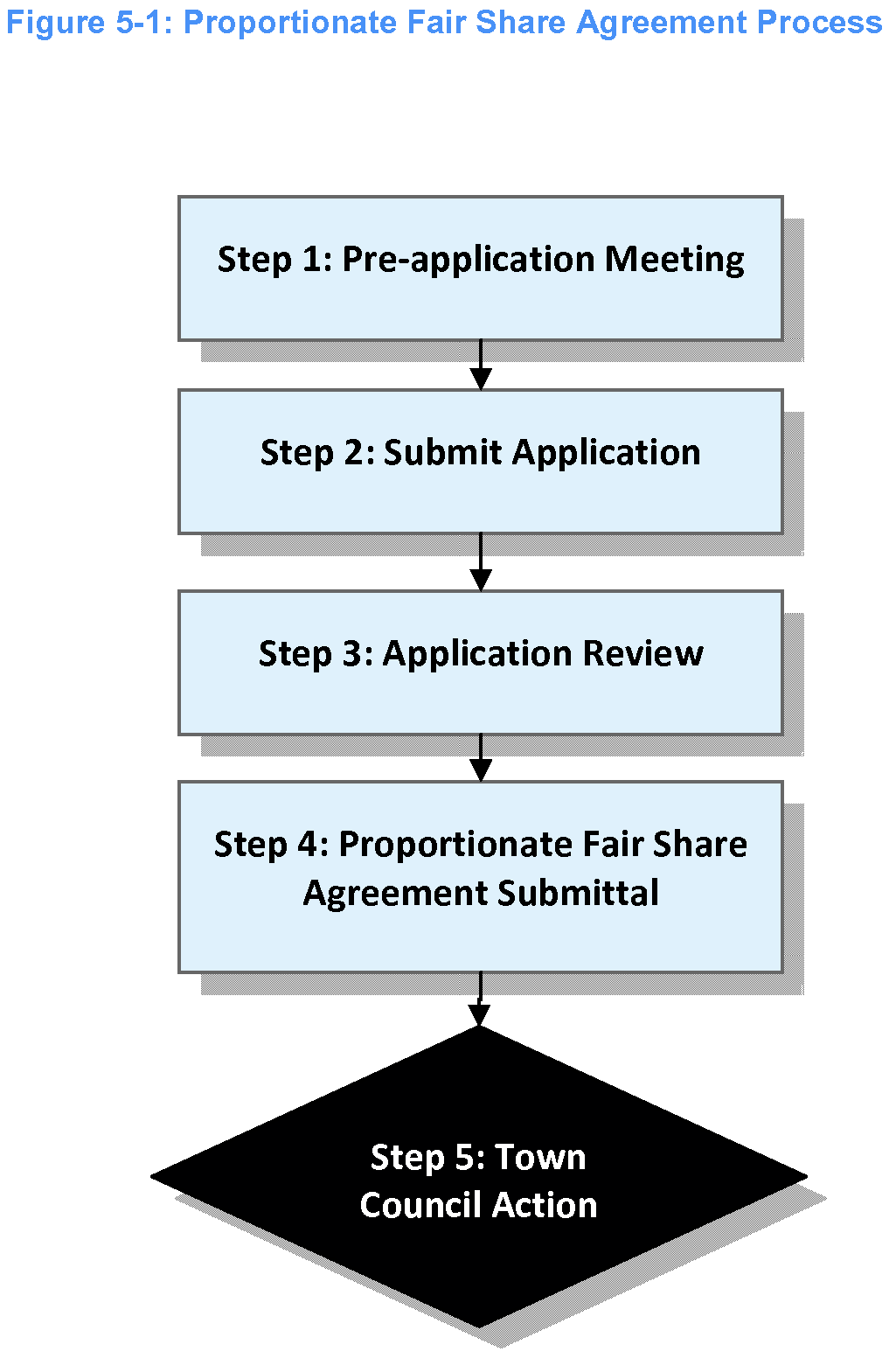
After the applicant is notified of a lack of capacity to satisfy transportation concurrency, the following procedure shall be followed for proportionate fair-share agreements.
A.
Step 1: Pre-application meeting. A pre-application meeting with the director is required prior to submitting an application for a proportionate fair-share agreement. The purpose of the meeting is to discuss eligibility, submittal requirements, mitigation options, and other issues. Volusia County and FDOT shall be advised of the pre-application meeting accordingly.
B.
Step 2: Submit application. Eligible applicants shall submit an application to the director that includes an application fee and the following:
a.
Name, address, and phone number of owner(s), developer, and/or authorized agent;
b.
Property location, including parcel identification numbers;
c.
Legal description and survey of property;
d.
Description of proposed development including land uses, density, and intensity;
e.
Traffic impact analysis (TIA) performed in accordance with the Volusia TPO (Transportation Planning Organization) guidelines adopted herein;
f.
Phasing schedule, if applicable; and
g.
Description of requested proportionate fair-share mitigation method(s).
C.
Step 3: Application review.
1.
Completeness and compliance determination. The director shall review the application for completeness and compliance with section 5.8.2. If an application is incomplete or does not meet section 5.8.2, the applicant shall be notified in writing of the deficiencies within ten business days of application submittal.
2.
Corrections. Corrections to the application must be made within 60 days of deficiency notification. Applications failing to do so are considered invalid. The director may grant an extension to this timeframe if the applicant shows good cause for the extension and has taken reasonable steps to correct the deficiencies.
D.
Step 4: Proportionate fair-share agreement submittal. The applicant shall be notified in writing when an application is deemed complete and complies with section 5.8.2. A proposed proportionate fair-share agreement shall be submitted to the director within 60 days from when the applicant receives this notification. Copies of the agreement shall be provided to FDOT and Volusia County, if applicable, for any proposed proportionate fair-share mitigation related to their respective transportation facilities.
E.
Step 5: Town council action. The director shall notify the applicant of the town council public hearing date to decide on the application. No agreement shall be effective until approved by the town council. Town council review of the agreement may be conducted in conjunction with its review of the accompanying development application.
5.8.5 - Determining proportionate fair-share mitigation improvements.
A.
General provisions.
1.
Generally, the proportionate share funds from a development will be used by the developer to implement an improvement that is agreed upon by the town and/or county, and is expected to be of substantial benefit to the impacted roadway network. If needed improvements are scheduled in the CIE, then the town will accept payment of the proportionate share.
2.
Proportionate fair-share mitigation improvements may include, without limitation, separately or collectively, private funds, construction of improvements, and contributions of land and/or facilities.
3.
The applicant shall receive a credit on a dollar-for-dollar basis for impact fees, mobility fees, and other transportation concurrency mitigation requirements paid or payable in the future for the project. The credit shall be reduced by the percentage share that the project's traffic represents of the added capacity of the selected improvement, up to a maximum of 20 percent.
4.
Cost values shall include design, right-of-way, maintenance of traffic, construction, and other costs as described in the methodology. However, costs of major utility upgrades or the costs of other activities that are advantageous to accomplish with the road construction but that do not relate to providing transportation capacity or services should not be included.
B.
Proportionate fair-share calculation.
1.
Methodology. The methodology used to calculate an applicant's proportionate fair-share contribution shall be as provided for in F.S. § 163.3180(5)(h)3 , as follows:
Figure 5-2: Methodology for Proportionate Fair-Share Calculation
FORMULA:
Proportionate fair-share = Development Trips ÷ Capacity Increase x Construction Cost
WHERE:
Development Trips = Those trips from the total development or phase of development under review that are assigned to the roadway network and have resulted in transportation facility deficiency based on town's CMS;
Capacity Increase = The increase in roadway capacity provided by the eligible improvement to the deficient roadway segment(s);
Cost = Adjusted cost of the improvement project(s). Cost shall include all improvements and associated costs, such as design, right-of-way acquisition, planning, engineering, inspection, utilities, and physical development costs directly associated with construction indexed to the future year of construction.
2.
Fair share costs, timing. To determine proportionate fair-share costs, the town shall determine project(s) costs based on the actual and/or anticipated costs of the project(s) in the year that construction will occur. These costs shall be determined by the director. The town may also accept engineer-certified costs submitted for approval to the director.
3.
Right-of-way dedication. The values of the right-of-way dedication accepted for all or part of the proportionate fair-share mitigation shall be subject to approval of the director.
5.8.6 - Execution of proportionate fair-share agreements.
A.
Development order. Following execution of a proportionate fair-share agreement and approval of the associated development plans, the town shall issue a development order as per the procedures in section 6.5 of this code. If the applicant fails to apply for a building permit within the time frame specified in the development order, the proportionate fair-share agreement becomes null and void and the applicant must reapply.
B.
Payment. Payment of the proportionate fair-share contribution is due in full and shall be paid within 60 days of the effective date of the proportionate fair-share agreement. The effective date shall be specified in the agreement and is the date the agreement was approved by the town council.
C.
Completion of transportation projects. All transportation improvement project(s) to be constructed pursuant to a proportionate fair-share agreement must be completed prior to issuance of a certificate of occupancy, or as otherwise established in a binding agreement. This agreement must be accompanied by a security instrument sufficient to ensure the completion of all required transportation improvement project(s) as provided in section 6.7 of this code.
D.
Dedication of right-of-way. Dedication of necessary right-of-way for transportation facility improvements pursuant to a proportionate fair-share agreement shall be completed prior to issuance of a building permit, or may be accomplished with recordation of an approved subdivision final plat.
E.
Development modifications. Any requested change to a development subsequent to a development order may be subject to additional proportionate fair-share contributions if the change would generate additional traffic requiring mitigation.
F.
Withdrawal. Applicants may submit a letter to the director requesting to withdraw from the proportionate fair-share agreement at any time prior to the execution of the agreement. The application fee and any associated advertising costs to the town are non-refundable.
5.8.7 - Appropriation of fair-share revenues.
A.
Proportionate fair-share revenues shall be placed in the appropriate transportation improvement project(s) account for funding of scheduled improvements, or as otherwise established in the terms of the proportionate fair-share agreement. Proportionate fair-share revenues may be used for operational improvements, such as intersection modifications, prior to construction of the capacity related project(s) from which the proportionate fair-share revenues were derived at the discretion of the town.
B.
If a scheduled improvement project(s) is removed from the CIP, the proportionate fair-share revenues collected for its improvement may be applied toward alternative transportation facility project(s) within the town. These alternative project(s) shall mitigate the impacts of development on the congested roadway(s) for which the original proportionate fair-share contribution was made. At a minimum, the proposed improvements should meet the following criteria:
1.
The locations proposed for improvement must be within the impacted area and must be at or near deficiency,
2.
The improvement must be other than simply a signal timing or phasing change,
3.
Mitigation must improve the overall mobility of the town's transportation network by the equivalent amount of improvement at the primarily impacted location(s),
4.
The improvements must not already be, or be in the process of being, a condition of approval of another development,
5.
All applicable analysis requirements for the primary locations(s) shall apply to the analysis of the alternative location(s).
5.9.1 - Traffic circulation.
A.
Level of service standard. The following level of service standards shall apply for traffic circulation systems:
Table 5-1 Level-Of-Service Standards, Traffic Circulation
B.
Traffic impact analysis methodology and requirement. Development applications subject to transportation concurrency review shall submit a traffic impact analysis. The analysis shall follow methodology and procedures of the Transportation Impact Analysis (TIA) Guidelines - Methodology For Development Applications Requiring a TIA In Volusia County, Florida, dated November 24, 2009, as approved by the Volusia County Transportation Planning Organization, adopted here by reference. The applicant for all new development and/or redevelopment applications subject to concurrency review shall submit a traffic impact analysis utilizing these TIA Guidelines. Friday, weekend, or holiday counts may be required for land uses active on weekends, as determined by the town engineer.
5.9.2 - Potable water.
A.
Level of service standard. The following level of service standards apply for potable water:
Table 5-2 Level-Of-Service Standards, Potable Water
B.
Determination of project impact. The potable water required by a proposed development is determined based on the equivalent residential unit (ERU) conversion factors in the following table:
Table 5-3 Potable Water Demand Schedule
C.
Rules of interpretation. Rules of interpretation are applicable to Table 5-3, Potable Water Demand Schedule and Table 5-4 Sanitary Sewer Service Demand Schedule:
1.
Any use not specifically defined in categories 1 through 7 will be assigned to one of the above categories by the director.
2.
If a building or plumbing permit is issued for an existing connection that will increase water and/or sanitary sewer demand, or if a building changes from residential to nonresidential occupancy, the total number of ERUs for the old and new parts of the facility shall be computed and the number of additional ERUs determined by subtracting the old ERUs from the new total number ERUs for the facility.
3.
For the purposes of this section, convenience stores are mercantile establishments which offer food and other products similar to those offered by grocery stores but are differentiated by their smaller size and more restricted selection. Convenience stores are therefore defined as establishments having a gross building floor area not exceeding 3,000 square feet.
4.
An equivalent residential unit (ERU) represents a nominal usage of 278 gallons of potable water per day and 200 gallons of sanitary sewer per day as determined by historical water/sewer use records and population/housing unit estimates.
D.
Concurrency evaluation. The developer shall obtain a letter of capacity approval for the proposed development from the City of Port Orange. This letter shall state that sufficient capacity is available in the city's potable water system to satisfy the projected demand of the development in question. In lieu of a letter pertaining to an individual development, the town may receive a reservation of capacity from the City of Port Orange sufficient to accommodate more than one development. In this case, the town engineer shall make a determination as to whether sufficient capacity is available to accommodate the proposed development. In making this determination, the town engineer shall consider the amount of capacity that has already been allocated, but not yet used.
5.9.3 - Sanitary sewer.
A.
Level-of-service standard. The following level-of-service standard shall apply: 200 gallons per day per equivalent residential unit (ERU), as per the comprehensive plan, Sanitary Sewer Sub-Element.
B.
Determination of project impact. The sanitary sewer usage required by a proposed development is determined based on the equivalent residential unit (ERU) conversion factors in the following table:
Table 5-4 Sanitary Sewer Service Demand Schedule
C.
Rules of interpretation. The rules of interpretation applicable to Table 5-3 (Potable Water Demand Schedule) also apply to Table 5-4 (Sanitary Sewer Service Demand Schedule).
D.
Concurrency evaluation. The developer shall obtain a letter of capacity approval for the proposed development from the City of Port Orange. This letter shall state that sufficient capacity is available in the city's sanitary sewer system to satisfy the projected demand of the development in question. In lieu of a letter pertaining to an individual development, the town may receive a reservation of capacity from the City of Port Orange sufficient to accommodate more than one development. In this case, the town engineer shall make a determination as to whether sufficient capacity is available to accommodate the proposed development. In making this determination, the town engineer shall consider the amount of capacity that has already been allocated, but not yet used.
5.9.4 - Stormwater drainage system.
No development shall be approved unless there is sufficient available capacity to sustain the following levels of service for the stormwater drainage system established in the comprehensive plan.
A.
Level-of-service standards.
1.
First inch of rainfall shall be retained on site.
2.
Discharge hydrograph for post-development conditions shall maintain pre-development conditions.
3.
Peak discharge from post-development conditions shall not exceed peak discharge from pre-development conditions for a 100-year frequency storm.
B.
Concurrency evaluation. Stormwater drainage systems designed to accommodate the impacts of proposed development shall meet all applicable design and construction standards of this code, in addition to the LOS standards for concurrency, including requirements for flood hazard reduction and water quality.
5.9.5 - Solid waste.
A.
Level-of-service standard. The level-of-service standard for solid waste collection is 8.6 pounds per capita per day, as per the comprehensive plan, Capital Improvements Element.
B.
Concurrency evaluation. The developer shall obtain a letter of capacity approval for the proposed development from Volusia County. This letter shall state that sufficient capacity is available in the county's waste disposal facilities to satisfy the projected demand of the subject development. In lieu of a letter from an individual development, the town may receive a reservation of capacity in advance from the county sufficient to accommodate more than one development. In this case, the town engineer shall determine whether sufficient capacity is available to accommodate the proposed development. In making this determination, the town engineer shall consider the amount of capacity that has already been allocated, but not yet used.
5.9.6 - Parks and recreation facilities.
A.
Level-of-service standard. The following level-of-service standard applies to parks and recreation facilities: 3.5 acres per 1,000 residents, as per the comprehensive plan, Capital Improvements Element.
B.
Determination of project impact. The impact of a proposed development on available capacity shall be determined as follows:
1.
Area of impact. The area of impact of the development is the entire area under the town's jurisdiction.
2.
Demand generated by the residential development. Only residential developments are considered to generate a demand for parks and recreation facilities. Facilities intended for short-term occupancy are not considered to generate demand for parks and recreation facilities.
3.
Generation rates. For purposes of this section, each residential dwelling unit is considered to contain 1.98 persons (excludes nonresident population).
C.
Determination of park capacity. The maximum resident population that can be accommodated by existing parks at the adopted level of service standard is determined by multiplying the number of acres of existing parks by the applicable level of service standard. The town's records are the source of existing park acreage.
D.
Determination of background demand. Background demand shall be determined by adding together existing resident population as reported in the latest available estimates from the University of Florida, Bureau of Economic and Business Research (BEBR) and the population anticipated to occupy dwelling units which have been approved, but which are not yet reflected in the BEBR resident population estimate. The director shall maintain a record of background demand available.
E.
Determination of available capacity. Available capacity shall be determined by subtracting background demand from total park capacity.

