
Ponce Inlet City Zoning Code
ARTICLE 6
ADMINISTRATION AND PROCEDURES
SECTION 6.1.- PURPOSE AND APPLICABILITY
This article establishes the application and review procedures required to obtain development orders and development permits. The purposes of this article are:
A.
To assure that all development proposals are thoroughly and efficiently reviewed for compliance with this code, the town's comprehensive plan, and other applicable town regulations.
B.
To promote efficiency, predictability, and citizen participation.
C.
To assure compliance with approved development orders and this code through rigorous but fair enforcement actions.
D.
To establish the regulations, procedures and standards for review and approval of all proposed development in the town.
E.
To adopt a development review process that is:
1.
Efficient, in terms of time and expense.
2.
Effective, in terms of addressing the natural resource and public facility implications of proposed development.
3.
Equitable, in terms of consistency with established regulations and procedures, respect for the rights of property owners, and consideration of the interests of the citizens of the town.
4.
To provide specific procedures to ensure that development orders and permits are conditioned on the availability of public facilities and services that meet level of service requirements (concurrency).
SECTION 6.4. - TABLE OF PROCEDURES
Table 6-1, Table of Procedures, summarizes the procedural steps (described in section 6.3, General Procedural Rules, of this article) that are common to the applications required by this article, and the role of relevant review bodies. Provisions specific to each type of land development application are found in section 6.6, Specific Review Procedures of this article.
Table 6-1 Table of Procedures
(Ord. No. 2015-08, § 2(Exh. A), 11-19-2015; Ord. No. 2018-07, § 2(Exh. A), 5-17-2018)
6.2.1 - Town council.
The town council may:
A.
Exercise the powers listed in this article, to be carried out in accordance with this code;
B.
Exercise the powers and duties set forth in section 6.6 (Specific procedures);
C.
Hear and decide appeals from the planning board;
D.
Perform other planning duties and functions consistent with the comprehensive plan, Code of Ordinances, or this code; and
E.
Exercise all other duties and council procedures assigned by article III of the Town Charter and chapter 2 of the Code of Ordinances.
6.2.2 - Planning board.
A.
Established. A planning board is created that has the power and duties of a planning commission and a board of adjustment, consistent with section 7.01 of the Charter, and serves as the local planning agency in accordance with the Community Planning Act (2011) F.S. § 163.3161 et. seq. It is referred to in this code as the "board." Membership, powers, duties, responsibilities, and limitations are provided in this section.
B.
Membership and terms of office. The board shall consist of five regular members and two alternates appointed by the town council. Each regular member shall be appointed for a three-year term, in staggered sequence, with an exception for the initial term of this board as a five-member board: terms for seats one and two shall expire in December 2019, terms for seats three and four shall expire in December 2018, and the term for seat five shall expire in December 2017. Alternate members shall be appointed for a term of one year.
C.
Rules of procedure.
1.
The board shall meet at regular intervals and other times as it may deem necessary. It shall adopt written bylaws and procedures necessary for the administration of its responsibilities, as consistent with the Code of Ordinances, and this code. Bylaws and procedures shall be approved by town council. The board shall keep a properly indexed public record of its transactions, findings, and determinations.
2.
A quorum shall be three members. A simple majority of members present is necessary to render a decision.
D.
Powers and duties. The planning board shall have the powers and duties set forth in section 6.6 (Specific procedures) and the following:
1.
As the local planning agency, to review proposed land development regulations, determine their consistency with the comprehensive plan, and make recommendations to the town council as to whether the regulations should be adopted;
2.
To hear, review, and make recommendations on the approval of quasi-judicial land use and development applications and whether the applications meet the general criteria of section 6.3.6, including consistency with the comprehensive plan.
3.
To hear and decide variances and appeals of orders, administrative decisions, or determinations in the enforcement and interpretation of this code. On appeal, the planning board may reverse, affirm, or modify any administrative order, requirement, decision or determination.
4.
To perform other duties and functions consistent with F.S. § 163.3161 et seq., the comprehensive plan, Code of Ordinances, or this code, and as directed by the town council.
(Ord. No. 2017-05, § 1, 4-20-2017)
6.2.3 - Cultural services, historic preservation, and tree advisory board.
A.
Established. A cultural services, historic preservation, and tree advisory board is created that has the powers, duties, and review and decision-making responsibilities set forth in this article, to be carried out in accordance with this code. Per this provision any reference within the Town's Code of Ordinances and/or the Land Use and Development Code to the term(s) "historic and archaeological preservation board" and/or "parks, recreation, and tree advisory board," (including any shortened version of either board's title) shall be replaced and substituted in practice with the term "cultural services, historic preservation, and tree advisory board."
B.
Membership and terms of office. The cultural services, historic preservation, and tree advisory board shall consist of five regular members and two alternates appointed by the town council. Each regular member shall be appointed for a three-year term, in staggered sequence, with an exception for the initial terms of members on this five-member board: terms for seats one and three shall expire in December 2020, terms for seats two and four shall expire in December 2019, and the term for seat five shall expire in December 2021. Alternate members shall be appointed to an annual term ending in December of each year.
C.
Rules of procedure.
1.
The cultural services, historic preservation, and tree advisory board shall normally meet monthly, at a minimum of once every three months. All meetings of the board shall be duly advertised. If there is no business for the board to conduct, the meeting may be canceled.
2.
The cultural services, historic preservation, and tree advisory board shall receive assistance and relevant expertise from the cultural services department, the public works department, and the planning and development department in the performance of its responsibilities.
D.
Powers and duties.
1.
The cultural services, historic preservation, and tree advisory board is established to take action necessary and appropriate to accomplish the purposes of section 4.13 (Historic and cultural resources protection) along with the following duties, which include, but are not limited to:
a.
Surveying and inventorying historic buildings, areas, and archaeological sites and planning for their preservation;
b.
Reviewing and making recommendations regarding the designation of historic districts or areas and individual landmarks and landmark sites for placement on the local register;
c.
Reviewing and making recommendations regarding all local property nominations to the National Register of Historic Places, following the regulations of the state historic preservation office;
d.
Holding hearings and making decisions on applications for certificates of appropriateness regarding alterations, demolitions, relocations, and new construction to designated property as set forth in section 6.6;
e.
Recommending incentives to encourage the preservation of historic properties;
f.
Advising and assisting property owners and other persons and groups, including neighborhood organizations interested in historic preservation;
g.
Initiating plans for the preservation and rehabilitation of historic properties;
h.
Recommending historic marker placement;
i.
Investigating, reviewing, and making recommendations regarding current and potential future parks and recreational areas and facilities;
j.
Making written recommendations to the town council with respect to parks and recreational facilities within the town, and consulting with other officials of the town with respect to such matters;
k.
Carrying out the duties of the board, as set out in section 4.10 of this code with respect to review of certain applications for specimen tree removal and landscape plans associated with development permits or development orders; and
l.
Performing any other duties as may be assigned to it by the town council.
1.
The cultural services, historic preservation, and tree advisory board shall assist the town manager and his or her staff in preparing applications for grant awards for historic preservation, historic survey activities, tree preservation, and parks and recreation.
2.
The geographic area of responsibility for the cultural services, historic preservation, and tree advisory board shall be the boundaries of the town.
E.
Qualifications. The cultural services, historic preservation, and tree advisory board members shall be composed of qualified electors of the town. Preference shall be given to full-time residents who possess knowledge, skills, and experience from the disciplines of historic preservation, parks and recreation, environmental science, knowledge or interest in trees common to Ponce Inlet and the importance of preservation of such trees where possible, and/or related disciplines.
(Ord. No. 2018-11, § 1, 8-23-2018; Ord. No. 2019-06, § 1, 10-17-2019)
Editor's note— Ord. No. 2018-11, § 1, adopted Aug. 23, 2018, repealed the former § 6.2.3 and enacted a new § 6.2.3 as set out herein. The former § 6.2.3 pertained to historic and archeological preservation board and derived from the original codification of this Code.
6.2.4 - Reserved.
Editor's note— Ord. No. 2018-11, § 1, adopted Aug. 23, 2018, repealed § 6.2.4, which pertained to parks, recreation and tree advisory board and derived from Ord. No. 2016-01, § 2, adopted March 17, 2016.
6.2.5 - Director.
The director of the planning and development department, referred to in this code as the "director," may:
A.
Exercise the review and decision-making responsibilities listed in this code, and
B.
Make interpretations in accordance with the comprehensive plan and the LUDC.
C.
Grant administrative variances as set forth in this article.
6.3.1 - Overview of procedures.
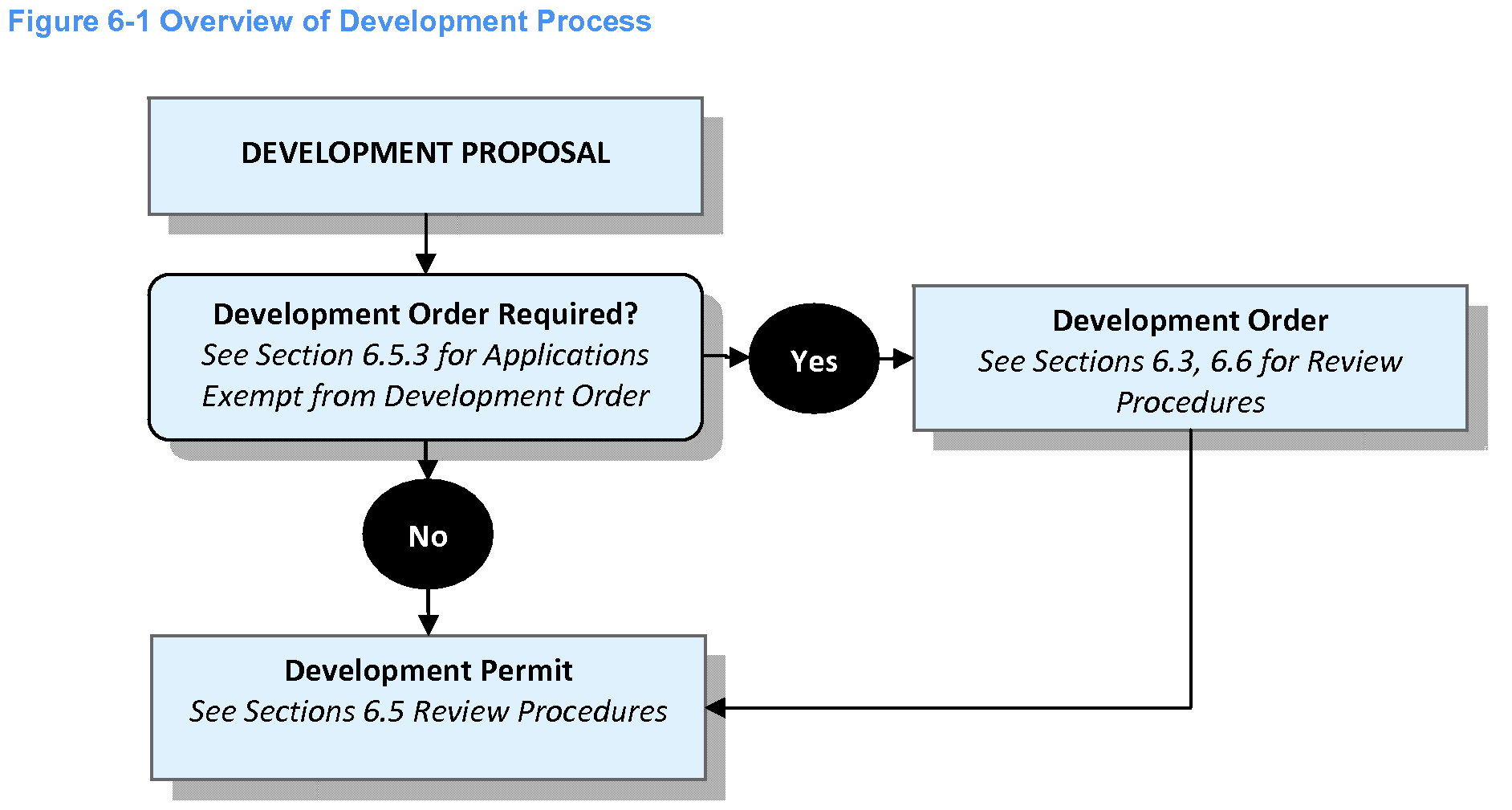
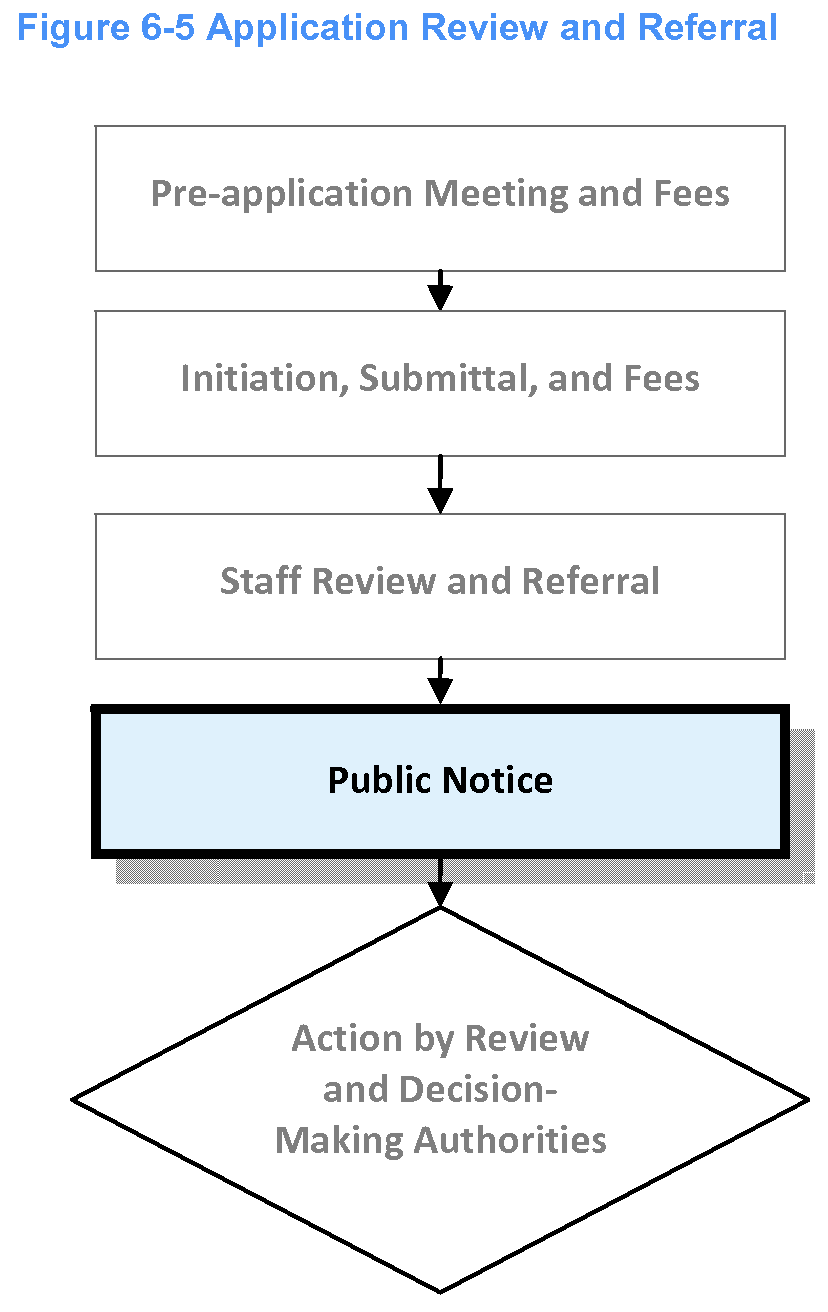
This section describes the procedural steps, requirements, and review criteria that are common to development orders. This section's common procedural requirements apply to all development orders submitted pursuant to this section, unless otherwise exempted or when alternative procedures are specified in this section. The following figure generally illustrates the development process in Ponce Inlet:
6.3.2 - Pre-application meeting.
A.
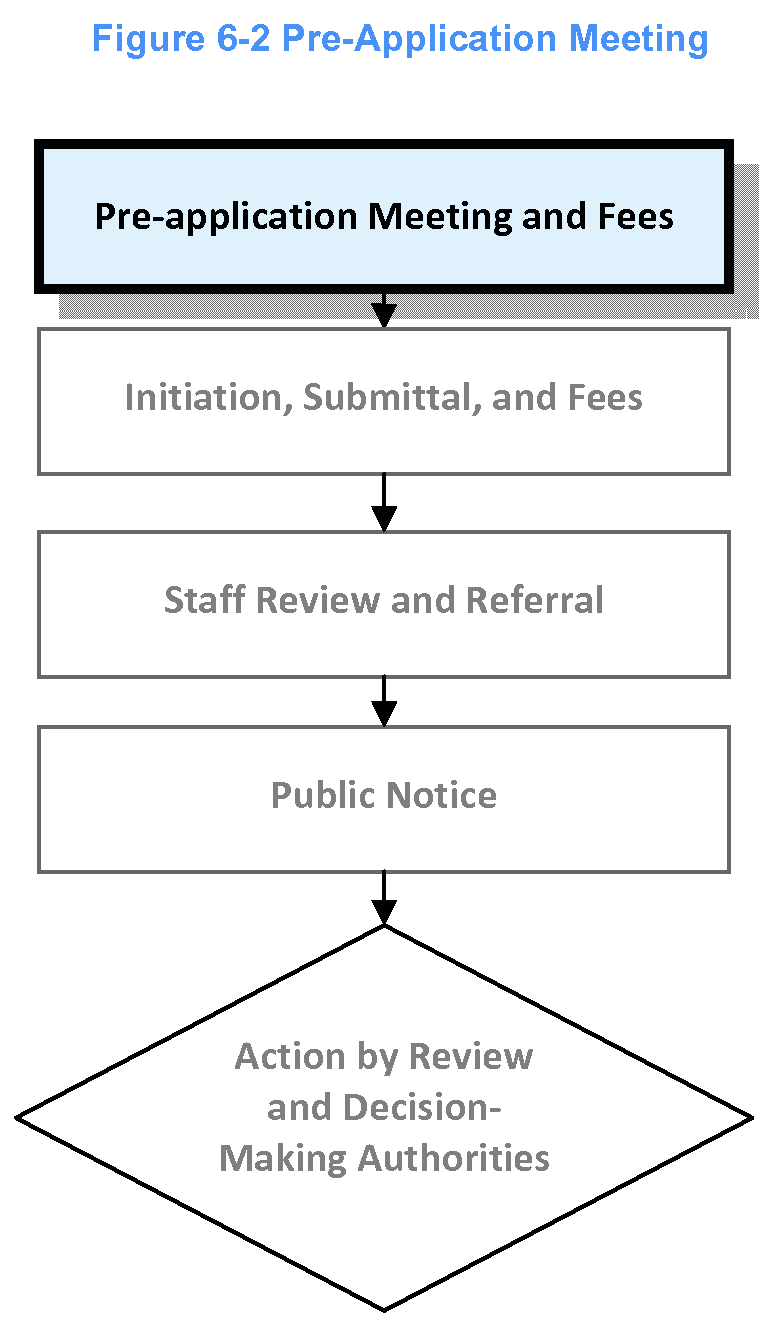
Purpose. A pre-application meeting provides an opportunity for the applicant and town staff to discuss the development proposal prior to any substantial investment, such as a land acquisition for a proposed development, site and engineering design, or the preparation of other data, in order to:
1.
Determine the required application(s) and the timing of multiple application submittals (i.e., whether they may be processed concurrently or must be processed sequentially);
2.
Provide the applicant with application materials and information about submittal requirements and fees;
3.
Provide the applicant with an estimated time frame for the review process;
4.
Discuss general compliance of a proposed conceptual plan (if required), with the code's zoning, use, density, development, and design standards, and attempt to identify potentially significant issues;
5.
Discuss the requirements for any public notice, if applicable; and
6.
Refer the applicant to other departments or agencies to discuss potential significant issues prior to application submittal.
B.
Applicability.
1.
A pre-application meeting is required prior to certain types of applications, as listed in section 6.6 (Specific procedures). Applications for these types of approvals shall not be accepted until after the pre-application meeting is completed.
2.
Regardless of whether a pre-application meeting is required, an applicant for development approval may still request a pre-application conference with planning and development department staff.
C.
Submittal requirements. Submittal requirements for pre-application meetings are set forth in article 10, Table 10-1.
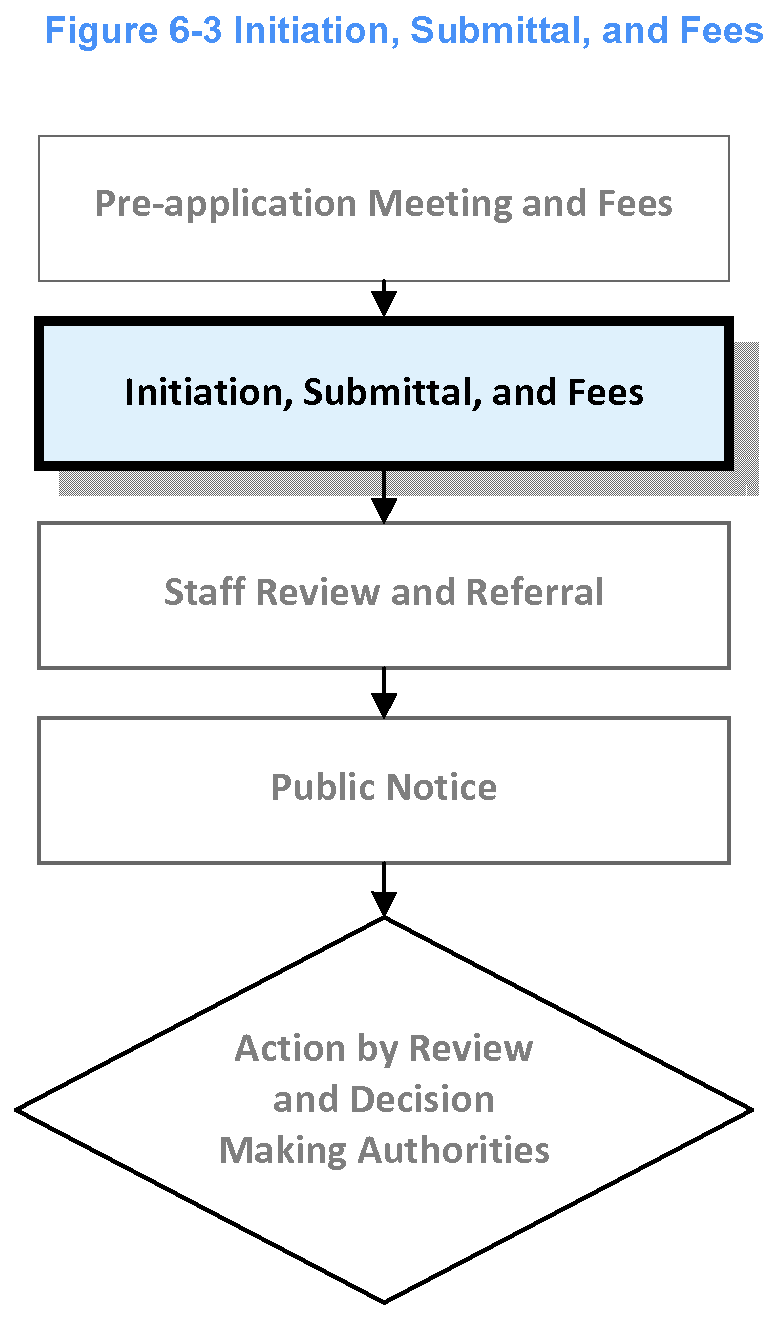
6.3.3 - Initiation, submittal, and fees.
A.
Authority to file applications. Development applications shall be filed by the person having legal authority to take action according to the type of approval sought under this code. This person shall be the record owner, contract purchaser, or the duly authorized agent of the record owner.
B.
Applications. Applications required by this section shall be submitted only after a pre-application meeting, if required. All applications required by this section shall be submitted to the planning and development department, unless otherwise specified.
C.
Application contents and fees.
1.
Application contents. Submittal requirements for specific applications are listed in article 10 of this chapter. The director may establish additional submittal requirements for all development applications required by this section and update the requirements as necessary to ensure effective and efficient town review. The applicant shall provide any additional information, documents, or other material relevant to the application that the director believes is necessary for the town to evaluate the application. This may include a traffic study or trip generation analysis and environmental assessment of the site.
2.
Submittal requirement waivers. The director may waive certain submittal requirements, except for fees, if deemed unnecessary to ensure compliance with this code. The director may waive these requirements where the projected size, complexity, anticipated impacts, or other factors associated with the application justify the waiver.
3.
Fees. Fees shall be paid to the town at the time an application is filed, in accordance with the most current fee schedules adopted by town council resolution.
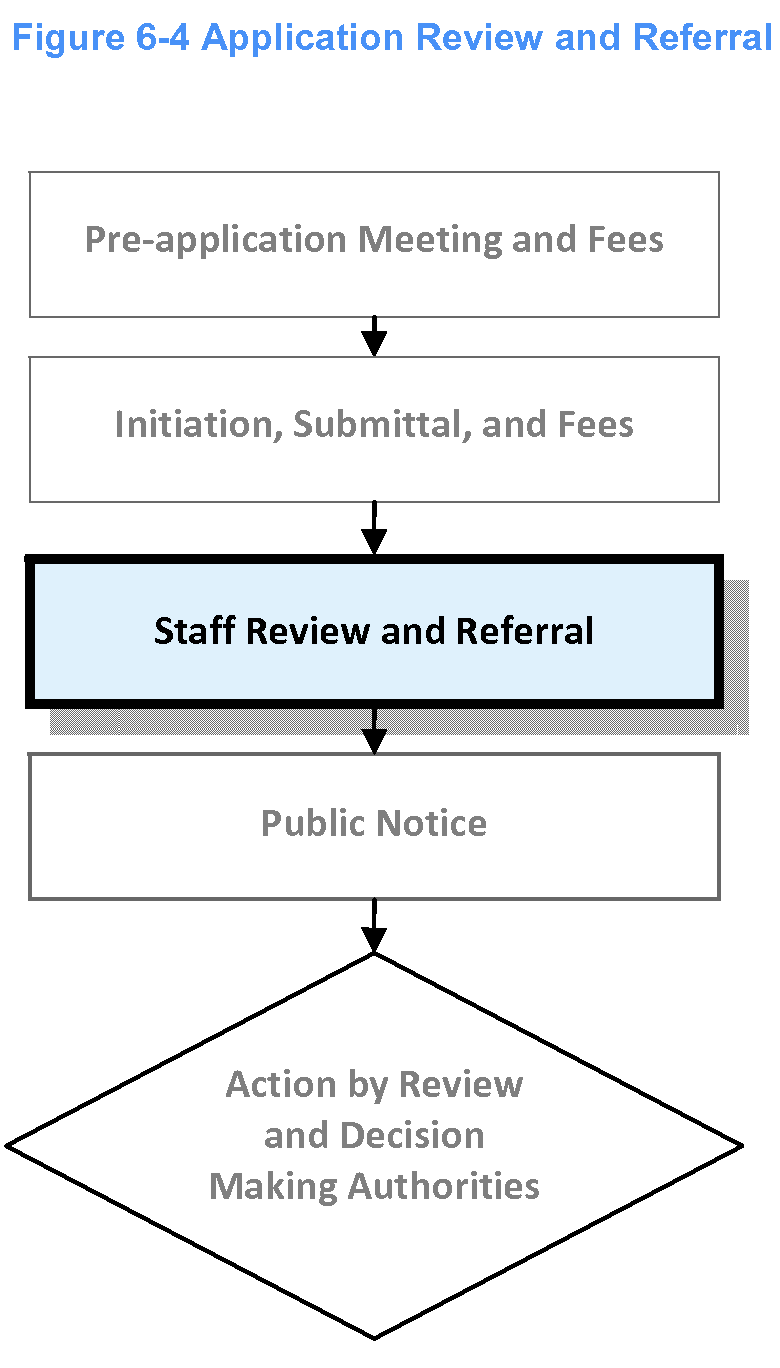
6.3.4 - Application review and referral.
A.
Complete application required for processing. The town shall accept only complete applications for further processing pursuant to section 6.3.3.
B.
Staff review of application for completeness. The director shall review the application and accompanying documentation for completeness and legal sufficiency, after which the following actions shall be taken.
1.
Complete applications shall be processed according to this article, including referrals to the town's engineering consultants and outside agencies and scheduling for public hearing, as applicable.
2.
Substantially incomplete applications shall be returned to the applicant along with all supporting materials and a written description of the application's specific deficiencies.
3.
If the application is returned as incomplete, the applicant may submit an amended application within 30 working days without payment of a reapplication fee, but thereafter may reinitiate review only with submittal of a new application and payment of all fees in effect at the time of re-submittal.
C.
Referral of complete application to outside agencies and departments.
1.
As necessary, the director shall distribute the complete application to other town departments, consulting engineers, the town attorney, and to any other appropriate governmental or quasi-governmental agencies to solicit comments and ensure that the proposal complies with all applicable standards, requirements, and review criteria. The applicant shall submit copies of all application materials in sufficient quantities to enable department and agency review.
2.
The director shall provide the criteria for evaluating the application to the review and decision-making bodies as a part of any referral response.
D.
Subsequent requests for information. Staff and referral agencies shall use best efforts to identify all major issues and to request additional information or clarification from the applicant during the first referral and review period. This shall not preclude staff or referral agencies from requesting additions, revisions, or corrections to previously submitted materials if the materials are subsequently found to be inaccurate, incomplete, or do not comply with this code.
E.
Staff comments. Staff shall compile all referral comments into a single comment letter after the close of the referral period. The staff letter shall report whether the application complies with applicable regulations and shall specify any areas of noncompliance. The letter shall also identify any need for plan modifications, additional information, or technical reports to address outstanding technical comments.
F.
Submission of revised application and scheduling.
1.
The applicant shall revise the application to address each issue identified by the referral agencies.
2.
Revisions shall be limited to changes that directly respond to specific requests or suggestions made by the staff or the review or decision-making body, as long as they constitute only minor additions, deletions, or corrections and do not include significant substantive changes to the proposed plan for development.
3.
Unless the director grants an extension, the applicant shall submit the revised application and related materials to the planning and development department within 90 calendar days after receipt of the staff comment letter.
4.
If a revised application is not submitted within this time frame, the application is considered withdrawn. The town shall treat submittals after expiration of the time period as a new application for purposes of review, scheduling, and payment of application fees.
5.
Any other voluntary revisions to the application may be submitted at any time during the review procedure, but shall be reviewed as if it were a new application, and may be subject to additional application fees to defray the additional processing costs.
G.
Scheduling for review and/or decision-making authority action. After review, the director shall schedule the application for consideration on the next available regular meeting agenda before the applicable review or decision-making authority. Public notice shall be given according to section 6.3.5 (Public notice) and any specific additional notice as contained in section 6.6 (Specific procedures).
H.
Preparation of staff report and recommendation. The director shall prepare a written staff report for review and decision-making authority action. The report shall include discussion of the relevant issues pertaining to this code and other applicable regulations, relevant responses and comments from reviewing departments and agencies, and a recommendation for application approval, approval with conditions, or denial.
I.
Distribution of staff report. The staff report shall be provided to the applicant, the relevant review or decision-making authority, and the town attorney as appropriate, and shall also be made available to any member of the public upon request.
6.3.5 - Public notice.
Applications for development approval shall comply with the Florida Statutes and this article for public notification.
A.
General provisions. Unless otherwise stated in this code, notice for all public hearings shall be held pursuant to this subsection and section 6.6 (Specific procedures). The applicant shall be responsible for mailing all required notices and for all costs of advertising.
B.
Specific notice requirements. Table 6-1 lists the specific notice requirements for applications requiring any type of notification.
C.
Published notice. When required by this code, published notice shall be a legal notice in a newspaper of general circulation at least seven days prior to the public hearing. The notice shall state the date, time, place, and purpose of the meeting and that interested persons will have an opportunity to be heard.
D.
Written (mailed) notice. When required by this code, written notice with the time, place, and purpose of the hearing shall be sent by certified mail to owners of contiguous property at least 15 calendar days before the hearing.
E.
Posted notice. When required by this code, the applicant shall post a notice on the subject property at least 15 calendar days before the hearing. Notice signs shall be provided by the planning and development department. Posted notice shall be easily visible from all public and private streets abutting the property. The applicant shall remove the posted notice within seven calendar days after completion of the hearing.
F.
Other notices. Applicants shall be responsible for compliance with any additional notice requirements in this code, other town ordinances, or state law. Notice of all public hearings shall be posted on the Town of Ponce Inlet website as soon as is practicable. Failure to post notice on the town's website shall not constitute grounds for the cancellation of any public hearing nor any action taken by a board at the hearing.
G.
Proof of public notice. The applicant shall present affidavits of proof of the required mailing and posting, together with photographic evidence of posting, prior to the hearing.
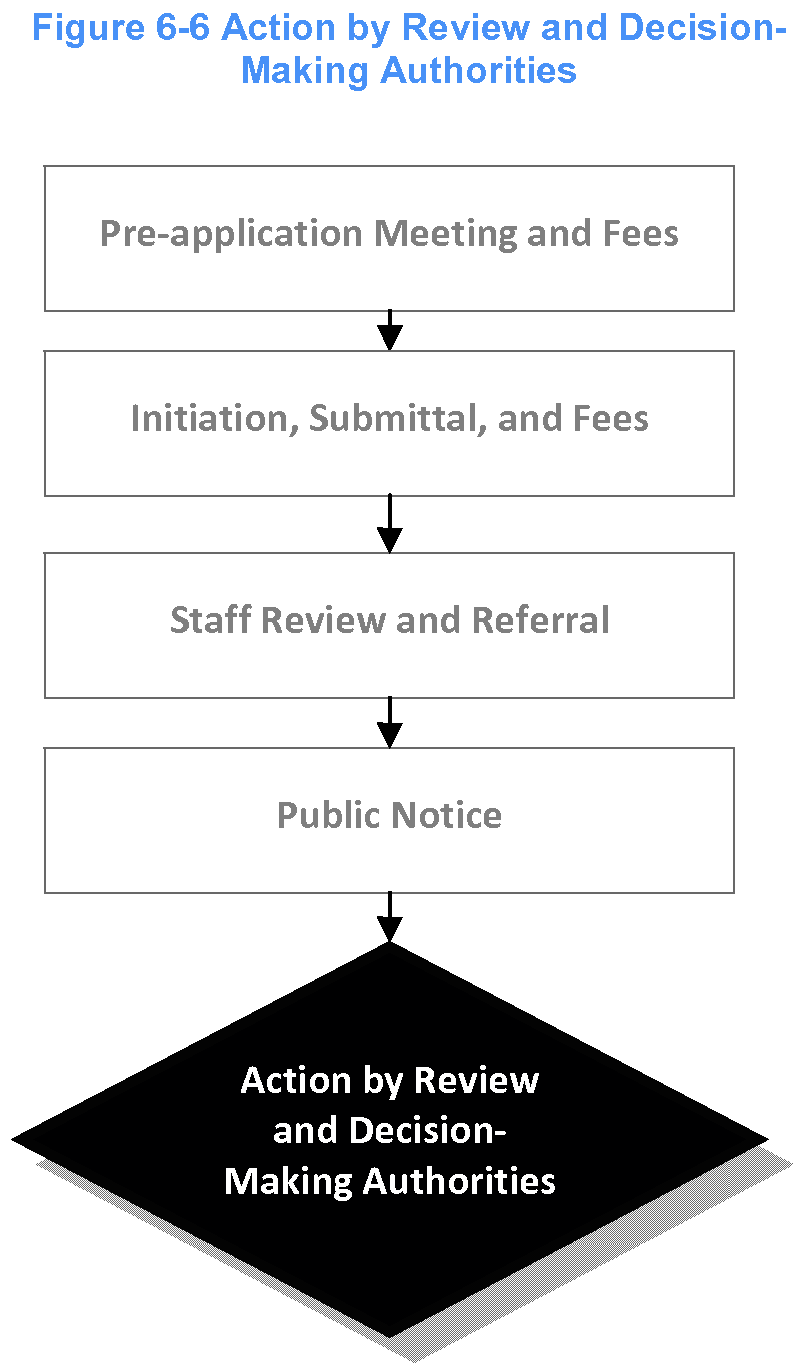
6.3.6 - Action by review and decision-making authorities.
A.
Permitted actions.
1.
Recommendations by review authority.
a.
A review authority pursuant to section 6.6 (Specific procedures), shall evaluate the application, referral comments, staff report, and public testimony, and make a recommendation to the decision-making authority to approve, approve with conditions, continue for additional information or further study, or deny the application.
b.
The review authority's actions shall be based on evidence presented and in compliance with the review criteria for the subject application, as set forth in subsection 6.3.6.F below, and the relevant specific review procedures set forth in section 6.6 (Specific procedures).
2.
Review and action by decision-making authority.
a.
A decision-making authority shall take action on an application or appeal by approving, approving with conditions, continuing, remanding for additional information or further study, or denying the application or appeal.
b.
In taking action, the decision-making authority shall evaluate the application, referral comments, staff report, any public testimony, and the review authority's recommendation. All final decision actions shall be based on the application or appeal's compliance with the review criteria for the subject application, as set forth in subsection 6.3.6.F and in the relevant specific sections of this article.
B.
Withdrawal of application. An applicant may withdraw an application, without prejudice, at any time prior to action on the application at a public hearing or meeting. The applicant shall submit the withdrawal request in writing to the director, and the town shall not take further action on the application. To re-initiate review, the applicant must resubmit the application that will be treated as a new application for purposes of review, scheduling, and payment of application fees. Once scheduled, withdrawal of an application from a public hearing or meeting agenda is at the discretion of the review or decision-making authority.
C.
Continuation of public hearings. The review or decision-making authority may continue the public hearing for its consideration of the application for a definite time not to exceed 60 calendar days, unless a longer period is agreed to by the applicant in writing or at a public hearing. The continuance may be granted by the review or decision-making authority on its own initiative or at the request of the applicant or affected property owners.
D.
Written findings of fact. Recommendations or decisions at the conclusion of any required public hearing shall be accompanied by written findings of fact addressing how the application does or does not comply with the relevant review criteria for that type of application. All findings of fact shall be based on information contained in the application, or submitted or arising during the public hearing.
E.
Conditions of approval.
1.
The review or decision-making authority may recommend or impose conditions on the subject development that may be necessary to carry out the general purpose and intent of this code. Conditions and additional information requirements shall be in written form and attached to the approved plan, plat, or permit.
2.
Conditions of approval shall be reasonably related to the anticipated impacts of the proposed use or development and based upon adopted standards.
3.
The decision-making authority may place specific time limits on the satisfaction of any condition of approval.
4.
The decision-making authority may require financial guarantees from the applicant where it finds the guarantees are necessary to ensure compliance with conditions of approval and protect the public health, safety, or welfare. The town shall release these guarantees when the department has determined that all conditions attached to the approval have been or will be satisfied.
F.
Generally applicable review criteria. Unless otherwise specified in this article, town review and decision-making authorities shall review all development applications submitted for compliance with the general review criteria stated in this section. The application may also be subject to additional review criteria specific to the type of application. In case of conflict between the general review criteria set forth in this section and the specific review criteria in section 6.6 (Specific procedures), the specific review criteria shall apply.
1.
Consistency with comprehensive plan. The development order shall be consistent with the comprehensive plan and the future land use map. A finding of consistency with all elements of the plan is required.
2.
Impact on surrounding area. The development order shall be consistent with the proposed use(s), intensity, density, scale, mass, bulk, height, lot configurations, architecture and building orientation of the surrounding uses (if applicable) and the intensity, density and scale of surrounding development.
3.
Impact on evacuation times. Resulting development shall not occur in amounts, types or locations that would cause an increase in the number of travel through-lanes or total evacuation times to exceed those established in the comprehensive plan's Coastal Management Element. The town shall ensure that it maintains out-of-county hurricane evacuation times for a Category 5 storm event as measured on the Saffir-Simpson scale for the total population of the town. These evacuation times shall be no more than 16 hours from the time of first official order to evacuate.
4.
Compliance with consistency and concurrency standards When required, the development order shall include a finding of consistency with article 5, Consistency and concurrency standards.
5.
Consistent with prior approvals. The development order shall be consistent with the terms and conditions of any prior plan or plat approval, as applicable, including without limitation an approved phasing plan for development and installation of public improvements and amenities.
6.
Compliance with use and development standards. The development order shall comply with all applicable use standards, site development standards, design standards, subdivision standards, public improvement standards, floodplain management standards, and all other applicable substantive standards stated in this code.
7.
Compliance with other applicable regulations. The proposed development shall comply with all other applicable regulations, standards, requirements, or plans of the town, county, federal or state governments and other relevant jurisdictions.
8.
Minimizes adverse fiscal impacts. The development order shall not result in significant adverse fiscal impacts on the town.
6.3.7 - Appeals.
The following language applies to appeals for development orders and administrative decisions. Specific appeal procedures are also found in section 6.6 (Specific procedures). All appeals provided for in this code shall be heard anew (de novo), relying upon the same original facts and testimony, except as provided under subsection 6.3.7.C below.
A.
Administrative decision appeals to planning board.
1.
Appeal filing, transmittal to planning board.
a.
The planning board shall hear and decide appeals from any interpretation, order, requirement, administrative decision, or determination in the administration and enforcement of this code.
b.
Appeals may be filed by any aggrieved person or by any officer, board, department, or agency of town government adversely affected by any administrative decision.
c.
Aggrieved parties must file a notice of appeal with the director and the town clerk within 30 days of the order, requirement, decision, or determination, using a form provided by the director.
d.
After receipt of the appeal request and payment of any fee established by the town council, and after due public notice, the director shall transmit all documents, plans, papers or other materials relating to the appealed decision to the planning board.
2.
Planning board public hearing on appeal. The planning board shall hear and decide on the appeal at the first available meeting following the appeal submittal.
B.
Planning board decision appeals to town council.
1.
Appeal filing, transmittal to town council. An aggrieved person may file a notice of appeal of the planning board's decision to town council within 30 days of the planning board's decision. Upon payment of any appeal fee established by town council, the appeal shall be processed in the same manner as the initial appeal to the planning board, including notice requirements. The board may recommend that the town council refund the appeal fee to the appellant.
2.
Town council public hearing on appeal. The town council shall hear and decide on the appeal at the first available meeting following the appeal submittal.
C.
Appeals of town council decisions. Any person aggrieved by any decision of the town council may apply to the circuit court to review the council's decision (review by certiorari) within 30 days pursuant to the Florida Rules of Appellate Procedure.
D.
Effect of appeals on proceedings. Appeals to the planning board or the town council do not stay any work on the premises unless the director certifies to the board or council that there is an imminent peril to life or property. Thereafter, all work must be stopped, and an order from the board or a circuit court must be obtained before it can be recommenced.
E.
Appeals involving constitutional or statutory claims.
1.
As part of the appeal, the applicant may request and the town council may approve an exemption from any of the requirements of this chapter, to the extent necessary to comply with or conform to federal or state law, or to avoid or resolve any alleged violation of rights based on the freedom of religion afforded to any person under federal or state law caused by the enforcement of any regulation imposed by this chapter.
2.
An applicant requesting an exemption under subsection 6.3.7.E.1 above shall file, as part of its appeal, a separate statement that:
a.
Advises which particular town regulation the requested exemption relates to;
b.
Explains how the regulation does not conform to federal or state law or how it allegedly violates the person's rights of religious freedom afforded under federal or state law;
c.
Describes how granting the exemption is in the public interest and is not contrary to health, safety and welfare considerations; and
d.
Describes the intended use of land or activity for which the exemption is sought.
3.
The petitioner shall submit any additional information requested by the town council and shall appear before the town council at the public hearing to explain the request and to answer any questions relative to the appeal.
4.
In considering an exemption from the requirements of this chapter, the town council may approve the exemption if it finds, based on the presented evidence, that at least one of the following criteria apply:
a.
The exemption is in the public interest and is not contrary to health, safety and welfare considerations.
b.
The exemption is necessary for the petitioner or the town to comply with or conform to federal or state law, the regulation does not constitute or further a compelling governmental interest in need of protection, and the regulation is not the least restrictive alternative to satisfy or achieve the governmental interest.
c.
The exemption is necessary to avoid or resolve any alleged violation of religious freedom afforded to any person under federal or state law caused by the enforcement of any regulation of this chapter.
d.
Enforcement of the regulation would otherwise violate state or federal law, and the exemption complies with state and federal law and any lawful purpose of the regulation.
5.
The town council may request additional information from the petitioner, and may continue the hearing to fully consider the petition and all pertinent information.
6.
The petitioner may file a written request with the town council for a temporary certificate of compliance to allow the use or activity through the duration of the exemption petition process pursuant to this chapter.
7.
After the conclusion of the public hearing, the town council shall either grant or deny the exemption within 30 days. The town council may grant the exemption in full or in part by waiving compliance with certain aspects of this chapter, and may also approve it subject to conditions that are related to the public health, safety and welfare.
8.
Decisions of the town council shall be in the form of a written order that includes any conditions of approval, or the reasons for denial. The town shall provide a copy of the written order to the petitioner.
6.3.8 - Rehearing.
A.
If it is alleged that the town council or the planning board has overlooked or misunderstood certain facts or points of law, a rehearing may be granted by the body to rehear its prior decision. The rehearing may be proposed either on the motion of any member voting on the prevailing side, or on the motion of any person aggrieved by its decision. The motion shall be in writing, filed with the director within tenworking days after the decision, and shall state its grounds. The person requesting the rehearing shall send a notice by certified U.S. Mail to all interested persons, stating the date, time, and place the motion for rehearing, as provided by the director, will be heard by the council or the board.
B.
If the council or the board grants such a motion, it shall state its reasons for doing so, and set a time, date, and place for another public hearing upon due public notice.
C.
The council or board shall not otherwise hear the same petition or application again, based upon the same facts or issues, until at least one year has elapsed from the date of rendition.
6.5.1 - General.
No development activity may be undertaken without a development permit.
6.5.2 - Development permit prerequisites.
Except as provided in section 6.5.3, a development permit may not be issued unless the proposed development activity is authorized by a final development order issued pursuant to this code.
6.5.3 - Exceptions to requirement for final development order.
A development permit may be issued for the following development activities without a final development order. Unless otherwise specified, the development activity shall conform to this code.
A.
Development activity necessary to implement a valid development plan where construction began prior to the adoption of this code and has continued in good faith pursuant to section 7.2.
B.
The construction or alteration of a one- or two-family dwelling on a lot of record or in a recorded subdivision approved prior to the adoption of this code.
C.
The alteration of an existing building or structure resulting in a net change to its gross floor area of less than 1,000 square feet.
D.
The removal of protected trees on a previously developed site and independent of any other development activity on the site.
E.
The resurfacing of a vehicle use area that conforms to this code.
F.
Any division of land classified as a "minor replat."
G.
The construction or alteration of an accessory structure.
6.5.4 - Post-permit changes.
After a permit is issued, it shall be unlawful to change, modify, alter, or otherwise deviate from the terms or conditions of the permit without first obtaining approval. A modification may be applied for in the same manner as the original permit. A written record of the modification shall be entered upon the original permit and maintained in the planning and development department files.
6.5.5 - Certificate of occupancy.
A.
None of the following are allowed until the town issues a certificate of occupancy:
1.
The establishment of any new use on land, water, or a building,;
2.
Any change to an existing use of land area, water, or building;
3.
Any alteration or modification of a building or structure; or
4.
Any change of occupancy from one type of commercial, retail, office or business use to another.
B.
If the proposed occupancy/use complies with this code, the director shall make a final inspection and issue a certificate of occupancy within three days of the request. If the certificate of occupancy is denied, the director shall provide written justification to the applicant.
6.5.6 - Use and structure to remain the same as approved.
A.
Development permits or certificates of occupancy issued on the basis of plans and applications approved pursuant to this code authorize only the use, structure, configuration, and construction set forth in the approved plans and applications.
B.
Use, structure, configuration, or construction inconsistent with this code is considered a violation and subject to article 8 (Enforcement).
6.5.7 - Expiration of development permit.
A.
If the work described in any development permit has not begun within six months from the date of issuance, the permit shall expire.
B.
If the work described in any development permit is suspended or abandoned for a period of six months after work has commenced, the permit shall be canceled by the director. Written notice shall be given to the applicant along with notice that further work described in the canceled permit shall not proceed unless and until a new development permit is obtained. The director may grant one or more extensions up to 90 days each.
6.5.8 - Structures under construction; existing permits.
See section 7.2, Transitional regulations.
6.6.1 - Amendments to the official zoning map (rezonings).
A.
Purpose. The boundaries of any zoning district may be changed, or the zoning classification of any parcel of land may be changed, pursuant to this section. The purpose is not to relieve particular hardships but only to make adjustments to the official zoning map that are necessary in light of changed conditions, changes in public policy, to conform to the comprehensive plan, or that are necessary to advance the general welfare of the town.
B.
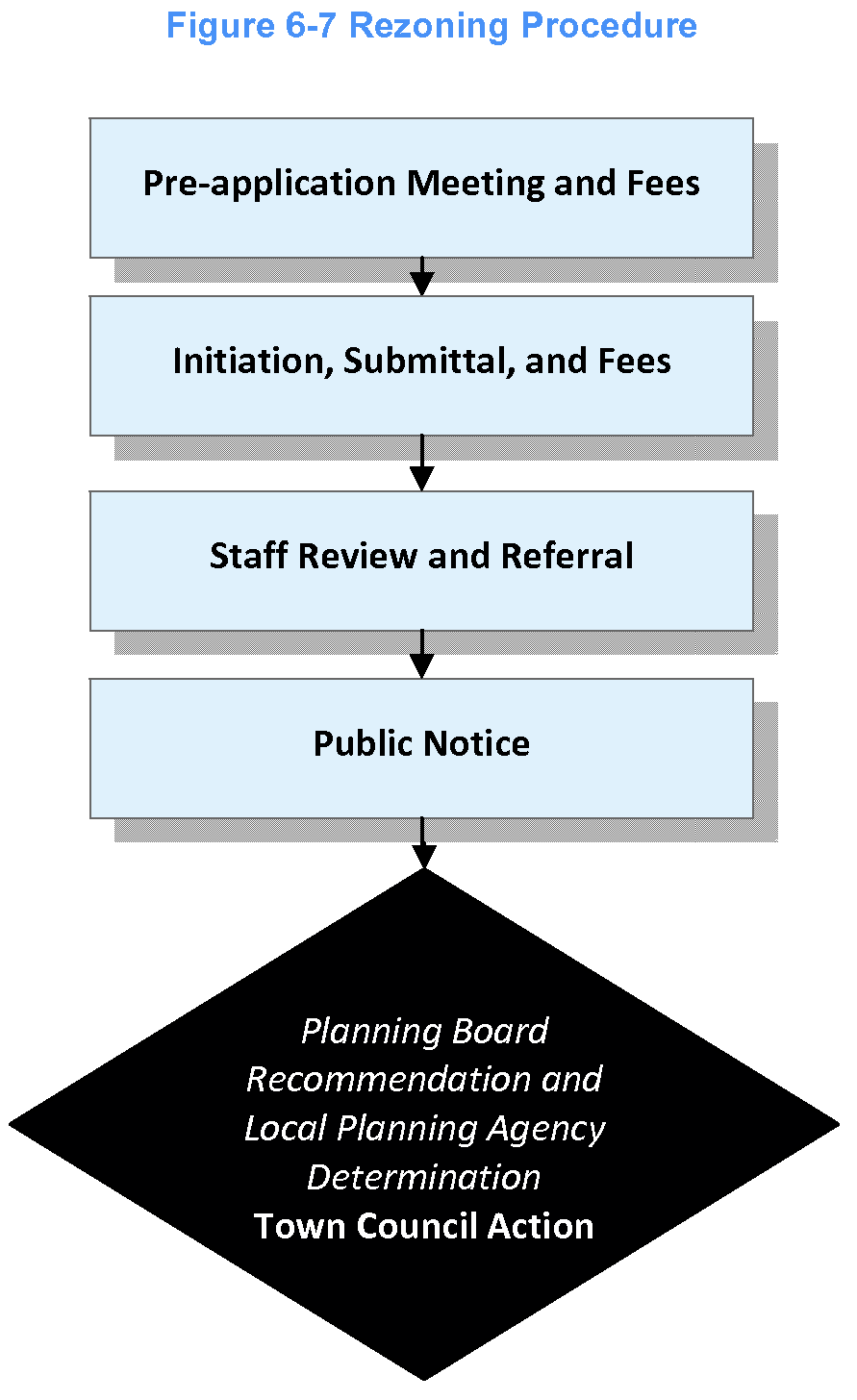
Procedures.
1.
Pre-application meeting. Applicable pursuant to section 6.3.2.
2.
Initiation, submittal, and fees. Applicable pursuant to section 6.3.3. There are two types of rezonings:
a.
Quasi-judicial rezonings. Applications initiated by any town land owners.
b.
Legislative rezonings. Applications initiated by town council, any member of the town council, or the town manager or designee.
3.
Staff review and referral. Applicable pursuant to section 6.3.4.
4.
Public notice. Published, written, and posted notice required pursuant to section 6.3.5.
C.
Action by review and decision-making authorities.
1.
Planning board public hearing and recommendation.
a.
Quasi-judicial rezonings. The planning board shall hold a public hearing and recommend approval, approval with conditions, postponement, or denial.
b.
Legislative rezonings. The town council may refer the application to the planning board to recommend approval, approval with conditions, or denial.
2.
Local planning agency determination. Applicable pursuant to section 6.2.2. In its capacity as the local planning agency, the planning board shall review the rezoning for consistency with the comprehensive plan and provide its determination to the town council.
3.
Town council public hearing and decision.
a.
Quasi-judicial rezonings. The town council shall hold a public hearing and approve, approve with conditions, postpone, or deny the application. It may accept, accept with conditions, modify or reject the planning board's recommendation, or seek additional information from the planning board.
b.
Legislative rezonings. The town council shall hold a public hearing and approve, approve with conditions, postpone, or deny the application. It may accept, accept with conditions, modify or reject the planning board's recommendation, or seek additional information from the planning board or local planning agency. No approval at any public hearing of a legislative amendment to the official zoning map shall be made unless at least four members of the town council affirmatively approve the amendment.
D.
Criteria. The application shall be consistent with the comprehensive plan, specifically Table II-1 (Zoning/Future Land Use Plan Compatibility Matrix) and the future land use map. In its review, recommendation, and decision on a quasi-judicial application, the town council and planning board shall consider:
1.
Whether it is consistent with all adopted elements of the comprehensive plan.
2.
Its impact upon the environment or natural resources.
3.
Its impact upon the economy of any affected area.
4.
Its impact upon any existing necessary governmental services such as schools, sewage disposal, solid waste, or transportation systems, or any other infrastructure.
5.
Any changes in circumstances or conditions affecting the area.
6.
Any mistakes in the original classification other than re-classifications due to inadvertent boundary errors, including clerical or scrivener's errors, which may be corrected administratively.
7.
Its effect upon the use or value of the affected area.
8.
Its impact upon the public health, welfare, or safety.
6.6.2 - Text amendments.
A.
Purpose. The purpose of this section is to provide standards and requirements for amending the text of this code. A text amendment adjusts the text of this code to address changed conditions, changes in the comprehensive plan, public policy, or that are necessary to advance the general welfare of the town.
B.
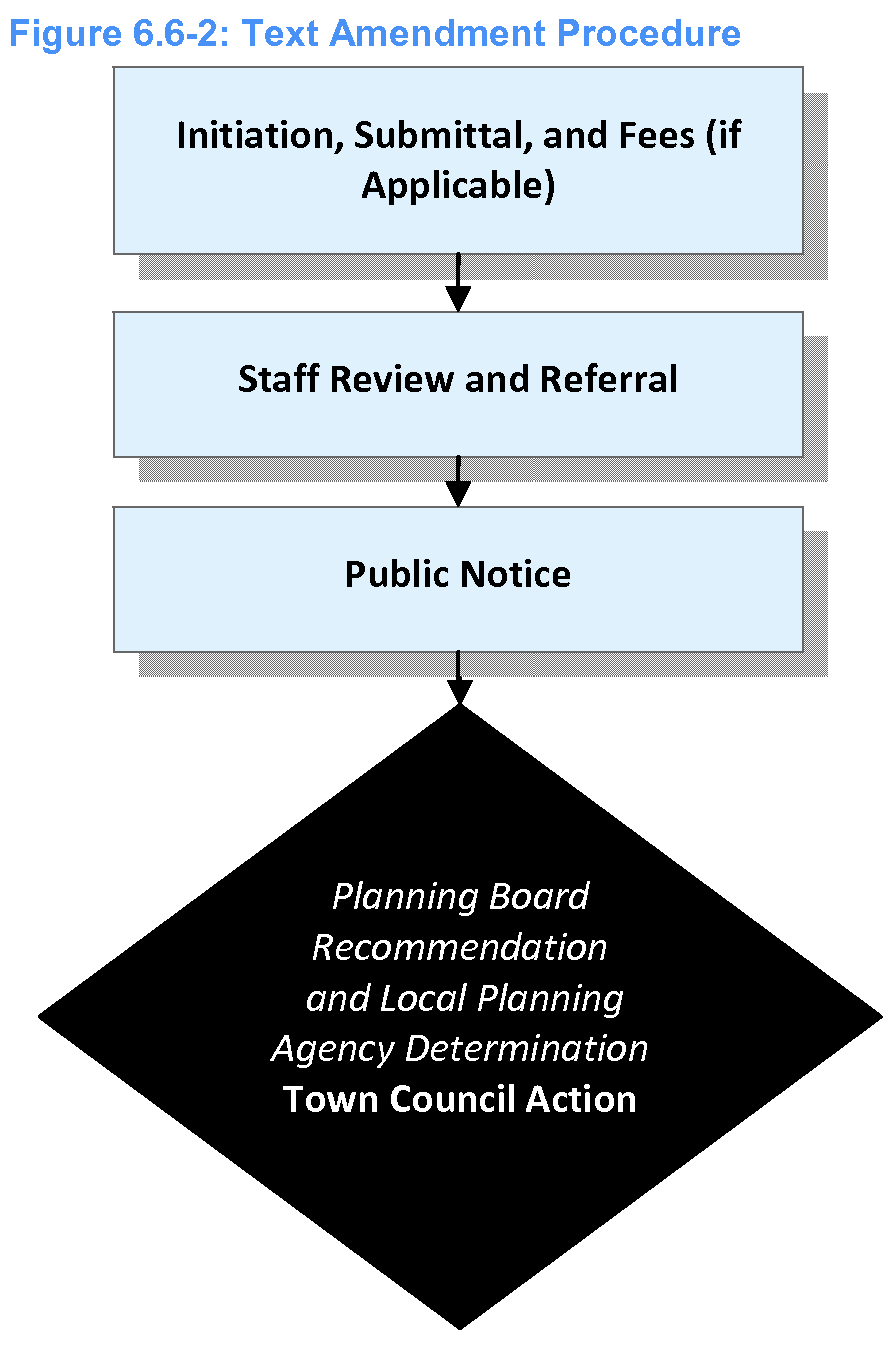
Procedures.
1.
Initiation, submittal, and fees. A proposal for a legislative decision to amend the land development regulations adopted in the Land Use and Development Code may be initiated by the town council, the town manager or designee, or any member of the public. The proposal shall be scheduled before the town council as soon as practicable.
2.
Staff review and referral. Applicable pursuant to section 6.3.4.
3.
Public notice. Published notice required pursuant to section 6.3.5 in addition to Florida Statutory notice requirements for changes to permitted uses in zoning districts.
4.
Action by review and decision-making authorities.
a.
Planning board public hearing and recommendation. The town council shall refer the application to the planning board to review and recommend approval, approval with conditions, or denial.
b.
Local planning agency determination. Applicable pursuant to section 6.2.2. In its capacity as the local planning agency, the planning board shall review the rezoning for consistency with the comprehensive plan and provide its determination to the town council.
c.
Town council public hearing and decision. The town council shall hold a public hearing and approve, approve with conditions, postpone, or deny the application.
d.
Criteria. The planning board and town council shall make their recommendation and decision based on whether the amendment:
(1)
Is consistent with the comprehensive plan.
(2)
Is specifically required by the comprehensive plan.
(3)
Provides specific and detailed regulations necessary to implement the goals, objectives, and policies of the comprehensive plan.
(4)
Maintains availability of public facilities and services at their adopted level-of-service standards (if applicable).
(5)
Does not otherwise conflict with the comprehensive plan.
(6)
Is consistent with town council policies or any other lawful consideration.
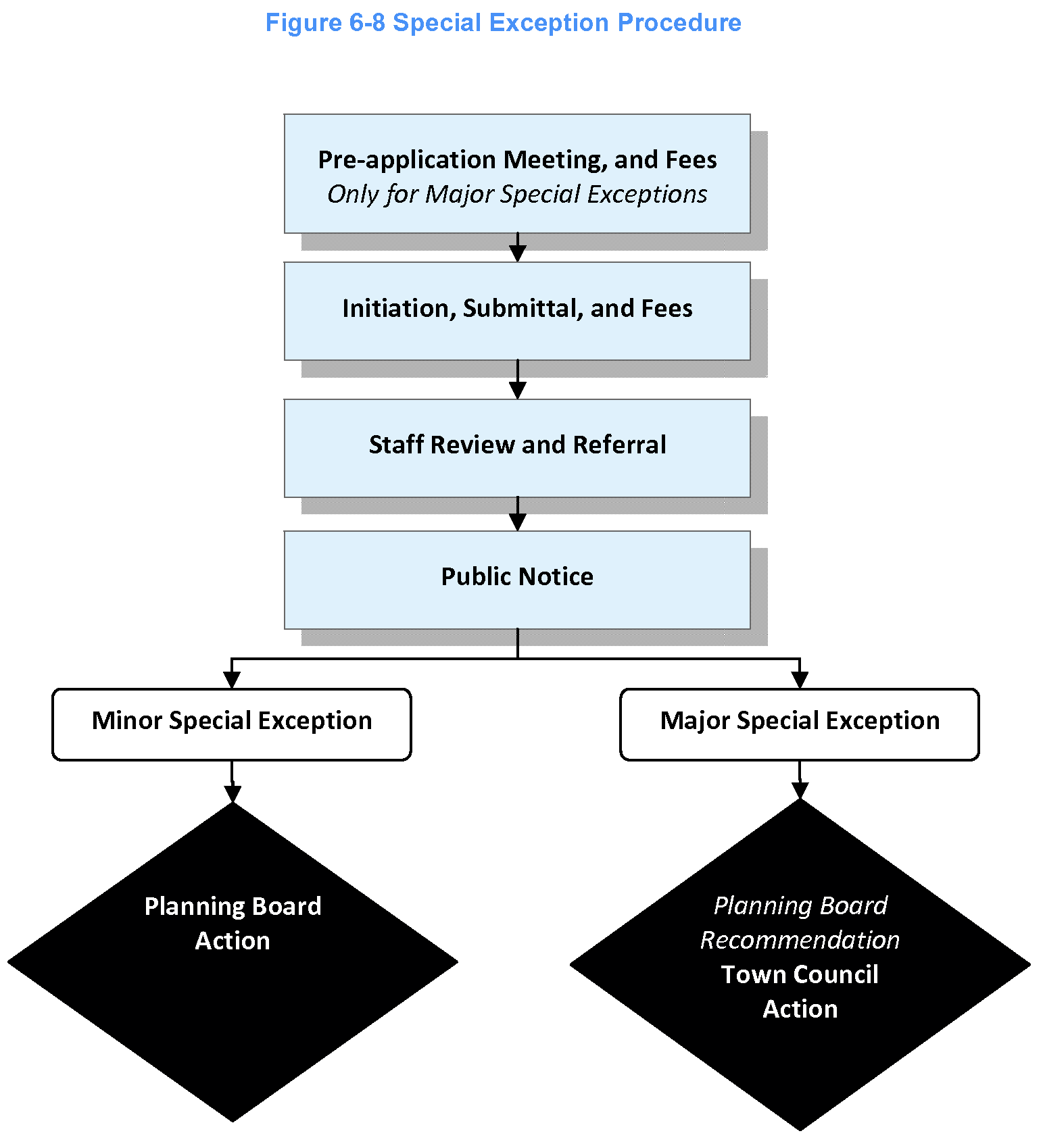
6.6.3 - Special exceptions.
A.
Purpose. The town recognizes that certain uses may be appropriate in a specific zoning district, but may have characteristics that have greater community impacts than permitted uses. A special exception is a use that would not be appropriate without restriction, but which, if controlled as to number, area, location or relation to the surrounding area, would promote the public health, safety and general welfare. These uses require more comprehensive review, and by their nature may necessitate specific conditions to mitigate any potential adverse impacts. Such uses may be permitted in a zoning district as a special exception only if identified as such in this code.
B.
Applicability. All uses listed as "special exceptions" in section 2.40, Table 2-5 (Table of Permitted Uses), shall follow the procedures below. There are two types of special exceptions - major and minor - which are distinguished by their potential impact and level of review required for approval. The procedures for each are set forth below.
C.
Procedures.
1.
Pre-application meeting, and fees. Required for major special exceptions pursuant to section 6.3.2.
2.
Initiation, submittal, and fees. Applicable pursuant to section 6.3.3.
3.
Staff review and referral. Applicable pursuant to section 6.3.4.
4.
Public notice. Published, written, and posted notice required pursuant to section 6.3.5.
5.
Action by review and decision-making authorities.
a.
Minor special exceptions. The planning board shall hold a public hearing and approve, approve with conditions, postpone, or deny the application.
b.
Major special exceptions.
(1)
Planning board public hearing and recommendation. The planning board shall hold a public hearing and recommend approval, approval with conditions, postponement, or denial to the town council.
(2)
Town council public hearing and decision. The town council shall hold a public hearing and approve, approve with conditions, postpone, or deny the application.
D.
Criteria. The director, planning board, and town council shall make their recommendation and decision based on the general criteria in subsection 6.3.6.F and the applicable special exception standards in article 3.
E.
Conditions and safeguards. The town council or planning board may impose any conditions or safeguards not otherwise required with the special exception if necessary to further the purpose of this code.
F.
Revocation. After notice to the owner and any occupant and a public hearing, the town council or planning board, as applicable, may revoke the special exception permit after finding that there have been violations of any code criteria or conditions of approval, or that the conduct of the owner and any occupant constitutes a public nuisance. No applicant who has had a permit revoked shall be able to apply for another special exception permit for two years after the revocation date.
G.
Expiration or abandonment of special exception uses. Special exceptions expire if:
1.
They do not begin to serve the purpose for which they were granted within 12 months from the date they are recorded, or
2.
The use is abandoned for 12 consecutive months after the date of recordation.
H.
Preservation of special exception uses. A use or structure legally permitted before the date of adoption of this code for which a special exception would now be required under this code, may continue as originally permitted without needing special exception approval. Any terms or conditions which applied to the use or structure prior to the effective date of this code shall remain in full force and effect following the effective date of this code.
6.6.4 - Variances.
A.
Purpose. The variance process is intended to provide limited relief from this code in cases where strict application of a particular requirement will create a practical difficulty or undue hardship prohibiting the use of land in a manner otherwise allowed under this code. Variances are intended to provide such relief where this code renders the land difficult or impossible to use because of some physical attribute other factor unique to the property for which the variance is requested.
B.
Applicability.
1.
A variance may be granted by the planning board, acting as the board of adjustment, only to modify the area, size, setbacks, or open space requirements of this code.
2.
A variance shall not be granted to permit or expand a use not permitted generally or by special exception in the applicable zoning classification.
3.
A variance may be granted only if the applicant meets all of the criteria listed in subsection 6.6.4.E below.
4.
No nonconforming use of neighboring land, structures, or buildings in the same zoning classification and no permitted use of lands, structures or buildings in other zoning classifications shall be considered grounds for the authorization of a variance.
5.
Inconveniences or financial burdens that can be resolved by means other than a variance shall not constitute evidence of unnecessary and undue hardship and shall not alone be considered grounds to justify granting a variance.
6.
State and/or federal laws or requirements may not be varied by the town.
C.
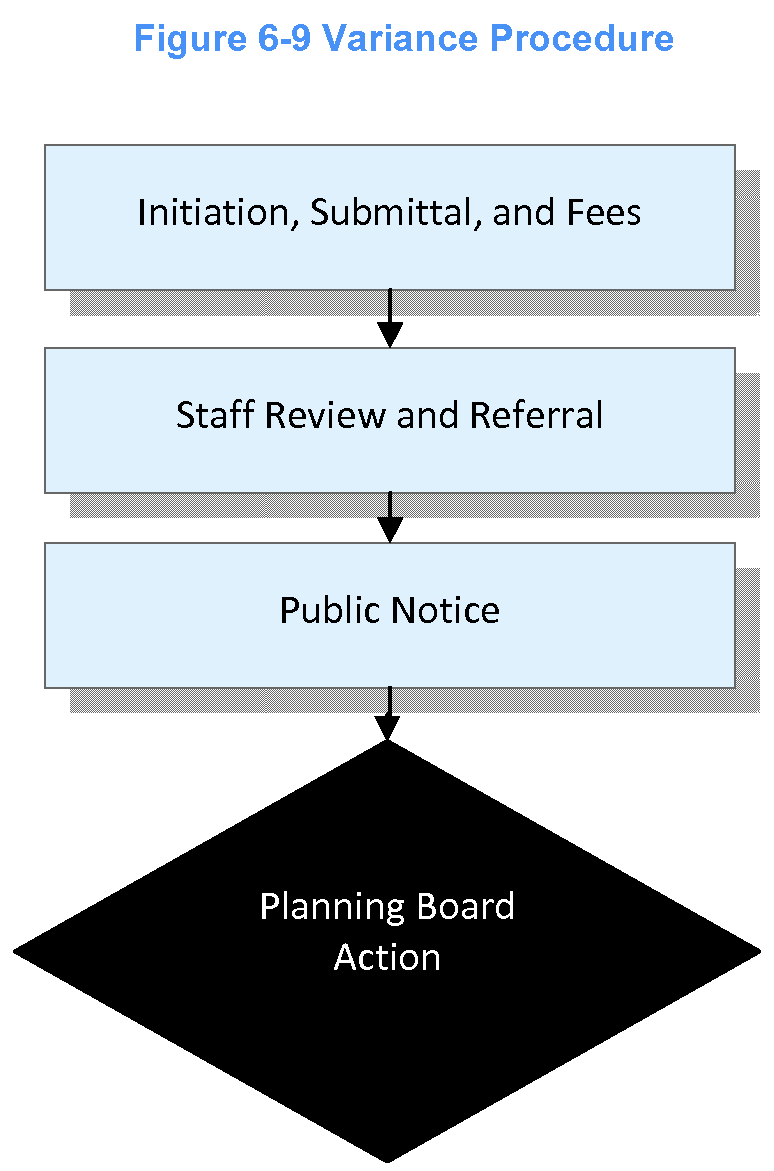
Procedures.
1.
Initiation, submittal, and fees. An applicant shall submit a written application for a variance in accordance with section 6.3.3, demonstrating compliance with the criteria established below.
2.
Public notice. Published, written, and posted notice required pursuant to section 6.3.5.
3.
Planning board public hearing and decision. The planning board shall hold a public hearing and approve, approve with conditions, postpone, or deny the application.
D.
Variances and development review. Any variance may be granted or denied by the planning board in conjunction with an application for development review. Any such variance application brought before the planning board shall be heard and acted on before final development approval. The development shall be conditioned upon approval of the variance and circumstances requiring the variance. For projects requiring multiple development review approvals, a variance, once granted by the planning board, shall be valid for all subsequent development reviews as long as it has not expired or the conditions and circumstances requiring the variance have not changed.
E.
Criteria. The applicant shall demonstrate that the proposed variance complies with all of the following:
1.
Special conditions and circumstances exist that are peculiar to the land, structure, or building involved and not typical of other lands, structures, or buildings in the same zoning classification; and
2.
The special conditions and circumstances do not result from the actions of the applicant; and
3.
Literal interpretation of this code would deprive the applicant of rights commonly enjoyed by other properties in the same zoning classification and would create an unnecessary and undue hardship on the applicant; and
4.
Strict adherence to the provision does not promote the purpose for which it is intended; and
5.
The variance does not conflict with a town policy such as preservation of dunes, water conservation, or preservation of natural vegetation; and
6.
The variance is the minimum variance that will make possible the reasonable use of the land, building or structure; and
7.
The variance is in harmony with the general intent and purpose of the LUDC and does not injure the area involved.
F.
Conditions. The planning board may impose any conditions on the variance it deems necessary to further the purposes of this code. Violation of any conditions may result in revocation of the variance in addition to any other remedy for the violation provided in this code or by law.
G.
Expiration. If a variance does not begin to serve the purpose for which it was granted within 12 months from the date it is recorded, or, if its use is subsequently abandoned for 12 consecutive months, it shall expire. A shorter or longer period of time for expiration may be set by the planning board when granting variances.
6.6.5 - Administrative variances.
A.
Purpose. The purpose of this section is to establish authority, procedures, standards, and appeals for the granting of administrative variances from certain requirements of this code.
B.
Authority and scope. Within certain limitations as set forth herein, the director is authorized to grant the following variances according to the standards in subsections 6.6.5.E. and F below:
1.
Reduction of certain minimum setback requirements in article 2 for all districts except conservation (C), planned waterfront development (PWD), riverfront overlay district (ROD), and the lighthouse overlay (LOD) district. Reduction is limited to five feet for front and rear yards (non-waterfront) and 20 percent for side yards.
2.
Reduction of the off-street parking requirements in section 4.7.8, by no more than 20 percent.
3.
Reduction of the total area of interior landscaping for paved vehicular use areas of subsection 4.10.3.E by no more than ten percent.
4.
Reduction of the bufferyard requirements of subsection 4.10.3.C by no more than ten percent.
5.
Increase in the maximum height of fences and walls outlined in section 4.4 by no more than two feet. Fences and walls subject to a height limitation waiver under section 4.4.4.D are not eligible for an increase in maximum height under this section.
C.
Application. An application for an administrative variance under this section shall be submitted to the director.
D.
Sufficiency review. The director shall normally review the application for sufficiency and completeness of information within five working days after submission. The director shall inform the applicant in writing immediately if corrections are needed. Incomplete applications cannot be processed.
E.
Standards. The director may grant a variance under this section if the applicant demonstrates that all of the following standards are met:
1.
A showing of good and sufficient cause;
2.
Failure to grant the variance would result in an undue hardship to the applicant;
3.
Granting the variance will not result in increased public expenses, create a threat to public health and safety, create a public nuisance, or cause fraud or victimization of the public;
4.
The property has special conditions or peculiar circumstances which are not applicable to other properties in the same zoning district;
5.
Granting the variance will not give the applicant any special privilege denied to other properties in the immediate neighborhood in terms of the provisions of this chapter or established development patterns;
6.
Granting the variance is not based on disabilities, handicaps or health of the applicant or members of his or her family;
7.
Granting the variance is not based on the domestic difficulties of the applicant or his or her family; and
8.
The variance is the minimum necessary to provide relief to the applicant.
F.
Additional standards for the front yard setback variances under this section. The director may approve a variance that modifies the minimum front yard requirements set out in subsection 6.6.5.B.1 above, provided the applicant demonstrates that the average existing front yard setback, as measured pursuant to section 4.6.10, on the street where the subject property is located is less than the zoning district standard, as established in article 2.
G.
Public notification of proposed administrative variance. After determining that an application for an administrative variance is sufficient, the director shall provide written notice of the proposed administrative variance and require posting as follows:
1.
The director shall send written notice by first-class mail to owners of real property located within 300 feet of the subject property. The notices shall be sent to the addresses listed by the tax assessor's office or at any other addresses which are provided to the town. If the notices are returned as unclaimed, posting of the property shall be sufficient to show that the notice requirements have been met, without regard to whether or not owners of property within 300 feet actually received such notice.
2.
The applicant shall post the subject property with a waterproof sign provided by the director in a location that is easily visible from all public streets and public ways abutting the property. The property shall remain posted for no less than 15 consecutive calendar days beginning five working days after the date that the application is deemed to be sufficient.
3.
The notice and posting shall provide a brief description of the proposed variance and indicate where the public may examine the application. The notices shall require that any written comments or objections be sent to the director within 15 calendar days from the date such notices are sent. If no written objections are provided, such property owners shall be presumed to have not objected and to have waived their right to object to the administrative variance. The cost of providing notice and posting shall be borne by the applicant.
H.
Decision by the director. The director is not authorized to approve any application when there are objections from any property owner within 300 feet of the property. In addition, if the director, in his or her discretion, believes the application should be decided at a public hearing because of unusual circumstances, the variance shall be heard by the planning board. If no written objections to the administrative variance are made after 15 calendar days of proper posting, and after reviewing all public responses to the variance application, the director shall issue a written decision stating the reasons to either grant or deny the administrative variance.
I.
Appeal of director's decision. The director's written decision may be appealed within 30 days to the planning board. Persons with standing to file the appeal are the applicant or any owner of real property located within 300 feet of the subject property. Upon payment of any required appeal fee, the appeal shall be processed in the same manner as the variance proceeding before the planning board, including requirements of due public notice. The appeal shall be heard de novo by the planning board at the next available board meeting. A person appealing a variance decision is entitled to be represented by legal counsel or an agent. Failure to appear at the appeal hearing may result in denial of the appeal and affirmation of the director's decision. The planning board's decision may be appealed to town council pursuant to section 6.3.7.
J.
Public hearing by the planning board. If requested in writing by the applicant, or upon receipt of an objection from an owner of real property located within 300 feet of the subject property submitted within the allotted time frame, a public hearing before the planning board shall be scheduled. All costs of the public hearing shall be the responsibility of the applicant. The public hearing after due public notice shall be conducted in accordance with subsection 6.6.4.C.
K.
Reporting. The director shall provide to the planning board, at its next regularly scheduled meeting, a descriptive list of granted administrative variances.
(Ord. No. 2021-03, § 2(Exh. B), 2-18-2021)
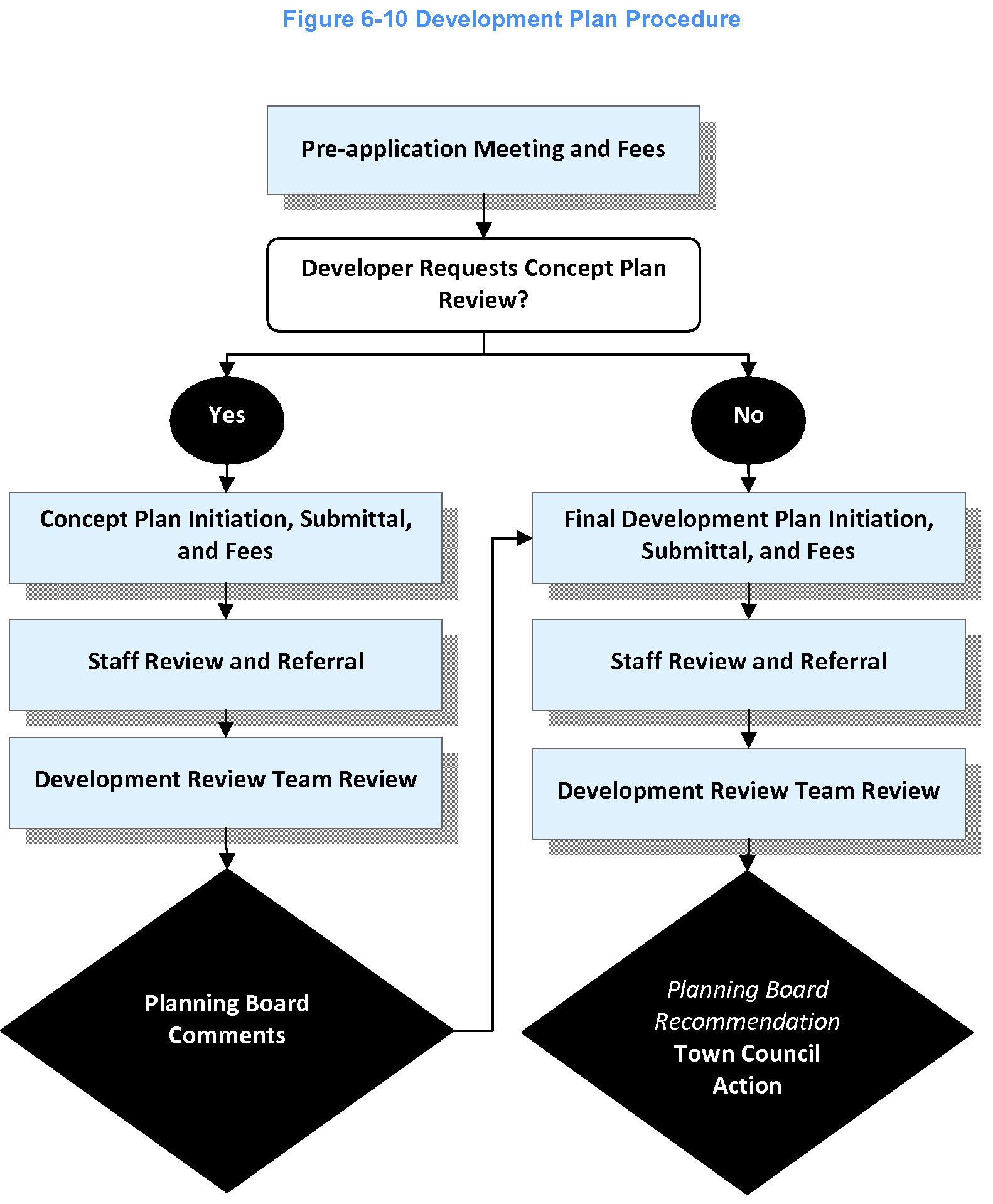
6.6.6 - Development plans and subdivision plats.
A.
Purpose. The purpose of the development plan procedure is to ensure that development plans comply with this code and are consistent with the comprehensive plan.
B.
Procedures.
1.
Pre-application meeting and fees. Applicable pursuant to section 6.3.2.
2.
Initiation, submittal, and fees. Applicable pursuant to section 6.3.3. Additional submittal requirements for master plans and final development orders are set forth in section 10.1, Table 10-1. Any developer may elect to submit a concept plan for review. This review is recommended for development proposals that may be controversial, in order to obtain constructive feedback prior to the preparation and submittal o final development plans. All other steps in this procedure are mandatory.
3.
Staff review and referral. Applicable pursuant to section 6.3.4.
4.
Public notice. Published, written, and posted notice required pursuant to section 6.3.5.
5.
Action by review and decision-making authorities.
a.
Concept plan review (optional).
(1)
Development review team review.
(a)
Concept development plan applications shall be reviewed by the development review team (DRT), as defined by this code.
(b)
The developer shall file an application for concept plan review at least 20 days prior to any meeting of the DRT, including the required fee.
(c)
The proposal and DRT's recommendations shall be placed on the agenda of the next meeting of the planning board that allows the required review time.
(2)
Planning board comments, criteria. The review and findings of the planning board are intended to provide feedback, and as such are non-binding and advisory in nature. The planning board may not issue any order, finding, or other official indication of approval or disapproval of the proposal or implication that the particular proposal will be ultimately approved or disapproved in any form. The planning board shall consider the following items in concept plan review.
(a)
Characteristics of the site and surrounding area, including important natural and manmade features, the size and accessibility of the site, and surrounding land uses.
(b)
Whether the concurrency requirements of article 5 of this code could be met if the development were built.
(c)
The nature of the proposed development, including land use types and densities; the placement of proposed buildings and other improvements on the site; the location, type, and method of maintenance of open space and public use areas; the preservation of natural features; proposed parking areas; internal traffic circulation system; the approximate total ground coverage of paved areas and structures; and types of water and sewage treatment systems.
(d)
Consistency of the proposed development with the comprehensive plan.
(e)
Conformity of the proposed development with this code and other applicable regulations.
(f)
Concerns of surrounding landowners and other affected persons, presented as competent substantial evidence regarding one or more of the criteria of this subsection.
b.
Final development plan review.
(1)
Development team review.
(a)
The developer shall file an application for final development plan review at least 40 days prior to any meeting of the development review team (DRT), including the required fee.
(b)
The director shall place the proposal on the agenda of the next available meeting of the DRT. Recommendations from the DRT shall be forwarded to the planning board.
(2)
Planning board public hearing and recommendation. The planning board shall conduct a public hearing on the application and consider the same criteria as for concept plan review above. The planning board shall forward a recommendation to the town council to approve, approve with modifications, postpone, or deny the final development plan. The planning board chairman shall sign one copy of the final development plan following the board's review.
(3)
Town council public hearing and decision. The town council shall hold a public hearing and approve, approve with conditions, postpone, or deny the application based on the criteria in this section.
C.
Review of related subdivision plats.
1.
Generally. When a proposed development includes the subdivision of land, the final development plans and record plat shall be reviewed and approved together. Approval of the final development plan and the related subdivision plat results in a development order.
2.
Application for approval of a record plat. The developer shall submit an application for plat approval together with the plans for development approval.
3.
Review by town engineer and town attorney. The town engineer shall be responsible for assuring conformance of the final plat with the final development order. He shall also certify that the required improvements have been completed in accordance with the final development order, unless the developer has provided the town with a performance bond for these improvements.
The town attorney shall certify that all necessary plat signature blocks have been properly executed, and that any deed restrictions or protective covenants are sufficient to achieve the intended purpose. He shall also comment on the sufficiency of the improvements warranty and the performance bond when the bond is provided in lieu of completing the required improvements.
4.
Town council public hearing and decision. The town council shall review and take action on the record plat after its approval by the town engineer and town attorney. If the final plat meets all requirements of this code and is in accordance with the final development order, and all required improvements have been either completed or bonded, the town council shall approve the final plat and indicate its approval by the signature of the mayor and clerk.
5.
Recording of approved plat. Upon approval by the town council of the final plat, the town clerk or his designee shall file the plat with the clerk of the circuit court for recording in the public records of Volusia County. The applicant shall pay all recording fees.
D.
Project phasing—Master plan requirement. A master plan for the entire development site must be approved for a major development that will be developed in phases. The master plan must be reviewed and approved before or in conjunction with, the final development plan for the first phase of the development. A final development plan must be approved for each phase of the development under the procedures for development review prescribed above.
The procedure for submission, review, and approval of a proposed master plan shall be the same as required for a proposed final development plan. One copy of the approved master plan shall be signed and dated by the mayor and the town clerk. This master plan is the basis for preparation and submittal of future final development plans for the subject parcel. No development permit shall be issued on the basis of an approved master plan until a final development plan for the subject parcel is approved by the town council.
E.
Expiration of final development orders. The final development order expires if the development activity authorized by the final development order is not completed within 18 months from the date that the final plat is recorded. The applicant may request an extension in writing at least three months before the development order expires. If a timely written request is filed, the town council may grant one or more extensions, up to six months in length per extension.
6.6.7 - Minor replats.
A.
Purpose. Minor replats are intended to be an efficient procedure for the division, combination, or reconfiguration of lots in any zoning district, for property already served by streets and other required infrastructure.
B.
Applicability.
1.
No real property shall be divided, combined, or reconfigured for the purpose of sale or development without complying with the requirements of this section, unless specifically exempted herein.
2.
Minor replats pursuant to this section include property line adjustment, lot combinations, lot reconfigurations, and lot divisions as described and illustrated on Figure 6-12. All other subdivisions or replatting of land, including those for which public infrastructure is required or proposed, shall comply with section 6.6.6. and F.S. § 177.011—177.051.
3.
No building permit shall be issued for subdivided, combined, or reconfigured property until a minor replat has been approved and recorded pursuant to this section.
4.
Replattings may be allowed within an existing land use category even if a consequence of such actions is an increase in the projected build-out population of the town.
5.
A minor replat is required for the assemblage of multiple, contiguous, non-conforming lots under single ownership for development purposes under section 7.3.1.
Figure 6-12 Minor Replat Types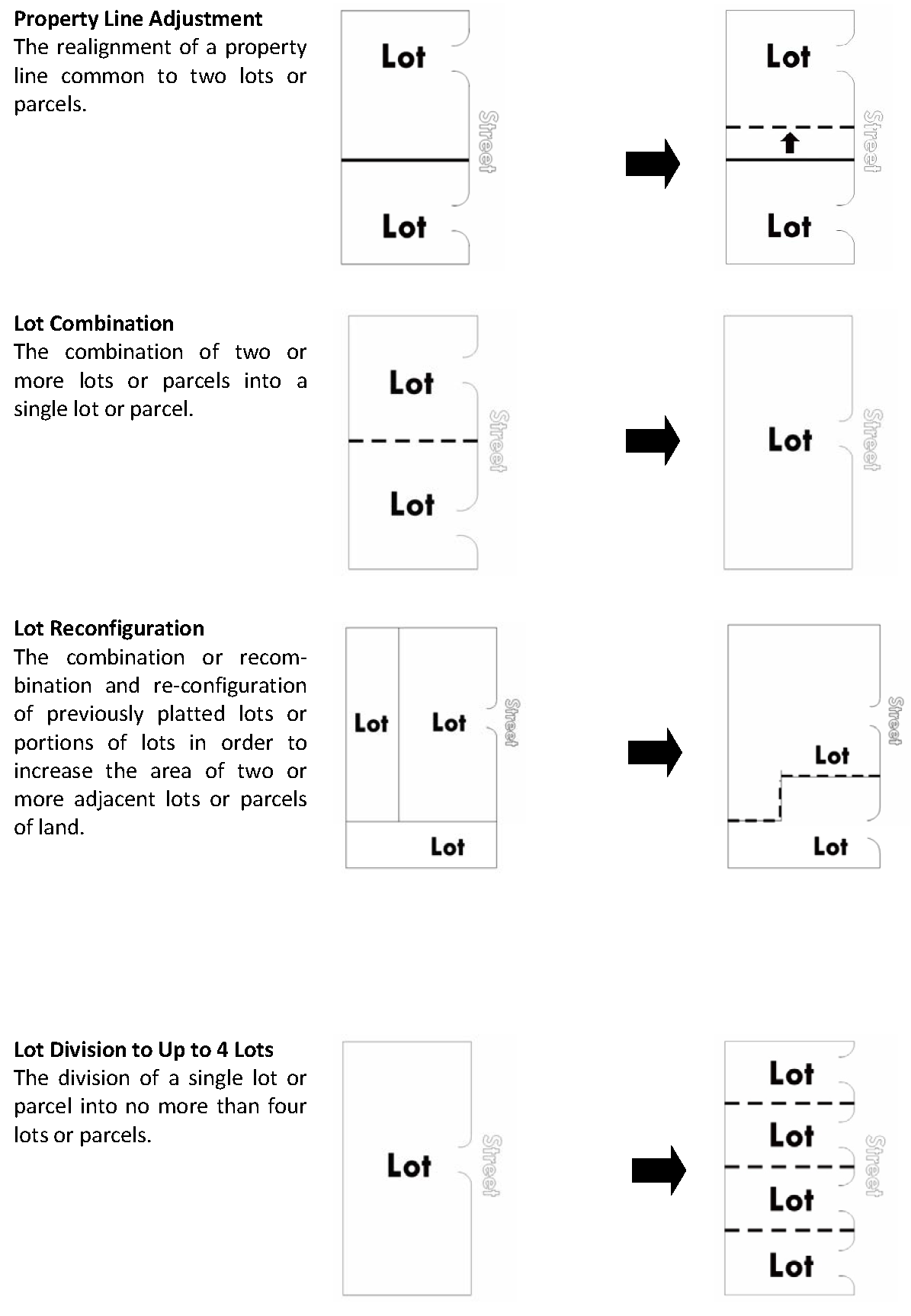
C.
Standards.
1.
All minor replats shall meet the following requirements:
a.
All lots shall have access to an existing public street or approved private way.
b.
Water and sewer services are available, and no major improvements or extensions are proposed or required.
c.
All lots shall meet the minimum lot area, width, and depth requirements for the applicable zoning district. Flag lots created in single-family residential zoning districts shall meet the standards of section 4.6.9.
d.
The new lot boundaries shall not cause existing structures on the property to become non-conforming with respect to setbacks and other requirements of this code.
e.
The number of lots shall not exceed the maximum density allowed by the future land use designation of the property
f.
New or reconfigured public easements as necessary for utilities, drainage, conservation, or other purposes shall be conveyed to the town.
2.
Lot reconfigurations shall not increase the number of lots, tracts, or parcels.
3.
Lot divisions shall not result in more than four lots.
4.
No more than one lot division is permissible for a particular property within a two-year time period, measured from the date of approval.
D.
Initiation, Submittal, and Fees. See section 6.3.3. Additional submittal requirements are set forth in article 10.
E.
Staff Review and Referral. Applicable pursuant to section 6.3.4.
F.
Public Notice. Published, written, and posted notice required pursuant to section 6.3.5.
G.
Action by review and decision-making authorities.
1.
Lot reconfigurations. The director shall approve, approve with conditions, postpone, or deny the application. If approved, the director shall prepare the form to be used for recording purposes per paragraph H below. The form shall include the legal description of the lots to be reconfigured, the purpose of the reconfiguration, and a reference to any related surveys and other documents to be attached and recorded with the form.
2.
Lot divisions. Applications resulting in no more than two lots may be approved by the Planning Board. Applications resulting in up to four lots shall be reviewed by the Town Council at a public hearing. Applications shall be approved, approved with conditions, postponed, or denied in accordance with the standards in section 6.6.7.C above.
3.
If the minor replat is denied by the reviewer, the reasons for denial shall be submitted in writing to the applicant within ten days of the decision.
H.
Recording. Within 45 days after approval, the applicant shall file the lot recording form, original drawing of the survey, and any covenants, deed restrictions, or other required documents with the clerk of the Circuit Court of Volusia County. If not recorded within the 45 days, the minor replat shall become null and void. A copy of the recorded documents shall be submitted to the planning and development department, only after which shall the minor replat become effective for purposes of this code. The applicant is responsible for all recording fees.
(Ord. No. 2015-08, § 2(Exh. A), 11-19-2015; Ord. No. 2018-07, § 2(Exh. A), 5-17-2018)
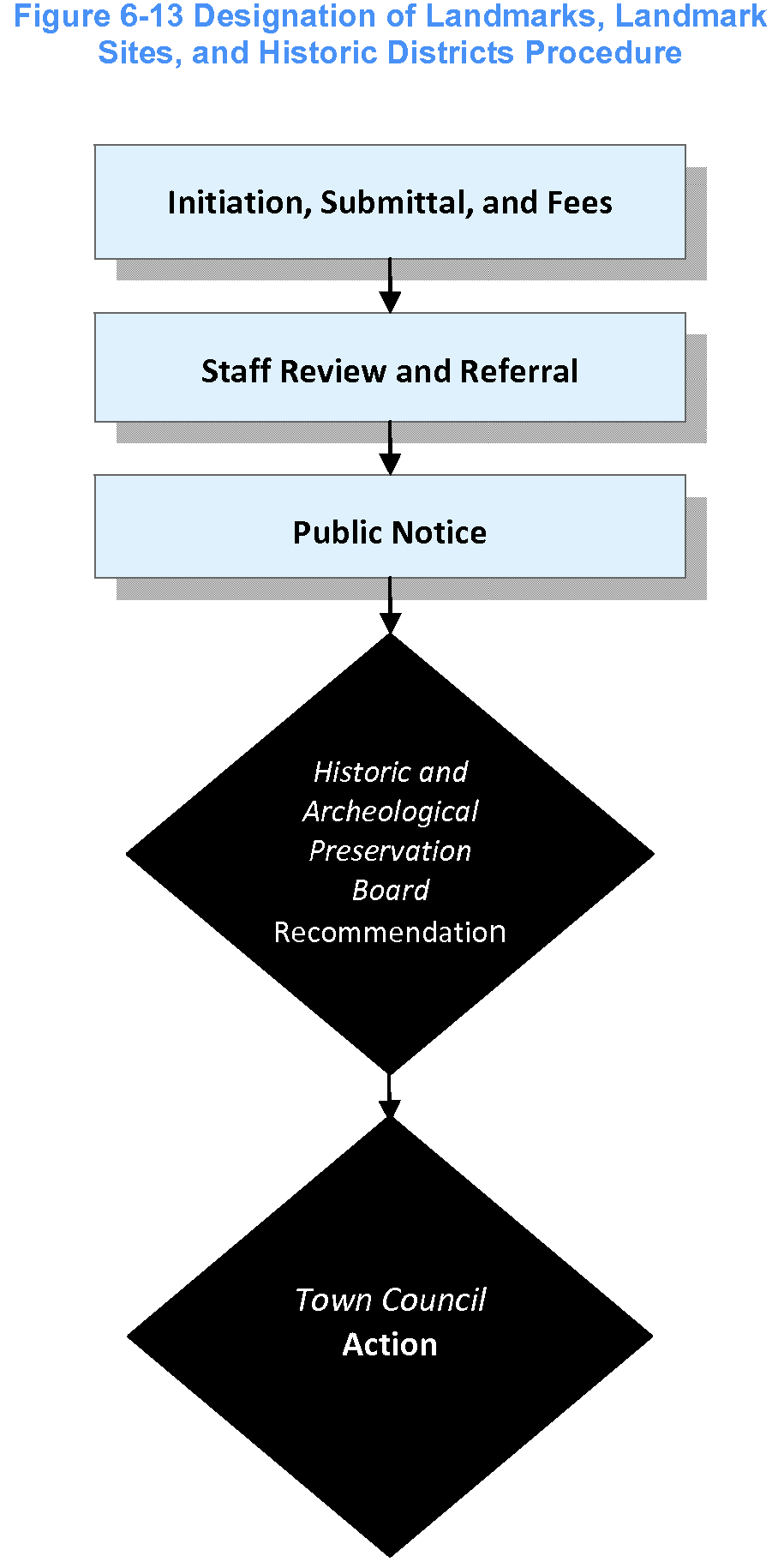
6.6.8 - Designation of landmarks, landmark sites, and historic districts.
A.
Local register established. A local register of historic places is hereby created as a means of recognizing and protecting various sites, buildings, structures, districts, and areas in the town as historic and/or archeologically significant. The register shall consist of those properties designated historic as prescribed in this section.
B.
Authorization. The town council may designate individual landmarks, landmark sites and historic districts to the local register after recommendation from the historic and archeological preservation board by resolution. Each designation of a landmark shall include a designation of a landmark site.
C.
Procedures.
1.
Initiation, submittal, and fees. See section 6.3.3. Additional submittal requirements are set forth in article 10.
2.
Staff review and referral. Applicable pursuant to section 6.3.4.
3.
Public notice. Published, written, and posted notice required pursuant to section 6.3.5. For district nominations, the written notice shall also advise property owners of their option to not be included.
4.
Action by review and decision-making authorities.
a.
Historic and archeological preservation board public hearing and recommendation.
(1)
Upon submittal of a complete application, the historic board shall schedule a public hearing on the proposed designation at the next available meeting. The board shall make a recommendation to the town council with a written report on the property or district under consideration. Applications for designation shall be recommended for approval or denial or modification. The historic board may vote to defer its decision for an additional 30 days.
(2)
If the historic board recommends a designation, it shall explain how the proposed landmark or historic district qualifies for designation under the criteria in this section. This evaluation may include references to other buildings and areas in the town and shall identify the significant features of the proposed landmark or historic district. The report shall include a discussion on the relationship between the proposed designation and existing and future plans for the development of the town.
(3)
For historic district applications, property owners may opt out of the proposed district by submitting a notarized letter to the town stating they are the owner of their parcel and wish to not be included. In such cases, the board may recommend modification of the proposed district boundary based on the input of property owners received before or during the hearing.
b.
Town council action.
(1)
The town council shall approve, modify or deny the proposed designation within 60 days of the board recommendation. If a designation is made, the comprehensive plan, including the future land use map, shall thereafter be amended to contain the designation in accordance with F.S. § 163.3177.
(2)
The planning and development department shall notify each applicant and property owner of the decision within 30 days of the town council action and shall arrange that the property or historic district is added to the local register and recorded with the county clerk.
5.
Criteria for designation. The board shall recommend, and the town council shall make a decision based on the following criteria:
a.
Its value is a significant reminder of the cultural or archeological heritage of the town, state, or nation;
b.
Its location is a site of a significant local, state, or national event;
c.
It is identified with a person who significantly contributed to the development of the town, state or nation;
d.
It is identified as the work of a master builder, designer, or architect whose individual work has influenced the development of the town, state or nation;
e.
Its value as a building is recognized for the quality of its architecture, and it retains sufficient elements showing its architectural significance;
f.
It has distinguishing characteristics of an architectural style valuable for the study of a period, method of construction, or use of indigenous materials;
And for historic districts,
g.
Its character is a geographically definable area possessing a significant concentration, or continuity of sites, buildings, objects or structures united in past events or aesthetically by plan or physical development; or
h.
Its character is an established and geographically definable neighborhood, united in culture, architectural style or physical plan and development.
i.
It has the support of all property owners within the proposed district boundary.
6.
Amendments and rescissions. The designation of any landmark and landmark site or historic district may be amended or rescinded through the same procedure utilized for the original description.
6.6.9 - Nominations to the national register of historic places.
The historic board shall review all local property nominations to the National Register of Historic Places following the regulations of the state historic preservation office. Following a public hearing with 30 days public notice, the historic board shall consider the nomination. When necessary, the board shall seek expert advice before evaluating the nomination. The historic board shall forward to the state historic preservation officer its action on the nomination and the recommendations of the local officials within 60 days of the nomination. When a property owner objects to having property nominated to the national register, the historic board shall cease any further review process and notify the state historic preservation officer of the property owner's objection to the proposed listing. The board shall not recommend registry over the objection of the property owner.
6.6.10 - Incentives for historic preservation.
The town council may adopt resolutions or issue proclamations creating incentives and recognition for historic preservation. Examples of such incentives include:
A.
Reduction of fees.
B.
Commemorative plaques.
C.
Annual recognition event.
D.
Tax exemptions.
E.
Relief from certain zoning dimensional requirements through the variance process.
F.
Proclamation of special historic areas of town as an alternative to historic district designation.
6.6.11 - Certificates of appropriateness (approval of changes to landmarks, landmark sites, and property in historic districts).
A.
Applicability.
1.
As specified below, the director shall forward each application for a permit that would authorize an alteration, new construction, demolition, or relocation affecting a designated property on the local register to the historic and archeological preservation board for a certificate of appropriateness.
2.
A certificate of appropriateness is required for any of the following actions affecting designated properties on the local register, including landmarks, landmark sites, or a property in a historic district:
a.
Any alterations requiring a building permit that will change the exterior appearance of any building or structure. Review of any alterations to designated buildings and structures shall be limited to exterior changes. Whenever any alteration is undertaken pursuant to this section without a certificate of appropriateness, the chief building official may issue a stop work order.
b.
Any new construction or erection of any principal or accessory building or structure in any historic district.
c.
The demolition of any building or structure.
d.
The relocation of any building or structure, including the relocation of a building or structure into or out of a historic district.
3.
A certificate of appropriateness is required for the demolition or exterior alteration of any building or structure that is eligible for inclusion on the National Register of Historic Places or the Local Register of Historic Places, as identified by the town's 2007 Historic Site Survey as may be updated, at the time any application is made for demolition or alteration.
4.
A certificate of appropriateness shall not be required for properties jointly listed on both the List of National Historic Landmarks and the Local Register of Historic Places, as long as such properties commit in writing to following the United States Secretary of the Interior's Standards for Historic Preservation Projects, and provide to the historic and archeological preservation board an annual report of all exterior alteration, new construction, demolition, or relocation activities.
5.
A certificate of appropriateness shall be in addition to any other required building permits. An approved certificate of appropriateness does not relieve compliance with other state and local regulations.
6.
Ordinary repairs and maintenance that are otherwise permitted may be undertaken without a certificate of appropriateness provided the work does not alter the exterior appearance of the building, structure, or archeological site, or alter elements significant to its architectural or historic integrity.
B.
Procedures.
1.
Initiation, submittal, and fees. Applicable pursuant to section 6.3.3. Additional submittal requirements are set forth in article 10.
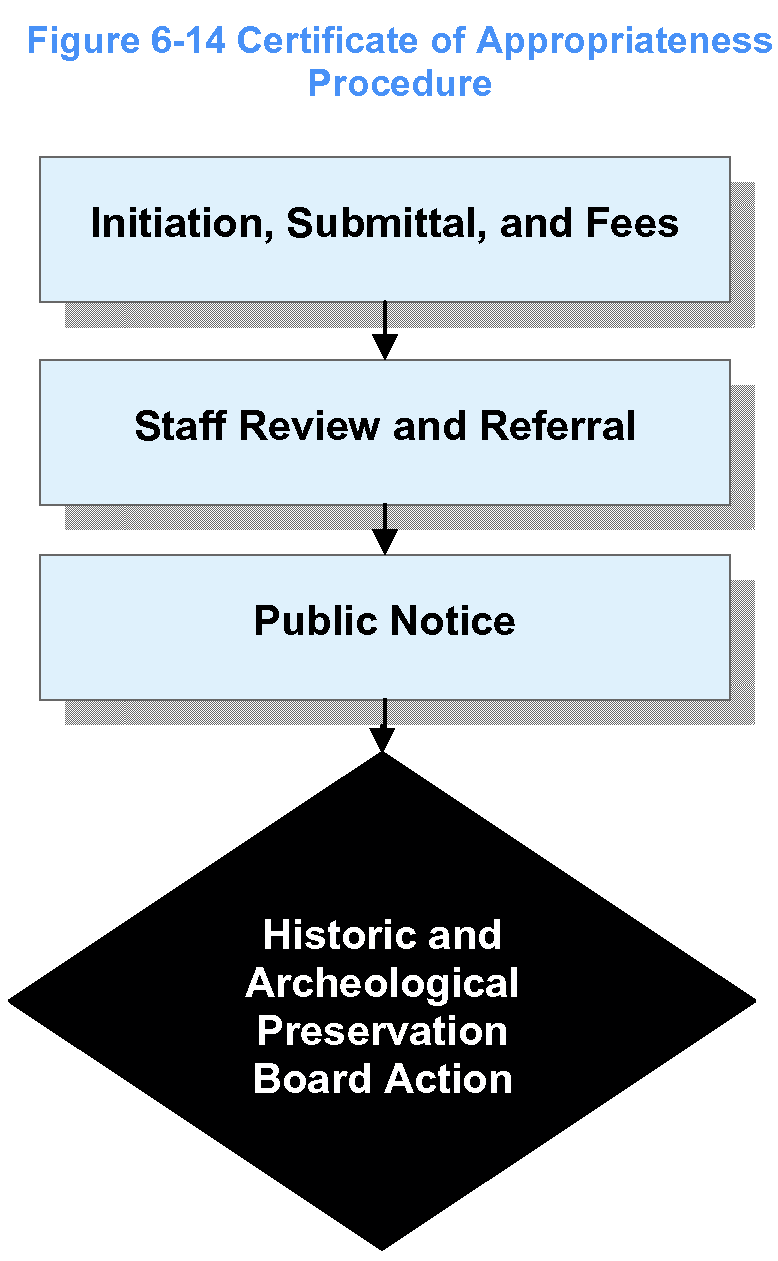
2.
Staff review and referral. Applicable pursuant to section 6.3.4.
3.
Public notice. Published, written, and posted notice required pursuant to section 6.3.5.
4.
Historic and archeological preservation board public hearing and decision. The historic board shall hold a public hearing on each certificate of appropriateness within 30 days after receipt of a completed application. The historic board shall approve, approve with conditions, or deny each application based on the criteria and guidelines in this section.
5.
Appeals to town council. Any board decision on an application for a certificate of appropriateness may be appealed to the town council if filed within 15 days of the historic board's decision. The town council shall approve, approve with modifications, or deny each application based on the criteria and guidelines in this section.
6.
Effective date. Certificates of appropriateness pursuant to this section shall become effective 15 days after the historic and archeological preservation board's decision. If an appeal is made to town council during that 15-day period, the historic and archeological preservation board's decision shall automatically be stayed pending town council review.
C.
Criteria and guidelines.
1.
General criteria. In approving or denying applications for certificates of appropriateness for alterations, new construction, demolition or relocation, the historic board shall use the following general guidelines:
a.
The effect of the proposed work on the landmark or the property;
b.
The relationship between the work and other structures on the landmark site or other property in the historic district;
c.
The extent the historic, architectural, or archeological significance, architectural style, design, arrangement, texture, materials, and color of the landmark or the property will be affected;
d.
Whether the denial of a certificate of appropriateness would deprive the property owner of reasonable beneficial use of his property; and
e.
Whether the plans may be reasonably carried out by the applicant.
2.
Additional guidelines for alterations. In approving or denying applications for certificates of appropriateness for alterations, the board shall also use the following additional guidelines based on the United States Secretary of the Interior's Standards for Historic Preservation Projects.
a.
Every reasonable effort shall be made to provide a compatible use for a property that requires minimal alteration of the building, structure or site and its environment, or to use a property for its originally intended purpose.
b.
The distinguishing original qualities or character of a building, structure, or site and its environment shall not be destroyed. The removal or alteration of any historic material or distinctive architectural features should be avoided when possible.
c.
All buildings, structures, and sites shall be recognized as products of their own time. Alterations that have no historical basis and that seek to create an earlier appearance are discouraged.
d.
Changes that may have taken place in the course of time are evidence of the history and development of a building, structure, or site and its environment. These changes may have acquired significance in their own right, and this significance shall be recognized and respected.
e.
Distinctive stylistic features or examples of skilled craftsmanship that characterize a building, structure, or site shall be treated with sensitivity and care.
f.
Deteriorated architectural features shall be repaired rather than replaced, wherever possible. If replacement is necessary, the new material should match the material being replaced in composition, design, color, texture and other visual qualities. Repair or replacement of missing architectural features should be based on accurate duplications of features, substantiated by historical, physical, or pictorial evidence rather than on conjectural designs or the availability of different architectural elements from other buildings or structures.
g.
The surface cleaning of structures shall be undertaken with the gentlest means possible. Sandblasting and other cleaning methods that will damage the historic building material shall not be undertaken.
h.
Every reasonable effort shall be made to protect and preserve archeological resources affected by or adjacent to any acquisition, protection, stabilization, preservation, rehabilitation, restoration or reconstruction project.
i.
The board may grant a certificate of appropriateness for alterations if it determines that the property no longer contributes to a historic district or no longer has significance as a historic, architectural or archaeological landmark, and/or otherwise has no significance as a historic resource, or that that the alteration is required by the comprehensive plan.
3.
Additional guidelines for new construction. In approving or denying applications for certificates of appropriateness for new construction, the board shall also use the following additional guidelines:
a.
The height of the proposed building shall not exceed 35 feet;
b.
The relationship of the building width to the height of the front elevation shall be visually compatible to buildings and places to which it is visually related;
c.
The size and proportion of the windows in a building shall be visually compatible with buildings and places to which the building is visually related;
d.
The relationship of solids to voids in the front facade of a building shall be visually compatible with buildings and places to which it is visually related;
e.
The relationship of building to open space between it and adjoining buildings shall be visually compatible to the buildings and places to which it is visually related;
f.
The relationship of entrance and porch projections to sidewalks of a building shall be visually compatible to the buildings and places to which it is visually related;
g.
The relationship of the materials, texture, and color of the facade of a building shall be visually compatible with the predominant materials used in the buildings to which it is visually related;
h.
The roof shape of a building shall be visually compatible with the buildings to which it is visually related;
i.
Appurtenances of a building such as walls, wrought iron fences, evergreens, landscape masses, building facades, etc., shall, if necessary, form cohesive walls of enclosures along a street, to ensure visual compatibility of the building to the buildings and places to which it is visually related;
j.
The size of a building, the mass of a building in relation to open spaces, the windows, door openings, porches and balconies shall be visually compatible with the buildings and places to which it is visually related;
k.
A building shall be visually compatible with the buildings and places to which it is visually related in its directional character, whether this be vertical character, horizontal character or non-directional character; and
l.
The board may grant a certificate of appropriateness for new construction if it determines that the property no longer contributes to a historic district or no longer has significance as a historic, architectural or archaeological landmark, and/or otherwise has no significance as a historic resource, or that the construction is required by the comprehensive plan.
4.
Additional requirements for demolitions.
a.
The board shall not issue a certificate of appropriateness for demolition unless the applicant has demonstrated that no other feasible alternative to demolition can be found. The board may ask interested individuals and organizations for assistance in seeking an alternative to demolition. On all demolition applications, the board shall study the question of economic hardship for the applicant and determine whether the landmark or the property in the historic district can be put to reasonable beneficial use without the approval of the demolition application. In the case of an income-producing building, the board shall also determine whether the applicant can obtain a reasonable return from the existing building. The board may ask applicants for additional information to be used in making these determinations, including but not limited to evidence that the plans for a new building on the site will be implemented. If the applicant fails to establish the lack of a reasonable beneficial use or the lack of a reasonable return, the board shall deny the demolition application.
b.
The board may grant a certificate of appropriateness for demolition even though the building has reasonable beneficial use if the board determines that the property no longer contributes to a historic district or no longer has significance as a historic, architectural or archaeological landmark, or otherwise has no significance as a historic resource, and/or that the demolition of the designated property is required by a community redevelopment plan or the comprehensive plan.
5.
Additional guidelines for relocation. When an applicant seeks to obtain a certificate of appropriateness for the relocation of a landmark, a building or structure on a landmark site, or a building or structure in a historic district or wishes to relocate a building or structure to a landmark site or to a property in a historic district, the board shall also consider the following:
a.
The contribution the building or structure makes to its present setting;
b.
Whether there are definite plans for the site to be vacated;
c.
Whether the building or structure can be moved without significant damage to its physical integrity; and
d.
The compatibility of the building or structure to its proposed site and adjacent properties.
D.
Emergency conditions; designated properties. In any case where the chief building official determines that there are emergency conditions dangerous to life, health or property affecting a landmark, a landmark site, or a property in an historic district, the official may order the conditions to be remedied without the approval of the board or issuance of a required certificate of appropriateness. The chief building official shall promptly notify the chair of the board of the action being taken.
E.
Conformity with certificates of appropriateness. All work performed pursuant to a certificate of appropriateness shall conform to all provisions of the certificate. It shall be the responsibility of the building division to inspect from time to time any work being performed to assure compliance. If work is being performed not in accordance with the certificate, the chief building official may issue a stop work order. No additional work shall be undertaken as long as the stop work order is in effect.
(Ord. No. 2013-05, § 2, 4-18-2013; Ord. No. 2014-02, § 2, 1-16-2014)
6.6.12 - Certificates to excavate (preservation of historical, archeological and paleontological resources).
A.
Applicability. A certificate to excavate is required for any of the following activities:
1.
Any proposed earth-disturbing activities that may have an adverse impact on any historical, archaeological, and paleontological resources listed on or eligible for listing on the Florida Master Site File, the local landmark list, or the National Register of Historic Places.
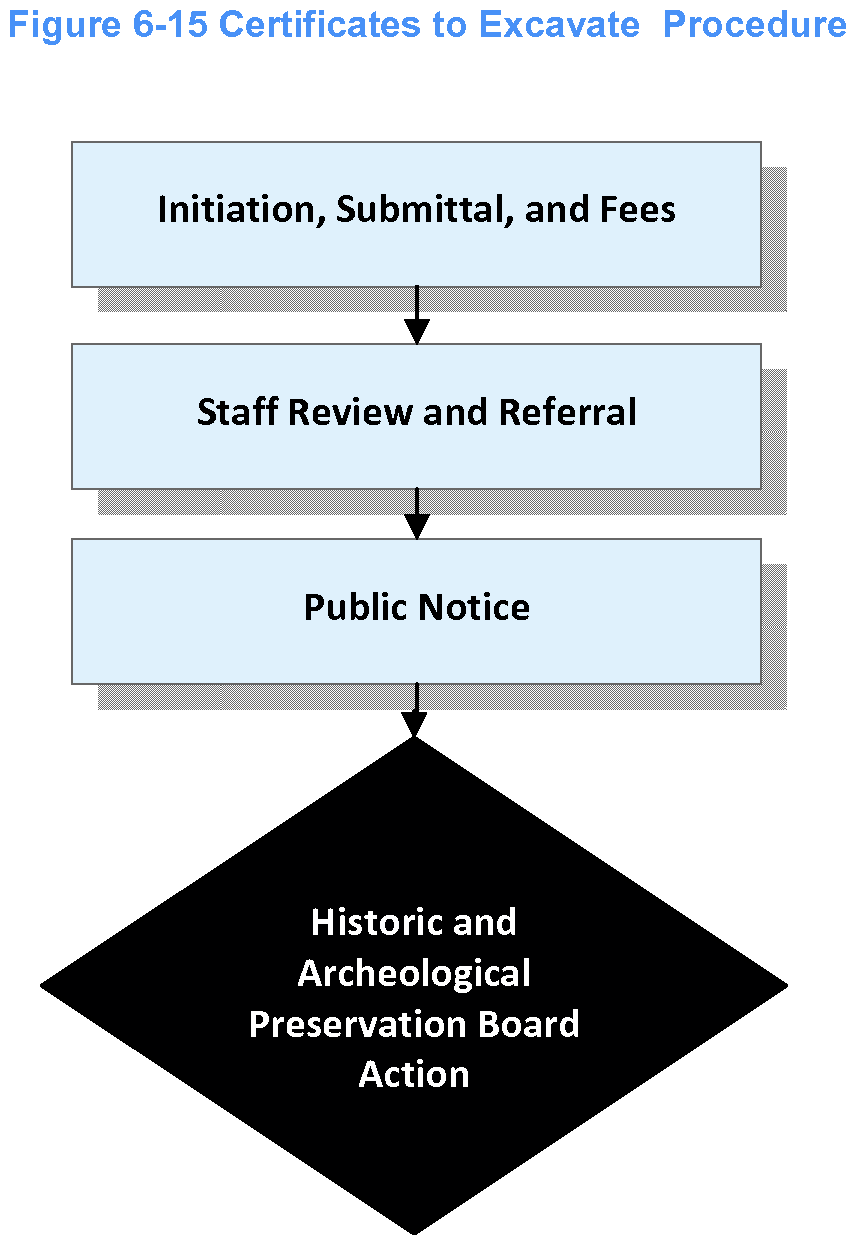
2.
A certificate to excavate shall be in addition to any other required building permits. An approved certificate of appropriateness does not relieve compliance with other state and local regulations.
B.
Procedures.
1.
Initiation, submittal, and fees. Applicable pursuant to section 6.3.3. Additional submittal requirements are set forth in article 10. The following also applies.
a.
Applications shall be completed based on town requirements and utilizing recommended guidelines of the Florida Department of State, Division of Historic Resources Staff.
b.
The design and procedures of surveys and measures shall be developed in consultation with the Florida Department of State and town staff.
c.
New information on previously unrecorded historic resources shall be transmitted to the Florida Division of Historic Resources.
2.
Staff review and referral. Applicable pursuant to section 6.3.4.
3.
Public notice. Published, written, and posted notice is required pursuant to section 6.3.5.
4.
Historic and archeological preservation board public hearing and decision. The board shall hold a public hearing on each certificate to excavate within 30 days after receipt of a completed application. The board shall approve, approve with conditions, or deny each application, based on the criteria in this section.
5.
Appeals to town council. Any board decision on an application for a certificate to excavate may be appealed to the town council if filed within 15 days of the board's decision. The town council shall approve, approve with modifications, or deny each application based on the criteria and guidelines in this section.
6.
Effective date. Certificates to excavate pursuant to this section shall become effective 15 days after the historic and archeological preservation board's decision. If an appeal is made to town council during that 15-day period, the historic and archeological preservation board's decision shall automatically be stayed pending town review.
C.
General criteria for granting certificates to excavate. The board shall not approve any application for a certificate to excavate that does not provide for the mitigation of adverse impacts on a designated historic resource with archaeological significance. Upon receipt of a complete application, the board shall review the proposed project to determine the type of archaeological work that is necessary to mitigate the adverse impact of the proposed earth-disturbing activity on the affected archaeological resource. After receiving a complete application, a decision shall be made by the board as to the type of mitigation method appropriate for the project. The board shall select one or more of the following alternatives:
1.
Site monitoring. This method includes the visual inspection of a property by the town manager or designee and/or a professional archaeologist for evidence of artifacts or structural remains unearthed during the development process or earth-disturbing activity. If significant archaeological deposits are unearthed, work may be halted by the board, with the recommendation for action from the director or a professional archaeologist, for up to 180 days from the date the application was filed. This time delay may be used to conduct any necessary archaeological work. At the end of the delay, the applicant will be allowed to continue the project as planned.
2.
Subsurface testing. This method includes limited sampling prior to the development process. Work of this nature must be conducted and/or supervised by a professional archaeologist. In situations where additional effort is warranted, the board may request the applicant to conduct full-scale excavation and/or in-situ preservation.
3.
Full-scale excavation. If the area to be adversely impacted by the proposed project contains significant archaeological deposits as determined through documentary records and/or subsurface testing, a full-scale excavation may be warranted. This action requires a team supervised by a professional archaeologist. The time required for excavation will depend on the type and size of site, extent of soil disturbance, definition of the site made during the excavation, and weather conditions, but shall not exceed 365 days in duration.
4.
In-situ preservation. This method should be utilized, if feasible, as an alternative for full-scale excavation in projects that involve significant archaeological deposits. In-situ preservation is defined as maintaining the archaeological site in an undisturbed state at its present location such as through an easement, preserve, passive park, or designated open space area, or by sealing the site under pavement and/or fill. Specific boundaries are identified and all development activity and earth-disturbing activity occurs outside of the identified boundaries.
D.
Stop work. Work activities shall be stopped in the immediate vicinity of the excavation site for up to 30 days upon discovery of previously unknown paleontological, archaeological or historic remains. The director may extend this time, if needed, for an additional 120 days. The town and the Florida Department of State, Division of Historic Resources shall be immediately notified of the discovery and arrangements shall be made to evaluate and appropriately treat those resources considered to be significant. If human remains are discovered, then F.S. § 872.05 applies.
E.
Conformity with certificates to excavate. All work performed pursuant to a certificate of appropriateness shall conform to the certificate. It shall be the responsibility of the building division to inspect from time to time any work being performed to assure compliance. If work is being performed not in accordance with the certificate, the chief building official may issue a stop work order. No additional work shall be undertaken as long as the stop work order is in effect.
6.6.13 - Development agreements.
A.
Purpose. The purpose of development agreements is to provide the applicant and the town with a mechanism to govern land use and development on a particular site under the authority of the Florida Local Government Development Agreement Act, F.S. §§ 163.3220—163.3243.
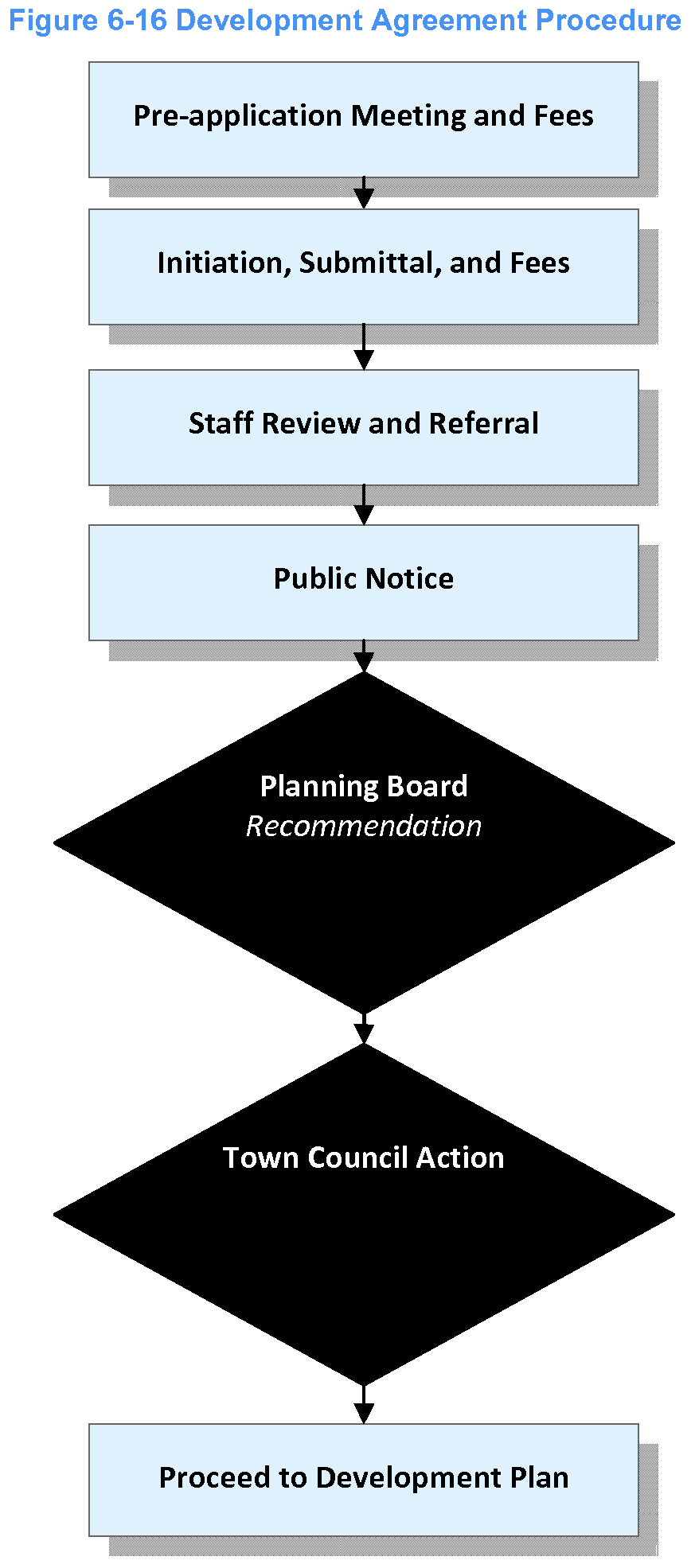
The issuance of development agreements is intended to promote and facilitate orderly and planned growth and development by providing a degree of certainty in the development approval process. The certainty accorded development under these regulations will encourage greater participation in the comprehensive planning process; assure there are adequate public facilities for the development; and reduce the economic cost of development.
Development agreements are intended to accompany the approval of PUDs and PWDs; as well as phased development projects, projects involving public partnerships, or other projects where special arrangements for the provision and timing of public infrastructure are beneficial and appropriate.
B.
Initiation, submittal, and fees. Development agreements are submitted in conjunction with other development applications, following section 6.3.3. Submittal contents are stated below. Additional requirements for agreements submitted with certain types of applications are set forth in article 10.
C.
Staff review and referral. Applicable pursuant to section 6.3.4.
D.
Contents. The development agreement shall include any statements or information requested by any reviewing department or agency during the approval process, such as:
1.
A legal description of the land subject to the agreement.
2.
The names of the property's legal and equitable owners, along with evidence of unified ownership and control.
3.
The duration of the agreement;
4.
A statement agreeing to:
a.
Proceed with all proposed development according to all regulations;
b.
Provide performance and maintenance guarantees in accordance with the town regulations for public facilities including landscaped buffers, and;
c.
Follow all other provisions of these regulations and F.S. ch. 163, and bind the applicant's successors in title to his commitments.
5.
The acreage and percentage of the total land area devoted to each of the proposed land uses.
6.
Maximum density for each type of dwelling.
7.
Maximum building heights.
8.
Minimum building spacing and floor areas.
9.
Lot sizes, yard areas, and buffer areas, including perimeter buffers.
10.
A description of public facilities that will service the development, including who shall provide such facilities; the date any new facilities, if needed, will be constructed; and a schedule to assure public facilities are available concurrent with the impacts of the development;
11.
A description of any reservation or dedication of land for public purposes, if applicable;
12.
A description of all local development permits approved or needed to be approved for the development of the land;
13.
A finding that the development permitted or proposed is consistent with the local government's comprehensive plan and land development regulations;
14.
A description of any conditions, terms, restrictions, or other requirements determined to be necessary by the local government for the public health, safety, or welfare of its citizens;
15.
When the phased development is proposed, a schedule of the phases;
16.
Statement that the proposed language of any covenants, easements, or other restrictions has been reviewed by the town and found satisfactory for its intended purpose relating to the development, operation, and maintenance of the development;
17.
A statement indicating that the failure of the agreement to address a particular permit, condition, term, or restriction shall not relieve the developer of the necessity of complying with the law governing said permitting requirements, conditions, term, or restriction;
18.
Provisions for annual monitoring and reporting in accordance with this section;
19.
Any additional information or statements subsequently deemed necessary by any reviewing department or agency;
20.
Statement of compliance with any conditions of approval set forth in the development order approval, if applicable.
E.
Approval with development. The town may approve a development agreement concurrent with the final approval of any development order in this article, or any development permit.
F.
Public hearing. The application for a proposed development agreement shall be considered at two public hearings.
1.
Planning board public hearing and recommendation. The planning board shall conduct a public hearing and shall forward a recommendation to the town council to approve, approve with modifications, postpone, or deny the development agreement.
2.
Town council public hearing and decision. The town council shall hold a public hearing and approve, approve with conditions, postpone, or deny the development agreement based on the criteria in this section.
G.
The notice of public hearing. Published, written, and posted notice is required pursuant to section 6.3.5.
H.
Amendment or cancellation of development agreement. A development agreement may be canceled by the town or amended, subject to the procedural and public hearing requirements, and under one or more of the following conditions:
1.
Where there is mutual consent of the parties to the agreement, or by their successors in interest.
2.
Where state or federal laws have been enacted which preclude one or more parties of the agreement from complying with the terms of the agreement.
3.
Where the town council has found that there is substantial noncompliance with the terms of the agreement.
I.
Recordation. Pursuant to F.S. § 163.3239, the town shall record the executed development agreement with the clerk of the circuit court, upon which the agreement shall become effective.
J.
Duration. Pursuant to F.S. § 163.3229, the duration of a development agreement shall not exceed 30 years, and may limited to a shorter period of time as appropriate for the size and complexity of the development, market conditions, or other factors. It may be extended by mutual consent of the governing body and the developer, subject to a public hearing in accordance with F.S. § 163.3225.
K.
Consistency with the comprehensive plan and Land Use and Development Code. Pursuant to F.S. § 163.3231, a development agreement and authorized development shall be consistent with the comprehensive plan and Land Use and Development Code.
L.
Annual review procedures.
1.
Filing an annual monitoring report. The developer of the property governed by the development agreement shall submit an annual monitoring report to the planning and development department for review. This report shall be submitted by the date specified in the adopted development agreement and each year thereof, until such times as the terms and conditions of the agreement are satisfied. This report shall contain:
a.
Any changes to the development plan or phasing, or to the terms of the agreement itself;
b.
A summary comparison of development activity proposed and actually developed;
c.
The identification of undeveloped tracts of land, other than individual single-family lots that have been sold to a separate entity or developer;
d.
An assessment of the level of compliance with the conditions contained in the development agreement by the developer, the town and other parties if applicable; and
e.
The identification of any changes in local, state or federal legislation substantially affecting compliance with the development agreement.
Failure to submit an annual report or deliberate misrepresentation in the report may be grounds for the initiation of proceedings to amend or cancel the development agreement.
2.
Annual development agreement review.
a.
The planning and development department shall send a copy of the submitted report to each of the review agencies for their review, analysis, and comments.
b.
Reviewing agencies will have 15 days to evaluate the report and issue comments to planning and development department. The review shall address the following:
(1)
The completeness and accuracy of the information contained within the submitted document;
(2)
The degree of compliance with the terms of the development agreement; and
(3)
The identification of any substantial changes warranting an amendment or cancellation of the development agreement.
c.
Upon receipt of all review agency comments, the director shall issue a formal report on the findings of the annual review and issue a determination of compliance with the terms of the development agreement. This report shall be sent to the town council and property owner and shall be available for public inspection at the planning and development department.
d.
The property owner or any member of the town council may request in writing that the item shall be placed on the next council agenda for discussion.
3.
Determination of noncompliance. Should the director find that there has been a failure to comply with the terms of the development agreement, the town shall initiate proceedings at a regularly scheduled town council meeting to amend or cancel the development agreement.
6.6.14 - Planned unit development (PUD) approval.
A.
Procedures.
1.
Pre-application meeting. Applicable pursuant to section 6.3.2.
2.
Initiation, submittal, and fees. Applicable pursuant to section 6.3.3.
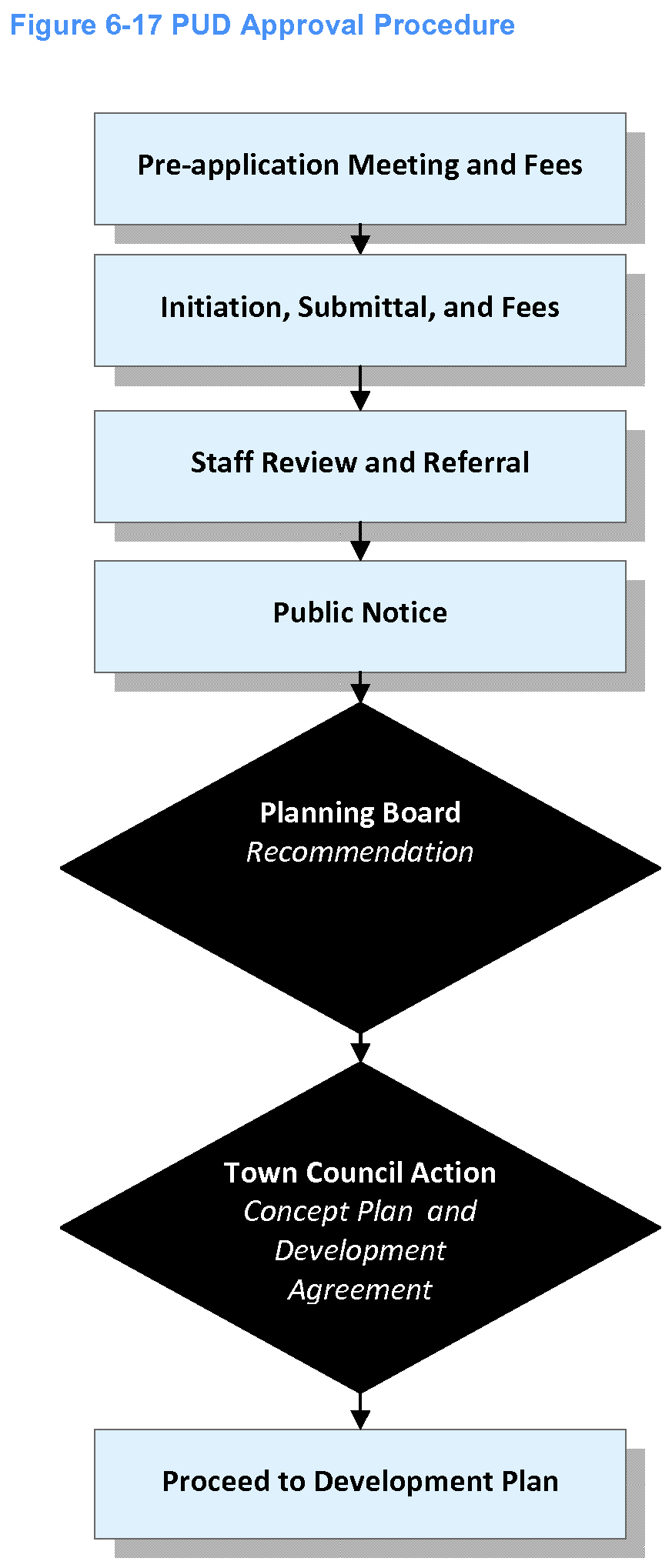
a.
Concept plan. A sketch plan shall be submitted to the director. Written comments on the concept plan shall be made by the DRT and any other interested departments within 30 days. The director shall coordinate this review.
b.
Overall development plan. An application for approval of a PUD shall be submitted to the director, including an overall development plan (ODP) consisting of a preliminary plan and development agreement, and application fees. An ODP may be reviewed concurrently with an application for a subdivision or site plan.
3.
Staff review and referral. Applicable pursuant to section 6.3.4.
4.
Public notice. Published, written, and posted notice required pursuant to section 6.3.5.
5.
Action by review and decision-making authorities.
a.
Planning board ODP review. The planning board may recommend approval of the ODP if consistent with the comprehensive plan.
b.
Town council ODP approval. The town council may approve the ODP if consistent with the comprehensive plan.
c.
Recording ODP. The approved ODP shall be signed by the mayor and attested by the town manager, and shall be recorded in the Public Records of Volusia County, Florida, at the expense of the applicant.
6.
Final development plan approval. After the ODP is recorded, a final development plan or subdivision plan shall be submitted in the manner required by section 6.6.6.
7.
Construction. Building permits shall not be issued unless supporting infrastructure is in place and terms of the development agreement have been fully complied with as determined by the town council.
8.
Amendments. All amendments shall be subject to review and recommendation of the planning board and approval by the town council. No action shall be taken by the planning board or the town council in regard to any amendment of a PUD except at a public hearing after due public notice, and in accordance with applicable state and local laws.
B.
Deviations. A request for a deviation from the requirements for perimeter setbacks, landscape buffers, off-street parking and loading, private streets, and sketch plat shall be voted on separately from the overall approval of the PUD and may be approved only by a super-majority vote of the town council.
6.6.15 - Planned waterfront development (PWD) approval.
A.
Procedures.
1.
Pre-application meeting. Applicable pursuant to section 6.3.2.
2.
Initiation, submittal, and fees. Applicable pursuant to section 6.3.3.
a.
Concept plan. A concept plan shall be required for phased developments if determined by the director.
b.
Development agreement. All development in the PWD district requires a development agreement. The development agreement shall be approved concurrent with the final approval of the application for rezoning to a PWD district.
3.
Staff review and referral. Applicable pursuant to section 6.3.4.
4.
Public notice. Published, written, and posted notice required pursuant to section 6.3.5.
5.
Action by review and decision-making authorities.
a.
Planning board review. The planning board may recommend approval of the concept plan and development agreement if consistent with the comprehensive plan.
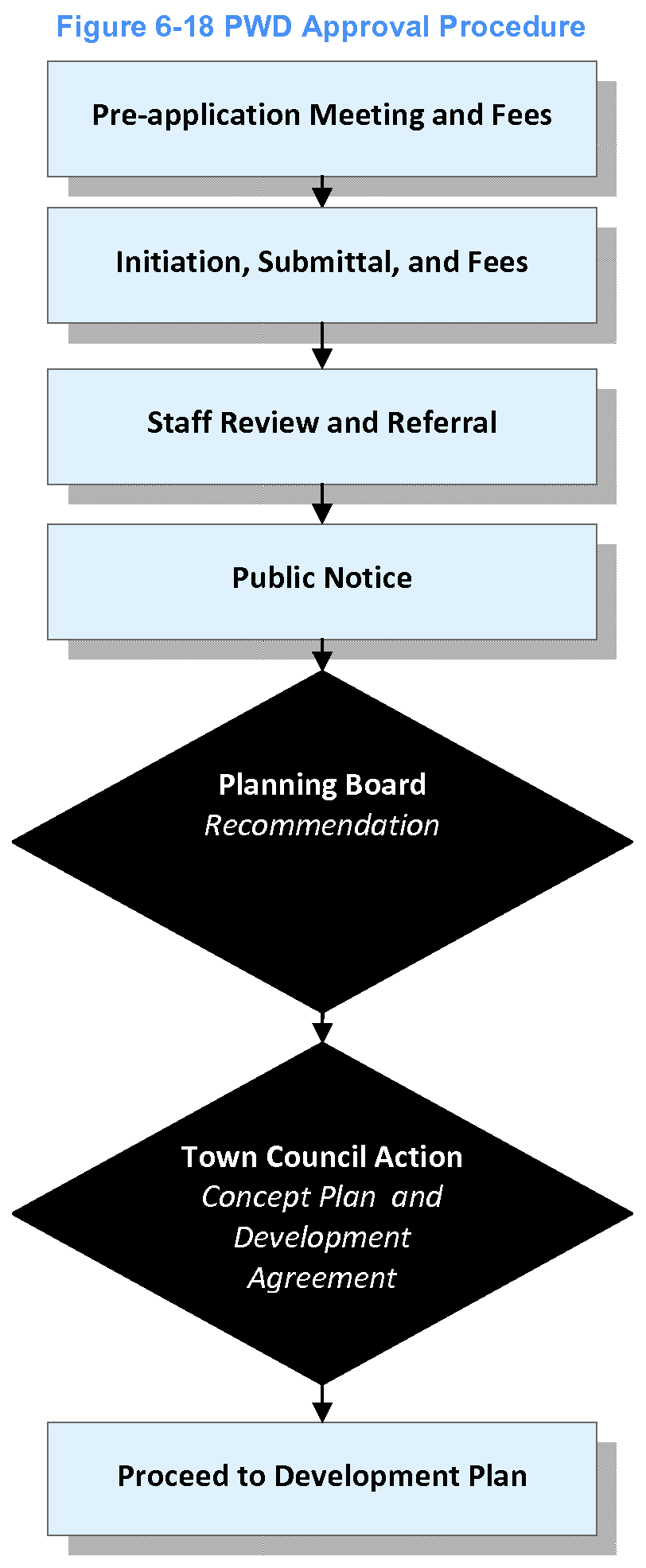
b.
Town council approval. The town council may approve the concept plan and development agreement if consistent with the comprehensive plan.
6.
Recording. The approved concept plan and development agreement shall be signed by the mayor and attested by the town manager, and shall be recorded in the Public Records of Volusia County, Florida, at the expense of the applicant.
B.
Final development permit review. After the concept plan and development agreement are recorded, a development permit application shall be submitted and reviewed pursuant to section 6.5.
C.
Construction. Building permits shall not be issued unless supporting infrastructure is in place and terms of the development agreement have been fully complied with as determined by the town council.
D.
Amendments. All amendments shall be subject to review and recommendation of the planning board and approval by the town council. No action shall be taken by the planning board or the town council in regard to any amendment of a PWD except at a public hearing after due public notice, and in accordance with applicable state and local laws.
6.6.16 - Waivers.
A.
Purpose. To provide limited flexibility for the construction of accessory structures on single-family lots where strict application of development requirements creates a hardship for the property owner.
B.
Applicability.
1.
Waivers may be granted regarding the area, size, setbacks, height, and location of accessory structures on single-family residential properties. Waivers for height shall not exceed the 35-foot maximum height limit pursuant to this code.
a.
Waiver requests of less than 10 percent of any dimensional requirement may be granted by the director.
b.
Waiver requests of 10 to 20 percent of any dimensional requirement may be granted by the planning board. Relief from any dimensional requirements that exceed 20 percent shall require a variance application in accordance with section 6.6.4 of the LUDC.
2.
A waiver shall not be granted to permit or expand a use not permitted in the applicable zoning classification.
3.
A waiver may be granted only if the application meets all of the criteria listed in subsection 6.6.16.E below.
4.
The existence of nonconforming land, structures, or buildings on the applicant's property or elsewhere shall not be considered grounds for granting a waiver unless their existence directly creates or causes the hardship on the property.
5.
Personal preferences, aesthetic considerations, inconveniences, or financial burdens shall not constitute evidence of hardship and shall not be considered sole grounds to justify granting a waiver.
C.
Procedures.
1.
Initiation, submittal, and fees. An applicant shall submit a written application for a waiver in accordance with section 6.3.3, demonstrating compliance with the criteria established below.
2.
Public notice. Published, written, and posted notice is required pursuant to section 6.3.5.
3.
Director review and decision. For waivers decided by the director pursuant to paragraph B.1.a., the director shall approve, approve with conditions, request additional information, or deny the application. The director is not authorized to approve a waiver application if there are objections from any property owner contiguous to the subject property. If written objections to the waiver are received within 15 days after proper posting, the director shall forward the application to the planning board for decision at a public hearing.
4.
Planning board public hearing and decision. For waivers decided by the planning board pursuant to paragraph B.1.b, or C.3. due to the written objection(s) from contiguous property owner(s), the board shall hold a public hearing and approve, approve with conditions, postpone, or deny the application.
D.
Waivers and development review. A waiver may be considered by the director or planning board in conjunction with a development permit application for eligible accessory structures. Any such waiver application shall be heard and acted on before the development permit application is approved. In addition to the development permit application, a separate application for the waiver shall be submitted.
E.
Criteria. The applicant shall demonstrate with competent substantial evidence that the proposed waiver complies with all of the following:
1.
The waiver is necessary to provide relief for a demonstrated hardship as defined in section 9.4.
2.
The hardship is not the result of actions of the applicant.
3.
The proposed development plan for the accessory structure meets the requirements of this code except for the one(s) requested to be waived and is consistent with the comprehensive plan.
4.
The proposed development plan is not a detriment to the public health, safety, and welfare.
5.
The waiver will not diminish property values or alter the essential character of the surrounding neighborhood and will not have a negative impact on adjacent properties.
6.
The waiver granted is the minimum waiver reasonably necessary to reduce or eliminate the hardship.
F.
Conditions. The director or planning board may impose any conditions on the waiver deemed necessary to further the purposes of this code, including the mitigation of any perceived negative impacts. Violation of any conditions shall be treated as a violation of this code and may result in revocation of the waiver.
G.
Effective date and expiration. A waiver shall become effective upon written approval by the director or planning board. If a waiver does not begin to serve the purpose for which it was granted within 12 months from the date it is approved, or if its use is subsequently abandoned for 12 consecutive months, it shall expire. A shorter or longer expiration period may be set by the director or planning board. Once established, a waiver shall be limited to the life of the accessory structure for which it was granted and shall not run with the land in perpetuity. Waivers may be passed to subsequent owners of the property as long as the accessory structure is not expanded or enlarged and stands in good condition.
H.
Appeals. Pursuant to section 6.3.7.
I.
Reporting. The director shall provide to the planning board, at its next regularly scheduled meeting, a descriptive list of granted administrative waivers.
(Ord. No. 2015-04, § 2, 7-16-2015)
6.6.17 - Temporary uses.
A.
Purpose. To establish standards and an approval process for certain temporary uses as defined in section 9.4 of this code to ensure compatibility with surrounding land uses. A temporary use shall include, but not be limited to those uses listed under section 2.40.1, Table 2-5 as temporary uses.
B.
Authority and scope. Within certain limitations as set forth herein, the director is authorized to grant temporary use permits. A temporary use permit cannot be transferred to another person, business, location, or structure.
C.
Procedures.
1.
Initiation, submittal, and fees. Applicable pursuant to section 6.3.3. The following information shall be submitted with the application:
a.
Existing survey or scaled drawing of the property illustrated to show the location of the temporary use and distance from adjacent property lines. The survey or scaled drawing provided must accurately depict the location of the property lines, parking spaces, and building location(s).
b.
Signed and notarized property owner authorization form.
c.
Completed application form including but not limited to: contact information, name of business, duration and frequency of use as authorized by property owner, and previous code enforcement violations, if any.
d.
Written narrative demonstrating compliance with the applicable review criteria.
e.
Copies of any federal, state, or local licenses required to operate the use.
2.
Staff review and referral. Applicable pursuant to Sec. 6.3.4.A-E.
3.
Decision by the director. The director shall approve, approve with conditions, request additional information, or deny the application. The director may impose conditions on the use if necessary to mitigate for unforeseen circumstances of the subject property or adjacent uses.
4.
Public hearing. If at the director's discretion, it is determined that the request for a temporary use permit should be decided at a public hearing because of unusual circumstances, the application shall be heard by the planning board, subject to section 6.3.5 and 6.3.6.
D.
Temporary uses and development review. Prior to issuance of the temporary use permit, any associated development permits or building permits and inspections shall be secured.
E.
Criteria. The application shall comply with the applicable special standards for each temporary use in article 3 - Use Regulations.
F.
Time limitation.
1.
Effective date. A temporary use permit shall become effective upon written approval by the director.
2.
Expiration.
a.
A temporary use permit shall be limited to the dates of approval shown on the permit and shall expire on the end date specified within the permit.
b.
No temporary use permit shall exceed a duration of one year from the date of approval.
G.
Permit cancellation. A temporary use permit shall be canceled under the following circumstances:
1.
Upon the property owner's written notice to the director that the owner's authorization for temporary use operation has been rescinded; or
2.
Upon the permit holder's written notice to the director that the use will no longer be operated. The date such notice is received by the town shall serve as the permit cancellation date unless specified otherwise in the written notice.
H.
Violations.
1.
Revocation. A temporary use permit may be revoked at any time by the director if it is determined that the application contains a material falsehood or misrepresentation; the recipient is in violation of this Code or conditions of approval; or that the conduct of the owner and any occupant constitutes a public nuisance. Revocation shall result in the permit approval becoming null and void, after which the permitted use or activity shall cease immediately. The affected area shall be returned to the same condition as it existed before the temporary use permit was issued within seven days. In making a determination to revoke a temporary use permit, the director shall consider the magnitude of the violation of the Code, including whether:
a.
It is a reoccurring violation;
b.
The violation has created an impact on the surrounding properties or uses; and
c.
The applicant has demonstrated an effort to correct the violation.
2.
Denial of application. No applicant who has had a permit revoked shall be able to apply for the same temporary use for 12 months after the revocation date.
3.
Unpermitted activity. No property owner shall at any time allow a temporary use to operate on any vacant or developed lot that does not have a valid and active temporary use permit from the town.
I.
Appeals. Pursuant to LUDC section 6.3.7
(Ord. No. 2022-07, § 2, 11-17-2022)
6.7.1 - Generally.
A.
All financial securities provided in this section shall be in an amount and form satisfactory to the town council.
B.
All bonds shall be approved by the town council upon advice of the town attorney whenever a bond is required by these regulations.
C.
The surety company executing the bond shall be listed by the U.S. Treasury Department as being approved for writing bonds for federal projects on its current list in an amount of at least the amount of the bond tendered to the town.
6.7.2 - Performance guarantee.
A.
Subdivision plat improvement guarantee. Before commencement of on-site or off-site subdivision improvements prior to recording the final plat, the developer shall provide one of the guarantees in this section.
1.
Subdivision completion bond. Guarantees by subdivision completion bond as follows:
a.
The guarantee amount shall be 125 percent of the estimated cost of all improvements.
b.
The bond underwriter shall be authorized to do business in the State of Florida and shall have an "A" or better rating from a bond-rating company preferred by the town, with a financial strength rating of "6" or better.
c.
The developer shall keep the bond in full force and effect during all phases of the construction.
d.
The bond shall be in effect for an initial term of one year. All improvements required by the final development plan must be completed within the one-year period. If the improvements are not completed within that period and no extension for good cause is granted by the town council, the town council may demand completion of the improvements by the surety in accordance with the approved final development plan. The town shall not be obligated to complete the improvements.
e.
The developer shall submit an estimate of the cost for completion of improvements. The estimate shall be prepared by and certified by the engineer of record. The town engineer shall determine the appropriate amount of the costs to be guaranteed.
f.
The town shall be named as the obligee and the developer shall be named as the principal.
2.
Letter of credit. Guarantee by irrevocable letter of credit and contractor's dual obligee performance and payment bonds as follows:
a.
The guarantee amount of the irrevocable letter of credit shall be 125 percent of the estimated costs of all improvements.
b.
The issuer of the letter of credit shall be a bank or other financial institution authorized to do business in the State of Florida and approved by the town manager and town auditor based on bank ratings.
c.
The developer shall keep the letter of credit in full force and effect during all phases of the construction.
d.
The letter of credit shall be issued for an initial term of 13 months. All improvements required by the final development plan must be completed within that period. If the improvements are not completed within that period and no extension for good cause is granted by the town council, the town council may draw the full amount of the letter of credit and utilize same for the completion of the subdivision improvements pursuant to the approved final development plan.
e.
The developer shall submit an estimate of the costs for completion of improvements. The estimates shall be prepared by and certified by the engineer of record. The town engineer shall determine the appropriate amount of the costs to be guaranteed.
3.
Performance bonds.
a.
The performance and payment bonds shall be 125 percent of the cost of all public improvements.
b.
The bond underwriter shall be authorized to do business in the State of Florida and shall have an "A" or better rating from the bond-rating company preferred by the town, with a financial strength rating of "6" or better.
c.
The developer shall keep the bonds in full force and effect during all phases of the construction.
d.
The performance and payment bonds shall be in effect for an initial term of 13 months. All improvements required by the final development plan must be completed within that period. If the improvements are not completed within that period and no extension for good cause is granted by the town council, the town council may demand completion of the improvements by the surety in accordance with the approved final development plan.
e.
The town and the developer shall be named as the obligees and the contractor shall be named as the principal on the bonds.
f.
The contract for construction between the developer and the contractor shall include a provision that the contractor shall provide for the payment of all laborers, material and suppliers and shall provide a maintenance guarantee conforming with section 6.7.2 upon completion of the improvements.
g.
The bonds shall include coverage for payment to laborers, material and suppliers and for maintenance period required under this subsection.
4.
Exceptions. Property requiring no public improvement and located within single-family zoning classifications shall not be required to comply with this section. One-unit single-family property uses requiring no public improvements shall also not be required to comply with this section.
B.
Requirements of the developer upon completion of construction. The town shall not accept the construction as complete until the following has occurred:
1.
The engineer of record shall certify to the town that all improvements have been constructed in substantial accordance with the approved construction plans and list any deviations from said plans.
2.
The surveyor of record shall certify to the town that all permanent reference monuments and all permanent control points are in place in accordance with F.S. ch. 177 as required in the plat.
3.
The City of Port Orange approves, in writing, that construction of the sanitary sewer facilities are completed, approved, and accepted for operation.
4.
The developer shall provide to the town engineer lien waivers for all contractors, subcontractors, material, laborers and suppliers.
5.
The contractor shall post the maintenance bond naming the town as the obligee.
6.
The developer shall provide the town engineer all other information required to determine compliance with all town ordinances.
7.
The town engineer shall review all of the above information within ten days of receipt for compliance with this code and submit a report to the director.
The above items must be completed before the development permit expires.
C.
Site plan improvement construction guarantee.
1.
Contractor guarantee. No structure shall be erected, moved, or altered in any manner pursuant to an approved site plan until the developer has submitted evidence of a contractor's guarantee in a form approved by the town attorney. The guarantee shall be in the form of performance and payment bonds in an amount equal to 125 percent of the estimated cost of the improvements. The bonds shall name the contractor as principal and the developer as the obligee. The bonding company must be rated by the bond-rating company preferred by the town with an "A" or better rating and shall be rated "6" or better for financial strength. Additionally, the developer shall provide the town with a dual obligee performance and payment bond and/or cash deposit equal to 125 percent of the cost for restoration of site in accordance with the standards set forth in this section. The developer shall keep the bond in full force and effect during all phases of construction. The bonds shall be in substantially the same form as those required by the town.
2.
Cost of improvements. The developer shall submit an estimate of the cost for completion of improvements and restoration of landscape. This estimate shall be prepared by and certified by the engineer of record. The town engineer shall determine the appropriate amount of the costs to be guaranteed.
3.
Completion of improvements. The town shall not be obligated to complete improvements. The performance and payment bond shall be for an initial term of 13 months and all improvements required by the site plan must be completed within a one-year period. If the improvements are not completed within that one-year period and an extension for good cause has not been granted, the town shall have authority to demand restoration of the site by the surety or shall have the authority to expend the cash deposit, if any, for such purposes after 30 days written notice to the developer.
4.
On-site and off-site public improvements. All on-site and off-site public improvements shown on the approved construction plans shall be bonded in the same manner as required for subdivision improvements.
5.
Restoration standards. The town engineer shall require compliance with the following standards to estimate restoration costs:
a.
For area disturbed within the road right-of-way:
(1)
Grade eight-inch-deep swale midway between edge of pavement and right-of-way line.
(2)
Sod disturbed right-of-way area with bahia sod.
(3)
Maintain growth for six months.
b.
Adjacent to the right-of-way and other areas:
(1)
Restore original grade or grade as specified by the town engineer.
(2)
Seed and mulch or hydroseed disturbed area.
(3)
Replace vegetation with drought-tolerant indigenous plantings well-suited to the local environment that will not adversely affect the safety of pedestrians, bicyclists or automobile line of sight.
(4)
Plant drought-tolerant indigenous plantings well-suited to the local environment.
(5)
Install sand fencing along exposed dune crests and at other high exposed sandy areas.
(6)
Maintain growth for six months.
6.
Exceptions. Property requiring no public improvements and located within single-family zoning classifications shall not be required to comply with this section.
6.7.3 - Maintenance guarantee.
A.
Following town acceptance of the improvements to be dedicated to the town, the developer is required to maintain the improvements until the town council accepts the improvements for town maintenance. The developer's maintenance period shall be a minimum of one year. The town council shall require cash in escrow or some other type of cash guarantee as recommended by the town attorney) guaranteeing all improvements against defects in design, material, and workmanship, and further guaranteeing that the developer shall maintain all the improvements for the required period of time. This guarantee shall be in the amount of ten percent of the construction cost of the improvements.
B.
If the developer fails to maintain any of the improvements during the specified maintenance period, the town engineer shall notify the developer, in writing, giving the developer 15 days to take corrective actions. If the developer fails to take the appropriate corrective action, the town may correct the problem, deducting the cost from the developer's guarantee.
C.
The developer may request the town council to accept the improvements for maintenance at the time of or after the acceptance of the construction improvements, but prior to the expiration of the developer's one-year maintenance period. When this occurs, it is the developer's responsibility to sod all areas of the constructed improvements where the potential for erosion exists because of an inadequate stand of grass. These areas which may require sodding shall include, but not be limited to, shoulders, swales, and drainage retention areas. The cash guarantee will be retained for the full one-year maintenance period to guarantee all improvements against defects in design, materials, and workmanship.
D.
The town council shall not accept the improvements for town maintenance nor release the cash guarantee until it is determined that all improvements are in acceptable condition and until certification is received from the Port Orange Director of Public Utilities that sanitary sewer improvements have been constructed as required.

