
Powder Springs City Zoning Code
ARTICLE 13
- ZONING AMENDMENTS AND PROCEDURES
Sec. 13-1. - Definitions.
Applicant: A property owner or his or her authorized representative who has petitioned the city for approval of a zoning change, subdivision plat, site plan, development permit, building permit, or any other authorization for the use or development of his or her property under the requirements of this development code.
Application: A petition for approval of a zoning change, subdivision plat, site plan, development permit, building permit, or any other authorization for the use or development of a property under the requirements of this development code.
Comprehensive plan: The comprehensive plan for the city, prepared, adopted and as amended from time to time in accordance with rules of the Georgia Department of Community Affairs.
Condition of zoning approval: A requirement adopted by the governing body at the time of approval of a rezoning or special use, placing greater or additional requirements or restrictions on the property than provided in this development code in order to reduce an adverse development impacts and to protect the public health, safety, or general welfare.
Governing body: The Mayor and City Council of the City of Powder Springs, Georgia.
Planning Commission: The Planning and Zoning commission established by the Code of Ordinances of the City of Powder Springs.
Quasi-judicial officers, boards, or agencies means an officer, board, or agency appointed by a local government to exercise delegated, quasi-judicial zoning powers including hearing appeals of administrative decisions by such officers, boards, or agencies and hearing an rendering decisions on applications for variances, special administrative permits, special exceptions, conditional use permits, or other similar permits not enumerated herein as a zoning decisions, pursuant to standards for the exercise of such quasi-judicial authority adopted by a local government.
Zoning decision means final legislative action by a local government which results in:
(A)
The adoption or repeal of a zoning ordinance;
(B)
The adoption of an amendment to a zoning ordinance which changes the text of the zoning ordinance;
(C)
The adoption or denial of an amendment to a zoning ordinance which rezones to rezone property from one zoning classification to another;
(D)
The adoption or denial of an amendment to a zoning ordinance by a municipal local government which zones to zone property to be annexed into the municipality; or
(E)
The grant or denial of a permit relating to a special use of property;
(F)
The grant or denial of a variance or conditions concurrent and in conjunction with a decision pursuant to subparagraphs (C) or (E) of this paragraph.
(Ord. No. 2023-008, § 1(Exh. A), 8-21-2023)
Sec. 13-2. - Incorporation clause.
This article is intended to comply with the provisions of the Georgia Zoning Procedures Act, O.C.G.A. § 36-66 et. seq., which Act is incorporated by reference in its entirety into this article. Where any provision of this article is in conflict with any provision of the act, the act shall control. Or where this article is incomplete in having failed to incorporate a provision necessarily required for the implementation of the act, such provision of the act, so as to meet the mandate of the act, shall be fully complied with.
Sec. 13-3. - Standards for quasi-judicial officers, boards, or agencies appointed by the City of Powder Springs.
Any zoning decision, as defined in section 13-1, shall include the criteria established in section 13-37 and section 13-38 of this chapter.
(Ord. No. 2023-008, § 1(Exh. A), 8-21-2023)
Sec. 13-11. - Authority to amend.
The governing body and quasi-judicial officers, boards, or agencies may from time to time amend any regulation pertaining to any zoning district; or may amend any other article or section of this development code.
(Ord. No. 2023-008, § 1(Exh. A), 8-21-2023)
Sec. 13-12. - Initiation of proposals for text amendments.
An application to amend the text of this development code may be initiated by:
(a)
The governing body;
(b)
The Planning Commission;
(c)
The community development director;
(d)
The director of public works, in the case of text amendments pertaining to article 21 of this development code;
(e)
The building inspector, in the case of text amendments pertaining to article 24 of this development code;
(f)
Any person, firm, corporation or agency, provided said individual, firm, corporation or agency is the owner or owner's agent of the property for which an amendment is sought, and further provided that the applicant has attended a pre-application meeting with the community development director.
(g)
Quasi-judicial officers, boards, or agencies appointed by the City of Powder Springs.
(Ord. No. 2023-008, § 1(Exh. A), 8-21-2023)
Sec. 13-13. - Application requirements.
Applications to amend the text of this development code shall require submittal of an application fee, application form, and proposed text amendment in a form approved in advance by the community development director. The community development director shall waive the application fee required by this section when an application is initiated by the governing body, planning commission, director of public works, building inspector, the community development director, or quasi-judicial officers, boards, or agencies.
(Ord. No. 2023-008, § 1(Exh. A), 8-21-2023)
Sec. 13-14. - Concurrent consideration.
In cases where an applicant is proposing a text amendment to modify or create a new zoning district or to add a permitted or special use to an existing zoning district, and where the applicant also desires to rezone property to the new or modified zoning district (or establish a special use that may include a variance in accordance with the amendment), there shall be only one hearing required in accordance with O.C.G.A. § 36-66-4.
(Ord. No. 2023-008, § 1(Exh. A), 8-21-2023)
Editor's note— Ord. No. 2023-008, § 1(Exh. A), adopted Aug. 21, 2023, amended § 13-14 in its entirety to read as herein set out. Former § 13-14 pertained to limitation on concurrent consideration.
Sec. 13-15. - Notice of public hearing.
(a)
Planning Commission. Prior to the date of the public hearing before the Planning Commission, if a hearing is to be held, the city may cause to be published within a newspaper of general circulation within the city a notice of the public hearing before the Planning Commission. The notice if published shall state the time, place, and purpose of the public hearing.
(b)
Mayor and City Council. At least 15 but not more than 45 days prior to the date of the public hearing before the governing body, the city shall cause to be published within a newspaper of general circulation within the city a notice of the public hearing before the governing body. The notice shall state the time, place, and purpose of the public hearing.
(c)
Exemption. Notice of public hearing shall not be required for amendments to article 21 or article 24 of this development code.
(d)
A local government delegating decision-making power to a quasi-judicial officer, board, or agency shall provide for a hearing on each proposed action described in 13-1 of this chapter and paragraph (1.1) of O.C.G.A. § 36-66-3. Notice of such hearing shall be provided at least 30 days prior to the quasi-judicial hearing, with such notice being made as provided for in section 13-15 of this Code section and with additional notice being mailed to the owner of the property that is the subject of the proposed action.
(e)
(1)
Notwithstanding any other provisions of this chapter to the contrary, when a proposed zoning decision relates to an amendment of the zoning ordinance to revise one or more zoning classifications or definitions relating to single-family residential uses of property so as to authorize multifamily uses of property pursuant to such classification or definitions, or to grant blanket permission, under certain or all circumstances, for property owners to deviate from the existing zoning requirements of a single-family residential zoning, such zoning decision must be adopted in the following manner:
(A)
The zoning decision shall be adopted at two regular meetings of the local government making the zoning decision, during a period of not less than 21 days apart; and
(B)
Prior to the first meeting provided for in subparagraph (A) of this paragraph, at least two public hearings shall be held on the proposed action. Such public hearings shall be held at least three months and not more than nine months prior to the date of final action on the zoning decision. Furthermore, at least one of the public hearings must be held between the hours of 5:00 p.m. and 8:00 p.m. The hearings required by this paragraph shall be in addition to any hearing required under subsection (a) of this Code section. The local government shall give notice of such hearing by:
(i)
Posting notice on each affected premises in the manner prescribed by subsection (b) of this Code section; provided, however, that when more than 500 parcels are affected, in which case posting notice is required every 500 feet in the affected area; and
(ii)
Publishing in a newspaper of general circulation within the territorial boundaries of the local government a notice of each hearing at least 15 days and not more than 45 days prior to the date of the hearing.
Both the posted notice and the published notice shall include a prominent statement that the proposed zoning decision relates to or will authorize multifamily uses or give blanket permission to the property owner to deviate from the zoning requirements of a single-family residential zoning of property in classification previously relating to single-family residential uses. The published notice shall be at least nine column inches in size and shall not be located in the classified advertising section of the newspaper. The notice shall state that a copy of the proposed amendment is on file in the office of the clerk or the recording officer of the local government and in the office of the clerk of the superior court of the county of the legal situs of the local government for the purpose of examination and inspection by the public. The local government shall furnish anyone, upon written request, a copy of the proposed amendment, at no cost.
(2)
The provisions of paragraph (1) of this subsection shall also apply to any zoning decisions that provide for the abolition of all single-family residential zoning classifications within the territorial boundaries of a local government or zoning decisions that result in the rezoning of all property zoned for single-family residential uses within the territorial boundaries of a local government to multifamily residential uses of property.
(3)
This subsection shall not apply to zoning decisions for the rezoning of property from a single-family residential use of property to a multifamily residential use of property when (a) the rezoning is initiated by the owner or authorized agent of the owner of such property.
(Ord. No. 2023-008, § 1(Exh. A), 8-21-2023)
Sec. 13-16. - Work sessions.
Work sessions of the Planning Commission and governing body may be convened from time-to-time to discuss pending matters prior to public hearings. Work sessions at which applications for text amendment are to be discussed shall be attended by the applicant or representative thereof with authority to make binding commitments to the city with respect to any stipulations that may be offered in connection with such application. Failure to attend the work session may result in the application being tabled one time. Failure to attend the rescheduled work session may result in denial of the application.
Sec. 13-17. - Public hearing.
(a)
Planning Commission. The Planning Commission may hold a public hearing on text amendments in accordance with the public hearing procedures specified in this article. The governing body may waive the requirement for public hearing, consideration, and action by the Planning Commission.
(b)
Governing body and quasi-judicial officers, boards, or agencies. The governing body and quasi-judicial officers, boards or agencies shall hold a public hearing on all text amendments in accordance with the public hearing procedures specified in this article.
(c)
Exemption. A public hearing shall not be required for amendments to article 21 or article 24 of this development code. Amendments to article 21 or 24 of this development code may be considered just the same as any other amendment to the City's Code of Ordinances.
(Ord. No. 2023-008, § 1(Exh. A), 8-21-2023)
Sec. 13-18. - Recommendation and decision.
(a)
Planning Commission recommendation. Unless review and recommendation by the Planning Commission is waived by the City Council, within a period of 32 calendar days from the date of the Planning Commission's scheduled meeting on any such application, the Planning Commission shall provide a recommendation on the application. The Planning Commission may recommend approval or disapproval of the proposed text amendment, or it may recommend modifications of the text amendment originally proposed.
(b)
Governing body decision. Within a period of 65 calendar days from the date of the public hearing held by the governing body on any such application, the governing body shall render a decision on the application. The governing body may approve or disapprove the proposed text amendment as written, or it may approve modifications of the text amendment originally proposed.
(c)
Information. In rendering a decision on any such application, the governing body shall consider all information supplied by the community development director, the Planning Commission, and the applicant if different.
(d)
Criteria. The Planning Commission and the governing body shall consider the following standards in considering any proposal that would result in a change to the text of this development code (except articles 21 and 24), giving due weight or priority to those factors that are appropriate to the circumstances of each proposal:
1.
Is the proposed amendment consistent with the purpose and intent of this development code?
2.
Does the proposed amendment further the purpose and intent of the comprehensive plan, or is it needed to properly implement the comprehensive plan?
3.
Is the proposed amendment needed to address new or changing conditions?
4.
Does the proposed amendment reasonably promote the public health, safety, morality or general welfare?
(e)
Exemption. Review of and recommendation by the Planning Commission shall not be required for amendments to article 21 or article 24 of this development code.
Sec. 13-19. - Withdrawal of text amendment.
Any application for an amendment to the text of this development code may be withdrawn at any time at the discretion of the person or agency initiating such a request, upon written notice to the community development director.
Sec. 13-20. - Notice of action.
When a text application is filed by a property owner, the community development director shall notify the applicant of the recommendation of the Planning Commission on the application, if required, and action taken by the governing body on the application.
Sec. 13-31. - Authority to amend.
The governing body and quasi-judicial officers, boards, or agencies appointed by the City of Powder Springs may from time to time amend the boundaries of any zoning district or overlay district established in this development code, and may amend the boundaries of any other map adopted in or adopted by reference by this development code.
(Ord. No. 2023-008, § 1(Exh. A), 8-21-2023)
Sec. 13-32. - Initiation of proposals for rezoning.
An application to amend the official zoning map of the city, thus changing the boundaries of a zoning district or overlay district, may be initiated by the governing body, quasi-judicial officers, boards, or agencies appointed by the City of Powder Springs or by any person, firm, corporation or agency, provided said individual, firm, corporation or agency is the owner or owner's agent of the property for which an amendment is sought.
(Ord. No. 2023-008, § 1(Exh. A), 8-21-2023)
Sec. 13-33. - Initiation of special use applications.
An application for special use may be initiated by any person, firm, quasi-judicial offices, boards, or agencies appointed by the City of Powder Springs, corporation or agency, provided said individual, firm, corporation or agency is the owner or owner's agent of the property for which the special use is sought.
(Ord. No. 2023-008, § 1(Exh. A), 8-21-2023)
Sec. 13-34. - Application requirements.
Applications to amend the official zoning map and applications for special use shall require submittal of an application requirements specified in this section. The community development director may waive the application fee and certain application requirements specified in this section when an application for amendment of the official zoning map is initiated by the governing body.
(a)
Application fee as specified by this article or established by resolution of the governing body;
(b)
Application form furnished by the community development director, including signed and notarized signature of property owner;
(c)
Legal description of the property;
(d)
Survey plat of the property;
(e)
Letter of intent describing the proposed use of the property or other action requested, and including an analysis of how the proposed action compares to decision criteria specified in this article and a description of any special conditions voluntarily made a part of the request;
(f)
Sketch plan of the property at an appropriate engineering scale showing the proposed use and relevant information regarding proposed improvements;
(g)
Statistics regarding the proposed development;
(h)
A traffic impact study prepared by a professional engineer registered in Georgia shall be required to be submitted for applications for proposed developments with 500,000 square feet or of nonresidential floor area or 350 dwelling units or more, must be submitted along with the application. Such a traffic study may be required by the Planning Commission or the governing body as deemed necessary for adequate consideration and a fully-informed decision on the application.
(i)
Other information as may be required by the community development director.
(j)
For rezoning requests, a public information meeting shall be held after application submittal, and prior to the City Council Public hearing. This requirement may be waived at the discretion of the community development director.
Sec. 13-35. - Sketch plan.
If any new construction, new use, or alteration of the site is proposed, applications to amend the official zoning map and applications for special use shall include a sketch plan, which may be prepared by the applicant, a professional engineer, a registered land surveyor, a landscape architect, a land planner or any other person familiar with land development activities. The sketch plan shall be drawn to an engineering scale on a boundary survey of the tract or on a property map showing the approximate location of the boundaries and dimensions of the tract and shall at minimum include on the information specified in this section. The community development director may waive one or more of the requirements of this section in individual cases when he/she determines that one or more elements of the required information specified in this section are not essential to the review process.
(a)
Name, address, telephone number and e-mail address of the property owner, and of the applicant if different from the property owner;
(b)
If drawn on a boundary survey, the date of survey and source of data;
(c)
Date of sketch plan drawing, and revision dates, if applicable;
(d)
North arrow and graphic engineering scale;
(e)
Location (land district and land lot, address, and tax map and parcel number) and size of the property in acres (or in square feet if less than an acre);
(f)
Vicinity map, showing the property in relation to the surrounding area with regard to well-known landmarks such as arterial streets or railroads. Vicinity maps may be drawn in freehand and at a scale sufficient to show clearly the information required. U.S. Geological Survey maps at a scale of one inch equals 2,000' may be used for vicinity maps.
(g)
Zoning district classification of the subject property and all adjacent properties;
(h)
Man-made features within and adjacent to the property, including existing streets and names, city limit lines, and other significant information such as location of bridges, major utility lines, existing buildings and structures to remain, and other features as appropriate to the nature of the request;
(i)
The proposed project layout, including the approximate location of all buildings, and the location of all minimum building setback lines, outdoor storage areas, buffers, parking areas, driveways, and approximate location of proposed storm water detention facilities;
(j)
Proposed use or uses of the property, including for special use applications such pertinent operating characteristics as hours of operation, outdoor activities, and lighting;
(k)
A statement as to the source of water supply and the provision for sanitary sewage disposal;
(l)
Other information as may be required by the community development director.
Sec. 13-36. - Development statistics required.
Applications for amendment of the official zoning map and applications for special uses shall submit development statistics and specifications which at minimum include on the site plan or in written form the information specified in this section. The community development director may waive one or more of the requirements of this section in individual cases when he/she determines that one or more elements of the required information are not essential to the review process.
(a)
Maximum and proposed height of any structure;
(b)
Maximum and proposed gross square footage of the building area (nonresidential only);
(c)
Maximum and proposed number of dwelling units and minimum and proposed square footage of heated floor area for any dwelling unit (residential only);
(d)
Maximum and proposed lot coverage of building area (square feet and percent);
(e)
Minimum and proposed square footage of landscaped area (square feet and percent);
(f)
Minimum, maximum and proposed number of parking spaces; and
(g)
Other dimensional information as may be required by the community development director.
Sec. 13-37. - Criteria for rezoning decisions.
Applications to amend the official zoning map shall provide a written analysis comparing the proposed action with the criteria in this section. The Planning Commission and the governing body will take into consideration these standards in making a recommendation and decision, respectively, on a rezoning application.
(a)
Whether the proposed zoning district and uses within that district are compatible with the purpose and intent of the comprehensive plan. The future development map and the future land use plan map of the city's comprehensive plan shall be used in decision-making relative to amendments to the official zoning map, in accordance with Table 13-1:
Table 13-1
Zoning Districts Consistency with Future Development and Future Land Use Categories
of the Comprehensive Plan
(b)
Whether the proposed zoning district and uses permitted within that district are suitable in view of the zoning and development of adjacent and nearby property;
(c)
Whether the existing use or usability of adjacent or nearby property will be adversely affected by one or more uses permitted in the requested zoning district;
(d)
Whether there are substantial reasons why the property cannot or should not be used as currently zoned;
(e)
Whether public facilities such as roads, schools, water and sewer utilities, and police and fire protection will be adequate to serve the proposed zoning district and uses permitted;
(f)
Whether the proposed zoning district and uses permitted within that zoning district are supported by new or changing conditions not anticipated by the comprehensive plan or reflected in the existing zoning on the property or surrounding properties; and
(g)
Whether the proposed zoning district and uses permitted within that zoning district reflect a reasonable balance between the promotion of the public health, safety, morality or general welfare and the right to unrestricted use of property.
Sec. 13-38. - Criteria for special use decisions.
Applications for special use shall provide a written analysis comparing the proposed action with the criteria in this section. The Planning Commission and the governing body will take into consideration these standards in making a recommendation and decision, respectively, on a special use application.
(a)
Whether the proposed special use is consistent with the stated purpose of the zoning district in which it will be located;
(b)
Whether the establishment of the special use will impede the normal and orderly development of surrounding property for uses predominate in the area;
(c)
Whether the location and character of the proposed special use are consistent with a desirable pattern of development in general;
(d)
Whether the type of street providing access to the use is or will be adequate to serve the proposed special use;
(e)
Whether access into and out of the property is or will be adequate to provide for traffic and pedestrian safety, the anticipated volume of traffic flow, and access by emergency vehicles;
(f)
Whether public facilities such as schools, water or sewer utilities, and police or fire protection are or will be adequate to serve the special use;
(g)
Whether refuse, service, parking and loading areas on the property will be located or screened to protect other properties in the area from such adverse effects as noise, light, glare or odor;
(h)
Whether the hours and manner of operation of the special use will have adverse effects on other properties in the area; and
(i)
Whether the height, size or location of the buildings or other structures on the property are or will be compatible with the height, size or location of buildings or other structures on neighboring properties.
Sec. 13-39. - Application compliance and completeness.
(a)
No application described in this division shall be processed by the community development director unless it complies with the procedural requirements of this division and is found to be complete with regard to application materials, payment of fees, supportive materials, and any other application requirements specified by this division.
(b)
If an application described and regulated by this division does not comply with all provisions of this division, the community development director shall reject the application and refuse to process it.
(c)
In cases where a rezoning and special use application pertaining to the same piece of property are filed simultaneously, the applicant must prepare separate applications and meet all application requirements for each application filed; provided, however, that the community development director may waive separate site plan or letter of intent filing requirements when they would be unnecessarily duplicative.
Sec. 13-40. - Administrative processing of applications.
The community development director is hereby authorized to establish administrative deadlines for the receipt of applications specified in this division. Upon a finding by the community development director that an application is complete and complies with the requirements of this division and administrative deadlines, the application shall be marked received and approved for initiation, and the date of such consideration shall be indicated in the file of the application.
Sec. 13-41. - Concurrent consideration of applications.
In cases where an applicant is proposing a rezoning (i.e., amendment to the official zoning map), and where the applicant files an application to obtain a special use at the same time of filing a rezoning application, the two applications may be processed simultaneously in accordance with section 13-14 and O.C.G.A. § 36-66-4.
(Ord. No. 2023-008, § 1(Exh. A), 8-21-2023)
Sec. 13-42. - Investigations and recommendation.
(a)
The community development director may send the application out for review by internal municipal departments and external agencies as may be appropriate (i.e., inter-agency review). Any written comments received in a timely manner shall be submitted to the applicant, Planning Commission and governing body for consideration, and any such comments shall become an official public record.
(b)
The community development director or designee shall investigate and make a recommendation regarding any or all of the relevant matters concerning the application. Any such investigation and recommendation shall if in writing be made available to the applicant, Planning Commission, and governing body prior to public hearings and shall become an official public record.
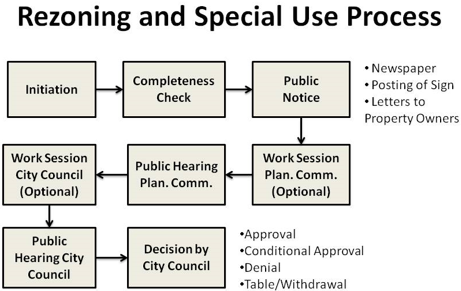
Sec. 13-43. - Public hearing notice - newspaper.
(a)
Planning Commission. Prior to the date of the public hearing before the Planning Commission, the city may cause to be published within a newspaper of general circulation within the city a notice of the work session and public hearing before the Planning Commission. The notice if provided shall state the time, place, and purpose of the public hearing and shall include the location of the property. For rezoning applications, the notice shall include the existing zoning classification and the proposed zoning classification of the property.
(b)
Mayor and City Council. At least 15 but not more than 45 days prior to the date of the public hearing before the governing body, the city shall cause to be published within a newspaper of general circulation within the city a notice of the work session and public hearing before the governing body. The notice shall state the time, place, and purpose of the public hearing and shall include the location of the property. For rezoning applications, the notice shall include the existing zoning classification and the proposed zoning classification of the property. For special use applications, the notice shall include the existing zoning classification and the proposed special use.
(c)
Quasi-judicial officers, boards, or agencies. Public hearing notice shall be provided in accordance with section 13-15 of this chapter and O.C.G.A. § 36-66-4.
(Ord. No. 2023-008, § 1(Exh. A), 8-21-2023)
Sec. 13-44. - Public hearing notice - sign on property.
(a)
Requirement and locations. The applicant shall be required to post and maintain signs supplied by the city on or near the right-of-way of the nearest public street, so as to be visible from the street for at least 15 days and not more than 45 days immediately preceding the date for the governing body's public hearing on the rezoning or special use application. Signs providing notice of hearings by quasi-judicial officers, boards, or agencies shall be erected in accordance with O.C.G.A. § 36-66-4. One such sign shall be placed in a conspicuous location along each street frontage of the property for which the rezoning or special use approval has been requested. If the property has no street frontage, the sign shall be placed on each street where access to the property will be gained.
(b)
Content. The sign providing notice shall state the time, place, and purpose of the public hearing and shall include the location of the property. For rezoning applications, the notice shall include the existing zoning classification and the proposed zoning classification of the property.
(c)
Time period. It is the responsibility of the applicant to post the signs and to maintain the signs during the posting period. Said signs pertaining to the governing body's public hearing shall remain posted until a final decision by the governing body has been rendered.
(d)
Consequences of non-maintenance. Failure to post and maintain the signs continuously may prohibit consideration of the application at any scheduled public hearing. In the event the signs are not posted continuously, the city, in its sole discretion, may require the reposting and readvertising prior to any future public hearing, for which the applicant shall pay an additional readvertising fee. The city may also in its sole discretion, continue, hold, approve, or dismiss the application. Any dismissal under the provisions of this article shall be with prejudice unless specifically noted as being without prejudice by the city.
(Ord. No. 2023-008, § 1(Exh. A), 8-21-2023)
Sec. 13-45. - Public hearing notice - surrounding property owners.
(a)
Prior to the public hearing before the Planning Commission, the applicant may be required by the community development director to mail a notice to all persons owning property located in whole or in part within 200' of any portion of the property that is the subject of the rezoning or special use.
(b)
The written notice, if provided, is to be mailed to the property owners as such names and addresses appear on the County's current ad valorem tax records.
(c)
The notice if provided shall state the time, place, and purpose of the work sessions and public hearings before the Planning Commission and governing body and shall include the location of the property. For rezoning applications, the notice if provided shall include the existing zoning classification and the proposed zoning classification of the property. For special use applications, the notice if provided shall include the existing zoning classification and the proposed special use. In addition, the notice if provided shall include a page size copy of the sketch plan submitted with the application.
(d)
When required to provide notices per this section, the applicant shall submit an affidavit to the community development director or designee prior to the public hearing before the Planning Commission, listing the property owners and certifying the date that the notices were mailed.
(e)
Notices of hearings by quasi-judicial officers, boards, or agencies provided to surrounding property owners shall be in accordance with O.C.G.A. § 36-66-4.
(Ord. No. 2023-008, § 1(Exh. A), 8-21-2023)
Sec. 13-46. - Special notice requirements for halfway houses and related uses.
This section is adopted pursuant to the specific requirements of the state zoning procedures law. When a proposed zoning map amendment or special use application relates to or will allow the location or relocation of a halfway house, drug rehabilitation center, or other facility for treatment of drug dependency, a duly noticed public hearing shall be held by the governing body on the proposed action in accordance with the procedures and requirements established in this article. In addition, the following requirements shall apply.
(a)
Such public hearing before the governing body shall be held at least 6 months but not more than 9 months prior to the date of final action on the application.
(b)
All published or posted notices of the public hearing shall include a prominent statement that the proposed zoning map amendment or special use relates to or will allow the location or relocation of a halfway house, drug rehabilitation center, or other facility for treatment of drug dependency.
(c)
The published notice shall be at least 6 column inches in size and shall not be located in the classified advertising section of the newspaper.
Sec. 13-47. - Work sessions.
Work sessions of the Planning Commission and governing body may be convened from time-to-time to discuss pending matters prior to public hearings. Work sessions at which applications for rezoning and special use approval are to be discussed shall be attended by the applicant or representative thereof with authority to make binding commitments to the city with respect to any stipulations that may be offered in connection with such application. Failure to attend the work session may result in the application being tabled one time. Failure to attend the rescheduled work session may result in denial of the application.
Sec. 13-48. - Public hearings.
(a)
Planning Commission. The Planning Commission may hold a public hearing on all rezoning and special use applications and if held shall be in accordance with the public hearing procedures specified in this article.
(b)
Governing body. The governing body shall hold a public hearing on all rezoning and special use applications in accordance hearing with the public procedures specified in this article.
Sec. 13-49. - Recommendation and decision.
(a)
Planning Commission recommendation. Within 32 calendar days of the date of its regular scheduled meeting on the application, which may include a public hearing, the Planning Commission shall provide a recommendation on applications for rezoning and special use. This time limit may be extended if the applicant consents to extend the time frame. The Planning Commission may recommend approval or disapproval of the proposed rezoning or special use as applied for, or it may recommend conditions of approval on the application. The Planning Commission may also in the case of a rezoning application recommend rezoning the property to a more restrictive zoning classification than requested by the applicant. The Planning Commission may also recommend a reduction of the boundaries of the area rezoned or the area pertaining to a special use that is less than that requested by the applicant. In rendering a recommendation on any such application, the Planning Commission shall consider all information supplied by the applicant and community development director.
(b)
Governing body decision. Within 65 calendar days of the date of its public hearing, the governing body shall render a decision on the application for rezoning or special use. This time limit may be extended if the applicant consents to extend the time frame. The governing body may approve or disapprove the proposed rezoning or conditional use as applied for, return the application to the Planning Commission for further study, place conditions of approval on the application. The governing body may also in the case of a rezoning application rezone the property to a more restrictive zoning classification than requested by the applicant. The governing body may also reduce the boundaries of the area rezoned or the area pertaining to a special use that is less than that requested by the applicant. In rendering a decision on any such application, the governing body shall consider all information supplied by the applicant, community development director, and Planning Commission.
(c)
Mayoral veto. The Mayor shall have 4 business days after the date at which the governing body rendered a decision to file with the City Clerk in writing his/her veto. Any rezoning or special use application regarding which a veto has been filed shall be heard again at a public hearing to be held no later than 60 days from the date of the meeting at which the governing body acted on the application for rezoning or special use. For said hearing, the application shall be republished and posted as described in this division.
Sec. 13-50. - Withdrawal of application.
(a)
Prior to public notice. If a request for withdrawal is received prior to the publication of notice for a public hearing, the application shall be withdrawn administratively by the community development director without restriction on the refiling of a rezoning or special use application on the property in the future, as described in this division.
(b)
After public notice. If notice has been published or is irretrievably set for publication but the rezoning or special use application has not been heard by the Planning Commission, the application shall be withdrawn administratively by the community development director, provided that: the applicant shall mail written notice of the withdrawal to the property owners previously notified and shall submit an affidavit to the community development director listing the property owners and certifying the date that the notices were mailed. Additionally, withdrawal of an application for a rezoning or special on the property under the terms of this subsection may not be resubmitted for 6 months from the date of withdrawal.
(c)
After Planning Commission public hearing. Should any request for withdrawal be made by the applicant after the Planning Commission's public hearing but before or at the governing body's public hearing, the application shall remain on the governing body's public hearing agenda and the withdrawal request shall be considered for approval or denial, with or without prejudice, by the governing body. If withdrawal is not allowed, the public hearing on the rezoning or special use will proceed.
Sec. 13-51. - Notice of action.
When a rezoning or special use application is filed by a property owner, the community development director shall notify the applicant of the recommendation of the Planning Commission on the application, and action taken by the governing body.
Sec. 13-52. - Finality and legal recourse.
(a)
To ensure that the general public is afforded due process in an orderly way to petition the courts for review of a local government's exercise of zoning, administrative, or quasi-judicial powers as guaranteed by Article I, Section I, Paragraphs IX and XII of the Constitution, the General Assembly, pursuant to its authority under Article VI, Section IV, Paragraph I of the Constitution, provides the following mechanism by which each of the powers described in this chapter may be reviewed by the superior court of the county wherein such property is located:
(1)
Zoning decisions as described in this chapter (section 13-1), being legislative in nature, shall be subject to direct constitutional challenge regarding the validity of maintaining the existing zoning on the subject property or the validity of conditions or an interim zoning category other than what was requested in the superior court pursuant to its original jurisdiction over declaratory judgments pursuant to chapter 4 of title 9 and equity jurisdiction under title 23. Such challenges shall be by way of a de novo review by the superior court wherein such review brings up the whole record from the local government and all competent evidence shall be admissible in the trial thereof, whether adduced in a local government process or not and employing the presumption that a governmental zoning decision is valid and can be overcome substantively by a petitioner showing by clear and convincing evidence that the zoning classification is a significant detriment to the petitioner and is insubstantially related to the public health, safety, morality, or general welfare; or
(2)
Quasi-judicial decisions as described in this chapter and zoning decisions under subparagraph (E) of paragraph (4) of Code section 36-66-3 shall be subject to appellate review by the superior court pursuant to its appellate jurisdiction from a lower judicatory body and shall be brought by way of a petition for such review as provided for in title 5. Such matters shall be reviewed on the record which shall be brought to the superior court as provided in title 5.
(b)
All such challenges or appeals shall be brought within 30 days of the written decision of the challenged or appealed action.
(c)
To ensure that the citizens of this state are not unnecessarily burdened by the review process as a mechanism of appeal, local governments shall designate by ordinance or resolution:
(1)
The officer of the quasi-judicial board or agency who shall have authority, without additional board or agency action, to approve or issue any form or certificate necessary to perfect the petition described in title 5 for review of lower judicatory bodies and upon whom service of such petition may be effected or accepted on behalf of the lower judicatory board or agency, during normal business hours, at the regular offices of the local government; and
(2)
The elected official or his or designee who shall have authority to accept service and upon whom service of an appeal of a quasi-judicial decision may be effected or accepted on behalf of the local governing authority, during normal business hours, at the regular offices of the local government.
(d)
An appeal or challenge by an opponent filed pursuant to this chapter shall stay all legal proceedings in furtherance of the action appealed from or challenged, unless the local government, officer, board, or agency from which or from whom the appeal or challenge is taken certifies that, by reason of the facts stated in the certificate, a stay would cause imminent peril to life or property. In such actions, the applicant for the zoning decision or the quasi-judicial decision shall be a necessary party and shall be named as a defendant in the action and served in accordance with the requirements of title 5 or title 9, as appropriate.
(Ord. No. 2023-008, § 1(Exh. A), 8-21-2023)
Sec. 13-53. - Limitations on the frequency of filing applications.
(a)
No rezoning or special use application affecting the same or any portion of property which was denied by the governing body shall be accepted for filing by a property owner until 12 months shall have elapsed from the date said application was denied by governing body.
(b)
The same or any portion of property previously considered in a rezoning or special use application which was denied by the governing body may not again be initiated by the governing body until the expiration of at least 6 months immediately following the final decision rendered on the application by the governing body.
Sec. 13-54. - Amendments to stipulations or site plan specific approvals.
(a)
On any rezoning which is conditioned upon a site plan or upon a stipulation or stipulations, proposed minor modifications which do not alter or conflict with the basic intent of the plan may be approved by the community development director if the minor modification does not:
(1)
Reduce the size of an approved buffer adjacent to property that is zoned the same or in a more restrictive zoning district.
(2)
Relocate a structure closer to the property line of an adjacent property that is zoned the same or in a more restrictive zoning district.
(3)
Increase the height of a building that is adjacent to property that is zoned the same or in a more restrictive zoning district.
(4)
Change access location to a different roadway.
(5)
Increase the density of the Residential Community.
(6)
Violate zoning provision from article 2 of the UDC, applicable to the property.
Sec. 13-61. - Conference with community development director prior to filing.
(a)
Prior to filing an application for annexation of property into the city limits, the property owner(s) is strongly encouraged to schedule and attend a meeting with the community development director, the purpose of which is to discuss the zoning district or districts potentially applicable to the property to be annexed and to determine the most appropriate zoning district of the city to be applied to the annexed area in the event that development exists on the property.
(b)
Property owners proposing to annex property already developed are encouraged to bring a copy of an as-built survey of the property, if available. The community development director may also advise the applicant on the procedures to be followed in annexation and zoning the subject property as specified in state law (O.C.G.A. § 36-36-1 et seq.) and this development code.
Sec. 13-62. - Zoning application for lands to be annexed.
(a)
An application for rezoning of the property or properties proposed for annexation shall be filed with the community development director concurrently with the filing of any application by a property owner for annexation.
(b)
The rezoning application shall meet the requirements for submittal of materials as specified in this article; provided however, that the community development director may waive the requirements for a site plan, letter of intent, and statistics regarding the proposed development if the applicant indicates in the annexation application that there is no intent to develop the property within 180 days of the effective date of the annexation if approved.
Sec. 13-63. - Zoning procedures for properties to be annexed.
(a)
The city shall complete the procedures required by state law (O.C.G.A. § 36-36-1 et seq.) for the proposed zoning of annexed land, except for the final vote of the governing body, prior to adoption of the annexation ordinance but no sooner than the date the notice of the proposed annexation is provided to the governing authority of the county as required under O.C.G.A. § 36-36-6 (reference: O.C.G.A. § 36-36-4). If the annexation request is denied, any action by the governing body on the zoning shall be null and void.
(b)
The rezoning procedure shall comply with the public notice and procedural requirements specified in this article for rezoning applications and the zoning procedures law (O.C.G.A. § 36-66 et seq.).
Sec. 13-64. - Nonconformities.
(a)
Any use existing at the time of annexation approval on property annexed by the city which does not comply with the use provisions of the city's zoning district assigned to said annexed property shall be considered a nonconforming use.
(b)
Any annexed property which has been subdivided in a manner that does not meet the requirements of the city's zoning district assigned to said annexed property shall be considered a nonconforming lot or lots.
(c)
Existing developed conditions on property annexed may not meet height, bulk, setback, and/or other requirements of this zoning ordinance, in which case they are nonconforming buildings and situations.
(d)
All such nonconformities are governed by article 1 of this development code.
Sec. 13-65. - Conformity with development code.
Lands hereafter annexed into the city limits shall, upon the effective date of such annexation, be subject to all applicable procedural and substantive requirements of this development code as adopted or hereafter amended. Any new use of an annexed property after zoning approval shall only be permitted if it conforms to all applicable provisions of this development code.
Sec. 13-71. - Generally.
Public hearings held by the Planning Commission and the governing body for rezoning and special use applications shall be conducted in accordance with this division.
Sec. 13-72. - Convening a hearing.
(a)
The public hearing will be convened at the scheduled time and place by the Planning Commission chair, the Mayor or an appointed designee, as appropriate, who will act as the presiding official. The presiding official shall indicate that a public hearing has been called on one or more applications made and shall summarize the procedures of this division or call on the community development director or designee to summarize the procedures. The presiding official shall then open the public hearing.
(b)
Upon opening the public hearing, the presiding official shall call the first case and the hearing body shall consider each application on an individual basis in succession as printed on the published agenda or as otherwise approved by the hearing body; provided, however, that the presiding official may at his or her discretion call and consider more than one application simultaneously if more than one application involves the same piece of property, or if proceedings would be efficiently completed by combining separately required public hearings and discussing more than one scheduled matter as a single group of applications.
Sec. 13-73. - Call for presentation.
The presiding official will call for each proposed zoning change to be presented by the community development director or designee.
Sec. 13-74. - Requirements to speak.
Time permitting, any member of the general public may speak at the public hearing; however, no person in attendance shall speak unless first formally recognized by the presiding official. Upon rising to speak, each person recognized except staff members shall state their name and home address.
Sec. 13-75. - Sequence and limits.
(a)
When an individual application comes up for hearing, the presiding official may ask for a show of hands of those persons who wish to appear in support of and in opposition to the application. If it appears that the number of persons wishing to appear in support of or in opposition to the application is in excess of that which may reasonably be heard, the presiding official may request that a spokesperson for the group be chosen to make presentations. The presiding official may place reasonable limits on the number of persons who may speak for or against a proposal, on the time allowed for each speaker, and on the total time allowed for presentation of the proposed zoning change or special use application.
(b)
No less than 10 minutes will be provided for all of those speaking in support of a zoning change or special use application, and no less than 10 minutes will be provided for all of those speaking against; provided, however, that proponents or opponents may take less time than the minimum required in which case the full 10 minutes shall not be required to be allotted.
(c)
After any staff presentation on the application, the applicant will be allowed to speak first in order to present the application. The hearing shall be attended by the applicant or representative thereof with authority to make binding commitments to the city with respect to any stipulations that may be offered in connection with such application. Failure to attend the hearing by the applicant or his or her authorized representative may result in the application being tabled.
(d)
Each speaker may speak only to the proposed application under consideration and shall address his or her remarks only to the hearing body. Each speaker shall refrain from personal attacks on any other speaker or the discussion of facts or opinions irrelevant to the proposed application under consideration. The presiding official may limit or refuse a speaker the right to continue if, after first being cautioned, the speaker continues to violate this procedure.
(e)
Upon conclusion of the applicant's presentation, others in support of the application may then speak, followed by those in opposition to the application. Those present who are neither opposed or in favor of the application but who have question will speak during the time afforded the opposition.
(f)
During the public hearing, any member of the Planning Commission or governing body as appropriate may upon recognition by the presiding official ask questions of the applicant, staff, or a member speaking at the public hearing. Time devoted to questions and answers will not be counted against any time limitations that have been imposed on presentations.
Sec. 13-76. - Close of hearing.
(a)
After the foregoing procedures have been completed, the presiding official will indicate that the public hearing is closed.
(b)
Upon the closing of the public hearing, the applicant or his agent and any member of the public shall no longer address the hearing body in any way, including hand waving or motions for attention; provided, however, the presiding officer may, in his or her discretion, reopen the public hearing for a limited time and purpose.
(c)
After the close of public hearing, the hearing body may act on the application.
Sec. 13-81. - Definitions.
Initial DRI information form: A form intended to identify basic information about a proposed development of regional impact on which a local government is being requested to take action, and which provides information to the Regional Commission. This form notifies the regional commission of a potential development of regional impact in order for the Commission to meet its responsibilities within the DRI review process.
DRI Review initiation request form: A form intended to provide additional information about the proposed project to the regional commission, the submission of which serves as an official request that the DRI review process be started by the Commission.
Regional Commission: The Atlanta Regional Commission, or any successor or subsequent agency with jurisdiction for development of regional impact applications.
Sec. 13-82. - Applicability.
This division shall apply when an applicant (industry, business, or developer) requests some type of local government action related to a project, such as, but not limited to, a request for rezoning, conditional use, variance, permit, hookup to a water or sewer system, master or site plan approval, or entering into a contract, and it appears that the proposed development (or, for multi-phased projects, the complete development) meets the threshold(s) of a development of regional impact, according to "Rules of Georgia Department of Community Affairs, Chapter 110-12-3, Developments of Regional Impact, effective March 1, 2014, as may be amended from time to time.
Sec. 13-83. - Jurisdiction.
If a proposed development project is to be located in more than one jurisdiction and, in total, the proposed development meets or exceeds a DRI threshold, the local government in which the largest portion of the project is to be located is responsible for initiating the DRI review process.
Sec. 13-84. - Procedures.
The application procedures established in this development code will be modified by this division in cases where a rezoning request, conditional use application or variance application fits the definition of a "development of regional impact." Developments of regional impact will be processed according to procedures of the Georgia Department of Community Affairs as described in "Rules of Georgia Department of Community Affairs, Chapter 110-12-3, Developments of Regional Impact, effective March 1, 2014, as may be amended from time to time.
When an application is received for development that meets or exceeds the thresholds established for that development type and thus constitutes a "development of regional impact" according to the aforementioned Rules of the Georgia Department of Community Affairs, the city will follow the procedures identified in said administrative rules which are summarized here.
(a)
When an application for a development of regional impact is received, the community development director will complete an "Initial DRI Information" form and a "DRI Review Initiation Request" form. Each of these 2 forms may be submitted to the Regional Commission simultaneously, provided the city has all necessary project-related information.
(b)
The city shall not take any official legislative or administrative action to advance or further a DRI project until the review process identified under the DRI review procedure specified in "Rules of Georgia Department of Community Affairs, Chapter 110-12-3, Developments of Regional Impact," effective March 1, 2014, as may be amended from time to time, is completed. The city may undertake preliminary staff administrative functions associated with a proposed DRI including, but not limited to, project evaluation/assessment, site visits, and placing consideration of the application on a future agenda for formal action, if required. The city shall not take any official action related to such a project until the DRI review process is completed and the city has had adequate time to consider the DRI review comments.
(c)
After the DRI review process is completed, the city may proceed with whatever action it deems appropriate regarding the proposed project, although it is encouraged to take the public finding and additional comments into consideration as it makes its decision.
(d)
If the project receives a negative public finding from the Regional Commission and the city approves said project or takes action to advance said project, the city shall notify the Regional Commission and the Georgia Department of Community Affairs of its action and identify all local requirements it has placed on the development that could mitigate any negative findings identified in the DRI review process.

