
Powder Springs City Zoning Code
ARTICLE 5
- SITE AND ARCHITECTURAL DESIGN REVIEW
Sec. 5-1. - Findings.
The Powder Springs Mayor and City Council find that its citizens have widely shared human values related to the visual environment. The desire to protect certain features of the visual environment reflects a widespread pattern of community preference. That finding is supported by community visioning and character area delineation completed as a part of the city's comprehensive planning process. Regulations for design review and aesthetics are therefore based on the visual sensibilities of the average person in the community. The Mayor and City Council find further that visual harm to a widespread pattern of community preference can occur without the imposition of the site design and architectural review provisions adopted in this article. The requirements contained in this article are related to legitimate public purposes, and they are the minimum necessary to prevent substantial harm to existing features of the visual environment of the city.
Without guidance, future developments will likely be self-contained, compartmentalized, and without coherence and relationship with other developments. Without guidance, developers are unlikely to interrelate streets, buildings, human uses, and natural systems in a manner that results in a coordinated, pleasing, and sustainable-built environment across property lines. Left to its own workings, the real estate development industry is unlikely to produce development that is coordinated with adjacent buildings and uses.
Sec. 5-2. - Purposes.
Establishing the appropriate character of the city requires attention to the aesthetics of development, buildings, and sites. It is in the public interest to direct and control the visual appearance of buildings, structures, landscapes, and development in the city, to prevent patently offensive harm to the existing visual character of the city, and to safeguard the happiness, comfort, and general well-being of citizens. Careful attention to the architectural design of buildings and the layout of land development sites is in the best interests of the city, its citizens, and business owners. Attractive and integrated architectural and site design features tend to improve an area's image, raise overall property values, attract new businesses and residents, and improve the quality of life.
Design guidelines provide criteria to evaluate the appropriateness of proposed changes to individual buildings, properties, and land use activities The design guidelines provided in this article are intended to provide clear guidance to property owners and their engineers, landscape architects, site designers, and architects on best practices for site design, land development, and architecture of buildings. Criteria in this article allow for a wide range of architectural and site design solutions but also articulate strong preferences for certain designs. These guidelines are not intended to force a level of sameness; instead, a richness of character and expression is desired.
This article is intended to establish a predictable and clear process for review and approval of the site design of land developments and architectural features of buildings.
Sec. 5-3. - Design-related definitions.
Appearance: The outward aspect of a building or site development that is visible to the public.
Architectural appearance, exterior: The architectural character and general composition of the exterior of a building or structure, including but not limited to the kind, color, and texture of the building material and the type, design, and character of all windows, doors, light fixtures, signs attached to the building or structure, and any appurtenant elements.
Architectural features: Ornamental or decorative features attached to or protruding from an exterior wall or roof, including cornices, eaves, belt courses, sills, lintels, bay windows, chimneys, and decorative ornaments.
Architectural recesses: Portions of a building wall at street level which are set back from the street line so as to create articulation of the building wall and/or to provide space for windows or doors.
Attractive: Having qualities that arouse satisfaction and pleasure in numerous, but not necessarily all, observers.
Awning, internally illuminated: A fixed awning covered with a translucent membrane that is, in whole or part, illuminated by light passing through the membrane from within the structure.
Bollard: A luminaires having the appearance of a short, thick post, used for walkway and grounds lighting. The optical components are usually top mounted.
Brightness: The subjective sensation to measured luminances. Brightness is affected by the environment in which the luminaire resides and is also a function of average luminance, luminous intensity, mounting height, beam angle, and background luminance. As the background luminance of a scene gets higher, the apparent brightness of a luminaire becomes lower. Brightness is difficult if not impossible to measure. However, higher luminous intensities generally mean higher brightness.
Build-to line: An alignment establishing a certain distance from the curb or right-of-way line to a line along which a building or buildings shall be built.
Character: Special physical characteristics of an area, building, structure, or site that set it apart from its surroundings and contribute to its individuality.
Cohesiveness: Unity of composition among elements of a building or among buildings and/or structures, and their landscape development.
Compatibility: With regard to development, the characteristics of different land uses or activities that permit them to be located near each other in harmony and without conflict; with regard to buildings, harmony in appearance of architectural features in the same vicinity.
Continuity: The flow of elements or characteristics in a non-interrupted manner.
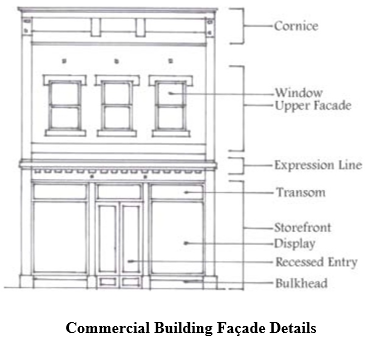
Cornice: Any horizontal member, structural or non-structural, of any building, projecting outward from the exterior walls at the roof line.
Design guideline: A standard of appropriate activity that will establish, preserve, or enhance the architectural character and site design and function of a building, structure, or land development.
Dormer: A window projecting from a roof.
Eave: The projecting lower edges of a roof overhanging the wall of a building.
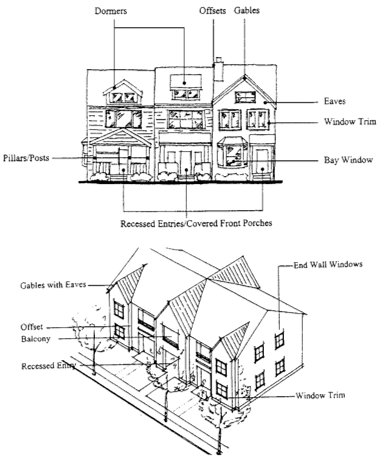
Illustration of Selected Architectural Details
Source: Oregon Transportation and Growth Management Program. Commercial and Mixed
Use Development Code Handbook
Elevation drawing: An architectural drawing of a building or building facade, intended to illustrate its design, characteristics, and major features.
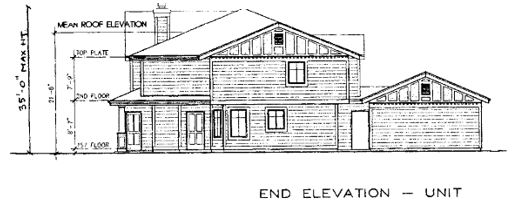
Example Elevation Drawing
Facade: The face (exterior elevation) of a building, especially the face parallel to or most nearly parallel to a public street.
Fenestration: The organization of windows on a building wall.
Footcandle: A unit of illuminance on a surface that is everywhere one foot from a uniform point source of light of one candle and equal to one lumen per square foot. One footcandle (FC) is the equivalent of 10.76 Lux (1 Lux = 0.0929 FC).
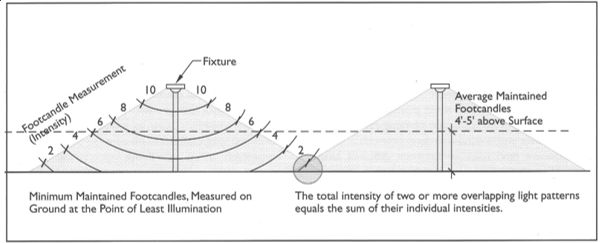
Footcandle Measurement
Source: John Wiley & Sons. 2006. Planning and Urban Design Standards, p. 496.
Gable: The triangular upper portion of an end wall, underneath a peaked roof.
Glare: The sensation produced by luminance within the visual field that is sufficiently greater than the luminance to which the eyes are adapted and which causes annoyance, discomfort, or loss in visual performance and visibility.
Harmony: A quality that represents an attractive arrangement and agreement of parts of a composition, as in architectural elements.
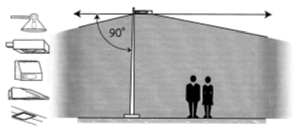
Full Cutoff Luminaire
Source: A Guide to Fairfax County's Lighting Standards. Department of Planning and
Zoning, Zoning Administration Division, September 2003.
Luminaire, full cutoff: A luminaire that provides a light distribution where zero candela intensity occurs at an angle of 90 degrees above nadir, and at all greater angles from nadir. Additionally, the candela per 1000 lamp lumens does not numerically exceed 100 (10%) at a vertical angle of 80 degrees above nadir. This applies to all lateral angles around the luminaire.
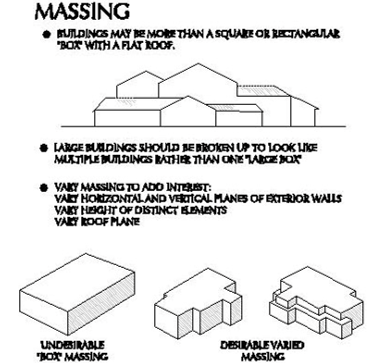
Massing
Massing: The overall visual impact of a structure's volume; a combination of height and width and the relationship of the heights and widths of the building's components.
Modularity: Design composition comprised of a rhythmic organization of parts.
Modulation: A measured setback or offset.
Parapet: That portion of a wall which extends above the roof line.
Pedestrian-scale development: Development designed with an emphasis primarily on the street sidewalk and on pedestrian access to the site and building, rather than auto access and parking areas. The building is generally placed close to the street and the main entrance is oriented to the street sidewalk. There are generally windows or display cases along building facades which face the street.
Pedestrian-scale lighting: Light standards or placements no greater than 15' in height, located along walkways.
Plaza: An open area adjacent to a building that functions as a gathering place and may incorporate a variety of non-permanent activities.
Porch: A projection from a building wall which is covered but enclosed on no more than one side by a vertical wall.
Portico: An exterior appendage to a building, normally at the entry, usually roofed.
Proportion: Balanced relationship of parts of a building, signs and other structures, and landscape to each other and to the whole.
Retail display window: A window or opening in the exterior wall of any portion of a building used for business purposes, through which merchandise, services, or businesses are displayed or advertised and visible from the ground or sidewalk level.
Roof: The cover of a building, including the eaves and similar projections.
Roof, flat: A roof having no pitch or a pitch of not more than 2:12.
Roof, pitched: A shed, gabled, or hipped roof having a slope or pitch of at least one foot rise for each 4' of horizontal distance.
Safety lighting: Exterior lighting that involves ensuring proper levels of illumination to provide safe working conditions, safe passage, and the identification of outdoor hazards.
Scale: Proportional relationships of the size of parts to one another and to humans.
Shop front: A business or retail use where the facade is aligned directly on the frontage line with the entrance at grade; typical of sidewalk retail. Shop fronts often have awnings.
Spill light. Light emitted by an outdoor light fixture that falls outside the boundaries of the property on which the installation is sited.
Street furniture: Those features associated with a street that are intended to enhance the street's physical character and use by pedestrians, such as benches, trash receptacles, planting containers, pedestrian lighting, kiosks, etc.
Street hardware: Objects other than buildings or street furniture that are part of the streetscape. Examples are: non-pedestrian street light fixtures, utility poles, traffic lights and their fixtures, fire hydrants, etc.
Streetscape: The appearance and organization along a street of buildings, paving, plantings, street hardware, street furniture, and miscellaneous structures.
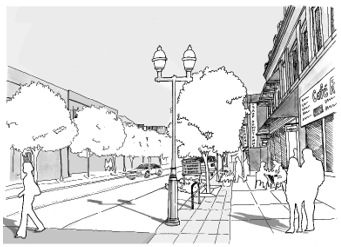
Streetscape
Undergrounding: The placement of utility lines below ground, with the removal of above-ground poles, wires and structures as applicable.
Sec. 5-4. - General requirements.
(a)
The review and approval by the city of the architectural and site design features of buildings and land development shall be required for any land development and any principal or accessory building, unless exempted from the requirement to comply with this article.
(b)
The community development director shall not issue a development permit if required by this unified development code until and unless an application for site design review, if required, has been submitted and approved in accordance with this article.
(c)
No, grading, or alteration or improvement of land shall take place prior to approval of site design in accordance with the requirements of this article.
(d)
No construction of building(s) shall commence prior to the approval of the architectural design of said building(s) in accordance with the requirements of this article, if required.
Sec. 5-5. - Exemptions.
The following are exempt from the provisions of this article:
(a)
Any development site or building that has already accomplished site and architectural design review or its equivalent via a prior application such as rezoning or special use, as determined by the community development director.
(b)
Re-occupancy of a building for which design review has already been accomplished.
(c)
Buildings and structures accessory to a detached, single-family dwelling on an individual lot, however, all accessory buildings and structures will be reviewed administratively for consistency with the surrounding area. Accessory structures 144 square feet or greater shall conform in appearance, materials and design to the principal structure as approved by the community development director.
(d)
Alterations and repairs to the interior of existing buildings.
Sec. 5-11. - Design review required.
For all developments and buildings subject to compliance with this article, an application or applications shall be made by the property owner or agent for the property owner to the community development department for site and architectural design review approval, as required by and in accordance with this article.
Sec. 5-12. - Division of design review.
An application for site and architectural design review may submitted as a single application or it may be divided into 2 applications and approval processes, one for the development site, and one for the building or buildings. The division of design review applications and approval processes into 2 distinct (i.e., site and building architecture) components is appropriate when a property owner or land developer desires to proceed with land development approval but elects at that time to defer application for the architectural review and approval of the building or buildings until a subsequent stage of the permitting process.
Sec. 5-13. - Application requirements for site design review.
(a)
When a preliminary plat or a development permit is required, the application requirements for site design review shall at minimum be those plans and information required for applications for a preliminary plat as specified in article 15 of this development code or a development permit as specified in article 8, division V of this development code. In addition, an application for site design review shall include all information necessary to demonstrate compliance with the site design requirements of this article.
(b)
The community development director or designee may refuse to act on an incomplete application or an application for site design review that fails to contain submission materials with respect to design that it finds necessary to make a decision on said application.
(c)
The community development director may waive submission requirements where in his or her opinion such information is not necessary to ensure compliance with this article.
Sec. 5-14. - Process of site design approval.
(a)
The process of site design approval is administrative. It shall be the responsibility of the community development department to review development permit applications for compliance with the site design requirements of this article. The community development director or designee is authorized to review, approve, conditionally approve, or deny applications for site design approval, in accordance with this article.
(b)
When an application for a preliminary plat or development permit is made, the applicant shall be required to comply with the site design requirements of this article, as well as all other applicable development regulations of this unified development code. Plans and information submitted as a part of an application for a preliminary plat or a development permit shall constitute an application for site design approval as required by this article, if said application includes all the information required or necessary to ensure compliance with the provisions of this article for site design.
(c)
When site design review is applied for and accomplished in conjunction with a preliminary plat or a development permit application, a decision on site design review shall be made in accordance with procedural requirements for considering preliminary plats or development permits, as the case may be.
(d)
If a preliminary plat or development permit is not required by this unified development code for a particular subdivision, development or building, then compliance of said development or building with the requirements of this article relative to site design, as applicable, shall be reviewed by the community development director or designee in conjunction with a building permit application or prior to issuance of a building permit for a building on the property.
(e)
When site design review is applied for and accomplished in conjunction with an architectural design application, a decision on site design review shall be made in accordance with the procedures applicable for architectural design review as specified in this article.
Sec. 5-15. - Architectural design approval.
(a)
The community development director or designee is authorized to review, approve, conditionally approve, or deny applications for architectural design review, in accordance with this article, except as specifically provided in this section.
(b)
Architectural design approval by the Mayor and City Council, after review and recommendation by the Planning and Zoning Commission, shall be required for the following:
1.
For any building(s) proposed pursuant to a rezoning to the MXU Zoning District.
2.
Residential buildings within any development project exceeding 5 units per acre in the MDR, Medium Density Residential, Zoning District.
3.
Any building or development within the Central Business District (CBD) Zoning District.
(c)
Where the record of application approval clearly indicates, demonstration of compliance with the architectural review requirements of this article at the time of rezoning or special use application approval shall be construed as satisfying the architectural design review requirements of this article.
(d)
No later than when an application for a building permit is made, the applicant seeking design approval shall be required to comply with the architectural design requirements of this article, as applicable. It shall be the responsibility of the community development department to review building permit applications for compliance with the architectural design requirements of this article and the development code.
(e)
The community development director shall not authorize the issuance of a building permit or certificate of occupancy as required by this unified development code and/or the building code applicable in the city until and unless an application for architectural design review of the building or buildings proposed, if required, has been submitted and approved in accordance with this article.
Sec. 5-16. - Application requirements for architectural design review.
Applications for design review shall include the following, and no design review application shall be processed by the community development director unless it is found to be complete with regard to the requirements of this section:
(a)
Application fee;
(b)
Application form furnished by the community development director, including signature of property owner or authorized agent;
(c)
Legal description of the property and survey plat of the property;
(d)
Letter of intent describing the proposed building(s) on the property, which may include a description of any special conditions voluntarily made a part of the request;
(e)
Site plan of the property at an appropriate engineering scale showing the proposed use and relevant information regarding proposed improvements;
(f)
Exterior elevation drawings drawn to scale and signed by an architect, engineer or other appropriate professional and submitted in sufficient number of copies as required by the community development director. Said exterior elevation drawings shall clearly show in sufficient detail the exterior appearance and architectural design of proposed buildings and structures or change(s) thereto;
(g)
Material and colors samples. The community development director may accept written descriptions, product summary sheets, photographs, or other information in lieu of actual color and material samples.
(h)
Other information as may be essential to demonstrate compliance with this article. an applicant for architectural design review may be also be required to submit information in the form of photographs or sketches of adjoining uses and indicate how the architectural design of the proposed project or improvement is compatible with the surrounding context.
Sec. 5-17. - Criteria for decisions on architectural design applications.
In acting upon applications for architectural design approval, the community development director (or as the case may be, Mayor and City Council after review and recommendation by the Planning and Zoning Commission) shall consider whether the proposal meets the following criteria:
(a)
Whether the proposal complies with the requirements of this article and other applicable provisions of this unified development code.
(b)
Whether the proposal is consistent with the design guidelines of this article and any adopted design guidelines for the type of development and/or the proposed use.
(c)
Whether the design, scale, arrangement, materials, and colors of the proposed building(s) or structure(s) is compatible with buildings and structures in the immediate surrounding area or the same zoning district.
Sec. 5-18. - Decision with regard to architectural design applications.
(a)
The community development director shall render a decision on the architectural design application as expediently as possible but within no more than 30 calendar days from the date a complete application is received.
(b)
If the Mayor and City Council has jurisdiction over architectural design review, a decision shall be made on the application within no more than 60 calendar days from the date a complete application was scheduled for consideration by the Mayor and City Council; provided, however, that this time frame for decision may be extended with the consent of the applicant. For any application involving review and approval of architectural design by the Mayor and City Council, the meeting or meetings at which the application will be considered must be attended by the applicant or representative thereof with authority to make binding commitments to the city with respect to any stipulations that may be offered in connection with such application. Failure of the applicant or representative thereof to attend any work session, meeting, or hearing during which the architectural design application is considered shall result in the application being tabled one time. Failure to attend a rescheduled work session, meeting, or hearing shall be cause for denial of the application.
(c)
If the community development director (or approval authority) finds that the proposal meets the criteria for architectural design as specified in this division, the director shall approve the application.
(d)
If the director (or approval authority) finds that the proposal is mostly acceptable but requires modifications, the director may approve the application with conditions or the director may request changes and require modifications to the proposed design for consideration as a modified application at a future date.
(e)
If the director (or approval authority) finds that the proposal fails to meet the criteria for architectural design specified by this article, or does not comply with this unified development code, the application shall be denied. Among other grounds for considering a design inappropriate are the following defects: character foreign to the area, arresting and spectacular effects, violent contrasts of material or color, intense or lurid colors, a multiplicity or incongruity of details resulting in a restless and disturbing appearance, and the absence of unity and coherence in composition not in consonance with the density and character of the present structure or surrounding area.
Sec. 5-19. - Notice of decision.
The community development director shall notify the applicant in writing of the action taken on design review applications promptly after the date action was taken on said application. If the application was denied, the reasons for the denial shall be stated in the written notice of decision.
Sec. 5-20. - Reapplication and appeal.
(a)
An applicant for architectural design approval may revise plans and reapply for architectural design approval.
(b)
Denial of a design review application by the community development director may be appealed as an administrative decision, in accordance with the requirements of article 14 of this development code; provided, however, that public notice of such an appeal shall not be required, and the appeal of a design plan decision by the community development director shall be placed on the next regular meeting of the Mayor and City Council for consideration. The Mayor and City Council for good cause may affirm, reverse, overturn or otherwise modify a decision of the community development director with respect to an architectural design application, upon the proper filing of an appeal.
(c)
Decisions of the Mayor and City Council with regard to an architectural design application, whether with original jurisdiction or on appeal, shall be final, subject to any further legal remedy by a court with jurisdiction.
Sec. 5-21. - Compliance with approved applications.
(a)
Approval of site and architectural design applications is conditioned on compliance with the approved application(s).
(b)
After the development and building are constructed and completed, but before issuance of a certificate of occupancy, the community development director or designee shall inspect the site and building for compliance with the approved design plans for the site or building.
(c)
The community development director shall direct the building inspector not to issue a certificate of occupancy if the site or building is not in compliance with approved design plans.
Sec. 5-31. - Applicability.
Unless the context clearly indicates otherwise as specifically provided in this article, the development requirements and guidelines of this division are intended to apply to all land uses except for detached, single-family dwellings.
Sec. 5-32. - Interpretation.
(a)
Those provisions in this division and the following division which use the term "shall" are regulations and must be followed.
(b)
When the terms "should" and "are encouraged" are used in this division and the following division, the language shall be considered a guideline, and flexibility toward compliance may be exercised if it is determined by the community development director that the spirit and intent of the guideline is being followed or an alternative to the guideline is acceptable.
Sec. 5-33. - Existing site features.
(a)
Significant site features such as habitats, natural ground forms, existing site vegetation, large rock outcroppings, water, and significant view corridors should be identified on grading plans as protected from land disturbance and incorporated into development plans.
(b)
When the alteration or improvement of significant natural resource areas are permitted, the site designer should ensure that potential losses are mitigated and best management practices are employed to minimize permanent damage.
(c)
Existing vegetation should be retained to the maximum extent possible. Clearing of native vegetation should be limited to that required for the provision of essential purposes (i.e., access, building, sewage disposal, etc.). Where appropriate, existing native vegetation should be enhanced with plantings of the same variety.
(d)
Environmental functions damaged by prior site activities should be restored and enhanced.
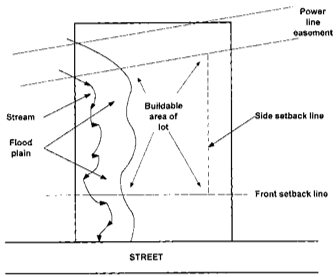
Adequate Building Area Required
(e)
Land subject to flooding, improper drainage or erosion, or that is unsuitable for the use for topographical or other reasons, shall not be platted or developed for any use that will continue or increase the danger to health, safety, or of property destruction, unless the hazards can be and are corrected. Each lot or development site shall contain an adequate are for building, not subject to flooding and outside the limits of any existing easements or required building setback lines
Sec. 5-34. - Grading.
(a)
Developments should be designed to fit the existing contours and landform of the site and to minimize the amount of earthwork.
(b)
Excavation and earthwork should be kept to a minimum to reduce visual impacts and erosion. Where cut and fill is required, balancing the cut and fill is highly encouraged.

Illustrative Cut and Fill
(c)
Abrupt or unnatural-appearing grading is strongly discouraged. Avoid the creation of harsh, easily eroded banks and cuts.
(d)
When cut or fill is involved in the grading of an individual building pad or development site, the finished grade of the parking lot or driveway should be terminated far enough inside the property to allow for the slope to return to that of the natural grade or finished ground elevation at the property line. When inter-parcel access is provided or required, the slope at such a property line or provided shall not exceed 10%. The purposes of this design guideline is to both facilitate inter-parcel access at reasonable grades between compatible land uses and to avoid harsh differences in grade between abutting properties. This practice also provides for a blending of the finished site elevations in a manner so that stark contrasts in the landscape will not occur. Where inter-parcel access is not required due to incompatible land uses, grade differentiation at a property line may be permitted but should be mitigated or softened as much as possible.
(e)
The height and length of retaining walls should be minimized and screened with appropriate landscaping. Tall, smooth-faced concrete retaining walls should be avoided in highly visible areas. Terracing should be considered as an alternative to the use of tall or prominent retaining walls, particularly in highly visible areas on hillsides.
(f)
Disturbed areas which are not used for roads, buildings, or other auxiliary uses should be replanted.
Sec. 5-35. - Drainage and low impact development.
(a)
Land developers shall utilize, to the maximum extent practicable, stormwater better site design practices as described in the Georgia Stormwater Management Manual. During the land development permitting process, a stormwater management plan is required (see article 11 of this development code). As specified in article 11, the city will require the land development applicant to examine and where feasible implement stormwater management methods broadly referred to as "low-impact development" and as specifically referred to in the Georgia Stormwater Management Manual as stormwater better site design practices and limited application structural stormwater controls (i.e., filter strips, grassed channels, and porous concrete, among others (reference: GSMM, Vol. 2, Sec. 3.3).
(b)
Porous paving materials are encouraged, including porous concrete, porous asphalt, porous unit paver systems, gravel paving systems, to improve infiltration.
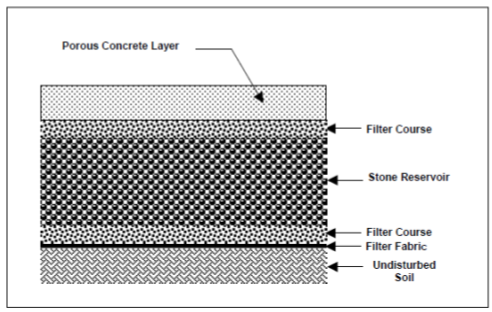
Figure 3.3.7-1 Porous Concrete System Selection
(Modified from: LAC 2000)
Source: Georgia Stormwater Management Manual, Vol. 2.
(c)
Grassy swales and bio-retention areas, with pierced or broken curbs, is an acceptable and encouraged alternative to curbing. Where curb is necessary, utilize the pierced or broken curb option to direct runoff to swales or bio-retention areas. Rain gardens and constructed wetlands are also encouraged to handle surface drainage of parking lots providing 10 or more parking spaces.
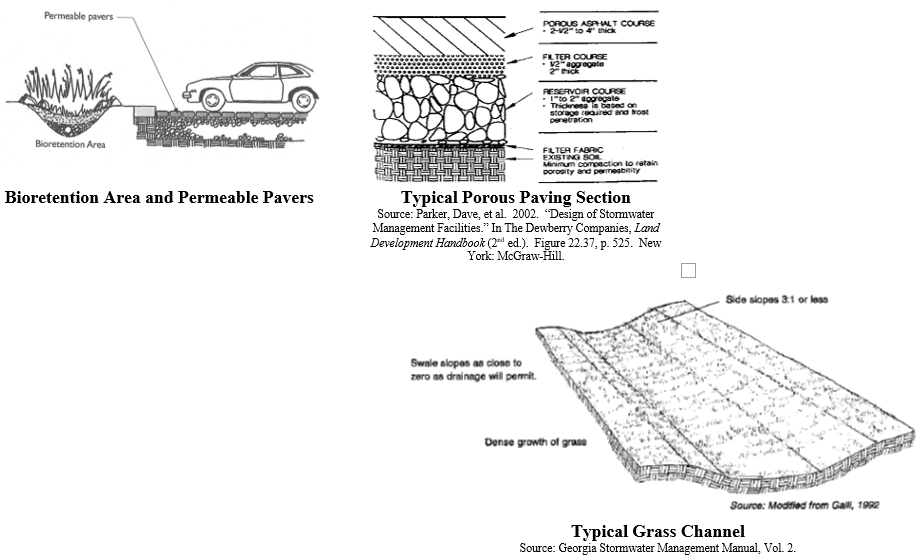
Typical Grass Channel
Source: Georgia Stormwater Management Manual, Vol. 2.
(d)
Mimic the predevelopment site hydrology by using site design techniques that store, infiltrate, evaporate, and detain runoff. Natural drainage patterns that exist on the site will need to be identified (as part of the stormwater planning process) to plan around these critical areas where water will concentrate. Where possible, natural drainage ways should be used to convey runoff over and off the site to avoid the expense and problems of constructing an artificial drainage system. Natural on-site drainage patterns and low impact development methods such as vegetative swales and bioretention should be used to the maximum extent practicable.
(e)
Stormwater management designers should reduce, minimize, and disconnect the total impervious area at the site. Disconnect as much impervious area as possible to increase opportunities for infiltration and reduce water runoff flow.
(f)
Maximize overland sheet flow. Incorporate on-infiltration into existing parking lot designs where possible.
(g)
Minimize and then mitigate the hydrologic impacts of land use activities closer to the source of generation. This can be done by implementing the principle of "microstorage," or breaking up drainage areas into small manageable subcatchment areas. Break up flow directions from large paved surfaces, and direct stormwater where appropriate to drain to natural systems, vegetated buffers, natural resource areas, or infiltratable zones/soils.
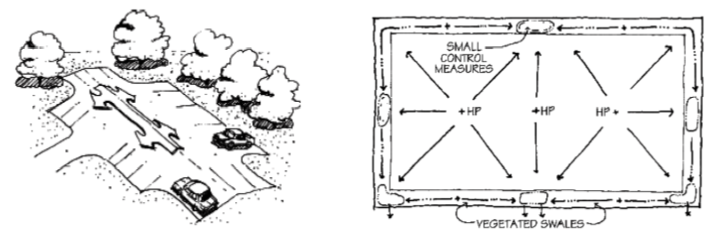
Figure 1.4.2-31 Design Paved Surfaces to Disperse Flow to Vegetated Areas
Source: NCDENR, 1998
Source: Georgia Stormwater Management Manual, Vol. 2
(h)
Eliminate the use of concrete curb and gutter where feasible, to implement these objectives.
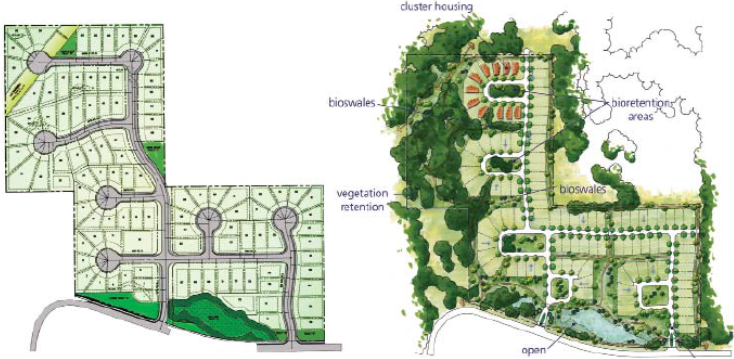
Comparison of Conventional Development (left)
and Low Impact Development (Right)
Source: AHBL for Puget Sound Partnership. July 2012. Integrating LID into Local Codes:
A Guidebook for Local Governments
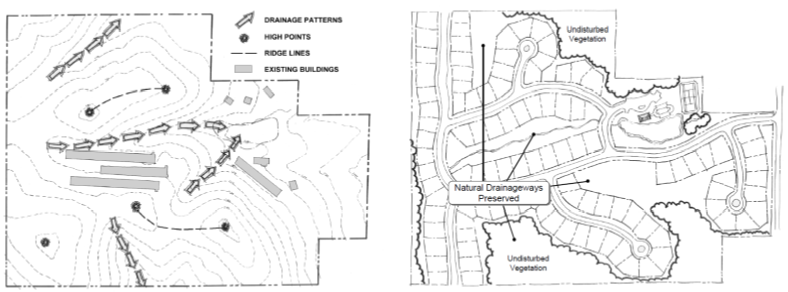
Figure 1.4.2-29 Example of a Subdivision Using Natural Drainageways for Stormwater
Conveyance and Management
Illustrated Example of Implementing Low Impact Development
Source: Georgia Stormwater Management Manual, Vol. 2.
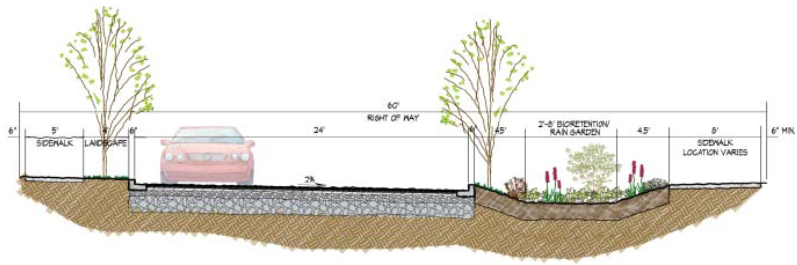
Illustrative Bioretention Rain Garden
Incorporated into Street Section
Source: AHBL for Puget Sound Partnership. July 2012. Integrating LID into Local Codes:
A Guidebook for Local Governments.
(i)
Man-made lakes and stormwater ponds should be designed for maximum habitat value and/or to serve as amenity features.
(j)
Stormwater ponds and facilities that are visible from the public right-of-way shall be landscaped with a combination of densely planted shrubs and ground cover. Any fencing surrounding a stormwater pond that is visible from the public right-of-way shall be decorative in nature, or if chain link fencing is permitted it shall be vinyl coated green or black.
Sec. 5-36. - Interparcel access.
Inter-parcel access for vehicles between abutting and nearby properties shall be provided so that access to individual properties can be achieved between adjacent and nearby developments as an alternative to forcing all movement onto abutting highways and public roads, unless the community development director during development permit and/or the site design approval process determines that it is unnecessary to provide inter-parcel access due to the unlikelihood of patrons traveling among 2 or more existing or proposed uses on abutting or nearby sites, or where the 2 land uses are incompatible.
Illustrative Interparcel Access
Where opportunities for shared or interparcel access have been identified by the community development director, developments must provide shared or interparcel access with adjoining properties to facilitate driveway connections between parcels. The property owner shall grant an access easement to facilitate the movement of motor vehicles and pedestrians from site to site.
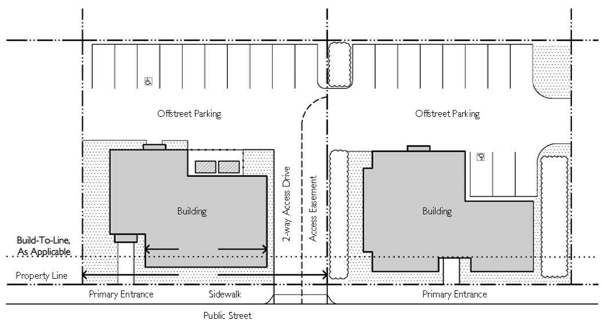
Illustrative Shared Driveway and Access Easement
Source: Oregon Transportation and Growth Management Program, 2012
Model Development Code & User's Guide for Small Cities, 3rdEd.
Sec. 5-37. - Utilities.
(a)
All electrical, cable, telephone and other such services shall be installed underground.
(b)
All transformers and other facilities and equipment, including telecommunications equipment, shall either be screened through the use of architectural materials compatible with the architectural materials present on the site or, alternatively, through landscape screening. Such screening shall be adequate to completely screen such facilities from view from the right-of-way.
(c)
Utility easements should be coordinated and combined to minimize the number of additional easements and stream and road crossings needed. Utility easements should be landscaped.
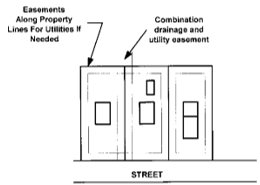
Easement Combination
Sec. 5-38. - Exterior lighting.
(a)
Exterior lighting should be architecturally compatible with the building style, material, and colors.
(b)
Fixture mounting height should be appropriate for the project and the setting. The mounting height of fixtures in smaller parking lots or service areas should not exceed 20', with lower mounting heights encouraged, particularly where adjacent to residential areas or other sensitive land uses.
(c)
All outdoor light fixtures shall be fully shielded or be designed or provided with light angle cut-offs, so as to eliminate up-lighting, spill light, and glare.
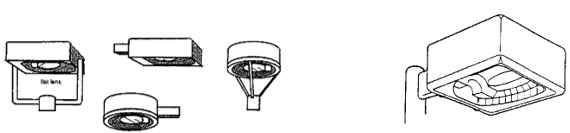
Cut-Off Fixtures
(d)
Use of low, bollard-type fixtures, 3' to 4' to in height, are encouraged as pedestrian area lighting.
(e)
Provide human-scaled, decorative street lighting along streets designated for "main street" or town center pedestrian retail uses, to create a distinct character. The fixtures should match or resemble those already installed along streetscapes in Powder Springs.
(f)
Illuminance levels for outdoor lighting fixtures measured at 3' above the ground or finished grade, shall comply with the following:
Sec. 5-39. - Pedestrian circulation.
(a)
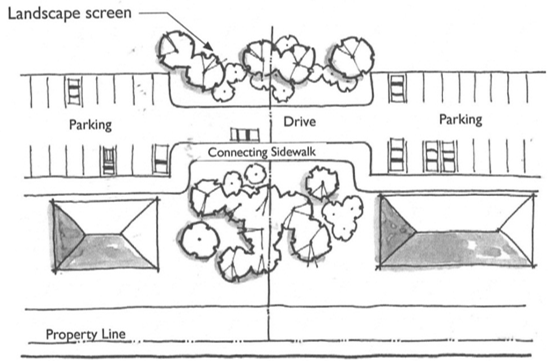
Except in Industrial Zoning Districts, pedestrian circulation should take precedence over vehicular circulation. Pedestrian ways shall be well defined, should take as direct a path as possible, and they should be separated where practical from automobile access ways. Parking aisle dividers are appropriate locations for pedestrian access facilities. Relocate landscape areas that may interfere with pedestrian "short cuts."
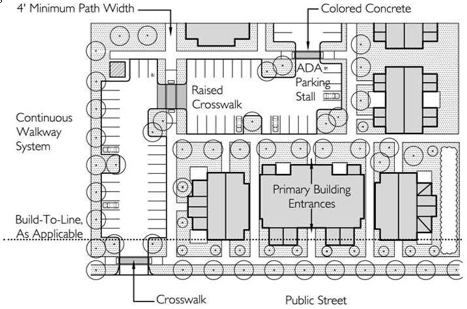
Illustrative Provision of Pedestrian Access
Source: Oregon Transportation and Growth
Management Program, 2012
Model Development Code & User's Guide
for Small Cities, 3rdEd.
(b)
Sidewalks on individual properties shall connect to the sidewalk system within public road right-of-way, where such system exists or is planned.
(c)
All principal entries to a building shall provide direct pedestrian access to the sidewalk within a public right-of-way or along a dedicated street.
(d)
When multiple buildings are proposed on a single development site, they shall be linked with on-site pedestrian walkways.
(e)
Where pedestrian circulation crosses vehicular routes, a change in grade, paving material, or texture, or paving color should be provided to emphasize the conflict point and improve its visibility and safety. Accent strips of brick or textured paving may also be appropriate for defining pedestrian walkways.
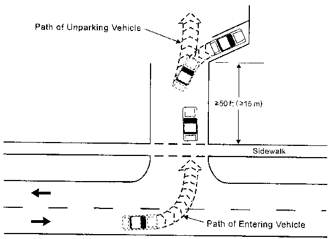
Provide Adequate Driveway Throat Length
Source: Stover, Vergil G., and Frank J. Koepke. 2002.
Transportation and Land Development (2ndEd.).
Washington, DC: Institute of Transportation Engineers.
Figure 7-22, p. 7-31.
Sec. 5-40. - Driveway throat depth.
Designers should strive to provide a 100' deep clear zone between the pavement of an arterial road and the first turning movement from an internal driveway. On any other road (city street) the clear zone or throat length should be at least 50' before a turning movement occurs (including parking), to provide sufficient queuing room for cars and/or delivery vehicles exiting the street. This provision may be modified by the community development director after review by a traffic engineer or City Engineer.
Sec. 5-41. - Parking.
The visual impact and presence of vehicles shall be minimized, preferably by siting parking areas to the rear or side of the property rather than alongside the street.
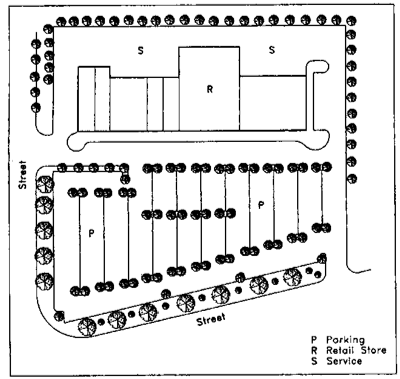
Separation of Service and Parking Areas
Source: Couture, Dennis. 2002 "Development Patterns and Principles." Figure 12.20
in Land Development Handbook, 2nded. The Dewberry Companies. New York, McGraw-Hill.
Sec. 5-42. - Service functions.
(a)
Service functions (e.g., deliveries, maintenance activities) need to be integrated into the circulation pattern in a manner which minimizes conflicts with vehicles and pedestrians.
(b)
Access for service vehicles, shall be provided to the rear or sides of buildings being served.
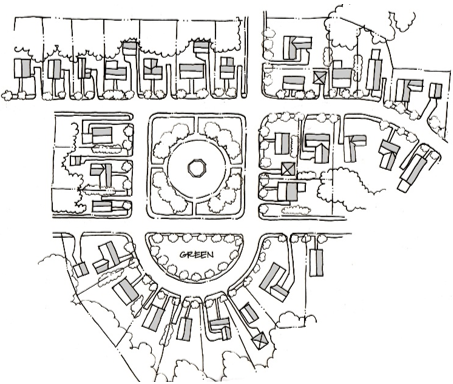
Illustrative Provision of Square and Green
in a Traditional Neighborhood Development
Sec. 5-43. - Open spaces.
(a)
Open spaces, such as greens and squares, should be located and designed to add to the visual amenities of the development.
(b)
Greens and squares should be spatially defined and distributed throughout the development so that no lot is more than a walking distance of 1,350' from a green, square, or park. Greens and squares should not be less than 8,000 square feet in area.
(c)
A mix of peripheral as well as internal green space should be provided.
Sec. 5-44. - Plazas and pedestrian-gathering places.
In pedestrian retail and institutional areas, designers are encouraged to provide plazas or gathering places by including design elements such as play areas, landscaping, street furniture, public art, and/or other attractive features that reflect the desired district character. Gathering places provide area for activities that promote safe community interaction, exchange, and congregation.
Sec. 5-51. - Architectural design compatibility.
Buildings or other improvements should be compatible with the orientation, directional emphasis, shape, volume, massing, proportion, rhythm, scale and materials of the context, setting and streetscape of the site. Architectural design should be compatible with the developing character of the neighboring area. Design compatibility includes complementary building style, form, size, color, materials, and detailing. Determinations of compatibility will consider each of the following contexts as appropriate:
(a)
Size: The relationship of the project to its site.
(b)
Orientation: The relationship of buildings to streets. Buildings should front directly onto public sidewalks unless site features prohibit such building configuration.
(c)
Scale: The relationship of the building to those around it. Efforts to coordinate the height of buildings and adjacent structures are encouraged. This is especially applicable where buildings are located very close to each other. It is often possible to adjust the height of a wall, cornice or parapet line to match that of an adjacent building.
(d)
Massing: The relationship of the building's various parts to each other.
(e)
Fenestration: the placement of windows and doors. The building may incorporate design that is similar to or links with designs of neighboring buildings. For instance, window lines should be placed in a pattern that reflects the same elements on neighboring buildings.
(f)
Rhythm: The relationship of fenestration, recesses and projections.
(g)
Setback: Placement in relation to setback of immediate surroundings.
(h)
Materials: The compatibility of building materials with those used in the zoning district.
(i)
Context: The overall relationship of the project to its surroundings.
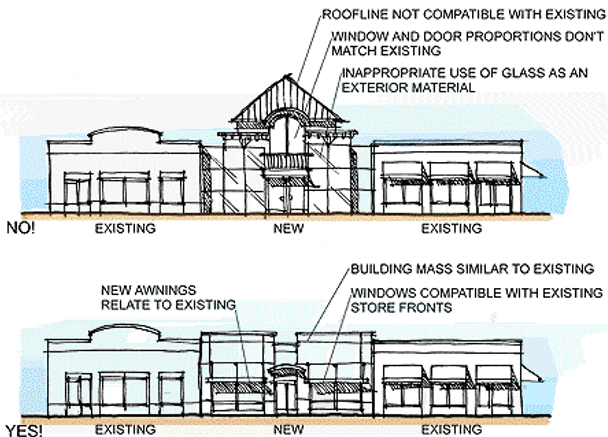
Architectural Character (Nonresidential)
Sec. 5-52. - Building style.
(a)
When more than one building is constructed on a development site or within a planned development, all buildings shall reflect a compatible architectural style and create a cohesive visual relationship between the buildings.
(b)
"Theme" or stylized architecture which is characteristic of a particular historic period or trend is not encouraged, unless the existing building or site is historically important to the district or necessary for architectural harmony.
(c)
Franchise architecture will be reviewed for compatibility with surroundings and may require adjustments to be compatible with surrounding buildings in the district.
Sec. 5-53. - Building materials.
(a)
All construction shall be brick, stone, wood, glass in combination with metal or similar, durable architectural materials. Materials found to be other than durable products are specifically prohibited. Side and rear building elevations should be substantially consistent with the front building elevation.
(b)
The following types of building materials shall not be used: highly reflective, shiny, or mirror-like materials; mill-finish (non-colored) aluminum metal windows or door frames; exposed, unfinished foundation walls; exposed plywood or particle board; and exposed, unfinished concrete masonry blocks.
(c)
Buildings with all-metal siding shall not be permitted except in Industrial Zoning Districts. In Industrial Districts, buildings if permitted to be constructed with all-metal siding shall be screened from view from a public or private street.
(d)
Smooth-faced concrete block, tilt-up concrete panels, or prefabricated steel panels are discouraged and shall only be permitted in Industrial Zoning Districts. Split face (integrated block) materials may be authorized.
(e)
Non-residential building walls shall consist of or be finished on the exterior with brick, stone, wood, cementitious siding, glass in combination with metal, or other similar, durable architectural materials approved by the community development director.
(f)
Within the Business Park (BP) Zoning District, the exterior walls of any building that is located within a through road corridor and/or is visible from a through road corridor shall be of masonry (excluding concrete, concrete products or hardiplank and/or stucco-type) construction. These building material finishes shall be applied to all sides of the building.
(g)
All sides of a building may impact on its surroundings and should be considered for treatment with an architectural finish of primary materials (i.e., brick and stone), unless other materials demonstrating equal or greater quality are used. As a general guide: front and side facades should be at least 50% brick and stone; side facades should be at least 50% brick and stone. Rear facades do not have a minimum suggested standard for primary materials unless they are visible from a public right-of-way. Requirements for brick or stone may be modified to accommodate creatively designed structures as determined by the community development director. Materials used for side and rear building elevations should be substantially consistent with the materials used for the front building elevation.
(h)
Use of vinyl material in the Central Business District (CBD) Zoning District is prohibited. See section 4-130 for regulations regarding use of vinyl on exterior walls of dwelling units. Any vinyl material, if authorized during architectural design review, shall be certified under the product certification program as meeting:
1.
The specifications of ASTM D3679 for rigid poly (vinyl chloride) siding with nominal thickness of 0.044 inches or greater that is not laminated and that includes a formed insulation having the same profile as the vinyl panel;
2.
Product and color retention certification approvals by the Vinyl Siding Institute:
3.
Enhanced panel locking system with features to help straighten the wall appearance;
4.
Reinforced nail hem curl or double nail hem designed to increase panel wind load resistance;
5.
Polypropylene sidings; and
6.
5/8-inch or greater panel projection.
Sec. 5-54. - Modulation.
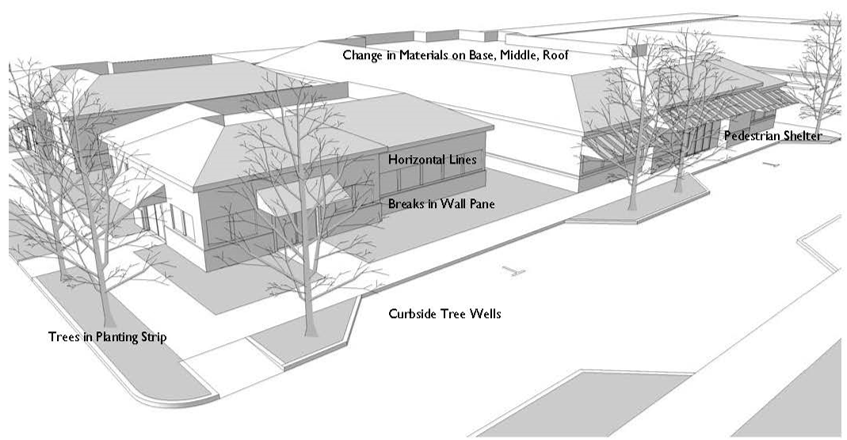
Avoid constructing buildings with blank facades parallel to public rights-of-ways. In pedestrian activity areas, buildings should exhibit more detail and elements appropriate for close range view by the pedestrian. The walls of building facades for office, institutional, commercial, and industrial use shall not extend more than 200 linear feet unless the front facade of the building (including roof) is designed in a way that modulates the building face into discrete architectural elements. This may be accomplished one or a combination of modulation techniques described below.
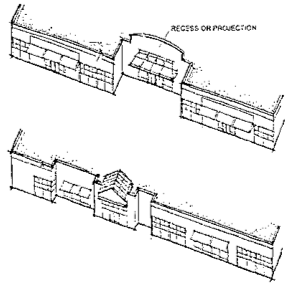
Illustrative Recesses and Projections
(a)
Recesses and projections should be used along the front facade to break up long expanses of wall planes (see figure).
(b)
Rooflines can be modulated by alternating dormers, or using stepped roofs, gables, or other roof elements.
(c)
Windows with awnings above the windows can be provided in a repeating pattern or at regular intervals, or bay windows can be used to achieve some modulation.
(d)
The building design can incorporate and feature awnings, canopies, porches, porticos, patios, decks, other covered entries to portions of the facade at the ground level, or in the case of buildings containing 2 or more story, balconies.
(e)
Changes to building materials at a change in building plane can achieve some modulation.
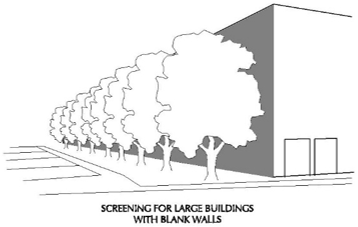
Screening of Large Building Walls
(f)
In addition to building modulation, large, expansive front building facades should be partially screened with landscaping (see figure).
(g)
A horizontal accent stripe (e.g., a foot wide stripe of different color) may be appropriately used to help reduce monotonous color and break up the appearance of large building walls.
Sec. 5-55. - Roofs.
(a)
Flat roofs are discouraged, unless the zoning district includes buildings already developed with flat roofs, or unless such a design is needed for a "green" or "cool" roof.
(b)
Roof planes should be varied to increase visual interest.
Sec. 5-56. - Awnings and canopies.
(a)
Awnings are encouraged for first floor retail uses to provide architectural interest and to encourage pedestrian activity. Where awnings are used, they should be designed to coordinate with the design of the building and any other awnings along the same block face.
Illustrative Use of Awnings
Source: Oregon Transportation and Growth Management Program, 2012
Model Development Code & User's Guide for Small Cities, 3rdEd.
(b)
Awnings are recommended to be constructed with a durable frame covered by a canvas material.
(c)
Flameproof vinyl, canvas, or metal awnings and canopies may be appropriate.
(d)
Aluminum and other metal canopies are acceptable in most instances, particularly when integrated into shopping center designs.
(e)
Solid colors are preferred over striped awnings, but striping is permitted if colors compliment the character of the structure or group of buildings.
(f)
Awnings that are backlit through translucent materials are discouraged if not prohibited altogether.
Sec. 5-57. - Colors.
(a)
The "base" color (used on the majority of the building surface) of buildings and accessory buildings and structures should be harmonious and compatible with colors of other buildings within and immediately adjacent to the zoning district in which the building or structure is located.
(b)
High-intensity colors, metallic colors, black, or fluorescent colors shall not be used.
(c)
Facade colors should be low reflectance, subtle, neutral, or earth tone colors. If a color palette or chart is adopted by the Mayor and City Council and maintained in the office of the community development department, then color selections should be limited to colors so indicated.
(d)
Trim color (used on the window trim, fascia, balustrades, and posts) may be brighter than base color.
(e)
All vents, gutters, downspouts, flashing, electrical conduits, etc., should be painted to match the color of the adjacent surface, unless they are being used expressly as a trim or accent element.
(f)
Accent color may be used with discretion on the building's exterior.
Sec. 5-58. - Architectural lighting.
(a)
Well-designed and distinctive lighting of building facades is one of the best ways to attract attention and make a favorable impression with a minimal investment. Building facade lighting can help enhance the intrinsic charm, beauty, and utility of any given setting. Architectural lighting may include outlining, floodlighting, spotlighting, or any applicable combination of these techniques.
(b)
The discrete lighting of a few key architectural features or details is preferred over uniform floodlighting of the entire building facade. Focal points can also be established through careful floodlighting of major buildings, with the lighting of secondary buildings keyed in turn to these focal points.
(c)
Highly polished surfaces such as glass, marble, glazed tile, glazed brick, porcelain enamel, and various metals can reflect the image of the light source. Designers should avoid lighting these reflective surfaces directly. Glass buildings usually cannot be lighted for nighttime viewing.
(d)
Exterior lighting of the building shall be designed so that light is not directed off the site and the light source is shielded from direct off-site viewing.
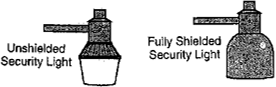
Security Lighting
(e)
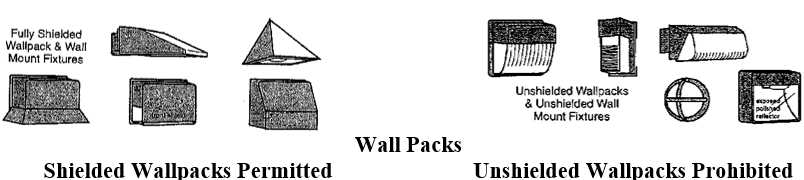
Security lighting, unless activated by motion sensor devices, shall be shielded or cutoff fixtures.
Wallpacks are not permitted unless fully shielded.
Sec. 5-59. - Trash and recycling collection facilities.
All institutional, commercial, industrial, multi-family residential sites must provide appropriate refuse dumpsters and areas devoted to the storage of waste materials (including grease or oil containers where used). The minimum area for said requirement shall be 36 square feet.
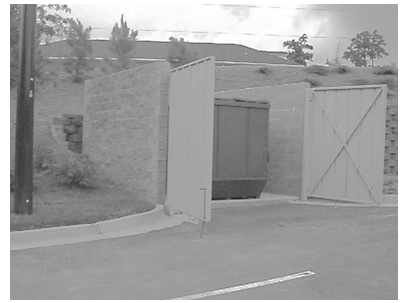
Recommended Practice for Dumpsters
All garbage dumpsters and other similar areas devoted to the storage of waste materials and grease or oil containers should be screened on 3 sides of said dumpster or area with a minimum 6' high (8' preferred) wall constructed of materials substantially similar in appearance to the building on site. Dumpster areas must be gated on the fourth side with a material that provides opaque screening, such as a solid, wooden fence matching the height of the surrounding wall.
Temporary dumpsters:
(1)
Only one temporary dumpster unit may be placed on a property.
(2)
A temporary dumpster unit shall only be placed on a hardened surface and shall be located at the furthest point away from the street.
(3)
A temporary dumpster unit or similar enclosure is limited to 30 days on a property during any 365-day period beginning on the date of the placement of the unit.
(4)
In no event shall a temporary dumpster or similar enclosure be placed in a public street or on the right-of-way.
(5)
In no event shall a temporary dumpster or similar enclosure pose an obstruction for public safety.
(6)
In cases where there is an active building permit to significantly perform a major remodel to an existing structure or to construct a new structure the temporary dumpster unit or similar enclosure may be placed on the property as long as there is an active building permit and work is progressing to the satisfaction of the building official. Only debris from the permitted construction activity is permitted in a temporary dumpster. In no event will the dumpster unit be allowed to remain on a property for over 180 days. The temporary dumpster unit must be removed prior to the issuance of a certificate of occupancy. If no driveway with a hardened surface exists on the property where a new structure is being constructed, a gravel pad shall be provided for placement of the temporary dumpster to prevent erosion on the site.
(7)
In cases where a hardship can be demonstrated, the director of community development may grant an extension on a property for 30 days. Only three 30-day extensions may be granted at a specific site by the director of community development. Any additional request for an extension may be considered by the Mayor and Council. A hardship may be caused by an accidental or unintentional fire, flood, natural disaster or other circumstances presented on a case by case basis that creates a need for additional time for the unit to remain on the property. The applicant for the extension shall bear the burden of proof to document and demonstrate, in writing, to the director the basis for the required extension.
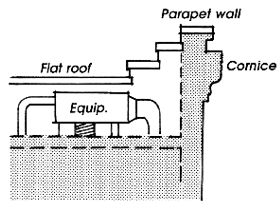
Roof Top Screening
Sec. 5-60. - Mechanical systems.
Air conditioning units installed at grade should be sited to the rear or side of the building rather than the front of the building. Mechanical systems located on a rooftop shall be screened from view from the front and side lot lines by a parapet wall or other approved architectural feature.
Sec. 5-61. - Accessory nonresidential storage areas.
Any accessory use involving the storage of equipment, refuse, or spare parts, or motorized vehicles under repair, shall be kept inside an enclosed building or otherwise fully shielded from public view by a fully opaque fence kept in good repair.
Sec. 5-62. - Fences and walls.
(a)
The design of fences and walls shall be compatible with the architecture of the main building(s) and should use similar materials.
(b)
All walls or fences 50' in length or longer, and 4' in height or taller, should be designed to minimize visual monotony though changes in plane, height, material or material texture or significant landscape massing.
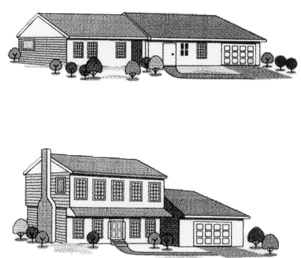
Discouraged Garage Location
Source:John Matusik and Daniel Deible. "Grading and Earthwork."
Figure 24.23 in Land Development Handbook, 2nded.
New York: McGraw-Hill, 2002, p. 562.
Sec. 5-63. - Residential garages and carports.
Garages should be placed in rear yards. If facing the street, garages, whether integrated into residential dwellings or established as a freestanding carport or accessory building, should be set back further into the interior of the lot than the dwelling facade. In no case shall the garage's or carport's facade be allowed to be located closer to the street than the dwelling's facade.
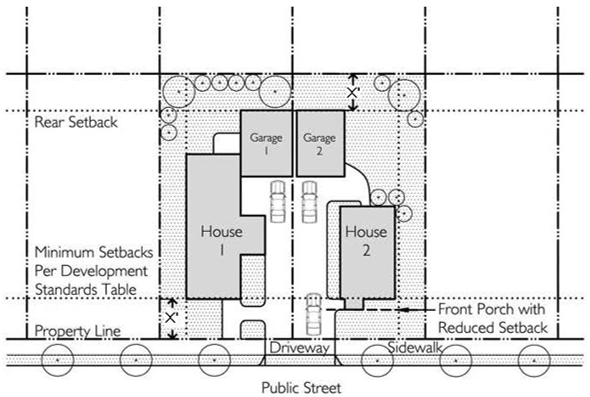
Encouraged Residential Garage Location
Source: Oregon Transportation and Growth Management Program, 2012 Model Development
Code & User's Guide for Small Cities, 3rdEd.
Sec. 5-64. - Residential unit differentiation.
In residential development, floor plans and building elevations shall not be repeated at a rate greater than the same plan and elevation once every 5 building lots along the same street frontage, nor any 4 building lots across the street. The units should be further differentiated by varying the selection of architectural materials within the approved elevations. Any residential subdivision, townhome or condominium development and multi-family complex shall be required to submit a copy of the approved plat or site plan denoting or identifying model names or architectural elevations (which must accompany the plat or site plan as attachments) that demonstrates compliance with this section. The designer responsible for preparing this exhibit demonstrating compliance shall also certify that the model names or architectural elevations referenced meet the requirements of sections 5-53, 5-57, 5-62 and 5-63 of the UDC.
Sec. 5-71. - Intent and applicability.
(a)
The guidelines in this division are provided to assist applicants and staff in retaining and enhancing the special qualities of Powder Springs' neighborhoods. Design review enables the city to evaluate project proposals to ensure that the design and scale of the addition(s) or new structure are consistent with the patterns of development already established within the city's residential areas.
(b)
These guidelines may be considered applicable to any new residential development in the city, as determined appropriate by the community development director, although the specific considerations in this division are intended to address dwelling incompatibility issues that occur when one or more dwellings are constructed in an already established residential neighborhood.
Sec. 5-72. - Lot grading and drainage.
(a)
When a lot requires grading, contour grading of slopes is encouraged where feasible to minimize the effect of large, unnatural slopes.
(b)
On a sloping lot, consider a step-down dwelling layout (different elevations of the home) as an alternative to extensive cut, fill, and grading operations to level the entire building site.
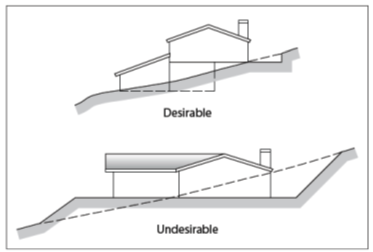
Placement of Dwelling on Slope
Source: Tom Camara Graphics, Mill Valley, California
(c)
Avoid grading at and near property lines where possible.
(d)
Accommodate existing and new drainage patterns and surface water flow that may result from the building project.
(e)
Cut or fill slopes on, abutting, or adjacent to residential lots shall be maximum 3:1.
(Ord. No. 2025-004, § 1 (Exh. A), 4-7-2025)
Sec. 5-73. - Orientation.
(a)
The longest dimension of the dwelling footprint should be placed parallel to the primary street.
(b)
The primary entrance to a dwelling should face the primary street on which the lot fronts.
Sec. 5-74. - Setback.
While a minimum building setback is established for the zoning district in which the dwelling is located, consideration should be given to establishing the front building line in a manner that is consistent with other dwellings on the same side of the street and within 500' of the lot to be built upon.
Sec. 5-75. - Dwelling width.
When a new dwelling is to be located on a lot in an infill development area, the width of the dwelling as it parallels the street should not exceed the width of dwellings on adjacent lots.
Sec. 5-76. - Height and scale.
(a)
New dwellings should have heights within the range typically observed for dwellings on adjacent or nearby lots in the neighborhood. Where a dwelling must be taller than existing dwellings in the vicinity (e.g., a 2-story home along a street where one-story homes are prevalent), the scale of the new, taller infill dwelling should be mitigated through the use of upper story setbacks and articulation of facade planes.
(b)
For 2-story dwellings or additions, design the second story so that it is subordinate in scale to the first story and so as not to project or overhang the first floor footprint.
Sec. 5-77. - Roofs.
(a)
Roof forms of the dwelling should be similar to those existing on dwellings in the vicinity.
(b)
Flat roofs should be avoided; a minimum roof pitch of at least 4:12 is recommended.
(c)
Preferred roofing materials include asphalt composition shingles, tile or standing seam metal. Wood shingles should not be used.
(d)
Plumbing, attic, and other vents and other rooftop accessories should be painted or of a material colored to match the color of the roofing material.
Sec. 5-78. - Dwelling entry.
The use of a covered porch, stoop, and/or other entryway feature is encouraged for the dwelling's primary entrance. A minimum front porch depth of 6' and a minimum area of 40 square feet is encouraged.
Sec. 5-79. - Additional architectural features.
Trellises, balconies, columns, bay windows, and similar architectural projections that are consistent with the architectural style are encouraged.
Sec. 5-80. - Walkways and pathways.
A concrete walkway is encouraged from the dwelling's primary entrance to the fronting street, (connected to the public sidewalk where it exists).
Sec. 5-81. - Exterior building materials.
(a)
A range of exterior building materials may be appropriate. Traditional natural materials like kiln-fired brick or stone and wood are preferred, however, other materials such as cementitious fiberboard and cedar shake may also be considered, depending on surrounding dwellings and neighborhood covenants.
(b)
Materials on the facade to be avoided include metal or aluminum siding, reflective materials and finishes, and unfinished concrete block.
(c)
When material changes are incorporated into a facade, they should occur at a change in plane.
(d)
Accent materials, if used at the base of the structure, should be at least 3' high.
(e)
On corner lots, exterior building materials should be consistent on dwelling elevations facing both streets.
Sec. 5-82. - Building articulation.
(a)
Projections and recesses should be used to provide shadow and depth. Therefore, long, unbroken volumes and large, unarticulated wall and roof planes should be avoided. In addition, building forms should be articulated by varying roof heights and wall planes.
(b)
Roof articulation may be achieved by changes in plane of no less than 2' 6" and/or the use of traditional roof forms such as gables, hips, and dormers. However, avoid multiple roof angles, types, or slopes that may create a disjointed or chaotic appearance.
(c)
As a general guide, at least 25% of the facade should be offset a minimum of 2' either projecting from or recessed back from the remainder of the facade.
Sec. 5-83. - Windows.
(a)
Windows should be rectangular or arched openings of various sizes and forms. Recessed windows should be considered in the design of the structure. Bay windows are also acceptable.
(b)
Examples of inappropriate window styles and types are windows flush with the wall, reflective glass, and silver aluminum or gold window frames.
Sec. 5-84. - Additions to principal dwellings.
(a)
Additions to principal dwellings should be similar in height and roof form to the principal dwelling and preferably located to the sides or rear of the primary dwelling.
(b)
Incorporate materials and finishes on a building addition or remodel consistent and continuous with the existing dwelling.
Sec. 5-85. - Garages and carports.
(a)
Garages attached to the principal dwelling should not face the street, but if such placement is necessary, street-facing garages should be recessed a minimum 10' behind the facade of the principal dwelling.
(b)
Street-facing garages, where permitted, should have recessed garage doors (i.e., appear to be set into a wall rather than flush with an exterior wall) to allow for shadow and depth.
(c)
Pre-fabricated metal carport or storage structures are discouraged and if provided should be located in a rear yard.
Sec. 5-86. - Fences and walls.
(a)
Decorative fences and walls should be constructed of consistent and high quality materials to create a coordinated appearance.
(b)
Fences and walls, if permitted in front yards, should be at least 50% transparent. Preferred fence composition materials are wood and wrought iron; aluminum picket, painted black is acceptable.
(c)
Walls facing the outside of the property should be constructed of decorative block. Wall accent materials are also encouraged.
(d)
If a retaining wall is needed in the front yard, its appearance should be mitigated with landscaping between the back of sidewalk (where it exists, or the street right-of-way line) and the wall face.
Sec. 5-87. - Trees in front yard.
(a)
Preserve individual trees and groves of trees where they exist in the front yard, where possible, particularly those providing significant canopy near the public right-of-way.
(b)
Plan the location of driveways and curb cuts to avoid existing trees.
Sec. 5-88. - Yard landscaping.
(a)
Sodded front, side and rear yards are necessary for consistency in city neighborhoods.
(b)
Unless street trees already exist or a different street tree standard applies, front lawns should be supplemented with two street trees and five shrubs.
(Ord. No. 2024-011, § 1(Exh.), 6-3-2024)
Editor's note— Ord. No. 2024-011, § 1(Exh.), adopted June 3, 2024, amended § 5-88 in its entirety to read as herein set out. Former § 5-88 pertained to front yard landscaping.
Sec. 5-89. - Outdoor lighting.
(a)
One foot-candle is the general standard for site lighting. All parking, building, amenity, and site lighting should directed down to diminish nuisance light. Additionally, units should have exterior entry and porch door lights controlled from within the unit.
(b)
Solar-powered lighting is acceptable and encouraged, if common throughout.
(c)
Gas lamp lighting in the front yard is acceptable.
Sec. 5-90. - Utilities.
All utility distribution systems should be underground where possible.
Sec. 5-101. - Purpose and intent statement.
It is hereby established that an urban core within the boundaries of the Downtown Development Authority of the City of Powder Springs with its own geographically described boundaries is hereby established.
The purpose and intent of such a boundary is to protect the historic nature and character of the area by establishing architectural styles, permitted building materials and colors in order to enhance the historic area, provide uniformity in future construction and/or rehabilitation of the existing building stock, to protect the investment of properties and building stock and to further promote the economic development of properties within said boundaries.
The Powder Springs downtown area has a long history and was established as early as 1838 when it was first incorporated as the City of Springville and grew to become a vibrant commercial area in the 1800s with a resort, hotel, retail shops, homes, medical offices and a school.
The existing urban core includes a number of historically significant structures made up of certain architectural elements and materials that create an architectural style of its own and is reflective of the original designs from the major development pattern of the 19 th century to mid-20 th century.. Construction was primarily of one and two story buildings with large plate glass storefront windows to allow natural light in the buildings. Materials were of brick, wood horizontal siding, and architectural shingles on the roofs while some were flat but with a parapet. Homes at that time had large sweeping porches with some being 2 stories.
Therefore it is hereby established that the architectural style of the urban core shall be that of what was originally established in the period that is significant of when the area was first developed. The following materials, architectural design and colors are hereby established within the geographical boundaries of the Powder Springs Urban Core. Said boundaries are attached hereto and shown as Exhibit A to this article
Sec. 5-102. - Establishment of architectural design style.
The existing urban core is a style that includes a number of historically significant structures made up of certain architectural elements and materials that create an architectural style of its own. It is hereby established that the architectural style of the urban core shall be that of what was originally established in the period that is significant of when the area was first developed.
Sec. 5-103. - Establishment of building materials.
It is hereby established that the following building materials or a combination thereof be required:
(a)
Brick
(b)
Stone
(c)
Wood (horizontal siding)
(d)
Glass
(e)
Cement siding (horizontal siding)
(f)
Roofing
1.
Architectural shingles
2.
Flat with an architectural parapet
Sec. 5-104. - Establishment of traditional storefront elements.
It is hereby established that the following elements shall be contained within the storefront:
(a)
Bulkheads/kick plates;
(b)
Display windows;
(c)
Transoms;
(d)
Pilasters;
(e)
Belt course where applicable;
(f)
Cornices; and
(g)
Entryway.
Sec. 5-105. - Establishment of a color pallet.
It is hereby established that the color pallet Fundamentally Neutral and manufactured by Sherwin-Williams shall be the colors used or a gradation of the same for the urban core.
Sec. 5-106. - Other applicable codes used with this article.
The following codes shall be used where appropriate in conjunction with this article. The community development director shall determine which of the following codes are applicable and meet the requirements of the urban core.
(a)
Article Five: Site and Architectural Design Review, Powder Springs Unified Development Code;
(b)
Historic Property Design Guidelines of Powder Springs;
(c)
Powder Springs Overlay Standards;
(d)
Springs In Motion Powder Springs LCI Plan Update 2016; and
(e)
Powder Springs Zoning Ordinance.
Sec. 5-107. - Review and approval authority.
It is hereby established that the community development director for the City of Powder Springs, Georgia shall have the authority to review and approve the design of new construction, addition, rehabilitation or a combination of the same for any building construction with the boundaries of the urban core.
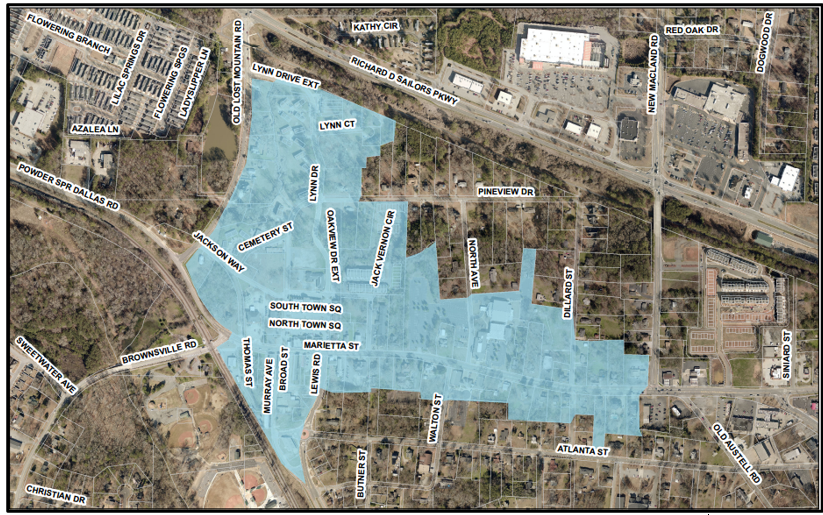
Urban Historic Core in Downtown Development Authority Boundary

