
Powder Springs City Zoning Code
ARTICLE 7
- SIGNS AND ADVERTISING DEVICES
Sec. 7-1. - Beneficial functions.
(a)
Signs provide a means of communication, a visual, place-based medium by which to express messages. Signs and advertising devices facilitate and aid in the identification and location of business establishments, institutions, and other land uses. Signs can be an effective, easily available, and cost-efficient way to inform people and aid their decision-making. Signs are an investment that brings economic value to businesses. Signs provide a means for attracting consumers who are not otherwise familiar with the geographic area. Signs provide assistance in individuals making selections from among alternative choices. Signs help certain locations work from a profitability standpoint that otherwise might fail without adequate signage.
(b)
Signs derive their value in part from public improvements. Businesses exist and prosper in part because consumers have access to their locations via public rights-of-ways. Businesses locate, and signs are erected, because of the facilitation of access the community provides to business locations. The public way creates much of the value for the person or establishment erecting the sign, and visibility from the public way is what creates the problems which give rise to the need for sign controls. Because the public way contributes to value, the public therefore has a right, and indeed an obligation, to control the problems that arise from creating that opportunity and value.
Sec. 7-2. - Regulation of messaging.
Signage is a form of advertising. All other advertising mediums are regulated. There is limited federal and state regulation of signs, despite significant intervention by the federal government in the regulation of other forms of communication. Signage is a type of advertising that cannot be turned off or rejected by the consumer, like some other forms of communication. For instance, radio and television advertisements can be avoided by turning off the radio or television. With regard to signs, however, motorists must keep eyes open to drive and cannot block out signs from their peripheral vision. Absent federal and significant state regulation, it is in the public interest for the city to control signage.
Sec. 7-3. - Public safety.
(a)
Signs by their very nature are intended to gain the attention of motorists and therefore distract them from the primary purpose of maneuvering a vehicle along a road. Signs, if unregulated, can confuse motorists by mimicking traffic safety signals and signs. Motorists might confuse signs that contain flashing or blinking red, green, or yellow lights with roadway traffic signals. Signs constructed of shapes like an octagonal "stop" sign might also impair public safety by confusing the motorist. Therefore, there is a substantial public purpose served in prohibiting signs that mimic or would be confused with traffic safety signals and signs. Unregulated signs can also degrade the utility and reduce the visibility and effectiveness of public safety signs. The regulation of signs is needed to ensure that signs can be read for their many beneficial purposes but in a way that does not impair visibility or cause traffic accidents.
(b)
Sign regulations achieve public safety purposes not achieved by building codes. Without regulations, signs can pose a clear danger to public safety. It has long been recognized that sign controls are needed to promote traffic safety and avoid traffic accidents. Signs erected too close to a road can impair visibility and can cause traffic accidents. If signs are not regulated with regard to placement, height, size, and other physical attributes, they can interfere with the sight of motorists exiting a driveway onto a public road. It is necessary to regulate the time, placement, and manner of signs for public safety purposes.
(c)
Addressing of places and other means of locating establishments are essential to police, fire, and other emergency responders. Signage, if left unregulated, can cause confusion and delay in responding to emergencies.
(d)
Limitations placed on signs erected on storefront windows can increase visibility from outside the establishment and may help deter crime and robberies. Sign controls that limit the amount of storefront window and door areas that can be covered with signs enhance visibility of activities within the store or building. Limits on window signs can provide for an appropriate minimum visibility from the exterior and can increase public safety of commercial areas through a reduction in crime potential.
(e)
Electronic multiple message signs, which allow operators to change content from remote locations in a matter of seconds, have been shown to create possible threats to public safety. Such signs are erected for the purpose of trying to hold the attention of motorists by changing messages and pictures for short durations using a series of bright, colorful images produced mainly via LED (light emitting diode) technologies. Brightly lit and colorful signs that change messages every few seconds compel motorists to notice them, and they lure the attention of motorists away from what is happening on the road and onto the sign. Such signs pose public safety threats because if they attract a motorist's attention, the motorist will look at the sign and not at the road. Electronic multiple message signs are also a threat to public safety because of their brightness, making them visible from great distances. Due to their nature of brightness, changing colors, and changing displays, electronic multiple message signs are more distracting than signs which do not vary the brightness, color or message, or multiple message signs that are changed by other means at less frequent intervals. Some electronic multiple message signs could, if unregulated, have the appearance of large, plasma-screen televisions. An electronic LED display contains brightly-lit text and graphics which can be seen from hundreds of feet away, drawing the attention of everyone within view. Unless otherwise regulated, such displays can be extremely bright since they are designed to be visible in bright sunlight and at night. Furthermore, the human eye is drawn to them far more strongly than to traditional illuminated signs. It can take 6 seconds for a person to comprehend the message on an electronic sign, which is considered 3 times the safe period for driver distraction.
Sec. 7-4. - Public health.
Unregulated signage can contribute to clutter and lack of organization in the wayfinding system of a community and thereby negatively influence the stress levels of motorists. Roadside blight can contribute to high stress levels of motorists (Source: Meg Maguire, Ray Foote, and Frank Vespe, 1997, "Beauty As Well As Bread," Journal of the American Planning Association 63(3): 317-328). Height, size, placement, and other sign regulations serve substantial public purposes of bringing order to the wayfinding system that may help to avoid undue stress levels of motorists.
Sec. 7-5. - Reduction and mitigation of adverse impacts on adjacent properties.
The size, height, construction materials, location, condition, and attributes of signs can have an impact on surrounding and nearby land uses and properties. Signs can have adverse impacts on adjacent properties if not regulated and properly maintained, including the lowering of property values. Abandoned and antiquated signs and sign structures (e.g., a pole with a blank structure for a sign face) can have a particularly detrimental effect on adjacent properties and contribute to an overall image of blight in the community.
Sec. 7-6. - Prevention of adverse impacts on community character and attractiveness.
(a)
Sign regulations promote and ensure the aesthetics of the community. The concept of public welfare is broad and inclusive, and the values it represents are spiritual as well as physical, aesthetic as well as monetary. Sign regulations serve the substantial public purposes of ensuring that the community is beautiful as well as healthy, spacious as well as clean, well balanced as well as carefully controlled (Source: Berman v Parker 348 U.S. 26, 75 S. Ct. 98, 99 L. Ed. 27 1954).
(b)
Appearance of a community, which is substantially influenced by signs, is essential to the city's long-term economic viability. Signs and advertising, without regulation, can detract from the character, beauty, and visual attractiveness of the city. Unregulated signage and advertising devices can mar scenic landscapes and impair other visual qualities of the city. Visual blight adversely affects the aesthetic quality of life and traffic safety in the community for residents, businesses, pedestrians, and motorists.
(c)
The city has great interest in maintaining and enhancing the aesthetic environment. Regulations are needed to ensure that signs are compatible with the surroundings and do not detract from the character of particular districts. The regulation of signage according to different zoning districts is therefore an acceptable way of ensuring character and attractiveness are maintained. Sign controls, including regulations that go beyond size, height, location, and manner restrictions, are necessary to improve the visual character and quality of life of the community.
Sec. 7-7. - Protection of public investments.
Unregulated signs adversely impact public investments. Sign regulations help to assure that public benefits derived from expenditures of public funds for the improvement and beautification of streets and other public structures and spaces are protected. Unregulated signs can neutralize the value and benefit of public investments in streetscapes.
Sec. 7-8. - Promotion and maintenance of private investments.
Sign regulations benefit businesses that seek to advertise. Unregulated commercial signage can be detrimental to individual businesses, because business owners may be compelled to erect larger and more costly signs to outperform neighboring or nearby businesses. Such competition for visibility among business can result in too many signs and excessive sizes, to a point of diminishing returns where individual business signs are not adequately visible. If unregulated, the competition for visual recognition can defeat the purpose of the signs, which is to carry a message, often a commercial one. If signs are left unregulated, patrons of individual businesses may miss their destinations because they cannot find the particular business of choice in the sea of advertising devices.
Sec. 7-11. - Viewshed is subject to regulation.
This article is intended to apply to all signs and advertising devices that are or are intended to be viewed from a public right-of-way or adjacent property, or that are intended to be viewed from outdoor areas of public property, except as otherwise specifically stated in this article.
Sec. 7-12. - Content neutrality.
(a)
The city intends to adopt regulations which are content-neutral. It is not the intent to regulate the content of messages in any way. To accomplish this, these regulations do not distinguish between on-site or off-site sign content, nor do they distinguish between commercial and non-commercial content. It is the intent of this article to allow political, religious, or personal (non-commercial) messages on any sign permitted to be erected by this article.
(b)
For a sign code to be content neutral, it is necessary to define all signs in terms of something other than the content of the message displayed on a given sign, such as its location. If in applying a sign regulation it is necessary to read the content of the sign to determine whether the sign is lawful or not, the sign regulation has failed to achieve content neutrality.
(c)
The principle of content neutrality runs counter to most people's thought processes, as they usually will have in mind a particular purpose when they want to erect a sign or ask for a sign permit. For instance, one person may wish to express a message unrelated to business or commerce (non-commercial speech), while business owners are trying to attract customers, identify their products, and perhaps assist other businesses or landowners in identification and location. A sign code must provide for commercial and noncommercial speech, even though it is considered wise not to distinguish between the two in the regulations themselves, since to make that distinction one would have to read the message to determine whether it is commercial or noncommercial speech. It is widely recognized that how sign regulations treat noncommercial speech in relation to commercial speech is subject to scrutiny by courts, given the constitutional right to free speech.
Sec. 7-13. - Time, placement, and manner restrictions.
It is the intent of this article to regulate the composition, type, location, placement, height, size, illumination, and the duration of signs and advertising devices that may be displayed. In adopting these sign regulations, the Mayor and Council especially recognizes the vast number of court decisions, coming from Georgia courts, the federal courts, and courts throughout the United States, which recognize that the regulation of the size, location and quantity of sign structures is a valid and lawful means of achieving the intentions and purposes of this article, and that such intentions and purposes are valid and lawful governmental interests. The regulations contained herein are no more extensive than necessary to serve the substantial governmental interests identified in this article.
Sec. 7-14. - Noncommercial and commercial messages.
In imposing sign regulations, all landowners need to be equally protected in terms of expression of noncommercial messages. Landowners and occupants have the right to free speech, including political speech, even when there is no election upcoming. One would not expect commercial messages to be needed on a lot used exclusively for residential purposes. This means that sign regulations for residential zoning districts can more or less prevent signage to accommodate commercial messages, but yet those restrictions must respect first amendment rights to free speech and also accommodate nonresidential uses that may exist or are allowed in residential zoning districts. A sign code can protect the rights to noncommercial speech by not specifying the content of messages ? thus any sign allowed by a given ordinance could display a noncommercial message, even if such sign is most likely going to be used to identify a business or establishment, or provide direction to such establishments on or off-site.
Sec. 7-15. - Variation required.
Not all lots, parcels, or properties are equal when it comes to the need for signs. Signs along state highways are generally greater in area and height not only because of the desire to allow commercial messages but also because motorist travel speeds (i.e., posted speed limits) are typically greater than in residential neighborhoods. There is evidence that larger signs are needed for legibility and visibility on state highways given their greater motor vehicle speeds (i.e., less time to view a message) and greater width of the right-of-way, which increases distance of the motorist to sign messages and thus decreases legibility and visibility.
Sec. 7-16. - Regulation by zoning district.
The zoning district is an appropriate means of regulating signs, because generally a character is established by each zoning district (see the city's adopted comprehensive plan). The needs for signage differ remarkably among single-family residential zoning districts from zoning districts allowing business, which in turn differ significantly from business parks, low-rise office complexes, and industrial establishments. Greater sign heights and areas are appropriate in business and industrial zones when compared with residential zoning districts.
Sec. 7-17. - Proportionality.
The relationship of sign characteristics (area and height, for example), especially wall signs, to the building on which it is attached is very important in terms of aesthetics. Without regulation, signage placed on walls can be too large in proportion to the building facade. Similarly, sign codes need to accommodate the differences in size, scale, and height of different buildings. For instance, if an absolute maximum sign area is established, it may be appropriate proportionally for a certain size of building but inappropriate (too small and also out of proportion) to a very large building. For this reason, it is appropriate to regulate wall signage on the basis of the percentage of area of the building facade. Similar, a proportionality regulation is considered appropriate for window signage. An industrial establishment, with large wall areas, does not have the same needs as a commercial establishment in this regard and is appropriately limited to a smaller percentage of wall area used for signs and advertising than a commercial establishment.
Sec. 7-18. - Rationale for sign allowances.
(a)
In addition to regulation by zoning district, by which sign height and maximum sign area are distinguishable, the uses permitted within zoning districts can range from residential, to institutional, commercial and industrial land uses. Sometimes, non-residential uses are permitted in residential zones, and sign regulations need to account for the needs to identify such nonresidential establishments in residential zoning districts, but yet ensure that such signs are compatible by way of height and area appropriate to a residentially zoned area. The regulations adopted in this article distinguish between different land uses and assign different sign permissions based on such land use. For instance, signage allowances differ among a lot with a single dwelling, a lot containing a single non-residential principal permitted use (which can occur in virtually any zoning district), and a lot containing more than one permitted principal use or more than one building (such as shopping centers and office parks). The regulations also define allowable signage for vacant lots.
(b)
Residential uses do not require identification other than by street address. However, non-residential uses, whether in residential or nonresidential zoning districts, usually do require identification of some sort. This is why a principal use ground sign is allowed for nonresidential but not for single-family residential uses; while intended to serve primarily establishment identification needs, principal use ground signs are not limited in the message and therefore may be used in total or in part to carry a noncommercial message. Each land use type, including vacant lots, are permitted an accessory ground sign - which is intended to allow for reasonable noncommercial speech for each lot owner or resident. For nonresidential land uses, the need for accessory messaging is greater than for lots with single dwellings, and therefore, more than one accessory ground sign is allowed.
(c)
With regard to wall signage, there is no need to have signs attached to single dwellings, but nonresidential establishments have the need to identify uses within buildings. This is why a residential dwelling does not allow wall signs (other than that described for temporary durations in the event of lease or sale), while nonresidential uses regardless of zoning district are allowed wall and window signage proportional to the building or area within which a sign can be placed.
Sec. 7-19. - Real estate-related messages.
Although a content neutral sign code cannot describe and regulate signs related to the sale or lease of real estate, the sign code must still accommodate these needs. The needs of lot and building or leased space owners to market the sale and lease of properties and buildings can be accommodated with a duration-type sign allowance - i.e., a special sign allowance during the time a lot, building, or part of building is for sale or lease. The sign regulations therefore provide for signs advertising a building or lot for sale or for lease, during the time such lot or building or portion thereof is for sale or lease; these regulations accommodate such signage needs as ground signs as well as wall and window signs.
Sec. 7-20. - Sign prohibitions.
Given the objectives of the city, it is appropriate to prohibit signs and other advertising devices where if used frequently by multiple businesses would create an appearance of clutter, information overload, and distractions to motorist safety. Certain advertising devices such as wind-blown or air-blown devices create movement that distracts motorists and such devices are not fundamentally necessary to attract customers in light of other signage and advertising allowances.
Sec. 7-21. - Billboards.
Due to their large areas, billboards are inherently incompatible with the goals and objectives for development and community character as established in the city's adopted comprehensive plan. Because this sign ordinance allows for any type of message on any type of lawful sign, it is unnecessary to allow large signs that are inconsistent with the city's desired character and not fundamentally necessary in terms of providing additional opportunity for messages that may be classified informally as "off site." The purposes served by billboards are reasonably accommodated by other signs, but with smaller areas and at lower heights than would be accomplished with billboards. The city recognizes that billboards that exist, even though they may not be in compliance with the city's sign allowances, can be continued and cannot be "amortized" per federal law and/or court cases.
Sec. 7-22. - Illumination.
The city recognizes that the lighting of signs has a significant effect on the character of districts. A number of problems with external lighting have long been recognized, including light trespass, light pollution, sky glow, and brightness and glare which can detract from drivers during hours of darkness. In addition, the city finds that signs which are internally illuminated create an appearance of a nonresidential or business area which is inappropriate in residential zones. It is reasonable and appropriate to establish regulations for the lighting of signs depending on zoning district and also based on the type of sign. There is no compelling reason why signs of a temporary nature should be or need to be illuminated. Multiple message electronic signs pose unique challenges regarding the visual environment and traffic safety unless regulated. It is appropriate for aesthetics, compatibility, and other objectives as well as for energy purposes that lighted signs be restricted from utilizing lighting, when the establishment is not open.
Sec. 7-23. - Advertising for special events.
Certain advertising devices, such as banners or inflatable signs, are not normally appropriate given the objectives of the city to maintain aesthetics and to prevent inappropriate competition among establishments for attention. While it is appropriate to disallow the general use of air-blown devices, banners, and inflatable signs, it is considered appropriate in the city to permit businesses and establishments to occasionally use such advertising devices, typically for a limited duration for special events such as grand openings and "going out of business" sales.
Sec. 7-24. - Flags.
Flying the American flag is one of the most fundamental rights of every person in the United States. Federal protections have been instigated to protect that right. It is not the intent to prevent the display of the American flag on any sign, although it is also appropriate to restrict the use of flags as an advertising medium. The city finds that the flying of flags, whether the nation's flag or any other, can be abused. Specifically, businesses, in an effort to outdo their competitors or to stand out in the complex visual environment of messaging, will sometimes install flags on light posts or place multiple small flags along street frontages. Other businesses may, if unregulated, choose to fly uncolored flags in multiple locations just to gain attention. These situations are not considered responsible displays of the American flag and are considered abuses for advertising purposes. The use of flags as an advertising or attention-attracting medium deserves regulation. Accordingly, it is appropriate to regulate flags, including colored flags without sign copy, to ensure the city's various objectives are met, while at the same time safeguarding the rights of individuals, establishments, and property owners to demonstrate allegiance to the nation, a state, a city or a private establishment. The regulations pertaining to the size, height, and manner of displaying flags is intended to permit such expressions of allegiances while preventing the potential abuses. The copy or content of flags is not regulated by this article.
Sec. 7-25. - Sign maintenance.
The city finds that signs, if improperly maintained, present an unkempt appearance and may present an image of blight to visitors, residents, and employees. It is in the interest of the city to ensure that signs are properly maintained to avoid the appearance of blight and also to prevent possible detrimental impact on property values that may result from such blight.
Sec. 7-26. - Architectural review.
In some parts of cities, such as neighborhoods or business areas containing buildings of historic or cultural significance, the impact of signage on aesthetics and character is more intense and of even greater concern to the city. Historic and downtown business districts, to maintain character, need special scrutiny with regard to the materials and appearance of signs. Accordingly, it is appropriate to require architectural review of signs in order to maintain and enhance the harmony and character of the visual setting of such district or districts.
Sec. 7-27. - Regulatory relief.
It is acknowledged that no set of sign regulations can anticipate all situations relative to sign needs. It is further acknowledged that sign regulations may impose undue burdens on property owners and occupants. Accordingly, it is appropriate to have a procedure, in the form of a variance permission, which can bring relief from strict sign regulations when conditions warrant such relief be granted.
Sec. 7-32. - Purposes.
The purposes of this article are to:
(a)
Facilitate safety of the public.
(b)
Promote and improve traffic safety.
(c)
Avoid confusion and delay when public safety personnel are responding to emergencies.
(d)
Protect adjacent properties from adverse effects of signs and advertising devices.
(e)
Balance the rights of individuals to convey their messages through signs with the rights of the public to be protected against the unrestricted proliferation of signs.
(f)
Preserve and improve the appearance of the community as a place in which to live and work and as an attraction to nonresidents who come to visit or trade.
Sec. 7-33. - Content of sign.
This article does not, and shall not be construed to, regulate the specific content of signs. Any sign, display, or device allowed under this article may contain any message, whether commercial or non-commercial.
Sec. 7-34. - Compliance with other laws.
All signs and advertising devices shall comply with all applicable federal, state, county, and city laws and ordinances. Compliance with the terms of this article shall not relieve any individual, corporation, or other entity of any other duty imposed by law. Where state sign law and/or regulations apply, and there is conflict or overlap with this article, the more restrictive requirements shall govern. [References: O.C.G.A. § 32-6; Signs displaying sexual conduct or sexually explicit nudity, defined by the State of Georgia at O.C.G.A. § 36-60-3; Obscene signs, as defined by the State of Georgia at O.C.G.A. § 16-12-80; regulation of signs and advertising within the right-of-way of any public road, per O.C.G.A. § 32-6-51; state statute on outdoor advertising, per O.C.G.A. § 32-70 et seq.; Rules and Regulations for Outdoor Advertising per O.C.G.A. § 32-6-90 and Rules of the Georgia Department of Transportation, Chapter 672-7, Outdoor Advertising].
Sec. 7-35. - Definitions.
Accessory ground sign: A secondary sign allowance provided for in this sign ordinance, for a sign erected on the ground.
Advertising device: Any structure or device erected or intended for the purpose of displaying advertising situated upon or attached to real property. For purposes of this article, an advertising device is a "sign."
Air-blown device: Any device not otherwise specifically defined in this article, that is designed to inform or attract, whether or not such device carries a message, and which all or part of the device is set in motion by mechanically forced air. For purposes of this article, air-blown devices are advertising devices.
Animated sign: A sign with action, motion, sound, or changing colors which accomplishes such action, motion, sound, or changing colors with or without electrical energy. This includes signs with lights or other illuminating devices that blink, flash, fluctuate, or have a changing light intensity, brightness, or color. This definition does not include a "swinging sign" or "multiple message sign" as defined by this article. For purposes of this article, the transition of a message on an electronic multiple message sign shall not be considered "animation."
Awning: An architectural projection or shelter projecting from and supported by an exterior wall of a building and composed of a covering of rigid or non-rigid materials and/or fabric on a supporting framework that may be either permanent or retractable.
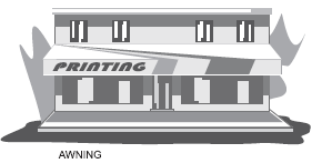
Source: United States Sign Council. 2011.
Model Code for Regulation of On-Premise Signs.
Awning sign: An awning that contains letters, numbers, symbols, pictures, logos, or visual display, or other communication, attached, painted on, or made an integral part of an awning. Awning signs are "wall signs" for the purposes of this article.
Banner: A sign with or without characters, letters, illustrations, or ornamentation applied to cloth, paper, plastic, or natural or synthetic fabric of any kind with only such material for a backing. For purposes of this article, a banner is a "sign."
Building frontage: The width in linear feet of the front exterior wall of a particular building in which an establishment is located.
Building marker: Any sign copy cut into a masonry surface or made of bronze or other permanent material.
Bunting: A long, colored strip of cloth or other pliable material used for festive decorations. For purposes of this article bunting is a "holiday decoration" but can be abused as an advertising device.
Canopy, attached: A multi-sided structure or architectural projection supported by attachment to a building on one or more sides and also supported by columns or supports at additional points.
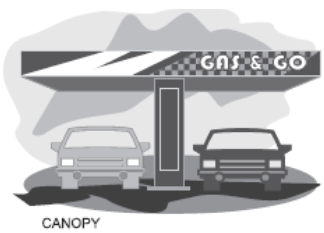
Source: United States Sign Council. 2011
Model Code for Regulation of On-Premise signs.
Canopy sign: A sign attached, painted on, or made an integral part of a canopy, whether that canopy is attached to a building or structure or freestanding. Canopy signs, whether attached, painted on, or made an integral part of a canopy (including suspension underneath a canopy), are wall signs for the purposes of this article, unless specifically identified otherwise in this article.
Derelict sign: A sign that is dilapidated or in such condition as to create a hazard or nuisance, or to be unsafe or fail to comply with the building or electrical Codes applicable in the city.
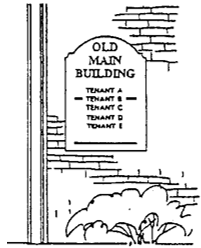
Wall Directory Sign
Directory sign for multi-tenant development: A sign which is allowed on the interior portion of a property with multiple buildings
and/or more than one tenant or occupant of a building. Directory signs may be freestanding
or attached to a building (i.e., wall sign).
Double-faced sign: A sign structure with 2 sign faces that are parallel (back-to-back)
or that form an angle to one another, where each sign face is designed to be seen
from a different direction and the 2 sign faces are separated from each other at their
nearest point by no more than 3'.
Erect: To construct, build, raise, assemble, place, affix, attach, create, paint, draw, or in any other way bring into being or establish. Activities performed as an incident to the change of advertising message or the normal maintenance or repair of a sign structure are excluded from this definition.
Externally illuminated sign: Any sign that is partially or completely illuminated at any time by an artificial light source that directly or indirectly illuminates the face of the sign from outside the sign structure.

Feather banner: a vertical portable sign, made of lightweight material that is prone to move in the wind, and that contains a harpoon-style pole or staff driven into the ground for support or supported by means of an individual stand. This definition includes such signs of any shape including flutter, bow, teardrop, rectangular, shark, feather, and U-shaped. For purposes of this article, a feather banner is an advertising device and sign.
Flag: A device made of cloth, plastic, or natural or synthetic fabric, with or without characters, letters, illustrations, or ornamentation applied to such surface, and which is designed to move in the wind. For purposes of this article, except as specifically authorized, a "flag" is an advertising device and "sign."
Ground sign: A sign or advertising device which is wholly independent of a building or structure for support (i.e., freestanding).
Inflatable sign: Any sign that is or can be filled with air or gas, excluding latex and similar balloons of less than 2' in diameter.
Illuminated sign: A sign that utilizes a constant, non-varying artificial light source primarily in order to convey its message after sunset, in contrast to an animated sign. Illuminated signs are of 2 classifications: internally illuminated and externally illuminated.
Internally illuminated sign: A sign illuminated by an internal light source which is viewed through a transparent or translucent panel.
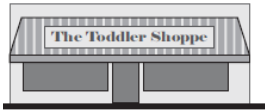
Source: United States Sign Council. 2011.
Model Code for Regulation of On-Premise Signs.
Marquee: A roof-like structure attached to and supported by a building wall without vertical supports and that projects in a cantilever fashion from the wall of a building.
Marquee sign: A sign painted on, attached to, or hung from a marquee. For purposes of this article, marquee signs are "wall signs."
Source: United States Sign Council. 2011.
Model Code for Regulation of On-Premise Signs.
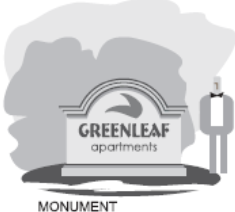
Monument sign: A sign where the structural part of the sign below the sign face encompasses an area no more than 50% of the area of the sign face and which is composed of brick, stone, or other similar quality material, and which the base is composed of or finished on the exterior with brick or stone or other approved material that is at least 18" in height above the ground.
Multiple message sign: A sign, display, or device which is designed so changes to the message or copy on the sign can be made expeditiously. Such a change of message or copy can be accomplished electronically, or by movement or rotation of panels or slats, or by changing the copy by manual means.
Multiple message electronic sign: Any sign which results in the illuminated display of messages or information by the use of a matrix of electric lamps, for example, digital, LED (light emitting diode) or similar or refined display technology, or other electric methods, which allows the message change to be actuated by an electronic control mechanism. It is characteristic of such signs that the sequence of messages and the rate of change can be electronically programmed and modified by electronic processes. Electronic multiple message signs are also "internally illuminated" signs. A multiple message electronic sign is distinguishable from an animated sign, as defined.
Nit: A standard unit of luminance; a measurement of direct light (i.e., looking directly at the light source), used to describe displays. A "nit" is an amount of emanating light equal to one candela per square meter (cd/m 2 ).
Nonconforming sign: Any sign which lawfully existed on the effective date of this article but which does not conform to the provisions of this article, or which does not comply with this article due to amendments to this article since the date of erection of the sign.
Pennant: A small, triangular or rectangular flag or multiples thereof, made of lightweight plastic, fabric, or other material, individually supported or attached to each other by means of a string, rope, or other material and meant to be stretched across or fastened to buildings, or between poles and/or structures, and which is designed to move in the wind. For purposes of this article, pennants are advertising devices.
Source: United States Sign Council. 2011.
Model Code for Regulation of On-Premise Signs
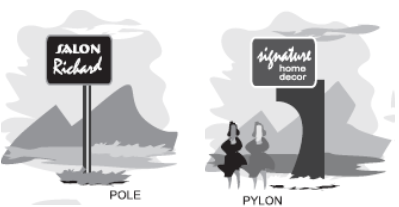
Pole or pylon sign: A sign that is mounted on a freestanding pole or poles, columns, or similar support such that the bottom of the sign structure is not in contact with the ground along the entire portion of the sign face. A pole or pylon sign is distinguishable from a monument sign.
Portable sign: Any sign whether on its own trailer, wheels, or otherwise, which is designed to be transported from one place to another. It is characteristic of a portable sign that the space provided for advertising messages may be changed at will by the replacement of lettering or symbols (i.e., a changeable copy sign). Even if the wheels or supports of such sign are removed and the sign converted and attached, temporarily or permanently, to the ground or other structure, said sign shall remain a portable sign for purposes of this article.
Portico: A porch or walkway, open to the outside air, which is covered by a roof supported by columns or pillars, typically leading to the entrance of a building. Signs attached to porticos are considered wall signs for purposes of this article.
Post and panel sign: An unlighted sign fabricated by using one or more posts to support the sign body. This type of sign is distinguishable from a pole or pylon sign for purposes of this article.
Principal use sign: Any notice or advertisement, which is permitted in conjunction with a principal use or principal building or use located on the property, and which may display a noncommercial, commercial, or other message, the content of which is not regulated by this article.
Projecting sign: A sign affixed to a wall and extending more than 4" from the surface of such wall, usually perpendicular to the wall surface.
Road frontage: The distance in linear feet of a lot where it abuts the right-of-way of any public street.
Source: United States Sign Council. 2011.
Model Code for Regulation of On-Premise Signs.
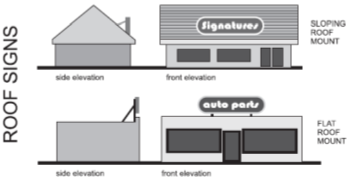
Roof sign: A sign projecting to a greater height than the front building wall, or any sign supported by or attached to a roof, including a sign painted on or adhered to a roof.
Source: Escondido, California,
Downtown Specific Plan
Sign Criteria & Guidelines
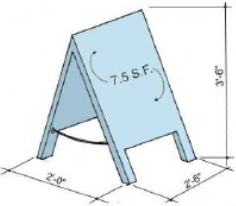
Sidewalk sign: A movable sign not secured or attached to the ground or surface upon which it is located, and which may include framed chalkboards.
Sign: A lettered, numbered, symbolic, pictorial, visual display, device, or communication designed or used for the purpose of identifying, announcing, directing, informing, or bringing to the attention of others the subject thereon, that is visible from the public right-of-way, a driveway or parking lot with access to a public right-of-way, or from an adjacent property, except as specifically noted otherwise in this article. The term sign includes but is not limited to "banners," "balloons," "flags," "pennants," "streamers," "windblown devices," and "advertising devices." Furthermore, the term "sign" includes the sign structure, supports, lighting system, and any attachments, ornaments, or other features used to draw the attention of the observers.
Sign area: The area within a continuous perimeter enclosing the limits of writing, representation, emblem, figure, or character together with any frame, other material, open space, or color forming an integral part of the display or used to differentiate such writing, representation, emblem, figure, or character from the background against which it is placed.
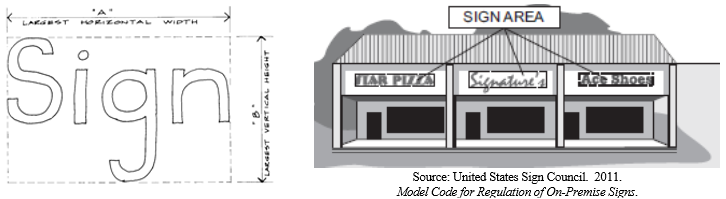
The sign area of wall signs shall be the net geometric area measured by the smallest possible rectangle or combination of rectangles enclosing the display surface of the sign, including the outer extremities of all letters, characters and delineations.
Sign face: That part of a sign that is or can be used for advertising purposes; that portion of the surface of a sign structure where words, letters, figures, symbols, logos, fixtures, colors, or other design elements are or may be located in order to convey the message, idea, or intent for which the sign has been erected or placed.
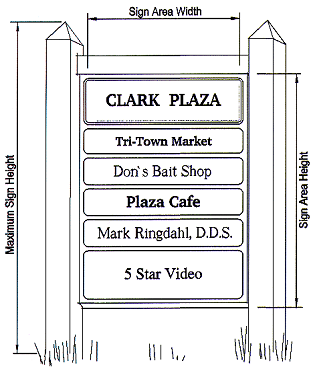
Sign height: The distance measured vertically in feet from the unaltered elevation of the ground at the base of the sign or directly beneath the sign, to the highest point of the sign, whether that highest point is the frame of the sign face or panel or the support of the sign.
Signable area: In the case of a wall sign, signable area is the building face on which the sign is proposed, excluding windows and doors. In the case of marquees or canopies, signable area shall be the area of the marquee or canopy wall on which the sign is proposed. For window signs, signable area shall be measured and calculated on the basis of the proportion of area within each individual window frame, not the total window area of all building windows visible from a street.
Sign in need of maintenance: Any sign or advertising device that includes any of the following or similar condition as identified by the city: lettering or other elements of the sign have become detached or have fallen off the sign or become misaligned; painted surfaces on the sign or sign structure have begun to peel, flake over a significant portion of the sign, or have faded or oxidized to an extent that the sign no longer displays the message as originally intended; a significant number of the bricks, stones, or other materials on the structural base of a sign have become detached or have fallen off, or have become misaligned; one or more illumination devices are not working and have not been replaced.
Sign structure: All elements of a sign, including the sign face, background, or decorative elements related to the presentation or support of the sign's message, and the structural supports.
Subdivision or project entrance sign: A freestanding monument sign pertaining to a subdivision or project designed for residences, offices, businesses, institutions, or light industries or combination thereof, located at the street entrance to the subdivision or project.
Suspended sign: A sign that hangs or is suspended beneath an awning or the cover of a walkway or beneath a support extending from a building. A suspended sign is distinguishable from an animated sign even if the sign copy area is attached to a building or structure in a way that can be set in motion with wind pressure. This term does not include any freestanding signs.
Temporary sign: A sign of a nonpermanent nature and erected for a limited duration. This term includes signs constructed from cardboard, coated paperboard, or corrugated plastic and which are either attached to a wooden post or stake, or set with a wire metal frame.
Visible: Capable of being seen (whether or not legible) without visual aid by a person of normal visual acuity.
Source: United States Sign Council.
2011.Model Code for Regulation of On-Premise Signs
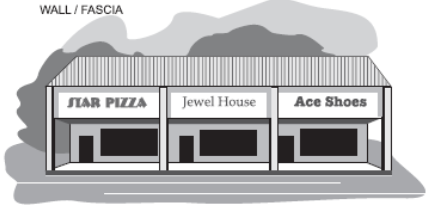
Wall sign: A single-sided sign with one visible face applied to or mounted to the wall or surface of a building or structure, in a parallel fashion, and which does not project more than 4" from the outside wall of such building or structure. Must be constructed of a durable material and not include vinyl letters adhered to the wall.
Windblown device: Any device not otherwise specifically defined in this article, that is designed to inform or attract, whether or not such device carries a message, and which all or part of the device is set in motion by wind. This device includes streamers, ribbons, or long narrow strips of fabric, plastic, or other pliable material designed to move in the wind. For purposes of this article, windblown devices are advertising devices.
Window sign: A sign that is placed on or behind a windowpane or a glass door or a sign installed within 2' of an exterior window or door and intended to be visible from the exterior of the building. Displays which show products or depict services sold on the premises and which are more than 2' from an exterior window or door shall not be classified as window signs.
Sec. 7-36. - Applicability.
(a)
No sign or advertising device may be erected, placed, established, painted, created, or maintained except in conformance with this article.
(b)
A sign may be erected, placed, established, painted, created, or maintained in the city only in conformance with the standards, procedures, exemptions, and other requirements of this article.
Sec. 7-37. - Exemptions.
The following signs are exempt from the provisions of this article:
(a)
Building markers and decorative or architectural features integral to buildings.
(b)
Cemetery stones and markings of individual graves or burial plots.
(c)
Holiday decorations, provided that they are removed within a reasonable period following the holiday season to which they pertain.
(d)
Signs, advertising devices, and product displays located more than 2' inside a building.
(e)
Street address identifiers and building identification numbers, and directory signs for multi-tenant developments as defined, which do not exceed an area of 4 square feet each or a height of 6'.
(f)
Public notice signs and signs of a public interest, erected by or on the order of a public officer in the performance of his duty, such as public notices, safety signs, memorial plaques, and signs of historical interest.
(g)
Scoreboards on conforming athletic fields.
(h)
Signs not oriented or intended to be legible from a public right-of-way, private road or driveway, or other private property.
(i)
Signs or stickers which are designed and sized to be read only from close range (i.e., 5'), attached to or integrated into a device or structure more than 25' from the right-of-way of a road, not to exceed 0.5 square feet each sign or sticker.
(j)
Traffic safety and traffic directional signs, installed within the right-of-way of a public street under the authority of the city or government with authority.
(k)
Traffic safety and traffic directional signs along private streets and driveways, and in off-street parking lots that are installed per the requirements of the city engineer and which do not exceed 4 square feet each.
(l)
Signs identifying disabled parking spaces required pursuant to applicable state law or this development code.
Sec. 7-38. - Prohibited signs.
The following signs and advertising devices are prohibited:
(a)
Airblown advertising devices.
(b)
Animated signs.
(c)
Any sign illuminated at such an intensity or brightness which reasonably interferes with the peace, comfort, convenience, and general welfare of residents or occupants of adjacent properties, or which reasonably creates a hazard to operators of motor vehicles.
(d)
Any sign not specifically permitted in a zoning district as provided in this article shall be prohibited in that district.
(e)
Flags, as defined, and including any flag for which there is no symbol, emblem, text, number, or copy whatsoever on the flag (i.e., colored flags with no message), except in the manner specifically provided by this article.
(f)
Hand-held signs, except as may be authorized by a special event sign permit (Section 7-68).
(g)
Inflatable signs and tethered balloons, except as may be authorized by a special event sign permit (Section 7-68).
(h)
Neon tubes or other exposed tubes containing luminescent gas on the outside a building or located inside a building and outlining a window or door.
(i)
Pennants, except as may be authorized by special event sign permit (Section 7-68).
(j)
Pole or pylon signs.
(k)
Portable signs.
(l)
Roof signs.
(m)
Signs containing reflective elements that sparkle in the sunlight or that contain luminous paint that glows in the dark.
(n)
Signs erected without the permission of the property owner.
(o)
Signs mounted or painted upon a parked vehicle that is positioned for the primary purpose of acting as a sign or advertising device and where such vehicle may not be in use in the ordinary course of carrying out its transportation function.
(p)
Signs located in a manner that obstructs any fire escape, window, door, or opening usable for fire prevention or suppression, or any sign that interferes with any opening required for ventilation.
(q)
Signs that are painted on or attached to benches, trees, fences, fence posts, utility poles, or rocks or other natural features.
(r)
Strobe, laser, and search lights when not used for emergency or public safety operations.
(s)
Umbrellas used for advertising or with sign copy.
(t)
Windblown advertising devices, except as may be authorized by a special event sign permit (Section 7-68).
Sec. 7-39. - Sign variance.
(a)
A property owner or sign owner may apply for a variance from the provisions of this article.
(b)
The application shall be accompanied by an elevation drawing and/or plot plan, drawn to scale, showing the dimensions and arrangement of the proposed sign. An inventory of signs and sign areas and heights existing on the property shall also be submitted. The department of community development may require other information about the variance requested and its relationship to the surrounding properties. Variance applications shall be accompanied by a fee as established by resolution of the Mayor and City Council.
(c)
Applications to vary the sign regulations in this article shall be filed, considered and decided subject to the procedures and notice requirements of article 14 of this development code for "Variances."
Sec. 7-41. - Signs on public property.
No sign shall be erected on or encroach on any public right-of-way unless authorization is specifically granted by the Mayor and City Council. Such sign shall be consistent with applicable state law with regard to signage in public rights-of-way.
Sec. 7-42. - Sight visibility triangle.
(a)
No sign erected to a height between 3' and 8' shall be permitted within an area beginning at the intersection of any right-of-way lines of any streets, roads, highways, or railroads, and extending 20' along each such right-of-way, and closed by a straight line connecting the end points of the 20' sections of the right-of-way lines.
(b)
No sign shall obstruct or impair the vision of any vehicle operator at the intersection of any public rights-of-way, at any entrance onto or exit from a public road, or any other location where said obstruction would create a hazard to life or property.
Sec. 7-43. - Obstruction of visibility of public sign.
No sign shall be located so as to obscure or otherwise interfere with the effectiveness of an official traffic sign, signal, or device.
Sec. 7-44. - Sign setback.
No sign shall be located closer than one foot from the right-of-way of a public or private road, and all signs shall be located outside of sight visibility triangles established by this development code.
Sec. 7-45. - Sign height.
(a)
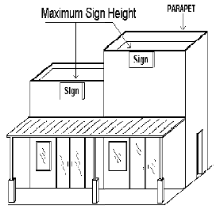
Wall signs shall not exceed the height of the building wall on which it is attached. Ground signs shall not exceed the maximum specified in Table 7-1, "Maximum Height of Signs by Zoning District."
(b)
Temporary signs shall not exceed 8' in height.
Table 7-1
Maximum Height of Ground Signs by Zoning District
* Except properties fronting on C. H. James Parkway, in which case the maximum height shall be 20 feet.
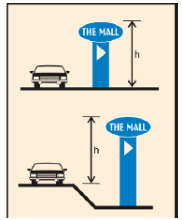
Source: United States Sign Council. 2011.
Model Code for Regulation of On-Premise Signs.
(c)
The maximum height established for the zoning district in which the sign is located shall apply to any sign, except that for properties situated below road grade, if the maximum height permitted would prevent adequate visibility, ground sign height may increase by up to 10' above the grade of the road to which said sign is directed. This subsection shall not be applicable in the CBD zoning district.
(d)
No sign projecting more than 4" from a building wall (projecting sign), if permitted, shall be placed less than 8' above the finished elevation of the ground, sidewalk, or other pavement surface.
Sec. 7-46. - Sign number by sign type.
(a)
Sign allowances are based on zoning district and use within the zoning district and also in some cases depending on the number of property frontages. The number of signs of a particular type shall not exceed the maximum established for such signs for the use and the zoning district in which it is located, as provided in Table 7-2, "Maximum Number and Area of Signs by Use Type by Zoning District." Unless specifically provided otherwise in Table 7.2, a property shall be limited to only one sign of the type permitted.
(b)
With regard to wall sign allowances, if a building, structure, or freestanding canopy faces more than one road frontage, each wall facing a road frontage shall be permitted to have the wall sign area specified for such building.
(c)
When this article permits one sign for each road frontage, the sign number allowance allotted to one road frontage shall not be transferred to another road frontage.
Sec. 7-47. - Sign area.
(a)
Maximum. The area of any sign of a particular type shall not exceed the maximum established for such type of signs for the use and the zoning district in which it is located, as provided in Table 7-2, "Maximum Number and Area of Signs by Use Type by Zoning District." The maximum square footages in Table 7-2 are for one face of a sign. A ground sign may consist of one or more faces, provided all such sign faces are attached to or integrated into one sign structure.
(b)
Wall signs. For a building containing more than one business or identifiable establishment, wall signage allowances shall be calculated separately for each tenant space on the basis of signable area of that portion of the front building wall devoted to tenant space use. When a building contains more than one wall for which signage is regulated by this article, the maximum sign areas established in this article shall be applied to each wall associated with the tenant space. Wall signage area allowances established by this article may be distributed among more than one sign.
(c)
Canopy signs. The maximum sign area for a canopy sign shall be 50% of the signable area of the side of the canopy on which the sign is integrated.
Sec. 7-48. - Computation of sign area.
(a)
Address display on signs. The display of street address on a ground sign, wall, or window shall not be computed in determining the maximum allowable area of a ground, wall, or window sign, respectively; provided that it is separate and distinguishable from any sign copy. In no event shall letters for addresses exceed 9" in height on a ground sign or 18" in height if mounted to a wall, door, or glass window.
(b)
Double-faced signs. For double-faced signs, only one display face shall be measured in computing sign area when the sign faces are parallel, or where the interior angle formed by the faces is 60 degrees or less. If the 2 faces of a double-faced sign are of unequal area, the sign area shall be taken as the area of the larger face.
(c)
Wall signs. For a wall sign, the sign area shall be the area within a continuous rectangular perimeter enclosing the limits of each separate writing, representation, emblem, message, or any figure or similar character, together with any frame or other material or color forming an integral part of the display or used to differentiate the sign from the background against which it is placed; provided, however, that any open space contained within the rectangular perimeter (such as between letters in a word) or between any component panel, strip, or figure of any kind composing the sign shall be included in the computation of the sign area whether this open space be enclosed or not by a frame or border.
Sec. 7-49. - Description of sign type allowances (Table 7-2).
Table 7-2 shows several variables that are best explained in text as a supplement to Table 7-2.
(a)
Number of street frontages. The number of signs generally follows the rationale that a property owner with more than one property frontage (abutting a street) may have signs on both frontages, whereas a property owner with only one street frontage would be allowed only one such sign.
(b)
Type of street frontage. Local streets have lower posted speeds and lower driving speeds when compared with state routes. Table 7-2 provides larger areas for certain signs for lots fronting on state routes, because posted speed limits and driving speeds are generally higher than those established for local streets.
(c)
Vacant or undeveloped lot. One distinction made in Table 7-2 is whether the property is developed or undeveloped. Vacant properties have some sign allowance, under the premise that the regulation must provide for the property owner to express opinion or provide information. Additional signage on a vacant lot is allowed during the time the land is for sale, rent, or lease, or under construction, as it is on developed lots as well.
(d)
Number of buildings. The sign allowances in Table 7-2 vary based on the number of buildings on the lot and the use of the building. Lots containing more than one permitted principal use, or more than one building, have different sign allowances than lots with a single building.
(e)
Zoning district. The sign allowances in Table 7-2 vary the allowable area of certain signs based on zoning district. The purposes of that variation is to seek proportionality and compatibility with respect to the neighborhood, area character, and adjacent or nearby land uses. The area allowances reflect an intent to maintain a pedestrian-scale with respect to signs in residential, mixed use, and other zoning districts, while permitting signs with greater area in community commercial and industrial areas. Note that a particular use shown in Table 7-2 may not be permitted in a particular zoning district shown in Table 7-2, even though the table provides sign allowances for the same.
Table 7-2
Maximum Number and Area of Signs by Use Type by Zoning District
Sec. 7-50. - Illumination.
(a)
No sign may have exposed electrical wires. All electrical service to a sign shall be in compliance with the Electrical Code.
(b)
Strings of light bulbs or led lights are not permitted, except as part of holiday decorations.
(c)
No sign or illumination device shall resemble an official traffic control or warning sign.
(d)
No sign in an R-30, R-20, or R-10 zoning district shall be internally illuminated.
(e)
Internally channeled or reverse-channeled letters are permitted only in instances of wall signs affixed to buildings with a front setback of more than 150'. This setback may be varied administratively during design review but shall be no less than 50'.
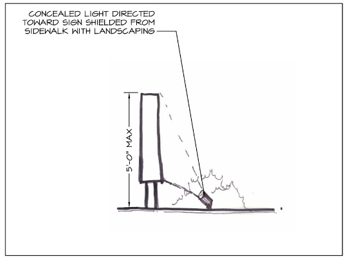
Externally Illuminated Sign
(f)
Externally illuminated signs shall be lighted by a white, steady stationary light of reasonable intensity, shielded and directed solely at the sign, so as not to cause glare or spill light into the road right-of-way or up into the sky.
(g)
Temporary signs shall not be illuminated.
Sec. 7-51. - Sign construction.
All ground signs, except temporary ground signs as determined by the community development director, shall be monument signs, as defined.
Sec. 7-61. - Banners.
Banners shall be prohibited except as follows:
(a)
Permitted pursuant to a special event authorized by the city (see Section 7-68); and
(b)
Banners are permitted when attached to a building wall more or less in the same place as where a wall sign is authorized to be erected, but such banners shall only be authorized after issuance of a certificate of occupancy for the building space to which the banner is attached, and shall remain only until the time a wall sign is erected more or less in its place. In no case shall said banner remain on the site for longer than 60 days.
Sec. 7-62. - Drive-through lanes.
Drive-through lanes may have a maximum of 2 display boards not exceeding 6' in height or 36 square feet in area.
Sec. 7-63. - Flags.
(a)
Generally. Any residence, establishment, or institution may display as many as 3 flags, per lot, when displayed in accordance with this section. Flags may be displayed on a freestanding pole, projecting from a building or door or placed in a window.
(b)
Pole flags. No flag displayed from a pole shall be flown at a height of greater than 24'. An individual flag shall not exceed an area of 40 square feet.
(c)
Projecting flags. Flags may be flown from a metal or wooden pole attached to a bracket projecting from the side of a building or doorframe. The pole shall not exceed 6' in length, or one inch in diameter. The flag flying from such pole shall not exceed 3' from top to bottom and 5' in length. Additionally, flags displayed in such a manner shall not impede pedestrian or vehicular traffic.
(d)
Window flags. Flags may be hung in the window of any non-residential property. The area of the flag shall be used in the calculation of allowable window signage.
(e)
Limit on number. A maximum of 3 flags (ground, projecting or window) shall be permitted per lot. Any additional flags (ground, projecting or window) displayed shall be used in the calculation of the ground, projecting or window sign area permitted on the property.
Sec. 7-64. - Multiple message electronic sign.
(a)
Zoning district. Multiple message electronic signs shall be permitted only in the MXU, O-I, NRC, CRC, LI, and HI zoning districts. Unless otherwise specifically provided, a multiple message electronic sign shall only be permitted in place of a sign that is permitted by Table 7-2 of this article.
(b)
Other permits. Multiple message electronic signs require the issuance of an electrical permit in addition to a sign permit, and a building permit may be required depending on size and construction.
(c)
Limit one per lot. No more than one multiple message electronic sign shall be permitted for any single lot and only one such sign may exist on a single lot.
(d)
Nature of display. Signs must automatically adjust to ambient light levels. Sign content/ messages shall remain static except during transition. Sign content/messages shall not consist of video, and shall not move, blink, animate, flash, travel, scroll, vary in light intensity, or behave in any other way which constitutes or implies motion, except as specifically provided in this section during transition time; notwithstanding the requirements of this subsection, a multiple-message electronic sign or any other sign erected in a window of a building (one per establishment) that is at least 100' from the right-of-way fronting the lot shall be authorized to flash but no more frequently than one change per second.
(e)
Duration of message. Each message on a multiple message electronic sign shall remain fixed for at least 6 seconds.
(f)
Transition time. The change sequence of messages shall either occur immediately, or there shall be a transition time of less than one second between different messages. A "fade" or "dissolve" mode, may be used to accomplish a gradual transition from one message to another. For purposes of this subsection, "fade" shall mean a mode of message transition on a multiple message electronic sign accomplished by varying the light intensity, where the first message gradually reduces intensity to the point of not being legible and the subsequent message gradually increases intensity to the point of legibility. For purposes of this subsection, "dissolve" shall mean a mode of message transition on a multiple message electronic sign accomplished by varying the light intensity or pattern, where the first message gradually appears to dissipate and lose legibility simultaneously with the gradual appearance and legibility of the subsequent message.
(g)
Lighting and brightness limitations. The lighting intensity of any multiple message electronic sign, whether resulting from internal or external illumination, shall not exceed 60' candles when measured with a standard light meter held at a distance of 10" from the sign face. The maximum brightness level for LED signs during daylight hours shall not exceed 5,000 nits (candles per square meter) when measured at the sign's face at its maximum brightness and 500 nits when measured at the sign's face at its maximum brightness between dusk and dawn. LED signs shall be required to have an automatic dimming function to reduce brightness to prescribed levels at dusk. The owner of the parcel on which a multiple message electronic sign is placed shall submit certification from an electrical engineer or other qualified professional that all requirements of this subsection are met, along with supporting documentation ensuring said certification.
(h)
Freeze of display when malfunction occurs. Such signs shall include a default designed to freeze a display in one still position if a malfunction occurs.
Sec. 7-65. - Changeable copy sign, not electronic.
Signs with copy changeable by non-electronic means may be permitted on any principal use ground sign but are limited to one sign per street frontage per parcel.
Sec. 7-66. - Projecting signs.
Projecting signs are permissible, subject to the limitations for wall signs. Projecting signs shall project perpendicularly from the building. Projecting signs shall be secured in place with a frame mount assembly. Projecting signs shall have a ground clearance of no less than 8' above the lowest ground elevation.
Sec. 7-67. - Sidewalk signs.
In CBD, NRC, MXU and CRC zoning districts, establishments which have a sidewalk or private walkways in in front of the building in which it is located are authorized to have one sidewalk sign, which shall be permitted only during the business or establishment's hours of operations and shall be removed when the business or establishment is not operating.
Sec. 7-68. - Special event signage.
Upon application for a sign permit, in the same manner as described in this article for a sign permit, additional signage and advertising devices may be authorized by the department of community development on a temporary basis in the form of a special event sign permit, subject to the following requirements:
(a)
Only 5 temporary special event sign permits shall be issued to any one business or institution in any calendar year.
(b)
A special event signage permit shall be valid for a maximum of 21 days. The applicant may divide the 21-day period into no more than 2 separate periods. It shall be a violation of this article to continue to display of temporary signs or advertising devices authorized pursuant to this section, after the expiration of a special event signage permit, unless another such permit is lawfully issued.
(c)
At the discretion of the applicant for a special event sign permit, the following may be authorized by the department of community development, provided that the total square footage of special event signage shall not exceed 64 square feet or its equivalent as determined by the department of community development and the total number of different signs or advertising devices authorized by the permit shall not exceed 4 during any event: banner, feather banner, flag, pennants, and/or sandwich board sign. Prohibited temporary sign types: Air blown devices and handheld sign jugglers/ spinners.
(d)
Awards and Recognition Signs can be displayed for a period of one year, provided that the award is from an official and recognized organization. Awards and Recognition signs shall decrease the annual allowed number of temporary special event sign permits by one and will be allowed for a period of 12 consecutive months and cannot be renewed once expired. Maximum allowed area for Awards and Recognition Signs shall be 12 square feet.
Sec. 7-69. - Temporary signs.
Temporary signs shall be made of metal, plastic, laminated cardboard, or some other durable and waterproof material. No such sign shall be made of paper.
Sec. 7-70. - Weekend signs.
Weekend signs are allowed only between Friday starting at 5:00 p.m. and Sunday ending at 8:00 p.m. as temporary signs and subject to the following provisions:
(a)
Such signs are allowed on properties in all land use categories.
(b)
Such signs shall be erected and maintained only with the permission of the owner of the property upon which the sign is erected.
(c)
Such signs shall not exceed 6 square feet in area nor be more than 3' in height.
(d)
Nonpermanent but water-resistant construction materials may be used, such as but not limited to poster board, foam core board or illustration board.
(e)
The words, letters, figures, symbols, logos, fixtures, colors, or other design elements that convey the sign's message shall be permanently applied to the sign's face; automatic or manual changeable copy shall not be allowed.
(f)
Such signs shall not be illuminated.
Sec. 7-81. - Duration and continuance.
Signs which do not meet all requirements of this article on its effective date, or which do not meet provisions of this article at the time of its amendment, may stay in place until or unless provided otherwise by this division.
Sec. 7-82. - Changes, repair, and maintenance.
(a)
No structural repairs, change in shape, or size of a nonconforming sign shall be permitted except to make the sign comply with the requirements of this article.
(b)
Nonconforming signs shall not be modified to add additional lighting or to be altered in any way that increases the value of said nonconforming sign.
(c)
A nonconforming sign which has been damaged to such extent that repairs equal to or exceeding 50% of the sign's current replacement value, as may be determined by independent appraisal or accepted by the community development director, shall not be repaired or replaced except in conformity with this article.
(d)
Minor repairs and maintenance of nonconforming signs shall be permitted. This does not include refacing that exceeds 25% of the value of the sign.
Sec. 7-83. - Replacement.
A nonconforming sign shall not be replaced by another nonconforming sign, except that the substitution or interchange of poster panels, painted boards or dismountable material less than 25% of the total value on nonconforming signs shall be permitted.
Sec. 7-84. - Additional signage on lot with nonconforming signs.
No principal use or accessory use ground or wall sign shall be authorized or permitted to be erected on the same property with an existing nonconforming sign until the nonconforming sign has been removed or made to conform to the provisions of this article. This provision shall not apply to billboards as lawfully existed on the effective date of this article.
Sec. 7-91. - Building and electrical permits for signs.
(a)
Building permit. A building permit, for signs with areas of more than 15 square feet shall be obtained from the building inspector prior to installation or placement of any sign. It shall be unlawful for any person to post, display, or erect a sign in the city without first having obtained a building permit, if required by the building code for said sign.
(b)
Electrical permit. An electrical permit, if required by the building or electrical code, shall be obtained prior to the installation or placement of any illuminated sign. All electrical service to a sign once installed shall be in compliance with the electrical code. It shall be unlawful for any person to post, display, or erect a sign with an electrical connection in the city without first having obtained an electrical permit, if required by the electrical code for said sign.
(c)
Conformity. All signs for which a building permit or electrical permit is required shall be constructed and maintained in conformance with all applicable building code and electrical code requirements.
(d)
Application and structural plans. The applicant for a building permit shall submit application materials as specified by the building inspector, including a sketch or print drawn to an engineering or architectural scale showing pertinent information such as wind pressure requirements and display materials in accordance with requirements of the building code. To issue a building permit, if required by the building code, the city may require plans prepared by a qualified structural engineer, demonstrating conformance of the sign and sign structure with all structural and wind-load resistance standards of the building code.
(e)
Plan certification. Plans required for issuance of a building permit for any projecting sign shall be certified as to conformance with all structural and wind-load resistive standards of the building code by a qualified structural engineer, or be prepared using standard drawings prepared by a structural engineer or other qualified professional meeting or exceeding all requirements of the building code.
(f)
Process. For signs requiring a building or electrical permit, the city shall process such permit applications in the same manner as required for any other building or electrical permit, according to procedures specified in the building or electrical code, whichever is applicable, and as administratively established by the building inspector and as administered by the department of community development. No building or electrical permit for a sign shall be issued without approval of the director of community development to ensure conformity with this article.
Sec. 7-92. - Sign permit may require other permits.
No sign permit, as may be required by this article, shall be issued unless a building permit or electrical permit, if required by the applicable building or electrical code, has been issued. The city may simultaneously issue approvals of sign, building, and electrical permits as may be required for a given sign. If architectural review is required by the development code, wall and ground signage shall also be subject to approval during architectural review.
Sec. 7-93. - Sign permit required.
A sign permit shall be required for the following.
(a)
Any ground, projecting, wall, or other sign for which a building permit is required.
(b)
Any ground, wall, or other sign for which an electrical permit is required.
(c)
Any ground or wall sign with a sign area of 16 square feet or more.
(d)
Any principal use ground sign or wall sign larger than 8 square feet in area on a building or property in the CBD zoning district.
Sec. 7-94. - Who may apply for sign permit.
An application for a sign permit shall require the authorization of the property owners. Only the sign owner or authorized agent of the sign owner may make application for a sign permit. Sign permits shall be issued only to the owner of the real property where the sign is to be located; or to an authorized agent of the property owner, or to a lessee who has the right to maintain a sign on the real property where the sign is to be located; or to the sign contractor, constructor, or erector as the agent of the owner or lessee.
Sec. 7-95. - Contents of sign permit application specified.
Application materials required for a sign permit are supplemental and in addition to the application materials required for a building or electrical permit for the sign. An application for a sign permit shall be made on an application form furnished by the community development department. The application form and or application materials shall include the following:
(a)
The names, mailing addresses, telephone numbers, and e-mail addresses of the sign owner, sign erector, property owner, lessee (if applicable), and the agent (if applicable) making the application; approval of the property owner shall be evidenced by signature on the application form by the property owner or authorized agent (in which case a power of attorney or other evidence of legal authority to act on behalf of the property owner shall also be submitted); and
(b)
A non-refundable application fee as may be established by resolution of the Mayor and City Council; and
(c)
The address and description (e.g., tax parcel number) of the property on which the sign is to be erected; and
(d)
An itemized list and/or a keyed site and/or building facade sketch at a suitable scale showing the location, size, and height of all existing signs on the property, and if applicable, an indication of which signs are not in compliance and to be removed; and
(e)
The type of sign to be permitted, as classified by this article; and
(f)
The number of sign faces and the height and area of the sign to be permitted; and
(g)
The proposed placement location, shown on a sketch of the building facade if a wall sign or on a plot plan or boundary survey of the property if a ground sign; and
(h)
For signs requiring architectural review, a scaled elevation drawing for each sign that is subject to architectural review, showing dimensions and illustrating the finished character of the sign; at the discretion of the community development director, material and color samples and illumination details may be required to be submitted with the application.
Sec. 7-96. - Procedures for sign permitting.
(a)
Submission. When required, a sign permit application shall be submitted to the department of community development for review and disposition.
(b)
Other permits. If a building or electrical permit is required, the application for sign permit shall be submitted simultaneously with an application for a building or electrical permit for the sign. Sign permit applications requiring a building or electrical report shall be submitted to the community development department for consideration by the building inspector in conjunction with an application for building and/or electrical permit, if required, for a sign. Building or electrical permits for a sign shall not be issued until a sign permit if required is issued.
(c)
Review. The community development department may elect not to accept an application or may refuse to process such application for a sign permit on property that includes an existing unlawful sign or signs. Incomplete applications will be returned to the applicant and will not be processed. Processing times from the date a complete application for a sign permit has been received, shall not exceed 15 calendar days, during which time the building inspector shall review the application for building and electrical permits, if required, and the community development department shall review the sign permit application for compliance with this article; provided, however, that sign permits requiring architectural review as specified by this article shall have processing times that do not exceed 30 calendar days.
(d)
Decision. Upon determination that the application fully complies with the provisions of this article, and building and electrical codes if applicable, the department of community development shall issue the sign permit. Issuance of a sign permit shall be considered sufficient notice to the applicant that such sign permit is approved. Applications for sign permits which do not comply with the provisions of this Article or applicable building or electrical codes shall not be approved by the city. A sign permit may be denied by the community development department if the applicant, landowner or lessee is responsible for and is presently maintaining any sign on the subject property in violation of this article.
(e)
Denial. If an application for a sign permit is denied, the applicant shall be given written notice stating the reason(s) for the denial. A property owner may reapply for the same sign which was previously denied a sign permit, in order to secure permission for a sign which complies with this article and applicable building and electrical codes. An applicant may appeal the denial of a sign permit in accordance with the provisions for appeals of administrative decisions, as specified in this development code.
Sec. 7-97. - Procedures for architectural review of signs.
No sign requiring a sign permit shall be erected, and no sign permit shall be issued for a sign that requires a sign permit in the CBD zoning district or for a development or building that requires architectural review per this development code, until or unless the architectural characteristics, materials, and composition of such sign have been approved by the department of community development. Architectural review if required shall occur during the sign permitting process, if a sign permit is required.
The community development department shall consider the following, which shall not be limiting, in issuing approvals of architectural characteristics for signs and may use these criteria in determining whether to approve, deny, or modify said signs:
(a)
Construction. The proposed sign is composed of materials that are compatible with the materials of the face of the building facade where it is placed or to which it pertains. Principal use ground signs for commercial developments shall be monument signs. Exposed surfaces of signs must be constructed of or appear to be constructed of metal, glass, stone, concrete, brick, cloth, or wood, or similar approved material. Plastic substrate, plywood, or unfinished wood are not appropriate materials for signs and shall not be permitted.
(b)
Compatibility. The scale, size, and shape of the sign are proportional to the building on which they are placed or to which it pertains and the area in which it is located. Further, the design, lettering, and composition of the sign are compatible with the building and other materials in the district. To this end, the community development department may find that a sign is out of character with the area or not proportional to the building, activity or use and may work with the sign permit applicant to reduce the scale, size, shape, or placement of the sign or signs. However, the department shall not have authority to limit the area of a sign to less than the maximum permitted by this article, without agreement by the sign permit applicant.
(c)
Wall sign locations. Appropriate locations for wall signage on buildings with more than one story shall be in the lintel space which separates the storefront from the upper floor, and the space above the transom in the storefront, where one exists. Wall signs should be located on flat, unadorned parts of the building facade, somewhere above storefront display windows (where they exist) and below second-story windows (where they exist). If the building facade or storefront has a lintel strip or signboard, the wall sign should be placed directly on it. Wall signs should be located centrally on the facade.
(d)
Wall sign rhythm and proportionality. If the sign proposed is a wall sign, it establishes an appropriate rhythm and is proportional to the facade.
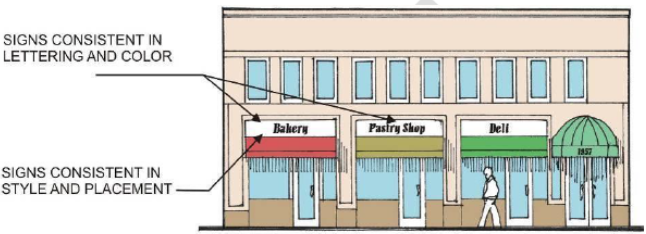
Source: Escondido, California, Downtown Specific Plan Sign Criteria & Guidelines
(e)
Awning and storefront canopy signs. Awning signs should be silk-screened or sewn onto the awning fabric, and they should be placed on the valance of the awning. Signs on canopies should be located on the primary face or top edge (or front-angled or sloped part) of canopies. Back-lit canopy signs shall not be permitted except as otherwise specifically provided by this article.
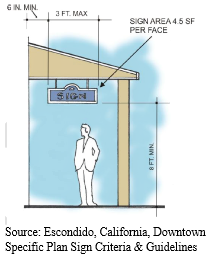
(f)
Suspended signs. Suspended signs may be permitted in pedestrian retail districts.
(g)
Colors. No individual sign shall have more than 3 colors. Colors of signs should be coordinated with overall building colors. White or other light-colored backgrounds for signs should not be proposed.
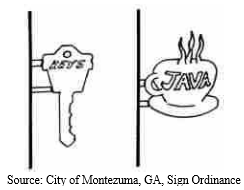
(h)
Shape. Signs should typically be square or rectangular; provided, however, this shall not prevent individual signs that may be circular or some other shape, or shaped like a particular object (e.g., a sign in the shape of a shoe for a shoe store).
Sec. 7-101. - Maintenance.
(a)
All signs, together with all their supports, braces, guys, and anchors shall be kept in good repair. Property owners of a "sign in need of maintenance," as defined in this article, shall be responsible for promptly maintaining such sign in good repair.
(b)
Except for nonconforming signs, replacing or altering the words, letters, figures, symbols, logos, fixtures, colors, or other design elements that compose an existing sign's message, in whole or in part, shall be considered to be either maintenance or a lawful change in the copy of said sign and such replacement or altering of existing sign copy does not require a sign permit when the sign panel or sign structure itself is not changed.
(c)
Painting and cleaning of a sign shall be considered maintenance and shall not require a sign permit.
Sec. 7-102. - Removal.
Derelict signs, and any signs erected without proper authorization in street rights-of-way, or on private property alongside a right-of-way that constitute a safety hazard, may be removed from placement in such locations by city personnel.
Sec. 7-103. - Enforcement of sign maintenance.
In cases of a sign in need of maintenance, the department of community development shall notify property owners and sign owners of the need to maintain signs. If a condition of sign in need of maintenance still exists for more than 30 calendar days after the date such notification was mailed, the department of community development or other city designee for enforcement shall issue a notice of violation and compliance order to the property owner and if different, the sign owner.
Sec. 7-104. - Discontinued signs.
(a)
If a principal use or activity on a property has ceased operation, any permanent ground signs including supports, and wall signs, permitted in connection with said principal use or activity shall be removed within 90 days of the discontinuance of said principal use or activity; provided, however, that a property owner with a significant investment in a sign structure that may be reused for another activity within one year, may retain the sign structure in compliance with this section.
(b)
If a discontinued principal use ground or wall sign contains a sign face that is in the form of a removable panel, the panel containing advertising shall be removed and replaced with a panel without sign copy until another principal use is established and a sign permit if required is issued for a new principal use ground or wall sign. The purpose of this provision is to prevent the image of blight associated with a sign structure that has had the copy or sign panel removed, leaving interior supports of the sign structure exposed to public view.
(c)
If a discontinued principal use monument sign contains a sign copy area that is not removable without disassembling the monument, then the sign copy area shall be painted over if possible, or, where it cannot be painted over, covered with durable cloth or canvas so that the sign copy and/or underlying structure which was permitted in connection with the business or activity discontinued is no longer visible, until such time as a new sign permit, if required, is applied for and granted, or approved sign copy is affixed on the sign copy area of said monument.
Sec. 7-105. - Enforcement of illegal signs.
In addition to enforcement mechanisms permissible with regard to violations of this development code generally, no new sign shall be authorized to be erected on the same property, and no new sign shall be permitted by the city, unless the property on which the new sign is proposed is in compliance with the requirements of this article in all respects. At the discretion of the community development director, sign permits may be withheld if the site on which the sign is proposed to be located contains a prohibited sign, a derelict sign, or a sign for which maintenance is required and which has not been maintained in accordance with the requirements of this article. Additionally, the community development director may elect not to issue a sign permit on a site which contains a nonconforming sign, until such nonconforming sign is removed or made to comply with this article.

