
Powder Springs City Zoning Code
ARTICLE 6
ACCESS, PARKING AND LOADING
Sec. 6-1. - Findings.
(a)
Need for parking. Space for the parking of motor vehicles is needed to serve every property that contains a principal use, for the safety and convenience of the people who live or work on the property, shop or do business on the property, or otherwise visit the property in the normal course of activity of the principal use.
(b)
Need for loading and unloading spaces. Space for the loading and unloading of equipment, supplies, and products is needed to serve properties engaging in such loading and unloading operations. If not required, adequate and proper loading spaces in acceptable locations tend not to be provided.
(c)
Environment. Poor design of parking lots can lead to damage to the environment and may require the community to subsidize the interests of a private property owner at the expense of the community's environment. It is reasonable to good design of parking lots. Possible negative effects of parking and loading areas include changes to microclimate, isolation of pedestrians, increased stormwater runoff, and reduced stormwater infiltration into the ground. Large parking lots can create heat islands where pavement absorbs solar radiation during the day and remains warm well into the night. When heat islands exist, cooling costs are higher than normal. Strategies can be used to reduce heat islands and their effects.
(d)
Stormwater management. Parking lots surfaces such as asphalt contribute to the degradation of local water quality. Parking lots can be more compatible environmentally if protection measures are incorporated into design standards and regulations. Porous pavement and grass pavers reduce runoff by allowing it to pass through the paved surface and infiltrate back into the soil and groundwater. Utilizing porous pavements and grass pavers also reduces or eliminates land dedicated to surface storm water management facilities. Porous pavement designs and grass pavers are appropriate in some instances. Other types of stormwater management facilities are environmentally compatible, such as vegetative swales and bioretention.
(e)
Pedestrian mobility. Areas of paving are necessary to accommodate automobiles, but they can be unfriendly to pedestrians without specific regulations requiring that designers accommodate pedestrians. Large, open parking areas are conducive to high speeds and random maneuvers which can endanger pedestrians. Wide driveway aisles and access roads also increase speeds and discourage pedestrian travel. Street and parking lot design can balance the needs to accommodate automobile-centered standards with approaches that take into account the needs of pedestrians.
(f)
Overbuilding of parking lots. Off-street parking requirements, as conventionally implemented, have resulted in excess, unnecessary parking around shopping centers and malls because it remains unused for most of the year. Parking lot construction is a considerable factor in the cost of development. Reducing parking areas reduces development costs. Therefore, reductions in the size of paved parking and flexibility in the types of pavement and parking designs are beneficial to all concerned.
(g)
Connectivity. Abutting properties which do not provide interconnecting access to one another make it difficult, dangerous, and inefficient if not impossible, for motorists to travel between those properties. Between compatible uses, provisions requiring inter-parcel access meet substantial public purposes of convenience and safety.
Sec. 6-2. - Purposes.
The multiple purposes of this article are summarized as follows:
(a)
Establish requirements for multi-modal access to development sites, including vehicular, truck service, and pedestrian, as appropriate;
(b)
Establish on-site circulation patterns conducive to safe pedestrian as well as vehicular and truck access;
(c)
Establish minimum off-street parking and loading areas in proportion to the need created by each use, but considering reductions for the provision of alternative modes of travel;
(d)
Reduce congestion in the streets and ensure that uses and functions of public rights-of-ways are not interrupted;
(e)
Establish certain maximum as well as minimum requirements for parking spaces to reduce development costs and ensure that excess impervious surfaces are not constructed, while providing for exceeding maximums when a demonstrated need exists. Parking requirements should be based on actual average parking demands, rather than to accommodate the highest hourly parking at a site;
(f)
Provide for alternative pavement materials, such as porous asphalt, turf block, gravel, and cobbles which have higher degrees of water quality effectiveness than conventional asphalt and pervious concrete;
(g)
Promote flexible approaches to the provision of off-street parking, including in some cases, as appropriate, use of on-street parking, shared parking arrangements, smaller spaces for compact cars, and unimproved or pervious pavement overflow or spillover parking areas;
(h)
Establish design and improvement specifications for the development of parking lots, loading areas, access aisles, and connections of parking lots to public streets; and
(i)
Promote and require inter-parcel access to facilitate movement of customers from business to business without generating additional turning movements on the public street, thus increasing public safety.
Sec. 6-3. - Applicability.
(a)
This article shall apply to all development; provided however, that within this article certain exceptions are made to specific sections or subsections.
(b)
This article shall not be construed as requiring compliance with this article of parking lots which lawfully existed on the effective date of this article; provided, however, that the community development director shall ensure parking lots that do not comply with this article meet the requirements of this article or substantially comply when a new development permit is required or a building permit is required to add additional building space on the site. If substantial redesign of the parking lot is required to comply with this article in such cases of new development or building additions, the community development director may accept substantial rather than complete compliance when the strict application of a requirement of this article would pose substantial practical difficulty.
Sec. 6-4. - Definitions.
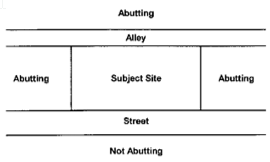
Abutting: Having property lines in common, or having property separated by only an alley. Separation by a street right-of-way is not considered abutting.
Access: A way or means of approach to provide physical entrance to a property.
Best management practices (BMPS): A wide range of stormwater management regulations, procedures, engineering designs, activities, prohibitions or practices which have been demonstrated to effectively control nonpoint source pollution encompassing the quality, quantity, and erosion and sediment control aspects of stormwater. Such practices could include but not be limited to: detention and retention ponds, sand filters, vegetative swales and buffers, street cleaning, installation of stream bank stabilization measures, and public education programs.
Curb break or curb cut: Any interruption or break in the line of a street curb for the purpose of connecting a driveway to a street, or otherwise to provide vehicular access to abutting property.
Deceleration lane: An added roadway lane, of a specified distance and width and which may include a taper, as approved by the director of public works, which permits vehicles to slow down and leave the main vehicle stream.
Development permit: An official authorization issued by the community development director in accordance with this development code to proceed with land disturbance and grading, as set forth in this development code.
Driveway: A constructed vehicular access serving one or more properties and connecting to a public or private street.
Floor area: The sum of all square footages (areas) of each floor of a building, measured from the interior faces of the exterior walls or from the centerline of walls separating 2 buildings. The following areas are excluded from the measurement of floor area: unfinished attics, attached garages or spaces used for off-street parking and loading, breezeways, and enclosed or unenclosed decks and porches.
Handicapped parking space: A space laid out and designated by signage in accordance with the requirements of the federal Americans with Disabilities Act.
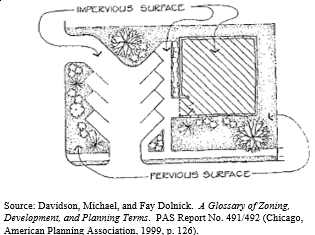
Impervious surface: A man-made structure or surface, which prevents the infiltration of water into the ground below the structure or surface. Examples are buildings, structures, roads, driveways, parking lots, decks, swimming pools, or patios.
Improvements: The physical addition and changes to land that may be necessary to produce usable, desirable and acceptable lots or building sites.
Mixed-use development: A single building containing more than one type of land use; or a single development of more than one building and use, where the different types of land uses are in close proximity, planned as a unified complementary, cohesive whole.
Parking aisle: The traveled way, which is not the public right-of-way, by which cars enter and depart parking spaces and maneuver within a designated parking lot.
Parking lot: Any public or private area at grade used for the express purpose of temporarily parking automobiles and other vehicles otherwise in operation for personal or business use.
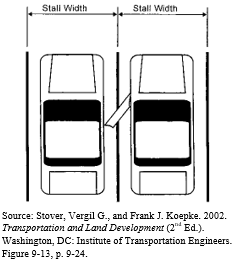
Parking space: A space identified and set aside for the temporary parking of an automobile or other motor vehicle. The typically acceptable parking space has a dimension of 9' in width by 20' in length, although this article permits reductions in parking space widths in certain circumstances.
Right-of-way: Land reserved for and immediately available for public use as a street or other purpose.
Sidewalk: A hard-surfaced pedestrian access area adjacent to or within the right-of-way of a street.
Street: An improved way for the conveyance of motor driven, rubber-tired vehicles, such as automobiles and trucks.
Variance, administrative: A variance which is authorized to be approved by an administrative officer under the terms of this development code.
Sec. 6-5. - Access control on state routes.
(a)
Access onto a state road shall meet existing Georgia Department of Transportation requirements. A copy of the Georgia Department of Transportation permit, if required, shall be submitted to the community development director before plans can be approved.
(b)
For driveways accessing U.S. or State highways, the requirements of the Georgia Department of Transportation shall apply whenever more restrictive than the standards in this article.
Sec. 6-6. - Parking and circulation plan required.
(a)
Before any development permit or building permit is issued for a given development or building, the parking lot layout and area must be found by the community development director to be in compliance with all applicable requirements of this article and site design review as required by article 5 of this development code is accomplished. The building inspector shall not allow occupancy or use of a building until advised by the community development director that parking facilities meet the applicable requirements of this article.
(b)
Such parking and circulation plans shall include the number of spaces provided and required, the location of entrances, exits, aisles, curbing where required, landscaping, screening, surface materials, provisions for drainage and other specifications necessary to ensure compliance with this article.
Sec. 6-7. - Interpretations.
(a)
Fractions. Where a calculation of minimum or maximum parking or loading spaces results in a fraction, the required number of parking spaces shall be construed to be (rounded up to) the next highest whole number of spaces.
(b)
Parking space requirement not specified. Where the parking requirement for a particular use is not described in this article, and where no similar use is listed, the community development director shall determine the number of spaces to be provided based on requirements for similar uses, location of the proposed use, the number of employees on the largest shift, total square footage, potential customer use, and other expected demand and traffic generated by the proposed use. At the discretion of a development applicant, a parking generation study prepared by a qualified professional may be submitted to aid the community development director in making such a determination; if submitted, it shall be considered by the community development director prior to making a determination.
(c)
Computations for multiple floor uses within a building. In cases where a building contains some combination of office space, retail or wholesale sales area, and/or bulk storage area, the community development director may authorize that the building space be divided in to such floor space use areas and combined computations of floor areas (e.g., warehousing, retail, and/or office) in meeting the off-street parking or loading space requirements of this article.
(d)
Maneuvering lanes not considered parking. Areas designated for temporary occupancy of vehicles while maneuvering on a site, such as queuing lanes for a drive-in window, are not considered and shall not be counted as parking spaces for purposes of meeting the requirements of this article.
Sec. 6-8. - Parking for company-owned vehicles.
Every business that stores vehicles owned by the business on site overnight (such as a company fleet), or maintains a stock of vehicles as part of its business activities (such as a car sales lot, a salvage and wrecking yard, car rental agency, etc.), shall provide for adequate parking or storage for the vehicles such that no parking occurs in a public right-of-way or in an area that has not been improved as a parking lot or storage yard. Such parking spaces shall be in addition to those required for residents, employees, customers and visitors.
Sec. 6-9. - Guest parking provisions.
Any residential community, whether owned individually, in common, or corporately shall provide areas sufficient to accommodate parking for guests visiting the residents within the community. These areas must be shown on a site plan prepared by a design professional licensed to practice in Georgia and address the following criteria.
(a)
Number required. Notwithstanding a shared parking analysis prepared by a design professional licensed to practice in Georgia that provides an alternative number, guest parking areas shall be provided at 0.35 space/area per dwelling unit.
(b)
Area required for guest parking. In general, areas designated for guest parking must meet size requirements outlined in this code.
(c)
Acceptable locations for guest parking. Areas to be designated for guest parking may be:
1.
Within the public or private right of way. If right of way width is increased to allow for "on street guest parking," the community development director is authorized to provide administrative variance relief for up to 25 percent of underlying requirements that may be affected, including but not limited to setbacks, minimum lot size, configuration, impervious surface maximums, etc. This administrative relief shall not allow for additional density that would be achieved utilizing minimum local road right of way requirements.
2.
Within or on privately owned property. Individual lots that have dimensions (width and length of driveways) sufficient to accommodate guest parking areas may be subtracted from the total dwelling units requiring one-half spaces/areas per dwelling unit. Privately owned properties meeting such criteria, must be identified on a site plan prepared by a design professional with a statement or note illustrating compliance.
3.
Within or on commonly owned property. Amenity areas and mail kiosk areas may account for up to 60 percent of required guest parking areas. Said percentage can be increased if site plan prepared by a design professional demonstrates a central location within the community, accessible by sidewalk or other pedestrian access arrangement.
(d)
Directional and informational signage required. Any site plan prepared to address these criteria must identify where guest parking areas are provided, including signage that directs visitors to designated areas, as well as signage that restricts parking areas to guests only.
(Ord. No. 2023-008, § 1(Exh. A), 8-21-2023)
Sec. 6-21. - Access driveway required.
(a)
Every development and every lot shall have access to the public street system via an approved roadway or driveway.
(b)
Ingress and egress to parking areas shall be by means of a driveway from the abutting street meeting the minimum requirements of this article.
Sec. 6-22. - Minimum driveway width.
Access drives shall be constructed to a minimum width required in Table 6-1. When a property containing a single-family residence is converted to a use that requires a wider driveway, the public works director may reduce the driveway width required by this section if access via a narrower driveway will not be impeded.
Sec. 6-23. - Maximum driveway width.
(a)
Driveways, as measured at the right-of-way line, shall not exceed a width of 20 feet for single-family or 24 feet for two-family dwellings.
(b)
Driveways serving uses other than single-family or two-family dwellings shall not exceed 40 feet in width as measured at the right-of-way line, unless adjoining a state route, in which case the driveway shall meet Georgia Department of Transportation standards. On non-state routes, the public works director may limit the width of a driveway when it is deemed to be of benefit to the safety and welfare of the public.
Table 6-1
Driveway Requirements
(Ord. No. 2023-008, § 1(Exh. A), 8-21-2023)
Sec. 6-24. - Driveway surfacing.
Driveways shall be improved with concrete per city standard. Driveways shall be surfaced as described in section 6-58 for parking lots.
Sec. 6-25. - Number of driveways permitted.
The number of driveways that access a property from any one street, road or highway shall be limited per the requirements of this section.
(a)
Arterial streets. Along any arterial street as designated in the Powder Springs comprehensive plan, each lot shall be permitted no more than one point of vehicular access for each 300' of lot frontage. Along State routes or U.S. numbered highways, the number and location of access points may be further restricted by the Georgia Department of Transportation. Lots existing on the date of adoption of this development code which have less than 300' of frontage shall be allowed one point of access.
(b)
Other streets. Along any street other than an arterial as designated in the Powder Springs comprehensive plan, each lot shall be permitted no more than one point of vehicular access for each 200' of lot frontage. Lots existing on the date of adoption of this development code, or which are created in accordance with this development code, which have less than 200' of frontage shall be allowed one point of access.
Sec. 6-26. - Driveway separation.
(a)
The distance from a driveway or parking area access drive to the intersection of two street right of ways shall not be less than 20' for a single-family or two-family dwelling and not less than 50' for all other uses.
(b)
Except where shared driveways are authorized, the distance between driveways along a street right-of-way shall not be less than 10' for a single-family or two-family dwelling and not less than 40' for all other uses.
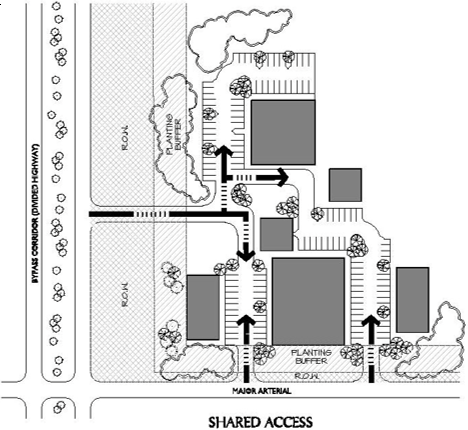
Sec. 6-27. - Common access easements for shared driveways.
Shared driveways between 2 parcels along the common property line may be required by the community development director. In such cases, each property owner shall grant an access easement to facilitate the movement of motor vehicles across the site.
Sec. 6-28. - Vision clearance at driveways.
With the exception of sign posts and other structures less than 8" in diameter, structures and landscaping shall not exceed 3' in height within a triangle measuring 20' along the edge of a driveway and 20' along the street right-of-way line.
Sec. 6-29. - Driveway apron.
The public works director may require installation of a driveway apron at any driveway connecting to a public street. All driveway aprons shall have a radius connecting the driveway to the curb line or pavement edge as specified in Table 6-2.
Table 6-2
Driveway Apron Radii
| Use |
Minimum
Driveway Radius | |
|---|---|---|
| Single-Family Residential | 5 feet | 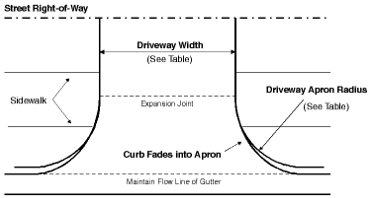 |
| Commercial or Multi-Family Residential | 15 feet | |
| Industrial | 25 feet |
Sec. 6-30. - Driveway permit.
(a)
No driveway shall be connected to a public street or private street, and no curbs or medians on public streets or rights-of-way shall be cut or altered for access without a driveway permit issued by the community development director after consultation with the public works director.
(b)
As a condition of driveway permit approval the public works director is authorized to the driveway applicant to install a storm drainage culvert of a size specified by the public works director.
(c)
Deceleration lanes may be required at all entrances to subdivisions and industrial and commercial developments that front on arterial and collector streets. Deceleration lanes shall be 12' in width plus curb and gutter for a minimum distance of 200' measured from the intersection of the right-of-way lines, or as may be otherwise required by the Georgia Department of Transportation (on state routes) or the public works director for a local street.
Sec. 6-41. - Vehicular circulation.
Efficient and easily recognized vehicular circulation routes within a development are vital and shall be provided. Internal vehicle circulation shall be designed or redesigned in a manner that avoids conflicts between through-traffic (i.e., traffic flowing into and out of the site) and local traffic (i.e., traffic through parking areas). Interior vehicular circulation shall be provided by the following means:
(a)
Considering the entire parcel and its anticipated development, rather than simply a particular project, in formulating and approving access plans;
(b)
Avoiding dead-end parking areas;
(c)
Integrating service functions (e.g., deliveries, maintenance activities), when present or required as part of a development, into the circulation pattern in a manner which minimizes conflicts with vehicles and pedestrians; this includes the separation of service access and loading areas from main circulation and customer parking areas where possible;
(d)
Visually orienting the driver with a regular, logical system of interior driveways and roadways;
(e)
Identifying entrance drives with small entry signs; and
(f)
Preventing vehicles from driving across or through designated parking areas by placing raised landscaped dividers or walkways between parking aisles.
Sec. 6-42. - Pedestrian facilities internal to site required.
(a)
Internal to each building site, non-single-family residential developments shall provide safe routes of pedestrian access between points of departure and destinations. Such provisions for pedestrian access shall be shown on plans, including site plans for development permits and building permits.
(b)
When multiple buildings are proposed, they shall be linked with on-site pedestrian walkways.
(c)
All walkways internal to the site shall be a minimum of 4' wide.
(d)
The internal sidewalk system shall connect to the public sidewalk system along streets and highways, where it exists or is planned. Where a transit stop exists, the internal sidewalk system shall provide as direct a link as possible from the buildings on site to the transit stop.
(e)
When two or more parking lots aisles within a parking lot with more than 20 parking spaces are arranged perpendicular to the principal building on the property, one sidewalk or other approved pedestrian access way a minimum of 4' in width shall be required to be installed. Said sidewalks shall connect from the public right-of-way abutting the lot and extend the length of the parking aisle.
(f)
Where pedestrian circulation crosses vehicular routes, a change in grade, materials, textures or colors, or appropriate striping or demarcation, shall be provided to emphasize the point of intersection between pedestrians and vehicles and improve its visibility and safety. For example, brick pavers and other special paving materials can help to distinguish pedestrian walkway surfaces from vehicular access ways.
Sec. 6-43. - Inter-parcel access.
(a)
Required. Inter-parcel access for vehicles between abutting and nearby properties shall be provided so that access to individual properties can be achieved between adjacent and nearby developments as an alternative to forcing all movement onto abutting highways and public roads. Where opportunities for shared access have been identified by the community development director, developments must provide shared access with adjoining properties to facilitate vehicular and pedestrian connections between parcels.
(b)
Easement. Easements are required to facilitate inter-parcel access between any office, retail sales or services use, and another abutting office, retail sales or services use or lot that is zoned for office, retail sales or services use. The inter-parcel access easement shall permit automobile and pedestrian access from the adjoining property to driveways and parking areas intended for customer or tenant use, but parking spaces may be restricted to use by the owner's customers and tenants only. The granting of such easement shall be effective only upon the granting of a reciprocal easement by the abutting property owner.
(c)
Connection. Upon the availability of access to driveways and parking areas of the abutting lot, the pavement or other surfacing of each owners' driveways and parking areas shall be extended by each owner to the point of access on the property line.
(d)
Location of inter-parcel connections. The location of vehicular connections across a property line shall be mutually determined and constructed by both property owners. Connection of parking areas for vehicular access may be provided in the front portion of the site. In cases where it is not possible to provide the connection in front, it may be provided in the rear portion of the site. In the case of coordination problems or any factors preventing construction of an inter-parcel connection, the community development director will determine the location of the inter-parcel connection to be constructed by property owners, subject to appeal as an administrative decision.
(e)
Waiver. The community development director may waive the requirements of this section if he or she finds that it is unnecessary to provide inter-parcel access due to the unlikelihood of patrons traveling among two or more existing or proposed uses on abutting or nearby sites. The Mayor and City Council is authorized to waive in whole or in part the requirement for an inter-parcel access easement, upon application for a variance in accordance with this development code, in the event an administrative variance is not granted by the community development director.
Sec. 6-51. - Applicability.
(a)
The provisions of this division apply to all off-street parking spaces and parking areas, whether the parking is provided to serve a particular development or the parking lot is operated as a principal use on a property and not dedicated to serving a particular development.
(b)
Construction of a new parking lot or loading area, or expansion of an existing parking lot or loading area, requires issuance of a development permit in accordance with the requirements of this development code.
Sec. 6-52. - Improvement setback.
Off-street parking areas shall be set back from front, side, and rear property lines by at least 5', except that the community development director may authorize a reduction in the parking lot improvement setback to no less than 3' where a front landscape strip as required by article 5 of this development code is authorized to have a variable width.
Sec. 6-53. - Parking space relationship to street.
(a)
Except single-family detached or two-family dwellings, all areas devoted to off-street parking shall be so located so that no vehicle is required to use a public or private street to maneuver into or out of a parking space.
(b)
No off-street parking spaces shall be permitted directly from an access driveway within the first 30' of the driveway back from the street right-of-way line.
(c)
Unenclosed off-street parking for single-family and 2-family dwellings shall not be located within the minimum front yard setback, except on a hard-surface driveway, nor between the minimum front yard setback and the front of the principal dwelling except on a hard-surface driveway or in a carport or garage.
Sec. 6-54. - Area per parking space.
(a)
Perpendicular and angled spaces. Every parking space shall provide a useable, rectangular area at least nine feet wide by 20 feet long; provided that parking space widths may be reduced in width only as specified in section 6-87, use division of large parking lots. Access aisles shall not encroach into this minimum rectangular area.
(b)
Parallel spaces. Every parking space shall provide a useable, rectangular area at least nine feet wide by 22 feet long; provided that parking space widths may be reduced in width only as specified in section 6-87, use division of large parking lots. Access aisles shall not encroach into this minimum rectangular area.
(Ord. No. 2023-008, § 1(Exh. A), 8-21-2023)
Sec. 6-55. - Demarcation.
(a)
Every parking space shall be clearly demarcated by lines painted on or otherwise applied to the parking lot surface.
(b)
One-way traffic aisles must be clearly marked with directional arrows on the pavement at each intersection with another aisle, driveway, or street entrance.
(c)
The community development director may grant exceptions to the requirement of this section to mark common boundaries between parking spaces in the case of gravel parking lots, if and where permitted, or to authorize traffic directional signs in lieu of one-way pavement markings.
Sec. 6-56. - Access aisle specifications.
(a)
Access aisles in parking lots serving parking spaces are perpendicular (90º) to the access aisle shall be at least 22' wide (exclusive of area devoted to parking spaces) and provide for two-way traffic.
(b)
Access aisles in parking lots serving parking spaces that are angled shall be limited to one-way traffic. Such access aisles shall be a minimum of 18' wide serving spaces that are at a 60-degree angle to the aisle and a minimum of 13' wide serving spaces that are at a 45-degree angle to the aisle.
(c)
Access aisles in parking lots serving parking spaces that are parallel to the access aisle shall be at least 22 feet wide (exclusive of area devoted to parking spaces).
(d)
Parking aisle lengths shall not exceed 300 feet without a break for circulation.
(e)
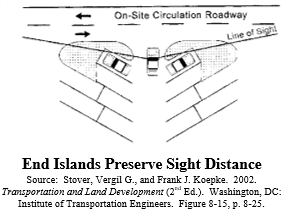
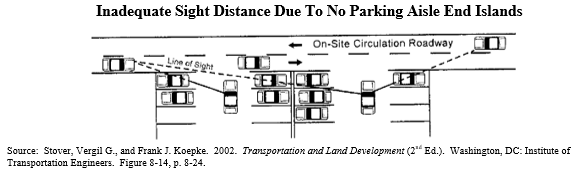
The intersection of parking aisles with a ring road or other on-site roadways or driveways shall provide adequate intersection sight distance. Parking aisle end islands shall be curbed unless that requirement is waived for water quality purposes or in a rural/exurban area; painted end islands are ineffective and are generally not permitted.
(Ord. No. 2023-008, § 1(Exh. A), 8-21-2023)
Sec. 6-57. - Parking lot drainage.
For any use that will require a parking area of 5 spaces or more, or a loading area, to be newly constructed, added to, or altered in such a way as to affect drainage either on or off the site, storm water drainage plans, including grading plans, shall be submitted to and approved by the community development director and the public works director, prior to the issuance of a development permit.
Sec. 6-58. - Parking lot surfacing.
Parking areas shall be surfaced with concrete, asphaltic concrete, asphalt or other dust-free surface; provided, however, that porous pavement parking spaces and grass pavers may be substituted for standard dust free pavements as specified in section 6-87, "Use Division of Large Parking Lots."
(a)
Off-street parking areas for single-family and two-family dwellings shall be improved with a concrete surface at least four inches thick. Additionally:
1.
The installer must ensure that installation occurs during optimal weather conditions or make adjustment using additives to prevent shrinkage cracks, surface cracks or structural cracks.
2.
The sub-base should be compacted to 95 percent or consist of crush-n-run material.
3.
The concrete mixture should have a minimum strength of 3000 PSI.
4.
Cracks in control joints are acceptable and only one additional crack is allowed per driveway. Cracks must be sealed. Where cracks exist, an engineer's certification of structural soundness must be provided.
5.
No cracks are allowed in sections of concrete that are located within the right-of-way.
(b)
Asphalt surfacing of residential driveways shall not be permitted except by special use.
(c)
Aggregate (gravel) surface may be considered appropriate and approved by the community development director in rural or low-density residential areas by a special use approval by the Mayor and Council. Water quality effectiveness and character of the zoning district shall be considered in determining surfacing requirements. Any permitted aggregate surface shall be maintained with rock or stone not more than one inch in diameter with an average depth of two inches and a minimum depth of one inch. The rock or stone may not contain dirt, sticks, construction debris, or other foreign matter. Sand rock or stone powder, crush and run or other similar material is prohibited. Aggregate surface shall be contained to prevent migration of the gravel onto other areas.
(d)
Off-street parking areas for uses other than single-family and two-family dwellings shall be improved with a permanent dust-free surface consisting of a minimum of a six-inch graded aggregate base overlaid with a two-inch Type B binder and a one and one-half-inch Type E asphaltic concrete wearing surface.
(e)
In the LI and HI Industrial zoning districts, the above type of surface is required for customer, visitor, and employee automobile parking. In the LI and HI Industrial zoning districts the following surface is required in areas used for loading docks and parking of commercial trucks and other commercial equipment:
a.
An eight-inch graded aggregate base, overlaid with a two-inch Type B binder and a one and one-half-inch Type E asphaltic concrete wearing surface; or
b.
A ten-inch graded aggregate base, overlaid with a 12-inch course of 3,000 P.S.I. concrete.
(Ord. No. 2024-011, § 1(Exh.), 6-3-2024; Ord. No. 2024-018, § 1 (Exh. A), 12-2-24)
Sec. 6-59. - Curbing or stops.
Curbing shall be installed as required by the public works director when considered necessary for drainage, although water quality effectiveness and character of the zoning district shall be considerations in determining curbing requirements. Toward the end of maximizing infiltration and the promoting the water quality effectiveness of low impact development techniques, the public works director is authorized to vary curb requirements.
Sec. 6-60. - Lighting.
(a)
Any lights used to illuminate a parking area shall be arranged, located or screened to direct light away from any adjoining residential use and shall not cause glare on any abutting property or street.
(b)
Parking areas shall not be illuminated between the hours of 12:00 midnight and 6:00 a.m. if the uses on the property are not open for business or operation, although temporary activation by motion detectors may be allowed to provide security lighting for periods not to exceed 15 minutes.
(c)
Design review of the lighting of parking lots is required. See section 5-38, exterior lighting.
Sec. 6-61. - Light pole locations and specifications.
Light poles should be located in landscaped planter strips. Where this cannot be accomplished, light poles must be placed on a reinforced concrete pedestal to protect them from damage or being knocked over.
Sec. 6-62. - Screening and landscaping.
Parking lots shall be screened and landscaped as required by article 12 of this development code.
Sec. 6-71. - Off-street parking required.
(a)
Permanent on-site parking spaces shall be provided in accordance with the requirements of this article as follows, at the time: of the establishment of any use, or erection of any building; of occupancy of a building by a new use; and any principal building is enlarged or increased in capacity by adding dwelling units, guest rooms, seats, or floor area.
(b)
All required off-street parking areas shall be ready for use, including surfacing as required, prior to occupancy of the property (in the case of a new building or addition) or within 45 days after the issuance of a certificate of occupancy (in the case of a change of occupancy in an existing building).
Sec. 6-72. - Access and location of off-street parking.
All parking spaces required to meet the minimum standards of this article shall be provided on the same lot with the main building or use which it serves; provided however, that upon demonstration that the parking spaces required by this article are not available and cannot reasonably be provided on the same lot as the building, structure or use it serves, the community development director may authorize the provision of required on-site parking to be located in proximity to the use that the spaces serve, as specified by Table 6-3.
Table 6-3
Required Location of Parking Spaces
Sec. 6-73. - Maximum number of off-street parking spaces required.
(a)
The maximum number of outdoor parking spaces allowed per dwelling unit for a single-family or two-family residence is 4, exclusive of any spaces within an enclosed garage or carport.
(b)
For all other uses, the maximum number of outdoor off-street parking spaces to be provided for residents, employees, customers and visitors for each type of land use shall be determined according to Table 6-4, rounded up to the nearest whole parking space. Additional spaces may be provided for residential and lodging uses within fully enclosed garages.
Sec. 6-74. - Minimum number of off-street parking spaces required.
(a)
Reference to requirements table. Unless specifically provided otherwise in this article, on each lot where a building, structure, or use exists, each site shall be designed to provide and shall provide for off-street parking in the minimum (and not to exceed the maximum) amounts in Table 6-4.
(b)
Single-family and two-family dwellings. The minimum number of parking spaces required per dwelling unit for a single-family or two-family residence is 2, exclusive of an enclosed garage or carport. Garages shall be provided (attached or detached). Single car garages shall be a minimum of 11 feet by 25 feet and double car garages shall be a minimum of 21 feet by 23 feet. All measured shall be clear internal measurements (exclusive of water heater or other mechanical equipment).
(c)
All other uses. For all other uses, the minimum number of outdoor parking spaces required on a property for residents, employees, customers and visitors shall be as determined for the type of land use in Table 6-4.
(d)
Two or more uses. Developments containing 2 or more of the uses listed on Table 6-1 shall provide no less than 80% of the number of spaces allowed for each use (except as may be further reduced per section 6-83, shared use of parking spaces.
(e)
No double counting. Parking spaces provided to meet the requirements of this article for one use shall not be used to meet the parking requirements of any other use, except as provided per section 6-83, shared use of parking spaces.
(f)
Reduction. No existing or future off-street parking area shall be reduced in capacity to less than the minimum required number of spaces, or increased to more than the maximum permitted number of spaces, or altered in design or function to less than the minimum standards, unless specifically provided for in this article.
Table 6-4
Minimum and Maximum Number of
Off-Street Parking Spaces Required
Note: Unless otherwise noted, the parking requirement shall be based on the gross square footage of the building or buildings devoted to the particular use specified.
(Ord. No. 2023-008, § 1(Exh. A), 8-21-2023)
Sec. 6-75. - Minimum number of accessible parking spaces required.
(a)
Regulations and dimensions for handicapped parking spaces shall be per requirements of the Americans with Disabilities Act (ADA) (Public Law 101-136) and the Georgia Accessibility Code. The required number of handicapped accessible spaces, which must be provided on-site, shall be as provided in Table 6-5.
Table 6-5
Handicapped Parking Requirements
(b)
Part of overall requirements. Said spaces shall count toward the requirements for off-street parking as specified in Table 6-1.
(c)
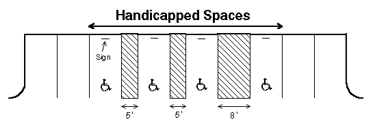
Aisle specifications and van accessibility. Handicap accessible parking spaces shall have an adjacent aisle 5' wide, and one in every 8 handicapped spaces shall be adjacent to an aisle 8' wide and the space shall be signed "van accessible." For van spaces, the width of the parking space shall be at least 11'. Handicapped parking space aisles shall be clearly demarcated by lines painted on or otherwise applied to the parking lot surface.
(d)
Surface slope. Handicap accessible parking spaces shall be located on a surface with a slope not exceeding 1 vertical foot in 50 horizontal feet (1:50).
(e)
Ramps. Wheelchair ramps shall be provided in accordance with applicable specifications at locations appropriate to normal travel routes from the parking lot to the principal use.
(f)
Signage. Accessible parking spaces shall be designated as reserved by a sign showing the symbol of accessibility, per applicable state law requirements. Such signs shall be located so that they cannot be obscured by a vehicle parked in that space.
Sec. 6-76. - Angled parking.
Parking spaces may be permitted with 90-degree, 60-degree, or 45-degree angles to the access aisle. Parking lots with parking space angles less than 45 degrees to the access aisle are not allowed, except for parking spaces that are parallel to the access aisle.
Sec. 6-77. - Compact parking spaces.
Compact parking spaces may be used in parking areas when more than 20 parking spaces are required, provided that the areas for compact parking are clearly marked and not more than 20% of the number of parking spaces provided in the entire parking area is designated compact auto parking.
Sec. 6-78. - Stacking spaces for drive-through facilities or service windows.
Stacking spaces shall be provided for any use having a drive-through facility or areas having drop-off and pick-up areas in accordance with this section.
(a)
Stacking spaces shall begin at the window or communication/mechanical device (e.g., order board) first encountered by the vehicle user. Financial institutions with drive-through windows, car washes (automated or staffed facilities), drive-through coffee sales facilities, and any other uses with drive-through facilities shall provide 3 stacking spaces for each window or drive-through service facility. Restaurants with drive-through facilities shall at least provide 5 stacking spaces for each window or drive-through service facility.
(b)
Stacking spaces and lanes for drive-through stations shall not impede on and off site traffic movements, shall not cross or pass through off-street parking areas, and shall not create a potentially unsafe condition where crossed by pedestrian access to a public entrance of a building.
(c)
Drive-through lanes shall be separated by striping or curbing from off-street parking areas. Individual lanes shall be striped, marked, or otherwise distinctly delineated.
(d)
All drive-through facilities shall be provided with a bypass lane with a minimum width of 10', aside the drive-through lane.
Sec. 6-81. - Administrative variances.
(a)
The minimum and maximum on-site parking requirements for uses in the CBD zoning district may be waived by the community development director upon a determination that adequate parking is otherwise available.
(b)
The community development director may allow parking at a rate of up to 10% above the maximum permitted number of spaces, or at a rate of no more than 20% below the minimum required, on a case-by-case basis, based upon the scale and impacts of the request, for good cause shown. The applicant shall make said request in writing which may be required to include documentation from an acceptable industry publication (e.g., Institute of Transportation Engineers, Urban Land Institute, American Planning Association, etc.) or a study prepared by a qualified professional that documents parking requirements.
(c)
The community development director may authorize a reduction of a number of required parking spaces when it can be demonstrated to his or her satisfaction that the use provides other areas on the site that are not marked as parking spaces but which serve some of the demand for on-site parking.
(d)
In approving administrative variances to the parking requirements of this section, the community development director may as a condition of approval, if applicable, require an area to be reserved or set-aside for additional parking area for future use if needed.
Sec. 6-82. - Off-site parking.
If required parking spaces are not located on the same lot as the particular use, building or establishment they are intended to serve, the following shall apply:
(a)
The parking spaces must be located on a property that has the same zoning classification as the property that the spaces serve, or a less restrictive zoning classification.
(b)
No required parking spaces may be located across any State or U.S. highway from the use they are intended to serve.
(c)
An easement (or other recordable instrument satisfactory to the community development director) dedicating the off-site parking to the property that the spaces serve shall be recorded with the Clerk of the Superior Court and a copy provided to the community development director. The document must be written to survive future changes in ownership in perpetuity, unless the agreement is dissolved with approval by the Mayor and City Council.
(d)
Off-site parking spaces shall be located in proximity to the use that the spaces serve, in accordance with the locational requirements of Table 6-3.
Sec. 6-83. - Shared use of parking spaces.
The parking spaces provided for separate uses may be combined in one parking lot but the required spaces assigned to each use may not be assigned to another use, except as follows:
(a)
Shared parking between day and night users. One-half of the parking spaces assigned to a church, theater, or assembly hall whose peak attendance will be at night or on Sundays may be assigned to a use that will be closed at night or on Sundays.
(b)
Mixed use developments. Parking spaces may be shared by more than one use if the community development director finds that the total number of spaces will be adequate at the peak hours of the uses they serve. The ratios shown on Table 6-6 may be used in determining the time of day and the day of the week at which the maximum number of spaces will be needed by the uses served by the shared parking facility.
Table 6-6
Percentage of Parking Spaces Demanded by Time Period
(c)
Availability of shared spaces. Parking spaces that are proposed to be shared among 2 or more uses must be clearly available to each use and not appear in any way to be serving a particular use, either through signage dedicating the spaces or through design techniques that would tend to orient use of the spaces to a particular business or building.
(d)
Recordation of shared parking agreement. Shared parking arrangements must be committed to writing in an instrument acceptable to the community development director, and approved by the owners of each of the affected properties or uses. The instrument must be approved by the community development director and shall be recorded with the Clerk of Superior Court, and a copy of the recorded document must be supplied to the community development director. The document must be written to survive future changes in ownership in perpetuity, unless the agreement is dissolved with approval by the Mayor and City Council.
Sec. 6-84. - Reduction for on-street parking.
The community development director may in individual cases administratively authorize a reduction in the minimum number of parking spaces for projects that are directly served by on-street parking approved by the public works director, on a one-to-one basis (one off-street parking space reduced for each on-street parking space directly serving the subject development). In such instances on-street parking shall be counted toward meeting minimum on-site parking space requirements.
Sec. 6-85. - Reduction for mixed-use development.
In the MXU zoning district, when developed for mixed uses, the minimum total required parking spaces specified for the combination in uses may be reduced by 10%.
Sec. 6-86. - Reduction for demand management.
(a)
The community development director may in individual cases administratively authorize a proportional reduction in the required minimum number of parking spaces for office, institutional, industrial, and public uses with 50 or more employee parking spaces, if a formal carpool or van pool program is instituted.
(b)
For purposes of this section, carpool is defined as 2 or more persons per car, and vanpool is defined as 5 or more persons per van. Any carpool or vanpool program shall provide at least 5 spaces reserved for carpool or vanpool vehicles and shall be clearly marked "Reserved - Carpool/Vanpool Only" through signage or pavement markings.
(c)
Designated carpool/vanpool spaces shall be the closest employee parking spaces to the building entrance normally used by employees except for any handicapped parking spaces provided.
(d)
The applicant must agree that the parking preferences will be enforced.
Sec. 6-87. - Use division of large parking lots.
When a parking lot of 75 spaces or an area of one acre or more of parking is proposed, the applicant may be required by the community development director to divide the parking lot into distinct use areas as provided in Table 6-7 for purposes of applying impervious surface reduction and water quality infiltration techniques.
Table 6-7
Division of Large Parking Lots for Impervious Surface Reduction, Porous Pavement Usage,
and Compact Space Design
Sec. 6-91. - Off-street loading required.
On the same lot with every building, structure or part thereof, erected or occupied for manufacturing, storage, warehouse, truck freight terminal, department store, wholesale store, grocery supermarket, hotel, hospital, mortuary, dry cleaning plant, retail business, or other uses similarly involving the receipt or distribution of vehicles, materials or merchandise, there shall be provided and maintained adequate space for the standing, loading, and unloading of such materials to avoid undue interference with public use of streets, alleys, and private or public parking areas.
Sec. 6-92. - Minimum number of on-site loading spaces required.
One off-street loading space shall be provided for the first 10,000 square feet of gross floor area or fractional part thereof for light industrial use and one off-street loading space for the first 5,000 square feet of gross floor area or fractional part thereof for retail or other non-industrial use for which a loading space is required. One additional space shall be required for each additional 25,000 square feet of gross floor area or fractional part thereof for light industrial use and for each additional 10,000 square feet for retail or other non-industrial use.
Sec. 6-93. - Location of loading spaces.
Loading areas shall be located to the rear of the building unless site design precludes a rear location, in which case loading shall be to the side of a building.
Sec. 6-94. - Loading area specifications.
Unless otherwise approved by the community development director, loading spaces shall be a minimum of 14' wide, 40' long, with 14' of height clearance. When the development requires loading and unloading by full-size tractor-trailers, loading spaces shall be 60' long with a 63' apron, for a total of 123'.
Sec. 6-95. - Administrative variance.
The community development director is authorized to modify the loading area specifications of this division and reduce or waive off-street loading space requirements for good cause shown, after application for administrative variance.

