
Powder Springs City Zoning Code
ARTICLE 14
- APPEALS AND VARIANCES
Sec. 14-1. - Appeal as a remedy.
It is the intent of this development code that all questions arising in connection with the administration and enforcement of this development code shall be presented first to the community development director for potential resolution. Persons may appeal to the governing body for relief when aggrieved by an action or an interpretation of the community development director made under this development code. All such requests for relief shall be taken as an appeal to the governing body, as provided in this division.
Sec. 14-2. - Initiation of an appeal.
Any person aggrieved by a decision of the community development director or any person acting administratively under authority of this development code may initiate, by application, an appeal of an administrative action or interpretation to the governing body. An application for an appeal for any property or properties may be initiated by the owner of a majority interest in the property affected, or his or her authorized representative.
Sec. 14-3. - Bases for an appeal.
(a)
An appeal may be filed where it is alleged that the community development director has misinterpreted or misapplied one or more requirements or other provisions of this development code.
(b)
An appeal may be filed where it is alleged that an enforcement officer erred in finding the person or property in violation of any provision of this development code or in violation of permit conditions.
Sec. 14-4. - Application requirements.
(a)
All appeal applications shall be submitted to the community development director on forms provided by the Department. When the appeal application is referred to the governing body, the applicant shall be required to submit 10 copies of the documentation necessary to support the appeal application.
(b)
All appeal applications shall be accompanied by a non-refundable fee, as set by resolution of the governing body from time to time.
(c)
An application for an appeal shall include such descriptions, maps or drawings as needed to clearly illustrate or explain the action requested. The City may request such additional information from the appellant as necessary to provide a full understanding of the appeal.
(d)
Such appeal application must be filed within 30 days of the action or interpretation that is the subject of the appeal. If the person aggrieved by an action by an administrative official with regard to this development code does not file a complete appeal application within 30 days of the decision appealed from, then the decision of the community development director shall stand, and no further remedy shall be available under this development code.
(e)
The community development director shall review the application for completeness within 5 working days of submission. Incomplete or improper applications will be returned to the applicant.
Sec. 14-5. - Stay of proceedings.
The filing of a completed application for an appeal of an administrative decision stays all legal proceedings in furtherance of the action appealed from, unless the community development director certifies to the governing body, after the notice of appeal shall has been filed, that by reason of facts stated in the certificate a stay would cause imminent peril to life or property. In such case, proceedings shall not be stayed unless the applicant for appeal of an administrative decision secures an order from a court of competent jurisdiction.
Sec. 14-6. - Appeal procedures.
(a)
Assembly of record. Upon receiving a complete and timely application for an appeal, the community development director or his/her designee shall assemble such memos, papers, plans, or other documents as may constitute the record for the appeal or as may provide an understanding of the issues involved.
(b)
Schedule of appeal hearing. Once the record has been assembled, the community development director or his/her designee shall schedule the appeal for public hearing and consideration at the next meeting of the governing body for which adequate public notice can be given.
(c)
Notification to the general public. At least 15 days but not more than 45 days prior to public hearing, notice shall be published in a newspaper of general circulation within the city. The notice shall state the time, place and purpose of the hearing. The published notice shall also include the location of the property for which the appeal arises, if applicable, the existing zoning classification of the property, and the nature of the appeal.
Sec. 14-7. - Authority and action.
(a)
Decision or determination. The governing body shall after application and public hearing make findings and render a decision on the appeal. The governing body may affirm, overrule or modify, in whole or in part, the rulings, or decisions or interpretations of the community development director.
(b)
Remedies. In cases where an appeal is granted, the governing body may direct the issuance of land development permits or building permits, not otherwise inconsistent with this development code or other ordinance adopted by the governing body. The governing body may determine the boundaries of the various zoning districts where uncertainty exists. The governing body may interpret such provisions of this development code as may require clarification or extension in specific cases.
(c)
Notice. The city clerk shall notify the applicant, in writing, of its decision within 5 calendar days after the governing body has rendered its decision.
(d)
Binding action. The community development director shall be bound by the decision of the governing body on the appeal application.
(e)
Finality. A decision of the governing body pursuant to this division shall constitute final action and may be appealed only to a court of competent jurisdiction in the manner provided by law.
Sec. 14-11. - Authority.
(a)
In accordance with the requirements of this division, the community development director shall have the power to authorize upon application in specific cases such administrative variances from the terms of this development code as will not be contrary to the public interest where, owing to special conditions, a literal enforcement of the provisions of this development code will in an individual case result in practical difficulty or unnecessary hardship, so that the spirit of this development code shall be observed, public safety and welfare secured, and substantial justice done.
(b)
The community development director may upon application consider the approval, conditional approval, or denial of administrative variances, subject to the requirements of this division. In granting an administrative variance, the community development director may impose such requirements and conditions with respect to the location, construction, maintenance and operation of any use or building, in addition to those expressly set forth in this development code, as may be deemed necessary for the protection of adjacent properties and the public interest.
Sec. 14-12. - Provisions that may be administratively varied.
The community development director is authorized upon application and in specific instances, in accordance with the requirements of this division, to grant administrative variances to the following provisions:
(a)
Front setback. Reduction not to exceed 35% of a front setback for a principal building, as required generally by section 1-43 of this development code and as specifically required by Table 2-2 or Table 2-4 of this development code, whichever is applicable;
(b)
Side setback. Reduction not to exceed 35% of a side setback for a principal building, as required generally by section 1-43 of this development code and as specifically required by Table 2-2 or Table 2-4 of this development code, whichever is applicable;
(c)
Rear setback. Reduction not to exceed 35% of a rear setback for a principal building, as required generally by section 1-43 of this development code and as specifically required by Table 2-2 or Table 2-4 of this development code, whichever is applicable;
(d)
Accessory building setback. Reduction not to exceed 35% of a setback required for an accessory building or structure, as specified by Table 2-2 or Table 2-4 of this development code, whichever is applicable.
(e)
Principal building separation. Reduction not to exceed 35% of principal building separation requirements of section 1-43 of this development code.
(f)
Principal and accessory building separation. Reduction not to exceed 35% of the minimum separation between a principal building and an accessory building or structure as required by section 4-05 of this development code.
(g)
Specific use setbacks and separation. Reduction not to exceed 35% of any building, structure, or use setback or separation requirement established in article 4 of this development code, except section 4-05; provided, however, that this authority shall not include authority to administratively vary required buffers.
(h)
Improvement setback. Reduction of a setback for improvements as required by section 6-52 of this development code, to no less than 3'.
(i)
Minimum required parking spaces. Reduction not to exceed 20% of the minimum required number of parking spaces required by section 6-74 and Table 6-4 of this development code, subject to the requirements of section 6-81 of this development code. Reductions greater than 20% can be granted based on a shared parking study prepared by a professional engineer to industry standards that demonstrates that the reduction will not have an adverse effect on internal and external traffic operations and adjoining properties.
(j)
Maximum parking spaces. Increase not to exceed 10% of the maximum number of parking spaces limited by section 6-73 and Table 6-4 of this development code, subject to the requirements of section 6-81 of this development code.
(k)
Minimum loading area requirements. Reduction or waiver of minimum number of on-site loading spaces required by section 6-92 of this development code, and the loading specifications of section 6-94, as also provided per section 6-95 of this development code.
(l)
Conflicts between a PUD-R or MXU adopted site plan and the Unified Development Code may be administratively varied as long as there is no conflict with safety or floodplain requirements as long as it is demonstrated that the variances are in keeping with the original intent of the approval and does not conflict with section 13-54.
Sec. 14-13. - Initiation of administrative variance applications.
An application for administrative variance may be initiated by any person, firm, corporation or agency, provided said individual, firm, corporation or agency is the owner or owner's agent of the property for which the administrative variance is sought.
Sec. 14-14. - Application requirements.
Applications for administrative variance shall require submittal of the following.
(a)
Application fee as specified by resolution of the governing body;
(b)
Application form furnished by the community development director, including signed and notarized signature of property owner;
(c)
Legal description of the property;
(d)
Survey plat of the property;
(e)
Site plan or other exhibit of the property at an appropriate engineering scale showing the proposed use and relevant information regarding proposed improvements;
(f)
Written analysis of how the proposed action compares to decision criteria specified in this division for administrative variances; and
(g)
Other information as may be required by the community development director.
The community development director may waive one or more of the requirements of this section (excluding fees which shall not be waived) in individual cases when he/she determines that one or more elements of the required information specified in this section are not essential to the review process.
Sec. 14-15. - Criteria for granting administrative variances.
Any applicant requesting consideration of an administrative variance shall provide a written justification that one or more of the following condition(s) exist. The community development director shall not approve an administrative variance application unless he or she has adopted written findings that the one or more of the following conditions exist:
(a)
There are extraordinary and exceptional conditions or practical difficulties pertaining to the particular piece of property in question because of its size, shape or topography that are not applicable to other lands or structures in the same district;
(b)
A literal interpretation of the provisions of this development code would effectively deprive the applicant of rights commonly enjoyed by other properties of the district in which the property is located;
(c)
Granting the variance requested will not confer upon the property of the applicant any special privileges that are denied to other properties of the district in which the applicant's property is located;
(d)
The requested variance will be in harmony with the purpose and intent of this development code and will not be injurious to the neighborhood or to the general welfare;
(e)
The special circumstances are not the result of the actions of the applicant; and/or
(f)
The variance requested is the minimum variance that will make possible the proposed use of the land, building, or structure in the use district proposed.
Sec. 14-16. - Procedures.
(a)
To approve an administrative variance, the community development director shall make written findings that the variance requested complies with the administrative variance criteria specified in this division.
(b)
The community development director shall issue a written decision as promptly as possible, but no later than within 14 calendar days of receipt of a completed application, stating whether the administrative variance request is approved, approved with conditions, or denied.
(c)
If denied, the community development director shall state in the letter that the applicant denied an administrative variance may file an application for variance in accordance with division III of this article.
Sec. 14-17. - Withdrawal of application.
An administrative variance application may be withdrawn at any time at the discretion of the person or agency initiating such a request, upon written notice to the community development director. No refund of the application fee shall be provided in the case of a withdrawal.
Sec. 14-21. - Authority to grant variances.
(a)
The governing body shall have the power to authorize upon application in specific cases such variances from the terms of this development code as will not be contrary to the public interest where, owing to special conditions, a literal enforcement of the provisions of this development code will in an individual case result in practical difficulty or unnecessary hardship, so that the spirit of this development code shall be observed, public safety and welfare secured, and substantial justice done.
(b)
The governing body may upon application approve, conditionally approve, or deny variances, subject to the requirements of this division. In granting a variance, the governing body may impose such requirements and conditions with respect to the location, construction, maintenance and operation of any use or building, in addition to those expressly set forth in this development code, as may be deemed necessary for the protection of adjacent properties and the public interest.
Sec. 14-22. - Initiation of variance applications.
An application for variance may be initiated by any person, firm, corporation or agency, provided said individual, firm, corporation or agency is the owner or owner's agent of the property for which the variance is sought.
Sec. 14-23. - Application requirements.
Applications for variance shall require submittal of the following items:
(a)
Application fee as specified by resolution of the governing body;
(b)
Application form furnished by the community development director, including signed and notarized signature of property owner;
(c)
Legal description of the property;
(d)
Survey plat of the property;
(e)
Letter of intent describing the proposed use of the property or other action requested;
(f)
Site plan of the property at an appropriate engineering scale showing existing and proposed buildings and structures and other information as may be required by the community development director to describe and/or graphically depict the requested variance;
(g)
Written analysis of how the proposed action compares to decision criteria specified for the granting of variances pursuant to this division; and
(h)
Other information as may be required by the community development director.
The community development director may waive one or more of the requirements of this section (excluding fees which shall not be waived) in individual cases when he/she determines that one or more elements of the required information specified in this section are not essential to the review process.
Sec. 14-24. - Criteria for granting variances.
Any applicant requesting consideration of a variance to any provision of this development code shall provide a written justification that one or more of the following condition(s) exist. The governing body shall not approve a variance application unless it shall have adopted findings that one or more of the following conditions exist:
(a)
There are extraordinary and exceptional conditions or practical difficulties pertaining to the particular piece of property in question because of its size, shape or topography that are not applicable to other lands or structures in the same district;
(b)
A literal interpretation of the provisions of this development code would effectively deprive the applicant of rights commonly enjoyed by other properties of the district in which the property is located;
(c)
Granting the variance requested will not confer upon the property of the applicant any special privileges that are denied to other properties of the district in which the applicant's property is located;
(d)
The requested variance will be in harmony with the purpose and intent of this development code and will not be injurious to the neighborhood or to the general welfare;
(e)
The special circumstances are not the result of the actions of the applicant;
(f)
The variance requested is the minimum variance that will make possible the proposed use of the land, building, or structure in the use district proposed; and/or
(g)
The variance shall not permit a use of land, buildings or structures, which is not permitted by right in the zoning district or overlay district involved.
Sec. 14-25. - Application compliance and completeness.
(a)
No variance application shall be processed by the community development director unless it complies with the procedural requirements of this division and is found to be complete with regard to application materials, payment of fees, supportive materials, and any other application requirements specified by this division.
(b)
If the variance application does not comply with all application submittal requirements of this division, the community development director shall reject the application and refuse to process it.
(c)
In cases where more than one application (rezoning, special use, variance) pertaining to a particular piece of property is filed simultaneously, the applicant must prepare separate applications and meet all application requirements for each application filed; provided, however, that the community development director may waive separate site plan or letter of intent filing requirements when they would be unnecessarily duplicative.
Sec. 14-26. - Administrative processing of applications.
The community development director is hereby authorized to establish administrative deadlines for the receipt of variance applications. Upon a finding by the community development director that a variance application is complete and complies with the requirements of this division, including deadlines, the application shall be marked received and approved for initiation, and the date of such consideration shall be indicated in the file of the application.
Sec. 14-27. - Concurrent variance application.
In cases where an applicant is proposing a rezoning (i.e., amendment to the official zoning map) or special use, or both, and where the applicant files an application to obtain a variance at the same time of filing a rezoning or special use application, the applications may be processed simultaneously, but the variance application shall not be considered until the rezoning or special use application, or both as appropriate, is approved (which may be the same public hearing or meeting), since the variance would not otherwise be permitted without the rezoning or special use.
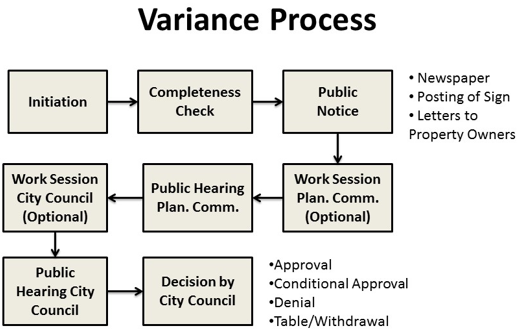
Sec. 14-28. - Investigation and recommendation.
(a)
The community development director may send the application out for review by internal municipal departments and external agencies as may be appropriate (i.e., inter-agency review). Any written comments received in a timely manner shall be submitted to the applicant, planning commission and governing body for consideration, and any such comments shall become an official public record.
(b)
The community development director or designee shall investigate and make a recommendation regarding any or all of the relevant matters concerning the application. Any such investigation and recommendation shall if in writing be made available to the applicant, planning commission, and governing body prior to public hearings and shall become an official public record.
Sec. 14-29. - Public hearing notice - newspaper.
(a)
Planning Commission. Prior to the date of the public hearing before the planning commission, if held, the city may cause to be published within a newspaper of general circulation within the city a notice of the work session and public hearing before the planning commission. The notice if provided shall state the time, place, and purpose of the public hearing and shall include the location of the property. The notice if provided shall also include the existing zoning classification and the nature of the variance request including the section requested to be varied.
(b)
Mayor and City Council. At least 15 but not more than 45 days prior to the date of the public hearing before the governing body, the city shall cause to be published within a newspaper of general circulation within the city a notice of the work session and public hearing before the governing body. The notice shall state the time, place, and purpose of the public hearing and shall include the location of the property. The notice shall also include the existing zoning classification and the nature of the variance request including the section requested to be varied.
Sec. 14-30. - Public hearing notice - sign on property.
(a)
Requirement and locations. The applicant shall be required to post and maintain signs supplied by the city on or near the right-of-way of the nearest public street, so as to be visible from the street for at least 15 days and not more than 45 days immediately preceding the date for the City Council public hearing on the variance application. One such sign shall be placed in a conspicuous location along each street frontage of the property for which the variance has been requested. If the property has no street frontage, the sign shall be placed on each street where access to the property will be gained.
(b)
Content. The sign providing notice shall state the time, place, and purpose of the public hearing and shall include the location of the property. The notice shall also include the existing zoning classification and the nature of the variance request including the section requested to be varied.
(c)
Time period. It is the responsibility of the applicant to post the signs and to maintain the signs during the posting period. Said signs pertaining to the governing body's public hearing shall remain posted until a final decision by the governing body has been rendered.
(d)
Consequences of non-maintenance. Failure to post and maintain the signs continuously may prohibit consideration of the application at any scheduled public hearing. In the event the signs are not posted continuously, the city, in its sole discretion, may require the reposting and readvertising prior to any future public hearing, for which the applicant shall pay an additional readvertising fee. The city may also in its sole discretion, continue, hold, approve, or dismiss the application. Any dismissal under the provisions of this subsection shall be with prejudice unless specifically noted as being without prejudice by the city.
Sec. 14-31. - Public hearing notice - surrounding property owners.
(a)
No less than 15 days prior to the public hearing before the Planning Commission, the community development director may require the applicant to mail a notice to all persons owning property located in whole or in part within 200' of any portion of the property that is the subject of the variance application.
(b)
The written notice if provided is to be mailed to the property owners as such names and addresses appear on the County's current ad valorem tax records.
(c)
The notice if provided shall state the time, place, and purpose of the work sessions, Planning Commission scheduled hearing or meeting, and public hearing before the governing body and shall include the location of the property. The notice if provided shall also include the existing zoning classification and the nature of the variance request including the section requested to be varied. In addition, the notice if provided shall include a page size copy of the site plan or variance exhibit submitted with the application.
(e)
If required to provide notice per this section, the applicant shall submit an affidavit to the community development director or designee prior to the public hearing before the planning commission, if a hearing is to be held, listing the property owners and certifying the date that the notices were mailed.
Sec. 14-32. - Work sessions.
Work sessions of the Planning Commission and governing body may be convened from time-to-time to discuss pending matters prior to public hearings. Work sessions at which applications for variances are to be discussed shall be attended by the applicant or representative thereof with authority to make binding commitments to the city with respect to any stipulations that may be offered in connection with such application. Failure to attend the work session may result in the application being tabled one time. Failure to attend the rescheduled work session may result in denial of the application.
Sec. 14-33. - Public hearings.
(a)
Planning Commission. The Planning Commission may hold a public hearing on variance applications and if held said hearings shall be in accordance with the public hearing procedures specified in this article.
(b)
Governing body. The governing body shall hold a public hearing on all variance applications in accordance hearing with the public procedures specified in this article.
Sec. 14-34. - Recommendation and decision.
(a)
Planning Commission recommendation. Within 32 calendar days of the date of its meeting, which may include a public hearing, the Planning Commission shall provide a recommendation on applications for variance. This time limit may be extended if the applicant consents to extend the time frame. The Planning Commission may recommend approval or disapproval of the variance as applied for, or it may recommend conditions of approval on the application. In rendering a recommendation on any such application, the Planning Commission shall consider all information supplied by the applicant and community development director.
(b)
Governing body decision. Within 65 calendar days of the date of its public hearing, the governing body shall render a decision on the application for variance. This time limit may be extended if the applicant consents to extend the time frame. The governing body may approve or disapprove the proposed variance, return the application to the Planning Commission for further study, or place conditions of approval on the application. In rendering a decision on any such application, the governing body shall consider all information supplied by the applicant, community development director, and Planning Commission.
Sec. 14-35. - Withdrawal of application.
(a)
Prior to public notice. If a request for withdrawal is received prior to the publication of notice for a public hearing, the application shall be withdrawn administratively by the community development director without restriction on the refiling of a variance on the property in the future, as described in this division.
(b)
After public notice. If notice has been published or is irretrievably set for publication but the variance application has not been heard by the Planning Commission, the application shall be withdrawn administratively by the community development director, provided that: the applicant shall mail written notice of the withdrawal to the property owners previously notified and shall submit an affidavit to the community development director listing the property owners and certifying the date that the notices were mailed. Additionally, withdrawal of an application for a variance on the property under the terms of this subsection may not be resubmitted for 6 months from the date of withdrawal.
(c)
After Planning Commission meeting or public hearing. Should any request for withdrawal be made by the applicant after the Planning Commission's meeting or public hearing but before or at the governing body's public hearing, the application shall remain on the governing body's public hearing agenda and the withdrawal request shall be considered for approval or denial, with or without prejudice, by the governing body. If withdrawal is not allowed, the public hearing on the variance will proceed.
Sec. 14-36. - Notice of action.
When a variance application is filed by a property owner, the community development director shall notify the applicant of the recommendation of the Planning Commission on the application, and action taken by the governing body on the application.
Sec. 14-37. - Finality and legal recourse.
A decision of the governing body with regard to a variance application shall be final and may be appealed only to a court of competent jurisdiction. Such appeal must be taken within 30 days of the decision of the governing body. Reconsideration of an action on a variance application under court order shall follow the same procedures of this division as though a new application.
Sec. 14-38. - Limitations on the frequency of filing applications.
(a)
No variance application affecting the same or any portion of property which was denied by the governing body shall be accepted for filing by a property owner until 12 months shall have elapsed from the date said application was denied by governing body.
(b)
The same or any portion of property previously considered in a variance application which was denied by the governing body may not again be initiated by the governing body until the expiration of at least 6 months immediately following the final decision rendered on the application by the governing body.

