
Redwood City City Zoning Code
ARTICLE 36
EXTERIOR SITE IMPROVEMENTS1
Editor's note— Ord. No. 1130-364, § 18(Exh. N), adopted August 24, 2015, repealed Art. 36 and enacted a new article as set out herein. Former Art. 36, §§ 36.1—36.9, pertained to streetscape provisions and was derived from Ord. 1130.255, eff. 8-19-87; Ord. 1130.329 § 19, eff. 4-26-04; and Ord. 1130.336 § 27 (part), eff. 1-5-06.
36.1 - Purpose.
To encourage quality design and reduce potential impacts of exterior improvements on adjoining properties.
(Ord. No. 1130-364, § 18(Exh. N), 8-24-15)
36.2 - Applicability.
The provisions of this article apply to all zoning districts unless specifically stated otherwise.
(Ord. No. 1130-364, § 18(Exh. N), 8-24-15)
36.3 - Fences.
A.
Definitions.
1.
Fence. An artificially constructed barrier or wall of any material or combination of materials erected to physically separate properties, provide privacy, or provide security or confinement. Walls are included in the definition of a fence.
2.
Open Fence. A fence, including any gates in such fence, that permits direct vision through at least eighty percent (80%) of any one (1) square foot segment of vertical fence surface area. Measured surface area does not include major posts, pilasters, or other structures which provide lateral strength. The open area is uniformly distributed along the fence and is not concentrated in one (1) area. No single component or element of the fence, including lamp posts or pilasters, shall be wider than twelve (12) inches.
3.
Solid Fence. Any fence that does not qualify as an open fence.
B.
General Requirements.
1.
Fence Height. Fence height is measured from the nearest adjoining grade. In the case of differing grades, fences are measured from the lowest adjoining grade. Lattice or other decorative elements are counted toward the total fence height.
2.
Vision Triangles. In order to ensure visibility and safety, no solid fence or hedge exceeding three (3) feet in height shall be located within a fifteen-foot vision triangle on either side of a driveway providing access to required on-site parking or where two (2) streets intersect on the corner (refer to Figure 36.3, Visibility Triangle).
3.
Prohibited Materials.
a.
Residential Zoning Districts. Electrically charged fences, barbed wire, razor wire or other types of wire fences are prohibited in residential zones.
b.
Mixed Use Zoning Districts. Chain link fencing, barbed-wire, razor-wire, and corrugated metal fencing are prohibited in Mixed Use Corridor (MUC), Mixed Use Neighborhood (MUN) and Mixed Use Transitional (MUT) Zoning Districts.
C.
Location—Specific Requirements.
1.
Front Yard.
a.
All solid fences located in the required front yard shall not exceed three (3) feet in height;
b.
All combination solid/open fences located in the required front yard shall not exceed five (5) feet in height. Chain link fencing above three (3) feet is prohibited in the front yard in residential zoning districts.
c.
Privately constructed fences are prohibited in the public right-of-way.
2.
Interior Side and Rear. All fences, regardless of type, are limited to seven (7) feet in height in the side or rear yards. Such height may be increased to ten (10) feet in any district except the Professional Office (PO) or any Residential (R) District upon approval of an Architectural Permit.
3.
Exterior Side (Street Side).
a.
Fences are limited to six (6) feet in height in the side yard adjacent to the street on corner lots. The fence must be set back eighteen (18) inches from the sidewalk and meet vision triangle requirements as described in Section 36.3(B). Privately constructed fences are prohibited in the public right-of-way. The privately owned area between the fence and sidewalk must be landscaped and maintained in a healthy and weed-free condition. Chain link fences above three (3) feet in height are prohibited in side yards adjacent to the street in residential zoning districts.
Figure 36.3 Vision Triangles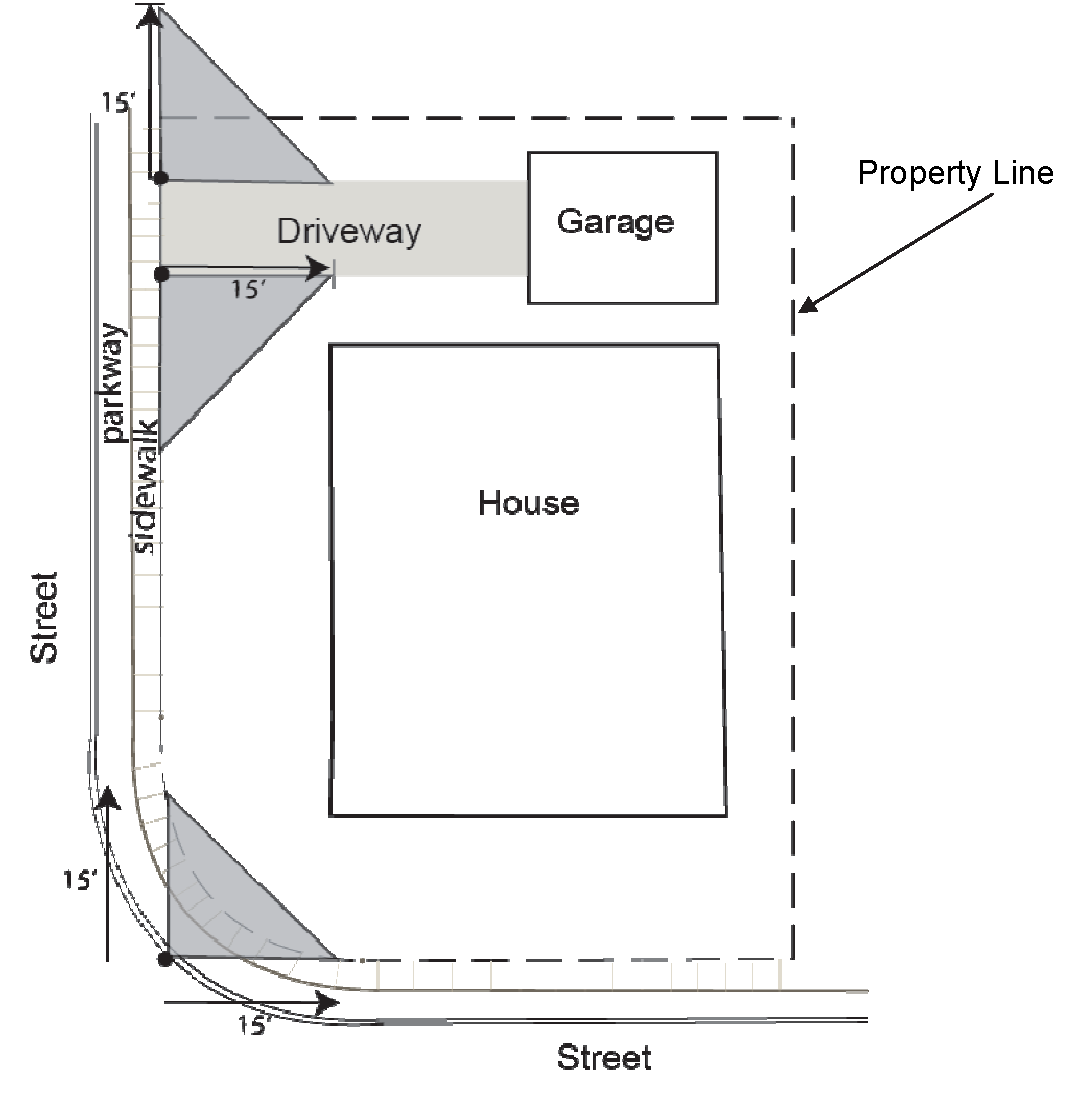
In case of a discrepancy between the wording of the regulation and the diagram, the regulation controls.
(Ord. No. 1130-364, § 18(Exh. N), 8-24-15; Ord. No. 1130-890, § 4(Exh. A), 8-26-24)
36.4 - Arbors.
A.
Definition: An arbor is an accessory structure that is substantially open to the passage of light and air on all sides. The arbor has a roof consisting of lattice that is a minimum of sixty percent (60%) open to the sky at any point across the entire structure. "Substantially open" sides of the structure shall also be a minimum of sixty percent (60%) open at any point across the entire side. Trellises are included in the definition of arbor.
B.
Applicability: Arbors are permitted in any zoning district subject to the restrictions of this section.
C.
Measurement of Setbacks: Setbacks are measured to the outside of the supporting posts of the arbor, and beams may extend up to one (1) foot closer to the lot line than the minimum setback otherwise allowed.
D.
Measurement of Area: The maximum dimensions for arbors at gates and entries are measured to the outside of the supporting posts or to the edge of the beams, whichever is greater.
E.
Lot Coverage: Arbors do not count towards lot coverage.
F.
Requirements for Arbors:
1.
Height. The maximum arbor height is fourteen (14) feet; nine (9) feet when located in street-side yards.
2.
Setback. The minimum setback must be three (3) feet from the front and rear lot line and meet the minimum side yard setback for the zoning district except where otherwise allowed by (G) below.
3.
Length. The maximum length of the arbor is thirty percent (30%) of the length of the rear lot line in R zoning districts.
G.
Special Requirements for Arbors at Entries: Arbors provided at gates or entries have the following requirements:
1.
Height. The maximum height is nine (9) feet.
2.
Setback. There is no minimum setback. Such arbors must be integrated into perimeter fencing (unless no fencing exists) in required front and street side yards.
3.
Length and Depth. Arbor length is limited to eight (8) feet and depth is limited to three (3) feet.
4.
Number. Properties in R zoning districts are limited to one (1) arbor per street frontage and required yard, for a maximum of four (4) arbors per property.
(Ord. No. 1130-364, § 18(Exh. N), 8-24-15; Ord. No. 1130-367, § 5, 6-13-16)
36.5 - Accessory Buildings.
The requirements of this section apply to all accessory buildings in any zoning district.
A.
Definition.Accessory Building. An accessory building is any subordinate detached building located on the same lot as a main building or buildings, and serves a purpose that is customarily incidental to the main structure, such as a garage or storage buildings. Where a building is in any way connected at any point to a main building, it shall comply with the requirements for the main building of the underlying zoning district. Accessory buildings do not include trash enclosures, disaster shelters (Section 36.6) or accessory dwelling units.
B.
Use of Accessory Buildings. Accessory buildings with a kitchen are considered accessory dwelling units and shall meet the requirements of Article 37 (Accessory Dwelling Units).
C.
Location. An accessory building shall not project beyond the front wall line of a main building and shall meet the following setback requirements:
1.
Front Yard. An accessory building shall comply with the minimum front yard setback of the underlying zoning district.
2.
Side Yard. For interior side yard setbacks, the accessory building shall provide a minimum side yard setback of four (4) feet.
3.
Exterior Side Yard. The accessory building shall provide the minimum exterior side yard setbacks of the underlying zoning district.
4.
Rear Yard. An accessory building shall have a minimum rear yard setback of four (4) feet.
5.
Setback from Other Buildings. The accessory building shall be set back at least six (6) feet from other buildings on the same lot.
D.
Height. The total height of an accessory building is limited to sixteen (16) feet and the wall height is limited to nine (9) feet for flat or shed roofs adjacent to the side and rear property line.
E.
Lot Coverage. Accessory buildings count towards the maximum lot coverage of the underlying zoning district.
F.
Provisions for Small Accessory Buildings. Accessory buildings of less than one hundred twenty (120) square feet without foundations may be located in the rear setback, behind the wall of the main building and in a required side or rear yard area provided they do not exceed seven (7) feet in height or the maximum allowed height of a fence in the setback, whichever is less.
G.
Total Amount of Accessory Buildings. Any combination of accessory buildings shall not cover more than fifty percent (50%) of the required rear yard area.
H.
Provisions for Roof Decks. Roof decks shall be prohibited on top of accessory structures.
(Ord. No. 1130-364, § 18(Exh. N), 8-24-15; Ord. No. 1130-366, § 4, 12-7-15; Ord. No. 1130-369, § 4, 4-24-17; Ord. No. 1130-378, § 3(Exh. A), 8-26-19; Ord. No. 1130-385, § 3(Exh. A), 9-13-21)
36.6 - Disaster Shelters.
A.
Definition.Disaster Shelter. A disaster shelter is a building constructed above or below the ground, designed solely to protect inhabitants from disasters such as blast, radiation, bombs, fallout, storms and fire.
B.
Size. A disaster shelter designed for fifteen (15) or fewer persons is allowed by right, provided the requirements of this section are met. Disaster shelters for sixteen (16) or more persons require a Use Permit.
C.
Location. Disaster shelters shall not be located within any street right-of-way, official plan line area, or public utility, storm drainage, sanitary sewer, or water line easement.
1.
Front Yard. Disaster shelters in the required front yard area must be at least six (6) inches below the natural grade of the yard, unless the shelter is located beneath the driveway. Disaster shelters located beneath the driveway may be flush with the driveway surface but must not project above the natural grade.
2.
Side or Rear Yard. Disaster shelters in the required side or rear yard must not project more than three (3) feet above the natural slope of the yard, including any fill placed on the roof.
D.
Safety of Vehicles. Any disaster shelter constructed below the ground surface is required to be marked and blocked so that vehicles will not pass over it. In the case of a disaster shelter located in the driveway, the shelter must be constructed with walls and roof of sufficient strength to support a load limit of H-20-33 as established by the "Standard Specifications for Highway Bridges" adopted by the American Association of State Highway Officials in 1953 and as amended or revised.
E.
Safety of Pedestrians. Ventilating structures or entrances rising up to one (1) foot above the ground in any yard having uncontrolled access by the public shall be marked or blocked by planting or fencing.
F.
Entrances. Entrances and ventilating structures in a required front yard shall be screened from adjacent properties and public right-of-way by landscaping or fencing.
(Ord. No. 1130-364, § 18(Exh. N), 8-24-15)
36.7 - Outdoor Equipment, Decks and Patios.
A.
Decks and Patios.
1.
Setbacks. Patio slabs, decks, driveways, sidewalks, and other paving one-foot high or less in height as measured from finished grade do not have a minimum setback requirement. Patio slabs, decks or other paving that exceeds one (1) foot in height must meet the setback requirements for the Zoning District.
2.
Pervious Surface Requirements. See individual zoning district articles for requirements on minimum area of pervious surface. See Section 32.12 (Stormwater Treatment) for further information on pervious areas and stormwater infiltration.
B.
Outdoor Equipment.
1.
Setbacks. Outdoor equipment such as air conditioning units or pool equipment must be located in the side or rear yard and setback a minimum of three (3) feet from the property line.
2.
Rooftop Equipment. Outdoor equipment may be located on the roof and must be screened on all sides and architecturally consistent with the structure. Rooftop equipment screening shall comply with the underlining Zoning District's maximum height standards.
3.
Noise. Regardless of the location where it is installed, outdoor equipment shall not exceed fifty-five (55) dBA in noise level at any point along the property line.
4.
Furniture and Landscape Features. Outdoor furniture and small landscape features such as water features may be located within the setback.
(Ord. No. 1130-364, § 18(Exh. N), 8-24-15; Ord. No. 1130-890, § 4(Exh. A), 8-26-24)
36.8 - Pools and Spas.
A.
Applicability. The requirements of this section apply to all pools, spas, ponds, lakes or open tanks (referred to collectively in this section as "pools") with the following exceptions:
1.
Any pool located within a completely enclosed building, or
2.
Any pool with no more than twenty-four (24) inches in depth.
B.
Commercial Use Prohibited. Such pools shall be used solely for the enjoyment of the occupants of the premises on which located, and their guests, and shall not be used for any commercial or business purposes or for economic gain.
C.
Setbacks. Pools must be set back a minimum of six (6) feet from the side and rear property lines and must comply with the minimum front yard setback for the individual zoning district.
D.
Equipment. Pool equipment shall meet the requirements of Section 36.7.B (Outdoor Equipment, Decks, and Patios).
(Ord. No. 1130-364, § 18(Exh. N), 8-24-15; Ord. No. 1130-367, § 5, 6-13-16)
36.9 - Sidewalks and Park Strips.
A.
Requirements. Sidewalks and park strips must be integrated into adjacent development drainage design to provide for the treatment of stormwater prior to discharge to creeks, other watercourses or channels, or the storm drain system, where possible. Stormwater control measures must be consistent with the provisions of Section 32.12 (Stormwater Treatment) of the Zoning Ordinance and of Chapter 27A (Stormwater Treatment Measures and Maintenance Program) of the Municipal Code, as that section and chapter, respectively, may be amended from time to time.
B.
Techniques. Techniques may include the use of park strips for infiltration of runoff, the use of permeable materials for sidewalks and the use of vegetated swales rather than asphalt or concrete ditches for drainage.
C.
Review and Approval. All such methods are subject to review and approval by the Community Development Department.
(Ord. No. 1130-364, § 18(Exh. N), 8-24-15)

