
Redwood City City Zoning Code
ARTICLE 53
MIXED-USE CORRIDOR ZONING DISTRICT
53.1 - Intent and Purpose.
A.
Overall Vision and Intent. The Mixed-Use Corridor (MUC) zoning district is composed of five (5) sub-districts, as established in Section 53.1.B. The five (5) MUC zoning sub-districts implement the Mixed-Use - Corridor land use category in the General Plan and provide opportunities for development that supports major transit and complementary land uses, with the goal of facilitating transit use, bicycle use, and pedestrian activity. The purpose of the MUC zoning sub-districts is to provide areas for a variety of activities, including commercial, office, and high-density residential uses, or a mixture thereof. Mixed-Use means that residential and nonresidential uses may be integrated vertically or mixed horizontally. Single-use residential and nonresidential buildings are permitted in the MUC zoning sub-districts as well. Convenient transit access, innovative housing options, sensitivity to lower-intensity adjacent uses, on-site amenities, and pedestrian and street-oriented design are key considerations. This designation allows for the highest residential densities in Redwood City, with the exception of the Downtown Precise Plan.
B.
Sub-Districts: Establishment and Intent.
1.
Sub-District Establishment. Five (5) Mixed-Use Corridor zoning sub-districts are established:
a.
Mixed-Use Corridor - El Camino Real,
b.
Mixed-Use Corridor - Veterans Boulevard,
c.
Mixed-Use Corridor - Redwood Creek,
d.
Mixed-Use Corridor - Streetcar Broadway, and
e.
Mixed-Use Corridor - Gateway Broadway.
2.
Sub-District Intent. Each of these sub-districts implements the General Plan Mixed-Use - Corridor designation and provides for more specific regulations for distinct areas of Redwood City. Any parcel zoned Mixed-Use Corridor shall be located in one (1) of the following sub-districts:
a.
Mixed-Use Corridor - El Camino Real (MUC-ECR): Purpose. Redwood City is committed to the revitalization of El Camino Real as a grand, multimodal, and attractive boulevard. The MUC-ECR sub-district represents a continuation of the Grand Boulevard Initiative vision and the Downtown Precise Plan design goals. The purposes of the MUC-ECR sub-district are to:
i.
Transform El Camino Real into a remarkable, walkable, and exciting corridor, home to a variety of residential and nonresidential uses.
ii.
Facilitate a pedestrian-scaled environment with buildings that emphasize active and street-oriented frontages, well-scaled and designed buildings, and engaging outdoor spaces and landscaping.
iii.
Allow for higher-intensity residential, commercial, and mixed-use buildings to provide the appropriate height relative to the width of the street.
iv.
Provide increased opportunities in Redwood City for residents to live near goods, services, transit, and entertainment.
v.
Ensure that consideration and proper transition is provided to adjacent lower-density residential uses.
vi.
Encourage additional pedestrian and transit amenities along El Camino Real and the development of a consistent street front, with ample public right-of-way to facilitate pedestrian environment.
b.
Mixed-Use Corridor—Veterans Boulevard (MUC-VB): Purpose. Veterans Boulevard and surrounding mixed use designated sites provides a primary entrance gateway into Downtown Redwood City from U.S. 101, Woodside Road, and neighboring jurisdictions. The purposes of the MUC-VB sub-district are to:
i.
Encourage signature buildings that accentuate the gateway and boulevard features of Veterans Boulevard and surrounding mixed-use designated sites at appropriate locations that serve as entrances to Redwood City.
ii.
Facilitate circulation interconnectedness and maximize walkability within sites and between adjacent developments, including connections across Veterans Boulevard and surrounding mixed-use designated sites to link the bayfront of Redwood City with Downtown.
iii.
Ensure that consideration and proper transition is provided to adjacent lower-density residential uses.
iv.
Encourage the implementation of street patterns of a similar scale to adjoining historic areas.
c.
Mixed-Use Corridor - Redwood Creek (MUC-RC): Purpose. Redwood Creek is a significant visual and environmental resource that flows through Redwood City. The purposes of the MUC-RC sub-district are to:
i.
Reorient development towards Redwood Creek to feature this natural amenity while also providing for active and engaging street frontage along Main Street, Walnut Street, and Veterans Boulevard.
ii.
Encourage development that fosters a linkage between Downtown and the bayfront area via Redwood Creek.
iii.
Provide opportunities for residential and nonresidential uses in close proximity to transit, the San Francisco Bay, and Redwood Creek.
iv.
Facilitate public access to Redwood Creek, and foster active and engaging open spaces.
d.
Mixed-Use Corridor - Streetcar Broadway (MUC-SB): Purpose. Broadway in Downtown Redwood City is known for its historic buildings and events in Courthouse Square that create a lively and stimulating atmosphere. The purposes of the MUC-SB sub-district are to:
i.
Continue the vibrancy of Broadway heading toward Woodside Road outside of the Downtown Precise Plan area.
ii.
Connect the major employment districts of Downtown and South Broadway and enhance mobility for pedestrians, transit riders, bicyclists, and drivers.
iii.
Provide opportunities for residential, commercial, and mixed-use development at intensities that could support a potential streetcar line.
iv.
Facilitate the transition of the corridor from an auto-oriented commercial strip to a comprehensive multiuse corridor complementary to Downtown.
v.
Ensure that new construction is respectful of existing historic structures in terms of scale, design, and transition.
e.
Mixed-Use Corridor - Gateway Broadway (MUC-GB): Purpose. The large parcels on Broadway at Woodside Road provide opportunities for signature development. Appropriate commercial uses include destination uses, hospitality businesses, large-scale commercial centers, and high-quality office spaces with associated amenities. The purposes of the MUC-GB sub-district are to:
i.
Facilitate a positive impression and identifiable gateway to Redwood City through the use of signature architecture, inviting public plazas, and development that supports a walkable environment.
ii.
Provide opportunities for destination uses in concert with residential uses.
iii.
Foster comprehensive development plans that accommodate the pedestrian on large-scale sites and encourage an appropriately scaled street grid.
C.
Applicability. The building design standards, site design standards, and any and all other land use and development requirements, standards, regulations, or other provisions set forth in this Article 53 shall apply to all development within the geographic boundaries established by and for the Article, notwithstanding any other provision of the Redwood City Zoning Ordinance to the contrary. Whenever the requirements, standards, regulations, or other provisions of this Article conflict with the requirements, standards, regulations or other provisions set forth in the Redwood City Zoning Ordinance or the Redwood City Municipal Code, the requirements, standards, regulations, or other provisions in this Article 53 shall govern.
(Ord. No. 1130-353, § 1(Exh. E), 6-27-11; Ord. No. 1130-386, § 4(Exh. A), 7-24-23)
53.2 - Use Regulations.
A.
Use Regulations by Sub-District.
1.
Allowed Land Uses. Table 53-1 indicates the uses permitted (P), permitted with a conditional use permit (C), permitted as an accessory use (A), and not permitted (—) in each of the five (5) Mixed-Use Corridor Zoning Sub-Districts. Any other use not explicitly addressed in Table 53-1 (Allowed Uses for Mixed-Use Corridor Sub-Districts) is prohibited, except that the Zoning Administrator may permit or conditionally permit any use not addressed in Table 53-1 if the use is determined to be a similar and/or compatible use to any permitted, conditionally permitted, or permitted accessory use in Table 53-1 and meets the purpose and intent of the Zoning District. All uses, unless stated otherwise, shall be conducted entirely within a building.
2.
Applicable Regulations. Where the last column in the table ("Specific Use Regulations") includes a Section number, the regulations in the referenced section apply to the use; however, provisions in other Sections of this Zoning Ordinance may also apply.
Footnotes:
1. In accordance with applicable San Carlos ALUCP Safety Compatibility Policies and State law.
B.
Use Regulations Applicable to all Sub-Districts.
1.
Uses Restricted to Indoor. Unless otherwise indicated in this Article 53, all uses in Table 53-1 must be conducted primarily within a building.
2.
Residential Use - Specific Regulations.
a.
Freeway Separation. No new residential units shall be permitted within five hundred (500) feet of the outermost lane of a freeway.
i.
Exception to the residential location requirement. The responsible review authority may approve an exception to the residential location requirement, subject to the issuance of a conditional use permit, and subject to the following:
(1)
Screening analysis. The project applicant shall conduct a screening analysis to indicate whether new receptors will be exposed to roadway Toxic Air Contaminant (TAC) emissions at concentrations exceeding the threshold of significance as determined and periodically updated by the Bay Area Air Quality Management District (BAAQMD). The screening analysis shall be submitted to Redwood City Community Development Services for review. If the results of the screening analysis indicate thresholds of significance would be exceeded by the project, a quantitative health risk assessment shall be required to identify exposure levels to TACs below those recommended by the BAAQMD.
(2)
Findings. The responsible review authority, in approving an exception to the residential location requirement, must make findings that any such project includes measures to mitigate air quality impacts associated with TACs to a less-than-significant level.
b.
Residential Noise Notice. Residents of new residential or mixed-use development projects in the Mixed-Use Corridor Zoning Sub-Districts, whether owners or tenants, shall be notified in writing before taking up residence that they will be living in an urban-type environment and that the noise levels may be higher than a strictly residential area.
The covenants, conditions, and restrictions of a residential or mixed-use project shall require that prospective residents acknowledge the receipt of the written noise notification. Signatures shall confirm receipt and understanding of this information.
3.
Mixed-Use Development - Specific Regulations. Mixed-Use that is vertically integrated into one (1) building or horizontally integrated on the same site shall comply with the development standards listed in Tables 53-2 and 53-3 as they pertain to Mixed-Use, in addition to the standards below.
a.
Limitations on Use. The nonresidential component of a mixed-use project shall be a use allowed within the applicable zone by Section 53.2 (Use Regulations), subject to the following additional limitations.
i.
Prohibited uses. The following uses and activities shall not be permitted within any mixed-use development:
(1)
Vehicle maintenance or repair (e.g., body or mechanical work, including boats and recreational vehicles), vehicle detailing and painting, upholstery, or any similar use.
(2)
Storage of flammable liquids or hazardous materials beyond that normally associated with a residential use.
(3)
Manufacturing or industrial activities, including but not limited to welding, machining, or any open flame work.
(4)
Any other activity or use, as determined by the responsible review authority to not be compatible with residential activities and/or to have the possibility of affecting the health or safety of live/work unit residents due to the potential for the use to create dust, glare, heat, noise, noxious gases, odor, smoke, traffic, vibration or other impacts, or would be hazardous because of materials, processes, products, or wastes.
ii.
Changes in use. After approval, a mixed-use building shall not be converted to entirely residential use.
b.
Entrances. When nonresidential and residential uses are located in the same building, separate pedestrian entrances shall be provided for each use. The entrances for nonresidential uses shall be designed to be visually distinct from the entrances for residential uses.

c.
Loading and Unloading Activities. Where applicable, the covenants, conditions, and restrictions of a mixed-use development shall indicate the times when the loading and unloading of goods may occur on the street, provided that, in no event, shall loading or unloading take place after 10:00 p.m. or before 7:00 a.m. on any day of the week.
d.
Lighting Standards. Lighting for nonresidential uses shall be appropriately designed, located, and shielded to ensure that they do not negatively impact the residential uses in the development nor any adjacent residential uses.
e.
Recycling and Refuse Storage Facilities Standards. Recycling and refuse storage facilities for nonresidential uses shall be located as far as possible from residential units and shall be completely screened from view from the residential portion of the development. Recycling and refuse storage facilities for nonresidential uses shall be compatible in architectural design and details with the overall project. The location and design of trash enclosures shall mitigate nuisances from odors when residential uses might be impacted. Trash areas for food service and sales uses, when occupying the same building as residential uses, shall control odor through refrigeration or other means that preclude the spread of odor.
4.
Reserved.
5.
Automobile Service Uses.
a.
Automobile Service Use Restrictions. Vehicle repair shall be permitted only as an accessory use to automobile retail sales uses. All vehicle repair, restoration, and storage areas and operations shall occur within an enclosed building. Used or damaged equipment removed from vehicles during the repair process shall be stored indoors or shall be deposited in an approved covered outdoor collection receptacle for appropriate off-site disposal. Outdoor storage and work areas are prohibited.
b.
Automobile Service Bay Screening and Location. Service bays for vehicle repair, restoration, and storage shall be screened from direct view from a public right-of-way and private properties. If service bays face a street, the service bays shall be situated parallel to a secondary street or alley.
c.
Automobile Rental Screening. Any outdoor area used for the storage of vehicles for rent that is visible from a public street shall be limited to not more than two (2) times the area of all primary buildings on the lot. There is no limitation on the size of outdoor vehicle storage areas for vehicle rental that are screened from view from a public right-of-way.
(Ord. No. 1130-353, § 1(Exh. E), 6-27-11; Ord. No. 1130-359, § 10(Exh. I), 4-8-13; Ord. No. 1130-367, § 5, 6-13-16; Ord. No. 1130-381, § 4(Exh. A), 1-27-20; Ord. No. 1130-383, § 4(Exh. A), 4-12-21; Ord. No. 1130-384, § 4(Exh. A), 4-12-21; Ord. No. 1130-386, § 4(Exh. A), 7-24-23; Ord. No. 1130-890, § 4(Exh. A), 8-26-24)
Editor's note— Ord. No. 1130-367, § 5, adopted June 13, 2016, amended § 53.2 to read as set out herein. Previously § 53.2 was titled "Use Regulations."
53.3 - New Streets and Pathways Regulations.
A.
New Streets and Pathways Regulations Applicable to all Sub-Districts.
1.
New Streets. Sites in excess of one (1) acre shall be designed to provide block and street patterns consistent with the adjacent properties and/or surrounding contextual environment. New streets shall establish a pedestrian-friendly interconnected street network, with no block face exceeding four hundred (400) feet in length.
2.
Street and Pathway Connectivity. New development shall maintain and enhance pedestrian, bicycle, transit, and vehicle connectivity with a hierarchy of streets and pathways, consistent with the street typology identified in the Redwood City General Plan (Figure BE-14). Primary pedestrian access to buildings shall be from the sidewalk.
a.
Enhanced Streetscapes. Streetscapes shall be enhanced with enriched streetscape elements, including but not limited to a variety of landscaping and pedestrian amenities, such as benches, pedestrian-scaled lighting, trash enclosures, and bicycle storage.
3.
Pedestrian-Oriented Design/Pedestrian Access. The design of new projects shall promote walkability and connectivity to include design and orientation standards such as:
a.
Internal Connections. A system of pedestrian walkways shall connect all buildings on a site to each other, to on-site automobile and bicycle parking areas, and to any on-site open space areas and pedestrian amenities.
b.
Internal Pedestrian Walkways Width. Internal walkways shall be a minimum of six (6) feet wide where located adjacent to any common open space areas. Internal walkways elsewhere on the property shall be a minimum of four (4) feet wide and paved with permeable materials, unless walkways are located near swimming pools or in heavily trafficked areas.
c.
Lighting. Lighting shall be incorporated along sidewalks or other pedestrian walkways to enhance the pedestrian environment and provide for public safety. Lighting shall be low mounted, downward casting so as to reduce light trespass onto adjacent properties.
d.
Connections to Primary Street. Connections between on-site walkways and the public sidewalk shall be provided. An on-site walkway shall connect the primary building entry or entries to a public sidewalk on each street frontage. Such walkway shall be the shortest practical distance between the primary entry and sidewalk, generally no more than one hundred twenty-five percent (125%) of the straight line distance.
B.
New Streets and Pathways Regulations by Sub-District.
1.
Supplemental Development Standards for the MUC-RC Sub-District.
a.
Redwood Creek Trail. New development shall incorporate design approaches that reconfigure top-of-bank areas to include a creekside trail and overlook areas.

i.
Trail width. A creek trail shall be provided along the existing top-of-bank. The trail right-of-way shall be fourteen (14) feet wide.
ii.
Surfacing and lighting. The trail shall consist of ten (10) feet of asphalt or other smooth surface with two-foot-wide edge bands of decomposed granite; sustainable surfacing materials will be considered subject to Americans with Disabilities Act (ADA) requirements and community access considerations. Trail improvements shall include pedestrian-oriented lighting at a minimum spacing of one hundred (100) feet on center. Trail surfacing and lighting to be determined by the responsible review authority, and shall be consistent from one property to the next.
iii.
Other design options. Other design options that provide continuous trail access may be considered. These may include cantilevered walkways, subject to review and approval by the U.S. Army Corps of Engineers, State Department of Fish and Game, and any other applicable agency.
iv.
Creek trail connections. A minimum of one private street connection or paseo connection to the Creek Trail shall be provided per project. Additional connections may be required by the responsible review authority, depending upon project size and configuration.
(Ord. No. 1130-353, § 1(Exh. E), 6-27-11)
53.4 - Open Space Regulations.
A.
Open Space Regulations Applicable to all Sub-Districts.
1.
Residential Open Space Required. Outdoor recreation and leisure space shall be provided for each residential-only or mixed-use project containing residential uses.
2.
General Residential Open Space Requirements.
a.
Minimum open space required. The required minimum amount of open space shall be one hundred twenty-five (125) square feet per unit. The minimum open space may be met through a combination of private, common, quasi-public, and/or public open space provided on-site.
b.
Usable open space. All required open space shall be usable. Usable open space shall be improved to support residents' passive or active use. Such open space shall be located on the same parcel as the dwelling units for which it is required. The computation of such open space shall include no obstructions other than devices and structures designed to enhance its usability, such as swimming pools, changing facilities, fountains, planters, benches, and landscaping.
c.
Open space location. Usable open space does not need to be located on the ground. Rooftop gardens and rooftop landscaping, including rooftops above parking structures, may be used to satisfy the open space requirement. The requirement for open space shall not be satisfied through the utilization of required setbacks, parking areas, driveways, or service areas. Areas designed to accommodate stormwater retention may satisfy a portion of the requirement for open space if additional pedestrian amenities are provided near the space in a manner that fosters usability. Compliance with this requirement shall be evaluated by the responsible review authority in the review process.
d.
Public and Quasi-Public open space. Required open space may be designed so as to be accessible to the public, in addition to residents of a residential or mixed-use project. Public and quasi-public open space shall be accessible and fully visible from the public right-of-way (including street, sidewalk, or trail). Public and quasi-public open space shall be located in front of buildings, and shall not be located where views of the quasi-public space from the public right-of-way would be obstructed by buildings or other structures. The provision of public and quasi-public open space, including restrictions on use and access and other aspects of the management of the space, shall be required at the discretion of the responsible review authority.
3.
Private Residential Open Space Requirements.
a.
Minimum Dimension. The minimum dimension of any private open space area shall be six (6) feet.
b.
Private Open Space Orientation. Private open space(s) attached to residential units shall be designed to avoid direct visibility into the interiors of adjacent units. Ground-level open spaces may be enclosed and secured, but shall contain an open gate or fence that allows visibility to and from the space.

4.
Common Residential Open Space Requirements. To the extent that common open space is provided, the following standards are applicable:
a.
Minimum Dimension. The minimum dimension of any common open space area shall be fifteen (15) feet.
b.
Minimum Square Footage. Minimum square footage of any common open space area shall be five hundred (500) square feet.
c.
Common Open Space Open to the Sky. Not less than eighty percent (80%) of the total required usable common open space shall be unobstructed to the sky. Of the allowable twenty percent (20%) that may be obstructed to the sky, obstructions may include such structures as required to accommodate changing rooms, bathrooms, and other ancillary uses.
5.
Pedestrian Environment. Site planning for sites in excess of one (1) acre shall integrate the street pedestrian environment through the use of courtyards, plazas, street furniture, and walkways. Public and private walkways, passages, paseos, and related facilities shall be provided.
a.
Seating Options. Pedestrian spaces shall provide a variety of seating options, areas of sun and shade for year-round climatic comfort, shelter, and night lighting to encourage public activity and to provide for safety.
b.
Visibility from Public Street. Pedestrian spaces shall be visible from public streets and sidewalks, as determined by the responsible review authority.
c.
Lighting. Lighting shall be incorporated into plazas, paseos, courtyards, and other common open areas to enhance the pedestrian environment and provide for public safety. Lighting shall be low mounted, downward casting so as to reduce light trespass onto adjacent properties.
6.
Pervious Area and Open Space. Pervious areas set aside as usable open space may also serve as areas for infiltration of stormwater runoff, subject to review and approval by the Engineering and Construction Division. Use of open space areas for stormwater control shall be incorporated into plans to comply with the provisions of Section 32.12 (Stormwater Treatment) of the Zoning Ordinance and Chapter 27A (Stormwater Treatment and Maintenance Program) of the Municipal Code, as that Section and Chapter, respectively, may be amended from time to time.
7.
Mixed-Use Open Space Share. Mixed-Use buildings shall be arranged to create opportunities for open space for the residential uses. In general, open space areas for residential uses shall be separated from nonresidential uses on the site. However, the sharing of open space may be permitted by the responsible review authority when it is clear that the open space will provide direct benefit to residents of the project and subject to the following limitations:
a.
Horizontal Mixed-Use Share. Up to thirty percent (30%) of the required open space for residential uses in a horizontal mixed-use project may be provided within the nonresidential component of the project.
b.
Vertical Mixed-Use Share. Up to fifty percent (50%) of the required open space for residential uses in a vertical mixed-use project may be provided within the nonresidential component of the project.
c.
Child Care Facility Share. Open space required for on-site Child Care Centers may also be utilized for required residential open space per the following:
1.
The open space shall meet all State licensing requirements;
2.
The requirements of 7(a) or 7(b) in this Section are met; and
3.
The hours of use of the shared open space by the Child Care Facility are limited to Monday through Friday, 9:00 a.m. to 6:00 p.m.
(Ord. No. 1130-353, § 1(Exh. E), 6-27-11; Ord. No. 1130-890, § 4(Exh. A), 8-26-24)
53.5 - Sidewalk, Setback, and Landscaping Regulations.
A.
Sidewalk, Setback, and Landscaping Regulations by Sub-District.
1.
General Development Standards by Sub-District.

2.
Supplemental Development Standards for the MUC-RC Sub-District.
a.
Creekside Setbacks. Minimum building setback from the Redwood Creek Trail shall be twenty-five (25) feet, or approximately thirty-nine (39) feet from creek top-of-bank.
b.
Creek Stormwater Protection. New development adjacent to Redwood Creek shall provide protection for creeks and riparian vegetation and integrate stormwater best management measures to minimize water quality and erosion impacts to the creek environment.
B.
Sidewalk, Setback, and Landscaping Regulations Applicable to all Sub-Districts.
1.
Architectural Features Projections into Setbacks. Lobbies, porches, stoops, and other attractively designed, entry-related architectural features may extend up to eight (8) feet into the front setback area. Fully subterranean parking structures may extend into front setbacks up to street-fronting property lines, provided the parking structures are designed to accommodate surface porches, planters, and/or other complementary architectural features. Upper-floor balconies may extend up to two (2) feet into the setback area; up to three (3) feet may be considered depending on design and responsible review authority approval. In no case shall an architectural feature encroach into a public right-of-way.
2.
Setback Exception for Nonresidential Portions of Residential Developments. Residential developments where nonresidential uses (defined here as accessory uses to a residential development, such as a leasing office or common areas, but not including parking) are located adjacent to the front setback, the minimum front setback requirement required for residential uses indicated in Table 53-2 shall not apply; the minimum front setback requirement shall conform to the requirement for Commercial/Vertical Mixed-Use indicated in Table 53-2.
3.
Sidewalk Required. All projects shall incorporate publicly accessible sidewalks along all streets. Sidewalk width shall be as shown in Table 53-2 of Section 53.5.
a.
Minimum sidewalk width - measurement. Minimum sidewalk width shall be measured along the horizontal plane representing the shortest distance between the two (2) edges of the surface area available and retained for pedestrian access. Sidewalk measurement is not related to face of curb, property line, or any other dimension. Exceptions to minimum sidewalk width for encroachments such as outdoor dining, street trees, and street furniture shall apply as outlined in this Section 53.5.
b.
Minimum sidewalk width for secondary streets. Minimum sidewalk width for secondary streets, as defined in Table 53-2, shall achieve consistency with existing sidewalk conditions while enhancing the pedestrian environment. Requirements for minimum sidewalk widths on secondary streets shall be determined by the responsible review authority on a case by case basis.
c.
Street trees required. Street trees are required along public streets. Street trees shall be spaced not more than forty (40) feet apart, and may not be spaced less than twenty (20) feet apart, unless species selection warrants a different spacing or planting location. Trees shall be located away from primary entrances. Generally, trees should be spaced no more than three (3) feet from the face of the curb in order to provide shade to both the sidewalk and the roadway, and to provide a physical buffer between pedestrians and traffic. When located within a parkway strip, street trees should be centered within it. Trees should be aligned with other trees on the block. Exact tree locations shall be at the discretion of the responsible review authority.
d.
Street Tree Sidewalk Encroachment. Street trees may be located within the required sidewalk area, provided that at least eight (8) feet in width of sidewalk area is available, clear, and unimpeded for pedestrian traffic.
e.
Accessory Outdoor Uses. Accessory Outdoor Uses are permitted in accordance with Section 31.15 (Accessory Outdoor Uses).
4.
Secondary Street Parkway Required. On secondary streets (i.e. streets other than that for which the Sub-District is named), a landscaped parkway located between the sidewalk and the street may be required. If an existing parkway on the secondary street adjacent to the property exists, a parkway shall be required and the width of the parkway shall be consistent with existing parkway widths along that secondary street. If an existing parkway on the secondary street does not exist, the requirement for and/or width of the landscaped parkway shall be determined by the responsible review party on a case by case basis. A required parkway shall be provided in addition to any required sidewalk width on secondary streets.
5.
Landscaping. Landscaping shall be provided to enhance the appearance of development projects, provide pedestrian comfort, create shaded areas, reduce heat and glare, conserve water, screen potentially incompatible land uses and facilities, and improve air and water quality.
a.
Landscape Plans. A landscape plan shall be submitted as part of the development application.
i.
Design layout. The landscape plan shall exhibit a design layout that demonstrates the desired landscaping program in terms of function, location, size/scale, theme, and similar attributes.
ii.
Integral project component. Landscaping shall be planned as an integral part of the overall project design and not simply be located in excess space after parking areas and structures have been planned.
iii.
Pedestrian environment. Landscaping shall be provided to enhance the pedestrian environment. Pedestrian access to sidewalks and buildings shall be considered in the design of all landscaped areas.
iv.
Landscape design. The required landscape plan shall be designed to integrate all elements of the project (i.e., buildings, structures, parking lots, and streets) to achieve aesthetic objectives, provide shade and amenities for pedestrians, provide opportunities for stormwater infiltration, and to minimize water and energy demand.
b.
Landscape Location Requirements.
i.
Zero-lot line landscaping. Where the front setback is zero feet and abuts the front property line, landscaping shall be provided in the form of street trees. Street trees shall be allowed to encroach on the minimum sidewalk width.
ii.
Landscaped setback and open space required. All setback areas and other open areas of a site not occupied by buildings or sidewalk shall be landscaped.
iii.
Walk-up residential. The landscaped front setback for walk-up residential units may include privacy hedges or low walls or fences to provide separation from the sidewalk edge. Landscaping shall screen blank walls and accent space provided for an entry, front stoop, or porch.
c.
Landscaping and Irrigation Systems. All landscaping and irrigation systems shall comply with Article 32, Section 12 and Article 36, Section 5 of this Zoning Ordinance.
6.
Walls and Fencing. Provisions of Article 36 of the Redwood City Zoning Ordinance shall apply, except as provided in this Section.
a.
Front Yard Fence Height - At Grade. Overall height of fences and walls located in the front yard shall not exceed three (3) feet if located at grade.
b.
Front Yard Fence Height - Above Grade. Where private open space occurs above grade in front yards, the overall height of fences and walls located in the front yard shall not exceed forty-two (42) inches. The highest twelve (12) inches of fencing or wall shall be designed to allow visibility to and from the space.
c.
Prohibited Fencing. Chain-link fencing, barbed-wire, razor-wire, and corrugated metal fencing shall not be permitted.
7.
Building Length Exceptions. Building facade lengths may exceed maximum limits if projects dedicate a portion of the project property to reintroduce the historic street grid through the development of private streets, pedestrian paseos, or right-of-way dedications for public streets. However, no street-facing or pedestrian paseo-facing building facade length shall exceed three hundred (300) feet.
8.
Integration and Standards for Nonresidential Uses in Vertical Mixed-Use Buildings.
a.
Nonresidential Location. Nonresidential uses shall be located along street frontages and shall have a minimum depth of eighteen (18) feet. The responsible review authority may reduce the depth requirements for nonresidential uses located on a secondary street.
b.
Nonresidential Corner. On corner parcels, the nonresidential space shall turn (wrap around) the corner for a distance of at least fifty percent (50%) of the building facade, but not less than thirty (30) feet along secondary/side streets. The termination of use shall occur at an architectural break in the building.
9.
Screening of Mechanical Equipment and Service Areas.
a.
Service Areas. Service areas and related materials, equipment, supplies, etc. shall be screened from view from adjacent properties and streets. As feasible, loading docks, service bays, and mechanical facilities shall be internal to buildings, with bay doors that can be closed when facilities are not in use. Feasibility shall be determined by the responsible review authority. If such areas and/or facilities must be located outside of the building, they shall be contained within attractively designed exterior enclosures. Exterior enclosures shall reflect the architectural form and materials of principal buildings and enhanced with landscape materials appropriate for the location.
b.
Mechanical Equipment. Mechanical equipment shall be designed into the building, screened, and baffled as outlined in this sub-section. Mechanical equipment may include, but is not limited to, HVAC systems, generators, vents, fire-risers, utility connections, transformers, antennas, cables, and/or satellite dishes, alarm boxes, electrical connections to signs and lighting fixtures, and lighting.
i.
Screening. All mechanical and air conditioning equipment shall be shielded and screened from view from adjacent streets and properties. The screening shall be integrated architecturally with the building.
(1)
Ground-mounted equipment. Ground-mounted equipment screening shall consist of a solid wall, solid fence, or sufficient landscaping, and site layout dependent on the site, land use, and zoning district. Otherwise, such equipment shall be enclosed in a building. Transformers between a building and the street shall be underground.
(2)
Roof-mounted equipment. Appropriate building massing, as well as roof screens and/or parapet walls designed to incorporate the architectural style of the building, shall form a complete screen of all roof-top equipment. Roof-mounted equipment shall be set back from building roof edge to minimize view of equipment from adjacent streets and properties.
(3)
Facade installed equipment. Equipment installed on the facade visible from the public right-of-way shall be minimized in visual prominence, incorporated inside the building wall, or located out of public view. Exposed electrical conduit is not permitted and shall be run inside building walls. If pre-existing, exposed conduit shall be concealed and at minimum painted to match the building.
ii.
Baffling. All mechanical equipment shall be baffled to reduce sound to levels consistent with Chapter 24 (Noise Regulation) of the Municipal Code.
iii.
Location. Mechanical equipment shall not be located in required yard setback areas.
c.
Trash and Recycling Enclosures. Trash enclosures, recycling area enclosures, or trash rooms shall be covered to protect from the elements, and completely screened from the view of any public right-of-way. Where trash and recycling enclosures are provided, enclosures must be accommodated completely within the property lines, and the materials used shall match those of the buildings.
10.
Stormwater Management. New development shall be subject to the requirements of Redwood City Stormwater Management and Discharge Control Program (Municipal Code Chapter 27A). In addition, new development shall maximize on-site stormwater management through landscaping and permeable pavement to the extent feasible.
(Ord. No. 1130-353, § 1(Exh. E), 6-27-11; Ord. No. 1130-384, § 4(Exh. A), 4-12-21; Ord. No. 1130-890, § 4(Exh. A), 8-26-24)
53.6 - Parking and Storage Regulations.
A.
Parking and Storage Regulations Applicable to all Sub-Districts.
1.
Vehicle Parking Standards. Parking, access, and loading shall conform to the standards in Article 30 (Off-Street Parking and Loading) of the Zoning Ordinance, except as provided in this Section. The required number of parking spaces shall be determined as set forth in Article 30 of the Zoning Ordinance, except as provided in this Section.
2.
Vehicle Parking Design Regulations.
a.
Location of Parking. Surface and/or structured parking areas shall be located on the interior side or rear of the site and, wherever feasible, placed behind buildings. Feasibility shall be determined by the responsible review authority. Structured parking shall be fronted or wrapped with habitable uses where possible.

b.
Parking Structure Integration.
i.
Primary Street. Any parking structure with at least one (1) floor of parking at grade or above, and which also contains primary property frontage on a street for which the sub-district is named, shall incorporate either: Wrapped residential uses or retail businesses with shopping windows viewable from the sidewalk along the ground floor.
ii.
Secondary Street. Any parking structure with at least one (1) floor of parking at grade or above, and which contains primary property frontage on a street other than that for which the sub-district is named (i.e. a side street or a secondary street), shall incorporate wrapped residential uses or retail businesses with shopping windows viewable from the sidewalk along the ground floor, or two (2) or more of the following features: (1) display or shopping windows; (2) landscape material (e.g., foundation plantings, vertical trellis with vines, planter boxes with cascading landscape material) that results in the parking structure being adequately screened from adjoining parcels; (3) architectural detailing and articulation that provides texture on the facade or structure openings and effectively integrates the parking structure into the basic building design; and/or (4) artwork such as sculptures, murals, and mosaics.
c.
Landscaped Setback of Parking. Surface and structured parking areas shall be set back from adjacent buildings and streets, and shall be landscaped in accordance with Section 30.18 (Improvements for Parking and Loading Facilities). In addition:
i.
From streets. Where surface parking is located between a building and a street, a landscaped setback at least two (2) feet wide must be provided between the parking area and the adjacent right-of-way. The landscaping shall be planted and maintained in a manner that provides thorough screening of the parking use from the public right-of-way.
ii.
From on-site buildings. Surface and structured parking areas must be separated from on-site buildings by a minimum distance of six (6) feet, which may be occupied by landscaping or required walkways.
3.
Driveway Frequency and Curb Cuts. Parking, loading, and service areas shall be accessed from alleys and/or side streets, wherever feasible. Feasibility shall be determined by the responsible review authority. Curb cuts shall be minimized and located in the location least likely to impede pedestrian circulation. Curb cuts shall be located at least fifteen (15) feet from an intersection curb return or pedestrian crosswalk. For parcels of less than two hundred (200) feet in length along the street front, only one (1) vehicular access point shall be permitted off the street front. For all other parcel frontages, a maximum of one (1) vehicular access point for each two hundred (200) feet of street frontage is permitted.
4.
Bicycle Parking Provision. Bicycle parking shall be provided for new development consistent with this Section.
a.
Residential Bicycle Parking. Secure bicycle parking facilities shall be provided for residential units. Minimum capacity shall be one (1) secured parking space per three (3) dwelling units. Acceptable parking facilities shall be located convenient to the street and must include:
i.
Covered, lockable enclosures with permanently anchored racks for bicycles; and/or
ii.
Lockable bicycle rooms with permanently anchored racks; and/or
iii.
Lockable, permanently anchored bicycle lockers.
b.
Commercial Bicycle Parking (Tenant). For buildings with over ten (10) tenant-occupants, secure bicycle parking shall be provided for five percent (5%) of motorized vehicle parking capacity, with a minimum of one (1) space. Acceptable parking facilities shall be located convenient to the street and must include one or more of the following:
i.
Covered, lockable enclosures with permanently anchored racks for bicycles; and/or
ii.
Lockable bicycle rooms with permanently anchored racks; and/or
iii.
Lockable, permanently anchored bicycle racks.
c.
Commercial Bicycle Parking (Visitor). If the project is anticipated to generate visitor traffic, permanently anchored bicycle racks shall be provided within one hundred (100) feet of the primary entrance. Such parking shall be readily visible to passers-by. Bicycle parking shall be provided at five percent (5%) of motorized vehicle parking capacity, with a minimum of one (1) two-bike capacity rack.
5.
Personal Storage Development Standards. Each residential unit shall be provided a minimum of eighty (80) cubic feet of enclosed, lockable storage space located outside of the unit. The storage space may be within a fully enclosed garage as long as the storage space is in addition to the parking space(s) required. The storage space may also be located off of a patio, balcony, or deck as long as it is in addition to the private open space required, is in an enclosed space, and does not negatively impact facade appearance.
B.
Parking Regulations by Sub-District.
1.
Supplemental Development Standards for the MUC-SB Sub-District.
a.
Parking and Loading Location. Parking (structured or surface) and loading areas shall not be accessed from Broadway. Parking, loading, and service areas shall be accessed from Marshall Street or other side streets, unless Broadway is the only street along which a parcel has property frontage.
2.
Supplemental Development Standards for the MUC-GB Sub-District.
a.
Parking and Loading Location. Parking (structured or surface) and loading areas shall not be accessed from Broadway. Access to parking facilities shall be provided from alleyways wherever feasible; feasibility shall be determined by the responsible review authority.
(Ord. No. 1130-353, § 1(Exh. E), 6-27-11; Ord. No. 1130-367, § 5, 6-13-16)
53.7 - Height, Density, and Intensity Regulations.
A.
Height, Density, and Intensity Regulations by Sub-District.
1.
General Development Standards by Sub-District.
Footnotes:
*. Eligible projects may request an FAR bonus as described in Article 32.4: Floor Area Ratio (FAR) Bonus.
2.
Supplemental Development Standards for the MUC-VB Sub-District.
a.
MUC-VB Height Exceptions. Buildings within the MUC-VB zoning sub-district that exceed the applicable height restrictions may be permitted to accentuate Redwood City gateways, subject to the issuance of a conditional use permit, and subject to the following:
i.
Findings. The responsible review authority, in approving a height exception, must make findings that any such project includes signature design quality to facilitate a gateway function, and appropriately transitions to any adjacent lower-density residential development.
ii.
Height exceptions limits and requirements. No building in the MUC-VB zoning sub-district shall exceed one hundred twenty-five (125) feet. The portion of any development granted a height exception shall be limited to fifty percent (50%) of the total ground-floor square footage. Corner features that reinforce the intersection are required.
3.
Supplemental Development Standards for the MUC-GB Sub-District.
a.
MUC-GB Height Exceptions. Buildings within the MUC-GB zoning sub-district that exceed the applicable height restrictions may be permitted to accentuate Redwood City gateways, subject to issuance of a conditional use permit and subject to the following:
i.
Findings. The responsible review authority, in approving a height exception, must make findings that any such project includes signature design quality to facilitate a gateway function, and appropriately transitions to any adjacent lower-density residential development.
ii.
Height exceptions limits and requirements. No building in the MUC-GB zoning sub-district shall exceed one hundred twenty-five (125) feet. The portion of any development granted a height exception shall be limited to fifty percent (50%) of the total ground-floor square footage. Corner features that reinforce the intersection are required.
B.
Height, Density, and Intensity Regulations Applicable to all Sub-Districts.
1.
Development Intensity Transition and Sight Lines.
a.
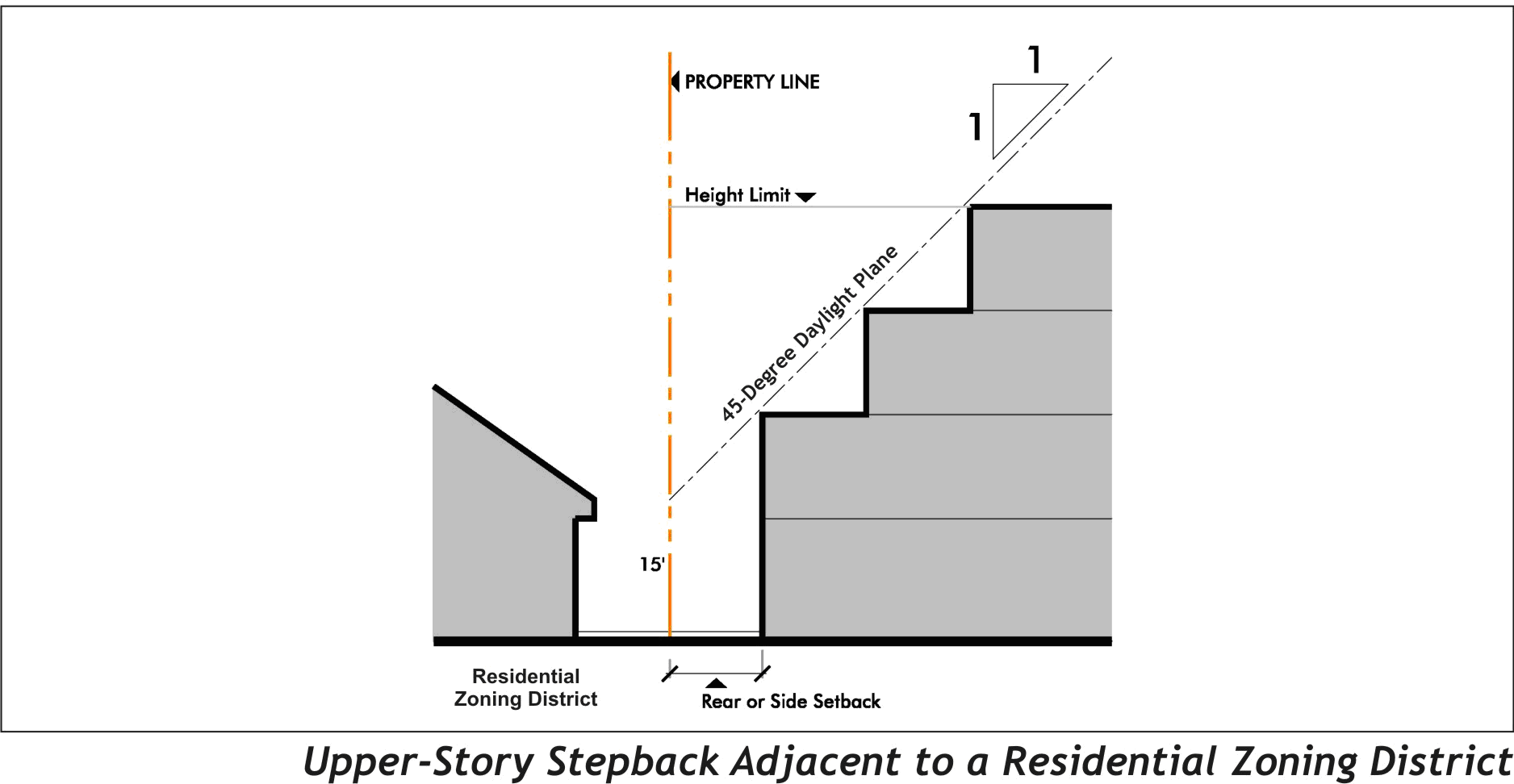
Upper-Story Stepback Adjacent to a Residential Zoning District. Buildings shall not intercept a forty-five (45)-degree daylight plane inclined inward from fifteen (15) feet above existing grade at the property line of the parcel adjacent to the residential district boundary line.
b.
Upper-Story Stepback Adjacent to Public Open Space or Historic Resources. Buildings shall not intercept a forty-five (45)-degree daylight plane inclined inward from fifteen (15) feet above existing grade at the property line of the parcel adjacent to property line of an adjacent property containing public open space or an historic resource.
c.
Sight Lines. Sight lines into and from neighboring properties shall be minimized.
2.
Minimum Development Height. The minimum height regulations shall apply only to the first fifteen (15) feet of building depth as measured from the building frontage.
a.
Minimum Height Exception. The responsible review authority may approve an exception to the minimum height requirement, provided that at least one (1) of the following findings can be made:
i.
The project is constrained by unusual parcel size, shape, or features that render this requirement infeasible; or
ii.
The project is providing usable quasi-public or public open space on site, adjacent to the primary street right-of-way.
3.
Bonus Height. The bonus height maximum limits stated in Table 53-3 shall be permitted for projects that (1) provide clear public benefits or (2) which have severe and unusual frontage constraints as described in Subsections 53.7.B.3.a below.
a.
Public Benefit. A project may be permitted to rise to the Bonus Height if it provides a clear public benefit. Project traits or characteristics considered as a public benefit shall include, but not be limited to, the following:
i.
Mixed-Use. The ground-floor frontage along all major streets will be occupied by retail or restaurant uses for a depth of no less than twenty (20) feet.
ii.
Quasi-Public or Public open space. Usable open space that is open to the public will be provided which amounts to 0.25 acres or ten percent (10%) of the project area, whichever is greater.
iii.
Stringent transition height adjacent to residential zoning districts. Buildings will not intercept the forty-five (45)-degree daylight plane inclined inward from existing grade at the property line of the parcel adjacent to the residential district boundary line.
iv.
New streets. New streets that are identified by the responsible review authority as necessary to improve walkability, reduce auto trip lengths, improve neighborhood connectivity, or result in blocks of less than four hundred (400) feet in length will be provided through the site.
b.
Severe and Unusual Frontage Constraints. A project can be permitted to rise to the Bonus Height if the subject property has severely and unusually constrained street frontage along El Camino Real, Veterans Boulevard, or Broadway. Severely and unusually constrained street frontage shall be defined as street frontage of less than seventy-five (75) linear feet for each acre of gross site area. In such cases, projects shall be subject to the following conditions:
i.
Rental residential leasing offices. For rental residential uses, the leasing office shall be located at the street in the ground floor of the building, and shall be treated as a storefront and a dedicated entrance from the public sidewalk.
ii.
Subdivisions to create condominium/community apartment projects. Conversions of multifamily rental dwellings to condominiums and/or community apartments shall conform to the standards and regulations in Article 11 of Chapter 30 (Subdivisions) of the Municipal Code, except as follows:
(1)
Nonresidential use. In the event of the conversion of the property to condominiums and/or community apartments, the leasing office shall be occupied by retail or restaurant uses.
(2)
Recording. The covenants, conditions, and restrictions of a mixed-use project in any MUC zoning sub-district shall include the requirement that any building with a residential leasing office shall convert the entirety of that leasing office space to a commercial space, to accommodate commercial uses, upon project conversion to a condominium or community apartment project.
4.
Roof Height Exceptions. The responsible review authority may approve an exception to the minimum height requirement to accommodate a roof, if the following findings can be made:
a.
Compatible. Such height exception will be compatible with surrounding properties, uses and neighborhood;
b.
Number of stories. Such height exception will not exceed the allowable number of stories permitted pursuant to regulations in Table 53-3; and
c.
Necessary. The roof is limited to the height necessary for its proper functioning or to be consistent with a particular architectural style.
(Ord. No. 1130-353, § 1(Exh. E), 6-27-11; Ord. No. 1130-386, § 4(Exh. A), 7-24-23; Ord. No. 1130-890, § 4(Exh. A), 8-26-24)
53.8 - Facade Composition and Architectural Regulations.
A.
Facade Composition and Architectural Regulations Applicable to all Sub-Districts.
1.
Building Orientation and Entrances.
a.
Nonresidential Entrances. Street-facing primary entrances shall be unlocked and accessible to the public during business hours. Entries shall be clearly defined features of front facades, and of a scale that is in proportion to the size of the building and number of units being accessed; larger buildings shall have a more prominent building entrance, while maintaining a pedestrian scale.
b.
Transitional Space at Residential Entries. New residential buildings shall provide transitional spaces in the form of stoops, overhangs, and porches between public areas fronting the primary street and entrances. This type of element or equivalent shall be required for each unit or group of units; but no less than one (1) of this type of element shall be provided.

2.
Building Transparency/Windows and Openings Facing Streets. Placement and orientation of doorways, windows, and landscape elements shall create strong, direct relationships with the street. Street-facing facades of all buildings shall incorporate windows and openings providing light to adjacent spaces, rooms, and uses.
a.
Commercial Ground-Floor Uses. Windows and openings facing streets shall constitute a minimum of fifty percent (50%) of street-facing building faces. Windows shall provide a clear and transparent view into ground floor-uses or shall display merchandise to reinforce a pedestrian scale.
b.
Commercial Upper-Floor Uses. Windows and openings facing streets shall constitute a minimum of forty percent (40%) of street-facing building faces.
c.
Residential Ground-Floor Uses. Windows and openings facing streets shall constitute a minimum of thirty percent (30%) of street-facing building faces.
d.
Residential Upper-Floor Uses. Windows and openings facing streets shall constitute a minimum of twenty percent (20%) of street-facing building faces.
3.
Blank Walls. No street frontage wall may run in a continuous plane for more than twenty (20) feet without an opening. Openings fulfilling this requirement shall have transparent glazing and provide views into work areas, display areas, sales areas, lobbies, or similar active spaces, or into window displays that are at least three (3) feet deep. Exceptions are subject to approval by the responsible review authority.
4.
Corner Features. At important intersections in Redwood City (defined as the intersection of two (2) of any of the following street typologies as identified in Figure BE-14 of the General Plan: Transit Street, Bicycle Boulevard, Pedestrian Street, Connector Street, and/or Boulevard), buildings shall incorporate special features to reinforce the intersection. Corner entrances, bay windows, and towers are examples of elements that may be considered to emphasize corner locations.
5.
Ground Floor Design.
a.
Elevation of First Floor.
i.
Nonresidential uses. The first habitable floor shall be located no more than two (2) feet above or below the existing grade at any point along a street property line.
ii.
Residential uses. The first habitable floor of a residential-only building shall be located no more than six (6) feet above existing grade and no more than two (2) feet below existing grade along a street property line.
b.
Minimum Ground Floor Height. The minimum height of nonresidential ground floor spaces shall be twelve (12) feet. The minimum height of residential and live/work ground floor spaces shall be ten (10) feet. This height shall be measured from the floor of the first story to the floor of the second story. If there is no second story, the height shall be measured to the top of roof.
c.
Horizontal Separation of Ground Floor. For buildings exceeding three (3) stories or forty (40) feet in height, the first story shall provide horizontal separation from the upper portions of the building by incorporating architectural features that enhance the pedestrian experience.

6.
Architectural Articulation. Buildings in all MUC zoning sub-districts shall be designed to minimize the appearance of massing and provide for articulation and high-quality design. Buildings shall incorporate at least one (1) of the options provided in items a—d. Alternatively, new development may provide a narrative with comprehensive site plans explaining how massing is minimized in other ways. Compliance with this requirement shall be evaluated by the responsible review authority in the review process.
a.
Facade Plane Modulation. Exterior walls that vary in depth and/or direction, exhibiting offsets, recesses, or projections with depth of at least eighteen (18) inches, or a repeated pattern of offsets, recesses, or projections of smaller depth.
b.
Feature Projections and Recesses. Projecting eaves and overhangs, balconies, porches, canopies, trellis features, arcades, window recesses, and other features that provide human scale and help break up building mass.
c.
Variety in Height and Roof Forms. Varied building heights that result in a noticeable change in height or changes in pitch, plane, and/or orientation.
d.
Facade Detail. Details such as cornices, window trim, changes in material, and other architectural elements that provide architectural interest.
7.
Visual Relationship between Multiple Buildings. Multiple buildings on a single site shall be designed to create a strong visual relationship between and among the buildings, while including architectural variety on different buildings.
8.
Adjacent to Rail. Residential buildings near railroad rights-of-way shall be designed to minimize impacts associated with noise and vibration generated in the railroad right-of-way. For all residential buildings and vibration-sensitive development located within one hundred (100) feet of the centerline of railroad tracks, a site-specific vibration study is required. The vibration study shall recommend measures to reduce vibration to meet Redwood City standards.
9.
Preservation of Neighborhood Character. The design of new infill development shall respect, complement, and be compatible with the scale, style, theme, and design of surrounding buildings and neighborhoods.
B.
Facade Composition and Architectural Regulations by Sub-District.
1.
Supplemental Development Standards for the MUC-ECR Sub-District.
a.
Primary Pedestrian Entrance. At parcels fronting El Camino Real, at least one (1) primary entrance to a ground floor use shall face El Camino Real. On corner parcels, the primary entrance may face the street corner of El Camino Real and a secondary street. Interior space shall be arranged to orient toward the entrance facing El Camino Real as the primary entrance. Signage or other means shall be used to direct persons toward that entrance.
b.
Pedestrian Entrance Frequency. At street frontages, ground-related entrances shall occur at least once every one hundred (100) feet, as measured along the front property line. Ground-related entrances include entrances to ground-floor uses, residential units, clusters of residential units, lobbies, or private courtyards. Retail-related uses shall have ground-related pedestrian entrances that occur at least once every fifty (50) feet. Buildings with a single tenant on the ground floor may have an alternative pedestrian entrance frequency where other design treatments or articulations are used to maintain visual interest and sense of security for pedestrians including, but not limited to, windows, wainscots, decorative light sconces, statuary, bas relief panels, and murals with the approval of the Community Development Director or his/her designee.

2.
Supplemental Development Standards for the MUC-VB Sub-District.
a.
Primary Pedestrian Entrance. At parcels fronting Veterans Boulevard, at least one (1) primary entrance to a ground-floor use shall face Veterans Boulevard. On corner parcels, the primary entrance may face the street corner of Veterans Boulevard and a secondary street. Interior space shall be arranged to orient toward that entrance as the primary entrance. Signage or other means shall be used to direct persons toward that entrance.
b.
Pedestrian Entrance Frequency. At street frontages, ground-related entrances shall occur at least once every one hundred (100) feet, as measured along the front property line. Ground-related entrances include entrances to ground-floor uses, residential units, clusters of residential units, lobbies, or private courtyards. Retail-related uses shall have ground-related entrances that occur at least once every fifty (50) feet. Buildings with a single tenant on the ground floor may have an alternative pedestrian entrance frequency where other design treatments or articulations are used to maintain visual interest and sense of security for pedestrians including, but not limited to, windows, wainscots, decorative light sconces, statuary, bas relief panels, and murals with the approval of the Community Development Director or his/her designee.
3.
Supplemental Development Standards for the MUC-RC Sub-District.
a.
Primary Pedestrian Entrance. Primary entrances shall be located on a street-fronting facade or a street-fronting corner. Supplemental entrances shall be configured to face the creek trail. Significant blank, rear facade areas shall not abut Redwood Creek.
b.
Pedestrian Entrance Frequency. At street frontages, ground-related entrances shall occur at least once every one hundred (100) feet, as measured along the front property line. At Redwood Creek frontages, ground-related entrances shall occur at least once every one hundred fifty (150) feet. Ground-related entrances include entrances to ground-floor uses, residential units, clusters of residential units, lobbies, or private courtyards. Retail-related uses shall have ground-related entrances that occur at least once every fifty (50) feet. Buildings with a single tenant on the ground floor may have an alternative pedestrian entrance frequency where other design treatments or articulations are used to maintain visual interest and sense of security for pedestrians including, but not limited to, windows, wainscots, decorative light sconces, statuary, bas relief panels, and murals with the approval of the Community Development Director or his/her designee.
4.
Supplemental Development Standards for the MUC-SB Sub-District.
a.
Primary Pedestrian Entrance. At parcels fronting Broadway, at least one (1) primary entrance to a ground floor use shall face Broadway. On corner parcels, the primary entrance may face the street corner of Broadway and a secondary street. Interior space shall be arranged to orient toward that entrance as the primary entrance. Signage or other means shall be used to direct persons toward that entrance.
b.
Pedestrian Entrance Frequency. At street frontages, ground-related entrances shall occur at least once every one hundred (100) feet, as measured along the front property line. Ground-related entrances include entrances to ground-floor uses, residential units, clusters of residential units, lobbies, or private courtyards. Retail-related uses shall have ground-related entrances that occur at least once every fifty (50) feet. Buildings with a single tenant on the ground floor may have an alternative pedestrian entrance frequency where other design treatments or articulations are used to maintain visual interest and sense of security for pedestrians including, but not limited to, windows, wainscots, decorative light sconces, statuary, bas relief panels, and murals with the approval of the Community Development Director or his/her designee.
c.
Parcels with Access to Broadway and Marshall Street. Broadway shall be treated as the primary street with regard to building orientation. Marshall Street shall be treated as the secondary street. Architectural articulation is required on both street frontages, with greater attention given to Broadway.
5.
Supplemental Development Standards for the MUC-GB Sub-District.
a.
Primary Pedestrian Entrance. At parcels fronting Broadway, at least one (1) primary entrance to a ground-floor use shall face Broadway. On corner parcels, the primary entrance may face the street corner of Broadway and a secondary street. Interior space shall be arranged to orient toward that entrance as the primary entrance. Signage or other means shall be used to direct persons toward that entrance.
b.
Pedestrian Entrance Frequency. At street frontages, ground-related entrances shall occur at least once every one hundred (100) feet, as measured along the front property line. Ground-related entrances include entrances to ground-floor uses, residential units, clusters of residential units, lobbies, or private courtyards. Retail-related uses shall have ground-related entrances that occur at least once every fifty (50) feet. Buildings with a single tenant on the ground floor may have an alternative pedestrian entrance frequency where other design treatments or articulations are used to maintain visual interest and sense of security for pedestrians including, but not limited to, windows, wainscots, decorative light sconces, statuary, bas relief panels, and murals with the approval of the Community Development Director or his/her designee.
c.
Entry Statements. Entry statements in the form of significant architectural features and signage shall be included at the following intersections: Broadway and Woodside Road; and U.S. 101 off-ramps and Woodside Road.
(Ord. No. 1130-353, § 1(Exh. E), 6-27-11; Ord. No. 1130-890, § 4(Exh. A), 8-26-24)

