
Redwood City City Zoning Code
ARTICLE 2
DEFINITIONS
2.1 - Use of Definitions.
A.
Unless the provision or context otherwise requires, the definitions in this article shall govern the construction of this ordinance.
B.
The present tense includes the past and future tenses; and the future, the present.
C.
The masculine gender includes the feminine and neuter.
D.
The singular number includes the plural; and the plural, the singular.
E.
"Shall" is mandatory and "may" is permissive.
(Ord. No. 1130-353, § 1(Exh. A), 6-27-11)
2.2 - Definitions.
Abandonment of Use. To cease or discontinue a use or activity, but excluding temporary or short-term interruptions to a use or activity during periods of remodeling, maintaining, or otherwise improving or rearranging a structure, or during normal periods of vacation or seasonal closure.
Abutting Parcels. Parcels of land having a common property line other than a property line located within a public street.
Accessory Building. See Section 36.5 (Accessory Buildings).
Accessory Dwelling Unit. See Article 37 (Accessory Dwelling Units).
Accessory Use, Building, or Structure. A use, building, or structure subordinate to the principal use on the same building site and serving a purpose customarily incidental to the principal use or structure, such as garage and storage buildings.
Adjacent. Directly abutting, having a boundary or property line(s) in common or bordering directly, or contiguous to.
Adult Day Program. Any community-based facility or program that provides care to persons eighteen (18) years of age or older in need of personal services, supervision, or assistance essential for sustaining the activities of daily living or for the protection of these individuals on less than a twenty-four-hour basis.
Administrative Office and Service Facility. An office or other structure or service facility for rendering management level administrative services for firms and institutions including, but not limited to, regional and headquarter management services.
Agent of Owner. A person who submits a written statement from a property owner authorizing him to act for the property owner.
Agriculture. The term "agriculture" includes farming, dairying, pasturage, apiaries, horticulture, floriculture, viticulture, and animal and poultry husbandry.
Alcohol Sales, Off-Sale Outlet. Any commercial retail establishment, business or facility that holds a license from the State Department of Alcoholic Beverage Control that authorizes the sale of beer, wine or distilled spirits for consumption off premises where sold. References to the establishment shall include any immediately adjacent area that is owned, leased, or rented, or controlled by the licensee.
Alcohol Sales, On-Sale Outlet. Any commercial retail establishment, business or facility at which alcoholic beverages are sold, served, or given away for consumption on the premises and which has applied for or has obtained a license from the State Department of Alcoholic Beverage Control that authorizes the sale of beer, wine or distilled spirits for the consumption on the premises where sold. References to the establishment shall include any immediately adjacent area that is owned, leased, or rented, or controlled by the licensee.
Alley. A public or private roadway or easement, generally not more than thirty (30) feet wide that provides vehicle access to the rear or side of parcels having other public street frontage, and is not intended for general traffic circulation.
Alteration (see also Structural Alteration). Any change, addition or modification in construction or occupancy.
Amusement Games. The term "amusement game" shall mean any device, machine, apparatus, or other instrument (including electronic games, marble games, and pinball) operated electronically, mechanically, or manually for amusement purposes which requires for the use thereof the deposit in such device, machine, apparatus, or instrument or in a receptacle attached to such device, machine, apparatus, or other instrument or connected therewith, a coin, token, or other thing of value. The term "amusement game" shall not include a device, machine, apparatus, or other instrument which contains a pay-off device for the return of slugs, money, coins, checks, tokens or merchandise.
Animal-Related Uses. Any commercial business providing services and care to animals, including, but not limited to, pet day care, pet hotel, kennel, veterinary clinic, animal hospital, and pet grooming. Does not include retail pet stores (see "Retail stores, general merchandise") with no related animal care and grooming services.
Antenna. A device used to receive or transmit telecommunications or radio signals, mounted on the ground as an independent structure or attached to another structure, including, but not limited to, panels, single plies ("whips"), broadcasting masts and aerials, and microwave dishes.
Arbor. See Section 36.4 (Arbors).
Architectural Features. See Section 32.3 (Supplemental Setback Requirements).
Assembly and Meeting Facility. A facility or facilities for public or private assembly and meetings that include kitchens, multi-purpose rooms, offices, etc. Examples include places of worship, banquet rooms, auditoriums, community centers, conference facilities and meeting halls, and excludes entertainment establishments, child care centers, and schools, except that schools or associated conference, meeting, multi-purpose, or gathering facilities that are accessory and incidental to another principal use and typically used only by on-site employees and clients, and that occupy less floor area on the site than the offices they support are not prohibited.
Assisted Living Facility (land use). See Residential Care Facility, Senior.
Average Slope. Defined with the following formula:
C — The interval of measured contours of elevation in feet
L — The combined length of such contours, in feet
A — The area of the parcel, in square feet
Bar/Cocktail Lounge (land use). Businesses serving beverages for consumption on the premises as a primary use and including on-sale service of alcohol including beer, wine, liquor, and mixed drinks.
Basement. Basement is that portion of a building between floor and ceiling which does not extend more than six (6) feet above grade. Refer to the definition of "story" for when a basement is considered a story.
Birth Centers. A healthcare facility that is designed to provide a comfortable, homelike setting during childbirth and that is generally less restrictive than a hospital in its regulations, as in permitting midwifery or allowing family members or friends to attend the delivery.
Bookstore. The term "bookstore" shall mean any establishment whose primary purpose is the sale, distribution, or display of books, pictures, magazines, films, pamphlets, or other printed matter or pictorial representations.
Building. Any structure having a roof supported by columns or by walls and used or designed for the shelter or housing of any person or animal or the storage of property.
Building, Accessory. See Accessory Building.
Building Face. The exterior surface of a wall, window, door, pediment, or column, whether vertical or inclined, facing required front, side, or rear yard.
Building Frontage. That face of a building or length of a lot that is parallel to, or is at a near parallel angle to a public street or public parking area.
Building, Main. A building in which is conducted the principal use of the building site on which it is situated.
Building Official. The Building Official of the City of Redwood City, or the designee of the Building Official.
Business Office. A use principally providing services to individuals, firms, or other entities, including but not limited to real estate, insurance, property management, Title companies, investment, loan and lending institutions, personnel, travel, and similar services, and including business offices of public utilities or other activities when the service rendered is that customarily associated with office services.
Business Services (land use). Establishments that primarily provide goods and services to other businesses on a fee or contract basis, including printing and copying, blueprint services, advertising and mailing, equipment rental and leasing, office security, custodial services, photo finishing, publishing, cartography, book binding, and model building.
Business, Retail. See Retail Sales, General.
Business, Wholesale. Any establishment for the sale, to retailers, jobbers, or contractors, of any article, substance, or commodity, but not including the handling of lumber or other building materials or the open storage or sale of any material or commodity, and not including the processing or manufacture of any product or substance.
Car Share Vehicle. An automobile that is offered for rent to the public through an hourly or subscription service by a car share network operator and regularly stored in the same location.
Carport Space. A building used for the storage of vehicles or trailers having at least fifty (50) percent of two (2) sides open.
Check Cashing. A commercial land use that generally includes a variety of financial services including cashing of checks, warrants, drafts, money orders, or other commercial paper serving the same purpose; deferred deposit of personal checks whereby the check casher refrains from depositing a personal check written by a customer until a specific date; money transfers; payday advances; issuance of money orders; and similar uses.
Child Care Center. See Article 39 (Child Care).
City Attorney. The City Attorney of the City of Redwood City, or the designee of the City Attorney.
Commission. The Planning Commission of the City of Redwood City.
Condominium. A building or group of buildings, in which units are owned individually, and the structure, common areas and facilities are owned by all the owners on a proportional, undivided basis. Includes development in which the individual owns land directly below the "footprint" of a unit, and all other land within the project is owned in common. Includes a common interest development as defined by California Civil Code Section 4100.
Construction. Beginning of construction shall mean the incorporation of labor and materials within the foundation of a building.
Council. The Council of the City of Redwood City.
Cultural Institution (land use). A nonprofit institution displaying or preserving objects of interest in one (1) or more of the arts or sciences. This use includes libraries, museums, and art galleries.
Daylight Plane: An inclined plane, beginning at a stated height above grade at a side or rear property line, and extending into the site at a stated upward angle to the horizontal, which may limit the height or horizontal extent of structures at any specific point on the site where the daylight plane is more restrictive than the height limit or the minimum setback applicable at such point on the site.
Development. Any construction activity or alteration of the landscape, its terrain contour or vegetation, including the erection or alteration of structures or buildings. New development is any construction, or alteration of an existing structure or land use, or establishment of a land use.
Disaster Shelter. See Section 36.6 (Disaster Shelters).
Distribution, Services. A use intended for the storage and dispatch of items and supplies required for a service business that provides services offsite, including, but not limited to, storage of professional landscaping and cleaning supplies.
District. A portion of the City within which certain uses of land and certain structures and buildings are permitted or prohibited and within which certain yards and other open spaces are required and certain height limits are established for buildings, all as set forth and specified in this ordinance.
Drive-Through Restaurant. A restaurant which in addition to customary restaurant services is designed to sell products through a sales window to customers who are in vehicles.
Dwelling, Accessory. See Section 37.2 of Article 37 (Accessory Dwelling Units).
Dwelling, Multi-Family. Three (3) or more dwelling units on a lot or in a single development, including townhouses, condominiums or rental apartments and accessory community buildings or recreational facilities.
Dwelling, Single-Family. One (1) dwelling unit on a lot that may include an accessory dwelling unit and/or junior accessory dwelling unit.
Dwelling, Studio Apartment. A dwelling unit consisting of not more than one (1) habitable room together with kitchen or kitchenette and sanitary facilities.
Dwelling, Two-Family or Duplex. Two (2) dwelling units on a lot or in a single development.
Dwelling Unit. A building or portion of a building that contains cooking, sleeping and sanitary facilities for residential occupancy. Dwelling units do not include hotels, motels, rooming houses, tents or trailers. Transitional housing, supportive housing, family childcare and small residential care facilities are considered a residential use of property in any dwelling type.
Dwelling Unit, Primary. Any dwelling unit that is not an accessory dwelling unit, as provided in Article 37 of the Zoning Code.
Electronic Equipment Facility. A building where more than fifty (50) percent of the floor area is devoted to electronic equipment. These facilities are also known as, but not limited to, the following: server farm, routing facility, data center, telco hotel, carrier hotel, and switching station.
Emergency Shelter. Housing for homeless persons with minimal supportive services that is limited to occupancy of six (6) months or less.
Enlargement of a Nonconforming Structure. To increase the height, footprint, floor area, volume, or coverage of a nonconforming structure or any portion of the structure, or to decrease the distance from any portion of the structure to a property line.
Entertainment Establishment (land use). Any establishment (indoors or outdoors) where entertainment, either passive or active, is provided for the pleasure of the patrons, either independent or in conjunction with any other use. Commercial entertainment does not include sexually oriented businesses as defined and regulated in Redwood City Municipal Code Chapter 18B - Sexually Oriented Businesses. Entertainment establishments may include amusement arcades, indoor spectator entertainment such as motion picture theaters, indoor sports and recreation such as bowling alleys, billiard parlors, ice and roller skating rinks, and outdoor sports and recreation such as driving ranges, golf courses, swimming pools, marinas, and tennis courts.
Expansion of a Nonconforming Use. To enlarge a structure housing a nonconforming use, or to increase the floor area of a nonconforming use within a structure, or to occupy a larger area on the site, or to intensify the occupancy of the nonconforming use and associated activities such that additional impacts, such as noise, traffic or parking, are likely to result.
Family. One (1) person living alone, two (2) or more persons related by blood, marriage, or legal adoption, or two (2) or more persons living as a single housekeeping unit.
Family Child Care Home, Large. See Article 39 (Child Care).
Family Child Care Home, Small. See Article 39 (Child Care).
Farmworker Employee Housing. Housing for agricultural employees consisting of no more than thirty-six (36) beds in group quarters or twelve (12) units or less designed for use by a single household that is allowed as an agricultural use.
Feasible. Capable of being accomplished in a successful manner within a reasonable period of time, taking into account economic, environmental, social, and technological factors.
Fence. See Section 36.3 (Fences).
Financial Institutions and Related Services (land use). Establishments that solicit, receive, or accept money or its equivalent on deposit and loan money as a regular business. Typical examples include federal or state-regulated banks, savings and loan associations, savings banks, credit unions, and lending establishments, with automatic teller machines (ATMs) as an accessory use. Does not include mortgage broker, accounting, financial investment, or similar offices ("Offices, Business, Government, and Professional"). Does not include check cashing establishments (see "Check Cashing").
Financial Service. The provision of financial services to individuals, firms, or other entities including services customarily provided by banks, savings and loan institutions, credit unions, and similar institutions and organizations.
Floor Area, Gross.
A.
The sum of the gross horizontal areas of the several floors of such buildings measured from the exterior faces of exterior walls or from the center line of party walls separating two (2) buildings and shall include:
1.
All stories;
2.
Elevators, stairs, and stairwells at each floor;
3.
Floor space used for mechanical equipment where the structural headroom exceeds seven and one-half (7½) feet, but not including, equipment, open or enclosed, located on the roof, such as bulkheads, water tanks and cooling towers;
4.
Attic floor space where the structural headroom exceeds seven and one-half (7½) feet;
5.
Interior balconies and mezzanines, except when the computation of the floor area ratio is defined differently in a zoning district;
6.
Enclosed porches and lanais, but not uncovered terraces, porches, balconies or stairs;
7.
Accessory buildings unless excluded in the zoning district.
B.
For the purpose of determining gross floor area for single-family dwellings, see Article 48, Floor Area Ratio Ordinance.
Floor Area Ratio ("FAR"). The ratio, expressed as a percentage, of the maximum permitted gross floor area of a building or buildings to the lot area.
Funeral Home. An establishment primarily engaged in the provision of services involving the care, preparation, or disposition of human remains and conducting memorial services. This use includes a crematory, columbarium, mausoleum, or mortuary.
Garage Space. A building or portion thereof used for the storage of vehicles or trailers.
Grade or Ground Level. The average of the finished ground level at the center of all walls of a building. In case walls are within five (5) feet of a sidewalk ground level shall be measured at the sidewalk.
Grade, Finished. The elevation of the ground surface established by grading for the proposed project.
Grade, Natural. The elevation of the ground surface prior to any excavation or fill.
Grandfathered. A designation established by means of a "grandfather clause," exempting a class of uses or structures from the otherwise currently applicable provisions of Ordinance 1130 (zoning ordinance), because such uses or structures conformed with earlier applicable provisions of Ordinance 1130, prior to the enactment of subsequent provisions.
Ground Floor. The first floor of a structure that is at ground level or street level. Does not include a basement.
Ground Floor Dependent Offices. Offices used for on-site property management, for professional or consulting services including, but not limited to, travel agencies, insurance agencies, income tax preparers, real estate agencies, notary publics, and ground floor dependent portion of financial services. In determining whether a particular use is ground floor dependent, consideration shall be given to the requirement of such use for ground floor visibility in commercial districts to serve patrons on an unannounced or drop-in basis, and to rely upon a product or service display in the store frontage.
Group Home. Housing shared by unrelated persons with disabilities that provides peer and other support for residents' disability related needs and in which residents share cooking, dining, and living areas, and may participate in communal living activities. This use excludes hotels and residential care facilities.
Handicraft/Custom Manufacturing (land use). Manufacture of crafts, art, sculpture, stained glass, jewelry, apparel, and similar items using hand tools and small mechanical devices (i.e., drills and saws, hammers and chisels; paint brushes and sprayers; pottery wheels and kilns; sewing machines; spinning wheels, etc.) and the incidental direct sale to consumers of only those goods produced on-site.
Health/Fitness Club (land use).
Small. An indoor facility of two thousand (2,000) square feet or less in size where passive or active exercises and related activities are performed using minimal muscle-building equipment or apparatus for the purpose of physical fitness, improved circulation or flexibility, and/or weight control. Examples of uses include personal training and yoga studios.
Large. A full service fitness center, gymnasium, or health and athletic club, which is over two thousand (2,000) square feet in size and may include any of the following: sauna, spa or hot tub facilities; weight rooms; indoor tennis, handball, or racquetball courts; aerobic classes and other indoor sports activities; locker rooms and showers.
Height of Building. The vertical distance from any point of the roof to the finished or natural grade, whichever is lower, directly below that point. A diagram depicting the measurement of height for residential structures on sloping lots is included at the end of the article for illustrative purposes only.
Home Occupations. See Section 31.12 (Home Occupations).
Hospital. Facilities providing medical services, including psychiatric or surgical services for sick or injured persons primarily on an in-patient basis, but may also include ancillary facilities for outpatient and emergency treatment, diagnostic services, training, research, administration, pharmaceuticals, and other services for patients, employees, or visitors.
Hotel. See "Lodging."
Impervious Surface. A surface that hinders the ability of water to percolate through underlying soils. Examples typically include, but are not limited to, pavement (including driveways, parking lots, patios, walkways), rooftops, buildings and compacted soils.
In-Law Unit. See Accessory Dwelling Unit.
Industry, General (land use). Manufacturing of products from extracted or raw materials or recycled or secondary materials, or bulk storage and handling of such products and materials. This classification includes operations such as biomass energy conversion; food and beverage processing; textile mills; production apparel manufacturing; photographic processing plants; leather and allied product manufacturing; wood product manufacturing; paper manufacturing; chemical manufacturing; plastics and rubber products manufacturing; nonmetallic mineral product manufacturing; primary metal manufacturing; fabricated metal product manufacturing; recycling materials processing facilities in which post-consumer materials are sorted, condensed, baled, or transformed; and automotive, ship, aircraft, and heavy equipment manufacturing.
Industry, Limited (land use). Establishments engaged in light industrial activities (as outlined below) taking place within enclosed buildings and producing minimal impacts on nearby properties. This classification includes operations such as manufacturing finished parts or products primarily from previously prepared materials; commercial laundries and dry cleaning plants; mobile home manufacturing; monument works; engraving; computer and electronic product manufacturing; furniture and related product manufacturing; and industrial services. Does not include storage, mini-storage, or self-storage.
Landscape Area. Land open to the sky that is set apart for the planting of grass, shrubs, trees, or similar living plants, or other pervious ground surface treatment such as decorative rock, bark or stone.
Liquor Stores (land use). A retail establishment primarily engaged in selling beer, wine, and other alcoholic beverages.
Live/Work (Unit). See Section 31.4 (Live/Work Units).
Lodging (land use).
A.
Bed and Breakfast Inns. Establishments offering lodging rooms for less than thirty (30) days in a dwelling unit, with incidental eating and drinking service for lodgers only, provided from a single kitchen.
B.
Hotel. An establishment that provides guest rooms or suites for a fee to transient guests for sleeping purposes. No provisions for cooking are provided in the guest rooms, with the possible exception of microwaves and refrigerators. Access to units is primarily from interior lobbies, courts, or halls. Related accessory uses may include conference and meeting rooms, restaurants, bars, and recreational facilities. A hotel operates subject to taxation under Revenue and Taxation Code Section 7280.
C.
Long-Term Hotel (Extended Stay). A long-term hotel facility offering transient lodging accommodations to the general public, targeted to the business or leisure traveler who is planning to stay for an extended time. To constitute a long-term hotel, each hotel room must contain kitchen facilities to include a range cooktop, microwave or conventional oven, refrigerator, and sink. A long-term hotel (extended stay) operates subject to taxation under Revenue and Taxation Code Section 7280.
D.
Motel. An establishment that provides guest rooms for a fee to transient guests for sleeping purposes. Guest rooms do not contain kitchen facilities. A motel is distinguished from a hotel primarily by direct independent access to, and adjoining parking for, each guest room. A motel operates subject to taxation under Revenue and Taxation Code Section 7280.
Lot. A parcel of land occupied or intended for occupancy for a use permitted in Ordinance 1130.
Lot Area. The lot area shall be the horizontal area within the exterior lines of a lot as established by subdivision map, metes and bounds, or any other means of description contained in any conveyance of title thereof, or any other interest therein, on file and recorded in the office of the County Recorder, County of San Mateo.
Lot, Corner. A lot situated at the junction of and abutting on two (2) or more intersecting streets.
Lot Coverage. The footprint of all structures including the primary building(s), accessory buildings, covered patios and decks, covered front entries, and any covered parking areas expressed as a percentage of the total lot area. Certain structures may be exempt from lot coverage calculations otherwise as described in the Zoning Code.
Lot, Interior. A lot abutting only one (1) street.
Lot Lines. The boundary line separating the lot front from a street, the lot side from a street or adjoining property, or the lot rear from an alley, street or adjoining property.
Lot, Side. Any lot boundary not a front or rear lot line.
Lot Size. See Lot Area.
Lot Width. The width of the lot measured at right angles to its depth. Average lot width shall mean the average width of the lot throughout its full depth measured at right angles to the depth.
Low-Barrier Navigation Center. A temporary shelter that provides services for individuals experiencing homelessness, as defined by California Government Code Section 65660.
Maintenance and Repair Services (land use). Establishments that provide home appliance and/or electronic or office equipment repair and maintenance, or building maintenance services. Does not include maintenance and repair of vehicles (see "Vehicle/Equipment Repair").
Marina. A facility for secure mooring of boats including related facilities. Marinas may include accessory uses such as boat storage and repair, sailing school and charter service, retail sales of boating supplies and fuel, noncommercial meeting rooms and supporting office. A marina may provide for a proportion of slips to accommodate residential use if consistent with state law, provided the majority of slips are not designated for liveaboards.
Medical Clinic. See definition for Medical Office.
Medical Office. A use providing consultation, diagnosis, therapeutic, preventative, corrective personal treatment services by doctors, dentists, medical and dental laboratories, acupuncture and similar practitioners of medical services for humans, licensed for such practice by the state of California and including services related to medical research, testing and analysis but excluding the use of hazardous materials in excess of the exempt amounts contained in the Uniform Building Code and Uniform Fire Code as said Codes are adopted and amended by the City from time to time. Medical clinics where multiple practitioners (doctors, dentists, therapists, nurses, paraprofessionals, etc.) offer a variety of services including, but not limited to, consultation or counseling, diagnosis, therapy, prevention, laboratory testing or analysis, and/or corrective personal treatment are included in this definition. Certified massage businesses, acupressure or aromatherapy services are not considered a medical office use (see Personal Services, General).
Mixed-Use. The combination of commercial and residential uses located on the same property as part of a unified development. Mixed-Use Development consists of commercial and residential uses integrated either vertically (vertical mixed-use) in the same structure or group of structures, or horizontally on the same development site (horizontal mixed-use) where parking, open spaces, and other development features are shared. In a mixed-use development, both uses are considered primary uses of the land.
Mobile Home. Shall mean any dwelling unit transportable in one (1) or more sections, used or designed to be used for living or sleeping purposes or both and which is not equipped with wheels used for the purpose of transporting such unit from place to place whether by motive power or other means.
Mobile Home Park. Shall mean any place, area, or tract of land offered to the public for the accommodation of any mobile home or trailer, except recreational areas operated by public agencies or areas used exclusively for the sale or storage of mobile homes or trailers.
Motel. See "Lodging."
Neighborhood. A sub-area of the City in which the residents share a common identity focused around a school, park, community business center, or similar feature.
Nightclub (land use). A facility which provides live entertainment for an audience of fifty (50) or more persons and serves alcoholic beverages on the premises.
Nonconforming Lot. Any lot having less area or dimensions than are required in the district in which the lot is located, and that was lawfully created prior to the adoption of the current zoning requirements for lot area or dimensions. Lots not legally established shall be deemed to be illegal lots.
Nonconforming Parking. Parking for any use, structure or site for which current parking standards are not met due to the number, size and/or location of parking spaces, or related design criteria for driveway access or parking backup area, but that complied with applicable parking requirements at the time the use, structure or site development was established. Parking that does not comply with applicable parking requirements in effect at the time the development was established shall be deemed to be illegal.
Nonconforming Structure. Any structure legally constructed or established which fails to conform to the regulations of the ordinance codified in this article, other than use regulations, for the district in which it is located by reason of adoption of the ordinance codified in this article, or any amendment thereto, or by reason of annexation of territory to the City. Structures not legally established, which fail to conform to the provisions of this article, shall be deemed to be illegal structures.
Nonconforming Use. A use legally established and existing which fails to conform with the use regulations of the district in which it is located by reason of adoption of the Ordinance codified in this Article, or any amendment thereto, or by reason of annexation of territory to the City. Uses not legally established, which fail to conform to the provisions of this Article, shall be deemed to be illegal uses. Notwithstanding the foregoing, a residential use legally established as of June 8, 2023, is not considered to be a nonconforming use solely for failing to comply with applicable residential density regulations.
Nursing Home. Shall mean any premises with less than fifteen (15) sleeping rooms where persons are lodged and furnished with meals and nursing care.
Offices - Business, Government, and Professional (Land Use). Offices of firms, individuals, or organizations that provide professional, executive, management, or administrative services (e.g., accounting, architectural, engineering, government, insurance, investment, legal, mortgage, real estate offices, etc.). Includes administrative, clerical, or public contact offices of a government agency, including incidental storage and maintenance of vehicles. Does not include financial institutions ("Financial Institutions and Related Services") or medical or dental services ("Medical Office").
Open Space. Any lot or area of land or water set aside, designated, dedicated, or reserved for public or private use or enjoyment.
Common Open Space. The total land area within a residential development that is not individually owned or dedicated for public use; and that is designed, intended, and reserved exclusively for the shared use of all the residents of the development and their guests. Illustrative examples include barbecue and picnicking areas, play areas, swimming pools, tennis courts, turf areas, and other recreational-leisure features and facilities. Does not include enclosed spaces/facilities (e.g., community center, meeting rooms, etc.).
Private Open Space. A usable outdoor living area directly adjoining and accessible to a dwelling unit, reserved for the exclusive private enjoyment and use of residents of the dwelling unit and their guests. Boundaries are evident through the use of fences, gates, hedges, walls, or other similar methods of controlling access and maintaining privacy.
Public Open Space. A parcel or area of land or water that is restricted to active or passive recreational uses, that is available for use by the general public and is owned and/or operated by a public agency.
Quasi-Public Open Space. A parcel or area of land or water restricted to active or passive recreational uses, that is accessible and available for use by the general public, but is owned, maintained, and operated by a private entity.
Total Open Space. The sum of public, quasi-public, common, and private open space in a residential development.
Usable Open Space. Outdoor or unenclosed area in a residential development on the ground, or on a roof, balcony, deck, porch or terrace designed and accessible for outdoor living, recreation, pedestrian access or landscaping, but excluding parking facilities, driveways, utility or service areas.
Owner. The recorded property owner, a person holding an option to purchase, a person under a contract to purchase, the administrator, executor, or trustee of an estate, or other similar person or the attorney of any such person.
Parking Lots and Garages. A parcel of land or a building used commercially for parking self-propelled vehicles, but not including repair or service to such vehicles and not including the storage or display of such vehicles for sale.
Permeable Pavement. An area of a vehicular or pedestrian use or other hardscape areas, paved with material that permits water penetration into the soil. Permeable pavement may consist of any porous surface materials that are installed, laid or poured.
Person. Includes any individual, partnership, corporation, cooperative, association, trust, or any other legal entities including governmental bodies.
Personal Services (land use).
A.
Personal Services, General. An establishment providing non-medical services to individuals as a primary use. Examples of these uses include:
• barber shops and nail, tanning and beauty salons including aromatherapy and acupressure
• day/health spa
• dry cleaning pick-up stores with limited equipment, tailors and shoe and clothing repair and rental
• fortunetellers, psychics, and similar services
• laundromats (self-service laundries)
• locksmiths
• massage establishment as regulated in Municipal Code Chapter 18A
B.
Personal Services - Studio: Art, Dance, Martial Arts, Music, etc. Small-scale instructional facilities, typically accommodating one (1) group of students at a time, in no more than one (1) instructional space. Examples of these small-scale facilities include:
• individual and group instruction and training in the arts
• production rehearsal
• photography, and the processing of photographs produced only by users of the studio facilities
• martial arts training studios
• gymnastics instruction
• production studios for individual filmmakers, musicians, painters, sculptors, photographers, and other artists
Larger facilities are included under the definition of "Schools - Public and Private." These uses may also include accessory retail sales of products related to the services provided.
Personal Storage (Mini-Storage) (land use). A structure or group of structures containing generally small, individual, compartmentalized stalls or lockers rented as individual storage spaces.
Pervious Surface. Any surface that has the specific quality of allowing the passage of water or other liquid through it.
Planning Director. The Planning Director of the City of Redwood City, or the designee of the Planning Director.
Planning Permits. "Planning Permits," as used in this article, shall mean and refer to permits issued per the zoning ordinance.
Professional Office. An office for providing professional or consulting services in the fields of law, architecture, engineering, accounting, architectural and engineering design, and similar professions (but excluding medical offices), including associated incidental product testing and prototype development, but excluding product manufacture or assembly and excluding use of hazardous materials in excess of the exempt amounts contained in the Uniform Building Code and Uniform Fire Code, as said codes are adopted and amended from time to time by the City.
Project. Any proposal for new or changed use, or for new construction, alteration or enlargement of any structure, that is subject to the provisions of this Zoning Ordinance.
Property Line, Front. The narrowest dimension of a lot fronting on a street. The Zoning Administrator shall determine the front yard for corner lots, panhandle lot, and irregularly shaped lots based primarily on the orientation of neighboring structures and setbacks of the existing structure. The location of the front door may also be considered for determining the front of the lot.
Property Line, Interior Side. Any lot boundary not a front, exterior side, or rear property line.
Property Line, Exterior Side. The side property line of a corner lot abutting a street.
Property Line, Rear. The property line which is opposite and most distant from the front property line.
Public Use. Shall mean a use operated exclusively by a governmental body and having the purpose of serving the public health, safety, or general welfare, including, but not limited to, public schools, parks, playgrounds, hospitals, and administrative and service facilities.
Public Works Director. The Public Works Director of the City of Redwood City, or the designee of the Public Works Director.
Quasi-Public Use. Shall mean a use operated by a private non-profit educational, religious, recreational, charitable, or medical institution and having the primary purpose of serving the local community, including, but not limited to, churches, schools and colleges, recreational facilities, and private hospitals.
Recreation, Indoor Commercial. A use providing recreation, amusement, or exercise services, including bowling lanes, billiard parlors, skating arenas, gymnasiums, exercise studios or facilities, fitness centers, health clubs or spas, martial arts studios, group movement instruction, and similar services, operated on a private basis, within a building or buildings.
Recreation, Outdoor Commercial. A use providing recreation or amusement services, including golf, tennis, swimming, riding, or similar services, operated on a private basis, primarily outdoors, except for accessory enclosed services or facilities.
Repair(s). The reconstruction or renewal of any part of an existing building for the purpose of its maintenance. The term "repair" or "repairs" shall not apply to any other change in a structure such as would be required by additions to or structural alterations to such structure.
Research and Development. A use primarily engaged in the study, testing, engineering, design, analysis, or experimental development of products, processes, or services related to current or new technologies. Research and development may include manufacturing, fabricating, processing, assembling or storage of products or materials, or similar related activities, where such activities are accessory to research, development or evaluation. Related administrative uses such as finance, marketing, sales, accounting, purchasing, or corporate offices; provisions of services to others on- or off-site; and related educational uses may also be included provided they remain accessory to the primary uses of "research and development," and are consistent with any limitations on accessory uses for the applicable zone district. Typical "research and development" uses may include, but are not limited to, computer software and hardware firms, electronic research firms, biotechnical firms, and pharmaceutical research laboratories.
Research and Development, Laboratory Type. A research and development use for which the research and development components require substantial laboratory space and/or other equipment for testing or development, which may also include associated adjacent or nearby workstations for recording or preparing written documentation of research. Typical laboratory research and development uses may include, but are not limited to, biotechnical firms and pharmaceutical research laboratories.
Research and Development, Office Type. A research and development use for which the research and development components primarily occur in an office setting, with minimal laboratory area or research equipment, other than computers and other related electronic equipment. Typical office type research and development uses may include, but are not limited to, computer software and computer simulation firms.
Residential Care Facility, General. Facilities for seven (7) or more adult residents, ages eighteen (18) through fifty-nine (59), providing permanent living accommodations and twenty-four-hour primarily nonmedical care and supervision for persons in need of personal services, supervision, protection, or assistance for sustaining the activities of daily living.
Residential Care Facility, Senior. Facilities for seven (7) or more residents, seventy-five percent (75%) of whom are age sixty (60) and over, providing housing arrangement, supervision, and assistance with activities of daily living, such as bathing and grooming, and with population composition and licensing requirements consistent with California Code of Regulations, Title 22, Division 6, Chapter 8. This use includes continuing care uses and is exclusive of small residential care facilities.
Residential Care Facility, Small. Facilities for six (6) or fewer adult residents that provide twenty-four-hour care of persons in need of personal services, supervision, or assistance essential for sustaining the activities of daily living or for the protection of the individual. See definition under Title 22 (Social Security) in the California Code of Regulations (Section 80001[g]).
Restaurants (land use).
Restaurant, Accessory Food Service. An establishment that sells food and/or beverages as an accessory use in a retail, office, or institutional structure and that does not change the character of the primary use.
Restaurant, Drive-Through. An establishment that provides food and/or beverages accessible to persons who remain in their motor vehicles.
Restaurant, Fast Food. A restaurant that supplies food and beverages primarily in disposable containers and that is characterized by self-service and short stays by customers.
Restaurant, Sit-down. An establishment engaged in the business of selling food and beverages, including alcoholic beverages, prepared on-site for primarily on-site consumption. Food and beverages are served to the customer at a fixed location (i.e., booth, counter, or table). Food and beverages are ordered from individual menus. Customers typically pay for food and beverages after service and/or consumption.
Take-Out Service. An establishment that offers a limited variety of food or beverages. Transactions are sales for off-site consumption. Customers are served either at a counter or service window. Incidental seating (less than two hundred fifty (250) square feet of seating area) may be provided for limited on-site consumption of food or beverages. Typical uses include bakeries, coffee stores, ice cream and frozen dessert stores, delivery-only pizza establishments, small delicatessens, and similar establishments.
Retail Sales, General (land use). Retail establishments, completely enclosed within structures, engaged in selling goods or merchandise to the general public for profit. Examples of these establishments and lines of merchandise can include:
• antiques
• appliances
• artists' supplies
• automotive parts and accessories
• bakeries (retail only)
• bicycle sales and rentals
• books
• cameras and photographic supplies
• carpeting and floor covering
• clothing and accessories
• convenience market
• drug and discount stores
• electronic equipment
• fabrics and sewing supplies
• florists and houseplant stores (indoor sales only)
• gift shops
• grocery store
• handcrafted items
• hardware
• hobby materials
• jewelry
• kitchen utensils
• locksmiths
• luggage and leather goods
• medical supplies and equipment
• musical instruments, parts and accessories
• newsstands
• office supplies
• orthopedic supplies
• paint and wallpaper
• pharmacies
• religious goods
• secondhand clothing sales
• shoe stores
• small wares
• specialty food and beverage
• specialty shops
• sporting goods and equipment
• stationery
• supermarket
• tobacco
• toys and games
• travel services
Retail Sales, Bulk Merchandise (land use). Retail establishments engaged in selling goods or merchandise to the general public as well as to other retailers, contractors, or businesses, and rendering services incidental to the sale of the goods. Bulk retail is differentiated from general retail by either of the following characteristics:
1.
A high volume of sales of related and/or unrelated products in a warehouse setting (i.e., "big box" retail).
2.
The sale of goods or merchandise that require a large amount of floor space and that are warehoused and retailed at the same location.
Examples of items for sale include:
• Electrical and heating fixtures and supplies
• Furniture
• Groceries
• Household appliances
• Household furnishings
• Household products
• Lumber
• Nursery stock
• Personal care products
Retail Sales, Second Hand Store (land use). A retail establishment that buys and sells used products that may include clothing, furniture and household goods, jewelry, household appliances, musical instruments, business machines and office equipment, hand tools, and similar items. This does not include used book stores, antique stores, sales of used farm or construction equipment, junk dealers, scrap/dismantling yards, sales of used cars or other vehicles, or pawn shops.
Riparian Vegetation. Vegetation that is next to, or affected by, water sources such as rivers, creeks, lakes, springs or other natural watercourses.
Rooming House. A dwelling other than a hotel, where lodging or meals for three (3) or more persons is provided for compensation.
Runoff. Water originating from rainfall, irrigation or other sources that flows over the land, building, pavement or other surfaces to drainage facilities, rivers, streams, springs, seeps, ponds, lands, wetlands or the San Francisco Bay.
Salvage or Wrecking Yard. The storage of junk or salvage materials, including scrap materials and metals, or wrecked, disabled, or inoperative automobiles or other vehicles or parts of vehicles, machinery, or building parts, whether or not the sale of such salvage is made or proposed; and also including the dismantling or "wrecking" of vehicles or machinery of any type and the reconditioning of used building materials. The term salvage or wrecking yard shall not include incidental, concealed trash disposal facilities.
SB 9 Project. A proposed development containing no more than two (2) residential dwelling units within a single-family residential zone that meets the requirements set forth in Government Code [Section] 65852.21 and Article 5, Section 5.10.
School. A public or private academic educational institution. Illustrative examples of these uses include: boarding school; community college, college, or university; elementary, middle, or junior high school; high school; and military academy. Also includes schools providing specialized education/training. See also the definition of "Studio—Art, Dance, Martial Arts, Music, etc." under "Personal Services" for smaller-scale facilities offering specialized instruction.
Second Unit. See Accessory Dwelling Unit.
Sensitive Area. Areas located less than two hundred (200) feet away from a water resource including, but not limited to, a wetland, pond, river, the San Francisco Bay, or other bodies of water.
Service Station. Shall mean a facility or area limited to retail sales to the public, on the premises, of gasoline, motor oil and lubricants, motor fuels, travel aids, in-bay non-automatic car washing service, minor automobile accessories, and minor automobile repairs and servicing, but not including major automobile repairs such as engine rebuilding, clutch, transmission, or differential repairing, reconditioning of motor vehicles, collision services such as body, frame, or fender straightening and repair, upholstery work, tire recapping, conveyor-operated car-washing facilities, or overall painting of automobiles.
Shared Parking. Parking in a private facility which can be used by the general public free of penalty during at least one (1) of the following times: Monday through Friday, 8:00 a.m. to 5:00 p.m.; Monday through Friday 5:00 p.m. through 10:00 p.m. and all day on Saturday and Sunday and Holidays.
Single Room Occupancy (SRO) Facility. A building containing six (6) or more SRO units used as a primary residence by occupants.
Single Room Occupancy (SRO) Unit. A room that is used by no more than two (2) persons as a primary residence within a single room occupancy facility, but which lacks either or both a self-contained kitchen or bathroom.
Skilled Nursing Facility. Facilities that provide in-patient health care services and which are licensed and operated under State of California Department of Health Care Services regulations.
Source Control Measures. Any project design features that aim to prevent stormwater pollution by eliminating or reducing the potential for contamination at the source of the pollution.
Stormwater Site Design Measures. Any project design features that reduce stormwater pollution by decreasing or slowing stormwater runoff or intercepting the flow of runoff across a series of contiguous impervious surfaces.
Stormwater Treatment Measures. Any engineered system designed to remove pollutants from stormwater by simple gravity settling of particulate pollutants, filtration, biological uptake, media adsorption or any other physical, biological or chemical process.
Story. That portion of a building included between the surface of any floor and the surface of the floor next above it, or, if there be no floor above it, then the space between the floor and the ceiling next above it. If a basement is more than six (6) feet above finished grade or natural grade (whichever is lower), such basement shall be considered a story.
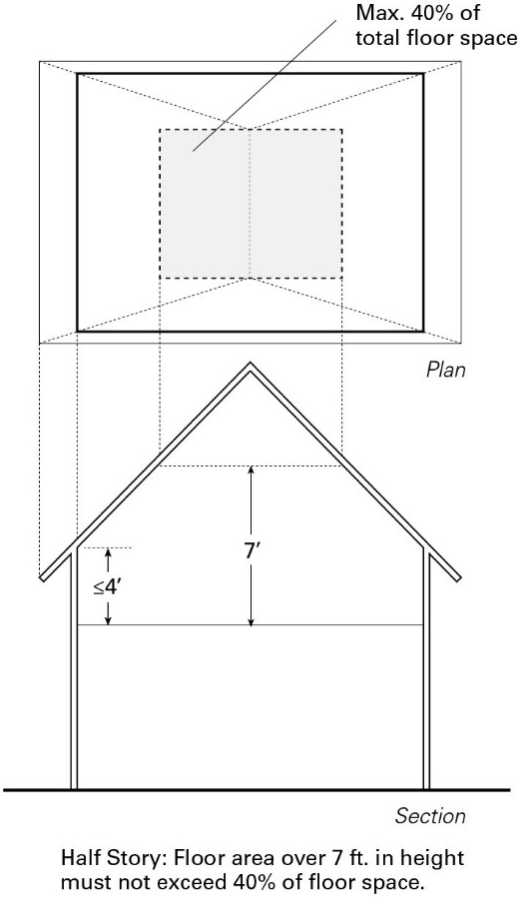
Story, Half. A partial story under a gable, hip, or gambrel roof, the wall plates of which, on at least two (2) opposite exterior walls, are not more than four (4) feet above the floor of such story, and the interior height of which, from the floor to the underside of the roof, does not equal or exceed seven (7) feet for more than forty (40) percent of the floor space. Diagrams depicting the measurement of a half story are included at the end of this article for illustrative purposes only.
Street. A public right-of-way which affords principal means of access to abutting property, including avenue, place, way, drive, lane, boulevard, highway, road, and any other thoroughfare except an alley as defined herein.
Street Line. The boundary between a street right-of-way and adjoining property.
Structure, Accessory. See Accessory Building.
Structural Alteration. Any change to the supporting members of a structure including the foundations, bearing walls, columns, or girders. Incidental repairs to such supporting members do not constitute structural alteration.
Structure. Anything constructed or erected, the use of which requires location on or in the ground, or attachment to something having location on the ground, including swimming pools, but excluding driveways, sidewalks, patios, or parking spaces.
Sufficient to Allow Separate Conveyance. Shall mean each housing unit being constructed in a manner adequate to allow transfer of title, ownership, rights, and interest in the property, from one (1) entity to another.
Supportive Housing. Housing with no limit on length of stay that is occupied by the target population, as defined in Government Code Section 65582(i), and that is linked to an onsite or offsite service that assists the supportive housing resident in retaining the housing, improving his or her health status, and maximizing his or her ability to live and, when possible, work in the community.
Tasting Lounge. Establishment that offers the on-site consumption of wine or beer in connection with the marketing of wines or beer offered for sale on the premises. With the exception of wine and beer, no beverages or items containing alcohol shall be offered for sale or consumed on the premises. Non-alcoholic retail items associated with wine drinking such as wine glasses, decanters, ice buckets, toppers, serving implements, snack foods and non alcoholic beverages may also be offered for sale.
Telecommunications Tower. A self-supporting structure which supports equipment used to transmit or receive telecommunications signals, including, but not limited to, monopoles and lattice-like steel structures.
Theater, Indoor or Outdoor. A building or outdoor area used primarily for entertainment or educational purposes for participants or spectators. Typical examples of uses of theaters may include, but are not limited to, cinema, performing arts, private parties, and general assembly.
Top of Bank. The line where a distinct change in grade between the ravine of a creek or waterway and the surrounding topography is apparent. Where the top of banks are not distinguishable, the top of banks shall be as determined by the Engineering and Construction Division based on the adjacent slopes and/or the extent of riparian vegetation.
Trailer. Shall mean any unit used, or designed to be used, for living or sleeping purposes or both, and which is equipped with wheels for transporting such unit from place to place whether by motive power or other means.
Transitional Housing. Any facility configured as rental housing developments, but operated under program requirements that call for the termination of assistance and recirculation of the assisted units to another eligible program recipient at some future point in time, which shall be no less than six (6) months. This definition shall be construed in light of the definition in Health and Safety Code Section 50675.2(h).
Truck Terminal (land use). Any lot, building, or part of a building used primarily for the storage, maintenance, or servicing of highway-type vehicles carrying persons or property including, but not limited to, trucks and buses. Truck Terminal does not include parking of vehicles in connection with a Permitted Use or repairing or maintaining vehicles used in connection with a permitted use on the same lot as the permitted use.
Urban Lot Split. See Section 30.30 of Article II of the Municipal Code (Parcel Map).
Use. The purpose for which land or a building is designed, arranged, or intended or for which either land or building is or may be occupied or maintained.
Use, Change of. The replacement of an existing use by a new use, or a change in the nature of an existing use, but not including: a change of ownership, tenancy, or management where the previous nature of the use, line of business, or other function is not substantially changed. A change in the existing nature of the use may include, but is not limited to, changes in the characteristics of the use or associated activities that are likely to result in increased impacts, such as noise, traffic or parking.
Use, "Neighborhood Serving." A use which primarily serves residents within the surrounding neighborhood.
Vegetated Swale. An open vegetated drainage channel that is designed to detain or infiltrate runoff volume associated with a water quality storm event, irrigation or other source of runoff.
Vehicle/Equipment Rental (land use). Rental of automobiles, construction equipment, motorcycles, recreational vehicles, trucks, and similar vehicles and equipment, including on-site storage and incidental maintenance that does not require pneumatic lifts.
Vehicle/Equipment Repair (land use). The repair of automobiles, trucks, motorcycles, mobile homes, recreational vehicles, or boats, including the sale, installation, and servicing of related equipment and parts. These uses include auto repair shops, body and fender shops, but exclude vehicle dismantling or salvage.
Vehicle/Equipment Sales and Leasing (land use). The sale, or leasing of automobiles, trucks, tractors, construction or agricultural equipment, mobile homes, and similar equipment, including storage and incidental maintenance and repair. This use does not include uses that exclusively rent vehicles (see Vehicle/Equipment Rental).
Vehicle/Equipment Repair, Major (land use). The repair of automobiles, trucks, motorcycles, mobile homes, recreational vehicles, and boats, including the sale, installation, and servicing of related equipment and parts. This classification includes auto repair shops, body and fender shops, transmission shops, but excludes vehicle dismantling or salvaging and tire retreading or recapping.
Vehicle/Equipment Service and Repair, Minor (land use). The service and repair of automobiles, light-duty trucks, boats, and motorcycles, including the sale, installation, and servicing of related equipment and parts. This classification includes the replacement of small automotive parts and liquids as an accessory use to a gasoline sales station or automotive accessories and supply store, and quick-service oil, tune-up and brake and muffler shops where repairs are made or service provided in enclosed bays and no vehicles are stored overnight. This classification excludes disassembly, removal or replacement of major components such as engines, drive trains, transmissions or axles; automotive body and fender work, vehicle painting or other operations that generate excessive noise, objectionable odors or hazardous materials, and towing services. It also excludes repair of heavy trucks, limousines or construction vehicles.
Vehicle Parts - Retail Sales and Repair (land use). The sale of vehicle equipment and parts. These uses include brake shops, oil change shops, auto glass sales, stereo and alarm sales, and tire sales, but exclude vehicle dismantling, salvage, tire retreading or recapping, or repairs performed by customers on-site.
Warehousing (land use). Establishments engaged in providing facilities for the storage of furniture, household goods, products, or other commercial goods. Includes cold storage. Does not include personal storage (mini storage) facilities offered for rent or lease to the general public ("Personal Storage-Mini-Storage"); or warehouse facilities in which the primary purpose of storage is for wholesaling ("Business, Wholesale").
Small - Establishments that occupy five thousand (5,000) square feet of floor area or less.
Large - Establishments that occupy more than five thousand (5,000) square feet of floor area.
Watercourse, Protected. A perennial or intermittent river, stream, creek, watercourse, waterway or channel within the incorporated limits of the City, which specifically includes and is limited to the following: (a) Cordilleras Creek upstream of Highway 101, and (b) Redwood Creek and its tributaries upstream of Highway 101 to Bradford Street and upstream of El Camino Real. A segment of a watercourse located within these defined boundaries but located within concrete channels or culverts, as may be determined by the Engineering and Construction Division, is not considered a protected watercourse.
Wireless Communications Equipment Building. A structure which houses accessory equipment for a wireless communications telecommunications tower, antenna, or similar device.
Wireless Communications Facility. The equipment and appurtenant structures necessary or appropriate for receiving telecommunications or radio signals from a mobile communications source and for transmitting those signals to a central switching station which connects the mobile communications unit to a communications network; including, but not limited to, telecommunications towers, antennas, associated wireless communications equipment, and structures housing such equipment and appurtenances.
Yard. An open space on the same lot with a building, which open space is unoccupied and unobstructed from the ground upward, except as otherwise permitted in Article 32.
Yard, Front. A yard extending across the full width of the front of the lot and measured from the front line of the lot toward the nearest line of the building.
Yard, Rear. Except as otherwise provided in this article, a yard extending across the full width of the lot, adjacent to the rear lot line, and measured from the rear line of the lot towards the main building.
Yard, Side. A yard measured from the side line of the lot toward the interior of the lot and extending from the required front yard to the required rear yard, or rear lot line if no rear yard is required.
Zoning Administrator. The Planning Director of the City of Redwood City, or the designee of the Planning Director.
Example Diagrams
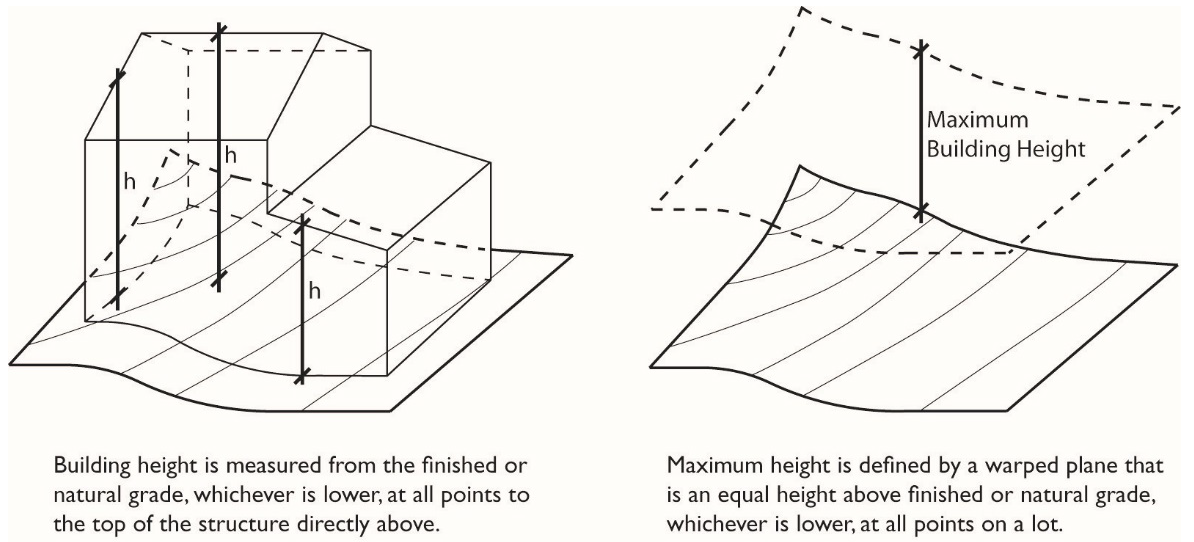
Height of Residential Structures on Sloping Lots
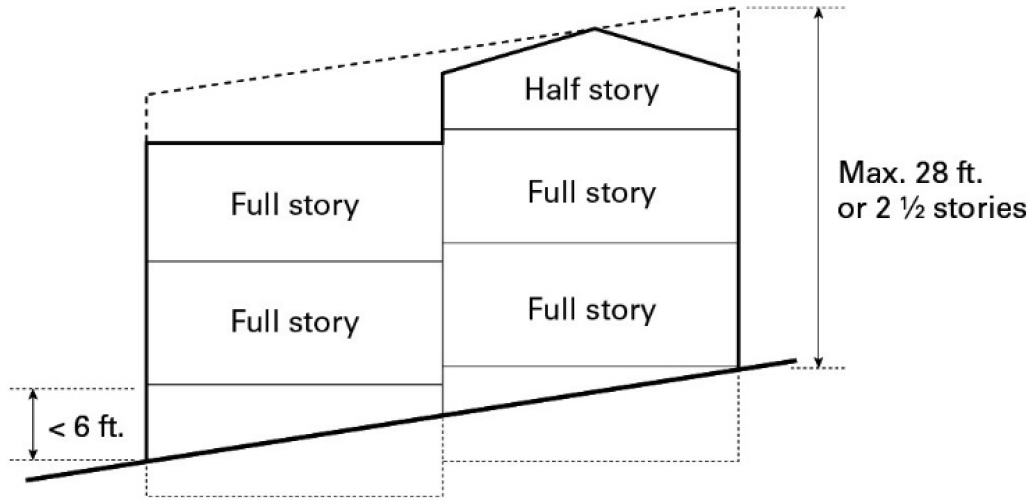
Measurement of Half Story
(Ord. No. 1130-353, § 1(Exh. A), 6-27-11; Ord. No. 1130-359, § 1(Exh. A), 4-8-13; Ord. No. 1130-360, § 5, 2-10-14; Ord. No. 1130-363, § 5, 6-22-15; Ord. No. 1130-364, § 1(Exh. A), 8-24-15; Ord. No. 1130-365, § 4(Exh. A), 10-26-15; Ord. No. 1130-366, § 4, 12-7-15; Ord. No. 1130-367, § 5, 6-13-16; Ord. No. 1130-368, § 5, 1-9-17; Ord. No. 1130-373, § 5, 5-21-18; Ord. No. 1130-379, § 5(Exh. A), 8-26-19; Ord. No. 1130-381, § 4(Exh. A), 1-27-20; Ord. No. 1130-383, § 4(Exh. A), 4-12-21; Ord. No. 1130-384, § 4(Exh. A), 4-12-21; Ord. No. 1130-386, § 4(Exh. A), 7-24-23; Ord. No. 1130-890, § 4(Exh. A), 8-26-24)
Editor's note— Ord. No. 1130-363, § 11, adopted June 22, 2015, reads as follows: "This Ordinance shall go into effect on January 1, 2016, per City Council motion at the April 13, 2015 hearing." At the direction of the City, and prior to their effective date, the changes enacted by Ord. No. 1130-363, § 5, have been included as set out herein.

