Richmond City Zoning Code
ARTICLE 14
- EXTERIOR LIGHTING
Sec. 14.01.- Purpose.
The purpose of this article is to preserve and enhance the lawful nighttime use and enjoyment of all properties in the city through the use of appropriate lighting practices and systems. The standards of this article are intended to allow sufficient (but not excessive) lighting for parking areas, walkways, driveways, building entrances, loading areas, and common areas; to minimize the adverse effects of inappropriate lighting; and to provide for the safety and security of people and property in the city. Exterior lighting shall be designed, installed, and maintained to control glare and light trespass; conserve energy and resources; and prevent the degradation of the nighttime visual environment.
It is the further intent of this article to:
1.
Encourage the use of innovative lighting designs and decorative light fixtures that enhance the city's character, while preserving the nighttime visual environment.
2.
Establish consistent and compatible exterior lighting standards for all uses in the city.
3.
Preserve and respect public and private investments in streetscape, site, and building improvements in the city.
4.
Protect the general welfare by maintaining and enhancing the city's visual environment, character, and economic vitality.
Sec. 14.02. - Scope.
The standards of this article shall apply to all exterior lighting sources, and to all light sources visible from any public right-of-way or adjacent parcel.
Sec. 14.03. - General provisions.
The following general standards shall apply to all light sources regulated by this article:
A.
Consistency. Exterior lighting fixture color, style, design, layout, and light intensity shall conform with the standards of this article, and shall be consistent with the following:
1.
Applicable recommendations of the city's master plan, and any adopted streetscape improvement plans or guidelines.
2.
Existing fixtures on adjacent zoning lots, where the planning commission has determined that a consistent fixture pattern has been established.
3.
The architectural character of the principal building on the zoning lot.
4.
Lamp wattages and types shall be consistent with the light fixture's style and intended function, as follows:
a.
Antique-style street lamps and other decorative exterior light fixtures shall be limited to incandescent, compact fluorescent, or high-pressure sodium lamps with a maximum wattage of 100 watts per fixture.
b.
Security lighting in low traffic areas shall be provided by low-pressure sodium lamps.
c.
Fixtures for parking lots, streets, sidewalks, and other high traffic areas shall use high pressure sodium or metal halide lamps with a maximum lamp wattage of 250 watts per fixture up to 20 feet in height above grade, and 400 watts per fixture over 20 feet in height above grade.
B.
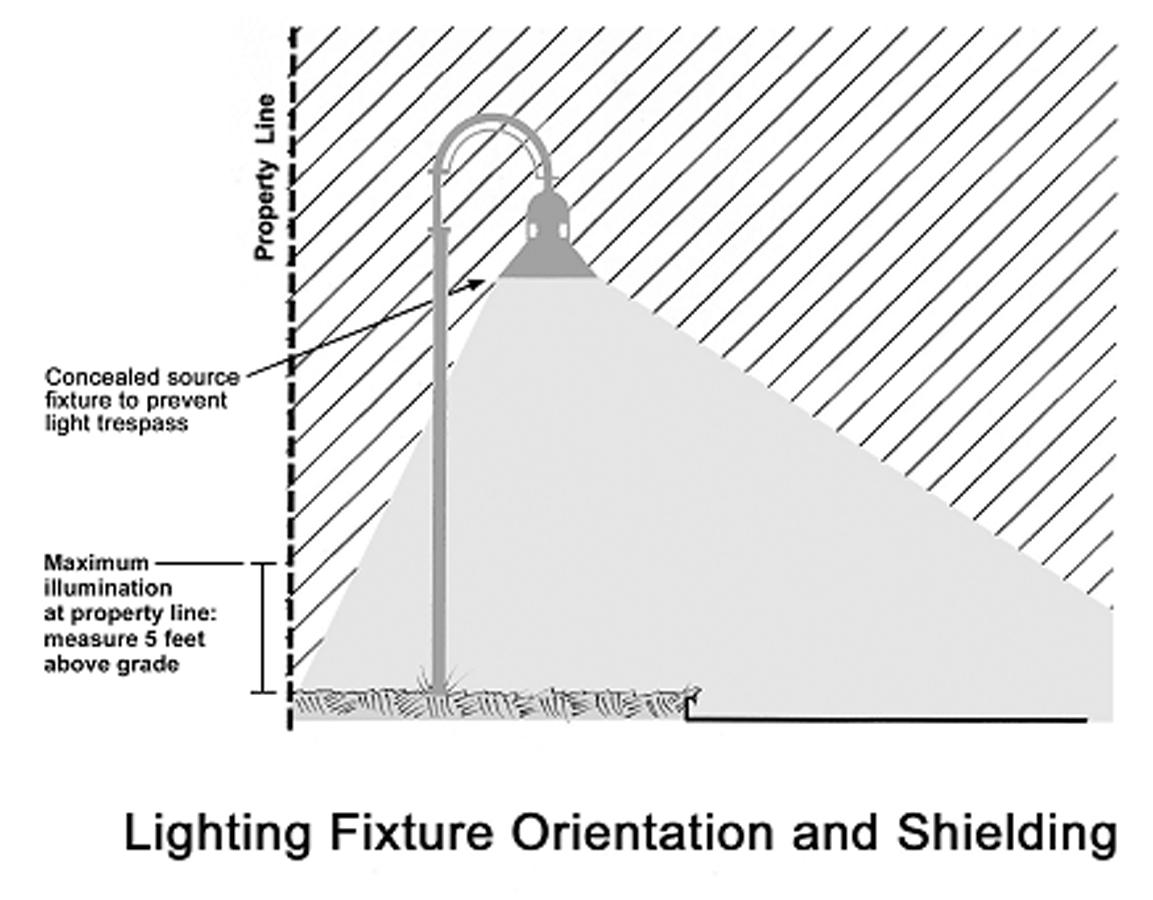
Fully-shielded. Exterior lighting shall be fully shielded, using concealed source fixtures directed downward and away from adjacent properties and street rights-of-way. All exterior light fixtures shall utilize full cutoff housings, louvers, glare shields, optics, reflectors or other measures to prevent off-site glare and minimize light pollution (see illustration).
C.
Intensity. The maximum intensity of light within any site shall not exceed the following standards:
1.
Outdoor dealership sales area lighting. The planning commission may permit a maximum lighting intensity of 20.0 footcandles for any point within a dealership outdoor sales area, provided that all site lighting is otherwise in compliance with this ordinance.
2.
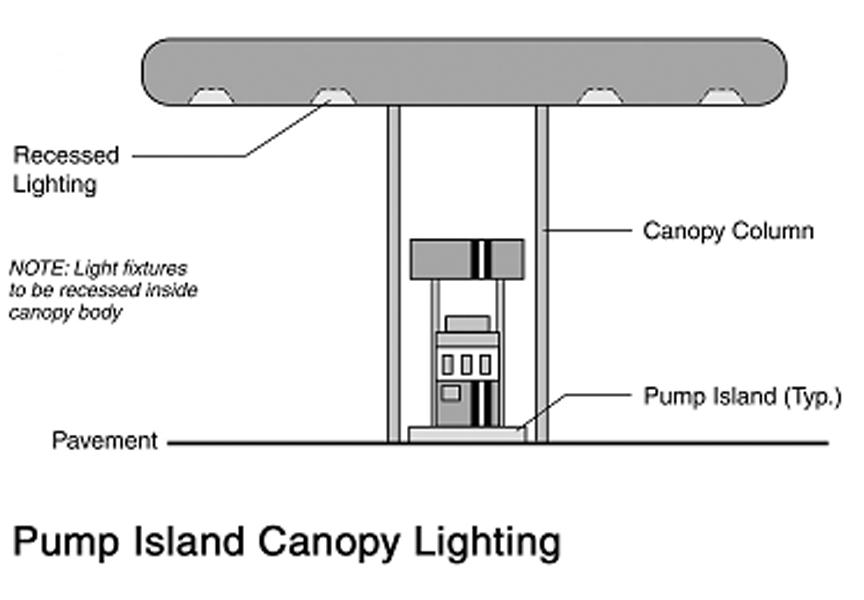
Pump island canopy lighting. The planning commission may permit a maximum light intensity of 20.0 footcandles for any point under a gas station pump island canopy, where all light fixtures under the canopy are fully recessed into the canopy structure, and all site lighting is otherwise in compliance with this ordinance (see illustration).
D.
Glare and light trespass. Exterior lighting shall be designed, constructed, and maintained in a manner that does not cause off-site glare or light trespass on neighboring properties, or a traffic hazard or nuisance condition for motorists on adjacent street rights-of-way.
E.
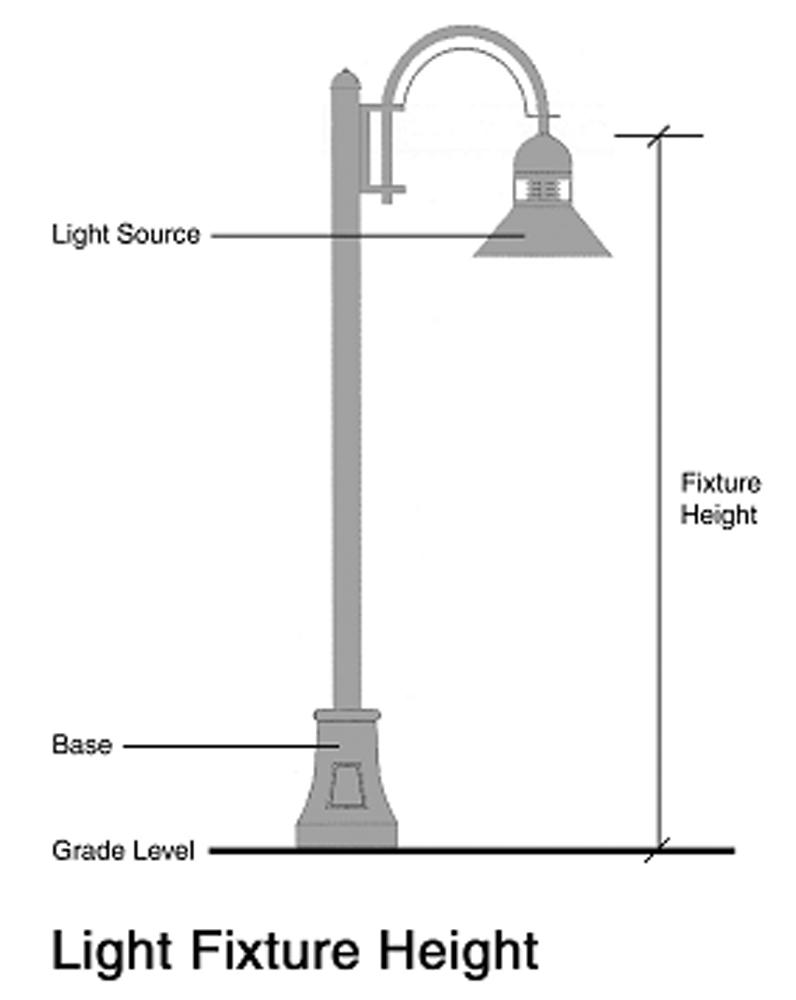
Measurements. Measurements of exterior lighting height and intensity shall be made in accordance with the following (see illustration):
1.
Light intensity levels within the site shall be measured on the horizontal plane at grade level.
2.
Light intensity levels shall be measured on the vertical plane of the lot or street right-of-way boundaries at a height of five feet above grade.
3.
Fixture height shall be measured from grade level to the highest point of the light source.
F.
Submittal requirements. The following exterior lighting information shall be required with any site plan, site condominium plan, or subdivision plat application:
1.
The location, type and height of all existing and proposed light fixtures.
2.
A photometric grid measuring the overall light intensity within the site in footcandles.
3.
Manufacturer's specifications and details for each type of light fixture, including the total lumen output, type of lamp, and method of shielding.
The city planner or building official may also require submittal of any of the above information as part of a building, electrical, or zoning permit application where exterior lighting is proposed to be altered or installed.
Sec. 14.04. - Standards by type of fixture.
The following additional standards shall apply to specific types of exterior light fixtures, in addition to the provisions of section 14.03 (general standards):
A.
Freestanding pole lighting. The following standards shall apply to all freestanding, pole-mounted light fixtures:
1.
Maximum overall height. The maximum height of pole-mounted fixtures shall be directly proportional to the fixture's proximity to the boundary of a residential district or lot occupied by an existing residential use, as follows:
2.
Hours of operation. All private exterior lighting systems in non-residential districts shall incorporate automatic timers. Exterior light fixtures shall not be illuminated after 11:00 p.m., or one-half hour following the close of the business day, whichever is later. Such fixtures shall not be illuminated before sunrise, or one-half hour prior to the beginning of the business day, whichever is earlier. Minimal illumination for security purposes shall be permitted between these hours.
B.
Architectural lighting. Architectural lighting shall be subject to the following:
1.
Facade illumination. Exterior illumination of building facades shall be limited to fully shielded fixtures directed towards the facade with all light concentrated on the wall.
2.
Accent lighting. Unshielded luminous tube (neon) or fluorescent lighting shall be prohibited as an architectural detail on the exterior of any structure; including but not limited to rooflines, cornices, eaves, windows, and door openings. The planning commission may approve internally illuminated architectural bands or similar shielded lighting accents as part of a site plan, upon determining that such lighting accents would enhance the aesthetics of the site, and would not cause off-site glare or light pollution.
C.
Window lighting. All interior light fixtures visible through a window from a public right-of-way or adjacent property shall be shielded to prevent glare at the property line or within a public right-of-way. Unshielded luminous tube (neon) and fluorescent light fixtures shall be prohibited where the light source would be visible through the window from a public right-of-way or adjacent property.
D.
Illuminated signs. Sign illumination shall also comply with the provisions of article 13 (signs).
E.
Searchlights. The use or operation of searchlights and similar high intensity, non-laser light sources projected above the horizontal plane shall be permitted for temporary periods not exceeding a maximum of four consecutive days and a total of 30 calendar days per year.
Sec. 14.05. - Prohibited lighting.
The following types of exterior light sources and activities shall be prohibited:
1.
Mercury vapor lighting. The installation of mercury vapor fixtures shall be prohibited.
2.
Animated lighting. Lighting shall not be of a flashing, moving, animated or intermittent type, including electronic reader boards and other animated sign lighting.
3.
Laser source lighting. The use or operation of exterior laser source lighting shall be prohibited.
Sec. 14.06. - Exempt lighting.
The following types of exterior lighting shall be exempt from the requirements of this article, except that the city planner or building official may impose reasonable restrictions on the use of such lighting where necessary to protect the health, safety and welfare of the public:
1.
Shielded pedestrian walkway lighting, and single family residential lighting that does not cause off-site glare or contribute to light pollution.
2.
Holiday decorations displayed for temporary periods not to exceed 90 calendar days.
3.
Lighting for a permitted temporary circus, fair, carnival, or civic use.
4.
Circumstances where federal or state laws, rules or regulations take precedence over the provisions of this article, or where fire, police, emergency, or repair personnel need light for temporary or emergency situations.
5.
Fossil fuel light produced directly or indirectly from the combustion of natural gas or other utility-type fossil fuels (e.g., gas lamps).
Sec. 14.07. - Alternatives and substitutions.
Specific lighting design alternatives or fixture substitutions may be permitted in accordance with the purpose of this article and the following:
1.
Decorative light fixtures. The planning commission may approve the use of decorative light fixtures as an alternative to fully shielded fixtures, where such fixtures would enhance the aesthetics of the site without causing off-site glare or light pollution.
2.
Alternative lighting designs. The planning commission may approve an alternative lighting design, provided that the commission finds that the design would be in accordance with the purpose of this article.
3.
Fixture alteration or replacement. Light fixtures regulated by this article shall not be altered or replaced after approval has been granted, except where the city planner has verified that the alteration or replacement would conform to this article.
Sec. 14.08. - Exceptions.
It is recognized by the city that certain uses or circumstances may have special exterior lighting requirements not otherwise addressed by this article. The Board of Zoning Appeals (BZA) may waive or modify specific provisions of this article for a particular use or circumstance, upon determining that all of the following conditions have been satisfied:
1.
A public hearing shall be held for all lighting exception requests in accordance with the procedures set forth in section 1.12 (public hearing procedures).
2.
The waiver or modification is necessary because of safety or design factors unique to the use, circumstance or site.
3.
The minimum possible light intensity is proposed that would be adequate for the intended purpose. Consideration shall be given to maximizing safety and energy conservation; and to minimizing light pollution, off-site glare, and light trespass on to neighboring properties or street rights-of-way.
4.
For lighting related to streets or other vehicle access areas, a determination is made that the purpose of the lighting cannot be achieved by installation of reflectorized markers, lines, informational signs, or other passive means.
5.
Additional conditions or limitations may be imposed by the BZA to protect the public health, safety or welfare, or to fulfill the spirit and purpose of this article.
ILLUSTRATIONS