
Richmond City Zoning Code
ARTICLE 5
- DIMENSIONAL STANDARDS
Sec. 5.101. - Table of dimensional standards by district.
(Ord. No. 156-35, § I, 12-15-25, eff. 4-11-26)
Sec. 5.201. - Front yards.
Any required front yard area shall be used primarily for recreational and ornamental purposes, unless otherwise permitted by this ordinance. No permanent structures shall be maintained within the required front yard, except porches, fences, and similar items. Front yards shall be further subject to the following:
A.
Existing neighborhoods. Where the predominant pattern of front yard setbacks on a single block in a single family residential district is less than that required by section 5.101 (table of dimensional standards by district), the minimum front yard setback for any new dwelling on the same block may be reduced to the average front yard depth of existing dwellings on the same side of the street.
B.
Setbacks along major streets. The minimum front yard setback required in section 5.101 (table of dimensional standards by district) for all single family residential districts shall be increased by five feet for all front yards abutting a public street classified as an arterial or thoroughfare by the city's master plan, or county or state road authorities.
C.
Maximum setbacks. The purpose of the maximum front yard setbacks (also known as "build-to lines") established for the B-1 and B-2 districts are to preserve the unique character of the city's downtown commercial areas, provide a pleasant and diverse experience for pedestrians, and enhance the city's attractiveness and economic vitality. All new buildings, alterations and expansions constructed after the effective date of this ordinance shall follow the established historic development pattern of these areas of the city by complying with the maximum setback requirements of this article.
D.
Corner lots. Structures on corner lots shall comply with the minimum front yard setback requirements from all street rights-of-way. Such lots shall be deemed to have two front yards for purposes of this ordinance.
E.
Double frontage lots. Where a block of double frontage lots exists, one street may be designated by the city planner as the front street for all lots in the block. Otherwise, both frontages shall be considered front yards for purposes of this ordinance.
Sec. 5.202. - Side yards.
The planning commission may reduce or waive the required side yard setback for any primary building in the office or business districts as part of site plan approval, subject to the following:
1.
Applicable state construction and fire code requirements shall be satisfied.
2.
A setback of not less than ten feet shall be provided on any side yard that borders on a residential district.
3.
Where a building wall facing an interior side lot line contains windows or other openings, a side yard of not less than ten feet shall be provided.
4.
A setback of not less than 12 feet shall be provided on any side yard of an existing lot of record in the R-1 (single family residential) district with a minimum lot width of 100 feet.
Sec. 5.203. - Rear yards.
In all districts where alleys exist, the measurement of the rear yard setback for primary buildings may include one-half the width of the alley.
Sec. 5.204. - Height exceptions.
Chimneys, elevator towers, stage scenery lofts, water towers, mechanical equipment and similar structures shall not be included in calculating the height of the primary building, provided that the total area covered by such structures shall not exceed 20 percent of the roof area of the building.
Sec. 5.205. - Permitted yard encroachments.
Fire escapes, chimneys, balconies, egress window wells, architectural features, and similar projections shall be considered part of the primary building for purposes of determining yard and setback requirements. Limited projections into certain required yards shall be permitted as follows:
(Ord. No 156-25, § I, 11-19-18)
Sec. 5.301. - Standard methods of measurement.
When determining compliance with the provisions of this ordinance, the following standardized methods of measurement shall apply:
A.
Overhangs. When the overhang is two feet or less, not including the gutter, setback measurements shall be taken from the outside wall of the building. Otherwise, setback measurements shall be taken from the edge of the overhang.
B.
Lot coverage. Accessory garages, terraces, porches, patios, decks and other structures shall be deemed a part of the primary building for the purpose of determining compliance with lot coverage requirements.
C.
Buildable lot area and open space calculations. Calculation of permitted residential densities and open space requirements shall be subject to the following:
1.
No lot, parcel or portion of same shall be used more than once in such calculation.
2.
Lakes, ponds, state or federally regulated wetlands, retention basins, drain easements, public street rights-of-way and private road easements shall be excluded from area calculations for buildable lot area.
3.
Areas lying within delineated wetlands, detention basins, or drain easements may be used to satisfy up to 20 percent of any minimum open space requirement of this ordinance.
4.
Required front, side, or rear yard setback areas for individual dwellings, perimeter yard setbacks or buffer areas for other principal buildings and uses, and areas used for parking, loading or other accessory uses shall be excluded from area calculations for any open space requirement of this ordinance.
D.
Floor area. Measurements of floor area shall be based upon distance between exterior surface of enclosing walls and between center lines of common partition walls for each living unit, and the following:
1.
Gross floor area (GFA). The sum of the gross horizontal areas of the several floors of the building measured from the exterior faces of the exterior walls or from the centerline of walls separating two buildings, including a basement floor area where more than one-half of the basement height is above the established lot grade at the building.
2.
Usable floor area (UFA). Eighty percent of the gross floor area of a building, or that portion of the building area, measured from the interior face of the exterior walls, intended for services to the public or to customers, patrons, clients or patients, and excluding areas intended for storage of merchandise, utility or mechanical equipment rooms or sanitary facilities. Usable floor area shall have a minimum clear height of seven feet or more.
Sec. 5.302. - Area and yard regulations.
No structure shall be erected, converted, enlarged, reconstructed or structurally altered except in conformity with the yard and area regulations of the district in which the structure is located:
A.
Lot standards.
1.
New lots created after the effective date of adoption or amendment of this ordinance shall comply with all applicable dimensional standards of this ordinance.
2.
No lot, adjacent lots in common ownership, required yard, parking area or other required open space shall be created, divided or reduced in dimensions or area below the minimum requirements of this ordinance.
3.
Every building hereafter erected on a lot or parcel of land created subsequent to the effective date of this ordinance shall comply with the lot size, lot coverage, and setback requirements for the district in which it is located.
4.
Existing yard setbacks shall not be reduced below the minimum requirements of this ordinance.
B.
Number of principal uses per lot. Only one principal building shall be placed on a lot of record of parcel in a single family residential district. In single family condominium project, only one principal building shall be placed on each condominium lot, as defined in section 2.02 (definitions).
Sec. 5.303. - Frontage and access required.
No dwelling shall be built on any lot that does not abut and have direct frontage on an approved street. Indirect access via a private access easement shall not be sufficient to satisfy this requirement.
Sec. 5.304. - Corner clearance areas.
No structures, walls, fences, signs, landscaping or other obstructions to visibility shall be permitted between the heights of 30 inches and six feet above the existing street grade within a triangular area formed by the intersection of two street right-of-way lines connected by a diagonal across the interior of such lines at points ten feet from the point of intersection. Trees shall be permitted within the triangular area, provided that limbs and foliage are trimmed so that they do not obstruct visibility or otherwise create a traffic hazard.
Buildings in the B-2 (downtown business) district shall be exempt from this requirement. Upon review of site circulation, visibility and accessibility, the planning commission may require additional corner clearance area for sites in the B-3 (general business) district.
ILLUSTRATIONS
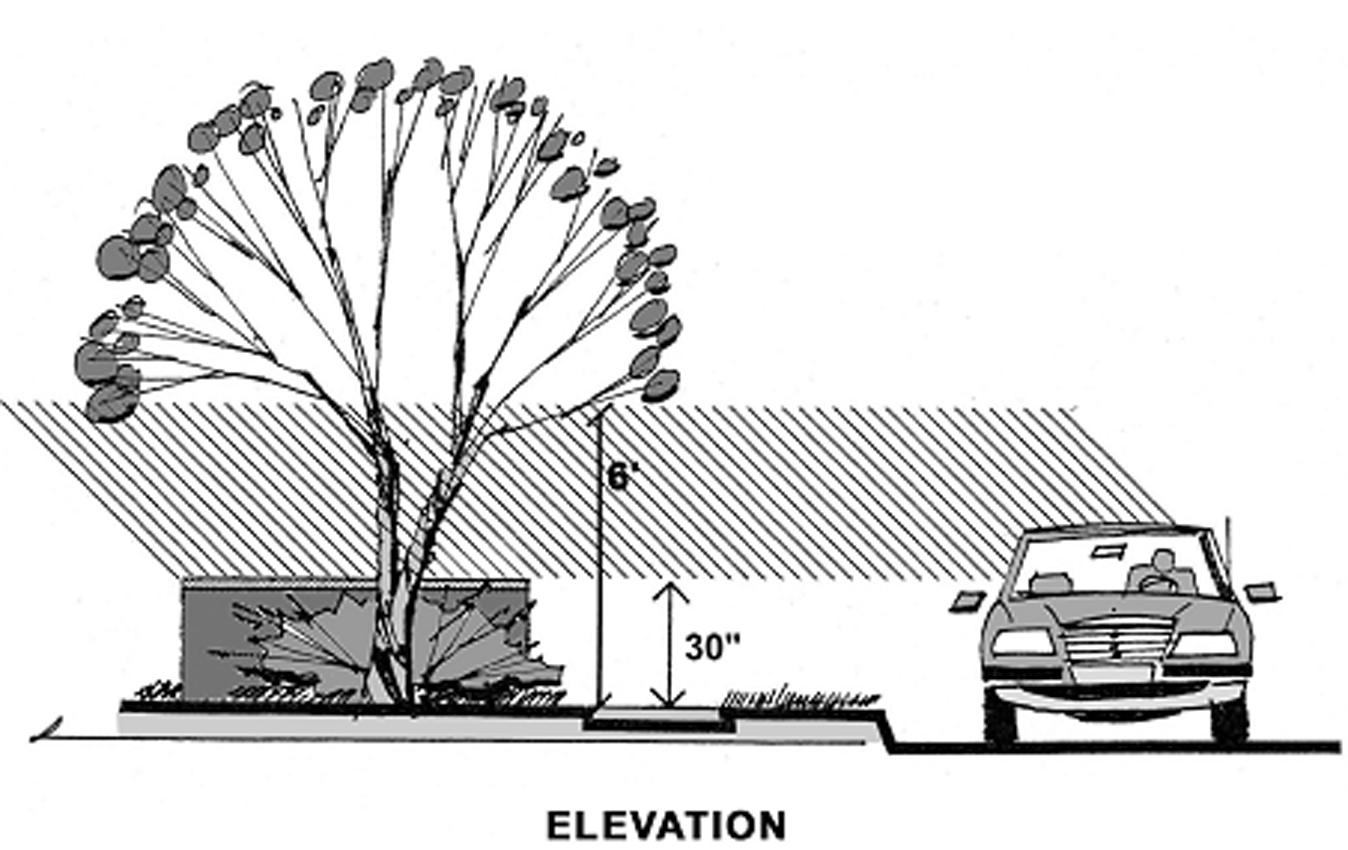
Corner Clearance Area—Elevation
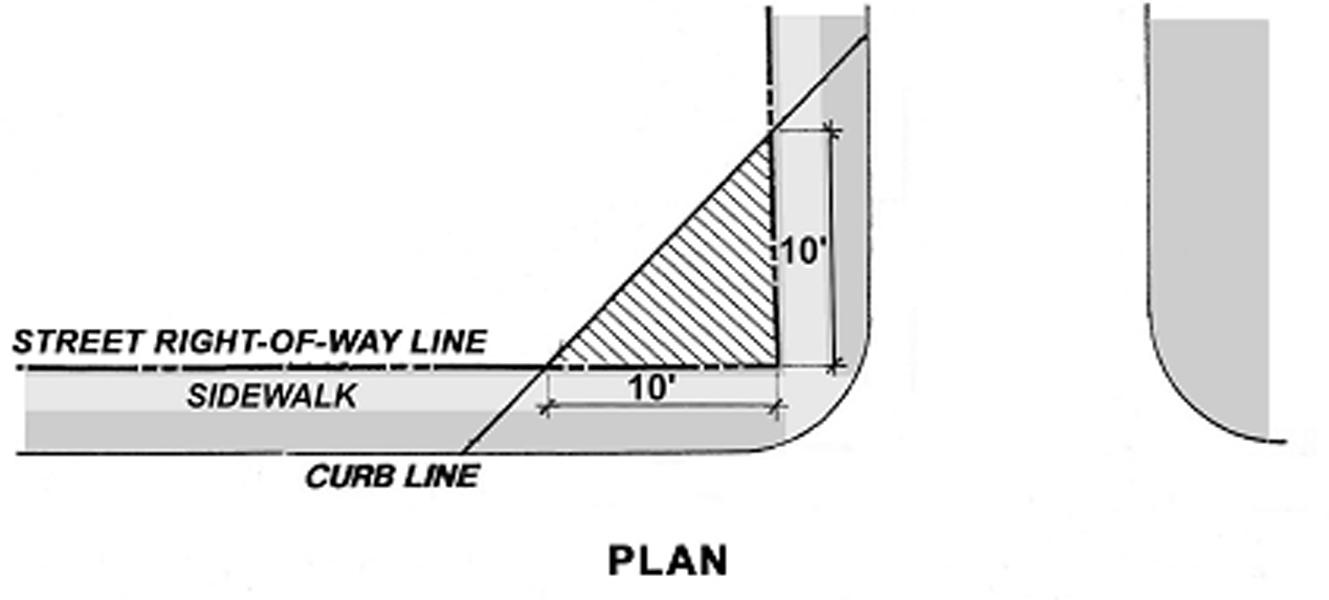
Corner Clearance Area—Plan

