
Richmond City Zoning Code
ARTICLE 20
- PLANNED UNIT DEVELOPMENT PUD OVERLAY DISTRICT
Sec. 20.01.- Intent.
The provisions of this article outline the standards for the submission, design, review and approval of planned unit development (PUD) projects subject to approval of an overlay zone. The intent of this district is to provide areas within which several land use types can be developed through innovative and thoughtful land use design. While traditional height, area, and bulk requirements may be modified in a PUD in order to achieve particular design objectives, any such development shall adhere to all applicable health and building codes and clearly demonstrate a commitment to maintaining a balance between residential and non-residential land use, between public open space provided and private land set aside, and in accordance with the ability of the remainder of the city to absorb and effectively deal with the attendant growth. Planned unit developments are encouraged to:
1.
Foster innovation in land use planning, development, and redevelopment.
2.
Encourage assembly of lots and redevelopment of inefficient land uses, outdated structures, and Brownfield sites.
3.
Support in-fill development on sites that would be difficult to develop according to conventional standards because of the shape, size, abutting development, accessibility, environmental status or other unique features or conditions related to the site.
4.
Provide enhanced housing, employment, and shopping opportunities.
5.
Create a development framework that promotes appropriate business activity and enhances the economic viability of the city.
6.
Allow for unique development projects consistent with the city's master plan objectives for land use, transportation, and community facilities.
7.
Provide for a network of pedestrian pathways, usable open spaces, and recreation areas within the city.
8.
Promote a development pattern that preserves and utilizes natural topography and features, scenic vistas, existing vegetation, and existing historical elements.
The provisions of this article are intended to result in land development substantially consistent with the master plan and surrounding neighborhood, with modifications and departures from generally applicable requirements made in accordance with standards provided in this article to ensure appropriate, fair and consistent decision-making.
Sec. 20.02. - Scope.
The provisions of this article may be applied to any parcel of land located in any zoning district and which is under single ownership, subject to a determination that the proposed project and site satisfy section 20.03 (eligibility criteria). The provisions of this article may also be applied to any site designated as a Brownfield by state or federal law.
These regulations are not intended as a device for ignoring the more specific standards of the city, or the planning upon which the standards are based.
Sec. 20.03. - Eligibility criteria.
To be eligible for planned unit development (PUD) approval, the applicant shall demonstrate that the following criteria will be met:
1.
Availability and capacity of public services. The proposed type and density of use shall not exceed the existing or planned capacity of existing public services, facilities, and utilities. For purposes of this section, such services shall include, but are not limited to police and fire protection, drainage and stormwater management facilities, municipal water and sanitary sewer facilities, refuse disposal, and educational services.
2.
Compatibility with the master plan. The proposed development shall be consistent with the city's master plan.
3.
Compatibility with PUD intent. The proposed development shall be consistent with the intent and spirit of these regulations, as stated in section 20.01 (intent).
4.
Economic impact. The proposed development shall not impede the continued use or development of surrounding properties for uses that are permitted in the zoning ordinance, or planned in the adopted city master plan.
5.
Unified control. The entire area of the proposed development shall be under single ownership or unified control, such that there is a single entity having responsibility for completing the entire project. This provision shall not prohibit a transfer of ownership or control, provided that notice of such transfer is given in advance to the city planner and a unified ownership remains.
6.
Public benefit. A recognizable and material benefit will be realized by both the future residents and the city as a whole, where such benefit would otherwise be unfeasible or unlikely.
7.
Preservation of site features. Long-term conservation of natural, historical, architectural or other significant site features or open space will be achieved, where such features would otherwise be destroyed or degraded by development as permitted by the underlying zoning district(s).
8.
Sufficient land area for proposed uses. Sufficient land area has been provided to comply with all applicable regulations of this ordinance, to adequately serve the needs of all permitted uses in the PUD project, and to ensure compatibility between uses and the surrounding neighborhood.
Sec. 20.04. - PUD project use standards.
A planned unit development (PUD) project shall be consistent with the following use standards:
A.
Permitted uses. Uses within a PUD project shall be regulated by the restrictions of the underlying zoning district, except as specifically modified through the PUD approval process. To achieve superior design and land use compatibility, the city council, upon recommendation by the planning commission, may include or exclude specific land uses from a PUD project or from specific portions of the PUD project, regardless of the provisions of the underlying zoning district(s). To support the inclusion of a specified use in a PUD project, the applicant may be required to provide evidence (such as a professional market study) that a demand exists for the proposed use within the local market area.
Notwithstanding the flexibility provided above, industrial, research and laboratory uses, as specified in article 4 (land use tables), shall be excluded from all PUD projects that have a residential component. Industrial, research and laboratory uses shall only be permitted in a non-residential PUD project.
B.
Residential use and density. The planning commission may require that a variety of housing types be provided as part of a residential PUD project, including detached and attached single-family dwellings, two-family dwellings, townhouses, and other multiple-family dwellings.
The number of dwelling units permitted within a PUD project shall be determined through review of a parallel plan prepared by the applicant. The parallel plan for the project shall be consistent with state, county, and city requirements and design criteria for the type of dwelling unit proposed. The parallel plan shall meet all standards for lot size, lot width, and setbacks normally required for such development. The parallel plan shall also provide sufficient area for storm water detention. Lots in a parallel plan shall provide sufficient building size without impacting wetlands regulated by the Michigan Department of Environmental Quality (MDEQ).
The planning commission shall review the design and determine the number of dwelling units that could feasibly be constructed and economically viable following the parallel design. This number, as determined by the planning commission, shall be the maximum number of dwelling units allowable in the PUD project, except where additional dwelling units are permitted by the planning commission per subsection 20.04.C. (exemplary project density bonus).
C.
Exemplary project density bonus. A density bonus may be permitted for an exemplary project, at the discretion of the planning commission, based upon a demonstration by the applicant of design excellence for the PUD. The planning commission shall consider the following elements when determining the appropriate density bonus:
1.
An integrated mixture of housing types and densities, including but not limited to attached housing, housing for the elderly, and or detached housing.
2.
Provision of a perimeter transition along the roadway and on all other sides of the development. The transition area shall utilize a variety of landscape plantings, berming, and or decorative fencing/walls. The transition area's depth and location shall be subject to planning commission approval, based upon site conditions and adjacent land uses.
3.
Incorporating active recreation areas.
4.
Extensive clean-up of a blighted site, including clean up of contamination.
5.
Utilizing creative architectural design that establishes a distinctive unity where all homes share a thematic character. The following shall be incorporated:
a.
Roof types. To provide a variation on facades of the structures, peaked rooflines shall be a minimum four to 12 pitch. Architectural accents such as cupolas, cross gables, and dormers are encouraged.
b.
Doors and windows. The location, orientation, and proportion of doors and windows should be used to define the character and enhance the building facade.
c.
Porches. Front porches shall be provided for individual units as a semi-public living place on the street wall of the building. Various designs of front porches, covered patios, stoops, balconies, and terraces are encouraged.
d.
Garages. A mixture of recessed front-entry, side-entry, and detached garages shall be provided. Detached garages shall be located to the rear of the principal building. Front-entry garages shall be setback at least five feet from the front building line, exclusive of any porch. Front-entry garages shall be limited to a maximum capacity of two vehicles and shall include separate overhead doors for each interior parking space.
6.
Additional elements as determined by the planning commission to provide a material benefit to all residents of the development.
D.
Nonresidential uses and density. Office and service uses, community uses, commercial uses, and industrial, research and laboratory uses, as specified in article 4 (land use tables), shall be accessed by public streets and sited in such a manner as to not encourage through traffic in existing residential neighborhoods or any potential residential area within the PUD. Such non-residential uses may occupy up to ten percent of the gross area of a residentially zoned parcel.
Sec. 20.05. - PUD project design standards.
A planned unit development (PUD) project shall be consistent with the following general standards for the type, bulk, design and location of structures, common space, and public facility requirements. The planning commission shall have the authority to waive or modify these requirements, upon determination that an alternative standard would be in accordance with the intent of this article.
A.
Setbacks and buffering.
1.
Interior. The setback requirements of the underlying zoning district(s) shall establish the required interior setbacks for the PUD. These requirements may be modified within the PUD project, subject to approval by the planning commission.
2.
Perimeter. The proposed location and arrangement of structures shall not be materially detrimental to existing or prospective adjacent structures or to existing or prospective development of the neighborhood. There shall be a perimeter setback and landscaping and/or berming, as recommended by the planning commission, for the purpose of buffering the adjacent properties from the planned unit development. The setback distance and buffering treatment need not be uniform at all points on the perimeter of the development. However, in cases where nonresidential uses in the PUD are adjacent to residentially zoned property, such uses shall be visually screened by a landscape berm, evergreen screen, or a decorative wall.
B.
Access and circulation. The internal circulation system shall provide adequate systems for vehicular and non-vehicular circulation, subject to the following:
1.
Streets. The proposed development shall provide logical extensions of existing or planned streets in the city, and shall provide suitable street connections to adjacent parcels, where applicable. Streets shall be designed to meet the city's engineering design standards, and shall be dedicated to the public. Curb cuts and driveway access shall comply with the standards of article 10 (access management).
2.
Sidewalks and pedestrian paths. Pedestrian circulation shall be provided within the site and shall interconnect all use areas. The pedestrian system shall provide for a logical extension of pedestrian ways outside of the PUD where applicable.
3.
Parking and loading. Off-street parking and loading spaces shall be provided in accordance with article 9 (off-street parking and loading).
4.
Traffic impacts. Traffic to, from, and within the site shall not be hazardous or inconvenient to the project or to the neighborhood. In applying this standard, the planning commission shall consider, among other things, convenient routes for pedestrian traffic, relationship of the proposed project to main thoroughfares and street intersections; and the general character and intensity of the existing and potential development of the neighborhood. A traffic impact study may be required by the planning commission, per section 10.06 (traffic impact studies).
C.
Common open space. Common open space and other common areas and facilities shall be so planned to achieve a unified design, subject to the following:
1.
Minimum area. A minimum of 20 percent of the PUD shall be designated and maintained as common open space readily accessible and available to the residents of the PUD project. Up to 25 percent of the required common open space area may be occupied by wetlands, floodplains or open water areas.
2.
Dedication. The applicant shall provide for a conservation easement or similar device satisfactory to the city attorney to ensure that public and common areas will be or have been irrevocably committed for that purpose. Provisions shall be made to provide for financing of improvements and maintenance for open spaces and other common areas.
3.
Continuity. The design of such common areas and facilities shall be coordinated with surrounding uses and lands, as well as the natural characteristics of the project site.
4.
Not included as open space. Open space areas shall not include the following:
a.
The area of any street right-of-way proposed to be dedicated to the public.
b.
The area utilized for off-street parking and vehicular circulation.
c.
Any portion of the project used for non-residential purposes.
d.
The required transition and buffering areas.
e.
Required yard setbacks on individual single-family residential lots or units.
D.
Recreational uses. Public and private recreational uses, including but not limited to golf courses, riding stables, swim clubs, and tennis clubs (including accessory structures and uses) may be incorporated within residential areas of a PUD project. Developed recreational uses such as tennis clubs, swim clubs, golf courses, riding stables, and the like, may be used to satisfy 50 percent of the common open space requirement, provided such uses are integrated into the overall PUD project.
E.
Infrastructure and other site improvements. Road, drainage and utility design shall meet or exceed the applicable city and county requirements. All utilities shall be installed underground. Drainage structures (detention/retention basins, swales) shall be designed to blend with the site's natural features. Stormwater basins shall be designed to emulate a naturally formed or free form depression. Basins shall be designed to avoid the need for perimeter fencing. Where such fencing is necessary, it shall be decorative, in the determination of the planning commission.
Project lighting, signs, exterior building materials and design, landscaping and other features shall be designed and constructed with the objective of creating and identifiable design character that is consistent with the overall character of the community, adjacent existing and planned land uses, and the site's natural features.
F.
Other impacts. The planning commission shall determine, where applicable, that noise, odor, light, or other external effects that may be associated with any proposed use will not adversely affect adjacent and neighboring lands and uses.
Sec. 20.06. - Project phasing.
Where a planned unit development (PUD) project is proposed to be constructed in phases, the project shall be so designed that each phase shall be complete in terms of the presence of services, construction, facilities, and open space, and shall contain the necessary components to ensure the health, safety and welfare of the users of the PUD, and the residents of the city. If a project will be constructed in phases, the following shall apply:
1.
A minimum of 50 percent of the total number of residential dwelling units in any planned unit development shall be constructed and be ready for sale prior to the construction of any commercial portion of the planned unit development, except that site grading, road construction, and utility installations related to the commercial portions of the planned unit development may be undertaken concurrent with the development of residential units and public or private recreation uses. The planning commission may authorize the construction of commercial uses prior to the completion of 50 percent of the total number of residential dwelling units, based on supportive evidence provided by a professional market study.
2.
A narrative description of the phased process that describes all work to be done in each phase shall be submitted to the planning commission.
3.
A phase shall not be dependant upon subsequent phases for safe and convenient vehicular and pedestrian access, open spaces or recreation facilities. Each phase shall be designed to provide a proportional share of the common open space required for the entire project.
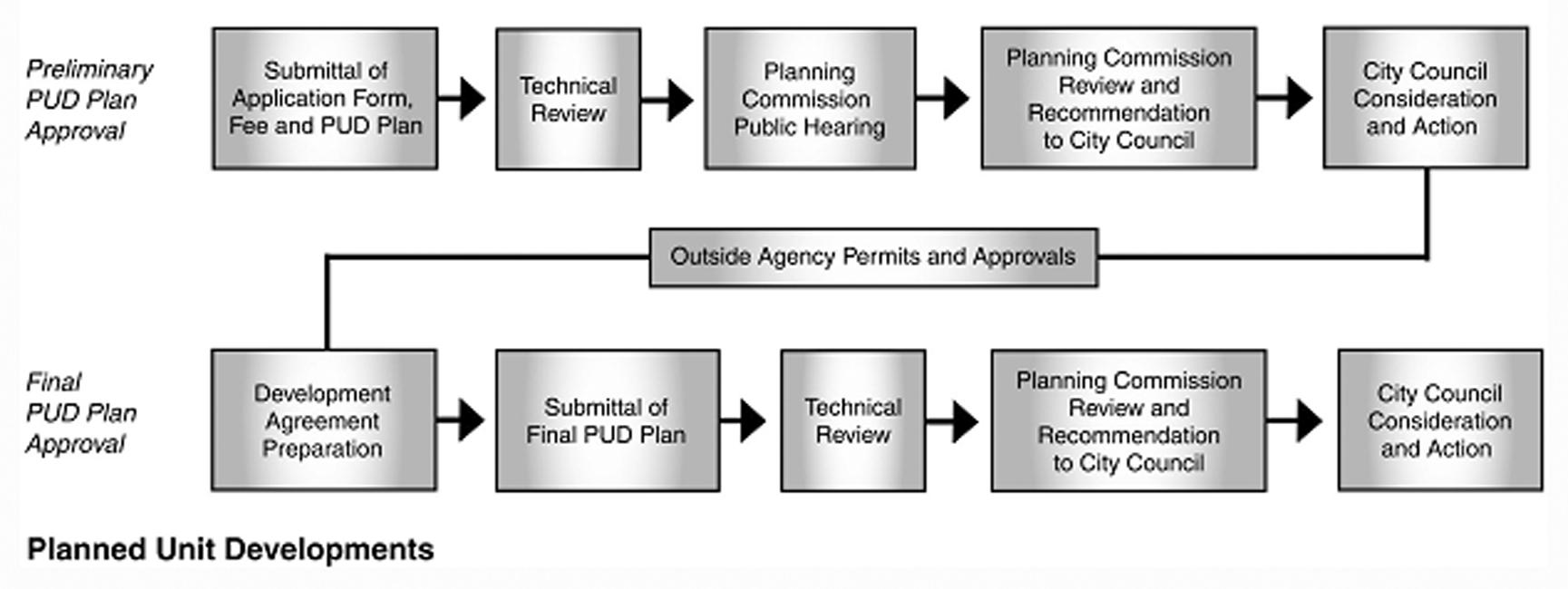
Sec. 20.07. - Preliminary PUD review procedures.
The application of a planned unit development (PUD) overlay district shall be achieved through the submission and approval of a PUD plan that controls the development of a specific site and may modify the uses permitted by the underlying zoning district. The application shall be processed as outlined herein. With the approval of a PUD overlay district, the underlying zoning district(s) shall remain undisturbed and regulate the future use of land, except as provided in the PUD agreement. This provision shall not preclude a change in an underlying zoning district in conjunction with the approval of a PUD overlay district or a future change in the underlying zoning district by the city council.
A.
Pre-application conference. An applicant for a PUD may request a pre-application conference with the city staff prior to filing an application for a PUD. The city may invite other officials or designated city consultants to assist the city in the review of the project. The purpose of this conference shall be to inform city and other officials of the proposed development concept, and to provide the applicant with information regarding land development policies, procedures, standards, and requirements of the city and other agencies. The applicant is encouraged to present schematic plans, site data, and other information that will explain the proposed development.
Statements made at the pre-application meeting shall not be legally binding commitments.
B.
Required information. An applicant for planned unit development authorization shall submit an application for PUD approval and sufficient copies of a preliminary PUD plan and accompanying documentation for review and recommendation by the planning commission, and authorization by the city council. A complete preliminary PUD submittal shall include, at a minimum, the following written and graphical information.
1.
Name, address and telephone number of the applicant, any agent involved, and the contact persons for each.
2.
Name, address, telephone number and Michigan registration number of the plan preparer (architect, landscape architect, engineer, etc.)
3.
Physical development plan drawn to an engineer's scale appropriate for a sheet size of at least 24 by 36 inches, not to exceed one inch equals 50 feet. The plan shall include plan preparation and revisions dates, a graphical scale, north arrow, and location map. If a large development must be depicted in sections on multiple sheets, then an overall composite sheet shall be provided.
4.
A survey of the PUD project boundaries showing property line dimensions and bearings, any easements of record, and a written legal description.
5.
Property lines of adjacent tracts of subdivided and unsubdivided land shown in relation to the proposed PUD site, including those of areas across abutting roads.
6.
Location, widths, and names of existing public and private road rights-of-way, and public easements within or adjacent to the proposed PUD project site, including those located across abutting roads.
7.
Location and dimensions of existing structures within 100 feet of the site, and notes regarding which on-site structures will be retained, removed or altered.
8.
Location of existing and proposed sewers, septic fields, water mains, wells, storm drains, detention/retention ponds and other underground facilities within or adjacent to the proposed PUD project site.
9.
Location of existing natural features such as, but not limited to woodlands, drainageways, floodplains, lakes, and ponds. Existing topography shall be shown at a minimum two-foot contour interval, extended a minimum distance of 100 feet outside the proposed PUD project boundaries.
10.
Location and dimensions of proposed rights-of-way, acceleration/deceleration lanes, driveways, parking spaces, maneuvering lanes, loading areas, and sidewalks. Proposed traffic control measures and proposed street names shall also be indicated.
11.
Location and dimensions of proposed buildings and setbacks, including building elevations and floor plans. In the case of single-family detached dwellings, the proposed building envelope, building orientation and lot dimensions shall be depicted.
12.
Location and function of both recreational and common open space areas, as well as the layout of facilities to be included on developed open spaces.
13.
Conceptual site grading and landscaping plans.
14.
Depiction of proposed development phases and estimated timing schedule for completion.
15.
Total site acreage and percent of total PUD project in various uses, including the proposed density of residential uses.
16.
If the PUD will contain a residential component, a parallel plan conforming to section 20.04b (residential use and density) shall be included.
17.
Documentation that the PUD application satisfies the standards of section 20.03 (eligibility criteria).
18.
Other data and graphics that will serve to further describe the proposed PUD.
B.
Technical review. Prior to planning commission consideration, the PUD application materials shall be distributed to appropriate city officials and staff for review and comment. The city planner may also submit the application materials to applicable outside agencies and designated city consultants for review.
C.
Public hearing. Upon receipt of a complete preliminary PUD submittal, a public hearing shall be held before the planning commission consistent with state law and section 1.12 (public hearing procedures).
D.
Planning commission recommendation. After the public hearing, the planning commission shall submit a report on the public hearing and the planning commission's recommendation to the city council. Before recommending preliminary approval to the city council, the planning commission shall determine that the PUD application and preliminary development plan are in accordance with the specific conditions and requirements of this article and ordinance.
E.
City council authorization. The city council shall review the public hearing report and the planning commission recommendation. The city council may approve, approve with modifications, or deny the preliminary PUD submittal, or may refer the PUD application back to the planning commission for further consideration or revision. The applicant shall be notified of the city council's actions in writing. If the city council denies the preliminary PUD plan submittal, the written notification shall include the reasons for the denial.
F.
PUD agreement. If the city council approves the preliminary PUD submittal, the applicant shall prepare a PUD agreement setting forth the conditions upon which the approval is based for review by the city attorney. The agreement shall be subject to the mutual approval of the city council and the applicant, and shall be recorded in the county register of deeds office.
The city council shall approve the PUD agreement prior to or in conjunction with the final PUD plan. Final PUD plan approval shall not be granted until city council has approved the PUD agreement.
At a minimum, the agreement shall provide:
1.
Certified survey and legal description of the PUD project site.
2.
List of permitted uses and any conditions attached to the establishment of a specified use.
3.
Statement regarding the developer's intentions regarding sale or lease of all or portions of the PUD project, including common open space areas, dwellings units, nonresidential development sites and buildings, and recreational facilities.
4.
Provision assuring that the common open space areas shown on the PUD plan for use by the public or residents will be or have been irrevocably committed for that purpose and that the satisfactory maintenance of these areas is assured.
5.
Statement of covenants, easements (including easements for public utilities), and other restrictions to be imposed upon the uses of the land and structures.
6.
Statement regarding the phasing and timing of development phases.
7.
The cost of installing all required infrastructure improvements and utilities has been assured by a satisfactory means, including the manner for assessments and the enforcement of any assessments and costs.
8.
The approved preliminary PUD plan shall be attached as an exhibit.
G.
Effect of preliminary authorization. A final PUD submittal for some portion of the planned unit development shall be submitted within 365 calendar days following approval of the preliminary PUD submittal. If no final PUD submittal is accepted within that period, approval of the preliminary PUD shall be automatically rescinded and the underlying zoning will take effect. However, the city council may, upon written request, approve one extension of preliminary approval for a period of up to 365 additional calendar days.
Sec. 20.08. - Outside agency permits and approvals.
The applicant shall be responsible for obtaining all necessary permits or approvals from applicable outside agencies, prior to final PUD plan approval.
Sec. 20.09. - Final PUD review and authorization.
The final planned unit development (PUD) submittal for all or a portion of the planned unit development shall be subject to review and recommendation by the planning commission, and final action by the city council, in accordance with the following:
A.
Required information. The final PUD submittal shall include the information required for preliminary approval by subsection 20.07.B. (required information), and shall be prepared in accordance with the following, as applicable to the type of project:
1.
A detailed site plan, per the requirements of section 18.03 (required information for site plans).
2.
A final preliminary plat in conformance with Chapter 82 (Subdivisions) of the City of Richmond Code of Ordinances and the Land Division Act (P.A. 288 of 1967, as amended).
3.
A condominium subdivision plan as provided by article 19 (condominium regulations) of this ordinance and the Condominium Act (P.A. 59 of 1978, as amended).
B.
Consistency with preliminary PUD submittal. The final PUD submittal shall not:
1.
Vary the proposed residential density of use in any portion of the planned unit development by more than ten percent;
2.
Involve a reduction of the area set aside for common open space;
3.
Increase the gross floor area of proposed non-residential buildings by more than ten percent; or
4.
Increase the total ground area covered by buildings by more than five percent.
C.
Planning commission action. The planning commission shall review the final PUD submittal to ensure conformance with the approved preliminary PUD plan, any conditions of preliminary approval, and the standards of this ordinance. The planning commission shall recommend approval to city council for the final PUD plan if it substantially conforms to the approved preliminary PUD plan. If the final PUD plan deviates from the preliminary PUD plan by more than the limits prescribed above, the planning commission shall require the final PUD plan to be modified to ensure conformance.
D.
City council authorization. The city council shall review the recommendation of the planning commission and either approve, approve with modifications, or deny the final PUD plan. The applicant shall be notified of the city council's action in writing. If the city council denies the final PUD plan submittal, the written notification shall include the reasons for the denial. The city council shall approve the PUD agreement prior to or in conjunction with the final PUD plan. Final PUD plan approval shall not be granted until city council has approved the PUD agreement.
E.
Effect of final PUD approval. Final PUD plan approval by the city council, along with submittal by the applicant to the city planner of proof of recording of the PUD agreement with the county register of deeds office, shall constitute authorization for the city to review construction and building plans and issue permits for development activity to begin on the site. All construction and building plans and permits shall conform to the approved final PUD plan, and no development may take place on the site, nor may any use thereof be made, except in accordance with the approved final PUD plan and PUD agreement.
Sec. 20.10. - Appeals and amendments.
The board of zoning appeals shall have no authority to consider any appeal of a decision by city council or planning commission concerning a planned unit development (PUD) application. Amendments to an approved PUD shall be subject to the following:
1.
Minor amendments. The following amendments to an approved PUD plan may be reviewed and approved by the planning commission, without requiring a public hearing:
a.
Substituting landscape materials, provided a nurseryman or landscape architect certifies that the substituted species is of a similar nature or quality.
b.
Changing the location or design of exterior light fixtures, provided that there will be no change in the intensity of site lighting, the design is consistent with the PUD's overall layout and character, and the location conforms to the requirements of this ordinance.
c.
Changing the dimensions or location of approved signage, provided that the sign design is consistent with the PUD's overall layout and character and the sign conforms to the requirements of this ordinance.
d.
Changing the height or material of fencing, provided that the height conforms to the requirements of this ordinance, the substituted material is of a similar quality to the original, and the fence design is consistent with the PUD's overall layout and character.
e.
Altering the location of a non-vehicular circulation system, provided that the system maintains connections to common open space areas and adjacent neighborhoods and developments.
f.
Altering the location of an accessory structure up to 1,000 square feet in area, provided that the location conforms to the requirements of this ordinance.
2.
Major amendments. All other plan revisions and changes to an approved PUD shall be considered major amendments, which shall be reviewed and approved in the same manner as the original submittal, and shall require the mutual consent of the property owner and the city.
Sec. 20.11. - Expiration of final PUD approval.
If construction has not commenced within 365 calendar days of final PUD approval by the city council, all PUD approvals become null and void and a new preliminary PUD application shall be required to continue the project. Upon written request received prior to the expiration date, city council may grant one extension of up to 365 calendar days, provided that the approved PUD plan remains in conformance with the intent and eligibility requirements of this article, and adequately represents current conditions on and surrounding the site.
Sec. 20.12. - Fees and performance guarantees.
Fees for the review of a conceptual, preliminary or final planned unit development submittal shall be in accordance with the schedule of fees adopted by resolution of the city council. The applicant shall reimburse the city for any outstanding review costs and fees, prior to final PUD approval.
Performance guarantees may be required for all public and common improvements in single- and multi-phased developments, in accordance with section 1.11 (performance guarantees). Cost estimates for completing such improvements shall be made or verified by the city engineer.
Sec. 20.13. - Compliance required.
No construction, grading, tree removal, topsoil stripping or other site improvements or alterations shall take place, and no permits shall be issued for development on a zoning lot under petition for PUD approval until the requirements of this article have been met.
Sec. 20.14. - Violations.
Any violation of the approved final PUD plan or PUD agreement shall be considered a violation of the zoning ordinance, which shall be subject to enforcement action and penalties as described in this ordinance.
Sec. 20.15. - Rescinding approval of a PUD.
Approval of a planned unit development (PUD) may be rescinded by the city council upon determination that the approved PUD plan or PUD agreement have been violated, or that the site has not been improved, constructed or maintained in compliance with approved permits, approved PUD plan or PUD agreement. Such action shall be subject to the following:
1.
Public hearing. Such action may be taken only after a public hearing has been held by the city council in accordance with the procedures set forth in section 1.12 (public hearing procedures), at which time the developer of the PUD project, the owner of an interest in land for which PUD approval was sought, or the owner's designated agent, shall be given an opportunity to present evidence in opposition to rescission.
2.
Determination. Subsequent to the hearing, the decision of the city council with regard to the rescission shall be made and written notification provided to the developer, owner or designated agent.

