
Richmond City Zoning Code
ARTICLE 6
- DESIGN STANDARDS FOR SPECIFIC USES
Sec. 6.001.- Intent and scope of regulations.
Each use listed in this article, whether permitted by right or subject to approval as a special land use, shall be subject to the site and use standards specified, in addition to applicable standards and requirements for the district where the use is located. These standards are intended to:
1.
Alleviate any adverse impacts of a use that is of an area, intensity or type unique or atypical for the district in which the use is allowed.
2.
Mitigate the impact of a use that possesses characteristics unique or atypical for the district in which the use is allowed.
3.
Ensure that such uses will be compatible with surrounding land uses.
4.
Promote the orderly development of the district and the city as a whole.
Conformance with these standards shall be subject to site plan review. Unless otherwise specified, each use listed in this article shall be subject to all applicable yard, bulk and other standards for the district in which the use is located.
Sec. 6.002. - Organization.
For the purposes of clarity and ease of use, the provisions of this article have been organized into the following divisions:
Sec. 6.101. - Farm-based tourism or entertainment activities.
Farms providing tourism or entertainment-oriented facilities or activities for promotion of agriculture, rural lifestyle or farm product sales shall be subject to the following:
1.
All vehicular access to the site shall be from a public street classified as a collector, arterial or thoroughfare by the city's master plan, or county or state road authorities.
2.
Development or alteration of such facilities shall be subject to site plan review and approval in accordance with article 18 (site plan review).
3.
Greenbelt tree plantings, crop growing areas with a depth of not less than 200 feet or other effective visual screening shall be provided where off-site abutting lots are occupied with dwelling structures within 200 feet of any area on the site occupied with sales or entertainment facilities.
4.
Adequate off-street parking shall be provided to serve such facilities, subject to planning commission approval.
5.
Noise levels shall not exceed 65 decibels at any lot lines of the farm where an adjacent lot is occupied by a dwelling within 200 feet of the lot line, nor shall it exceed a maximum of 75 decibels at any other lot line or street right-of-way.
6.
Hours of operation of any outdoor entertainment facilities shall be limited to reasonable hours, subject to planning commission approval.
Sec. 6.102. - Greenhouses, nurseries, garden centers, and feed stores.
Greenhouses, nurseries, garden centers and feed stores shall be subject to the following:
1.
Accessory to an active farm use. Greenhouses, nurseries, garden centers and feed stores not located in a business district shall be accessory to an active farm use on the same zoning lot.
2.
Setbacks. Plant storage and display areas shall comply with the minimum setback requirements for the district in which the establishment is located.
3.
Storage. The storage of soil, wood chips, fertilizer, or similar loosely packaged materials shall be contained to prevent blowing of materials or dust upon adjacent properties and access by small animals. Such storage areas shall be screened in accordance with section 11.04 (methods of screening and buffering).
4.
Other conditions. The planning commission may require stored materials to be covered, and may impose additional conditions upon the use to minimize adverse impacts on adjacent uses.
Sec. 6.103. - Kennels and animal shelters.
Animal shelters and kennels for animal breeding or boarding (keeping) shall be subject to the following:
1.
Minimum lot area. Kennels and animal shelters for the boarding (keeping) of animals shall have a minimum lot area of one acre. Kennels that provide animal breeding services shall have a minimum lot area of five acres.
2.
Screening. Structures where animals are kept, outdoor runs, and exercise areas shall be screened in accordance with section 11.04 (methods of screening and buffering), and shall have impervious surfaces and an approved system for runoff, waste collection, and disposal.
3.
Use standards. Animals shall not be kept or quartered outside of the buildings between 8:00 p.m. and 8:00 a.m. All structures and ventilation systems used for kennel purposes shall be constructed to prevent noise and odors from reaching the building exterior. Kennels shall be kept clean, and waste shall be treated and handled in such a manner as to control odor and flies.
4.
Setbacks. Structures where animals are kept, outdoor runs and exercise areas shall not be located in any required yard setback areas, and shall also be set back at least 50 feet from existing residential uses or residentially zoned property.
5.
Other conditions. Kennels and animal shelters shall conform with the applicable standards of Chapter 14 (Animals) of the Code of Ordinances, and shall be subject to all permit and operational requirements established by appropriate regulatory agencies. The planning commission may impose other conditions and limitations deemed necessary to prevent or mitigate possible nuisances related to noise or odor.
Sec. 6.104. - Private riding stables.
All private stables, arenas and related facilities for the rearing, schooling and housing of horses, mules, ponies and similar riding animals shall meet the following requirements:
1.
Accessory use. Private riding stables shall be accessory to another animal or agricultural use or residential use on the same zoning lot.
2.
Minimum lot area and setbacks. Stable sites shall have a minimum of five acres. All structures wherein animals are kept shall not be less than 100 feet from any occupied dwelling or to any adjacent building used by the public.
3.
Animal density. The number of permitted animals shall not exceed two animals for the first five acres of net lot area, plus one animal per additional acre of net lot area.
4.
Performance standards. Stables shall be enclosed by a suitable fence, and shall be maintained so that odor, dust, noise or water drainage shall not constitute a nuisance or hazard to adjoining premises.
5.
City council approval. The keeping and housing of horses, mules, ponies and similar riding animals in the city shall be subject to city council approval in accordance with Chapter 14 (Animals) of the Code of Ordinances.
Sec. 6.105. - Produce stands and farm markets.
Produce stands and farm markets shall be subject to the following:
1.
Sale of produce. All produce or products for sale shall be grown or produced on the premises or made from produce grown or material produced on the premises.
2.
Size. Where permitted, each lot shall be limited to a maximum of one seasonal produce stand not larger than 400 square feet. The stand shall be portable and shall be removed from its roadside location during seasons when it will not be in use.
3.
Signs. All signs used in connection with the use shall be temporary, and shall be removed when the stand is not in use. All signs shall comply with the requirements of article 13 (signs).
4.
Permits. A zoning permit is required. The city planner may require any supporting documentation such as a sketch plan that illustrates locations of all structures, parking areas, driveways, signs and other structures. The zoning permit shall be issued for a period not to exceed 120 days. A site may have only two such permits issued in any one calendar year.
Sec. 6.106. - Veterinary clinics.
Veterinary clinics and hospitals shall comply with the following requirements:
1.
Setbacks. Structures shall be set back at least 50 feet from abutting residential districts.
2.
Landscaping and screening. Outdoor enclosures or runs shall be screened from street rights-of-way and adjacent residential districts and uses per section 14.04 (methods of screening and buffering).
3.
Operating requirements. The clinic shall be operated by a licensed or registered veterinarian, and shall be subject to the following:
a.
All boarding shall be limited to animals brought in for treatment or surgery, unless the site has also been approved as a kennel per section 6.102 (kennels and animal shelters).
b.
All activities shall be conducted within a completely enclosed building constructed to ensure that noise and odors shall not be perceptible beyond the lot boundaries.
c.
Outdoor exercising is allowed, provided that the pet is accompanied by an employee. Animals shall not be kept or quartered outside of the buildings between 8:00 p.m. and 8:00 a.m.
4.
Other conditions. Veterinary clinics and hospitals shall conform with the applicable standards of Chapter 14 (Animals) of the Code of Ordinances, and shall be subject to all permit and operational requirements established by appropriate regulatory agencies. The planning commission may impose other conditions and limitations deemed necessary to prevent or mitigate possible nuisances related to noise or odor.
Sec. 6.201. - Accessory dwelling units.
It is the intent of this section to permit apartments accessory to and within principal single-family dwellings in the R-1, R-2 and R-3 districts for the purpose of accommodating the desire of some senior citizens, family groups, and other persons with special needs for private housing close to relatives, and to extend the economic life of some larger houses in certain older neighborhoods by allowing the owner to justify substantial renovation or modernization costs.
It is further the intent of this section to permit apartments accessory to and within principal buildings occupied by office and service uses or commercial uses in the B-1 (local business) and B-2 (downtown business) districts, subject to specific standards designed to preserve the predominantly commercial character of these districts.
The standards of this section are designed to prevent the undesirable proliferation of multiple-family buildings in predominantly single-family neighborhoods, and to preserve the character and appearance of principal buildings that include one or more accessory dwelling units.
A.
Accessory to detached single-family dwellings. The following shall apply to dwelling units accessory to detached single-family dwellings:
1.
All accessory dwelling units shall be located entirely within the principal building. Accessory dwelling units shall be prohibited in any detached accessory structures.
2.
The exterior of the principal building shall remain unchanged, so that it does not give the appearance of being divided into separate units. Access to an accessory dwelling unit shall be limited to a common front foyer, or a separate entrance door on a side wall. The use of exterior stairways to provide access to upper floor accessory dwellings shall be prohibited.
3.
Each accessory dwelling unit shall have a minimum gross floor area of 450 square-feet, and accessory dwelling units not occupy more than 25 percent of the principal building's gross floor area.
4.
The principal building shall be the primary and permanent legal residence of the owner(s) of the property. The owner(s) of the property shall occupy a minimum of 1,500 square feet of gross floor area within the principal building. Permitted accessory dwelling units shall be clearly secondary to the use of the dwelling as a residence.
B.
Accessory to office and services uses or commercial uses. The following shall apply to dwelling units accessory to office and services uses or commercial uses:
1.
Accessory dwelling units shall be contained entirely within the principal building, and shall occupy no more than 50 percent of the gross floor area of the building.
2.
Accessory dwelling units shall not be located on the ground floor or basement of the principal building.
3.
Each accessory dwelling unit shall have separate kitchen, bath, and toilet facilities and a private entrance. Where there is more than one accessory dwelling unit in a building, such entrances may be provided from a common hallway.
Sec. 6.202. - Adult foster care large group homes, and other managed or state-licensed residential facilities.
The following regulations shall apply to adult foster care large group homes, and other managed or state-licensed residential facilities:
1.
Licensing. In accordance with applicable state laws, such uses shall be registered with or licensed by the State of Michigan, and shall comply with the standards outlined for such facilities.
2.
Separation requirements. New adult foster care large group homes and other managed or state-licensed residential facilities shall be located a minimum of 1,500 feet from any other state licensed residential facility, as measured between the nearest points on the property lines of the lots in question. The planning commission may permit a smaller separation between such facilities upon determining that such action will not result in an excessive concentration of such facilities in a single neighborhood, or in the city overall.
Sec. 6.203. - Bed and breakfast inns.
Bed and breakfast inns shall be subject to the following:
1.
Primary residence. The principal building shall be the primary and permanent legal residence of the bed and breakfast inn operator. Meals or other services provided on the premises shall only be available to residents, employees and overnight guests of the establishment.
2.
Guests. There shall be a maximum of five (5) rooms for lodging, with a maximum of 15 guests at any given time. Guests may stay no longer than 30 consecutive days, and 60 days in any one calendar year. Off-street parking areas shall be provided for guests outside of any required front yard. Stacking of more than two vehicles in a driveway is prohibited.
3.
Landscaping. Screening shall be provided between adjacent residences and parking areas or any outdoor eating area, in compliance with section 11.04 (methods of screening and buffering).
5.
Appearance. The exterior of the principal building shall remain unchanged. The use of exterior stairways to provide access to upper floor sleeping rooms shall be prohibited.
6.
Additional signs prohibited. Signage for the bed and breakfast inn shall be limited to signs permitted for residential uses, per article 13 (signs).
Sec. 6.204. - Family and group child day care homes.
The following regulations shall apply to family and group child day care homes:
1.
Licensing. In accordance with applicable state laws, all child day care homes shall be registered with or licensed by the State of Michigan, and shall comply with the standards outlined for such facilities.
2.
Outdoor play area. A minimum of 150 square feet of outdoor play area shall be provided per child, at the maximum licensed capacity of the day care home, in the rear yard area of the day care home premises. The outdoor play area shall be suitably fenced and screened.
3.
Pick-up and drop-off. Adequate areas shall be provided for employee and resident parking, and pick-up and drop-off of children or adults, in a manner that minimizes pedestrian-vehicle conflicts, and allows maneuvers without affecting traffic flow on the public street.
4.
Separation requirements. New group child day care homes shall be located a minimum of 1,500 feet from any other state licensed residential facility, as measured between the nearest points on the property lines of the lots in question. The planning commission may permit a smaller separation between such facilities upon determining that such action will not result in an excessive concentration of such facilities in a single neighborhood, or in the city overall.
5.
Hours of operation. Day care homes shall operate a maximum of 16 hours per day.
Sec. 6.205. - Home occupations.
Home occupations shall be subject to the following:
A.
Use standards.
1.
Intensity of use. Home occupations must be clearly incidental and secondary to the use of the dwelling as a residence. No more than 25 percent of the habitable floor area of the residence, and 25 percent of the floor area of any accessory structure may be used for the home occupation.
2.
Employment. No persons shall be employed in the home occupation, other than the dwelling occupants.
3.
Customer or client visits. A home occupation shall not generate more than ten customer or client visits per day, nor more than 20 customer or client visits per week. No more than two customers or clients may be present at any given time.
4.
Parking and deliveries. Traffic generated by a home occupation shall not be greater in volume than that normally generated by a typical residence in the neighborhood. Home occupations shall be limited to the parking or storage of one commercial vehicle on the premises not exceeding a three-quarter-ton capacity, provided such vehicle is directly related the home occupation. Delivery vehicles used to deliver goods to a home occupation are limited to automobiles, passenger vehicles, mail carriers and express package carriers. Hours of operation. Customer or client visits, and deliveries associated with the home occupation shall be limited to between the hours of 8:00 a.m. and 8:00 p.m.
B.
Permitted home occupations. The following uses shall be permitted as home occupations:
1.
Home offices for such professionals as architects, doctors, brokers, engineers, insurance agents, lawyers, realtors, accountants, writers, salespersons and similar occupations.
2.
Personal services, including barber shops, beauty parlors, manicure and pedicure shops, grooming, catering, and chauffeuring services.
3.
Home office for a massage therapist, subject to the standards of section 6.304 (therapeutic massage).
4.
Tutoring, and studios for artists, sculptors, musicians, and photographers.
5.
Workshops for tailors, dressmakers, milliners, and craft persons, including weaving, lapidary, jewelry making, cabinetry, and wood-working.
6.
Repair services, limited to watches and clocks, small appliances, bicycles, computers, electronic devices, and similar small devices.
7.
Home occupations not specifically listed may be permitted as a special land use by the planning commission, subject to the provisions of this section, and article 17 (special land uses).
C.
Prohibited uses. The following uses are expressly prohibited as a home occupation:
1.
Motor vehicle, recreational vehicle or small engine repair; bump and paint shops; and salvage or storage yards.
2.
Kennels, animal shelters, and veterinary clinics.
3.
Medical or dental clinics.
4.
Retail sales of merchandise, and eating or drinking establishments.
5.
Undertaking and funeral homes.
6.
Adult uses and sexually-oriented businesses.
7.
Uses similar to the above listed uses, or any use which would, in the determination of the city planner, result in nuisance factors as defined by this ordinance.
D.
Other prohibited activities. Home occupations shall not include:
1.
Outdoor display or storage of materials, goods, supplies or equipment used in the home occupation.
2.
The use of machinery, equipment or facilities not commonly incidental or accessory to a residential dwelling.
3.
Changes or alterations to the character or appearance of the residence.
4.
Use of any signs or outside displays on the premises, except as permitted for residential dwellings in article 13 (signs).
5.
Parking of vehicles on the site or within the street right-of-way in excess of the amount customarily incidental to a single-family dwelling.
E.
Violations. Failure to maintain a lawfully established home occupation in compliance with the standards of this section or any conditions of approval shall be a violation of this ordinance. Upon complaint, and verification of a violation by the city planner, the operator of the home occupation shall be notified by the city, and shall have ten working days to correct the violation. If the violations are not corrected within that time, the permit to operate the home occupation shall be revoked and all related activities shall cease.
Failure by the operator to allow a zoning inspection or provide reasonable information to the city to verify compliance with this section shall be a violation of this ordinance.
Sec. 6.206. - Manufactured housing parks.
Manufactured housing parks shall be subject to all the rules and requirements of the Mobile Home Commission Act (P.A. 96 of 1987, as amended), the Manufactured Housing Commission General Rules, and the following minimum requirements:
1.
Plan review. The preliminary plan for a manufactured housing park shall be submitted to the city and reviewed by the planning commission in accordance with the application requirements and procedures specified in Section 11 of the Mobile Home Commission Act (P.A. 96 of 1987, as amended). The planning commission shall take action to approve or deny the preliminary plan, or approve the preliminary plan subject to conditions, within 60 days after the city officially receives a complete and accurate application. The planning commission may table an application for further study, or to obtain additional information, provided that final action is taken within the 60-day review period. A copy of the state-approved final construction plan shall be submitted to the city prior to the start of construction on the site.
2.
Minimum area for a manufactured housing park. The minimum parcel size for manufactured housing parks shall be 15 acres, excluding adjacent parcels proposed for expansion.
3.
Minimum manufactured housing site size. Manufactured housing parks shall be developed with a minimum manufactured housing site size of 5,500 square feet. Individual sites may be reduced to as small as 4,400 square feet, provided that for every square foot of land gained through such reduction, at least an equal amount of land shall be dedicated as open space for the collective use and enjoyment of all manufactured housing park residents. This open space shall be in addition to the minimum open space required under section 6.206.11 (open space), or the Manufactured Housing Commission Rules.
4.
Setbacks. Manufactured houses shall comply with the following minimum setbacks:
a.
For a home not sited parallel to an internal road, 20 feet from an adjacent home, including an attached structure that may be used for living purposes for the entire year.
b.
For a home sited parallel to an internal road, 15 feet from an adjacent home, including an attached structure that may be used for living purposes for the entire year if the adjacent home is sited next to the home on and parallel to the same internal road or an intersecting internal road.
c.
Ten feet from an attached or detached structure or accessory of an adjacent home that may not be used for living purposes for the entire year.
d.
Fifty feet from any permanent building.
e.
One hundred feet from any baseball, softball or similar recreational field.
f.
Seven feet from the back of curb or edge of pavement for an internal road.
g.
Seven feet from an adjacent home site's parking space or off-site parking bay.
h.
Seven feet from a common sidewalk.
i.
All mobile homes, accessory buildings and parking shall be set back not less than 20 feet from any manufactured housing park boundary line, except that a minimum setback of 50 feet shall be provided from the street rights-of-way of public streets abutting the park.
j.
Fifty feet from the edge of any railroad right-of-way.
5.
Maximum height. The maximum height of any community or similar building in a manufactured housing park shall not exceed two stories or 35 feet, whichever is less. Storage or service buildings shall not exceed one story or 15 feet.
6.
Roads. Roads shall satisfy the minimum dimensional, design, and construction requirements in the Manufactured Housing Commission Rules. The main entrance to the park shall have access to a public street by a permanent easement, which shall be recorded by the developers. All roads shall be hard-surfaced.
7.
Parking. Each manufactured housing site shall be provided with two parking spaces per the Manufactured Housing Commission Rules.
8.
Common storage areas. If boats, boat trailers and utility trailers are permitted to be parked within the manufactured housing park, adequate parking spaces for such vehicles shall be provided in a central or collective parking area. This area shall be in addition to the automobile parking requirements of this section, and shall be adequately locked, fenced and permanently buffered.
9.
Sidewalks. Concrete sidewalks having a minimum width of three feet shall be provided on at least one side of internal manufactured housing park streets. In addition, a five-foot wide concrete sidewalk shall be constructed along any public street abutting the manufactured housing park.
10.
Accessory buildings and facilities. Accessory buildings and structures, including park management offices, storage buildings, laundry facilities or community facilities, shall be designed and operated for the exclusive use of park residents.
a.
Site-built buildings and structures within a manufactured housing park, such as a management office or clubhouse, and any addition to a manufactured house that is not certified as meeting the standards of the U.S. Department of Housing and Urban Development (HUD) for manufactured houses, shall be constructed in compliance with applicable state building, electrical and fire codes and shall be subject to approval of appropriate permits and certificates of occupancy by the city.
b.
Storage shed with a maximum area of 144 square feet may be placed upon any individual manufactured home site for the storage of personal property. Such structures shall be constructed in accordance with applicable standards of the State Construction Code enforced by the city. Except as otherwise noted in this section, no personal property (including tires) shall be stored outside or under any manufactured home, or within carports which are open on any side. Bicycles and motorcycles may be parked in carports. Seasonal outdoor storage of outdoor cooking grills is permitted, so long as they are kept on either a finished wooden deck, a concrete or asphalt patio, or equivalent type of surface associated with the home.
11.
Open space. Any manufactured housing park containing 50 or more manufactured housing sites shall provide a minimum of 25,000 square feet of dedicated and contiguous open space, which shall be shown on the preliminary plan. Any other open space areas or recreational improvements provided at the developer's option shall also be shown on the preliminary plan. This open space may include the two percent minimum open space requirement established in the Manufactured Housing Commission General Rules.
12.
Perimeter screening. Where a manufactured housing park abuts an existing residential development, screening shall be provided along the boundary abutting the residential development. If the manufactured housing park abuts non-residential development, screening shall not be required.
13.
Screening along public rights-of-way. A landscaped screen shall be provided along all public streets abutting the manufactured housing park. This screen shall consist of evergreen trees or shrubs at least three feet in height, planted so as to provide a continuous screen at maturity.
14.
Alternative screening. Alternative screening devices may be utilized if they conceal the manufactured housing park as effectively as the required landscaping elements described above.
15.
Parking lot landscaping. Landscaped planting strips and islands shall be dispersed throughout all parking lots to direct traffic flow, create shade and break-up large expanses of pavement. Parking lot landscaping shall be subject to the following standards:
a.
All landscaped areas shall be designed to ensure proper protection of the plant materials. Where adjacent to streets, driveway aisles, or parking areas, shall be protected with concrete curbing. Plant materials used shall be hardy, salt-tolerant species characterized by low maintenance requirements.
b.
The size and number of planting islands and proposed plantings shall be in scale with the overall site, and shall clearly define the egress/ingress points, interior circulation system and fire lanes. Landscaping shall not obscure traffic signs or lighting, access to fire hydrants or motorist sight-distance.
c.
Planting islands shall have a minimum width of five feet and a minimum area of 100 square feet. A minimum of one deciduous shade tree shall be provided for each 100 square feet of planting area within the island. Ornamental trees, shrubs, mulch or groundcover shall be used to cover all unplanted areas of the island.
16.
Trash disposal. The proposed method(s) and location(s) of trash storage and disposal shall conform to the requirements of Part 5 of the Michigan Department of Environmental Quality (MDEQ) Manufactured Home Park Standards, and shall be identified on the preliminary plan.
17.
Awnings. Awnings may be attached to any manufactured house. Awnings shall comply with the setback and distance requirements set forth in this section, and shall require a permit.
18.
Sewer service. Public sewer systems shall be required in a manufactured housing park, if available within 200 feet of the park boundaries at the time of preliminary plan approval. If a public sewer system is unavailable, the development shall connect to a state-approved sewage system.
19.
Water service and storm drainage systems. Water supply and drainage systems shall conform to the requirements of Parts 2—4 of the Michigan Department of Environmental Quality (MDEQ) Manufactured Home Park Standards.
20.
Telephone and electric service. All electric, telephone, cable TV, and other lines within the park shall be underground, per the Manufactured Housing Commission General Rules.
21.
Fuel oil and gas. Any fuel oil and gas storage shall be located in underground tanks, at a safe distance from all manufactured housing sites. All fuel lines leading to manufactured housing sites shall be underground and designed in conformance with the Manufactured Housing Commission Rules and other applicable local, county and state regulations.
22.
Operational requirements.
a.
Permit. It shall be unlawful for any person to operate a manufactured housing park unless that individual obtains a license for such operation in compliance with the requirements of the Mobile Home Commission Act (P.A. 96 of 1987, as amended). The building official shall communicate recommendations regarding the issuance of such licenses to the director of the bureau of construction codes and fire safety, Michigan Department of Labor and Economic Growth.
b.
Violations. Whenever, upon inspection of any manufactured housing park, the building official finds that conditions or practices exist which violate provisions of this section, the building official shall give notice in writing by certified mail to the director of the bureau of construction codes and fire safety, Michigan Department of Labor and Economic Growth, including the specific nature of the alleged violations and a description of possible remedial action necessary to effect compliance. This process shall be governed by Sections 17(2) and 36 of the Mobile Home Commission Act (P.A. 96 of 1987, as amended).
The notification shall include such other information as is appropriate in order to fully describe the violations and potential hazards to the public health, safety and welfare resulting from the violation. A copy of such notification shall be sent by certified mail to the last known address of the park owner or agent.
c.
Inspections. The building official or other authorized city agent is granted the authority, as specified in the Mobile Home Commission Act, P.A. 96 of 1987, as amended, to enter upon the premises of any manufactured housing park for the purpose of determining compliance with the provisions of this ordinance or other regulations referenced herein.
d.
License. A manufactured housing park shall not be operated until a license has been issued by the State of Michigan.
23.
Sale of mobile homes. The business of street selling new or pre-owned manufactured homes as a commercial operation in connection with the operation of a manufactured housing community shall be prohibited. The operator of a manufactured housing community, or designee, who is an authorized licensed manufactured home retailer or broker, is permitted to feature and sell in-park model homes to be located on a variety of sites within the manufactured housing community.
New or pre-owned manufactured houses located on sites within the manufactured housing park, to be used and occupied on that site, may be sold by a authorized licensed manufactured home retailer or broker, or by a resident of the manufactured housing park, provided the park's regulations permit such sale.
24.
Mailbox clusters. The United States Postal Service may require that manufactured housing parks be served by clusters of mailboxes serving several sites rather than individual mailboxes serving individual sites. If mail box clusters are required, they shall be located at least 200 feet from any intersection of a manufactured housing park road with a public road.
Sec. 6.207. - Multiple-family dwellings and developments.
Multiple-family dwellings and developments shall comply with the following:
1.
Architectural details. Walls visible from a street or other residential uses shall include windows and architectural features similar to the front facade of the building, including, but not limited to awnings, cornice work, edge detailing or other decorative finish materials. All buildings shall have pitched roofs, which may include functional dormer windows and varying lines customary with gable or hip style roofing. Standing seam metal roofing is prohibited.
2.
Street design and vehicle circulation. Street connections shall be provided to adjacent neighborhoods and parcels in residential districts. Ingress and egress from the public streets shall be designed to minimize congestion and interference with normal traffic flow. All interior streets, drives, and parking areas shall be subject to city engineering standards, and shall be hard surfaced with curbs and gutters. Drainage shall be designed to contain stormwater draining within the site, and to minimize impacts on adjacent lots.
3.
Pedestrian circulation. Minimum five-foot wide concrete sidewalks shall be provided along both sides of interior streets, and from parking areas, public sidewalks and recreation areas to all building entrances. Public sidewalks shall be provided along abutting public streets per chapter 78 (streets, sidewalks, and other public places) of the Code of Ordinances.
4.
Parking. The planning commission may give credit towards parking requirements where abutting on-street parking is available. All off-street parking spaces must be screened from view of any public road, pedestrian path, or adjacent residential use in compliance with section 11.04 (methods of screening and buffering).
5.
Recreation areas. Passive or active recreation areas (including but not limited to seating areas, playgrounds, swimming pools, walking paths and other recreational elements in accordance with the intended character of the neighborhood) shall be provided at a ratio of at least 15 percent of the gross lot area. The minimum size of each area shall be not less than 5,000 square feet, and the length to width ratio of each area, as measured along the perimeter, shall not exceed four to one (4:1). Such areas shall be centrally and conveniently located to be physically and visibly accessible to residents, and shall not be located within any required yard setbacks or building separations.
6.
Utilities. All multiple-family dwellings shall be connected to the public sewer and public water system per Chapter 94 (Utilities) of the Code of Ordinances.
7.
Other requirements. Adequate landscaping and screening shall be provided along all property lines that abut a residential district or use, and along all street frontages. Parking or storage of recreational vehicles, boats, utility trailers or similar items shall be prohibited, except in areas designated on an approved site plan.
Sec. 6.208. - Senior and elderly housing.
Elderly and senior housing shall be subject to the following:
A.
General standards for all elderly and senior housing. All types of elderly and senior housing shall comply with the following:
1.
Common outdoor recreation space. Common outdoor recreation space for residents shall be provided, subject to the following:
a.
The total area shall equal or exceed ten percent of the gross lot area, and shall include areas for both passive and active recreation appropriate for the anticipated users. If developed in phases, the recreation space improvements shall be completed in proportion to the gross floor area constructed in each phase.
b.
Off-street parking areas, street rights-of-way or street setback areas, access drives, perimeter yard setbacks and submerged land areas of a pond, lake, river or stream shall not be counted as recreation space.
2.
Private outdoor living space. Private outdoor living space shall be provided for each independent or congregate dwelling unit. Such space shall be adjacent to the unit, and the total area shall equal or exceed ten percent of the gross floor area of the unit. Assisted living elderly housing shall not require private outdoor living space.
3.
Access. Sidewalks shall be provided from main building entrances to sidewalks along adjacent streets. All vehicular access to the site shall be from a public street classified as a collector, arterial or thoroughfare by the city's master plan, or county or state road authorities. The planning commission may allow secondary access from local streets. Vehicles shall be able to easily circulate within and through the site to a designated pick-up/drop-off area, without impeding circulation on the site or traffic on nearby roads.
4.
Resident facilities. Meeting and activity facilities, dining room facilities, beauty or barber shops, laundry rooms and similar accessory facilities for facility residents, employees and their guests shall be permitted as accessory uses.
5.
Building separation. Where building groupings change direction and are connected or tied together by a gate opening or similar structure not more than six feet in width, such units shall be considered together as one building. Separation distance between buildings shall be subject to the following:
B.
Independent elderly housing. The following additional standards shall apply to independent elderly housing, as defined in section 25.02 (definitions):
1.
Minimum floor area. All dwelling units shall meet the following minimum floor area requirements:
2.
Maximum density. The maximum number of independent elderly housing units shall not exceed the density permitted in the zoning district.
C.
Dependent elderly housing. The following additional standards shall apply to dependent elderly housing, as defined in section 25.02 (definitions):
1.
Maximum density. The maximum density of the dependent elderly housing units shall not exceed a maximum of two dependent elderly housing units per dwelling unit permitted in the zoning district.
2.
Minimum lot area and setbacks. Sites must have a minimum lot area of two acres. The principal building and all accessory building shall be setback a minimum distance of 40 feet from all property lines.
3.
State and federal regulations. Such facilities shall be constructed, maintained, and operated in conformance with applicable state and federal laws and licensing requirements.
4.
Accessory uses. Accessory retail, restaurant, office, and service uses may be permitted within the principal residential building. No exterior signs of any type are permitted for these accessory uses.
Sec. 6.209. - Single-family dwellings, detached.
This section is not intended to discourage architectural variation, but shall seek to promote the reasonable compatibility of the character of dwelling units, thereby protecting the economic welfare and property value of surrounding residential uses and the city at large. Detached single-family dwellings, except manufactured houses located in an approved and licensed manufactured housing parks, shall comply with the following standards:
1.
Building orientation and layout.
a.
Exterior wall and roof configuration. Dwelling units shall be provided with an exterior building wall, foundation and roof configuration that are similar to the dwelling units on adjacent properties or in the surrounding residential neighborhood. The minimum width across any front, side or rear elevation shall be 24 feet, and the average width to depth or depth to width ratio shall not exceed three to one (3:1).
b.
Exterior finish materials. Dwelling units shall be provided with exterior finish materials similar to and aesthetically compatible with the dwelling units on adjacent properties or in the surrounding residential neighborhood. Such materials shall include siding or wall materials, windows, porches, shingles and other roofing materials. Standing seam metal roofing is prohibited.
c.
Foundation. Dwelling units shall be permanently attached to a perimeter foundation and shall have the same perimeter dimensions as the dwelling. All such dwellings shall be secured to the premises by an anchoring system or device that is in full compliance with all applicable codes and rules.
Where a dwelling is proposed to be set on piers or other acceptable foundations not at the perimeter of the dwelling, a perimeter wall shall also be constructed of durable materials that meet all local requirements with respect to materials, construction and necessary depth below the frost line. Any such wall shall also provide an appearance compatible with the dwelling and other homes in the area.
2.
Utilities. All single-family dwellings shall be connected to the public sewer and public water system.
3.
Storage. The dwelling units shall contain storage capability in a basement located under he dwelling, in an attic area, in closet areas, or in a separate structure of standard construction similar to or of better quality than the principal dwelling, which shall be equal to a minimum of ten percent of the square footage of the dwelling or 100 square feet, whichever is less.
4.
Front porch. New dwellings shall be constructed with a primary entrance on the front facade and connected to the public sidewalk or right-of-way by a paved path, with a front porch or stoop that is at least six feet in width and depth, and 70 square-feet in area.
5.
Determinations. The compatibility of design and appearance shall be determined by the building official, subject to appeal by an aggrieved party to the zoning board of appeals. The building official may require the applicant to furnish such plans, elevations and similar documentation as is deemed necessary to permit a complete review and evaluation of the proposal.
Any determination of compatibility shall be based upon these standards, with a comparison to the character, design and appearance of homes in the same neighborhood within 300 feet of the subject lot, outside of any manufactured housing parks. If the area within 300 feet does not contain any such homes, then the nearest 25 similar type dwellings shall be considered.
Sec. 6.301. - Body art parlors and body piercing studios.
Tattoo Parlors shall be subject to the following:
A.
License requirements. All body art or piercing artists operating within the City of Richmond shall comply with all licensing, health, and sanitation requirements from the Macomb County Health Department.
B.
Hours of operation.
1.
No body art or piercing studio shall be kept open for any purpose between the hours of 11:00 p.m. and 8:00 a.m. Sunday through Thursday, and from 2:00 a.m. to 8:00 a.m. on Friday and Saturday.
(Ord. No. 156-14, 3-17-14; Ord. No. 156-28, § I, 2-15-21)
Sec. 6.302. - Catering facilities.
In the O (office), B-1 (local business), and B-2 (central business) districts, catering facilities shall only be permitted as an accessory use located entirely within the space occupied by a permitted restaurant use.
(Ord. No. 156-14, 3-17-14)
Sec. 6.303. - Funeral homes or mortuaries.
Funeral homes, mortuaries and crematoriums shall be subject to the following:
1.
Assembly area. An adequate assembly area shall be provided off-street for funeral processions and activities. All maneuvering area and exit aprons shall be located within the site and may be incorporated into the required off-street parking. Streets and alleys shall not be used for maneuvering or parking of vehicles.
2.
Screening. The service and loading area shall be screened from adjacent residential areas in accordance with section 11.04 (methods of screening and buffering).
3.
Caretaker's residence. A caretaker's residence shall be permitted accessory to a funeral home, mortuary or crematorium use, in accordance with the following:
a.
An accessory dwelling unit within the principal building shall be subject to the requirements of subsection 6.201.B. (accessory dwelling units).
b.
A detached single-family dwelling located on the same lot with the principal use shall be subject to the requirements of section 6.208 (single-family dwellings, detached), and the area, height and bulk requirements for the R-3 (single-family residential) district specified in the schedule of regulations.
4.
Crematoriums. Crematoriums are an industrial, research, and laboratory use subject to the use standards of article 4 (land use table) and section 6.602 (intensive industrial operations).
(Ord. No. 156-14, 3-17-14)
Sec. 6.304. - Hospitals and urgent care centers.
Hospitals shall be subject to the following:
1.
Setbacks. The principal building and all accessory buildings shall be set back a minimum of 100 feet from any property line.
2.
Frontage and access. Hospitals shall have frontage on, and direct vehicle access to a public street classified as a collector, arterial or thoroughfare by the city's master plan, or county or state road authorities.
3.
Accessory uses. Accessory uses, such as a pharmacy, gift shop, cafeteria, place of worship, and similar uses shall be allowed within the principal building to serve the needs of patients, employees and visitors.
4.
Screening. Ambulance parking, emergency room and urgent care entrances, and loading areas shall be effectively screened from all adjacent residential uses by the building design, landscaping, or a masonry wall.
5.
State and federal regulations. Hospitals shall be constructed, maintained, and operated in conformance with applicable state and federal law.
(Ord. No. 156-14, 3-17-14)
Sec. 6.305. - Therapeutic massage.
Massage therapy clinics and uses shall be subject to the following:
1.
Accessory use. In addition to districts where therapeutic massage is permitted as a principal use, hospitals, sanitariums, nursing homes, medical clinics or the offices of physicians, chiropractors, osteopaths, psychologists, clinical social workers or family counselors licensed to practice in the state shall be permitted to provide massage therapy services as an accessory use. Beauty salons, barber shops, and retail stores selling physical therapy supplies shall also be permitted to provide massage therapy services as an accessory use.
2.
Certification. All massage therapists shall be licensed (where such licenses are available), and shall be certified members of the American Massage and Therapy Association or International Myomassethics Federation. Proof of such licenses or certifications shall be provided to the city.
3.
Adult massage parlors prohibited. All activities that meet the definition of an adult use or sexually-oriented business shall be prohibited.
(Ord. No. 156-14, 3-17-14)
Sec. 6.306. - Workshops or studios.
Workshops, studios, showrooms or offices of photographers, skilled trades, decorators, artists, upholsterers, tailors, taxidermists and similar businesses; or for repair and service of bicycles, electronics, small appliances, furniture, shoes, and similar items shall be subject to the following standards by zoning district:
1.
Office (O) and industrial (I-1 or I-2) districts. Showrooms or sales and display areas for sales of products or services at retail on the premises shall be limited to no more than ten percent of the usable floor area occupied by the use.
2.
Business (B-1, B-2 or B-3) districts. Showrooms or sales and display areas for sales of products or services at retail on the premises shall occupy a minimum of 50 percent of the usable floor area occupied by the use, and shall include the street level façade.
(Ord. No. 156-14, 3-17-14)
Sec. 6.401. - Cemeteries.
Cemeteries and similar uses shall be subject to the following:
1.
Ingress and egress. All access shall be provided from a public road classified as a state highway or county primary road by the city's master plan, or county or state road authorities.
2.
Screening. All sides of the cemetery shall be screened from abutting residential districts or existing residential uses, and secured by a continuous fence or wall, per section 11.04 (methods of screening and buffering).
3.
Setback. All crypts, mausoleums, and other buildings containing bodies or remains, other than a subterranean grave, shall be located at least 100 feet from the nearest lot line.
4.
Continuity. The location of such facility shall not disrupt the convenient provision of utilities to adjacent lots, nor disrupt the continuity of the public street system.
5.
Compliance. An approved cemetery shall comply with all federal, state and local laws, and applicable regulations of the State of Michigan.
Sec. 6.402. - Child or adult day care centers and child caring institutions.
The following regulations shall apply to child or adult day care centers and child caring institutions:
1.
Licensing. In accordance with applicable state laws, such uses and facilities shall be registered with or licensed by the State of Michigan, and shall comply with the minimum standards outlined for such facilities.
2.
Outdoor recreation area for child day care centers. A minimum of 150 square feet of outdoor recreation area shall be provided and maintained per child at the licensed capacity of the child day care center or child caring institution, provided that the overall area shall not be less than 5,000 square feet. The outdoor recreation area shall be suitably fenced, secured, and screened from abutting residential uses in accordance with section 11.04 (methods of screening and buffering). The planning commission may approve the use of off-site outdoor recreational facilities to satisfy this requirement.
3.
Pick-up and drop-off. Adequate areas shall be provided for employee and resident parking and pick-up and drop-off of children or adults in a manner that minimizes pedestrian-vehicle conflicts and disruption of traffic flow on the public streets.
4.
Access and frontage. Such uses and facilities shall have frontage on, and direct vehicle access to a public street classified as a collector, arterial or thoroughfare by the city's master plan, or county or state road authorities. Vehicle access to local streets shall be limited to secondary access where necessary for health and safety purposes.
5.
Separation requirements. New child or adult day care centers or child caring institutions shall be located a minimum of 1,500 feet from any other state licensed residential facility, as measured between the nearest points on the property lines of the lots in question. The planning commission may permit a smaller separation between such facilities upon determining that such action will not result in an excessive concentration of such facilities in a single neighborhood, or in the city overall.
6.
Hours of operation. Day care facilities in residential districts or accessory to a residential use shall operate a maximum of 16 hours per day. Child caring institutions shall be permitted to operate 24 hours per day.
Sec. 6.403. - Institutional uses.
Institutional uses, as defined in section 25.02 (definitions), shall be subject to the following:
1.
Height. The principal building's height shall be permitted to exceed the maximum height requirements of the district up to a maximum height of 50 feet, provided that the minimum required front, side and rear yard setbacks shall be increased above the minimum required by one foot per foot of building height exceeding the district maximum. The highest point of chimneys, church spires, cupolas, domes, and similar structures may be erected to a height not exceeding twice the height of the building, provided that no such structure shall occupy a total area greater than 20 percent of the roof area of the building.
2.
Screening. Screening shall be provided in accordance with section 11.04 (methods of screening and buffering) where the site abuts a residential district or use.
3.
Accessory facilities. Accessory facilities such as rental, fellowship or social halls, gymnasiums or recreation facilities, and similar uses incidental to the principal use shall be permitted, subject to the requirements of this ordinance. Other uses on the site, such as retreat facilities or conference centers, schools, accessory dwellings, and similar uses shall meet the requirements of this ordinance for such uses.
4.
Frontage and access. Such uses shall have frontage on, and direct vehicle access to a public street classified as a collector, arterial or thoroughfare by the city's master plan, or county or state road authorities. Vehicle access to local streets shall be limited to secondary access where necessary for health and safety purposes.
5.
Traffic impacts. A traffic impact study may be required by the planning commission for institutional uses that have a seating capacity of over 500 persons, per section 10.06 (traffic impact studies).
Sec. 6.404. - Public utility and essential service structures and uses.
Public utility and essential service structures and uses shall be subject to the following:
1.
Need and location requirements. Applicants shall provide evidence that operating requirements necessitate the location of the facility within the district for the intended service area. Where feasible, utility structures and public service buildings shall be located so as to not hinder the development of the area or detract from the value of adjoining development.
2.
Use requirements. Such structures and uses shall be subject to conditions or limitations designed to minimize any adverse impacts from the use on surrounding properties. Structures shall be architecturally compatible with the surrounding neighborhood. Electric or gas regulator equipment, emergency generators, and pumping stations and apparatus shall be set back a minimum of 20 feet from all lot lines.
3.
Off site impacts. Such uses shall not create a health or safety hazard, a nuisance, or have adverse impact on the surrounding area either due to appearance or operation.
a.
Fencing and screening. Security fencing is permitted, and screening requirements are subject to planning commission approval based on analysis of potential effect on surrounding properties. Any permitted storage yards shall be screened from adjacent residential districts or uses in accordance with section 11.04 (methods of screening and buffering).
b.
Solid waste transfer stations. In no case shall access to a solid waste transfer station be provided through a residential area.
Sec. 6.405. - Recreation, indoor and outdoor.
Indoor and outdoor recreational facilities and uses, except public parks, shall be subject to the following:
1.
Frontage and access. Where the indoor or outdoor recreation facilities are designed or intended to serve areas beyond the immediate neighborhood, such uses shall have frontage on, and direct vehicle access to a public street classified as a collector, arterial or thoroughfare by the city's master plan, or county or state road authorities. Vehicle access to local streets shall be limited to secondary access where necessary for health and safety purposes.
2.
Permitted uses. Permitted uses may include, but shall not be limited to recreational, fitness and athletic fields, tracks or courts; roller/in-line, skateboarding, and ice-skating rinks; playgrounds; bowling alleys; swimming pools open to the general public or operated by a private non-profit organization; archery ranges; golf courses or driving ranges; and similar activities and facilities.
3.
Accessory uses. Permitted accessory uses to the above permitted uses may include, but shall not be limited to refreshment stands, retail shops selling items related to the above uses, maintenance buildings, offices for management functions, spectator seating and service areas, including locker rooms and rest rooms. Accessory retail or commercial facilities shall be designed to serve only the patrons of the recreation facility, unless otherwise listed as a permitted use in the district where the facility is located.
4.
Use standards.
a.
The location, layout, design, or operation of recreation facilities shall not impair the continued enjoyment, use, and future orderly development of adjacent and nearby properties. The applicant shall provide documentation that the site area is adequate, according to national standards for the use.
b.
A plan to control loitering and litter shall be provided, and all recreation uses shall comply with section 8.301 (performance standards).
c.
Hours of operation, maintenance, lighting, and irrigation may be restricted by the planning commission to protect nearby residential districts.
5.
Setback requirements. No structure or spectator seating facility shall be located within 50 feet of a lot line abutting a residential zoning district boundary or lot occupied by an existing dwelling. Pools shall be at least 50 feet from any residential zoning district, and shall comply with section 7.03 (swimming pools, hot tubs and similar facilities).
6.
Screening. The planning commission may require screening of any outdoor recreational facilities where such uses abut a residential district, in accordance with section 11.04 (methods of screening and buffering).
Sec. 6.501. - Amusement centers.
Amusement centers and arcades that provide space for patrons to engage in the playing of mechanical amusement devices or similar activities shall be subject to the following:
1.
Access and location. All amusement arcades shall have frontage on, and direct vehicle access to a public street classified as a collector, arterial or thoroughfare by the city's master plan, or county or state road authorities.
2.
Floor area limitations. Amusement centers and arcades located in the B-2 (downtown business) district shall not exceed a maximum usable floor area of 1,500 square feet.
3.
Outdoor amusement centers. Outdoor amusement centers shall be subject to the standards of section 6.508 (open air business and outdoor display areas).
Sec. 6.502. - Car washes.
Wash facilities for automobiles, trucks, recreational vehicles, and other motor vehicles shall be subject to the following:
1.
Lot size and frontage. A self-service car wash shall have a minimum lot area of 10,000 square feet, with a minimum of 100 feet of frontage on a public street classified as a collector, arterial or thoroughfare by the city's master plan, or county or state road authorities. An automatic car wash shall have a minimum lot area of 20,000 square feet, with a minimum of 150 feet of frontage along a major street.
2.
Setbacks. All car washes shall have a minimum front yard setback of 30 feet. All buildings shall maintain a 50 foot setback from any residential district or use.
3.
Screening. Such uses shall be screened from all street rights-of-way and abutting residential districts or uses in accordance with section 11.04 (methods of screening and buffering).
4.
Access. Curb openings for drives shall not be permitted where the drive would create a safety hazard or traffic nuisance for other ingress and egress drives, traffic generated by other buildings or uses, or adjacent pedestrian crossings.
a.
Vehicle access to local streets shall be prohibited.
b.
The edge of any access drives shall be set back a minimum of 50 feet from the intersections of two street right-of-way lines. No more than one access drive curb opening shall be permitted per street.
c.
Permitted curb cuts shall have a minimum width of 24 feet at the street right-of-way line, and a maximum width of 30 feet.
5.
Use standards.
a.
All washing facilities shall be completely within an enclosed-building.
b.
Vacuuming facilities may be outside the building, but shall not be in the front yard and shall not be closer than 100 feet from any residential district or existing residential use.
c.
Exit lanes shall be sloped to drain water back to the wash building or to drainage grates.
d.
Automatic drying equipment shall be provided within the wash facility, or adequate drying area for at least two vehicles shall be provided at the wash facility exit.
e.
Drains shall be provided at all entrances and exits to prevent surface drainage from flowing across public sidewalks or into the street right-of-way.
6.
Traffic impacts. A traffic impact study may be required by the planning commission, per section 10.06 (traffic impact studies).
Sec. 6.503. - Drive-in or drive-through lanes or facilities.
The following shall apply to all accessory drive-in or drive-through lanes, facilities or establishments, in addition to any requirements for the principal use:
1.
Location and minimum lot width standards. Sites shall have a minimum of 100 feet of frontage on a public street classified as a collector, arterial or thoroughfare by the city's master plan, or county or state road authorities.
2.
Access. Curb openings for drives shall not be permitted where the drive would create a safety hazard or traffic nuisance for other ingress and egress drives, traffic generated by other buildings or uses, or adjacent pedestrian crossings.
a.
Vehicle access to local streets shall be prohibited.
b.
The edge of any access drives shall be set back a minimum of 50 feet from the intersections of two street right-of-way lines. No more than one access drive curb opening shall be permitted per street.
c.
Permitted curb cuts shall have a minimum width of 24 feet at the street right-of-way line, and a maximum width of 30 feet.
3.
Traffic. A traffic impact study may be required by the planning commission, per section 10.06 (traffic impact studies).
4.
Use standards.
a.
Bypass lane. A bypass lane or similar means of exiting or avoiding the drive-through facility shall be provided, subject to planning commission approval.
b.
Noise. Devices for the transmission of voices shall be so directed or muffled as to prevent sound from being audible beyond the boundaries of the site.
c.
Prohibited uses. Sales of alcoholic beverages shall be prohibited through any drive-in or drive-through service window or facility.
5.
Screening. Such uses shall be screened from all street rights-of-way and abutting residential districts or uses in accordance with section 11.04 (methods of screening and buffering).
6.
Menu boards. Menu boards may be erected, subject to the following:
a.
Such signs shall be located on the interior of the lot and shall be shielded so that they are not visible from street rights-of-way and abutting residential districts or uses.
b.
The location, size, content, coloring or manner of illumination of a menu board shall not constitute a traffic or pedestrian hazard, or impair vehicular or pedestrian traffic flow in any manner.
c.
Each menu board shall not exceed 48 square feet in sign area.
Sec. 6.504. - Hotels and inns.
Hotels shall be subject to the following:
1.
Design. Each unit available for rental within a hotel shall have a minimum gross floor area of 300 square feet, and at least one full bath and bedroom.
2.
Use standards. The hotel shall provide customary cleaning, laundry and maintenance services to all guest rooms.
3.
Caretaker's residence. An owner's residence or accessory dwelling unit for a manager shall be permitted accessory to and located within a principal hotel building, subject to the requirements of section 6.201B (accessory dwelling units).
4.
Other accessory facilities. A hotel may include any of the following amenities as accessory uses:
a.
A dining room within the principal building to serve the needs of guests and employees.
b.
Banquet facilities and meeting rooms.
c.
A freestanding restaurant located on the same site or contiguous site, and developed simultaneously or in advance of the hotel.
d.
Gift shops, convenience stores, and similar retail uses within the principal building to serve the needs of guests and employees.
Sec. 6.505. - Medical marihuana dispensary, compassion centers, grow facilities, or other similar operations for the use, consumption, or distribution of medicinal marihuana.
It shall be unlawful for any person or entity to own, manage, conduct, or operate a medical marihuana dispensary, compassion center, grow facility, or other similar operation, or to participate in such operation as an employee, contractor, agent or volunteer, or in any other manner or capacity, in any medical marihuana dispensary, compassion center, grow facility, or other similar operation in the City of Richmond.
(Ord. No. 156-13, 11-21-2011)
Sec. 6.506. - Motion picture cinemas.
Motion picture cinemas shall be subject to the following:
1.
Screening. Screening shall be provided in accordance with section 11.04 (methods of screening and buffering) where the site abuts a residential district or use.
2.
Access. Sites shall have frontage on a public street classified as an arterial or thoroughfare by the city's master plan, or county or state road authorities. Vehicle access to local or collector streets shall be prohibited.
3.
Traffic impacts. A traffic impact study may be required by the planning commission, per section 10.06 (traffic impact studies), for facilities that have a seating capacity of over 500 persons.
(Ord. No. 156-13, 11-21-2011)
Sec. 6.507. - Motor vehicle service centers, repair stations, and fueling stations.
Service centers, repair stations and fueling stations for automobiles, trucks, recreational vehicles, and other motor vehicles shall be subject to the following:
1.
Minimum lot size and setbacks. The minimum lot area shall be 15,000 square feet, with a minimum of 150 feet of frontage on a public street classified as a collector, arterial or thoroughfare by the city's master plan, or county or state road authorities. Pump island canopies shall be setback a minimum of 20 feet from any right-of-way line. Fuel pumps shall be located a minimum of 30 feet from any right-of-way line.
2.
Access. Curb openings for drives shall not be permitted where the drive would create a safety hazard or traffic nuisance for other ingress and egress drives, traffic generated by other buildings or uses, or adjacent pedestrian crossings.
a.
Vehicle access to local streets shall be prohibited.
b.
The edge of any access drives shall be set back a minimum of 50 feet from the intersections of two street right-of-way lines. No more than one access drive curb opening shall be permitted per street.
c.
Permitted curb cuts shall have a minimum width of 24 feet at the street right-of-way line, and a maximum width of 30 feet.
3.
Overhead doors. Overhead doors shall not face residential districts or uses. The planning commission may modify this requirement upon determining that there is no reasonable alternative, subject to adequate screening being provided in accordance with section 11.04 (methods of screening and buffering).
4.
Pump island canopy. The proposed clearance of any pump island canopy shall be noted on the site plan. Any signs, logo or identifying paint scheme on the canopy shall be reviewed by the planning commission. All lighting fixtures under the canopy shall be fully recessed into the canopy structure.
The planning commission may permit a maximum intensity of 20.0 footcandles for lighting under the canopy, provided that site lighting is otherwise in compliance with this ordinance.
5.
Repair and service use limitations. All equipment and service bays shall be entirely within an enclosed building, and all repair work shall be conducted completely within an enclosed building. Repair stations shall not be permitted on sites immediately adjacent to any residential zoning district or use.
6.
Temporary vehicle storage. The storage, sale, rental or display of new or used cars, trucks, trailers, and any other vehicles, vehicle components and parts, materials, commodities, supplies or equipment on the premises is prohibited except in conformance with the requirements of this section and ordinance. Inoperable vehicles shall not be stored or parked outside for a period exceeding 30 days for repair stations and 24 hours for service centers. Partially dismantled vehicles, damaged vehicles, new and used parts, and discarded parts shall be stored within a completely enclosed building.
7.
Accessory uses. Accessory retail and restaurant uses shall conform to the standards for such uses, as specified in this ordinance.
8.
Noise and odors. There shall be no external evidence of service and repair operations, in the form of dust, odors, or noise, beyond the interior of the service building. Buildings containing service and repair activities shall have appropriate filtering systems to prevent emission of paint odors. Building walls facing any residential districts or uses shall be of masonry construction with soundproofing.
9.
Screening. Such uses shall be screened from all street rights-of-way and abutting residential districts or uses in accordance with section 11.04 (methods of screening and buffering).
10.
Traffic impacts and pollution prevention. The applicant shall submit a Pollution Incidence Protection Plan (PIPP) describing measures to prevent groundwater contamination caused by accidental gasoline spills or leakage, such as special check valves, drain back catch basins and automatic shut off valves. A traffic impact study may also be required by the planning commission, per section 10.06 (traffic impact studies).
(Ord. No. 156-13, 11-21-2011)
Sec. 6.508. - Outdoor cafes and eating areas.
Outdoor eating areas and sidewalk cafes shall be permitted as an accessory use, subject to the following:
1.
Sidewalks and pedestrian circulation. Pedestrian circulation and access to building entrances shall not be impaired, subject to the following:
a.
A minimum of five feet of sidewalk along the curb and leading to the entrance to the establishment must be maintained free of tables and other encumbrances, unless an alternative layout and means of access is approved by the planning commission.
b.
Planters, posts with ropes or other enclosures shall be used to define the area occupied by the outdoor cafe.
c.
No permanent installations shall be permitted within the street right-of-way.
2.
Use standards. The outdoor cafe must be kept clean, litter-free, and with a well-kept appearance within and immediately adjacent to the area of the tables and chairs. Additional outdoor waste receptacles may be required. Written procedures for cleaning and waste containment and removal responsibilities shall be included with all applications and approved by the planning commission. Broadcasting of music or any other amplified sound shall be prohibited.
3.
Compatibility. Tables, chairs, planters, waste receptacles, and other elements of street furniture should be compatible with the architectural character of the adjacent buildings. If table umbrellas will be used, they should complement building colors.
4.
Signs. Additional signs are not permitted beyond those permitted for the existing use.
5.
Permits. Outdoor cafes on public property shall be subject to annual zoning permit approval by the city planner.
(Ord. No. 156-13, 11-21-2011)
Sec. 6.509. - Open air businesses, outdoor display areas, and dealership sales lots.
Open air businesses, and outdoor display areas for sale, exhibition, rental or leasing or equipment, machinery, automobiles and other motor vehicles, recreational vehicles and trailers, boats, building supplies, hardware and other items shall be subject to the following:
1.
Location requirements. All sales activity and the display of all merchandise shall be limited to the area specified on an approved plan. No sales activity or display of merchandise shall be permitted in a street right-of-way or required setback area, except as follows: Limited outdoor display areas shall be permitted within the street right-of-way in the B-1 (local business) and B-2 (downtown business) districts, subject to annual zoning permit approval by the city planner.
2.
Setback requirements. Open air businesses and outdoor display areas shall be set back a minimum of ten feet from any parking area, driveway or access drive, and 20 feet from any residential district or use.
3.
Sidewalk standards. The proposed activity shall be located so as to ensure safe vehicular and pedestrian circulation. A minimum of five feet of sidewalk width to the entrance of the establishment shall be maintained free for pedestrian circulation.
4.
Maintenance standards. Open air businesses and outdoor display areas shall be kept clean, litter-free, with outdoor waste receptacles provided. Written procedures for cleaning and waste containment and removal responsibilities shall be included with all applications and approved as part of site plan review. Vending machines and devices for the outdoor broadcasting of voice, telephone monitoring, music or any other amplified sound shall be prohibited.
5.
Surface. Sales and display areas shall be provided with a permanent, paved surface of bituminous asphalt, concrete or similar paving materials, and shall be graded and drained so as to dispose of all surface water. All areas for display of motor vehicles, recreational vehicles, and similar items shall be paved.
6.
Screening. Such uses and associated site improvements shall be separated from any required parking areas by landscaping, a decorative wall or other architectural feature, and shall be screened from street rights-of-way and abutting residential districts or uses in accordance with section 11.04 (methods of screening and buffering).
7.
Hours of operation. Operational hours for open air businesses, outdoor display area, and exterior lighting may be restricted by the planning commission to protect nearby residential districts.
8.
Temporary structures and uses. Temporary structures including display tables or fixtures to be used as part of the proposed sales area shall be erected in a safe manner in accordance with any applicable city codes, ordinances or regulations.
(Ord. No. 156-13, 11-21-2011)
Sec. 6.510. - Reserved.
Editor's note— Ord. No. 156-33, § I, adopted April 17, 2023, repealed § 6.510, which pertained to package liquor stores and derived from Ord. No. 156-13, adopted Nov. 21, 2011.
Sec. 6.511. - Pawnshops.
Pawnshops shall be located at least 500 feet from all existing pawnshops, and all windows and display areas shall be kept neat and orderly.
(Ord. No. 156-13, 11-21-11)
Sec. 6.512. - Recording studios.
No internal noise or sounds shall be audible outside of the building or beyond the walls of the space occupied by the studio. External activities generating noise or sound shall be no greater than the existing background noise level of the surrounding area.
(Ord. No. 156-13, 11-21-11)
Sec. 6.513. - Retail stores and commercial uses with 40,000 square feet or more of gross floor area.
Uses subject to the requirements of this section shall include, but shall not be limited to "Big-Box" stores, supermarkets, wholesales stores, shopping centers and malls:
1.
Access and circulation. A traffic impact study shall be required meeting the requirements of section 10.06 (traffic impact studies). Sites shall have frontage on a public street classified as an arterial or thoroughfare by the city's master plan, or county or state road authorities. Vehicle access to local or collector streets shall be prohibited. The design shall ensure that vehicular circulation patterns are appropriately designed to eliminate potential conflicts between traffic generated by the site, and traffic and adjacent streets and streets. The number and location of curb cuts shall be the minimum necessary to provide adequate access to the site.
2.
Shopping center outlots. The site design, circulation, parking layout and building architecture of any outlots in a multi-tenant shopping center shall be complementary to and fully integrated with the design of the overall site. Separate curb cuts for any outlots shall be prohibited, except where determined to be necessary by the planning commission.
3.
Compatibility. The site and building design of such uses in the B-2 (central business) district shall be compatible with the character, layout and appearance of other buildings and uses in the district, as determined by the planning commission.
4.
Screening. Screening shall be required from adjacent residential districts in accordance with section 11.04 (methods of screening and buffering), along with adequate screening for all loading facilities, trash dumpsters, and mechanical equipment.
5.
Loading areas. Loading/unloading of merchandise or equipment, and trash disposal or compaction shall be prohibited between the hours of 10:00 p.m. and 7:00 a.m. Trucks or trailers parked at a loading dock may be unloaded onto the loading dock between the hours of 10:00 p.m. and 7:00 a.m., provided that all activity occurs inside the truck or trailer or within the building.
6.
Pedestrian access. A six-foot wide concrete sidewalk shall be provided from public sidewalks to all public entrances in a manner that effectively separates pedestrians from vehicular traffic. Driveway crossings shall be clearly delineated with pavement striping.
(Ord. No. 156-13, 11-21-11)
Sec. 6.601. - Hazardous materials storage.
Hazardous materials storage facilities shall be subject to the following:
1.
Compliance with outside agency standards. Such uses shall comply with current standards established by the U.S. Environmental Protection Agency, the U.S. Department of Agriculture, State of Michigan, county health department and other county, state or federal agencies with jurisdiction.
2.
Application information. The applicant shall supply the following documentation with any plan submitted for review:
a.
Description of all planned or potential discharge of any type of wastewater to a storm sewer, drain, lake, stream, wetland, other surface water body or into the groundwater.
b.
MSDS (Material Safety Data) sheets shall be provided to the city for all types of hazardous materials proposed to be stored on-site, including common name, name of chemical components, location, maximum quantity expected on hand at any time, type of storage containers or base material, and anticipated procedure for use and handling.
c.
Description of any transportation, on-site treatment, cleaning of equipment, and storage or disposal of hazardous waste or related containers.
d.
Description of any secondary containment measures, including design, construction materials and specifications, and security measures.
e.
Description of the process for maintaining and recording of all shipping manifests.
3.
Setbacks and screening. Such uses shall be set back a minimum of 500 feet from any residential district or use. Such uses shall be screened from all street rights-of-way and abutting residential districts or uses in accordance with section 11.04 (methods of screening and buffering).
4.
Parking and loading. All parking, loading and maneuvering space shall be contained within the site. Special consideration shall be given to any potential loading and unloading nuisances on surrounding properties.
5.
Impact assessment. The proposed use may have significant impacts upon the environment, traffic, infrastructure or demands for public services that potentially exceed anticipated impacts of other uses permitted in the district. The applicant shall submit an impact assessment describing the expected odor, aesthetic, environmental, and traffic impacts associated with the use. The assessment shall also describe procedures for managing stormwater runoff and preventing pollution of surface water bodies or groundwater.
The assessment shall include proposed mitigation measures to be employed, which shall be subject to planning commission approval. The city reserves the right to hire experienced professionals to evaluate the impact assessment and prepare additional analyses, with the cost borne by the applicant.
Sec. 6.602. - Intensive industrial operations.
Intensive industrial operations shall be subject to the following:
1.
Setbacks and screening. Such uses shall be set back a minimum of 500 feet from any residential district or use. Such uses shall be screened from all street rights-of-way and abutting residential districts or uses in accordance with section 11.04 (methods of screening and buffering).
2.
Parking and loading. All parking, loading and maneuvering space shall be contained within the site. Special consideration shall be given to any potential loading and unloading nuisances on surrounding properties.
3.
Impact assessment. The proposed use may have significant impacts upon the environment, traffic, infrastructure or demands for public services that potentially exceed anticipated impacts of other uses permitted in the district. The applicant shall submit an impact assessment describing the expected odor, aesthetic, environmental, and traffic impacts associated with the use. The assessment shall also describe procedures for managing stormwater runoff and preventing pollution of surface water bodies or groundwater.
The assessment shall include proposed mitigation measures to be employed, which shall be subject to planning commission approval. The city reserves the right to hire experienced professionals to evaluate the impact assessment and prepare additional analyses, with the cost borne by the applicant.
Sec. 6.603. - Outdoor storage, general.
General outdoor storage shall be subject to the following:
1.
Setbacks. Any storage area shall comply with the minimum setback requirements for the district in which the facility is located, and no storage shall be permitted in the front yard.
2.
Screening. Storage areas shall be screened from all street rights-of-way and abutting uses in accordance with section 11.04 (methods of screening and buffering). The planning commission may permit the use of a screen wall up to ten feet or fence up to eight feet in height, upon determination that the additional height is necessary to adequately screen the proposed use.
3.
Use standards. All outdoor storage areas shall further comply with the following:
a.
No materials shall be stored above the height of the required wall or fence.
b.
No junk or junk vehicles shall be stored, and no trailer, manufactured home or truck trailer shall be stored or used for storage.
c.
Stored materials shall be contained to prevent blowing of materials or dust upon adjacent properties and access by small animals. The planning commission may require stored materials to be covered, and may impose additional conditions upon the use to minimize adverse impacts on adjacent uses.
d.
The planning commission may require outside storage areas to be paved or surfaced with hard surface material, and may require installation of a storm water drainage system.
Sec. 6.604. - Outdoor storage, dismantling or recycling of motor vehicles, recreational vehicles, manufactured houses, and similar items.
Outdoor storage, dismantling or recycling of motor vehicles, recreational vehicles, manufactured houses and similar items shall be subject to the following:
1.
Minimum lot size and setbacks. All outdoor storage, dismantling or recycling areas shall be set back a minimum setback of 150 feet from the front lot line or street right-of-way, and a minimum of 20 feet from rear and side lot lines.
2.
Location. Such uses shall be located not less than 1,000 feet from any residential district, and not les than 300 feet distant from any other zoning district boundary.
3.
Screening. Such storage areas shall be screened from all street rights-of-way and abutting uses in accordance with section 11.04 (methods of screening and buffering). The planning commission may permit the use of a screen wall up to ten feet or fence up to eight feet in height, upon determination that the additional height is necessary to adequately screen the proposed use.
4.
Surfacing. All roads, driveways, parking lots, and loading and unloading areas shall be paved and provided adequate drainage.
5.
Permits. All required city, county, and state permits shall be obtained prior to establishing a junkyard.
6.
Use standards. The applicant must demonstrate that the activities of the salvage yard will comply with all state and federal regulations, the requirements of this ordinance, and the following:
a.
No junk vehicles or scrap materials shall be stored above the height of the required wall or fence. Vehicle parts shall not be stored, loaded, unloaded, or dismantled outside the wall or fence enclosing the yard.
b.
Vehicles or vehicle bodies shall be stored in rows with a minimum 20-foot wide continuous loop drive separating each row of vehicles.
c.
All batteries shall be removed and all radiator and fuel tanks drained prior to placing the vehicle in the storage yard. A licensed disposal company shall remove salvaged batteries, oil, and other hazardous substances.
d.
No vehicle, vehicle bodies, or other materials shall be stored in a manner as to be visible from any residence, business, or street.
e.
The crushing of vehicles or any part thereof shall be limited to daylight hours, and all processes involving the use of equipment for cutting or compressing shall be conducted within a completely enclosed building.
f.
The use shall be subject to periodic inspection by the city to ensure continuing compliance with the above standards.
g.
There shall be no burning on site.
h.
The total lot area occupied by on-site tire storage or disposal facilities shall be limited to a maximum of five percent of the net lot area of the site. All tires stored on-site for more than 72 hours shall be cut into pieces to prevent collection of stagnant water.
Sec. 6.605. - Recycling collection facilities and composting centers.
Recycling collection facilities and composting centers shall be subject to the following:
1.
Access. Sites shall have frontage on a public street classified as an arterial or thoroughfare by the city's master plan, or county or state road authorities. Vehicle access to local or collector streets shall be prohibited.
2.
Setbacks. Commercial composting operations shall be at least 500 feet from any residential district or use. All composting operations shall be at least 200 feet from the boundary of any lake, stream, drain, wetland or other surface water body.
3.
Screening and Landscaping. Outdoor facilities and composting areas shall be screened from all street rights-of-way and abutting uses in accordance with section 11.04 (methods of screening and buffering).
4.
Use standards.
a.
Recycling facilities shall be limited to the collection of recyclable materials for processing at another site.
b.
Composting centers shall have a minimum lot area of five acres.
c.
Stored materials shall be contained to prevent blowing of materials or dust upon adjacent properties and access by small animals. The planning commission may require stored materials to be covered, and may impose additional conditions upon the use to minimize adverse impacts on adjacent uses.
d.
The planning commission may require outside facilities to be paved or surfaced with hard surface material, and may require installation of a storm water drainage system.
5.
Impact assessment. The proposed use may have significant impacts upon the environment, traffic, infrastructure or demands for public services that potentially exceed anticipated impacts of other uses permitted in the district. The applicant shall submit an impact assessment describing the expected odor, aesthetic, environmental, and traffic impacts associated with the use. The assessment shall also describe procedures for managing stormwater runoff and preventing pollution of surface water bodies or groundwater.
The assessment shall include proposed mitigation measures to be employed, which shall be subject to planning commission approval. The city reserves the right to hire experienced professionals to evaluate the impact assessment and prepare additional analyses, with the cost borne by the applicant.
Sec. 6.606. - Self-storage warehouses.
Self-storage warehouse facilities shall be subject to the following:
1.
Minimum lot area. The minimum lot area shall be two acres.
2.
Use standards. Self-storage-warehouses shall be limited to storage of household goods and non-hazardous commercial goods. Storage of recreational vehicles and recreational equipment shall be subject to the following:
a.
Such storage shall be incidental to the main use of enclosed storage.
b.
Such storage shall be located to the rear of the lot and subject to any additional screening, as determined by the planning commission at site plan review.
c.
All such recreational vehicle and equipment storage shall be operable and licensed to operate on the highways of the State of Michigan.
3.
Screening. All storage facilities shall be screened from adjacent uses and street rights-of-way in accordance with section 11.04 (methods of screening and buffering).
4.
Exterior appearance. The exterior of any self-storage-warehouse shall be of finished quality and design, subject to the standards of article 12 (building design and composition). Storage buildings shall have pitched roofs and gables, and shall be oriented so that overhead doors do not face toward street rights-of-way, unless such doors are completely screened from view.
5.
Manager or caretaker's residence. A manager or caretaker's residence shall be permitted accessory to a self storage warehouse use, in accordance with the following:
a.
An accessory dwelling unit within the principal building shall be subject to the requirements of section 6.201.B. (accessory dwelling units).
b.
A detached single-family dwelling located on the same lot with the principal use shall be subject to the requirements of section 6.208 (single-family dwellings, detached), and the area, height and bulk requirements for the R-3 (single-family residential) district as specified in article 5 (dimensional standards).
Sec. 6.607. - Slaughterhouses, rendering plants, tanneries, stock yards, glue or soap factories, and similar uses.
Slaughterhouses, rendering plants, tanneries, stock yards, glue or soap factories, and similar uses shall be subject to the following:
1.
Separation requirements. The above uses shall be located at least 1,000 feet from any residential district or use, and 300 feet from any non-residential district boundary, except slaughtering, rendering and penning uses. All slaughtering, rendering and penning of animals to be slaughtered on premises) shall be located at least 1,000 feet from any other zoning district boundary.
2.
Sanitation requirements. The waste and by-products obtained from the slaughtering operations conducted on the premises may be transported to some other location to be rendered. No rendering shall be permitted on products originating outside of the slaughterhouse, and only dry rendering processes shall be used. Sanitary facilities shall be approved by the City of Richmond, county health department, and other outside agencies with jurisdiction. All waste and manure shall be removed daily.
3.
Parking and loading. All parking, loading and maneuvering space shall be contained within the site. Special consideration shall be given to any potential loading and unloading nuisances on surrounding properties.
4.
Impact assessment. The proposed use may have significant impacts upon the environment, traffic, infrastructure or demands for public services that potentially exceed anticipated impacts of other uses permitted in the district. The applicant shall submit an impact assessment describing the expected odor, aesthetic, environmental, and traffic impacts associated with the use. The assessment shall also describe procedures for managing stormwater runoff and preventing pollution of surface water bodies or groundwater.
The assessment shall include proposed mitigation measures to be employed, which shall be subject to planning commission approval. The city reserves the right to hire experienced professionals to evaluate the impact assessment and prepare additional analyses, with the cost borne by the applicant.
Sec. 6.608. - Warehouses and other storage facilities, distribution plants, freezers and lockers, truck terminals, and distribution facilities.
Warehouses and other storage facilities, distribution plants, freezers and lockers, truck terminals, and distribution facilities shall be subject to the following:
1.
Setbacks. Terminals shall be set back a minimum of 200 feet from any residential district or use.
2.
Traffic. A traffic impact study may be required by the planning commission, per section 10.06 (traffic impact studies).
3.
Parking and loading. All parking, loading and maneuvering space shall be contained within the site. Special consideration shall be given to any potential loading and unloading nuisances on surrounding properties.
4.
Screening. Truck and trailer parking areas shall be screened from all street rights-of-way and abutting uses, and screening shall be required on side or rear lot lines abutting a residential district or use, in accordance with section 11.04 (methods of screening and buffering).
Sec. 6.701. - Adult regulated uses.
All adult-only uses and sexually-oriented businesses, as defined in section 25.02 (definitions), shall be subject to the following:
A.
Uses specified. Uses subject to these controls and regulations are herein defined as adult regulated uses of land and the enterprises conducted within are classified as "adult only businesses." These uses and businesses are as follows:
1.
Adult related businesses.
2.
Adult motion picture theaters/arcades or adult live stage performing theater.
3.
Adult book or supply store and video stores.
4.
Adult cabarets.
5.
Adult model studio.
6.
Adult motel.
B.
Uses not interpreted as adult regulated uses. The following uses shall not be interpreted as adult regulated uses included within the definition of an adult only business:
1.
Establishments that provide services, as the principal use, by a licensed physician, chiropractor, physical therapist, nurse practitioner or any similarly licensed or certified medical professional.
2.
Establishments that offer massages performed by certified massage therapists.
3.
Gymnasiums, fitness centers, and health clubs.
4.
Electrolysis treatment by a licensed operator of electrolysis equipment.
5.
Continuing instruction in martial or performing arts, or in organized athletic activities.
6.
Hospitals, nursing homes, medical clinics, or medical offices.
7.
Adult photography studios whose business activity does not include the taking of photographs of "specified anatomical areas," as defined in section 25.02 (definitions).
C.
Site location. Adult only businesses are prohibited from locating within 1,000 feet of a residential zoning district, existing residentially-used lot or parcel, religious institution, place of worship, school, library, public park or playground, non-commercial assembly facility, public office building, licensed day care facility or arcade within the City of Richmond or surrounding communities. Measurement shall be made from the outer most boundaries of the lot or parcel upon which the proposed adult only business will be situated.
An adult only business shall not be permitted within a 1,000-foot radius of an existing adult only business. Measurement shall be made from the outer most boundaries of the lot or parcel upon which the proposed adult only business will be situated.
D.
Site development requirements.
1.
The site layout, setbacks, structures, function, and overall appearance shall be compatible with adjacent uses and structures.
2.
Windows, displays, signs, and decorative structural elements of buildings shall not include or convey examples of a sexual nature. All such displays and signs shall be in conformance with this ordinance.
3.
All building entries, windows, and other such openings shall be located, covered, or screened in such a manner as to prevent viewing into the interior from any public or semi-public area as determined by the planning commission.
4.
No loud speakers or sound equipment shall be permitted to project sound outside of the adult only business.
5.
An adult only business shall clearly post notification at the entrance to the business, or any portion of the business utilized for adult only use, that minors are excluded.
6.
An adult only business shall be located in a freestanding building. A shared or common wall structure or shopping center is not considered to be a freestanding building.
7.
"Adult cabarets" (as defined herein) are required to include a stage raised at least three feet from the viewing floor, with a barrier of at least two feet at the edge of the stage. A person is in violation of the ordinance if he or she permits an entertainer off of the stage or permits a customer on the stage.
8.
"Mainstream media outlets" carrying less than a "substantial portion" of "adult media" (all as defined herein) are not subject to the standards for adult only businesses. Adult media in a shop to which this section is applicable shall be kept in a separate room or section of the shop, which room or section shall:
a.
Restrict access to any person under the age of 18;
b.
Shall be physically and visually separated from the rest of the store by an opaque wall of durable material, reaching at least eight feet high or to the ceiling, whichever is less;
c.
Shall be located so that the main entrance is as far as reasonably practicable from media or other inventory in the store likely to be of particular interest to children;
d.
Shall have access controlled by electronic or other means to ensure that persons under age 18 will not gain admission and that the general public will not accidentally enter such room or section or provide continuous video or window surveillance of the room by store personnel; and
e.
Shall provide notification at all entrances stipulating that persons under 18 are not permitted inside.
E.
Use regulations.
1.
No person shall reside in or permit a person to reside in the premises of an adult only business.
2.
No person shall operate an adult only business unless there is conspicuously placed in a room where such business is carried on, a notice indicating the process for all services performed therein. No person operating or working at such a place of business shall solicit or accept any fees except those indicated on any posted notice.
3.
The owners, operators, or persons in charge of an adult only business shall not allow entrance into such building or any portion of a building used for such use, to any minors as defined by MCL 722.51 et seq., as amended.
4.
No adult only business shall posses, disseminate or permit persons therein to posses or disseminate on the premises any obscene materials as defined by MCL 752.361 et seq., as amended.
5.
No person shall operate an adult personal service business without obtaining a current zoning and building occupancy permit. Such licenses shall be issued by the city following an inspection to determine compliance with the relevant ordinances of the City of Richmond. Such license shall be subject to all regulations of federal, state, and local governments.
6.
No person shall lease or sublease, nor shall anyone become the lessee or sub-lessee of any property for the purpose of using said property for an adult only business without the express written permission of the owner of the property for such use and only upon having obtained the appropriate licenses and permits from the city, the county, and the State of Michigan.
F.
Conditions and limitations. Prior to the granting of any permit herein provided, the planning commission may impose any such conditions or limitations upon the location, construction, maintenance or operation of the establishment or adult only business, as may in its' judgment, be necessary for the protection of the public interest. Failure to follow such limitation or condition will act to immediately terminate any permit or license issued.
G.
Limit on reapplication. No application for an adult only business that has been denied wholly or in part shall be resubmitted for a period of one year from the date of the order of denial, except on the grounds of new evidence not previously considered or proof of a change in conditions from the original request.
Sec. 6.702. - Airports, heliports, and related uses.
Airports shall be consistent with the previous of the Airport Zoning Act (Act 23, P.A. of 1950 as amended). Airports, private landing strips, heliports, hangers, masts and related facilities shall meet the following standards:
1.
Plan approval. The plans for such facilities shall have received approval by the Federal Aviation Agency (FAA) and the Michigan Department of Aeronautics, based on airport classification, prior to submittal to the planning commission for their review and approval.
2.
Minimum standards. The airport site and design shall comply with the standards established by the FAA and the Michigan Department of Aeronautics concerning obstruction to air navigation.
3.
Clear zones and approaches. All required "clear zones" (as defined by the FAA) shall be owned by the airport facility. The location and approaches shall be in areas along the route with the lowest density residential or non-residential zoning and development.
4.
Aircraft and vehicle parking. Sufficient parking shall be provided for aircraft storage. Additional vehicular parking shall be provided for airport users, and for accessory offices, restaurants, sales rooms, and other uses associated with the airport.
5.
Heliport standards. Heliports shall be clearly defined areas. Heliport surfaces shall be paved and remain clear to prevent debris or other matter from blowing onto adjacent properties. Outdoor routine maintenance of helicopters shall be prohibited from dusk to dawn. Heliport landing approaches shall be clearly illustrated as being clear of vertical obstructions on the site plan. Heliports shall be screened in accordance with section 11.04 (methods of screening and buffering). Rooftop heliports shall demonstrate compliance with all appropriate construction and fire codes.
Sec. 6.703. - Circuses, fairs, carnivals, and similar uses.
Circuses, fairs, carnivals, and similar temporary entertainment uses shall be subject to the following:
A.
Permits and approvals. Circuses, fairs, carnivals, and similar temporary entertainment events shall be subject to the following permits and approvals:
1.
Uses subject to administrative approval. Institutional uses and similar non-profit organizations may hold circuses, fairs, carnivals, and similar temporary entertainment events for the sole purpose of raising money for the financial support of such institutions, subject to zoning permit approval by the city planner. All parking, access, loading or staging areas, and associated activities shall be located entirely on the zoning lot outside of any street rights-of-way.
2.
Uses subject to city council approval. All other circuses, fairs, carnivals, and similar temporary entertainment events, including those that are located on municipal property or within street rights-of-way, shall be subject to review and approval by the city council.
3.
Private parties. The standards of this section shall not apply to private parties on an individual zoning lot or entirely within a principal building
B.
Use standards. The following shall apply to all circuses, fairs, carnivals, and similar temporary entertainment events:
1.
Setbacks. All buildings, structures and parking shall be at least 100 feet from any residential uses on adjoining properties.
2.
Access. Sites shall have frontage on a public street classified as a collector, arterial or thoroughfare by the city's master plan, or county or state road authorities. Vehicle access to local streets shall be prohibited. Adequate stacking area for vehicles entering and leaving the site shall be provided, based upon anticipated traffic levels. Required stacking shall be located on the zoning lot, outside of any street right-of-way.
3.
Minimize impacts. Such uses shall not create undue traffic hazards or congestion, and parking, access, loading or staging areas, and associated activities shall be designed to minimize impacts on public services. A traffic impact study may be required by the city to verify impacts on traffic flow and street function and identify proposed mitigation measures, per section 10.06 (traffic impact studies).
4.
Proof of outside agency approval. The applicant shall provide the city with proof of appropriate permits from the county health department, county or state road authorities, and other agencies with jurisdiction.
5.
Insurance. The applicant shall provide evidence of adequate public liability insurance and property damage insurance to cover potential liability for death or injury to persons, or damage to property, which may result from the conduct of the activity. The policy shall further indemnify the City of Richmond and its prior, present and future officials, representatives and employees from all damage suits or actions of every nature brought or claimed for injuries or damages to persons or property sustained by any person or persons through any act of omission or negligence by the applicant, agents or employees. Said policy shall contain a clause whereby it cannot be canceled or changed until after written notice has been filed with the city at least 30 days prior to the date of cancellation.
6.
Other conditions. The city may establish limitations on hours of operation, and other measures necessary to preserve the public peace and tranquility, minimize adverse impacts on nearby uses, maintain traffic operations along public streets, and protect availability of public services. The city council may submittal of a performance guarantee by the applicant to cover anticipated costs for public services needed to support the event.
Sec. 6.704. - Garage sales, estate sales, and private auctions.
All garage sales, estate sales and private auctions shall be subject to the requirements of Chapter 66 (Secondhand Goods) of the Code of Ordinances.
Sec. 6.705. - Mining and extraction uses.
The purpose of these requirements is to provide for the use of lands that have significant gravel, sand or other deposits for mining or extraction purposes in a manner that complies with the regulations of this ordinance, would not constitute a hazard to the public health, safety and welfare, and would result in reclamation of the land in a suitable manner for other purposes. Such uses shall be subject to the following:
A.
Site plan information. The following additional information shall be provided on a site plan:
1.
Name and address of the person, firm or corporation who or which will be conducting the actual operation.
2.
Location of the processing plant or buildings, whether on-site or off-site.
3.
Type of materials or resources to be removed or to be brought to the site.
4.
Proposed method of removal or filling, or incineration, general haul route, and whether blasting or other use of explosives will be required.
5.
General description of equipment to be used.
6.
The estimated time to complete total operations.
7.
The total area (expressed in acres) proposed to be excavated or mined.
8.
A reclamation plan containing the following information:
a.
A proposed grading and landscape plan.
b.
A description of the land use activities proposed to be located on the site upon completion of mining or extraction operations.
c.
A description and location of the street, drainage, water and sanitary sewer facilities required to serve the uses.
B.
Impact assessment. The proposed use may have significant impacts upon the environment, traffic, infrastructure or demands for public services that potentially exceed anticipated impacts of other uses permitted in the district. The applicant shall submit an impact assessment describing the expected odor, aesthetic, environmental, and traffic impacts associated with the use. The assessment shall also describe procedures for managing stormwater runoff and preventing pollution of surface water bodies or groundwater.
The assessment shall include proposed mitigation measures to be employed, which shall be subject to planning commission approval. The city reserves the right to hire experienced professionals to evaluate the impact assessment and prepare additional analyses, with the cost borne by the applicant.
C.
Minimum lot area and setbacks.
1.
The minimum lot area shall be ten acres.
2.
The following minimum setback standards shall apply:
a.
All structures and machinery shall be a minimum of 100 feet from all property lines and 200 feet from any residential districts or uses.
b.
No mining, excavation, stockpiling of material or processing shall take place less than 100 feet from all property lines and 200 feet from any residential districts or uses. The planning commission may approve a reduction in this setback requirement upon determining that proposed lateral support will adequately protect abutting property, and may require additional setback area upon determining that additional setback area is necessary to adequately protect adjacent property.
c.
No mining, excavation, stockpiling of material or processing shall take place less than 100 feet from any street right-of-way, except where determined by the planning commission to be necessary to reduce or raise the final elevation to the existing elevation of the street.
D.
Security. The site shall be enclosed with a six-foot security fence with a locking access gate. Such fences shall be placed no closer than 50 feet to the top or bottom of any slope. The owner or operator shall place appropriate "KEEP OUT" - "DANGER" signs around said premises not more than 200 feet apart.
E.
Reclamation plan. Reclamation and rehabilitation of mining and landfill areas in accordance with the reclamation plan shall be accomplished as soon as practicable following the mining or excavation of an area. Where possible, such rehabilitation and reclamation shall be accomplished concurrently with the mining or excavation operations. Substantial completion of reclamation and rehabilitation shall be effected within two years after termination of mining or excavation activity. Inactivity for a 365 consecutive day period shall constitute termination of mining activity.
F.
State and federal requirements. Proof of all required outside agency approvals or permits shall be provided to the city prior to the start of work on the site.
G.
Access and circulation. Truck routing shall be restricted to those streets designed to accommodate truck traffic on a year-round basis. All roads used for the purpose of ingress and egress shall be kept dust free.
H.
Use standards. Such uses shall comply with the following:
1.
Creation of a lake or pond shall only be permitted where the applicant can demonstrate using engineering and hydrological studies that the water can be maintained in a non-polluted condition, and that the applicant meets any requirements of the State of Michigan. To protect water wells and the water supply of the city, the pumping or drainage of water from such quarrying operations shall be prohibited.
2.
No topsoil shall be removed from the site, and all topsoil shall be redistributed properly upon completion of the extractive activities, or phase thereof.
3.
The slopes of the banks of the excavation shall in no event exceed seven feet horizontal to one-foot vertical. Where ponded water results from the operation, this slope shall be maintained and extended into the water to a depth of ten feet
Sec. 6.706. - Non-enclosed multiple-family and non-residential parking structures.
Non-enclosed parking structures shall be considered "carports" and shall be subject to the following:
A.
Carport development standards for multiple-family and non-residential uses. Carports accessory to a multiple-family or non-residential use and not attached to a principal building shall be subject to the following:
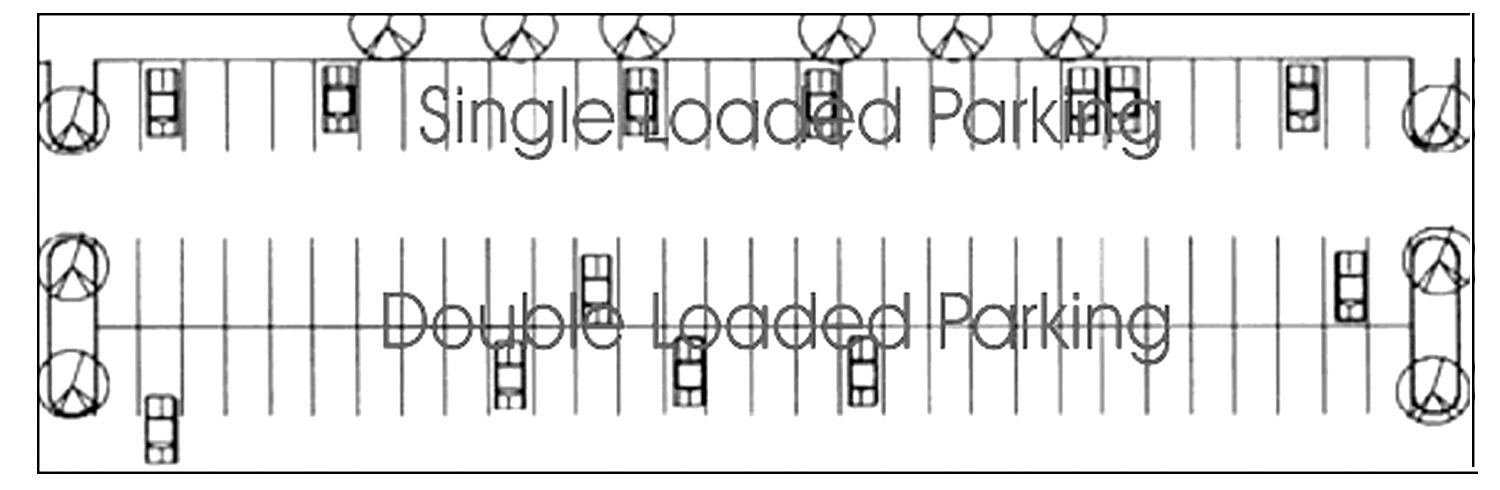
Illustration showing parking row configurations
B.
Design standards for carport structures.
a.
Carport structures should be designed to include elements that are architecturally compatible with the main structures in the project and should utilize substantial support posts.
b.
Carport structures abutting property boundaries shall be designed with a front (leading) edge that goes down far enough to shield adjacent properties from vehicle headlights and noise associated with vehicles.
c.
Landscaping material associated with the carport should have adequate room to grow and be protected from abuse by vehicles.
d.
Double loaded parking rows must be accessible on both sides by a drive aisle.
(Ord. No. 156-2, § I, 9-4-06)
Sec. 6.707. - Temporary structures and uses.
Temporary structures and uses may be permitted, including a temporary dwelling installed on a single-family residential lot while a permanent dwelling is under construction. Such structures and uses shall comply with all applicable city codes and ordinances, and the following:
A.
Use standards. Temporary structures and uses shall comply with the following:
1.
The granting of the temporary use shall in no way constitute a change in the basic uses permitted in the district.
2.
The use shall be in harmony with the purpose and character of the district, and shall comply with all applicable standards of this ordinance.
3.
Temporary structures shall comply with the dimensional standards of the district.
4.
Adequate provisions shall be made for emergency vehicle access, off-street parking and loading, drainage, and soil erosion.
B.
Approval. The granting of the temporary use approval shall be in writing, stipulating all conditions as to time, nature of activity permitted, and arrangements for removal of the use or structure at the end of the permitted period. The city may impose other conditions deemed necessary to protect the public health, safety, peace, morals, comfort, convenience and general welfare of the inhabitants of the City of Richmond.
C.
Duration. Temporary structures or uses, other than temporary construction buildings approved as part of a site plan, shall be permitted on a site up to a maximum of 365 calendar days. Upon application, the city planner may grant one extension of up to an additional 365 calendar days. The city planner may also impose a lesser maximum time period where deemed necessary.
D.
Temporary construction buildings. Installation of temporary buildings, construction trailers or temporary sales offices associated with a construction or development project shall be subject to zoning permit approval. Such buildings shall not be erected for more than 90 calendar days in any district unless the planning commission has approved a site plan for the project. Such buildings shall be removed from the site before a final certificate of occupancy is issued for the primary building.
E.
Performance guarantee. To ensure strict compliance with the conditions attached to the issuance of the permit for a temporary structure or use, the applicant may be required to furnish a performance guarantee, per section 1.11 (performance guarantees), in an amount equal to the estimated cost of removing and disposing of the temporary structure or use ($500.00 minimum). The guarantee shall be returned after the temporary structure or use has been removed from the premises.
F.
Removal. Temporary structures or uses, other than temporary construction buildings, shall be removed within ten days after expiration of the permit or approval, or the performance guarantee may be forfeited and the funds used by the city to initiate such removal.
G.
Mobile food vendors. Mobile food vendors on private or public property will require Richmond City Council approval. This approval is subject to policies and procedures developed by the Richmond City Council.
(Ord. No. 156-26, § 1, 5-4-20)
Sec. 6.708. - Topsoil removal or stockpiling.
The removal or temporary stockpiling or of topsoil on a site in the City of Richmond shall comply with all applicable federal, state, and local laws, regulations, codes, and ordinances; and shall be subject to the following:
1.
Site plan approval. Removal or temporary stockpiling of topsoil on a site in the City of Richmond shall be prohibited, except where a site plan for development of the site has received final approval from the city in accordance with article 18 (site plan review).
2.
Zoning permit. Approval of a zoning permit per section 1.08 (permits) shall be required for removal or temporary stockpiling of topsoil from any site in the city. The permit application shall include a plan showing the following:
a.
Areas of temporary topsoil stockpiling, and proposed methods of containment.
b.
Proposed truck route(s) for any removal of topsoil from the site.
c.
Calculations of the volume of existing topsoil on the site, the minimum volume required to support the planned development of the site, and any volume anticipated to be removed from the site.
3.
Setbacks. Topsoil stockpiling areas shall comply with the minimum setback requirements for the district, and shall be set back a minimum of 100 feet from the boundary of any residential zoning district or any lot boundary abutting an existing residential use.
4.
Use standards. Removal or stockpiling of topsoil shall be further subject to the following:
a.
Access. All truck access to the site for removal of topsoil shall be from a public street classified as a collector, arterial or thoroughfare by the city's master plan, or county or state road authorities. Removal of topsoil using local streets shall be prohibited.
b.
Containment and screening. Stockpiled topsoil shall be contained to prevent blowing of materials or dust upon adjacent properties. Such stockpiled areas shall be screened in accordance with section 11.04 (methods of screening and buffering).
c.
Limitation on removal. Removal of topsoil from the site shall be limited only to that determined not to be needed for the planned development on the site, as demonstrated on a plan submitted for zoning permit approval.
5.
Expiration. Expiration of site plan approval shall also cause any zoning permit for removal or temporary stockpiling of topsoil to immediately expire. No topsoil removal or stockpiling shall take place on a zoning lot except under an approved site plan and approved zoning permit.
6.
Other conditions. The planning commission may require stockpiled topsoil to be covered, and may impose additional conditions upon the use to minimize adverse impacts on adjacent uses.

