Richmond City Zoning Code
ARTICLE 7
- ACCESSORY STRUCTURES AND USES
Sec. 7.01.- Purpose.
The purpose of this article is to provide consistent regulations for certain structures and uses that are accessory to principal buildings or uses in a zoning district; to protect the general health, safety and welfare; to ensure that the city's property values, appearance, and character are preserved and respected; and to minimize potential off-site impacts from permitted accessory structures and uses.
Sec. 7.02. - Accessory structures.
The following shall apply to all new accessory structures in the city, and to alterations, renovations, expansions or other work that includes exterior changes to existing structures:
A.
General standards. The following shall apply to accessory structures in all zoning districts:
1.
Timing of construction. No accessory structure shall be constructed or established on a parcel unless a principal building or use is under construction or already established on the same lot.
2.
Zoning permit. All accessory structures exceeding 100 square feet in gross floor area shall be subject to approval of a zoning permit per section 1.08 (zoning permits).
3.
Location in proximity to easements or rights-of-way. Accessory structures shall be set back a minimum of one foot from any alley, dedicated easement or right-of-way.
4.
Attached accessory structures. Accessory structures structurally attached to a principal building shall conform to the requirements of article 5 (dimensional standards).
5.
Vehicle shelters. Temporary or permanent vehicle shelters shall be considered accessory structures, and shall comply with the requirements of this section.
6.
Non-enclosed multiple-family and non-residential vehicle structures. Temporary or permanent non-enclosed vehicle shelters shall be considered carports, and shall comply with the requirements of section 6.706 (non-enclosed multiple-family and non-residential vehicle structures).
7.
Temporary accessory structures and uses. Temporary accessory structures and uses shall comply with the use standards of article 4 (land use table), and the design standards of section 6.707 (temporary uses and structures).
B.
Detached accessory structure standards for multiple-family and non-residential uses. Structures accessory to a multiple-family residential or non-residential use and not attached to a principal building shall be subject to the following:
C.
Detached accessory structure standards for single- and two-family residential uses. Structures accessory to a single- or two-family residential use and not attached to a principal building shall be subject to the following:
(Ord. No. 156-2, § I, 9-4-06; Ord. No. 156-29, § I, 10-4-21)
Sec. 7.03. - Swimming pools, hot tubs, and similar facilities.
Private outdoor swimming pools, hot tubs, and similar facilities constructed in, on or above the ground shall be permitted as an accessory use in all zoning districts subject to the following:
1.
Exemption. The standards of this section shall not apply to permanent above- or below-ground swimming pools, wading pools, and portable pools with a diameter of less than 12 feet, a water surface area of less than 100 square feet, and a maximum water depth of less than two feet.
2.
Yard limitations. Private outdoor swimming pools, hot tubs, and similar facilities shall be located only in the rear yard.
3.
Setback requirements. Private outdoor swimming pools, hot tubs, and similar facilities shall conform to the following minimum setback requirements:
a.
Ten feet horizontally from the water's edge to all side and rear lot boundaries, and to the exterior wall of any adjacent principal building.
b.
Ten feet horizontally from the water's edge to any overhead electrical, cable or telephone wires, and five feet horizontally to any to any underground utility leads or conduits, except for parts of the swimming pool system.
c.
Twenty-five feet horizontally from the water's edge to any water well and ten feet horizontally to any septic tank, tile field or other treatment facility, unless the county health department approves a shorter distance.
d.
Three feet horizontally from the water's edge to any dedicated easement or right-of-way. No swimming pool, hot tub or similar facility shall be located within an easement or right-of-way.
4.
Secured enclosure. To prevent unauthorized access and protect the general public, private outdoor swimming pools, hot tubs, and similar facilities shall be secured and completely enclosed by a minimum four-foot and maximum six-foot high fence with a self-closing and latching gate, subject to the following:
a.
Above-ground swimming pools with an overall height above grade of less than four feet shall be enclosed with an integral fence securely attached to the top rail of the swimming pool, provided that any ladders or steps shall be retractable or removable.
b.
Hot tubs and similar facilities may be secured with a lockable cover as an alternative to the fencing requirement.
c.
The Building Official may waive the requirement for an enclosure around the pool area upon determining that the entire yard area is adequately fenced and secured against unauthorized access.
5.
Other requirements. Construction or alteration of a private outdoor swimming pool, hot tub or similar facility shall be subject to approval of a zoning permit in accordance with section 1.08 (zoning permits), and shall comply with all applicable provisions of the State Construction Code enforced by the city.
Sec. 7.04. - Solar collectors and similar facilities.
Solar collectors and similar facilities shall be permitted as an accessory use in all zoning districts subject to the following:
1.
General requirements. All solar energy systems are subject to the following general requirements:
a.
All solar energy systems must conform to the provisions of this section and all county, state, and federal regulations and safety requirements as well as applicable industry standards.
b.
Solar energy systems shall be located or placed so that concentrated solar glare shall not be directed toward or onto nearby properties or roadways at any time of the day.
2.
Private solar energy systems.
a.
Private solar energy system (PSES). Private solar energy systems shall be permitted in all zoning districts, provided such PSES conform to applicable county, state and federal regulations and safety requirements, including the Michigan Building Code. A building permit shall be required for the installation of any PSES.
b.
Roof or building-mounted private solar energy systems. Roof or building-mounted private solar energy systems shall be considered an accessory use in all zoning districts, subject to the following requirements:
(1)
No part of the solar energy system erected on a roof shall extend beyond the peak of the roof. Solar energy systems shall only be limited to roof-top installations. Vertical wall-mounted solar energy systems shall be prohibited.
(2)
No part of a solar energy system mounted on a roof shall be installed closer than three feet from the edges of the roof, the peak, or eave or valley in order to maintain pathways of accessibility.
(3)
No part of a solar energy system mounted on a roof shall extend more than two feet above the surface of the roof.
(4)
In the event that a roof or building-mounted solar energy system has been abandoned (meaning not having been in operation for a period of one year), it shall be removed by the property owner within six months from the date of abandonment.
(5)
A building permit shall be required for installation of roof or building-mounted private solar energy systems.
3.
Ground-mounted private solar energy systems. Ground-mounted private solar energy systems shall be considered an accessory use in all zoning districts, subject to the following requirements:
a.
Prior to the installation of a ground-mounted solar energy system, the property owner shall submit a site plan to the zoning administrator. The site plan shall include setbacks, panel size, and the location of property lines, buildings, fences, greenbelts, and road rights-of-way. The site plan must be drawn to scale.
b.
A ground-mounted solar energy system and any mounts shall not exceed 15 feet above the ground when oriented at maximum tilt.
c.
A ground-mounted solar energy system shall be located in the rear yard and shall meet the rear yard setback requirements applicable in the zoning district in which the solar energy system will be located.
d.
All power transmission or other lines, wires or conduits from a ground-mounted solar energy system to any building or other structure shall be located underground. If batteries are used as part of the ground-mounted solar energy system, they must be placed in a secured container or enclosure.
e.
There shall be greenbelt screening around any ground-mounted solar energy systems and equipment associated with the system to obscure, to the greatest extent possible, the solar energy system from any adjacent residences. The greenbelt shall consist of shrubbery, trees, or other noninvasive plant species that provide a visual screen. In lieu of a planting greenbelt, a decorative fence (meeting the requirements of this section applicable to fences) may be used.
f.
No more than seven and one-half percent of the total lot area may be covered by a ground-mounted solar energy system.
g.
In the event that a ground-mounted solar energy system has been abandoned (meaning not having been in operation for a period of one year), it shall be removed by the property owner within six months from the date of abandonment.
h.
A building permit shall be required for installation of a ground-mounted solar energy system.
4.
Commercial solar energy systems. Commercial solar energy systems shall only be allowed in the "I-2" Industrial Districts as a special use approved by the planning commission. In addition to any other requirements for special use approval, commercial solar energy systems shall be ground-mounted and are subject to the following requirements:
a.
The property owner or applicant for a commercial solar energy system shall provide the planning commission with proof of ownership of the subject property, a copy of any lease agreement for a commercial solar energy system, together with an operations agreement, which shall set forth the operations parameters, the name and contact information of the certified operator, inspection protocol, emergency procedures and general safety documentation.
b.
Commercial solar energy systems shall be located on parcels of land no less than 20 acres in size.
c.
The commercial solar energy system shall meet the minimum front, side and rear yard setbacks of the zoning district.
d.
The height of the commercial solar energy system and any mounts shall not exceed 15 feet when oriented at maximum tilt.
e.
Landscaping shall be provided to screen the system from view on all sides to the greatest extent possible.
f.
Prior to installation, the applicant shall submit a descriptive site plan to the planning commission which includes where and how the commercial solar energy system will connect to the power grid.
g.
No commercial solar energy system shall be installed until evidence has been given to the planning commission that the electric utility company has agreed to an interconnection with the electrical grid or a power purchase agreement. any such agreement shall be furnished to the planning commission.
h.
To ensure proper removal of a commercial solar energy system upon discontinued use or abandonment, applications shall include a description of the financial security guaranteeing removal of the system which must be posted with the city within 15 days after approval or before a construction permit is issued for the facility. The financial security shall be: 1) a cash bond; or 2) an irrevocable bank letter of credit or a performance bond, in a form approved by the city. The amount of such guarantee shall be no less than the estimated cost of removal and may include a provision for inflationary cost adjustments. The estimate shall be prepared by the engineer for the applicant and shall be subject to approval by the city.
i.
If the owner of the facility or the property owner fails to remove or repair the defective or abandoned commercial solar energy system, the city, in addition to any other remedy under this section, may pursue legal action to abate the violation by seeking to remove the solar energy system and recover any and all costs, including attorney fees.
(Ord. No. 156-31, § I, 6-10-22)
Sec. 7.05. - Keeping of animals.
Keeping of animals accessory to a principal use in any zoning district shall be subject to the provisions of chapter 14 (animals) of the City of Richmond Code of Ordinances.
Sec. 7.06. - Ponds.
The creation or expansion of ponds and similar bodies of water accessory to farming or recreational uses, or for residential landscaping purposes, shall be subject to the following:
A.
Exemption for agricultural ponds and landscape water features. The standards of this section shall not apply to ponds used for agricultural purposes on parcels of 40 acres or more, and to landscape water features with a maximum water surface area of 75 square feet and a maximum water depth of one foot. Such agricultural ponds and landscape water features shall be subject to the following:
1.
Agricultural ponds and landscape water features shall be located entirely outside of any dedicated easement or right-of-way, and outside of all required yard setbacks as specified in article 5 (dimensional standards).
2.
Agricultural ponds and landscape water features shall be enclosed and secured with fencing or otherwise designed and located to prevent unauthorized access and protect the general public.
3.
Construction or alteration of agricultural ponds and landscape water features shall be subject to approval of a zoning permit in accordance with section 1.08 (zoning permits).
B.
Design standards. Ponds shall only be of an excavation type as defined by the Natural Resources Conservation Service (NRCS) engineering standards, and all ponds shall be constructed to NRCS Standard 378, or another applicable standard accepted by the city.
1.
No pond shall encompass more than 15 percent of the gross land area of any lot or parcel of land on which the pond is to be located.
2.
Ponds shall be designed and maintained to prevent runoff, overflow, spillage or seepage from encroaching upon adjacent lots or rights-of-way. Contaminated surface water shall be diverted around all ponds. Pond excavation shall not alter surface or groundwater flow or cause an increase in runoff or drainage to adjacent lots or rights-of-way beyond that which may have occurred prior to its construction.
3.
Sale or transportation of excavated materials off-site shall be considered a mining and extraction use subject to the use provisions of article 4 (land use table) and standards of section 6.705 (mining and extraction uses).
4.
Ponds shall be established and maintained in accordance with all applicable statutes of the State of Michigan. If any of the requirements of this section are less restrictive than applicable state statutes, the state requirements shall prevail.
5.
Pond banks shall have a maximum slope of one foot vertical rise to four feet of horizontal distance, which shall extend below the water's surface to a depth of at least eight feet. The intended water depth shall be a minimum of ten feet to ensure proper aeration and circulation of the water.
6.
All areas disturbed during construction of the pond shall be seeded with grasses or other groundcover suitable for a wetland environment, and shall be maintained in good condition to prevent erosion. Pond shall be maintained in a weed-free condition.
C.
Setback requirements. Ponds subject to the standards of this section shall conform to the following minimum setback requirements:
1.
Such ponds shall be prohibited within any required front yard setback area, as specified in article 5 (dimensional standards).
2.
The top of the bank of such ponds shall be set back a minimum of 25 feet from all lot boundaries, dedicated easements, and rights-of-way.
3.
Such ponds shall be set back a minimum of 25 feet from any well, septic tank or drain field, and a minimum of 20 feet from the exterior wall of any adjacent principal building.
4.
There shall be a minimum horizontal distance of not less than 20 feet from the water's edge to any overhead electrical, cable or telephone wires.
D.
Site plan approval. The creation or expansion of ponds shall be subject to site plan review and approval in accordance with article 18 (site plan review). The planning commission may require submittal of a topographic survey and engineered drawings showing the extent of excavation, proposed fill locations, and proposed soil erosion control measures.
E.
Other requirements. The following additional requirements shall apply to all ponds subject to the standards of this section:
1.
The property owner or pond developer shall obtain necessary permits and approvals from the Michigan Department of Environmental Quality and county agencies with jurisdiction, or shall provide documentation to the city that the permits or approvals are not required.
2.
Appropriate lifesaving equipment such as ring buoys, ropes, planks, and long poles shall be placed near the pond to be easily seen and accessible for use during an emergency. Appropriate warning signs shall be provided and maintained.
3.
Trespassing, swimming, wading, playing, or other unauthorized activities in a public or common retention pond or drainage basin shall be prohibited.
Sec. 7.07. - Fences.
All fences and similar enclosures shall conform to the following:
A.
General standards. The following shall apply to fences in all zoning districts:
1.
All fences shall comply with the unobstructed sight distance standards of section 5.304 (corner clearance areas).
2.
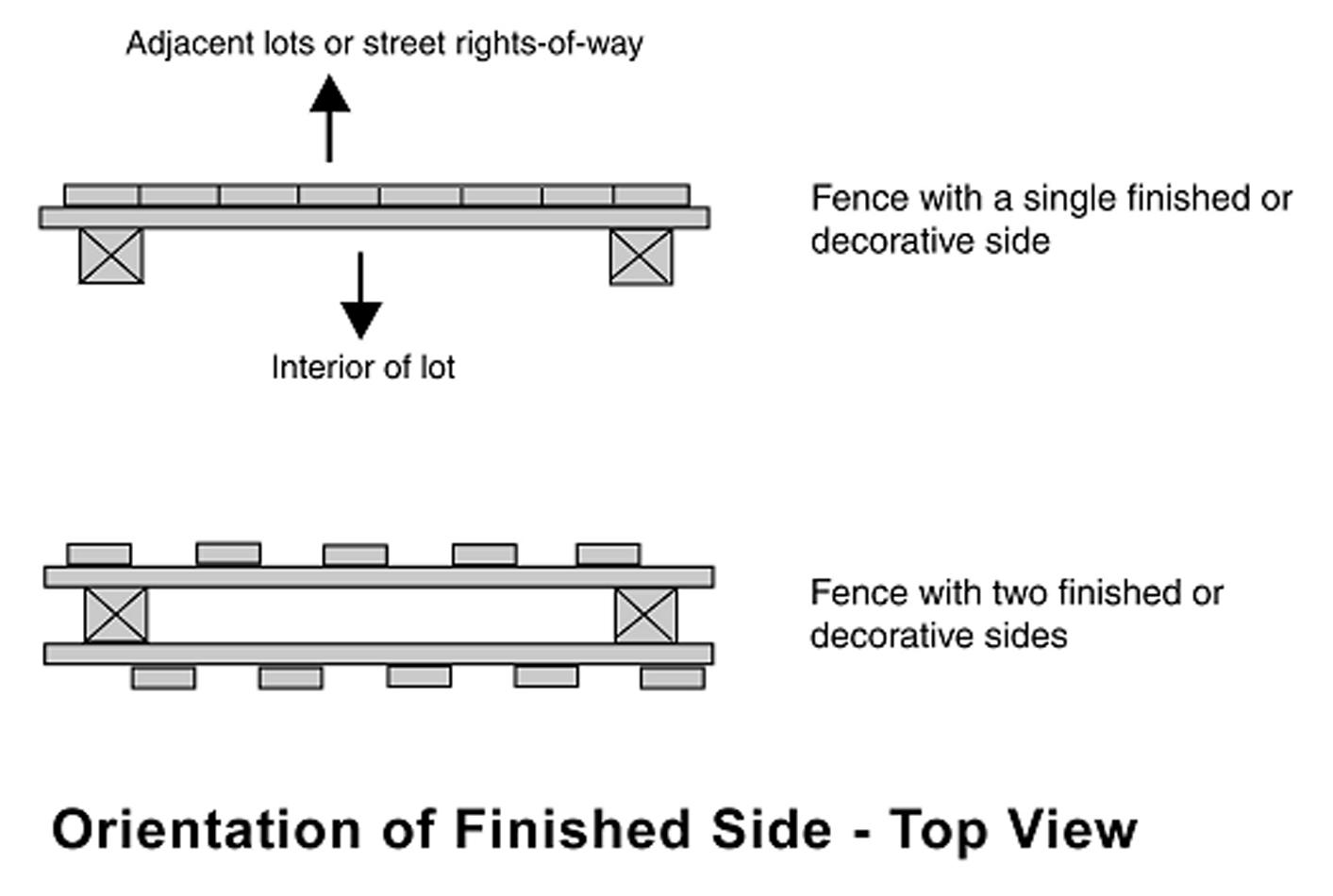
All fences shall be constructed in such a manner that all structural members shall be on the interior side of the fence, including braces, posts, poles, and other projections. Where one side of a fence or wall has a more finished appearance than the other, the side with the more finished appearance shall face the road or adjacent lots (see illustration).
3.
A maximum of one fence shall be permitted adjacent to a common lot boundary separating adjoining lots. A minimum ten-foot separation distance shall be provided between abutting fences placed in parallel along a lot boundary.
4.
Use of razor or barbed wire, electrified fences, spikes, and similar security materials on any fence shall be prohibited, except as follows:
a.
Barbed or electrified wire fences shall be permitted accessory to permitted animal and agricultural uses.
b.
Barbed wire cradles may be placed on top of fences enclosing public utility and essential service uses in any zoning district.
c.
The planning commission may approve use of razor or barbed wire, electrified fences, spikes or similar security materials on any fence where deemed necessary for security purposes or public safety.
d.
Barbed wire cradles shall consist of no more than three strands of wire and shall overhang into the lot for which it is designed to protect.
5.
Fences shall be constructed of wood, metal, and other acceptable materials. All fences shall be constructed solely of new materials accepted by the building official as durable, weather resistant, and easily maintained.
6.
The use of plastic slats or similar obscuring materials interwoven through a chain-link fence shall be prohibited.
B.
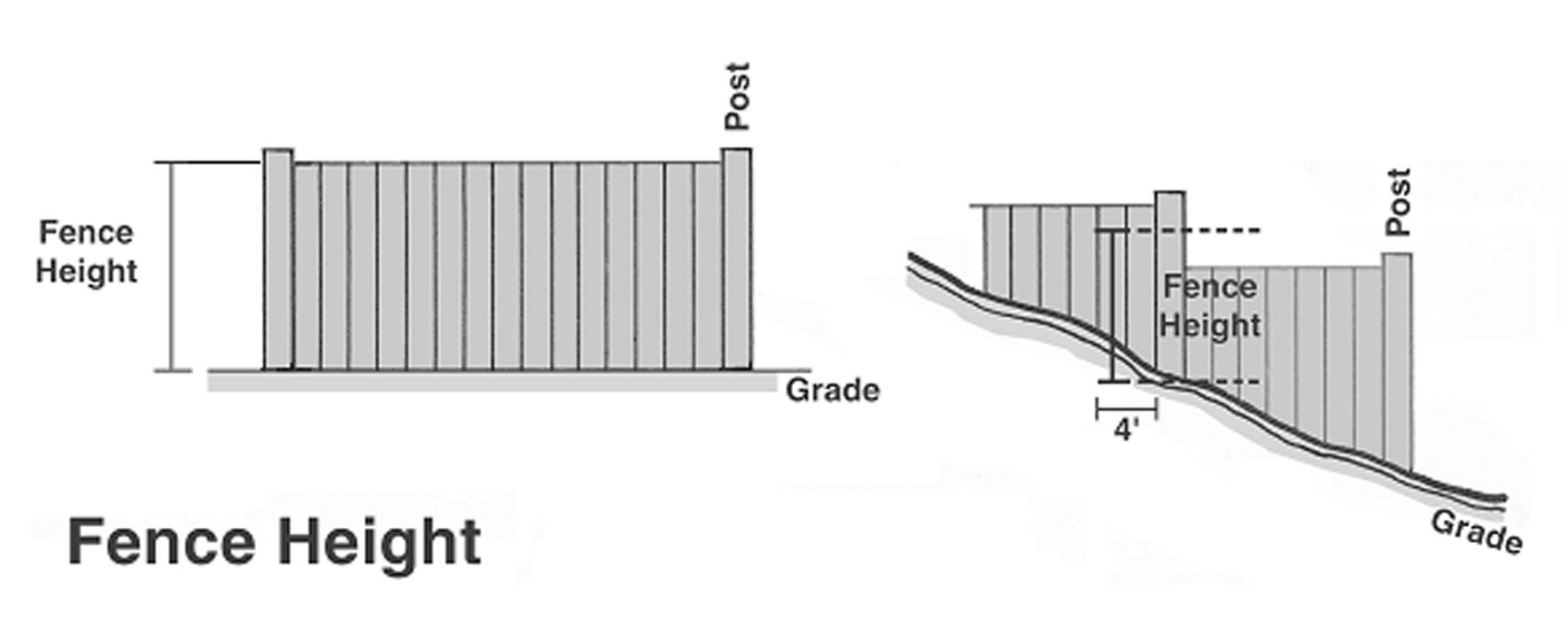
Height, locations, and type of fences permitted. Fence height shall be measured from ground level adjacent to the highest point of the fence. Fill shall not be used for the purpose of achieving a higher fence than otherwise permitted. Where the grade is not level, the maximum fence height shall be equal to the average fence height within four feet of any fence post (see illustration). Standards for maximum height, permitted fence locations, and type of fences permitted shall apply to the following use groups, as specified in section 4.02 (table of permitted uses by district):
1.
Animal and agricultural uses. Fences accessory to permitted animal and agricultural uses in any zoning district may include chain-link, wire, ornamental, privacy, and rail fence types. Such fences shall not exceed six feet in height. Fences exceeding three feet in height shall conform to the minimum front yard setback requirements for the zoning district, per article 5 (dimensional standards).
2.
Residential uses. The following standards shall apply to all fences accessory to permitted residential uses in any zoning district:
a.
Fences shall be located entirely within the boundaries of the lot to which the fence is accessory, except where adjoining lot owners consent in writing to the fence construction on a common lot line. The City of Richmond shall not be responsible for determining the location of any fence to be erected on a common lot line.
b.
A fence may be erected parallel to the side street lot line of a corner lot, provided that the fence shall be located at least one foot inside the side street lot line and shall not extend beyond the rear building line of the principal dwelling.
3.
Community uses and industrial, research and laboratory uses. The following standards shall apply to all fences accessory to permitted community uses and industrial, research and laboratory uses in any zoning district:
4.
Office and service uses and commercial uses. The following standards shall apply to all fences accessory to permitted office and service uses and commercial uses in any zoning district:
D.
Maintenance. Fences shall be maintained in a neat and safe condition, so as not to endanger life or property. Such maintenance shall be the responsibility of the owner of the lot on which the fence is located. The City of Richmond shall not be responsible for enforcement of any agreements relative to the mutual or separate payments of the cost of fence construction, maintenance or repair.
Any fence which, through lack of repair, type of construction, or otherwise, endangers life or property, shall be deemed a nuisance. The building official shall notify the owner, agent or person in control of the property on which such fence is located of the existence of such nuisance, and shall specify the required repairs or modifications to be made to render the fence safe. The building official may order the removal of an unsafe fence.
E.
Permit required. It shall be unlawful for any person to construct, alter, extend or relocate any fence upon any lot in any zoning district without having first obtained approval of a zoning permit per section 1.08 (zoning permits). Where adjoining lot owners consent in writing to the construction of a fence on a lot line, such written consent shall be filed with the application for a permit. The following activities shall be exempt from this requirement:
1.
Repairs to an existing fence or wall with no structural changes.
2.
Installation of gates of up to eight feet in width in an existing fence.
3.
Construction of up to eight feet of new fencing, provided such work is in compliance with the applicable provisions of this section.
4.
Installation of fences designed for agricultural purposes and accessory to an active farm use.
5.
Planting of continuous hedgerows or similar landscape features.
Sec. 7.08. - Decks.
Decks constructed, altered or maintained accessory to a residential dwelling shall be subject to the following:
1.
The deck shall be set back a minimum of 15 feet from the rear lot line, and shall not occupy any yard except the rear yard and any non-required side yard.
2.
The deck shall not be elevated above the elevation of the first floor of the residence.
3.
Not more than 25 percent of any deck shall be covered with structures, such as a gazebo or a permanent screened porch. Such structures shall not be used as living quarters, but seasonal awnings and screening shall be permitted.
4.
Decks shall conform to the lot coverage limitations specified in article 5 (dimensional standards).
5.
Decks shall be constructed in accordance with requirements of the State Construction Code enforced by the City of Richmond.
ILLUSTRATIONS