
Riverview City Zoning Code
ARTICLE 11
PD, PLANNED DEVELOPMENT DISTRICT
Section 11.01 - Intent and Scope.
It is the intent of these regulations to permit planned development for the purposes of:
1.
Fostering innovation in land use planning, development, and redevelopment.
2.
Achieving a higher quality of development than would otherwise be achieved.
3.
Encouraging assembly of lots and redevelopment of inefficient or outdated land uses.
4.
Supporting in-fill development on sites that would be difficult to develop according to conventional standards because of the shape, size, abutting development, accessibility, environmental status or other unique features or conditions related to the site.
5.
Providing enhanced housing, employment, and shopping opportunities.
6.
Creating a development framework that promotes appropriate business activity that significantly improves the economic viability of the City.
7.
Assuring compatibility of design and function among neighboring properties.
8.
Enhancing and expediting the redevelopment process for parcels, such as brownfield sites, that present complex solutions for re-use.
9.
Encouraging unique development and redevelopment that is consistent with the City's Master Plan.
These planned development regulations are not intended as a device for ignoring the more specific standards of the City, or the planning upon which the standards are based. Rather, these provisions are intended to result in development that is substantially consistent with the zoning standards generally applied to the proposed uses, but allowing for modifications to the general zoning requirements to assure a superior quality of development.
Section 11.02 - Eligibility Criteria.
To be eligible for planned development approval, the applicant must demonstrate that the following criteria will be met:
A.
Recognizable and Substantial Benefit.
The planned development shall result in a recognizable and substantial benefit to the ultimate users of the project and to the community.
B.
Minimum Frontage and Size.
Any planned development shall have minimum frontage of 200 feet along a public street or road. The minimum size of a parcel that is developed as a planned development (PD) shall be 10,000 square feet.
C.
Availability and Capacity of Public Services.
The proposed type and density of use shall not exceed the capacity of existing public services, facilities, and utilities.
D.
Compatibility with the Master Plan.
The proposed development shall be consistent with the City's Master Plan.
E.
Compatibility with the Planned Development Intent.
The proposed development shall be consistent with the intent and spirit of these regulations, as stated in Section 11.01 (Intent and Scope).
F.
Economic Impact.
The proposed development shall not impede the continued use or development of surrounding properties for uses that are permitted in the Zoning Ordinance, or planned in the adopted City Master Plan.
G.
Unified Control of Property.
The entire area of the proposed development shall be under single ownership or unified control, such that there is a single entity having responsibility for completing the entire project. This provision shall not prohibit a transfer of ownership or control, provided that notice of such transfer is given in advance to the Community Development Director and a unified ownership remains.
H.
Brownfield Classification.
Any site designated as a brownfield site by state or federal law may qualify for consideration as a PD zone.
Section 11.03 - Project Design Standards.
Proposed planned developments shall comply with the following project design standards:
A.
Location.
A planned development (PD) zone may be approved in any zoning district in the City, subject to review and approval as provided herein.
B.
Permitted Uses.
Any land use authorized in this Ordinance may be included in a planned development as a principal or accessory use, provided that public health, safety, and welfare are not impaired. The Planning Commission may recommend and City Council may approve a mix of land uses pursuant to Section 11.03F (Permitted Mix of Uses).
C.
Applicable Base Regulations.
Unless otherwise waived or modified as part of an approval in accordance with Section 11.03D (Regulatory Flexibility), all yard and bulk, parking, loading, landscaping, lighting, and other standards for the districts listed below shall be applicable for uses proposed in a planned development zone:
1.
Single-Family residential uses shall comply with the regulations applicable in the R-1 (Single-Family Residential) District.
2.
Multiple-Family residential uses shall comply with the regulations applicable in the RM-1 (Multiple-Family Residential) District.
3.
Retail commercial uses shall comply with the regulations applicable in the B-1 (Local Business) District.
4.
Office uses shall comply with the regulations applicable in the OS-1 (Office Service) District.
5.
Industrial uses shall comply with the regulations in the M-1 (Light Industrial) District.
6.
Mixed uses shall comply with the regulations applicable for each individual use.
7.
Projects involving brownfield sites shall be exempt from compliance with base district standards. All standards shall be noted in the development agreement as required in Section 11.06C.4. (Development Agreement).
D.
Regulatory Flexibility.
To encourage flexibility and creativity consistent with the planned development concept, departures from zoning regulations may be permitted, subject to review and recommendation by the Planning Commission and approval by City Council. For example, such departures may include, but shall not be limited to modifications to minimum lot dimensions, floor area standards, setback requirements, density standards, or parking, loading or landscaping requirements. Such modifications may be permitted only if specifically approved by the City and they result in a higher quality of development than would be possible without the granting of the modification.
E.
Residential Density.
Modifications to the density of residential development may be permitted upon determination that the desired density will not adversely impact water and sewer services, storm water drainage, road capacity, traffic flow, parks and recreation services, fire and police services, schools, character of the area, and any planned public or private improvements in the area.
F.
Permitted Mix of Uses.
Where the existing zoning district classification is residential, compatible non-residential uses may be permitted as part of a planned development at the sole discretion of the Planning Commission and City Council. The applicant must demonstrate that the residential uses will continue to be predominant. The Planning Commission shall determine predominance of use after taking into account the following criteria for each of the proposed uses:
1.
Amount of traffic generated.
2.
Hours of operation or use.
3.
Noise, odors, overall environmental impact on adjoining uses.
4.
Land area allocated to each use.
5.
Building area allocated to each use.
G.
Open Space Requirements.
Planned developments containing a residential component shall provide and maintain usable open space as shown on the approved site plan. The required open space shall be set aside by the developer through an irrevocable conveyance, such as a deed restriction or covenant that runs with the land, assuring that the open space will be developed according to the site plan and never changed to another use. Such conveyance shall:
1.
Provide for maintenance of the privately owned open space by private property owners with an interest in the open space.
2.
Provide maintenance standards and a schedule.
3.
Provide for assessment of the private property owners by the City of Riverview for the cost of maintenance of the open space in the event that it is inadequately maintained and becomes a public nuisance.
H.
Frontage and Access.
Planned developments shall front onto a major thoroughfare or public collector street, as specified in the adopted City Master Plan, except where the planned development involves reuse or redevelopment of at least one (1) existing structure or redevelopment of a brownfield site.
I.
Utilities.
All new utilities serving a planned development, including electric, telephone, and cable television lines, shall be placed underground, wherever feasible.
J.
Privacy for Dwelling Units.
The design of a planned development shall provide visual and sound privacy for any and all dwelling units within and surrounding the development. Fences, walks, and landscaping shall be used in the site design to protect the privacy of dwelling units.
K.
Emergency Access.
The configuration of buildings, driveways, and other improvements shall allow convenient and direct emergency vehicle access.
L.
Pedestrian and Vehicular Circulation.
A pedestrian circulation system shall be provided throughout the project that is insulated from the vehicular circulation system. The layout of vehicular and pedestrian circulation routes shall respect the pattern of existing streets, sidewalks, and bicycle pathways in the vicinity of the site.
Section 11.04 - Project Review Standards.
In considering any application for a planned development, the Planning Commission and City Council shall make their determinations on the basis of standards set forth for site plan review in Section 20.01M (Standards for Site Plan Approval), as well as the following standards and requirements for a planned development:
A.
Conformance with the Planned Development Concept.
The overall design of the site and all proposed land within the project shall be consistent with and promote the intent of the planned development concept as described in Section 11.01 (Intent and Scope), as well as comply with the specific project design standards set forth herein.
B.
Compatibility with Adjacent Uses.
The proposed project shall set forth specifications with respect to height, setbacks, density, parking, circulation, landscaping, views, and other design and layout features which exhibit due regard for the relationship of the development to surrounding properties and the uses thereon. In determining whether this requirements has been met, consideration shall be given to the following:
1.
The bulk, placement, and materials of construction of all proposed structures.
2.
The location and screening of vehicular circulation and parking areas in relation to surrounding development.
3.
The location and screening of outdoor storage, outdoor activity or work areas, and mechanical equipment in relation to surrounding development.
4.
The hours of operation of any proposed nonresidential use(s).
5.
The provision of landscaping and other site amenities.
C.
Public Services.
The project shall not exceed the capacity of existing and available public services, including but not necessarily limited to utilities, public roads, police and fire protection services, and educational services, unless the project proposal contains an acceptable plan for providing the necessary services or evidence that such services will be available by the time the planned development project is completed.
D.
Impact of Traffic.
The project shall be designed to minimize the impact of traffic generated by the proposed development on surrounding uses. In determining whether this requirement has been met, consideration shall be given to the issues by requesting that the applicant provide a traffic impact analysis at the direction of the Planning Commission.
E.
Accommodations for Pedestrian Traffic.
The planned development project shall be designed with a pedestrian network to accommodate safe pedestrian circulation throughout the interior and along the perimeter of the site without interference from vehicular traffic.
F.
Compatibility with the Master Plan.
The proposed planned development project shall be consistent with the general principles and objectives of the City Master Plan.
G.
Area, Height, Bulk, and Placement Requirements.
Buildings and uses in the Planned Development District are subject to the area, bulk, and placement requirements specified in Section 11.03 (Project Design Standards).
H.
General Development Standards.
Buildings and uses in the Planned Development District are subject to all applicable requirements set forth in this Ordinance, unless specifically modified through an approved application.
I.
Compliance with Applicable Regulations.
The proposed planned development project shall be in compliance with all applicable federal, state, and local laws and ordinances.
Section 11.05 - Phasing and Commencement of Construction.
A.
Integrity of Each Phase.
Where a planned development project is proposed to be constructed in phases, the project shall be so designed that each phase shall be complete in terms of the presence of services, construction, facilities, and open space, and shall contain the necessary components to ensure the health, safety and welfare of the users of the planned development, and the residents of the City.
B.
Rate of Completion of Residential and Non-residential Components.
1.
Purpose. The purpose of the following provisions is to assure that planned development projects are constructed in an orderly manner as approved and to assure that the planned development approach is not used as a means of circumventing restrictions on the location or quantity of certain types of land use.
2.
General standards. In planned developments that include both residential and non-residential components, the phasing plan shall detail time requirements for:
a.
Completion of at least thirty-five percent (35%) of all proposed residential units concurrent with the first phase of any non-residential construction.
b.
Completion of at least seventy-five percent (75%) of all proposed residential construction concurrent with the second phase of non-residential construction.
c.
Completion of one hundred percent (100%) of all residential construction prior to the third phase of non-residential construction.
For purposes of carrying out this provision, the percentages shall be approximations as determined by the Community Development Director, based upon the floor area and land area allocated to each use as presented in documents submitted by the applicant.
3.
Modifications to general standards. Such percentages may be modified should the Community Development Director agree that the applicant has presented adequate assurance that the residential component or components of the project will be completed within the specified time period.
4.
Completion of each phase. Construction of a phase may commence following site plan approval by the Planning Commission, provided that construction shall be commenced for each timed phase of the project and be substantially completed within 24 months of the schedule set forth on the approved plan for the planned development.
a.
The applicant may submit a revised phasing plan for review and approval by the Planning Commission. Once construction of a planned development has commenced, approval of any revisions to the phasing plan shall be approved only if the revised phasing does not materially change the integrity of the approved planned development.
b.
In the event that construction has not commenced within the required time period and a revised phasing plan has not been submitted, the City may initiate proceedings to amend the zoning classification of the undeveloped portion of the site to the preceding district, or any other district consistent with the Master plan.
Section 11.06 - Planned Development Procedure.
A.
Intent.
The procedure in this Section is intended to provide a consistent and uniform method for review of planned development applications. The review procedure is set forth to assure full compliance with the standards contained in this Ordinance and other applicable local ordinances, and state and federal laws.
B.
Application Data Requirements.
Applications for planned development zoning shall include applicable data required for site plan review as specified in Section 20.01L (Required Information for Site Plans), and the following:
1.
Overall PD plan. The overall plan shall graphically represent the development concept using maps and illustrations to indicate each type of use, square footage or acreage allocated to each use, approximate locations of each principal structure and use in the development, setbacks, and typical layouts and elevations for each type of use. The overall plan shall clearly delineate each type of residential use; office, commercial, and other non-residential use; each type of open space; community facilities and public areas; and other types of land uses.
2.
Map and master plan statement. A map and written explanation of the relationship of the proposed planned development to the City's Master Plan.
3.
Traffic data. Information concerning traffic generated by the proposed planned development. Sufficient information shall be provided to allow the City to evaluate the impact of the proposed development on adjoining roads. The following traffic-related information shall be provided:
a.
Estimates of the volume of traffic generated by each use.
b.
The peak hour volume of traffic expected to be generated by the proposed development.
c.
A schematic drawing indicating vehicular movement through the site, including anticipated turning movements.
d.
Measures being proposed to alleviate the impact of the development on the circulation system.
4.
Fiscal impact. Analysis of the fiscal impact of the proposed planned development on the City of Riverview and the school district.
5.
Market study. Evidence of market need for the proposed use(s) and the feasibility of completing the project in its entirety. This requirement may be waived by the Planning Commission upon making the determination, based on existing evidence and knowledge about the local economy, that market support does exist for the proposed uses.
6.
Legal documentation of single ownership or control. The documentation shall be in the form of agreements, contracts, covenants, and deed restriction which indicate that the development can be completed as shown on the plans, and further, that all portions of the development that are not to be maintained at public expense will continue to be operated and maintained by the developers or their successors.
7.
Schedule. A schedule of the development and construction details, including specific phasing dates and timing of all proposed improvements.
8.
Documents. A draft of ownership and governance documents is required. These documents shall include the following:
a.
Deeds.
b.
Warranties guaranteeing ownership conveyed and described in the deeds.
c.
A list of covenants, conditions, and restrictions that are conditions of ownership upon the purchasers and owners in the planned development.
d.
Association bylaws (for example, condominium association by-laws) that describe how the association is organized; the duties of the association to operate, manage, and maintain common elements of the planned development; and, the duties of individual shareholders to manage and maintain their own units.
e.
A draft development agreement.
C.
Procedural Requirements.
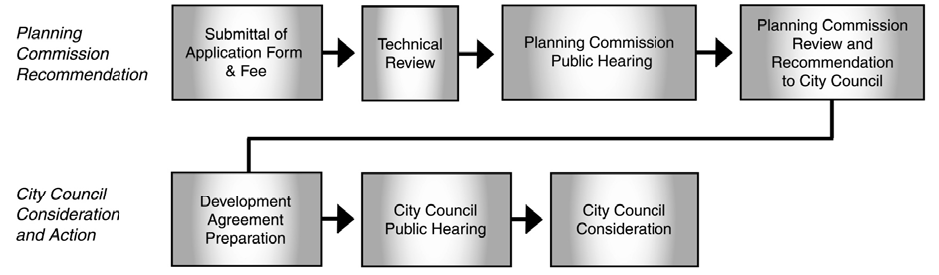
Planned Unit Developments
1.
Amendment required. The approval of a planned development application shall require an amendment to the Zoning Ordinance to revise the official Zoning Map to designate the subject property as "PD" (Planned Development District). Approval granted under this Section (including the development agreement, all aspects of the final plan, and any conditions imposed on it) shall constitute an inseparable part of the zoning amendment.
2.
General review procedures. Planned development applications shall be submitted in accordance with the following procedures and requirements, that provide for detailed review of planned development proposals by the Planning Commission, followed by review and approval by the City Council:
a.
Applicant eligibility. The application shall be submitted by the owner of an interest in land for which planned development approval is sought, or by the owner's duly designated agent. The applicant or a designated representative shall be present at all scheduled review meetings or consideration of the proposal may be tabled.
b.
Application forms and documentation. The application for planned development shall be made on the forms and according to the guidelines specified by the Community Development Director.
c.
Site plan preparation. The site plan shall be prepared in the manner specified in this section and on the planned development application form. A site plan that does not meet the stipulated requirements shall be considered incomplete and shall not be formally reviewed.
d.
Submission of a completed plan. The planned development application materials, required fees, and sufficient copies of the completed site plan shall be submitted to the Community Development Director for review.
e.
Review by City officials. The Community Development Director and other appropriate City officials and review committees shall review the site plan and application materials, and shall prepare a written review, which shall specify any deficiencies in the site plan and make recommendations as appropriate.
f.
Submission of a revised plan and planned development application. The applicant shall revise the site plan and application materials, based on the recommendations set forth in the Community Development Director's review. The applicant shall then submit sufficient copies of the revised plan for further review by staff and the Planning Commission at the same time.
3.
Planning Commission consideration. After all application materials have been received and review fees paid, the application shall be reviewed in accordance with following procedures:
a.
Acceptance for processing. The application shall be placed on the agenda of the next available scheduled Planning Commission meeting at which time a public hearing shall be scheduled.
b.
Public Hearing. The public hearing shall be scheduled and held in accordance with the procedures set forth in Section 20.03 (Public Hearing Procedures) of this Ordinance and Section 401 of the Michigan Zoning Enabling Act (P.A. 110 of 2006, as amended). The Planning Commission and City Council may hold a joint public hearing on a planned development application if so desired.
c.
Planning Commission review. Following the public hearing, the planned development proposal and plan shall be reviewed by the Planning Commission in relation to applicable standards and regulations, requested modifications and consistency with the intent and spirit of the planned development concept.
d.
Plan revision. If the Planning Commission determines that revisions are necessary to bring the planned development proposal into compliance with applicable standards and regulations, the applicant shall be given the opportunity to submit a revised plan. Following submission of a revised plan, the planned development proposal shall be placed on the agenda of the next available scheduled meeting of the Planning Commission for further review and possible recommendation to Council.
e.
Planning Commission recommendation. The Planning Commission shall review the application for a planned development, together with the public hearing findings and reports and recommendations from the Community Development Director and other appropriate reviewing bodies. The Planning Commission shall then make a recommendation to City Council. All decisions of the Planning Commission shall be contained within a report for transmittal to the City Council, stating its conclusions and findings and the basis for its decision.
(1)
Approval. Upon determination by the Planning Commission that the final plan for planned development is in compliance with the standards and requirements of this Ordinance and other applicable ordinances and laws, the Planning Commission may recommend approval.
(2)
Approval with conditions. The Planning Commission may recommend that City Council impose reasonable conditions with the approval of a planned development proposal, to the extent authorized by law, for the following purposes:
(a)
To ensure that public services and facilities affected by the proposed development will be capable of accommodating increased service loads caused by the development.
(b)
To protect the natural environment and conserve natural resources and energy.
(c)
To ensure compatibility with adjacent uses of land.
(d)
To promote the use of land in a socially and economically desirable manner.
(e)
To protect the public health, safety, and welfare of the individuals in the development and those immediately adjacent, and the community as a whole.
(f)
To achieve the intent and purpose of this Ordinance.
In the event that the planned development is approved subject to conditions, such conditions shall become a part of the record of approval, and shall be modified only as provided herein.
(3)
Denial. Upon determination by the Planning Commission that a planned development proposal does not comply with the standards and regulations set forth in this Ordinance, fails to comply with the intent of this Article, or otherwise could be injurious to the public health, safety, welfare, and orderly development of the City, the Planning Commission shall recommend denial.
The Planning Commission shall prepare and transmit a recommendation to City Council stating its conclusions and findings, the basis for a recommendation regarding the creation of a PD zone, and any recommended conditions relating to an affirmative decision.
4.
Development Agreement. Upon the approval recommendation of a PD district by the Planning Commission, the applicant shall prepare a written agreement setting forth any and all conditions upon which approval was based. The Community Development Director shall review the agreement, with assistance from the City Attorney and other advisors. After approval of the ordinance granting the zoning map amendment and development agreement by City Council, the agreement shall be recorded in the Office of the Wayne County Register of Deeds at the expense of the applicant. The agreement shall, at a minimum:
a.
Incorporate by reference the final approved site plan.
b.
If open space or common areas are indicated in the project for use by the residents, the open space or common areas shall be conveyed in fee or otherwise committed by dedication to the residents, and the use shall be irrevocably dedicated for use as open space for park, recreation or other common uses.
c.
Detail a program and related financing mechanisms for maintaining common areas, amenities and features, such as walkways, signs, lighting and landscaping.
d.
Assure that any natural features will be preserved as shown on the site plan.
e.
Assure the financing for the construction and maintenance of all roadways and necessary utilities (including public water, waste water collection and treatment) through a performance bond or other means, for any and all phases of the project. In the case of phased project, this requirement shall be reviewed for compliance at the time of construction plan approval for each phase of the project.
f.
Address any conditions placed upon the site or details of all remedial actions required by state or federal regulatory agencies for brownfield projects.
g.
State all dimensional standards to be incorporated in the redevelopment of brownfield sites.
h.
Address any other concerns or conditions placed on the approval by the Planning Commission or City Council.
5.
City Council Consideration. After the Planning Commission makes its recommendation, the applicant shall make any required revisions and submit sufficient copies of the revised site plan and supporting materials for City Council review.
a.
Public hearing. Upon receipt of a planned development plan and Planning Commission recommendation, City Council, solely at their option, may schedule an additional public hearing. Notice of said public hearing shall be in accordance with the procedures set forth in Section 20.03 (Public Hearing Procedures) of this Ordinance and the Michigan Zoning Enabling Act (P.A. 110 of 2006, as amended).
b.
City Council determination. City Council shall make a determination based on review of the final plan together with the findings of the Planning Commission, and the reports and recommendation from the Community Development Director, City Engineer, and other appropriate reviewing bodies. Following completion of its review, City Council shall approve, approve with conditions, or deny a planned development proposal along with its related map change and development agreement in accordance with the guidelines described for the Planning Commission in Section 11.06C.3.(e), above.
6.
Recording of Planning Commission and City Council action. Each action taken with respect to a planned development shall be duly recorded in the minutes of the Planning Commission or City Council, as appropriate. The grounds for the action taken shall also be recorded in the minutes.
7.
Effect of Approval. Approval of a planned development application shall constitute an amendment to the Zoning Ordinance. All improvements and land uses of the site shall be in conformity with the planned development amendment and any conditions imposed and the approved development agreement. Notice of the adoption of the amendment shall be published in accordance with the requirements set forth in the Michigan Zoning Enabling Act (P.A. 110 of 2006, as amended). The applicant shall record an affidavit with the Register of Deeds containing the legal description of the entire project, specifying the date of approval, and declaring that all future improvements will be carried out in accordance with the approved planned development, unless an amendment is adopted by City Council upon request by the applicant or successors.
8.
Zoning Board of Appeals Authority. The ZBA shall have no authority to consider any appeal of a decision by City Council or Planning Commission concerning a planned development application.
9.
Application for a Building Permit. Prior to issuance of a building permit, the applicant shall submit proof of the following to the Building Official:
a.
Final approval of the site plan, development agreement, and planned development application.
b.
Final approval of the engineered construction plans.
c.
Acquisition of all other applicable City, county, or state permits.
10.
Expiration of Planned Development Approvals. If construction has not commenced within 24 months of publication of the PD zoning amendment, any and all approvals become null and void and a new application for planned development shall be required. City Council may grant a 12 month extension, following a written request from the applicant, if City Council finds that the approved site plan adequately represents current conditions on and surrounding the site. The written request for a time extension must be received prior to the site plan expiration date. In the event that an approved planned development plan becomes null and void, the City Planning Commission shall initiate proceedings to amend the zoning classification of the site.
11.
Performance Guarantee. The Community Development Director may require that a performance guarantee be deposited with the City to ensure faithful completion of any and all improvements approved for a planned development project. Improvements that shall be covered by the performance guarantee include, but are not necessarily limited to landscaping, open space improvements, streets, lighting, and sidewalks. The performance guarantee shall comply with the requirements in Section 11.05 (Phasing and Commencement of Construction).
12.
Revision to Approved Plans.
a.
General revisions. Changes to the approved planned development plan that are not considered minor by the Director of Community Development shall be reviewed in accordance with the procedures set forth in Section 11.06 (Planned Development Procedure) for approval of a new PD proposal.
b.
Minor changes. Minor changes may be approved by the Community Development Director, subject to a finding that:
(1)
The proposed changes will not affect the initial basis upon which initial approval was granted.
(2)
The proposed minor changes will not adversely affect the overall planned development in light of the intent and purposes of such development as stated in Section 11.01 (Intent and Scope).
(3)
The proposed changes will not affect the character nor the intensity of use, the general configuration of a buildings and uses on the site, vehicular or pedestrian circulation, drainage patterns, or the demand for public services.
Examples of minor changes include, but shall not be limited to additions or alteration to the landscape plan or landscape materials; alterations to the internal layout of an off-street parking lot, provided that the total number of spaces does not change; relocation of a trash receptacle changes in locations or tree types on an approved landscape plan, or location of designated parking spaces; or an increase in floor area of less than twenty percent (20%) of the initial total floor area, up to 5,000 square feet maximum.
(Ord. No. 652, art. I. 6-4-12)

