Riverview City Zoning Code
ARTICLE 15
WALLS AND FENCES
Section 15.01 - General Standards for All Fences and Walls.
A.
Materials and Construction.
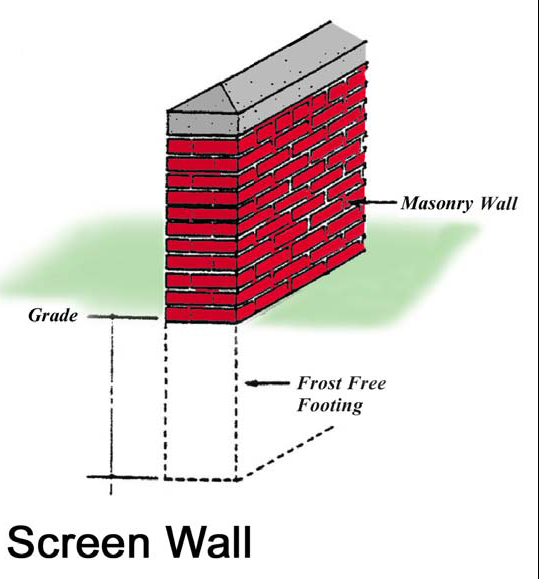
Walls shall be constructed of masonry materials that are architecturally compatible with the principal building facade; such as face brick, decorative block, or formed concrete with a textured surface. Walls shall meet all requirements of the State Construction Code enforced by the City.
Fences shall consist of durable wood, vinyl, metal or other materials commonly used in conventional fence construction. Wood fences shall be constructed of redwood, cedar, or No. 1 pressure-treated wood. Fence posts shall be sunk in the soil at least three (3) feet.
Electrified fences, or any fence upon which spikes, nails, razor wire or other sharp or pointed instruments or security materials are fixed, attached or placed shall be prohibited. Barbed wire shall be prohibited, except in industrial districts where the Planning Commission may approve the use of barbed wire at the top of a fence extending over the property to be enclosed.
B.
Corner Clearance.
Walls and fences shall comply with the unobstructed sight distance standards of Section 9.304 (Corner Clearance Areas).
C.
Finished Appearance.
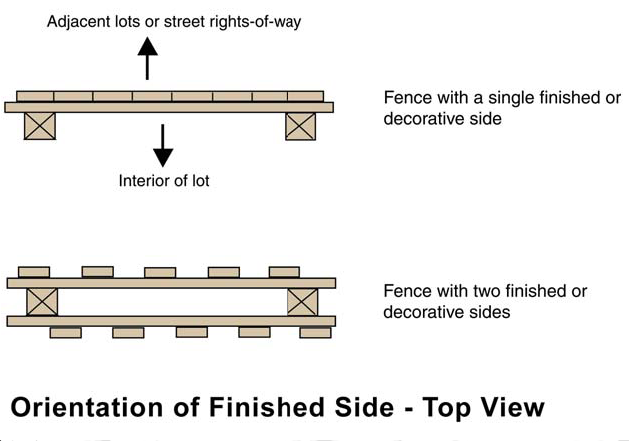
Where one side of a fence or wall has a more finished appearance than the other, the side with the more finished appearance shall face the exterior of the lot.
D.
Wall or Fence Height and Location Standards.
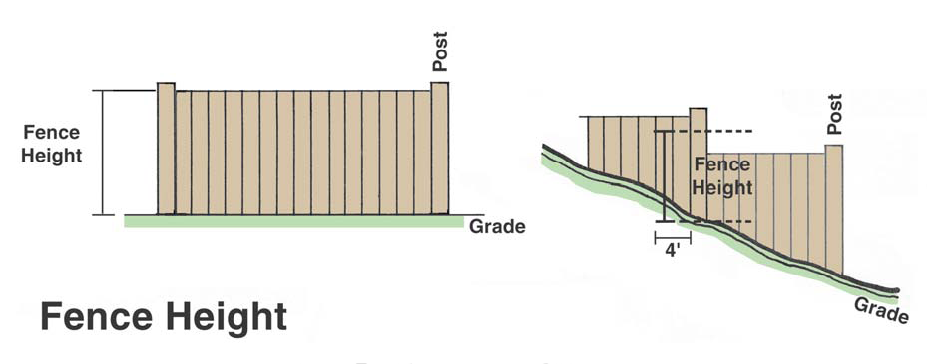
The height of the wall or fence shall be measured from ground level adjacent to the wall or fence to its highest point. Fill shall not be permitted for the purpose of achieving a higher fence than otherwise would be permitted. Where the grade is not level, the maximum fence height shall be equal to the average fence height within four (4) feet of any fence-post.
Schedule of Wall and Fence Requirements
E.
Fence and Wall Maintenance.
Fences and walls shall be maintained in good condition, so as not to endanger life or property. Such maintenance shall be the responsibility of the owner of the property on which the fence or wall is located. Rotten, crumbled or broken components shall be replaced, repaired, or removed, and exposed surfaces shall be painted, stained, or similarly treated.
Any fence or wall which, through lack of repair, type of construction, or otherwise, imperils life or property, shall be deemed a nuisance, and the Building Official shall notify the owner of the property upon which the fence or wall is located of the existence of such a nuisance. Such nuisances shall be abated within ten (10) days after receipt of such notice.
F.
Prohibited Fences and Walls.
Electrified fences, or any fence upon which spikes, nails, or other sharp or pointed instruments are fixed, attached or placed shall not be permitted. Razor wire, barbed wire and similar security materials shall be prohibited, except in industrial districts, where the Planning Commission may approve the use of such materials for security purposes as part of site plan review, provided that such materials are securely attached at the top of a fence extending over the property to be enclosed, and are not located within any required yard area.
Section 15.02 - Permitted Modifications to Standards.
In consideration of the overall site design, existing site conditions and impact of a specific use, and in consideration of the amount of existing plant material or other screening elements to be retained on the site, the Planning Commission may approve modifications to the specific standards of this Article, provided that the alternative is in keeping with the intent of this Article and the purpose of this Ordinance.
A.
Conditions.
In determining whether a modification is appropriate, the Planning Commission shall consider the following:
1.
Where unique site conditions (such as steep slopes and other topographic features, utility easements, or inadequate setback area) would hinder compliance with the strict standards of this Article, the Planning Commission may permit the substitution of any required fence or wall with a greenbelt or other landscaping in compliance with Article 14 (Landscaping and Screening), or combination of a wall or fence with greenbelt plantings.
2.
Parking, vehicular circulation, or land use are such that the required fence or wall would not enhance the site or result in the desired screening effect.
3.
The public benefits intended by strict application of these regulations could be better achieved with a plan that varies from the strict requirements of the Ordinance, provided that the alternative design would produce substantially the same results in terms of screening, durability, and permanence.
4.
Where an existing building is undergoing redevelopment, improvement, a change in use, or expansion, the proposed improvements are in reasonable proportion to the size and configuration of the site, and the scale of proposed building improvements, expansions or other site improvements.
B.
Review Committee Recommendation.
All proposed modifications or alternative designs shall be subject to a review and recommendation from any review committee(s), prior to Planning Commission consideration.
Section 15.03 - Obscuring Walls and Fences.
Where required by this Article or Ordinance, obscuring walls and fences shall be subject to the following requirements:
A.
Materials and Design Requirements.
An obscuring wall or fence is one where more than sixty percent (60%) of the vertical surface is opaque to obstruct vision or prevent observation of activities enclosed in the fence:
1.
All obscuring walls shall be constructed of a solid, un-pierced masonry material.
2.
Surface areas of any obscuring wall facing a residential district shall be constructed of brick, decorative block, formed concrete with a textured surface, or similar material compatible with the principal buildings in the residential district.
3.
All obscuring walls shall be erected on a concrete foundation approved by the Building Official.
4.
Solid (obscuring) fences shall be constructed of durable wood or vinyl. Chain link fences shall not be permitted for screening purposes.
B.
Location.
Required obscuring walls and fences shall be located inside and adjacent to the lot line. Where underground utilities or other circumstances interfere, the Planning Commission may approve an alternative location for the wall or fence.
C.
Obscuring Wall Requirements by District or Use.
1.
Conflicting uses. An obscuring wall or fence shall be provided where the following uses and districts abut a lot in a residential district:
• Business Districts (B-1, B-2, B-3)
• Industrial Districts (M-1 and M-2)
• Off-street parking
• Utility buildings and substations
2.
Parking lot screening. For the following uses and districts, an obscuring wall or fence shall be provided along the edges of parking lots:
• General Business District (B-3)
3.
Screening of automobile storage or dismantling yards, outdoor storage areas, recycling collection facilities, and similar uses. Such uses shall not be established or maintained unless an obscuring wall or fence has been erected and maintained around the perimeter of the lands on which such use is conducted. The wall or fence shall conform with all requirements of this Article and Ordinance, and the height of any materials stored or kept within the enclosed area shall not exceed the height of the wall or fence.
Section 15.04 - Residential Development Entranceway Structures.
Residential development entranceway structures that identify the entrance to a single family subdivision, condominium, or multiple family development (such as walls, columns or gates) shall be permitted in the required setback area, subject to the following:
1.
Entranceway structures shall not exceed five (5) feet in height and 48 square feet in area.
2.
Entranceway structures shall not restrict emergency vehicle access, and shall not be located in the existing or planned right-of-way.
3.
Approval of the Building Official and issuance of a building permit shall be required prior to construction.
Section 15.05 - Natural Barriers.
Any bush, hedgerow, shrub, trees, or any living green barrier will not be considered a fence. However, any natural or artificial barrier that prevents visibility for vehicular traffic, encroaches on sidewalks, or endangers the safety of children shall be prohibited.
Section 15.06 - Existing Fences.
Fences lawfully erected prior to the effective date of adoption or amendment of this Ordinance that do not conform with the provisions of this Article shall be considered nonconforming structures subject to the provisions of Article 22 (Nonconformities).
Section 15.07 - Permits Required.
Construction, alteration, and relocation of fences shall be subject to approval of a zoning permit by the Building Department. Construction and alteration of walls shall be subject to approval of appropriate building permits in accordance with the State Construction Code enforced by the City. It shall be unlawful for any person to construct or cause to be constructed any fence or wall upon any property within the city limits without having first obtained all necessary permits.
ILLUSTRATIONS