
Riverview City Zoning Code
ARTICLE 6
B-1, B-2, B-3 AND FS DISTRICTS1
Editor's note— Ord. No. 676, art. I, adopted July 20, 2015, changed the title of Article 6 from "B-1, B-2, and B-3, Business Districts" to "B-1, B-2, B-3 and FS Districts."
Section 6.01 - Local Business (B-1) District.
A.
Intent.
The Local Business (B-1) District is hereby established to provide for local service and convenience shopping facilities to meet the day-to-day needs of persons residing in nearby residential areas. It is the intent of the Local Business District to encourage concentrations of complementary businesses in a manner harmonious with the character of the neighborhood and surrounding uses, and to the mutual advantage of neighborhood residents and district merchants. Business establishments should be retail or service in character, and should deal directly with customers with all goods produced on the premises and sold at retail on the premises where produced. The intended potential customer base for these uses would be the residential neighborhoods immediately adjacent to the district.
Uses which would create hazards, offensive and loud noises, vibration, smoke, glare, heavy traffic or late hours of operation are prohibited, and building sizes for permitted uses are limited to promote such appropriately scaled business development in the district. Automotive-related services and other uses that would typically interfere with the continuity of retail frontage, hinder pedestrian circulation, disrupt the functioning of this district, or create hazards, offensive or loud noises, vibration, smoke, glare or heavy traffic shall also be prohibited.
B.
Principal Uses and Structures.
In the B-1 District, no structure or land shall be used, erected, or altered, in whole or in part, except for one (1) or more of the following principal permitted uses:
1.
Banks, credit unions, savings and loan associations, and similar financial-related uses.
2.
Barber shops, beauty salons, nail care, and similar personal service establishments.
3.
Generally recognized retail businesses which supply commodities on the premises; such as but not limited to groceries, meats, dairy products, baked goods or other foods, drugs, dry goods, clothing, and notions or hardware.
4.
Medical, dental, osteopathic, chiropractic, and physical therapy offices and clinics. Therapeutic massage shall be permitted as a principal or accessory use, subject to the standards of Section 8.320 (Therapeutic Massage).
5.
Offices for professional, executive, governmental, or administrative uses; accountants, writers, attorneys, realtors, architects, engineers, planners, and similar professions and occupations.
6.
Pharmacies or apothecary shops, or optical service establishments.
7.
Printing and copy centers.
8.
Restaurants, bakeries, coffeehouses, delicatessens, and similar places serving food or beverages, subject to the standards of Section 8.316 (Restaurants).
9.
Self-service laundries and dry-cleaners. Central dry cleaning plants serving more than one (1) retail outlet shall be prohibited.
10.
Studios and showrooms, for painters, photographers, decorators, dressmakers, artists, upholsterers, tailors, taxidermists, and similar service establishments that require a retail adjunct.
11.
Workshops and showrooms for the repair or service of bicycles, electronics, small appliances, furniture, shoes, and similar items.
12.
Other uses similar to the above uses, as determined by the Planning Commission.
C.
Accessory Uses and Structures.
The following uses and structures shall be permitted accessory to principal uses in the B-1 District, subject to the provisions of Section 24.03 (Uses):
1.
Signs, subject to the provisions of Article 17 (Signs).
2.
Off-street parking, subject to the provisions of Article 13 (Streets and Off-Street Parking).
3.
Indoor storage of goods or material normally incidental to a principal use, subject to the standards of Section 8.410 (Industrial Uses in Commercial Districts).
4.
Other accessory structures and uses customarily incident to the principal uses permitted in the B-1 District.
D.
Special Land Uses.
The following uses may be permitted in the B-1 District by the Planning Commission, subject to the conditions specified for each use; review and approval of the site plan by the Planning Commission; any special conditions imposed by the Planning Commission to fulfill the purposes of this Ordinance; and the procedures and requirements set forth in Section 20.02 (Special Land Uses):
1.
Child or adult day care centers, child caring institutions, and nursery schools, subject to the standards of Section 8.103 (Child Care Center, Group Day Care, Nursery Schools, Day Nurseries, and Pre-schools).
2.
Funeral homes, mortuary establishments, and crematoriums, subject to the standards of Section 8.307 (Funeral Homes, Mortuaries and Crematoriums).
3.
Outdoor eating areas and sidewalk cafes may be permitted accessory to a principal restaurant use, subject to the standards of Section 8.313 (Outdoor Eating Areas and Sidewalk Cafes).
4.
Public utility and service buildings and uses (without storage yards), subject to the standards of Section 8.205 (Public Utility and Essential Service Structures and Uses).
5.
Veterinary clinics and hospitals, subject to the standards of Section 8.318 (Veterinary Clinics and Hospitals).
6.
Adult-use cannabis retailers, subject to the conditions and standards set forth in Article XIV "Cannabis Businesses", in Chapter 14 "Businesses" of the Code of Ordinances.
7.
Other uses similar to the above uses, as determined by the Planning Commission.
(Ord. No. 740, art. I, 3-20-2023)
Section 6.02 - Community Business (B-2) District.
A.
Intent.
The Community Business (B-2) District is hereby established to permit a wider range of business and entertainment activities than those permitted in the Local Business (B-1) District, and are generally characterized by an integrated or planned cluster of establishments served by common parking areas and generating large volumes of vehicular and pedestrian traffic. The intended potential customer base for uses in this District is the entire City, plus people in transit through the City. Business establishments should be retail or service in character, and should deal directly with customers with all goods produced on the premises and sold at retail on the premises where produced.
Because of the types of uses permitted in the Community Business (B-2) District, detailed attention must be focused on relationships with adjacent areas, site layout, building design, and vehicular and pedestrian circulation. Accordingly, development in the Community Business (B-2) District shall be compatible in design with the overall City character, designed in coordination with adjoining sites, buffered from or located away from residential areas, and served by major streets or thoroughfares.
B.
Principal Uses and Structures.
In the B-2 District, no structure or land shall be used, erected, or altered, in whole or in part, except for one (1) or more of the following principal permitted uses:
1.
Any retail business whose principal activity is the sale of merchandise in an enclosed building.
2.
Banks, credit unions, savings and loan associations, and similar financial-related uses.
3.
Barber shops, beauty salons, nail care, and similar personal service establishments.
4.
Institutional uses [as defined in Section 25.02 (Definitions)], subject to the standards of Section 8.203 (Institutional Uses).
5.
Medical, dental, osteopathic, chiropractic, and physical therapy offices and clinics. Therapeutic massage shall be permitted as a principal or accessory use, subject to the standards of Section 8.320 (Therapeutic Massage).
6.
Offices for professional, executive, governmental, or administrative uses; accountants, writers, attorneys, realtors, architects, engineers, planners, and similar professions and occupations.
7.
Pharmacies or apothecary shops, or optical service establishments.
8.
Printing and copy centers.
9.
Restaurants, bakeries, coffeehouses, delicatessens, and similar places serving food or beverages, subject to the standards of Section 8.316 (Restaurants). Outdoor eating areas and sidewalk cafes may be permitted accessory to a principal restaurant use, subject to the standards of Section 8.313 (Outdoor Eating Areas and Sidewalk Cafes).
10.
Self-service laundries and dry-cleaners. Central dry cleaning plants serving more than one (1) retail outlet shall be prohibited.
11.
Studios and showrooms for painters, photographers, decorators, dressmakers, artists, upholsterers, tailors, taxidermists, and similar service establishments that require a retail adjunct.
12.
Workshops and showrooms for the repair or service of bicycles, electronics, small appliances, furniture, shoes, and similar items.
13.
Other uses similar to the above uses, as determined by the Planning Commission.
C.
Accessory Uses and Structures.
The following uses and structures shall be permitted accessory to principal uses in the B-2 District, subject to the provisions of Section 24.03 (Uses):
1.
Signs, subject to the provisions of Article 17 (Signs).
2.
Off-street parking, subject to the provisions of Article 13 (Streets and Off-Street Parking).
3.
Indoor storage of goods or material normally incidental to a principal use, subject to the standards of Section 8.410 (Industrial Uses in Commercial Districts).
4.
Other accessory structures and uses customarily incident to the principal uses permitted in the B-2 District.
D.
Special Land Uses.
The following uses may be permitted in the B-2 District by the Planning Commission, subject to the conditions specified for each use; review and approval of the site plan by the Planning Commission; any special conditions imposed by the Planning Commission to fulfill the purposes of this Ordinance; and the procedures and requirements set forth in Section 20.02 (Special Land Uses):
1.
Child or adult day care centers, child caring institutions, and nursery schools, subject to the standards of Section 8.103 (Child Care Center, Group Day Care, Nursery Schools, Day Nurseries, and Pre-schools).
2.
Drive-in or drive-through facilities shall be permitted accessory to a principal use in the B-2 District, subject to the standards of Section 8.306 (Drive-in or Drive-through Lanes, Facilities or Establishments).
3.
Fueling (gasoline) stations for automobiles, trucks and other motor vehicles, subject to the standards of Section 8.304 (Vehicle Repair Garages, Service Centers, or Fueling (Gas) Stations).
4.
Funeral homes and mortuary establishments, subject to the standards of Section 8.307 (Funeral Homes, Mortuaries and Crematoriums).
5.
Hotels, subject to the standards of Section 8.311 (Hotels and Motels).
6.
Private gymnasiums, health clubs and fitness centers, subject to the standards of Section 8.315 (Recreation, Indoor and Outdoor).
7.
Public utility and service buildings and uses (without storage yards), subject to the standards of Section 8.205 (Public Utility and Essential Service Structures and Uses).
8.
Veterinary clinics and hospitals, subject to the standards of Section 8.318 (Veterinary Clinics and Hospitals).
9.
Adult-use cannabis retailers, subject to the conditions and standards set forth in Article XIV "Cannabis Businesses", in Chapter 14 "Businesses" of the Code of Ordinances.
10.
Other uses similar to the above uses, as determined by the Planning Commission.
(Ord. No. 740, art. I, 3-20-2023)
Section 6.03 - General Business (B-3) District.
A.
Intent.
The General Business (B-3) District is hereby established to provide sites for more diversified business types incompatible with pedestrian traffic and are often located so as to serve the passerby traffic. The intended potential customer base for permitted uses in this district would be the entire City, plus surrounding communities in the southeastern Michigan region. This district is further intended to provide opportunities for automobile-related businesses, uses that generate large traffic volumes or require substantial off-street parking facilities, and other uses incompatible with the pedestrian-oriented character, scale and mix of permitted uses in the B-1 or B-2 Districts. Accordingly, this district should generally abut major streets and thoroughfares to prevent potential nuisances and use conflicts.
Because of the types of uses permitted in the General Business District, detailed attention must be focused on relationships with adjacent areas, site layout, building design, and vehicular and pedestrian circulation. Development in the district shall be compatible in design with the overall City character, designed in coordination with adjoining sites, buffered from or located away from residential areas, and served by major streets or thoroughfares.
B.
Principal Uses and Structures.
In the B-3 District, no structure or land shall be used, erected, or altered, in whole or in part, except for one (1) or more of the following principal permitted uses:
1.
Any retail business whose principal activity is the sale of merchandise in an enclosed building.
2.
Banks, credit unions, savings and loan associations, and similar financial-related uses.
3.
Barber shops, beauty salons, nail care, and similar personal service establishments.
4.
Bus passenger stations.
5.
Christmas tree lots and other seasonal sales operations, subject to the standards of Section 8.503 (Temporary Structures and Uses).
6.
Indoor sales or showroom for automobiles, trucks, or other motor vehicles, boats, trailers, recreational vehicles or similar items.
7.
Medical, dental, osteopathic, chiropractic, and physical therapy offices and clinics. Therapeutic massage shall be permitted as a principal or accessory use, subject to the standards of Section 8.320 (Therapeutic Massage).
8.
Offices for professional, executive, governmental, or administrative uses; accountants, writers, attorneys, realtors, architects, engineers, planners, and similar professions and occupations.
9.
Pharmacies or apothecary shops, or optical service establishments.
10.
Printing and copy centers.
11.
Private gymnasiums, health clubs and fitness centers, subject to the standards of Section 8.315 (Recreation, Indoor and Outdoor).
12.
Restaurants, bakeries, coffeehouses, delicatessens, and similar places serving food or beverages, subject to the standards of Section 8.316 (Restaurants). Outdoor eating areas and sidewalk cafes may be permitted accessory to a principal restaurant use, subject to the standards of Section 8.313 (Outdoor Eating Areas and Sidewalk Cafes).
13.
Self-service laundries and dry-cleaners. Central dry cleaning plants serving more than one (1) retail outlet shall be prohibited.
14.
Studios and showrooms for painters, photographers, decorators, dressmakers, artists, upholsterers, tailors, taxidermists, and similar service establishments that require a retail adjunct.
15.
Workshops and showrooms for the repair or service of bicycles, electronics, small appliances, furniture, shoes, and similar items.
16.
Other uses similar to the above uses, as determined by the Planning Commission.
C.
Accessory Uses and Structures.
The following uses and structures shall be permitted accessory to principal uses in the B-3 District, subject to the provisions of Section 24.03 (Uses):
1.
Signs, subject to the provisions of Article 17 (Signs).
2.
Off-street parking, subject to the provisions of Article 13 (Streets and Off-Street Parking).
3.
Indoor storage of goods or material normally incidental to a principal use, subject to the standards of Section 8.410 (Industrial Uses in Commercial Districts).
4.
Other accessory structures and uses customarily incident to the principal uses permitted in the B-3 District.
D.
Special Land Uses.
The following uses may be permitted in the B-3 District by the Planning Commission, subject to the conditions specified for each use; review and approval of the site plan by the Planning Commission; any special conditions imposed by the Planning Commission to fulfill the purposes of this Ordinance; and the procedures and requirements set forth in Section 20.02 (Special Land Uses):
1.
Amusement arcades, subject to the standards of Section 8.302 (Amusement Arcades).
2.
Automobile car wash, subject to the standards of Section 8.305 (Car Washes).
3.
Automobile service stations, subject to the standards of Section 8.304 (Vehicle Repair Garages, Service Centers, or Fueling (Gas) Stations).
4.
Bars, cocktail lounges, taverns, brewpubs, night clubs, and similar establishments, subject to the standards of Section 8.317 (Bar and/or Lounge).
5.
Child or adult day care centers, child caring institutions, and nursery schools, subject to the standards of Section 8.103 (Child Care Center, Group Day Care, Nursery Schools, Day Nurseries, and Pre-schools).
6.
Drive-in or drive-through facilities shall be permitted accessory to a principal use in the B-3 District, subject to the standards of Section 8.306 (Drive-in or Drive-through Lanes, Facilities or Establishments).
7.
Fueling (gasoline) stations for automobiles, trucks and other motor vehicles, subject to the standards of Section 8.304 (Vehicle Repair Garages, Service Centers, or Fueling (Gas) Stations).
8.
Funeral homes and mortuary establishments, subject to the standards of Section 8.307 (Funeral Homes, Mortuaries and Crematoriums).
9.
Hotels and motels, subject to the standards of Section 8.311 (Hotels and Motels).
10.
Indoor commercial recreation establishments, such as bowling alleys, pool or billiard parlors, archery or tennis clubs, and similar recreational activities located entirely within an enclosed building, subject to the standards of Section 8.315 (Recreation, Indoor and Outdoor).
11.
Institutional uses [as defined in Section 25.02 (Definitions)], subject to the standards of Section 8.203 (Institutional Uses).
12.
Open air businesses not otherwise specified in this Article, subject to the standards of Section 8.312 (Open Air Businesses).
13.
Outdoor commercial recreational establishments, such as children's amusement parks, miniature golf courses, and similar open air recreational activities, subject to the standards of Section 8.315 (Recreation, Indoor and Outdoor).
14.
Outdoor sales or display areas, subject to the standards of Section 8.303 (Outdoor Sales or Display Areas).
15.
Pawnshops and dealers of secondhand merchandise.
16.
Plant materials nurseries for the retail sale of plant materials, including fruits or vegetables, greenhouses and garden centers, subject to the standards of Section 8.310 (Greenhouses, Nurseries, and Garden Centers). Accessory sales of lawn furniture, playground equipment, garden supplies, and similar items shall be permitted, subject to the standards of Section 8.303 (Outdoor Sales or Display Areas).
17.
Public utility and service buildings and uses (without storage yards), subject to the standards of Section 8.205 (Public Utility and Essential Service Structures and Uses).
18.
Veterinary clinics and hospitals, subject to the standards of Section 8.318 (Veterinary Clinics and Hospitals).
19.
Adult-use cannabis retailers, subject to the conditions and standards set forth in Article XIV "Cannabis Businesses", in Chapter 14 "Businesses" of the Code of Ordinances.
20.
Other uses similar to the above uses, as determined by the Planning Commission.
(Ord. No. 684, art. I, 6-20-2016; Ord. No. 740, art. I, 3-20-2023)
Section 6.04 - Fort Street (FS) District.
A.
Intent.
The Fort Street (FS) District is hereby established to promote a flexible mix of land uses, both horizontally and vertically, with an emphasis on retail, office, and high-density residential. The FS District does not prohibit existing permitted uses, but rather encourages quality mixed-use developments, high-quality architecture, gateway features, and pedestrian-friendly design to enhance the Fort Street streetscape. The FS District utilizes form-based provisions and places greater emphasis on physical development and building form to create a sense of place and contribute to the overall image of the City.
The FS District recognizes the importance of Fort Street as both a gateway into and the main corridor through the City and is designed to implement the goals of the Fort Street Strategic Vision. Specifically, the FS District will do the following:
1.
Create a sense of place and an identity for Riverview through unique streetscape elements, pedestrian-oriented design, attractive architecture and pedestrian spaces;
2.
Improve the economic development potential of the entire district by permitting mixed-use development in both horizontal and vertical forms and utilize place-making strategies to promote job creation;
3.
Limit the impact of off-street parking areas which interrupt the flow and consistency of the "street wall." Orient building entrances and storefronts to the street to add visual interest, increase pedestrian traffic, and create memorable outdoor spaces;
4.
Visually distinguish Fort Street from the rest of Riverview by encouraging full use of property, consistency, and density while respecting adjacent single-family residential areas;
5.
Encourage attractive attached single-family and multi-family residential developments that promote traditional urban form and walkability and support adjacent commercial and office uses;
6.
Improve public health, safety and welfare by reducing the number of traffic hazards, reducing the number of pedestrian and vehicular conflict points, and improving emergency vehicle access and circulation. Encourage collaboration between adjacent property owners in the form of shared access and lot combinations;
7.
Give the Planning Commission flexibility in waiving strict dimensional requirements if such waivers promote quality development.
B.
FS Zones.
The Fort Street District is further divided into three (3) separate zones: Fort Street - East, Fort Street - West and Fort Street - Civic Park. The purpose of separating the FS District into zones is to allow use and development regulations to be adapted to the unique conditions present in each zone. Although each zone is unique, combined, they are intended to create a cohesive Fort Street District. The intent of each FS Zone is described as follows:
1.
Fort Street - East (FS-E). The intent of the FS-E Zone is to create an active, walkable corridor through a strong mix of commercial, office and residential uses. Due to the shallow and narrow lots along the east side of Fort Street, quality mixed-use development within this zone relies heavily on coordination between adjacent property owners in terms of shared parking, shared access, and pedestrian amenities. Lot combinations are highly encouraged for new developments to create larger-scale developments.
2.
Fort Street - West (FS-W). The intent of the FS-W Zone is similar to that of the FS-E Zone in that it encourages vertical and mixed commercial, office and residential developments. However, due to the presence of wider and deeper lots, the FS-W Zone is more capable of accommodating larger-scale and taller developments. Coordination between adjacent property owners is highly encouraged in terms of shared parking, shared access, and pedestrian amenities.
3.
Fort Street - Civic Park (FS-CP). The intent of the FS-CP Zone is to accommodate two-family, townhouse and multiple-family neighborhoods, as well as associated neighborhood commercial uses, which provide views to and access to Young Patriots Park and the Civic Center complex. This zone is further intended to provide pedestrian connectivity between adjacent residential developments and to commercial/office uses along Fort Street. Note that existing M-1 within the FS-CP Zone will be considered legally conforming and may be permitted to expand. However, it is not the intent of the FS-CP Zone to permit new industrial uses.
C.
Fort Street District Boundaries.
The boundaries of the Fort Street District shall be that which is displayed on the Official Zoning Map and as illustrated in the figure below:
Figure 1. Fort Street District and Zone Boundaries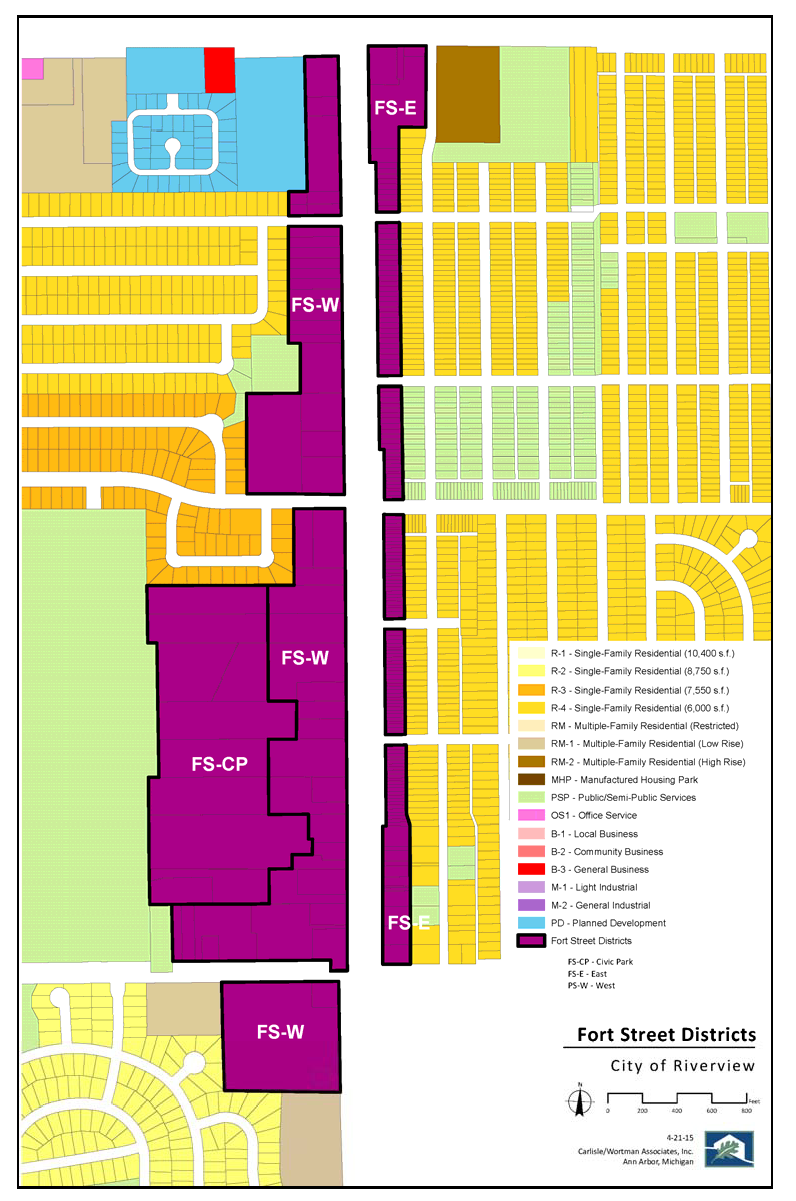
D.
Applicability.
1.
The requirements of the FS District shall apply to any new use, structure, or building addition that requires full site plan approval pursuant to Section 20.01, with the following exceptions:
a.
Continuation of an existing use permitted at the date of adoption of this Ordinance, which shall be granted conforming land-use status, pursuant to Article 22.
b.
Uses, structures, structural expansions or other site alterations that can be accommodated through the administrative site plan review process, as follows:
(1)
Changes of use within an existing structure provided the new use is permitted.
(2)
Minor building modifications, landscaping changes, decorative fencing not exceeding thirty-six (36) inches in height, or parking lot improvements that do not increase the number of existing parking spaces.
(3)
An increase in the existing floor area of a building of up to twenty-five hundred (2,500) square feet.
(4)
Other projects eligible for administrative review, pursuant to Section 20.01(C).
c.
Where expansion to an existing use or structure exceeds twenty-five hundred (2,500) square feet, all of the FS standards shall apply, with the possible exceptions as noted in Subsection (D)2.
2.
The Planning Commission shall have the authority to waive or modify the standards of this Article during the site plan review stage upon consideration of the following:
a.
The standards provided herein would prevent reasonable development of the site due to the size of the parcel, limited circulation or right-of-way, site constraints due to existing structures on-site, or the location of utilities.
b.
Demonstration by the applicant that the site design will improve pedestrian features beyond the requirements of this Article.
c.
Demonstration by the applicant that architectural or design elements not otherwise permitted in the FS District would enhance the overall economic potential of the District and meet the overall intent of the District.
3.
Where the standards of this Article conflict with other articles of the Zoning Ordinance, the standards of this Article shall take precedence.
E.
Uses Permitted.
Permitted uses within the Fort Street District shall be restricted to those listed as either permitted principal, special or accessory uses in the Use Matrix. In addition to the development and design standards of this District, permitted uses may also be subject to the special Fort Street use standards of Subsection (F) and the specific use standards of Article 8. Where the standards of this article conflict with other standards of the Zoning Ordinance, this article shall take precedence.
The following standards apply to all uses within the Use Matrix:
1.
Certain uses shall be subject to the additional use standards contained in Section (F) and Article 8, as indicated within the Use Matrix.
2.
Uses not listed in the Use Matrix shall be considered prohibited. However, other uses similar to those permitted in the Use Matrix may be permitted as a special use. In determining that a use is similar, the Planning Commission shall find that the use will meet the intent of the FS District, the Special Land Use standards of section 20.02 and, if necessary, the specific use standards of Article 8.
3.
Land uses existing at the time of adoption of this Article shall be granted conforming land-use status and shall not be burdened with customary non-conforming status.
4.
Special land uses permitted within the Use Matrix shall be subject to the specific use standards of Article 8 and the procedural standards of Section 20.02.
Table 1. Fort Street District Use Matrix
F.
FS Use Standards.
1.
Single-family attached and multi-family residential uses shall meet the specific use requirements of Section 8.106 and the requirements of Subsection (J)7.
2.
Mixed-use residential developments shall meet the architectural and design standards of Subsection (J)8.
3.
In addition to the specific use standards of Section 8.305, automobile car washes within the FS District shall comply with the following standards:
a.
Service bays of self-service and automatic car washes shall not be located on the front façade.
b.
Vacuuming activities shall be limited to the side or rear yard.
c.
Car washes shall meet the transparency requirements of Subsection (J)8. Clear windows along the front façade could fulfill the transparency requirement.
Figure 2. Example of Auto Wash Transparency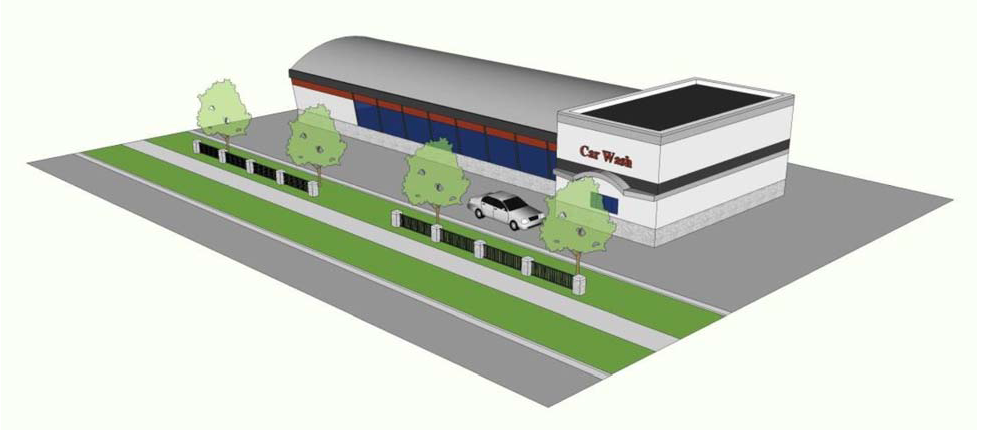
4.
In addition to the specific use standards of Section 8.304, automobile repair garages, service centers and fueling stations shall comply with the following standards:
a.
Vehicular service bays and fuel pumping islands shall be limited to the rear and side yards only.
b.
Outdoor storage accessory to repair garages, such as the storage of disabled or inoperable vehicles or those awaiting pickup, may be permitted if the storage area is located in the rear yard and screened from view from the public right-of-way in accordance with Subsection (J)6.
c.
No more than fifty percent (50%) of a site's linear frontage adjacent to Fort Street shall be occupied by a parking area and/or pumping islands, which shall be screened from the public right-of-way in accordance with Subsection (J)6.
d.
A convenience store may be permitted with a fueling station. The convenience store portion of a fueling station shall meet the setbacks of Subsection (G) and the architecture and design standards of Subsection (J)8.
e.
Pump-island canopies shall be of high architectural quality and reflect the context of the Fort Street District.
Figure 3. Fueling Station Siting Standards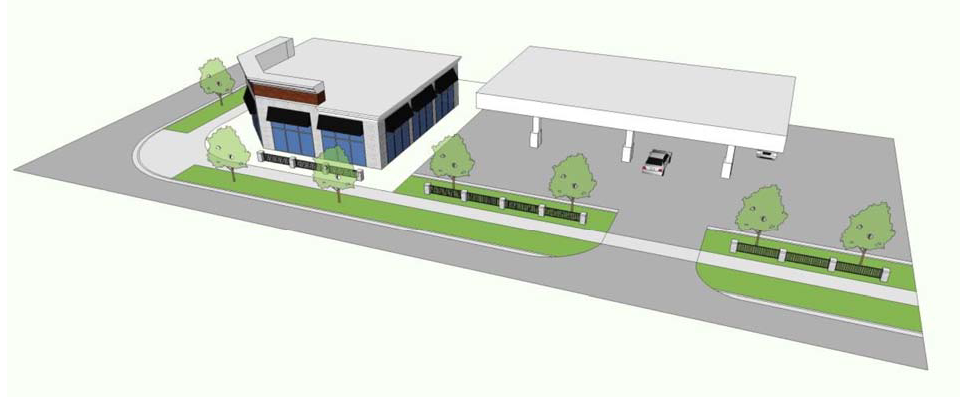
5.
In addition to the specific use standards of Section 8.205, public utility uses shall, to the extent practicable, be fully or partially enclosed and shall have an exterior appearance harmonious with the general character of the neighborhood, including architectural treatment, landscaping, screening and/or fencing.
G.
Development Regulations.
Buildings and sites within the Fort Street District shall be developed in a manner which contributes to the character of the corridor by maximizing the value of property and creating a traditional "street wall." Area, height and placement requirements for each zone of the FS District are provided in the following table, and further provided in Article 9, Schedule of Regulations.
The Planning Commission shall have the authority to waive or modify development regulations per Subsection (D)2.
Table 2. Area, Height and Placement Requirements
H.
Footnotes to Development Regulations.
1.
In cases where minimum setbacks interfere or conflict with applicable building or fire codes, the building and fire codes shall take precedence.
2.
The first floor of residential structures shall be at least ten (10) feet in height. The first floor of commercial structures shall be at least twelve (12) feet in height. The height of a first floor shall be measured from floor level to the underside of the ceiling.
3.
Buildings in the FS-W and FS-CP Zones may be permitted additional building height per the bonus provisions of Subsection (I).
4.
The Planning Commission may permit a single row of parking or an access aisle within the front yard setback per Subsection (J)1.
I.
Bonus Provisions.
There are instances where it is in the best interests of the private landowner and the City of Riverview to exceed or fall short of the standards of this Chapter. In such instances, the City's interests in upholding its standards can be offset by the provision of certain exemplary amenities which will benefit the Fort Street District as a whole. This system provides regulatory incentives while ensuring that modifications are not made solely and exclusively for the private benefit of the landowner.
Buildings within the FS District are eligible for a height bonus and/or a reduction in numerical parking requirements where certain eligibility criteria are met:
1.
Bonus Height Eligibility Criteria.
Buildings within the FS-W Zone are eligible for a height bonus of up to one (1) additional story and/or fifteen (15) feet and buildings within the FS-CP Zone are eligible for a height bonus of up to two (2) additional stories and/or thirty (30) feet where two (2) or more of the following criteria are met. Additional stories shall be stepped back from the top story permitted by right in order to reduce the appearance of excessive height.
a.
A mixed-use building that provides residential dwelling units above first-floor commercial where a minimum of fifty percent (50%) of the building's floor area is residential;
b.
Dedication of an improved public plaza or open space which ties into the District's main pedestrian circulation system. Any on-site or corner pedestrian areas shall use a variety of design elements including, but not limited to, decorative lighting, landscaping, pavement, arches and furnishings;
c.
An assemblage of parcels in conjunction with a development as approved by the Planning Commission;
d.
A covered bicycle rack comprising at least five (5) stalls located adjacent to a building's main pedestrian entrance. Bicycle racks shall not encroach into pedestrian walkways or vehicle areas;
e.
Installation of streetscape furnishings, including street trees, tree grates, decorative lighting, or street furniture. Street furniture shall include, but is not limited to:
• A permanently mounted seating fixture constructed of decorative metal;
• A permanently reserved planting bed with defined, durable edges;
f.
Through-block pedestrian connections providing a continuous walkway accessible to the public (covered or open);
g.
Other public amenities as deemed appropriate by the Planning Commission.
2.
Parking Reduction Eligibility Criteria.
Developments within all zones are eligible for up to a twenty percent (20%) reduction in numerical parking requirements where one (1) or more of the following criteria are met:
a.
A shared parking/shared site access arrangement with adjacent properties. Shared parking arrangements shall meet the standards of Subsection (J)1.
b.
Parking area is provided entirely within the rear yard, screened from the right-of-way.
c.
An assemblage of parcels in conjunction with a development as approved by the Planning Commission.
d.
Other site improvements as deemed appropriate by the Planning Commission.
J.
Design Standards.
In addition to complying with the form-oriented regulations set forth in this Article, all proposed developments in the FS District shall comply with the design standards set forth herein:
1.
Vehicular Parking. Parking lots shall be permitted only in side and rear yards as follows:
a.
Off-street parking is required for all uses and shall comply with the numerical parking requirements pursuant to Section 13.02 of the Zoning Ordinance. Certain projects may be eligible for a parking reduction per Subsection (I)2.
b.
When located in a side yard, no more than fifty percent (50%) of the total site's linear feet along the required building line shall be occupied by parking.
c.
For a corner lot, the cumulative total of both frontages occupied by parking shall be no more than fifty percent (50%) of the total site's linear feet along both frontages; the building shall be located at the corner of the lot adjacent to the intersection.
d.
Where it is determined that there are site constraints regarding the size of parcel, circulation, limited right-of-way, or when it is deemed necessary for promoting best practice access-management techniques, the Planning Commission may permit a single row of parking or an access aisle within the front yard setback in conjunction with an increased front-yard setback. The parking and maneuvering lane shall meet the standards of Article 13, Off-Street Parking. There shall be an adequate and marked pedestrian walkway through the parking area connecting the street sidewalk to the front entrance in accordance with Subsection (J)5.
e.
Alley networks shall be utilized to encourage the use of rear yard parking and minimize the amount of new curb cuts.
f.
All off-street parking areas shall be screened or buffered in a matter that separates the parking areas as seen from the public right-of-way or from residentially zoned or used property. Screening shall meet the requirements set forth in Subsection (J)6.
2.
Access Management and Shared Parking.
a.
The number of stand-alone commercial driveways within the FS District shall be limited in order to ensure pedestrian and vehicular safety. However, each property shall provide reasonable access for regular traffic and emergency vehicles while preserving traffic operations and safety along Fort Street. New developments shall adhere to best practices for access management in order to reduce the number of traffic hazards, reduce the number of pedestrian and vehicular conflict points, and improve emergency vehicle access and circulation.
b.
A means of direct or indirect access shall be provided for each separately owned parcel. Where possible, this access shall be via a shared driveway and cross-access connections. Where it is not possible to provide shared access, this access may be by a single driveway. Additional driveways may be permitted subject to site plan approval. Residential developments shall provide areas for future cross-access to promote pedestrian and automobile connectivity.
c.
Shared parking lots are encouraged within the FS District for neighboring uses based upon the fact that certain uses may operate at different times over a twenty-four (24) hour period, with the greatest demand for parking occurring during different times. The Planning Commission may permit a shared parking arrangement upon finding that there is not a substantial conflict in the principal operating hours of the proposed uses. The Planning Commission may require that the applicant submit parking studies, data and/or documentation on parking use. A shared parking arrangement shall fulfill one (1) of the parking reduction eligibility criteria of Subsection (I)2.
d.
Developments within all zones are eligible for up to a twenty percent (20%) reduction in numerical parking requirements per Subsection (I)2.
Figure 4. Shared Parking Area and Driveway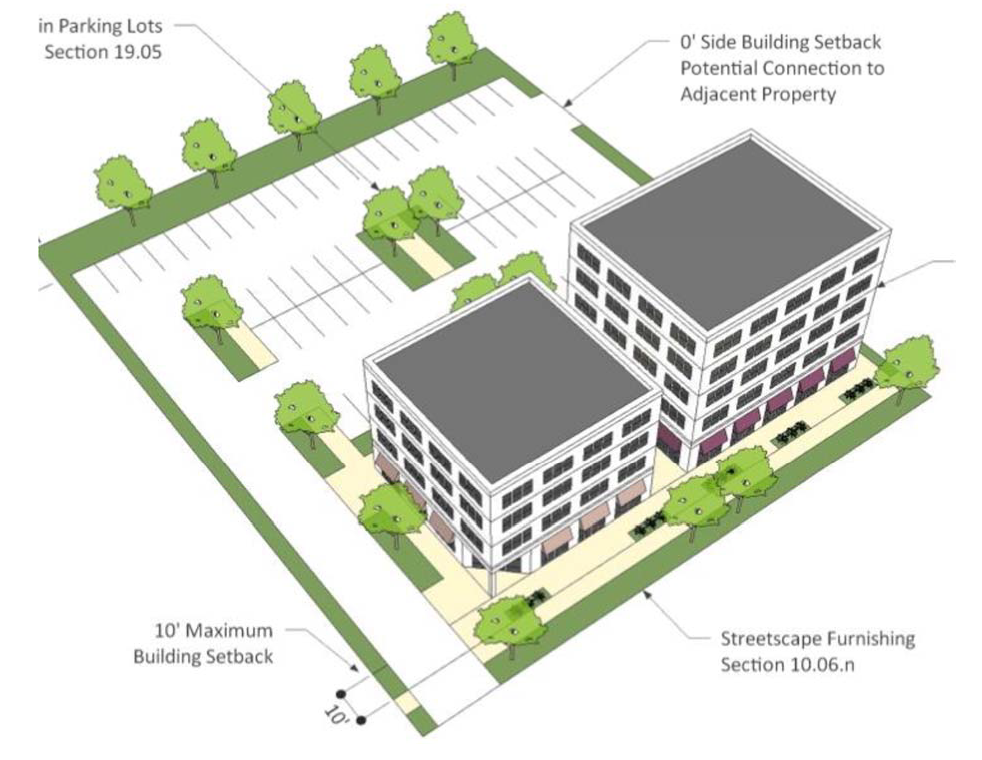
3.
Corner Clearance Areas. Corner clearance areas shall be maintained along all driveways and streets, pursuant to Section 9.304. Buildings at a corner of intersecting streets may include a pedestrian plaza in order to maintain sight visibility and provide a pedestrian amenity, which shall fulfill one (1) of the bonus height eligibility requirements per Subsection (I)1.
Figure 5. Corner Clearance Area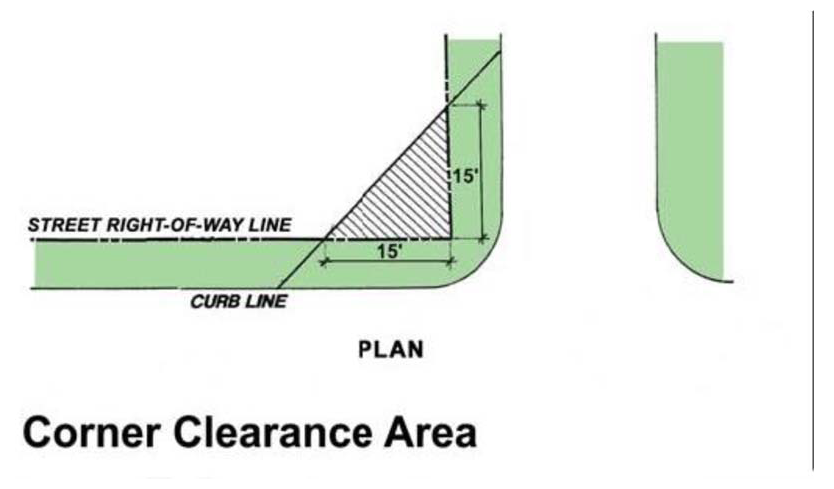
4.
Pedestrian and Non-Motorized Enhancements. Sidewalks shall be required along all street frontages, in accordance with Section 24.10, as modified as follows:
a.
Sidewalks shall be provided along all street frontages.
b.
Sidewalks along Fort Street shall be five (5) feet in width and shall be located one (1) foot off the property line in the road right-of-way, except where the planned right-of-way is greater in width than the existing right-of-way, in which case the sidewalk shall be located one (1) foot inside the planned right-of-way.
5.
Pedestrian Access. The primary entrance for a non-residential and/or mixed-use building shall be clearly identifiable, useable and located facing the right-of-way. A pedestrian connection shall provide a clear, publicly-accessible connection between the primary street upon which the building fronts and the building. A direct pedestrian walkway shall be provided from rear and side yard parking areas to the building that is of a level of materials, quality and design emphasis at least equal to that of the primary entrance.
6.
Landscape and Streetscape Elements. Landscape and streetscape elements shall be required in accordance with Article 14 and the following. Whenever provisions of Article 14 may conflict with the provisions of this Article, the provisions of this Article shall take precedence.
a.
Streetscape furnishings, including street trees, tree grates, special concrete finishing, decorative lighting, and street furniture shall be considered along all frontages to the satisfaction of the Planning Commission and shall fulfill one (1) of the bonus height eligibility requirements of Subsection (I)1. Street trees shall be located in accordance with the standards of the Michigan Department of Transportation or Wayne County Department of Public Services. Street trees shall not be located within a corner clearance area.
Street furniture features include, but are not limited to:
• A permanently mounted seating fixture constructed of decorative metal.
• A permanently reserved planting bed with defined, durable edges.
• Waste receptacle constructed of decorative metals.
• Pedestrian plaza.
b.
All off-street parking areas shall be screened or buffered in a matter that separates the parking areas as seen from the public right-of-way or from single-family residentially-zoned or used property. A minimum six-foot wide buffer between the parking lot and any street right-of-way or adjacent single-family residentially-zoned or used property shall be shown. The buffer shall include one (1) or combinations of the following:
• Dense landscaping (minimum one (1) tree and eight (8) shrubs every forty (40) feet).
• Decorative metal fencing (thirty (30) to thirty-six (36) inches high), in accordance with Article V of the Code of Ordinances.
• Masonry screening wall (thirty (30) to thirty-six (36) inches high).
7.
Residential Architecture and Design Standards. It is the intent of the FS District to encourage attractive attached single-family and multi-family residential developments that encourage traditional urban form and walkability. Emphasis shall be placed upon methods that focus attention on high-quality homes that front on the adjacent right-of-way.
a.
Front Façade. All residential units shall provide a pedestrian door facing the front lot line. The front façade of all residential units shall be at least twenty-five percent (25%) windows or doors. Building wall offsets (projections and recesses), cornices, awnings, varying building materials or pilasters shall be used to break up the mass of a single building.
b.
Garages. Attached garages shall be located in the rear or side yard. The Planning Commission may permit garage doors on the front façade subject to attractive screening and landscaping. Detached garages and other accessory buildings located in the rear yard shall meet the requirements of Section 24.06.
c.
Cross Access/Circulation. Residential developments shall provide areas for future cross-access to promote pedestrian and automobile connectivity and safety.
d.
Well-Defined Base. The first floor of residential structures shall have a height of at least ten (10) feet, measured from floor level to the underside of the ceiling.
8.
Commercial/Mixed Use Architecture and Design Standards. It is the intent of the FS District to improve the appearance of and add visual interest to the Fort Street corridor. Emphasis shall be placed upon methods that focus attention on attractive buildings that front on the adjacent right-of-way.
a.
Façade Variation. The maximum length of an uninterrupted building façade facing public streets and/or parks shall be thirty (30) feet. Building wall offsets (projections and recesses), cornices, awnings, varying building materials or pilasters shall be used to break up the mass of a single building. Building facades, especially those more than one hundred (100) feet in length, shall be "broken-down" in scale through visual articulation including multiple entries, the careful placement of windows and variations in massing and architectural detail.
b.
Building Transparency. The first floors of all buildings shall be designed to encourage and complement pedestrian-scaled activity. Building transparency shall be defined as the percentage of windows, doors and other features which enable a pedestrian to view the inside of a structure from the exterior. Ground floor facades that face public streets shall have arcades, display windows, entry areas, awnings, or other such features along no less than fifty percent (50%) of the length of the façade. Upper stories shall feature a façade transparency of at least thirty percent (30%).
Outdoor dining/seating located between the building and the right-of-way may count toward the transparency requirement. Such spaces must be permanently created by a wall or other permanent improvement defining the outdoor dining area.
c.
Building Entrance. Each principal building on site shall have clearly defined, highly visible entrances featuring sheltering elements such as awnings, arcades, porticos, recesses/projections, and decorative architectural details.
d.
Well-Defined Base. The first floor of commercial structures shall have a height of at least twelve (12) feet, measured from floor level to the underside of the ceiling.
e.
Garage Doors. Garage doors shall not be permitted on a front façade. The Planning Commission may permit garage doors on the front façade subject to attractive screening and landscaping or if the garage is utilized as a design amenity for uses such as outdoor dining patios or outdoor sales.
f.
Building Materials and Colors. The exterior of buildings shall be constructed of high quality materials, including, but not limited to, brick, stone, architectural steel and glass, and integrally tinted/textured concrete masonry units. All façade colors shall be reviewed and approved by the Planning Commission as part of the full site plan review process.
g.
Corner Building Standards. Corner buildings and structures shall incorporate distinctive features, materials, designs, height levels and colors that accentuate their prominent location, but are simultaneously sensitive to neighboring buildings. This can be accomplished through design features such as building peaks, towers, or similar accents with the highest point located at the intersecting corner.
Wider sidewalks and/or further setback from the corner's edge are encouraged to retain corner clearance areas. Additionally, use of ground level open-aired areas at the intersection of sidewalks is encouraged. The design of open-aired areas or pedestrian plazas adds aesthetic distinction to the façade and compliments the intended pedestrian atmosphere along Fort Street. Integrating covered/uncovered eating and resting areas is highly encouraged.
(Ord. No. 676, art. I, 7-20-2015; Ord. No. 740, art. I, 3-20-2023)

