Riverview City Zoning Code
ARTICLE 14
LANDSCAPING AND SCREENING
Section 14.01 - Intent and Scope of Requirements.
A.
Intent.
Landscaping enhances the visual image of the City, preserves natural features, improves property values, and alleviates the impact of noise, traffic, and visual distraction associated with certain uses. Screening is important to protect less intensive uses from the noise, light, traffic, litter and other impacts of more intensive uses. The provisions of this Article are intended to set minimum standards for the design and use of landscaping, greenbelts, and screening, and for the protection and enhancement of the City's environment. More specifically, the intent of this Article is to:
1.
Improve the appearance of off-street parking areas, vehicular use areas, storm water management facilities, and property abutting public rights-of-way.
2.
Preserve the appearance, character, and value of residential uses that abut non-residential areas, parking areas, and other intensive use areas, thereby protecting the public health, safety and welfare.
3.
Reduce soil erosion and depletion, stormwater runoff and the potential for flooding.
4.
Encourage the coordination and linking of landscaping, screening and open space elements on adjoining properties.
B.
Scope of Application.
Every property owner and developer has the responsibility to ensure that the use of a lot in the City does not adversely impact adjacent properties. No site plan shall be approved nor a new Certificate of Occupancy issued unless all applicable landscaping and screening requirements of this Article have been met. Except where specifically noted, the provisions of this Article shall not apply to single-family detached dwellings.
C.
Minimum Requirements.
The provisions of this article shall be considered as minimum standards for landscaping and screening. Developers and owners of lots or uses subject to these standards are encouraged to exceed these minimums through the use of enhanced landscape design, or larger or more extensive plant materials.
D.
Design Creativity.
Creativity in landscape design is encouraged. Accordingly, required trees and shrubs may be planted in uniform intervals or informal groupings to achieve the designer's desired visual effect.
Section 14.02 - Permitted Modifications to Standards.
In consideration of the overall site design, existing site conditions and impact of a specific use, and in consideration of the amount of existing plant material or other screening elements to be retained on the site, the Planning Commission may approve modifications to the specific standards of this Article, provided that the alternative is in keeping with the intent of this Article and the purpose of this Ordinance.
A.
Conditions.
In determining whether a modification is appropriate, the Planning Commission shall consider the following:
1.
Where unique site conditions (such as steep slopes and other topographic features, utility easements, or inadequate setback area) would hinder compliance with the strict standards of this Article, the Planning Commission may permit the substitution of any greenbelt or other landscaping requirement with a wall or fence in compliance with Article 15 (Walls and Fences), or combination of a wall or fence and an alternative landscape design.
2.
Parking, vehicular circulation, or land use are such that required landscaping would not enhance the site or result in the desired screening effect.
3.
The public benefits intended by strict application of these regulations could be better achieved with a plan that varies from the strict requirements of the Ordinance, provided that the alternative design would produce substantially the same results in terms of screening, durability, and permanence.
4.
Where an existing building is undergoing redevelopment, improvement, a change in use, or expansion, the proposed improvements are in reasonable proportion to the size and configuration of the site, and the scale of proposed building improvements, expansions or other site improvements.
B.
Review Committee Recommendation.
All proposed modifications or alternative designs shall be subject to a review and recommendation from any review committee(s), prior to Planning Commission consideration.
Section 14.03 - Summary of Regulations.
The following table summarizes the landscaping regulations contained in this Article:
Summary of General Requirements
Footnotes to table above:
[1]
See Sections 14.04 and 14.05 for detailed requirements.
[2]
General Site Landscaping for:
- Manufactured housing parks: 2 trees plus 4 shrubs per lot.
- Multiple-family uses: 2 trees plus 4 shrubs per dwelling unit.
[3]
Eight (8) shrubs may be substituted for each tree.
[4]
Evergreens must be closely spaced (no further than 15 feet apart) to form complete visual barrier within three (3) years.
[5]
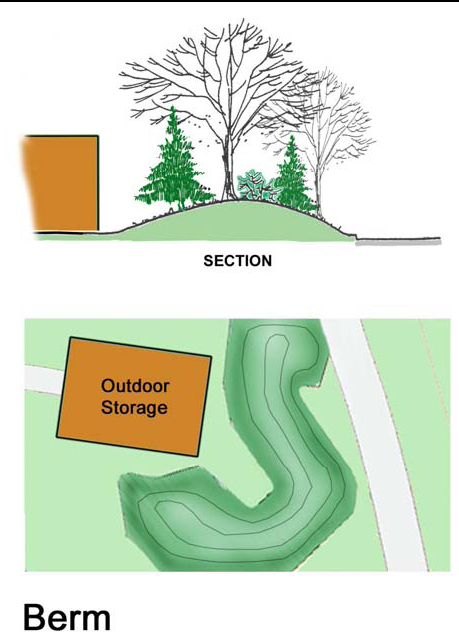
Berms shall have slopes no steeper than one (1) foot vertical for each three (3) feet horizontal. Thus, the minimum width is equal to total height multiplied by three (3). Maximum height of berms in the front yard: three (3) feet.
[6]
Minimum area of each parking lot landscaped area: 150 square feet.
Summary of Specific Requirements per District
Section 14.04 - General Requirements.
A.
General Site Requirements.
All developed portions of the site shall conform to the following general landscaping standards, except where specific landscape elements (such as a greenbelt, berms, or screening) are required:
1.
All unpaved portions within the developed portion of the site shall be planted with grass or other appropriate ground cover, shrubbery, or other suitable live plant materials, which shall extend to any abutting street pavement edge. Lawn areas shall be planted with sod or hydro-seeded.
2.
One (1) evergreen or deciduous tree shall be planted per 3,000 square feet of unpaved open area on non-residential parcels for which specific landscaping requirements do not otherwise apply.
B.
Landscaping Adjacent to Road Rights-of-Way.
1.
Planting requirements. Where required, landscaping adjacent to road rights-of-way shall comply with the following planting requirements:
Landscape Material Planting Requirements
For the purposes of computing length of road frontage, openings for driveways and sidewalks shall not be counted. Trees and shrubs may be planted in uniform intervals or informal groupings.
2.
Location and dimensions. Required landscaping adjacent to roads shall be located totally on private property within a planting strip adjacent to the road right-of-way. The minimum width of the planting strip shall be ten (10) feet.
Example of landscaping adjacent to roads:
Length of Road Frontage: 250 feet minus 30-foot driveway = 220 feet
Required Number of Plants:
C.
Berms.
Where required, berms shall conform to the following standards:
1.
Dimensions. Unless otherwise deemed appropriate by the Planning Commission, required berms shall be measured from the grade of the parking lot or flat ground adjacent to the berm, and shall be constructed with slopes no steeper than one (1) foot vertical for each three (3) feet horizontal (33% slope), with at least a two (2) foot flat area on top.
Berms may undulate in height, subject to review and approval of berm design as shown on the site plan. Unless otherwise indicated, the maximum height of required berms shall be three (3) feet.
2.
Protection from erosion. Required berms shall be planted with sod, ground cover, or other suitable live plant materials to prevent erosion. The use of railroad ties, cement blocks, and other types of construction materials to retain the shape and height of a berm shall be prohibited unless specifically reviewed and approved by the Planning Commission.
3.
Required plantings.
a.
Berms located in the front yard of non-residential parcels. Berms located in the front yard of non-residential parcels shall be landscaped in accordance with the requirements of Section 14.04B (Landscaping Adjacent to Roads).
b.
Berms used for screening other than in the front yard. Berms used for screening other than in the front yard shall be landscaped in accordance with the requirements of Section 14.04E (Screening).
4.
Measurement of berm length. For the purpose of calculating required plant material, berm length shall be measured along an extension of the highest elevation line connecting the lowest elevation lines at opposite ends of the berm.
D.
Greenbelts.
Where required, greenbelts shall conform to the following standards:
1.
Measurement of greenbelt length. For the purpose of calculating required plant material, greenbelt length shall be measured along the exterior edge of the greenbelt.
2.
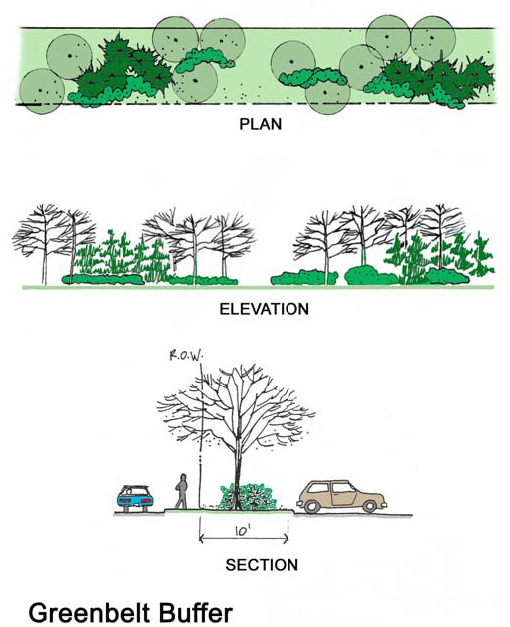
Dimensions. The minimum width of the greenbelt shall be ten (10) feet.
3.
General planting requirements.
a.
Groundcover requirements. Grass, ground cover, or other suitable live plant materials shall be planted over the entire greenbelt area, except where paved walkways are used.
b.
Tree and shrub requirements. Greenbelts used for screening shall be landscaped in accordance with the requirements of Section 14.04E (Screening). Greenbelts not intended for screening purposes shall include a minimum of one (1) deciduous or evergreen tree for each 30 lineal feet (or portion thereof) of required greenbelt. Alternatively, eight (8) shrubs may be substituted for each required tree.
c.
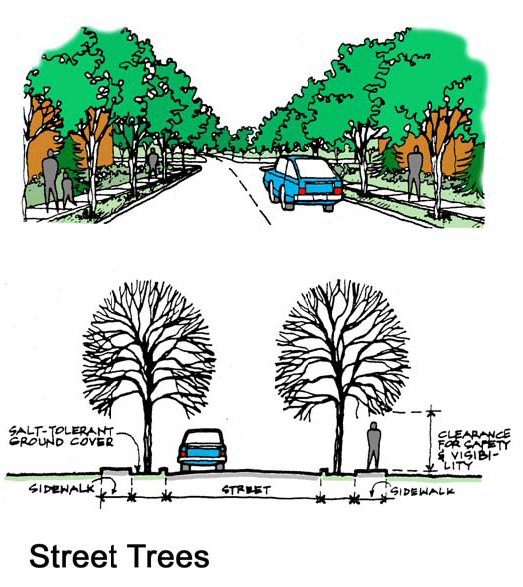
Distance from sidewalk. To provide adequate sight distance and minimize damage to public facilities, trees and shrubs shall not be placed closer than four (4) feet to any public or private sidewalk.
E.
Screening.
1.
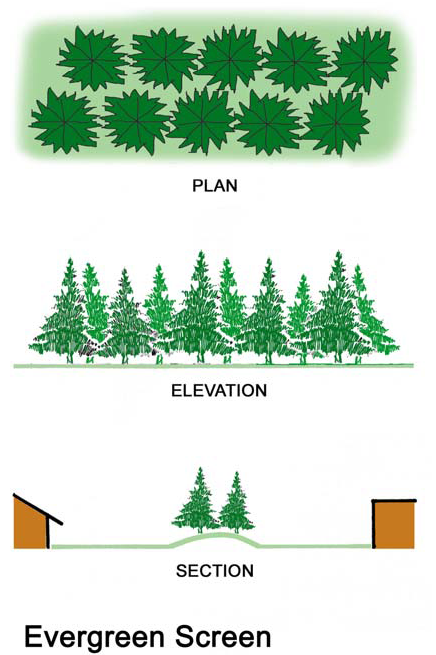
General screening requirements. Unless otherwise specified, wherever an evergreen or landscaped screen is required, screening shall consist of closely-spaced evergreen plantings (i.e., no farther than 15 feet apart) which can be reasonably expected to form a complete visual barrier that is at least six (6) feet above ground level within three (3) years of planting.
Deciduous plant materials may also be used, provided that a complete visual barrier can be maintained throughout the year. Wherever screening is required adjacent to a residential district or existing residential use, the screening must be installed prior to the beginning of site grading and general construction. Where such activity would result in damage to the required screening, temporary construction fencing shall be erected and maintained until it is feasible to install the required screening.
2.
Screening of equipment. Mechanical equipment, such as air compressors, pool pumps, transformers, generators, sprinkler pumps, satellite dish antennae, air conditioners, and similar equipment shall be screened on all sides visible from public rights-of-way, or adjoining properties or uses.
Such screening shall exceed the vertical height of the equipment being screened by at least six (6) inches (plant materials shall exceed this height within two (2) years of planting). A minimum two (2) foot open area should be maintained around such equipment to facilitate repairs, if necessary.
F.
Parking Lot Landscaping.
In addition to required screening, all off-street parking areas shall be landscaped as follows:
1.
Landscaping ratio. Off-street parking areas containing ten (10) or more parking spaces shall be provided with at least 20 square feet of interior landscaping per parking space. Whenever possible, parking lot landscaping shall be designed to improve the safety of pedestrian and vehicular traffic, guide traffic movement, and improve the appearance of the parking area.
2.
Minimum area. Landscaped areas in parking lots shall be no less than five (5) feet in any single dimension and no less than 150 square feet in area. Landscaped areas in or adjacent to parking lots shall be protected with curbing or other means to prevent encroachment of vehicles.
3.
Other landscaping. Required landscaping elsewhere on the parcel shall not be counted in meeting the parking lot landscaping requirements.
4.
Required plantings. Requirements for plant material shall be based on the location, size, and shape of the parking lot landscaped area, as described in the following table:
Minimum Required Plantings for Parking Lot Landscaping
Parking lot plantings shall comply with the unobstructed sight distance standards of Section 9.304 (Corner Clearance Areas). The landscape plan shall indicate the types, sizes, and quantities of plant material proposed for such area.
5.
Stormwater Management. The site plan shall adhere to the City of Riverview Stormwater Management Implementation Guide and Low Impact Development Manual for Michigan produced by the Southeast Michigan Council of Governments.
G.
Landscaping of Rights-of-Way.
Public rights-of-way located adjacent to required landscape areas and greenbelts shall be planted with grass or other suitable live ground cover, and shall be maintained by the owner or occupant of the adjacent property as if the rights-of-way were part of the required landscaped areas or greenbelts. Additional landscape standards for subdivisions can be found in the Subdivision Regulations, City of Riverview Code of Ordinances.
H.
Maintenance of Unobstructed Visibility For Drivers.
No landscaping shall be established or maintained on any parcel or in any parking lot that will obstruct the view of drivers. Parking lot plantings shall comply with the unobstructed sight distance standards of Section 9.304 (Corner Clearance Areas).
I.
Potential Damage to Utilities.
In no case shall landscaping material be planted in a way that will interfere with or cause damage to underground utility lines, fire hydrants, public roads, or other public facilities. Species of trees whose roots are known to cause damage to public roadways, sewers, or other utilities shall not be planted closer than fifteen (15) feet from any such roadways, sewers, or utilities. Trees shall be setback from overhead utility lines as indicated in the following table:
Landscape Material Spacing from Utilities
J.
Landscaping of Divider Medians and Culs-de-Sac.
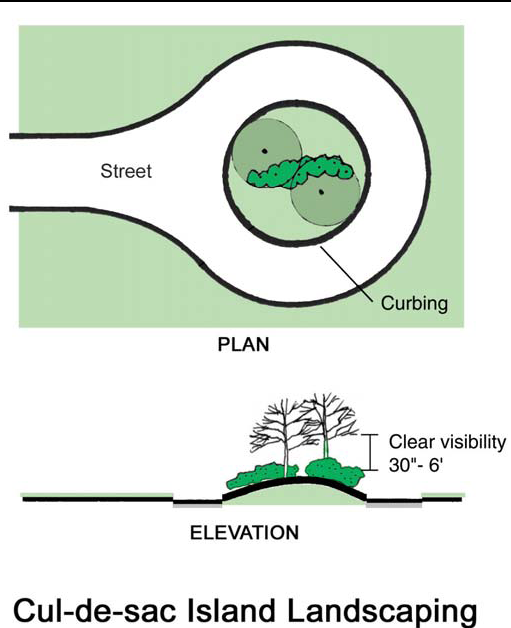
Where traffic on driveways, maneuvering lanes, private roads, or similar vehicle accessways is separated by a divider median, the median shall be curbed and have a minimum width of ten (10) feet. A minimum of one (1) deciduous or evergreen tree shall be planted for each thirty (30) lineal feet or portion thereof of median. Trees may be planted at uniform intervals, at random, or in groupings, but in no instance shall the center-to-center distance between trees exceed sixty (60) feet.
Culs-de-sac and site entrances shall be landscaped with species tolerant of roadside conditions in Wayne County.
K.
Irrigation.
A method of irrigation must be available to all landscaped areas. Accommodations shall be made to ensure protection of drip lines of plantings.
L.
Street Trees in Single-Family Districts.
A minimum of one (1) deciduous tree, measuring at least two and one-half (2.5) inches in trunk diameter at the time of planting, shall be planted on each single-family parcel or lot on which a new dwelling unit is proposed to be constructed for each forty (40) feet of street frontage measured at the right-of-way line.
(Ord. No. 704, art. I, 8-20-2018)
Section 14.05 - Specific Requirements per District.
A.
Requirements for Business, Office, and Industrial Districts.
All lots or parcels located in business, office, and industrial zoning districts shall comply with the following landscaping requirements:
1.
General site landscaping. All developed portions of the site shall conform to the standards of Section 14.04A (General Site Requirements), except where specific landscape elements are required.
2.
Landscaping adjacent to road. All commercial, office, and industrial developments shall comply with the requirements of Section 14.04B (Landscaping Adjacent to Road Rights-of-Way).
3.
Berm requirements. A berm may be used to screen off-street parking from view of the road, in which case the berm shall be a maximum of three (3) feet in height, and shall be planted in accordance with Section 14.04C (Berms). The berm shall be located totally on private property, adjacent to the road right-of-way. Berms are not intended as an effective screening device between zoning districts.
4.
Screening. Screening in the form of a landscaped berm or greenbelt shall be required wherever a non-residential use in a commercial, office, or industrial district abuts directly upon land zoned for residential purposes, and where loading areas would be visible from residential districts.
a.
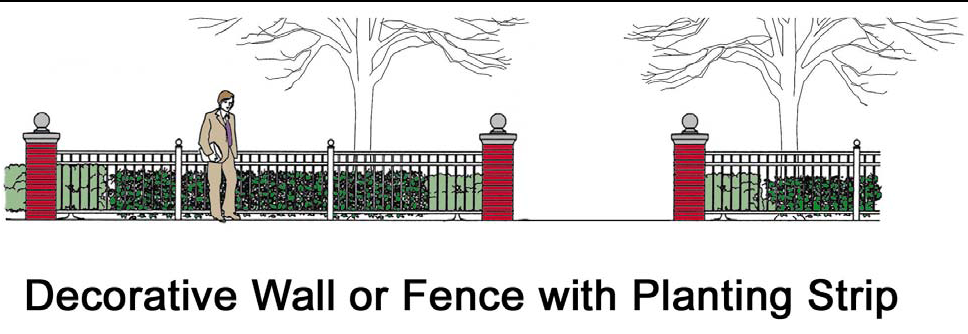
Landscaped screening shall comply with the requirements of Section 14.04E (Screening). If the length of the adjoining residentially zoned property is less than 200 feet, a wall or solid fence with a planting strip a minimum of three (3) feet in width may be erected in lieu of a berm or greenbelt, subject to site plan approval.
b.
The landscaping in the planting strip shall consist of appropriate landscaping material and be arranged to provide a maximum opacity to a minimum height of four (4) feet within three (3) years.
5.
Parking lot landscaping. Off-street parking areas containing greater than 10 spaces shall comply with the requirements for parking lot landscaping in Section 14.04, subsection F. All off-street parking areas shall be screened on those sides which abut or are across the street from a residential zoning district or residential use by a landscape screen, berm, wall or fence. A landscape screen, berm, wall or fence may be used.
Landscaped screening shall comply with the requirements of Section 14.04E (Screening). If a wall or fence is used instead of landscaping, the requirements of Article 15 (Walls and Fences) shall be complied with, but a landscaped greenbelt shall be required on the side of the wall facing the residential district.
B.
Requirements for Multiple-Family Developments.
All lots or parcels of land used for multiple-family development shall comply with the following landscaping requirements:
1.
General site landscaping. A minimum of two (2) deciduous or evergreen trees plus four (4) shrubs shall be planted per dwelling unit. Unless otherwise specified, required landscaping elsewhere in the multiple-family development shall not be counted in meeting these requirements for trees. A method of irrigation shall be provided.
2.
Landscaping adjacent to road. All multiple-family developments shall comply with the requirements of Section 14.04B (Landscaping Adjacent to Road Rights-of-Way).
3.
Greenbelt privacy screen. A landscaped privacy screen shall be provided where multiple-family dwellings are designed so that rear open areas or patio areas front onto a public street. The screen may consist of a combination of trees, shrubs, and berms, and shall be subject to site plan review by the Planning Commission.
4.
Parking lot landscaping. Off-street parking areas in the front or side yard must be screened with a hedge not more than four (4) feet in height. Hedges shall comply with the height and location standards of Section 9.304 (Corner Clearance Areas). Off-street parking areas containing greater than ten (10) spaces shall comply with the requirements of Section 14.04F (Parking Lot Landscaping).
C.
Requirements for Non-Residential Uses in Residential Districts.
All non-residential uses located in residential zoning districts shall comply with the following landscaping requirements:
1.
General site landscaping. All developed portions of the site shall conform to Section 14.04A (General Site Requirements), except where specific landscape elements are required.
2.
Landscaping adjacent to road. All non-residential developments located in residential districts shall comply with the requirements of Section 14.04B (Landscaping Adjacent to Road Rights-of-Way).
3.
Berm requirements. A berm may be used to screen off-street parking from view of the road, in which case the berm shall be a maximum of three (3) feet in height, and shall be planted in accordance with Section 14.04C (Berms). The berm shall be located totally on private property, adjacent to the road right-of-way.
4.
Screening. Screening in the form of a landscaped berm, greenbelt, or wall shall be required wherever a non-residential use abuts directly upon land zoned for residential purposes. Landscaped screening shall comply with the requirements of Section 14.04E (Screening).
5.
Parking lot landscaping. Off-street parking areas containing greater than 10 spaces shall comply with the requirements of Section 14.04F (Parking Lot Landscaping). All off-street parking areas shall be screened on those sides which abut or are across the street from a residential zoning district or residential use by a landscape screen, berm, wall or fence.
Section 14.06 - Landscape Materials Standards.
Unless otherwise specified, all landscape materials shall comply with the following standards:
A.
Plant Quality.
Plant materials used in compliance with the provisions of this Ordinance shall be nursery grown, free of pests and diseases, hardy in Southeast Michigan, in conformance with the standards of the American Association of Nurserymen, and shall have passed inspections required under state regulations. An appropriate variety of plantings hall be provided to ensure long term survival of mature plants.
B.
Non-Living Plant Material.
Plastic and other non-living plant materials shall not be considered acceptable to meet the landscaping requirements of this Ordinance.
C.
Plant Material Specifications.
The following specifications shall apply to all plant material proposed in accordance with the landscaping requirements of this Ordinance:
Summary of Plant Materials Specifications
Footnotes to table above:
1.
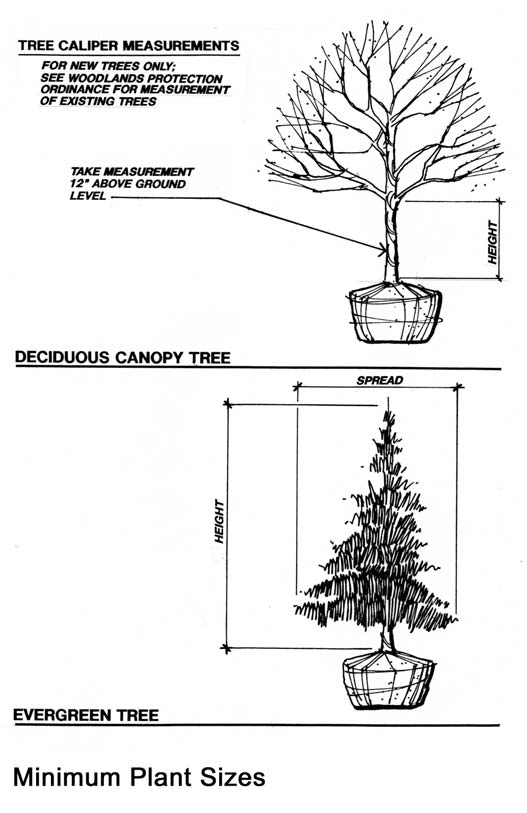
Measured 12 inches above grade.
2.
Measured six (6) inches above grade.
1.
Large deciduous trees. Deciduous shade trees shall be a minimum of two and one-half (2.5) inches in caliper measured 12 inches above grade with the first branch a minimum of four (4) feet above grade when planted.
2.
Deciduous ornamental trees. Deciduous ornamental trees shall be a minimum of one and one-half (1.5) inches in caliper measured six (6) inches above grade with a minimum height of four (4) feet above grade when planted.
3.
Evergreen trees. Evergreen trees shall be a minimum of six (6) feet in height when planted. Furthermore, evergreen trees shall have a minimum spread of two and one-half (2.5) feet, and the size of the burlapped root ball shall be at least ten (10) times the caliper measured six (6) inches above grade.
4.
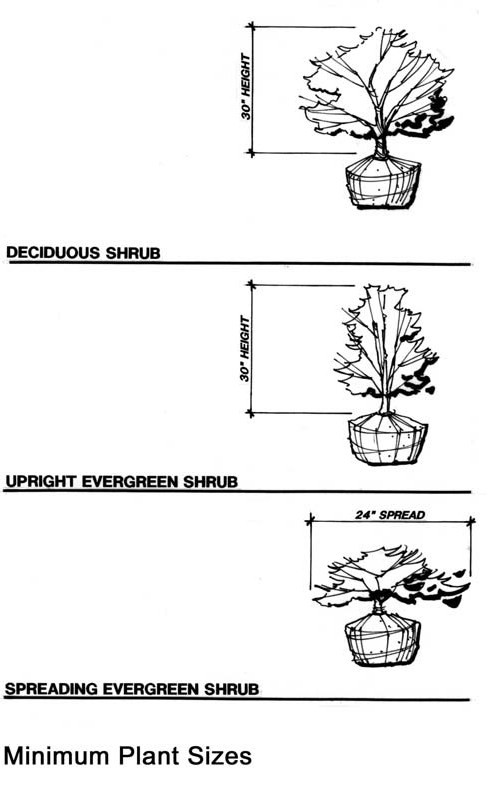
Shrubs. Shrubs shall be a minimum of two (2) feet in height when planted. Low growing shrubs shall have a minimum spread of two (2) feet when planted.
5.
Hedges. Hedges shall be planted and maintained in a manner that forms a continuous, unbroken, visual screen within two (2) years after planting, barring unusual growing conditions, such as drought or disease. Hedges shall be a minimum of two (2) feet in height when planted.
6.
Ground cover. Ground cover used in lieu of turf grasses in whole or in part shall be planted in such a manner as to present a finished appearance and reasonably complete coverage after one (1) complete growing season.
7.
Grass. Grasses shall be planted using species normally grown as permanent lawns in southeastern Michigan. Grass, sod, and seed shall be clean and free of weeds, pests, and diseases. Grass may be sodded, plugged, sprigged or seeded. Where grass is to be established by a method other than complete sodding or seeding, nurse grass seed shall be sown for immediate effect and protection until complete coverage is otherwise achieved. Straw or other mulch shall be used to protect newly seeded areas.
8.
Mulch. Mulch used around trees, shrubs, and vines shall be a minimum of three (3) inches deep, and installed in a manner as to present a finished appearance.
9.
Suggested plant materials. A suggested plant materials list will be kept on record and available for inspection in the Community Development Department.
Section 14.07 - Installation and Maintenance.
The following standards shall be observed where installation and maintenance of landscape materials are required:
A.
Installation.
Landscaping shall be installed in a sound, workmanlike manner to ensure the continued growth of healthy plant material. Trees, shrubs, hedges, and vines shall be generously mulched at the time of planting.
B.
Installation of Perimeter Landscaping.
Landscaping along the perimeter shall be installed prior to construction, except where such landscaping would be destroyed during construction.
C.
Seeding or Sodding.
Lots or parcels shall be seeded or sodded within 90 days after occupancy.
D.
Protection from Vehicles.
Landscaping shall be protected from vehicles through use of curbs or wheel stops in parking lots. Landscape areas shall be elevated above the pavement to a height that is adequate to protect the plants from snow removal, salt, and other hazards.
E.
Off-Season Planting Requirements.
If development is completed during the off-season when plants cannot be installed, the owner shall provide a performance guarantee to ensure installation of required landscaping in the next planting season, in accordance with Section 24.11 (Performance Guarantee).
F.
Maintenance.
Landscaping required by this Ordinance shall be maintained in a healthy, neat, and orderly appearance, free from refuse and debris. A healthy, neat and orderly appearance includes: proper pruning, regular mowing of lawns, removal of all litter and the replacement of dead and unhealthy plant material.
1.
All unhealthy and dead plant material shall be replaced immediately upon notice from the Building Official, unless the season is not appropriate for planting, in which case such plant material shall be replaced at the beginning of the next planting season.
2.
All landscaped areas shall be provided with a readily available and acceptable supply of water. Underground irrigation systems are required. Trees, shrubs, and other plantings and lawn areas shall be watered regularly throughout the growing season.
3.
All constructed or manufactured landscape elements, such as but not limited to benches, retaining walls, edging, and so forth, shall be maintained in good condition and neat appearance. Rotted, deteriorated, or damaged landscape elements shall be repaired, replaced, or removed.
Section 14.08 - Treatment of Existing Plant Materials.
The following regulations shall apply to existing plant material:
A.
Consideration of Existing Elements in the Landscape Design.
In instances where healthy plant material exists on a site prior to its development, the Planning Commission may permit substitution of such plant material in place of the requirements set forth previously in this Article, provided such substitution is in keeping with the spirit and intent of this Article and Ordinance.
Existing hedges, berms, walls, or other landscape elements may be used to satisfy the requirements set forth previously, provided that such landscaping is in conformance with the requirements of this section.
B.
Preservation of Existing Plant Material.
Site plans shall show all existing trees which are located in the portions of the site that will be built upon or otherwise altered, and are five (5) inches or greater in caliper, measured 12 inches above grade.
Trees shall be labeled "To Be Removed" or "To Be Saved" on the site plan. If existing plant material is labeled "To Be Saved" on the site plan, protective measures should be implemented, such as the placement of fencing or stakes at the dripline around each tree. No vehicle or other construction equipment shall be parked or stored within the dripline of any tree or other plant material intended to be saved.
Trees to be preserved may provide credits toward the required trees for greenbelts, buffers, and parking lot landscaping. To obtain credit, the preserved trees shall be of a high quality and at least two and one half (2.5) inches caliper measured 12 inches above grade. Trees to be preserved shall be counted for credit only if they are located on the developed portion of the site as determined by the Planning Commission.
The credit for preserved trees shall be as follows:
Schedule for Preserved Tree Credits
In the event that healthy trees that are intended to meet the requirements of the Ordinance are cut down, damaged or destroyed during construction, the removed trees shall be replaced with the same species as the damaged or removed tree, in accordance with the Schedule of Preserved Tree Credits, unless otherwise approved by the Community Development Director, based on consideration of the site and building configuration, available planting space, and similar considerations:
Schedule of Damaged or Removed Tree Replacement
ILLUSTRATIONS
 |  |
 |  |
 |  |