Riverview City Zoning Code
ARTICLE 16
LIGHTING
Section 16.01 - Purpose.
The purpose of this Article is to preserve, protect, and enhance the lawful nighttime use and enjoyment of all properties in the City through the use of appropriate lighting practices and systems. Exterior lighting shall be designed, installed and maintained to control glare and light trespass, minimize obtrusive light, conserve energy and resources, maintain safety, security and productivity, and prevent the degradation of the nighttime visual environment. It is the further intent of this Article to encourage the use of innovative lighting designs and decorative light fixtures that enhance the character of the community while preserving the nighttime visual environment.
Section 16.02 - Submittal Requirements.
The following information shall be provided with all site plans, site condominium plans, and subdivision plats where exterior lighting is proposed to be altered or installed. The Building Official may also require that any or all of the following information be provided with building, electrical, sign or zoning permit applications where exterior lighting is proposed to be altered or installed:
1.
The location, type and height of all existing and proposed light fixtures, such as freestanding, building-mounted and canopy light fixtures, and all existing and proposed sign lighting.
2.
A photometric grid indicating the overall light intensity, measured in footcandles, throughout the site.
3.
Specifications and details for each type of light fixture, including the total lumen output, type of lamp and method of shielding. If available, the manufacturer's catalogue specifications and documents, drawings, and certified test reports shall be submitted.
Section 16.03 - General Provisions.
The design and illumination standards of this Article shall apply to all exterior lighting sources and other light sources visible from any public way or any adjacent parcel, except where specifically exempted herein.
A.
Fully-Shielded.
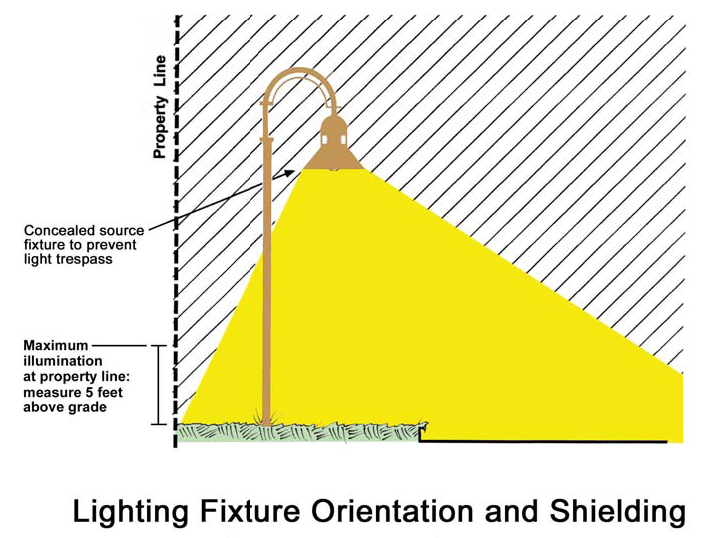
Exterior lighting shall be fully shielded and directed downward, and shall utilize full cutoff housings, louvers, glare shields, optics, reflectors or other measures to prevent off-site glare and minimize light pollution.
B.
Intensity.
The intensity of light within a site shall not exceed ten (10) footcandles within any site, and one (1) footcandle at any lot boundary or street right-of-way line. Where a lot abuts a residential district or use, the intensity shall not exceed one-half (½) footcandle at the lot boundary.
1.
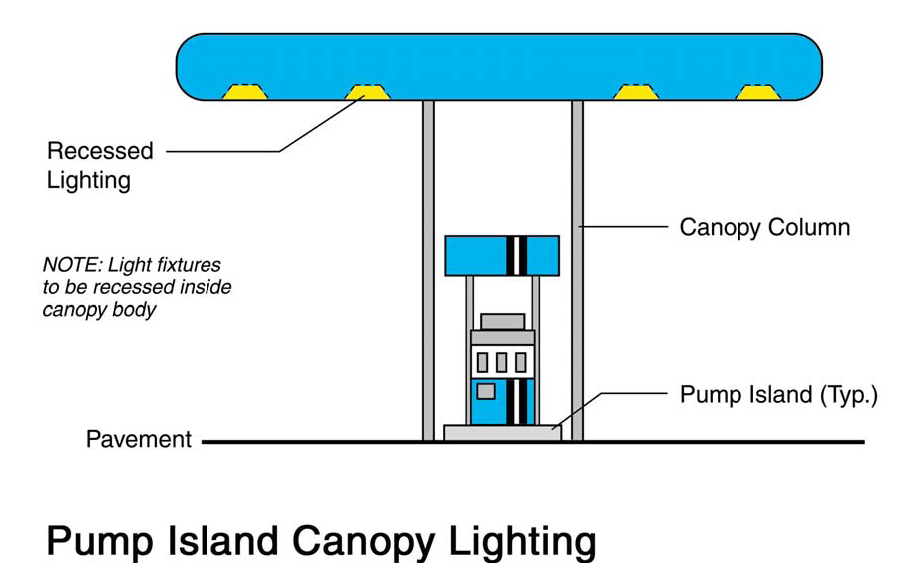
Pump island canopy lighting. The Planning Commission may permit a maximum intensity of 20 footcandles for lighting under a gas station's pump island canopy, provided that all light fixtures under the canopy shall be fully recessed into the canopy structure, and all site lighting is otherwise in compliance with this Ordinance.
2.
Outdoor dealership sales area lighting. The Planning Commission may permit a maximum intensity of 20 footcandles for lighting within a dealership's outdoor sales area, provided that all site lighting is otherwise in compliance with this Ordinance.
C.
Glare and Light Trespass.
Exterior lighting sources shall be designed, constructed, located and maintained in a manner that does not cause off-site glare or light trespass on neighboring properties or street rights-of-way.
D.
Measurements.
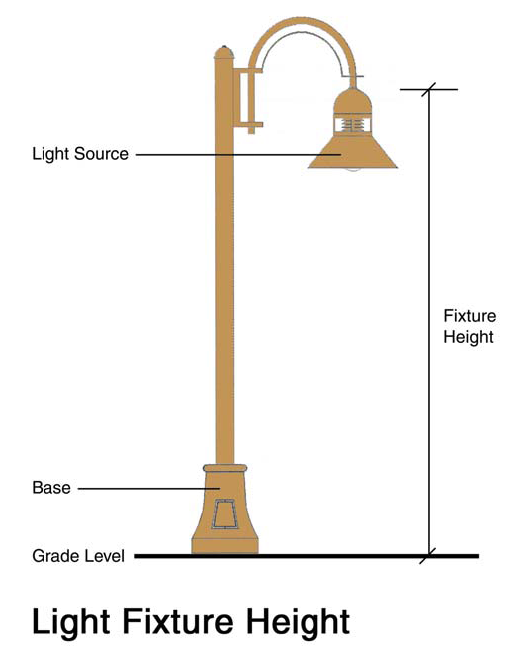
Light intensity levels shall be measured in footcandles on the horizontal plane at grade level within the site, and on the vertical plane of the lot or street right-of-way boundaries at a height of five (5) feet above grade. Fixture height shall be measured from grade level to the highest point of the light source.
E.
Lamp Options.
Lamps with a maximum wattage of 250 watts per fixture are recommended for use in the City to maintain a unified lighting standard and to minimize light pollution. Low-pressure sodium lamps are preferred for security lighting in low traffic areas. High pressure sodium or metal halide lamps are preferred in parking lots and high traffic areas.
The Planning Commission may permit the use of other lamp-types and wattages up to 400 watts maximum for fully shielded fixtures, provided that such lighting is otherwise in compliance with this Article.
Section 16.04 - Standards by Type of Fixture.
A.
Freestanding Pole Lighting.
The following standards shall apply to all freestanding pole-mounted light fixtures:
1.
Maximum overall height. The maximum height of pole-mounted fixtures shall be directly proportional to its proximity to a residential district or use, as follows:
a.
15 feet high, where such fixtures are located within 50 feet of a residential district or use.
b.
20 feet high, where such fixtures are located more than 50 feet from a residential district or use.
c.
25 feet high, where such fixtures are located more than 300 feet from a residential district or use.
2.
Hours of operation. All private exterior lighting systems in non-residential districts shall incorporate automatic timers. Exterior light fixtures shall not be illuminated after 11:00 p.m., or one-half (½) hour following the close of the business day (whichever is later).
Such fixtures shall not be illuminated before sunrise, or one-half (½) hour prior to the beginning of the business day (whichever is earlier). Minimal illumination for security purposes shall be permitted between these hours.
B.
Building-Mounted Lighting.
Unshielded luminous tube (neon) or fluorescent lighting shall be prohibited as an architectural detail on all buildings; including but not limited to areas along roof lines, cornices and eaves, or around and within window and door openings. The Planning Commission may approve internally illuminated architectural bands or similar shielded lighting accents as part of a site plan, provided that such lighting accents would enhance the aesthetics of the site and would not cause off-site glare or light pollution.
C.
Illuminated Signs.
Illuminated signs shall be equipped with a functional timer control. Such signs shall not be illuminated after 11:00 p.m., or one-half (½) hour following the close of the business day, whichever is later. Such signs shall not be illuminated before sunrise, or one-half (½) hour prior to the beginning of the business day, whichever is earlier.
D.
Window Lighting.
Unshielded luminous tube (neon) and fluorescent lighting visible through a window from the public way shall be prohibited, and all light fixtures visible from the public way through a window shall be shielded to prevent glare at the property or street right-of-way line.
E.
Decorative Light Fixtures.
The Planning Commission may approve decorative light fixtures as an alternative to shielded fixtures, provided that such fixtures would enhance the aesthetics of the site and would not cause off-site glare or light pollution. Such fixtures may utilize incandescent, tungsten-halogen, metal halide or high-pressure sodium lamps with a maximum wattage of 100 watts per fixture.
F.
Alternative Lighting Designs.
Upon recommendation from the Design Review Committee, the Planning Commission may approve an alternative lighting design, provided that the Commission finds that the alternative design would be in accordance with the purpose of this Article.
G.
Lamp or Fixture Substitutions.
Light fixtures regulated under this Article shall not be altered or replaced after approval has been granted, except where the Community Development Director has verified that the substitution would comply with the provisions of this Article.
Section 16.05 - Exempt Lighting.
The following types of exterior lighting are exempt from the requirements of this Article, except that the Building Official may take steps to minimize glare, light trespass or light pollution impacts where determined to be necessary to protect the health, safety and welfare of the public:
1.
Holiday decorations.
2.
Lighting for a permitted temporary circus, fair, carnival, or civic use.
3.
Shielded pedestrian walkway lighting.
4.
Single family residential lighting that does not cause off-site glare or contribute to light pollution.
5.
Circumstances where federal or state laws, rules or regulations take precedence over the provisions of this Article.
6.
Situations where fire, police, emergency, or repair personnel need light for temporary or emergency situations.
7.
Fossil fuel light produced directly or indirectly from the combustion of natural gas or other utility-type fossil fuels (e.g., gas lamps).
Section 16.06 - Prohibited Lighting.
A.
Recreational Facility Lighting.
No outdoor recreational facility, public or private, shall be illuminated after 11:00 p.m., except to conclude a permitted event or activity in progress prior to 11:00 p.m.
B.
Outdoor Building and Landscape Lighting.
Unshielded illumination of an exterior building facade or landscaping is prohibited.
C.
Mercury Vapor and Wall Pack lighting.
The installation of mercury vapor fixtures is prohibited. Wall pack fixtures are also prohibited, except where the light source is fully shielded.
D.
Laser Source light.
The use of laser source light or any similar high intensity light source for outdoor advertising or entertainment, when projected above the horizontal is prohibited.
E.
Search lights.
The operation of search lighting for advertising purposes is prohibited between 11:00 p.m. and sunrise.
F.
Animated lighting.
Lighting shall not be of a flashing, moving, animated or intermittent type, including electronic reader boards and other animated sign lighting.
Section 16.07 - Lighting Exceptions.
It is recognized by the City that there are certain uses or circumstances not otherwise addressed in this Article, such as streetlighting, or lighting for monuments and flags, that may have special exterior lighting requirements. The Zoning Board of Appeals may waive or modify specific provisions of this Article for a particular use or circumstance upon determining that all of the following conditions have been satisfied:
1.
A public hearing shall be held for all lighting exception requests.
2.
The waiver or modification is necessary because of safety or design factors unique to the use, circumstance or site.
3.
The minimum possible light intensity is proposed that would be adequate for the intended purpose. Consideration shall be given to maximizing safety and energy conservation, and to minimizing light pollution, off-site glare and light trespass on to neighboring properties or street rights-of-way.
4.
For lighting related to streets or other vehicle access areas, a determination is made that the purpose of the lighting cannot be achieved by installation of reflectorized markers, lines, informational signs, or other passive means.
5.
Additional conditions or limitations may be imposed by the Zoning Board of Appeals to protect the public health, safety or welfare, or to fulfill the spirit and purpose of this Article.
ILLUSTRATIONS