Riverview City Zoning Code
ARTICLE 17
SIGNS
Section 17.01 - Purpose.
The primary function of signage, as it relates to this Ordinance, is to identify a particular user of a parcel of property. Unrestricted signage does not benefit individual businesses or property owners, or the community as a whole, because a proliferation of signs in the City would unduly distract motorists and pedestrians, create traffic hazards, restrict light and air, harm the City's appearance, contribute to blighting, negatively impact property values and reduce the effectiveness of signs needed to direct and inform the public.
Reasonable regulation of signs and other advertising distractions and obstructions is necessary to minimize hazards and distractions for motorists and pedestrians, and to preserve the City's character and appearance. It is, therefore, within the City's health, safety and welfare responsibilities that this Article is established.
The further purposes of this Article are to:
1.
Regulate the construction, alteration, repair and maintenance of all signs with respect to structural and fire safety, location, type of sign, dimensions, height and method of illumination.
2.
Encourage free expression of ideas and dissemination of messages, regardless of content, using signs that are compatible with their surroundings and legible under the circumstances in which they are seen.
3.
Prohibit signs and the proliferation of visual clutter that would confuse, distract or mislead motorists, endanger the public health or safety, obstruct vision or potentially harm business opportunities or community appearance.
4.
Protect public and private investment and property values in buildings, businesses, and land development.
5.
Protect the general public from damage and injury caused by distractions, hazards, or obstructions caused by poorly designed or improperly constructed signage.
6.
Preserve the appearance of the City by preventing the placement of oversized signs that are out of scale with surrounding buildings and structures.
7.
Seek the removal of unlawful and abandoned signs, and encourage the replacement or removal of nonconforming signs that are incompatible with the purpose of this Article.
Section 17.02 - Prohibited Signs.
The following types of signs are prohibited in all districts:
1.
Signs imitating or resembling official traffic or government signs or signals that are made of the same material, and are of the same size and shape and color.
2.
Portable signs, and signs attached to trees, utility poles, streetlights, park-type benches, fences, or streetlights.
3.
Signs placed upon or across any public right-of-way, except where expressly permitted by the City Council.
4.
Animated signs, permanent or temporary, having rapid or intermittent display of images or blinking lights creating an illusion of movement.
5.
Projecting signs when used as an electronic message sign.
6.
Signs structures, frames, faces and similar features that move. This does not include a message as regulated in a City of Riverview code or ordinance.
7.
Neon signs except for those permitted and regulated.
8.
Signs that incorporate string lights, flashing, moving or intermittent lights, exposed incandescent bulbs, animation or unshielded luminous tube and exposed bulb fluorescent lighting.
9.
Signs that have any visible moving parts, mechanical movement, rotation, or other apparent visible movement achieved by electrical or mechanical means or by action of normal wind currents.
10.
Abandoned or unlawful signs.
11.
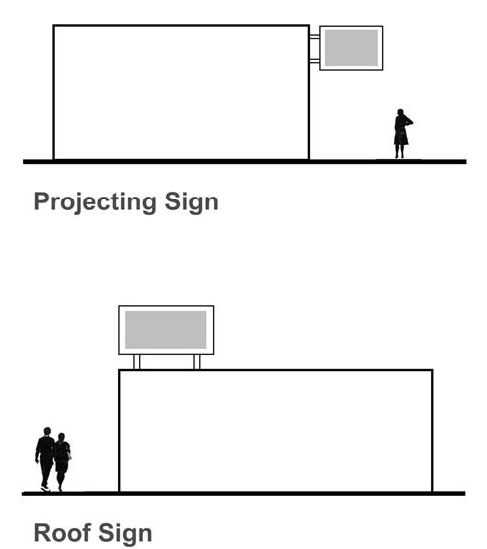
Roof, marquee, and projecting signs.
12.
Non-accessory and off-premises signs, including billboard signs per Section 17.09 (Billboards).
13.
Signs advertising businesses and services on other properties.
14.
Displays of obscene material on any sign.
15.
Posting of any placard, poster or other advertising matter on any post, tree or other object within any street area or upon any public property, except legal notices which shall be posted on boards as may be designated by the City Council.
16.
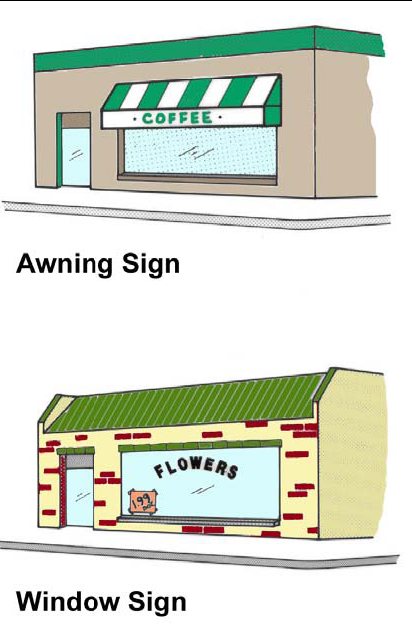
Window signs that obscure visibility through the window to an extent greater than twenty percent (20%) of the street level facade window surface area.
17.
Electronic message signs advertising in whole or in part for multiple businesses or uses on a sign structure.
18.
Any sign not expressly permitted by this Article.
(Ord. No. 662, art. I, 3-18-2013)
Section 17.03 - General Standards.
The following general standards shall apply to signs in all zoning districts:
A.
Standards of Measurement.
Dimensional standards and measurements for signs shall be subject to the following:
1.
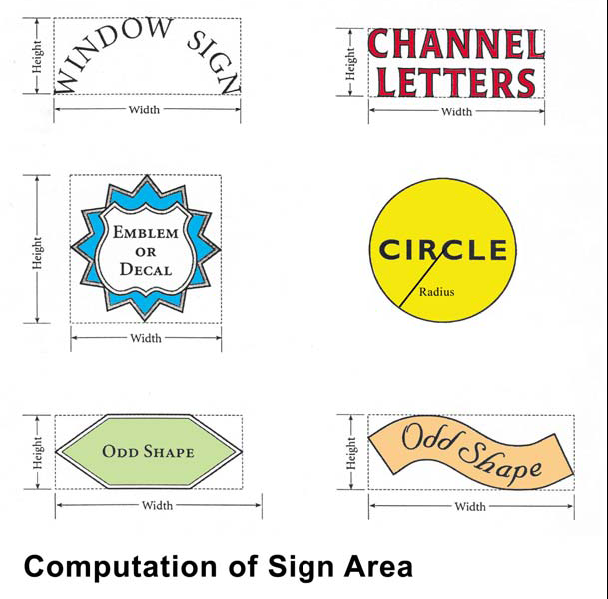
Sign area. The surface area of a sign shall be measured and defined by the area which encloses the extreme limits of individual letters, words, symbols or message of the sign together with any frame.
a.
Where two (2) sign faces with identical sign areas are placed back to back within two (2) feet of one another, then the sign area shall equal the area of one (1) face.
b.
Where two (2) sign faces with different sign areas are placed back to back within two (2) feet of one another, then the sign area shall equal the area of the larger face.
c.
Where two (2) or more sign faces are placed more than two (2) feet from one another at any point, then the sign area shall equal the total area of all sign faces.
2.
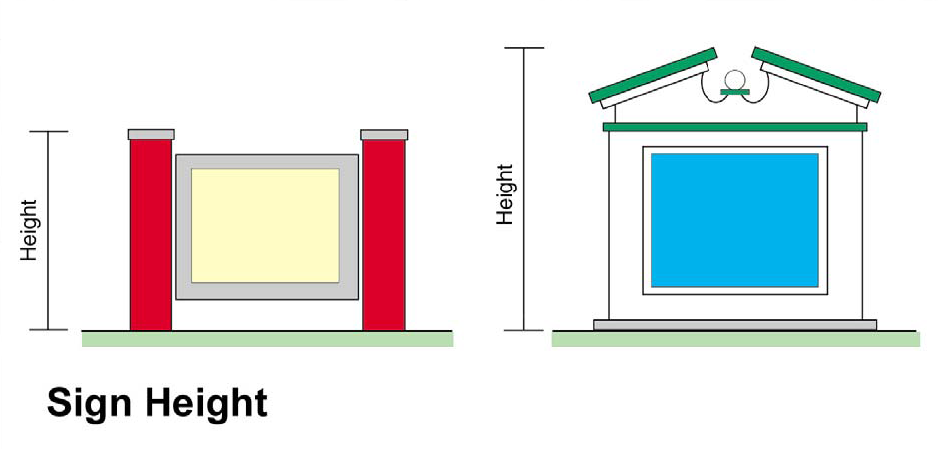
Sign height. The distance from the average level of the ground or pavement directly below the sign to the highest point of the sign structure, including any supportive or decorative elements.
3.
Sign setback. Setbacks shall measure from the closest street right-of-way or front property line to the nearest edge of the sign.
4.
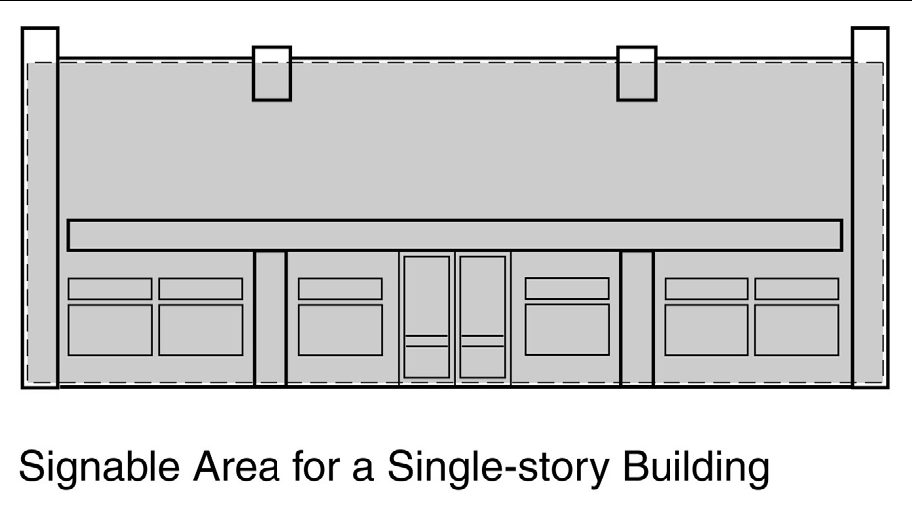
Signable area. The signable area of a building shall equal the area of the building's first floor or street level facade.
a.
Multiple uses. Where more than one business or use occupies space on the street level facade, the total signable area allowed for the building shall be divided among the businesses or uses in proportion to the size of their occupied space.
b.
Corner lots. Where a building has two (2) or more street level facades (such as on a corner lot), the signable area shall equal the area of the largest street level facade.
B.
Construction and Maintenance Specifications.
1.
All signs shall be constructed, installed and erected in compliance with the State Construction Code, and applicable fire and electrical codes enforced by the City.
2.
All signs, sign frames, sign copy area, panels, structural elements, lamps and electrical hardware shall be maintained in good repair and working order, so as to present a neat and orderly appearance. Non-galvanized or corrosion-resistant materials shall be painted when necessary to prevent corrosion.
3.
Face of sign shall be smooth. No nails, tacks or wires shall be permitted to protrude from the front of any sign. This shall not exclude, however, the use of block letters, electrical reflectors, or other devices which may extend over the top and in front of the sign structure.
C.
Hazards and Obstructions.
1.
Signs shall not be located within any street right-of-way or corner clearance area.
2.
Signs shall not confuse or mislead motorists or pedestrians, create traffic or pedestrian hazards, obstruct free and clear vision or interfere with any traffic control device.
3.
No sign shall be erected or maintained so as to prevent ingress or egress from any door, window or fire escape. No sign of any kind shall be attached to a standpipe, fire escape or other means of ingress or egress.
4.
All signs shall be located at least ten (10) feet from any utility pole, overhead wire, transformer or streetlight.
D.
Use.
Signs shall not impair the use of adjacent properties. All signs shall be accessory to the principal use of the lot where the sign is located, unless specifically permitted by this Article. Any sign permitted by this Article may contain a non-commercial message.
E.
Illumination.
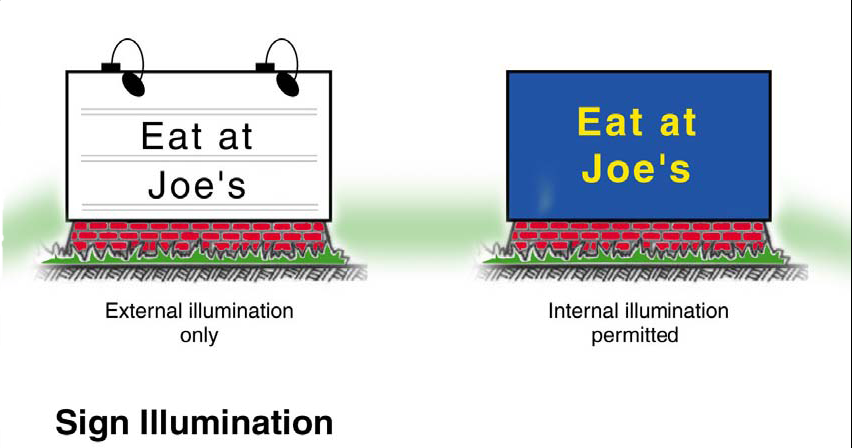
The standards of this subsection are intended to prohibit excessive and poorly shielded illumination of signs in the City; minimize light pollution and light trespass from illuminated signs; and reduce glare impacts on motorists. Internal and external lighting, reflectorized, glowing, and other forms of illumination shall be permitted on all signs, subject to the standards of Article 16 (Exterior Lighting) and the following:
1.
External sign illumination. External sign illumination shall be limited to fully-shielded light fixtures mounted above, and directed downward towards the sign face.
a.
All illumination shall be concentrated on the area of the sign to prevent glare upon the street or adjacent property.
b.
Uplighting of a sign face from ground level or below the sign shall be prohibited.
2.
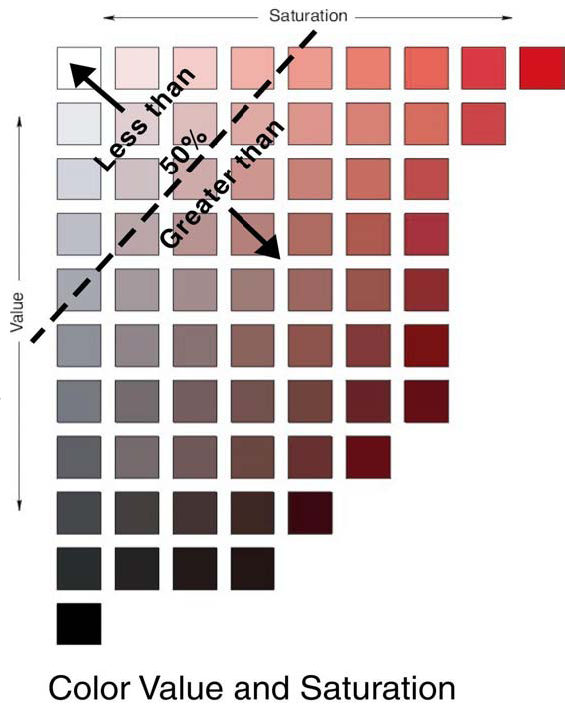
Internal sign illumination. Internal sign illumination shall be limited to sign faces that are more than fifty percent (50%) covered by semi-opaque colors and materials.
a.
Semi-opaque colors shall have a color value and saturation of fifty percent (50%) or higher.
b.
Internally illuminated panels that include fifty percent (50%) or more white space shall be prohibited.
3.
Prohibited lighting. Neon or fluorescent tube lighting shall not be used as part of a sign where the tubing or light source would be visible from any street right-of-way or adjacent property. Such light sources shall be shielded by translucent panels or similar methods of shielding.
4.
Types of illumination. Sign illumination shall be provided solely by electrical means or devices not of a flashing, intermittent, moving or animated type. In no instance shall such light be located as to be hazardous to traffic as determined by the Police Chief.
5.
Hours of illumination. Illuminated signs shall be equipped with a functional timer control. Such signs shall not be illuminated after 11:00 p.m., or one-half (½) hour following the close of the business day, whichever is later. Such signs shall not be illuminated before sunrise, or one-half (½) hour prior to the beginning of the business day, whichever is earlier.
F.
Insurance Certificate.
The applicant shall submit a valid certificate of insurance for existence, usage, message content and performance of the sign in addition to Federal, State or local laws or ordinances, to be renewed annually, listing the City of Riverview as the certificate holder and naming the City of Riverview, its past, present and future elected officials, representatives, employees, boards, commissions and agents as additional named insured. The certificate shall also state that if the policy is to be cancelled before the expiration date thereof, the issuing company will mail thirty (30) days' written notice to the City as certificate holder. The City may require the applicant to supply a one thousand dollar ($1,000.00) cash bond to the City, which shall be used to reimburse administrative expenses in the event the certificate is allowed to lapse.
G.
The City is exempt from the provisions of this Article for all signs conveying a public service message or announcement.
(Ord. No. 662, art. I, 3-18-2013)
Section 17.04 - Signs Permitted Without a Permit.
The following non-illuminated signs are exempt from Section 17.09 (Sign Permit) requirements, and shall be permitted accessory to a permitted use in any zoning district:
A.
Temporary Signs.
The following types of temporary signs shall be permitted accessory to a permitted use in any zoning district, subject to the following:
1.
Temporary signs displaying a non-commercial message. Temporary signs displaying a non-commercial message ("temporary non-commercial signs") shall be subject to the following:
a.
For the purpose of this Section, signs posted by a property owner or their agent for the purpose of marketing property for sale or lease shall be considered to be temporary non-commercial signs.
b.
Total sign area of all temporary non-commercial signs on a single lot shall not exceed seven (7) square-feet in the City's lower density residential districts (R-1, R-2, R-3, RM, RM-1, and R-4), and 24 square-feet in any other zoning district.
c.
The maximum sign height of each temporary non-commercial sign shall not exceed four (4) feet in the City's lower density residential districts (R-1, R-2, R-3, RM, RM-1, and R-4), and six (6) feet in any other zoning district.
d.
Such signs shall be removed by the property owner, agent or persons or bodies responsible for creating the sign or placing the sign on the property within five (5) calendar days following completion or discontinuation of the event, action, or activity to which the sign pertains.
e.
No temporary sign shall be strung across any public right-of-way nor shall any temporary sign project beyond the property line, except as authorized by the City Council.
f.
Temporary signs found by the Building Official to be in a torn, damaged or unsafe condition shall be immediately removed by the owner upon receipt of notice from the Building Official.
2.
Construction signs. Temporary construction signs shall be subject to the following:
a.
Number of signs. Maximum of one (1) sign per street frontage.
b.
Sign area, height and location. The maximum sign area shall not exceed 24 square-feet, and the maximum sign height shall not exceed six (6) feet.
c.
Display period. The sign shall not be erected prior to approval of a site plan, final preliminary plat or equivalent City action, and shall be removed within five (5) calendar days of completion of the project's final phase.
3.
Garage sale signs. One (1) temporary sign, not exceeding eight (8) square feet in area for each side of such sign, may be used to advertise a garage sale. Such sign shall be located on the premises of the garage sale and shall be promptly removed upon completion of the garage sale. Garage sale signs located at other properties anywhere throughout the City other than the property holding the sale shall be strictly forbidden.
B.
Other Signs and Sign-Related Activities.
The following types of signs and sign-related activities shall be permitted accessory to a permitted use in any zoning district, subject to the following:
1.
All principal buildings shall display their assigned street number in a manner legible from the street right-of-way, and in accordance with Fire Department policies.
2.
Nameplates, not exceeding two (2) square-feet in area, identifying the name of the business or occupants of a building or lot.
3.
Painting, servicing, cleaning or minor repairs to an existing sign, provided that the sign is restored to its original design and all work is in compliance with applicable structural and electrical codes, and the requirements for such signs specified in this Article.
4.
Window signs not exceeding two (2) square-feet in area, that indicate the hours of operation for a business and whether the business is open or closed.
5.
Memorial signs or tablets, when cut into any masonry surface or constructed of bronze or other incombustible material.
6.
Flags bearing the official design of a nation, state, municipality, educational institution, award or non-profit organization, including pennants installed by the City on major streets for aesthetic or promotional purposes.
7.
Traffic safety and control signs that conform to the requirements of the Michigan Manual of Uniform Traffic Control Devices, or other municipal signs, including legal notices, park and playground signs and emergency notices.
8.
Changes to sign copy within an approved changeable copy area.
9.
Posting of not more than one "No Trespassing" sign or similar notice for each 100 feet along a lot boundary. Each sign shall not exceed three (3) square-feet in area, and shall be located entirely upon private property.
Section 17.05 - Signs Permitted With a Permit.
The following signs shall be permitted accessory to a permitted use in any zoning district, subject to approval of a sign permit in accordance with Section 17.10 (Sign Permit) requirements:
A.
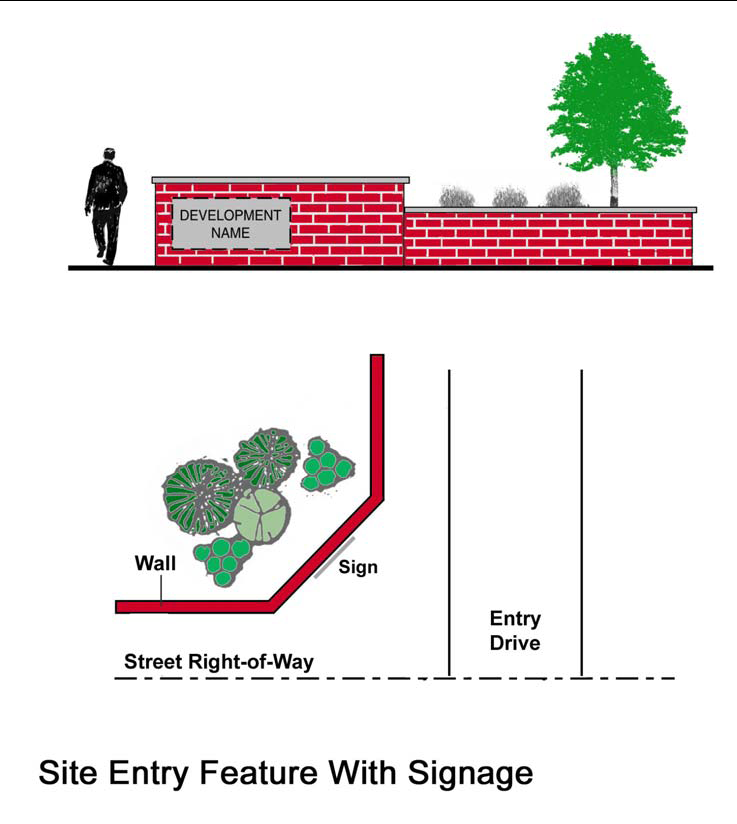
Site Entry Features with Signage.
Site entry features with signage may be erected at each entrance to a residential subdivision, apartment community, condominium development, manufactured housing park or office, research or industrial park, subject to the following:
1.
Number of signs. Maximum of one (1) sign on each side of the entrance from a major street.
2.
Setbacks. Site entry features with signage shall be located outside of any street right-of-way or corner clearance area, and shall further comply with the following minimum setback requirements:
a.
10 feet from any street right-of-way or curbline of any internal access driveway.
b.
Five (5) feet from any sidewalk or paved path.
3.
Sign area and height. The maximum height for signs on a site entry feature shall not exceed six (6) feet, and the maximum sign area shall not exceed 24 square feet.
4.
Planning Commission review. The location and design of each site entry feature with signage shall be subject to review and approval by the Planning Commission.
B.
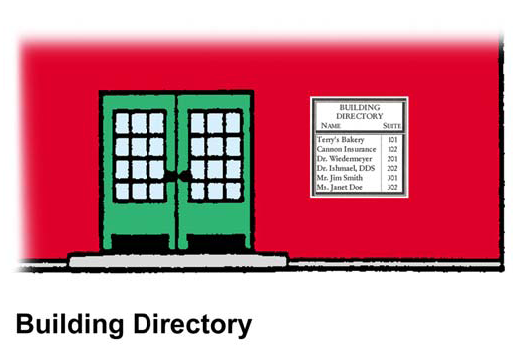
Building Directory.
Where a single building on a single lot is occupied by more than one (1) business, dwelling or other use above the street level facade (such as a multiple-story office or commercial building), a building directory sign may be erected on the street level facade for these uses, subject to the following:
1.
The building directory shall be separate from any permitted signs accessory to the uses occupying the street level facade.
2.
The maximum sign area of the building directory shall not exceed three percent (3%) of the signable area of the building.
C.
Other Temporary Signs.
Temporary signs not otherwise regulated by Section 17.04 (Signs Permitted Without a Permit) [including temporary balloon signs, festoons, banners, pennants, and other temporary signs displaying a commercial message] shall be subject to the following:
1.
Number of permitted signs. A maximum of one (1) sign per street frontage shall be permitted.
2.
Maximum sign area and height. The maximum area and height of temporary signs permitted under this Section shall not exceed four (4) feet, and the maximum sign area shall not exceed twenty-four (24) square feet.
3.
Sign removal. A removal agreement or security bond to guarantee removal of such signs may be required. Signs must be removed within four (4) days after completion of the activity for which they were erected.
4.
Display period. The display period for such signs per use on a single lot shall not exceed two (2) times per calendar year for a temporary time period not to exceed 15 consecutive days per time period.
5.
Permission to display sign required. Written permission to display the temporary sign(s) shall be required from the property owner, or the owner's agent or manager. Such permission shall be submitted with the sign permit application.
(Ord. No. 662, art. I, 3-18-2013)
Section 17.06 - Building-Mounted Signs.
The intent of this Section is to establish consistent and reasonable standards for the location, size and range of permitted types of signs located on buildings in the City, and to minimize the proliferation of excessive or out-of-scale signage that would compete for the attention of motorists, creating traffic hazards and visual blight within the City.
The following shall apply to all building-mounted signs accessory to non-residential uses in any zoning district [signs associated with residential uses are subject to the standards of Section 17.05 (Signs Permitted in All Districts with a Permit)]:
A.
Building-Mounted Sign Standards.
1.
Location. All building-mounted signs regulated by this Section shall be located entirely within the street level facade(s) of a building.
2.
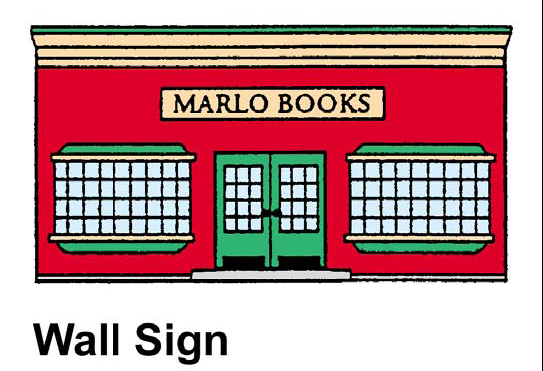
Painted wall signs. Signs applied with paint or similar substance on an exterior surface of a structure (including murals) shall be considered a building-mounted sign subject to the standards of this Section. Prior to painting a sign on a wall, a permit must be obtained and the wall surface must be freshly painted with one continuous base color.
3.
Window signs. The purpose of limiting the amount of window surface area that may be obscured by signage to a maximum of twenty percent (20%) of the street level facade window surface area is to:
a.
Provide for the safety and security of persons and property in the City by preserving reasonable visibility through the windows; and
b.
Prevent a proliferation of window signage that would distract motorists, adversely impact surrounding uses, and detract from the character of the neighborhood and City as a whole.
B.
Permitted Modifications.
The following modifications to the standards of this Section for wall and awning signs have been established to:
1.
Preserve the neighborhood character and appearance of the City's lower density residential districts (R-1, R-2, R-3, RM, RM-1, and R-4) through more restrictive signage standards for permitted non-residential uses in these districts.
2.
To distinguish between the Office (OS-1) and Local Business (B-1) Districts that act as a transitional buffer zones for abutting Residential Districts, and the more intensive commercial and industrial districts.
The following modifiers to the standards for wall and awning signs specified in Section 17.06A shall apply to all wall, awning or projecting signs associated with non-residential land uses and buildings in the above zoning districts:
Section 17.07 - Ground Signs.
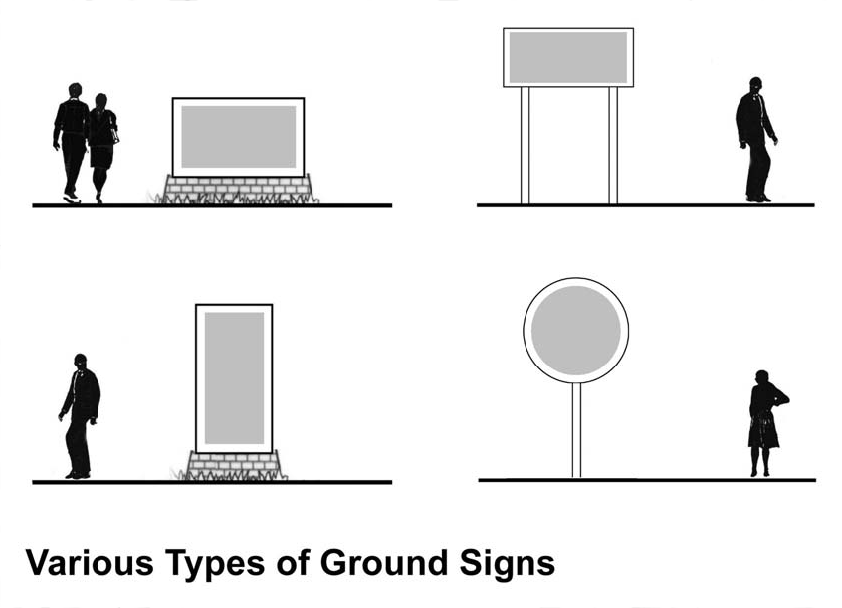
The intent of this Section is to establish consistent and reasonable standards for the height, location and size of ground signs in the City, and to minimize the proliferation of excessive or out-of-scale ground signage that would compete for the attention of motorists, creating traffic hazards and visual blight within the City. The following shall apply to all ground signs accessory to non-residential uses in any zoning district [signs associated with residential uses are subject to the standards of Section 17.05 (Signs Permitted in All Districts with a Permit)]:
A.
Ground Sign Standards.
B.
Permitted Modifications.
The following modifications to the standards of this Section have been established to:
1.
Preserve the neighborhood character and appearance of the City's lower density residential districts (R-1, R-2, R-3, RM, RM-1, and R-4) through more restrictive signage standards for permitted non-residential uses in these districts.
2.
Ensure that permitted signage is in reasonable proportion to the land use intensity.
3.
Address the specific signage needs of multi-tenant shopping centers, large land uses, and uses that abut roads with expansive rights-of-way, such as Fort Street.
4.
Distinguish between the Office (OS-1) and Local Business (B-1) Districts that act as a transitional buffer zone for abutting residential districts, and the more intensive commercial and industrial districts.
Modifiers shall be cumulative down each column of the following table, as applied to a particular land use or zoning lot:
C.
Permit Required.
No person shall erect, alter or relocate a ground sign, including any changes in sign copy, without first obtaining appropriate permits from the City.
Section 17.08 - Electronic Message Sign Standards.
Electronic message signs shall be permitted within the OS, B-1, B-2, B-3, M-1 and M-2 zoning districts. Such sign must be freestanding. Such sign shall be allowed subject to the sign regulations for each zoning district and subject to the following additional regulations:
A.
An electronic message sign is permitted and regulated as a ground sign per Section 17.07. Wall signs are prohibited.
B.
A maximum of one (1) electronic message sign is permitted per property, business or business center occupied by multiple businesses, uses or buildings.
C.
The electronic display shall not flash, pulse or scroll.
D.
The frequency of the message change shall:
1.
Not exceed once every ten (10) seconds.
2.
Be completed in one (1) second.
3.
Occur simultaneously over the entire face of the electronic message sign.
E.
The maximum area of all electronic message signs shall not exceed fifty percent (50%) of the total permitted sign area.
F.
The maximum elevation of an electronic message sign shall not exceed six (6) feet. Such sign shall be setback ordinance requirements inclusive of the sign structure. Signs advertising fuel prices shall not exceed twelve (12) feet in elevation. Elevations are measured from grade level to top of sign structure.
G.
The width of an electronic sign shall not exceed eight (8) feet.
H.
No sign shall orient to face a residentially zoned property.
I.
No advertising of products, services or similar sold or located off-premise is permitted.
J.
The intensity of the display on any variable electronic message sign shall not exceed the levels specified in the chart below:
K.
Prior to issuing a permit for an electronic message sign, applicant shall provide a written certification from the sign manufacturer that the light intensity has been factory pre-set not to exceed the levels specified in the chart above, and the intensity level is protected from end-user manipulation by password-protected software or other method deemed appropriate by the Department. The characters on any variable electronic message sign must be lighted against a darker or less luminous background.
L.
The property owner and sign operator shall provide contact information for a person that is available to promptly turn off the variable electronic message sign after a malfunction. The property owner and sign operator shall correct the malfunction or remove power to the sign within twenty-four (24) hours of a request by the City of Riverview.
M.
A sign base and side supports shall be installed. The top of the base shall be set a minimum one (1) foot above grade level. The base and side supports shall be faced with material matching the texture and color of the principal building.
N.
An electronic message sign shall be required to be shut off between the hours of 10:00 p.m. or the closing time of normal business hours, whichever is later, and 7:00 a.m. or the opening of business hours, whichever is earlier.
O.
Signs which constitute nonconforming uses under Section 18.17 of this Ordinance, or as to which variance(s) has/have been granted for sign size, height, location, or number, must be eliminated or brought into conformity with all currently applicable ordinance limits prior to the issuance of a variable electronic message sign permit for the business, business center, and/or regional center to which such nonconforming sign(s) pertain(s).
P.
An electronic message sign which does not comply with the provisions of this subsection shall not be permitted in any zoning district in the City.
(Ord. No. 662, art. I, 3-18-2013)
Section 17.09 - Billboards.
A.
Findings.
The City has made the following determinations related to billboard signs:
1.
The placement of oversized and out-of-scale billboard signs would result in visual pollution, and obstructions of light and sunshine to adjoining properties and uses.
2.
Billboard signs are not appropriate in areas zoned for residential uses, or in adjoining office or local business districts that serve as a transitional zone for the residential districts, because the advertising activity is commercial in nature, would be harmful to residential property values, and incompatible with the quality of life in residential areas.
3.
Billboard signs are not appropriate in areas along the major thoroughfares and highways in the City, because a proliferation of billboard signs would create additional visual clutter and compete for the visual attention of motorists. These road corridors have been developed with multiple existing curb cuts, driveways and intersections, and numerous businesses that experience a high volume of employee, customer and client traffic. Location of billboard signs in these areas would create a visual diversion for motorists, and a traffic hazard to other vehicles and pedestrians in the area.
4.
The placement of new billboard signs in the City is contrary to the purpose of this Article, and the goals and objectives of the City's Master Plan.
B.
Billboards Prohibited.
In accordance with the above findings, billboard signs are hereby prohibited within the City of Riverview.
C.
Existing Billboards.
Billboard signs lawfully existing in the City on the date of adoption of this Ordinance shall be permitted to continue, subject to the provisions of Section 17.10 (Nonconforming Signs). The Building Official shall be responsible for maintaining an inventory of the location and condition of all existing billboard signs in the City.
(Ord. No. 662, art. I, 3-18-2013)
Section 17.10 - Sign Permit.
No person shall erect, alter or relocate a sign without first obtaining appropriate building and/or zoning permits from the City. The following shall be provided with any permit application:
A.
Required information.
1.
Application. The name, address and telephone numbers for the applicant, property owner, and sign contractor, street address or property location where the sign is to be located, and the type of sign, as defined in this Ordinance. Written consent of the property or sign owner to perform the proposed work shall also be provided upon request.
2.
Plot plan. A plot plan shall include a parcel survey, easements, dimensions, locations of all structures, and all existing and proposed signs on the lot. If building-mounted signs are proposed, elevation drawings of all buildings on the site shall be provided showing all existing and proposed building-mounted signs.
3.
Construction drawings. Specifications and drawings showing the materials, design, dimensions, structural supports, electrical components and type of illumination for each sign.
4.
License and insurance. Every person who engages in the business of erecting, altering or dismantling signs in the City shall first submit proof of appropriate licenses and a liability insurance policy that indemnifies the City of Riverview and its prior, present and future officials, representatives and employees from all damage suits or actions of every nature brought or claimed against the erector for injuries or damages to persons or property sustained by any person or persons through any act of omission or negligence of said erector, his servants, agents or employees. Said policy shall contain a clause whereby it cannot be canceled or changed until after written notice has been filed with the City at least 30 days prior to the date of cancellation.
5.
Removal agreement or bond. The Building Official may require a signed removal agreement, bond or other acceptable surety to guarantee the future removal of a sign.
B.
Sign Permit Fee.
It shall be unlawful for any person to erect or alter any sign, except those signs specifically exempted herein, unless a permit has first been obtained from the Building Official, and a permit fee paid to the City according to the schedule of fees established by the City Council.
C.
Sign Permit Revocable At Any Time.
All rights and privileges accrued under the provisions of this Ordinance or any amendment hereto are mere licenses and may be revoked upon the violation of any of the conditions contained herein. If the work authorized by an approved sign permit has not been completed within 180 days after date of issuance, the permit shall become null and void and a new permit shall be necessary to continue the project. Partially completed signs, if abandoned, shall be removed by the erector or property owner upon notice from the Building Official.
(Ord. No. 662, art. I, 3-18-2013)
Section 17.11 - Nonconforming Signs.
All existing signs that do not conform to the provisions of this Article and Ordinance shall be permitted to continue as nonconforming signs until removed or altered, at which time they shall conform to the provisions of this Article and Ordinance. Nonconforming signs shall be subject to the following:
A.
General Standards.
Nonconforming signs of shall be maintained in accordance with the requirements for all signs specified in Section 17.03 (General Standards).
B.
Good Working Order.
Nonconforming signs shall be maintained with all necessary structural and decorative parts, including, but not limited to supports, sign box or enclosure and electrical equipment. All sign faces or copy areas must be intact, and illuminated signs must be capable of immediate illumination.
C.
Expansion, Relocation, and Servicing of Nonconforming Signs.
Nonconforming signs shall not be expanded or relocated. Painting, servicing, cleaning or minor repairs to a nonconforming sign shall be permitted, provided that the sign is restored to its original design and all work is in compliance with the requirements for all signs specified in Section 17.03 (General Standards).
D.
Alterations to Nonconforming Signs.
Alterations to a nonconforming sign frame or structural elements shall be subject to the following conditions:
1.
The sign shall be brought into compliance with the maximum sign height and area standards for the location and type of sign, as specified in this Article.
2.
Existing ground sign support structures and wiring may be re-used, provided that permitted alterations will not increase any nonconformity caused by inadequate sign setback.
3.
Alterations to the sign copy area or structure of a nonconforming billboard sign shall be permitted, provided that the sign area and height are not increased.
(Ord. No. 662, art. I, 3-18-2013)
Section 17.12 - Sign Removal by City Action.
A.
Abandoned or Unlawful Signs.
The Community Development Director shall have the authority to determine whether a sign is unlawful or has been abandoned, as defined in Section 25.02 (Definitions), and subject to appeal by an aggrieved person to the Zoning Board of Appeals. The Community Development Director may order the removal of such signs in accordance with the following procedure:
1.
Determination. Written notification of the determination and any order for removal shall be provided by certified mail to the owner, operator or person having beneficial use of the property upon which the sign is located.
2.
Removal. Abandoned or unlawful signs shall be removed within 30 days after notification of a determination and order for removal by the Community Development Director. All support structures and components shall be completely removed. Failure to remove the sign shall constitute grounds for the City to seek Circuit Court approval to remove the sign at the property owner's expense. The owner shall reimburse the City for the actual costs of the removal plus associated administrative costs, or the City may place a lien on the property for necessary removal expenses.
B.
Damaged Signs.
Signs determined to be in a damaged condition by the Building Official shall be repaired or removed within 30 days after notification by certified mail. If such action is not taken by the owner, operator or person having beneficial use of the property where the sign is located, the Building Official shall have the authority to order the repair or removal of the damaged sign. The owner shall reimburse the City for the actual costs of the repair or removal plus associated administrative costs, or the City may place a lien on the property for such expenses.
C.
Unsafe Signs.
The Building Official may order the removal of any sign determined to be unsafe without prior notice. After removal, the Building Official shall notify the property owner by certified mail of the action taken and the reasons for the action. The owner shall reimburse the City for the actual costs of removal, storage and reclamation, or the City may place a lien on the property for such expenses.
D.
Nonconforming Signs.
The elimination of nonconforming signs in the City is hereby declared to be for a public purpose and for a public use. The City may purchase nonconforming signs for the purpose of removal, or may initiate condemnation proceedings for nonconforming signs determined to be in violation of Section 17.10 (Nonconforming Signs) requirements.
E.
Temporary Signs.
Temporary signs displayed within a street right-of-way or corner clearance area, without a valid permit, or after permit expiration may be removed by the City without notice. Signs removed shall be held by the City for a 5 calendar day reclamation period, after which the sign may be discarded.
(Ord. No. 662, art. I, 3-18-2013)
Section 17.13 - Exceptions.
The Zoning Board of Appeals (ZBA) shall have the authority to grant an exception from the strict application of these regulations, provided that such relief may be granted without substantially impairing the intent of this Article. Application and consideration of sign exceptions shall be in accordance with the following procedures and standards:
A.
Applications for Sign Exceptions.
Any party who has been denied a permit for a proposed sign may file a request for an exception to this Article with the Zoning Board of Appeals (ZBA) within thirty (30) calendar days of the decision. Applications for exceptions from one (1) or more provisions of this Article shall be submitted in accordance with Section 19.05K (ZBA Application Requirements). Following a public hearing the ZBA may consider the standards stated in Section for the merits of granting an exception to particular requirements of this Article.
B.
Procedures for Consideration of Sign Exceptions.
Applications for exceptions from the provisions of this Article shall be considered by the ZBA in accordance with the review procedures specified in Section 19.05 (Zoning Board of Appeals Authority, Responsibilities and Procedures).
C.
Exception Standards for Signs.
The ZBA shall consider the following standards while reviewing any application for an exception from one (1) or more provisions of this Article.
1.
Intent of this Article. The exception, if granted, does not substantially impair the intent and purpose of this Article.
2.
Visibility. A conforming sign would be blocked from the sight of passing motorists due to existing buildings, trees, or other obstructions.
3.
Obstructions. Construction of a conforming sign would obstruct the vision of motorists or otherwise endanger public health or safety.
4.
Site features. Construction of a conforming sign would require removal or severe alteration to significant features on the site, such as removal of trees, alteration of the natural topography, obstruction of a natural drainage course, or alteration or demolition of significant historical features or site amenities.
5.
Scale. A sign that exceeds the allowable height or area standards of the Ordinance would be more appropriate in scale because of the intensity of the use, or the large size or frontage of the premises or building.
D.
Findings and Conditions.
In granting or denying a sign exception, the ZBA shall state the specific grounds and findings for the decision. The ZBA may attach any conditions to approval of a sign exception regarding the location, character, timing of display, or other features of the proposed sign as deemed reasonable.
(Ord. No. 662, art. I, 3-18-2013)
Section 17.14 - Summary of Regulations.
The following summary of selected sign provisions shall not supercede or replace other sections or regulations of this Article:
A.
Building-Mounted Signs.
B.
Ground Signs.
(Ord. No. 662, art. I, 3-18-2013)
ILLUSTRATIONS
 |  |
 |  |