
Riverview City Zoning Code
ARTICLE 20
PROCEDURES AND STANDARDS
Section 20.01 - Site Plan Review.
A.
Purpose.
The purpose of this Article is to establish procedures and standards that provide a consistent method of review of site plans, and to ensure full compliance with the standards contained in this Ordinance and other applicable Codes and Ordinances.
Flexible review standards have been established to ensure that the type of review and amount of required information is directly proportional to the project's scale and use intensity. It is the further purpose of this Article to protect natural, cultural and civic resources, minimize adverse impacts on adjoining or nearby properties, encourage cooperation and consultation between the City and the applicant, and facilitate development in accordance with the City's Master Plan.
B.
Type of Site Plan Review Required.
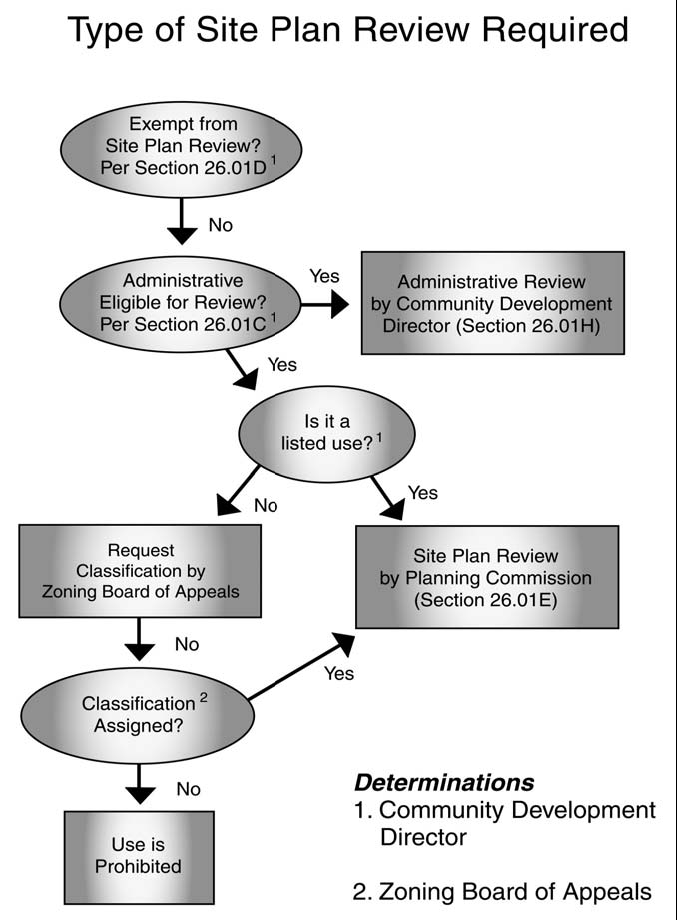
Two separate review processes have been established in accordance with the purpose of this Article. Certain developments or uses, as listed in Section 20.01C, have been determined to be appropriate for a less intensive administrative site plan review. A small number of uses, as listed in Section 20.01D, are exempt from site plan review.
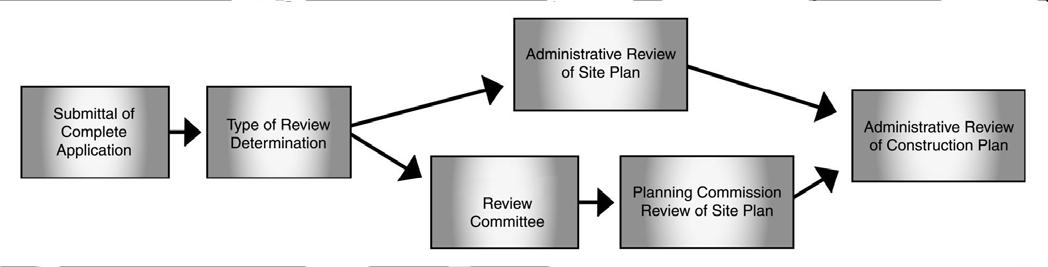
For all other development projects and uses, submission and approval of a site plan shall be required in accordance with the following chart:
Site Plan Review Process
C.
Projects Eligible for Administrative Review.
The following development projects, uses and other activities shall be eligible for administrative review and approval:
D.
Exempt Projects.
The following activities are exempt from site plan review due to their relatively low impact on adjacent land uses, or because compliance with applicable building, fire and zoning regulations can be addressed by other means:
1.
A single-family dwelling and accessory structures on a single lot.
2.
Family child day care homes, as licensed by the State of Michigan.
3.
Establishment of a home occupation listed in Section 10.104 as a permitted accessory use.
4.
Essential service or barrier-free access improvements.
E.
Site Plan Review Procedure.
Site plans shall be reviewed in accordance with the following:
1.
Pre-application meeting. Applicants are encouraged to meet informally with the Community Development Director to discuss site issues and application of Ordinance standards, prior to submitting site plans for formal review.
2.
Application. The owner of an interest in land for which site plan approval is sought, or the owner's designated agent, shall submit a completed application form and sufficient copies of a site plan to the City. Any application or site plan that does not satisfy the information requirements of this Section shall be considered incomplete, and shall be returned to the applicant.
3.
Technical review. Prior to Planning Commission consideration, the site plan and application shall be distributed to any review committee(s) for review and comment. The Community Development Director may also submit the plans to applicable outside agencies and designated City consultants for review and comment.
4.
Planning Commission consideration of the site plan. The Planning Commission shall review the site plan, together with any reports and recommendations from any review committee(s), staff, consultants and other reviewing agencies and any public comments. The Planning Commission shall then make a determination based on the requirements of this Ordinance and the standards of Section 20.01M (Standards for Site Plan Approval). The Planning Commission is authorized to postpone, approve, approve subject to conditions or deny the site plan as follows:
a.
Postponement. Upon determination by the Planning Commission that a site plan is not sufficiently complete for approval or denial, or upon a request by the applicant, the Planning Commission may postpone consideration until a later meeting.
b.
Denial. Upon determination that a site plan does not comply with the standards and regulations set forth in this Ordinance, or would require extensive revisions to comply with said standards and regulations, the site plan shall be denied.
If a site plan is denied, a written record shall be provided to the applicant listing the reasons for such denial. Failure of the applicant, or the applicant's designated representative, to attend two or more meetings shall be grounds for the Planning Commission to deny site plan approval.
c.
Approval. Upon determination that a site plan is in compliance with the standards and regulations set forth in this Ordinance, the site plan shall be approved.
d.
Approval subject to conditions. The Planning Commission may approve a site plan, subject to any conditions necessary to address minor required modifications, ensure that public services and facilities can accommodate the proposed use, protect significant site features, ensure compatibility with adjacent land uses, or otherwise meet the intent and purpose of this Ordinance. Such conditions may include the need to obtain variances or approvals from other agencies.
5.
Recording of site plan action. Planning Commission action on the site plan shall be recorded in the Planning Commission meeting minutes, stating the name and location of the project, the proposed use, the most recent plan revision date, and the conditions or grounds for the Planning Commission's action. The Secretary shall mark and sign three (3) copies of the site plan "APPROVED" or "DENIED" as appropriate, with the date that action was taken and any conditions of approval. Two (2) copies shall be kept on file in the City, and one (1) shall be returned to the applicant.
F.
Outside Agency Permits or Approvals.
The applicant shall be responsible for obtaining all necessary permits or approvals from applicable outside agencies, prior to construction plan approval.
G.
Construction Plan Review Procedure.
The applicant shall submit construction plans to the City for review and approval prior to the start of work on the site, along with copies of all necessary permits or approvals from outside agencies.
1.
Approval of construction plans. Construction plans shall be subject to administrative review and approval by the Building Official.
2.
Standards for construction plan approval. Construction plan approval shall be granted when all of the following requirements are met:
a.
The site design and improvements shown on the construction plan are consistent with the approved site plan, except for changes that do not materially alter the approved site design, or that address any conditions of site plan approval.
b.
All applicable engineering, building and fire code standards have been addressed to the satisfaction of the Fire Department, City Engineer and Building Official.
c.
All local, county and state requirements that apply to the site or proposed use have been satisfied, and all necessary outside agency permits or approvals have been obtained by the applicant.
3.
Recording of construction plan action. After action has been taken on the construction plan, at least three (3) copies of the final plan shall be marked "APPROVED" or "DENIED" as appropriate, with the date that action was taken. At least one (1) copy shall be returned to the applicant, and two (2) copies shall be kept on file in the City.
H.
Administrative Review.
The following shall apply to all site plans eligible for administrative review:
1.
Application requirements and procedures. The application requirements and procedures for administrative review shall be the same as for Planning Commission site plan review, as outlined in Section 20.01E, except that the Community Development Director shall have the authority to approve, approve subject to conditions, or deny the site plan.
2.
Appeals to the Planning Commission. The Community Development Director or the applicant shall have the option to request Planning Commission consideration of a site plan eligible for administrative review. All appeals of administrative review determinations shall be made to the Planning Commission. In such cases, the Planning Commission shall review the site plan in accordance with the procedures outlined in Section 20.01E (Site Plan Review Procedure).
I.
Approval of Phased Developments.
The Planning Commission may grant approval for site plans with multiple phases, subject to the following:
1.
The site design and layout for all phases and outlots be shown on the site plan to ensure proper development of the overall site.
2.
Improvements associated with each phase shall be clearly identified on the site plan, along with a timetable for development. Development phases shall be designed so that each phase will function independent of any improvements planned for later phases.
3.
Each phase shall be subject to a separate plan review by the Building Official and Community Development Director. Any revisions to the approved site plan shall be reviewed in accordance with Section 20.01K (Revisions to Approved Site Plans).
J.
Site Plan Resubmission, Appeals, Expiration or Revocation.
1.
Resubmission. A site plan that has been denied may be revised by the applicant to address the reasons for the denial and then resubmitted for further consideration. The resubmitted site plan shall be subject to the same requirements and review procedures as a new site plan submitted in accordance with this Article.
2.
Appeals. The Zoning Board of Appeals (ZBA) shall not have the authority to consider appeals of site plan determinations, except as follows:
a.
Appeals of Planning Commission actions. Appeals of Planning Commission site plan review actions shall be subject to the review procedure and criteria for appeals of administrative actions, as specified in Section 19.05 (Zoning Board of Appeals Authority, Responsibilities and Procedures).
b.
Order of review. Development projects requiring approval of a dimensional variance and a site plan shall first be submitted for site plan review, prior to ZBA consideration of dimensional variances. If a use variance is required, the project shall first be submitted for use variance review, prior to Planning Commission consideration of the site plan.
c.
Appeals of Planning Commission actions. If the Planning Commission approves a site plan contingent upon approval of one or more variances from specific requirements of this Ordinance, the applicant shall initiate such a request to the ZBA, prior to construction plan review. ZBA consideration shall be limited to the specific variances identified as conditions of site plan approval.
3.
Expiration of site plans.
a.
Site plan approval. Site plans shall expire 365 days after the date of approval, unless the construction plan for the project has been submitted to the City for review.
b.
Extension of approval. Upon written request received by the City prior to the expiration date, the Planning Commission may grant one (1) extension of final approval for up to 180 days, provided that site conditions have not changed in a way that would affect the character, design or use of the site, and that the approved site plan remains in conformance with all applicable provisions of this Ordinance.
4.
Rescinding approval of site plans. Site plan approval may be rescinded by the Planning Commission upon determination that the site has not been improved, constructed or maintained in compliance with approved permits, site plans, or conditions of site plan or special land use approval. Such action shall be subject to the following:
a.
Public hearing. Such action may be taken only after a public hearing has been held in accordance with the procedures set forth in Section 20.03 (Public Hearing Procedures), at which time the owner of an interest in land for which site plan approval was sought, or the owner's designated agent, shall be given an opportunity to present evidence in opposition to rescission.
b.
Determination. Subsequent to the hearing, the decision of the Planning Commission with regard to the rescission shall be made and written notification provided to said owner or designated agent.
K.
Revisions to Approved Site Plans.
Minor revisions to an approved site plan may be administratively reviewed by the Community Development Director, provided that such changes do not materially alter the approved site design, intensity of use or demand for public services. Revisions to an approved site plan that are not considered by the Community Development Director to be minor, shall be reviewed by the Planning Commission as an amended site plan.
L.
Required Information for Site Plans.
The following information shall be included with all site plan review applications, except where the Planning Commission determines that certain information is not necessary or applicable to the review:
M.
Standards for Site Plan Approval.
The following criteria shall be used as a basis upon which site plans will be reviewed and approved, approved with conditions, or denied:
1.
Adequacy of information. The site plan includes all required information in a complete and understandable form, provides an accurate description of the proposed uses, and complies with all applicable Ordinance requirements.
2.
Site appearance and coordination. The site is designed in a manner that promotes the normal and orderly development of surrounding property, and all site design elements are harmoniously organized in relation to topography, adjacent facilities, traffic circulation, building orientations, and pedestrian access.
3.
Preservation of site features. The site design preserves and conserves natural, cultural, historical and architectural site features, including architecturally or historically significant buildings, archeological sites, wetlands, topography, tree-rows and hedgerows, wooded areas and significant individual trees, to the extent feasible.
4.
Pedestrian access and circulation. Existing and proposed sidewalks or pedestrian pathways connect to existing public sidewalks and pathways in the area, are insulated as completely as possible from the vehicular circulation system, and comply with applicable regulations regarding barrier-free access.
5.
Vehicular access and circulation. Drives, streets, parking, site access and other vehicle-related elements are designed to minimize traffic conflicts on adjacent streets and promote safe and efficient traffic circulation within the site.
6.
Building design and architecture. Building design and architecture relate to and are harmonious with the surrounding neighborhood with regard to texture, scale, mass, proportion, materials and color.
7.
Parking and loading. Off-street parking lots and loading areas are arranged and located to accommodate the intensity of proposed uses, minimize conflicts with adjacent uses, and promote shared-use of common facilities where feasible.
8.
Landscaping and screening. Landscaping and screening are provided in a manner that adequately buffers adjacent land uses and screens off-street parking, mechanical appurtenances, loading and unloading areas and storage areas from adjacent residential areas and public rights-of-way.
9.
Exterior lighting. All exterior lighting fixtures are designed, arranged and shielded to minimize glare and light trespass, prevent night blindness and vision impairments, and maximize security.
10.
Impact upon public services. The impact upon public services (including utilities, streets, police and fire protection, public schools and public sidewalks/pathways) will not exceed the existing or planned capacity of such services.
11.
Drainage and soil erosion. Adjoining properties, public rights-of-way and the capacity of the public storm drainage system will not be adversely impacted by stormwater runoff and sedimentation.
12.
Emergency access and vulnerability to hazards. All sites and buildings are designed to allow convenient and direct emergency access, and the level of vulnerability to injury or loss from incidents involving hazardous materials or processes will not exceed the City's emergency response capabilities.
N.
As-Built Site Plans.
The Community Development Director may require submittal to the City of an as-built site plan, prior to issuance of a certificate of occupancy or as a condition of occupancy. The as-built plan shall clearly indicate all modifications from the approved site plan, and shall be subject to approval by the Community Development Director.
O.
Compliance with an Approved Site Plan.
It shall be the responsibility of the property owner, and the owner or operator of the use(s) for which site plan approval has been granted, to develop, improve and maintain the site, including the use, structures and all site elements in accordance with the approved site plan and all conditions of approval, until the property is razed, or a new site plan is approved. Failure to comply with the provisions of this Section shall be a violation of this Ordinance and shall be subject to the same penalties appropriate for a use violation.
The Community Development Director shall make periodic investigations of developments for which site plans have been approved. Noncompliance with the requirements and conditions of the approved site plan shall constitute grounds for the Planning Commission to rescind site plan approval.
Section 20.02 - Special Land Uses.
A.
Purpose.
Special land uses include those uses that serve an area, interest or purpose that extends beyond the borders of the City, create particular problems of control in relation to adjoining uses or districts, have detrimental effects upon public health, safety or welfare, or possess other unique characteristics that prevent such uses from being classified as principal permitted uses in a particular zoning district.
This Section is intended to provide a consistent and uniform method for review of special land use applications, ensure full compliance with the standards contained in this Ordinance, achieve efficient use of land, prevent adverse impacts on neighboring properties and districts, and facilitate development in accordance with the land use objectives of the Master Plan.
B.
Application Requirements.
Special land use applications shall be submitted in accordance with the following procedures and requirements, which provide for review and action by the Planning Commission:
1.
Eligibility. The application shall be submitted by the owner of an interest in land for which special land use approval is sought, or by the owner's designated agent. The applicant or agent shall be present at all scheduled review meetings, or consideration of the proposal may be tabled.
2.
Requirements. Special land use applications shall be submitted to the City at least 30 calendar days prior to a Planning Commission meeting at which review is sought, and shall include the following information:
a.
Contact information for the applicant and property owner, and proof of ownership. If the property is leased by the applicant, a copy of the lease shall be provided, along with the owner's authorization for the application.
b.
Address, location and tax identification number of the property.
c.
A detailed description of the proposed use.
d.
A site plan, if required by Section 20.01 (Site Plan Review).
e.
Appropriate review fees, as determined by City Council.
f.
Any other information deemed necessary by the Planning Commission to determine compliance with this Ordinance.
C.
Special Land Use Review.
After a complete and accurate application has been received and review fees paid, the application shall be reviewed in accordance with following procedures:
1.
Acceptance for processing. The application shall be placed on the agenda of the next available, regularly-scheduled Planning Commission meeting to set a public hearing date.
2.
Coordination with site plan review. A site plan associated with a special land use shall not be approved unless the special land use has first been approved. The Planning Commission may, at its discretion, consider special land use and site plan applications at the same meeting, or may require the site plan to be submitted for review following approval of the special land use.
3.
Technical review. Prior to Planning Commission consideration, the application materials shall be distributed to appropriate City officials and staff for review and comment. The Community Development Director may also submit the application materials to applicable outside agencies and designated City consultants for review.
4.
Public hearing. A public hearing shall be held for all special land uses consistent with state law, and in accordance with the procedures set forth in Section 20.03 (Public Hearing Procedures).
5.
Planning Commission consideration. Subsequent to the hearing, the Planning Commission shall review the application for special land use approval, together with any reports and recommendations from staff, consultants and other reviewing agencies, and any public comments. The Planning Commission shall then make a determination based on the requirements of this Ordinance and the standards contained in Section 20.02E (Standards for Special Land Use Approval). The Planning Commission is authorized to table, approve, approve subject to conditions or deny the special land use as follows:
a.
Tabling. Upon determination by the Planning Commission that a special land use application is not sufficiently complete for approval or denial, or upon a request by the applicant, the Planning Commission may table consideration until a later meeting. Failure of the applicant, or the applicant's designated representative, to attend the meeting shall be grounds for the Planning Commission to table consideration of the special land use.
b.
Denial. Upon determination that a special land use application is not in compliance with the provisions of this Ordinance, including Section 20.02E (Standards for Special Land Use Approval), or would require extensive modifications to comply with said standards and regulations, the special land use shall be denied. If a special land use is denied, a written record shall be provided to the applicant listing the reasons for such denial. Failure of the applicant, or the applicant's designated representative, to attend two (2) or more meetings shall be grounds for the Planning Commission to deny the special land use.
c.
Approval. The special land use may be approved by the Planning Commission upon determination that it is in compliance with the provisions of this Ordinance, including Section 20.02E (Standards for Special Land Use Approval). Upon approval, the special land use shall be deemed a conforming use permitted in the district in which it is proposed, subject to site plan approval, and any conditions imposed on the use. Such approval shall affect only the lot or portion thereof upon which the use is located.
d.
Approval subject to conditions. The Planning Commission may approve a special land use subject to reasonable conditions:
(1)
Designed to protect natural resources, the health, safety, welfare, and social and economic well-being of users or patrons of the use under consideration, residents and landowners immediately adjacent to the proposed use, or the community as a whole,
(2)
Related to the valid exercise of the police power, and the impacts of the proposed use, or
(3)
Necessary to meet the intent and purpose of this Ordinance, related to the standards established in this Ordinance for the special land use under consideration, and necessary for compliance with those standards.
Examples of such conditions include limitations on hours of operation or scope of permitted activities, requirements for periodic review or renewal, or automatic expiration of approval if the use ceases.
e.
Recording of special land use action. Planning Commission action on the special land use shall be recorded in the Planning Commission meeting minutes, stating the name, description and location of the proposed use, and the grounds for the Planning Commission's action. The Community Development Director shall keep one (1) copy of the written record on file in the City, and shall forward one (1) copy to the applicant as evidence of special land use approval.
D.
Special Land Use Resubmission, Appeals, Expiration or Revocation.
1.
Resubmission. A special land use application that has been denied shall not be resubmitted for a period of 365 days from the date of denial, except on grounds of new evidence or proof of changed conditions found by the Planning Commission to be valid.
2.
Appeals. The Zoning Board of Appeals shall not have the authority to consider appeals of special land use determinations by the Planning Commission.
3.
Expiration of special land use approval. Special land use approval shall expire 365 days after the date of approval, unless the use has been established on the site, or the construction plan associated with the special land use has been submitted for review. Special land use approval shall also expire upon expiration of the approved construction plan associated with a special land use.
Upon written request received by the City prior to the expiration date, the Planning Commission may grant one (1) extension of up to 180 days, provided that the approved special land use conforms to current Zoning Ordinance standards.
4.
Rescinding approval of special land uses. Approval of a special land use may be rescinded by the Planning Commission upon determination that the use has not been improved, constructed or maintained in compliance with this Ordinance, approved permits, site plans, or conditions of site plan or special land use approval. Such action shall be subject to the following:
a.
Public hearing. Such action may be taken only after a public hearing has been held in accordance with the procedures set forth in Section 20.03 (Public Hearing Procedures), at which time the owner of an interest in land for which special land use approval was sought, or the owner's designated agent, shall be given an opportunity to present evidence in opposition to rescission.
b.
Determination. Subsequent to the hearing, the decision of the Planning Commission with regard to the rescission shall be made and written notification provided to said owner or designated agent.
E.
Standards for Special Land Use Approval.
Approval of a special land use shall be based upon the determination that the proposed use complies with all applicable requirements of this Ordinance, and all of the following standards as deemed applicable to the use by the Planning Commission:
1.
A documented need exists for the proposed use. A documented and immediate need exists for the proposed use within the community and the neighborhood.
2.
Compatibility with adjacent uses. The special land use is compatible with adjacent uses and the existing or intended character of the surrounding neighborhood, and will not have an adverse impact upon or interfere with the development, use or enjoyment of adjacent properties, or the orderly development of the neighborhood.
3.
Compatibility with the Master Plan. The special land use location and character is consistent with the general principles, goals, objectives and policies of the adopted Master Plan.
4.
Compliance with applicable regulations. The proposed special land use is in compliance with all applicable Ordinance provisions.
5.
Impact upon public services. The impact of the special land use upon public services will not exceed the existing or planned capacity of such services, including but not limited to utilities, streets, police and fire protection services, and educational services.
6.
Traffic impacts. The special land use is designed and located in a manner that minimizes any adverse traffic impacts caused or exacerbated by the use.
7.
Environmental and public health, safety, welfare impacts. The location, design, activities, processes, materials, equipment, and operational conditions of the special land use will not be detrimental or injurious to the environment or the public health, safety, and welfare by reason of traffic, noise, vibration, smoke, fumes, odors, dust, glare, light, drainage, topographic changes or other adverse impacts.
8.
Isolation of existing uses. Approval of the special land use location will not result in a small residential or non-residential area being substantially surrounded by incompatible uses.
F.
Compliance with Special Land Use Approval.
It shall be the responsibility of the owner of the property and the operator of the use for which special land use approval has been granted to develop, improve, operate and maintain the use, including the site, structures and all site elements, in accordance with the provisions of this Ordinance and all conditions of special land use approval until the use is discontinued. Failure to comply with the provisions of this Section shall be a violation of the use provisions of this Ordinance and shall be subject to the same penalties appropriate for a use violation.
The Community Development Director may make periodic investigations of developments for which a special land use has been approved. Noncompliance with Ordinance requirements or conditions of approval shall constitute grounds for the Planning Commission to rescind special land use approval.
Section 20.03 - Public Notice; Public Hearings.
A.
All applications for development approval requiring a public hearing shall comply with the Michigan Zoning Enabling Act, PA 110 of 2006 and the other provisions of this Section with regard to public notification.
1.
Responsibility: When the provisions of this Ordinance or the Michigan Zoning Enabling Act require that notice be published, the City Clerk shall be responsible for preparing the content of the notice, having it published in a newspaper of general circulation in the City of Riverview and mailed or delivered as provided in this Section.
2.
Content of the Notice as Required by P.A. 110 of 2006: All mail, personal and newspaper notices for public hearing shall describe the nature of the request, the location which is the subject of the request, when and where the request will be considered and shall include a description of any written comments.
3.
Personal and Mailed Notice:
a.
General: When the provisions of this Ordinance or state law require that personal or mailed notice be provided, notice shall be provided to:
(1)
The owners of property for which approval is being considered, and the applicant, if different than the owner(s) of the property.
(2)
Except for re-zoning requests involving eleven (11) or more adjacent properties or an ordinance interpretation request that does not involve a specific property; to all persons to whom real property is assessed within three hundred (300) feet of the boundary of the property subject to the request, regardless of whether the property or occupant is located within the boundaries of the City of Riverview. If the name of the occupant is not known, the term "occupant" may be used in making notification. Notification need not be given to more than one (1) occupant of a structure, except that if a structure contains more than one (1) dwelling unit or spatial area owned or leased by different individuals, partnerships, businesses, or organizations, one (1) occupant of each unit or spatial area shall receive notice. In the case of a single structure containing more than four (4) dwelling units or other distinct spatial areas owned or leased by different individuals, partnerships, businesses or organizations, notice may be given to the manager or owner of the structure who shall be requested to post notice at the primary entrance of the structure.
(3)
All neighborhood organizations, public utility companies, railroads and other persons which have requested to receive notice pursuant to this Section.
(4)
Other governmental units or infrastructure agencies within one (1) mile of the property involved in the application.
b.
Notice by mail/affidavit: Notice shall be deemed mailed by its deposit in the United States mail, first class, properly addressed, postage paid. The City Clerk shall prepare a list of property owners and registrants to whom notices were mailed, as well as of anyone to whom personal notice was delivered.
4.
Time of Notice: Unless otherwise provided in the Michigan Zoning Enabling Act, PA 110 of 2006, or this Ordinance where applicable, notice of a public hearing shall be provided as follows:
a.
For a public hearing on an application for a re-zoning, text amendment, special land use, planned unit development, variance, appeal, or ordinance interpretation: not less than fifteen (15) days before the date the application will be considered for approval.
b.
For another public hearing required by this Ordinance: Fifteen (15) days.
B.
Registration to Receive Notice by Mail:
1.
General: Any neighborhood organization, public utility company, railroad or any other person may register with the City Clerk to receive written notice of all applications for development approval pursuant to this Section, or written notice of all applications for development approval within the zoning district in which they are located. The City Clerk shall be responsible for providing this notification. Fees may be assessed for the provision of this notice, as established by the legislative body.
2.
Requirements: The requesting party must provide the City Clerk information on an official form to ensure notification can be made. All registered persons must re-register bi-annually to continue to receive notification pursuant to this Section.
C.
Board of Zoning Appeals: The Board of Zoning Appeals shall make no recommendation except in a specific case and after a public hearing conducted by the Board. It shall, either by general rule or in specific cases, determine the interested parties who, in the opinion of the Board, may be affected by any matter brought before it. In all cases, interested parties shall include those persons to whom any real property within 300 feet of the premises in question shall be assessed, according to the latest assessment roll of the City, and the occupants of all single and two-family dwellings within 300 feet of the premises in question. Such notice may be delivered either personally or by mail, addressed to such respective owners as disclosed by the assessment roll and to the tenants at the addresses given for the property in the last assessment roll. If the tenant's name is not known, the term "occupant" may be used. The Board may require any party applying to the Board for relief to give such notice to other interested parties as the Board shall describe.
(Ord. No. 652, art. I, 6-4-12)
Section 20.04 - Amendments.
The City Council may, after recommendation from the Planning Commission, amend, supplement or change the provisions of this Ordinance or official Zoning Map, consistent with state law and the following procedures and standards:
A.
Initiation of Amendment.
Amendments to the provisions of this Ordinance may be initiated by the City Council, Planning Commission, or Community Development Director, or by petition from one (1) or more residents or property owners of the City. An amendment to the official Zoning Map may be initiated by the City Council, Planning Commission, or Community Development Director, or by the title holder for the property subject to the proposed amendment. No fee shall be charged for amendments initiated by the City Council, Planning Commission, or Community Development Director.
B.
Application.
An amendment to this Ordinance (except those initiated by the City Council, Planning Commission, or Community Development Director), shall be initiated by submission of a complete and accurate application to the City, along with the required fee established by City Council. In the case of an amendment to the official Zoning Map, the following information shall accompany the application and fee:
1.
A legal description and street address of the subject property, together with a survey and location map identifying the subject property in relation to surrounding properties.
2.
The name and address of the owner of the subject property, and a statement of the applicant's interest in the subject property, if not the owner in fee simple title.
3.
The existing and proposed zoning district designation of the subject property and surrounding properties.
4.
A written description of how the requested amendment meets the criteria stated in this Section.
C.
Amendment Review Procedure.
The amendment and application materials shall be prepared in accordance with the provisions of this Section, and shall be reviewed in accordance with the following procedure. Amendments or application materials that do not meet the stipulated requirements shall be considered incomplete and shall not be eligible for consideration by the Planning Commission:
1.
Technical review. Prior to Planning Commission consideration, the proposed amendment and application materials shall be distributed to appropriate City officials and staff for review and comment. The Community Development Director may also submit the application materials to applicable outside agencies and designated City consultants for review.
2.
Public hearing. A public hearing shall be held for all proposed amendments in accordance with the procedures set forth in Section 20.03 (Public Hearing Procedures).
3.
Planning Commission consideration of the proposed amendment. Subsequent to the hearing, the Planning Commission shall review the proposed amendment, together with any reports and recommendations from staff, consultants, other reviewing agencies and any public comments. The Planning Commission shall identify and evaluate all relevant factors, and shall report its findings and recommendation to the City Council.
In considering a proposed amendment to the official Zoning Map, the Planning Commission shall consider the following factors in making its findings and recommendations:
a.
Consistency with the Master Plan's goals, policies and future land use map, including planned timing or sequence of development. If conditions have changed since the Master Plan was adopted, the consistency with recent development trends in the area shall be considered.
b.
Compatibility of all the potential uses allowed in the proposed zoning district with the site's physical, geological, hydrological and other environmental features.
c.
Compatibility of all the potential uses allowed in the proposed zoning district with surrounding uses and zoning in terms of suitability, intensity, traffic impacts, aesthetics, infrastructure and potential influence on property values.
d.
Capacity of City's utilities and services sufficient to accommodate the uses permitted in the requested district without compromising the health, safety and welfare of the city.
e.
Capability of the street system to safely and efficiently accommodate the expected traffic generated by uses permitted in the requested zoning district.
f.
The apparent demand for the types of uses permitted in the requested zoning district in the City in relation to the amount of land in the City currently zoned and available to accommodate the demand.
g.
The boundaries of the requested rezoning district in relationship to the surrounding area and the scale of future development on the site.
h.
The requested rezoning will not create an isolated or incompatible zone in the neighborhood.
i.
Other factors deemed appropriate by the Planning Commission and City Council.
4.
City Council action on the proposed amendment. Upon receipt of the report and recommendation from the Planning Commission, the City Council shall consider the proposed amendment. If determined to be necessary, the City Council may refer the amendment back to the Planning Commission for revision or further consideration.
D.
Re-Application.
Whenever an application for an amendment to this Ordinance has been denied by the City Council, a new application for the same amendment shall not be accepted by the Community Development Department for a period of 365 calendar days unless the Community Development Director determines that one or more of the following conditions has been met:
1.
There is a substantial change in circumstances relevant to the issues or facts considered during review of the application.
2.
New or additional information is available that was not available at the time of the review.
3.
The new application is materially different from the prior application.
Section 20.05 - Conditional Rezoning.
A.
Purpose and Intent. The city council may, from time to time, on recommendation from the planning commission, on its own motion, or on petition, amend, supplement, modify, or change the zoning ordinance in accordance with the authority of Act No. 110 of the Public Acts of Michigan of 2006, as amended, in accordance with the following procedural outline:
1.
A petition for amendment to the zoning ordinance by an owner, or other person having a sufficient legal or countable interest, may be presented to the council. Such petition shall be accompanied with a fee in an amount established by resolution by the council and shall be used to defray the expense of publishing required notices and related expenditures. Should no public hearing be held thereon, the fee shall be refunded to the petitioner.
2.
All amendment proposals not originating with the planning commission shall be referred by the council to the planning commission for a recommendation before any action is taken by the council.
3.
The planning commission shall study the proposed ordinance amendment and make written recommendation addressing all legal and statutory requirements to the council for approval, conditional approval, or disapproval. In the course of such study, the planning commission shall hold a public hearing on the proposed amendment as required by the provisions of Public Act 110 of the Public Acts of Michigan of 2006, as amended.
4.
An owner of land may voluntarily offer in writing and the council may approve, certain use and development of land as a condition to the approval of a rezoning consistent with the provisions of Section 405 of Public Act No. 110 of 2006 (MCL 125.3405) and in accordance with the following:
a.
Procedure. Except as otherwise provided herein, the application, review, and approval of a conditional rezoning request shall follow the same procedures as established by the council and as provided by Public Act No. 110 of 2006 (MCL 125.3101 et seq.) for all rezoning requests without an offer of conditions.
A written offer of conditions may be submitted either at the time an application for rezoning is filed or at a later time during the rezoning process. An applicant may voluntarily amend or withdraw all or part of the offer of conditions at any time during the rezoning process, provided that if such amendment or withdrawal occurs subsequent to the planning commission's public hearing on the original request, the rezoning application shall be referred back to the planning commission for a new public hearing and recommendation.
Notice of the public hearing shall be given as required by state law. An offer of more restrictive conditions may not require a new public hearing.
b.
Conditions. An offer of conditions submitted as part of a conditional rezoning request shall bear a reasonable and rational relationship to the property for which rezoning is requested.
c.
Approval. Upon approval of a conditional rezoning request, the applicant shall submit a formal written statement of conditions as approved by the board which shall be incorporated by attachment as an inseparable part of the ordinance adopted by the council. The statement of conditions shall:
(1)
Be in a form recordable with the Wayne County Register of Deeds and include a statement acknowledging that it is recorded.
(2)
Contain a legal description of the land to which it pertains.
(3)
Acknowledge that upon the rezoning taking effect, the use and development of the land shall conform thereafter to all of the requirements regulating use and development within the new zoning district as modified by the statement of conditions.
(4)
Contain a provision acknowledging that the statement of conditions runs with the land and is binding upon successor owners of the land. Any person who establishes a development or commences a use upon such land shall continuously operate and maintain the development or use in compliance with all of the conditions set forth in the statement of conditions.
(5)
Incorporate by attachment or reference any diagram, plans or other documents submitted or approved by the owner that are necessary to illustrate the implementation of the statement of conditions. If any such documents are incorporated by reference, the reference shall specify where the document may be examined.
(6)
Specify that failure to comply with any of the conditions set forth in the statement of conditions shall constitute a violation of this zoning ordinance and shall be punishable accordingly.
(7)
Contain the notarized signatures of all of the owners of the subject land preceded by a statement attesting to the fact that they voluntarily offer and consent to the provisions contained within the document.
B.
Recording. The approved statement of conditions shall be filed by the city clerk with the Wayne County Register of Deeds. The council shall have the ability to waive this requirement if it determines that, given the nature of the conditions and/or the time frame within which the conditions are to be satisfied, the recording of such a document would be of no material benefit to the township or to any subsequent owner of the land. An approved conditional rezoning shall be designated on the zoning map in a manner that identifies that the property is subject to a statement of conditions.
C.
Effect. The following shall apply to approved conditional rezoning requests:
1.
Unless another time period is specified in the ordinance rezoning the subject land, the approved development and/or use of land pursuant to building and other required permits must be commenced upon the land within eighteen (18) months after the rezoning took effect and thereafter proceed diligently to completion. This time limitation may upon written request be extended by the council if (1) it is demonstrated to the council's reasonable satisfaction that there is a strong likelihood that the development and or use of will commence within the period of extension and proceed diligently thereafter to completion and (2) the council finds that there has not been a change in circumstances that would render the current zoning with statement of conditions incompatible with other zones and uses in the surrounding area or otherwise inconsistent with sound zoning policy.
2.
If approved development and/or use of the rezoned land does not occur within the time frame specified under section 20.05C.1, then the land shall revert to its former zoning classification as set forth in Section 405(2) of Public Act No. 110 of 2006 (MCL 125.3405) subrelates any action taken as provided in subparagraph A. The reversion process shall be initiated by the council requesting that the planning commission proceed with consideration of the rezoning of the land to its former zoning classification. The procedure for considering and making this reversionary rezoning shall thereafter be the same as applies to all other zoning requests.
3.
When land that is rezoned with a statement of conditions is thereafter rezoned to a different zoning classification or to the same zoning classification but with a different or no statement of conditions, whether as a result of a reversion of zoning pursuant to section 20.05C.2, or otherwise, the statement of conditions imposed under the former zoning classification shall cease to be in effect. Upon the owner's written request, the city clerk shall record with the Wayne County Register of Deeds a notice that the statement of conditions is no longer in effect.
4.
During the time period for commencement of an approved development or use specified pursuant to section 20.05C.1, or during any extension thereof granted by the council, the township shall not add to or alter the conditions in the statement of conditions.
5.
The statement of conditions may be amended thereafter in the same procedure as set forth for the original conditional rezoning approval.
6.
Nothing in the statement of conditions nor in the provisions of this Section shall be deemed to prohibit the township from rezoning all or any portion of land that is subject to a statement of conditions to another zoning classification. Any rezoning shall be conducted in compliance with this ordinance and Public Act No. 110 of 2006 (MCL 125.3101 et seq.).
(Ord. No. 742, art. I, 6-5-2023)

