
Roswell City Zoning Code
ARTICLE 13
- ADMINISTRATION
Sec. 13.1.- Summary of Review Authority
The following table summarizes the review and approval authority of the various reviews bodies and officials that implement and administer the UDC.
KEY: R = Review & Recommendation D = Final Decision A = Appeal PH = Public Hearing PM = Public Meeting Y = Required N = Not Required
(1) The Historic Preservation Commission provides review when it has jurisdiction over the application.
(2) Any appeal related to a requirement in Articles 1 through 10 must be filed with the Board of Zoning Appeals under Sec. 13.12.
(3) Refer to Sec. 13.8.7 and Sec. 13.8.10 for additional review authority requirements.
13.2.1.- Planning Commission
The Planning Commission is established as authorized in Article 2.6 of the Code of Ordinances. The Planning Commission has those powers and duties expressly identified in this Article and in Article 2.6 of the Code of Ordinances.
(Ord. No. 2024-02-04, 2-26-2024)
13.2.2. - Board of Zoning Appeals
The Board of Zoning Appeals is established as authorized in Article 2.6 of the Code of Ordinances. The Board of Zoning Appeals has those powers and duties as expressly identified in this Article and in Article 2.6 of the Code of Ordinances.
(Ord. No. 2024-02-04, 2-26-2024)
13.2.3. - Design Review Board
The Design Review Board is established as authorized in Article 2.6 of the Code of Ordinances. The Design Review Board has those powers and duties as expressly identified in this Article and in Article 2.6 of the Code of Ordinances.
(Ord. No. 2024-02-04, 2-26-2024)
13.2.4. - Historic Preservation Commission
The Historic Preservation Commission is established as authorized in Article 2.6 of the Code of Ordinances. The Historic Preservation Commission has those powers and duties as expressly identified in this Article and in Article 2.6 of the Code of Ordinances and as authorized by O.C.G.A 44-10 et seq., incorporated herein by reference and which can be found on the City website (www.roswellgov.com) or can be obtained from the Community Development Department offices, which are located at Roswell City Hall, 38 Hill Street, Roswell, GA 30075.
(Ord. No. 2021-10-18, § 1, 10-12-2021; Ord. No. 2024-02-04, 2-26-2024)
13.2.5. - Administrator
A.
Community Development Director. The Community Development Director is established as authorized in Article 2.4 of the Code of Ordinances. The Community Development Director has those powers and duties as expressly identified in this Article and in Article 2.4 of the Code of Ordinances. The Community Development Director designates UDC review and approval authority to the Zoning Director and Engineering Director. The Community Development Director remains responsible for the actions taken by their designee.
1.
Zoning Director. The Zoning Director serves as the administrator of the UDC and has primary review authority over Articles 1 through 10 (with the exception of Sec. 10.5.) and Sec. 11.6.
2.
Engineering Director. The Engineering Director has primary review authority over Sec. 10.5., Sec. 11.2., Sec. 11.5., Sec. 12.1., Sec. 12.2., Sec. 12.3., Sec. 12.4., Sec. 12.6. and Sec. 12.7.
B.
Transportation Director. The Transportation Director is established as authorized in Article 2.4 of the Code of Ordinances. The Transportation Director has primary review authority over Sec. 11.3. and Sec. 11.4.
C.
Environmental/Public Works Director. The Environmental/Public Works Director is established as authorized in Article 2.4 of the Code of Ordinances. The Environmental/Public Works Director has primary review authority over Sec. 12.5 and Sec. 12.9.
(Ord. No. 2020-06-07, § 1, 6-8-2020; Ord. No. 2024-02-04, 2-26-2024)
13.3.1.- Applicability
The following requirements are common to the procedures in Sec. 13.4. through Sec. 13.12. and apply to applications submitted under this Article.
13.3.2. - Georgia Zoning Procedures Act
A.
This Article is intended to comply with the provisions of the Georgia Zoning Procedures Act, O.C.G.A. § 36-66 et seq., which Act is incorporated by reference in its entirety into this UDC. This Article is also intended to comply with O.C.G.A. § 36-67, pertaining to zoning decisions.
B.
Where any provision of this Article is in conflict with any provision of State law, the State law controls. Where this Article is incomplete in having failed to incorporate a provision necessarily required for the implementation of State law, the provision of State law must be fully complied with.
13.3.3. - Application Requirements
A.
Application Submittal.
1.
All applications must be filed with the Community Development Department and must be submitted on forms and in such numbers as required by the Zoning Director.
2.
Application forms can be found on the City's website (www.roswellgov.com) or hard copies can be obtained from the Community Development Department offices, which are located at Roswell City Hall, 38 Hill Street, Roswell, GA 30075.
3.
Mixed Use Development Construction Phasing:
Construction phasing: A project build-out schedule for NX, CX, SH, CC, CH, PV and DX mixed-use developments shall be submitted for review by City staff in accordance with the construction phasing policy adopted by Mayor and Council by resolution. The purpose of such phasing plan shall be to provide assurance that the development will include both the proposed non-residential and residential elements at certain project milestones and/or at build-out.
B.
Fee Schedule.
1.
Filing fees have been established to help defray the cost of processing applications. The current fee schedule is available on-line on the City's website and kept on file by the Community Development Department and is updated and adopted by the City Council.
2.
Before review of an application, all filing fees must be paid in full.
C.
Completeness Determination.
1.
All applications must be complete before the City is required to review the application.
2.
An application is considered complete when it contains all of the information necessary to decide whether or not the application will comply with all of applicable requirements of this UDC.
3.
The presumption is that all of the information required in the City's application forms is necessary to satisfy the requirements of this Article. However, it is recognized that each application is unique, and more or less information may be required according to the specifics of a particular case. The applicant may rely on the Zoning Director to determine whether more or less information has to be submitted.
D.
Application Deadline. Complete applications must be submitted in accordance with the published schedule. Schedules indicating submittal dates are developed each year and made available on-line on the City's website and to the public at the Community Development Department offices.
E.
Revised Application Materials.
1.
All revised application materials must be submitted to the Community Development Department, who will route the materials to the appropriate review bodies. No plans may be sent directly to the Planning Commission, Design Review Board, Historic Preservation Commission, Mayor or City Council.
2.
No revised application materials, either hard copy or electronic, may be submitted to the Community Development Department less than 12 days prior to a scheduled public meeting or public hearing.
F.
Withdrawal of an Application.
1.
Any application may be withdrawn at any time at the discretion of the applicant by providing written notice to the Zoning Director.
2.
No portion of a required application fee will be refunded on any application withdrawn.
3.
For applications for Legislative Review, if a public hearing has been held by the Mayor and City Council, the withdrawn application will be announced at the hearing, and the application is subject to the refiling delay in Sec. 13.4.9.
4.
For applications for Legislative Review, if a public hearing has not been held by the Mayor and City Council, the withdrawn application is not subject to the refiling delay in Sec. 13.4.9. But an application for Legislative Review affecting the same or any portion of property may not be refiled, except upon initiation of Mayor and City Council, for a period of at least 180 calendar days.
G.
Notice of Decision. Within 5 working days after a decision is made, a copy of the decision must be sent to the applicant by the Zoning Director. In the case of permit issuance, the permit constitutes written notice of the decision.
(Ord. No. 2021-10-19, § 1, 10-12-2021)
13.3.4. - Public Notice and Hearing Requirements
For public notice and hearing requirements see Sec. 13.1. The fact that notice is not received due to an error that was not the fault of the City does not prevent the public hearing from happening, change any decision made at the public hearing, or prevent the application from continuing to move forward through the review process.
A.
Published Notice. Where published notice is required, notice of the public hearing must be published by the Zoning Director at least once in a newspaper generally circulated within the City at least 15 calendar days but not more than 45 calendar days, prior to the date of the public hearing or as otherwise required by the Georgia Zoning Procedures Act, O.C.G.A. § 36-66 et seq.
B.
Web Notice. Where web notice is required, notice of the public hearing or public meeting must be posted on the City's website at least 15 calendar days, prior to the date of the public hearing or meeting.
C.
Posted Notice. Where posted notice is required, a sign must be posted on the property at a point visible from the nearest public street. In case of multiple parcels, sufficient signs must be posted to provide reasonable notice to interested persons. Sign must be posted at least 15 calendar days prior to the date of the public hearing or as otherwise required by the Georgia Zoning Procedures Act, O.C.G.A. § 36-66 et seq.
D.
Mailed Notice. Where mailed notice is required, the City will notify by mail all owners of property included in the proposed application and all owners of property within 300 feet on all sides, as shown on the Fulton County tax records. Notice must be mailed at least 15 calendar days, but not more than 45 calendar days, prior to the date of the public hearing.
E.
Special Requirements for a Halfway House.
1.
When a Zoning Map Amendment or Conditional Use Permit application relates to or will allow the location or relocation of a halfway house, drug rehabilitation center or other facility for treatment of drug dependency, all published or posted notices of the public hearing must include a prominent statement that the request relates to or will allow the location or relocation of a halfway house, drug rehabilitation center, or other facility for treatment of drug dependency.
2.
The published notice must be at least 6 column inches in size and cannot be located in the classified advertising section of the newspaper.
F.
Content of Notice. Required notice of a public hearing must provide at least the following:
1.
A case number;
2.
The address of the subject property (if available);
3.
The general location of the land that is the subject of the application, which may include a location map;
4.
A description of the action requested;
5.
Where a Map Amendment is proposed, the current and proposed zoning districts;
6.
The time, date and location of the public hearing or meeting;
7.
A phone number and e-mail address to contact the Community Development Department;
8.
The web address for Community Development Department; and
9.
A statement that interested parties may appear at the public hearing or meeting.
(Ord. No. 2019-01-04, § 1, 1-14-2019; Ord. No. 2023-04-09, §§ 1, 2, 4-24-2023)
13.4.1.- When Does Legislative Review Apply?
Legislative Review is required for the following.
A.
Text Amendments. A request to amend the text of this UDC.
B.
Zoning Map Amendments (Rezonings). A request to amend the Official Zoning Map from one zoning district to another, or to change the boundaries of an existing zoning district.
C.
Conditional Use Permits. A request to change to or expand an existing use identified as a conditional use in Articles 3 through 7.
D.
Concurrent Variances. A request for a Concurrent Variance may be submitted simultaneously with a Zoning Map Amendment or Conditional Use Permit application.
13.4.2. - Who Approves the Application?
The City Council approves applications for Legislative Review.
13.4.3. - Who Can Submit an Application?
A.
The City Council, the Planning Commission or the Zoning Director may initiate an application for Legislative Review.
B.
Any person, firm, corporation or agency may initiate a Zoning Map Amendment or Conditional Use Permit application, provided they are the owner or the owner's representative of the subject property.
C.
The Historic Preservation Commission may initiate Text Amendment and Zoning Map Amendment applications that pertain to the -HOD and its related procedures.
D.
1.
No amendment to the Official Zoning Map for the Unified Development Code shall be made and no applications for such Official Zoning Map amendments shall be accepted by the City involving a request to rezone in the Future Development Map Designation of Estate Residential, Suburban Residential, Neighborhood Residential and Active Neighborhoods to the following zoning districts.
a.
RS-6
b.
RS-4
c.
R-CC
d.
R-TH
2.
No amendment to the Official Zoning Map for the Unified Development Code shall be made and no applications for such Official Zoning Map amendments shall be accepted by the City involving a request to rezone to the following zoning districts:
a.
RM-2
b.
RM-3
E.
Multi-Family shall be allowed as a conditional use in the following locations within the City of Roswell.
1.
On a parcel of property which borders Georgia State Highway/GA 9 or GA 140 east of GA 9 or Highway 92.
2.
On property where a multi-family development exists today or has had an approved plan as of January 1, 2020.
If neither of the above locations apply, multi-family would be allowed as a conditional use within the historic district at no more than eight (8) units per acre; or outside the historic district as a conditional use within a mixed-use development where the square footage of non-residential uses are greater than 75%.
If the proposed mixed-use development includes multiple parcels, a Subdivision Review in accordance with Sec. 13.5 is required to be completed prior to submission of the conditional use request. If the proposed mixed-use development includes existing buildings, uses, or infrastructure that are required to meet the square footage of non-residential uses then those existing buildings, uses or infrastructure must comply with all other applicable sections of this UDC, and the conditional use request must include all applicable conditional use requests or concurrent variances as required by the current UDC.
(Ord. No. 2020-07-12, § 1, 7-13-2020; Ord. No. 2022-05-03, §§ 2, 3, 5-9-2022; Ord. No. 2022-07-10, § 2, 7-25-2022)
13.4.4. - How Do I Submit an Application?
A.
Scheduling a Pre-Application Conference.
1.
Before submitting an application, you must schedule a pre-application conference with the Zoning Director to discuss the procedures, standards and regulations required for approval.
2.
To schedule a pre-application conference, call the Community Development Department or go to the Community Development Department offices, which are located at Roswell City Hall, 38 Hill Street, Roswell, GA 30075.
B.
Submitting Your Application.
1.
Following the pre-application conference, you may start the application process. To begin, submit a complete application form and proposed site plan, along with the required review fees, to the Community Development Department.
2.
The Zoning/Concurrent Variance/Conditional Use application form can be found on the City's website (www.roswellgov.com) or paper copies may be obtained from the Community Development Department.
3.
The general submittal requirements for all development review applications are listed in Sec. 13.3.3 and must be followed.
13.4.5. - How is Public Hearing Notice Provided?
A.
Legislative Review requires a public hearing in front of the Planning Commission and in front of the City Council. Notice requirements for public hearings are specified in Sec. 13.1.
B.
When a Zoning Map Amendment or Conditional Use Permit application relates to or will allow the location or relocation of a halfway house, drug rehabilitation center or other facility for treatment of drug dependency, a public hearing must be held at least 6 months but not more than 9 months prior to the date of final action on the application.
13.4.6. - How is an Application Reviewed?
A.
Initial Distribution an Application.
1.
Upon determination of a complete application, the Zoning Director will promptly distribute the application for review by internal City departments and external agencies.
2.
The Zoning Director will send the application to the Design Review Board, or Historic Preservation Commission if it has design review jurisdiction, for conceptual design review. The Zoning Director will also schedule a neighborhood presentation meeting. Notice of the meetings will be provided as specified in Sec. 13.1.
B.
Conceptual Design Review.
1.
An applicant or authorized representative must attend and participate at the Design Review Board meeting, or Historic Preservation Commission meeting if it has design review jurisdiction, on the proposed application.
2.
The meeting is for the Design Review Board or Historic Preservation Commission to provide preliminary input on the merits of the application.
C.
Neighborhood Presentation Meeting.
1.
An applicant or authorized representative must attend and participate in a neighborhood presentation meeting to discuss the proposed application.
2.
This meeting is to begin the discussion about the proposal and is not a forum for final decisions or for accepting comments concerning public support or opposition. No minutes of the meeting are required to be taken or provided at future meetings or hearings.
D.
Zoning Director Review.
1.
If after the internal and external review, the Zoning Director finds that the application and all application materials does not meet all applicable requirements of the UDC, the Zoning Director will notify the applicant of the specific provisions that have not been met and offer the applicant the opportunity to make changes to the application. If revised application materials are required, see Sec. 13.3.3.E.
2.
If after the internal and external review, the Zoning Director finds that the application meets all applicable requirements of the UDC, the application will be certified as complying with all applicable requirements of the UDC and scheduled for the next available Planning Commission hearing.
3.
Upon certification by the Zoning Director that the application complies with all applicable requirements of the UDC, no changes to the application are permitted prior to the Planning Commission hearing.
E.
Planning Commission Public Hearing.
1.
The Planning Commission will conduct a public hearing and provide a recommendation to the City Council on the application.
2.
The Planning Commission has 65 calendar days from the date of the public hearing to submit their recommendations to the City Council. This time period may be extended if both the applicant and the Planning Commission agree on an extension.
F.
City Council Public Hearing.
1.
Following the recommendation of the Planning Commission, the City Council will conduct a public hearing.
2.
The City Council has 65 calendar days from the date of the public hearing to approve, approve with conditions, deny or send the application back to the Planning Commission for additional consideration. This time period may be extended if both the applicant and the City Council agree on an extension.
13.4.7. - What Approval Criteria Are Used?
Different types of approvals have different review criteria. The following lists are not all-inclusive but provide guidance for making decisions on each type of approval.
A.
For a Text Amendment.
1.
The Text Amendment corrects an error or meets the challenge of some changing condition, trend or fact.
2.
The Text Amendment is in response to changes in State law, as established through amendments to the Georgia General Statutes or by court decision.
3.
The Text Amendment substantially conforms with the Comprehensive Plan.
4.
The Text Amendment substantially conforms with the stated purpose and intent of this UDC.
5.
The Text Amendment constitutes a benefit to the City as a whole and is not solely for the good or benefit of a particular landowner or owners at a particular point in time.
6.
The Text Amendment will not significantly impact the natural environment, including air, water, noise, stormwater management, wildlife and vegetation.
7.
The Text Amendment will not significantly impact existing conforming development patterns, standards or zoning regulations.
B.
For a Zoning Map Amendment.
1.
The Zoning Map Amendment corrects an error or meets the challenge of some changing condition, trend or fact.
2.
The Zoning Map Amendment substantially conforms with the Comprehensive Plan.
3.
The Zoning Map Amendment substantially conforms with the stated purpose and intent of this UDC.
4.
The Zoning Map Amendment will reinforce the existing or planned character of the area.
5.
The subject property is appropriate for the development allowed in the proposed district.
6.
There are substantial reasons why the property cannot be used according to the existing zoning.
7.
There is a need for the proposed use at the proposed location.
8.
The City and other service providers will be able to provide sufficient public facilities and services including schools, roads, recreation facilities, wastewater treatment, water supply and stormwater facilities, police, fire and emergency medical services, while maintaining sufficient levels of service to existing development.
9.
The Zoning Map Amendment will not significantly impact the natural environment, including air, water, noise, stormwater management, wildlife and vegetation.
10.
The Zoning Map Amendment will not have a significant adverse impact on property in the vicinity of the subject property.
C.
For a Conditional Use.
1.
The use is allowed as a conditional use in the respective zoning district (see Article 3 through 7).
2.
The use complies with the applicable specific use standard listed in Article 9, if any, without the granting of any variance.
3.
The use is compatible with adjacent uses in terms of location, scale, site design, hours of operation and operating characteristics.
4.
Any adverse impacts resulting from the proposed use in the affected area will be effectively mitigated or offset.
5.
The City and other service providers will be able to provide sufficient public facilities and services including schools, roads, recreation facilities, wastewater treatment, water supply and stormwater facilities, police, fire and emergency medical services, while maintaining sufficient levels of service to existing development.
D.
For a Conditional Use for Additional Height.
1.
The project design is superior to that permitted under the base regulations; or
2.
Additional public benefits that mitigate the increased height have been offered.
13.4.8. - What if I Need a Concurrent Variance?
The City Council will not approve a concurrent variance unless there are extraordinary and exceptional conditions or practical difficulties pertaining to the particular piece of property in question because of its size, shape or topography that are not applicable to other properties in the same zoning district. In making this determination, the City Council shall consider all of the following criteria:
A.
A literal interpretation of the provisions of this UDC would effectively deprive the applicant of rights commonly enjoyed by other properties of the zoning district in which the property is located;
B.
Granting the requested variance will not confer upon the property of the applicant any special privileges that are denied to other properties of the zoning district in which the property is located;
C.
The requested variance will be in harmony with the purpose and intent of this UDC and will not be injurious to the neighborhood or to the general welfare;
D.
The special circumstances are not the result of the actions of the applicant;
E.
The variance requested is the minimum variance that will make possible the proposed use of the land, building or structure;
F.
The variance does not permit a use of land, buildings or structures which is not permitted by right in the zoning district; and
G.
The variance does not reduce the lot size below the minimum lot size allowed in the zoning district.
13.4.9. - What if an Application is Denied?
A.
Decisions of the City Council are final. Anybody not satisfied with a decision of the City Council may pursue appeals to Fulton County Superior Court, within 30 calendar days of the decision.
B.
No application for Legislative Review affecting the same or any portion of property that was denied by the City Council will be accepted for filing within 12 months of the date the application was denied.
13.4.10. - What Happens After Legislative Approval?
Approval of an application for Legislative Review allows you to move forward with additional approvals applicable to your development.
A.
If you are going to subdivide your property go to Sec. 13.5.
B.
If you are not going to subdivide your property, then you will need a Design Plan (see Sec. 13.6.) or Land Disturbance Permit (see Sec. 13.8.) approval.
C.
If your property is located in the -HOD you will need to see the Historic Preservation Commission for final approvals (see Sec. 13.7.).
13.4.11. - Can an Application Be Fast-Tracked?
In cases involving redevelopment or extraordinary economic development, the City Council may pass a motion suspending certain procedural requirements, including the following:
A.
The requirement for a neighborhood meeting; and
B.
The separate public hearing with the Planning Commission (which may be combined with the public hearing with City Council);
13.5.1.- Why Review Subdivisions?
Subdivision Review helps to ensure that all subdivision and sale of land complies with the applicable requirements of the UDC.
13.5.2. - When is Subdivision Review Required?
Subdivision Review is required for any:
A.
Division of land into 2 or more lots;
B.
Recombination of 2 or more lots;
C.
Tree removal, land disturbance or grading activity (see Sec. 13.8.);
D.
Extension of public utilities (other than individual service lines) or other municipal facilities;
E.
Dedication of public right-of-way;
F.
Abandonment of existing public right-of-way; and
G.
Extension of public streets.
13.5.3. - Who Approves the Subdivision?
There are two types of Subdivision Review - Minor Plats approved by the Zoning Director and Major Plats approved by the City Council.
13.5.4. - What is a Minor Plat?
Minor Plats meet the following requirements.
A.
The subdivision will result in the creation of no more than 3 lots.
B.
The subdivision does not require the extension of public utilities (other than individual service lines) or other municipal facilities. No substantial alteration of existing utility installations is involved.
C.
The subdivision does not require the dedication of public right-of-way.
D.
The subdivision does not require public streets. Each proposed lot fronts on an existing paved public street that contains the necessary right-of-way width required in Article 11.
E.
Each proposed lot meets all applicable requirements of the UDC.
F.
All stormwater and water quality requirements of this UDC are met.
G.
No variance or waiver from a standard in the UDC is requested.
13.5.5. - What is a Major Plat?
1.
A subdivision not considered a Minor Plat in Sec. 13.5.4 above is considered a Major Plat.
2.
Any subsequent application for a Minor Plat of the same parent tract of record is not allowed. All subsequent subdivisions will be considered a Major Plat.
13.5.6. - Who Can Submit an Application?
Any person, firm, corporation or agency may initiate an application for Subdivision Review, provided they are the owner or the owner's representative of the property for which the application is being submitted.
13.5.7. - How Do I Submit an Application?
A.
Scheduling a Pre-Application Conference.
1.
Before submitting an application, you must schedule a pre-application conference with the Zoning Director to discuss the procedures, standards and regulations required for approval. This initial meeting will establish whether your application will be considered a Minor Plat or a Major Plat.
2.
To schedule a pre-application conference call the Community Development Department or go to the Community Development Department offices, which are located at Roswell City Hall, 38 Hill Street, Roswell, GA 30075.
B.
Submitting Your Application.
1.
Following the pre-application conference you can start the application process. To begin, submit a complete application form, along with the required review fees, to the Community Development Department.
2.
Minor Plat and Major Plat application forms can be found on the City's website (www.roswellgov. com) or paper copies can be obtained from the Community Development Department.
3.
The general submittal requirements for all development review applications are listed in Sec. 13.3.3 and must be followed.
13.5.8. - How is Public Hearing Notice Provided?
A public hearing is not required for either a Minor or Major Plat, therefore, no formal notice of the submittal is published, mailed or posted. However, Preliminary Plats and Final Plats are advertised as applicable on either the Planning Commission or City Council agenda, which is made available on the City's website (www.roswellgov.com) at least 7 days before the scheduled meeting.
13.5.9. - How is a Minor Plat Reviewed?
A.
Once the Zoning Director has determined the application is complete, the Zoning Director will review the application.
B.
External agency review is not required for Minor Plats.
C.
Following review of the application, the Zoning Director will approve or deny the Minor Plat. A decision will be made within 10 working days of receiving a complete application. This time period may be extended if both the applicant and the Zoning Director agree on an extension.
D.
If the Zoning Director finds that the Minor Plat does not meet all the applicable requirements of the UDC, the Zoning Director will notify the applicant of the specific provisions that have not been met and offer the applicant the opportunity to make changes to the Minor Plat.
E.
Approval or denial of a Minor Plat is based on whether or not the submittal meets, or fails to meet, the applicable requirements of the UDC. The Zoning Director cannot modify any standard in the UDC.
F.
If unsatisfied with the Zoning Director's decision, you may file an appeal within 30 calendar days of the decision as specified below.
1.
Any appeal related to a requirement in Articles 1 through 10 must be filed with the Board of Zoning Appeals under Sec. 13.12.
2.
Any appeal related to a requirement in Article 11 or 12 must be filed with the Planning Commission as an application for a Major Plat.
13.5.10. - How is a Major Plat Reviewed?
A.
Major Plat approval is a two-step process. You must first get Preliminary Plat approval from the Planning Commission and then get Final Plat approval from the City Council.
B.
Anything regulated in the UDC will be reviewed for compliance by the Zoning Director, with additional review by internal City departments and external agencies.
C.
The application will also be reviewed by the Planning Commission for substantial conformance with the City's adopted plans and policies. Components of an application that have been determined to meet the requirements of the UDC by the Zoning Director cannot be used as a basis for denial, or be modified by the Planning Commission, except to comply with an adopted plan or policy.
13.5.11. - How is a Preliminary Plat Approved?
A.
Review by the Zoning Director.
1.
Upon determination of a complete application, the Zoning Director will promptly distribute the application for review by internal City departments and external agencies.
2.
If after the internal and external review, the Zoning Director finds that the Preliminary Plat does not meet all the applicable requirements of the UDC, the Zoning Director will notify the applicant of the specific provisions that have not been met and offer the applicant the opportunity to make changes to the Preliminary Plat.
3.
If after the internal and external review, the Zoning Director finds that the Preliminary Plat meets all applicable requirements of the UDC, the application will be certified as complying with all applicable requirements of the UDC and scheduled for the next available Planning Commission meeting.
4.
Upon certification by the Zoning Director that the Preliminary Plat complies with applicable requirements of the UDC, no changes to the application are permitted prior to the Planning Commission meeting.
B.
Review by the Planning Commission.
1.
The Planning Commission will conduct a public meeting on the Preliminary Plat.
2.
The Planning Commission has 90 calendar days after submission of the completed Preliminary Plat application to approve, approve subject to listed modifications, or deny the Preliminary Plat. This time period may be extended if both the applicant and the Planning Commission agree on an extension.
3.
If waiver from a standard is requested to a Preliminary Plat, the Preliminary Plat must be approved by the City Council under Sec. 13.5.17.
4.
Approval of a Preliminary Plat does not constitute approval of a Final Plat. Rather it is approval of a generalized subdivision layout and is to be used as a guide for the preparation of an application for a Land Disturbance Permit.
13.5.12. - What Approval Criteria Are Used?
When reviewing or approving a Preliminary Plat, the Planning Commission considers the following:
A.
Recommendations of the Zoning Director, including recommendations from internal City departments and external agencies;
B.
Compliance with the applicable requirements of the UDC; and
C.
Substantial conformance with the City's applicable adopted plans and policies.
13.5.13. - What Happens After Preliminary Approval?
Upon approval of a Preliminary Plat, plans and specifications for the installation of improvements required for a Land Disturbance Permit may be prepared and submitted pursuant to Sec. 13.8.
13.5.14. - How Long is a Preliminary Plat Valid?
An approved Preliminary Plat expires 2 years after the approval date, unless the applicant has filed a complete application for a Final Plat.
13.5.15. - What if I Need Revisions?
A.
Minor revisions to an approved Preliminary Plat that reflect the same basic street and lot configurations as used for the original approval may be approved by the Zoning Director.
B.
Any request for a revision to an approved Preliminary Plat that results in a site plan that is not in substantial accordance with previously approved site plans (see Sec. 13.8.7.A.) must be initiated and processed as a new application.
13.5.16. - What if a Preliminary Plat is Denied?
If unsatisfied with the decision of the Planning Commission, you may file an appeal with the City Council within 30 calendar days of the decision. The City Council has to make a decision on the appeal within 30 calendar days from the date of the public hearing on the appeal. This time period may be extended if both the applicant and the City Council agree on an extension. Decisions will be made based on the record presented to the Planning Commission and the substantial evidence standard applies.
13.5.17. - How is a Final Plat Approved?
A.
Review by the Zoning Director.
1.
Before applying for Final Plat approval, the requirements of Sec. 13.8. must be met.
2.
Upon determination of a complete application, the Zoning Director, will promptly distribute the application for review by internal City departments and external agencies.
3.
If after the internal and external review, the Zoning Director finds that the Final Plat does not meet all the applicable requirements of the UDC or substantially conform with the Preliminary Plat, the Zoning Director will notify the applicant of the specific provisions that have not been met and offer the applicant the opportunity to make changes to the Final Plat.
4.
If after the internal and external review, the Zoning Director finds that the Final Plat meets all applicable requirements of the UDC and substantially conforms with the Preliminary Plat, the application will be certified as complying with all applicable requirements of the UDC and then scheduled for the next available City Council meeting.
5.
Upon certification by the Zoning Director that the application complies with all applicable requirements of the UDC, no changes to the application are permitted prior to the City Council meeting.
B.
Review by the City Council.
1.
The City Council will conduct a public meeting on the Final Plat. The City Council has 45 calendar days after submission of the completed Final Plat application to approve, approve subject to listed modifications, deny, or send the application back to the Planning Commission for additional consideration. This time period may be extended if both the applicant and the City Council agree on an extension.
2.
The Final Plat will be reviewed for substantial conformance with the approved Preliminary Plat by the City Council. The City Council will also accept any dedication of land or public improvements as part of approving a Final Plat. The Final Plat must be signed by the Mayor.
3.
Once approved, the Zoning Director will record the Final Plat in the records of the Clerk of the Superior Court of Fulton County and file the original or a copy with the Community Development Department.
13.5.18. - What Standards Can Be Waived or Modified?
When the City Council, with a recommendation from the Planning Commission, finds that because of topographic or other conditions peculiar to the site, the literal enforcement of a Preliminary Plat or Final Plat requirement may result in unnecessary hardship, they may waive or modify the requirements. Before a waiver or modification request is granted, the City Council must find all of the following:
A.
That the practical difficulties or unnecessary hardship were not created by the owner of the property or the applicant;
B.
That the practical difficulties or unnecessary hardship are not solely financial;
C.
That the waiver or modification will not substantially or permanently injure adjacent property or its improvements;
D.
The waiver or modification requested is the minimum required to resolve the difficulties that will make possible the legal use of the land, building or structure;
E.
The variance does not reduce the lot size below the minimum lot size allowed in the zoning district; and
F.
That the public health, safety and welfare are secured.
13.5.19. - What if a Final Plat is Denied?
Decisions of the City Council are final. Anybody not satisfied with a decision of the City Council may pursue appeals to Fulton County Superior Court, within 30 calendar days of the decision.
13.6.1.- Why Review Design Plans?
Design Plan Review helps to ensure that all construction and development complies with the applicable requirements of the UDC.
13.6.2. - When is a Design Plan Required?
A.
Design Plan Review is required for all:
1.
New construction, including any activity that requires a building permit;
2.
Building additions, parking lot and site expansions; and
3.
Tree removal, land disturbance or grading activity (see Sec. 13.8.).
B.
Design Plan Review is not required for a single-family dwelling or a two-family dwelling on a single lot.
C.
Design Plan Review is not required for any building structural improvements required to meet the current Fire Code.
D.
If your project is located in the -HOD, your request will not be reviewed under this Section, it will be reviewed under Sec. 13.7.
13.6.3. - Who Approves the Design Plan?
There are two types of Design Plans - Minor Design Plans approved by the Zoning Director and Major Design Plans approved the Design Review Board.
13.6.4. - What is an Administrative Design Plan?
Administrative review plans include the following.
A.
New multi-family and nonresidential buildings less than or equal to 5,000 square feet of gross floor area.
B.
Multi-family and nonresidential building additions less than or equal to 5,000 square feet of gross floor area.
C.
Expansions or additions of less than or equal to 5,000 square feet of improved site area.
D.
Any site and structure improvements required by the Americans with Disabilities Act (ADA).
E.
Repainting of an existing building to the same or substantially similar color to that originally approved.
F.
Revisions of window or door placement.
G.
A 10% increase or decrease in the number of originally approved parking spaces.
H.
Repair or reconstruction of existing freestanding retaining walls, decorative screening walls or fences, when repaired or replaced with materials that are the same or substantially similar to those originally approved.
I.
Modifications to outdoor lighting fixtures involving the replacement of light fixtures, which may involve an increase in the number of light fixtures at the same or lesser height, provided that the type of lighting and materials used for the light fixtures is the same or substantially similar to those originally approved.
J.
The relocation of an access driveway or curb cut that does not affect or interfere with the approved placement of buildings or structures.
K.
The replacement of awnings or installation of new awnings when using 2 colors or fewer.
L.
Screening of dumpsters; dumpster enclosures.
M.
Amenity area revisions for subdivisions, where previously approved by the Home Owner's Association (HOA).
N.
Paint to a neutral color such as beige, ivory, sand, tan, warm gray or similar earth tone.
O.
Accent color occupying no more than 10% of the building facade.
P.
A new or replacement subdivision entrance wall or fence with the same or substantially similar style and materials to those originally approved.
Q.
A new retaining wall less than 6 feet in height.
(Ord. No. 2019-01-05, § 1, 1-14-2019)
Editor's note— Ord. No. 2019-01-05, § 1, adopted Jan. 14, 2019, changed the title of § 13.6.4 from "What is a Minor Design Plan?" to read as herein set out.
13.6.5. - What is a Major Design Plan?
Any new development or construction, expansion or enlargement not identified as a Minor Design Plan in Sec. 13.6.4 is considered a Major Design Plan. A Minor Design Plan for a new building or expansion less than 5,000 square feet may be required to be reviewed as a Major Design Plan by the Design Review Board where the Zoning Director considers the design plan to have community-wide issues of interest.
13.6.6. - Who Can Submit an Application?
Any person, firm, corporation or agency can submit an application for Design Plan Review, provided they are the owner or the owner's representative of the subject property.
13.6.7. - How Do I Submit an Application?
A.
Scheduling a Pre-Application Conference.
1.
Before submitting an application, you must schedule a pre-application conference with the Zoning Director to discuss the procedures, standards and regulations required for approval. This initial meeting will establish whether your application will be considered Minor or Major.
2.
To schedule a pre-application conference call the Community Development Department or go to the Community Development Department offices, which are located at Roswell City Hall, 38 Hill Street, Roswell, GA 30075.
B.
Initial Review by the Design Review Board.
1.
A Minor Design Plan does not require initial review by the Design Review Board.
2.
An application that has been reviewed by the Design Review Board as a part of a Zoning Map Amendment or Conditional Use Permit does not require initial review by the Design Review Board.
3.
Following the pre-application conference for a Major Design Plan, an applicant or authorized representative must attend and participate at a Design Review Board meeting on the proposed application prior to filing.
4.
This meeting allows the Design Review Board to provide preliminary input on the merits of the application. No formal action on the part of the Design Review Board is required.
C.
Submitting Your Application.
1.
Following the pre-application conference on a Minor Design Plan or Design Review Board meeting on a Major Design plan, you can start the application process. To begin, submit a complete application form, along with the required review fees, to the Community Development Department.
2.
Minor and Major Design Plan application forms can be found on the City's website (www.roswellgov. com) or paper copies can be obtained from the Community Development Department.
3.
The general submittal requirements for all development review applications are listed in Sec. 13.3.3 and must be followed.
13.6.8. - How is Notice Provided?
A public hearing is not required for either a Minor or Major Design Plan, therefore, no formal notice of the submittal is published, mailed or posted. However, Major Design Plans are advertised on the Design Review Board agenda, which is made available on the City's website (www.roswellgov. com) at least 7 days before the scheduled meeting.
13.6.9. - How is an Administrative Design Plan Reviewed?
A.
Once the Zoning Director has determined the application is complete, the Zoning Director will review the application.
B.
External agency review is not required for Minor Design Plans.
C.
Following review of the Minor Design Plan, the Zoning Director will approve or deny the application. A decision will be made within 10 working days of receiving a complete application. This time period may be extended if both the applicant and the Zoning Director agree on an extension.
D.
If the Zoning Director finds that the Minor Design Plan does not meet all the applicable requirements of the UDC, the Zoning Director will notify the applicant of the specific provisions that have not been met and offer the applicant the opportunity to make changes to the Minor Design Plan.
E.
Approval or denial of a Minor Design Plan is based on whether or not the submittal meets or fails to meet the applicable requirements of the UDC. The Zoning Director may not modify a standard in the UDC unless the requested modification is allowed in Sec. 13.6.2.
F.
If you are unsatisfied with the Zoning Director's decision, an appeal may be filed with the Design Review Board, within 30 calendar days of the decision.
(Ord. No. 2019-01-05, § 2, 1-14-2019)
Editor's note— Ord. No. 2019-01-05, § 2, adopted Jan. 14, 2019, changed the title of § 13.6.9 from "How is a Minor Design Plan Reviewed?" to read as herein set out.
13.6.10. - How is a Major Design Plan Reviewed?
A.
Background Information.
1.
Anything regulated in the UDC will be reviewed for compliance by the Zoning Director, with additional review by internal City departments and external agencies.
2.
The application will also be reviewed by the Design Review Board for substantial conformance with the most relevant set of design guidelines.
3.
Components of a Major Design Plan that have been determined to meet the applicable sections of the UDC by the Zoning Director cannot be used as a basis for denial or be modified by the Planning Commission.
B.
Review by the Zoning Director.
1.
Upon determination of a complete application, the Zoning Director will promptly distribute the application for review by internal City departments and external agencies.
2.
If after the internal and external review, the Zoning Director finds that the application does not meet all requirements of the UDC, the Zoning Director will notify the applicant of the specific provisions that have not been met and offer the applicant the opportunity to make changes to the Major Design Plan.
3.
If after the internal and external review, the Zoning Director finds that the Major Design Plan meets all applicable requirements of the UDC, the application will be certified as complying with all applicable requirements of the UDC and then scheduled for the next available Design Review Board meeting.
4.
Upon certification by the Zoning Director that the Major Design Plan complies with all applicable requirements of the UDC, no changes to the application are permitted prior to the Design Review Board meeting.
C.
Review by the Design Review Board.
1.
The Design Review Board will review the Major Design Plan at a regularly scheduled meeting.
2.
During the meeting the Design Review Board will approve, approve with conditions, deny, or defer action to their next regularly scheduled meeting for additional consideration.
13.6.11. - What Approval Criteria Are Used?
When reviewing or approving a Major Design Plan, the Design Review Board considers the following:
A.
Recommendations of the Zoning Director, including recommendations from internal City departments and external agencies;
B.
Compliance with the applicable requirements of the UDC; and
C.
Substantial conformance with the most relevant set of design guidelines.
13.6.12. - What Standards Can Be Modified?
A.
Applicability. The Zoning Director may modify the following standards during Design Plan Review. Any other modification beyond those listed below must be considered by the Board of Zoning Appeals as a variance subject to Sec. 13.11.
1.
Setbacks. A reduction of up to 20% of the numeric standard for a minimum building setback.
2.
Build-to.
a.
An increase or reduction of up to 10% of the numeric standard for the minimum or maximum primary street or side street setback.
b.
A reduction of up to 5% of the minimum build-to percentage.
3.
Ground Floor Elevation. A reduction of the minimum ground floor elevation by up to 1 foot.
4.
Ground and Upper Story Floor Heights. A reduction of the minimum ground-story and upper-story floor heights by up to 10%.
5.
Transparency. A reduction of the minimum transparency requirements by up to 5%.
6.
Blank Wall Area. An increase of the maximum allowed blank wall area by up to 15%.
7.
Street-Facing Entrances. An increase in the minimum distance between street-facing entrances by up to 10%.
8.
Parking. A reduction in the minimum required vehicle parking spaces by up to 20%.
B.
Criteria for Approval. The Zoning Director must consider the following when approving a request for a modification:
1.
There are clear and compelling reasons that are not purely financial why the required standard cannot be met; and
2.
The approved modification is the minimum amount necessary to meet the objectives identified above.
13.6.13. - What if I Need Revisions?
A.
Revisions to an approved Major Design Plan may be approved by the Zoning Director for the following:
1.
Up to a 10% increase or any decrease in gross floor area of a single building;
2.
Up to a 10% reduction in the approved setbacks from exterior property lines; and
3.
Relocation of parking areas, internal driveways or structures where such relocation occurs more than 100 feet from exterior property lines.
B.
Any other changes must be resubmitted as a new application.
13.6.14. - How Long is a Design Plan Valid?
An approved Minor or Major Design Plan expires 1 year after the approval date unless the applicant has filed a complete application for a Land Disturbance Permit (see Sec. 13.8.) or Building Permit.
13.6.15. - What if a Design Plan is Denied?
A.
If unsatisfied with the Zoning Director's decision on a Minor Design Plan, you may file an appeal with the Design Review Board, within 30 calendar days of the decision. The Design Review Board will review the appeal based on the record of the Zoning Director's decision.
B.
If unsatisfied with the Design Review Board's decision on a Major Design Plan, you may file an appeal with the City Council within 30 calendar days of the decision. The City Council has 30 days to make a decision from the date of the public hearing on the appeal. This time period may be extended if both the applicant and the City Council agree on an extension. Decisions will be made based on the record presented to the Design Review Board, and the substantial evidence standard applies.
13.6.16. - What Happens After Design Plan Approval?
Upon approval of a Minor or Major Design Plan, plans and specifications for the installation of improvements required for a Land Disturbance Permit may be prepared and submitted pursuant to Sec. 13.8. and application for building permits may be made.
13.7.1.- What is Historic Review?
The historical and architectural heritage of Roswell is among its most valued and important assets. The purpose of historic review is to safeguard the heritage of Roswell by preserving the City's historic and architecturally worthy properties, areas, buildings, structures, monuments, streetscapes, squares and neighborhoods.
13.7.2. - When is Historic Review Required?
A.
Historic Review is required for all property in the -HOD or any property designated as an Historic Landmark that is located outside of the -HOD.
B.
Historic Review is required for all:
1.
New construction, including any activity that requires a building permit;
2.
Building additions, parking lot and site expansions; and
3.
Tree removal, land disturbance or grading activity (see Sec. 13.8.).
4.
No Land Disturbance Permit or Building Permit shall be issued without the approval of a Certificate of Appropriateness on the property.
C.
The Historic Preservation Commission shall review a project if the property used for the development is contained in both a Historic Preservation Commission and Design Review Board area.
D.
To determine if your property is located in the -HOD look at the Official Zoning Map, which can be viewed on the City's website (www.roswellgov.com) or at the Community Development Department offices.
E.
Ordinary maintenance or repair of any exterior architectural feature in or on a property, structure, or site or work of art in the Historic Overlay District (HOD) or on a designated Historic Landmark that does not involve a material change in design, material or outer appearance thereof is excluded from review.
(Ord. No. 2019-01-06, § 1, 1-14-2019; Ord. No. 2021-10-18, § 2, 10-12-2021)
13.7.3. - What is a Certificate of Appropriateness?
A.
A Certificate of Appropriateness is a document approving a proposal to make a material change in the appearance of a property, structure, site or work of art in the -HOD or a designated Historic Landmark.
B.
There are two types of Certificates of Appropriateness - Minor Certificates of Appropriateness approved by the Zoning Director, and Major Certificates of Appropriateness approved by the Historic Preservation Commission.
13.7.4. - What is an Administrative Certificate of Appropriateness?
Minor Certificates of Appropriateness include modifications to the following.
A.
Windows (including storm shutters);
B.
Roofs;
C.
Residential accessibility structures;
D.
Storage sheds/ playhouses;
E.
Doors (including storm shutters);
F.
Drainage;
G.
Utility meters: electric, gas, cables;
H.
Exhaust/supply fans/plumbing vents;
I.
Fences/gates/screening walls;
J.
HVAC;
K.
Exterior lighting;
L.
Shutters;
M.
Siding and trim;
N.
Railings;
O.
Awnings;
P.
Skylights; and
Q.
Demolition of buildings, structures, or other objects classified as Intrusion on the Historic Properties Map as established in Article 8.
R.
Other similar changes as determined by the Zoning Director with the consent of the chair of the Historic Preservation Commission.
(Ord. No. 2019-01-05, § 3, 1-14-2019; Ord. No. 2022-07-11, §§ 4, 5, 7-25-2022)
Editor's note— Ord. No. 2019-01-05, § 3, adopted Jan. 14, 2019, changed the title of § 13.7.4 from "What is a Minor Certificate of Appropriateness?" to read as herein set out.
13.7.5. - What is a Major Certificate of Appropriateness?
Anything not identified as a Minor Certificate of Appropriateness in Sec. 13.7.4 is considered a Major Certificate of Appropriateness.
13.7.6. - Who Can Submit an Application?
Any person, firm, corporation or agency can submit an application for a Certificate of Appropriateness, provided they are the owner or the owner's representative of the subject property.
13.7.7. - How Do I Submit an Application?
A.
Scheduling a Pre-Application Conference.
1.
Before submitting an application, you must schedule a pre-application conference with the Zoning Director to discuss the procedures, standards and regulations required for approval. This initial meeting will establish whether your application will be considered Minor or Major.
2.
To schedule a pre-application conference call the Community Development Department or go to the Community Development Department offices, which are located at Roswell City Hall, 38 Hill Street, Roswell, GA 30075.
B.
Submitting Your Application.
1.
Following the pre-application conference you can start the application process. To begin, submit a complete application form, along with the required review fees, to the Community Development Department.
2.
Minor and Major Certificate of Appropriateness application forms can be found on the City's website (www.roswellgov.com) or hard copies can be obtained from the Community Development Department.
3.
The general submittal requirements for all development review applications are listed in Sec. 13.3.3.
4.
Upon receipt of an application for a Certificate of Appropriateness, the Zoning Director will promptly review the application for completeness. If the Zoning Director finds that the application contains all required materials, it will be certified as "complete" and the applicant will be advised in writing. The date that completeness is determined will be indicated on the application.
13.7.8. - How is Notice of an Application Provided?
A.
A public hearing is not required for a Minor Certificate of Appropriateness, therefore, no formal notice of the submittal is published, mailed or posted.
B.
Major Certificates of Appropriateness require a public hearing in front of the Historic Preservation Commission. Notice requirements for public hearings are specified in Sec. 13.1.
C.
Also, Major Certificates of Appropriateness are advertised on the Historic Preservation Commission agenda, which is made available on the City's website (www.roswellgov.com) at least 7 days before the scheduled public hearing.
13.7.9. - How is an Administrative Certificate of Appropriateness Reviewed?
A.
Once the Zoning Director has determined the application is complete, the Zoning Director will review the application.
B.
External agency review is not required for a Minor Certificate of Appropriateness.
C.
Following review of the application for a Minor Certificate of Appropriateness, the Zoning Director will approve or deny the application. A decision will be made within 10 working days of receiving a complete application. This time period may be extended if both the applicant and the Zoning Director agree on an extension.
D.
The only basis for denial of a Minor Certificate of Appropriateness will be that the application: (1) does not meet all the applicable requirements of this UDC; (2) is incompatible with the originally approved Certificate of Appropriateness; or (3) is inconsistent with the applicable set of design guidelines.
E.
If the Zoning Director denies the Minor Certificate of Appropriateness, the Zoning Director will notify the applicant of the specific provisions that have not been met and offer the applicant the opportunity to make changes to the application, along with notice that the applicant may file for a Major Certificate of Appropriateness to accomplish the requested action if found otherwise to be in compliance with the UDC.
F.
If unsatisfied with the Zoning Director's decision, you may file any appeal as an application for a Major Certificate of Appropriateness with the Historic Preservation Commission.
(Ord. No. 2019-01-05, § 3, 1-14-2019)
Editor's note— Ord. No. 2019-01-05, § 3, adopted Jan. 14, 2019, changed the title of § 13.7.9 from "How is a Minor Certificate Reviewed?" to read as herein set out.
13.7.10. - How is a Major Certificate Reviewed?
A.
Review by the Zoning Director.
1.
Upon determination of a complete application, the Zoning Director will promptly distribute the application for review by internal City departments and external agencies.
2.
If after the internal and external review, the Zoning Director finds that the application does not meet all applicable requirements of the UDC, the Zoning Director will notify the applicant of the specific provisions that have not been met and offer the applicant the opportunity to make changes to the application.
3.
If after the internal and external review, the Zoning Director finds that the application meets all applicable requirements of the UDC, the application will be certified as complying with all applicable requirements of the UDC and then scheduled for the next available Historic Preservation Commission public hearing.
4.
Upon certification by the Zoning Director that the application complies with applicable requirements of the UDC, no changes to the application are permitted prior to the Historic Preservation Commission public hearing.
B.
Review by the Historic Preservation Commission.
1.
The Historic Preservation Commission must approve or reject an application for a Major Certificate of Appropriateness within 45 calendar days after the filing of a complete and compliant application.
2.
Failure of the Historic Preservation Commission to act within the 45-day period constitutes approval. This time period may be extended if both the applicant and the Historic Preservation Commission agree on an extension.
3.
The Historic Preservation Commission will approve, with or without conditions, the application and issue a Certificate of Appropriateness if it finds that the proposed material change in appearance would not have a substantial adverse effect on the aesthetic, historical or architectural significance and value of the historic property or the -HOD, and if the Historic Preservation Commission finds the application is consistent with the criteria in Sec. 13.7.12.
4.
The Historic Preservation Commission will deny an application for a Certificate of Appropriateness if it finds that a proposed material change would be detrimental to the interests of the -HOD and the public and is inconsistent with the criteria in Sec. 13.7.12.
5.
In acting on a Certificate of Appropriateness, the Historic Preservation Commission cannot reconfigure the design of a development that received prior approval by the City Council as a binding site plan, nor does the Historic Preservation Commission have authority to reconfigure site designs or change tree protection requirements in a manner inconsistent with the tree protection plan approved by the Arborist.
13.7.11. - What if an Application is for Demolition?
A.
In any case involving the demolition or partial demolition of a structure, before granting approval, the Historic Preservation Commission may call on the Building Official to provide a report on the state of repair and structural stability of the structure under consideration.
B.
Where, in the opinion of the Historic Preservation Commission, a proposed demolition or alteration of any building or structure would be detrimental to the interest of the -HOD, the Commission will take steps to ascertain what the City Council can do to preserve the building, including consultation with interested private civic groups, interested private citizens, and other public boards or agencies.
C.
The Historic Preservation Commission may investigate the use of the power of eminent domain when the preservation of a given building is clearly in the interest of the general welfare of the community and of certain historic and architectural significance.
D.
The Historic Preservation Commission will either disapprove the application or, if within the 45-day time limitation, delay action on the application and make such recommendations as deemed appropriate to the City Council.
E.
Where authorized by the City Council, in cases where it is reasonably necessary or appropriate for the preservation of a unique historic property, the Historic Preservation Commission may enter into negotiations with the owner for the acquisition by gift, purchase, exchange or otherwise, of the property or any interest in the property.
F.
The Historic Preservation Commission or the City Council on appeal must consider any or all of the following criteria in determining whether or not to grant a permit to move, remove, capsulate or demolish in whole or in part a building or structure within the -HOD.
1.
Is the building or structure of such architectural or historical interest that its moving, removing, capsulating or razing would be to the detriment of the public interest?
2.
Is the building or structure of such interest that it could be made into an historic shrine?
3.
Is the building or structure of such old and unusual or uncommon design, texture and material that it could not be reproduced or be reproduced only with great difficulty?
4.
Would retention of the building or structure help preserve and protect an historic place or area of historic interest in the city?
5.
Would retention of the building or structure promote the general welfare by maintaining and increasing real estate values, generating business, creating new positions, attracting tourists, students, writers, historians, artists and artisans, attracting new residents, encouraging study and interest in American history, stimulating interest and study in architecture and design, educating citizens in American culture and heritage and making the city a more attractive and desirable place in which to live?
G.
Demolition of buildings, structures, or other objects classified as Intrusion on the Historic Properties Map as established in Article 8 may be reviewed administratively using the same criteria as established in Section 13.7.11.F.
H.
Demolition of buildings, structures, or other objects classified as Historic-obscured on the Historic Properties Map as established in Article 8 shall be reviewed by the Historic Preservation Commission using the same criteria as established in Section 13.7.11.F. Demolition review of Historic-obscured buildings shall not require concurrent review of plans for redevelopment and or new construction on the same property.
(Ord. No. 2022-07-11, § 6, 7-25-2022)
13.7.12. - What Approval Criteria Are Used?
When reviewing or approving a Major Certificate of Appropriateness, the Historic Preservation Commission considers the following.
A.
The historic, architectural and aesthetic features of any existing structure, its use, and its importance to the City. The Historic Preservation Commission will, in making such judgments, consider the results of any available historic properties and structures surveys or will otherwise attempt to discern the structure's historic importance.
B.
The nature and character of the surrounding areas and the consistency of the proposed application with the nature and character.
C.
The general design, the character and appropriateness of design, scale of buildings, arrangement, texture and materials of the structure in question and the relation of the elements to similar features of structures in the surrounding area.
D.
The Historic Preservation Commission will consider the extent to which the proposed action is consistent with -HOD guidelines or other applicable design guidelines. Among other grounds for considering a design inappropriate are the following defects:
1.
Character foreign to the area;
2.
Arresting and spectacular effects;
3.
Violent contrasts of material;
4.
A multiplicity or incongruity of details resulting in a restless and disturbing appearance; and
5.
The absence of unity and coherence in composition not in consonance with the density and character of the present structure or surrounding area.
E.
In making its final decision regarding an application, the Historic Preservation Commission should consider and adhere to previous decisions made by the Historic Preservation Commission in the same matter, unless new evidence presented requires a different result.
F.
The Historic Preservation Commission shall not consider interior arrangement or uses having no effect on exterior architectural features.
(Ord. No. 2021-10-18, § 3, 10-12-2021)
13.7.13. - What if I Need Revisions?
After the issuance of a Certificate of Appropriateness, no material change in the appearance of a historic property or of a structure, site or work of art within the -HOD can be made or permitted, unless and until all requirements of this Article are met.
13.7.14. - How Long is a Certificate Valid?
A.
Approval of a Certificate of Appropriateness will expire 1 year after the date of approval, unless the applicant has filed a complete application for a Land Disturbance Permit or Building Permit.
B.
Extension of Historic Preservation Commission approval shall be reviewed by the Historic Preservation Commission and be limited to two extensions.
13.7.15. - What if a Certificate is Denied?
In the event the Historic Preservation Commission denies a Major Certificate of Appropriateness, it shall state its reasons for doing so and shall transmit a record of such actions and reasons, in writing to the applicant. If unsatisfied with the decision of the Historic Preservation Commission, you may file an appeal with the City Council within 30 calendar days of the decision. The City Council has to make a decision within 30 calendar days from the date of the public hearing on the appeal. This time period may be extended if both the applicant and the City Council agree on an extension. Decisions will be made based on the record presented to the Historic Preservation Commission. On appeal, Mayor and Council will give deference to the Historical Preservation Commission's decision, if the decision is based upon the factors set out in Sec. 13.7.12 and upon the UDC guidelines applicable to the case. If the decision does not reflect application of the factors set out in Sec. 13.7.12 and upon the UDC guidelines applicable to the case, Mayor and Council shall use those factors and guidelines in making its decision on appeal. Appeals from decisions of the Mayor and Council may be taken to the Superior Court of Fulton County as provided in O.C.G.A. 44-10-28.
(Ord. No. 2021-10-18, § 4, 10-12-2021)
13.7.16. - Undue Hardship
Where, by reason of unusual circumstances, the strict application of any provision of this ordinance would result in the exceptional practical difficulty or undue hardship upon any owner of a specific property, the Commission, in passing upon applications, shall have the power to vary or modify strict adherence to said provisions, or to interpret the meaning of said provisions, so as to relieve such difficulty or hardship; provided such variances, modifications, or interpretations, shall remain in harmony with the general purpose and intent of said provisions, so that the architectural or historical integrity, or character of the property, shall be conserved and substantial justice done. In granting variances, the Commission may impose such reasonable and additional stipulations and conditions that will, in its judgement, best fulfill the purpose of this ordinance. An undue hardship shall be a situation not of the persons own making.
(Ord. No. 2019-03-15, § 1, 3-25-2019)
13.7.17. - How is an amendment to the Historic Overlay District Established?
A)
Expansion of the Historic Overlay District or Designation of a new Historic District not contiguous to the existing district.
1)
The property or properties to be reviewed for inclusion into the Historic Overlay District or designation of a new Historic District shall meet two or more of the following criteria:
i.
It is an outstanding example of a building, structure, site or object representative of its era;
ii.
It is one of the few remaining examples of past architectural style;
iii.
It is a place or structure associated with an event or persons of historic or cultural significance to the City of Roswell, State or Georgia, or the region; or
iv.
It is the site of natural or aesthetic interest that is continuing to contribute to the cultural or historical development and heritage of the municipality, county, state or region.
2)
Boundaries of a Local Historic Landmark. Boundaries of a local historic landmark shall be included in the nomination and follow parcel lines based on the Official UDC Zoning Map of the City of Roswell.
B)
Applications for the Expansion of the Historic District boundary or Designation of a new Historic District. Amendments may be proposed by the Roswell Mayor and Council, the Historic Preservation Commission, or;
a)
a historical society, neighborhood association, or property owner may apply to the Commission for expansion.
C)
Requirements of an application for expansion or designation of a new district.
a)
Description of the proposed property or properties;
b)
List the name(s) of the owner(s) of the property or properties;
c)
Require that a Certificate of Appropriateness be obtained from the His toric Preservation Commission prior to any material change in the exterior appearance of the properties.
d)
Reason for request to expand the boundaries of the Historic Overlay District.
e)
Reason for request to create a new historic district that is not contiguous to the existing Historic District.
D)
Procedural process for Application for Expansion of the Historic Overlay District Boundary and process for Designating a new Historic District. The Historic Preservation Commission shall make or cause to be made an investigation and shall report on the historic, cultural, architectural or esthetic significance of each place, district, site, building, structure or work of art proposed for expansion of the boundary. The Historic Preservation Commission shall make their recommendation at a public hearing. Notice of the hearing shall be published at least three (3) times in the principal newspaper of general circulation within the city and written notice of the hearing shall be mailed to all owners and occupants of the property requested for designation. All such notices shall be published or mailed not less than ten (10) nor more than twenty (20) days prior to the date set for the public hearing. A notice sent via the United States mail to the last-known owner of the property shown on the City tax digest and a notice sent via attention of the occupant shall constitute legal notification to the owner and occupant under this ordinance.
E)
Notification to the Historic Preservation Division. The report requesting the expansion of the Historic Overlay District shall be submitted to the Office or Division of Historic Preservation of the Georgia Department of Natural Resources or its successor which will be allowed thirty (30) days to prepare written comments concerning the report.
F)
Recommendations on Proposed Designation. The Historic Preservation Commission shall make a recommendation on the proposed request for expansion or designation of a new district within fifteen (15) days following the public hearing to either affirm, modify or withdraw the proposed application for designation.
G)
Council action on the Historic Preservation Commission's Recommendation. Following the recommendation by the Historic Preservation Commission, the Roswell Mayor and Council, may adopt the amendment as prepared, adopt the amendment with changes it deems necessary, or reject the proposed amendment for designation.
If approved by the Mayor and Council for inclusion into the Historic Overlay District, then the property must also be rezoned so the property receives a Downtown Historic District zoning classification.
The zoning for an entire new Historic District designation if not contiguous to the existing district shall remain as zoned with the Historic Overlay placed on the properties.
H)
Notification of adoption of the Designation. Within thirty (30) days immediately following the adoption of the amendment of the landmark designation, the owners and occupants of each property and the owners and occupants of each structure, site, or work of art located within the new historic landmark shall be given written notification of such designation and which notice shall apprise said owners and occupants of the necessity of obtaining a certificate of appropriateness prior to undertaking any material changes in appearance of the landmark.
(Ord. No. 2019-03-16, § 1, 3-25-2019)
13.7.18. - How is a Landmark Designation Established?
A)
Designation of a Local Historic Landmark
1)
Designation. A local historic landmark is a historic resource that must meets two or more of the following criteria:
i.
It is an outstanding example of a building, structure, site or object representative of its era;
ii.
It is one of the few remaining examples of past architectural style;
iii.
It is a place or structure associated with an event or persons of historic or cultural significance to the City of Roswell, State or Georgia, or the region; or
iv.
It is the site of natural or aesthetic interest that is continuing to contribute to the cultural or historical development and heritage of the municipality, county, state or region.
2)
Boundaries of a Local Historic Landmark. Boundaries of a local historic landmark shall be included in the nomination and follow parcel lines based on the Official UDC Zoning Map of the City of Roswell.
B)
Applications for Designation of Local Historic Landmark. Designations may be proposed by the property owner, the Roswell Mayor and Council, or the Historic Preservation Commission.
C)
Requirements of a designation application.
a)
Description of the proposed individual historical landmark;
b)
List the name(s) of the owner(s) of the designated property;
c)
Written explanation indicating the historical significance of the proposed landmark and how it meets the criteria in Section A.
d)
Documentation including photos or other historic research documents that explain the history and significance of the proposed landmark.
e)
A recent survey of the property shall be submitted.
D)
Submittal process for Application for Designation. An application for the proposed landmark designation shall be submitted to the city for review and compliance before the application is processed. Once determination has been made that the proposed request has submitted all of the documentation, then the staff will write up a staff report that will be sent to the Historic Preservation Commission.
E)
Public Hearing before the Historic Preservation Commission and their Recommendation. Notice of the hearing shall be published at least three (3) times in the principal newspaper of general circulation within the city and written notice of the hearing shall be mailed to all owners and occupants of the property requested for designation. All such notices shall be published or mailed not less than ten (10) nor more than twenty (20) days prior to the date set for the public hearing. A notice sent via the United States mail to the last-known owner of the property shown on the City tax digest and a notice sent via attention of the occupant shall constitute legal notification to the owner and occupant under this ordinance.
The Historic Preservation Commission shall make or cause to be made an investigation and shall recommend on the historic, cultural, architectural or aesthetic significance of each place, district, site, building, structure or work of art proposed for designation of a landmark. The Historic Preservation Commission shall make their recommendation at a public hearing and their recommendation shall be submitted to the State at the time that the staff report requesting the designation is submitted.
After review of the staff report, the Historic Preservation Commission may recommend adopting the amendment as prepared, adopting the amendment with changes it deems necessary, or rejecting the proposed amendment for designation.
F)
Notification to the Historic Preservation Division. The staff report requesting the designation of the landmark shall be submitted to the Office or Division of Historic Preservation of the Georgia Department of Natural Resources or its successor which will be allowed thirty (30) days to prepare written comments concerning the report.
G)
Public Hearing before the Mayor and Council. Following the recommendation by the Historic Preservation Commission and the State Historic Preservation Division, the Roswell Mayor and Council, may adopt the amendment as prepared, adopt the amendment with changes it deems necessary, or reject the proposed amendment for designation.
A public hearing shall be held by the Mayor and Council on the proposed designation of the landmark. Notice of the hearing shall be published at least three (3) times in the principal newspaper of general circulation within the city and written notice of the hearing shall be mailed to all owners and occupants of the property requested for designation. All such notices shall be published or mailed not less than ten (10) nor more than twenty (20) days prior to the date set for the public hearing. A notice sent via the United
H)
Notification of adoption of the Designation. Within thirty (30) days immediately following the adoption of the amendment of the landmark designation, the owners and occupants of each property and the owners and occupants of each structure, site, or work of art located within the new historic landmark shall be given written notification of such designation and which notice shall apprise said owners and occupants of the necessity of obtaining a certificate of appropriateness prior to undertaking any material changes in appearance of the landmark. The new designated landmark shall be kept as a public record to provide notice of such designation.
I)
The UDC zoning map shall be updated to indicate the newly adopted landmark.
(Ord. No. 2019-04-18, § 1, 4-8-2019)
13.8.1.- Why Review Land Disturbance Permits?
The Community Development Department oversees the issuance of Land Disturbance Permits for commercial and residential projects that involve grading, development or tree removal, to ensure that site work conforms to federal, state and local regulations.
13.8.2. - When is a Land Disturbance Permit Required?
A.
A Land Disturbance Permit is required for land disturbance activity, including but not limited to, clearing, dredging, grading, excavating, filling, tree removal, storage or transporting of materials on or off a site.
B.
A Minor Land Disturbance Permit is required for:
1.
Construction of a single-family detached or attached house where the disturbance is less than 43,560 square feet and the lot is not part of a larger common plan of development (unless there is a valid land development permit for the common development);
2.
Construction of a single-family residential swimming pool, addition, deck or freestanding retaining wall over 8 feet in height;
3.
Any land disturbance of 5,000 square feet or more on a single-family detached or attached house lot; or
4.
Any land disturbance on a single-family detached or attached house lot within 200 feet of State waters.
C.
A Major Land Disturbance Permit is required for:
1.
Construction of a single-family detached or attached house that is part of a larger common plan of development with a Tertiary Permit;
2.
Any land disturbance of 5,000 square feet or more that is not on a single-family detached or attached house lot;
3.
Any land disturbance within 200 feet of State waters that is not on a single-family detached or attached house lot.
13.8.3. - Who Approves Land Disturbance Permits?
The Engineering Director signs off and approves applications for Land Disturbance Permits.
13.8.4. - Who Can Submit an Application?
Any person, firm, corporation or agency can submit an application for a Land Development Permit provided they are the owner or the owner's representative of the property for which the application is being submitted.
13.8.5. - How Do I Submit an Application?
A.
Scheduling a Pre-Application Conference.
1.
Before submitting an application for a Land Disturbance Permit, you must schedule a pre-application conference with the Engineering Director to discuss the procedures, standards and regulations required for approval. This initial meeting will establish what type of Land Disturbance Permit your project will fall under.
2.
To schedule a pre-application conference call the Community Development Department or go to the Community Development Department offices, which are located at Roswell City Hall, 38 Hill Street, Roswell, GA 30075.
B.
Submitting Your Application.
1.
Following the pre-application conference you can start the application process. To begin, submit a complete application form, along with the required review fees, to the Community Development Department.
2.
The Land Disturbance Permit application forms for the difference thresholds can be found on the City's website (www.roswellgov.com) or hard copies can be obtained from the Community Development Department.
3.
The general submittal requirements for all development review applications are listed in Sec. 13.3.3 and must be followed.
13.8.6. - How is Notice Provided?
A public hearing is not required for a Land Disturbance Permit, therefore, no formal notice of the submittal is published, mailed or posted.
13.8.7. - How is a Land Disturbance Permit Reviewed?
A.
Once the Engineering Director has determined the application is complete and in substantial accordance with previously approved site plans, the Engineering Director will review the application. In substantial accordance shall not include the following:
1.
Increased number of lots; or increase in units per acre;
2.
Increased building or lot square footage;
3.
Additions to existing buildings that alter the footprint of the building;
4.
Addition of extra stories to buildings;
5.
Relocation of streets or access driveways;
6.
Reconfiguration of parking facilities;
7.
Reconfiguration of the proposed lot and/or road alignment;
8.
Addition of a retaining wall equal to or greater than 6 feet in height;
9.
Modification to a previously approved retaining wall that increases the height to 6 feet or greater;
10.
Modification to a previously approved stormwater retention/detention pond type
11.
Decreased square footage of approved landscape open space, outdoor amenity space, and/or common open space;
12.
Conflict with the conditions of zoning and/or approval by the Board of Zoning Appeals or Historic Preservation Commission or Design Review Board; and
13.
Any change determined by the Zoning Director to not be in substantial accordance.
B.
If the application and site plan are not in substantial accordance with the previously approved site plan then it is subject to review and approval by the Mayor and City Council.
C.
Following review of the Land Disturbance Permit, the Engineering Director will approve or deny the application. A decision will be made within 14 calendar days of receiving a complete application. This time period may be extended if both the applicant and the Engineering Director agree on an extension.
D.
If the Engineering Director finds that the Land Development Permit does not meet all the applicable requirements of the UDC, the Engineering Director will notify the applicant of the specific provisions that have not been met and offer the applicant the opportunity to make changes to the Land Development Permit.
E.
Approval or denial of a Land Development Permit is based on whether or not the submittal meets or fails to meet the applicable requirements of this UDC.
(Ord. No. 2018-09-14, § 1, 9-10-2018)
13.8.8. - What Standards Can Be Waived or Modified?
The standards of this UDC may be modified by the Engineering Director where engineering best practices and site context require a site-specific approach.
13.8.9. - What if a Land Disturbance Permit is Denied?
If unsatisfied with the Engineering Director's decision you may file an appeal within 30 calendar days of the decision as specified below.
A.
Any appeal related to a requirement in Articles 1 through 10 must be filed with the Board of Zoning Appeals under Sec. 13.12.
B.
Any appeal related to a requirement in Articles 11 or 12 must be filed with the City Council. The City Council has to make a decision within 30 calendar days from the date of the public hearing on the appeal. This time period may be extended if both the applicant and the City Council agree on an extension.
13.8.10. - What if I Need Revisions?
Revisions to an approved Land Disturbance Permit may be approved by the Engineering Director. If the revisions result in a site plan that is not in substantial accordance with previously approved site plans (see Sec. 13.8.7.A.) then the revisions are subject to review and approval by the Mayor and City Council.
13.8.11. - How Long is a Permit Valid?
Land Distribution Permit applications expire after 6 months, if no permit is issued. Permits will expire if no activity takes places for 6 consecutive months. All work performed under the permit must be completed within 2 years from permit issuance. Permit extensions must be formally requested by filing a new application at least 30 days before expiration.
13.8.12. - Can I Bond For the Work Instead?
Prior to the approval of a Final Plat, a bond is required for right-of-way infrastructure improvements, landscaping and stormwater improvements that have not been installed. The required bond amount will be 125% of the total estimated cost for infrastructure. The bond will be released upon installation and City approval of the improvements.
13.8.13. - What Happens After Completion of the Work?
Upon completion of the work required under a Land Disturbance Permit, application for Final Plat and Building Permits may be made.
13.9.1.- What is an Administrative Variance?
An Administrative Variance is the process by which an applicant can, when meeting specific hardship criteria, request a deviation from a very limited set of provisions as listed below.
13.9.2. - Who Approves Administrative Variances?
The Zoning Director is authorized to approve Administrative Variances for the following:
A.
Front yard or yard adjacent to public street: variance not to exceed 15 feet;
B.
Side yard: variance not to exceed 2 feet;
C.
Rear yard: variance not to exceed 10 feet; and
D.
Distance between buildings on the same lot: variance not to exceed 10 feet.
(Ord. No. 2023-03-06, § 2, 3-27-2023)
13.9.3. - Who Can Request a Variance?
Any person, firm, corporation or agency can submit an application for a Variance provided they are the owner or the owner's representative of the property for which the application is being submitted.
13.9.4. - How Do I Submit a Request For a Variance?
A.
To begin, submit a complete application form, along with the required review fees, to the Community Development Department.
B.
Administrative variance application forms can be found on the City's website (www.roswellgov.com) or paper copies can be obtained from the Community Development Department.
C.
The general submittal requirements for all development review applications are listed in Sec. 13.3.3 and must be followed.
13.9.5. - How is Notice Provided?
Administrative Variances are approved by the Zoning Director. Mailed notice to abutting property owners is provided as specified in Sec. 13.3.4.D.
13.9.6. - How is a Request Reviewed?
A.
At least 15 calendar days prior to a decision to grant a modification, the Zoning Director must notify in writing each abutting property owner that the application for pertains to, citing the specific modification requested and the applicant's stated justification for the requested modification.
B.
A property owner that received notice then has 10 calendar days from the date such notice is received to object to the request by sending the objection in writing to the Zoning Director and stating the reason for the objection. The Zoning Director will then contact all parties who have objected to the request and determine if the matter can be settled between all parties.
C.
If the matter cannot be settled, the Zoning Director will deny the request and advise the property owner that they may file an application for a variance with the Board of Zoning Appeals under Sec. 13.11., within 30 calendar days of the decision.
D.
To approve the request, the signatures of all abutting property owners consenting to the modification must be provided on a form approved by the Zoning Director that includes the specific section or sections of the UDC proposed to be modified.
13.9.7. - What Approval Criteria Are Used?
The Zoning Director cannot approve an administrative variance unless all of the following conditions exist:
A.
There are practical difficulties pertaining to the particular piece of property in question because of its size, shape or topography;
B.
The requested variance will be in harmony with the purpose and intent of this UDC and will not be injurious to the neighborhood or to the general welfare; and
C.
The variance requested is the minimum variance that will make possible the proposed use of the land, building or structure.
13.9.8. - What if a Request is Denied?
If the Zoning Director denies the request, you may file an application for a variance with the Board of Zoning Appeals under Sec. 13.11., within 30 calendar days of the decision.
13.9.9. - What Happens After Approval?
Approval of a request for a Variance allows you to move forward with additional approvals as applicable to your project.
13.9.10. - How Long is an Administrative Variance Valid?
An administrative variance runs with the land and it remains valid in perpetuity, until such time as the land is redeveloped.
13.10.1.- Why Review a Traffic Impact Analysis?
A traffic impact analysis is a mechanism used to identify the demands a development proposal will place on the transportation network.
13.10.2. - When is a Traffic Impact Analysis Required?
A.
A traffic impact analysis is required for any Zoning Map Amendment, Preliminary Plat, Conditional Use Permit, Major Design Plan or Certificate of Appropriateness application that is expected to generate more than 100 new vehicle trips during an a.m. or p.m. peak hour or more than 750 new vehicle trips in an average day.
B.
A traffic impact analysis is not required when the application is initiated by the City of Roswell.
C.
An application may be exempted from the traffic impact analysis requirement by the Transportation Director if a prior traffic impact analysis for the subject property has been submitted to the City and the proposed development is substantially similar to that for which the prior traffic impact analysis was conducted.
D.
Any development of regional impact that complies with the rules of the Georgia Regional Transportation Authority may be exempted from the traffic impact analysis requirement.
13.10.3. - How Do I Submit a Traffic Impact Analysis?
A.
During the pre-application conference, the Zoning Director, in consultation with the Transportation Director, will discuss the threshold and submittal requirements for a traffic impact analysis.
B.
When required, a traffic impact analysis must be submitted with a Zoning Map Amendment, Preliminary Plat, Conditional Use Permit, Major Design Plan or Certificate of Appropriateness application.
13.10.4. - What is a Traffic Impact Analysis?
A.
The required contents for a Traffic Impact Analysis can be found in the application checklist on the City's website (www.roswellgov.com) or hard copies can be obtained from the Community Development Department.
B.
The required contents for a Traffic Impact Analysis will be jointly determined between the applicant and the Transportation Director since each situation is unique and there are no standard contents for analysis for different sizes of developments.
13.10.5. - How is a Traffic Impact Analysis Reviewed?
A.
The Zoning Director will transmit the traffic impact analysis to the Transportation Director, who may at their discretion submit copies to applicable review agencies, which may include the Georgia Department of Transportation, the Georgia Regional Transportation Authority, adjacent local jurisdictions and the Atlanta Regional Commission.
B.
The conclusions presented in the traffic impact analysis must be consistent with and supported by the data, calculations and analyses in the report. Calculations, graphs, tables, data, or analysis results that are contrary to good common sense or not consistent with and supported by the data will not be accepted. In such events, the Transportation Director will return the traffic impact analysis to the applicant for correction.
C.
The Transportation Director will complete their review and submit to the Zoning Director all recommendations for mitigation measures as stated in the traffic impact analysis and include any interpretations or recommended conditions of approving application that will mitigate traffic impacts of the proposed development.
13.10.6. - What Mitigation Measures Are Required?
A.
Upon receipt of the recommendations of the Transportation Director, the Zoning Director will determine which mitigation measures constitute "project" improvements and which mitigation measures constitute "system" improvements within the context of the Georgia Development Impact Fee Act of 1990 and the City of Roswell Development Impact Fee Ordinance.
B.
In the event that a particular improvement is called for in the traffic impact analysis or recommended by the Transportation Director, and the Zoning Director is unable to uniquely attribute the recommendation as a project or system improvement or finds that such improvement has characteristics of both a project improvement and a system improvement, the Zoning Director, with the assistance of the Transportation Director if necessary, will determine the proportion of the cost of such improvement that can reasonably be attributed to the development as a project improvement and the portion of such improvement that can reasonably be considered a system improvement.
13.11.1.- Why Request a Variance?
A variance is the process by which an applicant can, when meeting specific hardship criteria, request a deviation from certain provisions of the UDC.
13.11.2. - Who Approves Variances?
A.
The Board of Zoning Appeals is authorized to approve Variances.
B.
The Board of Zoning Appeals can only approve Variances related to the zoning requirements of the UDC and can only hear and decide on requests relating to Articles 1 through 10 and Sec. 12.7.
C.
All requested variances from Section 10.1.3, Vehicle and Bicycle Parking, Section 10.2.3. Neighborhood Compatibility Buffers, Landscape Open Space (min) requirements for Development and Sections 3.2.9, Townhouse, Activation, Pedestrian Access, 4.3.5, Townhouse, Activation, Pedestrian Access, 5.3.7, Townhouse, Activation, Pedestrian Access, and 6.3.2, Townhouse, Activation, Pedestrian Access shall be heard and decided by Mayor and City Council.
(Ord. No. 2023-03-06, §§ 3, 4, 3-27-2023)
13.11.3. - Who Can Request a Variance?
Any person, firm, corporation or agency can submit an application for a Variance provided they are the owner or the owner's representative of the property for which the application is being submitted.
13.11.4. - How Do I Submit a Request For a Variance?
A.
Scheduling a Pre-Application Conference.
1.
Before submitting an application for a Variance, you must schedule a pre-application conference with the Zoning Director to discuss the procedures, standards and regulations required for approval.
2.
To schedule a pre-application conference call the Community Development Department or go to the Community Development Department offices, which are located at Roswell City Hall, 38 Hill Street, Roswell, GA 30075.
B.
Submitting Your Application.
1.
Following the pre-application conference you can start the application process. To begin, submit a complete application form, along with the required review fees, to the Community Development Department.
2.
Variance application forms can be found on the City's website (www.roswellgov.com) or paper copies can be obtained from the Community Development Department.
3.
The general submittal requirements for all development review applications are listed in Sec. 13.3.3 and must be followed.
13.11.5. - How is Notice Provided?
A.
Variances require a public hearing in front of the Board of Zoning Appeals. Notice requirements for public hearings are specified in Sec. 13.1.
B.
Variances are advertised on the Board of Zoning Appeals agenda, which is made available on the City's website (www.roswellgov.com) at least 7 days before the scheduled public hearing.
13.11.6. - How is a Request For a Variance Reviewed?
A.
Initial Review of an Application.
1.
Once the Zoning Director has determined the application is complete, the Zoning Director will review the request and distribute the application.
2.
If the request is located in the -HOD, the Zoning Director will place the application on the next agenda for the Historic Preservation Commission.
3.
If the request is not located in the -HOD, the Zoning Director will place the application on the next agenda for the Board of Zoning of Appeals.
4.
The Zoning Director will provide a report and recommendation to the Board of Zoning Appeals.
B.
Historic Preservation Commission Review.
1.
If the request is located in the -HOD, the Historic Preservation Commission will conduct a public meeting and provide a recommendation on the Variance request.
2.
The Historic Preservation Commission may submit written comments pertaining to: (a) the possible impact the approval would have on the character of the -HOD; (b) whether the variance would be consistent or inconsistent with historic preservation policies and objectives of the City; (c) whether the variance should be approved or denied; and (d) any conditions of approval that may be needed to mitigate adverse impacts on adjacent properties or to comply with historic preservation policies and design guidelines of the City.
C.
Board of Zoning Appeals Public Hearing. Following receipt of the recommendation of the Zoning Director or Historic Preservation Commission, if applicable, the Board of Zoning Appeals will conduct a public hearing to approve, approve with conditions, deny or send the request back to the Zoning Director for additional consideration.
13.11.7. - What Approval Criteria Are Used?
The Board of Zoning Appeals will not approve a variance unless there are extraordinary and exceptional conditions or practical difficulties pertaining to the particular piece of property in question because of its size, shape or topography that are not applicable to other properties in the same zoning district. In making this determination, the Board of Zoning Appeals will consider all of the following criteria:
A.
A literal interpretation of the provisions of this UDC would effectively deprive the applicant of rights commonly enjoyed by other properties of the zoning district in which the property is located;
B.
Granting the requested variance will not confer upon the property of the applicant any special privileges that are denied to other properties of the zoning district in which the property is located;
C.
The requested variance will be in harmony with the purpose and intent of this UDC and will not be injurious to the neighborhood or to the general welfare;
D.
The special circumstances are not the result of the actions of the applicant;
E.
The variance requested is the minimum variance that will make possible the proposed use of the land, building or structure;
F.
The variance does not permit a use of land, buildings or structures, which is not permitted by right in the zoning district;
G.
The variance does not reduce the lot size below the minimum lot size allowed in the zoning district; and
H.
The variance does not increase the maximum allocation of sign area or the maximum area of an allowed sign type.
13.11.8. - What if a Request is Denied?
Decisions of the Board of Zoning Appeals are final. Anybody not satisfied with a decision of the Board of Zoning Appeals may pursue an appeal to Fulton County Superior Court, within 30 calendar days of the decision.
13.11.9. - What Happens After Variance Approval?
Approval of a request for a Variance allows you to move forward with additional approvals as applicable to your development.
13.11.10. - How Long is a Variance Valid?
A variance runs with the land and remains valid in perpetuity.
13.12.1.- Who Can Appeal an Administrative Decision?
Anybody unsatisfied with a Zoning Director decision on an application that is related to a requirement in Articles 1 through 10 can file an appeal with the Board of Zoning Appeals as shown below.
13.12.2. - How Do I Submit an Appeal?
A.
To begin the appeal process, submit a complete application form, along with the required review fees, to the Community Development Department. The appeal application must be filed within 30 calendar days of the date of decision of the Zoning Director.
B.
Administrative Appeal application forms can be found on the City's website (www.roswellgov.com) or hard copies can be obtained from the Community Development Department.
C.
The general submittal requirements for all development review applications are listed in Sec. 13.3.3 and must be followed.
13.12.3. - How is Public Hearing Notice Provided?
Notice of a public hearing in front of the Board of Zoning Appeals is required as shown in Sec. 13.1.
13.12.4. - How is an Administrative Appeal Reviewed?
A.
Any appeal received and all papers constituting the record relating to the action appealed will be transmitted by the Zoning Director to the Board of Zoning Appeals for a public hearing within 35 calendar days of receipt by the Zoning Director of a complete application.
B.
The Board of Zoning Appeals will conduct a public hearing and make findings and render a decision within 32 calendar days after the public hearing on the administrative appeal.
13.12.5. - Can I Still Pursue Other Approvals?
The filing of an appeal means you can no longer move forward with any other approvals related to your development project, unless the Zoning Director certifies to the Board of Zoning Appeals that in the Zoning Director's opinion not moving forward would cause immediate peril to life or property.
13.12.6. - What Approval Criteria Are Used?
The criteria for approving or denying the request are the same used for the original decision by the Zoning Director. The Board of Zoning Appeals may affirm or reverse the Zoning Director's decision based on the applicable standards in this UDC.
13.12.7. - What if a Request is Denied?
Decisions of the Board of Zoning Appeals are final. Anybody not satisfied with a decision of the Board of Zoning Appeals may pursue an appeal to Fulton County Superior Court, within 30 calendar days of the decision
13.13.1.- Nonconforming Building or Structure
A.
Defined. A principal or accessory building or structure that does not meet the requirements for the applicable zoning district.
B.
Expansion. A nonconforming building or structure may be expanded, enlarged or extended where the expansion, enlargement or extension is for a conforming use in the applicable zoning district. Any expansion, enlargement or extension of a nonconforming building or structure must meet the dimensional requirements for the applicable zoning district and all other requirements of this UDC.
C.
Damage of Destruction.
1.
In the event that a nonconforming structure devoted to a conforming residential or civic use is damaged or partially destroyed by exercise of eminent domain, riot, fire, accident, explosion, flood, lightning, wind or other calamity or natural cause, such structure may be restored within the existing footprint and to the condition existing immediately before the damage or destruction.
2.
In the event that a nonconforming structure devoted to a conforming non-residential use is damaged or partially destroyed by exercise of eminent domain, riot, fire, accident, explosion, flood, lightning, wind or other calamity or natural cause to the extent of 50% of the value of the structure prior to the damage or destruction, such structure may only be restored in conformance with this UDC, unless a variance is granted by the Board of Zoning Appeals.
13.13.2. - Nonconforming Use
A.
Defined. Any use of land, building or structure that does not conform to the use regulations of this UDC, but which was lawfully existing (conforming) on or before the effective date of this UDC or its amendment.
B.
Continuance. A nonconforming use may be continued, subject to the requirements of this Section.
C.
Proof of Lawful Establishment. It is the responsibility of the owner of a nonconforming use to prove to the Zoning Director that the use was lawfully established and existed on the effective date of adoption or amendment of this UDC.
D.
Change in Use. A nonconforming use may not be changed to another nonconforming use. A change in tenancy or ownership is not considered a change to another nonconforming use, provided that the use itself remains unchanged.
E.
Discontinuance. A nonconforming use may not be re-established after discontinuance for 90 days. Vacancy or non-use of the building, regardless of the intent of the owner or tenant, constitutes discontinuance under this provision. If a business registration is required for the nonconforming use, and the business registration has lapsed in excess of 90 days, the lapse of business registration will constitute discontinuance.
F.
Expansion. A nonconforming use may not be expanded, enlarged or extended, in land area or in floor space or volume of space in a building or structure, except for a use allowed within the applicable zoning district.
G.
Repair. A nonconforming use may not be rebuilt, altered or repaired after damage exceeding 50 percent of its replacement cost at the time of damage, as determined by the building inspector, except for a use that conforms with the applicable zoning district, and provided any rebuilding, alteration or repair is completed within one year of such damage.
13.13.3. - Nonconforming Lot of Record
A.
Defined. A lot that does not conform to the lot requirements of the applicable zoning district, but which was a conforming lot of record prior to the effective date of this UDC or its amendment.
B.
Use as Building Site. A nonconforming lot of record may be used as a building site, provided that the all other dimensional requirements of the applicable zoning district are met or a variance is obtained from the Zoning Board of Appeals. Where applicable, the nonconforming lot of record must meet all current requirements of the Fulton County Health Department.
13.13.4. - Nonconforming Build-to Requirement
A.
Additions. When an existing building is being expanded and the building doesn't meet the build-to requirement, the following provisions apply.
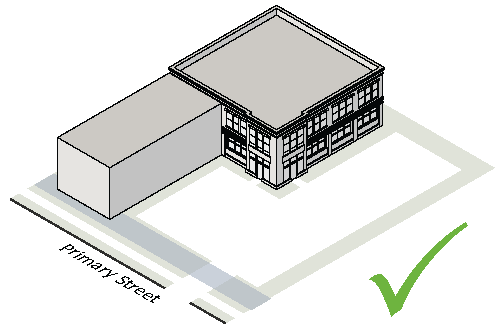
Front: Addition. Any addition to the front must be placed in the build-to zone. The addition does not have to meet the build-to percentage for the lot.
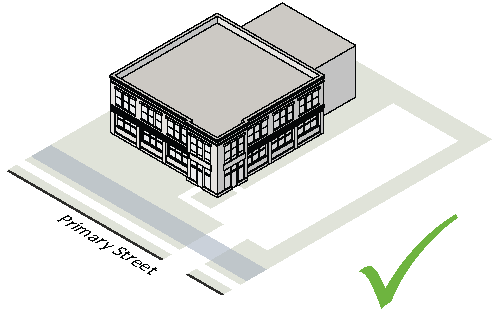
Rear: Addition. Rear additions are allowed because the addition does not increase the degree of the nonconformity.
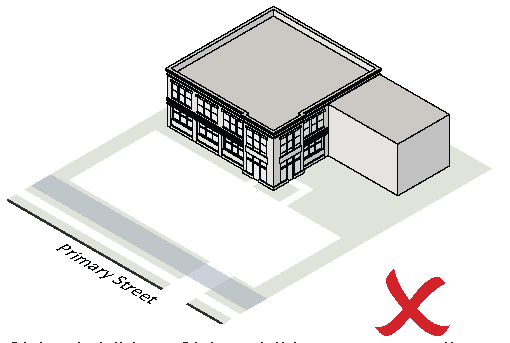
Side: Addition. Side additions are not allowed because the extension increases the width of the building not located in the build-to zone.
B.
New Buildings. Where a new building is being constructed on a lot or site with an existing building on it that doesn't meet the build-to requirement, the following provisions apply.
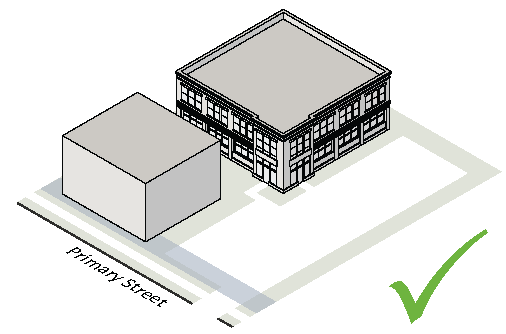
Front: New Building. All new buildings must be placed in the build-to zone until the build-to percentage for the lot has been met.
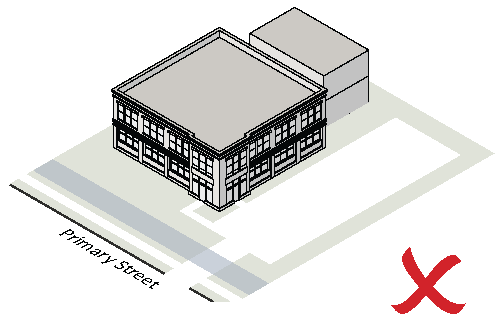
Rear: New Building. New buildings located outside of the build-to zone are not allowed until the build-to percentage for the lot has been met.
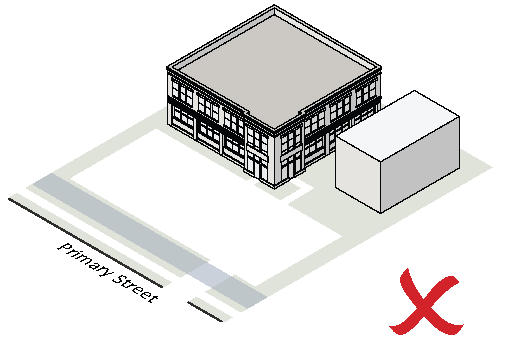
Side: New Building. New buildings located outside of the build-to zone are not allowed until the build-to percentage for the lot has been met.
C.
Replacement Buildings. New buildings located outside of the build-to zone are allowed to replace an existing building. Where the replacement building has the same or a similar footprint, it must be approved by the Design Review Board. Where the replacement building footprint is increased, it must be approved by the Mayor and City Council.
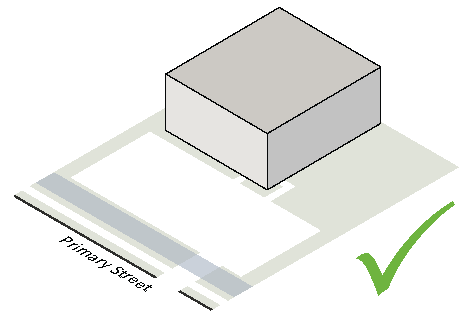
13.14.1.- Enforcement Authority
A.
Zoning Director. The Zoning Director serves as the administrator of the UDC and has primary enforcement authority over Articles 1 though 10 and Sec. 11.6.
B.
Engineering Director. The Engineering Director has primary enforcement authority over Sec. 11.2., Sec. 11.5., Sec. 12.1., Sec. 12.2., Sec. 12.3., Sec. 12.4., Sec. 12.6., and Sec. 12.7. The Engineering Director has shared enforcement authority over Sec 12.5.
C.
Transportation Director. The Transportation Director has primary enforcement authority over Sec. 11.3. and Sec. 11.4.
D.
Environmental/Public Works Director. The Environmental/Public Works Director has primary review authority over Sec. 12.9. The Environmental/Public Works Director has shared enforcement authority over Sec. 12.5.
(Ord. No. 2020-06-07, § 1, 6-8-2020)
13.14.2. - Violation
A.
Any action or inaction that violates the provisions of this UDC, the requirements of an approved stormwater management plan, or any permit issued subject to this UDC may be subject to an enforcement action.
B.
If any person commences any land-disturbing activity requiring a Land Disturbance Permit without first obtaining a permit, they will be deemed in violation of this UDC and, in addition to other penalties, are subject to penalties for violation as specified in this UDC.
13.14.3. - Notice of Violation
A.
If the City determines that an applicant or other responsible person has failed to comply with the terms and conditions of a permit, an approved stormwater management plan or the provisions of this UDC, it must issue a written notice of violation to the applicant or other responsible person. Where a person is engaged in activity covered by this UDC without having first secured a permit for that activity, the notice of violation will be served on the owner or the responsible person in charge of the activity being conducted on the site.
B.
The notice of violation must contain:
1.
The name and address of the owner or the applicant or the responsible person;
2.
The address or other description of the site upon which the violation is occurring;
3.
A statement specifying the nature of the violation;
4.
A description of the remedial measures necessary to bring the action or inaction into compliance with the permit, the stormwater management plan or this UDC and the date for the completion of such remedial action;
5.
A statement of the penalty or penalties that may be assessed against the person to whom the notice of violation is directed; and
C.
A statement that the determination of violation may be appealed to the City by filing a written notice of appeal within 30 days after the notice of violation (except that in the event the violation constitutes an immediate danger to public health or public safety, 24 hours' notice will be sufficient).
13.14.4. - Remedies and Penalties
In addition to other penalties and withholding of permits as may be specifically provided for elsewhere in this UDC, penalties for violating this UDC are provided in Section 1.1.3 of the City Code. Where a violation of this UDC exists with respect to the use of any building, structure, or land, the City may employ the following remedies and penalties.
A.
Citation. If the violation is by a tenant, person, corporation, firm or other entity who is not the owner of record of the building, structure or land, issue a citation for the violation of the City Code to that person or entity. In addition, the City may provide written notice, either personally or by certified mail, to the owner of record of such building, structure or land. Notice must contain a description of the violation and a 30-day period within which to abate or correct the violation. If the owner of record does not bring the use of the building, structure or land into compliance within 30 days, the owner shall be cited for violation of the City Code. Each day any violation continues shall constitute a separate offense.
B.
Bond Forfeiture. If, through inspection, it is determined that a person has failed to comply with an approved plan, a written notice to comply must be served upon that person. The notice must set forth the measures necessary to achieve compliance with the plan and state the time within which such measures must be completed. If the person fails to comply within the time specified, that person will be deemed in violation of this Section and, in addition to other penalties, will be deemed to have forfeited their performance bond, if required to post one. The local issuing authority may call the bond or any part of the bond to be forfeited and may use the proceeds to hire a contractor to bring the site into compliance.
C.
Withhold Permits and Licenses. If the violation is by the owner of record of the building, structure or land, or his agent, assign, employee or representative, in addition to other remedies available, the City may refuse or deny all City permits, licenses, certificates or applications to that owner or his agents until the violation is abated or corrected.
D.
Withhold Utility Service. The City may, in addition to other remedies, notify the Building Inspector of the violation and direct, require, or encourage that public utility service be withheld until the structure or premises is no longer in violation of this UDC.
E.
Withhold Certificate of Occupancy. The City may refuse to issue a certificate of occupancy for the building or other improvements constructed or being constructed on the site until the applicant or other responsible person has taken the remedial measures set forth in the notice of violation or has otherwise cured the violations described in the notice.
F.
Suspension, Revocation or Modification of Permit. The City may suspend, revoke or modify any permit authorized by this UDC. A suspended, revoked or modified permit may be reinstated after the applicant or other responsible person has taken the remedial measures set forth in the notice of violation or has otherwise cured the violations described in the notice, provided the permit may be reinstated upon such conditions as the City may deem necessary to enable the applicant or other responsible person to take the necessary remedial measures to cure such violations.
G.
Monetary Penalties. Any person who violates any provision of this UDC, or any permit condition or limitation established pursuant to this UDC, or who negligently or intentionally fails or refuses to comply with any final or emergency order of the City issued as provided in this Section will be liable for a fine not to exceed $2,000 per day. For the purpose of enforcing the provisions of this Section, the municipal courts is authorized to impose a penalty not to exceed $2,000 for each violation. Notwithstanding any limitation of law as to penalties which can be assessed for violations of City ordinances, any magistrate court or any other court of competent jurisdiction trying cases brought as violations of this UDC under City ordinances approved under this Section will be authorized to impose penalties for such violations not to exceed $2,000 for each violation. Each day during which violation or failure or refusal to comply continues is a separate violation.

