
Shreveport City Zoning Code
ARTICLE 8
- OFF-STREET PARKING AND LOADING1
Editor's note— Ord. No. 110, 2025, § 2(Exh. C), adopted October 28, 2025, repealed and reenacted Article 8 in its entirety to read as herein set out. Formerly, Article 8, §§ 8.1—8.14 pertained to similar subject matter and derived from Ord. No. 76, 2017, §§ 19—21, adopted September 12, 2017; Ord. No. 19, 2018, § 31, adopted March 13, 2018; Ord. No. 62, 2018, § 11, adopted August 14, 2018; Ord. No. 72, 2018, §§ 17—20, adopted August 28, 2018; Ord. No. 6, 2019, §§ 24—26, adopted February 12, 2019; Ord. No. 66, 2019, § 20, adopted June 11, 2019; Ord. No. 187, 2019, §§ 13—19, adopted December 10, 2019; Ord. No. 191, 2019, §§ 18—20, adopted January 14, 2020; Ord. No. 2, 2020, § 5, adopted January 28, 2020; Ord. No. 114, 2020, § 9, adopted September 8, 2020; Ord. No. 66, 2021, §§ 2, 3, adopted May 11, 2021; Ord. No. 95, 2021, §§ 6—8, adopted July 13, 2021; Ord. No. 137, 2021, § 13, adopted September 28, 2021; Ord. No. 136, 2022, § 6, adopted September 27, 2022; Ord. No. 137, 2022, § 1, adopted September 27, 2022; Ord. No. 42, 2023, § 4(Exh. D), adopted May 9, 2023; Ord. No. 114, 2023, § 5, adopted October 10, 2023, and Ord. No. 85, 2024, § 2, adopted August 13, 2024.
8.1 - GENERAL PROVISIONS
A.
Existing Facilities
1.
The existing number of off-street bicycle and loading spaces may not be reduced below the minimum requirements of this Code. If the number of existing spaces is already less than the requirements of this Article, it may not be further reduced.
2.
If a building permit was lawfully issued prior to the effective date of this Code, and if substantial construction has begun within 180 days of the issuance of a permit, the number of off-street bicycle and loading spaces is that required by building permit and supersedes the requirements of this Code.
B.
Change in Use
When the existing use of a structure or land is changed to a new use, bicycle spaces must be provided as required for the new use, except as described below:
1.
No additional bicycle parking spaces are required if the change in use would result in an increase of spaces of less than 25%. This also applies to a simultaneous change in use of a group of uses on the same lot which together result in a need for an increase in bicycle parking spaces of 25% or more. The 25% increase is calculated by dividing the number of additional spaces required by the number of spaces required before the increase.
C.
Change in Intensity of Use
Whenever the intensity of a use is increased based on an increase in the number of dwelling units, floor area, seating capacity, or other unit of measurement used to calculate the number of required number of bicycle parking spaces, additional spaces must be provided for that increase, except as described below:
1.
Whenever there is an increase in the intensity of a use that creates a need for additional bicycle parking spaces of 25% or more, the additional spaces are required. No additional bicycle parking spaces are required if the increase in intensity would result in an increase of spaces of less than 25%. This also applies to a simultaneous increase in intensity of a group of uses on the same lot which together result in a need for an increase in bicycle parking spaces of 25% or more. The 25% increase is calculated by dividing the number of additional spaces required by the number of spaces required before the increase.
D.
Prohibition on Use of Parking Facilities
The sale, repair, or dismantling or servicing of any vehicles, equipment, materials, or supplies, or the display of goods in off-street parking areas is prohibited, unless otherwise permitted by this Code.
(Ord. No. 110, 2025, § 2(Exh. C), 10-28-25)
8.2 - COMPUTATION OF REQUIREMENTS
This section describes how the number of bicycle, and loading spaces are calculated based upon the requirements of this Article. The total number of required bicycle parking and loading spaces is based upon the requirements for the principal use or uses located on the lot.
A.
Where multiple uses with different parking requirements occupy the same structure or lot, the required bicycle parking and loading spaces is the sum of the requirements for each use computed separately, unless otherwise permitted by this Code.
B.
Space allocated to any off-street loading space may not be used to satisfy the requirement for any off-street bicycle parking space or access aisle or portion thereof. Conversely, the area allocated to any off-street bicycle parking space may not be used to satisfy the replacement for any off-street loading space or portion thereof.
C.
A fraction of less than one-half is disregarded, and a fraction of one-half or more is counted as one loading space.
D.
For uses where patrons or spectators occupy benches, pews or open floor areas used for service, each 48 linear inches of benches, pews, or permanent seating areas, or five square feet of open floor areas used for seating is counted as one seat for the purpose of determining the requirement for the required number of spaces.
(Ord. No. 110, 2025, § 2(Exh. C), 10-28-25)
8.3 - REQUIRED OFF-STREET BICYCLE PARKING SPACES
A.
General Requirements
1.
Except as otherwise provided in this Code, the minimum number of off-street bicycle parking spaces to be provided for each use is listed in Table 8-1: Off-Street Bicycle Parking Requirements. Construction of all off-street parking must be completed prior to the issuance of a certificate of occupancy.
2.
Table 8-1 lists parking requirements for each use. In some cases, uses that are considered part of a generic use category are listed with specific. These specific uses are listed only for the purposes of this section and do not indicate whether such uses are permitted or special uses within any district. Certain uses listed within the districts are not listed in Table 8-1 and therefore do not have parking requirements.
3.
Certain uses listed within Table 8-1 are required to provide long-term spaces, where bicycles will be left for longer periods of time and require a safe and weatherproof storage area. The required number of long-term spaces is shown as a percentage of the required total bicycle spaces. All other required bicycle spaces must be designed as short-term spaces, which are areas where bicycles will be left for short stops, requiring a high degree of convenience.
4.
In all cases where bicycle parking is required, a minimum of two bicycle spaces must be provided. After the first 25 required bicycle parking spaces are provided, additional bicycle parking spaces are required at a 50% reduction.
5.
Where bicycle parking space requirements indicate "Over 10,000sf GFA" or other number threshold, this means that bicycle spaces are required only for structures over a certain gross floor area. In these cases, bicycle parking space requirements are calculated on the basis of the entire gross floor area.
6.
The Executive Director may waive a requirement relating to the number or type of bicycle spaces or approve an alternate method of compliance after considering the characteristics of the use, the site, and the surrounding area.
B.
Provision of Bike-Share Facilities
1.
Spaces within parking lots and structures may include designated areas for bike-share facilities. A bike-share facility provides bicycle rentals to the public and it is not considered a vehicle rental establishment. When a minimum of 20 bicycles are provided for rental, such bike-share facilities equate to 5% of the required vehicle spaces.
C.
Provision of Electric Vehicle Charging Stations
Spaces within parking lots and structures may include designated parking spaces for electric vehicle charging.
D.
Multi-Tenant Retail Center Parking Calculation
A multi-tenant retail center is defined as a group of two or more separate commercial establishments, primarily retail, but also including personal service, restaurant, office, and similar non-residential uses, that is planned, owned, and/or managed as a single property. The two main configurations of multi-tenant retail centers are large shopping centers and strip centers. Multi-tenant retail centers over 20,000 square feet in gross floor area require one bicycle space per 2,500 square feet of gross floor area.
TABLE 8-1: OFF-STREET BICYCLE PARKING REQUIREMENTS
(Ord. No. 110, 2025, § 2(Exh. C), 10-28-25)
8.4 - DESIGN OF BICYCLE PARKING SPACES
A.
Location
1.
The bicycle parking area must be convenient to building entrances and street access, but may not interfere with normal pedestrian and vehicle traffic. Bicyclists must not be required to travel over stairs to access parking.
2.
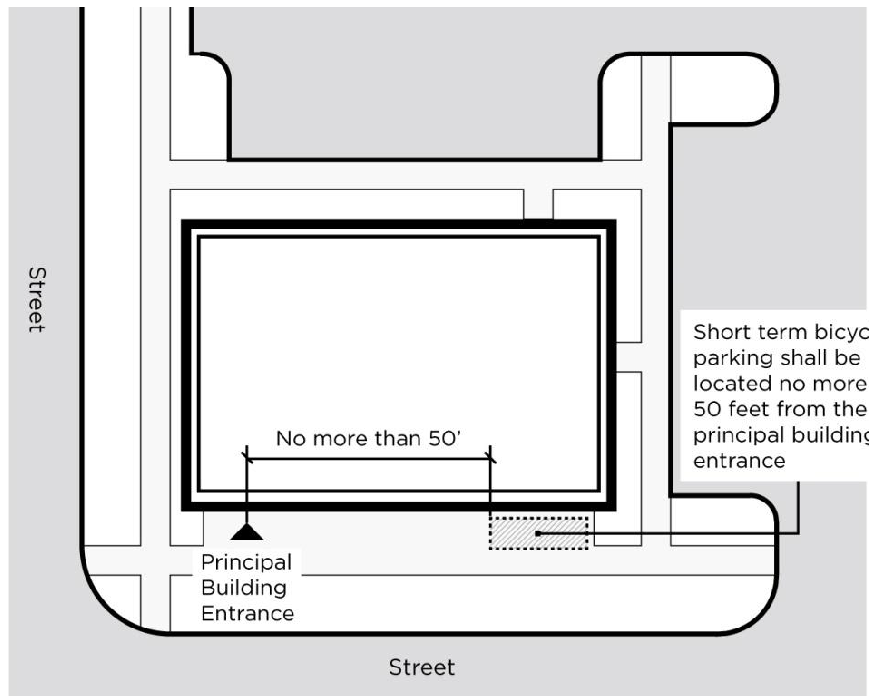
Short-term bicycle parking spaces must be located no more than 50 feet from the principal building entrance and at the same grade as the sidewalk or an accessible route. The property owner may make arrangement with the City Engineer to place required bicycle parking spaces in the public right-of-way so long as a minimum of five feet of clearance is maintained in the pedestrian way and the bicycle spaces are located within 50 feet of the lot. Required bicycle parking spaces may be located in the public right-of-way, with approval from the City Engineer, if one or more of the following conditions are met:
a.
The use does not provide vehicle parking on-site.
b.
Bicycle parking spaces in the right-of-way are shared by uses located on the same blockface. In such cases, the number of bicycle spaces required is cumulative of that required by all uses sharing such spaces.
3.
Long-term bicycle parking spaces must be located in a covered area that is easily accessible from the public-right-of-way and building entrances.
4.
Required bicycle parking for residential uses may be provided in garages, storage rooms, and other resident-accessible, secure areas. Spaces within dwelling units or on balconies do not count toward satisfying bicycle parking requirements.
FIGURE 8-3: BICYCLE PARKING IN THE RIGHT-OF-WAY
B.
Design
1.
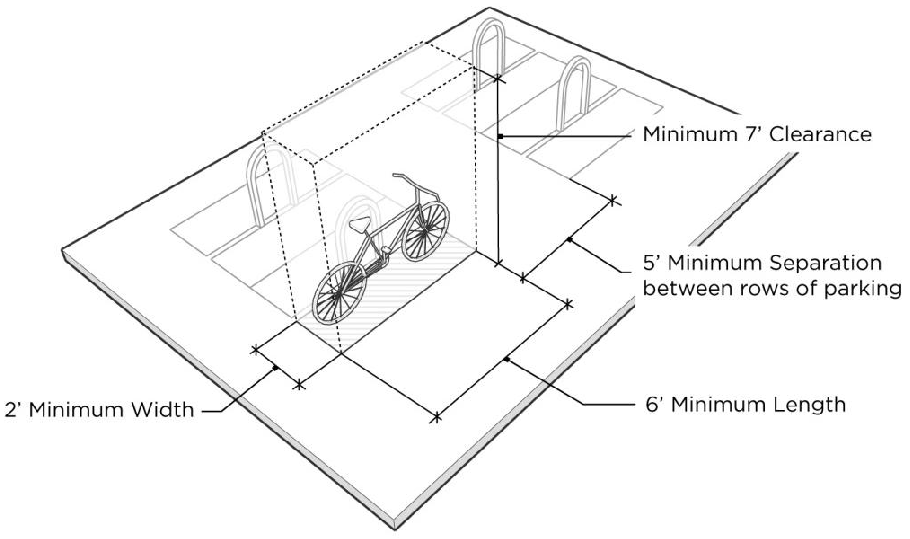
Required bicycle spaces must provide each bike space within a row of bicycle parking a minimum of two feet in width by six feet in length, with a minimum vertical clearance of seven feet. Each required bicycle parking space must be accessible without moving another bicycle. There must be an aisle at least five feet wide between each row of bicycle parking to allow room for bicycle maneuvering.
2.
The area devoted to bicycle parking must be surfaced as required for vehicle parking areas.
3.
All long-term bicycle parking spaces must be located indoors or fully covered, such as by the use of an overhang or covered walkway, weatherproof outdoor bicycle lockers, or an indoor storage area. Where bicycle parking is not located within a building or locker, the cover design must be of permanent construction, designed to protect bicycles from rainfall, snow, and inclement weather, and with a minimum vertical clearance of seven feet.
4.
Bicycle parking racks must permit the bicycle frame and one wheel to be locked to the rack and support the bicycle in a stable position. Structures that require a user-supplied locking device must be designed to accommodate U-shaped locking devices. All lockers and racks must be securely anchored to the ground or a structure to prevent the racks and lockers from being removed from the location.
5.
If required bicycle parking facilities are not visible from the street or principal building entrance, signs must be posted indicating their location.
FIGURE 8-4: BICYCLE PARKING DESIGN
(Ord. No. 110, 2025, § 2(Exh. C), 10-28-25)
8.5 - REQUIRED OFF-STREET LOADING SPACES
A.
Off-street loading spaces must be provided for any use that distributes or receives materials or merchandise by trucks or other commercial vehicles in accordance with Table 8-2: Off-Street Loading Requirements. In the case of multi-tenant developments, required loading spaces are calculated on the basis of each individual tenant. For example, if only one commercial tenant of a multi-tenant development is over 20,000 square feet, only one loading space is required; if all tenants are under 20,000 square feet, no loading is required.
B.
Structures that are 50 years of age or older as of the effective date of this Code and do not currently have any loading areas are exempt from off-street loading requirements. Other structures that do not provide loading spaces are nonconforming and subject to the rules of this Code for nonconforming site elements.
C.
If a use increases the floor area by 30% or more, calculated cumulatively from the effective date of this Code, accessory off-street loading spaces are required in accordance with Table 8-2.
D.
No structure is required to provide more than five loading spaces.
TABLE 8-2: OFF-STREET LOADING REQUIREMENTS
(Ord. No. 110, 2025, § 2(Exh. C), 10-28-25)
8.6 - DESIGN OF OFF-STREET LOADING SPACES
A.
Location
All off-street loading spaces must be located on the same lot as the use served. No off-street loading spaces may project into a public right-of-way. No off-street loading space is permitted in a front yard.
B.
Dimensions
1.
All required off-street loading spaces must be a minimum of 12 feet in width, a minimum of 35 feet in length, exclusive of aisle and maneuvering space, and have a minimum vertical clearance of 15 feet.
2.
Structures that are 50 years of age or older and maintain loading spaces that do not comply with the dimensions of this section are deemed legally conforming in terms of loading space dimensions. If new loading spaces are constructed, such spaces may be designed to match the dimensions of existing spaces rather than the requirements of this section.
C.
Surfacing
All off-street loading spaces must be paved with a durable, all-weather material or pervious paving that can support anticipated loads.
D.
Drainage and Maintenance
1.
Off-street loading facilities must be drained to eliminate standing water and prevent damage to abutting property and/or public streets and alleys. All drainage must comply with the requirements of this Code for stormwater management.
2.
Off-street loading areas must be maintained in a clean, orderly, and dust-free condition at the expense of the owner or lessee, and shall be kept free from the accumulation of filth, weeds, litter, refuse, graffiti, trash, and all other debris.
E.
Access Control and Signs
Each required off-street loading space must be designed with adequate means of vehicular access to a street or alley and in a manner that will minimize interference with traffic movement.
F.
Lighting
Loading facility lighting must meet the requirements of Section 7.2. Illumination of an off-street loading facility must be arranged so as to deflect the direct light away from adjacent properties and streets.
G.
Landscape and Screening
Loading facilities must be screened by a solid fence or masonry wall no less than six feet and no more than eight feet in height when visible from any public right-of-way or if abutting a residential district. A dense evergreen hedge may be substituted for a fence or wall, subject to approval of the landscape plan. Buffer yard requirements in Article 10 may substitute for this requirement, subject to approval of the landscape plan.
(Ord. No. 110, 2025, § 2(Exh. C), 10-28-25)
8.7 - DESIGN OF VEHICLE PARKING SPACES
A.
Permitted Vehicle Parking Locations
1.
Residential Uses
a.
For single-family - detached and attached, two-family, and townhouse dwellings, required vehicle parking spaces are permitted in private driveways, but must not encroach onto the public right-of-way. No additional outdoor vehicle parking spaces outside of driveway spaces are permitted in the front yard for single-family - detached and attached, two-family, and townhouse dwellings.
b.
Tandem vehicle parking is permitted for residential uses.
c.
For single-family - detached and attached and two-family dwellings where there is alley access, all vehicle parking areas must be accessed from the alley and all vehicle parking areas must be located in the rear yard.
B.
Dimensions of Vehicle Parking Spaces
1.
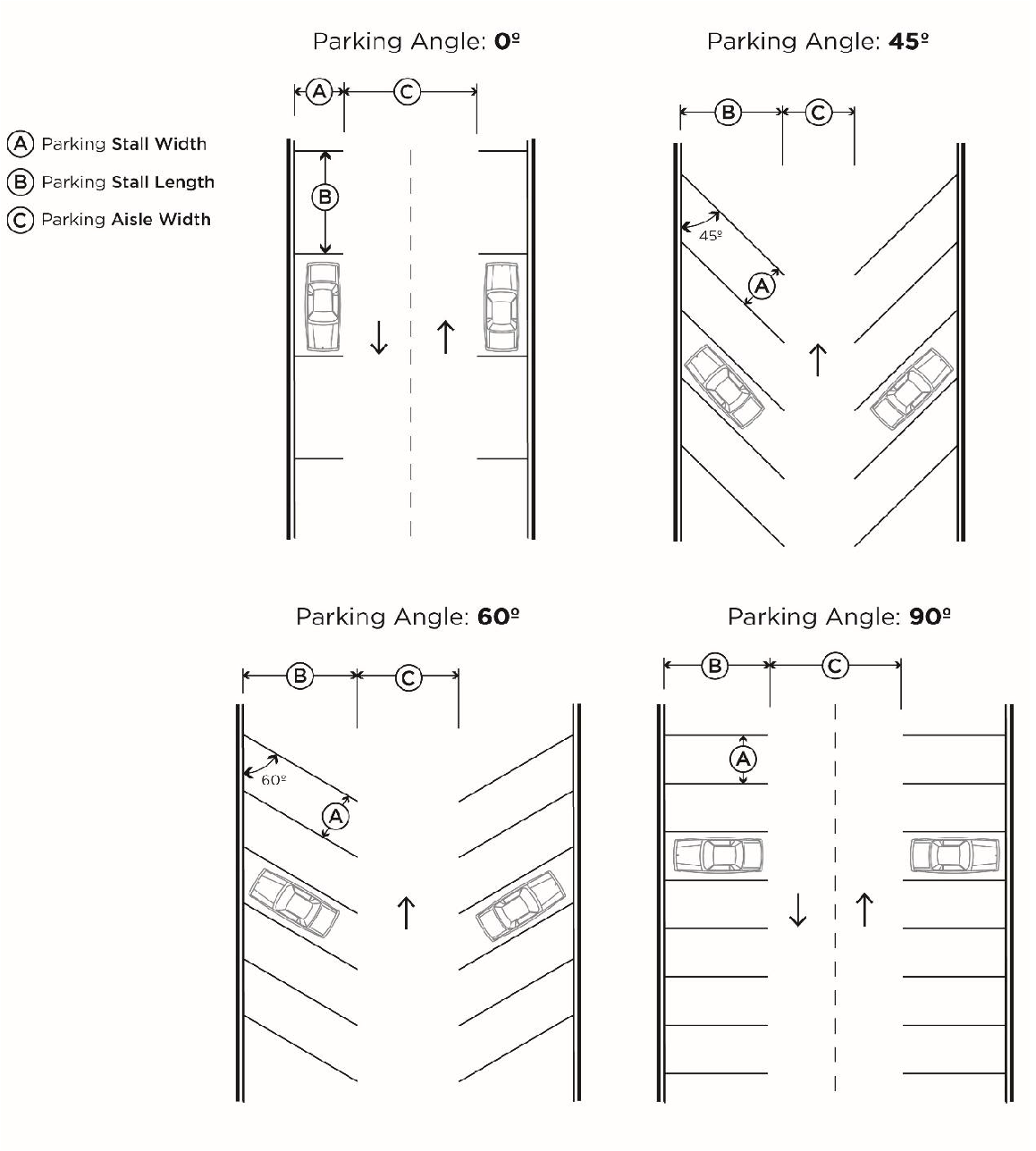
Off-street vehicle parking space dimensions must meet the standards of Figure 8-1. All vehicle parking spaces must have a minimum vertical clearance of seven feet six inches.
2.
Motorcycle and scooter parking spaces must measure at least four feet in width by eight feet in length and must be identified or designated through the use of signs or pavement markings.
C.
Access Requirements for Off-Street Vehicle Parking Areas
1.
Each off-street vehicle space must open directly upon an aisle or driveway of adequate width to provide access to a vehicle parking space. All off-street parking facilities must provide access in a manner that least interferes with traffic movement. For all uses except single-family, two-family, and semi-detached dwellings, the parking area must be designed so that the driver of the vehicle proceeds forward into traffic rather than backs out.
2.
All required off-street parking facilities must have vehicular access from a street, alley, driveway, or cross-access connection.
3.
When a gated entrance is permitted as part of the access to an off-street parking area or a residential subdivision, such gate is required to open toward the interior of the lot.
D.
Accessible Vehicle Parking Requirements
All parking lots must comply with the "ADA Accessibility Guidelines for Buildings and Facilities" regulations issued by federal agencies under the Americans with Disabilities Act of 1990 (ADA) for the amount and design of accessible vehicle parking spaces required in parking lots and structures.
E.
Hydraulic Lifts
All hydraulic lifts must be located within a parking structure. Use of hydraulic lifts, manufactured ramps, or similar mechanisms in parking lots for display purposes is prohibited.
F.
Striping
Off-street parking areas of must be marked by painted lines maintained in clearly visible condition, curbs or other means to indicate individual spaces. Signs or markers should be used as necessary to ensure efficient and safe circulation within the lot. Vehicle parking spaces for handicapped persons must be identified with the appropriate sign and visible at all times of the year, regardless of plant growth or similar conditions.
G.
Curbing and Wheel Stops
Wheel stops or curbing is required when a parking space abuts a pedestrian walkway, landscape, or fences. Breaks in curbing may be provided to allow for drainage into landscape areas that can absorb stormwater.
FIGURE 8-1: PARKING LOT DIMENSIONS
1 Two-way traffic
H.
Surfacing
1.
All surface parking lots must be paved with a durable all-weather material, such as concrete or asphalt. All uneven slabs must be resurfaced to provide a smooth surface. Pervious paving may be allowed, upon submission of detailed information regarding paving proposed, including a report from a professional engineer, licensed in the State of Louisiana, stating that the proposed paving and soil substrate can adequately allow percolation or infiltration of storm water at the proposed location. Gravel, crushed concrete or milled asphalt are acceptable on any property within the I-1 Light Industrial Zoning District and I-2 Heavy Industrial District, provided all of the following surfacing conditions are met:
a.
The surface material shall be designed by a professional engineer to sustain the anticipated traffic load. The surface type, along with the engineer's seal, shall be verified by the City Engineer, or his or her designee.
b.
A paved driveway apron, made of concrete or asphalt, is required to extend from the road to at least the right-of-way line, or a minimum of 15 [feet] from the road, whichever is greater.
c.
Should any surface material enter the public roadway, public drainage system, or public right-of-way, it shall be the responsibility of the property owner to remove the material immediately. Failure to do so may result in the following:
i.
The Zoning Administrator is authorized to revoke a certificate of occupancy, as well as issue any zoning violations to the property owner, as applicable.
ii.
The Director of Water and Sewerage, in accordance with the Shreveport City Code, is authorized to discontinue water service to any property discharging any surface material into the public roadway, public drainage system, or public right-of-way.
iii.
The Director of Public Works may prohibit and/or block any public access onto the property.
d.
Should any of the above enforcement actions take place, the site shall only regain full operation once all violations are corrected, costs reimbursed, and/or any fines paid in full, as applicable.
2.
Driveways must be paved with a durable all-weather material, such as concrete or asphalt, and all uneven slabs must be resurfaced to provide a smooth surface, with the following exceptions:
a.
Single-family - detached and attached, and two-family dwellings are permitted to construct driveways constructed of pervious paving, upon submission of detailed information regarding paving proposed, including a report from a professional engineer, licensed in the State of Louisiana, stating that the proposed paving and soil substrate can adequately allow percolation or infiltration of storm water at the proposed location.
b.
In the RA District, single-family-detached and manufactured homes are permitted a gravel driveway, however a paved driveway apron is required from the road to at least the right-of-way line, or a minimum of 15 [feet] from the road, whichever is greater.
c.
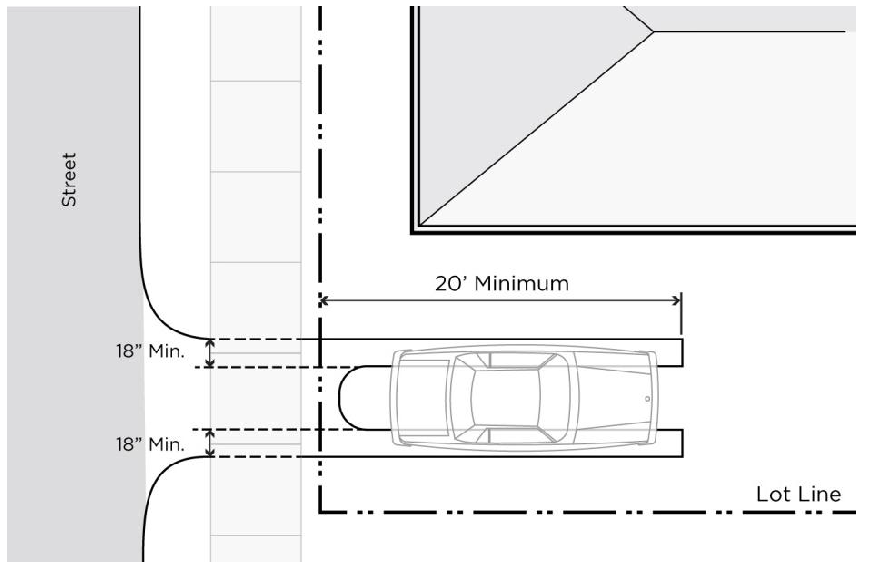
All single-family - detached and attached, and two-family dwellings are also permitted to construct driveways that consist of two concrete wheel strips, each of which is at least 18 inches wide and at least 20 feet long. Groundcover must be planted between the strips; gravel between the strips is not permitted.
3.
Any other areas used for off-street parking must be paved with a durable all-weather material, such as concrete or asphalt. All uneven slabs must be resurfaced to provide a smooth surface. Pervious paving may be allowed, upon submission of detailed information regarding paving proposed, including a report from a professional engineer licensed in the State of Louisiana, stating that the proposed paving and soil substrate can adequately allow percolation or infiltration of storm water at the proposed location. Gravel, crushed concrete or milled asphalt are acceptable on any property within the I-1 Light Industrial Zoning District and I-2 Heavy Industrial District, provided all of the following surfacing conditions are met:
a.
The surface material shall be designed by a professional engineer to sustain the anticipated traffic load. The surface type, along with the engineer's seal, shall be verified by the City Engineer, or his or her designee.
b.
A paved driveway apron, made of concrete or asphalt, is required to extend from the road to at least the right-of-way line, or a minimum of 15 [feet] from the road, whichever is greater.
c.
Should any surface material enter the public roadway, public drainage system, or public right-of-way, it shall be the responsibility of the property owner to remove the material immediately. Failure to do so may result in the following:
i.
The Zoning Administrator is authorized to revoke a certificate of occupancy, as well as issue any zoning violations to the property owner, as applicable.
ii.
The Director of Water and Sewerage, in accordance with the Shreveport City Code, is authorized to discontinue water service to any property discharging any surface material into the public roadway, public drainage system, or public right-of-way.
iii.
The Director of Public Works may prohibit and/or block any public access onto the property.
d.
Should any of the above enforcement actions take place, the site shall only regain full operation once all violations are corrected, costs reimbursed, and/or any fines paid in full, as applicable.
FIGURE 8-2: RESIDENTIAL WHEEL STRIPS
I.
Drainage and Maintenance
1.
Off-street parking facilities must be drained to eliminate standing water and prevent damage to abutting property and/or public streets and alleys. All drainage must comply with the requirements of this Code for stormwater management.
2.
Off-street parking areas must be maintained in a clean, orderly, and dust-free condition at the expense of the owner or lessee, and shall be kept free from the accumulation of filth, weeds, litter, refuse, graffiti, trash, and all other debris.
J.
Lighting
Parking lot lighting must comply with Section 7.2. Adequate lighting must be provided if off-street parking spaces are used at night. All lighting must be arranged to eliminate glare on residential property by location of light fixtures or use of fixtures designed to eliminate direct view of luminaries in fixtures from residential property.
K.
Landscape and Screening
All parking lots must be landscaped and screened in accordance with Article 10.
L.
Pedestrian Walkway Design within Parking Areas
Clearly delineated crosswalks of paving, brick paver, bituminous brick pattern stamping, or painted striping must connect landscaped areas and parking lot islands to building entrances and public streets to improve safe passageway for pedestrian. Curb cuts must be included on landscaped areas or islands where such crosswalks are located.
(Ord. No. 110, 2025, § 2(Exh. C), 10-28-25)
8.8 - QUEUING AND VEHICLE STACKING AREAS
In addition to meeting the off-street parking requirements of this Article, drive-through facilities, as well as parking lots with a gated entrance, residential developments with a gated entrance, and any other similar drive-through operation (as defined by this Code) and shall comply with the minimum queuing and vehicle stacking standards established by this Section in order to limit the impact of new drive-through uses.
1.
Required queuing spaces and vehicle stacking areas are subject to the following design and layout standards:
a.
Each queue space shall consist of a rectangular area not less than nine feet wide and 18 feet long.
b.
Queueing spaces and vehicle stacking areas shall be located entirely on the lot containing the drive-through use or operation and shall not encroach into any public right-of-way.
c.
Queueing spaces and vehicle stacking areas shall not impede fire lane(s), on or off-site traffic movements, identified pedestrian routes, vehicular movements into or out of off-street parking spaces, loading areas, or driveway access. It is strongly recommended to locate queue lines and service areas towards remote areas of a site to avoid conflicts with parking and circulation areas.
d.
A minimum ten-foot bypass shall be required adjacent to queue lines to allow vehicles an opportunity to circumvent the drive-through activity and exit the site.
e.
Queue areas and drive-through activities, including pedestrian crossing areas, shall be clearly identified with appropriate signage and marking. Although drive-through activities are not required to be completely separated from other activities on site, the queuing areas should be designed to enable the driver to readily identify and distinguish queuing areas from other activities on site.
2.
Queuing and vehicle stacking spaces shall be provided as indicated on the following table unless the Executive Director grants an exception. The minimum stacking spaces may be provided, cumulatively, by using multiple drive-through lanes. Each lane is not required to provide the minimum number of spaces.
TABLE 8-3: MINIMUM OFF-STREET STACKING SPACES
(Ord. No. 110, 2025, § 2(Exh. C), 10-28-25)
8.9 - DRIVEWAY DESIGN
A.
Driveway Design
1.
Single-Family - Detached or Attached and Two-Family Dwelling Residential Driveways
a.
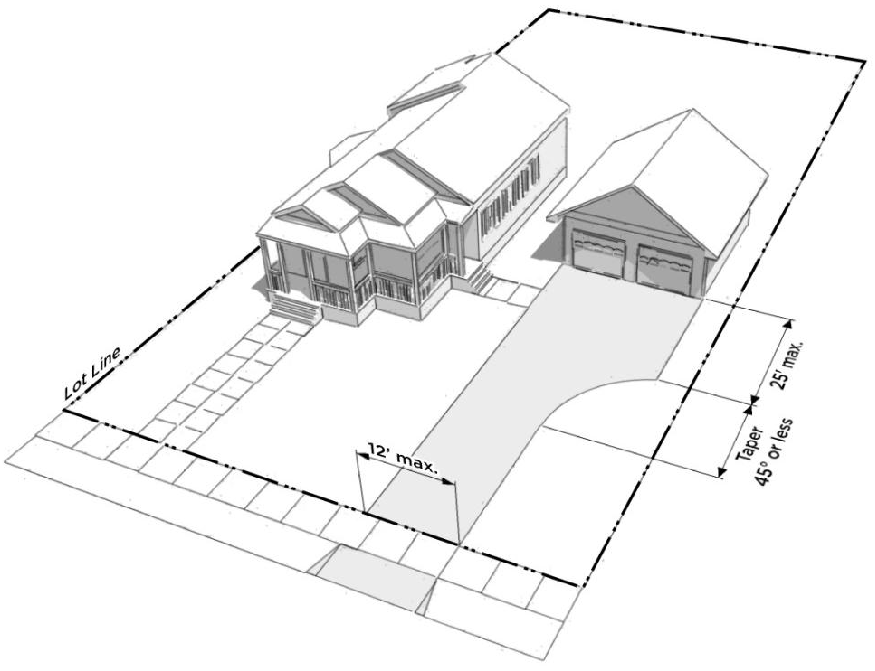
A residential driveway that provides access to a detached or attached garage is limited to a maximum width of 22 feet.
b.
A residential driveway may be shared by adjacent lots. This shared driveway location is only allowed if agreed to by the owners of each lot, and the agreement is recorded as a shared driveway servitude on each plat of survey.
c.
Driveways must be paved in accordance with the requirements of Section 8.5.H above.
2.
Multi-Family Dwellings, Townhouse, and Non-Residential Driveways
a.
With the exception of loading berths, driveways are limited to a maximum width of 14 feet for one-way drives, unless a greater width is required by the Fire Department, and a maximum of 35 feet for two-way drives.
b.
Driveways must be paved in accordance with the requirements of Section 8.5.H above.
B.
Curb Cuts
1.
All curb cuts require approval of the City Traffic Engineer.
2.
Single-family, two-family, and semi-detached dwellings are limited to one curb cut. However, lots of 60 feet or more in width may have two curb cuts to create a circular drive.
3.
Townhouse and multi-family dwellings are limited to one curb cut per frontage up to 100 feet of frontage, and two curb cuts where there is 100 feet or more of frontage.
FIGURE 8-5: RESIDENTIAL DRIVEWAYS
C.
Cross-Access Servitudes
1.
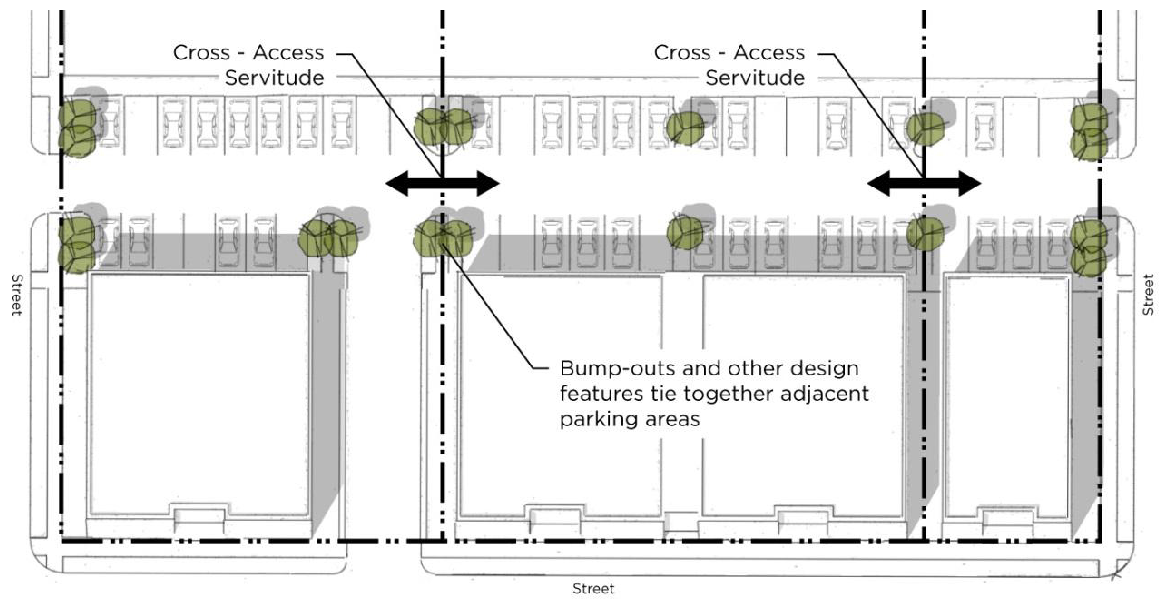
Adjacent non-residential uses, including mixed-use development, with dedicated parking areas are encouraged to provide a cross-access drive to allow circulation between sites. Adjacent properties under the same ownership may be required to have shared access if traffic warrants it. Property owners are encouraged to pursue cross-access with adjacent property owners at the time of development. If cross-access is provided, the property owner must provide proof that adjacent property owners have been contacted in writing regarding the provision of cross-access.
2.
Joint use driveways and cross-access servitudes must incorporate the following:
a.
Bump-outs and other site design features to make it visually obvious that the abutting properties are tied together.
b.
A unified access and circulation plan for shared parking areas.
3.
Pursuant to this section, property owners who establish cross-access servitudes must:
a.
Record a servitude allowing cross-access to and from properties served by the joint use driveways and cross-access servitude.
b.
Any pre-existing driveways must be closed and eliminated after construction of the joint-use driveway, unless approval to remain open is granted after review and approval of the City Traffic Engineer and/or the Louisiana Department of Transportation.
c.
Record a joint maintenance agreement defining the maintenance responsibilities of each property owner.
FIGURE 8-6: CROSS-ACCESS SERVITUDES
(Ord. No. 110, 2025, § 2(Exh. C), 10-28-25)
8.10 - STORAGE OF COMMERCIAL VEHICLES
A.
No commercial vehicle may be parked outdoors on a lot in a residential district, with the exception of vehicles engaged in loading or unloading or current work being done to the adjacent premises. This does not include standard size passenger motor vehicles including, but not limited to, vans, sports utility vehicles (SUVs), standard passenger size livery vehicles, and pick-up trucks, which are permitted to be stored or parked outdoors overnight on lots in residential districts. This includes vehicles owned and used for commercial purposes by the occupant of a dwelling or guest, provided that the vehicle is stored or parked in a permitted parking area. Permitted commercial vehicles may include the logo of the commercial business painted on or applied to the vehicle.
B.
All other commercial vehicles including, but not limited to, semi-truck tractor units, with or without attached trailers, commercial trailers, buses, tow trucks, construction vehicles, livery vehicles that exceed standard passenger vehicle size, such as limousines, or other large commercial vehicles are not permitted to be stored or parked outside overnight on a lot in a residential district.
C.
For non-residential uses, commercial vehicles with the logo of the commercial business painted on or applied to the vehicle that are being operated and stored in the normal course of business, such as signs located on delivery trucks, promotional vehicles, moving vans, and rental trucks, are permitted to be stored on the lot in areas related to their use as vehicles, provided that the primary purpose of such vehicles is not the display of signs. All such vehicles must be in operable condition. Signs placed or painted on parked vehicles where the only purpose is to advertise a product or service, or to direct the public to a business or activity located on or off the premises, are prohibited.
(Ord. No. 110, 2025, § 2(Exh. C), 10-28-25)
8.11 - STORAGE OF RECREATIONAL VEHICLES
A.
No recreational vehicle may be used for living, sleeping, or housekeeping purposes in any district and may not be hooked up to any public utilities.
B.
All recreational vehicles must be maintained in mobile condition. No recreational vehicle may be parked or stored in such manner as to create a dangerous or unsafe condition on the lot where it is parked or stored. If the recreational vehicle is parked or stored, whether loaded or not, so that it may tip or roll, it is considered to be a dangerous and unsafe condition.
(Ord. No. 110, 2025, § 2(Exh. C), 10-28-25)
8.12 - OVERNIGHT PARKING
A.
Except as otherwise provided in this Code, including but not limited to bona fide permitted truck stops, truck dealerships, truck repair, freight services and warehousing, industrial facilities, and heavy retail, rental, and service establishments, it is unlawful for any person to park any commercial vehicle or recreational vehicle on non-residential private property in the City of Shreveport between the hours of 9:00 p.m. and 9:00 a.m.
B.
This restriction does not apply to the following:
1.
Private parking lots of hotels, motels or other establishments providing overnight accommodations;
2.
This restriction does not apply to private parking lots of establishments providing accommodations, meals, and other services for travelers between the hours of 9:00 p.m. and 9:00 a.m.; and
3.
Properties located within the I-1 Light Industrial Zoning District and I-2 Heavy Industrial Zoning District.
(Ord. No. 110, 2025, § 2(Exh. C), 10-28-25)

