
Shreveport City Zoning Code
ARTICLE 10
- LANDSCAPE AND TREE PRESERVATION
10.1 - LANDSCAPE PLAN APPROVAL
A.
Required Submittals
1.
A landscape plan is required as part of a site plan review application for townhouse, multi-family, or non-residential, including mixed-use development and as part of the preliminary site plan application for a planned unit development, or site plan submittal for conditional zoning district approval. The landscape plan must be approved prior to the issuance of a building permit. Landscape plans must be prepared by a landscape architect, architect or civil engineer licensed in Louisiana. The landscape plan must meet the standards set forth in this Article and bear the landscape architects, architects or civil engineer's seal and signature.
2.
Landscape plans must be submitted to the Executive Director and must include all submittal requirements. The Executive Director will evaluate the appropriateness of the landscape plan and may approve or approve with conditions.
3.
New construction of single-family (attached or detached) and two-family dwellings do not require landscape plans.
B.
Contents
Landscape plans must contain a scale drawing showing the following:
1.
The location and dimensions of all existing and proposed structures, property lines, easements, parking lots and drives, rights-of-way, refuse disposal and recycling areas, pedestrian and bicycle paths, fences, mechanical equipment, overhead utility wires, retention/detention facilities, and other drainage facilities, such as drainage swales.
2.
The location, quantity, size, name, and condition, both botanical and common, of all existing plant materials on-site, indicating plant material to be retained and to be removed.
3.
The location, quantity, size, and name, both botanical and common, of all proposed plant material.
4.
Elevations of all proposed fences, stairs, and retaining walls.
5.
An irrigation plan by a certified irrigation designer, or a landscape architect or civil engineer licensed in Louisiana. The only irrigation information required on the landscape plan is the following:
a.
The location and size of all water meters, including ones dedicated to the irrigation system, which must be located in the public right-of-way or a dedicated easement.
b.
The irrigation plan must include a minimum of two hydro-zones: one for turf areas and one for prepared bed areas. Additional breakdowns may be requested after initial review of landscape plan.
6.
Any other details as determined necessary by a reviewing body.
C.
Stormwater Management and Alternative Landscape Design
1.
In accordance with Article 11 of this Code, certain development and redevelopment actions require on-site stormwater management. In addition to the requirements of this Article for landscape plans, a stormwater management plan may also be required.
2.
Alternative landscape design intended to improve stormwater quality and/or intended to decrease stormwater quantity will be considered if submitted as part of a site-specific stormwater management plan. Alternative landscape designs are subject to approval by the standards for landscape plan approval.
3.
Alternative landscape design or plant materials may be used where unreasonable or impractical situations would result from application of the landscaping requirements. Such situations may result from topography, geological characteristics, water features, significant vegetation, lot configuration, utility easements, locations of existing structures on the site, or from other unusual site conditions that pose unnecessary constraints to appropriate landscape development or the owner's use of the property.
4.
The Executive Director may approve an alternative landscape plan upon determining that such plan meets the intent of the standards of this article and meets or exceeds a landscape plan in strict compliance.
D.
Changes to Approved Landscape Plans
1.
Changes to the landscape plan that result in a reduction or addition in the net amount of plant material as specified on the approved landscape plan may be approved by the Executive Director.
2.
Changes to a landscaping plan that results in a reduction in the net amount of plant material pertaining to special use permits, Planned Unit Developments (PUD), and Conditional Zoning Districts (CZD) must be approved by the decision making body granting approval. If the net amount of required plant material is not reduced, the modified landscape plan may be approved administratively by the Executive Director.
E.
Certificate of Occupancy
No certificate of occupancy will be approved before completion of landscaping with the following exception. If, due to the seasonal nature of plant materials, landscaping has not been completed at the time that a certificate of occupancy could be granted, and the certificate is requested, the Executive Director and/or Zoning Administrator may grant a temporary certificate of occupancy, which will specify up to a maximum 90 day timeframe for completion of the landscaping requirements. The Executive Director and/or Zoning Administrator may grant an additional 30 days due to unforeseen circumstances.
F.
Waiver of Landscape Requirements
1.
The Executive Director has the authority to grant a waiver for any landscaping requirement contained in this Code. Applications subject to discretionary review (i.e., special use permit, planned unit development, conditional zoning, etc.) may not apply for a waiver of landscape requirements, unless the condition of a waiver is specifically identified within the provisions of a specific use (i.e., wireless telecommunication facility).
2.
The Executive Director shall not be obligated to make any waiver of landscaping requirements.
3.
As part of the waiver request, the applicant shall have the burden of proof in showing that there will be no adverse impact upon the neighborhood or general area by the granting of the waiver. In granting a waiver, the Executive Director shall consider the following:
a.
The special circumstances of the proposed use;
b.
Site constraints that would make landscape compliance not necessary and/or feasible;
c.
The neighborhood and the general development patterns of the surrounding properties and the prospects for development in the near future;
d.
Whether the development, as proposed, would serve the purpose of enhancing the public welfare and safety;
e.
Whether all reasonable alternative measures which meet the intent of the landscape requirements of this article were explored; and
f.
The Executive Director may also consider other factors deemed relevant in making his or decision.
4.
A waiver of any of the requirements of this article does not exempt the development from any other requirements of the Code.
5.
Waivers granted shall be for the specific use, as identified in the waiver application. Should the use be substantially altered to trigger full compliance, the developer must either obtain new waivers or comply with the Code.
6.
Within 30 days after the date of any waiver decision, the applicant or any aggrieved party may appeal waiver decision to the Zoning Board of Appeals.
(Ord. No. 76, 2017, § 22, 9-12-17; Ord. No. 62, 2018, §§ 13, 14, 8-14-18; Ord. No. 114, 2020, § 11, 9-8-20; Ord. No. 137, 2021, § 15, 9-28-21; Ord. No. 42, 2023, § 5, 5-9-23; Ord. No. 149, 2024, § 6, 11-8-24)
10.2 - LANDSCAPE DESIGN STANDARDS
A.
Tree and Plant Palette
Required trees and plantings must comply with the list of trees and plants that are suitable for local soil and climate conditions, as listed in Section 10.12. The Executive Director may approve plants not included in the list if the species are native or naturalized to the area, and capable to withstand the seasonal temperature variations of the City of Shreveport, as well as the individual site microclimate.
B.
Water Conservation
Landscape design must apply the principles of water conservation and will be reviewed for compliance with the following principles:
1.
Careful landscape design that applies water conservation methods.
2.
Soil protection and improvement.
3.
Careful selection and design of turf areas.
4.
The use of drought tolerant plant material.
5.
The use of organic mulch around all plant material and areas that are not turf or hardscape.
C.
Selection and Installation of Plant Materials
1.
All plant materials must be of good quality and meet American Association of Nurserymen (AAN) standards for minimum acceptable form, quality, and size for species selected. Size and density of plant material, both at the time of planting and at maturity, are additional criteria that must be considered when selecting plant material.
2.
All landscape materials must be installed in accordance with the current planting procedures established by the AAN. All plant materials must be free of disease and installed so that soil of sufficient volume, composition, and nutrient balance are available to sustain healthy growth. Installation of plant materials during the appropriate growing season is encouraged.
3.
Where overhead utilities are present, the following provisions apply to the selection and installation of plant materials:
a.
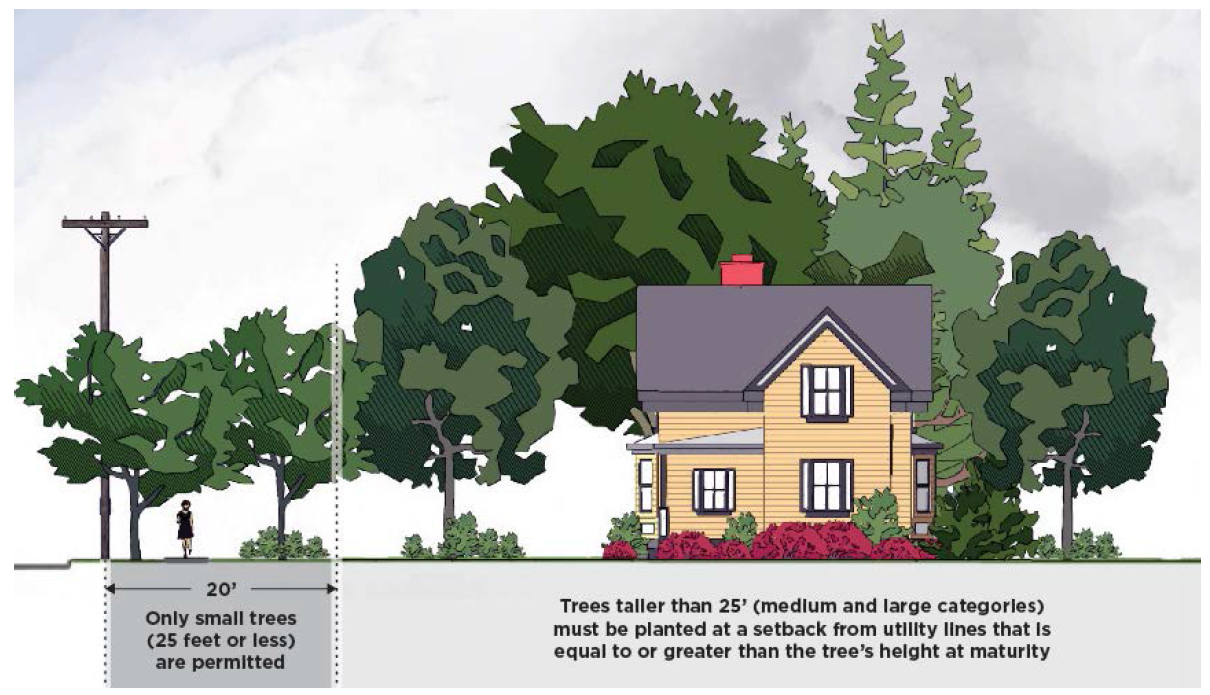
Only trees 25 feet in height or less at maturity are permitted within 20 feet of any overhead utilities. This includes the majority of the tree species classified as "small trees" in Section 10.12. Shrubs, grasses, vines, and other plant materials less than 25 feet in height are also permitted.
b.
Any tree species taller than 25 feet at maturity, as classified in Section 10.12, must be planted at a setback from utility lines that is equal to or greater than the tree's height at maturity.
FIGURE 10-1: OVERHEAD UTILITY PLANTING ZONES
D.
Minimum Planting Sizes
1.
Shade trees, including broad-leaf evergreens, must have a minimum trunk size of three inches in diameter at breast height (DBH) at planting. For the purposes of this Code, where shade trees are required, broad-leaf evergreens are considered a shade tree.
2.
Conifer evergreen trees must have a minimum height of six feet at planting.
3.
Single stem ornamental trees must have a minimum trunk size of two inches in tree caliper at planting. Multiple stem ornamental trees must have a minimum height of eight feet at planting.
4.
Large shrubs must have minimum height of three feet at installation. Small shrubs must have a minimum height of 18 inches at installation. Large shrubs are those shrubs that reach five or more feet in height at maturity. Small shrubs are those shrubs that may grow up to five feet in height if left unmaintained, but are generally maintained at heights of 18 to 36 inches.
E.
Plant Diversity. To promote diversity for areas of a site where landscaping is required or proposed, no single variety of plants shall be allowed to constitute more than the following:
TABLE 10-1: DIVERSITY REQUIREMENTS
F.
Existing Plant Materials
All plant materials existing on-site, including trees, may be counted toward any planting requirements of this Code so long as the location and type of plant material meets the intent of the specific planting requirements. Existing trees are credited according to the regulations of Section 10.6.B below.
G.
Tree Protection During Development
During development, all precautions must be undertaken to prevent construction damage to existing trees. Protection includes prevention of injury to the trunk, branches, and root systems. No person may create a trench through the root system of an existing tree, expose the roots to the air overnight without a method for maintaining moisture, change the soil grade within the dripline of the tree, or cause soil compaction with the use of vehicles, machinery, or other method. The root systems of trees on adjacent lots must also be protected.
H.
Underground Utilities and Utility Areas
1.
Underground utilities, drain lines, and similar facilities which are located below landscape areas within parking lots must be installed as near to the edge of the planting area as possible, within the outer one-third of the available width of the planter, to minimize interference with tree installation.
2.
Underground electric conduit, underground drain lines, communications cables, irrigation lines, and similar facilities must be installed within underground utility chases located within the first one-third of the available width of the planter, along the edge within medians, neutral grounds, peninsulas, divider islands, and interior islands. Offsets into the center of such spaces will be allowed if design dictates placement of light standards and other fixtures within the center of the space.
(Ord. No. 62, 2018, § 15, 8-14-18)
10.3 - LANDSCAPE MAINTENANCE STANDARDS
Landscape material depicted on approved landscape plans is considered a required site element in the same manner as structures, parking, lighting, and other improvements. As such, the property owner is responsible for the maintenance, repair, and replacement of all landscape material, fences, walls, steps, retaining walls, and similar landscape elements.
A.
All plant material must be maintained in a healthy and growing condition, and must be replaced with plant material of similar variety and size if damaged, destroyed, or removed. Upon notice to the property owner, any dead, unhealthy, or missing plants must be replaced within 60 days, season permitting.
B.
Landscape areas must be kept free of trash, litter, weeds, and other such materials, and free of plants not a part of the landscape.
C.
An automatic irrigation system is required for all landscaping. The irrigation system must be designed with efficient water usage as an operational goal. The design must include appropriate shut-off devices, manual over-rides, and rain sensors. The irrigation system must be designed with zones to water plants based on similar water needs.
D.
If the total required landscape area for a development site is less than 2,000 square feet, a hose bib and water spigot within 100 feet of all required landscaping may be used for irrigation. If the landscaping is not maintained in a livable condition, the Zoning Administrator may require an automatic irrigation system be installed.
E.
Nothing in this section prohibits tree pruning to promote the health of a tree or for public safety purposes.
(Ord. No. 62, 2018, § 16, 8-14-18; Ord. No. 114, 2020, § 12, 9-8-20)
10.4 - RIGHT-OF-WAY LANDSCAPE
A.
Any developer desiring to install and maintain landscape and irrigation facilities within the City right-of-way must first enter into and execute a "Right-of-Way Encroachment Permit," administered through Department of Public Works and the City Engineer, and approved by City Council.
B.
Entryway or amenity features within City right-of-way may be developed under the responsibility of a homeowners association or commercial property owners association. Documents must be submitted as part of the preliminary plat review process for approval conditioned on City Public Works Department concurrence.
(Ord. No. 85, 2024, § 3, 8-13-24)
10.5 - TREE PLANTING, MAINTENANCE AND REMOVAL ON STREET RIGHTS-OF-WAY AND OTHER PUBLIC GROUNDS
All electric transmission and distribution lines, wires, poles, lighting, along with any and all related facilities, in any way necessary for service by an electric public utility subject to the jurisdiction of the Louisiana Public Service Commission, shall be exempt from all of the limitations and requirements of this Code, except for requirements included in this section. Tree planting, maintenance and removal on street rights-of-way and other public grounds must meet the following standards:
A.
Tree Planting
Trees may be planted within street rights-of-way or on other public grounds only after notification to the City Public Works Department or the Shreveport Public Assembly and Recreation Department (SPAR), and provided the selection and location of said trees are in accordance with the requirements of this Article.
B.
Tree Removal
Trees shall not be removed from a street right-of-way or other public grounds unless approval is received from City Public Works Department or the Shreveport Public Assembly and Recreation Department (SPAR), with the exception that city employees may remove trees when necessary to accomplish emergency repairs to sewer or water systems, or in order to alleviate flooding or other emergencies. A tree removal permit is required in order to remove any tree 30 inches or larger in caliper.
C.
Damage to Trees
It shall be a violation of this section to damage, destroy or mutilate any tree in a public right-of-way or on other public grounds, or attach or place any rope or wire (other than one to support a young or broken tree or limb), sign, poster, handbill or any other thing to any such tree.
D.
Top or Cutback to Stubs
It shall be unlawful for any person to top or cutback to stubs the crown of any tree in street rights-of-way or on other public grounds.
E.
Reserved Rights
The City of Shreveport reserves the right to plant, preserve, prune, maintain or remove any tree within the street rights-of-way, alleys, squares, and all public grounds when such interferes with the proper spread of light along the street from a street light, or interferes with visibility of any traffic control device or sign, or as may be necessary to preserve or enhance the symmetry and beauty of such public grounds.
F.
Line of Sight
Trees shall not be planted to conceal a fire hydrant from the street or impede the line of sight on any street.
G.
Storm Damage
Trees severely damaged by storms, or other accidental causes, where required pruning practices are impractical are exempt from this Article.
H.
Public Utilities
Nothing in this section shall be construed to prohibit public utilities from pruning or removing trees that encroach upon electric, telephone, or cable television transmission lines, or gas, sewer or water pipes.
I.
Pruning Plans
The utility provider, whether it be electric, telephone, cable television, or gas shall present yearly pruning plans for trees located within designated utility easements that cross public property. The applicable department, at their discretion, may follow-up with said utility provider to address any issues identified in the submitted plans.
J.
Electric Utility Provider
The electric utility provider will provide a copy of its annual vegetation management plan submitted to the Louisiana Public Service Commission that addresses planned trimming of select electrical circuits. The applicable department, at their discretion, may follow-up with the electric utility provider to provide input regarding the plan. There will be no requirement to notify applicable departments of reactive vegetation management conducted outside of the annual vegetation management plan that is necessary to provide reliable electric service to the provider's customers.
10.6 - TREE PRESERVATION INCENTIVE
The purpose of this Section is to encourage the preservation and maintenance of the City urban forest and rural character.
A.
Tree Credit Option
1.
All property owners are encouraged to preserve as many existing mature trees as possible in the design and implementation of the landscape plan.
2.
Credit for tree preservation will be granted only for trees eight inches or greater in caliper and can be located anywhere on the site to receive tree credits towards the landscape plan.
3.
For each existing tree preserved and incorporated into the landscape design, all preserved trees will receive a 1:1 tree credit.
4.
Each individual tree may be credited only once.
5.
Preserved trees may provide up to 50% of the minimum tree requirement.
6.
Any tree proposed for use as a tree credit to satisfy a development's tree planting requirements must be shown on the landscape plan and approved as part of the underlying site plan review process.
7.
Trees identified for tree preservation that are damaged or destroyed during construction must be replaced.
(Ord. No. 72, 2018, § 26, 8-28-18; Ord. No. 114, 2020, § 13(Exh C), 9-8-20)
10.7 - REQUIRED SHADE TREE PLANTING
In order to restore and preserve the urban canopy, shade trees, including broad-leaf evergreens, are required to be planted. Table 10-2: Required Shade Tree Planting lists the requirements for each district. Existing trees are counted toward this required minimum number as are any trees in required landscape areas. In certain cases, where a hardship is demonstrated, the Executive Director may waive these requirements. Such required shade tree plantings must be shown on the landscape plan, when such plan is required. Where a landscape plan is not required, the building permit application must show where required shade trees will be installed.
TABLE 10-2: REQUIRED SHADE TREE PLANTING
*Required on-site trees must be planted within the first ten feet of front yard.
(Ord. No. 6, 2019, § 28(Exh. D), 2-12-19; Ord. No. 19, 2021, § 13(Exh. G), 2-9-21)
10.8 - LANDSCAPE REQUIREMENTS IN ALL DISTRICTS
All portions of a lot not covered by structures or paved surfaces must be landscaped with trees, shrubs, grass, live groundcover, and other plantings. The landscape design may also include the use of stone, mulch beds, or other pervious landscaping materials.
10.9 - NON-RESIDENTIAL DISTRICT AND USE LANDSCAPE REQUIREMENTS
These landscape requirements standards apply to all non-residential districts and uses. Parking lots are subject to the requirements of this section, whether accessory or principal. A planned unit development or a conditional zoning district that contains landscape standards is regulated by the standards of the approved planned unit development or conditional zoning district, as applicable.
A.
Landscape Buffer
Buffer yards are located within rear and interior side yards, including the required rear or interior side setbacks, and must be reserved for the planting of material and installation of screening as required by this section. No parking spaces or accessory structures are permitted within the required buffer yard.
1.
As of the effective date of this Code, non-residential districts and uses require buffer along interior side and rear yards in the following cases:
a.
Where a non-residential use is located within a residential district, excluding parks.
b.
Where a non-residential district abuts a residential district. This does not apply to the D-1, NA, or OS Districts or to any public parks.
c.
Where OR, I-MU, I-1, or I-2 District abuts a commercial district.
2.
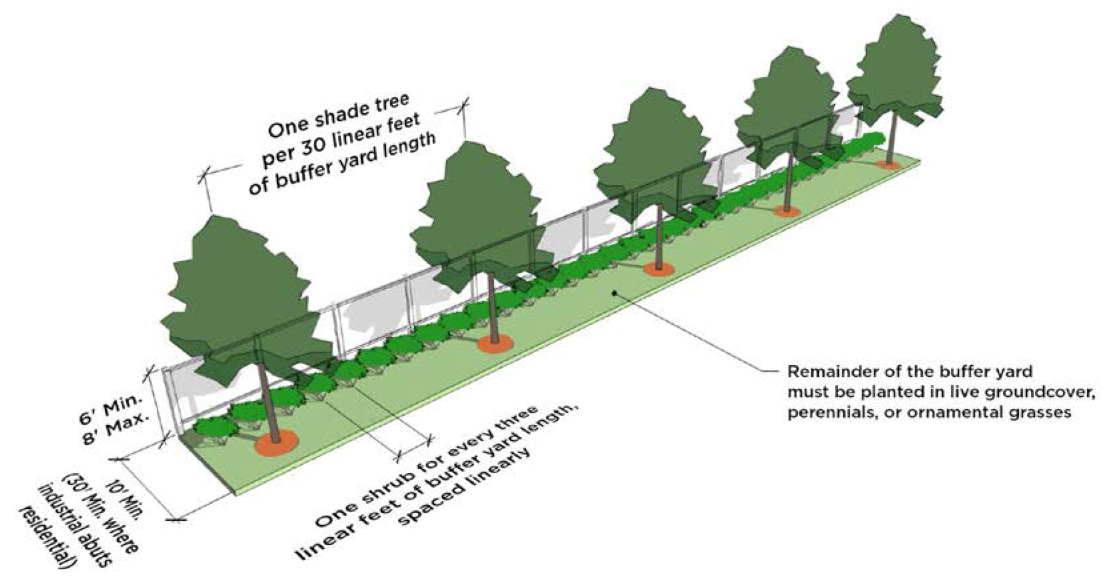
The minimum size and improvement of buffer yards is as follows (Figure 10-2). When the calculation of minimum buffer yard requirements results in a fraction, the fraction is rounded up to the nearest whole number.
a.
A buffer yard must be a minimum of ten feet in width. A buffer yard must be a minimum 30 feet in width where any industrial district abuts a residential district.
b.
One shade tree or three ornamental trees must be planted for every 30 linear feet of buffer yard length. As part of the landscape plan approval, trees may be spaced at various intervals based on specific site requirements, but the total number of trees planted must be no less than one per 30 linear feet of buffer yard length.
c.
A solid fence or masonry wall a minimum of six feet and a maximum of eight feet in height must be erected along 100% of the yard length.
3.
One shrub, measuring a minimum of 18 inches in height at planting and reaching a minimum of three feet in height at maturity, must be planted for every three linear feet of buffer yard length, spaced linearly.
4.
The remainder of the buffer yard must be planted in live groundcover, perennials, or grass.
FIGURE 10-2: BUFFER YARD
B.
Landscape Along Street Rights-of-Way
1.
Applicability
a.
All parking lots, whether accessory or principal, require landscaping along that portion of the parking lot that abuts a street right-of-way. Street right-of-way does not include alleys.
b.
Non-residential structures that are set back from any lot line that abuts a street right-of-way by 20 feet or more are also required to provide landscape in accordance with this section in such area. This excludes all or a portion of such area when it is used for outdoor seating. This does not apply to the OS or NA Districts or to any public park use.
2.
Planting Area Size
a.
The landscape planting area in the OR, I-1, I-2, and IC Districts must be a minimum of 15 feet in width. In all other districts, the landscape planting area must be a minimum of seven feet in width.
b.
The Executive Director or Metropolitan Planning Commission may reduce the width of the required landscape edge during site plan review when the reduction is required for public improvements.
c.
The Executive Director shall have administrative authority to waive these planting requirements due to adjacent zoning or uses, in regards to OR, I-1, and I-2 Districts.
3.
General Planting Requirements
All landscape areas along street rights-of-way are required to meet these general requirements:
a.
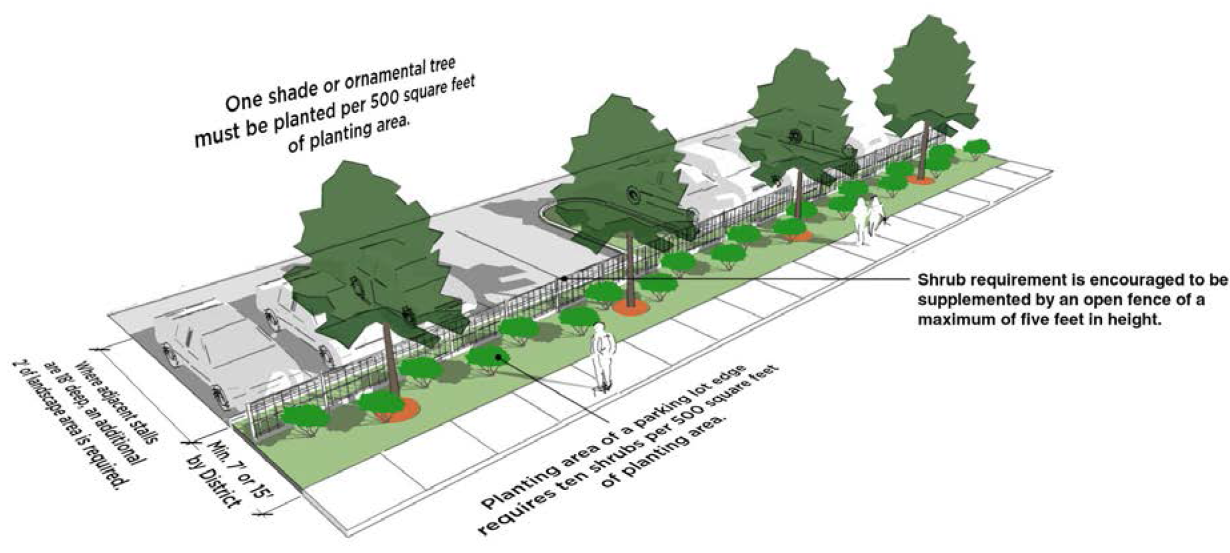
One shade tree or three ornamental trees must be planted per 500 square feet of planting area. The number of required trees is calculated solely on the area of the planting area.
b.
Landscape areas outside of required plantings must be planted with live groundcover, perennials, or grass. Any permeable surface not occupied by trees, shrubs, planting beds, signs, or other permitted fixtures must be planted with grass or other living groundcover. The landscape design may also include the use of stone, mulch beds, or other pervious landscaping materials.
c.
No site developed prior to the effective date of this Code is required to conform to the requirements of this Section unless the site is being redeveloped. Redevelopment is considered to occur when a building is increased by 25% or more of the existing gross floor area and/or the addition of 20 or more parking spaces to an existing parking lot.
4.
Parking Lot Edge Planting Requirements
In addition to the general requirements of item 3 above, parking lot edges that abut street rights-of-way are required to meet these requirements:
a.
The planting area of a parking lot edge that abuts a street right-of-way requires ten shrubs per 500 square feet of planting area. The number of required shrubs is calculated solely on the area of the planting area. The shrub requirement is encouraged to be supplemented by an open fence of a maximum of five feet in height. (Figure 10-3) Any one or more of the following alternatives to shrub plantings are also permitted:
i.
A berm that effectively screens vehicle headlights. The berm must be 18 to 40 inches above the average grade of the street and parking lot curbs. The slope of the berm cannot exceed a 3:1 grade. Berms must be planted with grass or groundcover. Additional plantings are encouraged to provide visual interest and may be required by the Executive Director.
ii.
A pedestrian wall a minimum of three feet to a maximum of four feet in height may be used instead of shrubs. Where feasible, plant materials should be installed between the sidewalk and the wall to provide a softening effect.
iii.
Stormwater management techniques, such as rain gardens and bioswales, that provides screening of a minimum of three feet in height.
b.
Automobile bumpers cannot overhang into the planting area of a parking lot. If the parking stalls adjacent to the landscape edge are 18 feet deep, an additional two feet of landscape area is required. The additional two feet of landscape area will not be included in calculating the required number of plantings.
FIGURE 10-3: PARKING LOT PERIMETER LANDSCAPE
C.
Interior Parking Lot Landscaping
Parking lots that abut street right-of-way, excluding alleys, of ten or more spaces must provide interior landscaping per this Section. Parking lots that do not abut street right-of-way and are not visible from the street right-of-way of 20 or more spaces must provide interior landscaping per this Section. Building sites that are less than one-half acre in size are exempt from the interior parking lot landscaping requirements. When the calculation of interior parking lot landscape requirements results in a fraction, said fraction is rounded up to the nearest whole number.
1.
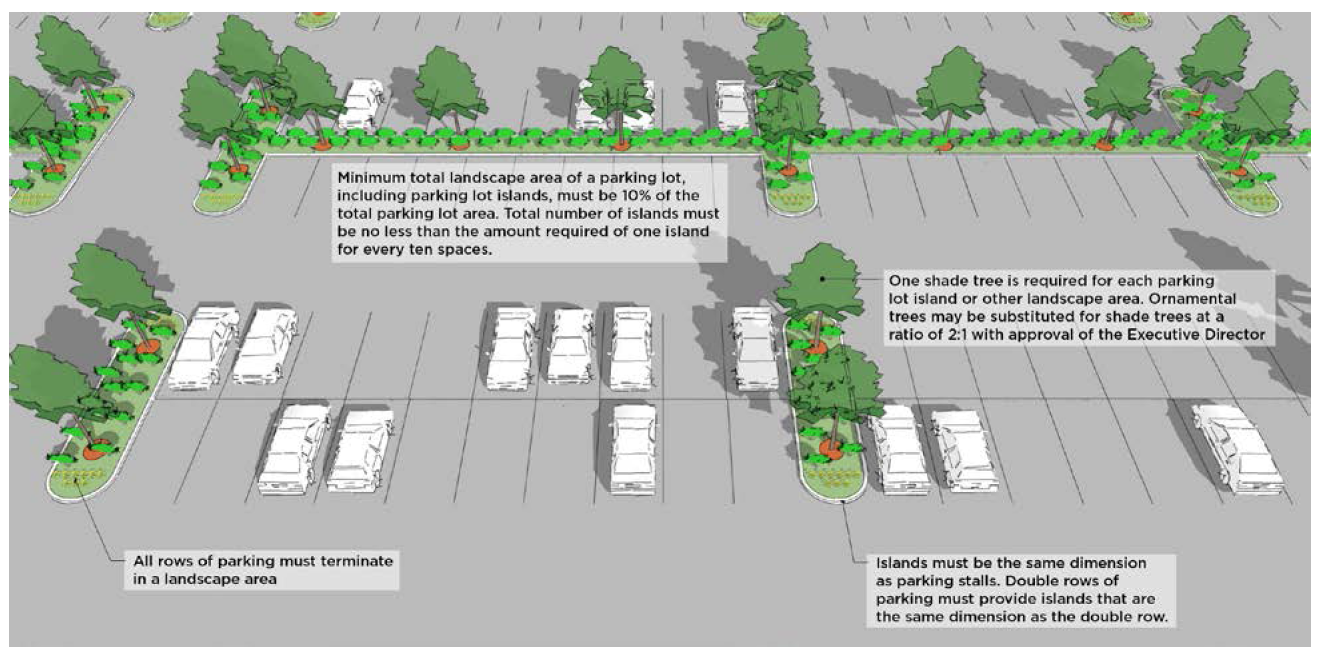
The minimum total landscape area of a parking lot, including parking lot islands, must be 10% of the total parking lot area. Parking lot landscaping along a street lot line, as required above, is excluded from the calculation of total parking lot area.
2.
One parking lot island is required between every ten parking spaces and all rows of parking spaces must terminate in a landscape area. As part of the landscape plan review and approval, parking lot island locations may vary from this requirement based on specific site requirements or design scheme, but the total number of islands must be no less than the amount required of one island for every ten spaces. Parking lot islands must be the same dimension as the parking stall. Double rows of parking must provide parking lot islands that are the same dimension as the double row. One shade tree is required for each parking lot island or other landscape area. Ornamental trees may be substituted for shade trees at a ratio of 2:1 with approval of the Executive Director.
3.
The use of stormwater management elements such as rain gardens and bioswales is encouraged in landscape areas. When a parking lot island is designed for stormwater management, the tree requirement may be exempted as part of landscape plan approval when such trees are not typically part of such design.
4.
Unless designated as a stormwater conservation area on a stormwater management plan, landscape areas must be protected by a raised six inch concrete curb. Pavement cannot be placed closer than five feet from the trunk of a tree. In cases where a tree must be within five feet of a curb or pavement, an approved root barrier device is required. The root barrier must be a rigid material system; no chemicals or flexible mesh are permitted.
5.
Where an existing parking area is altered or expanded to increase the number of spaces to more than 20 spaces, interior landscaping must be provided only on the new portion of the lot in accordance with the above standards.
FIGURE 10-4: PARKING LOT INTERIOR LANDSCAPE
D.
Landscaping for Below-Grade Open Parking Structures
Below-grade open parking structures located in the front setback must provide the following landscape:
1.
An 18 foot wide planting area must be provided between the below-grade parking structure and the street right-of-way. The landscape edge is exclusive of street rights-of-way.
2.
The planting area must include a minimum three foot tall berm, measured from the lot line after grading. The berm cannot exceed a 3:1 slope. One shade tree or an ornamental tree must be provided per 50 feet of street frontage within the landscape edge between the below-grade open parking and the street right-of-way. Berms must be planted with grass or groundcover. Additional plantings are encouraged to provide visual interest and may be required by the Executive Director.
E.
Landscaping for Above-Ground and/or At-Grade Parking Structures
Above-ground and/or at-grade parking structures must provide the following landscape. This does not apply to parking structures that are fronted with non-residential uses.
1.
When the structure is located 100 feet or less from the adjacent street right-of-way, landscape is required as follows:
a.
A minimum ten-foot landscape edge is required along the perimeter of the parking structure.
b.
Within the required landscape edge, one shade tree is required provided for every 50 linear feet of parking structure frontage, exclusive of entry drives and pedestrian access points. Ornamental trees can be substituted for shade trees at a ratio of 2:1.
c.
Additionally, ten shrubs are required per required shade tree. If a decorative trellis is used as part of the façade structure, vines meet the minimum shrub requirement.
2.
When the structure is located more than 100 feet from the adjacent street right-of-way, one shade tree is required for every 50 linear feet of parking structure frontage, exclusive of entry drives and pedestrian access points, and must be planted within a maximum of 10 feet from the exterior perimeter of the parking structure. Ornamental trees can be substituted for shade trees at a ratio of 2:1.
(Ord. No. 62, 2018, §§ 17, 18, 8-14-18; Ord. No. 6, 2019, § 27, 2-12-19; Ord. No. 191, 2019, § 21, 1-14-20; Ord. No. 114, 2020, § 14, 9-8-20; Ord. No. 149, 2024, § 7, 11-8-24)
10.10 - RESIDENTIAL DISTRICT AND USE LANDSCAPE REQUIREMENTS
These landscape requirements standards apply to all non-residential districts and uses. Parking lots are subject to the requirements of this section, whether accessory or principal. A planned unit development or a conditional zoning district that contains landscape standards is regulated by the standards of the approved planned unit development or conditional zoning district, as applicable.
A.
Landscape Buffer
Buffer yards are located within rear and interior side yards, including the required rear or interior side setbacks, and must be reserved for the planting of material and installation of screening as required by this section. No parking spaces or accessory structures are permitted within the required buffer yard.
1.
As of the effective date of this Code, buffer yards are required for new construction along interior side and rear yards in the following cases:
a.
Where an R-2, R-3, or R-4 District abuts a R-A, R-E, R-1-12, R-1-10, R-1-7, R-1-5, R-UC, R-HU, or R-TH District. This does not apply to any single-family - detached or attached, and two-family dwellings.
b.
Where a multi-family dwelling is located within a R-A, R-E, R-1-12, R-1-10, R-1-7, R-1-5, R-UC, or R-HU District.
2.
The minimum size and improvement of buffer yards is as follows (Figure 10-2). When the calculation of minimum buffer yard requirements results in a fraction, the fraction is rounded up to the nearest whole number.
a.
A buffer yard must be a minimum of ten feet in width.
b.
One shade tree must be planted for every 30 linear feet of buffer yard length. As part of the landscape plan approval, trees may be spaced at various intervals based on specific site requirements, but the total number of trees planted must be no less than one per 30 linear feet of buffer yard length.
c.
A solid fence or masonry wall a minimum of six feet and a maximum of eight feet in height must be erected along 100% of the yard length.
3.
One shrub, measuring a minimum of 18 inches in height at planting and reaching a minimum of three feet in height at maturity, must be planted for every three linear feet of buffer yard length, spaced linearly.
4.
The remainder of the buffer yard must be planted in live groundcover, perennials, or grass.
B.
Multi-Family Dwelling Landscaping Requirements
Multi-family dwellings that are set back from any lot line that abuts a street right-of-way by 10 feet or more are also required to provide landscape in accordance with this section in such area.
1.
One shade tree or an ornamental tree must be planted per 500 square feet of planting area. The number of required trees is calculated solely on the area of the planting area.
2.
A variety of ornamental trees and flowers are encouraged in addition to the required plantings.
3.
Any permeable surface not occupied by trees, shrubs, and plantings beds, signs or other permitted fixtures must be planted with grass or other living groundcover. Gravel, bark mulch, or other similar materials are not acceptable.
(Ord. No. 19, 2021, § 14, 2-9-21; Ord. No. 149, 2024, § 8, 11-8-24)
10.11 - PLANNED UNIT DEVELOPMENT AND CONDITIONAL ZONING DISTRICT LANDSCAPING REQUIREMENTS
An approved planned unit development (PUD) or conditional zoning district (CZD) that contains landscape standards is controlled by the regulations of either the approved planned unit development or conditional zoning district. Where the planned unit development or conditional zoning district does not contain specific landscape standards, the landscape standards of the underlying zoning district, as described in this Article, apply. However, the following exceptions apply to planned unit developments and conditional zoning districts.
A.
For all non-residential and multi-family PUDs or CZDs, a minimum 30-foot wide buffer yard is required around the entire perimeter of a planned unit development whenever the lands abutting the planned unit development or conditional zoning district are zoned for residential purposes. Landscaping and other screening features such as berms and/or fencing must be established within the required buffer area to provide a solid screen separating the development site from adjoining properties. No structures, parking, or outdoor storage is permitted in a required buffer area, although trail systems and walkways may be allowed, provided that solid screening is in place within the remaining buffer area.
B.
A minimum 20-foot wide buffer yard is required around the common perimeter of a planned unit development or conditional zoning district, whenever the lands abutting the PUD or CZD are zoned for non-residential purposes. The buffer must be continuous in nature, except in those locations where shared parking and/or shared access or utility connections are necessary, or when critical areas extend beyond the PUD or CZD boundaries to adjacent parcels.
C.
Maintenance responsibilities for the buffer area must be clearly identified in the preliminary application. All buffer area restrictions must be clearly noted on the preliminary and final site plan, as well as on the preliminary and final plat, to advise potential lot purchasers/lessees of said buffer restrictions and their individual responsibilities.
D.
During the preliminary site plan review process, the Metropolitan Planning Commission may reduce the width of the landscape edge upon a finding that the full landscape requirement would prevent a property's reasonable development in a safe, efficient manner.
(Ord. No. 149, 2024, § 9, 11-8-24)
Editor's note— Ord. No. 149, 2024, § 9, adopted November 8, 2024, changed the title of Section 10.11 from "Planned unit development landscaping requirements" to "Planned unit development and conditional zoning district landscaping requirements." The historical notation has been preserved for reference purposes.
10.12 - TREE AND PLANT PALETTE
A.
The following list contains trees and shrubs that are approved for planting based upon growth habit, natural range, and aesthetic quality. This list is by no means comprehensive, and other species may be used if plant zone requirements are met according to the temperature ranges of the Shreveport/Caddo area, and if approved by the Executive Director.
B.
The species included for Street/Parking Areas are tolerant of urban conditions, and are recommended for buffer yards or parking areas. Note that each species vary greatly in terms of size and appearance at maturity, and that not every tree is the right selection for every street. When selecting a street tree, it is critical to consider the physical conditions of the site, both natural and man-made. The species selected should be carefully considered for its ability to flourish while respecting functional requirements of the landscaped area where it is planted. These may include the accommodation of above-ground or underground utilities, vehicle clearances, solar access, and the placement of streetlights, among others. An appropriate species must be selected, and soil and hydrological conditions should be optimized, to ensure the health and longevity of the tree.
Click this link to download a PDF version of the Tree and Plant Palette.
(Ord. No. 6, 2019, § 29, 2-12-19)

