- USE STANDARDS
Where applicable, principal uses are required to comply with all use standards of this section, whether a permitted or special use, in addition to all other regulations of this Code.
In addition to any requirements under this Code, establishments selling or serving alcoholic beverages must be licensed and operating in compliance with the laws governing the sale and consumption of alcoholic beverages as established by Chapter 10 of the Shreveport Code of Ordinances, as well as all other applicable ordinances, statutes, rules and regulations of the City and State of Louisiana.
A.
Airport, Heliport, and Helipad
1.
All facilities must comply with all Federal Aviation Administration requirements. All documentation must be submitted as part of a zoning application and prior to issuance of a building permit.
2.
Any structures for such facilities must be set back a minimum of 50 feet from any residential district lot line.
B.
Animal Care Facility, Animal Shelter, and Commercial Breeder
The following standards apply to all animal care facilities, animal shelters, and commercial breeders. However, animal shelters operated by a public agency are exempt from these standards.
1.
Exterior exercise areas must be located in the interior side or rear yard. Exterior exercise areas must provide covered areas over a minimum of 30% of the exterior area to provide shelter against weather.
2.
The permitted hours for outdoor activities for an animal care facility are between 9:00 a.m. and 6:00 p.m.
3.
All overnight boarding facilities must be located indoors. Outdoor boarding facilities for commercial breeders are permitted but must be designed to provide shelter against weather.
4.
All animal quarters and exterior exercise areas must be kept in a clean, dry, and sanitary condition.
5.
A fence a minimum of six feet and a maximum of seven feet in height is required for all exterior exercise areas and any outdoor boarding quarters.
C.
Automated Teller Machine—Standalone
The following regulations for a standalone Automated Teller Machines (ATM) do not apply to financial institutions that typically provide services by Automated Teller Machines, whether drive-through or walk-up.
1.
A drive-through standalone Automated Teller Machine (ATM) is subject to the following standards:
a.
A drive-through standalone ATM is permitted only when a drive-through facility is allowed within the district and separate approval is obtained for the drive-through facility, including compliance with all standards for a drive-through facility.
b.
Queuing and vehicle stacking spaces (spaces for cars that are waiting for drive-up or drive-through services) are required for any automated teller machine - standalone use, as provided in Section 8.8 (Queuing and Vehicle Stacking Areas).
2.
A walk-up standalone Automated Teller Machine (ATM) may not encroach into the public right-of-way unless a right-of-way encroachment permit is obtained.
D.
Bar
1.
All bars must comply with the requirements of this Code, Chapter 10 of the Shreveport Code of Ordinances, as well as all other applicable ordinances, statutes, rules and regulations of the City and State of Louisiana. Note: Bars may be subject to State laws requiring a certain number of patron accommodations and public habitable floor area square footage requirements.
State law reference—La. R.S. 26:71.1 and La. R.S. 26:271.2.
2.
In addition to site plan requirements, the following elements of operation will be considered:
a.
The size, location, and configuration of the establishment.
b.
Days and hours of operation.
c.
Maximum occupancy loads.
d.
A noise abatement plan, including any plans for outdoor areas.
e.
A security plan.
f.
Exterior lighting design.
3.
If outdoor seating is part of the establishment, the site plan must include the total floor area of outdoor seating, and the general location of seats, tables, and other furniture proposed for outdoor seating.
4.
If the bar plans an increase in intensity, such as an expansion of floor area or increase in permitted occupancy, the site plan and its additional elements, as required by this section, must be updated and resubmitted for approval. Revised plans must be approved prior to the issuance of any permits.
E.
Bed and Breakfast
1.
The exterior of a bed and breakfast must maintain its original appearance as a single-family dwelling. Parking for any bed and breakfast shall comply with all applicable parking provisions as described in Article 9 of this Code. All vehicles shall be parked in designated parking areas, and parking is prohibited in any landscaped area.
2.
Cooking facilities are prohibited in individual guest rooms.
3.
Breakfast must be served to guests at a minimum. Meals may only be served to registered guests unless the meal is part of a special event. Special events may only be allowed through a temporary use permit approved by the Zoning Administrator.
4.
Guest stays are limited to a maximum of 14 consecutive days.
5.
Bed and breakfast facilities are limited to having six or fewer guest rooms, and may not exceed two adults per room. If the bed and breakfast wish to allow more than the maximum number of allowed rooms and/or adults per room, special exception use approval by the Zoning Board of Appeals is required.
6.
One sign, either freestanding or wall, is permitted. Such a sign may not exceed six square feet and is limited to five feet in height.
7.
Bed and breakfasts are permitted to host private events including, but not limited to luncheons, banquets, parties, weddings, meetings, charitable fundraising, commercial or advertising activities, or other similar gatherings for direct or indirect compensation, but must obtain a temporary use permit in accordance with Article 16. Private events may include food and beverages that are prepared and served on-site or by a caterer to invited guests. Live entertainment may be provided as an ancillary use as part of an event.
F.
Bus Transfer Station
1.
A public transit station for two or more bus routes in a public transit system, often times the endpoint for one or more bus routes, where passengers may change from one route to another.
2.
There is no off-street parking or loading requirements for this use.
3.
This use is exempt from the front, side, and rear yard requirements in this Code, except that the shelter structure must be set back at least five feet from the edge of the roadway.
4.
A litter container of adequate size must be provided on the site at all times.
5.
In residential districts, the shelter structure must not occupy an area greater than 100 square feet.
6.
No signs are permitted on any bus transfer station site except for governmental signs, transit system logos, schedules, and route information.
7.
This use must be installed by public agencies.
8.
A site plan must be submitted to and approved by the Executive Director per Article 16.
G.
Campground and Recreational Vehicle (RV) Park
1.
The minimum area for a campground or RV park is three acres.
2.
Campgrounds and RV parks must comply with all applicable state and city regulations, including those governing the installation, construction, and/or operation of swimming pools, water supply, sewage disposal, food storage and services, plumbing, structures, electrical wiring, and fire prevention.
3.
Management headquarters, recreational facilities, coin operated laundry facilities, cabins for counselors, overnight accommodations, living space, and other uses and structures customarily associated with the operation of a campground or RV park are permitted.
4.
Storage of all materials and/or equipment must be within enclosed structures.
5.
A 25-foot setback from the perimeter property line of the campground or RV park is required. Any permanent or semi-permanent structures, such as offices, platforms, ramps, lean-to's, garages, and sheds, are prohibited within this setback. The perimeter setback must be landscaped. Preservation of existing vegetation is encouraged.
H.
Car Wash
1.
Car wash facilities must be screened along interior side and rear lot lines with a solid fence or wall, a minimum of six feet and a maximum of seven feet in height. One shrub a minimum of three feet in height at time of planting must be planted linearly every three feet on-center along such fence or wall.
a.
Screening requirements are not required along any property line which the subject property is abutting an adjacent property with the same screening requirements.
b.
The Executive Director shall have administrative authority to waive these screening requirements due to surrounding zoning, topography, or lot configuration.
2.
The site must be graded to drain away from adjoining properties.
3.
All wash-water generated from the car wash must either:
a.
Secure a LDEQ Discharge Permit if discharging into the Municipal Separate Sewer System (MS4); or
b.
Meet the requirements of the Water and Sewer Codes of the Shreveport/Caddo Health Unit if discharging into the storm sewer system.
I.
Casino
1.
All casinos must meet all federal, state and local requirements including, but not limited to, licensing, security, safety and building code requirements.
2.
All casinos and gaming establishments are regulated by the Louisiana Gaming Control Board and are subject to the Louisiana Administrative Code regulations. Evidence that the casino's security system, management, and gaming regulations have been approved by the Louisiana Gaming Control Board (or its successor) and/or the Louisiana State Police must be submitted.
J.
Commercial Facility for Pop-Up Uses
Commercial facilities for pop-up uses are to accommodate certain uses within the facility that are temporary or seasonal in nature. Any pop-up use within the facility must be an allowable principal use within the zoning district where the commercial facility is located, as identified on the Use Matrix in Article 5. Both the commercial facility and allowable pop-up use(s) within the facility shall meet the following requirements.
1.
The Commercial Facility
a.
The facility shall be adequate in size and shape to accommodate any anticipated pop-up use.
b.
The proposed facility shall be adequately served by streets having sufficient width and improvements to accommodate the kind and quantity of traffic the anticipated pop-up use(s) could reasonably generate.
c.
The proposed facility shall provide adequate parking to accommodate vehicular traffic anticipated by the anticipated pop-up use(s).
d.
The operation of the facility shall not jeopardize, endanger, or otherwise constitute a menace to public health, safety, or general welfare.
e.
A certificate of occupancy is required for the entire facility on an annual basis to be issued by the Zoning Administrator. The use will be identified as a commercial facility for pop-up use.
2.
Pop-Up Uses within the Facility
a.
The pop-up use within the facility shall locate, operate, and maintain the space in a manner consistent with the policies of this Code and all applicable provisions of City ordinances and state law.
b.
Pop-up use tenants shall not make any permanent exterior alterations to the site without the required approvals and permits, as applicable.
c.
Pop-up use tenants shall remove any approved temporary signs associated with said use at the conclusion of said use.
d.
Pop-up use tenants shall obtain all other required permits, such as building or health department permits.
K.
Community Garden
1.
Community gardens are limited to the cultivation of herbs, fruits, flowers, or vegetables, including the cultivation and tillage of soil and the production, cultivation, growing, and harvesting of any agricultural, floricultural, or horticultural commodity. It may also include community-gathering spaces for active or passive recreation but playground equipment is prohibited.
2.
Greenhouses, including high tunnels/hoop-houses, cold-frames, and similar structures, are permitted to extend the growing season. Accessory structures such as sheds, gazebos, and pergolas are also permitted.
3.
Accessory structures and uses for the raising of chickens, fish, and bees are permitted so long as all such structures comply with the accessory structure requirements of Article 7. No other livestock is permitted.
4.
Farmstands are permitted and are limited to sales of items grown at the site. Farmstands must be removed from the premises or stored inside a structure on the premises during that time of the year when the use is not open to the public. Only one farmstand is permitted per lot.
L.
Data Center
1.
All data centers shall only operate in allowable zoning districts as indicated on the Use Matrix in Article 5 of this Code. Any data center located within 200 feet of a residentially zoned district shall require a special use permit approved by the Metropolitan Planning Commission.
2.
In all allowable zoning districts, all equipment necessary for cooling, ventilating, or otherwise operating the facility must be contained within an enclosed building where the use is located. This includes emergency power generators and other emergency power supply equipment.
3.
In the C-3 and C-4 Districts, the maximum permitted size is 40,000 square feet in gross floor area. However, this size limit may be exceeded as part of special use permit approval.
4.
In the I-MU and OR District, the maximum permitted size is 80,000 square feet in gross floor area. However, this size limit may be exceeded as part of a special use permit approval.
M.
Day Care Center and Day Care Home
1.
Each day care center must comply with all applicable state and federal regulations.
2.
The operator of a day care center must be licensed by the state.
3.
A day care home must maintain its original appearance as a residential dwelling.
4.
A day care center must provide a pickup/drop off area. When a day care center is part of a multi-tenant retail center, the pickup/drop off area must not interfere with vehicle circulation in the parking lot, including blocking of the drive aisle.
N.
Drive-Through Facility
1.
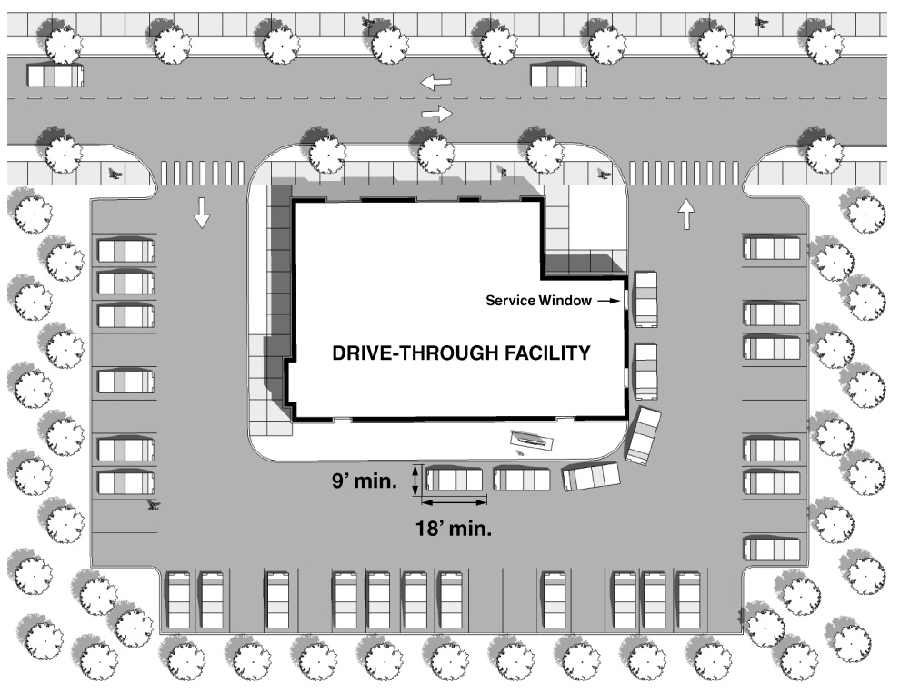
Queuing and vehicle stacking spaces (spaces for cars that are waiting for drive-up or drive-through services) are required for any drive-through facility use, as provided in Section 8.8 (Queuing and Vehicle Stacking Areas).
2.
All drive-through lanes must be located and designed to ensure that they do not adversely affect traffic circulation on adjoining streets. Drive-through lanes on corner lots must not route exiting traffic into adjacent residential neighborhoods.
3.
Drive-through facilities must be screened along interior side and rear lot lines with a solid fence or wall, a minimum of six feet and a maximum of seven feet in height. One shrub a minimum of three feet in height at time of planting must be planted linearly every three feet on-center along such fence or wall.
a.
Screening requirements are not required along any property line which the subject property is abutting an adjacent property with the same screening requirements.
b.
The Executive Director shall have administrative authority to waive these screening requirements due to adjacent zoning or uses, lot topography, or lot configuration.
4.
A drive-through lane must have bail out capability for all vehicles that enter the drive-through lane. The bailout lane must be a minimum width of 10 feet and run parallel to the drive-through lane. If a bail out lane is also an interior access drive providing access to parking spaces, the bailout lane is limited to a one-way traffic pattern following the direction of the drive-through lane.
FIGURE 6-1: DRIVE-THROUGH FACILITY
O.
Dwelling—Accessory Dwelling Unit
1.
All accessory dwelling units shall have their own legal means of ingress and egress and function as a complete separate dwelling unit.
2.
Accessory dwelling units shall include permanent provisions for living, sleeping, eating, cooking (i.e., stove, refrigerator, and sink) and sanitation (i.e., bathroom that includes sink, toilet and shower or bathtub).
3.
Accessory dwelling units may be attached to or added within the principal dwelling unit or an existing accessory structure such as a detached garage or carriage house.
4.
Accessory dwelling units may be completely detached from the principal dwelling unit. A dwelling unit is considered detached despite an intervening attached structure or shelter that is not enclosed.
5.
Detached accessory dwelling units may be constructed from freight containers or other prefabricated structures and shall be compliant with all applicable building codes including but not limited to the International Residential Code.
6.
Accessory dwelling units shall be visually subordinate to the principal dwelling unit. If the unit is located within an existing dwelling unit, there may be only one main entrance located on the primary street facing façade unless the façade already incorporated more than one entrance before the accessory dwelling unit was proposed.
7.
Manufactured homes may be used as accessory dwelling units provided that they are allowed in the zoning district or special approval is obtained to allow the use.
8.
Detached accessory dwelling units that are visible from a public right-of-way shall contain windows, doors, or other significant architectural features on the visible façade.
9.
No more than one accessory dwelling unit is allowed per lot. Where permitted, the accessory dwelling unit does not count toward the maximum number of dwelling units on a lot, including when the accessory dwelling unit is located in a detached structure.
10.
A detached accessory dwelling unit may not exceed the height of the principal dwelling, may not exceed a gross floor area of 60% of the gross floor area of the principal dwelling or 1,800 square feet, whichever is less.
11.
Detached accessory dwelling units may only be located in the rear yard. Detached accessory dwelling units must be located five feet from any lot line and shall be at least 10 feet from any principal building.
12.
No additional parking is required for an accessory dwelling unit. Required parking for the principal structure must be maintained.
P.
Dwelling—Manufactured Home
Manufactured homes must meet the following design standards when not located within a manufactured home park:
1.
Manufactured homes shall only operate in allowable zoning districts as indicated on the Use Matrix in Article 5 of this Code. Any zoning district identified as a special exception use, or "E," will location and site plan approval by the Zoning Board of Appeals in accordance with the provisions of Section 16.5 (Special Exception Use).
2.
The front entry must be a dominant feature on the front elevation of a manufactured home, using features such as porches, raised steps and stoops with roof overhangs, or decorative railings.
3.
Windows, entrances, bay windows, or other architectural features are required on all street-facing walls.
4.
Each manufactured home must utilize roofing materials such as asphalt shingles or similar material, similar in material and appearance to single-family dwellings.
5.
The roof design must be a full height roof element with a minimum pitch of 3:12.
6.
All manufactured homes must be designed with skirting that is constructed of fire-resistant material that meets the requirements of the building code
7.
The manufactured home must be set on a concrete slab or runway, and such slab or runway must be of a size large enough to accommodate a manufactured home in such a fashion that the concrete will extend at least one inch around the walls of the manufactured home on all sides.
Q.
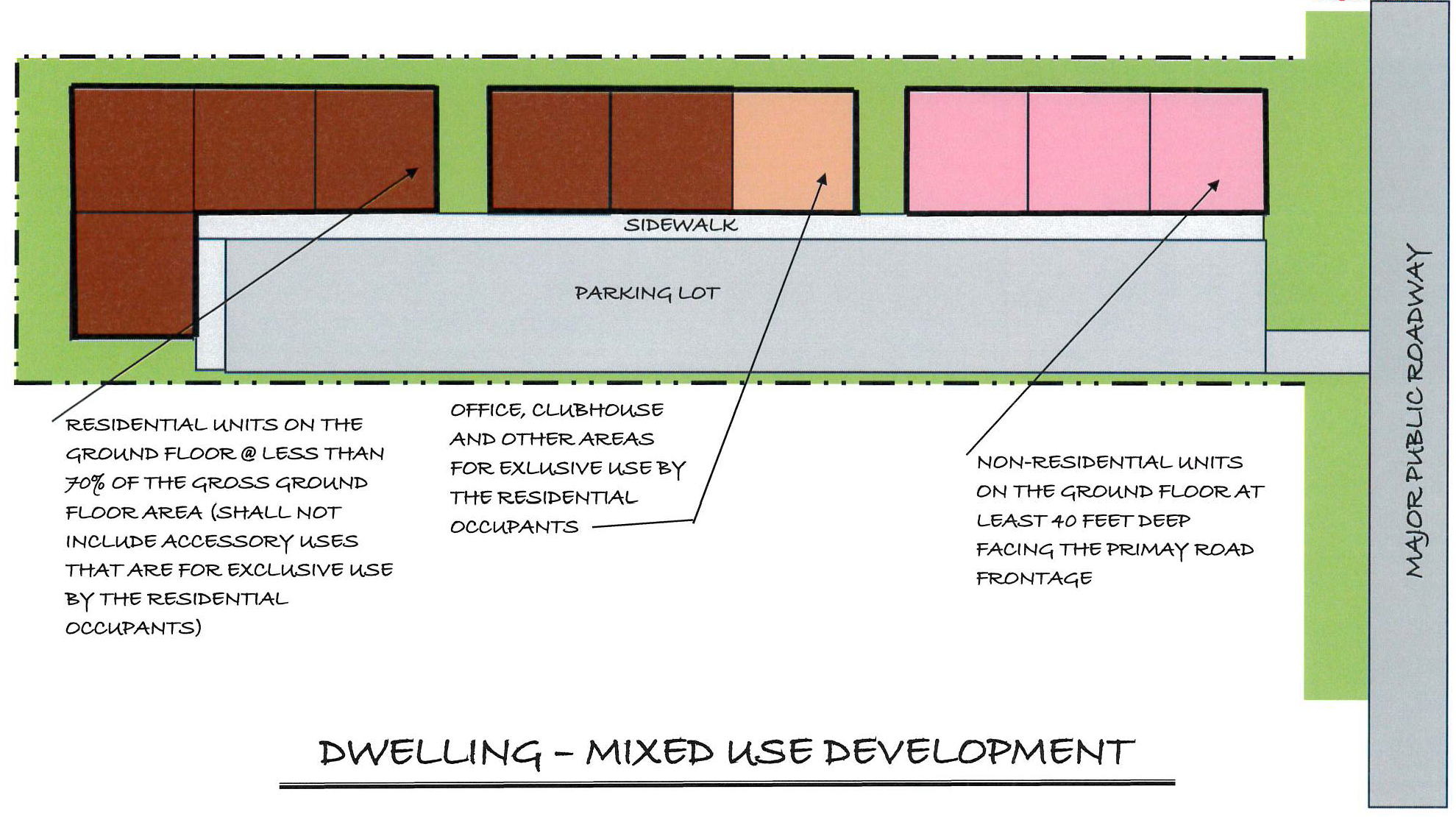
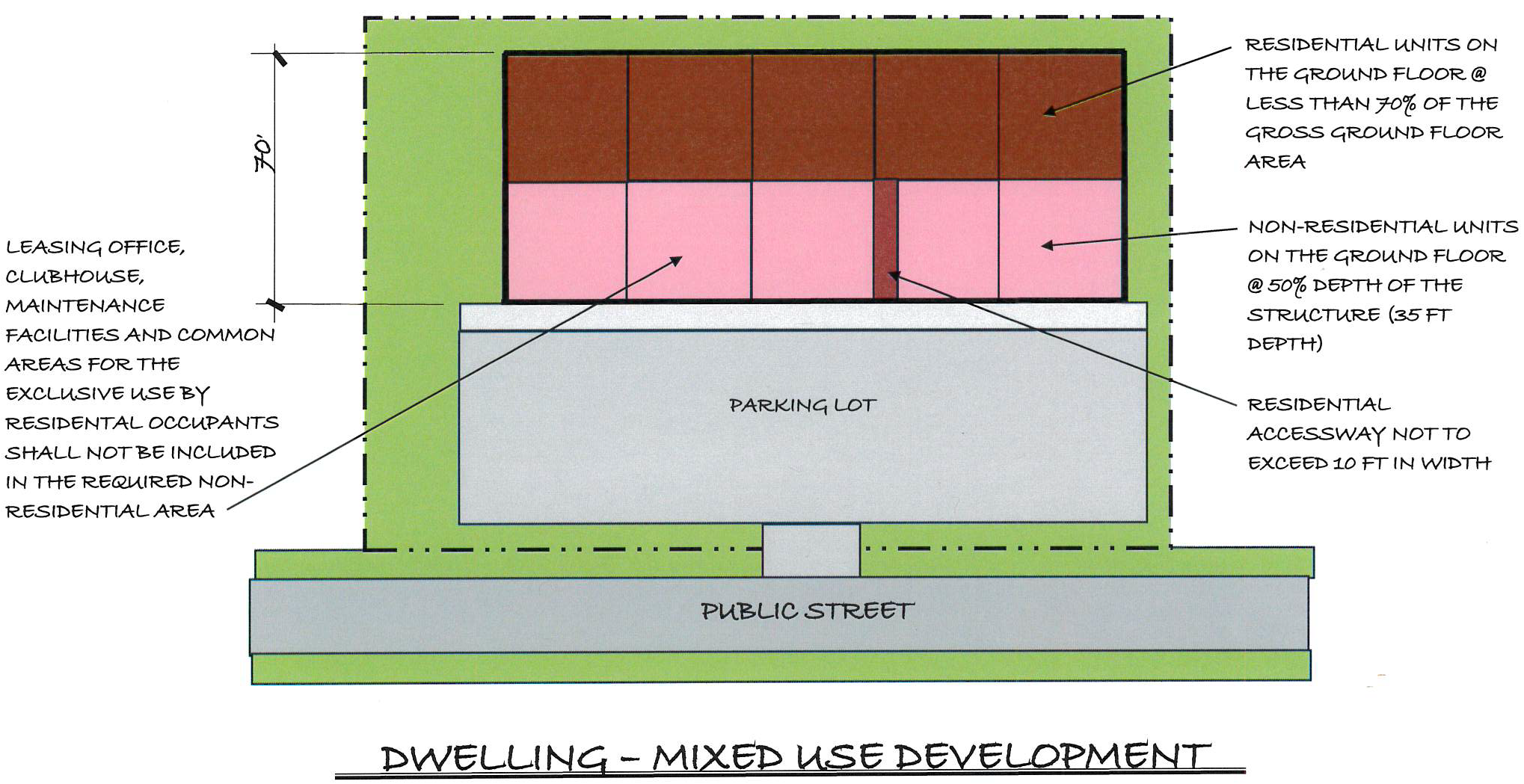
Dwelling—Mixed Use
1.
Location of Dwelling Units. Housing units can be on floors above businesses, behind businesses, or a mix of both.
2.
Street Frontage. If a building faces the main street, the first 40 feet of space or up to one-half the building's depth must be used for non-residential businesses on the ground floor. These businesses cannot be things like leasing offices, maintenance areas, or places only for people who live there. A doorway and a common area for residents can be included, but the walkway can't be more than 10 feet wide.
3.
Ground Floor Area. No more than 70% of the ground floor can be used for residential purposes in any development.
4.
Special Permits. If a Dwelling-Mixed Use development is less than 200 feet from a single-family zoning district, it needs a special use permit. The distance is measured from the nearest point on the property line of the proposed use to the nearest point of the property line of the single-family zoning district.
5.
Variance from Use Standards. None of the above standards shall be eligible for a variance request to be considered by the Zoning Board of Appeals.
R.
Dwelling—Multi-Family or Townhouse or Single Room Occupancy
1.
Facades must be designed with consistent materials and treatments that wrap around all street-facing facades. There must be a unifying architectural theme for the entire multi-family or townhouse development, utilizing a common vocabulary of architectural forms, elements, materials, or colors in the entire structure.
2.
Building facades must include windows, projected or recessed entrances, overhangs, and other architectural features. Three-dimensional elements, such as balconies and bay windows, are encouraged to provide dimensional elements on a facade.
3.
The following minimum transparency requirements apply to any facade facing a street and are calculated on the basis of the entire area of the facade:
a.
Townhouse Dwelling: 15%
b.
Multi-Family Dwelling or Single-Room Occupancy: 25%
4.
Flat roofs must include cornices, parapets, or similar architectural details to add variety and break up the roofline.
5.
There must be a minimum separation of 15 feet between sidewalls of rowhouse buildings. Where the front or rear wall of a rowhouse faces the front or rear wall of another rowhouse, the minimum required separation between such buildings must be 30 feet. Driveways and parking areas may be located within this minimum separation area.
6.
The following building materials are prohibited on any facade. However, such materials may be used as decorative or detail elements for up to 25% of the facade, or as part of the exterior construction that is not used as a surface finish material.
a.
Plain concrete block
b.
Corrugated metal
c.
Aluminum, steel, or other metal sidings
d.
Exposed aggregate (rough finish) concrete wall panels
e.
T-111 composite plywood siding
f.
Plastic
g.
Vinyl
FIGURE 6-2: MULTI-FAMILY DWELLING DESIGN STANDARDS
S.
Dwelling—Single-Family - Detached, Single-Family - Attached, or Two-Family
1.
A dwelling must have a primary entrance from the facade facing the street. The front entry must be a dominant feature on the front elevation of a home and an integral part of the structure, using features such as porches, raised steps and stoops with roof overhangs, or decorative railings to articulate the front facade.
2.
Windows, entrances, porches, or other architectural features are required on all street-facing facades to avoid the appearance of blank walls.
3.
A 15% minimum transparency requirement applies to any street-facing facade and is calculated on the basis of the entire area of the facade.
FIGURE 6-3: SINGLE-FAMILY DWELLING DESIGN STANDARDS
T.
Financial Institution with Drive-Through Facility
1.
Queuing and vehicle stacking spaces (spaces for cars that are waiting for drive-up or drive-through services) are required for any drive-through facility use, as provided in Section 8.8 (Queuing and Vehicle Stacking Areas).
2.
All drive-through lanes must be located and designed to ensure that they do not adversely affect traffic circulation on adjoining streets. Drive-through lanes on corner lots must not route exiting traffic into adjacent residential neighborhoods.
3.
Financial institutions with drive-through facilities must be screened along interior side and rear lot lines with a solid fence or wall, a minimum of six feet and a maximum of seven feet in height. One shrub a minimum of three feet in height at time of planting must be planted linearly every three feet on-center along such fence or wall.
a.
Screening requirements are not required along any property line which the subject property is abutting an adjacent property with the same screening requirements.
b.
The Executive Director shall have administrative authority to waive these screening requirements due to adjacent zoning or uses, lot topography, or lot configuration.
4.
A drive through lane must have bail out capability for all vehicles that enter the drive through lane. The bail out lane must be a minimum width of 10 feet in width and run parallel to the drive through lane. If a bail out lane is also an interior access drive providing access to parking spaces, the bail out lane is limited to a one-way traffic pattern following the direction of the drive through lane.
U.
Food Truck and Trailer Vendor
These regulations describe what is allowed, what is required and where a food truck and trailer vendor Is allowed to operate, with proper zoning and operations permits, within the City of Shreveport. These regulations are aimed to help foster an aesthetically appealing streetscape and help reduce potential dangerous traffic conditions, all for the promotion and protection of the public health, safety, and welfare.
1.
Food Truck and Trailer Vendor's License
a.
A food truck and trailer vendor's license shall be required to conduct business within the City of Shreveport and shall comply with all zoning and operational requirements as established by this Code, as well as all other applicable ordinances, statutes, rules and regulations of the City of Shreveport and State of Louisiana, unless exempt as follows:
i.
Food truck and trailer vendors operating on private or City-owned property under an approved special event permit such as a fair, carnival, festival, or similar transitory gathering, for which a sponsor or promoter has paid an occupational license tax or when the sponsor or promoter is exempt from the payment of an occupational license tax.
ii.
Food truck and trailer vendors operating on private or City-owned property under an approved special event permit sponsored by nonprofit organizations for any religious, charitable, patriotic, educational or philanthropic event, lasting four days or less in duration.
iii.
Food truck and trailer vendors operating on private or City-owned property under an approved special event permit held at least six times a year for any for-profit event, including but not limited to festivals, gun shows, arts and crafts fairs, antique shows, flea markets, vendor markets or other similar transitory gathering, for which the sponsor or promoter:
(1)
Has paid an occupational license tax under the requirements of the Shreveport City Code;
(2)
Owns the premises or has a lease thereof for at least one year;
(3)
Has obtained a certificate of occupancy for the premises or special event permit; and
(4)
Has provided all vendors with applications and notice of the requirement to register with the Caddo-Shreveport Sales and Use Tax Commission and to collect and remit sales tax, and has provided the Commission with the contact information of all vendors.
iv.
Sales of seasonal products such as, but not limited to, crawfish sales or portable beverage service facilities, operating at a permanent location under an approved temporary use permit.
v.
Catering of a private event with the express written consent of the property owner.
b.
The Office of the Metropolitan Planning Commission, along with the City's Revenue Division, shall develop a food truck and trailer application packet which combines land use and zoning requirements, as well as all other applicable ordinances, statutes, rules and regulations of the City, Parish and State of Louisiana as the Zoning Administrator may require.
c.
All food truck and trailer vendor's license requests shall be referred to the Caddo Parish Health Department, City's Finance Department, Police Department, Public Works Department, and/or Fire Prevention for review prior to approval, as applicable.
d.
A food truck and trailer vendor's license shall be displayed on the food truck and trailer vendor's vehicle at all times in a conspicuous place where It can be readily viewed by the general public.
e.
The food truck and trailer operator shall obtain the property owner(s), or their legal representative's, written permission to utilize the property for food truck and trailer operations prior to commencement of business and shall present a copy of such written permission upon request. An agreement must be provided for each location of operation.
f.
A food truck and trailer vendor's license is required to be renewed annually.
2.
Zoning and Location Restrictions
a.
Unless otherwise exempt from the requirements of this Article, a food truck and trailer vendor shall only operate in allowable zoning districts as indicated on the Use Matrix in Article 5 of this Code.
b.
Food truck and trailer vendors shall only be located on property where an existing, permanent business operates in a building with a certificate of occupancy.
c.
Food truck and trailer vendors may conduct business within the City's public right-of-way provided they operate per the requirements of Chapter 42 of the Shreveport City Code.
d.
A property owner can allow multiple mobile food vehicles to occupy their lot at the same time. The maximum number of food trucks per lot is limited as follows:
i.
Maximum of two food truck and trailer vendors on lots of one-half acre or less;
ii.
Maximum of three food truck and trailer vendors on between one-half acre and one acre;
iii.
Maximum of four food truck and trailer vendors on greater than one acre.
e.
Five or more food truck and trailer vendors are only allowed to operate on a single lot if:
i.
Operating under an approved food truck park and shall comply with the use requirements and restrictions for food truck parks.
ii.
Operating under an approved temporary use permit issued for a special outdoor event.
iii.
Operating under an approved special event permit such as a fair, carnival, festival, or similar transitory gathering issued by the City.
f.
Food truck and trailer vendors must be located at least 100 feet from the main entrance to any eating establishment or similar food service business, 100 feet from any outdoor dining area and 50 feet from any permitted food vending cart location, as measured from the designated location on the lot accommodating the food truck.
g.
Food truck and trailer vendors shall not conduct business on any property zoned for or occupied by a single-family or two-family residence, unless they are operating as part of:
i.
The catering of a private event;
ii.
The service to an active construction site;
iii.
A Special event on the property of a school; or
iv.
A special event for any City-recognized neighborhood/homeowner's association.
h.
Food truck and trailer vendors shall not conduct business on a vacant or abandoned lot.
3.
Operational Standards and Limitations
a.
No food and trailer vendor shall sell goods, wares, or other items of merchandise other than food or drink. Sale of alcoholic beverages is prohibited Sale of alcoholic beverages is prohibited.
b.
All food truck and trailer vendors must park on a durable all-weather material, such as concrete or asphalt.
c.
Reserved.
d.
Food truck and trailer vendors shall be secondary to an existing primary use on the property.
e.
Any food truck and trailer and its associated seating, if any, shall not occupy parking spaces required to fulfill the minimum requirements of the principal use, unless the principal use's hours of operation do not coincide with those of the food truck and trailer business. Likewise, any food truck and trailer and its associated seating, if any, shall not occupy parking spaces that may be leased to other businesses and uses to fulfill their minimum parking requirements.
f.
Any associated outdoor seating must be removed after operating hours and must not be stored, parked, or left overnight on any public street or sidewalk.
g.
Food truck and trailers must not occupy or prevent access to any handicapped accessible parking.
h.
Connection to City water services shall not be permitted unless approved by the Chief Building Official or Director of Water and Sewerage. Any unauthorized connection to the water system in conjunction with the operation of a food truck and trailer vendor in any way is strictly prohibited and is unlawful. Any such violation will be investigated and may be the cause for revoked licenses or denied license renewal.
i.
Under no circumstances can liquid waste or grease be released or disposed of in tree pits, storm drains or onto the sidewalks, streets, or other public space. If at any time evidence of the improper disposal of liquid waste or grease is discovered, the food truck and trailer vendor license will be revoked and the food truck and trailer vendor will be required to cease operation immediately. The operator of the food truck and trailer business may be issued a citation for such a violation.
j.
Food trucks and trailers shall be located at least 10 feet from the edge of any driveway or public sidewalk, handicapped ramp, building entrances and exit, emergency access/exit way, fire lane, or emergency call box and must not locate within any area of the lot that Impedes, endangers, or interferes with pedestrian or vehicular traffic.
k.
There shall be no restriction of visibility area sight distance at any driveway or intersection.
l.
Food truck and trailer vendors shall not use a hibachi, grill, or other similar device for cooking, heating, or any other similar purpose within 10 feet of any building or building overhang.
m.
Food trucks and trailers must be located a minimum distance of 15 feet in all directions of a fire hydrant and any fire department connection, utility box or vault.
n.
All food truck and trailer vendors, amenities, including but not limited to restrooms, tables, chairs and shade structures and other site improvements shall be identified on the food truck and trailer vendor's license application and shall be In accordance with this Code.
o.
The food truck and trailer vendor is responsible for the proper disposal of waste and trash associated with the operation and shall be equipped with a portable trash receptacle placed near the unit that does not impede pedestrian or vehicular traffic. City trash receptacles are not to be used for this purpose. Vendors must remove all waste and trash from their approved location at the end of each day or as needed to maintain the health and safety of the public.
p.
With the exception for the trash and any associated outdoor seating areas, all equipment required for the operation must be contained within, attached to or within five feet of the food truck and trailer and all food preparation, storage, and sales/distribution made in compliance with all applicable Parish and State Health Department sanitary regulations.
q.
Each food truck vendor must report to its designated commissary at least once a day for food, supplies, cleaning, and servicing and as required by the Caddo Parish Health Unit.
r.
A drive through is not permitted in conjunction with any food truck and trailer vendor.
s.
No signage shall be allowed other than signs permanently attached to the food tuck or trailer and one portable menu sign with a changeable face no more than six square feet in display area on the ground in the customer waiting area.
t.
All food truck and trailers must be maintained in mobile condition. No food truck and trailer may be parked or stored in such manner as to create a dangerous or unsafe condition on the lot where it is parked or stored.
u.
No food truck and trailer may be used for living, sleeping, or housekeeping purposes in any district.
v.
All food truck and trailers shall maintain compliance with the City's noise ordinance.
w.
No lighting, except localized lighting that is used on or in the food truck for the purpose of inside food preparation and menu illumination.
x.
A food truck shall be enclosed except for doors and windows, shall be constructed of high-quality materials, and shall be kept clean and in good repair
y.
Nothing provided herein shall exempt or preclude compliance with all other provisions of the Shreveport City Code, International Building Code, or other requirements (e.g. Fire Department) to protect health, safety and general welfare.
4.
Storage of Food Truck and Trailers
a.
No food truck and trailer may be stored within a residential driveway within the front or corner side yard.
b.
Food truck and trailers may be stored in a residential district either within a fully enclosed structure or within the interior side yard behind the front building line or rear yard. If stored in the interior side or rear yard, the food truck and trailer must be located at least five feet from any lot line and screened from view from any public right-of-way, excluding alleys, by a solid fence or wall. If the food truck and trailer is screened by an existing structure or landscape so that it is not visible from the public right-of-way, excluding alleys, it is considered to have met these requirements. Temporary storage tents for food truck and trailers are prohibited.
5.
Violations, Suspension/Revocation, and Enforcement
a.
The Zoning Administrator or Executive Director is authorized to revoke a food truck and trailer vendor's license, as well as issue any zoning violations to the property owner to which the food truck and trailer vendor is operating, if he or she determines that the vendor's operations are violating any of the zoning and operational requirements as established by this Code.
b.
Authorized personnel from the City's Revenue Division may revoke a food truck and trailer vendor's license if he or she determines that the vendor's operations are violating any applicable ordinances, statutes, rules and regulations of the City, Parish and State of Louisiana.
c.
Authorized personnel from the Shreveport Police Department, as well as the Shreveport Fire Department, may issue citations if he or she determines that the vendor's operations are violating any applicable ordinances, statutes, rules and regulations of the City of Shreveport and/or the State of Louisiana. Any person violating the provisions of this Section shall be issued a citation, which shall be paid in the same manner as provided for offenders of local traffic violations.
d.
Any food truck and trailer vendor's license will become void if the vendor's health permit has been suspended or revoked.
e.
The Director of Water and Sewerage, in accordance with the Shreveport City Code, is authorized to discontinue water service to any property in violation of unauthorized connection to the sewer system and/or unauthorized dumping of grease into the sanitary sewer system.
V.
Food Truck Park
A food truck park is a permitted use in all zoning districts as indicated on the Use Matrix in Article 5 of this Code and requires a special use permit. A food truck park shall require a certificate of occupancy and be subject to the following requirements:
1.
General Regulations
a.
All food truck parks shall comply with all the requirements of this Code, Chapter 10 of the Shreveport City Code, as well as all other applicable ordinances, statutes, rules and regulations of the City and State of Louisiana.
b.
At no point shall food truck park remain open for 24 hours.
c.
If a food truck park is proposed on a site that requires a new utility connection or if a permanent structure is being constructed, the property shall be on a legally platted lot pursuant to Article 17 of this Code.
d.
The commercial design standards in Article 4 of this Code shall apply to any permanent structure on the site. These standards do not apply to any individual food truck and trailer vendor.
e.
All food truck and trailer vendors shall be removed from any food truck park upon closing of the park. If a commissary is provided on-site and a food truck and trailer vendor is approved to use the site's commissary, then that food truck and trailer vendor will not have to be removed from the site each day.
f.
The property owner, or his/her designated manager, of the food truck park shall be responsible for the orderly organization of all food truck and trailer vendors, the cleanliness of the park, and the park's compliance with all rules and regulations.
g.
A food truck and trailer license is required for a food truck and trailer vendor operating in a food truck park.
2.
Food Truck Park Dimensional Standards
a.
The number of food truck and trailer vendor spaces allowed at the food truck park shall be calculated at one vendor space per 1,000 square feet of lot space. The minimum number of vendor spaces shall be two. The maximum number of vendor spaces allowed on any site shall be limited to 10, except that a request may be made to the Executive Director to approve an alternative number of vendors spaces. Vendor spaces do not need to be occupied at all times, but they must be shown and designed during the site plan process.
b.
Only one food truck and trailer vendor is permitted to occupy each vendor space at the food truck park.
c.
No food truck and trailer vendor, permanent structures, or seating areas shall be located within the required building setbacks of the applicable zoning district.
d.
There shall be a minimum of 10 feet of separation between each individual food truck and trailer vendor, and a minimum of 20 feet of separation between any food truck and trailer and a permanent on-site structure.
e.
A food truck and trailer vendor shall remain outside of a required fire lane, be located a minimum of three feet from any fire hydrant and shall not block access to a Fire Department Connection (FDC).
f.
No vehicle drive-through services shall be permitted within a food truck park.
g.
During hours of operation, each food truck and trailer vendor shall be responsible for providing a trash receptacle for use by customers and shall ensure the area is kept clear of litter and debris at all times. A common dumpster may be provided within the food truck park if the dumpster is screened in accordance with the screening requirements found in Article 7 of this Code.
h.
Any food truck park may establish or utilize a permanent structure for indoor seating, entertainment venue, or similar purposes provided the structures comply with all applicable requirements, including but not limited to building and fire department requirements.
3.
Required Site Plan
a.
A detailed site plan shall be required for the approval of any food truck park. At a minimum, the site plan must show the location of, and detail, the following items:
i.
Each food truck and trailer vendor space with appropriate separation distances;
ii.
Outdoor grills, fryers, and smoker pad sites;
iii.
Utility connections, including electric, gas, water, and sewer;
iv.
On-site lighting;
v.
Activity areas, including playground, movie screen, stage or similar areas;
vi.
Restrooms and hand washing facilities;
vii.
Designated customer seating areas;
viii.
ADA access to parking, vendors, and restrooms;
ix.
Proposed parking areas including on-site and off-site spaces;
x.
Fire lanes and fire truck routes;
xi.
Dumpsters and service vehicle access for waste removal, moving vendor trailers, etc.
b.
Access to a food truck park shall be through a single, all weather surface driveway directly connected to a public street, with a maximum driveway width of 35 feet. Where on-site parking is proposed near a driveway, a minimum throat distance of 50 feet shall be provided unless otherwise reduced by the City Traffic Engineer.
c.
All food truck and trailer vendors shall not be parked on unimproved surfaces and at a minimum be parked on compacted gravel base.
d.
Any outdoor fryer, grill, and smoker that is proposed to be placed outside a food truck and trailer vendor shall be placed on an approved all-weather material, such as concrete or asphalt, and identified on the site plan.
e.
Venues for live music, art performances, movies or similar activities shall be subject to the provisions provided herein, with the proposed location identified on the site plan.
f.
In order to improve safety, individual electrical generators shall be prohibited. All electrical services necessary to serve a food truck and trailer vendor or food truck park shall be provided through permanent on-site connections. Aerial electrical line extensions shall be prohibited.
g.
Individual electric service outlets with connection boxes shall be installed at each space through approved underground utility line extensions, unless approved by the Executive Director.
h.
Customer seating shall be provided at a minimum rate of four seats per individual vendor, and may be grouped within the food truck park. Seating areas may be located within a permanent building or under a shade structure, provided said building or structure meets all minimum building and fire code requirements. Where outdoor seating is proposed, the surface shall consist of turf grass, crushed granite, pavement, mulch, or other improved surface.
i.
All food truck parks shall be in compliance with all other provisions of this Code, International Building Code, or other requirements (e.g. Fire Department, Health Department) to protect health, safety and general welfare.
4.
Lighting
On-site lighting shall be provided within a food truck park and shall be in accordance with exterior lighting standards found in Article 7, with exception that string lights shall be permitted throughout a food truck park when a colored or warm white light is utilized. String lights shall adhere to the UL standards and shall not be placed in a manner which would establish a safety issue.
5.
Parking
a.
The required number of off-street parking spaces shall be calculated at a rate of two parking spaces per food truck and trailer vendor, provided however that an alternate parking plan may be completed and approved by the Executive Director.
b.
If the site plan identifies available space on-site for employees and/or towing vehicles to park, then the Executive Director may approve a reduced number of required parking spaces.
6.
Signage
a.
One monument sign shall be permitted for the entrance to the food truck park. The sign shall comply with all applicable sign requirements found in Article 9.
b.
Each food truck and trailer vendor within a food truck park may have signs mounted to their vehicle and/or trailer.
c.
Each food truck and trailer vendor within a food truck park may have one "A-frame" sign, not to exceed three feet in height, immediately adjacent to their vehicle for the purpose of displaying a menu or special advertisement.
d.
If the food truck park is located within any special zoning district, additional standards may apply pursuant to the requirements of that zoning district.
7.
Restroom Facilities
a.
Each food truck park shall provide facilities to accommodate for a minimum of two restrooms. Temporary portable restroom facilities may be considered as part of the special use approval.
b.
The restroom facilities should be equipped with hand washing facilities, or at a minimum, hand sanitation stations shall be provided near the restroom facility and throughout the food truck park.
8.
Venues
a.
Playgrounds, movie areas, stages for musical or art performances, or similar are encouraged within a food truck park. Said areas shall be oriented away from neighboring uses to reduce noise and light, and potential nuisance.
b.
Any food truck park shall comply with Chapter 58 Nuisances of the Shreveport City Code.
9.
Landscaping
a.
All food truck parks shall meet the landscaping requirements of Article 10 of this Code.
b.
Food truck parks adjacent to single-family or multi-family zoned property, shall provide a landscape buffer per the requirements of Article 10 of this Code.
c.
Park owners are encouraged to provide for an aesthetically-pleasing environment within the park, which includes shade and seating elements in addition to pervious groundcover.
d.
The Executive Director may allow for alternative compliance as it pertains to landscaping requirements.
W.
Gas Station
1.
All structures and all pump islands, compressed air connections, and similar equipment must be set back a minimum of 20 feet from interior side and rear lot lines. Structures are exempt from any build-to lines required by the district.
2.
The minimum distance between the canopy and the curb line must be 10 feet, and 15 feet from any interior side lot line.
3.
Motor vehicle repair is permitted as part of a gas station use. However, repair work is limited only to minor repair work, such as tire or tube repairing, battery changing, lubrication, engine tune-ups, brake and muffler repair or replacement, and similar types of work. Minor repair work does not include replacement of engines, replacement of transmissions, or any body work.
4.
Repair of vehicles must not take place within the building front or side yard portions of the property. Storage of all merchandise, auto parts, and supplies must be within an enclosed structure. All outdoor repairs are only allowed in the rear yard and must be screened by a solid fence or masonry wall no less than six feet and no more than eight feet in height. Any vehicles awaiting repair must be stored so that no fluids will drain into the storm sewer system, such as the use of drip pans and other coverings.
5.
The ancillary uses of a retail goods establishment and one car wash bay are permitted in connection with the principal gas station use.
X.
Liquor Sales
1.
All liquor sales, as defined in this Code, must comply with the requirements of this Code, Chapter 10 of the Shreveport Code of Ordinances, as well as all other applicable ordinances, statutes, rules and regulations of the City and State of Louisiana. Note: Liquor sales, as defined in this Code, may be subject to State law public habitable floor area square footage requirements.
State law reference—La. R.S. 26:271.3.
2.
In addition to site plan requirements, the following elements of operation will be considered:
a.
The size, location, and configuration of the establishment.
b.
Days and hours of operation.
c.
A security plan.
d.
Exterior lighting design.
3.
Any establishment with liquor sales must be located no closer than 200 feet from any residential zoning district, as measured from a point of the lot line on which such use is proposed to be located to the nearest point on the lot line from any residential zoning district.
4.
Any establishment with liquor sales must be located no closer than 1,000 feet from any other existing establishment with liquor sales, as measured from a point of the lot line on which such use is proposed to be located to the nearest point on the lot line on which any other of the same use is located.
5.
Liquor sales cannot be part of any ordinance relief request that is associated with any Planned Unit Development (PUD) or Conditional Zoning District (CZD) application.
6.
Liquor sales that are an accessory use to another principal use such as a retail goods establishment will be treated as a principal use for the purposes of this Code and shall comply with the use matrix for allowable district locations for liquor sales. Liquor sales as an accessory use shall also comply with all the use standards for liquor sales as described in this Section.
7.
A variance shall not be requested and granted to provide relief to any distance requirement for liquor sales by this subsection.
8.
Reserved.
9.
No more than two liquor sales establishments shall be located within a one square mile area of an approved liquor sale location, as measured from the property boundary of the approved location. Any more than two establishments located within the one square mile area will be strictly prohibited. A location will be considered included in the count if any portion of the property boundary of an existing use or proposed use encroaches into the above described one square mile area.
Y.
Group Home, Halfway House, Shelter Housing, and Social Services Center
1.
Such uses are subject to all local and federal regulations, and the regulations of the Louisiana Administrative Code.
2.
Group homes, halfway houses, and shelter housing must be located no closer than 1,000 feet from any other existing group home, halfway house, or shelter housing, as measured from the nearest point of the lot line on which such use is proposed to be located to the nearest point on the lot line on which any other of the same use is located. Any existing group homes, halfway houses, or shelter housing as of the effective date of this Code that do not meet the spacing requirement are deemed conforming. Such deemed conforming status is terminated when the group home, halfway house, or shelter housing ceases to operate or when any required licenses are revoked or not renewed. A group home, halfway house, or shelter housing is not considered to cease operations when it is closed for renovations in conjunction with a lawfully issued building permit.
3.
When a group home or halfway house is located within an existing residential structure, the location, design, and operation of such facility must not alter the residential character of the structure.
4.
Social service centers must be located no closer than 1,000 feet from any other existing social service center, as measured from the nearest point of the lot line on which such use is proposed to be located to the nearest point on the lot line on which any other of the same use is located. This includes residential facilities that provide the services of a social service center for non-residents. Any social service centers as of the effective date of this Code that do not meet the spacing requirement are deemed conforming. Such deemed conforming status is terminated when the social service center ceases to operate or when any required licenses are revoked or not renewed. A social service center is not considered to cease operations when it is closed for renovations in conjunction with a lawfully issued building permit.
Z.
Live Entertainment—Ancillary Use, Live Performance Venue, or Nightclub
Live entertainment - ancillary use, live performance venue, or nightclub requires site plan review by the Metropolitan Planning Commission. Where special use approval is required, the site plan review will be conducted concurrently.
1.
Live entertainment - ancillary use is considered a separate principal use. Live entertainment - ancillary use may only be established when allowed as a use within a zoning district and in conjunction with another principal use such as a bar, restaurant, amusement facility, or arts studio.
2.
In addition to site plan requirements, the following elements of operation will be considered:
a.
The size of the establishment and the size, location, and configuration of the live entertainment area within the establishment.
b.
Days and hours of operation of the nightclub.
c.
For live entertainment - ancillary use, the days and hours of operation for the establishment's general operations as a principal use, and the anticipated days and hours of operation for the live entertainment component.
d.
Maximum occupancy loads.
e.
A noise abatement plan that describes the soundproofing measures to be undertaken.
f.
A security plan.
g.
For live performance venues, all loading areas.
3.
If the live entertainment - ancillary use, live performance venue, or nightclub plans an increase in intensity, such as an expansion of floor area or increase in permitted occupancy, the site plan and its additional elements, as required by this section, must be updated and resubmitted for approval. Revised plans must be approved prior to the issuance of any building permit.
AA.
Lodge/Meeting Hall
1.
No more than 30% of the gross floor area may be used as office space for the lodge/meeting hall.
2.
Lodges/meeting halls are permitted to serve meals and alcohol on the premises for members and their guests only.
3.
Sleeping facilities are prohibited.
4.
Lodges/meeting halls leased or used as reception halls must comply with the requirements for reception halls.
BB.
Neighborhood Commercial Establishment
1.
Neighborhood commercial establishments are only allowed within existing structures that are non-residential in their construction and/or use as of the effective date of this Code.
2.
The following non-residential uses are permitted within a neighborhood commercial establishment:
a.
Art gallery.
b.
Arts studio.
c.
Office.
d.
Personal services establishment.
e.
Restaurant.
f.
Retail goods establishment. As a condition of approval, retail sales of alcohol may or may not be allowed.
3.
No off-street parking is required. However, any off-street parking currently provided must be maintained.
4.
Drive-through facilities are prohibited.
5.
Outside storage or display is prohibited. All business, servicing, processing, and storage uses must be located within the structure.
6.
Signs are limited to those allowed in the C-1 District.
CC.
Outdoor Dining
1.
Outdoor dining is considered a separate principal use. Outdoor dining may only be established when allowed as a use within a zoning district and in conjunction with another principal use such as a bar or restaurant.
2.
Outdoor dining must not interfere with any pedestrian access or parking spaces and aisles.
3.
Outdoor dining areas must be located on private property unless otherwise by a right-of-way encroachment permit to be located in the right-of-way. The seating areas located in the right-of-way may be required to be delineated through paint or structures to prevent unauthorized encroachments.
4.
An outdoor dining area for an establishment must be as continuous as possible by locating the outdoor dining area in a single portion of an establishment's frontage.
5.
When a structure is required to be constructed at a build-to line, the structure may have up to 50% or 60 linear feet of the front facade, whichever is less, designated as outdoor dining within a maximum setback of 25 feet from the required build-to line.
DD.
Overnight Truck Parking (Principal Use)
1.
Right-of-way landscaping, landscape buffer (including required fencing) and parking lot edge landscaping shall be required as outlined in this Code as applicable. Interior parking lot landscaping is not required for this use.
2.
In addition to the right-of way landscaping, one shrub a minimum of three feet in height must be planted linearly every three feet on-center along the right-of-way.
3.
Any vehicles stored on-site must be stored so that no fluids will drain into the storm sewer system.
4.
The Executive Director shall have administrative authority to waive these screening requirements due to adjacent zoning or uses, lot topography, or lot configuration.
EE.
Parking Lot and Parking Structure (Principal Use)
All parking structures and parking lots are subject to the parking design standards of this Code and the following standards:
1.
Parking Structure
a.
On portions of the ground floor facade along public streets where parking spaces are visible, a decorative fence and landscape or a kneewall is required to screen parking spaces. Such fence or kneewall must be a minimum of four feet in height.
b.
For parking structures with rooftop open-air parking, a five foot parapet wall is required for screening of parked vehicles.
c.
Where parking structures front on public streets, facade design and screening must mask the interior circulation ramps and create the illusion of horizontality along the street.
d.
Parking structures must be designed to minimize blank facades through architectural detailing and landscape.
e.
Parking structures in the D-1-CBD Sub-District must include non-residential uses along 50% of the ground floor, excluding required access areas from the calculation, when adjacent to a public right-of-way.
FIGURE 6-4: PARKING STRUCTURE
2.
Parking Lot
a.
A parking lot must be used solely for the temporary parking of motor vehicles and cannot be used as an off-street loading area.
b.
Only structures for the shelter of attendants or for payment kiosks are permitted in a parking lot. Shelters or kiosks must not exceed ten feet in height and 50 square feet in area.
c.
The parking lots must be screened and landscaped in accordance with the requirements of this Code.
d.
Parking lots must be designed to provide designated walkways for pedestrians. Walkways must connect building entrances with parking areas and with public sidewalks along adjacent streets.
FF.
PayDay/Title Loan Agency
1.
Payday/title loan agencies must be located no closer than 2,000 feet from any other existing payday/title loan agencies, as measured from the nearest point of the lot line on which any payday/title loan agency use is proposed to be located to the nearest point on the lot line on which any other existing similar use is located.
2.
Payday/title loan agencies must be located no closer than 1,000 feet from any church or religious institution, school (public or private), playground or recreational facility, residential zoned lot, multi-family apartment complex, condominium, or other similar use, as measured from the nearest point of the lot line on which any payday/title loan agency use is proposed to the nearest point on the lot line from any of the aforementioned uses.
3.
Any existing payday/title loan agency as of the effective date of this Code that does not meet the spacing requirement is deemed conforming; this applies only to payday/title loan agencies that are allowed as a permitted or special use within the district. If a payday/title loan agency is no longer allowed within a district as of the effective date of this Code, it is a nonconforming use.
4.
Payday/title loan agencies must be situated only within a freestanding building and must not be co-located in the same structure as other uses.
5.
Drive-through facilities for payday/title loan agencies, or other similar use, are prohibited.
6.
Payday/title loan agencies' hours of operation shall be between the hours of 7:00 a.m.—7:00 p.m. on any day of the week unless otherwise specified as part of the special use approval.
GG.
Reception Facility
1.
A general admission fee or any other monetary donations (payment at the door to the general public) for entrance is prohibited, with the exception of fundraisers or events for bona fide non-profit organizations, places of worship, or educational facilities.
2.
All main activities, such as dining and entertainment, must be held within a completely enclosed building.
3.
Outdoor seating areas are permitted for the use of guests. If a reception facility conducts main activities outdoors, special use approval is required for the outdoor component of the facility.
HH.
Residential Care Facility
1.
Residential care facilities are subject to all local and federal regulations, and the regulations of the Louisiana Administrative Code.
2.
When located in a non-residential district, the structure must be designed with a lobby entrance along the primary frontage.
3.
Residential care facilities must meet the design standards for multi-family dwellings.
II.
Restaurant
All restaurants must comply with the requirements of this Code, Chapter 10 of the Shreveport Code of Ordinances, as well as all other applicable ordinances, statutes, rules and regulations of the City and State of Louisiana. Note: Restaurants may be subject to State law public habitable floor area square footage requirements.
State law reference—La. R.S. 26:73 and La. R.S. 26:272.
JJ.
Retail Sales of Alcohol—Beer and Wine
1.
All retail sales of alcohol—beer and wine establishments, as defined in this Code, must comply with the requirements of this Code, Chapter 10 of the Shreveport Code of Ordinances, as well as all other applicable ordinances, statutes, rules and regulations of the City and State of Louisiana. Note: Retail sales of alcohol—beer and wine establishments, as defined in this Code, may be subject to State law public habitable floor area square footage requirements.
State law reference—La. R.S. 26:271.3.
2.
In addition to site plan requirements, the following elements of operation will be considered:
a.
The size, location, and configuration of the establishment.
b.
Days and hours of operation.
c.
A security plan.
d.
Exterior lighting design.
e.
Compatibility with residentially zoned property near the proposed location.
f.
Proximity to other establishments that sell package alcohol.
KK.
Salvage Yard and Storage Yard—Outdoor and Contractor Office
1.
The storage area must be completely enclosed along all lot lines by a solid fence or wall a minimum of six feet and a maximum of eight feet in height, including ingress and egress. Fences or walls along the front or corner side lot line must be set back a minimum of ten feet. Within that setback, one shrub a minimum of three feet in height must be planted linearly every three feet on-center along such fence or wall.
2.
Storage of any kind is prohibited outside the fence or wall.
3.
No items stored within 25 feet of the fence may exceed the height of the fence or wall for an outdoor storage yard. No items stored within 50 feet of the fence may exceed the height of the fence or wall for a salvage yard.
4.
Outdoor storage areas must be surfaced and graded to drain all surface water.
5.
Any vehicles stored on-site must be stored so that no fluids will drain into the storm sewer system.
6.
All requirements of the Water and Sewer Codes of the Shreveport/Caddo Health Unit must be met if discharging into the storm sewer system.
7.
The Executive Director shall have administrative authority to waive these screening requirements due to adjacent zoning or uses, lot topography, or lot configuration.
LL.
Self-Service Ice Vending Unit
1.
Only one self-service ice vending unit is permitted per parcel.
2.
Self-service ice vending units are permitted per Table 5-1: Use Matrix of this Code.
3.
No self-service ice vending units shall be closer than 100 feet to any property zoned or used for residential purposes.
4.
A self-service ice vending unit is approved separately as a principal use or in conjunction with other principal uses of the land on which it is located.
5.
Self-service ice vending units may be physically attached to the structure housing the primary use on the subject property or as a stand-alone primary structure. If located in front of a primary structure, the ice vending machine must meet the setback requirements of the district in which it is located.
6.
Ingress and egress to the unit shall not impede traffic circulation or fire or pedestrian access.
7.
At least two dedicated parking spaces shall be provided, one of which shall be a handicap accessible space.
8.
One drive through lane with room to allow stacking of two cars or a vehicle with a trailer, shall be required for the self-service ice vending unit
9.
Dispensing areas of the ice machine unit will be covered by metal awnings extending a maximum of four feet from the wall of the structure. Awnings shall have a minimum of nine feet clearance from the ground.
10.
Any mechanical/condensing units associated with the ice vending machine shall be located on the roof of the unit and hidden by a parapet wall. Parapet wall(s) will be of the same material and color of the structure and be a continuation of the vertical wall.
11.
Exterior lighting shall be located under the awnings.
12.
Signage shall be limited to wall areas located under the awning(s) at the dispensing areas. Signage shall not be internally lit, electronic changeable copy, and/or neon. Freestanding, temporary or portable signs are prohibited.
13.
The applicant shall comply with signage requirements found in Article 9 of this Code.
14.
The lot shall include a 15-foot landscape buffer around the automated ice vending machine excluding ingress and egress.
15.
Two shade trees shall be provided for each unit. Trees are to have an automated underground irrigation system.
16.
Bollards shall be placed to prevent a vehicle from damaging the ice machine unit or awnings. They shall be limited to one per each corner for a maximum of four bollards per unit.
17.
The applicant must meet all applicable Federal, State, Parish and City requirements.
18.
No self-service ice vending unit shall be constructed or operated prior to final site plan approval by the Executive Director.
19.
The Zoning Administrator shall not issue a certificate of occupancy until inspection confirms that all requirements have been met.
20.
The self-service ice vending unit shall be maintained by the owner/operator of the unit.
21.
All equipment and appurtenances shall be removed within 30 days of the closure or ceasing of operation of any automated ice vending machine.
MM.
Self-Storage Facility: Outdoor and Climate-Controlled
1.
Storage units cannot be used for residential occupancy, sales, service, repair, or any other commercial business venture at this facility.
2.
No plumbing connections are permitted in self-storage units.
3.
The following additional standards apply to self-storage facilities: climate controlled:
a.
All self-storage activities must be contained within a single building and conducted exclusively indoors. Individual storage units may be accessed from inside the building only.
b.
No individual storage space may be larger than 600 square feet.
c.
Outdoor storage is not permitted.
d.
Storing hazardous or toxic materials is prohibited.
e.
All facilities must meet the design standards of the district.
f.
Within the commercial and downtown districts, any facade that abuts a public right-of-way must include non-residential uses on the ground floor, such as retail, restaurant, or office uses, which may include offices for the facility and the common entry to access the storage units.
g.
Within the commercial and downtown districts, no storage units located on the first floor may be located within the first 50 feet of the front facade. No storage units located on the first floor may be visible from any public right-of-way.
h.
Access to loading areas must be located to the interior side or rear of the building.
i.
Climate-controlled self-storage facilities must provide 24-hour security or camera surveillance.
NN.
Sexually-Oriented Business
1.
All sexually-oriented businesses with the City of Shreveport must comply with the regulations of Chapter 72 of the Shreveport Code of Ordinances.
2.
All sexually-oriented businesses must be located a minimum of 1,000 feet from any residential district, day care center, educational facility, place of worship, public park, or cultural facility, as measured from the nearest point of the lot line on which any sexually-oriented business use is proposed to be located to the nearest point on the lot line on which any residential district, day care center, educational facility, place of worship, public park, or cultural facility is located.
3.
A sexually-oriented business must be located a minimum of 1,000 feet from any other sexually-oriented business, as measured from the nearest point of the lot line on which any sexually-oriented business is proposed to be located to the nearest point on the lot line on which any other sexually-oriented business is located.
4.
No sexually-oriented business may be maintained or operated in any manner that causes, creates, or allows public viewing of any adult material, or any entertainment depicting, describing, or relating to specified sexual activities or specified anatomical areas, from any public or private right-of-way or any property.
OO.
Short-Term Rental Property
All short-term rental properties are subject to the requirements of this Code. Defined in Article 23.
PP.
Solar Farm
1.
Systems, equipment, and structures are limited to the maximum height of the district.
2.
All solar farm structures must meet the district setbacks.
3.
No grid tied photovoltaic system must be installed until evidence has provided that the owner has been approved by the utility company to install the system.
4.
The facility owner and operator must, at their sole expense, complete decommissioning of the solar farm within one year after the end of the useful life of the solar farm. The solar farm is deemed to be at the end of its useful life if it is abandoned for a period for 180 days or more.
QQ.
Utilities
All electric transmission and distribution lines, wires, poles, lighting, along with any and all related facilities, in any way necessary for service by an electric public utility subject to the jurisdiction of the Louisiana Public Service Commission, shall be exempt from all of the limitations and requirements of this Code, except for requirements included in this section.
1.
All new utility facilities, including maintenance and service operations, unless otherwise stated in the section, must be screened from view from adjacent residential areas and public rights-of-way with a solid fence or wall with a minimum of six feet and a maximum of eight feet in height. One shrub, measuring a minimum of 18 inches in height at planting and reaching a minimum of three feet in height at maturity, must be planted for every three linear feet of fence length, spaced linearly.
2.
As the effective date of this Code, all electric substation facilities will be subject to such screening requirements as determined on a case-by-case basis through the special-use permitting process that complies with the National Electric Safety Code and electric utility provider's substation design standards.
3.
All structures for new substations are required to meet the setback regulations as required by the district regulations.
4.
Existing electric transmission facilities are deemed conforming as of the effective date of this Code and may continue to operate, be maintained or receive equipment upgrades and will not be required to conform to the new Code standards. Only new electric substations would be required to meet the screening requirements.
RR.
Vehicle Dealership—With Outdoor Storage/Display
1.
All vehicle dealership—with outdoor storage/display uses shall only operate in allowable zoning districts as indicated on the Use Matrix in Article 5 of this Code. Any vehicle dealership—with outdoor storage/display use located within 200 feet of a residentially zoned district shall require a special use permit approved by the Metropolitan Planning Commission.
2.
No outdoor storage/display is permitted in any public right-of-way or located so that it obstructs pedestrian or vehicular traffic. Outdoor storage/display is prohibited in a required setback.
3.
All manufacturing, assembly, repair, or work activity must take place inside an enclosed building.
4.
No required parking area may be used for outdoor storage or display.
5.
All outdoor storage must comply with all regulations regarding stormwater management and, if required, must be permitted through the LADEQ.
SS.
Vehicle Repair/Service—Major or Minor
1.
Vehicle repair/service establishments may not store the same vehicles outdoors on the site for longer than ten days once repair is complete. Only vehicles that have been or are being serviced may be stored outdoors.
2.
Repair of vehicles shall not take place within the building front or side yard portions of the property. Storage of all merchandise, auto parts, and supplies must be within an enclosed structure. Any vehicles awaiting repair must be stored so that no fluids will drain into the storm sewer system, such as the use of drip pans and other coverings.
3.
Vehicle repair/service establishments that abut a residential district must be screened along interior side and rear lot lines with a solid wall or fence, a minimum of six feet and a maximum of seven feet in height. Any outdoor repairs would only be allowed in the rear yard and must be screened by a solid fence or masonry wall no less than six feet and no more than eight feet in height.
4.
No partially dismantled, wrecked, junked, or discarded vehicles, or vehicles that sit on one or more flat tires or are inoperable in any manner may be stored outdoors on the premises. This standard does not apply to vehicles under repair.
5.
The sale of new vehicles is prohibited. The selling of used vehicles is allowed provided the establishment is located within a zoning district that permits the selling of used cars.
6.
No motor vehicles may be stored and no repair work may be conducted in the public right-of-way.
TT.
Wind Energy System
1.
The design of the wind energy system must conform to applicable industry standards as such standards exist as of the date construction is commenced. The facility owner or operator must submit certificates of design compliance obtained by the equipment manufacturers from Underwriters Laboratories, Det Norske Veritas, Germanishcer Lloyd Wind Energies, or similar certifying organizations.
2.
All wind turbines must be newly manufactured as of the date of installation. Experimental/prototype wind turbines may be approved as a special use.
3.
All wind energy system must be equipped with a redundant braking system. This includes both aerodynamic over speed controls (including variable pitch, tip, and other similar systems) and mechanical brakes. Mechanical brakes must be operated in a fail-safe mode. Stall regulation is not considered a sufficient braking system for over speed protection.
4.
All electrical components of the wind energy system must conform to applicable local, state, and national codes, and applicable international standards.
5.
An engineer's certificate must be completed by a structural engineer, licensed in the State of Louisiana, certifying that the tower and foundation of the wind turbines are compatible with, and are appropriate for, the particular model of wind turbine used, and that the specific soils at the site can support the wind turbine.
6.
Wind turbines must comply with the following design standards:
a.
Wind turbines must be a non-obtrusive and non-reflective color. The facility owner or operator must maintain the paint on wind turbines at all times in good repair.
b.
Wind turbines must not display advertising, except for reasonable identification of the turbine manufacturer, or the facility owner and operator.
c.
Within the wind energy system, wind turbines must be of a generally consistent size, design, and color, of similar height and rotor diameter, and rotate in the same direction.
d.
Wind turbines must not be artificially lit, except to the extent required by the Federal Aviation Administration or other applicable regulatory authorities.
e.
On-site transmission and power lines between wind turbines must, to the maximum extent practicable, be placed underground, reach the property line, and be located and constructed in such a way as to minimize disruption to the property's primary purpose as well as to facilitate the interconnection of other commercial wind power generating facilities.
f.
Non-essential appurtenances are prohibited to be affixed to any wind turbine, including, but not limited to, cellular or radio antennae.
g.
A clearly visible warning sign advising persons of the presence of high voltage levels must be placed at the base of all pad-mounted transformers and substations.
7.
The applicant must commission and submit at the time of permit application a wildlife assessment (impact study), conducted by a qualified wildlife expert having no less than ten years of experience conducting wildlife assessments, indicating possible risks to local wildlife, habitat, and migratory birds. Additionally, the applicant's wildlife expert must also develop a mitigation plan, if applicable, that addresses/mitigates any risk to wildlife, migratory birds, and affiliated habitat. All wind turbines at time of application must be located out of bird and bat migration pathways/corridors where wind turbine construction would pose a substantial risk.
8.
Wind turbines must not be climbable up to a height of at least 15 feet above ground surface. All access doors to wind turbines and electrical equipment must be locked or fenced, as appropriate, to prevent entry by non-authorized persons.
9.
Wind turbines must be set back from all structures on a participating property owner's property a distance of no less than the turbine height. The setback distance is measured from the nearest point on the outside edge of a tower to the nearest point on the foundation of the occupied building.
10.
All wind turbines must be set back from the nearest property line a distance of not less than the normal setback requirements for that zoning district or 110% of the turbine height, whichever is greater. The setback distance is measured from the property line to the nearest point on the outside edge of a tower. Operation and maintenance building(s) and substations must be located in accordance with zoning district yard requirements. All wind farm structures, except for wind turbines, must comply with the regulations of the zoning district.
11.
All wind turbines must be set back from the nearest public right-of-way a distance of 110% of the turbine height, as measured from the right-of-way line to the nearest point on the outside edge of a tower.
12.
The facility owner or operator must comply with all applicable Codes, as well as Codes regulating sound generation. In the event that any sound levels from a wind turbine are found to be in excess of permissible levels, the facility owner or operator must take necessary measures to bring sound levels down to an acceptable level.
13.
A wind turbine's shadow flicker must not fall on any window of an existing structure or within the buildable area of an adjacent lot as defined by current setback requirements.
14.
The facility owner and operator must, at their sole expense, complete decommissioning of the wind energy system, or individual wind turbines, within one year after the end of the useful life of the wind energy system or individual wind turbines. The wind energy system or turbine must be deemed to be at the end of its useful life if it is abandoned for a period of time in excess of 180 days. Decommissioning includes removal of wind turbines, structures, roads and foundations to a depth of 48 inches, and any other element constructed by facility owner or operator for the purpose of maintaining or operating the wind energy system.
(Ord. No. 76, 2017, §§ 11—13, 9-12-17; Ord. No. 103, 2017, § 4, 10-10-17; Ord. No. 19, 2018, § 27, 3-13-18; Ord. No. 62, 2018, §§ 7—9, 8-14-18; Ord. No. 72, 2018, § 9, 8-28-18; Ord. No. 6, 2019, §§ 14—19, 2-12-19; Ord. No. 66, 2019, §§ 11, 12, 6-11-19; Ord. No. 99, 2019, §§ 4, 5, 8-27-19; Ord. No. 130, 2019, § 5, 10-8-19; Ord. No. 187, 2019, §§ 9, 10, 12-10-19; Ord. No. 191, 2019, §§ 10—13, 1-14-20; Ord. No. 2, 2020, § 4, 1-28-20; Ord. No. 114, 2020, § 6, 9-8-20; Ord. No. 197, 2020, § 5, 1-26-21; Ord. No. 17, 2021, § 3, 3-9-21; Ord. No. 92, 2021, §§ 3, 4, 7-13-21; Ord. No. 95, 2021, §§ 2—5, 7-13-21; Ord. No. 108, 2021, § 2, 8-10-21; Ord. No. 137, 2021, §§ 6, 7, 9-28-21; Ord. No. 75, 2022, § 3, 6-14-22; Ord. No. 136, 2022, §§ 4, 5, 9-27-22; Ord. No. 42, 2023, § 3, 5-9-23; Ord. No. 114, 2023, §§ 2—4, 10-10-23; Ord. No. 160, 2023, § 2, 11-28-23; Ord. No. 56, 2024, §§ 1—4, 6-11-24; Ord. No. 104, 2024, § 4(Exh. D), 10-8-24; Ord. No. 149, 2024, § 5, 11-8-24; Ord. No. 25, 2025, § 2, 4-8-25; Ord. No. 46, 2025, §§ 2, 4, 6-10-25)
The purpose of this section is to authorize the establishment of certain temporary uses (including outdoor and special events) and temporary structures of a limited duration which comply with the use standards of this section, in addition to all other regulations of this Code. This section is intended to ensure that such uses or structures do not negatively affect adjacent land, are discontinued upon the expiration of a set time period, and do not involve the construction or alteration of any permanent building or structure.
1. These regulations found in this section are for temporary uses located on private property. Unless otherwise indicated, all temporary uses require a temporary use permit, which must be applied for by and issued to the property owner.
2. Prior to establishing any temporary use or structure, an applicant shall file an application for a temporary use permit to the Zoning Administrator. As part of the application process, the Zoning Administrator may ask for additional materials as he or she deems necessary for purposes of protecting the health, safety, and welfare of the community and/or mitigating potential impacts to surrounding property owners.
A.
Batch Plant/Rock Crushing Facility (Temporary)
1.
The exact timeframe of a batch plant/rock crushing facility will be determined and approved as part of the temporary use permit. Temporary use permits for a batch plant/rock crushing facility are approved by the Metropolitan Planning Commission.
2.
Within 10 days after the date of the decision, the applicant or any aggrieved party may appeal a Metropolitan Planning Commission decision on a temporary use permits for a batch plant/rock crushing facility to the City Council.
3.
Within 30 days after the date of the decision by City Council on the appeal, regarding a temporary use permit, the applicant or any aggrieved party may appeal the City Council decision to Caddo Parish Civil District Court.
4.
Rock crushing facilities must provide dust control techniques, which must be described as part of the temporary use permit application.
5.
A batch plant/rock crushing facility must not be located within 600 feet of any residential dwelling that is not located on the proposed site. This requirement may be reduced during temporary use approval.
6.
Street access and clear areas must be maintained to provide access to fire and emergency equipment.
7.
If applicable, an outline of methods to be employed to comply with any Environmental Protection Agency and Louisiana Department of Environmental Quality requirements must be included as part of the temporary use permit application
B.
Borrow Pit
1.
Borrow pits are permitted for a maximum of five years. The exact timeframe of a borrow pit will be determined and approved as part of the temporary use permit. Temporary use permits for a borrow pit are approved by the Metropolitan Planning Commission. Temporary use permit timeframes cannot be extended past the date set and must be reapplied for before expiration of the permit.
2.
A borrow pit must not be located within 600 feet of any residential dwelling that is not located on the proposed borrow pit site. This requirement may be waived or reduced during temporary use approval if adequate screening and/or buffering is provided.
3.
All extracted materials and extraction machinery must be set back from all lot lines a minimum of 100 feet. No area of excavation may be closer to any lot line than 100 feet. This requirement may be waived or reduced during special use approval if adequate screening and/or buffering is provided.
4.
Street access and clear areas must be maintained to provide access to fire and emergency equipment.
5.
An erosion control permit must be obtained from the Department of Public Works, if applicable. All required permits must be obtained from the Louisiana Department of Environmental Quality.
6.
All open excavations must be enclosed by a solid fence erected and maintained outside the excavation. The fence must be a minimum of eight feet to effectively control access to the excavation area and must be shown on the site plan. The fence design may be waived or modified, including increasing the height of the fence, during site plan review.
7.
An application for a temporary use permit for a borrow pit must include a site plan and development statement indicating the following:
a.
All existing and proposed structures, including dimensions from lot lines.
b.
Locations, size, and condition of all existing and proposed driveways and their points of connection with public roads.
c.
Adjacent land uses and existing natural screening to be retained.
d.
Areas on the lot subject to flood hazards.
e.
Areas on the lot to be used for material or machinery storage.
f.
Proposed excavation areas shown by phases, sequences, and anticipated depth of final excavation.
g.
Outline of methods to be employed to comply with Environmental Protection Agency and Louisiana Department of Environmental Quality requirements.
h.
Estimates of the average and maximum number of trucks entering and leaving the site each day and an estimate of the gross vehicle weight of each.
i.
Hours and days of operation.
j.
Methodology to be used to prevent off-site sediment tracking.
k.
Restoration plan indicating phasing, sequencing, and proposed reuse of the property. The minimum standards listed below must be achieved in order for any site to be considered restored:
i.
In all cases, the final grades must be appropriate for the expected reuse.
ii.
All final site drainage must be designed, sloped, revegetated, or treated by other measures to avoid standing or stagnant water and erosion and siltation of watercourses and ponds.
iii.
All restoration material used in the final grading of the site must be free from toxic contaminants as identified by the Louisiana Department of Environmental Quality and must be compacted as much as is practicable, such as by installation in layers. Final soil depths and types must be appropriate for the expected reuse.
iv.
All restoration must comply with all Louisiana Department of Environmental Quality requirements.
C.
Farmers' Market
1.
The timeframe of a farmers' market, including number of days per week and overall duration of the event, will be determined and approved as part of the temporary use permit. A temporary use permit for a farmers' market can be issued on a yearly basis, which allows for a schedule of days per week and number of weeks per year.
2.
A management plan is required as part of the temporary use permit application that demonstrates the following:
a.
The on-site presence of a representative of the farmers' market during hours of operation who directs the operations of vendors participating in the market.
b.
An established set of operating rules addressing the governance structure of the market, hours of operation, and maintenance when open to the public.
c.
A general site plan of vendor stalls, visitor facilities, such as any seating areas and restrooms, and all ingress and egress points to the site.
d.
Provision for waste removal.
e.
The days and hours of internal operation, including vendor set-up and take-down times.
3.
With the exception of the D-1 District, off-street parking is required for a farmers' market; no off-street parking is required in the D-1 District. One space is required for every 300 square feet of covered area used for the farmers' market. Such off-street parking facilities may be located within 600 feet of the market.
D.
Reserved
E.
Temporary Outdoor Events
1.
A temporary use permit is required for any temporary outdoor event on private property such as, but not limited to, outdoor concerts, festivals, carnivals, circuses and special events, or any other similar outdoor activity, and has a maximum duration of four days per event, with a minimum of 15 days between events, with the following exceptions: A temporary use permit for a carnival or circus is valid for a period of three events per calendar on the same lot no more than 16 consecutive days in duration, with a minimum of 30 days between events. An extended duration and the minimum time between events can be approved by the Zoning Administrator.
2.
A temporary use permit is not required for special outdoor events that have been approved by the Shreveport Public Assembly and Recreation Department (SPAR) for events on City-owned property or in the City's public right-of-way.
3.
Unless specified in the subsection, any special event or activity is limited to no more than 12 times per year and each event shall be no longer than four days. Each event requires its own specific approval and permit.
4.
The activity shall require adequate off-street parking and accessibility.
5.
The Fire Department and Police Department shall have determined that the site is accessible for public safety vehicles and equipment.
6.
Any existing or proposed permanent or temporary structures shall comply with applicable regulations of this Code.
7.
Adequate restroom facilities shall be provided and screened.
8.
Adjacent property owners shall be notified of the proposed event before its approval.
9.
Within seven days of the conclusion of the event, the site shall be left clean and restored to its previous condition or improved condition, and any temporary structures must be removed.
10.
Signage, temporary or permanent, shall be in accordance with Article 9 of this Code.
11.
Commercial circuses, carnivals or fairs shall not be permitted in residential districts. All facilities associated with a carnival shall be located at least 100 feet from the property line of the closest residential property or use.
12.
Special outdoor events run by non-profit, philanthropic organizations occurring no longer than seven consecutive days are allowed once every three months.
13.
A management plan is required for any temporary outdoor event, and shall be submitted as part of the temporary use permit application.
F.
Temporary Sale of Non-Seasonal Merchandise
Any lawfully existing commercial use shall be permitted to display and sell its merchandise outdoors only under the following limited conditions.
1.
No display, sales or parking is permitted in any street right-of-way. In addition, no display, sales or parking shall obstruct pedestrian or vehicular traffic.
2.
All display areas or temporary structures shall comply with the minimum required yard setbacks for the district in which the commercial temporary outdoor sale is being proposed.
3.
No more than 10% of the required parking area for the existing commercial use may be used for the temporary outdoor sales.
4.
Additional signage shall be restricted to one sign with an area not to exceed eight square feet. The sign shall be removed at the conclusion of the sale.
5.
Any temporary structures must be removed within seven days of conclusion of the event.
6.
Temporary sale of non-seasonal merchandise events are limited to three events per calendar year and a maximum duration of seven days per event. Extensions to these time limits may be approved by the Zoning Administrator.
G.
Temporary Seasonal Sales
Sales of seasonal products such as, but not limited to, crawfish sales, portable beverage service facility, Christmas tree sales, Christmas lighting display sales, fireworks sales, live plant sales, and roadside produce sales require a temporary use permit and site plan review and approval by the Zoning Administrator. A management plan is required for any temporary seasonal sale, shall be submitted as part of the temporary use permit application, and shall consist of the following:
a. The on-site presence of a representative of the temporary seasonal sale event during hours of operation who directs the operations of all participating vendors.
b. An established set of operating rules addressing the governance structure of the sales event, hours of operation, and maintenance.
c. A general site plan of vendor stalls, visitor facilities, such as any seating areas and restrooms, and all ingress and egress points to the site.
d. Provision for waste removal.
e. The days and hours of operation, including vendor set-up and take-down times.
f. Any other additional information the Zoning Administrator may require.
1.
Christmas Lighting/Decor Sales
a.
Christmas lighting and decor sales shall not operate for more than 60 consecutive days on the same lot or parcel for any consecutive 12-month period within the same respective season.
2.
Christmas Tree or Pumpkin Patch Sales
The annual sales of holiday related items such as Christmas trees, pumpkins, and similar items may be permitted in accordance with the following standards:
a.
Christmas tree sales shall encompass the sale of healthy, non- hazardous, cut or live evergreen trees, wreaths, and tree stands.
b.
Seasonal sales associated with holidays are allowed up to a month preceding and one week following the holiday. Christmas tree sales are allowed from Thanksgiving Day through December 31st.
3.
Crawfish Sales
Crawfish sales shall not operate for more than seven consecutive months, on the same lot or parcel within a calendar year.
4.
Fireworks Sales
Fireworks may be sold between June 25 and July 5 and between December 15 and January 1 of each respective holiday season.
5.
Live Plant Sales
Sales of live plants shall be limited to 90 consecutive days for any consecutive 12-month period.
6.
Roadside Produce Stands
Retail sale of fruits and/or vegetables from a temporary roadside structure are permitted as a temporary use from Memorial Day to Labor Day as shall meet the following criteria:
a.
Any activity or structure shall maintain a minimum 20-foot setback from the right-of-way. Said activity or structure shall also maintain a minimum setback of 10 feet from any internal drive or existing permitted curb cut.
b.
Any such temporary facility shall be located on an improved parking surface, with adequate space for parking and circulation, unless alternatively approved by the Zoning Administrator.
c.
No temporary sanitary facility or trash receptacle may be located within 100 feet of a property line of a residential use.
d.
No tent, table or other temporary structure shall be located within 100-feet of a residential structure unless said structure is on the same property as the operator's residential property.
e.
Sales from vehicles are prohibited, unless approved by the Zoning Administrator.
f.
Any permanent retail sale of fruits and/or vegetables shall be required to meet the zoning standards for a retail good establishment found in Article of this Code.
g.
Farmstands are permitted on any lot where there is an active agricultural use or community garden, and do not require a temporary use permit.
7.
Portable Beverage Service Facility
Any portable beverage service facility shall be limited to snow cone stands, beverage stands serving nonalcoholic beverages such as coffee, juices or sodas, or similar uses shall meet the following minimum conditions:
a.
The maximum time limit of such temporary use shall not operate for more than six months, April 1st through October 31st, on the same lot or parcel within a calendar year, or a time limit otherwise approved by the Zoning Administrator.
b.
Any portable beverage service facility and trailer shall meet all applicable City of Shreveport building and electrical code requirements, Caddo Parish health code requirements, and any zoning ordinance requirements. Portable beverage service facilities are not required to meet the landscaping requirements of this Code.
c.
Any portable beverage service facility shall be constructed of materials similar to any principal structure on site, and in character with the surrounding built environment as determined by the Zoning Administrator.
d.
A portable beverage service facility may be located in a parking lot of a separate business or group of businesses but shall not reduce the number of required parking spaces of any nearby building or use and cannot be located in a fire lane, accessible parking, and accessible aisles or routes.
e.
A portable beverage service facility must provide two parking spaces in addition to the required parking of the businesses occupying permanent structures on and about the property on which the portable beverage service facility is situated.
f.
Any such temporary facility shall be located on an all-weather (asphalt or concrete) parking surface with adequate space for parking and circulation, unless alternatively approved by the Zoning Administrator.
8.
Garage, Yard or Estate Sales
Any event entitled, but not limited to "garage," "estate," "lawn," "yard," "porch," "patio," or "rummage" sale may be conducted in any residential zoning district by obtaining a permit, subject to the following conditions:
a.
Sales shall be conducted under supervision of the occupant of the residence or property owner.
b.
Sales events shall be limited to three per year, with a maximum of three days per event.
H.
Temporary Subdivision Sales Office or Model Home
One temporary sales office for use in development of a new subdivision may be established and operated within any platted subdivision, and then only upon a platted lot within the boundaries of that subdivision for a period not exceeding three years from the date the plat of such subdivision is recorded; provided that extensions of time of one year may be granted by the Zoning Administrator upon receipt of a letter request to continue temporary use. Phased development as part of an overall subdivision development plan by a single developer shall be considered a subdivision for the purpose of this Section. A subdivision sales office may be located in a permanent residential structure and may not be used to facilitate sales in any other subdivision. Model homes may be utilized as a temporary subdivision sales office as described above.
(Ord. No. 19, 2018, § 28, 3-13-18; Ord. No. 72, 2018, §§ 13, 14, 8-28-18; Ord. No. 66, 2019, §§ 13—19, 6-11-19; Ord. No. 99, 2019, §§ 6, 7, 8-27-19; Ord. No. 191, 2019, §§ 14, 15, 1-14-20; Ord. No. 86, 2020, § 4, 7-28-20; Ord. No. 137, 2021, §§ 8, 9, 9-28-21; Ord. No. 178, 2021, § 1, 11-19-21; Ord. No. 75, 2022, § 4, 6-14-22)
Editor's note— Ord. No. 191, 2019, § 15, adopted January 14, 2020, enacted provisions intended for use as Subsection H. Inasmuch as there are already provisions so designated, and at the discretion of the editor, said provisions have been redesignated as Subsection I.
- USE STANDARDS
Where applicable, principal uses are required to comply with all use standards of this section, whether a permitted or special use, in addition to all other regulations of this Code.
In addition to any requirements under this Code, establishments selling or serving alcoholic beverages must be licensed and operating in compliance with the laws governing the sale and consumption of alcoholic beverages as established by Chapter 10 of the Shreveport Code of Ordinances, as well as all other applicable ordinances, statutes, rules and regulations of the City and State of Louisiana.
A.
Airport, Heliport, and Helipad
1.
All facilities must comply with all Federal Aviation Administration requirements. All documentation must be submitted as part of a zoning application and prior to issuance of a building permit.
2.
Any structures for such facilities must be set back a minimum of 50 feet from any residential district lot line.
B.
Animal Care Facility, Animal Shelter, and Commercial Breeder
The following standards apply to all animal care facilities, animal shelters, and commercial breeders. However, animal shelters operated by a public agency are exempt from these standards.
1.
Exterior exercise areas must be located in the interior side or rear yard. Exterior exercise areas must provide covered areas over a minimum of 30% of the exterior area to provide shelter against weather.
2.
The permitted hours for outdoor activities for an animal care facility are between 9:00 a.m. and 6:00 p.m.
3.
All overnight boarding facilities must be located indoors. Outdoor boarding facilities for commercial breeders are permitted but must be designed to provide shelter against weather.
4.
All animal quarters and exterior exercise areas must be kept in a clean, dry, and sanitary condition.
5.
A fence a minimum of six feet and a maximum of seven feet in height is required for all exterior exercise areas and any outdoor boarding quarters.
C.
Automated Teller Machine—Standalone
The following regulations for a standalone Automated Teller Machines (ATM) do not apply to financial institutions that typically provide services by Automated Teller Machines, whether drive-through or walk-up.
1.
A drive-through standalone Automated Teller Machine (ATM) is subject to the following standards:
a.
A drive-through standalone ATM is permitted only when a drive-through facility is allowed within the district and separate approval is obtained for the drive-through facility, including compliance with all standards for a drive-through facility.
b.
Queuing and vehicle stacking spaces (spaces for cars that are waiting for drive-up or drive-through services) are required for any automated teller machine - standalone use, as provided in Section 8.8 (Queuing and Vehicle Stacking Areas).
2.
A walk-up standalone Automated Teller Machine (ATM) may not encroach into the public right-of-way unless a right-of-way encroachment permit is obtained.
D.
Bar
1.
All bars must comply with the requirements of this Code, Chapter 10 of the Shreveport Code of Ordinances, as well as all other applicable ordinances, statutes, rules and regulations of the City and State of Louisiana. Note: Bars may be subject to State laws requiring a certain number of patron accommodations and public habitable floor area square footage requirements.
State law reference—La. R.S. 26:71.1 and La. R.S. 26:271.2.
2.
In addition to site plan requirements, the following elements of operation will be considered:
a.
The size, location, and configuration of the establishment.
b.
Days and hours of operation.
c.
Maximum occupancy loads.
d.
A noise abatement plan, including any plans for outdoor areas.
e.
A security plan.
f.
Exterior lighting design.
3.
If outdoor seating is part of the establishment, the site plan must include the total floor area of outdoor seating, and the general location of seats, tables, and other furniture proposed for outdoor seating.
4.
If the bar plans an increase in intensity, such as an expansion of floor area or increase in permitted occupancy, the site plan and its additional elements, as required by this section, must be updated and resubmitted for approval. Revised plans must be approved prior to the issuance of any permits.
E.
Bed and Breakfast
1.
The exterior of a bed and breakfast must maintain its original appearance as a single-family dwelling. Parking for any bed and breakfast shall comply with all applicable parking provisions as described in Article 9 of this Code. All vehicles shall be parked in designated parking areas, and parking is prohibited in any landscaped area.
2.
Cooking facilities are prohibited in individual guest rooms.
3.
Breakfast must be served to guests at a minimum. Meals may only be served to registered guests unless the meal is part of a special event. Special events may only be allowed through a temporary use permit approved by the Zoning Administrator.
4.
Guest stays are limited to a maximum of 14 consecutive days.
5.
Bed and breakfast facilities are limited to having six or fewer guest rooms, and may not exceed two adults per room. If the bed and breakfast wish to allow more than the maximum number of allowed rooms and/or adults per room, special exception use approval by the Zoning Board of Appeals is required.
6.
One sign, either freestanding or wall, is permitted. Such a sign may not exceed six square feet and is limited to five feet in height.
7.
Bed and breakfasts are permitted to host private events including, but not limited to luncheons, banquets, parties, weddings, meetings, charitable fundraising, commercial or advertising activities, or other similar gatherings for direct or indirect compensation, but must obtain a temporary use permit in accordance with Article 16. Private events may include food and beverages that are prepared and served on-site or by a caterer to invited guests. Live entertainment may be provided as an ancillary use as part of an event.
F.
Bus Transfer Station
1.
A public transit station for two or more bus routes in a public transit system, often times the endpoint for one or more bus routes, where passengers may change from one route to another.
2.
There is no off-street parking or loading requirements for this use.
3.
This use is exempt from the front, side, and rear yard requirements in this Code, except that the shelter structure must be set back at least five feet from the edge of the roadway.
4.
A litter container of adequate size must be provided on the site at all times.
5.
In residential districts, the shelter structure must not occupy an area greater than 100 square feet.
6.
No signs are permitted on any bus transfer station site except for governmental signs, transit system logos, schedules, and route information.
7.
This use must be installed by public agencies.
8.
A site plan must be submitted to and approved by the Executive Director per Article 16.
G.
Campground and Recreational Vehicle (RV) Park
1.
The minimum area for a campground or RV park is three acres.
2.
Campgrounds and RV parks must comply with all applicable state and city regulations, including those governing the installation, construction, and/or operation of swimming pools, water supply, sewage disposal, food storage and services, plumbing, structures, electrical wiring, and fire prevention.
3.
Management headquarters, recreational facilities, coin operated laundry facilities, cabins for counselors, overnight accommodations, living space, and other uses and structures customarily associated with the operation of a campground or RV park are permitted.
4.
Storage of all materials and/or equipment must be within enclosed structures.
5.
A 25-foot setback from the perimeter property line of the campground or RV park is required. Any permanent or semi-permanent structures, such as offices, platforms, ramps, lean-to's, garages, and sheds, are prohibited within this setback. The perimeter setback must be landscaped. Preservation of existing vegetation is encouraged.
H.
Car Wash
1.
Car wash facilities must be screened along interior side and rear lot lines with a solid fence or wall, a minimum of six feet and a maximum of seven feet in height. One shrub a minimum of three feet in height at time of planting must be planted linearly every three feet on-center along such fence or wall.
a.
Screening requirements are not required along any property line which the subject property is abutting an adjacent property with the same screening requirements.
b.
The Executive Director shall have administrative authority to waive these screening requirements due to surrounding zoning, topography, or lot configuration.
2.
The site must be graded to drain away from adjoining properties.
3.
All wash-water generated from the car wash must either:
a.
Secure a LDEQ Discharge Permit if discharging into the Municipal Separate Sewer System (MS4); or
b.
Meet the requirements of the Water and Sewer Codes of the Shreveport/Caddo Health Unit if discharging into the storm sewer system.
I.
Casino
1.
All casinos must meet all federal, state and local requirements including, but not limited to, licensing, security, safety and building code requirements.
2.
All casinos and gaming establishments are regulated by the Louisiana Gaming Control Board and are subject to the Louisiana Administrative Code regulations. Evidence that the casino's security system, management, and gaming regulations have been approved by the Louisiana Gaming Control Board (or its successor) and/or the Louisiana State Police must be submitted.
J.
Commercial Facility for Pop-Up Uses
Commercial facilities for pop-up uses are to accommodate certain uses within the facility that are temporary or seasonal in nature. Any pop-up use within the facility must be an allowable principal use within the zoning district where the commercial facility is located, as identified on the Use Matrix in Article 5. Both the commercial facility and allowable pop-up use(s) within the facility shall meet the following requirements.
1.
The Commercial Facility
a.
The facility shall be adequate in size and shape to accommodate any anticipated pop-up use.
b.
The proposed facility shall be adequately served by streets having sufficient width and improvements to accommodate the kind and quantity of traffic the anticipated pop-up use(s) could reasonably generate.
c.
The proposed facility shall provide adequate parking to accommodate vehicular traffic anticipated by the anticipated pop-up use(s).
d.
The operation of the facility shall not jeopardize, endanger, or otherwise constitute a menace to public health, safety, or general welfare.
e.
A certificate of occupancy is required for the entire facility on an annual basis to be issued by the Zoning Administrator. The use will be identified as a commercial facility for pop-up use.
2.
Pop-Up Uses within the Facility
a.
The pop-up use within the facility shall locate, operate, and maintain the space in a manner consistent with the policies of this Code and all applicable provisions of City ordinances and state law.
b.
Pop-up use tenants shall not make any permanent exterior alterations to the site without the required approvals and permits, as applicable.
c.
Pop-up use tenants shall remove any approved temporary signs associated with said use at the conclusion of said use.
d.
Pop-up use tenants shall obtain all other required permits, such as building or health department permits.
K.
Community Garden
1.
Community gardens are limited to the cultivation of herbs, fruits, flowers, or vegetables, including the cultivation and tillage of soil and the production, cultivation, growing, and harvesting of any agricultural, floricultural, or horticultural commodity. It may also include community-gathering spaces for active or passive recreation but playground equipment is prohibited.
2.
Greenhouses, including high tunnels/hoop-houses, cold-frames, and similar structures, are permitted to extend the growing season. Accessory structures such as sheds, gazebos, and pergolas are also permitted.
3.
Accessory structures and uses for the raising of chickens, fish, and bees are permitted so long as all such structures comply with the accessory structure requirements of Article 7. No other livestock is permitted.
4.
Farmstands are permitted and are limited to sales of items grown at the site. Farmstands must be removed from the premises or stored inside a structure on the premises during that time of the year when the use is not open to the public. Only one farmstand is permitted per lot.
L.
Data Center
1.
All data centers shall only operate in allowable zoning districts as indicated on the Use Matrix in Article 5 of this Code. Any data center located within 200 feet of a residentially zoned district shall require a special use permit approved by the Metropolitan Planning Commission.
2.
In all allowable zoning districts, all equipment necessary for cooling, ventilating, or otherwise operating the facility must be contained within an enclosed building where the use is located. This includes emergency power generators and other emergency power supply equipment.
3.
In the C-3 and C-4 Districts, the maximum permitted size is 40,000 square feet in gross floor area. However, this size limit may be exceeded as part of special use permit approval.
4.
In the I-MU and OR District, the maximum permitted size is 80,000 square feet in gross floor area. However, this size limit may be exceeded as part of a special use permit approval.
M.
Day Care Center and Day Care Home
1.
Each day care center must comply with all applicable state and federal regulations.
2.
The operator of a day care center must be licensed by the state.
3.
A day care home must maintain its original appearance as a residential dwelling.
4.
A day care center must provide a pickup/drop off area. When a day care center is part of a multi-tenant retail center, the pickup/drop off area must not interfere with vehicle circulation in the parking lot, including blocking of the drive aisle.
N.
Drive-Through Facility
1.
Queuing and vehicle stacking spaces (spaces for cars that are waiting for drive-up or drive-through services) are required for any drive-through facility use, as provided in Section 8.8 (Queuing and Vehicle Stacking Areas).
2.
All drive-through lanes must be located and designed to ensure that they do not adversely affect traffic circulation on adjoining streets. Drive-through lanes on corner lots must not route exiting traffic into adjacent residential neighborhoods.
3.
Drive-through facilities must be screened along interior side and rear lot lines with a solid fence or wall, a minimum of six feet and a maximum of seven feet in height. One shrub a minimum of three feet in height at time of planting must be planted linearly every three feet on-center along such fence or wall.
a.
Screening requirements are not required along any property line which the subject property is abutting an adjacent property with the same screening requirements.
b.
The Executive Director shall have administrative authority to waive these screening requirements due to adjacent zoning or uses, lot topography, or lot configuration.
4.
A drive-through lane must have bail out capability for all vehicles that enter the drive-through lane. The bailout lane must be a minimum width of 10 feet and run parallel to the drive-through lane. If a bail out lane is also an interior access drive providing access to parking spaces, the bailout lane is limited to a one-way traffic pattern following the direction of the drive-through lane.
FIGURE 6-1: DRIVE-THROUGH FACILITY
O.
Dwelling—Accessory Dwelling Unit
1.
All accessory dwelling units shall have their own legal means of ingress and egress and function as a complete separate dwelling unit.
2.
Accessory dwelling units shall include permanent provisions for living, sleeping, eating, cooking (i.e., stove, refrigerator, and sink) and sanitation (i.e., bathroom that includes sink, toilet and shower or bathtub).
3.
Accessory dwelling units may be attached to or added within the principal dwelling unit or an existing accessory structure such as a detached garage or carriage house.
4.
Accessory dwelling units may be completely detached from the principal dwelling unit. A dwelling unit is considered detached despite an intervening attached structure or shelter that is not enclosed.
5.
Detached accessory dwelling units may be constructed from freight containers or other prefabricated structures and shall be compliant with all applicable building codes including but not limited to the International Residential Code.
6.
Accessory dwelling units shall be visually subordinate to the principal dwelling unit. If the unit is located within an existing dwelling unit, there may be only one main entrance located on the primary street facing façade unless the façade already incorporated more than one entrance before the accessory dwelling unit was proposed.
7.
Manufactured homes may be used as accessory dwelling units provided that they are allowed in the zoning district or special approval is obtained to allow the use.
8.
Detached accessory dwelling units that are visible from a public right-of-way shall contain windows, doors, or other significant architectural features on the visible façade.
9.
No more than one accessory dwelling unit is allowed per lot. Where permitted, the accessory dwelling unit does not count toward the maximum number of dwelling units on a lot, including when the accessory dwelling unit is located in a detached structure.
10.
A detached accessory dwelling unit may not exceed the height of the principal dwelling, may not exceed a gross floor area of 60% of the gross floor area of the principal dwelling or 1,800 square feet, whichever is less.
11.
Detached accessory dwelling units may only be located in the rear yard. Detached accessory dwelling units must be located five feet from any lot line and shall be at least 10 feet from any principal building.
12.
No additional parking is required for an accessory dwelling unit. Required parking for the principal structure must be maintained.
P.
Dwelling—Manufactured Home
Manufactured homes must meet the following design standards when not located within a manufactured home park:
1.
Manufactured homes shall only operate in allowable zoning districts as indicated on the Use Matrix in Article 5 of this Code. Any zoning district identified as a special exception use, or "E," will location and site plan approval by the Zoning Board of Appeals in accordance with the provisions of Section 16.5 (Special Exception Use).
2.
The front entry must be a dominant feature on the front elevation of a manufactured home, using features such as porches, raised steps and stoops with roof overhangs, or decorative railings.
3.
Windows, entrances, bay windows, or other architectural features are required on all street-facing walls.
4.
Each manufactured home must utilize roofing materials such as asphalt shingles or similar material, similar in material and appearance to single-family dwellings.
5.
The roof design must be a full height roof element with a minimum pitch of 3:12.
6.
All manufactured homes must be designed with skirting that is constructed of fire-resistant material that meets the requirements of the building code
7.
The manufactured home must be set on a concrete slab or runway, and such slab or runway must be of a size large enough to accommodate a manufactured home in such a fashion that the concrete will extend at least one inch around the walls of the manufactured home on all sides.
Q.
Dwelling—Mixed Use
1.
Location of Dwelling Units. Housing units can be on floors above businesses, behind businesses, or a mix of both.
2.
Street Frontage. If a building faces the main street, the first 40 feet of space or up to one-half the building's depth must be used for non-residential businesses on the ground floor. These businesses cannot be things like leasing offices, maintenance areas, or places only for people who live there. A doorway and a common area for residents can be included, but the walkway can't be more than 10 feet wide.
3.
Ground Floor Area. No more than 70% of the ground floor can be used for residential purposes in any development.
4.
Special Permits. If a Dwelling-Mixed Use development is less than 200 feet from a single-family zoning district, it needs a special use permit. The distance is measured from the nearest point on the property line of the proposed use to the nearest point of the property line of the single-family zoning district.
5.
Variance from Use Standards. None of the above standards shall be eligible for a variance request to be considered by the Zoning Board of Appeals.
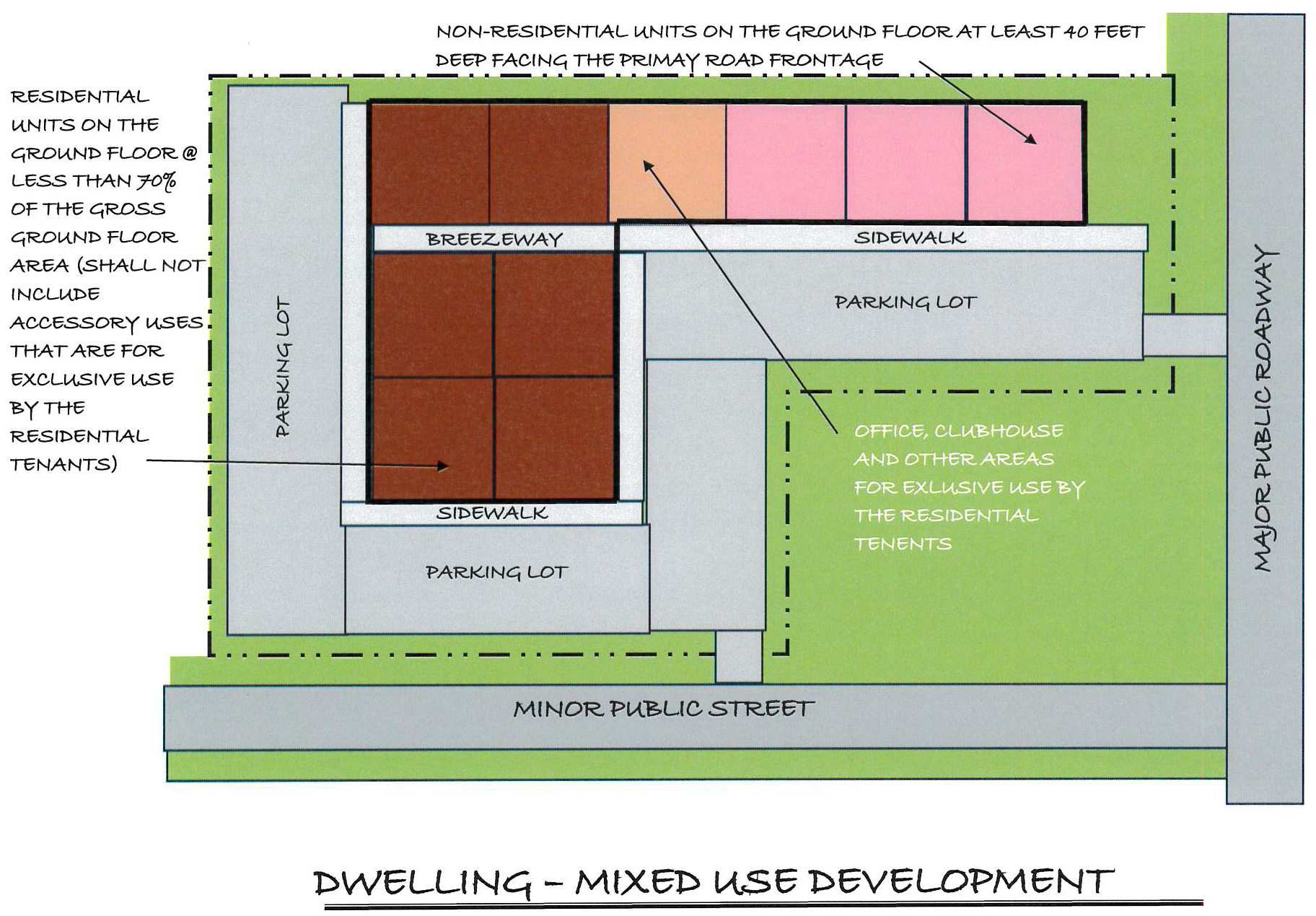
R.
Dwelling—Multi-Family or Townhouse or Single Room Occupancy
1.
Facades must be designed with consistent materials and treatments that wrap around all street-facing facades. There must be a unifying architectural theme for the entire multi-family or townhouse development, utilizing a common vocabulary of architectural forms, elements, materials, or colors in the entire structure.
2.
Building facades must include windows, projected or recessed entrances, overhangs, and other architectural features. Three-dimensional elements, such as balconies and bay windows, are encouraged to provide dimensional elements on a facade.
3.
The following minimum transparency requirements apply to any facade facing a street and are calculated on the basis of the entire area of the facade:
a.
Townhouse Dwelling: 15%
b.
Multi-Family Dwelling or Single-Room Occupancy: 25%
4.
Flat roofs must include cornices, parapets, or similar architectural details to add variety and break up the roofline.
5.
There must be a minimum separation of 15 feet between sidewalls of rowhouse buildings. Where the front or rear wall of a rowhouse faces the front or rear wall of another rowhouse, the minimum required separation between such buildings must be 30 feet. Driveways and parking areas may be located within this minimum separation area.
6.
The following building materials are prohibited on any facade. However, such materials may be used as decorative or detail elements for up to 25% of the facade, or as part of the exterior construction that is not used as a surface finish material.
a.
Plain concrete block
b.
Corrugated metal
c.
Aluminum, steel, or other metal sidings
d.
Exposed aggregate (rough finish) concrete wall panels
e.
T-111 composite plywood siding
f.
Plastic
g.
Vinyl
FIGURE 6-2: MULTI-FAMILY DWELLING DESIGN STANDARDS
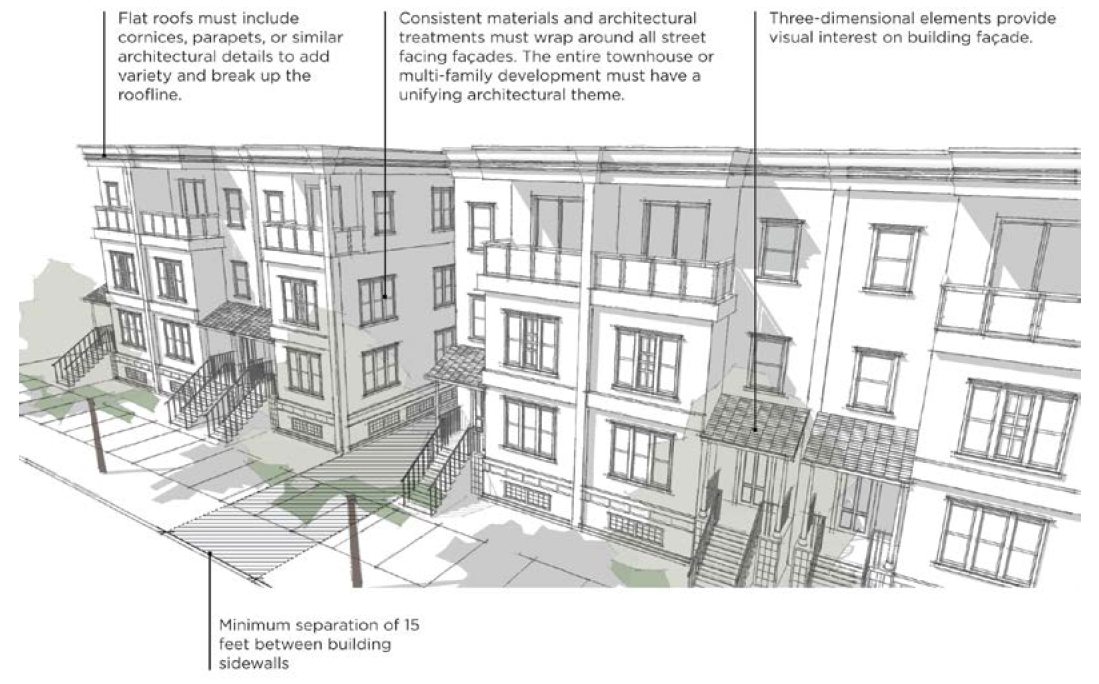
S.
Dwelling—Single-Family - Detached, Single-Family - Attached, or Two-Family
1.
A dwelling must have a primary entrance from the facade facing the street. The front entry must be a dominant feature on the front elevation of a home and an integral part of the structure, using features such as porches, raised steps and stoops with roof overhangs, or decorative railings to articulate the front facade.
2.
Windows, entrances, porches, or other architectural features are required on all street-facing facades to avoid the appearance of blank walls.
3.
A 15% minimum transparency requirement applies to any street-facing facade and is calculated on the basis of the entire area of the facade.
FIGURE 6-3: SINGLE-FAMILY DWELLING DESIGN STANDARDS
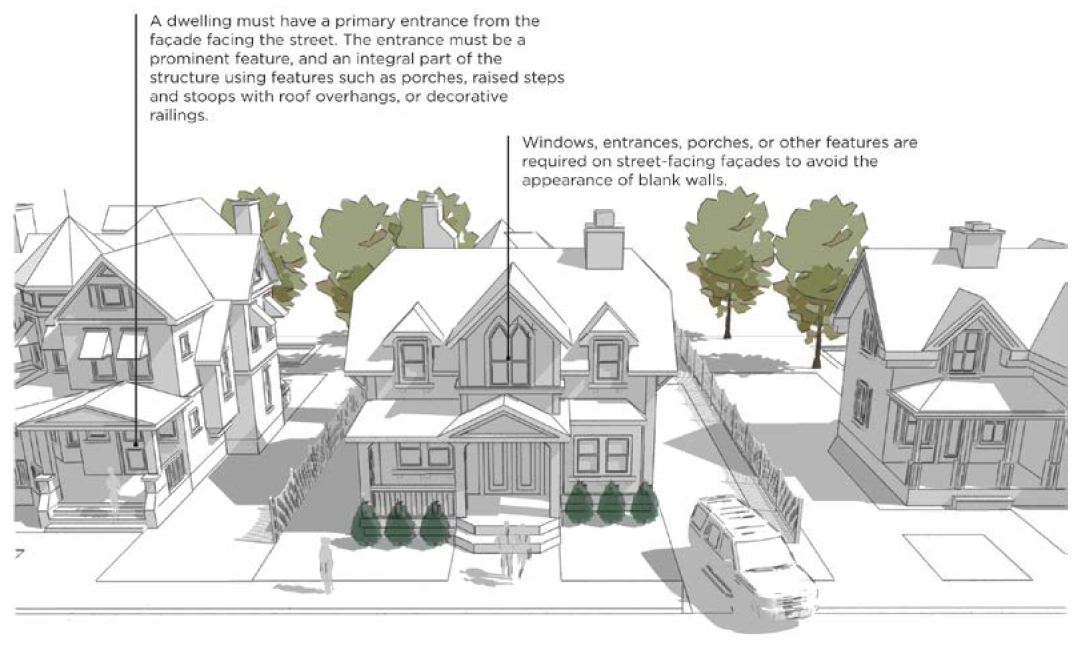
T.
Financial Institution with Drive-Through Facility
1.
Queuing and vehicle stacking spaces (spaces for cars that are waiting for drive-up or drive-through services) are required for any drive-through facility use, as provided in Section 8.8 (Queuing and Vehicle Stacking Areas).
2.
All drive-through lanes must be located and designed to ensure that they do not adversely affect traffic circulation on adjoining streets. Drive-through lanes on corner lots must not route exiting traffic into adjacent residential neighborhoods.
3.
Financial institutions with drive-through facilities must be screened along interior side and rear lot lines with a solid fence or wall, a minimum of six feet and a maximum of seven feet in height. One shrub a minimum of three feet in height at time of planting must be planted linearly every three feet on-center along such fence or wall.
a.
Screening requirements are not required along any property line which the subject property is abutting an adjacent property with the same screening requirements.
b.
The Executive Director shall have administrative authority to waive these screening requirements due to adjacent zoning or uses, lot topography, or lot configuration.
4.
A drive through lane must have bail out capability for all vehicles that enter the drive through lane. The bail out lane must be a minimum width of 10 feet in width and run parallel to the drive through lane. If a bail out lane is also an interior access drive providing access to parking spaces, the bail out lane is limited to a one-way traffic pattern following the direction of the drive through lane.
U.
Food Truck and Trailer Vendor
These regulations describe what is allowed, what is required and where a food truck and trailer vendor Is allowed to operate, with proper zoning and operations permits, within the City of Shreveport. These regulations are aimed to help foster an aesthetically appealing streetscape and help reduce potential dangerous traffic conditions, all for the promotion and protection of the public health, safety, and welfare.
1.
Food Truck and Trailer Vendor's License
a.
A food truck and trailer vendor's license shall be required to conduct business within the City of Shreveport and shall comply with all zoning and operational requirements as established by this Code, as well as all other applicable ordinances, statutes, rules and regulations of the City of Shreveport and State of Louisiana, unless exempt as follows:
i.
Food truck and trailer vendors operating on private or City-owned property under an approved special event permit such as a fair, carnival, festival, or similar transitory gathering, for which a sponsor or promoter has paid an occupational license tax or when the sponsor or promoter is exempt from the payment of an occupational license tax.
ii.
Food truck and trailer vendors operating on private or City-owned property under an approved special event permit sponsored by nonprofit organizations for any religious, charitable, patriotic, educational or philanthropic event, lasting four days or less in duration.
iii.
Food truck and trailer vendors operating on private or City-owned property under an approved special event permit held at least six times a year for any for-profit event, including but not limited to festivals, gun shows, arts and crafts fairs, antique shows, flea markets, vendor markets or other similar transitory gathering, for which the sponsor or promoter:
(1)
Has paid an occupational license tax under the requirements of the Shreveport City Code;
(2)
Owns the premises or has a lease thereof for at least one year;
(3)
Has obtained a certificate of occupancy for the premises or special event permit; and
(4)
Has provided all vendors with applications and notice of the requirement to register with the Caddo-Shreveport Sales and Use Tax Commission and to collect and remit sales tax, and has provided the Commission with the contact information of all vendors.
iv.
Sales of seasonal products such as, but not limited to, crawfish sales or portable beverage service facilities, operating at a permanent location under an approved temporary use permit.
v.
Catering of a private event with the express written consent of the property owner.
b.
The Office of the Metropolitan Planning Commission, along with the City's Revenue Division, shall develop a food truck and trailer application packet which combines land use and zoning requirements, as well as all other applicable ordinances, statutes, rules and regulations of the City, Parish and State of Louisiana as the Zoning Administrator may require.
c.
All food truck and trailer vendor's license requests shall be referred to the Caddo Parish Health Department, City's Finance Department, Police Department, Public Works Department, and/or Fire Prevention for review prior to approval, as applicable.
d.
A food truck and trailer vendor's license shall be displayed on the food truck and trailer vendor's vehicle at all times in a conspicuous place where It can be readily viewed by the general public.
e.
The food truck and trailer operator shall obtain the property owner(s), or their legal representative's, written permission to utilize the property for food truck and trailer operations prior to commencement of business and shall present a copy of such written permission upon request. An agreement must be provided for each location of operation.
f.
A food truck and trailer vendor's license is required to be renewed annually.
2.
Zoning and Location Restrictions
a.
Unless otherwise exempt from the requirements of this Article, a food truck and trailer vendor shall only operate in allowable zoning districts as indicated on the Use Matrix in Article 5 of this Code.
b.
Food truck and trailer vendors shall only be located on property where an existing, permanent business operates in a building with a certificate of occupancy.
c.
Food truck and trailer vendors may conduct business within the City's public right-of-way provided they operate per the requirements of Chapter 42 of the Shreveport City Code.
d.
A property owner can allow multiple mobile food vehicles to occupy their lot at the same time. The maximum number of food trucks per lot is limited as follows:
i.
Maximum of two food truck and trailer vendors on lots of one-half acre or less;
ii.
Maximum of three food truck and trailer vendors on between one-half acre and one acre;
iii.
Maximum of four food truck and trailer vendors on greater than one acre.
e.
Five or more food truck and trailer vendors are only allowed to operate on a single lot if:
i.
Operating under an approved food truck park and shall comply with the use requirements and restrictions for food truck parks.
ii.
Operating under an approved temporary use permit issued for a special outdoor event.
iii.
Operating under an approved special event permit such as a fair, carnival, festival, or similar transitory gathering issued by the City.
f.
Food truck and trailer vendors must be located at least 100 feet from the main entrance to any eating establishment or similar food service business, 100 feet from any outdoor dining area and 50 feet from any permitted food vending cart location, as measured from the designated location on the lot accommodating the food truck.
g.
Food truck and trailer vendors shall not conduct business on any property zoned for or occupied by a single-family or two-family residence, unless they are operating as part of:
i.
The catering of a private event;
ii.
The service to an active construction site;
iii.
A Special event on the property of a school; or
iv.
A special event for any City-recognized neighborhood/homeowner's association.
h.
Food truck and trailer vendors shall not conduct business on a vacant or abandoned lot.
3.
Operational Standards and Limitations
a.
No food and trailer vendor shall sell goods, wares, or other items of merchandise other than food or drink. Sale of alcoholic beverages is prohibited Sale of alcoholic beverages is prohibited.
b.
All food truck and trailer vendors must park on a durable all-weather material, such as concrete or asphalt.
c.
Reserved.
d.
Food truck and trailer vendors shall be secondary to an existing primary use on the property.
e.
Any food truck and trailer and its associated seating, if any, shall not occupy parking spaces required to fulfill the minimum requirements of the principal use, unless the principal use's hours of operation do not coincide with those of the food truck and trailer business. Likewise, any food truck and trailer and its associated seating, if any, shall not occupy parking spaces that may be leased to other businesses and uses to fulfill their minimum parking requirements.
f.
Any associated outdoor seating must be removed after operating hours and must not be stored, parked, or left overnight on any public street or sidewalk.
g.
Food truck and trailers must not occupy or prevent access to any handicapped accessible parking.
h.
Connection to City water services shall not be permitted unless approved by the Chief Building Official or Director of Water and Sewerage. Any unauthorized connection to the water system in conjunction with the operation of a food truck and trailer vendor in any way is strictly prohibited and is unlawful. Any such violation will be investigated and may be the cause for revoked licenses or denied license renewal.
i.
Under no circumstances can liquid waste or grease be released or disposed of in tree pits, storm drains or onto the sidewalks, streets, or other public space. If at any time evidence of the improper disposal of liquid waste or grease is discovered, the food truck and trailer vendor license will be revoked and the food truck and trailer vendor will be required to cease operation immediately. The operator of the food truck and trailer business may be issued a citation for such a violation.
j.
Food trucks and trailers shall be located at least 10 feet from the edge of any driveway or public sidewalk, handicapped ramp, building entrances and exit, emergency access/exit way, fire lane, or emergency call box and must not locate within any area of the lot that Impedes, endangers, or interferes with pedestrian or vehicular traffic.
k.
There shall be no restriction of visibility area sight distance at any driveway or intersection.
l.
Food truck and trailer vendors shall not use a hibachi, grill, or other similar device for cooking, heating, or any other similar purpose within 10 feet of any building or building overhang.
m.
Food trucks and trailers must be located a minimum distance of 15 feet in all directions of a fire hydrant and any fire department connection, utility box or vault.
n.
All food truck and trailer vendors, amenities, including but not limited to restrooms, tables, chairs and shade structures and other site improvements shall be identified on the food truck and trailer vendor's license application and shall be In accordance with this Code.
o.
The food truck and trailer vendor is responsible for the proper disposal of waste and trash associated with the operation and shall be equipped with a portable trash receptacle placed near the unit that does not impede pedestrian or vehicular traffic. City trash receptacles are not to be used for this purpose. Vendors must remove all waste and trash from their approved location at the end of each day or as needed to maintain the health and safety of the public.
p.
With the exception for the trash and any associated outdoor seating areas, all equipment required for the operation must be contained within, attached to or within five feet of the food truck and trailer and all food preparation, storage, and sales/distribution made in compliance with all applicable Parish and State Health Department sanitary regulations.
q.
Each food truck vendor must report to its designated commissary at least once a day for food, supplies, cleaning, and servicing and as required by the Caddo Parish Health Unit.
r.
A drive through is not permitted in conjunction with any food truck and trailer vendor.
s.
No signage shall be allowed other than signs permanently attached to the food tuck or trailer and one portable menu sign with a changeable face no more than six square feet in display area on the ground in the customer waiting area.
t.
All food truck and trailers must be maintained in mobile condition. No food truck and trailer may be parked or stored in such manner as to create a dangerous or unsafe condition on the lot where it is parked or stored.
u.
No food truck and trailer may be used for living, sleeping, or housekeeping purposes in any district.
v.
All food truck and trailers shall maintain compliance with the City's noise ordinance.
w.
No lighting, except localized lighting that is used on or in the food truck for the purpose of inside food preparation and menu illumination.
x.
A food truck shall be enclosed except for doors and windows, shall be constructed of high-quality materials, and shall be kept clean and in good repair
y.
Nothing provided herein shall exempt or preclude compliance with all other provisions of the Shreveport City Code, International Building Code, or other requirements (e.g. Fire Department) to protect health, safety and general welfare.
4.
Storage of Food Truck and Trailers
a.
No food truck and trailer may be stored within a residential driveway within the front or corner side yard.
b.
Food truck and trailers may be stored in a residential district either within a fully enclosed structure or within the interior side yard behind the front building line or rear yard. If stored in the interior side or rear yard, the food truck and trailer must be located at least five feet from any lot line and screened from view from any public right-of-way, excluding alleys, by a solid fence or wall. If the food truck and trailer is screened by an existing structure or landscape so that it is not visible from the public right-of-way, excluding alleys, it is considered to have met these requirements. Temporary storage tents for food truck and trailers are prohibited.
5.
Violations, Suspension/Revocation, and Enforcement
a.
The Zoning Administrator or Executive Director is authorized to revoke a food truck and trailer vendor's license, as well as issue any zoning violations to the property owner to which the food truck and trailer vendor is operating, if he or she determines that the vendor's operations are violating any of the zoning and operational requirements as established by this Code.
b.
Authorized personnel from the City's Revenue Division may revoke a food truck and trailer vendor's license if he or she determines that the vendor's operations are violating any applicable ordinances, statutes, rules and regulations of the City, Parish and State of Louisiana.
c.
Authorized personnel from the Shreveport Police Department, as well as the Shreveport Fire Department, may issue citations if he or she determines that the vendor's operations are violating any applicable ordinances, statutes, rules and regulations of the City of Shreveport and/or the State of Louisiana. Any person violating the provisions of this Section shall be issued a citation, which shall be paid in the same manner as provided for offenders of local traffic violations.
d.
Any food truck and trailer vendor's license will become void if the vendor's health permit has been suspended or revoked.
e.
The Director of Water and Sewerage, in accordance with the Shreveport City Code, is authorized to discontinue water service to any property in violation of unauthorized connection to the sewer system and/or unauthorized dumping of grease into the sanitary sewer system.
V.
Food Truck Park
A food truck park is a permitted use in all zoning districts as indicated on the Use Matrix in Article 5 of this Code and requires a special use permit. A food truck park shall require a certificate of occupancy and be subject to the following requirements:
1.
General Regulations
a.
All food truck parks shall comply with all the requirements of this Code, Chapter 10 of the Shreveport City Code, as well as all other applicable ordinances, statutes, rules and regulations of the City and State of Louisiana.
b.
At no point shall food truck park remain open for 24 hours.
c.
If a food truck park is proposed on a site that requires a new utility connection or if a permanent structure is being constructed, the property shall be on a legally platted lot pursuant to Article 17 of this Code.
d.
The commercial design standards in Article 4 of this Code shall apply to any permanent structure on the site. These standards do not apply to any individual food truck and trailer vendor.
e.
All food truck and trailer vendors shall be removed from any food truck park upon closing of the park. If a commissary is provided on-site and a food truck and trailer vendor is approved to use the site's commissary, then that food truck and trailer vendor will not have to be removed from the site each day.
f.
The property owner, or his/her designated manager, of the food truck park shall be responsible for the orderly organization of all food truck and trailer vendors, the cleanliness of the park, and the park's compliance with all rules and regulations.
g.
A food truck and trailer license is required for a food truck and trailer vendor operating in a food truck park.
2.
Food Truck Park Dimensional Standards
a.
The number of food truck and trailer vendor spaces allowed at the food truck park shall be calculated at one vendor space per 1,000 square feet of lot space. The minimum number of vendor spaces shall be two. The maximum number of vendor spaces allowed on any site shall be limited to 10, except that a request may be made to the Executive Director to approve an alternative number of vendors spaces. Vendor spaces do not need to be occupied at all times, but they must be shown and designed during the site plan process.
b.
Only one food truck and trailer vendor is permitted to occupy each vendor space at the food truck park.
c.
No food truck and trailer vendor, permanent structures, or seating areas shall be located within the required building setbacks of the applicable zoning district.
d.
There shall be a minimum of 10 feet of separation between each individual food truck and trailer vendor, and a minimum of 20 feet of separation between any food truck and trailer and a permanent on-site structure.
e.
A food truck and trailer vendor shall remain outside of a required fire lane, be located a minimum of three feet from any fire hydrant and shall not block access to a Fire Department Connection (FDC).
f.
No vehicle drive-through services shall be permitted within a food truck park.
g.
During hours of operation, each food truck and trailer vendor shall be responsible for providing a trash receptacle for use by customers and shall ensure the area is kept clear of litter and debris at all times. A common dumpster may be provided within the food truck park if the dumpster is screened in accordance with the screening requirements found in Article 7 of this Code.
h.
Any food truck park may establish or utilize a permanent structure for indoor seating, entertainment venue, or similar purposes provided the structures comply with all applicable requirements, including but not limited to building and fire department requirements.
3.
Required Site Plan
a.
A detailed site plan shall be required for the approval of any food truck park. At a minimum, the site plan must show the location of, and detail, the following items:
i.
Each food truck and trailer vendor space with appropriate separation distances;
ii.
Outdoor grills, fryers, and smoker pad sites;
iii.
Utility connections, including electric, gas, water, and sewer;
iv.
On-site lighting;
v.
Activity areas, including playground, movie screen, stage or similar areas;
vi.
Restrooms and hand washing facilities;
vii.
Designated customer seating areas;
viii.
ADA access to parking, vendors, and restrooms;
ix.
Proposed parking areas including on-site and off-site spaces;
x.
Fire lanes and fire truck routes;
xi.
Dumpsters and service vehicle access for waste removal, moving vendor trailers, etc.
b.
Access to a food truck park shall be through a single, all weather surface driveway directly connected to a public street, with a maximum driveway width of 35 feet. Where on-site parking is proposed near a driveway, a minimum throat distance of 50 feet shall be provided unless otherwise reduced by the City Traffic Engineer.
c.
All food truck and trailer vendors shall not be parked on unimproved surfaces and at a minimum be parked on compacted gravel base.
d.
Any outdoor fryer, grill, and smoker that is proposed to be placed outside a food truck and trailer vendor shall be placed on an approved all-weather material, such as concrete or asphalt, and identified on the site plan.
e.
Venues for live music, art performances, movies or similar activities shall be subject to the provisions provided herein, with the proposed location identified on the site plan.
f.
In order to improve safety, individual electrical generators shall be prohibited. All electrical services necessary to serve a food truck and trailer vendor or food truck park shall be provided through permanent on-site connections. Aerial electrical line extensions shall be prohibited.
g.
Individual electric service outlets with connection boxes shall be installed at each space through approved underground utility line extensions, unless approved by the Executive Director.
h.
Customer seating shall be provided at a minimum rate of four seats per individual vendor, and may be grouped within the food truck park. Seating areas may be located within a permanent building or under a shade structure, provided said building or structure meets all minimum building and fire code requirements. Where outdoor seating is proposed, the surface shall consist of turf grass, crushed granite, pavement, mulch, or other improved surface.
i.
All food truck parks shall be in compliance with all other provisions of this Code, International Building Code, or other requirements (e.g. Fire Department, Health Department) to protect health, safety and general welfare.
4.
Lighting
On-site lighting shall be provided within a food truck park and shall be in accordance with exterior lighting standards found in Article 7, with exception that string lights shall be permitted throughout a food truck park when a colored or warm white light is utilized. String lights shall adhere to the UL standards and shall not be placed in a manner which would establish a safety issue.
5.
Parking
a.
The required number of off-street parking spaces shall be calculated at a rate of two parking spaces per food truck and trailer vendor, provided however that an alternate parking plan may be completed and approved by the Executive Director.
b.
If the site plan identifies available space on-site for employees and/or towing vehicles to park, then the Executive Director may approve a reduced number of required parking spaces.
6.
Signage
a.
One monument sign shall be permitted for the entrance to the food truck park. The sign shall comply with all applicable sign requirements found in Article 9.
b.
Each food truck and trailer vendor within a food truck park may have signs mounted to their vehicle and/or trailer.
c.
Each food truck and trailer vendor within a food truck park may have one "A-frame" sign, not to exceed three feet in height, immediately adjacent to their vehicle for the purpose of displaying a menu or special advertisement.
d.
If the food truck park is located within any special zoning district, additional standards may apply pursuant to the requirements of that zoning district.
7.
Restroom Facilities
a.
Each food truck park shall provide facilities to accommodate for a minimum of two restrooms. Temporary portable restroom facilities may be considered as part of the special use approval.
b.
The restroom facilities should be equipped with hand washing facilities, or at a minimum, hand sanitation stations shall be provided near the restroom facility and throughout the food truck park.
8.
Venues
a.
Playgrounds, movie areas, stages for musical or art performances, or similar are encouraged within a food truck park. Said areas shall be oriented away from neighboring uses to reduce noise and light, and potential nuisance.
b.
Any food truck park shall comply with Chapter 58 Nuisances of the Shreveport City Code.
9.
Landscaping
a.
All food truck parks shall meet the landscaping requirements of Article 10 of this Code.
b.
Food truck parks adjacent to single-family or multi-family zoned property, shall provide a landscape buffer per the requirements of Article 10 of this Code.
c.
Park owners are encouraged to provide for an aesthetically-pleasing environment within the park, which includes shade and seating elements in addition to pervious groundcover.
d.
The Executive Director may allow for alternative compliance as it pertains to landscaping requirements.
W.
Gas Station
1.
All structures and all pump islands, compressed air connections, and similar equipment must be set back a minimum of 20 feet from interior side and rear lot lines. Structures are exempt from any build-to lines required by the district.
2.
The minimum distance between the canopy and the curb line must be 10 feet, and 15 feet from any interior side lot line.
3.
Motor vehicle repair is permitted as part of a gas station use. However, repair work is limited only to minor repair work, such as tire or tube repairing, battery changing, lubrication, engine tune-ups, brake and muffler repair or replacement, and similar types of work. Minor repair work does not include replacement of engines, replacement of transmissions, or any body work.
4.
Repair of vehicles must not take place within the building front or side yard portions of the property. Storage of all merchandise, auto parts, and supplies must be within an enclosed structure. All outdoor repairs are only allowed in the rear yard and must be screened by a solid fence or masonry wall no less than six feet and no more than eight feet in height. Any vehicles awaiting repair must be stored so that no fluids will drain into the storm sewer system, such as the use of drip pans and other coverings.
5.
The ancillary uses of a retail goods establishment and one car wash bay are permitted in connection with the principal gas station use.
X.
Liquor Sales
1.
All liquor sales, as defined in this Code, must comply with the requirements of this Code, Chapter 10 of the Shreveport Code of Ordinances, as well as all other applicable ordinances, statutes, rules and regulations of the City and State of Louisiana. Note: Liquor sales, as defined in this Code, may be subject to State law public habitable floor area square footage requirements.
State law reference—La. R.S. 26:271.3.
2.
In addition to site plan requirements, the following elements of operation will be considered:
a.
The size, location, and configuration of the establishment.
b.
Days and hours of operation.
c.
A security plan.
d.
Exterior lighting design.
3.
Any establishment with liquor sales must be located no closer than 200 feet from any residential zoning district, as measured from a point of the lot line on which such use is proposed to be located to the nearest point on the lot line from any residential zoning district.
4.
Any establishment with liquor sales must be located no closer than 1,000 feet from any other existing establishment with liquor sales, as measured from a point of the lot line on which such use is proposed to be located to the nearest point on the lot line on which any other of the same use is located.
5.
Liquor sales cannot be part of any ordinance relief request that is associated with any Planned Unit Development (PUD) or Conditional Zoning District (CZD) application.
6.
Liquor sales that are an accessory use to another principal use such as a retail goods establishment will be treated as a principal use for the purposes of this Code and shall comply with the use matrix for allowable district locations for liquor sales. Liquor sales as an accessory use shall also comply with all the use standards for liquor sales as described in this Section.
7.
A variance shall not be requested and granted to provide relief to any distance requirement for liquor sales by this subsection.
8.
Reserved.
9.
No more than two liquor sales establishments shall be located within a one square mile area of an approved liquor sale location, as measured from the property boundary of the approved location. Any more than two establishments located within the one square mile area will be strictly prohibited. A location will be considered included in the count if any portion of the property boundary of an existing use or proposed use encroaches into the above described one square mile area.
Y.
Group Home, Halfway House, Shelter Housing, and Social Services Center
1.
Such uses are subject to all local and federal regulations, and the regulations of the Louisiana Administrative Code.
2.
Group homes, halfway houses, and shelter housing must be located no closer than 1,000 feet from any other existing group home, halfway house, or shelter housing, as measured from the nearest point of the lot line on which such use is proposed to be located to the nearest point on the lot line on which any other of the same use is located. Any existing group homes, halfway houses, or shelter housing as of the effective date of this Code that do not meet the spacing requirement are deemed conforming. Such deemed conforming status is terminated when the group home, halfway house, or shelter housing ceases to operate or when any required licenses are revoked or not renewed. A group home, halfway house, or shelter housing is not considered to cease operations when it is closed for renovations in conjunction with a lawfully issued building permit.
3.
When a group home or halfway house is located within an existing residential structure, the location, design, and operation of such facility must not alter the residential character of the structure.
4.
Social service centers must be located no closer than 1,000 feet from any other existing social service center, as measured from the nearest point of the lot line on which such use is proposed to be located to the nearest point on the lot line on which any other of the same use is located. This includes residential facilities that provide the services of a social service center for non-residents. Any social service centers as of the effective date of this Code that do not meet the spacing requirement are deemed conforming. Such deemed conforming status is terminated when the social service center ceases to operate or when any required licenses are revoked or not renewed. A social service center is not considered to cease operations when it is closed for renovations in conjunction with a lawfully issued building permit.
Z.
Live Entertainment—Ancillary Use, Live Performance Venue, or Nightclub
Live entertainment - ancillary use, live performance venue, or nightclub requires site plan review by the Metropolitan Planning Commission. Where special use approval is required, the site plan review will be conducted concurrently.
1.
Live entertainment - ancillary use is considered a separate principal use. Live entertainment - ancillary use may only be established when allowed as a use within a zoning district and in conjunction with another principal use such as a bar, restaurant, amusement facility, or arts studio.
2.
In addition to site plan requirements, the following elements of operation will be considered:
a.
The size of the establishment and the size, location, and configuration of the live entertainment area within the establishment.
b.
Days and hours of operation of the nightclub.
c.
For live entertainment - ancillary use, the days and hours of operation for the establishment's general operations as a principal use, and the anticipated days and hours of operation for the live entertainment component.
d.
Maximum occupancy loads.
e.
A noise abatement plan that describes the soundproofing measures to be undertaken.
f.
A security plan.
g.
For live performance venues, all loading areas.
3.
If the live entertainment - ancillary use, live performance venue, or nightclub plans an increase in intensity, such as an expansion of floor area or increase in permitted occupancy, the site plan and its additional elements, as required by this section, must be updated and resubmitted for approval. Revised plans must be approved prior to the issuance of any building permit.
AA.
Lodge/Meeting Hall
1.
No more than 30% of the gross floor area may be used as office space for the lodge/meeting hall.
2.
Lodges/meeting halls are permitted to serve meals and alcohol on the premises for members and their guests only.
3.
Sleeping facilities are prohibited.
4.
Lodges/meeting halls leased or used as reception halls must comply with the requirements for reception halls.
BB.
Neighborhood Commercial Establishment
1.
Neighborhood commercial establishments are only allowed within existing structures that are non-residential in their construction and/or use as of the effective date of this Code.
2.
The following non-residential uses are permitted within a neighborhood commercial establishment:
a.
Art gallery.
b.
Arts studio.
c.
Office.
d.
Personal services establishment.
e.
Restaurant.
f.
Retail goods establishment. As a condition of approval, retail sales of alcohol may or may not be allowed.
3.
No off-street parking is required. However, any off-street parking currently provided must be maintained.
4.
Drive-through facilities are prohibited.
5.
Outside storage or display is prohibited. All business, servicing, processing, and storage uses must be located within the structure.
6.
Signs are limited to those allowed in the C-1 District.
CC.
Outdoor Dining
1.
Outdoor dining is considered a separate principal use. Outdoor dining may only be established when allowed as a use within a zoning district and in conjunction with another principal use such as a bar or restaurant.
2.
Outdoor dining must not interfere with any pedestrian access or parking spaces and aisles.
3.
Outdoor dining areas must be located on private property unless otherwise by a right-of-way encroachment permit to be located in the right-of-way. The seating areas located in the right-of-way may be required to be delineated through paint or structures to prevent unauthorized encroachments.
4.
An outdoor dining area for an establishment must be as continuous as possible by locating the outdoor dining area in a single portion of an establishment's frontage.
5.
When a structure is required to be constructed at a build-to line, the structure may have up to 50% or 60 linear feet of the front facade, whichever is less, designated as outdoor dining within a maximum setback of 25 feet from the required build-to line.
DD.
Overnight Truck Parking (Principal Use)
1.
Right-of-way landscaping, landscape buffer (including required fencing) and parking lot edge landscaping shall be required as outlined in this Code as applicable. Interior parking lot landscaping is not required for this use.
2.
In addition to the right-of way landscaping, one shrub a minimum of three feet in height must be planted linearly every three feet on-center along the right-of-way.
3.
Any vehicles stored on-site must be stored so that no fluids will drain into the storm sewer system.
4.
The Executive Director shall have administrative authority to waive these screening requirements due to adjacent zoning or uses, lot topography, or lot configuration.
EE.
Parking Lot and Parking Structure (Principal Use)
All parking structures and parking lots are subject to the parking design standards of this Code and the following standards:
1.
Parking Structure
a.
On portions of the ground floor facade along public streets where parking spaces are visible, a decorative fence and landscape or a kneewall is required to screen parking spaces. Such fence or kneewall must be a minimum of four feet in height.
b.
For parking structures with rooftop open-air parking, a five foot parapet wall is required for screening of parked vehicles.
c.
Where parking structures front on public streets, facade design and screening must mask the interior circulation ramps and create the illusion of horizontality along the street.
d.
Parking structures must be designed to minimize blank facades through architectural detailing and landscape.
e.
Parking structures in the D-1-CBD Sub-District must include non-residential uses along 50% of the ground floor, excluding required access areas from the calculation, when adjacent to a public right-of-way.
FIGURE 6-4: PARKING STRUCTURE
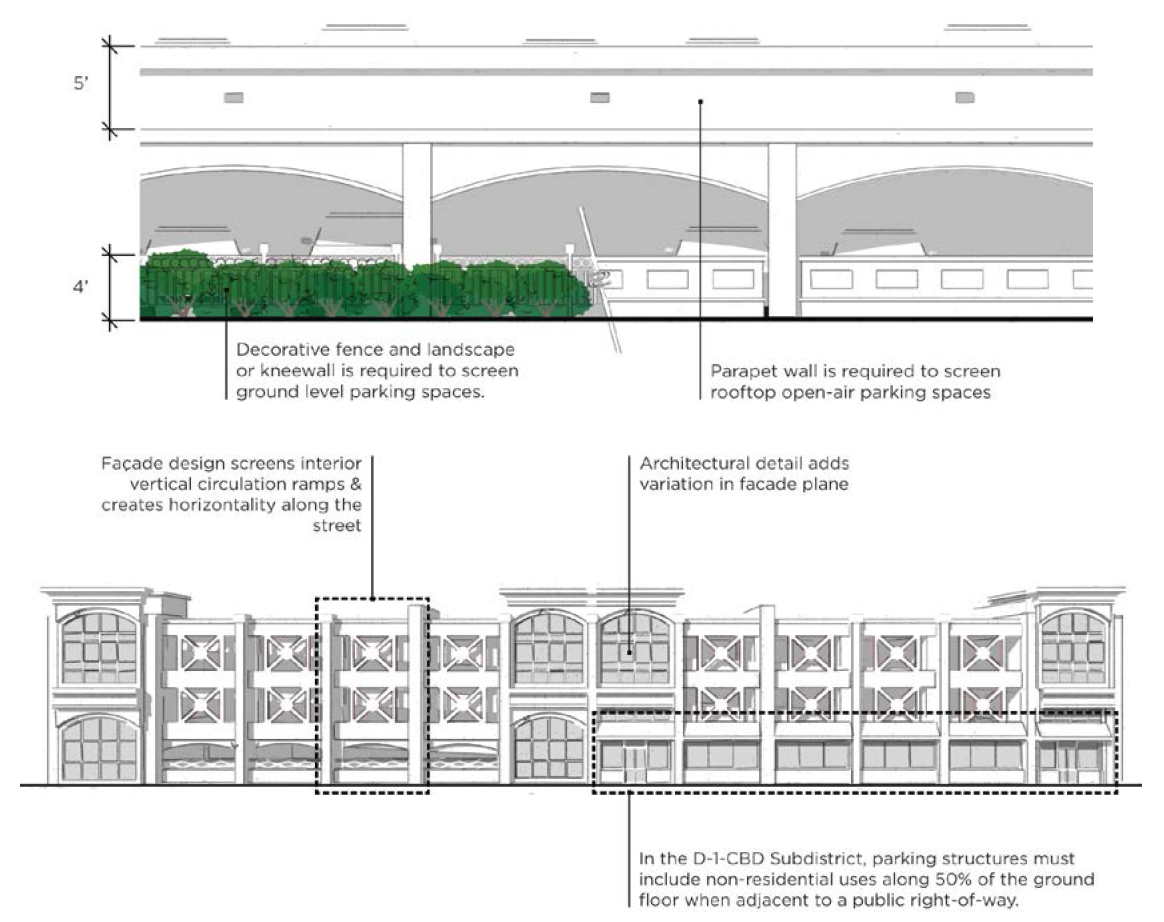
2.
Parking Lot
a.
A parking lot must be used solely for the temporary parking of motor vehicles and cannot be used as an off-street loading area.
b.
Only structures for the shelter of attendants or for payment kiosks are permitted in a parking lot. Shelters or kiosks must not exceed ten feet in height and 50 square feet in area.
c.
The parking lots must be screened and landscaped in accordance with the requirements of this Code.
d.
Parking lots must be designed to provide designated walkways for pedestrians. Walkways must connect building entrances with parking areas and with public sidewalks along adjacent streets.
FF.
PayDay/Title Loan Agency
1.
Payday/title loan agencies must be located no closer than 2,000 feet from any other existing payday/title loan agencies, as measured from the nearest point of the lot line on which any payday/title loan agency use is proposed to be located to the nearest point on the lot line on which any other existing similar use is located.
2.
Payday/title loan agencies must be located no closer than 1,000 feet from any church or religious institution, school (public or private), playground or recreational facility, residential zoned lot, multi-family apartment complex, condominium, or other similar use, as measured from the nearest point of the lot line on which any payday/title loan agency use is proposed to the nearest point on the lot line from any of the aforementioned uses.
3.
Any existing payday/title loan agency as of the effective date of this Code that does not meet the spacing requirement is deemed conforming; this applies only to payday/title loan agencies that are allowed as a permitted or special use within the district. If a payday/title loan agency is no longer allowed within a district as of the effective date of this Code, it is a nonconforming use.
4.
Payday/title loan agencies must be situated only within a freestanding building and must not be co-located in the same structure as other uses.
5.
Drive-through facilities for payday/title loan agencies, or other similar use, are prohibited.
6.
Payday/title loan agencies' hours of operation shall be between the hours of 7:00 a.m.—7:00 p.m. on any day of the week unless otherwise specified as part of the special use approval.
GG.
Reception Facility
1.
A general admission fee or any other monetary donations (payment at the door to the general public) for entrance is prohibited, with the exception of fundraisers or events for bona fide non-profit organizations, places of worship, or educational facilities.
2.
All main activities, such as dining and entertainment, must be held within a completely enclosed building.
3.
Outdoor seating areas are permitted for the use of guests. If a reception facility conducts main activities outdoors, special use approval is required for the outdoor component of the facility.
HH.
Residential Care Facility
1.
Residential care facilities are subject to all local and federal regulations, and the regulations of the Louisiana Administrative Code.
2.
When located in a non-residential district, the structure must be designed with a lobby entrance along the primary frontage.
3.
Residential care facilities must meet the design standards for multi-family dwellings.
II.
Restaurant
All restaurants must comply with the requirements of this Code, Chapter 10 of the Shreveport Code of Ordinances, as well as all other applicable ordinances, statutes, rules and regulations of the City and State of Louisiana. Note: Restaurants may be subject to State law public habitable floor area square footage requirements.
State law reference—La. R.S. 26:73 and La. R.S. 26:272.
JJ.
Retail Sales of Alcohol—Beer and Wine
1.
All retail sales of alcohol—beer and wine establishments, as defined in this Code, must comply with the requirements of this Code, Chapter 10 of the Shreveport Code of Ordinances, as well as all other applicable ordinances, statutes, rules and regulations of the City and State of Louisiana. Note: Retail sales of alcohol—beer and wine establishments, as defined in this Code, may be subject to State law public habitable floor area square footage requirements.
State law reference—La. R.S. 26:271.3.
2.
In addition to site plan requirements, the following elements of operation will be considered:
a.
The size, location, and configuration of the establishment.
b.
Days and hours of operation.
c.
A security plan.
d.
Exterior lighting design.
e.
Compatibility with residentially zoned property near the proposed location.
f.
Proximity to other establishments that sell package alcohol.
KK.
Salvage Yard and Storage Yard—Outdoor and Contractor Office
1.
The storage area must be completely enclosed along all lot lines by a solid fence or wall a minimum of six feet and a maximum of eight feet in height, including ingress and egress. Fences or walls along the front or corner side lot line must be set back a minimum of ten feet. Within that setback, one shrub a minimum of three feet in height must be planted linearly every three feet on-center along such fence or wall.
2.
Storage of any kind is prohibited outside the fence or wall.
3.
No items stored within 25 feet of the fence may exceed the height of the fence or wall for an outdoor storage yard. No items stored within 50 feet of the fence may exceed the height of the fence or wall for a salvage yard.
4.
Outdoor storage areas must be surfaced and graded to drain all surface water.
5.
Any vehicles stored on-site must be stored so that no fluids will drain into the storm sewer system.
6.
All requirements of the Water and Sewer Codes of the Shreveport/Caddo Health Unit must be met if discharging into the storm sewer system.
7.
The Executive Director shall have administrative authority to waive these screening requirements due to adjacent zoning or uses, lot topography, or lot configuration.
LL.
Self-Service Ice Vending Unit
1.
Only one self-service ice vending unit is permitted per parcel.
2.
Self-service ice vending units are permitted per Table 5-1: Use Matrix of this Code.
3.
No self-service ice vending units shall be closer than 100 feet to any property zoned or used for residential purposes.
4.
A self-service ice vending unit is approved separately as a principal use or in conjunction with other principal uses of the land on which it is located.
5.
Self-service ice vending units may be physically attached to the structure housing the primary use on the subject property or as a stand-alone primary structure. If located in front of a primary structure, the ice vending machine must meet the setback requirements of the district in which it is located.
6.
Ingress and egress to the unit shall not impede traffic circulation or fire or pedestrian access.
7.
At least two dedicated parking spaces shall be provided, one of which shall be a handicap accessible space.
8.
One drive through lane with room to allow stacking of two cars or a vehicle with a trailer, shall be required for the self-service ice vending unit
9.
Dispensing areas of the ice machine unit will be covered by metal awnings extending a maximum of four feet from the wall of the structure. Awnings shall have a minimum of nine feet clearance from the ground.
10.
Any mechanical/condensing units associated with the ice vending machine shall be located on the roof of the unit and hidden by a parapet wall. Parapet wall(s) will be of the same material and color of the structure and be a continuation of the vertical wall.
11.
Exterior lighting shall be located under the awnings.
12.
Signage shall be limited to wall areas located under the awning(s) at the dispensing areas. Signage shall not be internally lit, electronic changeable copy, and/or neon. Freestanding, temporary or portable signs are prohibited.
13.
The applicant shall comply with signage requirements found in Article 9 of this Code.
14.
The lot shall include a 15-foot landscape buffer around the automated ice vending machine excluding ingress and egress.
15.
Two shade trees shall be provided for each unit. Trees are to have an automated underground irrigation system.
16.
Bollards shall be placed to prevent a vehicle from damaging the ice machine unit or awnings. They shall be limited to one per each corner for a maximum of four bollards per unit.
17.
The applicant must meet all applicable Federal, State, Parish and City requirements.
18.
No self-service ice vending unit shall be constructed or operated prior to final site plan approval by the Executive Director.
19.
The Zoning Administrator shall not issue a certificate of occupancy until inspection confirms that all requirements have been met.
20.
The self-service ice vending unit shall be maintained by the owner/operator of the unit.
21.
All equipment and appurtenances shall be removed within 30 days of the closure or ceasing of operation of any automated ice vending machine.
MM.
Self-Storage Facility: Outdoor and Climate-Controlled
1.
Storage units cannot be used for residential occupancy, sales, service, repair, or any other commercial business venture at this facility.
2.
No plumbing connections are permitted in self-storage units.
3.
The following additional standards apply to self-storage facilities: climate controlled:
a.
All self-storage activities must be contained within a single building and conducted exclusively indoors. Individual storage units may be accessed from inside the building only.
b.
No individual storage space may be larger than 600 square feet.
c.
Outdoor storage is not permitted.
d.
Storing hazardous or toxic materials is prohibited.
e.
All facilities must meet the design standards of the district.
f.
Within the commercial and downtown districts, any facade that abuts a public right-of-way must include non-residential uses on the ground floor, such as retail, restaurant, or office uses, which may include offices for the facility and the common entry to access the storage units.
g.
Within the commercial and downtown districts, no storage units located on the first floor may be located within the first 50 feet of the front facade. No storage units located on the first floor may be visible from any public right-of-way.
h.
Access to loading areas must be located to the interior side or rear of the building.
i.
Climate-controlled self-storage facilities must provide 24-hour security or camera surveillance.
NN.
Sexually-Oriented Business
1.
All sexually-oriented businesses with the City of Shreveport must comply with the regulations of Chapter 72 of the Shreveport Code of Ordinances.
2.
All sexually-oriented businesses must be located a minimum of 1,000 feet from any residential district, day care center, educational facility, place of worship, public park, or cultural facility, as measured from the nearest point of the lot line on which any sexually-oriented business use is proposed to be located to the nearest point on the lot line on which any residential district, day care center, educational facility, place of worship, public park, or cultural facility is located.
3.
A sexually-oriented business must be located a minimum of 1,000 feet from any other sexually-oriented business, as measured from the nearest point of the lot line on which any sexually-oriented business is proposed to be located to the nearest point on the lot line on which any other sexually-oriented business is located.
4.
No sexually-oriented business may be maintained or operated in any manner that causes, creates, or allows public viewing of any adult material, or any entertainment depicting, describing, or relating to specified sexual activities or specified anatomical areas, from any public or private right-of-way or any property.
OO.
Short-Term Rental Property
All short-term rental properties are subject to the requirements of this Code. Defined in Article 23.
PP.
Solar Farm
1.
Systems, equipment, and structures are limited to the maximum height of the district.
2.
All solar farm structures must meet the district setbacks.
3.
No grid tied photovoltaic system must be installed until evidence has provided that the owner has been approved by the utility company to install the system.
4.
The facility owner and operator must, at their sole expense, complete decommissioning of the solar farm within one year after the end of the useful life of the solar farm. The solar farm is deemed to be at the end of its useful life if it is abandoned for a period for 180 days or more.
QQ.
Utilities
All electric transmission and distribution lines, wires, poles, lighting, along with any and all related facilities, in any way necessary for service by an electric public utility subject to the jurisdiction of the Louisiana Public Service Commission, shall be exempt from all of the limitations and requirements of this Code, except for requirements included in this section.
1.
All new utility facilities, including maintenance and service operations, unless otherwise stated in the section, must be screened from view from adjacent residential areas and public rights-of-way with a solid fence or wall with a minimum of six feet and a maximum of eight feet in height. One shrub, measuring a minimum of 18 inches in height at planting and reaching a minimum of three feet in height at maturity, must be planted for every three linear feet of fence length, spaced linearly.
2.
As the effective date of this Code, all electric substation facilities will be subject to such screening requirements as determined on a case-by-case basis through the special-use permitting process that complies with the National Electric Safety Code and electric utility provider's substation design standards.
3.
All structures for new substations are required to meet the setback regulations as required by the district regulations.
4.
Existing electric transmission facilities are deemed conforming as of the effective date of this Code and may continue to operate, be maintained or receive equipment upgrades and will not be required to conform to the new Code standards. Only new electric substations would be required to meet the screening requirements.
RR.
Vehicle Dealership—With Outdoor Storage/Display
1.
All vehicle dealership—with outdoor storage/display uses shall only operate in allowable zoning districts as indicated on the Use Matrix in Article 5 of this Code. Any vehicle dealership—with outdoor storage/display use located within 200 feet of a residentially zoned district shall require a special use permit approved by the Metropolitan Planning Commission.
2.
No outdoor storage/display is permitted in any public right-of-way or located so that it obstructs pedestrian or vehicular traffic. Outdoor storage/display is prohibited in a required setback.
3.
All manufacturing, assembly, repair, or work activity must take place inside an enclosed building.
4.
No required parking area may be used for outdoor storage or display.
5.
All outdoor storage must comply with all regulations regarding stormwater management and, if required, must be permitted through the LADEQ.
SS.
Vehicle Repair/Service—Major or Minor
1.
Vehicle repair/service establishments may not store the same vehicles outdoors on the site for longer than ten days once repair is complete. Only vehicles that have been or are being serviced may be stored outdoors.
2.
Repair of vehicles shall not take place within the building front or side yard portions of the property. Storage of all merchandise, auto parts, and supplies must be within an enclosed structure. Any vehicles awaiting repair must be stored so that no fluids will drain into the storm sewer system, such as the use of drip pans and other coverings.
3.
Vehicle repair/service establishments that abut a residential district must be screened along interior side and rear lot lines with a solid wall or fence, a minimum of six feet and a maximum of seven feet in height. Any outdoor repairs would only be allowed in the rear yard and must be screened by a solid fence or masonry wall no less than six feet and no more than eight feet in height.
4.
No partially dismantled, wrecked, junked, or discarded vehicles, or vehicles that sit on one or more flat tires or are inoperable in any manner may be stored outdoors on the premises. This standard does not apply to vehicles under repair.
5.
The sale of new vehicles is prohibited. The selling of used vehicles is allowed provided the establishment is located within a zoning district that permits the selling of used cars.
6.
No motor vehicles may be stored and no repair work may be conducted in the public right-of-way.
TT.
Wind Energy System
1.
The design of the wind energy system must conform to applicable industry standards as such standards exist as of the date construction is commenced. The facility owner or operator must submit certificates of design compliance obtained by the equipment manufacturers from Underwriters Laboratories, Det Norske Veritas, Germanishcer Lloyd Wind Energies, or similar certifying organizations.
2.
All wind turbines must be newly manufactured as of the date of installation. Experimental/prototype wind turbines may be approved as a special use.
3.
All wind energy system must be equipped with a redundant braking system. This includes both aerodynamic over speed controls (including variable pitch, tip, and other similar systems) and mechanical brakes. Mechanical brakes must be operated in a fail-safe mode. Stall regulation is not considered a sufficient braking system for over speed protection.
4.
All electrical components of the wind energy system must conform to applicable local, state, and national codes, and applicable international standards.
5.
An engineer's certificate must be completed by a structural engineer, licensed in the State of Louisiana, certifying that the tower and foundation of the wind turbines are compatible with, and are appropriate for, the particular model of wind turbine used, and that the specific soils at the site can support the wind turbine.
6.
Wind turbines must comply with the following design standards:
a.
Wind turbines must be a non-obtrusive and non-reflective color. The facility owner or operator must maintain the paint on wind turbines at all times in good repair.
b.
Wind turbines must not display advertising, except for reasonable identification of the turbine manufacturer, or the facility owner and operator.
c.
Within the wind energy system, wind turbines must be of a generally consistent size, design, and color, of similar height and rotor diameter, and rotate in the same direction.
d.
Wind turbines must not be artificially lit, except to the extent required by the Federal Aviation Administration or other applicable regulatory authorities.
e.
On-site transmission and power lines between wind turbines must, to the maximum extent practicable, be placed underground, reach the property line, and be located and constructed in such a way as to minimize disruption to the property's primary purpose as well as to facilitate the interconnection of other commercial wind power generating facilities.
f.
Non-essential appurtenances are prohibited to be affixed to any wind turbine, including, but not limited to, cellular or radio antennae.
g.
A clearly visible warning sign advising persons of the presence of high voltage levels must be placed at the base of all pad-mounted transformers and substations.
7.
The applicant must commission and submit at the time of permit application a wildlife assessment (impact study), conducted by a qualified wildlife expert having no less than ten years of experience conducting wildlife assessments, indicating possible risks to local wildlife, habitat, and migratory birds. Additionally, the applicant's wildlife expert must also develop a mitigation plan, if applicable, that addresses/mitigates any risk to wildlife, migratory birds, and affiliated habitat. All wind turbines at time of application must be located out of bird and bat migration pathways/corridors where wind turbine construction would pose a substantial risk.
8.
Wind turbines must not be climbable up to a height of at least 15 feet above ground surface. All access doors to wind turbines and electrical equipment must be locked or fenced, as appropriate, to prevent entry by non-authorized persons.
9.
Wind turbines must be set back from all structures on a participating property owner's property a distance of no less than the turbine height. The setback distance is measured from the nearest point on the outside edge of a tower to the nearest point on the foundation of the occupied building.
10.
All wind turbines must be set back from the nearest property line a distance of not less than the normal setback requirements for that zoning district or 110% of the turbine height, whichever is greater. The setback distance is measured from the property line to the nearest point on the outside edge of a tower. Operation and maintenance building(s) and substations must be located in accordance with zoning district yard requirements. All wind farm structures, except for wind turbines, must comply with the regulations of the zoning district.
11.
All wind turbines must be set back from the nearest public right-of-way a distance of 110% of the turbine height, as measured from the right-of-way line to the nearest point on the outside edge of a tower.
12.
The facility owner or operator must comply with all applicable Codes, as well as Codes regulating sound generation. In the event that any sound levels from a wind turbine are found to be in excess of permissible levels, the facility owner or operator must take necessary measures to bring sound levels down to an acceptable level.
13.
A wind turbine's shadow flicker must not fall on any window of an existing structure or within the buildable area of an adjacent lot as defined by current setback requirements.
14.
The facility owner and operator must, at their sole expense, complete decommissioning of the wind energy system, or individual wind turbines, within one year after the end of the useful life of the wind energy system or individual wind turbines. The wind energy system or turbine must be deemed to be at the end of its useful life if it is abandoned for a period of time in excess of 180 days. Decommissioning includes removal of wind turbines, structures, roads and foundations to a depth of 48 inches, and any other element constructed by facility owner or operator for the purpose of maintaining or operating the wind energy system.
(Ord. No. 76, 2017, §§ 11—13, 9-12-17; Ord. No. 103, 2017, § 4, 10-10-17; Ord. No. 19, 2018, § 27, 3-13-18; Ord. No. 62, 2018, §§ 7—9, 8-14-18; Ord. No. 72, 2018, § 9, 8-28-18; Ord. No. 6, 2019, §§ 14—19, 2-12-19; Ord. No. 66, 2019, §§ 11, 12, 6-11-19; Ord. No. 99, 2019, §§ 4, 5, 8-27-19; Ord. No. 130, 2019, § 5, 10-8-19; Ord. No. 187, 2019, §§ 9, 10, 12-10-19; Ord. No. 191, 2019, §§ 10—13, 1-14-20; Ord. No. 2, 2020, § 4, 1-28-20; Ord. No. 114, 2020, § 6, 9-8-20; Ord. No. 197, 2020, § 5, 1-26-21; Ord. No. 17, 2021, § 3, 3-9-21; Ord. No. 92, 2021, §§ 3, 4, 7-13-21; Ord. No. 95, 2021, §§ 2—5, 7-13-21; Ord. No. 108, 2021, § 2, 8-10-21; Ord. No. 137, 2021, §§ 6, 7, 9-28-21; Ord. No. 75, 2022, § 3, 6-14-22; Ord. No. 136, 2022, §§ 4, 5, 9-27-22; Ord. No. 42, 2023, § 3, 5-9-23; Ord. No. 114, 2023, §§ 2—4, 10-10-23; Ord. No. 160, 2023, § 2, 11-28-23; Ord. No. 56, 2024, §§ 1—4, 6-11-24; Ord. No. 104, 2024, § 4(Exh. D), 10-8-24; Ord. No. 149, 2024, § 5, 11-8-24; Ord. No. 25, 2025, § 2, 4-8-25; Ord. No. 46, 2025, §§ 2, 4, 6-10-25)
The purpose of this section is to authorize the establishment of certain temporary uses (including outdoor and special events) and temporary structures of a limited duration which comply with the use standards of this section, in addition to all other regulations of this Code. This section is intended to ensure that such uses or structures do not negatively affect adjacent land, are discontinued upon the expiration of a set time period, and do not involve the construction or alteration of any permanent building or structure.
1. These regulations found in this section are for temporary uses located on private property. Unless otherwise indicated, all temporary uses require a temporary use permit, which must be applied for by and issued to the property owner.
2. Prior to establishing any temporary use or structure, an applicant shall file an application for a temporary use permit to the Zoning Administrator. As part of the application process, the Zoning Administrator may ask for additional materials as he or she deems necessary for purposes of protecting the health, safety, and welfare of the community and/or mitigating potential impacts to surrounding property owners.
A.
Batch Plant/Rock Crushing Facility (Temporary)
1.
The exact timeframe of a batch plant/rock crushing facility will be determined and approved as part of the temporary use permit. Temporary use permits for a batch plant/rock crushing facility are approved by the Metropolitan Planning Commission.
2.
Within 10 days after the date of the decision, the applicant or any aggrieved party may appeal a Metropolitan Planning Commission decision on a temporary use permits for a batch plant/rock crushing facility to the City Council.
3.
Within 30 days after the date of the decision by City Council on the appeal, regarding a temporary use permit, the applicant or any aggrieved party may appeal the City Council decision to Caddo Parish Civil District Court.
4.
Rock crushing facilities must provide dust control techniques, which must be described as part of the temporary use permit application.
5.
A batch plant/rock crushing facility must not be located within 600 feet of any residential dwelling that is not located on the proposed site. This requirement may be reduced during temporary use approval.
6.
Street access and clear areas must be maintained to provide access to fire and emergency equipment.
7.
If applicable, an outline of methods to be employed to comply with any Environmental Protection Agency and Louisiana Department of Environmental Quality requirements must be included as part of the temporary use permit application
B.
Borrow Pit
1.
Borrow pits are permitted for a maximum of five years. The exact timeframe of a borrow pit will be determined and approved as part of the temporary use permit. Temporary use permits for a borrow pit are approved by the Metropolitan Planning Commission. Temporary use permit timeframes cannot be extended past the date set and must be reapplied for before expiration of the permit.
2.
A borrow pit must not be located within 600 feet of any residential dwelling that is not located on the proposed borrow pit site. This requirement may be waived or reduced during temporary use approval if adequate screening and/or buffering is provided.
3.
All extracted materials and extraction machinery must be set back from all lot lines a minimum of 100 feet. No area of excavation may be closer to any lot line than 100 feet. This requirement may be waived or reduced during special use approval if adequate screening and/or buffering is provided.
4.
Street access and clear areas must be maintained to provide access to fire and emergency equipment.
5.
An erosion control permit must be obtained from the Department of Public Works, if applicable. All required permits must be obtained from the Louisiana Department of Environmental Quality.
6.
All open excavations must be enclosed by a solid fence erected and maintained outside the excavation. The fence must be a minimum of eight feet to effectively control access to the excavation area and must be shown on the site plan. The fence design may be waived or modified, including increasing the height of the fence, during site plan review.
7.
An application for a temporary use permit for a borrow pit must include a site plan and development statement indicating the following:
a.
All existing and proposed structures, including dimensions from lot lines.
b.
Locations, size, and condition of all existing and proposed driveways and their points of connection with public roads.
c.
Adjacent land uses and existing natural screening to be retained.
d.
Areas on the lot subject to flood hazards.
e.
Areas on the lot to be used for material or machinery storage.
f.
Proposed excavation areas shown by phases, sequences, and anticipated depth of final excavation.
g.
Outline of methods to be employed to comply with Environmental Protection Agency and Louisiana Department of Environmental Quality requirements.
h.
Estimates of the average and maximum number of trucks entering and leaving the site each day and an estimate of the gross vehicle weight of each.
i.
Hours and days of operation.
j.
Methodology to be used to prevent off-site sediment tracking.
k.
Restoration plan indicating phasing, sequencing, and proposed reuse of the property. The minimum standards listed below must be achieved in order for any site to be considered restored:
i.
In all cases, the final grades must be appropriate for the expected reuse.
ii.
All final site drainage must be designed, sloped, revegetated, or treated by other measures to avoid standing or stagnant water and erosion and siltation of watercourses and ponds.
iii.
All restoration material used in the final grading of the site must be free from toxic contaminants as identified by the Louisiana Department of Environmental Quality and must be compacted as much as is practicable, such as by installation in layers. Final soil depths and types must be appropriate for the expected reuse.
iv.
All restoration must comply with all Louisiana Department of Environmental Quality requirements.
C.
Farmers' Market
1.
The timeframe of a farmers' market, including number of days per week and overall duration of the event, will be determined and approved as part of the temporary use permit. A temporary use permit for a farmers' market can be issued on a yearly basis, which allows for a schedule of days per week and number of weeks per year.
2.
A management plan is required as part of the temporary use permit application that demonstrates the following:
a.
The on-site presence of a representative of the farmers' market during hours of operation who directs the operations of vendors participating in the market.
b.
An established set of operating rules addressing the governance structure of the market, hours of operation, and maintenance when open to the public.
c.
A general site plan of vendor stalls, visitor facilities, such as any seating areas and restrooms, and all ingress and egress points to the site.
d.
Provision for waste removal.
e.
The days and hours of internal operation, including vendor set-up and take-down times.
3.
With the exception of the D-1 District, off-street parking is required for a farmers' market; no off-street parking is required in the D-1 District. One space is required for every 300 square feet of covered area used for the farmers' market. Such off-street parking facilities may be located within 600 feet of the market.
D.
Reserved
E.
Temporary Outdoor Events
1.
A temporary use permit is required for any temporary outdoor event on private property such as, but not limited to, outdoor concerts, festivals, carnivals, circuses and special events, or any other similar outdoor activity, and has a maximum duration of four days per event, with a minimum of 15 days between events, with the following exceptions: A temporary use permit for a carnival or circus is valid for a period of three events per calendar on the same lot no more than 16 consecutive days in duration, with a minimum of 30 days between events. An extended duration and the minimum time between events can be approved by the Zoning Administrator.
2.
A temporary use permit is not required for special outdoor events that have been approved by the Shreveport Public Assembly and Recreation Department (SPAR) for events on City-owned property or in the City's public right-of-way.
3.
Unless specified in the subsection, any special event or activity is limited to no more than 12 times per year and each event shall be no longer than four days. Each event requires its own specific approval and permit.
4.
The activity shall require adequate off-street parking and accessibility.
5.
The Fire Department and Police Department shall have determined that the site is accessible for public safety vehicles and equipment.
6.
Any existing or proposed permanent or temporary structures shall comply with applicable regulations of this Code.
7.
Adequate restroom facilities shall be provided and screened.
8.
Adjacent property owners shall be notified of the proposed event before its approval.
9.
Within seven days of the conclusion of the event, the site shall be left clean and restored to its previous condition or improved condition, and any temporary structures must be removed.
10.
Signage, temporary or permanent, shall be in accordance with Article 9 of this Code.
11.
Commercial circuses, carnivals or fairs shall not be permitted in residential districts. All facilities associated with a carnival shall be located at least 100 feet from the property line of the closest residential property or use.
12.
Special outdoor events run by non-profit, philanthropic organizations occurring no longer than seven consecutive days are allowed once every three months.
13.
A management plan is required for any temporary outdoor event, and shall be submitted as part of the temporary use permit application.
F.
Temporary Sale of Non-Seasonal Merchandise
Any lawfully existing commercial use shall be permitted to display and sell its merchandise outdoors only under the following limited conditions.
1.
No display, sales or parking is permitted in any street right-of-way. In addition, no display, sales or parking shall obstruct pedestrian or vehicular traffic.
2.
All display areas or temporary structures shall comply with the minimum required yard setbacks for the district in which the commercial temporary outdoor sale is being proposed.
3.
No more than 10% of the required parking area for the existing commercial use may be used for the temporary outdoor sales.
4.
Additional signage shall be restricted to one sign with an area not to exceed eight square feet. The sign shall be removed at the conclusion of the sale.
5.
Any temporary structures must be removed within seven days of conclusion of the event.
6.
Temporary sale of non-seasonal merchandise events are limited to three events per calendar year and a maximum duration of seven days per event. Extensions to these time limits may be approved by the Zoning Administrator.
G.
Temporary Seasonal Sales
Sales of seasonal products such as, but not limited to, crawfish sales, portable beverage service facility, Christmas tree sales, Christmas lighting display sales, fireworks sales, live plant sales, and roadside produce sales require a temporary use permit and site plan review and approval by the Zoning Administrator. A management plan is required for any temporary seasonal sale, shall be submitted as part of the temporary use permit application, and shall consist of the following:
a. The on-site presence of a representative of the temporary seasonal sale event during hours of operation who directs the operations of all participating vendors.
b. An established set of operating rules addressing the governance structure of the sales event, hours of operation, and maintenance.
c. A general site plan of vendor stalls, visitor facilities, such as any seating areas and restrooms, and all ingress and egress points to the site.
d. Provision for waste removal.
e. The days and hours of operation, including vendor set-up and take-down times.
f. Any other additional information the Zoning Administrator may require.
1.
Christmas Lighting/Decor Sales
a.
Christmas lighting and decor sales shall not operate for more than 60 consecutive days on the same lot or parcel for any consecutive 12-month period within the same respective season.
2.
Christmas Tree or Pumpkin Patch Sales
The annual sales of holiday related items such as Christmas trees, pumpkins, and similar items may be permitted in accordance with the following standards:
a.
Christmas tree sales shall encompass the sale of healthy, non- hazardous, cut or live evergreen trees, wreaths, and tree stands.
b.
Seasonal sales associated with holidays are allowed up to a month preceding and one week following the holiday. Christmas tree sales are allowed from Thanksgiving Day through December 31st.
3.
Crawfish Sales
Crawfish sales shall not operate for more than seven consecutive months, on the same lot or parcel within a calendar year.
4.
Fireworks Sales
Fireworks may be sold between June 25 and July 5 and between December 15 and January 1 of each respective holiday season.
5.
Live Plant Sales
Sales of live plants shall be limited to 90 consecutive days for any consecutive 12-month period.
6.
Roadside Produce Stands
Retail sale of fruits and/or vegetables from a temporary roadside structure are permitted as a temporary use from Memorial Day to Labor Day as shall meet the following criteria:
a.
Any activity or structure shall maintain a minimum 20-foot setback from the right-of-way. Said activity or structure shall also maintain a minimum setback of 10 feet from any internal drive or existing permitted curb cut.
b.
Any such temporary facility shall be located on an improved parking surface, with adequate space for parking and circulation, unless alternatively approved by the Zoning Administrator.
c.
No temporary sanitary facility or trash receptacle may be located within 100 feet of a property line of a residential use.
d.
No tent, table or other temporary structure shall be located within 100-feet of a residential structure unless said structure is on the same property as the operator's residential property.
e.
Sales from vehicles are prohibited, unless approved by the Zoning Administrator.
f.
Any permanent retail sale of fruits and/or vegetables shall be required to meet the zoning standards for a retail good establishment found in Article of this Code.
g.
Farmstands are permitted on any lot where there is an active agricultural use or community garden, and do not require a temporary use permit.
7.
Portable Beverage Service Facility
Any portable beverage service facility shall be limited to snow cone stands, beverage stands serving nonalcoholic beverages such as coffee, juices or sodas, or similar uses shall meet the following minimum conditions:
a.
The maximum time limit of such temporary use shall not operate for more than six months, April 1st through October 31st, on the same lot or parcel within a calendar year, or a time limit otherwise approved by the Zoning Administrator.
b.
Any portable beverage service facility and trailer shall meet all applicable City of Shreveport building and electrical code requirements, Caddo Parish health code requirements, and any zoning ordinance requirements. Portable beverage service facilities are not required to meet the landscaping requirements of this Code.
c.
Any portable beverage service facility shall be constructed of materials similar to any principal structure on site, and in character with the surrounding built environment as determined by the Zoning Administrator.
d.
A portable beverage service facility may be located in a parking lot of a separate business or group of businesses but shall not reduce the number of required parking spaces of any nearby building or use and cannot be located in a fire lane, accessible parking, and accessible aisles or routes.
e.
A portable beverage service facility must provide two parking spaces in addition to the required parking of the businesses occupying permanent structures on and about the property on which the portable beverage service facility is situated.
f.
Any such temporary facility shall be located on an all-weather (asphalt or concrete) parking surface with adequate space for parking and circulation, unless alternatively approved by the Zoning Administrator.
8.
Garage, Yard or Estate Sales
Any event entitled, but not limited to "garage," "estate," "lawn," "yard," "porch," "patio," or "rummage" sale may be conducted in any residential zoning district by obtaining a permit, subject to the following conditions:
a.
Sales shall be conducted under supervision of the occupant of the residence or property owner.
b.
Sales events shall be limited to three per year, with a maximum of three days per event.
H.
Temporary Subdivision Sales Office or Model Home
One temporary sales office for use in development of a new subdivision may be established and operated within any platted subdivision, and then only upon a platted lot within the boundaries of that subdivision for a period not exceeding three years from the date the plat of such subdivision is recorded; provided that extensions of time of one year may be granted by the Zoning Administrator upon receipt of a letter request to continue temporary use. Phased development as part of an overall subdivision development plan by a single developer shall be considered a subdivision for the purpose of this Section. A subdivision sales office may be located in a permanent residential structure and may not be used to facilitate sales in any other subdivision. Model homes may be utilized as a temporary subdivision sales office as described above.
(Ord. No. 19, 2018, § 28, 3-13-18; Ord. No. 72, 2018, §§ 13, 14, 8-28-18; Ord. No. 66, 2019, §§ 13—19, 6-11-19; Ord. No. 99, 2019, §§ 6, 7, 8-27-19; Ord. No. 191, 2019, §§ 14, 15, 1-14-20; Ord. No. 86, 2020, § 4, 7-28-20; Ord. No. 137, 2021, §§ 8, 9, 9-28-21; Ord. No. 178, 2021, § 1, 11-19-21; Ord. No. 75, 2022, § 4, 6-14-22)
Editor's note— Ord. No. 191, 2019, § 15, adopted January 14, 2020, enacted provisions intended for use as Subsection H. Inasmuch as there are already provisions so designated, and at the discretion of the editor, said provisions have been redesignated as Subsection I.