- NONCONFORMITIES
A.
Authority to Continue
Any structure, use, lot, site element, or sign that legally existed as a nonconformity as of the effective date of this Code, and any legally existing structure, use, lot, site element, or sign that has been made nonconforming as of the effective date of this Code, and any subsequent amendments, may continue subject to the provisions of this Article so long as it remains otherwise legal. A structure, use, lot, site element, or sign that is illegal as of the effective date of this Code, remains illegal if it does not conform with every requirement of this Code.
B.
Burden on Property Owner
The burden of establishing the legality of a nonconformity under the provisions of this Code is the responsibility of the property owner of the nonconforming structure, lot, site element, or sign, and the operator of the use.
C.
Safety Regulations
All police power regulations enacted to promote public health, safety, and welfare including, but not limited to, all building, fire, and health codes apply to nonconformities.
D.
Suspension for Force Majeure or Acts of Public Enemy
In the event of force majeure, such as a hurricane, tornado, or significant storm with flooding, or acts of public enemy, the City Council, by ordinance, may suspend all or a portion of the requirements of this Article for an established period.
A.
Definition
A nonconforming use is the use of a structure or land that at one time was an allowed use within a zoning district but because of subsequent amendments to the Code is no longer allowed.
B.
Expansion
A nonconforming use of a structure or land cannot be expanded or increased in intensity. This includes expansion, extension, or relocation of a nonconforming use to any other structure on the lot, additional floor area devoted to the nonconforming use, or occupying any land area currently not occupied by such nonconforming use.
C.
Intensification
A nonconforming use of a structure or land cannot be intensified in any manner. Intensification includes, but is not limited to, increasing hours of operation, increasing the number of dwelling units, or increasing the seating or occupancy capacity of any use. However, this does not prohibit the reconfiguration of existing dwelling units within a structure so long as such reconfiguration complies with the requirements of this Code.
D.
Relocation
A nonconforming use cannot be relocated, in whole or in part, to any other location on the same lot. The nonconforming use may only be relocated to another structure or lot if the use conforms to all regulations of the zoning district where it is relocated.
E.
Change of Use
A nonconforming use may not be changed to any other nonconforming use. A nonconforming use may only be changed to a use allowed within the district.
F.
Discontinuation or Abandonment
If a nonconforming use is discontinued, or the structure that it occupies becomes vacant and remains unoccupied for a continuous period of one year, the nonconforming use is presumed abandoned and cannot be reestablished or resumed regardless of intent. Any subsequent use or occupancy of such land or structure must comply with all regulations of the zoning district in which the structure or land is located. A period of discontinuance caused by acts of God or other events without any contributing fault by the user are not included in calculating the length of discontinuance for this section. It is also not considered a period of discontinuance when a use is closed for renovations in conjunction with a lawfully issued building permit.
G.
Damage or Destruction
In the event that any structure that is devoted in whole or in part to a nonconforming use is structurally damaged or destroyed through no fault of the user, the nonconforming use may be re-established provided that no new nonconformities are created and the degree of the previous nonconformity is not increased. If the structure containing the nonconforming use is a nonconforming structure, the structure may only be rebuilt, restored, repaired, or reconstructed in accordance with Section 18.3. However, if a building permit is not obtained within one year of the date of damage or destruction, then the nonconforming use may not be reestablished.
A.
Definition
A nonconforming structure is a principal or accessory structure that once conformed to zoning district regulations but because of subsequent amendments to the Code no longer conforms to applicable dimensional standards. Certain nonconforming site elements are regulated separately by Section 18.5.
B.
Maintenance
Normal maintenance and incidental repair may be performed on any nonconforming structure. No repairs or reconstruction are permitted that would create any new nonconformity or increase the degree of the existing nonconformity.
C.
Structural Alterations
No structural alterations are permitted on any nonconforming structure, except in the following situations:
1.
When the alteration is required by law or is necessary to restore the structure to a safe condition upon the order of any official charged with protecting public safety.
2.
When the alteration will eliminate the nonconformity.
3.
When the alteration will not create any new nonconformity or increase the degree of any existing nonconformity. For example, if a structure is nonconforming in terms of the required front setback (i.e., does not meet the required minimum), the structure may add a rear addition if it meets all other district regulations.
4.
When the alteration is as described in item F below.
D.
Relocation
A nonconforming structure cannot be relocated, in whole or in part, to any other location on the same lot unless such relocation would make the structure conforming. A nonconforming structure may be relocated to another lot if the structure conforms to all regulations of the zoning district where it is relocated.
E.
Damage or Destruction
1.
In the event that a nonconforming structure is damaged or destroyed by the fault of the property owner or tenant, the structure, as restored or repaired, must be rebuilt to comply with all requirements of this Code.
2.
In the event that any nonconforming structure is damaged or destroyed by acts of God or other events without any contributing fault by the property owner or tenant, it may be repaired or rebuilt to the same size and dimension as previously existed, provided that a building permit is obtained within one year following the damage or destruction.
F.
Extension of Walls for Nonconforming Single-Family - Detached and Attached and Two-Family Dwellings
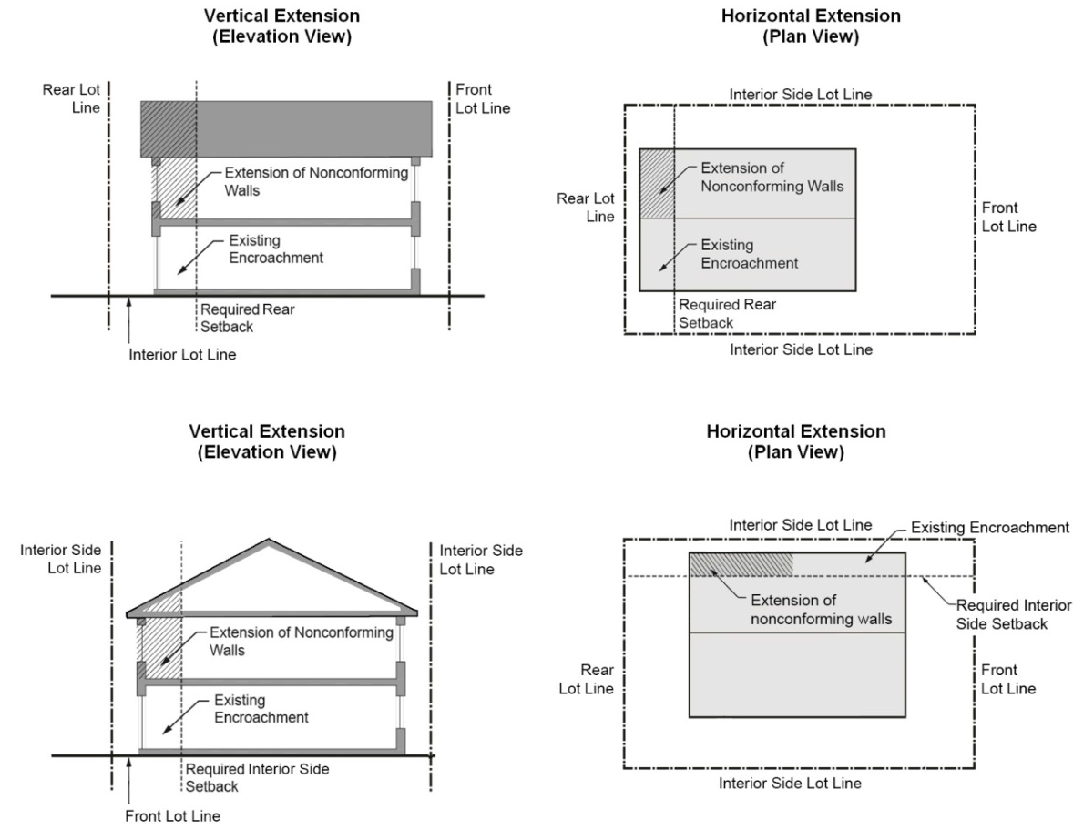
Where a single-family - detached or attached or two-family dwelling is deemed nonconforming because of encroachment into the required interior side or rear setback, the structure may be enlarged or extended vertically or horizontally along the same plane as defined by existing perimeter walls, so long as the resulting structure does not increase the degree of the existing nonconformity or otherwise violate this Code.
FIGURE 18-1: EXTENSION OF WALLS FOR NONCONFORMING
SINGLE-FAMILY AND TWO-FAMILY
G.
Replacing an Existing Mobile or Manufactured Home
If an existing nonconforming mobile or manufactured home occupies a lot in the City, the owner may remove the nonconforming structure from the lot and replace it with a newer mobile or manufactured home on the same property if the replacement structure has, at the very least, the same square footage as the structure that is being removed. A building permit is required and the replacement mobile or manufactured home must meet the current building setbacks.
(Ord. No. 191, 2019, § 28, 1-14-20)
A.
Definition
A nonconforming lot is a lot of record that at one time conformed to the lot dimension requirements (lot area, lot width, lot depth) of the zoning district in which it is located but because of subsequent amendments to the Code no longer conforms to the applicable lot dimensions.
B.
Use
1.
A nonconforming lot of record in a residential district may be used for a single-family dwelling.
2.
A nonconforming lot of record may be used for a manufactured home in any zoning district where it is located.
3.
Duplexes may be constructed within the R-2 or R-3 District where the lot width is nonconforming. A variance would not be required.
4.
Multiple nonconforming lots of record may be combined into one nonconforming lot of record. A variance would not be required.
C.
Development
Development of a nonconforming lot must meet all applicable dimensional or bulk regulations of the district in which it is located with the exception of any lot dimension requirement that renders it nonconforming.
(Ord. No. 76, 2017, § 26, 9-12-17; Ord. No. 114, 2020, § 22, 9-8-20; Ord. No. 58, 2023, § 2, 6-13-23)
A.
Definition
A nonconforming site element is a non-structural, physical characteristic of a site, such as landscape, fences or walls, lighting, and design or number of parking and loading spaces, that at one time conformed to the requirements of this Code, but because of subsequent amendments, has been made nonconforming. This does not include nonconforming signs which are regulated by Section 18.6.
B.
Maintenance
Normal maintenance and incidental repair to a nonconforming site element may be performed. No repairs or reconstruction are permitted that would create any new nonconformity or increase the degree of the previously existing nonconformity.
C.
Required Conformance
All nonconforming site elements must be brought into conformance when the following occurs:
1.
General
a.
The existing principal structure is demolished and a new structure is constructed.
b.
A new principal structure is constructed.
c.
The existing principal structure is increased in total building footprint by 50% or more.
d.
An existing parking lot of 20 or more spaces is fully reconstructed, or an existing parking lot area is expanded by 50%. Resealing or re-striping of an existing parking lot, which does not entail paving, is not considered reconstruction.
2.
Additional Specific Actions
a.
For fences and walls, when 50% or more of the length of a fence or wall is reconstructed along any one lot line, all fences or walls on the site must be brought into conformance.
b.
For exterior lighting, when 25% or more of exterior lighting fixtures are replaced, all exterior lighting on the site must be brought into conformance. This is calculated as installation of new lighting posts and/or non-post mounted lighting fixtures based on the total lighting installed by the type of mounting. For example, if over 25% of the wall-mounted fixtures are to be replaced, all wall-mounted fixtures must be brought into conformance while nonconforming freestanding fixtures may remain.
D.
Exemptions
When an existing parking lot which is required by item C above and is required to provide landscape which would result in creating a parking area that no longer conforms to the parking regulations of this Code, such existing parking lot may not be required to install all or a portion of the required landscape. The applicant is required to show that landscape cannot be accommodated on the site. If only certain requirements can be accommodated on the site, only those elements are required. The Zoning Administrator, with the concurrence of the Executive Director, will make the determination that all or a portion of required landscape does not have to be installed.
(Ord. No. 62, 2018, § 20, 8-14-18; Ord. No. 114, 2020, § 23, 9-8-20)
A.
A nonconforming sign and sign structure may remain in use, so long as it remains otherwise lawful and has not been damaged, destroyed, or removed as described in item D below. The sign face of an existing nonconforming sign may be replaced, but the structure cannot be altered to accommodate such change.
B.
No nonconforming sign and sign structure may be relocated, in whole or in part, to any other location on the same or other lot, unless the entire sign and sign structure conforms to all regulations of the zoning district in which the sign is relocated.
C.
Only nonconforming pole signs may be altered or enlarged up to a 10% expansion of its existing sign area. No other nonconforming sign types can be altered or enlarged in a way that increases the nonconformity of the sign or sign structure. This does not preclude normal maintenance and cleaning or changing of the sign face.
D.
In the event that any nonconforming sign and sign structure is damaged or destroyed to the extent of more than 50% of the replacement cost of an identical new structure, such sign may be repaired or rebuilt only in compliance of with the requirements of this Code. Sign owners must supply the Executive Director with a repair cost estimate of the damaged sign and an estimate of the cost of a new identical sign. The Executive Director will review the repair permit application and either approve or disapprove the request within 10 business days of application submittal.
E.
Any nonconforming sign that is located on a lot that has become vacant and unoccupied for a period of one year or more is deemed abandoned. Abandoned nonconforming signs must be removed by the owner of the sign or the property owner where the sign is installed. No permits or approvals may be issued for sites with nonconforming abandoned signs until such signs are removed. No business license may be issued for businesses with nonconforming abandoned signs after the date that such nonconforming signs are required to be removed or come into conformance.
F.
When a principal structure is demolished on a lot, all nonconforming signs located on that lot must be removed.
G.
Nonconforming billboards are subject to the billboard regulations of Section 9.8.
(Ord. No. 114, 2020, § 24, 9-8-20)

- NONCONFORMITIES
A.
Authority to Continue
Any structure, use, lot, site element, or sign that legally existed as a nonconformity as of the effective date of this Code, and any legally existing structure, use, lot, site element, or sign that has been made nonconforming as of the effective date of this Code, and any subsequent amendments, may continue subject to the provisions of this Article so long as it remains otherwise legal. A structure, use, lot, site element, or sign that is illegal as of the effective date of this Code, remains illegal if it does not conform with every requirement of this Code.
B.
Burden on Property Owner
The burden of establishing the legality of a nonconformity under the provisions of this Code is the responsibility of the property owner of the nonconforming structure, lot, site element, or sign, and the operator of the use.
C.
Safety Regulations
All police power regulations enacted to promote public health, safety, and welfare including, but not limited to, all building, fire, and health codes apply to nonconformities.
D.
Suspension for Force Majeure or Acts of Public Enemy
In the event of force majeure, such as a hurricane, tornado, or significant storm with flooding, or acts of public enemy, the City Council, by ordinance, may suspend all or a portion of the requirements of this Article for an established period.
A.
Definition
A nonconforming use is the use of a structure or land that at one time was an allowed use within a zoning district but because of subsequent amendments to the Code is no longer allowed.
B.
Expansion
A nonconforming use of a structure or land cannot be expanded or increased in intensity. This includes expansion, extension, or relocation of a nonconforming use to any other structure on the lot, additional floor area devoted to the nonconforming use, or occupying any land area currently not occupied by such nonconforming use.
C.
Intensification
A nonconforming use of a structure or land cannot be intensified in any manner. Intensification includes, but is not limited to, increasing hours of operation, increasing the number of dwelling units, or increasing the seating or occupancy capacity of any use. However, this does not prohibit the reconfiguration of existing dwelling units within a structure so long as such reconfiguration complies with the requirements of this Code.
D.
Relocation
A nonconforming use cannot be relocated, in whole or in part, to any other location on the same lot. The nonconforming use may only be relocated to another structure or lot if the use conforms to all regulations of the zoning district where it is relocated.
E.
Change of Use
A nonconforming use may not be changed to any other nonconforming use. A nonconforming use may only be changed to a use allowed within the district.
F.
Discontinuation or Abandonment
If a nonconforming use is discontinued, or the structure that it occupies becomes vacant and remains unoccupied for a continuous period of one year, the nonconforming use is presumed abandoned and cannot be reestablished or resumed regardless of intent. Any subsequent use or occupancy of such land or structure must comply with all regulations of the zoning district in which the structure or land is located. A period of discontinuance caused by acts of God or other events without any contributing fault by the user are not included in calculating the length of discontinuance for this section. It is also not considered a period of discontinuance when a use is closed for renovations in conjunction with a lawfully issued building permit.
G.
Damage or Destruction
In the event that any structure that is devoted in whole or in part to a nonconforming use is structurally damaged or destroyed through no fault of the user, the nonconforming use may be re-established provided that no new nonconformities are created and the degree of the previous nonconformity is not increased. If the structure containing the nonconforming use is a nonconforming structure, the structure may only be rebuilt, restored, repaired, or reconstructed in accordance with Section 18.3. However, if a building permit is not obtained within one year of the date of damage or destruction, then the nonconforming use may not be reestablished.
A.
Definition
A nonconforming structure is a principal or accessory structure that once conformed to zoning district regulations but because of subsequent amendments to the Code no longer conforms to applicable dimensional standards. Certain nonconforming site elements are regulated separately by Section 18.5.
B.
Maintenance
Normal maintenance and incidental repair may be performed on any nonconforming structure. No repairs or reconstruction are permitted that would create any new nonconformity or increase the degree of the existing nonconformity.
C.
Structural Alterations
No structural alterations are permitted on any nonconforming structure, except in the following situations:
1.
When the alteration is required by law or is necessary to restore the structure to a safe condition upon the order of any official charged with protecting public safety.
2.
When the alteration will eliminate the nonconformity.
3.
When the alteration will not create any new nonconformity or increase the degree of any existing nonconformity. For example, if a structure is nonconforming in terms of the required front setback (i.e., does not meet the required minimum), the structure may add a rear addition if it meets all other district regulations.
4.
When the alteration is as described in item F below.
D.
Relocation
A nonconforming structure cannot be relocated, in whole or in part, to any other location on the same lot unless such relocation would make the structure conforming. A nonconforming structure may be relocated to another lot if the structure conforms to all regulations of the zoning district where it is relocated.
E.
Damage or Destruction
1.
In the event that a nonconforming structure is damaged or destroyed by the fault of the property owner or tenant, the structure, as restored or repaired, must be rebuilt to comply with all requirements of this Code.
2.
In the event that any nonconforming structure is damaged or destroyed by acts of God or other events without any contributing fault by the property owner or tenant, it may be repaired or rebuilt to the same size and dimension as previously existed, provided that a building permit is obtained within one year following the damage or destruction.
F.
Extension of Walls for Nonconforming Single-Family - Detached and Attached and Two-Family Dwellings
Where a single-family - detached or attached or two-family dwelling is deemed nonconforming because of encroachment into the required interior side or rear setback, the structure may be enlarged or extended vertically or horizontally along the same plane as defined by existing perimeter walls, so long as the resulting structure does not increase the degree of the existing nonconformity or otherwise violate this Code.
FIGURE 18-1: EXTENSION OF WALLS FOR NONCONFORMING
SINGLE-FAMILY AND TWO-FAMILY
G.
Replacing an Existing Mobile or Manufactured Home
If an existing nonconforming mobile or manufactured home occupies a lot in the City, the owner may remove the nonconforming structure from the lot and replace it with a newer mobile or manufactured home on the same property if the replacement structure has, at the very least, the same square footage as the structure that is being removed. A building permit is required and the replacement mobile or manufactured home must meet the current building setbacks.
(Ord. No. 191, 2019, § 28, 1-14-20)
A.
Definition
A nonconforming lot is a lot of record that at one time conformed to the lot dimension requirements (lot area, lot width, lot depth) of the zoning district in which it is located but because of subsequent amendments to the Code no longer conforms to the applicable lot dimensions.
B.
Use
1.
A nonconforming lot of record in a residential district may be used for a single-family dwelling.
2.
A nonconforming lot of record may be used for a manufactured home in any zoning district where it is located.
3.
Duplexes may be constructed within the R-2 or R-3 District where the lot width is nonconforming. A variance would not be required.
4.
Multiple nonconforming lots of record may be combined into one nonconforming lot of record. A variance would not be required.
C.
Development
Development of a nonconforming lot must meet all applicable dimensional or bulk regulations of the district in which it is located with the exception of any lot dimension requirement that renders it nonconforming.
(Ord. No. 76, 2017, § 26, 9-12-17; Ord. No. 114, 2020, § 22, 9-8-20; Ord. No. 58, 2023, § 2, 6-13-23)
A.
Definition
A nonconforming site element is a non-structural, physical characteristic of a site, such as landscape, fences or walls, lighting, and design or number of parking and loading spaces, that at one time conformed to the requirements of this Code, but because of subsequent amendments, has been made nonconforming. This does not include nonconforming signs which are regulated by Section 18.6.
B.
Maintenance
Normal maintenance and incidental repair to a nonconforming site element may be performed. No repairs or reconstruction are permitted that would create any new nonconformity or increase the degree of the previously existing nonconformity.
C.
Required Conformance
All nonconforming site elements must be brought into conformance when the following occurs:
1.
General
a.
The existing principal structure is demolished and a new structure is constructed.
b.
A new principal structure is constructed.
c.
The existing principal structure is increased in total building footprint by 50% or more.
d.
An existing parking lot of 20 or more spaces is fully reconstructed, or an existing parking lot area is expanded by 50%. Resealing or re-striping of an existing parking lot, which does not entail paving, is not considered reconstruction.
2.
Additional Specific Actions
a.
For fences and walls, when 50% or more of the length of a fence or wall is reconstructed along any one lot line, all fences or walls on the site must be brought into conformance.
b.
For exterior lighting, when 25% or more of exterior lighting fixtures are replaced, all exterior lighting on the site must be brought into conformance. This is calculated as installation of new lighting posts and/or non-post mounted lighting fixtures based on the total lighting installed by the type of mounting. For example, if over 25% of the wall-mounted fixtures are to be replaced, all wall-mounted fixtures must be brought into conformance while nonconforming freestanding fixtures may remain.
D.
Exemptions
When an existing parking lot which is required by item C above and is required to provide landscape which would result in creating a parking area that no longer conforms to the parking regulations of this Code, such existing parking lot may not be required to install all or a portion of the required landscape. The applicant is required to show that landscape cannot be accommodated on the site. If only certain requirements can be accommodated on the site, only those elements are required. The Zoning Administrator, with the concurrence of the Executive Director, will make the determination that all or a portion of required landscape does not have to be installed.
(Ord. No. 62, 2018, § 20, 8-14-18; Ord. No. 114, 2020, § 23, 9-8-20)
A.
A nonconforming sign and sign structure may remain in use, so long as it remains otherwise lawful and has not been damaged, destroyed, or removed as described in item D below. The sign face of an existing nonconforming sign may be replaced, but the structure cannot be altered to accommodate such change.
B.
No nonconforming sign and sign structure may be relocated, in whole or in part, to any other location on the same or other lot, unless the entire sign and sign structure conforms to all regulations of the zoning district in which the sign is relocated.
C.
Only nonconforming pole signs may be altered or enlarged up to a 10% expansion of its existing sign area. No other nonconforming sign types can be altered or enlarged in a way that increases the nonconformity of the sign or sign structure. This does not preclude normal maintenance and cleaning or changing of the sign face.
D.
In the event that any nonconforming sign and sign structure is damaged or destroyed to the extent of more than 50% of the replacement cost of an identical new structure, such sign may be repaired or rebuilt only in compliance of with the requirements of this Code. Sign owners must supply the Executive Director with a repair cost estimate of the damaged sign and an estimate of the cost of a new identical sign. The Executive Director will review the repair permit application and either approve or disapprove the request within 10 business days of application submittal.
E.
Any nonconforming sign that is located on a lot that has become vacant and unoccupied for a period of one year or more is deemed abandoned. Abandoned nonconforming signs must be removed by the owner of the sign or the property owner where the sign is installed. No permits or approvals may be issued for sites with nonconforming abandoned signs until such signs are removed. No business license may be issued for businesses with nonconforming abandoned signs after the date that such nonconforming signs are required to be removed or come into conformance.
F.
When a principal structure is demolished on a lot, all nonconforming signs located on that lot must be removed.
G.
Nonconforming billboards are subject to the billboard regulations of Section 9.8.
(Ord. No. 114, 2020, § 24, 9-8-20)
