
Shreveport City Zoning Code
ARTICLE 16
- ZONING APPLICATION APPROVAL PROCESSES
16.1 - CODE TEXT AMENDMENT
A.
Purpose
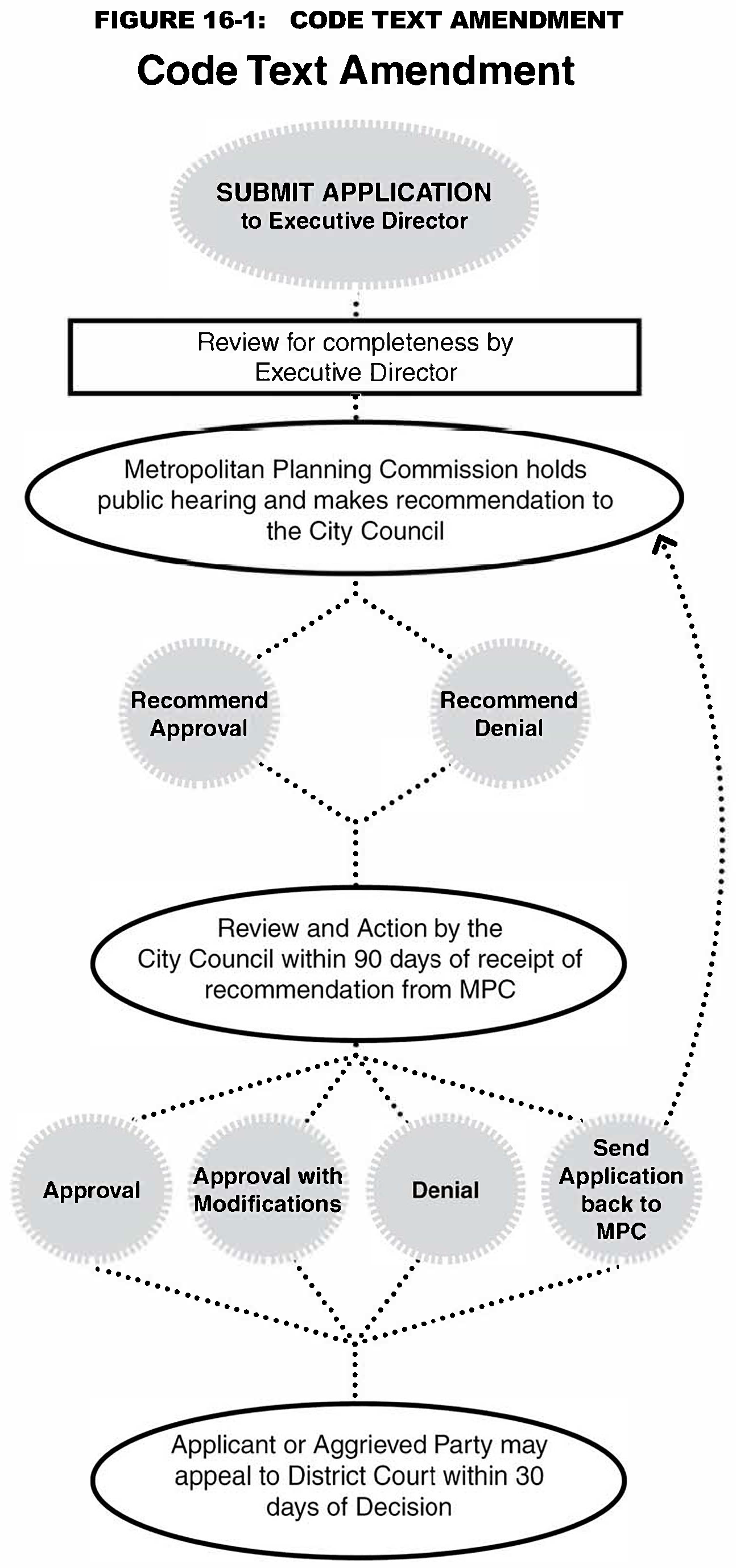
The regulations imposed and the districts created by this Code may be amended from time to time in accordance with this section. This process for amending the Code is intended to allow modifications in response to omissions or errors, changed conditions including subdivision of land, or changes in land use policy. Amendments are not intended to relieve particular hardships or confer special privileges or rights upon any person or party.
B.
Initiation
The City Council, the Metropolitan Planning Commission, a property owner in the City of Shreveport, or person expressly authorized in writing by the property owner, may propose a Code text amendment. Code text amendments initiated by the City Council also require an application, but are exempt from fees.
C.
Authority
The City Council, after receiving a recommendation from the Metropolitan Planning Commission, shall take formal action on requests for Code text amendments.
D.
Process
1.
Action by Executive Director
All applications for a Code text amendment must be filed with the Executive Director in accordance with Section 15.1 (Application). The Executive Director shall take the following actions upon submittal of an application.
a.
Once it is determined that the application is complete, the Executive Director shall review and provide a summary of the issue to be addressed by the proposed Code text amendment, and shall also include staff comments and a recommendation regarding the application and proposed Code text amendment.
b.
The Executive Director shall obtain a resolution from the Metropolitan Planning Commission that authorizes the preparation of the proposed Code text amendment for review by the Metropolitan Planning Commission.
c.
The Executive Director will prepare a draft of the proposed Code text amendment.
d.
The Executive Director may consult with appropriate City staff and/or community stakeholders groups in the course of drafting the proposed Code text amendment.
e.
The Executive Director will assign a case number and place the proposed Code text amendment in ordinance draft form on the official agenda for the Metropolitan Planning Commission.
2.
Action by Metropolitan Planning Commission
a.
After receipt of a complete application, summary, and staff comments, including a recommendation from the Executive Director, the Metropolitan Planning Commission will consider the proposed Code text amendment at a public hearing in accordance with Section 15.3 (Public Hearing). Notice for the public hearing must be in accordance with Section 15.2 (Notice).
b.
The Metropolitan Planning Commission must evaluate the application based upon the evidence presented at the public hearing, pursuant to the approval standards of this section and shall recommend any of the following actions: recommendation of approval, recommendation of approval with modifications, or recommendation of denial of the application for a Code text amendment.
c.
Within 60 days of the close of the date that the recommendation is rendered, the Metropolitan Planning Commission must forward its recommendation to the City Council.
3.
Action by City Council
a.
Upon receipt of a copy of the filed application, the Metropolitan Planning Commission Staff Report and the Metropolitan Planning Commission's recommendation the City Council will follow this Code and the City Council Rules of Procedure in review and action on the proposed Code text amendment.
i.
The City Council must act on the application within 90 days of receipt of the Metropolitan Planning Commission recommendation unless the City Council grants additional consideration time before the 90-day period has expired.
ii.
If the City Council does not act upon the application within 90 days of receipt of the Metropolitan Planning Commission recommendation, the application is deemed denied unless the City Council grants additional consideration time before the 90-day period has expired.
b.
Decisions on a Code text amendment are not final until the City Council takes action on the proposed Code text amendment in one of the following ways: approval, approval with modifications, or denial. Modifications for a Code text amendment are only allowed to clarify the intent of the proposed amendment, to resolve contradictions under the Code or to correct errors such as grammatical mistakes, labeling, numbering or formatting issues. The City Council may also return the application or request for a Code text amendment to the Metropolitan Planning Commission with instructions for further review and consideration.
i.
Simple Majority Vote. If the Metropolitan Planning Commission recommended approval of the Code text amendment then the City Council may render its decision to approve the amendment with a simple majority vote. (State law reference: La. R.S. 33:140.30)
ii.
Two-Thirds Vote. If the Metropolitan Planning Commission recommended denial of the Code text amendment then the City Council shall render its decision to approve the amendment with a two-thirds vote. (State law reference: La. R.S. 33:140.30)
c.
Decisions on a Code text amendment are not final until the City Council acts concerning the recommended Code text amendment.
E.
Approval Standards
In making their recommendation and decision, the Metropolitan Planning Commission and City Council must consider the following standards. The approval of Code text amendments is based on a balancing of these standards.
1.
The extent to which the proposed amendment promotes the public health, safety, and welfare.
2.
The consistency of the proposed amendment with the Master Plan and any adopted land use policies.
3.
The consistency of the proposed amendment with the intent of this Code.
4.
Whether the proposed amendment corrects an error or omission, adds clarification to existing requirements, or reflects a change in policy.
5.
The extent to which the proposed amendment creates nonconformities.
F.
Appeals
Within 30 days after the date of the decision, the applicant or any aggrieved party may appeal a City Council decision on a Code text amendment to Caddo Parish Civil District Court.
Click this link to download a PDF version of Figure 16-1.
(Ord. No. 103, 2017, §§ 5—7, 10-10-17)
16.2 - ZONING MAP AMENDMENT
A.
Purpose
The regulations imposed and the districts created by this Code may be amended from time to time in accordance with this section. This process for amending the Zoning Map is intended to allow modifications in response to omissions or errors, changed conditions including subdivision of land, or changes in land use policy. Amendments are not intended to relieve particular hardships or confer special privileges or rights upon any person or party.
B.
Initiation
The City Council, the Metropolitan Planning Commission, a property owner in the City of Shreveport, or person expressly authorized in writing by the property owner, may propose zoning map amendments. Zoning map amendments initiated by the City Council also require an application, but are exempt from fees.
C.
Authority
For zoning map amendments proposed within the boundaries of the City of Shreveport, the City Council, after receiving a recommendation from the Metropolitan Planning Commission, shall take formal action on requests for zoning map amendments.
D.
Process
1.
Action by Executive Director
All applications for a zoning map amendment must be filed with the Executive Director in accordance with Section 15.1 (Application). The Executive Director shall take the following actions upon submittal of an application.
a.
Once it is determined that the application is complete, the Executive Director shall review and provide a summary of the proposed zoning map amendment and shall also include staff comments and a recommendation regarding the application and proposed zoning map amendment.
b.
The Executive Director shall then schedule the application for consideration by the Metropolitan Planning Commission.
2.
Pre-Application Meeting and Neighborhood Participation Plan
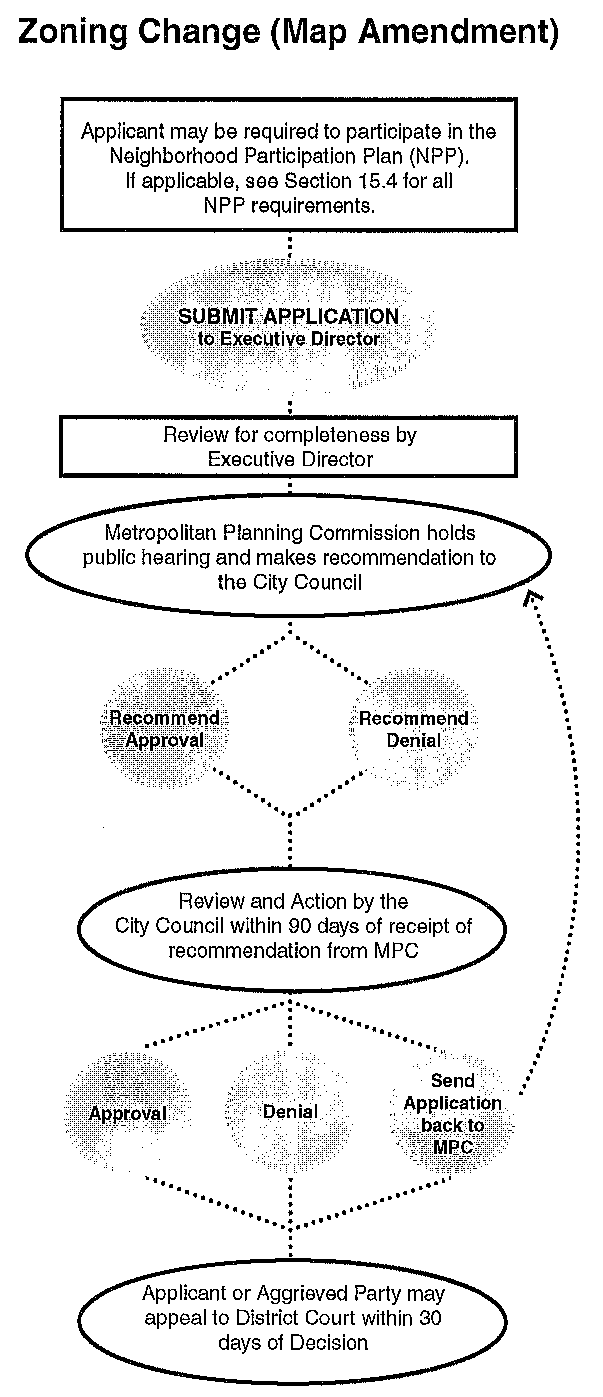
Some applications for zoning map amendments may be required to include a Neighborhood Participation Plan (NPP) report. If required, the application for a zoning map amendment will not be deemed complete until all mandatory NPP documents are submitted to MPC staff. All requirements for the NPP program are described in Section 15.4 (Neighborhood Participation Plan).
3.
Action by Metropolitan Planning Commission
a.
After receipt of a complete application, summary, and comments including a recommendation from the Executive Director, the Metropolitan Planning Commission will consider the proposed zoning map amendment at a public hearing in accordance with Section 15.3 (Public Hearing). Notice for the public hearing must be in accordance with Section 15.2 (Notice).
b.
The Metropolitan Planning Commission must evaluate the application based upon the evidence presented at the public hearing, pursuant to the approval standards of this section and shall recommend any of the following actions: recommendation of approval, recommendation of approval with modifications, or recommendation of denial of the application.
c.
Within 60 days of the close of the date that the recommendation is rendered, the Metropolitan Planning Commission must forward its recommendation to the City Council.
4.
Action by City Council
a.
Upon receipt of a copy of the filed application, the Metropolitan Planning Commission Staff Report and the Metropolitan Planning Commission's recommendation the City Council will follow this Code and the City Council Rules of Procedure in review and action on the proposed zoning map amendment.
i.
The City Council must act on the application within 90 days of receipt of the Metropolitan Planning Commission recommendation unless the City Council grants additional consideration time before the 90-day period has expired.
ii.
If the City Council does not act upon the application within 90 days of receipt of the Metropolitan Planning Commission recommendation, the application is deemed denied unless the City Council grants additional consideration time before the 90-day period has expired.
b.
Decisions on a zoning map amendment are not final until the City Council takes action on the proposed zoning map amendment for properties within the boundaries of the City of Shreveport, Louisiana in one of the following ways: approve or deny. The City Council may also return the application or request for a zoning map amendment to the Metropolitan Planning Commission with instructions for further review and consideration.
i.
Simple Majority Vote. If the Metropolitan Planning Commission recommended approval of the zoning map amendment then the City Council may render its decision to approve the amendment with a simple majority vote. (State law reference: La. R.S. 33:140.30)
ii.
Two-Thirds Vote. If the Metropolitan Planning Commission recommended denial of the zoning map amendment then the City Council shall render its decision to approve the amendment with a two-thirds vote. (State law reference: La. R.S. 33:140.30)
E.
Approval Standards
In making their recommendation and decision, the Metropolitan Planning Commission and City Council must consider the following standards. The approval of zoning map amendments is based on a balancing of these standards:
1.
The compatibility with the existing use and zoning of nearby property.
2.
The extent to which the proposed amendment promotes the public health, safety, and welfare.
3.
The suitability of the property for the purposes for which it is presently zoned, i.e., the feasibility of developing the property in question for one or more of the uses allowed under the existing zoning classification.
4.
The consistency of the proposed amendment with the Master Plan and any adopted land use policies.
5.
That the proposed amendment will benefit the City of Shreveport as a whole, and not just the applicant, property owner(s), neighbors of any property under consideration, or other special interest groups, and the extent to which the proposed use would be in the public interest and would not serve solely the interest of the applicant.
6.
The extent to which the proposed amendment creates nonconformities.
7.
The trend of development, if any, in the general area of the property in question.
8.
Whether adequate public facilities are available including, but not limited to, schools, parks, police and fire protection, roads, sanitary sewers, storm sewers, and water lines, or are reasonably capable of being provided prior to the development of the uses, which would be permitted on the subject property if the amendment were adopted.
F.
Appeals
Within 30 days after the date of the decision, the applicant or any aggrieved party may appeal a City Council decision on a zoning map amendment to Caddo Parish Civil District Court.
Click this link to download a PDF version of Figure 16-2.
FIGURE 16-2: ZONING MAP AMENDMENT
(Ord. No. 103, 2017, §§ 8—10, 10-10-17; Ord. No. 192, 2019, §§ 2, 3(Exh. C), 1-14-20; Ord. No. 196, 2020, §§ 2, 3(Exh. C), 1-12-21)
16.3 - SPECIAL USE PERMIT
A.
Purpose
This Code is based upon the division of the City of Shreveport into districts. Within each district the use of land and structures are substantially uniform. It is recognized, however, that there are certain uses that, because of their unique characteristics, must be considered individually in a district or districts to address the impact of those uses upon neighboring land and of the need for that use at the particular location.
B.
Initiation
A property owner in the City of Shreveport, or person expressly authorized in writing by the property owner, may file an application to use his/her land for one or more of the special uses authorized within the zoning district. A property owner may only propose a special use for property under his/her control.
C.
Authority
The Metropolitan Planning Commission shall take formal action on requests for special use permits.
D.
Application Process
1.
Action by Executive Director
All applications for a special use permit must be filed with the Executive Director in accordance with the requirements in Section 15.1 (Application). The Executive Director shall take the following actions upon submittal of an application:
a.
Once it is determined that the application is complete, the Executive Director shall review and provide a summary of the proposed special use permit and shall also include staff comments and a recommendation regarding the application and proposed special use permit.
b.
The Executive Director shall then schedule the application for consideration by the Metropolitan Planning Commission.
2.
Pre-Application Meeting and Neighborhood Participation Plan
Some applications for a special use permit may be required to include a Neighborhood Participation Plan (NPP) report. If required, the application for a special use permit will not be deemed complete until all mandatory NPP documents are submitted to MPC staff. All requirements for the NPP program are described in Section 15.4 (Neighborhood Participation Plan).
3.
Action by Metropolitan Planning Commission
a.
After receipt of a complete application, summary, and staff comments, including a recommendation from the Executive Director, the Metropolitan Planning Commission shall consider the special use permit application at a public hearing in accordance with Section 15.3 (Public Hearing). Notice for the public hearing must be in accordance with Section 15.2 (Notice).
b.
The Metropolitan Planning Commission must evaluate the application based upon the evidence presented at the public hearing, pursuant to the approval standards of this section and shall take any of the following actions: approval, approval with conditions, or denial of the application for a special use permit.
c.
Decisions on a special use permit are not final until the Metropolitan Planning Commission acts concerning the special use permit application.
E.
Approval Standards
The listing of a use as a special use within a zoning district does not constitute an assurance or presumption that such special use will be approved. Rather, each special use permit must be evaluated on an individual basis, in relation to all applicable standards of this Code. In considering each special use permit application, the Metropolitan Planning Commission or, on appeal, the City Council will review the overall compatibility of the proposed special use with surrounding property as well as such specific items, including but not limited to, screening, parking, and landscaping to make sure that the impact of the special use is minimal and that little or no adverse effects occur to nearby property.
The Metropolitan Planning Commission or, on appeal, the City Council must consider the following development standards and design specifications. The approval of a special use permit, is based on a balancing of these development standards and design specifications:
1.
The design, location, and operating plans must be such that the public health, safety and/or welfare is protected.
2.
The proposed special use is compatible with the general land use of adjacent properties and other property within 300 feet.
3.
The special use conforms to the regulations of the zoning district where it will be located.
4.
The location and dimensions of all public rights-of-way on or abutting the proposed special use.
5.
Existing and proposed vehicular and pedestrian circulation systems; including streets, alleys, walkways, service areas and loading areas, the location and arrangement of off-street parking areas and all points of vehicular entrance and exit.
6.
The outdoor surfacing and paving for all parking and loading areas.
7.
The proposed perimeter treatment of the property, with indication of screening materials to be used, including fences, walls, and plants, together with a description of uses, setbacks and the relationship to surrounding areas.
8.
A landscape plan showing proposed treatment of the areas designated as either buffers or open space.
9.
The location and dimensions of all existing and proposed easements and public improvements on the site.
10.
The location and size of all structures, distances between buildings, and distances from structures to property lines.
11.
The location and description of all signage, including facade signs on buildings.
12.
The proposed use of all structures and their dimensions, i.e., height, floor areas, entrances, and loading areas.
F.
Conditions
The Metropolitan Planning Commission or, on appeal, the City Council may impose conditions and restrictions upon the establishment, location, construction, maintenance, and operation of the special use permit as may be deemed necessary with the intent of minimizing the impact on nearby properties for the protection of the public health, safety, and welfare.
All conditions required for a special use permit must be complied with before any part of the use can be occupied.
G.
Violations
Violation of any term, condition, requirement, or duration of a special use permit approved under this division is unlawful, and will constitute a violation of this Code, and will subject the violator to the penalties set forth in Article 19 (Enforcement). In addition, the special use permit may be revoked or suspended by the City Council due to such violation, following public hearings by the Metropolitan Planning Commission and the City Council.
H.
Modifications to Approved Special Uses
1.
Administrative Modifications to Approved Special Use Permits
The Executive Director may approve the following administrative modifications to an approved special use permit when it is determined by the Executive Director that such changes are in substantial conformance with the approved special use. Any changes considered a minor or major modification, as defined in this section, cannot be approved as an administrative modification. No notice is required for an administrative modification. Administrative modifications are as follows:
a.
A change of ownership or name of the business.
b.
Changes required during construction when related to final engineering issues such as topography, drainage, underground utilities, or structural safety.
c.
Changes in building design, including building materials that continue to meet the requirements of this Code and any conditions of the final plan approval.
d.
Any additions or enlargements to a structure where the area devoted to a special use is increased by less than 10%.
e.
The modification of existing accessory structures or the addition of new accessory structures related to the special use when in conformance with the requirements of this Code. This does not include the addition or modification of any outdoor service components, which are considered a minor modification.
f.
Reserved.
g.
The modification of existing signs or the addition of new signs related to the special use when in conformance with the requirements of the sign regulations.
2.
Minor Modifications to Approved Special Use Permits
The Metropolitan Planning Commission, at a public meeting, may approve the following minor modifications to an approved special use permit when it is determined by the Metropolitan Planning Commission that such changes are in substantial conformance with the approved special use.
a.
Any additions or enlargements to a structure where the area devoted to a special use is increased by 10% up to a maximum of 25%.
b.
The addition or modification of new outdoor service components, such as seating or dining areas.
c.
Modifications to the approved landscape plan that result in a reduction of the total amount of plant material from that shown on the approved special use permit.
3.
Major Modifications to Approved Special Use Permits
The Metropolitan Planning Commission or, on appeal, the City Council may approve any other changes to an approved special use permit that do not qualify as an administrative modification or minor modification. Proposed major modifications to an approved special use permit must follow the process for approval of a new special use permit of this section.
I.
Term and Expiration of Special Use Permit
1.
Term
a.
A special use permit is approved indefinitely unless otherwise specified by the Metropolitan Planning Commission or, on appeal, the City Council.
b.
A special use permit shall expire one year following the discontinuation or abandonment of the use for which the special permit was approved.
2.
Expiration
A special use permit approval expires if any one of the following events or circumstances occurs.
a.
When an approved special use is changed to or replaced by another use.
b.
For new construction or additions or enlargements to an existing structure, the special use permit approval expires within 180 days of the date of approval if a building permit has not been issued.
c.
For special uses within existing structures or on lots where no structure is planned, the special use permit approval expires within 180 days of the date of approval if the licenses or permits required for the operation or maintenance of the use have not been obtained.
d.
For special uses regarding the retail sales of liquor and the retail sales of alcohol-beer and wine, the special use permit expires immediately when the use ceases to operate or is discontinued for any period. Except when the use is discontinued or ceases to operate for up to 180 days for remodeling or repairs when a valid permit for such work has been issued by the Chief Building Official of the City.
J.
Appeals
1.
Appeals of Metropolitan Planning Commission Decision
Within 10 days after the date of the decision for a special use permit by the Metropolitan Planning Commission, the applicant or any aggrieved party may appeal to City Council.
2.
Appeals of City Council
Within 30 days after the date of the decision by City Council on the appeal, regarding a special use permit, the applicant or any aggrieved party may appeal the City Council decision to Caddo Parish Civil District Court.
K.
Appeal Process
1.
Initiation
a.
Applicant or Any Aggrieved Party
The applicant or any aggrieved party may appeal a Metropolitan Planning Commission decision regarding a special use permit. All appeal documents and fees must be filed with the Metropolitan Planning Commission Office.
b.
Fees
i.
The applicant, if appealing the decision, shall be responsible for payment of an appeal fee in accordance with Article 25 (Fees).
ii.
Any other aggrieved party, if appealing the decision, shall not be required to pay an appeal fee.
c.
Deadline
The applicant or any aggrieved party who wants to appeal the decision must file the appeal documents and pay the associated fees with the Metropolitan Planning Commission Office no later than 5:00 p.m. on the 10th calendar day following the date of decision by the Metropolitan Planning Commission.
2.
Action by Executive Director
The Executive Director shall forward any filed appeal along with the Metropolitan Planning Commission's Staff Report and the Metropolitan Planning Commission's decision regarding the special use permit to the Clerk of Council no later than the next business day following the receipt of said appeal.
3.
Action by Clerk of City Council
a.
The clerk of council shall acknowledge in writing the receipt of any appeal from an applicant or any aggrieved party.
b.
Upon receipt of an appeal the Clerk of Council shall place the appeal on the City Council's agenda pursuant to City Council Rules of Procedure Section 1.5.
c.
The Clerk of Council shall mail notice not less than three calendar days before the City Council meeting to the following:
i.
Applicant filing an appeal,
ii.
Any aggrieved party filing an appeal,
iii.
Metropolitan Planning Commission through its Executive Director, and
iv.
Any person requesting in writing notice of the appeal.
4.
Action by City Council
a.
Upon the receipt of a copy of the filed appeal via placement on the City Council's Agenda the City Council will follow this Code and the City Council Rules of Procedure in review and action on the appeal. This Code prevails over any conflicting provisions in the City Council Rules of Procedure.
i.
The City Council must act on the appeal within 90 days unless the City Council grants additional consideration time before the 90-day period has expired.
ii.
If the City Council does not act upon the appeal within 90 days or grant the additional consideration time before the 90-day period has expired, the appeal is deemed denied and the Metropolitan Planning Commission decision is affirmed.
b.
The City Council shall take action on the appeal of a Metropolitan Planning Commission decision in one of the following ways: affirm, modify, overrule/reverse or remand to the Metropolitan Planning Commission.
c.
Any action by the City Council on an appeal will be by motion or resolution and does not require an ordinance.
i.
Simple Majority Vote. The City Council may render its decision on an appeal of a special use permit with a simple majority vote by a quorum of its members.
ii.
Tie Vote. In the event of a tie vote by a quorum of the City Council members the Metropolitan Planning Commission's decision shall be deemed affirmed.
FIGURE 16-3: SPECIAL USE PERMIT
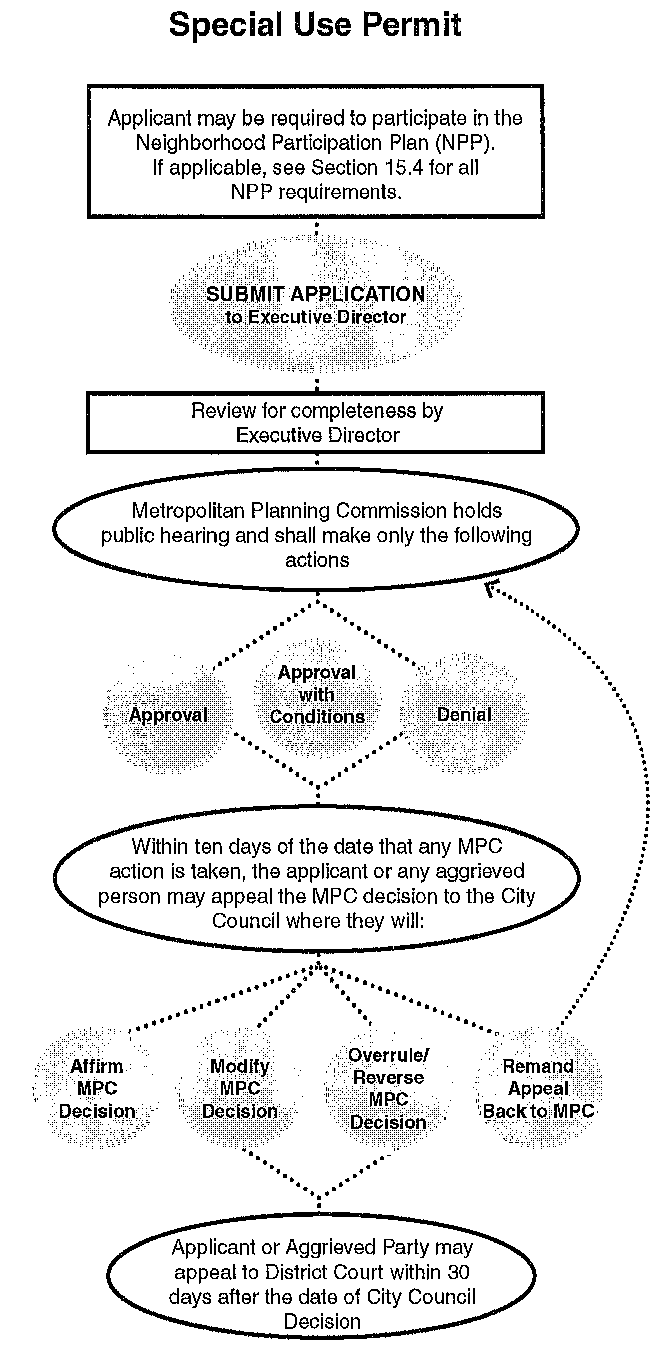
Click this link to download a PDF version of Figure 16-3.
(Ord. No. 6, 2019, §§ 32(Exh. E), 33(Exh. F), 2-12-19; Ord. No. 187, 2019, § 28, 12-10-19; Ord. No. 192, 2019, §§ 4, 5(Exh. D), 1-14-20; Ord. No. 196, 2020, §§ 4, 5(Exh. D), 1-12-21; Ord. No. 137, 2021, § 19, 9-28-21; Ord. No. 46, 2025, § 3, 6-10-25; Ord. No. 110, 2025, § 1(Exh. B), 10-28-25)
16.4 - ADMINISTRATIVE SPECIAL USE PERMIT
An applicant may seek the Executive Director's approval of an administrative special use permit (ASUP) for any use identified as "A" in Table 5-1: Use Matrix, pursuant to the standards and procedures outlined in this Section.
A.
Procedures for Administrative Special Use Approval
1.
An applicant for an ASUP shall file an application with the Executive Director on such forms and subject to such procedures as the Executive Director may establish for the purpose.
2.
Some applications for an administrative special use permit may be required to include a Neighborhood Participation Plan (NPP) report. If required, the application for an administrative special use permit will not be deemed complete until all mandatory NPP documents are submitted to MPC staff. All requirements for the NPP program are described in Section 15.4 (Neighborhood Participation Plan).
3.
Notice of a pending ASUP application shall be made in a newspaper of general circulation in the City, posted on the subject property, given to nearby civic, business, and/or neighborhood associations by email or equivalent electronic notice, and prominently posted on the MPC's web page on a list of pending ASUP applications for review by the public. Such notice shall be given at least 21 days prior to the approval of an ASUP application. The public may submit comments to the Executive Director regarding the application.
4.
The application shall be reviewed for compliance with all approval standards as described in Section 16.3.H.2 above.
5.
As an alternative to an ASUP approval, an applicant may choose to seek special use permit approval pursuant to Section 16.3 of this Article.
6.
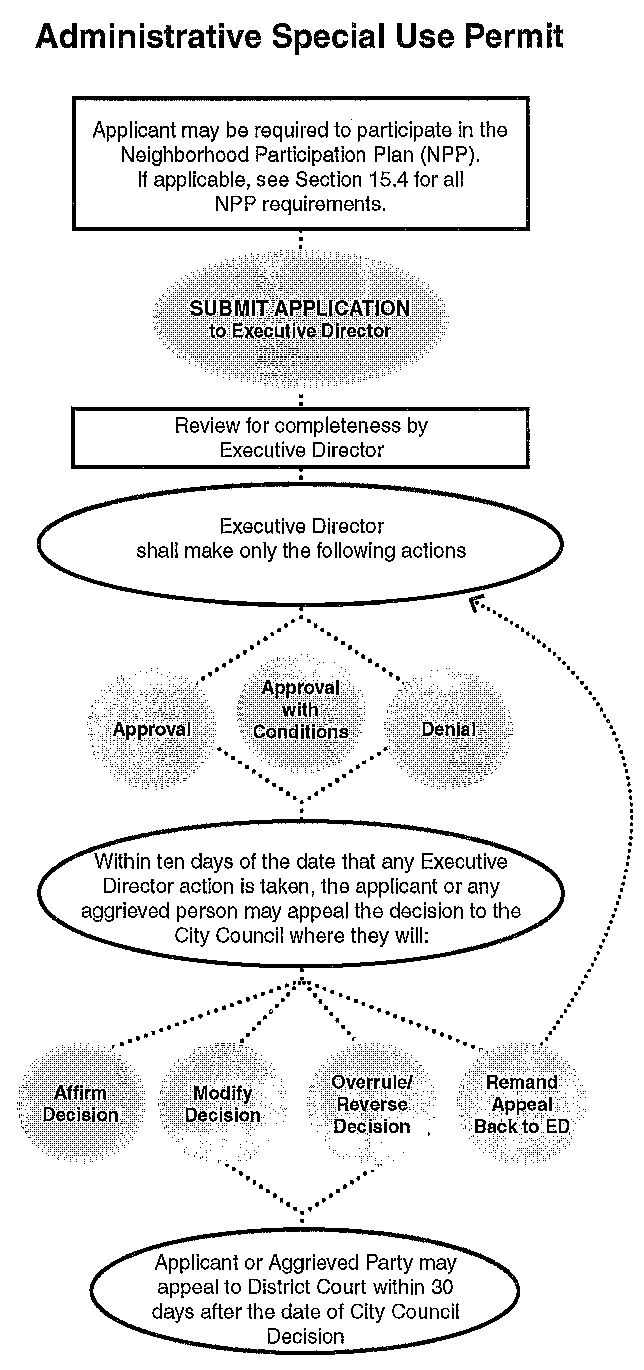
After review the Executive Director may approve, approve with conditions, or deny the application. An approval by the Executive Director shall be deemed to have the force and effect of a special use permit.
7.
At any time during the review process for an ASUP, the Executive Director may determine that an administrative approval is not appropriate and that special use permit approval shall be required if the proposal will not be compatible with the adjacent and surrounding properties, if the applicant fails to meet the standards for the permit, or if the applicant fails to consent to the conditions of the administrative permit.
8.
In the event any person, whether owner, leasee, principal, agent, employee or otherwise, materially fails to comply with any administrative special use standard of this subsection, the Executive Director may suspend or revoke the administrative special use approval in whole or in part and on such terms and conditions as deemed necessary to effect the cure of such failure. The applicant may appeal this suspension or revocation to the City Council.
B.
Administrative Special Use Approval Standards
1.
The listing of a use as an administrative special use within a zoning district does not constitute an assurance or presumption that such administrative special use will be approved. Rather, each administrative special use permit must be evaluated on an individual basis, in relation to all applicable standards of this Code. In considering each administrative special use permit application, the Executive Director or, on appeal, the City Council will review the overall compatibility of the proposed administrative special use with surrounding property as well as such specific items, including but not limited to, screening, parking, and landscaping to make sure that the impact of the administrative special use is minimal and that little or no adverse effects occur to nearby property.
2.
The Executive Director or, on appeal, the City Council must consider the following development standards and design specifications. The approval of an administrative special use permit is based on a balancing of these development standards and design specifications:
1.
The design, location, and operating plans must be such that the public health, safety and/or welfare is protected.
2.
The proposed special use is compatible with the general land use of adjacent properties and other property within 300 feet.
3.
The special use conforms to the regulations of the zoning district where it will be located.
4.
The location and dimensions of all public rights-of-way on or abutting the proposed special use.
5.
Existing and proposed vehicular and pedestrian circulation systems; including streets, alleys, walkways, service areas and loading areas, the location and arrangement of off-street parking areas and all points of vehicular entrance and exit.
6.
The outdoor surfacing and paving for all parking and loading areas.
7.
The proposed perimeter treatment of the property, with indication of screening materials to be used, including fences, walls, and plants, together with a description of uses, setbacks and the relationship to surrounding areas.
8.
A landscape plan showing proposed treatment of the areas designated as either buffers or open space.
9.
The location and dimensions of all existing and proposed easements and public improvements on the site.
10.
The location and size of all structures, distances between buildings, and distances from structures to property lines.
11.
The location and description of all signage, including facade signs on buildings.
12.
The proposed use of all structures and their dimensions, i.e., height, floor areas, entrances, and loading areas.
C.
Conditions
1.
The Executive Director or, on appeal, the City Council may impose conditions and restrictions upon the establishment, location, construction, maintenance, and operation of the administrative special use permit as may be deemed necessary with the intent of minimizing the impact on nearby properties for the protection of the public health, safety, and welfare.
2.
All conditions required for an administrative special use permit must be complied with before any part of the use can be occupied.
D.
Violations
Violation of any term, condition, requirement, or duration of an administrative special use permit approved under this Section is unlawful, and will constitute a violation of this Code, and will subject the violator to the penalties set forth in Article 19 (Enforcement). In addition, the special use permit may be revoked or suspended by the City Council due to such violation, following public hearings by the Metropolitan Planning Commission and the City Council.
E.
Minor Modifications to Approved Administrative Special Uses
The Executive Director may approve the following minor modifications to an approved administrative special use permit when it is determined by the Executive Director that such changes are in substantial conformance with the approved administrative special use. No notice is required for an administrative modification. Minor modifications are as follows:
1.
A change of ownership or name of the business.
2.
Changes required during construction when related to final engineering issues such as topography, drainage, underground utilities, or structural safety.
3.
Changes in building design, including building materials that continue to meet the requirements of this Code and any conditions of the final plan approval.
4.
Any additions or enlargements to a structure where the area devoted to a special use is increased by less than 10%.
5.
The modification of existing accessory structures or the addition of new accessory structures related to the special use when in conformance with the requirements of this Code. This does not include the addition or modification of any outdoor service components, which are considered a minor modification.
6.
Reserved.
7.
The modification of existing signs or the addition of new signs related to the special use when in conformance with the requirements of the sign regulations.
8.
Any additions or enlargements to a structure where the area devoted to a special use is increased by 10% up to a maximum of 25%.
9.
The addition or modification of new outdoor service components, such as seating or dining areas.
10.
Modifications to the approved landscape plan that result in a reduction of the total amount of plant material from that shown on the approved special use permit.
F.
Major Modifications to Approved Administrative Special Use Permits
Proposed major modifications to an approved administrative special use permit must follow the process for approval of a new special use permit of this Section.
G.
Term and Expiration
1.
Term
An administrative special use permit is approved indefinitely unless otherwise specified by the Executive Director or, on appeal, the City Council.
2.
Expiration
An administrative special use permit approval expires if any one of the following events or circumstances occurs:
a.
When an approved administrative special use is changed to or replaced by another use.
b.
For new construction or additions or enlargements to an existing structure, the administrative special use permit approval expires within 180 days of the date of approval if a building permit has not been issued.
c.
For administrative special uses within existing structures or on lots where no structure is planned, the administrative special use permit approval expires within 180 days of the date of approval if the licenses or permits required for the operation or maintenance of the use have not been obtained.
3.
Appeals of an Administrative Special Use Approval
a.
Within 10 days after the date of the decision for an administrative special use permit by the Executive Director, the applicant or any aggrieved party may appeal to City Council, by filing a notice of appeal, in writing, stating the grounds on which the aggrieved party is affected and the grounds of appeal, with the City Clerk.
b.
The City Council shall conduct a public hearing on any administrative SUP appeal filed pursuant to this Section. Following the conclusion of the hearing, City Council may affirm, reverse or modify the decision of the Executive Director, or vacate the decision and remand the matter to the Metropolitan Planning Commission or the Executive Director for further consideration.
c.
Within 30 days after the date of the decision by City Council on the appeal, regarding an administrative special use permit, the applicant or any aggrieved party may appeal the City Council decision to Caddo Parish Civil District Court.
FIGURE 16-4: ADMINISTRATIVE SPECIAL USE PERMIT
(Ord. No. 114, 2020, § 18(Exh. A), 9-8-20; Ord. No. 196, 2020, §§ 6, 7(Exh. E), 1-12-21; Ord. No. 110, 2025, § 1(Exh. B), 10-28-25)
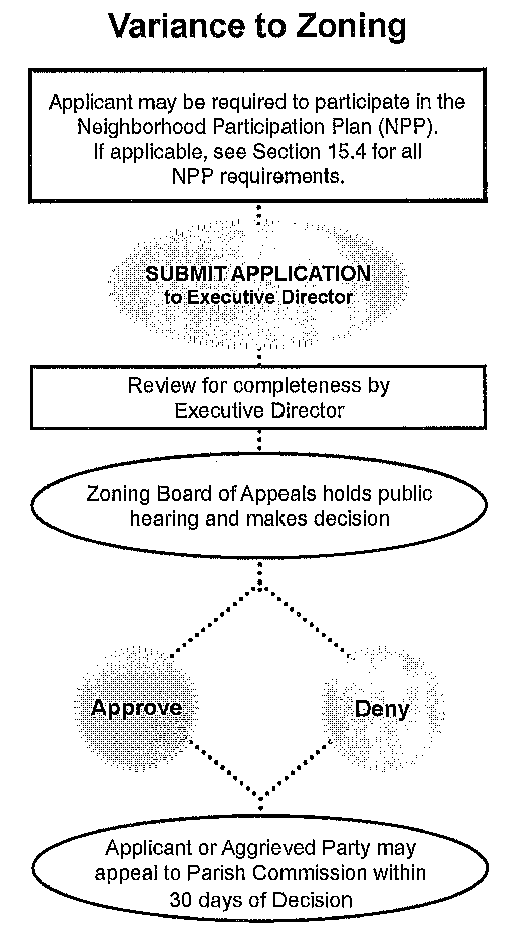
16.5 - VARIANCE TO ZONING
A.
Purpose
Zoning variances are intended to address unnecessary hardships or practical difficulties resulting from the strict application of zoning-related standards. The purpose of the variance process is to provide a narrowly limited means by which relief may be granted from unforeseen applications of this Code.
B.
Initiation
A property owner in the City of Shreveport or person expressly authorized in writing by the property owner, may file an application for a variance. A property owner, or his/her designee, may only propose a variance for property under his/her control.
C.
Authority
1.
The Zoning Board of Appeals shall take formal action on variance applications. However, the Executive Director is authorized to grant certain administrative exceptions, as described in Section 16.6 (Administrative Exception).
2.
Use variances are prohibited. A use variance is a request for a variance to allow a use that is not listed as a permitted or special use within a zoning district in Article 5.
D.
Process
1.
Action by the Executive Director
All applications must be filed with the Executive Director in accordance with Section 15.1 (Application). The Executive Director shall take the following actions upon submittal of an application:
a.
Once it is determined that the application is complete, the Executive Director shall review and provide a summary of the proposed variance and shall also include staff comments and a recommendation regarding the application and proposed variance to zoning.
b.
The Executive Director shall then schedule the application for consideration by the Zoning Board of Appeals.
2.
Pre-Application Meeting and Neighborhood Participation Plan
Some applications for a variance, with the exception of applications for variances involving a single-family or two-family dwelling, may be required to include a Neighborhood Participation Plan (NPP) report. If required, the application for a variance will not be deemed complete until all mandatory NPP documents are submitted to MPC staff. All requirements for the NPP program are described in Section 15.4 (Neighborhood Participation Plan).
3.
Action by the Zoning Board of Appeals
a.
After receipt of a complete application, summary, staff comments, and recommendation from the Executive Director, the Zoning Board of Appeals shall consider the proposed variance at a public hearing in accordance with Section 15.3 (Public Hearing). Notice for the public hearing must be in accordance with Section 15.2 (Notice).
b.
The Zoning Board of Appeals must evaluate the application based upon the evidence presented at the public hearing, pursuant to the approval standards of this Section. The Zoning Board of Appeals must act on the application within 90 days of receipt of the complete application unless the Zoning Board of Appeals grants additional consideration time before the 90-day period has expired. The Zoning Board of Appeals shall take action in one of the following ways: approval, approval with conditions, or denial.
c.
If the Zoning Board of Appeals does not act upon the application within 90 days of receipt of the complete application, the application is deemed denied unless the Zoning Board of Appeals grants additional consideration time before the 90-day period has expired.
d.
The Zoning Board of Appeals may impose such conditions and restrictions upon the variance as may be deemed necessary for the protection of the public health, safety, and welfare.
e.
The Zoning Board of Appeals may grant a variance that is less than that requested in the submitted application when it has been decided that the applicant is entitled to some relief, but not to the entire relief requested in the variance application.
E.
Approval Standards
1.
The Zoning Board of Appeals must make findings to support the following criteria:
a.
The strict application of the terms of this Code will result in undue hardship unless the specific relief requested is granted.
b.
The plight of the owner is due to unique circumstances inherent to the subject property and not from the personal situation of the owner.
c.
The variance, if granted, will not alter the essential character of the locality.
2.
The Zoning Board of Appeals, in making its findings, may inquire into the following evidentiary issues, as well as any others deemed appropriate:
a.
The particular physical surroundings, shape or topographical conditions of the specific property impose a particular hardship upon the owner, as distinguished from a mere inconvenience, if the strict letter of the regulations were to be carried out.
b.
The alleged difficulty or hardship has not been created by any person presently having a proprietary interest in the property in question.
c.
The granting of the variance will not be detrimental to the public health, safety, and welfare.
d.
The proposed variance is consistent with this Code.
F.
Expiration of Variance
An approved variance will expire 180 days from the date of approval unless a building permit is obtained before the expiration of such period. The Zoning Board of Appeals may grant an extension of time for a period of validity longer than 180 days. An applicant may apply in writing for an extension of time at any time prior to the date of expiration.
G.
Appeals
Within 30 days after the date of the decision, the applicant or any aggrieved party may appeal a Zoning Board of Appeals decision on a variance to Caddo Parish Civil District Court.
Click this link to download a PDF version of Figure 16-5.
FIGURE 16-5: VARIANCE TO ZONING
(Ord. No. 192, 2019, §§ 6, 8(Exh. E), 1-14-20; Ord. No. 114, 2020, § 18, 9-8-20; Ord. No. 196, 2020, §§ 8, 9(Exh. F), 1-12-21)
Editor's note— Ord. No. 114, 2020, § 18, adopted September 8, 2020, redesignated the former Sections 16.4—16.12 as Sections 16.5—16.13. The historical notation has been preserved for reference purposes.
16.6 - SPECIAL EXCEPTION USE
A.
Purpose
1.
This Code currently allows certain uses to be approved with a special use permit by the Metropolitan Planning Commission. It is recognized, however, that there are certain uses that, because of their unique characteristics, can be more appropriately evaluated by the Zoning Board of Appeals. These uses are known as a special exception use.
2.
Under this provision, a use or structure may be authorized by the Zoning Board of Appeals that would not be appropriate generally or without restriction throughout a district but which, if controlled could be appropriate within that district. Uses may be authorized with appropriate conditions and safeguards as may be determined by the Zoning Board of Appeals.
B.
Initiation
A property owner in the City of Shreveport, or person expressly authorized in writing by the property owner, may file an application to use his/her land for one or more of the special exception uses authorized within the zoning district. A property owner may only propose a special exception use for property under his/her control.
C.
Authority
The Zoning Board of Appeals shall take formal action on requests for special exception use approvals.
D.
Application Process
1.
Action by Executive Director
All applications for a special exception use must be filed with the Executive Director in accordance with the requirements in Section 15.1 (Application). The Executive Director shall take the following actions upon submittal of an application:
a.
Once it is determined that the application is complete, the Executive Director shall review and provide a summary of the proposed special exception use and shall also include staff comments and a recommendation regarding the application and proposed special exception use.
b.
The Executive Director shall then schedule the application for consideration by the Zoning Board of Appeals.
2.
Action by the Zoning Board Appeals
a.
After receipt of a complete application, summary, and staff comments, including a recommendation from the Executive Director, the Zoning Board of Appeals shall consider the special exception use application at a public hearing in accordance with Section 15.3 (Public Hearing). Notice for the public hearing must be in accordance with Section 15.2 (Notice).
b.
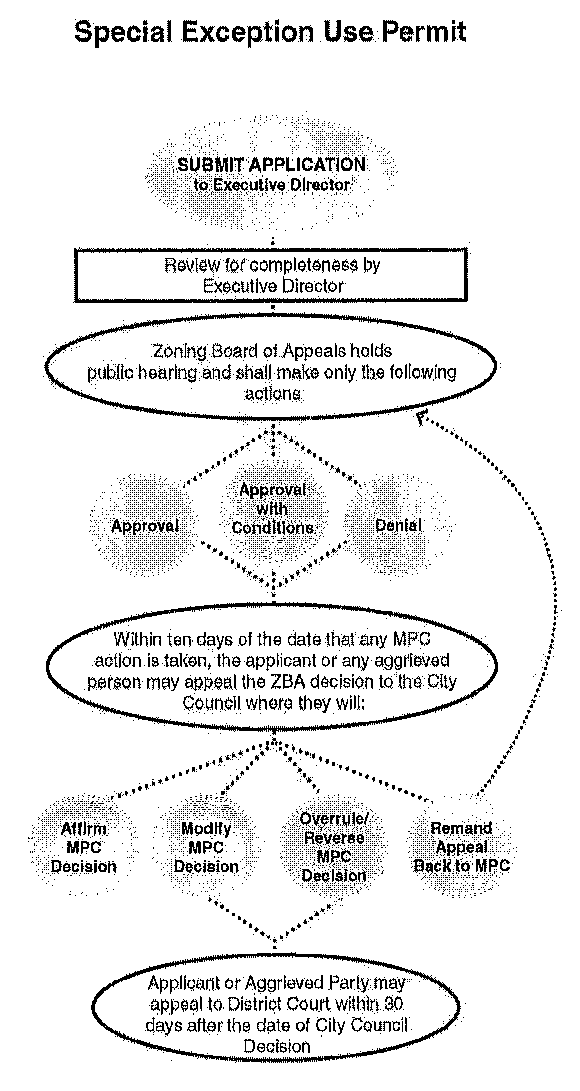
The Zoning Board of Appeals must evaluate the application based upon the evidence presented at the public hearing, pursuant to the approval standards of this Section and shall take any of the following actions; approval, approval with conditions, or denial of the application for a special exception use.
c.
Decisions on a special exception use are not final until the Zoning Board of Appeals acts concerning the special exception use application.
E.
Approval Standards
1.
The listing of a use as a special exception use within a zoning district does not constitute an assurance or presumption that such special exception use will be approved. Rather, each special exception use permit must be evaluated on an individual basis, in relation to all applicable standards of this Code. In considering each special exception use permit application, the Zoning Board of Appeals or, on appeal, the City Council will review the overall compatibility of the proposed special exception use with surrounding property as well as such specific items, including but not limited to, screening, parking, and landscaping to make sure that the impact of the special exception use is minimal and that little or no adverse effects occur to nearby property.
2.
The Zoning Board of Appeals or, on appeal, the City Council must consider the following development standards and design specifications. The approval of a special exception use is based on a balancing of these development standards and design specifications:
a.
The design, location, and operating plans must be such that the public health, safety and/or welfare is protected.
b.
The proposed special exception use is compatible with the general land use of adjacent properties and other property within 300 feet.
c.
The special exception use conforms to the regulations of the zoning district where it will be located except where allowed under Article 18.
d.
The special exception use in the specific location proposed is consistent with this Code.
F.
Conditions
1.
The Zoning Board of Appeals or, on appeal, the City Council may impose conditions and restrictions upon the establishment, location, construction, maintenance, and operation of the special exception use as may be deemed necessary with the intent of minimizing the impact on nearby properties for the protection of the public health, safety, and welfare.
2.
All conditions required for a special exception use permit must be complied with before any part of the use can be occupied.
G.
Violations
Violation of any term, condition, requirement, or duration of a special exception use approved under this division is unlawful, and will constitute a violation of this Code, and will subject the violator to the penalties set forth in Article 19 (Enforcement). In addition, the special exception use may be revoked or suspended following public hearings by the Zoning Board of Appeals and the City Council, if appealed.
H.
Modifications to Approved Special Exception Uses
1.
Administrative Modifications to Approved Special Exception Uses
The Executive Director may approve the following administrative modifications to an approved special exception use when it is determined by the Executive Director that such changes are in substantial conformance with the approved special exception use. Any changes considered a minor or major modification, as defined in this Section, cannot be approved as an administrative modification. No notice is required for an administrative modification. Administrative modifications are as follows:
a.
A change of ownership or name of the business.
b.
Changes required during construction when related to final engineering issues such as topography, drainage, underground utilities, or structural safety.
c.
Changes in building design, including building materials that continue to meet the requirements of this Code and any conditions of the final plan approval.
d.
Any additions or enlargements to a structure where the area devoted to a special exception use is increased by less than 10%.
e.
The modification of existing accessory structures or the addition of new accessory structures related to the special exception use when in conformance with the requirements of this Code. This does not include the addition or modification of any outdoor service components, which are considered a minor modification.
f.
Reserved.
g.
The modification of existing signs or the addition of new signs related to the special exception use when in conformance with the requirements of the sign regulations.
2.
Minor Modifications to Approved Special Exception Uses
The Zoning Board of Appeals, at a public meeting, may approve the following minor modifications to an approved special exception use when it is determined by the Zoning Board of Appeals that such changes are in substantial conformance with the approved special exception use.
a.
Any additions or enlargements to a structure where the area devoted to a special exception use is increased by 10% up to a maximum of 25%.
b.
The addition or modification of new outdoor service components, such as seating or dining areas.
c.
Modifications to the approved landscape plan that result in a reduction of the total amount of plant material from that shown on the approved special exception use.
3.
Major Modifications to Approved Special Exception Uses
The Zoning Board of Appeals or, on appeal, the City Council may approve any other changes to an approved special exception use permit that do not qualify as an administrative modification or minor modification. Proposed major modifications to an approved special exception use permit must follow the process for approval of a new special exception use of this Section.
I.
Term and Expiration of Special Exception Use
1.
Term
A special exception use is approved indefinitely unless otherwise specified by the Zoning Board of Appeals or, on appeal, the City Council.
2.
Expiration
A special exception use approval expires if any one of the following events or circumstances occurs:
a.
When an approved special exception use is changed to or replaced by another use.
b.
For new construction or additions or enlargements to an existing structure, the special exception use approval expires within 180 days of the date of approval if a building permit has not been issued.
c.
For special exception uses within existing structures or on lots where no structure is planned, the special exception use approval expires within 180 days of the date of approval if the licenses or permits required for the operation or maintenance of the use have not been obtained.
d.
A 90-day extension of any special exception use approval may be granted by the Executive Director provided that a written request is received in the Office of the MPC prior to the expiration of the original approval period. The Executive Director is authorized to grant a maximum of two 90-day extensions to the original approval.
J.
Appeals
1.
Appeals of Zoning Board of Appeals Decision
Within 10 days after the date of the decision for a special exception use by the Zoning Board of Appeals, the applicant or any aggrieved party may appeal to City Council.
2.
Appeals of City Council
Within 30 days after the date of the decision by City Council on the appeal, regarding a special exception use permit, the applicant or any aggrieved party may appeal the City Council decision to Caddo Parish Civil District Court.
K.
Appeal Process
1.
Initiation
a.
Applicant or Any Aggrieved Party
The applicant or any aggrieved party may appeal a Zoning Board of Appeals decision regarding a special exception use. All appeal documents and fees must be filed with the Metropolitan Planning Commission Office.
b.
Fees
i.
The applicant, if appealing the decision, shall be responsible for payment of an appeal fee in accordance with Article 25 (Fees).
ii.
Any other aggrieved party, if appealing the decision, shall not be required to pay an appeal fee.
c.
Deadline
The applicant or any aggrieved party who wants to appeal the decision must file the appeal documents and pay the associated fees with the Metropolitan Planning Commission Office no later than 5:00 p.m. on the 10th calendar day following the date of decision by the Metropolitan Planning Commission.
2.
Action by Executive Director
The Executive Director shall forward any filed appeal along with the Metropolitan Planning Commission's Staff Report and the Zoning Board of Appeals decision regarding the special exception use permit to the Clerk of Council no later than the next business day following the receipt of said appeal.
3.
Action by Clerk of City Council
a.
The clerk of council shall acknowledge in writing the receipt of any appeal from an applicant or any aggrieved party.
b.
Upon receipt of an appeal the Clerk of Council shall place the appeal on the City Council's agenda pursuant to City Council Rules of Procedure Section 1.5.
c.
The Clerk of Council shall mail notice not less than three calendar days before the City Council meeting to the following:
i.
Applicant filing an appeal,
ii.
Any aggrieved party filing an appeal,
iii.
Metropolitan Planning Commission through its Executive Director, and
iv.
Any person requesting in writing notice of the appeal.
4.
Action by City Council
a.
Upon the receipt of a copy of the filed appeal via placement on the City Council's Agenda the City Council will follow this Code and the City Council Rules of Procedure in review and action on the appeal. This Code prevails over any conflicting provisions in the City Council Rules of Procedure.
i.
The City Council must act on the appeal within 90 days unless the City Council grants additional consideration time before the 90-day period has expired.
ii.
If the City Council does not act upon the appeal within 90 days or grant the additional consideration time before the 90-day period has expired, the appeal is deemed denied and the Zoning Board of Appeals decision is affirmed.
b.
The City Council shall take action on the appeal of a Zoning Board of Appeals decision in one of the following ways: affirm, modify, overrule/reverse or remand to the Zoning Board of Appeals.
c.
Any action by the City Council on an appeal will be by motion or resolution and does not require an ordinance.
i.
Simple Majority Vote. The City Council may render its decision on an appeal of a special exception use with a simple majority vote by a quorum of its members.
ii.
Tie Vote. In the event of a tie vole by a quorum of the City Council members the Zoning Board of Appeal's decision shall be deemed affirmed.
(Ord. No. 197, 2020, § 10(Exh. D), 1-26-21; Ord. No. 62, 2023, § 1, 7-11-23; Ord. No. 110, 2025, § 1(Exh. B), 10-28-25)
16.7 - ADMINISTRATIVE EXCEPTION TO ZONING
A.
Purpose
Zoning variances, under Section 16.5, are intended to address unnecessary hardships or practical difficulties resulting from the strict application of zoning-related standards. The variance process, under Section 16.5, provides a narrowly limited means by which relief may be granted from unforeseen applications of this Code and the Zoning Board of Appeals shall take formal action on all variance applications. However, the Executive Director is authorized to grant certain administrative exceptions as described in this Section. The purpose of the administrative exception is to provide relief from carrying out a requirement of this Code that may cause a minor practical difficulty.
B.
Initiation
A property owner in the City of Shreveport, or person expressly authorized in writing by the property owner, may file an application for an administrative exception. A property owner, or his/her designee, may only propose an administrative exception for property under his/her control.
C.
Authority
Only the items listed below are eligible for an administrative exception; all other requests for relief are considered variances under Section 16.5. The Executive Director is authorized to grant administrative exceptions as follows:
1.
A reduction of not more than 25% in the front yard setback requirement in any district.
2.
A reduction of not more than 50% in the rear or side yard setback requirements in any district except when the reduction is for an accessory structure adjacent to a public utility easement, a railroad right-of-way or the 172-foot contour of Cross Lake, in which case the reduction may be up to 100 percent of the required rear or side yard.
3.
A reduction in required bicycle parking of up to 100%.
4.
A density increase of no more than 10% of the total number of residential units.
5.
An increase of not more than 10% in the maximum height permitted in any district.
6.
A hardship exists in the landscaping or screening requirements because of lot topography, size, shape, or location.
7.
An increase in sign area or height of no more than 10%. This exception would apply to all sign types except billboards.
8.
Approval of ground mounted mechanical equipment in the front yard when determined by the executive director that it is adequately screened from public view.
9.
Approval of a variance in the required minimum lot width up to 25% of the required width.
10.
Approval of a variance in the required minimum lot area up to 5% or the required area.
D.
Process
1.
Action by Executive Director
All applications for an administrative exception must be filed with the Executive Director in accordance with Section 15.1 (Application). The Executive Director shall take the following actions upon submittal of an application.
a.
Once it is determined that the application is complete, the Executive Director will consider an application for an administrative exception.
b.
The Executive Director must review and evaluate the complete administrative exception application, pursuant to the approval standards of this Section. The Executive Director must render a decision within 30 days of the date listed on the required notice, and either approve, approve with conditions, or deny the application.
c.
If the Executive Director fails to act within 30 days of the date listed on the required notice, the administrative exception will be resubmitted to the Zoning Board of Appeals as a variance, in accordance with the requirements of Section 16.5 (Variance).
d.
The Executive Director may impose such conditions and restrictions upon the administrative exception as may be deemed necessary for the protection of the public health, safety, and welfare.
e.
The Executive Director may grant an administrative exception that is less than that requested, in the submitted application, when it has been decided that the applicant is entitled to some relief of the hardship, but not to the entire relief requested in the application.
E.
Approval Standards
The decision of the Executive Director must make findings to support the following criteria:
1.
The strict application of the terms of this Code will result in undue hardship unless the specific relief requested is granted.
2.
The plight of the owner is due to unique circumstances inherent to the subject property and not from the personal situation of the owner.
3.
The variance, in the form of an administrative exception, if granted, will not alter the essential character of the locality.
F.
Expiration
An approved administrative exception will expire 180 days from the date of approval unless a building permit is obtained within such period. The Executive Director may grant an extension of time for a period of validity longer than 180 days. An applicant may apply in writing for an extension of time at any time prior to the date of expiration.
G.
Appeals
Within 30 days after the date of the decision, the applicant or any aggrieved party may appeal an Executive Director decision on an administrative exception to the Zoning Board of Appeals.
(Ord. No. 19, 2018, § 33, 3-13-18; Ord. No. 114, 2020, §§ 18, 19, 9-8-20; Ord. No. 197, 2020, § 10, 1-26-21; Ord. No. 137, 2021, § 20, 9-28-21; Ord. No. 148, 2024, § 2, 11-8-24; Ord. No. 110, 2025, § 1(Exh. B), 10-28-25)
Note— Ord. No. 197, 2020, § 10, adopted January 26, 2021, redesignated the former Sections 16.6—16.14 as Sections 16.7—16.15. The historical notation has been preserved for reference purposes. See also editor's note at Section 16.5.
16.8 - SITE PLAN REVIEW
A.
Purpose
1.
Intent
The site plan review process is intended to promote orderly development and redevelopment in the City of Shreveport, and to assure that such development or redevelopment occurs in a manner that is harmonious with surrounding properties, is consistent with the Master Plan and adopted land use policies, and promotes the public health, safety, and welfare. This section provides standards by which to determine and control the physical layout and design to achieve compatibility of land uses and structures, efficient use of land, minimization of traffic and safety hazards, and incorporation of stormwater management and sustainable design techniques.
2.
Exclusion of Detached Single-Family and Two-Family Uses
The Site Plan process establishes a procedure for coordinating improvements to properties zoned other than detached single-family or two-family uses.
3.
Multifamily, Townhome and Nonresidential Uses
Through site plan review, zoning regulations and other applicable standards or ordinances that may apply to specific site development can be uniformly implemented by this Code for multifamily, townhome and nonresidential uses.
4.
Results
This procedure is intended to promote, among other items, the efficient and harmonious use of land, safe and efficient vehicular and pedestrian circulation, parking and loading, lighting, screening, open space, landscaping, and natural features.
B.
Authority
The Executive Director shall review and issues final approval of site plans, unless a use and/or development is required to undergo site plan review by the Metropolitan Planning Commission; in such case the Metropolitan Planning Commission has final site plan approval.
C.
Applicability
1.
Uses Requiring Site Plan Review
a.
All special uses require site plan review by the Metropolitan Planning Commission.
b.
Certain permitted uses are identified in the use standards as requiring site plan review. These uses are reviewed by the Executive Director unless the standards require review by the Metropolitan Planning Commission.
c.
Bus transfer stations.
d.
Food truck parks, major or minor.
e.
A change in principal use, except a change to single-family residential use or a multi-tenant retail center, requires site plan review if the principal use requirements of the proposed new principal use are more stringent.
2.
Developments Requiring Site Plan Review
Site plan review and approval is required for the following types of developments described in this Section. These developments are reviewed by the Executive Director, unless the Code specifically requires review by the Metropolitan Planning Commission.
a.
New townhouse, multi-family, and non-residential (including mixed-use) construction.
b.
Additions to existing townhouse, multi-family, and non-residential (including mixed-use) development that increases the total floor area by 10% or more.
c.
New construction of parking lots of 10 or more spaces.
d.
New construction of parking structures.
e.
Any development with a drive-through facility, including a freestanding automated teller machine.
f.
Residential conversions per Subsection 4.2.F.
g.
Non-residential uses permitted by the RP Overlay District.
D.
General Process
Site plan review involves a series of two plans, progressing from a generalized evaluation of a site and development concept, being a preliminary site plan, to approval of a detailed development plan, being a final site plan. All applications for site plan review must be submitted to the Executive Director in accordance with the requirements in Section 15.1 (Application).
1.
Preliminary Site Plan
a.
The first plan in the series is the preliminary site plan. A preliminary site plan presents general information on building layout, parking, drives, landscaping, screening and other site improvements.
b.
Preliminary site plan approval assures the applicant that the general layout is acceptable prior to proceeding with detailed engineering and design work.
2.
Final Site Plan
a.
A final site plan is a detailed, scaled drawing of all surface improvements, structures and utilities proposed for development.
b.
Final site plan approval is required prior to the issuance of building permits.
3.
Preliminary Site Plan and Final Site Plan Approval
a.
Preliminary site plans require review and approval by the Executive Director, unless otherwise specified by ordinance.
b.
Final site plans require review and approval by the Executive Director, unless the standards require review by the Metropolitan Planning Commission. All special use permits require final site plan review and approval by the Metropolitan Planning Commission.
E.
Procedures, Forms and Standards
The Executive Director shall establish procedures, forms and standards with regard to the content, format and information constituting an application for preliminary site plans and final site plans. The Executive Director may amend and update the application materials from time to time.
F.
Approval Criteria/Standards
The following must be evaluated in the review of site plans:
1.
Conformity with the regulations of this Code, and any other applicable regulations within the Code of Ordinances, and the Master Plan and other adopted land use policies.
2.
The location, arrangement, size, design and general site compatibility of structures, lighting, and signs to ensure:
a.
Efficient use of land that responds to the existing off-site utilities and service conditions in order to minimize the demand for additional municipal services, utilities, and infrastructure.
b.
Compatibility with, and mitigation of, any potential impact upon adjacent property.
c.
Illumination designed and installed to minimize adverse impact on adjacent properties.
d.
Signs in conformance with this Code.
3.
Landscape and the arrangement of open space or natural features on the site should:
a.
Create a desirable and functional open space environment for all site users, including pedestrians, bicyclists, and motorists.
b.
Preserve unique natural resources, including measures to preserve and protect existing healthy plantings.
c.
Design drainage facilities to promote the use and preservation of natural watercourses and patterns of drainage.
d.
Utilize plant materials suitable to withstand the climatic conditions of the City of Shreveport and microclimate of the site. The use of species native and naturalized to Louisiana is encouraged.
e.
Use of screening to minimize the impact of the development on adjacent uses and impact of incompatible uses and certain site elements, and creating a logical transition to adjoining lots.
4.
Circulation systems and off-street parking designed to:
a.
Provide adequate and safe access to the site for motor vehicles as well as alternate modes of transportation, including pedestrians, bicyclists, and public transit users.
b.
Eliminate dangerous traffic movements.
c.
Minimize curb cuts by using cross-access servitudes and shared parking.
d.
Clearly define a network of pedestrian connections in and between parking lots, street sidewalks, open spaces, and structures that is visible, identifiable, and safe.
G.
Preliminary Site Plan
1.
Preliminary Site Plan General Information
A preliminary site plan is the first plan in the site plan approval process. A preliminary site plan is less detailed and specific than a final site plan in terms of exact arrangement of buildings, parking areas, open spaces, access points and any other site design features. A checklist of all required information to be depicted on a preliminary site plan shall be maintained by the Executive Director.
2.
Preliminary Site Plan Application Procedure and Requirements
A preliminary site plan shall be submitted in accordance with the following requirements:
a.
Pre-Application Review
i.
The purpose of the pre-application review is to provide an opportunity for an informal evaluation of an applicant's proposal and to become familiar with the MPC's submittal requirements, development standards, and approval criteria with the Development Review Committee (DRC). The DRC may provide recommendations and/or inform the applicant of any potential issues that might be presented to the applicable decision-making body. The pre-application meeting does not require formal application or fee.
ii.
The Director may require an additional pre-application meeting if a complete application is not submitted within six months of the pre-application meeting.
b.
Pre-Application Evaluation Not Binding
The informal evaluation and recommendations provided by the Executive Director or authorized staff during a pre-application meeting shall in no way be considered binding upon the applicant, the MPC or the City of Shreveport, nor represents approval of a project with respect to any official action that may be taken on the subsequent formal application.
c.
Pre-Application Waiver
The Executive Director may waive the pre-application requirement for applications if he or she finds that the projected size, complexity, anticipated impacts, or other factors associated with the proposed development clearly, in his or her opinion, support such waiver. Granting the pre-application conference waiver may increase the risk that the application will be rejected or processing will be delayed.
d.
Neighborhood Participation Plan
Some preliminary site plan applications may be required to include a Neighborhood Participation Plan (NPP) report. If required, the application for a preliminary site plan will not be deemed complete until all mandatory NPP documents are submitted to MPC staff. All requirements for the NPP program are described in Section 15.4 (Neighborhood Participation Plan).
e.
Preliminary Site Plan Application Submittal
Within one business day after the date of the pre-application review, the MPC shall notify the applicant in writing of its informal recommendations regarding the desired development activity. After the applicant has received written notice of the Development Review Committee's (DRC) informal comments, a formal preliminary site plan application may be submitted.
i.
The Executive Director shall compile the requirements for application contents, forms, and fees and make such materials available to the public. The Executive Director may amend and update the application materials from time to time.
ii.
The Executive Director shall make a determination of application completeness. If the application is determined to be complete, the application shall then be processed according to the procedures set forth in this Code.
iii.
An application will be considered complete if it is submitted in the required form, includes all mandatory information and supporting materials specified in the application packet, and is accompanied by the applicable fee.
iv.
If the application is determined to be incomplete, the Executive Director shall provide notice to the applicant that includes an explanation of the application deficiencies. No further processing of an incomplete application shall occur until the deficiencies are corrected in a resubmittal.
v.
If any false or misleading information is submitted or supplied by an applicant on an application, that application will be deemed void and a new application must be submitted together with payment of applicable development review fees.
vi.
An applicant may file a final site plan in lieu of a preliminary site plan.
f.
Preliminary Site Plan Application Review and Preparation of Staff Report
Following a determination that an application is complete, the Executive Director shall circulate the application to staff and appropriate referral entities for review. The Executive Director may also refer applications to other boards, commissions, government agencies, and nongovernmental organizations not referenced in this Article.
g.
Executive Director Issues Decision and Findings for Preliminary Site Plan
After consideration of the application, the staff report, comments received from other reviewers (if applicable), the Executive Director shall approve, approve with conditions, or deny the application based on the applicable approval criteria/standards. Written notification of the decision shall be provided by the Executive Director to the applicant within seven business days following the decision.
h.
Modification or Amendment to Preliminary Site Plan
The Executive Director may approve minor amendments to the site plan, an approved final site plan for a planned unit development (PUD), or an approved final site plan for a conditional zoning approval (CZD), provided the amendment conforms to the following standards:
i.
The amendment does not increase the density of the development by no more than 10% in the total number of residential units.
ii.
The amendment does not substantially alter the arrangement of buildings, increase the number or size of buildings (limited to no more than a 10% increase in the total gross floor area in square feet), or change the use of building space designated on the original plan.
iii.
The amendment does not substantially alter the configuration of streets or lots.
iv.
The amendment does not increase the height of buildings by more than six feet.
v.
The amendment does not substantially alter vehicular circulation or placement of parking areas.
vi.
The amendment does not significantly reduce or lessen the effectiveness of open space, landscape buffers, and edges.
vii.
The amendment does not conflict with other regulations specified within the ordinance establishing the preliminary site plan.
viii.
Any other requested modifications require submittal of a new preliminary site plan for review and approval.
H.
Final Site Plan
The site plan review and approval procedure is intended to ensure compliance with the development and design standards of this Code and to encourage quality development reflective of the goals and objectives of the Master Plan. The final site plan review procedures ensure that the MPC has the ability to address and mitigate any adverse impacts that may result from development projects.
1.
Final Site Plan General Information
A final site plan is the second plan in the site plan approval process. A final site plan is more detailed and specific plan of the public and private improvements to be constructed. A checklist of all required information to be depicted on a final site plan shall be maintained by the Executive Director. The purpose of the plan is to:
a.
Ensure compliance with applicable development regulations and previously approved, valid plans affecting development of the property;
b.
Coordinate and document the design of public and private improvements to be constructed;
c.
Coordinate the subdivision of land, including the granting of easements, rights-of-way, development agreements and provision of surety;
d.
Promote the health, safety and welfare of the public; and
e.
Identify and address environmental concerns (i.e., floodplain, drainage, trees, topography, etc.).
2.
Final Site Plan Application Procedure and Requirements
A final site plan is a prerequisite for the approval of any building permit. A final site plan shall be submitted and approved in accordance with the following requirements:
a.
Pre-Application Review
A pre-application review for a final site plan is not required if the applicant has previously attended the pre-application review as a part of the preliminary site plan process or if the applicant has been granted a waiver by the Executive Director.
b.
Final Site Plan Application Submittal
An applicant who has received approval of a preliminary site plan may submit a final site plan for approval by the Executive Director or, in the case of a special use permit, the Metropolitan Planning Commission. This application shall include the information listed on the final site plan application form and checklist, which shall be created and maintained by the Executive Director.
c.
Final Site Plan Standards of Approval
i.
Administrative Review and Approval. The application for final site plan approval shall be reviewed by the Executive Director and all other appropriate review departments and/or agencies. The Executive Director may approve, approve with conditions or deny the application based upon the criteria listed below.
ii.
Metropolitan Planning Commission Approval. In cases that require site plan review by the Metropolitan Planning Commission, the Metropolitan Planning Commission may approve, approve with conditions, or deny a final site plan based upon the criteria listed below.
3.
Final Site Plan Approval Criteria
The following must be evaluated in the review of site plans:
a.
Conformity with the regulations of this Code, and any other applicable regulations within the Code of Ordinances, and the Master Plan and other adopted land use policies.
b.
The location, arrangement, size, design and general site compatibility of structures, lighting, and signs to ensure:
i.
Efficient use of land that responds to the existing off-site utilities and service conditions in order to minimize the demand for additional municipal services, utilities, and infrastructure.
ii.
Compatibility with, and mitigation of, any potential impact upon adjacent property.
iii.
Illumination designed and installed to minimize adverse impact on adjacent properties.
iv.
Signs in conformance with this Code.
c.
Landscape and the arrangement of open space or natural features on the site should:
i.
Create a desirable and functional open space environment for all site users, including pedestrians, bicyclists, and motorists.
ii.
Preserve unique natural resources, including measures to preserve and protect existing healthy plantings.
iii.
Design drainage facilities to promote the use and preservation of natural watercourses and patterns of drainage.
iv.
Utilize plant materials suitable to withstand the climatic conditions of the City of Shreveport and microclimate of the site. The use of species native and naturalized to Louisiana is encouraged.
v.
Use of screening to minimize the impact of the development on adjacent uses and impact of incompatible uses and certain site elements, and creating a logical transition to adjoining lots and developments.
d.
Circulation systems and off-street parking designed to:
i.
Provide adequate and safe access to the site for motor vehicles as well as alternate modes of transportation, including pedestrians, bicyclists, and public transit users.
ii.
Eliminate dangerous traffic movements.
iii.
Minimize curb cuts by using cross-access servitudes and shared parking.
iv.
Clearly define a network of pedestrian connections in and between parking lots, street sidewalks, open spaces, and structures that is visible, identifiable, and safe.
e.
Elevation drawings of proposed facades and/or facade improvements including proposed signs.
4.
Decisions for Final Site Plan
After consideration of the application, the staff report, comments received from other reviewers (if applicable), the Executive Director or Metropolitan Planning Commission, where applicable, shall approve, approve with conditions, or deny the application based on the applicable approval criteria/standards.
5.
Conditions
If the Executive Director or Metropolitan Planning Commission approves the final site plan subject to conditions, all plans and drawings submitted as part of the application for a building permit or other approval must include those conditions.
I.
Modifications to Approved Final Site Plans
1.
An application for an amendment to an approved site plan must be submitted to the Executive Director. Amendment applications must include a written description of the proposed change, including the reason for such change, and a notation of the location on the approved final site plan.
2.
The Executive Director may approve the following minor modifications to approved final site plans:
a.
Minor changes required that are related to final engineering issues during construction involving topography, drainage, underground utilities, or structural safety. The written description must show how such minor change is related to one or more of these elements.
b.
The modification of existing accessory structures or the addition of new accessory structures when in conformance with the requirements of this Code.
c.
The construction of additional bicycle or parking spaces.
d.
Reserved.
e.
Modifications to the approved landscape plan that does not result in a reduction of the total amount of plant material required and conform to all landscape requirements.
f.
The modification of existing signs or the addition of new signs when in conformance with the requirements of this Code.
g.
The expansion of a principal structure by less than 25%.
3.
The Executive Director may decide that the proposed change or changes to the approved final site plan is such a significant change that it constitutes a new application and is subject to a complete site plan review per the provisions of this Section.
J.
Facade Improvements to Existing Buildings with or without an Approved Site Plan
1.
Facade modifications meeting the following conditions shall be exempt from the requirements of a site plan review and shall only require submittal and approval of a Minor Facade Improvements Review application before applying for a building permit:
a.
No building square footage or dwelling units are added.
b.
No modifications to any existing site elements (i.e., landscaping, parking, access, etc.).
2.
The Executive Director shall have the administrative authority to waive the facade review if the determination is made that the modifications do not significantly alter the facade.
3.
Facade modifications not meeting the above conditions shall require submittal and approval of a final site plan application form and checklist.
4.
The Executive Director may require such visual elements as may be necessary to review the facade plan application.
5.
The facade plan will be evaluated to ensure the various facade components, including but not limited to color, construction material and architectural features, are compatible and consistent with one another and complement the architectural style of the building, unless the entire facade is being completely modified.
6.
The Executive Director shall review the facade plan for compliance with this Code and standards referenced herein.
7.
Facade improvements do not pertain to single-family dwellings, duplexes or structures in I-2 zoning districts which are exempt from the provisions of this subsection.
K.
Modifications to Sites without Approved Site Plans
1.
All existing improved developments that do not have a site plan on file will be considered non-conforming. Site plan approval will not be required for all of these developments except in the following described circumstances. If any one of the following occurs, site plan approval will be required:
a.
The existing principal structure(s) is demolished and a new principal structure(s) is constructed.
b.
A new principal structure(s) is constructed.
c.
The existing structure or structures is increased in total building footprint by 50% or more.
d.
An existing parking lot of more than 20 spaces is fully reconstructed or repaved (any amount of reconstruction or repaving over 50% of the total area of the parking lot is considered fully reconstructed or repaved), or an existing parking lot area is expanded by 50%. Resealing or re-striping of an existing parking lot, which includes paving, resurfacing or replacement of the asphalt, concrete or other surface paving material of less than 50% of the total area of the parking lot is not considered reconstruction.
e.
A new driveway is constructed that is connected to a public street.
f.
Major changes in the vehicular circulation pattern of the site that will require staff analysis of the site.
2.
Once a determination is made by the planning staff that site plan approval is not required in accordance with the above stated policy, the project will be processed through the permit desk.
3.
For developments where only facade changes are contemplated (no site improvements are planned), please reference above Subsection facade improvements to existing buildings.
L.
Appeals
Within 30 days after the date of the final site plan decision, the applicant or any aggrieved party may file a written appeal of the decision of the Executive Director to the Metropolitan Planning Commission. Any appeals of Metropolitan Planning Commission decisions on site plan reviews are appealed as part of the applicable zoning application.
FIGURE 16-8 SITE PLAN REVIEW
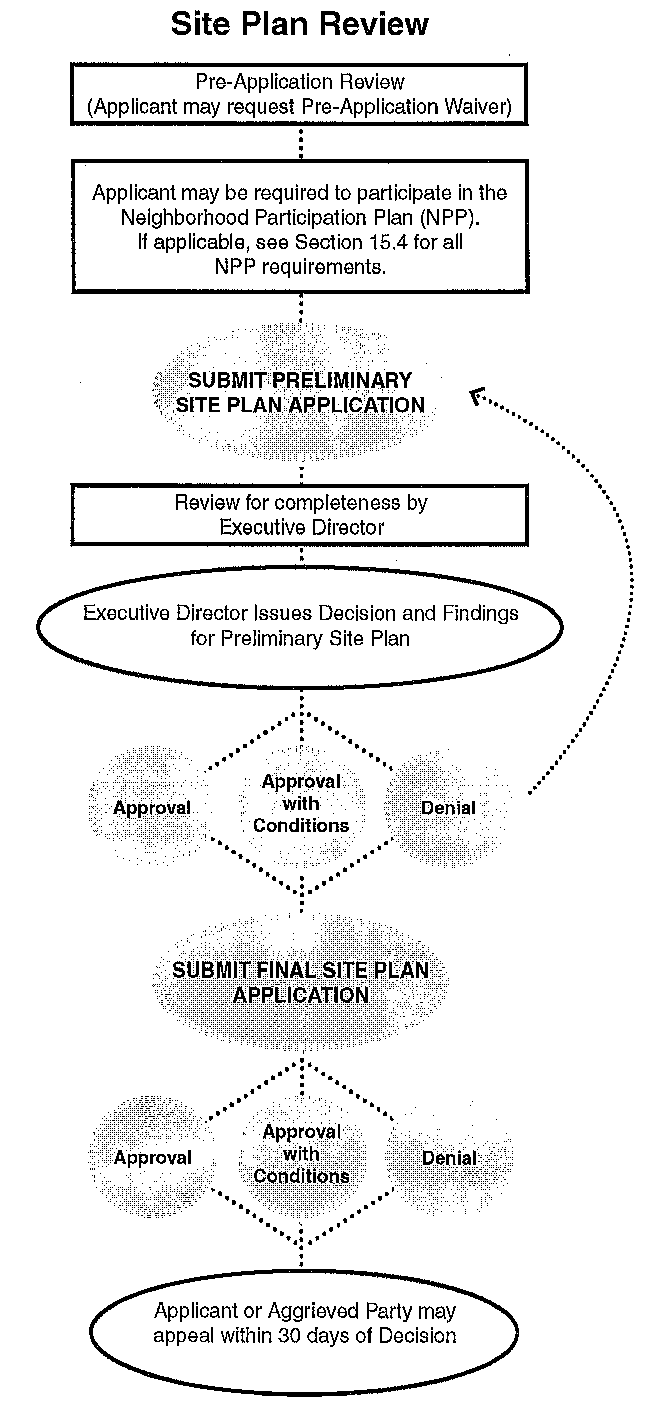
(Ord. No. 76, 2017, § 23, 9-12-17; Ord. No. 19, 2018, §§ 34, 35, 3-13-18; Ord. No. 62, 2018, § 19, 8-14-18; Ord. No. 6, 2019, §§ 31, 34(Exh. G), 2-12-19; Ord. No. 187, 2019, § 29, 12-10-19; Ord. No. 191, 2019, § 23(Exh. F), 1-14-20; Ord. No. 114, 2020, §§ 18, 20, 9-8-20; Ord. No. 196, 2020, §§ 10, 11(Exh. G), 1-12-21; Ord. No. 197, 2020, § 10, 1-26-21; Ord. No. 149, 2024, §§ 14, 15, 11-8-24; Ord. No. 110, 2025, § 1(Exh. B), 10-28-25)
Note— See note at Sections 16.5 and 16.7.
16.9 - PLANNED UNIT DEVELOPMENTS
A.
Purpose
A planned unit development (PUD) shall be classified as a special development type that is subject to the provisions of this section. A PUD may be used to permit new or innovative concepts in land utilization, master-planned communities or mixed-use developments that other zoning districts do not easily accommodate. A PUD also provides site-specific compatibility standards. While greater flexibility is given to allow special conditions or restrictions that would not otherwise allow the development to occur, procedures are established to ensure against misuse of increased flexibility. Planned unit developments are appropriate in areas where the Comprehensive Plan reflects either the specific uses proposed in the planned unit development or where the Comprehensive Plan reflects mixed use as a land use category.
B.
Objectives
The objectives of the planned unit development (PUD) process are:
1.
To encourage unified projects that exhibit creative planning and design in ways that cannot be achieved through a standard zoning district, yet is consistent with all applicable plans including but not limited to the Master Plan, Thoroughfare Plan and the intent of this Code.
2.
Allow the creation of development standards that respect the unique characteristics, natural quality and beauty of the site and the immediate vicinity and protect the community's natural resources by avoiding development on and destruction of sensitive environmental areas.
3.
Promote economical and efficient use of land and reduce infrastructure cost through unified development.
4.
To provide amenities and enhancements that will sustain the quality of life and property values within the development as well as the properties surrounding the proposed PUD.
5.
Assure compatibility between proposed land uses within and around the PUD through appropriate development controls.
6.
Where appropriate, provide community facilities, open space and recreational areas.
7.
To provide a maximum choice of business and living environments by allowing for a variety of housing, building types and imaginative architectural design.
8.
To provide an opportunity for a mix of complementary uses otherwise not permitted within the standard zoning classifications.
9.
To develop land in an orderly, coordinated and comprehensive manner that is consistent with accepted land planning, landscape architecture practices and engineering principles.
C.
Qualifying Conditions
At a minimum, all proposed PUDs shall meet the following qualifying conditions, as applicable, to be considered for approval:
1.
District Regulations. Every planned unit development shall comply with all the regulations established in this Code for the underlying district in which the planned unit development is located, except as provided for in this section. A planned unit development (PUD) may be used to:
a.
Define and condition uses allowed within the underlying districts, including expanding or restricting uses permitted by-right or by special use permit, including alcoholic beverage uses. Planned unit development zoning may specify the location of land uses and define standards, including the hours of operation and performance impacts of land uses.
b.
Specify development standards and actions required to protect the environment and to preserve natural features and vegetation within the district.
c.
Define the development standards pertaining to the building dimensional and setback standards, the number of buildings, the density, the design and exterior appearance of buildings, the standards for lot size and width, the location, extent, and design for open space, landscape, screening and buffers, the permitted appurtenances, signs, and amenities. A planned unit development may modify, delete, or add to standards of the underlying district. The standards may be more or less restrictive than those in the underlying district.
d.
Specify the location and design of streets, drives, parking, and pedestrian and bikeway connections. The planned unit development may be used to modify subdivision standards related to design of public and private facilities, but only where a specific finding is made by the Metropolitan Planning Commission that the alternative standard does not negatively impact public health, safety, and welfare, does not impair traffic movement, and does not result in a higher maintenance cost.
e.
Specify the timing, sequencing, and phasing of development, including coordinating the type, location, and intensity of development permitted with the construction and availability of public facilities and services.
f.
Provide for construction of public improvements and facilities on-site or within public servitudes and rights-of-way abutting the site as required to serve and benefit development within the district or as may be required to mitigate impacts resulting from development on other properties and uses outside the district. Subdivision standards pertaining to the design, performance, and cost participation for public improvements may be amended by a planned unit development.
2.
Designation. The boundary of each planned unit development will be identified on the zoning map and designated with the letters "PUD" followed by a unique number referencing the adopting ordinance and regulations.
3.
Location. Planned unit developments may be located in any part of the City, subject to meeting all other applicable requirements.
4.
Size. The site size for a planned unit development shall be a minimum of five acres and shall be approved by City Council based on the type of development, and:
a.
Rezoning the property to PUD will not result in a significant adverse effect upon nearby properties.
b.
The proposed uses will complement the character of the surrounding area.
c.
PUD approval is not being used as a means to circumvent conventional zoning requirements.
5.
Residential Development. A residential planned unit development shall contain a variety of housing types and/or lot sizes to provide for varying lifestyles, diversity, and affordability.
6.
Commercial Development. A commercial planned unit development shall enhance the City with design and architectural principles, high-quality construction techniques, preservation of natural resources, and the provision of aesthetic amenities.
7.
Industrial Development. An industrial planned unit development areas where industrial, office, and limited commercial uses are planned, should not conflict with surrounding land uses and shall enhance the City with design and architectural principles, high-quality construction techniques, preservation of natural resources, encourage sound traffic patterns, and the provision of aesthetic amenities.
8.
Mixed Use Development. A mixed use planned unit development combines residential and non-residential uses to create a specific environment that provides pedestrian walkability between housing, workplaces, and other amenities.
9.
Recognizable Public Benefit. The planned unit development shall achieve recognizable and substantial benefits that may not be possible under the existing zoning classification(s). At least four or more of the following benefits shall be accrued to the community as a result of the proposed PUD:
a.
Preservation of significant natural features.
b.
Preservation of historic structures and features.
c.
A complementary mix of land uses or housing types, such as:
i.
Senior housing set-aside of a minimum of 20%.
ii.
Affordable housing set-asides within a mixed-income development of a minimum of 20%.
d.
Preservation of common open space beyond the minimum required.
e.
Connectivity of preserved open space with open space, greenways, or public trails on abutting properties.
f.
Open space and recreational amenities including, but not limited to, swimming pools, tennis courts, hiking and jogging trails and fitness courses, playgrounds, skate parks, and similar recreational features, dog parks, natural water features and conservation areas.
g.
Multi-use trails, nature trails, boardwalks, overlooks, landscaped areas with native plantings, which may incorporate water features, such as a detention pond.
h.
Community amenities including plazas, malls, formal gardens, places to congregate, outdoor seating, public art, and pedestrian and public transit facilities.
i.
Coordinated redevelopment of multiple lots or parcels.
j.
Removal or adaptive reuse and renovation of existing buildings, sites, or contamination clean-up.
k.
Reduction of impervious surface throughout the development, including techniques such as low impact development, and the increased use of pervious paving materials.
l.
Enhanced building design above that required by the Code and/or the use of green building and sustainable development techniques, including Leadership in Energy and Environmental Design (LEED) or LEED-equivalent certification of structures.
m.
Appropriate development controls that ensure compatibility between proposed uses and neighboring properties that include all of the following:
i.
An increased landscaping amount of at least two times the minimum requirements, and shall include at least one or more of the following required landscaping areas:
1.
Landscape areas that abut the street right-of-way.
2.
Landscape buffer yards, and
3.
Interior parking lot landscaping.
ii.
The addition of supplemental screening, such as fencing or berming.
iii.
The placement of uses or site features that may be potentially disturbing to neighboring properties to alternate locations within the site in order to substantially lessen the impact of such uses or site features and may include:
1.
Dumpsters or other trash collection facilities,
2.
Loading and delivery areas,
3.
Large truck pathways and maneuvering areas, or
4.
Other features of uses that generate higher volumes of vehicular traffic, noise, or particulate that may produce irritating fumes or smells.
iv.
Elimination of non-conforming site elements that are not required to be removed but are voluntarily removed by the applicant.
D.
Procedures, Forms and Standards
The Executive Director shall establish procedures, forms and standards with regard to the content, format and information constituting any PUD application. The Executive Director may amend and update the application materials from time-to-time, as necessary.
E.
Approval Process
Approval of a planned unit development (PUD) includes a pre-application meeting, possible neighborhood participation plan meeting, preliminary site plan approval, and final site plan approval.
1.
Pre-Application Meeting with Executive Director
Prior to formal submittal of any PUD application, the applicant is required to schedule a pre-application meeting with the Executive Director.
a.
At a pre-application meeting, the applicant shall provide information as to the location of the proposed PUD, the proposed uses, proposed public and private improvements, including the proposed public benefits and amenities, anticipated exceptions to this Code, and any other information necessary to explain the planned unit development.
b.
The purpose of such pre-application meeting is to make advice and assistance available to the applicant before preparation of required preliminary site plan, so that the applicant may determine whether the PUD follows the provisions of this Code and other applicable regulations, and whether the proposed planned unit development will be in conformity with the adopted land use policies.
c.
The pre-application meeting does not require a formal application, fee, or filing of a planned unit development application. Any opinions or advice provided are in no way binding with respect to any official action that may be taken on the subsequent formal application.
2.
Neighborhood Participation Plan
Some PUD applications may be required to include a Neighborhood Participation Plan (NPP) report. If required, the PUD application will not be deemed complete until all mandatory NPP documents are submitted to MPC staff. All requirements for the NPP program are described in Section 15.4 (Neighborhood Participation Plan).
3.
Preliminary Site Plan
All PUD applications shall submit a preliminary site plan in accordance with the following and shall contain all submittal requirements outlined in this subsection.
a.
Action by Metropolitan Planning Commission
i.
After receipt of a complete application, including a summary, staff comments, and a recommendation from the Executive Director of the MPC, the Metropolitan Planning Commission shall consider the preliminary site plan at a public hearing in accordance with Section 15.3 (Public Hearing). Notice for the public hearing shall be in accordance with Section 15.2 (Notice).
ii.
The Metropolitan Planning Commission shall evaluate the preliminary site plan based upon the evidence presented at the public hearing, pursuant to the approval standards of this section and shall recommend any of the following actions: recommendation of approval, recommendation of approval with conditions, or recommendation of denial of the preliminary site plan.
iii.
Within 60 days of the date a recommendation is rendered, the Metropolitan Planning Commission shall forward its recommendation to the City Council.
b.
Action by City Council
The City Council shall take action on the preliminary site plan for properties within the boundaries of the City of Shreveport in one of the following ways: approve, approve with conditions, or deny.
i.
The City Council shall act on the preliminary site plan within 90 days of receipt of the Metropolitan Planning Commission recommendation unless the City Council grants additional consideration time before the 90-day period has expired. The City Council shall take action in the form of approval, approval with conditions, or denial.
ii.
If the City Council does not act upon the preliminary site plan within 90 days of receipt of the Metropolitan Planning Commission recommendation, the preliminary plan is deemed denied unless the City Council grants additional consideration time before the 90-day period has expired.
c.
Approval Standards for Preliminary Site Plan
The recommendation of the Metropolitan Planning Commission and decision of the City Council shall make findings to support the following standards for all PUD:
i.
Compliance with the Master Plan and adopted land use and design studies.
ii.
Compliance with this Code and other applicable development regulations, and previously approved valid plans for the property.
iii.
Impact on the site's natural resources and effect on adjacent area, property, and land use.
iv.
Safety and efficiency of vehicular, bicycle, and pedestrian circulation, traffic control, and congestion mitigation.
v.
Safety and convenience of off-street parking and loading facilities.
vi.
Access for firefighting and emergency equipment to buildings.
vii.
Use of landscape and screening to shield lights, noise, movement, or activities from adjacent properties, and to complement the design and location of buildings and parking.
d.
Effect of Approval of Preliminary Site Plan
i.
For a planned unit development (PUD), following approval of the preliminary site plan, the applicant will prepare and file a final site plan that includes all or a portion of the area included in the preliminary site plan.
ii.
A copy of the preliminary site plan shall be registered in the official case record and is binding upon the applicants, their heirs, successors, and assigns. The approved site plan limits and controls the issuance and validity of permits and certificates, and restricts and limits the use and operation of all land and structures within the area designated in the site plan to all conditions and limitations specified in the approval. Except as provided for in this section, the MPC staff shall review building permits and approve zoning certificates for buildings or structures in accordance with the approved site plan and with all other applicable ordinances and regulations.
4.
Final Site Plan for Planned Unit Development (PUD)
a.
Following approval of the preliminary site plan for a planned unit development (PUD), the applicant will prepare and file a final site plan for the Executive Director that includes all or a portion of the area included in the preliminary site plan.
b.
If in compliance with the approved preliminary site plan, the Executive Director will approve the final site plan for use in the issuance of building permits.
c.
If the final site plan reflects significant change from the preliminary site plan, the Executive Director will forward the final site plan to the Metropolitan Planning Commission for further consideration in accord with procedures established for preliminary site plan review.
d.
Upon approval of the final site plan, a copy of such plan shall be registered in the official case record and is binding upon the applicants, their heirs, successors, and assigns. The approved final site plan limits and controls the issuance and validity of permits and certificates, and restricts and limits the use and operation of all land and structures within the area designated in the final site plan to all conditions and limitations specified in the approval. Except as provided for in this section, the Zoning Administrator shall approve building permits or zoning certificates for buildings or structures in accordance with the approved final site plan and with all other applicable ordinances and regulations.
F.
Binding Nature of Approved Site Plans
Any approved site plan, whether preliminary or final, along with any conditions made at the time of approval shall be binding upon the applicant or any successors in interest in the planned unit development. Deviations from any approved site plan not in accordance with Subsection 16.9.F below shall constitute a violation of this Code.
G.
Modifications to Approved Site Plans
1.
The Executive Director may approve minor amendments to the final site plan provided the amendment conforms to the following standards:
a.
The amendment does not increase the density of the development by no more than 10% in the total number of residential units.
b.
The amendment does not substantially alter the arrangement of buildings, increase the number or size of buildings (limited to no more than a 10% increase in the total gross floor area in square feet), or change the use of building space designated within the original plan.
c.
The amendment does not substantially alter the configuration of streets or lots.
d.
The amendment does not substantially alter vehicular circulation or placement of parking areas.
e.
The amendment does not significantly reduce or lessen the effectiveness of open space, landscape buffers, and edges.
f.
The amendment does not conflict with other regulations specified within the ordinance establishing the PUD.
2.
All other requested modifications to a final site plan require submittal as a new preliminary site plan for review and approval, and shall follow the review procedures as identified in this section.
H.
Expiration and Failure to Begin Development
1.
The approval of a preliminary site plan for a planned unit development (PUD) is effective for a period of three years from the date of approval by the City Council, at the end of which time the applicant shall have submitted and received approval of a final site plan. The Executive Director, after reviewing the current conditions of the site and verifying that there is no significant change in the development or traffic patterns in the area, may extend the approval period for up to an additional three years. If a final site plan is not approved within three years of the original approval of the preliminary site plan, or within the time extended by the Executive Director, the preliminary site plan approval is null and void. If the final site plan approval is only for a portion of the property, the approval of the preliminary site plan for the remaining property is null and void if a phasing plan with extended timelines was not approved as part of the preliminary site plan application. Any further action shall require a new application and approval.
2.
The approval of the final site plan is effective for a period of three years. The Executive Director, after reviewing the current conditions of the site and verifying that there is no significant change in the development or traffic patterns in the area, may extend the approval period for up to an additional three years. If engineering plans and building permits are not approved and permitted construction activities have not commenced within three years, or within the time extended by the Executive Director, the final site plan approval is null and void. If engineering plans and permits have been approved only for a portion of the property and permitted construction activities has commenced, the final site plan for the remaining property is null and void if a phasing plan with extended timelines was not approved as part of the preliminary site plan application. Any further action shall require a new application and approval subject to the existing regulations.
I.
Appeals
A.
Within 30 days after the date of the decision, the applicant or any aggrieved party may appeal a City Council decision on a planned unit development (PUD) application to Caddo Parish Civil District Court.
B.
Within 30 days after the date of the decision for any administrative action taken on a conditional zoning district application, the applicant or any aggrieved party may appeal an Executive Director's decision to the Zoning Board of Appeals.
(Ord. No. 149, 2024, § 16(Exh. E), 11-8-24)
Editor's note— Ord. No. 149, 2024, § 16(Exh. E), adopted November 8, 2024, repealed and reenacted Section 16.9 in its entirety to read as herein set out. Formerly, Section 16.9 pertained to planned unit developments and small planned unit developments, and derived from Ord. No. 187, 2019, § 30, adopted December 10, 2019; Ord. No. 192, 2019, § 7, adopted January 14, 2020; Ord. No. 114, 2020, § 18, adopted September 8, 2020; Ord. No. 196, 2020, § 12, adopted January 12, 2021; Ord. No. 197, 2020, § 10, adopted January 26, 2021; Ord. No. 66, 2021, § 5, adopted May 11, 2021, and Ord. No. 95, 2021, § 18, adopted July 13, 2021.
16.10 - CONDITIONAL ZONING DISTRICT
A.
Purpose
A conditional zoning district (CZD) may be established to provide flexibility in the development of property while ensuring that a development is compatible with neighboring uses. Conditional zoning affords a degree of certainty in land use decisions not typically possible in conventional zoning.
B.
Conditional Zoning District Designation
Each conditional zoning district shall be designated on the City's Zoning Map and other official documents by combining the designation of its base zoning district with the suffix, "-CZD". For example, the conditional zoning district with a base zoning district of Rural Agricultural would be identified as "R-A-CZD" on the Zoning Map.
C.
Relationship to Base Zoning District
Development in a conditional zoning district shall be subject to all the use and development standard requirements that apply to development in the base zoning district, plus the conditions imposed as part of the conditional zoning approval.
D.
Procedures, Forms and Standards
The following are general submittal requirements for requesting to apply for a conditional zoning district:
1.
Property may be placed in a conditional zoning district only in response to an application by all owners of the property to be included in the CZD.
2.
The applicant must clearly include in the application any uses proposed to be permitted on the subject property. No uses will be permitted except those enumerated in the enacting ordinance establishing the CZD.
3.
The Executive Director shall establish procedures, forms and standards with regard to the content, format and information constituting any CZD application. The Executive Director may amend and update the application materials from time to time.
4.
An application for conditional zoning must include a site plan, drawn to scale, and supporting information and text, as determined by the Executive Director, that specifies the actual use or uses intended for the property and any rules, regulations and conditions that, in addition to all predetermined requirements, will govern the development and use of the property.
E.
Approval Process for Conditional Zoning District
1.
Conditional zoning district decisions are subject to the same procedures as applicable to a zoning map amendment, as described in Section 16.2 (Zoning Map Amendment) of this Code, except for the standard of review as outlined herein.
2.
Conditional zoning district decisions shall be made in consideration of identified relevant adopted land use plans for the area, including, but not limited to, the master plan, strategic plans, corridor plans, and other land-use policy documents.
3.
In making their recommendation and decision, the Metropolitan Planning Commission and City Council must consider the following standards. The approval of a conditional zoning district is based on a balancing of these standards and design specifications:
a.
Compliance with the master plan and adopted land use and design studies.
b.
Compliance with this Code and other applicable development regulations, and previously approved valid plans for the property.
c.
Safety and efficiency of vehicles, bicycle, and pedestrian circulation, traffic control, and congestion mitigation.
d.
Safety and convenience of off-street parking and loading facilities.
e.
The degree to which site design mitigates negative impacts on neighboring uses.
f.
Access for firefighting and emergency equipment to buildings.
g.
The trend of development, if any, in the general area of the property in question.
F.
Neighborhood Participation Plan
Some CZD applications may be required to include a Neighborhood Participation Plan (NPP) report. If required, the CZD application will not be deemed complete until all mandatory NPP documents are submitted to MPC staff. All requirements for the NPP program are described in Section 15.4 (Neighborhood Participation Plan) of this Code.
G.
Fair and Reasonable Conditions
1.
Specific conditions may be proposed by the applicant, MPC, or the City or its agencies, but only those conditions approved by the City Council shall incorporated into the district regulations.
2.
Conditions and site-specific standards imposed in a conditional zoning district shall be limited to those that address conformance of the development and use of the site to local ordinances, plans adopted pursuant to this Code, or the impacts reasonably expected to be generated by the development or use of the site.
3.
Such conditions to approval of the request may include, but are not limited to, dedication to the City, Parish or state, as appropriate, of any land, rights-of-way or easements for streets, water, sewer, drainage, recreational uses or other public utilities necessary to serve the proposed development.
4.
Conditions may relate to the relationship of the proposed use to surrounding property, size, scale, location and design of structures, proposed support facilities such as parking areas and driveways, pedestrian and vehicular circulation systems, screening and buffer areas, preservation of protected trees, the phasing of development, street and right-of-way improvements, water and sewer improvements, stormwater drainage, the provision of open space, and other matters that the City Council may find appropriate or the applicant may propose.
5.
If for any reason any condition for approval is found to be illegal or invalid or if the applicant should fail to accept any condition following approval, the approval of the site plan for the CZD shall be null and void and of no effect. Proceedings shall be instituted to rezone the property to its previous zoning classification.
H.
Effect of Approval
1.
If a request for conditional zoning is approved by the City Council, the development and use of the property shall be governed by the predetermined ordinance requirements applicable to the district's classification, any approved site plan for the district, and any additional approved conditions, as applicable, all of which shall constitute the zoning regulations for the approved district and are binding on the property as an amendment to these regulations and to the Zoning Map.
2.
If a CZD request is approved, only those uses and structures indicated in the enacting ordinance or indicated on a site plan referenced by the enacting ordinance shall be allowed on the subject property.
3.
Following the approval of the request for a conditional zoning district, the subject property shall be identified on the Zoning Map by the appropriate district designation. A conditional zoning district shall be identified by the same designation as the underlying general district followed by the letters "CZD" (for example, Rural Agriculture Conditional Zoning District would be designated as "R-A-CZD").
4.
No permit shall be issued for any development activity within a CZD except in accordance with the approved request and, if applicable, a site plan for the district.
5.
Any violation of the approved conditional zoning district or associated conditions for the district shall be treated the same as any other violation of this development regulation and shall be subject to the same remedies and penalties as any such violation.
I.
Modifications to an Approved Site Plan
1.
Major Changes. Major changes to approved site plans and conditions of development for a conditional zoning district may be authorized only by the City Council after review and recommendation by the Metropolitan Planning Commission in the same manner as applicable to Zoning Map amendments. Major changes include, but are not limited to:
a.
Change in use(s); except those permitted in the base zoning district.
b.
Increase in intensity of the development; such as, increase in density of units, whether residential, office, commercial or industrial;
c.
An increase of 10% or greater of overall ground coverage by structures; except those permitted in the based zoning district.
d.
A reduction in approved open space or screening;
e.
A change in vehicular access; or
f.
A variation from an imposed condition.
2.
Minor Changes. Minor changes, which are not deemed as major changes by the Executive Director or as set forth under the subsection above may, at his or her discretion, be authorized by the Executive Director in accordance with the following:
a.
The Executive Director shall have the delegated authority to approve minor changes to an approved site plan which is part of an approved conditional zoning district.
b.
The standard for approving or denying such a requested change shall be that the change does not significantly alter the site plan and that the change does not have a significant impact upon abutting properties and does not qualify as a major change as set forth in the subsection above.
c.
Any decision must be in writing stating the grounds for approval or denial.
d.
If the Executive Director declines to exercise the authority to approve minor changes to an approved site plan, the applicant may request a zoning map amendment as permitted by this Article.
e.
Any request for a minor change/administrative amendment shall be pursuant to a written letter, signed by the property owner(s), detailing the requested change. Upon request, the applicant must provide any additional information that is requested. Upon an approval of any minor change, the applicant must file a sufficient number of copies of a revised site plan (as applicable) as deemed necessary by the Executive Director.
J.
Review of Approval of a Conditional Zoning District
It is intended that property shall be reclassified to a Conditional Zoning District only in the event of firm plans to develop the property. Therefore, no sooner than three years after the date of approval of a CZD application, the Executive Director may examine the progress made toward developing the property in accordance with the approved application and any conditions attached to the approval. If the Executive Director determines that progress has not been made in accordance with the approved application and conditions, the Executive Director shall forward a report to the Metropolitan Planning Commission, which may recommend that the property be rezoned to its previous zoning classification or to another district.
K.
Appeals
A.
Within 30 days after the date of the decision, the applicant or any aggrieved party may appeal a City Council decision on a conditional zoning district (CZD) application to Caddo Parish Civil District Court.
B.
Within 30 days after the date of the decision for any administrative action taken on a conditional zoning district application, the applicant or any aggrieved party may appeal an Executive Director's decision to the Zoning Board of Appeals.
(Ord. No. 149, 2024, § 17(Exh. F), 11-8-24)
16.11 - SIGN PERMIT
A.
Applicability
No sign, except those identified as exempt by this Code, may be erected, constructed, altered, or relocated without first obtaining a sign permit.
B.
Authority
The Zoning Administrator, with concurrence of the Executive Director, is responsible for determining compliance with this Code and for issuing a sign permit.
C.
Process
Upon the filing of an application for a sign permit, the Zoning Administrator will determine whether the application is complete. Once it is determined that the application is complete, the Zoning Administrator will:
1.
Examine the plans and specifications and the premises upon which the proposed structure is to be erected.
2.
Issue a permit if the structure complies with the requirements of this Code and all other ordinances, including the electrical code.
D.
Inspection
The Zoning Administrator may inspect, as deemed appropriate, each sign regulated by this Code. The purpose of the inspection is to ascertain whether the structure is secure or insecure, whether in need of repair or removal, or not in conformance with the permit application or otherwise in violation of the provisions of this Code.
E.
Expiration
If the work authorized under a sign permit is not completed within 180 days after the date of issuance, the sign permit becomes null and void.
F.
Appeals
Within 30 days after the date of the decision, the applicant or any aggrieved party may appeal the Zoning Administrator's decision on a sign permit to the Zoning Board of Appeals.
(Ord. No. 114, 2020, § 18, 9-8-20; Ord. No. 197, 2020, § 10, 1-26-21; Ord. No. 149, 2024, § 17, 11-8-24)
Note— Ord. No. 194, 2024, § 17, adopted November 8, 2024, redesignated the former Sections 16.10—16.16 as Sections 16.11—16.17. The historical notation has been preserved for reference purposes. See also editor's notes as Sections 16.5 and 16.7.
16.12 - ZONING INTERPRETATION
A.
Purpose
The interpretation authority is intended to recognize that the provisions of this Code, though detailed and extensive, cannot, as a practical matter, address every specific zoning issue. However, this zoning interpretation authority is not intended to add or change the essential content of the Code.
B.
Initiation
The City Council, or a property owner in the City of Shreveport, or person expressly authorized in writing by the property owner, may initiate a zoning interpretation application. All interpretation requests must be for the purpose of furthering some actual development.
C.
Authority
The Executive Director will review and make final decisions on written requests for zoning interpretations.
D.
Process
1.
All applications for interpretations must be filed with the Executive Director in accordance with the requirements in Section 15.1 (Application).
2.
The Executive Director must review a written request for an interpretation and render the interpretation in writing within a reasonable time.
3.
The Executive Director may request additional information prior to rendering an interpretation.
E.
Appeals
Within 30 days after the date of the decision, the applicant or any aggrieved party may appeal the Executive Director decision on a zoning interpretation to the Zoning Board of Appeals.
(Ord. No. 114, 2020, § 18, 9-8-20; Ord. No. 197, 2020, § 10, 1-26-21; Ord. No. 149, 2024, § 17, 11-8-24)
Note— See editor's notes at Sections 16.5, 16.7 and 16.11.
16.13 - TEMPORARY USE PERMIT
A.
Purpose
A temporary use permit allows for the short-term use and/or placement of structures on a lot. The temporary use permit regulates temporary uses that occur entirely on and within a lot. Temporary uses located within the public right-of-way are regulated separately outside of this Code.
B.
Initiation
A property owner in the City of Shreveport, or person expressly authorized in writing by the property owner, may initiate a temporary use permit application.
C.
Authority
The Zoning Administrator, with concurrence of the Executive Director, will review and make final decisions on temporary use permit applications.
D.
Process
1.
All applications for temporary use permit must be filed with the Zoning Administrator in accordance with the requirements in Section 15.1 (Application).
2.
The Zoning Administrator must render a decision on the temporary use permit within 30 days of the date the application is deemed complete. The Zoning Administrator must review and evaluate the application, pursuant to the standards of this Section, and approve, approve with conditions, or deny the application.
E.
Approval Standards
All temporary uses must comply with the requirements of this Code, including the temporary use standards located in Article 6 (Use Standards), and the following additional standards:
1.
Unless expressly allowed by this Code, the temporary use or structure complies with the yard and bulk requirements of the district in which it is located.
2.
The temporary use does not negatively impact the public health, safety, and welfare.
3.
The temporary use is operated in accordance with such restrictions and conditions as the applicable police and fire department may require. The operator of the temporary use may be required to employ appropriate security personnel.
4.
The temporary use does not conflict with another previously authorized temporary use.
F.
Expiration
The temporary use permit is valid only for the time period granted as part of the approval. If no time period is specified, then the temporary use permit is only valid for 30 days.
G.
Appeals
Within 30 days after the date of the decision, the applicant or any aggrieved party may appeal a Zoning Administrator decision on a temporary use permit to the Zoning Board of Appeals.
(Ord. No. 76, 2017, § 24, 9-12-17; Ord. No. 114, 2020, § 18, 9-8-20; Ord. No. 197, 2020, § 10, 1-26-21; Ord. No. 149, 2024, § 17, 11-8-24; Ord. No. 110, 2025, § 1(Exh. B), 10-28-25)
Note— See editor's notes at Sections 16.5, 16.7 and 16.11.
16.14 - TEMPORARY CERTIFICATE OF OCCUPANCY
A.
Intent
A temporary certificate of occupancy (TCO) may be issued by the Zoning Administrator prior to the final certificate of occupancy (CO) being issued. The TCO is intended to acknowledge that some site features or building features may not be completed even though the site or building is safe for occupancy, or that a portion of the site or building can be safely occupied while work continues in another area. Then, upon application, the Zoning Administrator shall issue a CO when, after examination and inspection, it is found that the site and building, in all respects, conforms to the provisions of this Code, as well as all other regulatory codes, for the occupancy intended.
B.
Applicability
1.
A TCO shall only be issued for non-residential development in which the City Engineer, Zoning Administer, Fire Department and Chief Building Official have determined a plan for completing the appropriate work has been established. Commercial establishments that include food service will also need Caddo Parish Health Department authorization.
2.
TCO's requires all the same inspections as a CO and should only be issued when incidental construction remains. For this reason, the applicant should not view the TCO as a short cut to occupying the structure.
3.
The following items will be considered before a TCO is issued:
a.
The scope of the remaining work and its impact on the use of the space;
b.
How the space will be maintained safe and accessible while the remaining work is completed; and
c.
The timeframe needed to complete the remaining work.
(Ord. No. 114, 2020, § 21, 9-8-20; Ord. No. 197, 2020, § 10, 1-26-21; Ord. No. 149, 2024, § 17, 11-8-24)
Note— See notes at Sections 16.7 and 16.11.
16.15 - CERTIFICATE OF OCCUPANCY
A.
Generally
1.
A Certificate of Occupancy (CO) is required showing that any land, building or structure, and its use are in compliance with all permits and occupancy guidelines according to the provisions of this Code, the building code, approval conditions, and all other pertinent ordinances. It shall be unlawful to occupy any building or structure unless a full, or temporary certificate of occupancy has been issued by the Zoning Administrator.
2.
It shall be unlawful to operate a business without any type of certificate of occupancy. No building, structure, or premises shall be used or occupied, and no change in the existing occupancy classification of a building or structure or portion thereof, shall be made until the Zoning Administrator has issued a certificate of occupancy.
B.
Application
1.
Application for a full or temporary certificate of occupancy shall be made on a form approved by the Zoning Administrator.
2.
Accessory buildings or structures shall not require a separate certificate of occupancy, but rather may be included in the certificate of occupancy for the principal building or structure on the same lot, provided that such accessory buildings or structures are completed at the same time as or subsequent to the principal use.
C.
Issuance
No certificate of occupancy for any building or structure that is erected, altered, or repaired after the adoption of this Code shall be issued by Zoning Administrator unless such building or structure was erected, altered, or repaired in compliance with the provisions of this Code, applicable building codes, approval conditions, and other pertinent ordinances. Certificates of occupancy may be issued as follows:
1.
Certificate of Occupancy (CO). Certificates of occupancy shall be issued for buildings, structures, or parts thereof, or uses of land if after inspection, it is found that such buildings, structures, or parts thereof, or such use of land, comply with the provisions of this Code, the building code, approval conditions, and all other pertinent ordinances.
2.
Temporary Certificate of Occupancy (TCO). A temporary certificate of occupancy may be issued for a period not exceeding six months where construction, reconstruction, or remodeling does not require the vacating of the structure. Then, and only then, may a temporary certificate be issued to allow occupancy while work is in progress, provided that all necessary precautions have, in the opinion of the Zoning Administrator, been taken to ensure safety to the applicants. The Zoning Administrator may issue a temporary certificate of occupancy, provided that:
a.
The building or structure is fully completed, safe, and ready for occupancy; and
b.
The building, structure, and/or lot is in conformity with the provisions of this Code, International Building Code (as amended), approval conditions, and all other pertinent ordinances.
D.
Procedure
Procedure for a certificate of occupancy or a certificate of compliance shall be according to the procedures set out by the Zoning Administrator.
E.
Decision Criteria
1.
Decisions shall be rendered according to the procedures set out in this Code, the International Building Code, as amended, and the International Property Maintenance Code (as amended), approval conditions, and all other pertinent ordinances. If the Zoning Administrator refuses a certificate of occupancy for cause, the Zoning Administrator shall notify the applicant of the refusal and the cause.
2.
The Zoning Administrator shall maintain a record of all certificates of occupancy and certificates of compliance, and copies shall be a public record open to inspection by interested parties at reasonable times and upon reasonable notice and shall be furnished upon the request to any person.
3.
Failure to obtain a certificate of occupancy or a certificate of compliance, as described with this article, shall be a violation of this Code.
4.
The Zoning Administrator may revoke a certificate of occupancy and compliance when it is found that the building, structure or land does not conform to the use or condition, if any, in the certificate.
5.
Each day a use continues after revocation of the certificate shall constitute a separate offense and shall be punished, as provided herein.
(Ord. No. 76, 2017, § 25, 9-12-17; Ord. No. 114, 2020, §§ 18, 21, 9-8-20; Ord. No. 197, 2020, § 10, 1-26-21; Ord. No. 195, 2022, § 4, 12-13-22; Ord. No. 149, 2024, § 17, 11-8-24)
Note— Ord. No. 114, 2020, § 21, adopted September 8, 2020, redesignated the former Sections 16.12 and 16.13 as Sections 16.13 and 16.14. The historical notation has been preserved for reference purposes. See also editor's notes at Sections 16.5, 16.7 and 16.11.
16.16 - RESIDENTIAL RENTAL PROPERTY REGISTRATION
A.
Purpose
1.
Due to their impact on community character, property values and overall quality of life, residential rental properties are significant assets and represent a critical investment in the City of Shreveport To help maintain the quality of neighborhoods with the community, as well as to help facilitate effective code enforcement, the City must be able to efficiently communicate with property owners regarding maintenance and property conditions.
2.
In instances when residential properties are rented to others, rather than owner-occupied, the City of Shreveport has determined it is necessary to obtain accurate and current contact information in order to facilitate timely communication with property owners regarding potential issues related to property conditions and/or violations within this Code, within the Shreveport City Code including, but not limited to Chapter 38, and/or the laws of the State of Louisiana. The City has also determined that an inability to make timely contact with the owners of such residential rental properties may result in extended physical deterioration of housing stock and/or substandard living conditions for City residents. Therefore, registration for rental properties is in the best interest of public health, safety, and welfare and that the good order and governance of the City will be promoted and enhanced by the enactment of registration requirements for such residential rental properties and their owners through the adoption of the provisions set forth in this Section.
B.
Applicability
Except as provided below, no individual, corporation, business trust, estate, trust, partnership or association, any other legal or community entity, or any person or entity who has obtained any percentage of any residential rental property through a tax sale may rent, or offer to rent, to individuals or households any rental dwelling unit, as defined by this Code, until the residential rental property has been registered and a certificate of registration has been issued by the Office of the MPC.
C.
Exceptions
The registration requirements of this Section shall apply to all residential rental properties with the exception of:
1.
Properties for hotels, motels, inns, bed and breakfasts, single room occupancy or boarding houses, short-term rentals, RV parks, or other similar accommodations that provide lodging for transient guests;
2.
Properties for any state or federal licensed hospital, hospice, community care facility, intermediate care facility, nursing home, or other similar accommodations to which such properties are subject to licensing or regulations concerning the safety of the users, patients or tenants;
3.
Properties owned, managed, or operated by an educational or medical institution, or by a third party for any of the above institutions, when the properties are used for the sole use of employees, students, patients or others directly related to the institution;
4.
Properties that a government entity or housing authority owns, operates, or manages; or units exempted from municipal regulation by federal, state, or local law;
5.
Properties for any convent, monastery, parsonage, or other facility occupied exclusively by members of a religious order, clergy or congregation;
6.
Emergency or temporary shelter or transitional housing accommodations;
7.
Any individual residential dwelling unit that is owner-occupied; or
8.
Any person or entity that owns no more than two residential rental single-family properties.
D.
Appointment of a Local Authorized Designee Required
1.
Each residential rental property owner shall appoint a local authorized designee upon whom the City may lawfully serve notices pertaining to the administration of this or any other section of the City Code, or state or federal law of which, shall be as effective as if made upon such residential rental property owner.
2.
The residential rental property owner may serve as the local authorized designee, provided all requirements of a local authorized designee, as prescribed within this Section, are met by the residential rental property owner.
E.
Registration
1.
All residential rental properties shall be registered with the Office of the MPC by either the property owner or their local authorized designee.
2.
Every registrant for residential rental property registration shall file a complete registration form with the Office of the MPC, upon a form provided for that purpose, and be signed by the owner or their authorized local designee.
3.
Should any registrant owning more than two residential rental properties, which are located at separate and unique address locations—regardless of type of structure or the number of structures on site—all properties may be included on one application form, provided that each different property is uniquely identified.
4.
Upon completion of the residential rental property registration form, the Office of the MPC shall issue to the registrant a certificate of registration as proof of the registration.
5.
A certificate of registration is not transferable to any person or entity who has acquired ownership of a registered residential rental property, nor it is transferable to any tax sale party. Any tax sale purchaser shall be required to register their property, as required in Subsection 16.15(F) herein.
6.
Any person or entity, including all tax sale purchasers, owning residential rental property at the time of the adoption of this Section shall have one year from the effective date of this Section to comply with the registration provisions contained within this Section.
F.
Tax Sale Ownership Registration Required
1.
Any person or entity that acquires any type of residential rental property ownership through a tax sale purchase shall be required to register the property as required by this Section within 60 days of acquiring a tax sale certificate.
2.
If the property is redeemed, the person or entity redeeming the property shall contact the Office of the MPC. All registrations for the property shall be updated accordingly by the Office of the MPC. Any invalid registration associated with the redeeming of the property will become null and void.
G.
Fees
All applicable fees shall be established by Article 25 of this Code and shall be kept on file in the Office of the Metropolitan Planning Commission.
H.
Violation
Violation of any term, condition, or requirement approved under this Section is unlawful, and will constitute a violation of this Code, and will subject the violator to the penalties set forth in Article 19 (Enforcement). All violations shall be enforced in accordance with this Code and any other applicable Shreveport City Code provisions.
1.
No person shall rent, or permit or allow another person to rent or to occupy, a rental dwelling unit within a residential rental property that is not registered or updated in accordance with this Section. Each day that any person rents, or permits or allows another person to rent or to occupy a rental dwelling unit in violation of this article shall be considered a separate offense.
2.
It is unlawful for any person to provide false information on the prescribed registration form.
3.
It is unlawful to fail to submit a new registration form as required in Subsection 16.15(E) herein.
(Ord. No. 195, 2022, § 5(Exh. C), 12-13-22; Ord. No. 149, 2024, § 17, 11-8-24)
Note— See editor's note at Section 16.11.
16.17 - APPEAL OF ZONING ADMINISTRATOR OR EXECUTIVE DIRECTOR ADMINISTRATIVE DECISIONS
A.
Purpose
The appeals process of an administrative decision is intended to provide appropriate checks and balances on the administrative authority of the Zoning Administrator or Executive Director.
B.
Initiation
1.
A property owner in the City of Shreveport, or person expressly authorized in writing by the property owner, that is directly affected by a determination of the Zoning Administrator or Executive Director may file an appeal of the Zoning Administrator or Executive Director's decision on an administrative exception (Section 16.7), zoning interpretation (Section 16.12), temporary use permit (Section 16.13), or other administrative zoning decision related to this Code, excluding site plan review.
2.
The Executive Director's decision on site plan review is appealed to the Metropolitan Planning Commission in accordance with Section 16.8.
C.
Authority
The Zoning Board of Appeals will take formal action on appeal applications of administrative decisions.
D.
Process
1.
All applications must be filed with the Executive Director in accordance with Section 15.1 (Application). Once it is determined that the application is complete, the Executive Director will schedule the appeal application for consideration by the Zoning Board of Appeals.
2.
The application must be accompanied by a written statement that specifies the grounds for the appeal. The applicant for an appeal has the burden of proof to rebut the presumption of correctness of a determination of the Zoning Administrator or Executive Director by a preponderance of the evidence.
3.
After receipt of a complete appeal application, the Zoning Board of Appeals will consider the proposed zoning appeal at a public hearing in accordance with Section 15.3 (Public Hearing). Notice for the public hearing must be in accordance with Section 15.2 (Notice). The Zoning Board of Appeals will consider whether the Zoning Administrator's or Executive Director's action was appropriate considering the details of the case and the requirements of this Code.
4.
Within 60 days of the close of the public hearing, the Zoning Board of Appeals shall either confirm or overturn the Zoning Administrator or Executive Director's administrative decision.
E.
Limitations on Zoning Appeals
Within 30 days after the date of the decision, the applicant or any aggrieved party may appeal a Zoning Administrator, Executive Director or other staff administrative decision to the Zoning Board of Appeals.
(Ord. No. 114, 2020, §§ 18, 21, 9-8-20; Ord. No. 197, 2020, § 10, 1-26-21; Ord. No. 195, 2022, § 5(Exh. C), 12-13-22; Ord. No. 149, 2024, § 17, 11-8-24)
Editor's note— Ord. No. 195, 2022, § 5(Exh. C), adopted December 13, 2022, redesignated the former Section 16.15 as Section 16.16. The historical notation has been preserved for reference purposes.
Note— See editor's notes at Sections 16.5, 16.7, 16.11 and 16.13.

