
Shreveport City Zoning Code
ARTICLE 7
- ON-SITE DEVELOPMENT STANDARDS
7.1 - GENERAL REQUIREMENTS
A.
Number of Structures on a Lot
1.
In the R-A, R-E, R-1-12, R-1-10, R-1-7, R-1-5, and R-UC Districts there must be no more than one principal building per lot. This does not include permitted accessory structures, permitted accessory dwelling units, or agricultural structures. This also does not apply to educational facilities. In all other districts, more than one principal building is permitted on a lot, provided that it complies with all dimensional standards of the district.
2.
In any district, including the districts listed in item 1 above, a resident may reside in an existing residential structure while a new residential structure is being constructed on site. The existing structure may remain on the site until the new structure is complete. Once final inspection of the new structure has been made, the property owner has a maximum of 30 days to obtain a demolition permit from the date of final inspection and then 15 days from the date the demolition permit has been issued to demolish the original structure.
B.
All Activities within an Enclosed Structure
Within all districts, all activities must be conducted entirely within an enclosed structure, with the exception of the following uses and activities:
1.
Parking lots, principal and ancillary.
2.
Park/playground, conservation areas, and similar open space uses.
3.
Establishments with a permitted outdoor component, including, but not limited to, agriculture, outdoor amusement facilities, outdoor storage yards, heavy retail, rental, and service, outdoor storage yards, salvage yards, outdoor dining, car washes, animal care facilities, kennels, light and heavy industrial, and similar businesses. However, these businesses may be limited or the outdoor components prohibited as a condition of a special use, when special use approval is applicable.
4.
Permitted outdoor storage, and outdoor sales and display areas.
5.
Permitted outdoor temporary uses.
C.
Applicability of Required Setbacks
No lot may be reduced in area so that the setbacks are less than required by this Code. The required setbacks for a lot cannot be considered a setback for any other lot. No principal building or accessory structure may be located in a required setback unless specifically permitted by this Code or a variance is approved.
D.
Applicability of Bulk Requirements
All structures must meet the dimensional requirements of the zoning district in which the structure is located. No existing structure may be enlarged, altered, reconstructed, or relocated in such a manner that conflicts with the requirements of the district in which the structure is located unless a variance is approved.
E.
Sight Triangle
All structures, including a closed fence or wall, and all plantings are limited to a maximum height of three feet within the sight triangle. A semi-open fence that complies with all fence requirements that does not impair the sight triangle is permitted.
(Ord. No. 19, 2021, § 7, 2-9-21)
7.2 - EXTERIOR LIGHTING
A.
Lighting Plan Required
1.
A lighting plan is required for all non-residential uses and multi-family dwellings. Single-family - detached and attached, two-family, and townhouse dwellings are exempt from a required lighting plan but are subject to applicable lighting requirements.
2.
A lighting plan must include the following:
a.
A plan showing all light pole locations, building-mounted lights, bollard lights, and all other lighting, with schematic wiring layout and power source connection indicated.
b.
Specifications for luminaires and lamp types, poles, wiring, conduit, and appurtenant construction, including photographs or drawings of proposed light fixtures.
c.
Pole, luminaire, and foundation details including pole height, height of building-mounted lights, mounting height, and height of the luminaire.
d.
Elevations of the site including all structures and luminaires sufficient to determine the total cut off angle of all luminaires and their relationship to abutting parcels.
e.
Photometric plans that show the footcandle measurement at all lot lines.
f.
Other information and data reasonably necessary to evaluate the required lighting plan.
3.
A lighting plan is not required for an existing development if the following conditions are met:
a.
The only light fixtures are wall-mounted, no higher than 15 feet above ground.
b.
There are no adjacent residential properties.
B.
Maximum Lighting Regulations
1.
The maximum allowable footcandle at any lot line is one footcandle.
2.
When additional security lighting is required for security reasons in excess of the footcandle limit imposed by item 1 above, additional lighting may be allowed based on evidence for the need for additional security through site plan review.
3.
No glare onto adjacent properties is permitted.
C.
Luminaire with Cut Off Standards
1.
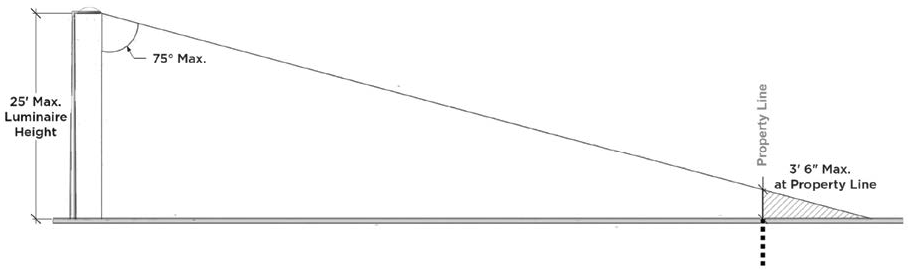
To be considered a cut off luminaire, the cut off angle must be 75 degrees or less.
2.
The maximum total height of a cut off luminaire, either freestanding or attached to a structure, is 25 feet. Any luminaire greater than 25 feet in total height requires a variance.
3.
A cut off luminaire must be designed to completely shield the light source from an observer three and one-half feet above the ground at any point along an abutting lot line.
FIGURE 7-1: CUT OFF LUMINAIRE
D.
Luminaire with No Cut Off Standards
1.
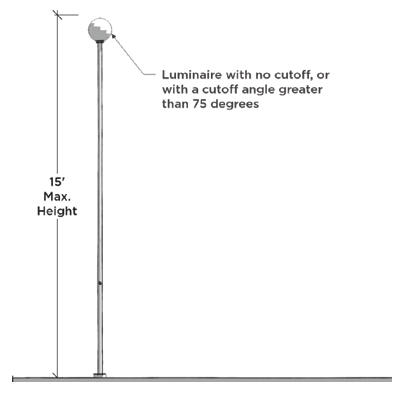
A luminaire is considered to have no cut off if it is unshielded or has a cut off angle greater than 75 degrees.
2.
The maximum permitted total height of a luminaire with no cut off is 15 feet. Any luminaire greater than 15 feet in total height requires special use approval.
FIGURE 7-2: NO CUT OFF LUMINAIRE
E.
Exceptions to Lighting Standards
1.
Luminaires used for public roadway illumination are exempt from the requirements of this section.
2.
All temporary emergency lighting required by public safety agencies, other emergency services, or construction are exempt from the requirements of this section.
3.
Because of their unique requirements for nighttime visibility and limited hours of operation, outdoor recreational facilities (public or private) such as, but not limited to, football fields, soccer fields, baseball fields, softball fields, tennis courts, golf driving ranges, show areas, and other similar uses are exempt from the requirements of this section. Recreational facilities are permitted a total luminaire height of 60 feet in any district. Luminaires greater than 60 feet in total height require special use approval.
4.
Certain temporary uses may be unable to meet the requirements of this section. When such temporary uses are allowed, approval of all lighting is required as part of the temporary use permit.
5.
Existing developments may be exempt from lighting plan restrictions if:
a.
The existing development does not reside adjacent to residential zoning districts, and
b.
The existing development does not add any new exterior freestanding lighting fixtures.
F.
Prohibited Lighting
1.
Flickering or flashing lights are prohibited.
2.
Searchlights, laser source lights, or any similar high intensity lights are prohibited.
(Ord. No. 191, 2019, § 16, 1-14-20; Ord. No. 114, 2020, § 7, 9-8-20; Ord. No. 115, 2023, § 4, 10-10-23)
7.3 - ACCESSORY STRUCTURES AND USES
All accessory structures and uses are subject to the requirements of this section and the permitted encroachment requirements of Section 7.4. Additional accessory structures not regulated in this section may be regulated in Section 7.4. Accessory structures that do not require a building permit are noted in Table 7-1.
A.
General Regulations for Accessory Structures
All accessory structures are subject to the following regulations, in addition to any other specific regulations within this section.
1.
No accessory structure may be constructed prior to construction of the principal building, to which it is an accessory structure, unless specifically exempted by this Code.
2.
A building permit is required for the construction of an accessory structure, unless specifically exempted by this Code. If the standards for an accessory structure do not specifically cite that a building permit is not required, such accessory structure requires a building permit.
3.
Only those accessory structures permitted by this section and Section 7.4 are permitted in required setbacks. Certain accessory structures may also be prohibited in certain yards.Required setbacks are stated in the district standards. The use of the term "yard" refers to the area between the applicable building line and lot line. The distinction is made because certain principal buildings may not be built at required district setback lines, thereby creating a yard larger than the minimum setback dimension. If a structure is permitted within a yard, it is permitted within the required setback subject to any additional limitations. Where there is no structure to determine yard location, yards are the same as the minimum district setback dimensions and the accessory structure is permitted in the buildable area. In applying the regulations of this section, the permissions and restrictions for structures within a front setback and yard apply to a reverse corner side setback and yard, unless specifically allowed otherwise.
4.
The maximum height of any detached accessory structure is 18 feet, unless otherwise permitted or restricted by this Code. This does not apply to agricultural accessory structures for a lot in agricultural use, including but not limited to barns and silos.
5.
Accessory structures are included and must comply with all maximum impervious surface and building coverage requirements.
6.
Accessory structures are limited to 40% coverage of any yard. This does not apply to agricultural accessory structures for a lot in agricultural use, including but not limited to barns and silos.
7.
No more than two detached accessory structures are permitted on any lot, with the following exceptions:
a.
For any lot in active agricultural use or any community garden, any detached accessory structures used for farming operations or cultivation are not included in calculations of the total number of detached accessory structures on a lot.
b.
The following are not included when calculating the total number of detached accessory structures on a lot: detached garages, carports, ground-mounted mechanical equipment, arbors and trellises, shade covering systems, fences or walls, lawn furniture and lawn decorations, book exchange boxes, mailboxes, and playground equipment.
8.
The footprint of a detached accessory structure cannot exceed the footprint of the principal building. This does not apply to agricultural accessory structures for a lot in agricultural use, including but not limited to, barns and silos.
9.
Accessory structures, including those listed in this section and Section 7.4, must be at least three feet from any lot line, unless otherwise permitted or restricted by this Code.
10.
Accessory structures on residential property shall be constructed of materials similar to the principal structure, and in character with the surrounding built environment as determined by the Executive Director.
B.
Amateur (HAM) Radio Equipment
1.
Towers that solely support amateur (HAM) radio equipment and conform to all applicable performance criteria as set forth in Section 7.5 are permitted only in the rear yard, and must be located 10 feet from any lot line and any principal building. Towers are limited to the maximum building height of the applicable district plus an additional 10 feet, unless a taller tower is technically necessary to engage successfully in amateur radio communications and a special use approval is obtained.
2.
Antennas may also be building-mounted and are limited to a maximum height of 10 feet above the structure, unless a taller antenna is technically necessary to engage successfully in amateur radio communications and special use approval is obtained.
3.
Every effort must be made to install towers or antennas in locations that are not readily visible from adjacent residential lots or from the public right-of-way, excluding alleys.
4.
An antenna or tower that is proposed to exceed the height limitations is a special use. The operator must provide evidence that a taller tower and/or antenna is technically necessary to engage successfully in amateur radio communications. In addition, the applicant must provide evidence that the tower and/or antenna will not prove a hazard and that it conforms to all applicable performance criteria of Section 7.5. As part of the application, the applicant must submit a site plan showing the proposed location of the tower or antenna, as well as its relation to the principal building and accessory structures.
5.
Any such antennas and/or towers owned and operated by the City are exempt from these requirements.
C.
Apiary
Apiaries as an accessory use do not apply to lots that are in use for agriculture as a principal use.
1.
Apiaries are permitted only in the rear yard and must be located 10 feet from any lot line and the principal building.
2.
All bee colonies must be kept in a removable frame hive, which must be kept in sound and usable condition.
3.
Where any colony is located within 25 feet of a lot line, as measured from the nearest point on the hive to the lot line, the beekeeper must establish and maintain a flyway barrier at least six feet in height consisting of a hedge, fence, solid wall, or combination that is parallel to the lot line and extends 10 feet beyond the colony in each direction so that bees are forced to fly at an elevation of at least six feet above ground level over adjacent lots in the vicinity of the apiary.
4.
Each beekeeper must provide a convenient source of water available to the bees at all times.
5.
In any instance in which a colony exhibits unusual aggressive characteristics by stinging or attempting to sting without due provocation or exhibits an unusual disposition toward swarming, the beekeeper must promptly re-queen the colony.
6.
Apiaries do not require a building permit.
D.
Aquaculture/Aquaponics
Aquaculture/aquaponics facilities as an accessory use do not apply to lots that are in use for agriculture as a principal use.
1.
Aquaculture/aquaponics facilities do not require a building permit.
2.
Aquaculture/aquaponics facilities are permitted only in the rear yard and must be located 10 feet from any lot line.
3.
All aquaculture/aquaponics operations must be located within fully or partially enclosed structures designed for holding and rearing fish, and contain adequate space and shade.
E.
Boathouse
1.
Wet boathouses, defined as the construction or placement of a boathouse below the normal pool elevation, are prohibited.
2.
Boathouses should be located so as to minimize earth disturbing activities and shoreland vegetation removal.
3.
Boathouses are limited to the storage of watercraft and related marine equipment, and cannot be used for human habitation or commercial purposes. Features inconsistent with the use of the structure exclusively as a boathouse are prohibited.
4.
The highest point of the roof elevation of the boathouse is limited to 20 feet in height measured from the lowest finished grade of the structure to the highest point of the roof.
5.
The boathouse is limited to a 1,000 square foot building footprint (enclosed areas only, any surrounding deck area is not included).
6.
Only one boathouse is permitted per lot.
7.
All boathouses must be set back a minimum of five feet from all lot lines, including the extension of boundary lines into the lake.
8.
A 20-foot separation is required between all boathouses.
F.
Book Exchange Box
1.
General Requirements
All book exchange boxes are subject to the following:
a.
No book exchange box may be located so that it impedes pedestrian access or circulation, obstructs parking areas, or creates an unsafe condition. Boxes cannot be constructed in a manner that obstructs visibility of intersections as defined in Section 106-1142 of the Shreveport Code of Ordinances.
b.
Boxes are prohibited in the public right-of-way.
c.
Each box must be designed and constructed in such a manner that its contents are protected from the elements. All media must be fully contained within a weatherproof enclosure that is integral with the structure that comprises the book exchange box.
d.
All book exchange boxes are subject to registration with the Zoning Administrator. The registration requires a plot plan that indicates the size and location of the proposed box. Once the box is installed, a site inspection is required to verify compliance with this section.
e.
Boxes are limited to a maximum height of 78 inches to the highest point on the structure, and a maximum width and depth of three feet.
2.
Single-Family and Two-Family Residential Districts
All book exchange boxes located in single-family and two-family residential districts are subject to the following requirements:
a.
Book exchange boxes are only allowed to front on streets classified as minor or residential streets or residential private streets as defined in Chapter 82 of the Shreveport Code of Ordinances. Boxes are allowed on corner lots where the box faces a minor or residential street and the adjacent street is classified as a non-residential street provided that the access to the structure is oriented to the minor or residential street.
b.
Boxes are permitted only in the front yard or side corner yard and must be located a minimum of five feet from any lot line.
c.
Temporary foundations comprised of concrete or masonry pavers or other similar movable materials must be utilized. Single metal or wooden posts set in concrete for pedestal mounted boxes or to provide additional stability to ground mounted boxes are allowed. Permanent concrete slab foundations are prohibited.
3.
Commercial and Townhouse and Multi-Family Residential Districts
All book exchange boxes located in the commercial and townhouse and multi-family residential districts are subject to the following requirements:
a.
Book exchange boxes are allowed only for:
i.
Single occupant commercial buildings with more than 2,500 square feet of gross floor area.
ii.
Individual tenants in a multi-tenant commercial building that have at least 30 linear feet of storefront.
iii.
Office, maintenance or clubhouse buildings associated with an apartment complex.
iv.
High-rise multi-family buildings.
b.
No more than one book exchange box may be located per building façade.
c.
Book exchange boxes must be flush against the façade of the principal structure and cannot project into required building setbacks.
d.
Book exchange boxes must be placed on impervious surface such as concrete or asphalt.
G.
Carport
1.
Carports must be located over a driveway.
2.
A carport is permitted only in the interior side yard, corner side yard, or rear yard.
3.
The total length of a carport is limited to 20 feet. The height of a carport is limited to 10 feet.
4.
A carport must be entirely open on at least two sides except for the necessary supporting columns and customary architectural features.
5.
A carport must be constructed as a permanent structure. Temporary tent structures are not considered carports.
H.
Chicken Coops
Chicken coops as an accessory use do not apply to lots that are in use for agriculture as a principal use.
1.
The keeping of chickens and chicken coops are permitted in the R-A, R-E, R-1-12, R-1-10, and R-1-7 Districts only.
2.
Chicken coops are permitted in the rear yard only.
3.
No hens may be kept or raised within a dwelling.
4.
Up to a maximum of eight hens on any lot. The owner of the hens must be a resident of the dwelling on the lot.
5.
Roosters are prohibited. However, if the sex of a chick cannot be determined at hatching, a chick of either sex may be kept on the property for up to six months.
6.
With the exception of the R-A District, all hens must be provided with both a chicken coop and a fenced outdoor enclosure, subject to the following provisions. In the R-A District, hens are allowed to free roam on the property.
a.
The chicken coop must provide a minimum of five square feet per hen.
b.
The chicken coop and fenced enclosure must be kept in good repair, maintained in a clean and sanitary condition, and free of vermin, obnoxious smells, and substances. The facility must be adequately lit and ventilated.
c.
The chicken coop must be designed to ensure the health and well being of the hens, including protection from predators, the elements, and inclement weather.
d.
The chicken coop must be located upon an impermeable surface that prevents waste run-off.
7.
All manure must be composted in enclosed bins.
8.
Slaughtering of chickens on-site is prohibited.
I.
Coldframe Structures
1.
Coldframe structures do not require a building permit.
2.
Coldframe structures up to three feet in height are permitted only in the interior side, corner side, and rear yards.
3.
Coldframe structures over three feet in height are permitted only in the rear yard.
4.
Coldframe structures are limited to a maximum square footage of 60 square feet and a maximum height of seven feet. In the R-A District, coldframe structures are permitted a maximum square footage of 120 square feet.
J.
Collective Alternative Energy System
1.
A collective alternative energy system, such as solar, wind, or geothermal, is permitted to be shared by property owners or a neighborhood organization, homeowners association, or institutional use.
2.
Properties may share an alternative energy system, including permission to install equipment along all properties. All owners must agree to such arrangement, and an agreement is recorded as an "collective alternative energy servitude" on each plat of survey and access is granted to all participants to maintain equipment. A management plan must be submitted to the Executive Director and servitude recorded.
3.
Collective alternative energy systems must be built in accordance with accessory use standards for the particular type of energy system used, as described in this section, and any other applicable regulations.
K.
Electric Vehicle Charging Station
1.
Commercial electric vehicle charging stations are permitted as an accessory use within any parking lot, parking structure, or gas station in all districts.
2.
Private charging stations are permitted as an accessory use to all residential uses to serve the occupants of the dwellings located on that property.
3.
Electric charging station equipment may not block the public right-of-way.
4.
Each public charging station space must be posted with a sign indicating the space is only for electric vehicle charging purposes. Days and hour of operations must be included if time limits or tow away provisions are to be enforced by the owner. Information identifying voltage and amperage levels or safety information must be posted.
5.
Charging station equipment must be maintained in good condition and all equipment must be functional. Charging stations no longer in use must be immediately removed.
L.
Fences and Walls
1.
General Requirements
a.
All fences, including repair of existing fences, require a building permit.
b.
A principal building or structure is not required for the construction of a fence or wall, unless specifically required by this Code.
c.
Every fence and wall must be maintained in a good repair and safe condition at all times. Every damaged or missing element must be repaired, removed, or replaced.
d.
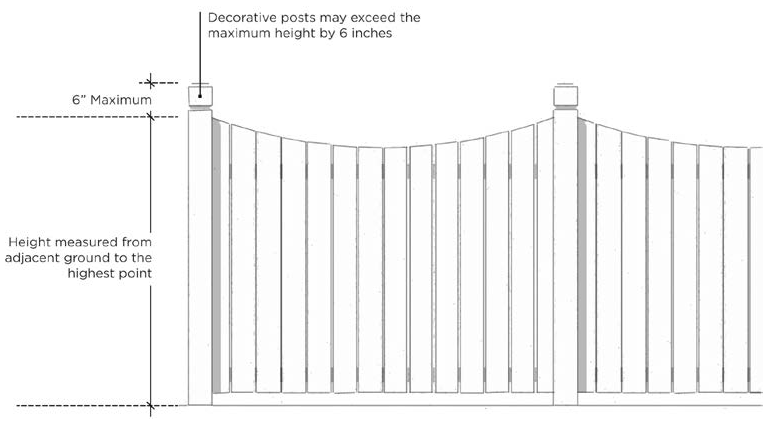
Height is measured from the adjacent ground to the highest point, except that decorative posts of a fence or wall may exceed the maximum height by six inches.
e.
When fence requirements are a condition of a use or site element, such requirements control.
f.
When additional fence and wall requirements are found in the use standards of Article 6 or the landscape standards of Article 10, such requirements control.
FIGURE 7-3: FENCE DESIGN
2.
Heights of Fences, Walls, and Hedges
a.
Fence Height in Residential Districts
i.
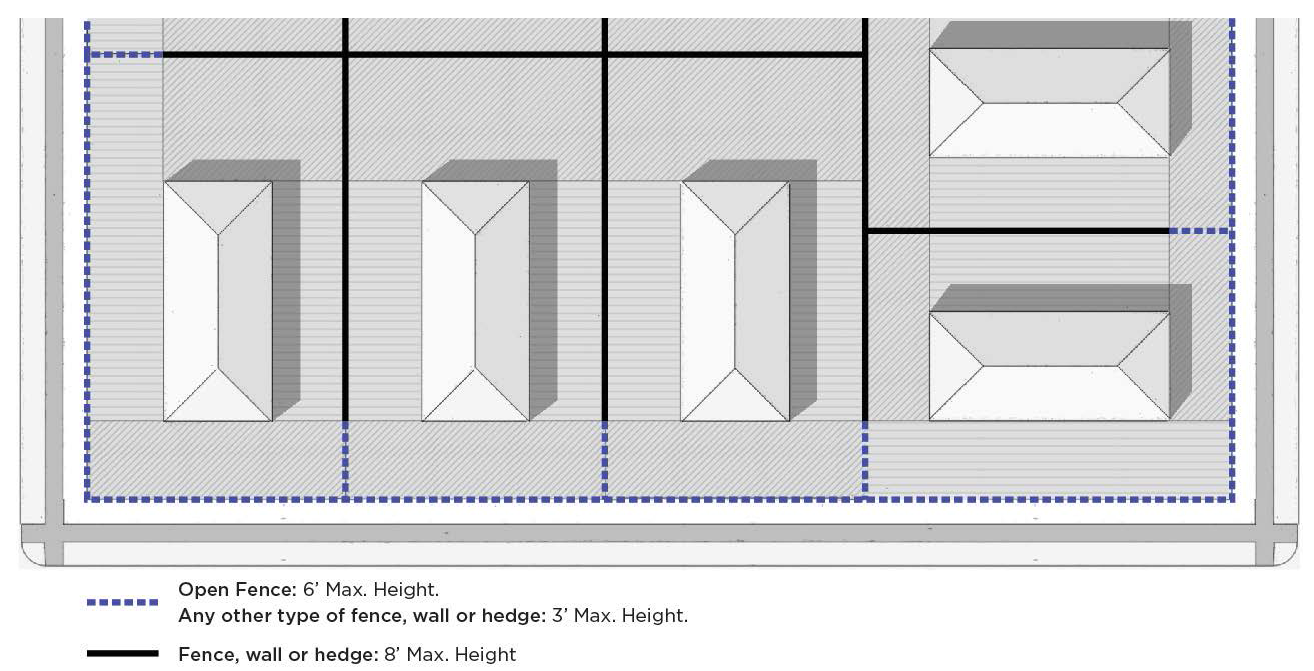
In the front, corner side, and reverse corner side yards, an open fence is permitted up to a maximum height of six feet. Any other type of fence (any non-open fence), wall, or hedge is permitted in the front yard but is limited to a maximum height of three feet.
ii.
Any other type of fence (any non-open fence), wall, or hedge is permitted in the corner side, and reverse corner side yards, but is limited to a maximum height of six feet. The height of the fence may exceed six feet to maintain an even fence line only when grade decreases from the highest grade where the fence is to be installed, and in no case shall the total fence height exceed eight feet.
iii.
In the interior side and rear yards, a fence of any type, wall, or hedge is permitted up to a maximum height of eight feet.
iv.
No solid fence permitted or required by this Article, or other sections of this Code, shall be built within the sight triangle, as identified in Subsection 7.1.E of this Code.
FIGURE 7-4: FENCE HEIGHT
b.
Fence Height in Non-Residential Districts
i.
In the front and corner side yard, an open fence is permitted up to a maximum height of six feet unless otherwise required by the landscape and screening regulations of Article 10.
ii.
In the interior side and rear yards, a fence of any type, wall, or hedge is permitted up to a maximum height of eight feet.
iii.
Properties in the C-UC, C-UV and D-1 districts that have a build-to zone/line are allowed a solid fence, wall or hedge in the front and corner side yard up to a maximum height of six feet.
c.
Fence Height for Public Recreation Areas
Public recreation areas may be enclosed along their boundaries (i.e., all yards) with an open fence to a height not to exceed eight feet. Tennis courts and other similar uses may be fenced in accordance with national standards for such uses.
3.
Barbed Wire and Razor Wire Fences
a.
Barbed wire, razor wire, spiked posts, or fences of similar material are only permitted on a lot used for a utility or supporting use for a utility in any district, or in the R-A, C-3, C-4, I-MU, I-1, or I-2 District.
b.
Barbed wire, razor wire, and similar material must be located a minimum of six feet above the adjacent ground.
4.
Fence and Wall Construction and Design Requirements
a.
When only one side of a fence is finished, the finished side of all fences must face away from the lot on which it is located. Fences constructed on property lines dividing single-family residential lots are exempt from this provision.
b.
A fence or wall, including all posts, bases, and other structural parts must be located completely within the boundaries of the lot on which it is located.
c.
No fence may be electrified, unless it is a battery-charged fence and meets the following requirements, as established by state law:
i.
Interfaces with a monitored alarm device in a manner that enables the alarm system to transmit a signal intended to summon law enforcement in response to an intrusion or burglary.
ii.
Is located on property that is not zoned exclusively for residential use.
iii.
Has an energizer that is powered by a commercial storage battery that is not more than 12 volts of direct current.
iv.
Has an energizer that meets the standards set forth by the International Electrotechnical Commission Standard 60335-2-76, current edition.
v.
Is surrounded by a nonelectric perimeter fence or wall that is not less than five feet in height.
vi.
Is the higher of 10 feet in height or two feet higher than the height of the nonelectric perimeter fence or wall.
vii.
Is marked with conspicuous warning signs that are located on the battery-charged fence at not more than 40-foot intervals and that read: "WARNING-ELECTRIC FENCE".
State law reference—La. R.S. 33:1376.
M.
Flat Roof Features
Accessory rooftop features of a flat roof, such as green roofs, rooftop decks, rooftop gardens, and stormwater detention systems are permitted below the parapet of any flat roof building, and are excluded from the calculation of maximum building height. Flat roof features must meet the following standards:
1.
For green roofs, rooftop gardens, and similar features, documentation must be submitted demonstrating that the roof can support the additional load of plants, soil, and retained water. For green roofs, this must also indicate an adequate soil depth will be provided for plants to survive.
2.
Rooftop decks or patios must be set back six feet from all building edges.
3.
Rooftop decks or patios must have a guardrail that is minimum of 30% open and a maximum of four feet in height as measured from the surface of the roof deck or patio.
4.
The roof must contain sufficient space for future installations, such as mechanical equipment.
N.
Garage
The following standards apply to all residential garages, with the exception of multi-family dwellings. Attached garages are not considered an accessory structure but are subject to the regulations of this section for attached garages.
1.
Attached Garages
a.
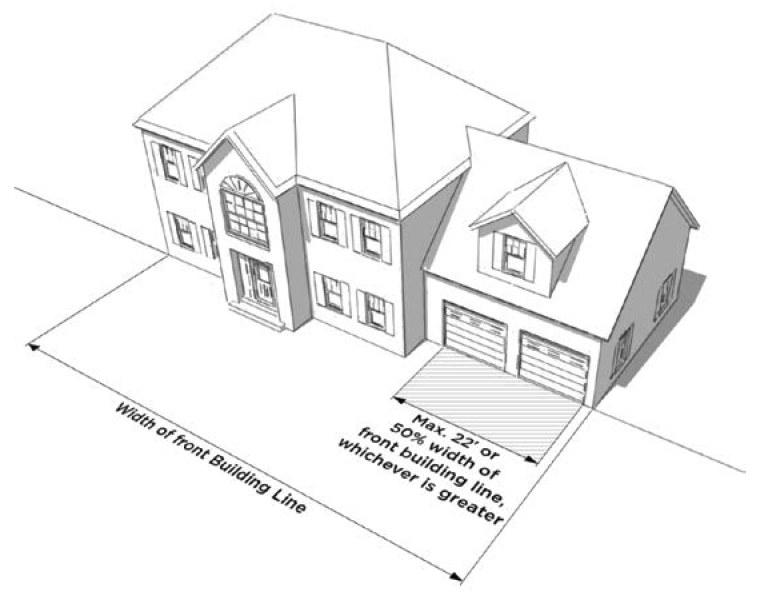
Front-loaded attached garages are limited to 50% of the width of the front building line or 22 feet, whichever is greater. Garage width is measure between garage doors; in the case of garages designed with multiple garage doors, the distance is measured between the edge of the outmost doors.
b.
Attached garages must be set back a minimum of five feet from the front building line.
FIGURE 7-5: ATTACHED GARAGE
2.
Detached Garages
a.
One detached garage is permitted per lot.
b.
The area above the vehicle parking spaces in a detached garage may not contain a kitchen or sleeping area but may contain an office or recreation room, unless as an accessory dwelling unit that has been approved by an administrative special use permit.
c.
Detached garages are permitted only in the rear, interior side, and corner side yards. Detached garages must be set back a minimum of five feet from the front building line.
d.
If a lot abuts a public alley that provides adequate access to a street, a detached garage may be constructed so that access is from the public alley.
O.
Home-Based Business
1.
A home-based business certificate of occupancy is required. Every home-based business is required to apply for a new certificate of occupancy every two years.
2.
The home-based business must be conducted by an individual permanently residing within the dwelling. Only residents of the dwelling may be employed in the home-based business.
3.
Signs, displays, or activities that indicate from the exterior that the structure is being used, in part, for any purpose other than that of a residence are prohibited.
4.
The home occupation and all related activity, including storage, must be conducted completely within the principal building or a permitted accessory structure.
5.
No toxic, explosive, flammable, combustible, corrosive, etiologic, radioactive, or other restricted materials may be used or stored on the site.
6.
No commodities can be sold or services rendered that require receipt or delivery of merchandise, goods, or equipment other than by a passenger motor vehicle or by parcel or letter carrier mail services using vehicles typically employed in residential deliveries.
7.
The home-based business cannot create greater vehicular or pedestrian traffic than normal for a residential area. The home-based business and any related activity must not create any traffic hazards or nuisances in public rights-of-way.
8.
Alterations to the residence or permitted accessory structures that would alter the residential character of the dwelling are prohibited.
9.
No more than four clients, patients, pupils, or customers are permitted at any given time. Such visits must occur between 7:00 a.m. and 7:00 p.m. and must be by appointment only.
10.
Barber or beauty shops are limited to one operator with one assistant, one styling chair, and one shampoo bowl. Scheduling for barber and beauty shops is limited to one appointment at a time only. All barber or beauty shops, operating as a homebased business within a residential zoning district, require a special exception use approved by the Zoning Board of Appeals.
11.
There must be no perceptible noise, odor, smoke, electrical interference, vibration, or other nuisance emanating from the structure where the home occupation is located in excess of that normally associated with residential use.
12.
Repair and service of any vehicles or any heavy machinery is prohibited as a home occupation.
13.
Use or storage of tractor trailers, semi-trucks, or heavy equipment, such as construction equipment used in a commercial business, is prohibited.
P.
Livestock
Keeping of livestock does not apply to lots that are in use for agriculture as a principal use. Chicken coops, apiaries, and aquaponic/aquaculture facilities are regulated separately. These standards do not apply to livestock kept as part of a public safety facility, such as horses for mounted police.
1.
Keeping of livestock, including the required livestock enclosures, is permitted as an accessory use only in the R-A, R-E, and R-1-12 Districts.
2.
All horses must be registered with Caddo Parish Animal and Mosquito Control. Any horses that have been maintained prior to the effective date of this Code in any district must be registered within 60 days of the effective date. When the maintenance of such existing horses is not in conformance with the provisions of this Code, such horses and their enclosures will be deemed legally conforming and may be maintained. Once the horses are no longer kept on the property or the livestock enclosure is demolished, no horses may be maintained unless in conformance with this section.
3.
A minimum lot size of one acre is required to keep livestock.
4.
All livestock enclosures, including repair of existing enclosures, require a building permit.
5.
Livestock enclosures are prohibited in the front or corner side yard.
6.
Livestock enclosures must be located 50 feet from any lot line.
7.
The maximum number of livestock permitted on a lot is calculated according to the following standards. These standards will be used as the basis by the Zoning Administrator for establishing a standard for any animal not included in the table. Lots of 20 or more acres are not subject to a minimum lot area per animal. The standards are cumulative requirements; for example, in order to keep one horse and one cow, a minimum of two acres of lot area is required. However, in any case, a minimum lot area of one acre is required to keep any livestock.
a.
Horse: 1 acre for first horse + 10,000 square feet for each additional horse.
b.
Cattle: 1 acre for first bull/cow + 10,000 square feet for each additional bull/cow.
c.
Goat or sheep: 10,000 square feet per goat or sheep.
d.
Pigs: 5,000 square feet per pig.
e.
Rabbit: 100 square feet per rabbit.
f.
Duck or other fowl (excluding chickens): 100 square feet per duck/fowl.
8.
In addition, in order to maintain livestock, a certain square footage of the lot must be maintained as open space and dedicated to the livestock, in accordance with the following standards. These standards will be used as the basis by the Zoning Administrator for establishing a standard for any animal not included in the table. Lots of 20 or more acres are not subject to this standard. The standards are cumulative; for example, in order to keep one horse and one cow, 50,000 square feet of open space dedicated to the livestock is needed. These standards are not used to determine lot area but rather to determine how much area on a lot must be maintained as open space for the livestock's use.
a.
Horse: 25,000 square feet for first horse + 12,250 square feet for each additional horse.
b.
Cattle: 25,000 square feet for first horse + 12,250 square feet for each additional bull/cow.
c.
Goat or sheep: 5,000 square feet per goat or sheep.
d.
Pigs: 2,500 square feet per pig.
e.
Rabbit: Not applicable.
f.
Duck or other fowl (excluding chickens): Not applicable.
9.
All enclosures must be designed to ensure the health and well-being of the animals, including protection from predators, the elements, and inclement weather.
10.
All livestock must be kept to prevent any adverse impact, including but not limited to: odor, noise, drainage, or pest infestation on any other property.
11.
The following activities are permitted as part of the operation of a horse stable:
a.
Riding lessons
b.
Boarding horses
c.
Renting horses for recreational riding
d.
Therapeutic riding
Q.
Mechanical Equipment
Mechanical equipment includes heating, ventilation, and air conditioning (HVAC) equipment, electrical generators, and similar equipment.
1.
Ground-Mounted Equipment
a.
Mechanical equipment is prohibited in the front yard unless an administrative exception is approved by the Executive Director. If mechanical equipment is located in the front yard as of the effective date of this Code, the equipment may remain and may be repaired and maintained unless it is replaced in its entirety or the principal structure is demolished.
b.
Mechanical equipment is permitted only in the interior side, corner side, or rear yard.
2.
Roof-Mounted Equipment
Roof-mounted equipment must be screened from view from a public street as follows:
a.
For structures four or more stories in height, all roof equipment must be set back from the edge of the roof a minimum distance of one foot for every two feet by which the equipment extends above the roof.
b.
For structures less than four stories in height and for any building where roof equipment cannot meet the setback requirement of item a above, there must be either a parapet wall to screen the equipment or the equipment must be housed in solid building material that is architecturally integrated with the structure.
R.
Outdoor Sales and Display (Ancillary)
1.
Retail goods establishments and vehicle dealerships are permitted to have accessory outdoor sales and display of merchandise.
2.
Outdoor sales and display of goods not offered for sale by the establishment is prohibited.
3.
Any outdoor display must be located on the same lot as the principal use. No outdoor display is permitted in the public right-of-way.
4.
All outdoor sales and display of vehicles for vehicle dealerships must comply with the parking lot perimeter landscape requirements of Article 10. Outdoor display of vehicles on hydraulic lifts, manufactured ramps, or similar mechanisms is prohibited.
5.
No required parking area may be used as outdoor display.
S.
Outdoor Storage (Ancillary)
The following uses are permitted outdoor storage: greenhouse/nursery - retail, including the growing of plants in the open, heavy retail, rental, and service, vehicle dealerships, vehicle rentals, vehicle operations facility, and light and heavy industrial. The Executive Director can also render an interpretation that a use not listed in this section would typically have outdoor storage and permit such use to include outdoor storage on the site. These uses are permitted ancillary outdoor storage in accordance with the following provisions:
1.
No outdoor storage is permitted in any public right-of-way or located so that it obstructs pedestrian or vehicular traffic. Outdoor storage is prohibited in a required setback.
2.
All manufacturing, assembly, repair, or work activity must take place inside an enclosed building. This does not apply to heavy industrial uses that are typically conducted outdoors or have an outdoor component.
3.
All outdoor storage must comply with all regulations regarding stormwater management and, if required, must be permitted through the LADEQ.
T.
Refuse Containers, Dumpsters, and Recycling Containers
1.
Dumpsters and recycling containers are prohibited in the front or corner side yard. No dumpsters or recycling containers may be located on any public right-of-way.
2.
All dumpsters and recycling containers must be fully enclosed on three sides by a solid fence, wall, or wall extension of the principal building a minimum of six feet and a maximum of eight feet in height. The enclosure must be gated. Such gate must be solid. Such construction requires a building permit. This requirement does not apply to refuse containers located in an alley.
3.
Dumpsters must not be located so that the disposal area drains toward a storm drain or off-site. Dumpsters must be covered and are not allowed to drain freely.
4.
Refuse containers, such as individual rolling trash bins, must be stored along the interior side or rear façade of the structure. This does not apply when refuse containers must be moved for pick-up.
5.
Existing properties, as of the effective date of this Code, whose dumpsters and recycling containers are not required to be enclosed, are exempt from this section unless the site is being redeveloped, or the existing building or parking lot is being expanded.
U.
Satellite Dish Antennas
1.
General Requirements
a.
Small satellite dish antennas do not require a building permit. Large satellite dish antennas require a building permit.
b.
Satellite dish antennas must be permanently installed on a building, in the ground, or on a foundation, and cannot be mounted on a portable or movable structure.
c.
Subject to operational requirements, the dish color must be of a neutral color, such as white or grey. No additional signs or advertising is permitted on the satellite dish itself, aside from the logos of the satellite dish service provider and/or dish manufacturer.
d.
Cables and lines serving ground-mounted satellite dish antennas must be located underground.
e.
Compliance with all federal, state, and local regulations is required in the construction, installation, and operation of satellite dish antennas.
f.
All exposed surfaces of the antenna must be kept clean and all supports must be painted to maintain a well-kept appearance.
g.
Antennas no longer in use must be immediately removed.
h.
Every effort must be made to install satellite dish antennas in locations that are not readily visible from neighboring properties or from the public right-of-way.
2.
Small Satellite Dish Antennas
Small satellite dish antennas, which are one meter (3.28 feet) or less in diameter, are subject to the general requirements above.
3.
Large Satellite Dish Antennas
Large satellite dish antennas, which are greater than one meter (3.28 feet) in diameter, are subject to the general requirements above as well as the following requirements:
a.
Residential Districts
i.
Large satellite dish antennas, which are greater than one meter (3.28 feet) in diameter, are permitted only in the rear yard, and must be set back a distance from all lot lines that is at least equal to the height of the dish, but in no case less than five feet from any lot line.
ii.
The overall height of a large satellite dish antenna cannot exceed 12 feet.
iii.
A large satellite dish antenna must be located and screened so that it cannot be readily seen from public rights-of-way or adjacent properties. Screening includes solid fences, plant materials, and/or earth berms located to conceal the antenna and its support structure. Plants must be a minimum of five feet tall at the time of installation.
b.
Non-Residential Districts
i.
Large satellite dish antenna are permitted only in the rear or interior side yard, and must be set back a distance from all lot lines that is at least equal to the height of the dish, but in no case less than five feet from any lot line.
ii.
Roof-mounting is permitted only if the satellite dish antenna is screened by an architectural feature.
iii.
A large satellite dish antenna must be located and screened so that it cannot be readily seen from public rights-of-way or adjacent properties. Screening includes solid fences, plant materials, and/or earth berms located to conceal the antenna and its support structure. Plants must be a minimum of five feet tall at the time of installation.
V.
Solar Panels
1.
General Requirements
a.
A solar panel may be building-mounted or freestanding.
b.
Solar panels must be placed so that concentrated solar radiation or glare is not directed onto nearby properties or roadways.
2.
Building-Mounted Systems
a.
A building mounted system may be mounted on the roof or wall of a principal building or accessory structure.
b.
On pitched roof buildings, the maximum height a roof-mounted solar panel may rise is 18 inches.
c.
On flat roofed buildings up to 40 feet in height, the roof-mounted solar panel system is limited to a maximum height of six feet above the surface of the roof. On flat roofed buildings over 40 feet in height, the roof-mounted solar panel system is limited to 15 feet above the height of such structure. Roof-mounted solar energy systems are excluded from the calculation of building height.
d.
Building-mounted solar panels may project up to two feet from a building façade and must be integrated into the structure as an architectural feature.
3.
Freestanding Systems
a.
A freestanding system is permitted only in the interior side and rear yard.
b.
The maximum height of a freestanding system is three feet in the front yard and eight feet in all other yards.
4.
Co-Location
Solar panels may be co-located on structures such as wireless communication towers, light poles, and billboards.
W.
Swimming Pools and Hot Tubs
1.
No private swimming pool or hot tub, or portion thereof, including, but not limited to, aprons, walks, and mechanical equipment, integral to the pool, may be located within a front yard, or within a required corner side or interior side setback.
2.
A private swimming pool or hot tub must comply with all requirements of the Code of Ordinances.
X.
Wind Turbines (Private)
Private wind turbines are subject to the following requirements:
1.
Wind turbines may be designed as either vertical or horizontal axis turbines with or without exposed blades, including designs that combine elements of the different types of turbines.
2.
Wind turbines are subject to the following height restrictions:
a.
The maximum height of any ground-mounted wind turbine is the maximum height allowed in the district. A taller height may be allowed by special use.
b.
The maximum height of any wind turbine mounted upon a structure is 15 feet above the height of such structure.
c.
Maximum height is the total height of the turbine system, including the tower and the maximum vertical height of the turbine blades. Maximum height therefore is calculated measuring the length of a prop at maximum vertical rotation to the base of the tower. The maximum height of any ground-mounted wind turbine is measured from grade to the length of a prop at maximum vertical rotation.
d.
No portion of exposed turbine blades (vertical access wind turbine) may be within 20 feet of the ground. Unexposed turbine blades (horizontal access wind turbine) may be within 10 feet of the ground.
3.
Ground-mounted wind turbines are permitted only in the rear yard. No part of the wind system structure, including guy wire anchors, may be located closer than 10 feet to any lot line. The tower must be set back from all lot lines equal to the height of the system. No principal buildings may be located within this area.
4.
All wind turbines must be equipped with manual (electronic or mechanical) and automatic over speed controls to limit the blade rotation speed to within the design limits of the wind energy system.
(Ord. No. 76, 2017, §§ 15—18, 9-12-17; Ord. No. 19, 2018, § 29, 3-13-18; Ord. No. 62, 2018, § 10, 8-14-18; Ord. No. 72, 2018, §§ 15, 16, 8-28-18; Ord. No. 6, 2019, §§ 20, 21, 2-12-19; Ord. No. 187, 2019, §§ 11, 12, 12-10-19; Ord. No. 191, 2019, § 17, 1-14-20; Ord. No. 114, 2020, § 8, 9-8-20; Ord. No. 197, 2020, § 6, 1-26-21; Ord. No. 19, 2021, § 8, 2-9-21; Ord. No. 137, 2021, §§ 10, 11, 9-28-21; Ord. No. 10, 2022, §§ 1, 2, 2-8-22; Ord. No. 21, 2024, § 2, 3-12-24; Ord. No. 148, 2024, § 1, 11-8-24; Ord. No. 59, 2025, § 3, 7-8-25; Ord. No. 110, 2025, § 1(Exh. B), 10-28-25)
7.4 - PERMITTED ENCROACHMENTS
An encroachment is the extension or placement of any attached or detached accessory structure or architectural feature into a required setback. Permitted encroachments are indicated in Table 7-1: Permitted Encroachments into Required Setbacks.
A.
Additional restrictions on permitted encroachments, including additional placement restrictions and dimensional standards, can be found in Section 7.3.
B.
Unless constructed concurrently with the principal building, attached or detached accessory structures or architectural features require a building permit, unless exempted by this section or Section 7.3.
C.
Unless otherwise indicated, all accessory structures and architectural features must be at least three feet from any lot line, unless otherwise permitted or restricted by this section or Section 7.3.
D.
When an attached or detached accessory structure or architectural feature regulated by Table 7-1 is permitted to locate in a required setback, it also indicates permission to locate in the corresponding yard.
E.
When an attached or detached accessory structure or architectural feature regulated by Table 7-1 is prohibited to encroach in a required setback, the structure or architectural feature may encroach in the corresponding yard beyond the required setback line unless specifically prohibited by the table or Section 7.3.
TABLE 7-1: PERMITTED ENCROACHMENTS INTO REQUIRED SETBACKS
Y= Permitted // N= Prohibited
Max. = Maximum // Min. = Minimum
NOTE: Generally, a building permit is required for the construction of an accessory
structure, unless specifically exempted by this Table or this Code.
(Ord. No. 19, 2018, § 30, 3-13-18; Ord. No. 6, 2019, §§ 22, 23, 2-12-19; Ord. No. 137, 2021, § 12, 9-28-21; Ord. No. 75, 2022, § 5, 6-14-22)
7.5 - ENVIRONMENTAL PERFORMANCE STANDARDS
All uses must comply with the performance standards established in this section unless any federal, state, or local law, ordinance, or regulation establishes a more restrictive standard, in which case, the more restrictive standard applies.
A.
Noise
No activity or use must be conducted in a manner that generates a level of sound as measured on another property greater than that allowed by federal, state, and local regulations, as amended from time to time. These limits do not apply to construction noises, noises emanating from safety signals or warning devices, noises not directly under the control of the owner or occupant of the property, and transient noises from moving sources, such as motor vehicles, railroads and aircraft.
B.
Glare and Heat
Any activity or the operation of any use that produces glare or heat must be conducted so that no glare or heat from the activity or operation is detectable at any point off the lot on which the use is located. Flickering or intense sources of light must be controlled or shielded so as not to cause a nuisance across lot lines.
C.
Stormwater Management
All development must comply with local, state, and federal stormwater management ordinances.
D.
Vibration
No earthborne vibration from the operation of any use may be detectable at any point off the lot on which the use is located.
E.
Dust and Air Pollution
Dust and other types of air pollution, borne by the wind from sources, such as storage areas, yards, roads, conveying equipment and the like, within lot boundaries, must be kept to a minimum by appropriate landscape, screening, sheltering, paving, fencing, wetting, collecting, or other acceptable means.
F.
Discharge and Disposal of Radioactive and Hazardous Waste
The discharge of fluid and the disposal of solid radioactive and hazardous waste materials must comply with applicable federal, state, and local laws and regulations governing such materials or waste. Radioactive and hazardous material waste must be transported, stored, and used in conformance with all applicable federal, state, and local laws.
G.
Electromagnetic Interference
Electromagnetic interference from any operation of any use must not adversely affect the operation of any equipment located off the lot on which such interference originates.
H.
Odors
Any condition or operation which results in the creation of odors of such intensity and character as to be detrimental to the public health and welfare, or which interferes unreasonably with the comfort of the public, must be removed, stopped or modified so as to remove the odor.
I.
Fire and Explosion Hazards
Materials that present potential fire and explosion hazards must be transported, stored, and used only in conformance with all applicable federal, state, and local regulations.

